Volume 1 — CHAPTER XXXIV.
Henry Yule translation
Concerning the Religion of the Cathayans;{1} their views as to the Soul; and their Customs.
As we have said before, these people are Idolaters, and as regards their gods, each has a tablet fixed high up on the wall of his chamber, on which is inscribed a name which represents the Most High and Heavenly God; and before this they pay daily worship, offering incense from a thurible, raising their hands aloft, and gnashing their teeth{2} three times, praying Him to grant them health of mind and body; but of Him they ask nought else. And below on the ground there is a figure which they call Natigai, which is the god of things terrestrial. To him they give a wife and children, and they worship him in the same manner, with incense, and gnashing of teeth,{2} and lifting up of hands; and of him they ask seasonable weather, and the fruits of the earth, children, and so forth.{3}
Their view of the immortality of the soul is after this fashion. They believe that as soon as a man dies, his soul enters into another body, going from a good to a better, or from a bad to a worse, according as he hath conducted himself well or ill. That is to say, a poor man, if he have passed through life good and sober, shall be born again of a gentlewoman, and shall be a gentleman; and on a second occasion shall be born of a princess and shall be a prince, and so on, always rising, till he be absorbed into the Deity. But if he have borne himself ill, he who was the son of a gentleman shall be reborn as the son of a boor, and from a boor shall become a dog, always going down lower and lower.
The people have an ornate style of speech; they salute each other with a cheerful countenance, and with great politeness; they behave like gentlemen, and eat with great propriety.{4} They show great respect to their parents; and should there be any son who offends his parents, or fails to minister to their necessities, there is a public office which has no other charge but that of punishing unnatural children, who are proved to have acted with ingratitude towards their parents.{5}
Criminals of sundry kinds who have been imprisoned, are released at a time fixed by the Great Kaan (which occurs every three years), but on leaving prison they are branded on one cheek that they may be recognized.
The Great Kaan hath prohibited all gambling and sharping, things more prevalent there than in any other part of the world. In doing this, he said: “I have conquered you by force of arms, and all that you have is mine; if, therefore, you gamble away your property, it is in fact my property that you are gambling away.” Not that he took anything from them however.
I must not omit to tell you of the orderly way in which the Kaan’s Barons and others conduct themselves in coming to his presence. In the first place, within a half mile of the place where he is, out of reverence for his exalted majesty, everybody preserves a mien of the greatest meekness and quiet, so that no noise of shrill voices or loud talk shall be heard. And every one of the chiefs and nobles carries always with him a handsome little vessel to spit in whilst he remain in the Hall of Audience—for no one dares spit on the floor of the hall,—and when he hath spitten he covers it up and puts it aside.{6} So also they all have certain handsome buskins of white leather, which they carry with them, and, when summoned by the sovereign, on arriving at the entrance to the hall, they put on these white buskins, and give their others in charge to the servants, in order that they may not foul the fine carpets of silk and gold and divers colours.]
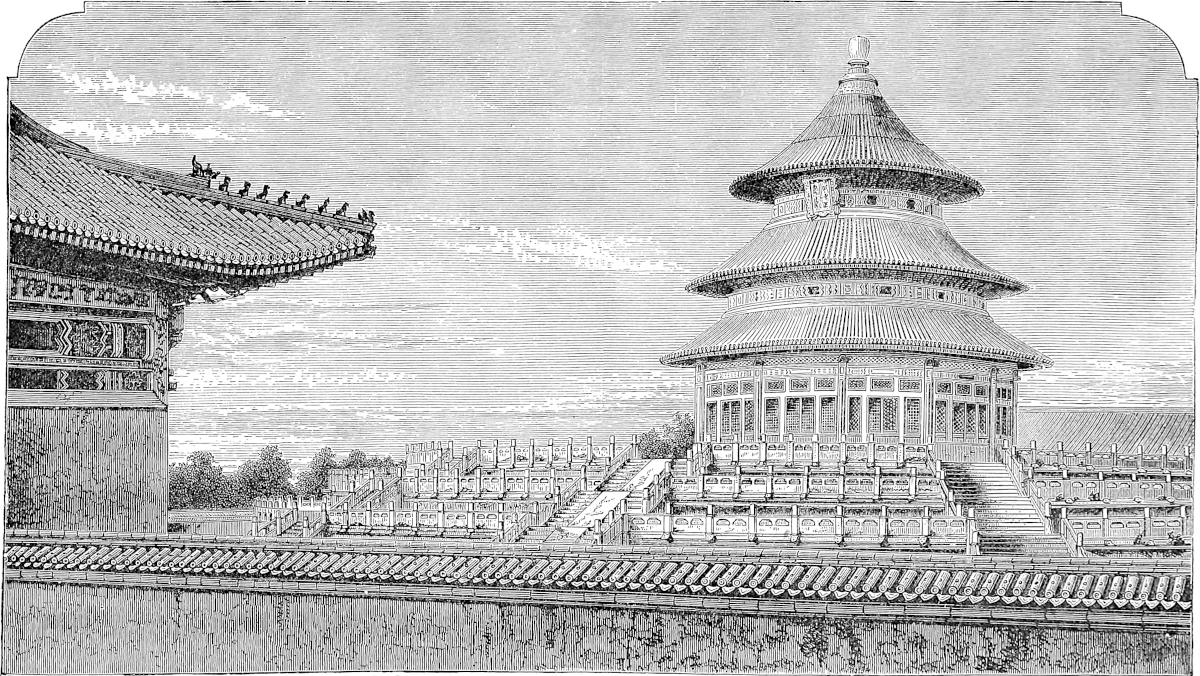
Great Temple of Heaven, Peking.
The charge of irreligion against the Chinese is an old one, and is made by Hayton in nearly the same terms as it often is by modern missionaries: “And though these people have the acutest intelligence in all matters wherein material things are concerned, yet you shall never find among them any knowledge or perception of spiritual things.” Yet it is a mistake to suppose that this insensibility has been so universal as it is often represented. To say nothing of the considerable numbers who have adhered faithfully to the Roman Catholic Church, the large number of Mahomedans in China, of whom many must have been proselytes, indicates an interest in religion; and that Buddhism itself was in China once a spiritual power of no small energy will, I think, be plain to any one who reads the very interesting extracts in Schott’s essay on Buddhism in Upper Asia and China. (Berlin Acad. of Sciences, 1846.) These seem to be so little known that I will translate two or three of them. “In the years Yuan-yeu of the Sung (A.D. 1086–1093), a pious matron with her two servants lived entirely to the Land of Enlightenment. One of the maids said one day to her companion: ‘To-night I shall pass over to the Realm of Amita.’ The same night a balsamic odour filled the house, and the maid died without any preceding illness. On the following day the surviving maid said to the lady: ‘Yesterday my deceased companion appeared to me in a dream, and said to me: “Thanks to the persevering exhortations of our mistress, I am become a partaker of Paradise, and my blessedness is past all expression in words.”’ The matron replied: ‘If she will appear to me also then I will believe what you say.’ Next night the deceased really appeared to her, and saluted her with respect. The lady asked: ‘May I, for once, visit the Land of Enlightenment?’ ‘Yea,’ answered the Blessed Soul, ‘thou hast but to follow thy handmaiden.’ The lady followed her (in her dream), and soon perceived a lake of immeasurable expanse, overspread with innumerable red and white lotus flowers, of various sizes, some blooming, some fading. She asked what those flowers might signify? The maiden replied: ‘These are all human beings on the earth whose thoughts are turned to the Land of Enlightenment. The very first longing after the Paradise of Amita produces a flower in the Celestial Lake, and this becomes daily larger and more glorious, as the self-improvement of the person whom it represents advances; in the contrary case, it loses in glory and fades away.’[2] The matron desired to know the name of an enlightened one who reposed on one of the flowers, clad in a waving and wondrously glistening raiment. Her whilom maiden answered: ‘That is Yangkie.’ Then asked she the name of another, and was answered: ‘That is Mahu.’ The lady then said: ‘At what place shall I hereafter come into existence?’ Then the Blessed Soul led her a space further, and showed her a hill that gleamed with gold and azure. ‘Here,’ said she, ‘is your future abode. You will belong to the first order of the blessed.’ When the matron awoke she sent to enquire for Yangkie and Mahu. The first was already departed; the other still alive and well. And thus the lady learned that the soul of one who advances in holiness and never turns back, may be already a dweller in the Land of Enlightenment, even though the body still sojourn in this transitory world” (pp. 55–56).
What a singular counterpart the striking conclusion here forms to Dante’s tremendous assault on a still living villain,—or enemy!
——“che per sua opra In anima in Cocito già si bagna, Ed in corpo par vivo ancor di sopra.” —Infern. xxxiii. 155.
Again: “I knew a man who during his life had killed many living beings, and was at last struck with an apoplexy. The sorrows in store for his sin-laden soul pained me to the heart; I visited him, and exhorted him to call on the Amita; but he obstinately refused, and spoke only of indifferent matters. His illness clouded his understanding; in consequence of his misdeeds he had become hardened. What was before such a man when once his eyes were closed? Wherefore let men be converted while there is yet time! In this life the night followeth the day, and the winter followeth the summer; that, all men are aware of. But that life is followed by death, no man will consider. Oh, what blindness and obduracy is this!” (p. 93).
Again: “Hoang-ta-tie, of T’ancheu (Changshu-fu in Honan), who lived under the Sung, followed the craft of a blacksmith. Whenever he was at his work he used to call without intermission on the name of Amita Buddha. One day he handed to his neighbours the following verses of his own composing to be spread about:—
‘Ding dong! The hammer-strokes fall long and fast, Until the Iron turns to steel at last! Now shall the long long Day of Rest begin, The Land of Bliss Eternal calls me in.’
Thereupon he died. But his verses spread all over Honan, and many learned to call upon Buddha” (103).
Once more: “In my own town there lived a physician by name Chang-yan-ming. He was a man who never took payment for his treatment from any one in poor or indifferent circumstances; nay, he would often make presents to such persons of money or corn to lighten their lot. If a rich man would have his advice and paid him a fee, he never looked to see whether it were much or little. If a patient lay so dangerously ill that Yanming despaired of his recovery, he would still give him good medicine to comfort his heart, but never took payment for it. I knew this man for many a year, and I never heard the word Money pass his lips! One day a fire broke out in the town, and laid the whole of the houses in ashes; only that of the physician was spared. His sons and grandsons reached high dignities” (p. 110).
Of such as this physician the apostle said: “Of a truth I perceive that God is no respecter of persons: But in every nation he that feareth Him, and worketh righteousness, is accepted with Him.”
[“By the ‘Most High and Heavenly God,’ worshipped by the Chinese, as Marco Polo reports, evidently the Chinese T’ien, ‘Heaven’ is meant, Lao t’ien ye in the common language. Regarding ‘the God of things terrestrial,’ whose figure the Chinese, according to M. Polo, ‘placed below on the ground,’ there can also be no doubt that he understands the T’u-ti, the local ‘Lar’ of the Chinese, to which they present sacrifices on the floor, near the wall under the table.
“M. Polo reports, that the Chinese worship their God offering incense, raising their hands aloft, and gnashing their teeth. Of course he means that they placed the hands together, or held kindled joss-stick bundles in their hands, according to the Chinese custom. The statement of M. Polo sbattendo i denti is very remarkable. It seems to me, that very few of the Chinese are aware of the fact, that this custom still exists among the Taouists. In the rituals of the Taouists the K’ow-ch’i (K’ow = ‘to knock against,’ch’i = ‘teeth’) is prescribed as a comminatory and propitiatory act. It is effected by the four upper and lower foreteeth. The Taouists are obliged before the service begins to perform a certain number of K’ow-ch’i, turning their heads alternately to the left and to the right, in order to drive away mundane thoughts and aggressions of bad spirits. The K’ow-ch’i repeated three times is called ming fa ku in Chinese, i.e. ‘to beat the spiritual drum.’ The ritual says, that it is heard by the Most High Ruler, who is moved by it to grace.
“M. Polo observed this custom among the lay heathen. Indeed, it appears from a small treatise, written in China more than a hundred years before M. Polo, that at the time the Chinese author wrote, all devout men, entering a temple, used to perform the K’ow-ch’i, and considered it an expression of veneration and devotion to the idols. Thus this custom had been preserved to the time of M. Polo, who did not fail to mention this strange peculiarity in the exterior observances of the Chinese. As regards the present time it seems to me, that this custom is not known among the people, and even with respect to the Taouists it is only performed on certain occasions, and not in all Taouist temples.” (Palladius, pp. 53–54.)—H. C.]
END OF VOL I.
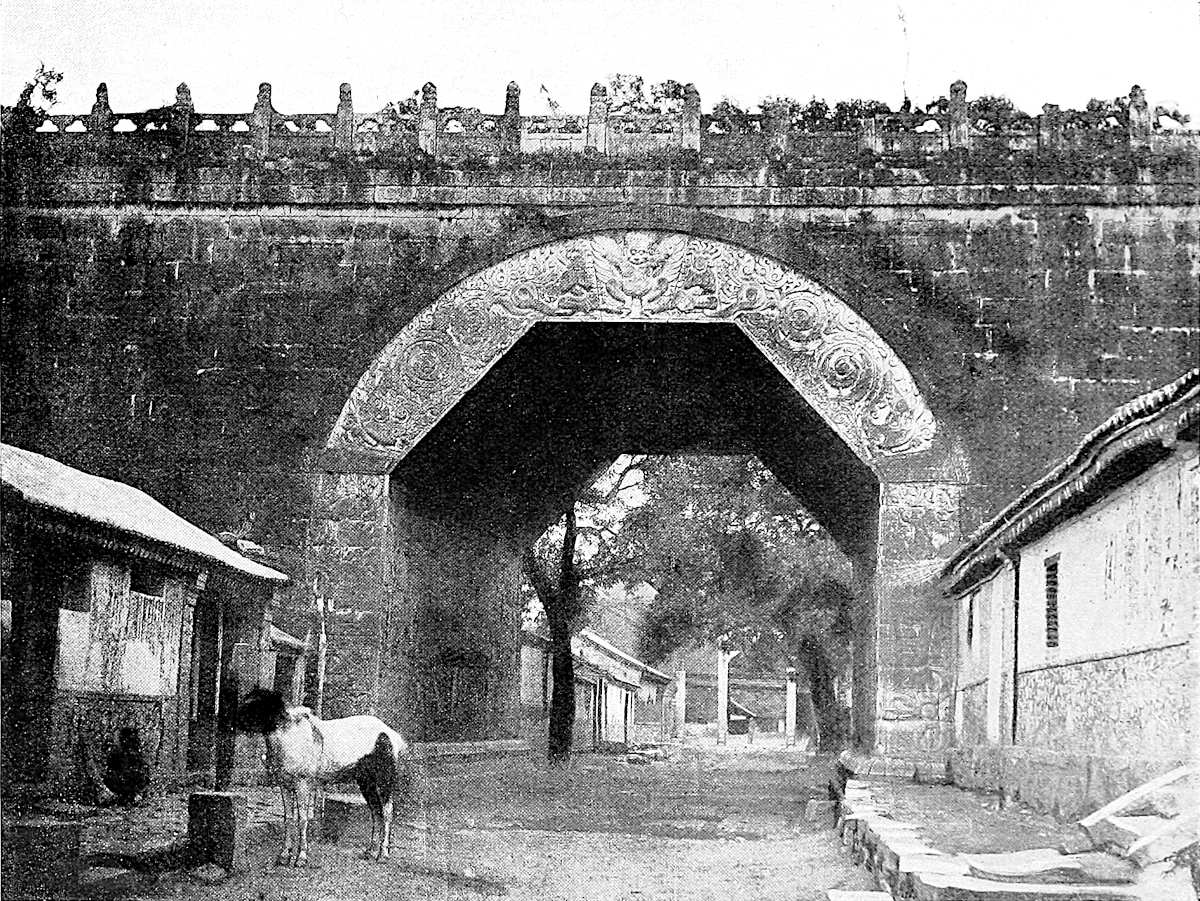
Archway erected under the Mongol Dynasty, at Kiu Yung Kwan, N.W. of Peking.[1]
MARCO POLO’S ITINERARIES No. IV. (Book I, Chapter 36 to end & chief part of Book II.
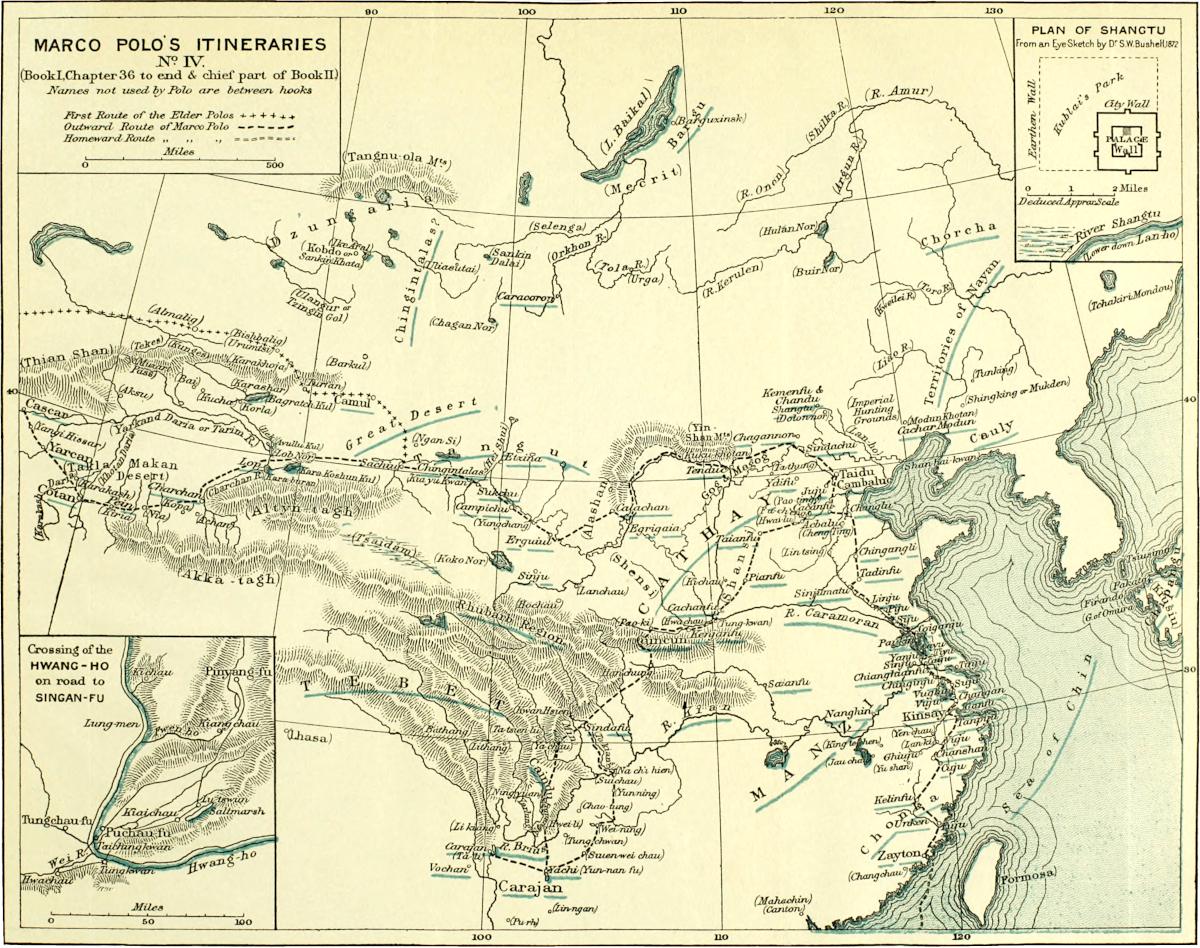
PLAN OF SHANGTU From an Eye-Sketch by Dr. S. W. Bushell, 1872 Crossing of the HWANG-HO on road to SINGAN-FU
INDEX
Aás, Asu, see Alans
Abacan, a Tartar general, ii. 255, 261n, 596n
Ábah, see Ávah
Abaji, Kúblái’s son, i. 361n
Ábáḳa (Abaga), Khan of Persia, i. 33n, 36n, 91n, 103n, ii. 465–467, 474, 475, 477n, 495n
Abano, Pietro of, his notice of Polo, 119
Abash (Habsh), see Abyssinia
Abba Gregory, ii. 433n
Abbás, Sháh, i. 90n
Abbott, Consul Keith E., i. 81n, 82n, 89n, 92n, 96n, 99n, 106n, 111n, 113n, 114n, 125n
Abdul Kuri islands, ii. 405n
—— Mejid, i. 175n
Abeskun (Baxon), on the Caspian, i. 59n
Abher, i. 38n, 82n
Abkashian forests, boxwood of the, i. 57n
Abnús, ebony, ii. 272n
Abraha, ruler of Yemen, ii. 434n
Abraiaman, see Brahmans
Abubakr, Atabeg of Fars, i. 85n, ii. 348n
—— Ibrahim, and Mahomed, engineers employed by Kúblái, ii. 168n
Abu’l Abbas Ahmed VII., Khalif of Baghdad, i. 69n
—— Fázl, i. 103n, 168n, 169n, ii. 367, 374n
Abulfeda, his geography, 4, i. 3n, 6n, 9n, 53n, 57n, 58n, 75n, 81n, 110n, 385n, ii. 237n, 286n, 367n, 377n, 486n, 489n;
at the siege of Acre, 165n
Abulfiez Khan, king of Bokhara, i. 88n
Abu Nasr Mohammed IX., Khalif of Baghdad, i. 69n
—— Saïd, i. 86n, ii. 347n
Abyssinia (Abash), ii. 427 seqq., 431n;
its king’s punishment of Soldan of Aden, 428–430;
dominion on the coast, mediæval history and chronology, 434n–437n;
table of kings, 435n;
wars with Mahomedan states, 436n
Acbalec Manzi, “White City of the Manzi frontier,” ii. 33, 34n, 35n
Acbalec or Acbaluc (Cheng-ting fu), ii. 13, 14n
Accambale, king of Champa, ii. 267, 270n
Achan, i. 66n
Achin, Acheh, Achem, ii. 283n, 286n, 295n, 296n, 300n, 303n, 305n, 307n;
its gold and lign-aloes, 287n;
conversion of, 288n;
its great power at one time, 289n;
elephants at, 289n
—— Head, ii. 300n, 307n
Achmath, the Bailo, see Ahmad
Acomat Soldan (Ahmad Sultan), seizes throne of Tabriz, ii. 467;
goes to encounter Argon, 468;
rejects his remonstrance, 469;
defeats and takes him, 470;
hears of Argon’s escape, is taken and put to death, 473;
notes on the history, 470n, 474n
Acorn bread, i. 122n
Acqui, Friar Jacopo d’, his notice of Polo, 54, 67, 119
Acre, i. 17, 22;
Broils at, between Venetians and Genoese, 42;
plan of, 18n;
captured by Saracens, ii. 165n, 441n;
wickedness of, 442n;
Polos at, 593n
Adam, Bishop and Pope of China, ii. 28n
—— Seth, and the Tree of Life, legend of, i. 135n
Adamodana, Castle of, i. 58n
Adam’s Apple, i. 99n
—— sepulchre on mountain (Adam’s Peak) in Ceylon, ii. 316, 328n;
rubies, 316n;
his teeth, hair, etc., 319–320;
the footmark, 321n–322n
Adel, apparently confused with Aden, ii. 433n, 435n, 440n
Aden, Horse and other Trade with India, ii. 340, 348n, 390, 407, 427, 431, 438;
Soldan’s treatment of a bishop, 428;
Vengeance of King of Abyssinia on him, 430;
confused with Adel, 433n;
account of Kingdom, 438, 439n–440n;
the Sultan, 438–439, 440n;
intercourse and trade with China, tanks, 440n;
view of, 441
Adoration of the Emperor, i. 391
Adulis, ii. 432n;
inscription of, 434n
Aegae, Ayas on the site of ancient, i. 16n
Aepyornis and its eggs, ii. 416n–417n
Aëtius, his prescription of musk, i. 279n, ii. 302n;
of camphor, 302n
Afghans, their use of the fat-tailed sheep, i. 100n
Africa, Sea surrounding to the South, ii. 415n
Agassiz, Professor, i. 100n
Agathocles, Coins of, i. 163n
Ἀγαθοῦ δαίμονος, island, ii. 310n
Agha Ali Sháh, present representative of the Old Man of the Mountain, i. 148n
—— Khan Meheláti, late representative of the Old Man, i. 147n
Aghrukji or Ukuruji, Kúblái’s son, i. 361n
Agricola, Governor of Cappadocia, etc., i. 45n
Aguil, Mongol general, ii. 136, 138n
Ahmad (Achmath), the Bailo, of Fenaket, his power, oppressions, death, etc., i. 415 seqq., 421n
—— Sultan, Khan of Persia, see Acomat
Ahwaz, province, i. 65n
Aidhab, ii. 439n
Aidhej, or Mal-Amir, i. 85n
Aijaruc, Kaidu’s daughter, ii. 463;
her strength and prowess, 463 seqq.;
her name, 463
Aikah Nowin, Engineer in Chief of Chinghiz, ii. 168n
Ai-lao (afterwards Nan-chao), ancient name of the Shans, ii. 79n
Aín Akbari (Ayeen Akbery), i. 65n, 99n, 101n, 103n, 409n, ii. 116n
Ajmir, ii. 426n
Akbar and Kúblái, a parallel, i. 349n
Ak Bulák salt mines, i. 154n
Akhaltziké (Western Georgia), i. 58n
Akhtuba River, i. 5n, 6n
Ak-khoja, ii. 470n
Aksarai, or Ghori River, i. 152n
Aksu River, i. 172n, 175n
Aktár, i. 96n
Áktásh Valley, i. 172n, 175n
Alabastri, ii. 432n
Alacou, see Hulákú
Aladja, striped cotton cloth, i. 44n
Alamút, Castle of the Ismailites, i. 141n, 142n, 145n, 148n
Alan country, Alania, i. 57n, ii. 490, 491n
Alans, or Aas, massacre at Chang-chau of, ii. 178;
employed under Mongols, 179n
Alaone, the name, 56
Alarm Tower, at Cambaluc, i. 375, 378n;
at Kinsay, ii. 189
Alatcha, cotton stuff with blue and red stripes, i. 190n
Alau, see Hulákú
Alá’uddin (Alaodin), see Old Man of the Mountain
—— (Alawating of Mufali), an engineer in Kúblái’s service, ii. 167n
—— Khilji, Sultan of Delhi, i. 104n, ii. 163n, 169n, 333n, 398n, 400n
Albenigaras, Mt., ii. 362n
Al Biruni, i. 104n, 174n, ii. 400n
Albuquerque, see D’Alboquerque
Alchemy, Kúblái’s, i. 423
Aleppo, i. 23n
Alexander the Great, allusions to legends and romances about, 113, i. 14n, 129n–133n, ii. 322n, 485n;
his rampart (Iron Gate), i. 50, 53n, 56n, 57n;
the curtains at a banquet given by, 66n;
and the ferrum candidum, 93n;
site of his battle with Darius, 128, 138n;
his wife Roxana, 151;
kills a lion, 152n;
Princes claiming descent from (Zulcarniain), 157, 160n;
his horse Bucephalus, 158;
fixes chains on Adam’s Peak, ii. 322n;
said to have colonised Socotra, 409n;
his tower on the border of Darkness, 485n
Alexander III., Pope, i. 231n
Alexander IV., Pope, i. 8n
Alexandria, 9, ii. 235;
trade from India to, 390, 438
Alhinde, Alfinde, Alinde, Al-hint, i. 93n
’Ali and Aliites, i. 140n–141n
Alidada, i. 452n
Alihaiya, Kúblái’s general, ii. 167n
Alinak, ii. 474n
Alligator, in Carajan, ii. 76, 81n;
mode of killing, 77;
eaten, 78, 81n;
prophecy of Bhartpúr about, 149n
Almalik, ii. 462n
Almanacs, Chinese (Tacuin), i. 447, 448n
Almonds, i. 153, 155n
Aloes, Socotrine, ii. 409n
—— wood, see Lign-aloes
Alor, war cry, 43
Al-Ramni, Al-Ramin, see Sumatra
Altai (Altay) Mountains, i. 212, 215n;
the Khan’s burial-place, 246, 269;
used for the Khingan range, 247n, 306n
Altun-Khan, Mountain, i. 247n
—— sovereign, ii. 19n
Amazons, fable of, ii. 405n
Ambergris, ii. 308n, 406, 411, 423, 424n;
how got, 408n
Amber-rosolli, i. 114n
Amda Zion, king of Abyssinia, his wars v. Mahomedans, ii. 435n seqq.;
not the king mentioned by Polo, 436n
Ament, Rev. W. S., i. 361n, 421n, ii. 6, 11, 12
Ameri, a kind of Brazil wood, ii. 301n, 380n
Amhara, ii. 436n
Amien, Mien (Burma), ii. 98, 99n
Amita Buddha, i. 460n
Ammianus Marcellinus, ii. 180n
Amoy, ii. 231n, 232n;
harbour, ii. 240n, 241n;
languages, 244n
Amphora, Anfora, ii. 417n
Amu, Aniu, see Anin
Amuki, devoted comrades of the king, ii. 347n
Anamis (Minao) River, i. 114n
Ananda, Kúblái’s grandson, ii. 29n, 31n
Anár, i. 90n
Anaurahta, king of Burma, ii. 99n, 329n
Ancestor Worship, ii. 85, 96n
Anchors, Wooden, ii. 386, 388n
Andaine, andena, andanicum, see Ondanique
Andaman (Angamanain) islands, ii. 306;
described, 307n, 309–312n;
people, 308n, 309, 311n;
form of the word, 310n
Andan, andun, Wotiak for steel, i. 94n
Andragiri, ii. 301n
Andreas, king of Abyssinia, ii. 435n, 436n
Andrew, Bishop of Zayton, ii. 237n
—— Grand Duke of Rostof and Susdal, i. 7n
Andromeda ovalifolia, poisonous, i. 218n
Angamanain, see Andaman
Angan, or Hanjám, i. 115n
’Angka, gryphon, see Ruc
Angkor, ruins of, 13
Ani in Armenia, i., 234n
Animal Patterns, see Patterns
Anin, province, ii. 119, 120n, 121n, 123, 128n, 129n, 266n
Annals of the Indo-Chinese States, ii. 106n
’An-nam, or Tong-king, ii. 120n
Anselmo, Friar, i. 131n
Anthropoides Virgo, the demoiselle, i. 297n
Antioch, i. 24n
Antongil Bay, Madagascar, ii. 414n
Aotonomoff, Spasski, his ascent of Ararat, i. 49n
Apostoille, word used for Pope, i. 12n
Apples of Paradise (Konars), i. 97, 99n, ii. 365
Apricots, ii. 210n
’Apuhota (Kapukada?), ii. 380n
Apushka (Apusca), Tartar envoy from Persia, i. 32, 33n
Arababni, ii. 436n
Arab geography, 132
—— colonies in Madagascar, ii. 414n
—— horses, early literary recognition of, ii. 349n;
trade in, see Horses
—— merchants, in Southern India, ii. 376
—— Seamen’s Traditions about Java, ii. 274n
Arabi (Arabs), i. 60
Arabia, ii. 438–451
Arabic character, i. 29n
Arachosía, arachoti, ii. 329n, 402n
Araines, ii. 461, 462n
Arakan, ii. 100n, 286n, 290n, 298n
Aram (Harám), Place of the, i. 139, 141n
Ararat, Mount, i. 46;
ascents of, 49n
Arblasts, crossbows, ii. 78, 82n, 161n
Arbre Sol, or Arbre Sec, Region of the (Khorasan), 113, i. 38n, 83, 127, 128n–139n, ii. 466, 474, 475;
tree described—Chínár or Oriental plane, i. 127, 128n–138n;
various readings, 129n;
Arbre seul, a wrong reading, i. 129n, 138n;
Tree of the Sun legend, 129n–131n;
Christian legend of the Dry Tree, 131n;
engrafted on legends of Alexander, 132n;
Trees of Grace in Persia, 134n;
Dry Trees in Mahomedan legend, 135n;
in Rabbinical and Buddhist stories, and legends of the Wood of the Cross, 135n–136n;
Polo’s Arbre Sec to be sought near Damghan, 138n;
Sabaean apologue, 138n;
clue to the term Arbre Sec, 148n
Arcali, Arculin, see Erculin
Architectural remains in Indo-China, 13
Ardeshír Bábekán, first Sassanian king, i. 91n
Ardeshír, last sovereign of Shabánkára, i. 86n
Areca, ii. 309n, 374n
Areng Saccharifera, ii. 297n
Arezzo, i. 21n
Argaeus, Mount, i. 44n
Argali, ii. 483n
Arghún, Khan of Persia (Polo’s Argon, Lord of the Levant), 23–24, i. 14n, ii. 50, 466–467;
sends an embassy to Kúblái for a wife, i. 32, 33n;
is dead when she arrives, 35, 36n, 38n, 101n;
his unhappy use of the elixir vitae, ii. 369n;
advances against his uncle Ahmad, 467;
harangues his chiefs, 468;
sends Ahmad a remonstrance, 469;
is taken prisoner, 470;
released by certain chiefs, 471;
obtains sovereignty, 472;
his death, 474;
his beauty, 478n
Argons (Arghún), half-breeds, i. 101n, 284, 290n
Arii, Ariana, ii. 402n
Arikbuga, Kúblái’s brother, i. 334n
Arimaspia, ii. 419n
Arimaspian gold, ii. 419n
Ariora-Keshimur, i. 86n, 98, 104n;
meaning of Ariora, 104n
Ariosto, i. 17n
Aripo, ii. 335n, 337n
Aristotle, 130, i. 87n, 130n, ii. 409n
Arjish (Arzizi), i. 45, 49n
Arkasun Noian, ii. 474n
Arkhaiun, applied to Oriental Christians or their Clergy, i. 290n
Armenia, Greater, i. 45, 98
Armenia (Hermenia), Lesser or Cilician, 10, i. 16, 20, 22, 23n, 41
Armenian Christians, i. 290n
Armenians, i. 43, 45, 75
Armillary Zodiacal Sphere, i. 450n
Armour of boiled leather, see Cuirbouly
Arms of Kerman, i. 90, 96n;
of the Tartars, i. 260, 263n, ii. 460
Arredon River, i. 54n
Arrow Divination, i. 243n
Arrows, Tartar, ii. 460
Artacki, 281n
Arts, the Seven, i. 13, 14n
Aru, Cumahā, ii. 303n
Arucki, i. 281n
Aruk, ii. 474n
Arulun Tsaghan Balghasun (Chagan-Nor), i. 297n, 306n
Arya Chakravarti, ii. 316n
Aryavartta, the Holy Lands of Indian Buddhism, i. 104n
Arzinga (Erzingan), i. 45, 46n
Arziron (Erzrum), i. 45, 48n
Arzizi (Arjish), i. 45, 49n
Asbestos, and the Salamander, i. 212, 216n–217n
Asceticism of the Sensin, i. 303;
of the Jogis, ii. 365
Asedin Soldan (Ghaiassuddin Balban, Sultan of Delhi), i. 99, 104n, 105n
Ashar (Asciar), king of Cail, ii. 370, 373n
Ashishin, see Assassins
Ashod, founder of the Bagratid dynasty, i. 53n
Ashurada, i. 59n
Asikan, Mongol general, ii. 260n
Asoka, ii. 328
Asper, or akché, about a groat, ii. 22, 23n
Assai River, i. 54n
Assassins (Ashishin, Hashíshin), Ismailites, i. 84n, 140;
how the Old Man trained them, 142;
murders by, 144n;
their destruction, 145;
survival and recent circumstances of the sect, 146n
Asses, in Persia, i. 83, 87n, 88, 89n, 123, 225n;
in Mongolia, 224, 225n, 397;
in Madagascar, ii. 413, 421n;
in Abyssinia, 431;
in Far North, 479, 481n
Asterius, Bishop of Amasia in Pontus, i. 66n
Astrakhan (Gittarchan), i. 5n, 6n
Astrolabe, i. 446
Astrology, -ers, in Tangut, i. 205;
of Chinghiz, 241;
at Kúblái’s Court, 301, 391;
at Cambaluc, 446;
of Tibet, ii. 49;
at Kinsay, 191, 203;
in Maabar, 344;
in Coilum, 376
Astronomical instruments, ancient Chinese, i. 378n, 449n–454n
Atabegs, of Mosul, i. 61n;
of Lúr, 85n;
of Fars, 85n, 121n;
of Yezd, 88;
of Kerman, 91n
Atjeh, see Achin
Atkinson’s Narratives, and their credibility, i. 214n, 215n
Atlas, Chinese, in Magliabecchian Library, ii. 193n
Ἀτταγὰς (Black Partridge), i. 99
Attalus, King, i. 66n
At-Thaibi family, i. 121n
Auberoche, Siege of, ii. 163n, 165n
Audh (Oudh), ii. 427n
Aufat, Ifat, ii. 435n
Augury, see Omens
Aung Khan (Unc Can), see Prester John
Aurangzíb, i. 168n
Aurora, Ibn Fozlán’s account of, i. 8n
Aussa, ii. 435n
Ávah, Abah, Ava, one of the cities of the Magi, i. 80, 81n
Avarian, epithet of S. Thomas, ii. 353, 355n–356n
Avebury, Lord, on couvade, ii. 93n
Avicenna’s classification of Iron, i. 94n
Avigi, ′afçi (falco montanus), i. 50, 57n
Axum, Inscription, ii. 432n;
Church of, 433n;
Court of, 434n
Ayas (Layas, Aiazzo, etc.), port of Cilician Armenia, 19, i. 16, 17n, 20, 22, 41;
Sea fight at, 43, 46, 54
Ayuthia, 13, ii. 278n, 279n
Azumiti, ii. 432n
Azure, Ultramarine (lapis armenus) Mines in Badakhshan, i. 157, 162n;
in Tenduc, 284;
ore, 365, 370n
Baba Buzurg, worshipped by the Lurs, i. 85n
Baber, E. C., on Ch’êng-tú, ii. 38n;
on wild oxen of Tibet, 52n;
Lolos, 61n–63n;
Gold River (Brius), 67n;
the word Caindu, 70n;
Talifu, 80n;
Mekong River 88n;
Zardandan, 89n;
site of battle between Kúblái and king of Mien, 105n;
descent of Mien, 108n
Baboons, etymology, ii. 385n, 431
Báb-ul-abwáh, “The Gate of Gates,” Pass of Derbend, i. 53n
Babylon, Babylonia (Cairo or Egypt), i. 22, 24n, ii. 226, 230n;
Sultan of, i. 22, ii. 439, 473
Babylonish garments, i. 66n
Baccadeo, indigo, ii. 382n
Baccanor, ii. 386n
Bacon, Roger, i. 94n, 426n;
as geographer, 114, 131
Bacsi, see Bakhshi
Bactria, its relation to Greece, i. 160n
Bacu, Sea of (Caspian), i. 59n
Badakhshan (Badashan), i. 98, 104n, 154, 157;
its population, 155n, 160n;
capitals of, 156n;
Mirs of, 156n, 160n;
legend of Alexandrian pedigree of its kings, 157, 160n;
depopulation of, 156n, 163n;
scenery, 158n;
dialects, 160n;
forms of the name, 161n;
great river of (Upper Oxus), 170
Badáún, ii. 427n
Badger, Rev. Dr. G. P., i. 65n, ii. 444n
Badghís, i. 150n, ii. 467
Badgír, Wind-catchers, ii. 452, 453n
Badruddín Lúlú, last Atabeg of Mosul, i. 61n
Báfk (Báft), i. 89n, 111n, 122n
Baghdad (Baudas), Baldac, taken by Alaü, Hulákú, i. 63;
its Khalif, 63, 64;
the miracle of the mountain, 69
—— Archbishop of, ii. 407
—— its indigo (baccadeo), ii. 382n
Bagratidae, of Armenia, i. 42n;
of Georgia, 52n
Bagration-Mukransky, Prince, i. 53n
Bahár, ii. 427n
Bahárak, plain, i. 156n
Bahá-uddin Ayaz, Wazir of Kalhát, i. 120n
Bahá-ul-hakh, the Saint of Multán, ii. 82n
Bahrámábád, i. 90n, 122n
Bahrámjird Village, i. 113n
Bahrein, ii. 348n
Baiberdon, i. 49n
Baiburt (Paipurth), Castle of, i. 48n, 49n
Baidu Khan, i. 14n, ii. 475n;
seizes throne of Persia, 476;
displaced and killed by Gházán, 476;
alleged to be a Christian, 476, 477n
Bailo, the title, i. 417;
etymology of, 421n
Bakhshi (Bacsi), Lamas, i. 414, 445;
their enchantments, 301, 302, 314n–318n;
various meanings of the word, 314n
Bakhtyáris of Lúristán, the, i. 87n
Baku, oil fields of, i. 46, 49n;
Sea of (Caspian), i. 59n
Balad-ul-Falfal (Malabar), ii. 377n
Baladi, ii. 381n
Balalaika, a two-stringed Tartar instrument, i. 339n
Balânjaríyah, devoted lieges, ii. 347n
Bala-Sagun, i. 232n
Balas rubies, i. 157, 161n, ii. 362n
Baldac, see Baghdad
Baldacchini (Baudekins), brocades made at Baghdad, i. 63, 65n
Baldwin II. (de Courtenay), last Latin Emperor of Constantinople, i. 2, 3n
Bali, Island of, ii. 287n
—— in Abyssinia, ii. 436n
Balios, 421n
Balish (a money of account), ii. 218n
Balista, always a crossbow in mediæval times, ii. 161n
Balkh (Balc), i. 151
Balkhash Lake, ii. 459n
Ballads, Genoese, on sea-fights at Ayas and Curzola, 43 seqq.
Ballard, Mr., ii. 382n, 387n
Balor, Balaur, Bilaur, Malaur, Bolor, i. 172, 178n–179n
Bâlos, Malacca boats with two rudders, i. 119n
Balsamodendron Mukul, ii. 397n
Balthazar, of the Magi, i. 78, 82n
Bálti, i. 160n, 178n
Balustrade, etymology of the word, 38
Bamboo (always called canes by Polo), its multifarious uses, i. 299, 307n;
Kúblái’s Chandu Palace made of, 299, 306n;
great, on banks of Caramoran river, ii. 220;
explode loudly when burning, 42, 43, 46n;
large in Tibet, 48n;
ropes of, 171, 174n;
in Che kiang, 221n
Bamian, caves at, i. 156n;
huge recumbent image at, 221n
Bám-i-Duniah, “Roof of the World,” i. 171, 174n
Bamm, i. 113n
Bandar Abbás (Bandar-Abbási), i. 86n, 89n, 106n, 122n
Bandith, i. 98, 100n, 151
Bangala, see Bengal
Banzaroff, Dorji, on Shamanism, i. 258n
Baptism, accompanied by branding, in Abyssinia, ii. 427, 432n
Bara, ii. 305n
Barac (Borrak), Khan of Chagatai, i. 9, 10n, 103n;
his war with Arghún, ii. 458n, 467
Baradaeus, Jacob, or James Zanzale, Bishop of Edessa, i. 61n
Barbaro, Josafat, i. 49n, 53n, 100n, 426n, 427n
Barbarossa, Frederic, 36, i. 82n
Barberino, Francesco da, 36, 118, i. 117n
Barda’at, saddle-cloths, i. 61n
Bardesir, i. 112n
Bardshír, Bardsír, Bard-i-Ardeshír, i. 92n
Bargu (Barguchin Tugrum, or Barguti), plain, i. 269, 270n
Barguerlac, Syrrhaptes Pallasii, a kind of sand grouse, i. 269, 272n;
its migration into England, 273n
Barguzinsk, i. 270n
Barin, Mongol tribe, ii. 148n
Bark, money made from, 108, i. 423;
fine clothes from, ii. 124, 127n
Barka (Barca), Khan, ruler of Kipchak, i. 4, 5n, 103n, ii. 491;
his war with Hulákú, i. 4, ii. 494 seqq.
Barkul, i. 345n
Barkút, búrgút (bearcoote), eagle trained to the chase, i. 397, 399n
Barlaam and Josaphat, Story of Saints, from Legend of Buddha, ii. 323n seqq.
Barley, huskless, i. 158, 162n
Baroch, ii. 367n
Baron-tala, name applied by Mongols to Tibet, i. 214n
Barons (Shieng or Sing), Kaan’s twelve, ii. 430
Barozzi, Nicolo, 30, 70
Barros, John de, i. 110n, 120n;
geography of, 3
Barsauma (St. Barsamo), i. 77
Barskul (Barscol), “Leopard Lake,” i. 343, 345n
Bartizan, Kúblái’s wooden, i. 337, 339n
Barus, Barros (Sumatra), its camphor, ii. 302n–303n, 304n
Barussae insulae, ii. 310n
Barygaza, ii. 397n, 408n
Bashai (Pashai), i. 165n
Bashkirds (Hungarians), i. 57n; ii. 492n
Bashpah, Lama, and the Mongol character called after him, i. 28n, 353n, ii. 46n
Basma, see Pasei
Basmuls (Guasmuls), half-breeds, i. 284, 292n
Basra (Bastra), noted for its date-groves, i. 63, 65n
Bathang, ii. 45n, 48n, 56n, 67n, 70n
Baths, natural hot, near Hormuz i. 110–122n;
in Cathay, 442;
public at Kinsay, ii. 189, 198n
Batigala, Batticalla, ii. 426n, 443n
Batochina, ii. 302n
Bats, large, in India, ii. 345
Battas of Sumatra, and cannibalism, ii. 288n, 298n
Batthála, Bettelar (Patlam in Ceylon), ii. 337n
Battles, Kúblái v. Nayan, i. 336;
Tartars v. king of Mien, ii. 101;
Caidu v. Khan’s forces, 461;
Borrak and Arghún, 467;
Arghún and Ahmad, 470n;
Hulákú and Barka, 496;
Toktai and Nogai, 499
Bátú, Khan of Kipchak, founder of Sarai, 11, i. 5n, 6n, 245, 247n;
invades Russia, 490, 493n;
made by Polo into two kings—Sain and Patu, 491, 492n;
his character and cruelty, 492n
Baudas, see Baghdad
Baudekins (baldacchini), brocades made at Baghdad, i. 63, 65n
Bauduin de Sebourc, 121 seqq., ii. 141, 144, 189, 216
Bavaria, Duke Ernest of, a mediæval Romance, ii. 418n
Bawárij, corsairs, ii. 410n
Bayan Chingsian, Kúblái’s greatest Captain, i. 10n, 334n, 361n, ii. 138n, 208n, 462n;
prophecy connected with his name, 145, 150n;
his conquest of Manzi or South China, 146;
his history and character, 148n, 149n;
his exceptional cruelty at Chang-chau, 179, 180n
Bayan, Khagan of the Avars, ii. 148n
Bayan (Baian), Kúblái’s Master of the Hounds, i. 400, 401n
Bayan, son of Nasruddin, ii. 104n
Bayezid Ilderim, i. 45n
Bdellium, ii. 397n
Beads, Hindu, ii. 338, 347n
Bears, i. 396, 397, 401, ii. 31, 37, 42, 78, 382, 411, 431;
white in Far North, 479, 481n
Beast and bird patterns, see Patterns
Beaten gold, i. 387, 388n
Beaujeu, William de, Master of the Temple, i. 25n
Beauty of—Georgians, i. 50, 53n;
Khorasan women, 128;
Kashmir women, 166;
Sinju women, 276;
Argons, or half-breeds, 284;
the Ungrat or Kungurat tribe, 357;
people of Coloman, ii. 122;
Kinsay women, 186;
Kaidu’s daughter, 463;
Arghún Khan, 478;
the Russians, 487
Beds, their arrangement in India, ii. 346, 352n
Beef, not eaten in Maabar, except by the Govi, ii. 341, 350n;
formerly eaten in India, 350n
Bejas of the Red Sea Coast, ii. 425, 432n, 434n
Belgutai, Chinghiz’s stepbrother, i. 334n
“Belic” for “Melic,” ii. 470n
Bell at Cambaluc, great, i. 375, 378n, 414
Bellál Rajas, ii. 367n
Belledi, balladi, ginger so called, ii. 381n;
Spanish use of the word, ib.
Benares, brocades of, i. 66n
Bendocquedar, see Bundúkdári, Bíbars
Benedict XII., Pope, ii. 179n
Bengal (Bangala), 12;
king of Mien (Burma) and, ii. 98;
why Polo couples these, 99n;
relations between Burma and, 99n, 114;
claim asserted by king of Burma to, 100n;
alleged Mongol invasion of, 115n;
its distance from Caugigu, 120;
its currency, 123;
confused with Pegu by Polo, 128n, 131n
Beni Búya dynasty, i. 91n
Benjamin of Tudela, on Alexander’s Rampart, i. 54n;
on the Gryphon, ii. 418n
Benzoin, etymology of, ii. 286n, 396n
Berard, Thos., Master of the Temple, i. 23, 24n
Berbera, Sea of, ii. 415n
Berchet, G., 27, ii. 507n
Bereké, Bátu Khan’s brother, i. 5n
Bernier, on Kashmir women’s beauty, i. 169n
Berrie, the Arabic Băríya, a desert, i. 237n
Bettelar, rendezvous of Pearl Fishers, ii. 331, 337n
Beyamini, wild oxen of Tibet, ii. 50, 52n
Bezant, i. 405, 424, 425, 426n, 427n, 444, ii. 41n, 186, 218n, 346n, 349n, 479;
value of, 592n
Bhagavata, ii. 346n
Bhamó, and River of, ii. 70n, 105n, 107n, 108n, 113n
Bhartpúr, prophecy about, ii. 149n
Bhattis, the, i. 104n
Bháwalpúr, i. 104n
“Bhim’s Baby,” colossal idol at Dhamnár caves, i. 221n
Bianco’s, Andrea, maps, i. 133n
Biar, ii. 305n
Bibars Bundúkdári, see Bundúkdári
Bielo Osero, ii. 486n
Bigoncio, a firkin, i. 384n
Bilúchis, i. 101n;
their robber raids, 106n;
Lumri or Numri, 114n
Binh Thuan (Champa), ii. 268n
Binkin, ii. 230n
Bintang (Pentam), ii. 280, 284
Birch-bark vessels, i. 309n;
books, ii. 124, 127n
Bír-dhúl, or Bujardawal, cap. of Ma’bar, ii. 335n
Bird-hunts, i. 269, 272n
Birdwood, Sir G., ii. 396n, 446n, 449n
Birhōrs of Chuta Nagpúr, ii. 298n
Bir-Pandi, or Pira-Bandi, ii. 333n, 334n
Birthday, celebration of Kúblái’s, i. 387
Bishbalik (Urumtsi), i. 214n, 440n
Bishop, of Male Island, ii. 404;
story of an Abyssinian, 428
Bitter bread, i. 110, 122n
—— water, i. 110, 122n, 194
Blac, Blachia (Lac, Wallach), ii. 489n
Black-bone, Chinese name for Lolos, ii. 63n
Black Crane (Kará Togorü), i. 296, 297n
—— Saints, White Devils in India, ii. 355, 359n
—— Sea, M. Maurum v. Nigrum, i. 2, 3n, 57n
—— Sect of Tibet, i. 324n
Blacker, the more beautiful, ii. 355
Blaeuw, map, i. 102n
Blochmann, Professor H., i. 114n, ii. 116n
Block-books, supposed to have been introduced from China, 139
Block-printing in Persia, i. 429n
Blood-sucking, Tartar, i. 261, 264n
Blous, bloies, i. 327n
Boar’s tusks, huge (Hipp.), ii. 413
Boccassini, i. 62n
Bode, Baron de, i. 85n
Bodhisatva Avalok., ii. 265n
Bodleian MS. of Polo, 18, 92, 94;
list of miniatures in, ii. 528n
Boeach, mistake for Locac, and its supposed position, ii. 280n
Boemond, Prince of Antioch and Tripoli, letter of Bibar to, i. 24n
Boga (Bukā), a great Mongol officer, delivers Arghún, ii. 471, 472, 474n
Boghra Khan, i. 188n
Bohea country, ii. 222n, 224n
Bohra, sect of W. India, i. 148n
Boikoff, Russian Envoy, i. 218n
Bokhara (Bocara), i. 9, 10
Boleyn, Anne, her use of buckram, i. 47n
Bolgana, Queen, see Bulughán
Bolgarskoye (called also Uspenskoye), i. 7n
Bolghar, borgal, borghal, Russia leather, i. 6n, 394, 395n
Bolghar (Bolgara), on the Volga, i. 4, 6n, ii. 481n, 486n, 493n;
ruins of, i. 7n;
court of, 384n
Bolivar, Padre, S. J., his account of the Condor (Rukh) of Africa, ii. 420n, 597n
Bolor, i. 172, 178n, 179n
Bombay, ii. 396n, 449n
Bonaparte, Prince Roland, Recueil des Documents de l’Époque Mongole, i. 14n, 28n
Bonga, ii. 96n
Bonheur, Rosa, i. 277n
Boniface VIII., Pope, 44, 52, 54, i. 23n
Bonin, C. E., i. 203n, 249n, 276n, 282n, 286n
Bonocio di Mestro, 67
Bonpos, old Tibetan Sect, i. 314n, 321n, 323n
Bonús, ebony, ii. 268, 272n
Bonvalot, i. 200n
Book of Marco Polo, its contents, 80;
original language, French, 81;
oldest Italian MS., 82;
“Geographic Text,” in rude French, 83 seqq.;
various types of Text—(1) “Geographic,” 90;
(2) Pauthier’s MSS., 92;
(3) Pipino s Latin, 95;
Preface to, ii. 525n;
Grynæus’ Latin, 95;
Müller’s reprint, 96;
(4) Ramusio’s Italian edition, its peculiarities, 96–101;
probable truth about it, 99;
bases of it, 100;
MS. and some of its peculiarities, 101;
general view of the relations of the texts, 101;
notice of an old Irish version, 102;
geographical data, 109;
how far influenced in form by Rustician, 112;
perhaps in description of battles, 113;
diffusion and number of MSS., 116;
basis of present version, 141 seqq.;
specimens of different recensions of text, ii. 522n–524n;
distribution of MSS., 526n;
miniatures in, 527n, 529n;
list of MSS., 532n–552n;
Tabular view of the filiation of chief MSS., 552;
Bibliography, 553n–582n;
titles of works cited, 582n–590n;
Spanish edition, 598n
Bore in Hang-chau Estuary, ii. 208n
Borgal, see Bolghar
Bormans, Stanislas, ii. 602n, 603n
Born, Bertram de, 44
Borneo, camphor, see Camphor
—— tailed men of, ii. 302n
Boro Bodor, Buddhist Monument, Java, 13, ii. 275n
Borrak, Amir, Prince of Kerman (Kutlugh Sultan?), i. 91n
—— Khan of Chaghatai, see Barac
Borús, the, ii. 310n
Bostam, i. 138n
Boswellia thurifera, ii. 396n, 446n, 448n;
serrata, 446n;
Carterii, 448n;
Bhauda-jiana, 448n;
papyrifera, 448n;
Frereana, 448n;
glabra, 396n
Bouqueran, see Buckram
Bourne, F. S. A., ii. 60n, 131n
Boxwood forests in Georgia, i. 50, 57n
Bozzí, i. 212n
Bra, the word, 45
Bracelets, in Anin, ii. 119
Bragadino, Marco, husband of Marco Polo’s daughter, Fantina, 76
—— Pietro, 76
Brahmanical thread, ii. 363
Brahmans (Abraiaman), fish-charmers to the pearl fishery, ii. 332, 337n;
their character and virtues, 363, 367n;
their king, 364;
their omens, 364, 368n, 369n;
longevity, 365;
Chughi, 365;
Palladian legend of, 405n
Brahma’s temple, Hang-chau, ii. 212n, 213n
Brahuis, i. 101n
Brakhimof, early capital of Bulgaria, i. 7n
Brambanan, ruins at, 13
Bran (Tibetan tsamba), parched barley, i. 303, 321n
Brazil wood, in Locac, ii. 276, 279n;
in Sumatra, 299;
manner of growth, ib., 309n;
in Ceylon, 313, 315n;
in Coilum (Coilumin), 375, 380n;
different kinds, ib.;
vicissitudes of the word, 380n;
its use prohibited by Painters’ Guild, 382n
Bread, bitter, i. 110, 122n
Brephung monastery, i. 319n
Bretesche, i. 339n
Bretschneider, Dr. Emil (Medical Researches), ruins of Bolghar, i. 7n;
the Uíghúr character, 28n;
Caucasian Wall, 54n;
use of muslin in Samarkand, 62n;
on nakh and nachetti, 65n;
Hulákú’s expedition to West Asia, 66n, 85n, 146n, 148n;
an extract from the Yüan Si, 115n;
Badakhshan, 161n;
Kashgar, 183n;
Shachau, 206n;
Kamul, 211n;
Chingintalas, 214n;
the Stipa inebrians, 219n;
the Utikien Uigúrs, 227n;
Erdenidso Monastery, 228n;
Belasagun, 232n;
death of Chinghiz, 248n;
tung lo or kumiz, 259n;
Kúblái’s death, 334n;
Peking, 366n, 368n, 370n, 372n, 376n–378n, ii. 5n, 6n, 8n;
verniques, i. 384n;
clepsydra, 385n;
the Bularguchi, 408n;
Achmath’s biography, 421n;
paper-money, 430n;
post stations, 437n;
Chinese intoxicating drinks, 441n;
regulations for time of dearth, 444n;
Lu-Ku-K’iao Bridge, ii. 8n;
introduction of plants from Asia into China, 16n;
morus alba, 25n;
Tibet, 46n;
bamboo explosions, 46n;
the Si-fans, 60n;
Cara-jang and Chagan-jang, 73n;
Nasr-uddin, 104n;
the Alans, 180n;
rhubarb in Tangut, 183n;
Polo’s “large pears,” 210n;
on galangal, 229n;
on sugar, 230n;
on Zayton, 238n;
on wood-oil, 252n;
on ostrich, 437n;
on Si-la-ni, 316n;
on frankincense, 449n;
on Magyars, 492n;
on Mongol invasion of Poland and Silesia, 493n
Brichu (Brius, the Upper Kiang), ii. 67n
Bridges of Pulisanghin, ii. 3;
Sindafu (Ch’êngtu), 37;
Suchau, 181;
Kinsay, 185, 187, 194n, 201, 212;
Kien-ning fu, 225, 228n;
Fuchau, 233n, 234n;
Zayton, or Chinchau, 241n
Brine-wells, see Salt
Brius River (Kin-sha Kiang, Gold River), ii. 36, 40n, 56, 67n
Brown, G. G., ii. 35n
—— Sir Thomas, ii. 420n, 424n;
on Polo, 115
Bruce’s Abyssinian Chronology, ii. 435n seqq.
Brunetto Latini’s Book, Li Tresor, 88, 117
Brunhilda, ii. 466n
Bruun, Professor Ph., of Odessa, i. 6n, 54n, 232n–235n
Bucephala, of Alexander, i. 105n
Bucephalus, breed of, i. 158, 162n
Buckrams, of Arzinga, i. 45;
described, 47n;
etymology, 48n;
at Mardin, 61, 62n;
in Tibet, ii. 45;
at Mutfili, 361, 363n;
Malabar, 389, 395, 398, 431
Buddha, see Sakya Muni
Buddhism, Buddhists, see Idolatry, Idolaters
Buddhist Decalogue, i. 170n
Buffaloes in Anin, ii. 119
Buffet and vessels of Kúblái’s table, i. 382, 384n
Bugaei, ii. 432n
Buka (Boga), a great Mongol chief, ii. 471, 472, 474n
Buka Bosha, 1st Mongolian Governor of Bokhara, i. 10n
Búkú Khan, of the Hoei-Hu, or Uighúrs, i. 227n
Bularguji (Bularguchi), “The Keeper of Lost Property,” i. 403, 407n
Bulgaria, Great, ii. 286n
Bulughán (Bolgana), Queen, 23, i. 32, 33n, 38n, ii. 474n
—— another, ii. 475n
Bundúkdár, Amír Aláuddín Aidekín (“The Arblasteer”), i. 24n
Bundúkdári, Malik Dáhir Ruknuddín Bíbars (Bendocquedar), Mameluke Sultan of Egypt, i. 22, 23n–25n, 145n, ii. 424n, 433n, 436n, 494n;
killed by kumiz, 259n
Buraets, or Burgats, the, i. 258n, 283n
Búrkán Káldún, i. 247n
Burma (or Ava), King of, ii. 98, 99n.
(See also Mien.)
Burnell, Arthur, ii. 335n, 359n, 386n
Burning the Dead, see Cremation
—— heretical books, i. 321n
—— paper-money, etc., at funerals, i. 204, 208n, 267, 268n, ii. 191
—— Widows in South India, ii. 341, 349n
Burrough, Christopher, i. 9n
Burton, Captain R. F., ii. 597n
Bushell, Dr. S. W., his visit to Shang-tu, i. 26n, 304n, 305n, 412n;
on the Khitan Scripts, 28n;
Tangut rulers, 205n;
orders for post-horses, 353n
Butchers, in Kashmir, i. 167;
Tibet, 170n;
S. India, ii. 342
Butiflis (Mutfili), ii. 362n
Butler, Hudibras, ii. 92n
Buyid dynasty, i. 86n
Ca’ Polo, Ca’ Milion, Corte del Millioni, the house of the Polos at Venice, 4, 26 seqq., 53, 70, 77
Caaju, castle of, i. 244
Cabs, Peking, ii. 211n
Cacanfu (Hokiang-fu), ii. 127, 132
Cachanfu (P’uchau-fu, Ho-chung-fu), ii. 22, 25n
Cachar Modun, i. 404, 408n
Cachilpatnam, ii. 387n
Cadmia, i. 126n
Caesalpinia, 380n;
and see Brazil
Caesarea of Cappadocia (Casaria, Kaisaríya), i. 43, 44n
Caichu, castle of (Kiai-chau, or Hiai-chau?), ii. 17, 19n, 26n
Caidu, see Kaidu
Caiju, on the Hwang-Ho, ii. 142
—— on the Kiang, Kwachau, ii. 171, 174
Cail (Káyal), ii. 370, 372n–373n;
a great port of Commerce, 370, 373n;
the king, ib.;
identified, 372;
meaning of name, ib.;
remains of, ib.
Caindu (K’ien-ch’ang), a region of Eastern Tibet, ii. 53, 70n
Caingan (Ciangan, Kiahing), ii. 184n, 185n
Cairo, ii. 439n;
museum at, 424n;
ventilators at, 452n.
(See Babylon.)
Caiton, see Zayton
Cala Ataperistan (Kala’ Atishparastán), “Castle of the Fire Worshippers,” i. 78
Calachan (Kalaján), i. 281, 282n
Calaiate, Calatu, see Kalhát
Calamanz, the word, ii. 272n
Calamina, city, ii. 357n
Caldwell, Rev. Dr. R., on devil-dancing among the Shanars, ii. 97n;
on name of Ceylon, 314n;
on Shahr-Mandi and Sundara Pandi, 333n;
on the Tower at Negapatam, 336n;
etymology of Chilaw, 337n;
on Pacauta, 346n;
Govis, 349n;
singular custom of arrest, 350n–351n;
rainy season, 351n;
food of horses, ib.;
Shanar devil-images, 359n;
choiach, 368n;
Cail, or Kayál city, 372n, 373n;
Kolkhoi, 373n;
King Ashar of Cail, ib.;
Kollam 377n;
Pinati, 380n;
etymology of Sapong, ib.;
Cape Comorin, 383n
Calendar, Ecclesiastical Buddhist, i. 220, 222n;
the Tartar, 447, 448n;
of Brahmans, ii. 368n–369n;
of Documents relating to Marco Polo and his family, 505n seqq.
Calicut, ii. 380n, 381n, 388n, 391n, 440n;
King of, and his costume, 346n
Calif, see Khalif
Caligine, Calizene (Khálij, a canal from Nile), ii. 439n
Camadi (City of Dakiánús), ruined, i. 97, 113n
Cambaluc (Khanbaligh, or Peking), capital of Cathay, 12, i. 38n, ii. 3, 132, 213n, 320;
Kúblái’s return thither after defeating Nayan, i. 348;
the palace, 362;
the city, 374;
its size, walls, gates, and streets, the Bell Tower, etc., 375n–378n;
period of khan’s stay there, 411;
its suburbs and hostelries, 412;
cemeteries, women, patrols, 414;
its traffic, 415;
the Emperor’s Mint, 423;
palace of the Twelve Barons, 431;
roads radiating from, 433;
astrologers of, 446
Cambay (Cambaet, Cambeth, Kunbáyat), kingdom of, ii. 394n, 397, 398n, 403n, 426n, 440n, 443n
Cambuscan, of Chaucer, corruption of Chinghiz, i. 247n
Camel-bird, see Ostrich
Camels, mange treated with oil, i. 46;
camlets from wool of, 281, 284;
white, 281, 283n;
incensing, 309n;
alleged to be eaten in Madagascar, ii. 411;
really eaten in Magadoxo, 413n;
ridden in war, 423, 425n
Camexu, Kamichu, see Campichu
Camlets (cammellotti), i. 281, 283n, 284
Camoens, ii. 266n
Camphor (Laurus Camphora) trees in Fo-kien, ii. 234, 237n
—— of Sumatra, ii. 287n;
Fansuri, 299, 302n;
earliest mention of, 302n;
superstitions regarding, 303n;
description of the tree, Dryabalanops Camphora, 303n–304n;
value attached by Chinese to, 304n;
recent prices of, ib.;
its use with betel, 371, 374n
—— oil, ii. 304n
Campichu (Kanchau), city of, i. 219, 220n
Camul (Kamul), province, i. 209, 211n, 214n
Camut, fine shagreen leather, i. 394, 395n
Canal, Grand, of China, ii. 132, 139, 140, 141n, 143n, 152n, 154n, 209n, 222n;
construction of, 174, 175n
Canale, Cristoforo, MS. by, 34, 37
—— Martino da, French Chronicle of Venice by, 88
Cananor, kingdom, ii. 388n
Cananore, ii. 386n, 387n
Canara, ii. 390n, 397n
Cancamum, ii. 397n
Canela brava, ii. 390n
Canes, Polo’s name for bamboos, q.v.
Cannibalism, ii. 293, 294, 298n, 311n, 312n;
ascribed to Tibetans, Kashmiris, etc., i. 301, 312n, 313n;
to Hill-people in Fo-kien, ii. 225, 228n;
to islanders in Seas of China and India, 264;
in Sumatra, 284, 288n;
regulations of the Battas, 288n;
ascribed to Andaman islanders, 309, 311n
Cannibals, i.e. Caribs, ii. 311n, 405n
Canonical Hours, ii. 368–369n
Cansay, see Kinsay
Canton, 3, ii. 199n, 237n
Cape Comorin, see Comari, Temple at, 76
—— Corrientes (of Currents), ii. 415n, 417n, 426n
—— Delgado, ii. 424n
—— of Good Hope, ii. 417n
Capidoglio (Capdoille), sperm-whale, ii. 414n
Cappadocian horses, i. 44n
Capus, G., i. 129n 162n
Caracoron (Kará Korum), i. 66n, 226, 227n, 269, ii. 460, 462n
Carajan (Caraian, Karájang, or Yun-nan), province, 21, ii. 64, 66, 67n, 72n, 76, 86
Caramoran River (Hwang-Ho), ii. 142, 143n, 144n, 151
Carans, or Scarans, i. 100n
Caraonas (Karaunahs), a robber tribe, i. 98, 101n, 121n
Carats, i. 359n
Carbine, etymology of, i. 101n
Cardinal’s Wit, i. 21n
Caribs, i.e. cannibals, ii. 311n, 405n
Carpets, of Turcomania (Turkey), i. 43, 44n;
Persian, 66n;
Kerman, 96n
Carriages, at Kinsay, ii. 205, 206;
Chinese, 211n
Carrion, shot from engines, ii. 163n
Carta Catalana, Catalan Map of 1375, 134, i. 57n, 59n, 82n, 161n, ii. 221n, 243n, 286n, 362n, 386, 396n, 494n
Carte, à la, ii. 486n
Carts, Mongol, i. 254n
Casan, see Gházán Khan
Casaria (Caesarea of Cappadocia), i. 43, 44n
Cascar (Kashgar), i. 180, 182n;
Chaukans of, 193n
Casem, see Kishm
Caspian Sea (Sea of Ghel or Ghelan), ancient error about, 2, 129;
its numerous names, i. 52, 58n, 59n, ii. 494n
Cassay, see Kinsay
Cassia, ii. 59n, 60n, 390n, 391n
—— buds, ii. 59n, 391n
—— fistula, ii. 398n
Castaldi, Panfilo, his alleged invention of movable types, 139–140
Castambol, i. 45n
Castelli, P. Cristoforo di, i. 52n, 53n
Casvin (Kazvín), a kingdom of Persia, i. 83, 84n, 101n, 141n
Catalan Navy, 38–39
Cathay (Northern China), 3;
origin of name, 11, 15, i. 60, 76n, 285, 414, 418, 441, ii. 10, 127, 132, 135, 139, 140, 192, 391n, 457;
coal in, i. 442;
idols, ii. 263;
Cambaluc, the capital of, see Cambaluc
Cathayans, v. Ahmad, i. 415 et seqq.;
their wine, 441;
astrologers, 446;
religion, 456;
politeness, filial duty, gaol deliveries, gambling, 457
Catholics, ii. 407;
Catholicos, of Sis, i. 42n;
of the Nestorians, 61n, 62n
Cators (chakors), great partridges, i. 296, 297n
Cat’s Head Tablet, i. 356n
Cats in China, ii. 350n
Caucasian Wall, i. 53n, 54n
Caugigu, province, ii. 116, 120, 123, 128n, 131n
Caulking, of Chinese ships, ii. 250, 251n
Cauly, Kauli (Corea), i. 343, 345n
Causeway, south of the Yellow River, ii. 153n
Cauterising children’s heads, ii. 432n
Cave-houses, i. 154, 156n, ii. 150n
Cavo de Eli, ii. 386n
—— de Diab, ii. 417n
Cayu (Kao-yu), ii. 152
Celtic Church, ii. 370n
Census, of houses in Kinsay, ii. 192;
tickets, ib.
Ceremonial of Mongol Court, see Etiquette
Ceylon (Seilan), ii. 312–314;
circuit of, 310n;
etymology of, 314n;
customs of natives, 315;
mountain of Adam’s (alias Sagamoni Borcan’s) Sepulchre, 316, 321n;
history of Buddha, 317;
origin of idolatry, 318 seqq.;
subject to China, 392n
Ceylon, King of, his pearl-ponds, ii. 337n
Chachan (Charchan, Charchand), i. 192n, 194, 195n, 196n
Chagatai (Sigatay), Kúblái’s uncle, son of Chinghiz, 10, i. 10n, 14n, 98, 102n, 183, 186n, ii. 457, 458n, 459
Chaghán-Jáng, ii. 72n, 73n
Chaghan-Kuren, ii. 23n
Chaghan-Nor (“White Lake”), N.E. of Kamul, i. 214n
—— (Chaghan, or Tsaghan Balghasun), site of Kúblái’s palace, i. 296, 297n, 306n, 422n, ii. 14n
Chairs, silver, i. 351, 355n
Chakor (cator), great partridges, i. 296, 297n
Chalcedony and jasper, i. 191, 193n
Chalukya Malla kings, ii. 336n
Champa (Chamba), kingdom of, ii. 266, 268n, 424, 426n, 596n;
Kúblái’s expedition v., 267;
the king and his wives, 268, 271n;
products, 268, 271n–272n;
locality, 269–270n;
invaded by king of Lukyn, 279n
Chandra Banu, ii. 315n
Chandu (Shangtu), city of peace of Kúblái, i. 25, 298, 304n, 410–411, 435
Changan, ii. 182, 184n
Chang-chau (Chinginju), ii. 178, 179n
—— in Fo-kien, ii. 233n, 238n;
Zayton(?), 238n;
Christian remains at, 240n–241n
Ch’ang Ch’un, travels, i. 62n
Changgan (Chang-ngan), ii. 27–29n
Chang-kia-Kau, the gate in the Great Wall, i. 56n
Chang K’ien, ii. 16n
Chang-shan (Chanshan), ii. 198n, 199n, 219, 221n, 222n, 224n
Ch’ang Te (the Chinese traveller), Si Shi Ki, i. 64n, 66n
Chang Te-hui, a Chinese teacher, i. 309n
Chang-y (Chenchu), i. 417–419, 422n
Chang Yao, Chinese general, i. 211n
Cháo de Bux (Cavo di Bussi), boxwood, i. 57n
Chaohien, Sung Prince, ii. 150n
Cháo-Khánahs, bank-note offices in Persia, i. 429n
Cháo Naiman Sumé Khotan, or Shangtu, “city of the 108 temples,” i. 304n
Cháo, paper-money, i. 426n, 429n
Cháo, title of Siamese and Shan Princes, ii. 73n
Chaotong, ii. 130n
Chapu, ii. 199n
Characters, written, four acquired by Marco Polo, i. 27;
one in Manzi, but divers spoken dialects, ii. 236
Charchan (Chachan of Johnson, Charchand), i. 192n, 194, 195n, 196n
Charcoal, store in Peking, palace garden of, i. 370n
Charities, Kúblái’s, i. 439, 443, 444;
Buddhistic and Chinese, 446n;
at Kinsay, ii. 188, 198n
Charles VIII., of France, i. 398n
Chau dynasty, i. 347n
Chaucer, quoted, i. 3n, 5n, 17n, 161n, 247n, 386n, ii. 11n
Chaukans, temporary wives at Kashgar, i. 193
Chaul, ii. 367n
Cheapness in China, ii. 202
Cheetas, or hunting leopards, i. 397, 398n
Cheh-kiang, cremation common during Sung dynasty in, ii. 135n;
roads into Fo-kien from, 224n
Cheinan, Gulf of, ii. 266
Chenchau, or Iching hien, ii. 173n, 174n
Chenching (Cochin-China), ii. 268n–269n, 277n
Chenchu (Chang-y), conspires with Vanchu v. Ahmad, i. 417–419, 422n
Ch’eng-ting fu, ii. 13, 14n
Ch’êng-Tsu (Yung-lo), Emperor, 392n
Ch’êng-tu (Sze-ch’wan), ii. 32n, 34n, 35n
Ch’êngtu-fu (Sindafu), ii. 36, 37n
Cheu, the Seven, ii. 277n
Chibai and Chiban, ii. 459, 462n
Chichiklik Pass, i. 172n, 175n
Chien-ch’ang (Caindu), ii. 70n.
(See K’ien-ch’ang.)
Chihli, plain of, ii. 14n
Chilaw, ii. 337n
Chiliánwála, battlefield of, i. 105n
Chilu-ku, last Karakhitai king, ii. 20n
Chin, Sea of, ii. 264, 265, 266n, 270n
China, 134;
Imperial Maritime Customs Returns for 1900, ii. 173n;
Dominicans in, 240n;
paved roads in, 189, 198n;
relations with Korea and Japan, 262n;
the name, 265n;
king of Malacca at Court of, 282n;
trade from Arabia to, 348n;
from Sofala in Africa, 400n.
(See also Cathay and Manzi.)
Chinangli (T’sinan-fu), ii. 133, 135, 137n
Chínár, Oriental planes, i. 128n, 138n
Chinchau, Chincheo, Chinchew, Chwanchew, Tswanchau, see Zayton
Chinese, Polo ignorant of the languages, 110, i. 29n;
epigrams, 170n;
funeral and mourning customs, 207n, ii. 191;
feeling towards Kúblái, i. 421n;
religion and irreligion, 456, 458n;
their politeness and filial piety, 457, 462n;
gambling, 457;
character for integrity, ii. 204, 210n;
written character and varieties of dialect, 236;
ships, 249 seqq.;
pagodas at Negapatam and elsewhere, 336n;
coins found in Southern India, 337n;
pottery, 372n–373n;
trade and intercourse with Southern India, 373n, 378n, 386, 390, 392n
Chinghian-fu (Chinkiang-fu), ii. 175, 176, 177n
Chinghiz Khan, 10, 11, i. 5n, 10n, 12n, ii. 458n, 479, 481n;
reported to be a Christian, i. 14n;
Aung Khan’s saying of, 27n;
his use of Uíghúr character, 28n;
Erzrum taken by, 49n;
harries Balkh, 151n;
captures Talikan, 154n;
ravages Badakhshan, 163n;
his respect for Christians, 186n, 242n, 243n;
subjugates Kutchluk Khân, 189n;
his campaigns in Tangut, 206n, 218n, 225n, 281n;
Rubruquis’ account of, 237n, 239n;
made king of the Tartars, 238;
his system of conquests, 238;
and Prester John, 239–241;
divining by twigs—presage of victory, 241;
defeats and slays Prester John, 244;
his death and burial-place, 244, 245n, 249n;
his aim at conquest of the world, 245n;
his funeral, 250n;
his army, 262, 265n;
defeats the Merkits, 270n;
relations between Prester John’s and his families, 284, 288n;
the Horiad tribe, 300, 308n;
his prophecy about Kúblái, 331n;
rewards his captains, 351n;
captures Peking, ii. 8n;
defeats and slays Taiyang Khan, 20n;
his alleged invasion of Tibet, 46n;
his mechanical artillery, 168n;
his cruelty, 181n;
Table of Genealogy of his House, 505n
Chinghiz Tora, ii. 481n
Ching-hoang tower at Hangchau-fu, ii. 214n
Chinginju (Chang-chau), ii. 178
Chingintalas, province, i. 212;
its identification, 214n, 215n
Chingkim, Chinkin, Chimkin, Kúblái’s favourite son and heir-apparent, i. 38n, 359, 360n, 418, 422n;
his palace, 366, 372n
Chingsang, Ching-siang (Chinisan), title of a Chief Minister of State, i. 432n, ii. 145, 148n, 150n, 218n
Chingting-fu (Acbaluc), ii. 13, 14n
Chingtsu, or Yung-lo, Emperor, ii. 392n
Chíní, coarse sugar, ii. 230n
Chinju (Tinju), ii. 153, 154n
Chin-tan, or Chínasthána, Chinese etymology of, ii. 119n
Chinuchi, Cunichi, Kúblái’s Masters of the Hounds, i. 400, 401n
Chipangu (Japan), ii. 253, 256n;
account of Kúblái’s expedition v., 255, 258;
its disasters, 255–256;
history of expedition, 260n seqq.;
relations with China and Korea, 262n
Chitral, i. 154n, 160n, 165n, 166n
Chloroxylon Dupada, ii. 397n
Cho-chau (Juju), ii. 10, 11n, 131n
Choiach, the term, ii. 364, 368n
Chola, or Sola-desam (Soli, Tanjore), ii. 335n, 336n, 364, 368n
Chonka (Fo-kien), kingdom of, ii. 231, 232n, 236;
explanation of name, 232n
Chonkwé, ii. 232n
Chorcha, see Churchin
Christian, astrologers, i. 241, 446;
churches in China, early, ii. 27n;
inscription of Singanfu, 28n;
Alans in the Mongol service, ii. 178, 179n
Christianity, attributed to Chinghizide princes, i. 14n, ii. 476, 477n;
Kúblái’s views on, i. 344n
—— former, of Socotra, ii. 410n
Christians, of the Greek rite, Georgians, i. 50;
and Russians, ii. 486;
Jacobite and Nestorian, at Mosul, i. 46, 60, 61n;
among the Kurds, 60, 62n;
and the Khalif of Baghdad—the miracle of the mountain and the one-eyed cobbler, 68–73;
Kashgar, 182, 183n;
in Samarkand, 183, 186n;
the miracle of the stone removed, 185;
Yarkand, 187;
Tangut, 203, 207n;
Chingintalas, 212;
Suh-chau, 217;
Kan-chau, 219;
in Chinghiz’s camp, 241;
Erguiul and Sinju, 274;
Egrigaia, 281;
Tenduc, 285;
Nayan and the Khan’s decision, 339, 344;
at Kúblái’s Court, 388;
in Yun-nan, ii. 66, 74n;
Cacanfu, 132;
Yang-chau, 154n;
churches at Chin-kiang fu, 177;
at Kinsay, 192;
St. Thomas’, 353–354;
Coilum, 375;
Male and Female Islands, 404;
Socotra, 406;
Abyssinia and fire baptism, 427, 432n;
of the Girdle, 432n;
in Lac (Wallachia), 487
Chrocho, the Rukh (q.v.), ii. 415n seqq.
Chronology and chronological data discussed, first journey of the Polos, i. 3n;
war between Barka and Hulákú, 8n;
Polos’ stay at Bokhara, 10n;
their departure and their second journey from Acre, 23n;
their return voyage and arrival in Persia, 38n;
story of Nigudar, 103n;
Hormuz princes, 120n;
destruction of Ismailites, 146n;
history of Chinghiz, 239n, 242n, 247n;
Kúblái’s birth and accession, 334n;
Nayan’ rebellion, 334n, 346n;
Polo’s visit to Yun-nan, ii. 81n;
battle with the king of Mien, 104n;
wars between China and Burma, 104n–106n, 111n, 114n;
value of Indo-Chinese, 106n;
conquest of S. China, 148n, 149n;
capture of Siang-yang, 167n;
Kúblái’s dealings with Japan, 260n–261n;
with Champa, 270n;
Marco’s visit to Japan, 271n;
Kúblái’s Java expedition, 275n;
review of the Malay, 282n;
events in Ma’bar, 333n;
King Gondophares, 357n;
cessation of Chinese navigation to India, 391n;
Abyssinia, 434n seqq.;
Kaidu’s wars, 462n, 467n;
Mongol revolutions in Persia, notes from, 470n–475n;
wars of Toktai and Noghai, 497.
(See also Dates.)
Chrysostom, i. 81n
Chuchu, in Kiang-si, ii. 224n, 229n
Chughis, see Jogis
Chung-Kiang, ii. 40n
Chungkwé, “Middle Kingdom,” ii. 232n
Chung-tu, or Yen-King (Peking, see Cambaluc)
Ch’ura, i. 265n
Churches, Christian, in Kashgar, i. 182;
Samarkand, 185;
Egrigaia, 281;
Tenduc, 287n;
early, in China, ii. 27n;
Yang-chau, 154n;
Chin-kiang fu, 177;
Kinsay, 192;
Zayton, 238n, 240n;
St. Thomas’s, 354–355, 356n;
Coilum, 377n;
Socotra, 409n–410n
Churchin, or Niuché, Churché, Chorcha (the Manchu Country), i. 231n, 343, 344n
Cielstan, Suolstan (Shúlistán), i. 83, 85n
Cinnamon, Tibet, ii. 49, 52n;
Caindu, 56, 59n;
Ceylon, 315n;
story in Herodotus of, 363n;
Malabar, 389, 390n
Circumcision of Socotrans, ii. 409n;
forcible, of a bishop, 429;
of Abyssinians, 432n
Cirophanes, or Syrophenes, story of, ii. 328n
Civet, of Sumatra, ii. 295n
Clement IV., Pope, i. 17, 18n, 21n
Clepsydra, i. 378n, 385n, ii. 214
Cloves, ii. 272, 306;
in Caindu, 56, 59n
Coal (Polo’s blackstone), i. 442;
in Scotland in Middle Ages, 443n;
in Kinsay, ii. 216
Cobbler, the one-eyed, and the miracle of the mountain, i. 70
Cobinan (Koh-Banán), i. 125
Cocachin (Kúkáchin), the Lady, 23–24, i. 32, 33n, 36, 38n
Cochin-China, the mediæval Champa (q.v.)
Coco-nut (Indian nut), i. 108, ii. 293, 306, 308n, 309n, 354, 389
Coco Islands, of Hiuen T’sang, ii. 307n
Cocos Islands, ii. 309n
Cœur de Lion, his mangonels, ii. 165n, 166n
Coffins, Chinese, in Tangut, i. 205, 209n
Cogachin (Hukaji), Kúblái’s son, King of Carajan, i. 361n, ii. 76
Cogatai, i. 419
Cogatal, a Tartar envoy to the Pope, i. 13, 15
Coiganju (Hwaingan-fu), ii. 142, 148, 151
Coilum (Kollam, Kaulam, Quilon), kingdom of, ii. 375, 382n, 403n, 413n, 426n, 440n;
identity of meaning of name, 377n;
Church of St. George at, 377n;
modern state of, 377n;
Kúblái’s intercourse with, 378n
Coilumin, columbino, colomní, so-called Brazil-wood, ii. 375;
ginger, 375, 381n
Coins of Cilician Armenia, i. 42n;
of Mosul, 61n;
Agathocles and Pantaleon, 163n;
Seljukian with Lion and Sun, 352n;
found at Siang-Yang, ii. 169n;
King Gondophares, 357n;
Tartar heathen princes with Mahomedan and Christian formulae, 477n
Coja (Koja), Tartar envoy from Persia to the Khan, i. 32–33n, 38n
Cold, intense, in Kerman, i. 91, 111n, 113n;
in Russia, ii. 487
“Cold Mountains,” i. 114n
Coleridge, verses on Kúblái’s Paradise, i. 305n
Coloman, province, ii. 122, 128n–131n
Colombino, see Coilumin
Colon, see Coilum
Colossal Buddhas, recumbent, i. 219, 221n
Columbum, see Coilum
Columbus, Polo paralleled with, 3;
remarks on, 105–106
Comania, Comanians, i. 50, ii. 382, 383n, 490, 491n
Comari, Comori (Cape Comorin, Travancore), ii. 333n, 382, 384, 385, 403n, 426n;
temple at, 383n
Combermere, Lord, prophecy applied to, ii. 149n
Comercque, Khan’s custom-house, ii. 37, 41n
Compartments, in hulls of ships, ii. 249, 251n
Compass, Mariner’s, 138
Competitive Examinations in beauty, i. 359n
Conchi, King of the North, ii. 479
Concubines, how the Khan selects, i. 357
Condor, its habits, ii. 417n;
Temple’s account of, 417n;
Padre Bolivar’s of the African, 420n
Condur and Sondur, ii. 276, 277n
Condux, sable or beaver, i. 410n
Conia, Coyne (Iconium), i. 43
Conjeveram, ii. 334n
Conjurers, the Kashmirian, i. 166, 168n;
weather-, 98, 105n, 166, 168n, 301, 309n–311n;
Lamas’ ex-feats, 315n–318n.
(See also Sorcerers.)
Conosalmi (Kamasal), i. 99, 106n
Constantinople, i. 2, 19n, 36, ii. 165n, 487;
Straits of, 488, 490
Convents, see Monasteries
Cookery, Tartar horse-, i. 264n
Cooper, T. T., traveller on Tibetan frontier, ii. 45n, 48n, 52n, 59n, 67n
Copper, token currency of Mahomed Tughlak, i. 429n;
imported to Malabar, ii. 390;
to Cambay, 398
Coral, valued in Kashmir, Tibet, etc., i. 167, 170n, ii. 49, 52n
Corea (Kauli), i. 343, 345n
Corn, Emperor’s store and distribution of, i. 443
Coromandel (Maabar), see Mabar
Corsairs, see Pirates
Corte del Milione, see Ca’ Polo
—— Sabbionera at Venice, 27 seqq.
Cosmography, mediæval, 130
Costus, ii. 397n
Cotan, see Khotan
Cotton, stuffs of, i. 44n, 45, 47n, 48n, 60, ii. 225, 228n, 361, 363n, 395, 398, 431;
at Merdin, i. 60;
in Persia, 84;
at Kashgar, 181;
Yarkand, 187;
Khotan, 188, 190n;
Pein, 191;
Bengal, ii. 115;
bushes of gigantic size, 393, 394n
Counts in Vokhan, i. 171, 173n;
at Dofar, ii. 444
Courts of Justice, at Kinsay, ii. 203
Couvade, custom of, ii. 85, 91n–95n, 596n
Cow-dung, its use in Maabar, ii. 341, 365
Cowell, Professor, i. 105n
Cowries (porcelain shells, pig shells), used for money, etc., ii. 66, 74n, 76, 123;
procured from Locac, 276, 279n
Cralantur, its meaning(?), i. 71n
Cramoisy (quermesis), i. 44n, 63, 65n
Cranes, five kinds of, i. 296, 297n
Crawford, John, ii. 277n
Cremation, i. 204, 208n, ii. 122, 132, 134n, 135, 140, 141, 151, 152, 191, 218, 221n;
in Middle Ages, ii. 133n
Cremesor, Hot Region (Garmsir), i. 75, 99n, 112n, 114n
Çrībhõja (Çribhôdja), country, 283n
Crocodiles, see Alligators
Cross, legend of the Tree of the, i. 135;
gibes against, on Nayan’s defeat, 343;
on monument at Singanfu, ii. 27n
Crossbows, ii. 78, 82n, 161n
Cruelties, Tartar, i. 151n, 265n, 266n, ii. 180n
Crusca MS. of Polo, 82, i. 18n, 38n, 85n, 297n, 358n, 384n, ii. 34n, 72n
Cubeb pepper, ii. 272, 391n
Cubits, astronomical altitude estimated by, ii. 382, 389, 392
Cublay, see Kúblái
Cucintana, ii. 396n
Cudgel, Tartars’ use of, i. 266, 267n, 414
Cuiju (Kwei-chau), province, ii. 124, 127n
Cuinet, Vital, on Turkman villages, i. 44n;
on Mosul Kurds, 62n
Cuirbouly, i. 260, 263n, ii. 78, 82n
Cuju, ii. 219, 221n, 224n
Cuncun (Han-Chung) province, ii. 31, 32n
Cunningham, General A., i. 12n, 104, 156n, 173n, 178n, 283n, 290n, ii. 357n
Cups, flying, i. 301, 314n, 349n
Curds and Curdistan, i. 9n, 60, 62n, 83n, 84n, 85n, 102n, 143n, 145n
Currency, copper token, in India, i. 429n;
salt, ii. 45, 54, 57n;
leather, i. 429n;
Cowrie, see Cowries
Currency, paper, in China, i. 423, 426n;
attempt to institute in Persia, 428n;
alluded to, ii. 124, 127, 132, 135, 138, 140, 141, 152, 154, 170, 174, 176, 178, 181, 187, 218
Current, strong south along East Coast of Africa, ii. 412, 415n
Currents, Cape of, or Corrientes, ii. 415n, 417n, 426n
Curtains, Persian, i. 66n
Curzola Island, Genoese victory at, 6, 45 seqq.;
Polo’s galley at, 49;
map of, 50
Curzon, Lord, i. 64n, 84n, 86n, 128n;
list of Pamirs, ii. 594n
—— Hon. R., on invention of printing, 138, 139
Customs, Custom-houses, ii. 37, 41n, 170, 204, 215, 216
Cutch pirates, ii. 410n
Cuxstac, Kuhestec, i. 110n
Cuy Khan (Kuyuk), i. 14n, 245, 247n
Cycle, Chinese, i. 447, 454n
Cynocephali, the, ii. 228n, 309, 311n
Cypresses, sacred, of the Magians, i. 131n
Cyprus, i. 65n
Cyrus, his use of camels in battle near Sardis, ii. 104n
Dabul, ii. 443n
Dadian, title of Georgian kings, i. 53n
Da Gama, ii. 386n, 391n
Dagroian, kingdom of, in Sumatra, ii. 293;
probable position of, 297n
Dailiu (Tali), ii. 81n
Daïtu, Taidu, Tatu (Peking), Kúblái’s new city of Cambaluc, i. 305n, 306n, 374, 375n
Dakiánús, city of (Camadi), i. 113n
Dalada, tooth relique of Buddha, ii. 329n–330n
Dalai Lama, with four hands, ii. 265n
D’Alboquerque, ii. 281n, 382n, 409n, 451n
Dalivar, Dilivar, Diláwar (Lahore), a province of India, i. 99, 104n, 105n
Dalmian, ii. 297n
Damas, i. 65n
Damascus, i. 23n, 143;
siege of, ii. 166n
Damasks, with cheetas in them, i. 398n;
with giraffes, ii. 424n.
(See also Patterns.)
Damghan, i. 138n, 148n
Dancing dervishes, ii. 97n
Dancing girls, in Hindu temples, ii. 345, 351n
Dandolo, Andrea, Admiral of Venetian fleet at Curzola, 6, 46;
his captivity and suicide, 48;
funeral at Venice, 50
D’Anghieria, Pietro Martire, 36, 120
Dantapura, ii. 329n
Dante, number of MSS., 117;
does not allude to Polo, 118;
Convito, i. 14n
D’Anville’s Map, i. 25n, 88n, 155n, 224n, 228n, 297n, 408n, ii. 69n, 72n, 141n
Darábjird, i. 86n
Darah, ii. 436n
Dárápúr, i. 104n, 105n
Dardas, stuff embroidered in gold, i. 65n
Dariel, Pass of (Gate of the Alans), 53n, 54n
Darius, i. 128, 138n, 151, 157;
the Golden King, ii. 17
Dark Ocean of the South, ii. 417n
Darkness, magical, i. 98, 105n, 166
—— land of, ii. 484, 485n;
how the Tartars find their way out, 484;
the people and their peltry, 484;
Alexander’s legendary entrance into, 485;
Dumb trade of, 486n
Darráj, black partridge, its peculiar call, i. 99n
Darúná, salt mines, i. 154n
Darwáz, i. 160n
Dasht, or Plain, of Bahárak, i. 156n
Dashtáb, hot springs, i. 122n
Dasht-i-Lut (Desert of Lút), i. 124n, 127, 128n
Dashtistan tribe and district, i. 86n
Dates (chronology) in Polo’s book, generally erroneous, i. 2, 17, 36, 63, 145, 238, 332, ii. 98, 114, 145, 177, 259, 267, 268, 319, 354, 428, 459, 464, 474, 494
—— (trees or fruit), Basra, 63, 65n;
Bafk, 88, 89n;
Reobarles, province, 97, 111n;
Formosa Plain, 107;
Hormos, 109, 116n;
wine of, 107, 115n;
diet of fish, etc., 107, 116n, ii. 450
Daughters of Marco Polo, 69, 71, 73, 76, ii. 506n
D’Avezac, M., i. 23n, 48n, 66n, 231n, 271n
David, king of Abyssinia, ii. 435n, 436n
David, king of Georgia (Dawith), i. 50, 53n
Davids, Professor T. W. Rhys, Buddhist Birth Stories, ii. 326n
Davis, Sir John F., ii. 139n, 142n, 152n, 173n, 175n, 176n, 182n
Dawaro, ii. 435n, 436n
Daya, ii. 300n, 305n
Dead, disposal of the, in Tangut, i. 205, 209n;
at Cambaluc, 414;
in Coloman, ii. 122;
in China, 133n;
in Dagroian, 293;
by the Battas, 298n
—— burning of the, see Cremation;
eating the, see Cannibalism
De Barros, ii. 239n, 283n, 287n, 300n, 410n;
on Java, 274n;
Singhapura, 281n;
Janifs, 286n
Debt, singular arrest for, ii. 343, 350n
Decima, or Tithe on bequest, 71
Decimal organisation of Tartar armies, i. 261, 264n
Decius, Emperor, i. 113n
Degháns, Dehgáns, i. 152n
Dehánah, village, i. 152n
Deh Bakri, i. 111n, 112n
De la Croix, Pétis, i. 9n, 155n, 183n, 239n, 243n, 281n, 410n
Delhi, Sultans of, 12, ii, 426n
D’Ely, Mount, see Eli
Demoiselle Crane, anthropoides virgo, i. 297n
Deogir, ii. 426n
Derbend, Wall of, i. 53n, ii. 495.
(See also Iron Gate of.)
Deserts, haunted, i. 197, 201n, 274
Deserts of Kerman or of Lút, i. 123, 124n;
of Khorasan, 149;
of Charchan, 194;
Lop (Gobi), 196, 197, 198n–203n, 210, 212, 214n, 223;
Karakorum, 224, 226, 237n
Desgodins, Abbé, ii. 57n
Despina Khatun, ii. 477n
Devadási, ii. 351n
Devapattan, ii. 400n
Devéria, G., i. 29n, 225n, 291n, ii. 60n, 63n, 70n, 89n, 108n, 122n, 124n
Devil-dancing, i. 315n, ii. 86, 97n
Devil trees, i. 136n
Devils, White, ii. 355, 359n
D’Evreux, Father Yves, ii. 94n
Dhafar (Dofar, Thafar), ii. 340, 348n, 444;
its incense, 445;
two places of the name, 445n–446n
Dhárani, mystic charms, i. 315
Dhúlkarnain (Alex.), see Zulkarnain
Dialects, Chinese, ii. 236, 243n–244n
Diamonds in India, how found, ii. 360–361;
mines of, 362n;
diffusion of legend about, ib.
“Diex Terrien,” i. 141n
Diláwar, Polo’s Dihar, i. 104n
Dimitri II., Thawdadebuli, king of Georgia, i. 53n
Dínár, see Bezant
Dinár of Red Gold, ii. 348n, 349n
Dinh Tiên-hwàng, king of An-nam, i. 264n
Diocletian, i. 14n
Dioscorides insula, ii. 408n
Dir, chief town of Panjkora, i. 104n, 164n, 165n
Dirakht-i-Fazl, i. 135n, 138n
Dirakht-i-Kush, i. 135n
Diráwal, ancient capital of the Bhattis, i. 104n
Dirhem-Kub, Shah Mahomed, founder of Hormuz dynasty, i. 115n, 121n
Dish of Sakya or of Adam, ii. 328n, 330n
Diu City, ii. 392n
Diul-Sind, Lower Sind, i. 86n
Divination by twigs or arrows, i. 241, 242n
Dixan, branding with cross at, ii. 433n
Dizabulus, pavilion of, i. 384n
Dizfúl River, i. 85n
Djao (Chao) Namian Sumé (Kaipingfu), i. 25n
Djaya, turquoises, ii. 56n
Doctors at Kinsay, ii. 203
Dofar, see Dhafar
Dogana, i. 151;
conjectures as to, 152n, 156n
Doghábah River, i. 152n
Dog-headed races, ii. 309, 311n
Dogs, the Khan’s mastiffs, i. 400;
of Tibet, ii. 45, 49, 52n;
fierce in Cuiju, 126
Dog-sledging in Far North, ii. 480, 481n, 482;
notes on dogs, 483n
Dolfino, Ranuzzo, husband of Polo’s daughter, Moreta, 76
Dolonnúr, i. 26n
Dominicans, sent with Polos but turn back, i. 22, 23
D’or plain, the expression, i. 269n
Doráh Pass, i. 165n
Doria, family at Meloria, 56
—— Lampa, 6;
Admiral of Genoese Fleet sent to Adriatic, 45;
his victory, 48;
his tomb and descendants, 51;
at Meloria with six sons, 56
—— Octaviano, death of, 48
—— Tedisio, exploring voyage of, 51
Dorjé, i. 360n
D’Orléans, Prince Henri, i. 200n, 277n
Douglas, Rev. Dr. C., ii. 232n, 237n, 240n, 241n, 244n
Doyley, Sir Fulke, ii. 166n
Dragoian (Ta-hua-Mien), ii. 297n, 306n
Draps entaillez, i. 392
Drawers, enormous, of Badakhshan women, i. 160, 163n
Dreams, notable, i. 305n
Drums, sound of in certain sandy districts, 197, 202n
Dryabalanops Camphora, ii. 303n
Dua Khan, i. 121n, ii. 459n, 462n
Du Bose, Rev. H. C., ii. 182n–184n
Ducat, or sequin, i. 426n, ii. 591n
Dudley, Arcano del Mare, ii. 266n
Duel, mode in S. India of, ii. 371
Dufour, on mediæval artillery, ii. 161n, 163n
Duhalde, Plan of Ki-chau, ii. 26n;
or T’si-ning chau, ii. 139n
Duḳuz Khatun, i. 288n
Dulcarnon (Zulkarnain), i. 161n
Dulites, ii. 432n
Dumas, Alexander, i. 53n
Dumb trade, ii. 486n
Duncan, Rev. Moir, ii. 28n
Dungen (Tungăni), or converts, i. 291n
Duplicates in geography, ii. 409n
Dupu, ii. 397n
Dürer’s Map of Venice, so-called, 29, 30
Durga Temple, ii. 383n
Dursamand, ii. 427n
Dúsháb, sweet liquor or syrup, i. 87n
Dust-storms, i. 105n
Duties, on Great Kiang, ii. 170;
on goods at Kinsay and Zayton, 189, 215, 216, 235;
on horses, 438;
at Hormuz, 450.
(See also Customs.)
Dutthagamini, king of Ceylon, i. 169n
Dwara Samudra, ii. 294n, 367n, 427n
Dzegun-tala, name applied to Mongolia, i. 214n
Dzungaria, i. 214n
Eagle mark on shoulder of Georgian kings, i. 50
Eagles, trained to kill large game, i. 397, 399n
—— white, in the Diamond Country, ii. 360–361
Eagle-wood, origin of the name, ii. 271n.
(See Lign-aloes.)
Earth honoured, ii. 341
East, its state, circa 1260, 8 et seqq.
Ebony (bonus), ii. 268, 272n
Edkins, Rev., ii. 199n
Edward I., 59, 62, 63, i. 21n, ii. 593n
Edward II., correspondence with Tartar princes, i. 36n, ii. 477n
Effeminacy, in Chinese palaces, ii. 17, 20n, 145, 207, 208
Eggs of Ruc and Aepyornis, ii. 416n, 417n
Egrigaia, province, i. 281, 282n
Ela (cardamom), ii. 388n
Elchidai, ii. 471, 474n
Elenovka, i. 58n
Elephantiasis, i. 187, 188n, ii. 350n
Elephants, Kúblái carried on a timber bartizan by four, i. 337, 404, 408n;
Kúblái’s, 391, 392n, ii. 104;
the king of Mien’s, 99;
numbers of men alleged to be carried by, 100n;
how the Tartars routed, 102;
wild, 107, 111, 117, 119n;
in Caugigu, 117;
Champa, 268, 271n;
Locac, 276, 279n;
Sumatra, 285, 289n, 290n;
Madagascar and Zanghibar, 411, 422;
trade in teeth of, ib.;
carried off by the Ruc, 412, 417n, 419n, 421n;
in Zanghibar, 422, 423;
used in war, 429, 433n–434n;
an error, 433n;
Nubian, 424n;
fable about, ib.;
not bred in Abyssinia, 431;
training of African, 434n;
war of the, ib.
Eli, Ely, Elly (Hili), kingdom of, ii. 385, 386n seqq., 403n, 426n
Elias, Ney, i. 215n, 225n, 278n, 288n, 291n, ii. 23n, 144n
Elixir vitae of the Jogis, ii. 365, 369n
Elliot, Sir Walter, i. 38n, 48n, 56n, 65n, 96n, 102n, 104n, 105n, 121n, 165n, 265n, ii. 295n, 333n, 334n, 336n, 350n, 367n, 369n, 370n, 372n, 400n, 410n, 419n
Emad, Ed-din Abu Thaher, founder of the Kurd dynasty, i. 85n
Embroidery of silk at Kerman, i. 90, 96n;
leather in Guzerat, ii. 394, 395n
Empoli, Giovanni d’, ii. 239n
Empusa, the Arabian Nesnás, i. 202n
Enchanters, at Socotra, ii. 407
Enchantments, of the Caraonas, i. 98.
(See also Conjurers, Sorcerers.)
Engano Island, legend, ii. 406n
Engineering feat, 50
Engineers, their growing importance in Middle Ages, ii. 166n
England, Kúblái’s message to king of, i. 34;
correspondence of Tartar princes with kings of, 36n, ii. 477n
English trade and character in Asia, ii. 368n
Enlightenment, Land of, i. 460n
Erba, poisonous plant or grass, i. 217, 218n
Erculin, Arculin (an animal), ii. 481, 483n, 484, 487
Erdeni Tso (Erdenidsu), or Erdeni Chao Monastery, i. 228n–230n
Eremites (Rishis), of Kashmir, i. 166, 169n
Erguiul, province, i. 274, 282n
Erivan, i. 58n
Erkeun (Ye li ke un), Mongol for Christians, i. 291n
Ermine, i. 257, 405, 410n, ii. 481, 484, 487
Erzinjan, Erzinga, Eriza (Arzinga), i. 45
Erzrum (Arziron), i. 45, 48n
Eschiel, the word, ii. 390n
Esher (Shehr, Es-shehr), ii. 442;
trade with India, incense, Ichthyophagi, 442, 443, 444n;
singular sheep, 443, 444n
Essentemur (Isentimur), Kúblái’s grandson, king of Carajan, ii. 64, 80n, 98
Estimo, Venetian, or forced loan, 47, 76
Etchmiadzin Monastery, i. 61n
Ethiopia and India, confused, ii. 432n
Ethiopian sheep, ii. 422, 424n
Etiquette of the Mongol Court, i. 382, 385n, 391, 393n, 457
Etymologies, Balustrade, 38;
buckram, i. 47n–48n;
Avigi, 57n;
Geliz (Ghellé), 59n;
Jatolic, 61n;
muslin, 62n;
baudekins, 65n;
cramoisy, 65n;
ondanique, 93n;
zebu, 99n;
carbine, 101n;
Dulcarnon, 161n;
balas, 161n;
azure and lazuli, 162n;
None, 173n;
Mawmet and Mummery, 189n;
salamander, 216n;
berrie, 237n;
barguerlac, 272n;
S’ling, 276n, 283n;
siclatoun, 283n;
Argon, 290n;
Tungani, 291;
Guasmul, 292n;
chakór, 297n;
Jádú and Yadah, 309n–310n;
Tafur, 313n;
Bacsi, 314n;
Sensin, 321n;
P’ungyi, 325n;
carquois, 366n;
Keshikán, 380n;
vernique, 384n;
camut, borgal, shagreen, 395n;
Chinuchi or Chunichi, 401n;
Toscaol, 407n;
Bularguchi, 407n;
Fondaco, 415n;
Bailo, 421n;
comercque, ii. 41n;
porcelain, 74n;
Sangon, 138n;
Faghfur, 148n;
Manjanik, mangonel, mangle, etc., 163n–164n;
galingale, 229n;
Chini and Misri, 230n;
Satin, 241n, 242n;
eagle-wood, aloes-wood, 271n–272n;
Bonús, Calamanz, ib.;
benzoni, 286n;
china pagoda, 336n;
Pacauca, 346n;
Balánjar, a-muck, 347n–348n;
Pariah, 349n;
Govi, ib.;
Avarian, 355n–356n;
Abraiaman, 367n;
Choiach, 368n;
proques, 370n;
Tembul and Betel, 374n;
Sappan and Brazil, 380n–381n;
Balladi, ib.;
Belledi, 381n;
Indigo baccadeo, 382n;
Gatpaul, baboon, 383n–385n;
Salami cinnamon, 391n;
κώμακον, ib.;
rook (in chess), 419n;
Aranie, 462n;
Erculin and Vair, 483n;
Misḳál, 592n
—— (of Proper Names), Curd, i. 62n;
Dzungaria, 214n;
Chingintalas, ib.;
Cambuscan, 247n;
Oirad, 308n;
Kungurat, 358n;
Manzi, ii. 144n;
Bayan, 148n;
Kinsay, 193n;
Japan, 256n;
Sornau, 279n;
Narkandam, 312n;
Ceylon, 314n;
Ma’bar, 332n;
Chilaw, 337n;
Mailapúr, 359n;
Sônagarpaṭṭanam, 372n;
Punnei-Káyal, Káyal, ib.;
Kollam (Coilum), 377;
Hili (Ely), 386n;
Cambaet, 398n;
Mangla and Nebila, 405n;
Socotra, 408n;
Colesseeah, 410n;
Caligine, 439n;
Aijaruc, 463;
Nemej, 493n
—— Chinese, ii. 119n
Etzina, i. 223
Eunuchs, i. 356;
procured from Bengal, ii. 115n
Euphrates, i. 43n;
said to flow into the Caspian, 52, 59n
Euphratesia, i. 43n
Euxine, see Black Sea
Evelyn’s Diary, i. 136n
Execution of Princes of the Blood, mode of, i. 67n, 343, 344n
Eyircayá, i. 281n
Facen, Dr. J., 139
Faghfur (Facfur, Emperor of Southern China), ii. 145;
meaning of title, 148n;
his effeminate diversions, 207;
decay of his palace, 208
Faizabad in Badakhshan, i. 156n, 163n, 173n, 175n
Fakanúr, ii. 440n
Fakata, ii. 260n
Fakhruddin Ahmad, Prince of Hormuz, i. 121n, ii. 333n
Falconers, Kúblái’s, i. 335, 402, 407n
Falcons, of Kerman, i. 90, 96n;
Saker and Lanner, 158, 162n;
peregrine, 269;
Kúblái’s, 402
Famine, horrors, i. 313n
Fanchán, P’ing-chang, title of a second class Cabinet Minister, i. 432n, ii. 179n
Fanchan Lake, ii. 29n
Fan-ching, siege of, ii. 167n
Fandaraina, ii. 386n, 391n, 440n
Fang, see Squares
Fansur, in Sumatra, kingdom of, ii. 299, 302n
Fansuri camphor, ii. 299, 302n
Fan Wen-hu, or Fan-bunko, a General in Japanese Expedition, 260n, 261n
Fariáb, or Pariáb, 106n
Faro of Constantinople, ii. 490
Farriers, none in S. India, ii. 340, 450
Fars, province, i. 85n, 92n, ii. 333n, 348n, 377n, 402n
Fashiyah, Atabeg dynasty, i. 85n, 86n
Fassa, i. 86n
Fasting days, Buddhist, i. 220, 222n
Fattan, in Ma’bar, ii. 333n, 336n
Fatteh, ’Ali Sháh, i. 146n, 179n
Fausto, Vettor, his Quinquereme, 33
Fazl, Ibn Hassan (Fazluïeh-Hasunïeh), i. 86n
Feili, Lurs dynasty, i. 84n
Female attendants on Chinese Emperors, ii. 17, 20n, 147, 207, 208
Ferlec, in Sumatra, kingdom of (Parlák), ii. 284, 287n, 294n, 295n, 305n;
Hill people, 284, 288n
Fernandez, or Moravia, Valentine, ii. 295n
Ferrier, General, i. 68n, 100n, 106n
Festivals, Order of the Kaan’s, i. 386, 388n
Fiag, or Pog River, i. 54n
Ficus Vasta, i. 129n
Fidáwí, Ismailite adepts, i. 144n, 145n
Filial Piety in China, i. 457, 462n
Filippi, Professor F. de, Silk industry in Ghílán, i. 59n
Finn, i. 122n
Fiordelisa, daughter of younger Maffeo Polo, 17, 65
—— supposed to be Nicolo Polo’s second wife, 17, 26, 27
—— wife of Felice Polo, 27, 65
Firando Island, ii. 260n
Firdús, Ismailite Castle, i. 148n
Firdúsí, i. 93n, 130n
Fire, affected by height of Pamir Plain, i. 171, 178n;
regulations at Kinsay, ii. 189
Fire-baptism, ascribed to Abyssinians, ii. 427, 432n
Fire-Pao (cannon?), i. 342n, ii. 596n
Fire-worship, or rockets, in Persia, i. 78, 80;
by the Sensin in Cathay, 303, 325n
Firishta, the historian, i. 104n, 169n
Fish miracle in Georgia, i. 52, 57n, 58n;
in the Caspian, 59n;
and date diet, 107, 116n, ii. 450;
supply at Kinsay, 202;
food for cattle, 443, 444n;
stored for man and beast, 443
Fish-oil, used for rubbing ships, i. 108, 117n
Florin, or ducat, ii. 215, 591n
Flour (Sago), trees producing, ii. 300, 304n, 305n
Flückiger, Dr., ii. 226n
Fog, dry, i. 105n
Fo-kien, see Fu-chau
Folin (Byzantine Empire), ii. 405n
Fondaco, i. 415n, ii. 238n
Foot-mark on Adam’s Peak, q.v.
Foot-posts in Cathay, i. 435
Forg, i. 86n
Formosa, Plain (Harmuza), i. 107, 115n
Forsyth, Sir T. Douglas, i. 193n, 194n, 216n, 400n
Fortune, R., ii. 182n, 198, 220n, 222n, 224n, 229n, 233n
Foundlings, provision for, ii. 147, 151n
Four-horned sheep, ii. 443, 444n
Fowls with hair, ii. 126, 129n
Foxes, black, ii. 479, 481n, 484, 487
Fozlán, Ibn, i. 7n, 8n, ii. 348n, 488n
Fra terre (Interior), i. 43n
Fracastoro, Jerome, 2
Franciscan converts, in Volga region, i. 5n, 9n, ii. 491n;
at Yang-chau, 154n;
Zayton, 237n
Francolin (darráj of the Persians), black partridge, i. 97, 99n, 107, 297n
Frankincense, see Incense
Frederic II., Emperor, his account of the Tartars, i. 56n;
story of implicit obedience, 144n;
his cheetas, 398n;
his leather money, 429n;
his giraffe, ii. 424n
French, the original language of Polo’s Book, 81 seqq.;
its large diffusion in that age, 86 seqq., 122
French Expedition up the Kamboja River, ii. 57n, 67n, 80n, 120n
Frenchmen, riding long like, ii. 78
French mission and missionaries in China, ii. 38n, 48n, 52n, 57n, 63n, 96n, 97n, 127n
Frère charnel, i. 187n
Frere, Sir B., i. 96n, 117n, 147n, ii. 395n, 424n
Froissart, i. 17n, 42n, 68n
Fu-chau (Fo-kien, Fuju), ii. 220n–222n, 224n, 226, 230, 231, 232n, 233n, 238n, 251n;
paper-money at, i. 428n;
wild hill people of, 225, 228n;
its identity, 232n, 238n;
language of, 243n;
tooth relique at, 330n
Fuen (Fen) ho River, ii. 17n
Funeral rites, Chinese, in Tangut, i. 204;
of the Kaans, 246, 250n;
at Kinsay, ii. 191.
(See also Dead.)
Fungul, city of, ii. 124, 127n
Furs, of the Northern Regions, i. 257, 405, 410n, ii. 481, 483n, 484, 487
Fusang, Mexico(?), ii. 405n
Fuyang, ii. 220n
Fuzo, see Fu-chau
Gabala, Bishop of, i. 231n
Gagry, maritime defile of, i. 54n
Gaisue, officer of Kúblái’s Mathematical Board, i. 449n
Galeasse, Venetian gallery, 36, i. 119n
Galingale, ii. 225, 229n, 272
Galletti, Marco, 27, ii. 512n
Galleys of the Middle Ages, war, 31 seqq.;
arrangement of rowers, 31–32;
number of oars, 32, 33;
dimensions, 33, 34;
tactics in fight, 38;
toil in rowing, ib.;
strength and cost of crew, 39;
staff of fleet, 39–40;
Joinville’s description of, 40;
customs of, 41
Galley-slaves not usual in Middle Ages, 39
Gambling, prohibited by Kúblái, i. 457
Game, see Sport
Game Laws, Mongol, i. 396, 406, ii. 13
Game, supplied to Court of Cambaluc, i. 396, 401
Ganapati Kings, ii. 362n
Gandar, Father, ii. 139n, 153n
Gandhára, ii. 114n, 329n, 330n;
Buddhist name for Yun-nan, ii. 73n
Ganfu, port of Kinsay, ii. 189
Ganja, gate of, i. 57n
Gan-p’u, ii. 238n
Gantanpouhoa, Kúblái’s son, i. 361n
Gantûr, ii. 362n
Gardenia, fruit and dyes, ii, 226n
Gardiner’s (misprinted Gardner’s) Travels, i. 160n, 179n
Gardner, C., ii. 196n, 198n
Garmsir, Ghermseer (Cremesor), Hot Region, i. 75n, 99n, 112n, 114n
Garnier, Lieut. Francis (journey to Talifu), ii. 38n, 48n, 57n, 58n, 60n, 64n, 67n, 74n, 80n, 90n, 91n, 95n, 99n, 117n, 120n, 122n, 123n, 128n, 130n, 198n, 278n
Garrisons, Mongol, in Cathay and Manzi, i. 336n, ii. 190, 200n;
disliked the people, 205
Garuda, ii. 351n, 415n, 419n
Gate of Iron, ascribed to Derbend, i. 57n
Gates, of Kaan’s palace, i. 363, 368n;
of Cambaluc, 374, 377n;
of Somnath, ii. 400–401
Gat-pauls, Gatopaul, Gatos-paulas, ii. 382, 383n, 385n
Gatto maimone, ii. 383n
Gauenispola Island, ii. 300, 307n
Gaur (Bos Gaurus, etc.), ii. 114n
Gauristan, i. 86n
Gavraz, village, i. 45n
Gazaria, ii. 490, 492n
Gedrosi, ii. 402n
Gelath in Imeretia, Iron Gate at, i. 57n
Geliz, Spanish for silk dealer, i. 59n
Genealogy of Polos, 13;
errors as given by Barbaro, etc., in, 77–78;
tabular, ii. 506n;
of House of Chinghiz, 505n
Genoa, Polo’s captivity at, 6, 48–55
—— and Pisa, rivalry, and wars of, 41, 56 seqq.
—— and Venice, rivalry and wars of, 41 seqq.
Genoese, their growth in skill and splendour, 42;
character as seamen by poet of their own, 43;
character by old Italian author, 48;
capture of Soldaia, i. 4n;
their navigation of the Caspian, 52, 59n;
trade in box-wood, 57n;
their merchants at Tabriz, 75;
in Fo-kien, ii. 238n
Gentile Plural names converted into local singulars, i. 58n
Geographical Text of Polo’s Book constantly quoted, its language, 83;
proofs that it is the original, 84 seqq.;
tautology, 85;
source of other texts, ib.
George (Jirjis, Yurji, Gurgán), king of Tenduc, of the time of Prester John, i. 284, 287n;
a possible descendant of, 288n, ii. 460
Georgia (Georgiana), beauty of, and its inhabitants, i. 50–53n;
their kings, 50, 52n
Gerfalcons (Shonkár), i. 270, 273n, 299, 402, 404;
tablets engraved with, 35, 351, 355n, ii. 487
Gerini, Colonel, ii. 596n
German Follower of the Polos, ii. 159
Ghaiassuddin Balban (Asedin Soldan), Sultan of Delhi, i. 99, 104n, 105n
Gháran country, ruby mines in, i. 161n
Gházán (Casan) Khan of Persia, son of Arghún, i. 14n, 29n, 88n, 103n, 121n, 138n, 429n, ii. 50, 166n, 466n;
his regard for the Polos, i. 35;
marries the Lady Kukachin, 36, 38n, ii. 465n;
his mosque at Tabriz, i. 76n;
set to watch the Khorasan frontier, ii. 474, 475n;
obtains the throne, 476;
his object and accomplishments, 478n
Ghel, or Ghelan (Ghel-u-chelan), Sea of, Caspian Sea, i. 52, 58n
Ghellé (Gílí), silk of the Gíl province, i. 52, 59n
Ghes, or Kenn (formerly Kish or Kais), i. 63, 64n
Ghez tree, i. 89n
Ghiuju, ii. 219, 221n, 222n
Ghiyas ed-din, last Prince of Kurd dynasty, i. 85n
Ghori, or Aksarai River, i. 152n
Ghúls, goblins, i. 202n
Ghúr, i. 102n
Giglioli, Professor H., 51
Gíl, or Gílán, province, i. 59n
Gilgit, i. 160n
Gill, Captain (River of Golden Sand), i. 408n, ii. 40n, 57n, 59n, 80n–82n, 84n, 88n, 91n, 109n, 169n, 221n
Ginao, Mt. and Hot Springs, i. 122n
Gindanes of Herodotus, ii. 48
Ginger, ii. 22;
Shan-si, 33;
Caindu, 56;
alleged to grow in Kiangnan, 181, 183n;
Fuju, 224, 325;
Coilum, 375, 381n;
different qualities and prices of, 381n;
Ely, 385, 388n;
Malabar, 389;
Guzerat, 393
Giraffes, ii. 413, 421n, 422, 431;
mediæval notices of, 424n
Girardo, Paul, 70, ii. 511n
Girdkuh, an Ismailite fortress, its long defence, i. 146n, 148n
Girls, consecrated to idols in India, ii. 345–346
Gittarchan, see Astrakhan
Glaza (Ayas, q.v.), 54
Gleemen and jugglers, conquer Mien, ii. 110
Goa, ii. 358n, 451n
Gobernador, Straits of, ii. 281n
Goës, Benedict, 20, i. 175n, 218n
Gog and Magog (Ung and Mungul), legend of, i. 56n, 57n;
rampart of, 57n;
country of, 285;
name suggested by Wall of China, 292n
Gogo, ii. 398n
Goître at Yarkand, i. 187, 188n
Golconda diamond mines, ii. 362n
Gold, Frankincense, and Myrrh, their mystic meaning, i. 79, 81n
Gold dust in Tibet, ii. 49, 52n;
exchanged for salt in Caindu, 54, 57n;
Brius River, 56;
in Kin-shia-Kiang, 72n;
and nuggets in Carajan, 76;
abundant in Yun-nan, 95n, 106;
Caugigu, 116;
Coloman, 123;
infinite in Chipangu, 253, 256;
in Sea of Chin Islands, 264;
dust in Gulf of Cheinan Islands, 266;
not found in Java, 274n;
in Locac, 276;
the Malayo-Siamese territories, 179n;
Sumatra, 284, 287n;
vast accumulations in South India, 12, ii. 340, 348n;
imported into Malabar, 390;
and into Cambay, 398;
purchased in Socotra, 407
Gold and silver towers of Mien, ii. 110
—— cloths of, i. 41, 50, 60, 63, 65n, 75, 84, 285, 387, ii. 23.
(See Silk and Gold.)
—— of the Gryphons in Herodotus, ii. 419n
—— Teeth (Zardandan), Western Yunnan, ii. 84, 88n–91n
—— to silver, relative value of, i. 426n, ii. 95n, 256n, 591n
Golden King and Prester John, tale of the, ii. 17–22
—— Island, ii. 174n, 175, 176n, 310n
—— Horde (kings of the Ponent), ii. 486n, 492n
Golfo, Indigo di, ii. 382n
Gomispola, Gomispoda, see Gauenispola
Gomushtapah, Wall of, i. 57n
Gomuti palm, ii. 297n
Gondophares, a king in the St. Thomas legends, ii. 357n
Gordon’s “Ever Victorious Army,” ii. 179n
Gordun Sháh, i. 120n
Göring, F., i. 74n
Goriosan, ii. 260n
Gor Khar, wild ass, i. 89n
Goshawks, i. 50, 57n, 96n, 252, 402;
black, ii. 285, 345
Gothia (Crimean), ii. 490;
its limit and language, 492n
Govy, a low caste in Maabar, ii. 341, 349n, 355
Goza, i. 38n
Gozurat, see Guzerat
Grail, Buddhist parallel to the Holy, ii. 328n, 330n
Granaries, Imperial, i. 443
Grapes in Shan-si, ii. 13, 15n, 16n
Grass-cloths, ii. 127n
Grasso, Donato, 25
Great Bear (Meistre), ii. 292, 296n;
and Little, force of, and application of these epithets, 286n
Great, or Greater Sea (Black Sea), i. 3n, ii. 487, 488, 490
Greece, Bactria’s relation to, i. 160n
Greek fire, 38, ii. 165n
Greeks, in Turcomania, i. 43;
and Greek tongue in Socotra, ii. 408n, 409n;
possible relic of, 410n
Green, Rev. D. D., ii. 193n
—— Island, legendary, ii. 381n
—— Islands, ii. 417n
—— Mount, Cambaluc, i. 365, 370n
—— R., see Ts’ien-T’ang
Gregorieff, his excavations at Sarai, i. 6n
Gregory X., Pope, see Theobald of Piacenza
Grenard, i. 189n, 190n, 193n, 195n, 200n, 203n, 276n, 310n, 324n, 409n, ii. 5n, 27n
Grioni, Zanino, ii. 517n
Griut (kurut), sour-curd, i. 265n
Groat, Venetian grosso, i. 424, 426n, ii. 22, 66, 153, 181, 201, 225, 236, 354, 591n
Groot, Professor, J. J. M. de, i. 209n, 251n, 268n, ii. 135n
Grote, Arthur, ii. 444n
Grueber and Dorville, Jesuit travellers, i. 276n
Grus, cinerea, antigone, leucogeranus, monachus, i. 297n
Gryphon, see Ruc
Guasmul (Basmul), half-breeds, i. 284, 292n
Guchluk, i. 161n
Gudar (village), i. 113n
Gudderi, musk animals, Tibet, ii. 45, 49n
Gudran, i. 126n
Guebers, the, i. 88n, 96n
Gujáh, Hulákú’s chief secretary, i. 33n
Gugal, bdellum, ii. 397n
Guilds of craftsmen at Kinsay, ii. 186
—— Venetian, 72
Guinea-fowl, ii. 431, 437n
Guions, a quasi-Tibetan tribe, ii. 60n
Gumish-Khának, silver mines, i. 49n
Gunpowder, 138
Gurgán, a Tartar chief, ii. 474n
Gurgán, son-in-law, a title, i. 288n
Gur-Khan of Karacathay, i. 233n
Gutturals, Mongol elision of, i. 8n, 64n
Guz = 100, i. 261, 263n
Guzerat (Gozurat), ii. 389, 390, 392, 394n;
products, mediæval architecture and dress, 393;
work, 393–394, 395n
Haast, Dr., discovers a fossil Ruc, ii. 417n
Habíb-ullah of Khotan, i. 189n
Habsh (Abash), see Abyssinia
Hadhramaut (Sessania Adrumetorum), i. 82n
Hadiah, ii. 436n
Haffer, ii. 445n
Hai-nan, Gulf of, ii. 266n
—— language of, ii. 244n
Hairy men in Sumatra, ii. 301n
Hajji Mahomed, i. 211n, 221n
Hakeddin, ii. 436n
Half-breeds, see Argons
Hamd Allah Mastaufi, the geographer, i. 76n, 81n, 84n, 92n, 135n
Hamilton, Captain Alexander, i. 106n, 122n
Hammer-Purgstall on Marco Polo, 115
Hamúm Arabs, ii. 443n
Hamza of Ispahan, i. 101n
Hamza Pantsúri, or Fantsúri, ii. 303n
Hanbury, D., ii. 183n, 226n, 229n
Han-chung (Cuncun), ii. 31, 32n, 34n, 35n
Hang-chau fu, see Kinsay
Han dynasty, i. 193n, 347n, ii. 32n, 35n, 70n
—— River, ii. 34n, 35n, 149n, 167n
Hanjám, i. 115n
Han-kau, ii. 183n
Hansi, ii. 427n
Han Yü, ii. 81n
Harám, i. 141n
Harhaura, W. Panjáb, i. 104n
Harlez, Mgr. de, i. 305n
Harmozeia, i. 114n
Harpagornis, fossil Ruc, ii. 417n
Harran, i. 23n
Harshadeva, king of Kashmir, i. 169n
Harsuddi, temple of, ii. 349n
Haru, or Aru, ii. 303n
Hashíshín, see Assassins
Hásik, ii. 444n
Hassán Kalá, hot springs at, i. 47n
Hassan, son of Sabah, founder of the Ismailites, i. 141n
Hastings, Warren, letter of, i. 57n
Hatan, rebellion of, i. 346n
Haunted deserts, i. 197, 201n, 274
Havret, Father H., ii. 155n, 212n
Hawáríy (Avarian), the term, ii. 356n
Hawks, hawking in Georgia, i. 50, 57n;
Yezd and Kerman, 88, 90, 96n;
Badakhshan, 158, 162n;
Etzina, 223;
among the Tartars, 252;
on shores and islands of Northern Ocean, 269, 273n;
Kúblái’s sport at Chagannor, 296;
in mew at Chandu, 299;
trained eagles, 397, 399n;
Kúblái’s establishment of, 402, 403, 407n, ii. 13;
in Tibet, 50;
Sumatra, 285;
Maabar, 345
Hayton I. (Hethum), king of Lesser Armenia, 11, i. 25n, 42n, ii. 592n;
his autograph, 13
Hazáras, the, Mongol origin of, i. 102n;
lax custom ascribed to, 212n, ii. 56n
Hazbana, king of Abyssinia, ii. 436n
Heat, great at Hormuz, i. 108, 109, 119n, ii. 452;
in India, 343, 375–376
Heaven, City of (Kinsay), ii. 182, 184n, 185, 203
Hedin, Dr. Sven, i. 188n, 190n, 193n, 198n, 203n, 225n, 276n
Heibak, caves at, i. 156n
Height, effects on fire of great, i. 171, 178n
Heikel, Professor Axel, on Buddhist monasteries in the Orkhon, i. 228n
Hei-shui (Mongol Etsina) River, i. 225n
Hel, Ela (Cardamom), ii. 388n
Helena, Empress, i. 82n
Helli, see Eli
He-lung Kiang, ii. 35n
Hemp of Kwei-chau, ii. 127
Henry II., Duke of Silesia, ii. 493n
Henry III., i. 27n, 56n
Heraclius, Emperor, said to have loosed the shut-up nations, i. 56n
Herat, i. 150n, ii. 402n
Hereditary trades, ii. 186, 196n
Hereford, Map, 132, i. 134n
Hermenia, see Armenia
Hermits of Kashmir, i. 166, 169n
Herodotus, i. 135n, ii. 104n, 109n
Hethum, see Hayton
Hiai- or Kiai-chau (Caichu?), ii. 19n
Hides, ii. 398.
(See Leather.)
Hili, Hili-Marawi, see Ely
Hill-people of Fo-kien, wild, ii. 225, 228n
Hinaur, see Hunáwar
Hind, ii. 402n
Hindu character, remarks on frequent eulogy of, ii. 367
—— Kush, i. 104n, 164n, 165n, ii. 594n
Hindus, their steel and iron, i. 93n
—— in Java, ii. 283n
Hing-hwa, language of, ii. 244n
Hippopotamus’ teeth, ii. 413, 421n
Hips, admiration of large, i. 160
Hirth, Dr. F., ii. 27n, 28n, 89n, 194n, 199n
Hiuan-Tsung, Emperor, ii. 28n
Hiuen Tsang, Dr., a Buddhist monk, i. 164n–165n, 169n, 174n, 189n–193n, 197n, 202n, 221n, 222n, 306n, 446n, ii. 28n, 60n, 594n, 595n
Hochau, in Sze-chwan, Mangku Khan’s death at, i. 245n
—— in Kansuh, ii. 29n
Hochung-fu (Cachanfu), ii. 25n
Hodgson, Mr., ii. 116n
Hoernle, Dr., i. 190n
Hojos, ii. 262n
Hokien-fu (Cacanfu), ii. 133n
Hokow, or Hokeu, ii. 224n
Holcombe, Rev. C., on Hwai-lu, ii. 15n;
on Yellow River, 23n;
on Pia-chau fu, 25n;
on road from T’ung-kwan to Si-ngan fu, 27n
Hollingworth, H. G., ii. 144n
Holy Sepulchre, ii. 429;
oil from lamp of, i. 14, 19, 26
Homeritae, ii. 432n
Homi-cheu, or Ngo-ning, ii. 122n, 128n, 129n, 131n
Homme, its technical use, i. 27n, 342n
Hondius map, i. 102n
Ho-nhi, or Ngo-ning (Anin) tribe, ii. 120n, 121n.
(See Homi-cheu.)
Hooker, Sir Joseph, on bamboo explosion, ii. 46n
Horiad (Oirad, or Uirad) tribe, i. 300, 308n
Hormuz (Hormos, Curmosa), i. 83, 107, 110n, ii. 340, 348n, 370, 402n, 449, 451;
trade with India, a sickly place, the people’s diet, i. 107, ii. 450;
ships, 108;
great heat and fatal wind, 108, 109, 119n, 119n;
crops, mourning customs, i. 109;
the king of, 110;
another road to Kerman from, 110, 122n;
route from Kerman to, 110n;
site of the old city, ib.;
foundation of, 115n;
history of, 120n;
merchants, ii. 340;
horses exported to India from, 348n;
the Melik of, 449, 450, 451
—— Island, or Jerun, i. 110n, 111n, ii. 451n;
Organa of Arian, i. 115n, 121n
Hormuzdia, i. 111n
Horns of Ovis Poli, i. 171, 176n
Horoscopes, in China, i. 447, ii. 191;
in Maabar, 344
Horse-posts and Post-houses, i. 433, 437n
Horses, Turkish, i. 43, 44n;
Persian, 83, 86n;
of Badakhshan, strain of Bucephalus, 158, 162n;
sacrificed at Kaans’ tombs, 246;
Tartar, 260, 264n;
and white mares, 300, 308n;
presented to Kaan on New Year’s Day, 390;
of Carajan, ii. 64, 78, 81n;
their tails docked, 82n;
of Anin, 119;
tracking by, 174n;
decorated with Yaks’ tails, 355;
now bred in S. India, 340, 342, 348n, 350n, 438, 450
—— great trade and prices in importing to India from Persia, i. 83, 86n;
modes of shipment, 108, 117n;
from Carajan, ii. 78;
from Anin, 119;
from Kis, Hormuz, Dofar, Soer, and Aden, 340, 348n, 370, 395, 438;
Esher, 442;
Dofar, 444;
Calatu, 450, 451n
—— duty on, 438;
captured by pirates, 395;
their extraordinary treatment and diet in India, 340, 345, 348n–349n, 351n, 450
Horse-stealing, Tartar laws v., i. 266
Hosie, A., ii. 131n;
on Ch’êng-tu, 40n;
brine-wells of Pai-yen-ching, 58n;
on the Si-fan, 60n, 61n;
on Caindu Lake, 72n
Hospitals, Buddhist, i. 446n
Hostelries, at Cambaluc, i. 412;
on the Cathay post-roads, 434, ii. 32n;
at Kinsay, 193
Hot springs in Armenia, i. 45, 46n;
near Hormuz, 110, 122n
Hounds, Masters of Kaan’s, i. 400–401n
Hours, struck from Cambaluc bell-tower, i. 373, 414;
at Kinsay, ii. 188;
unlucky, 364, 368n;
canonical, 368n, 369n
Hsi Hsia dynasty, i. 205n
Hsiang-Chên, Hsiang, wood, ii. 301n
Hu-chau fu (Vuju), ii. 184n
Hui-hui, white and black capped, two Mohammedan sects, ii. 30n,
Hukaji (Hogáchi, Cogachin), Kúblái’s son, i. 361n, ii. 76, 80n
Hukwan-hien, ii. 230n
Hulákú Khan (Alau, Alacon), Kúblái’s brother, and founder of Mongol dynasty in Persia, 10, i. 5, 10, 61n, 64n, 334n;
war with Barka Khan, 8n, 103n;
takes Baghdad and puts Khalif to death, 63, 66n, 85n, 86n;
the Ismailites and the Old Man, 145, 245, 247n
—— his treachery, ii. 181n;
his descendants, 477;
battle with Barca, 494;
his followers, 495
Hullukluk, village, near Sivas, i. 45n
Human fat, used for combustion in war, ii. 180n
—— sacrifices, i. 208n
Humáyún, Emperor, i. 155n, 277n
Humboldt, 106, 107, 110, 120, i. 178n
Hunáwar (Onore, Hinaur), ii. 390n, 440n
Hundred Eyes, prophecy of the, ii. 145, 146, 149n
Hundwáníy (ondanique), Indian steel, i. 93n
Hungary, Hungarians, ii. 286n, 492n
Hung Hao, Chinese author, i. 212n
Hun-ho (Sanghin River), ii. 5n, 6n
Hunting equipment and Expedition, Kúblái’s, i. 397, 398n, 404;