Volume 1 — CHAPTER IX.
Henry Yule translation
How the Two Brothers came to the city of Acre.
They departed from Layas and came to Acre, arriving there in the month of April, in the year of Christ 1269, and then they learned that the Pope was dead. And when they found that the Pope was dead (his name was Pope * *),{1} they went to a certain wise Churchman who was Legate for the whole kingdom of Egypt, and a man of great authority, by name Theobald of Piacenza, and told him of the mission on which they were come. When the Legate heard their story, he was greatly surprised, and deemed the thing to be of great honour and advantage for the whole of Christendom. So his answer to the two Ambassador Brothers was this: “Gentlemen, ye see that the Pope is dead; wherefore ye must needs have patience until a new Pope be made, and then shall ye be able to execute your charge.” Seeing well enough that what the Legate said was just, they observed: “But while the Pope is a-making, we may as well go to Venice and visit our households.” So they departed from Acre and went to Negropont, and from Negropont they continued their voyage to Venice.{2} On their arrival there, Messer Nicolas found that his wife was dead, and that she had left behind her a son of fifteen years of age, whose name was Marco; and ’tis of him that this Book tells.{3} The Two Brothers abode at Venice a couple of years, tarrying until a Pope should be made.
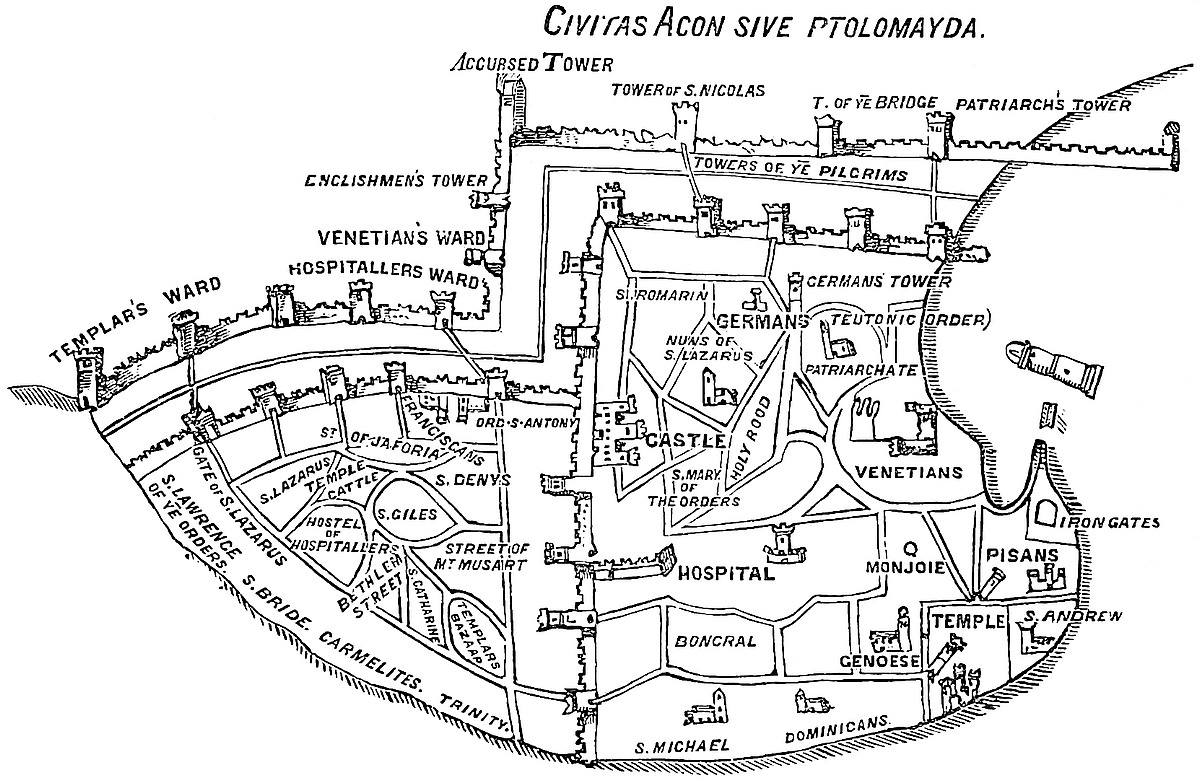
ACRE AS IT WAS WHEN LOST (A.D. 1291). FROM THE PLAN GIVEN BY MARINO SANUTO.
It is not clear that Theobald, though generally adopted, is the ecclesiastic’s proper name. It appears in different MSS. as Teald (G. T.), Ceabo for Teabo (Pauthier), Odoaldo (Crusca), and in the Riccardian as Thebaldus de Vice-comitibus de Placentia, which corresponds to Ramusio’s version. Most of the ecclesiastical chroniclers call him Tedaldus, some Thealdus. Tedaldo is a real name, occurring in Boccaccio. (Day iii. Novel 7.)
There is nothing in the old French texts to justify the usual statement that Marco was born after the departure of his father from Venice. All that the G. T. says is: “Meser Nicolau treuve que sa fame estoit morte, et les remès un filz de xv. anz que avoit à nom Marc,” and Pauthier’s text is to the same effect. Ramusio, indeed, has: “M. Nicolò trovò, che sua moglie era morta, la quale nella sua partita haveva partorito un figliuolo,” and the other versions that are based on Pipino’s seem all to have like statements.