Volume 1 — CHAPTER III.
Henry Yule translation
Description of the Greater Hermenia.
This is a great country. It begins at a city called Arzinga, at which they weave the best buckrams in the world. It possesses also the best baths from natural springs that are anywhere to be found.{1} The people of the country are Armenians, and are subject to the Tartar. There are many towns and villages in the country, but the noblest of their cities is Arzinga, which is the See of an Archbishop, and then Arziron and Arzizi.{2}
The country is indeed a passing great one, and in the summer it is frequented by the whole host of the Tartars of the Levant, because it then furnishes them with such excellent pasture for their cattle. But in winter the cold is past all bounds, so in that season they quit this country and go to a warmer region, where they find other good pastures. [At a castle called Paipurth, that you pass in going from Trebizond to Tauris, there is a very good silver mine.{3}]
And you must know that it is in this country of Armenia that the Ark of Noah exists on the top of a certain great mountain [on the summit of which snow is so constant that no one can ascend;{4} for the snow never melts, and is constantly added to by new falls. Below, however, the snow does melt, and runs down, producing such rich and abundant herbage that in summer cattle are sent to pasture from a long way round about, and it never fails them. The melting snow also causes a great amount of mud on the mountain].
The country is bounded on the south by a kingdom called Mosul, the people of which are Jacobite and Nestorian Christians, of whom I shall have more to tell you presently. On the north it is bounded by the Land of the Georgians, of whom also I shall speak. On the confines towards Georgiania there is a fountain from which oil springs in great abundance, insomuch that a hundred shiploads might be taken from it at one time. This oil is not good to use with food, but ’tis good to burn, and is also used to anoint camels that have the mange. People come from vast distances to fetch it, for in all the countries round about they have no other oil.{5}
Now, having done with Great Armenia, we will tell you of Georgiania.
The Buckrams of Arzinga are mentioned both by Pegolotti (circa 1340) and by Giov. d’Uzzano (1442). But what were they?
Buckram in the modern sense is a coarse open texture of cotton or hemp, loaded with gum, and used to stiffen certain articles of dress. But this was certainly not the mediæval sense. Nor is it easy to bring the mediæval uses of the term under a single explanation. Indeed Mr. Marsh suggests that probably two different words have coalesced. Fr.-Michel says that Bouqueran was at first applied to a light cotton stuff of the nature of muslin, and afterwards to linen, but I do not see that he makes out this history of the application. Douet d’Arcq, in his Comptes de l’Argenterie, etc., explains the word simply in the modern sense, but there seems nothing in his text to bear this out.
A quotation in Raynouard’s Romance Dictionary has “Vestirs de polpra e de bisso que est bocaran,” where Raynouard renders bisso as lin; a quotation in Ducange also makes Buckram the equivalent of Bissus; and Michel quotes from an inventory of 1365, “unam culcitram pinctam (qu. punctam?) albam factam de bisso aliter boquerant.”
Mr. Marsh again produces quotations, in which the word is used as a proverbial example of whiteness, and inclines to think that it was a bleached cloth with a lustrous surface.
It certainly was not necessarily linen. Giovanni Villani, in a passage which is curious in more ways than one, tells how the citizens of Florence established races for their troops, and, among other prizes, was one which consisted of a Bucherame di bambagine (of cotton). Polo, near the end of the Book (Bk. III. ch. xxxiv.), speaking of Abyssinia, says, according to Pauthier’s text: “Et si y fait on moult beaux bouquerans et autres draps de coton.” The G. T. is, indeed, more ambiguous: “Il hi se font maint biaus dras banbacin e bocaran” (cotton and buckram). When, however, he uses the same expression with reference to the delicate stuffs woven on the coast of Telingana, there can be no doubt that a cotton texture is meant, and apparently a fine muslin. (See Bk. III. ch. xviii.) Buckram is generally named as an article of price, chier bouquerant, rice boquerans, etc, but not always, for Polo in one passage (Bk. II. ch. xlv.) seems to speak of it as the clothing of the poor people of Eastern Tibet.
Plano Carpini says the tunics of the Tartars were either of buckram (bukeranum), of purpura (a texture, perhaps velvet), or of baudekin, a cloth of gold (pp. 614–615). When the envoys of the Old Man of the Mountain tried to bully St. Lewis, one had a case of daggers to be offered in defiance, another a bouqueran for a winding sheet (Joinville, p. 136.)
In accounts of materials for the use of Anne Boleyn in the time of her prosperity, bokeram frequently appears for “lyning and taynting” (?) gowns, lining sleeves, cloaks, a bed, etc., but it can scarcely have been for mere stiffening, as the colour of the buckram is generally specified as the same as that of the dress.
A number of passages seem to point to a quilted material. Boccaccio (Day viii. Novel 10) speaks of a quilt (coltre) of the whitest buckram of Cyprus, and Uzzano enters buckram quilts (coltre di Bucherame) in a list of Linajuoli, or linen-draperies. Both his handbook and Pegolotti’s state repeatedly that buckrams were sold by the piece or the half-score pieces—never by measure. In one of Michel’s quotations (from Baudouin de Sebourc) we have:
“Gaufer li fist premiers armer d’un auqueton Qui fu de bougherant et plaine de bon coton.”
Mr. Hewitt would appear to take the view that Buckram meant a quilted material; for, quoting from a roll of purchases made for the Court of Edward I., an entry for Ten Buckrams to make sleeves of, he remarks, “The sleeves appear to have been of pourpointerie,” i.e. quilting. (Ancient Armour, I. 240.)
This signification would embrace a large number of passages in which the term is used, though certainly not all. It would account for the mode or sale by the piece, and frequent use of the expression a buckram, for its habitual application to coltre or counterpanes, its use in the auqueton of Baudouin, and in the jackets of Falstaff’s “men in buckram,” as well as its employment in the frocks of the Mongols and Tibetans. The winter chapkan, or long tunic, of Upper India, a form of dress which, I believe, correctly represents that of the Mongol hosts, and is probably derived from them, is almost universally of quilted cotton.[1] This signification would also facilitate the transfer of meaning to the substance now called buckram, for that is used as a kind of quilting.
The derivation of the word is very uncertain. Reiske says it is Arabic, Abu-Kairám, “Pannus cum intextis figuris”; Wedgwood, attaching the modern meaning, that it is from It., bucherare, to pierce full of holes, which might be if bucherare could be used in the sense of puntare, or the French piquer; Marsh connects it with the bucking of linen; and D’Avezac thinks it was a stuff that took its name from Bokhara. If the name be local, as so many names of stuffs are, the French form rather suggests Bulgaria. [Heyd, II. 703, says that Buckram (Bucherame) was principally manufactured at Erzinjan (Armenia), Mush, and Mardin (Kurdistan), Ispahan (Persia), and in India, etc. It was shipped to the west at Constantinople, Satalia, Acre, and Famagusta; the name is derived from Bokhara.—H. C.]
(Della Decima, III. 18, 149, 65, 74, 212, etc.; IV. 4, 5, 6, 212; Reiske’s Notes to Const. Porphyrogen. II.; D’Avezac, p. 524; Vocab. Univ. Ital.; Franc.-Michel, Recherches, etc. II. 29 seqq.; Philobiblon Soc. Miscell. VI.; Marsh’s Wedgwood’s Etym. Dict. sub voce.)
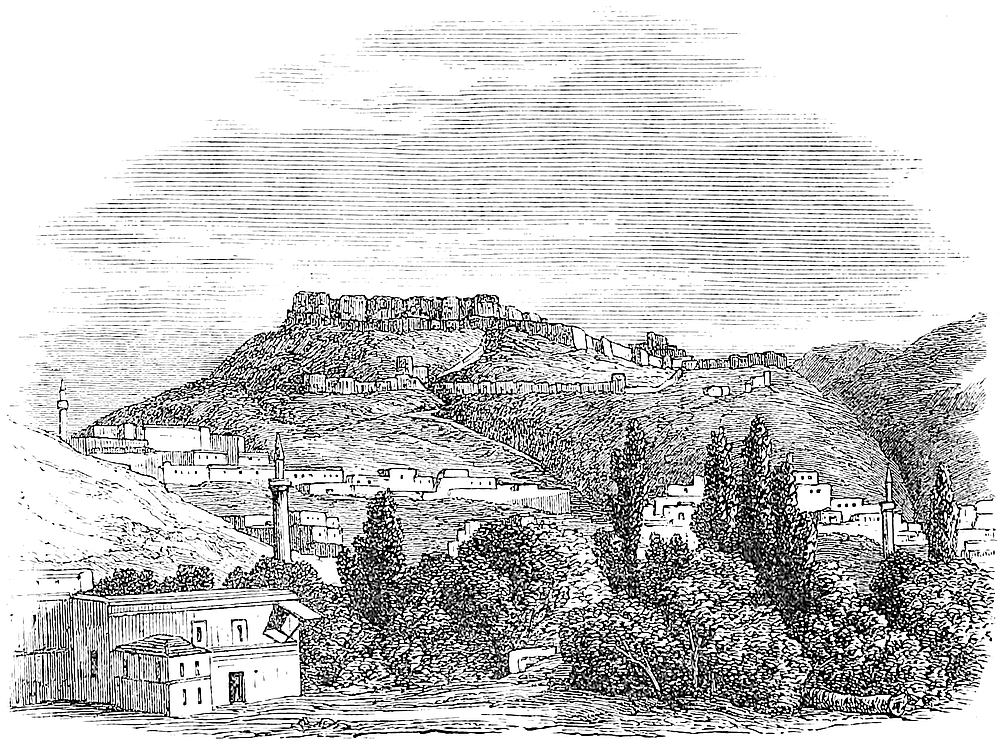
Castle of Baiburt.
Arjish is the ancient Arsissa, which gave the Lake Van one of its names. It is now little more than a decayed castle, with a village inside.
Notices of Kuniyah, Kaisariya, Sivas, Arzan-ar-Rumi, Arzangan, and Arjish, will be found in Polo’s contemporary Abulfeda. (See Büsching, IV. 303–311.)
Ararat (16,953 feet) was ascended, first by Prof. Parrot, September 1829; by Spasski Aotonomoff, August 1834; by Behrens, 1835; by Abich, 1845; by Seymour in 1848; by Khodzko, Khanikoff, and others, for trigonometrical and other scientific purposes, in August 1850. It is characteristic of the account from which I take these notes (Longrimoff, in Bull. Soc. Géog. Paris, sér. IV. tom. i. p. 54), that whilst the writer’s countrymen, Spasski and Behrens, were “moved by a noble curiosity,” the Englishman is only admitted to have “gratified a tourist’s whim”!
[The phenomenal rise in the production of the Baku oil-fields between 1890–1900, may be seen at a glance from the Official Statistics where the total output for 1900 is given as 601,000,000 poods, about 9,500,000 tons. (Cf. Petroleum, No. 42, vol. ii. p. 13.)]