EXPLANATORY LIST OF ILLUSTRATIONS TO VOLUME I. (continued 3)
Henry Yule translation
It then describes Armein Bec (Little Armenia), Armein Mor (Great Armenia), Musul, Taurisius, Persida, Camandi, and so forth. The last chapter is that on Abaschia:—
“Abaschia also is an extensive country, under the government of Seven Kings, four of whom worship the true God, and each of them wears a golden cross on the forehead; and they are valiant in battle, having been brought up fighting against the Gentiles of the other three kings, who are Unbelievers and Idolaters. And the kingdom of Aden; a Soudan rules over them.
“The king of Abaschia once took a notion to make a pilgrimage to the Sepulchre of Jesus. ‘Not at all,’ said his nobles and warriors to him, ‘for we should be afraid lest the infidels through whose territories you would have to pass, should kill you. There is a Holy Bishop with you,’ said they; ‘send him to the Sepulchre of Jesus, and much gold with him’”——
The rest is wanting.
XI. Some Estimate of the Character of Polo and His Book.
66. That Marco Polo has been so universally recognised as the King of Mediæval Travellers is due rather to the width of his experience, Grounds of Polo’s pre-eminence among mediæval travellers.the vast compass of his journeys, and the romantic nature of his personal history, than to transcendent superiority of character or capacity.
The generation immediately preceding his own has bequeathed to us, in the Report of the Franciscan Friar William de Rubruquis,[1] on the Mission with which St. Lewis charged him to the Tartar Courts, the narrative of one great journey, which, in its rich detail, its vivid pictures, its acuteness of observation and strong good sense, seems to me to form a Book of Travels of much higher claims than any one series of Polo’s chapters; a book, indeed, which has never had justice done to it, for it has few superiors in the whole Library of Travel.
Enthusiastic Biographers, beginning with Ramusio, have placed Polo on the same platform with Columbus. But where has our Venetian Traveller left behind him any trace of the genius and lofty enthusiasm, the ardent and justified previsions which mark the great Admiral as one of the lights of the human race?[2] It is a juster praise that the spur which his Book eventually gave to geographical studies, and the beacons which it hung out at the Eastern extremities of the Earth helped to guide the aims, though scarcely to kindle the fire, of the greater son of the rival Republic. His work was at least a link in the Providential chain which at last dragged the New World to light.[3]
67. Surely Marco’s real, indisputable, and, in their kind, unique claims to glory may suffice! His true claims to glory.He was the first Traveller to trace a route across the whole longitude of Asia, naming and describing kingdom after kingdom which he had seen with his own eyes; the Deserts of Persia, the flowering plateaux and wild gorges of Badakhshan, the jade-bearing rivers of Khotan, the Mongolian Steppes, cradle of the power that had so lately threatened to swallow up Christendom, the new and brilliant Court that had been established at Cambaluc: The first Traveller to reveal China in all its wealth and vastness, its mighty rivers, its huge cities, its rich manufactures, its swarming population, the inconceivably vast fleets that quickened its seas and its inland waters; to tell us of the nations on its borders with all their eccentricities of manners and worship; of Tibet with its sordid devotees; of Burma with its golden pagodas and their tinkling crowns; of Laos, of Siam, of Cochin China, of Japan, the Eastern Thule, with its rosy pearls and golden-roofed palaces; the first to speak of that Museum of Beauty and Wonder, still so imperfectly ransacked, the Indian Archipelago, source of those aromatics then so highly prized and whose origin was so dark; of Java the Pearl of Islands; of Sumatra with its many kings, its strange costly products, and its cannibal races; of the naked savages of Nicobar and Andaman; of Ceylon the Isle of Gems with its Sacred Mountain and its Tomb of Adam; of India the Great, not as a dream-land of Alexandrian fables, but as a country seen and partially explored, with its virtuous Brahmans, its obscene ascetics, its diamonds and the strange tales of their acquisition, its sea-beds of pearl, and its powerful sun; the first in mediæval times to give any distinct account of the secluded Christian Empire of Abyssinia, and the semi-Christian Island of Socotra; to speak, though indeed dimly, of Zangibar with its negroes and its ivory, and of the vast and distant Madagascar, bordering on the Dark Ocean of the South, with its Ruc and other monstrosities; and, in a remotely opposite region, of Siberia and the Arctic Ocean, of dog-sledges, white bears, and reindeer-riding Tunguses.
That all this rich catalogue of discoveries should belong to the revelations of one Man and one Book is surely ample ground enough to account for and to justify the Author’s high place in the roll of Fame, and there can be no need to exaggerate his greatness, or to invest him with imaginary attributes.[4]
68. What manner of man was Ser Marco? It is a question hard to answer. His personal attributes seen but dimly. Some critics cry out against personal detail in books of Travel; but as regards him who would not welcome a little more egotism! In his Book impersonality is carried to excess; and we are often driven to discern by indirect and doubtful indications alone, whether he is speaking of a place from personal knowledge or only from hearsay. In truth, though there are delightful exceptions, and nearly every part of the book suggests interesting questions, a desperate meagreness and baldness does extend over considerable tracts of the story. In fact his book reminds us sometimes of his own description of Khorasan:—“On chevauche par beaus plains et belles costieres, là où il a moult beaus herbages et bonne pasture et fruis assez.... Et aucune fois y treuve l’en un desert de soixante milles ou de mains, esquels desers ne treuve l’en point d’eaue; mais la convient porter o lui!”
Still, some shadowy image of the man may be seen in the Book; a practical man, brave, shrewd, prudent, keen in affairs, and never losing his interest in mercantile details, very fond of the chase, sparing of speech; with a deep wondering respect for Saints, even though they be Pagan Saints, and their asceticism, but a contempt for Patarins and such like, whose consciences would not run in customary grooves, and on his own part a keen appreciation of the World’s pomps and vanities. See, on the one hand, his undisguised admiration of the hard life and long fastings of Sakya Muni; and on the other how enthusiastic he gets in speaking of the great Kaan’s command of the good things of the world, but above all of his matchless opportunities of sport![5]
Of humour there are hardly any signs in his Book. His almost solitary joke (I know but one more, and it pertains to the οὐκ ἀνήκοντα) occurs in speaking of the Kaan’s paper-money when he observes that Kúblái might be said to have the true Philosopher’s Stone, for he made his money at pleasure out of the bark of Trees.[6] Even the oddest eccentricities of outlandish tribes scarcely seem to disturb his gravity; as when he relates in his brief way of the people called Gold-Teeth on the frontier of Burma, that ludicrous custom which Mr. Tylor has so well illustrated under the name of the Couvade. There is more savour of laughter in the few lines of a Greek Epic, which relate precisely the same custom of a people on the Euxine:—
——“In the Tibarenian Land When some good woman bears her lord a babe, ’Tis he is swathed and groaning put to bed; Whilst she, arising, tends his baths, and serves Nice possets for her husband in the straw.”[7]
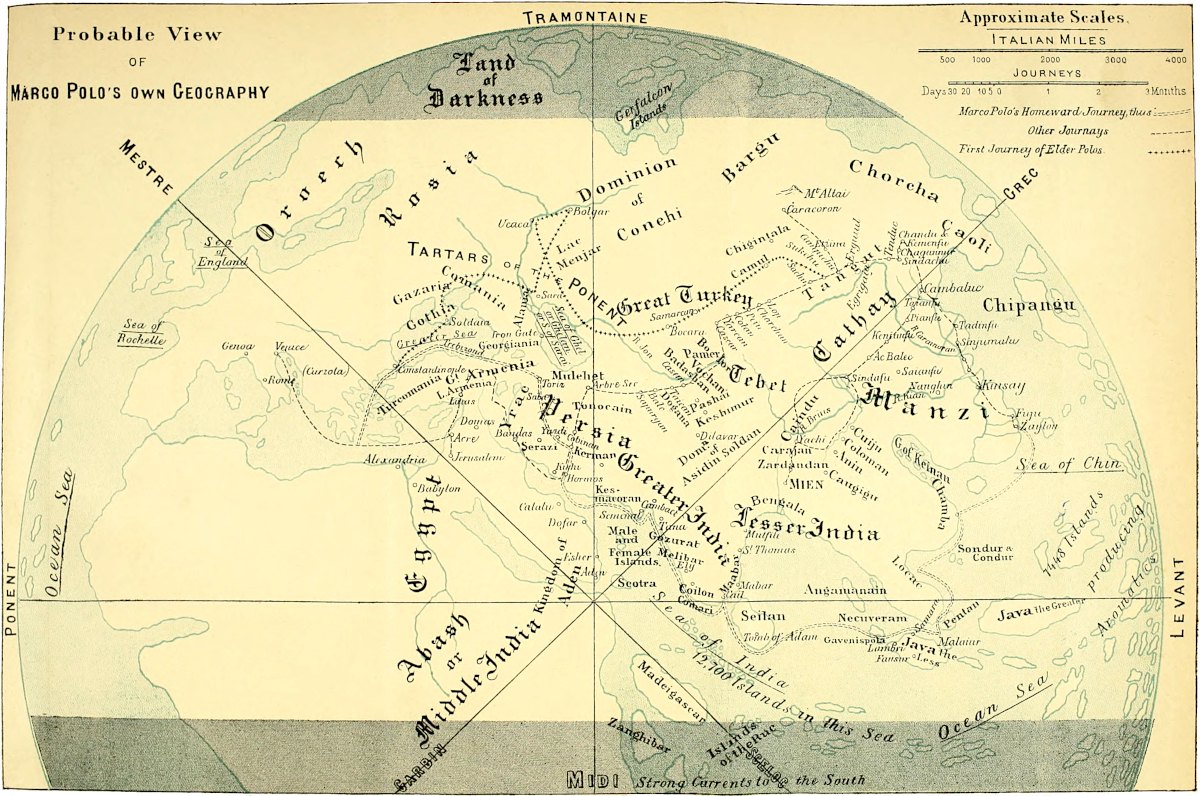
Probable View of Marco Polo’s Own Geography
Lit. Frauenfelder, Palermo
69. Of scientific notions, such as we find in the unveracious Maundevile, we have no trace in truthful Marco. The former, “lying with a circumstance,”Absence of scientific notions. tells us boldly that he was in 33° of South Latitude; the latter is full of wonder that some of the Indian Islands where he had been lay so far to the south that you lost sight of the Pole-star. When it rises again on his horizon he estimates the Latitude by the Pole-star’s being so many cubits high. So the gallant Baber speaks of the sun having mounted spear-high when the onset of battle began at Paniput. Such expressions convey no notion at all to such as have had their ideas sophisticated by angular perceptions of altitude, but similar expressions are common among Orientals,[8] and indeed I have heard them from educated Englishmen. In another place Marco states regarding certain islands in the Northern Ocean that they lie so very far to the north that in going thither one actually leaves the Pole-star a trifle behind towards the south; a statement to which we know only one parallel, to wit, in the voyage of that adventurous Dutch skipper who told Master Moxon, King Charles II.’s Hydrographer, that he had sailed two degrees beyond the Pole!
70. The Book, however, is full of bearings and distances, and I have thought it worth while to construct a map from its indications, in order to get some approximation toMap constructed on Polo’s data. Polo’s own idea of the face of that world which he had traversed so extensively. There are three allusions to maps in the course of his work (II. 245, 312, 424).
In his own bearings, at least on land journeys, he usually carries us along a great general traverse line, without much caring about small changes of direction. Thus on the great outward journey from the frontier of Persia to that of China the line runs almost continuously “entre Levant et Grec” or E.N.E. In his journey from Cambaluc or Peking to Mien or Burma, it is always Ponent or W.; and in that from Peking to Zayton in Fo-kien, the port of embarkation for India, it is Sceloc or S.E. The line of bearings in which he deviates most widely from truth is that of the cities on the Arabian Coast from Aden to Hormuz, which he makes to run steadily vers Maistre or N.W., a conception which it has not been very easy to realise on the map.[9]
71. In the early part of the Book we are told that Marco acquired several of the languages current in the Mongol Empire,Singular omissions of Polo in regard to China; Historical inaccuracies. and no less than four written characters. We have discussed what these are likely to have been (i. pp. 28–29), and have given a decided opinion that Chinese was not one of them. Besides intrinsic improbability, and positive indications of Marco’s ignorance of Chinese, in no respect is his book so defective as in regard to Chinese manners and peculiarities. The Great Wall is never mentioned, though we have shown reason for believing that it was in his mind when one passage of his book was dictated.[10] The use of Tea, though he travelled through the Tea districts of Fo-kien, is never mentioned;[11] the compressed feet of the women and the employment of the fishing cormorant (both mentioned by Friar Odoric, the contemporary of his later years), artificial egg-hatching, printing of books (though the notice of this art seems positively challenged in his account of paper-money), besides a score of remarkable arts and customs which one would have expected to recur to his memory, are never alluded to. Neither does he speak of the great characteristic of the Chinese writing. It is difficult to account for these omissions, especially considering the comparative fulness with which he treats the manners of the Tartars and of the Southern Hindoos; but the impression remains that his associations in China were chiefly with foreigners. Wherever the place he speaks of had a Tartar or Persian name he uses that rather than the Chinese one. Thus Cathay, Cambaluc, Pulisanghin, Tangut, Chagannor, Saianfu, Kenjanfu, Tenduc, Acbalec, Carajan, Zardandan, Zayton, Kemenfu, Brius, Caramoran, Chorcha, Juju, are all Mongol, Turki, or Persian forms, though all have Chinese equivalents.[12]
In reference to the then recent history of Asia, Marco is often inaccurate, e.g. in his account of the death of Chinghiz, in the list of his successors, and in his statement of the relationship between notable members of that House.[13] But the most perplexing knot in the whole book lies in the interesting account which he gives of the Siege of Sayanfu or Siang-yang, during the subjugation of Southern China by Kúblái. I have entered on this matter in the notes (vol. ii. p. 167), and will only say here that M. Pauthier’s solution of the difficulty is no solution, being absolutely inconsistent with the story as told by Marco himself, and that I see none; though I have so much faith in Marco’s veracity that I am loath to believe that the facts admit of no reconciliation.
Our faint attempt to appreciate some of Marco’s qualities, as gathered from his work, will seem far below the very high estimates that have been pronounced, not only by some who have delighted rather to enlarge upon his frame than to make themselves acquainted with his work,[14] but also by persons whose studies and opinions have been worthy of all respect. Our estimate, however, does not abate a jot of our intense interest in his Book and affection for his memory. And we have a strong feeling that, owing partly to his reticence, and partly to the great disadvantages under which the Book was committed to writing, we have in it a singularly imperfect image of the Man.
72. A question naturally suggests itself, how far Polo’s narrative, at Was Polo’s Book materially affected by the Scribe Rusticiano? least in its expression, was modified by passing under the pen of a professed littérateur of somewhat humble claims, such as Rusticiano was. The case is not a singular one, and in our own day the ill-judged use of such assistance has been fatal to the reputation of an adventurous Traveller.
We have, however, already expressed our own view that in the Geographic Text we have the nearest possible approach to a photographic impression of Marco’s oral narrative. If there be an exception to this we should seek it in the descriptions of battles, in which we find the narrator to fall constantly into a certain vein of bombastic commonplaces, which look like the stock phrases of a professed romancer, and which indeed have a strong resemblance to the actual phraseology of certain metrical romances.[15] Whether this feature be due to Rusticiano I cannot say, but I have not been able to trace anything of the same character in a cursory inspection of some of his romance-compilations. Still one finds it impossible to conceive of our sober and reticent Messer Marco pacing the floor of his Genoese dungeon, and seven times over rolling out this magniloquent bombast, with sufficient deliberation to be overtaken by the pen of the faithful amanuensis!
73. On the other hand, though Marco, who had left home at fifteen years of age, naturally shows very few signs of reading, Marco’s reading embraced the Alexandrian Romances. Examples.there are indications that he had read romances, especially those dealing with the fabulous adventures of Alexander.
To these he refers explicitly or tacitly in his notices of the Irongate and of Gog and Magog, in his allusions to the marriage of Alexander with Darius’s daughter, and to the battle between those two heroes, and in his repeated mention of the Arbre Sol or Arbre Sec on the Khorasan frontier.
The key to these allusions is to be found in that Legendary History of Alexander, entirely distinct from the true history of the Macedonian Conqueror, which in great measure took the place of the latter in the imagination of East and West for more than a thousand years. This fabulous history is believed to be of Græco-Egyptian origin, and in its earliest extant compiled form, in the Greek of the Pseudo-Callisthenes, can be traced back to at least about A.D. 200. From the Greek its marvels spread eastward at an early date; some part at least of their matter was known to Moses of Chorene, in the 5th century;[16] they were translated into Armenian, Arabic, Hebrew, and Syriac; and were reproduced in the verses of Firdusi and various other Persian Poets; spreading eventually even to the Indian Archipelago, and finding utterance in Malay and Siamese. At an early date they had been rendered into Latin by Julius Valerius; but this work had probably been lost sight of, and it was in the 10th century that they were re-imported from Byzantium to Italy by the Archpriest Leo, who had gone as Envoy to the Eastern Capital from John Duke of Campania.[17] Romantic histories on this foundation, in verse and prose, became diffused in all the languages of Western Europe, from Spain to Scandinavia, rivalling in popularity the romantic cycles of the Round Table or of Charlemagne. Nor did this popularity cease till the 16th century was well advanced.
The heads of most of the Mediæval Travellers were crammed with these fables as genuine history.[18] And by the help of that community of legend on this subject which they found wherever Mahomedan literature had spread, Alexander Magnus was to be traced everywhere in Asia. Friar Odoric found Tana, near Bombay, to be the veritable City of King Porus; John Marignolli’s vainglory led him to imitate King Alexander in setting up a marble column “in the corner of the world over against Paradise,” i.e. somewhere on the coast of Travancore; whilst Sir John Maundevile, with a cheaper ambition, borrowed wonders from the Travels of Alexander to adorn his own. Nay, even in after days, when the Portuguese stumbled with amazement on those vast ruins in Camboja, which have so lately become familiar to us through the works of Mouhot, Thomson, and Garnier, they ascribed them to Alexander.[19]
Prominent in all these stories is the tale of Alexander’s shutting up a score of impure nations, at the head of which were Gog and Magog, within a barrier of impassable mountains, there to await the latter days; a legend with which the disturbed mind of Europe not unnaturally connected that cataclysm of unheard-of Pagans that seemed about to deluge Christendom in the first half of the 13th century. In these stories also the beautiful Roxana, who becomes the bride of Alexander, is Darius’s daughter, bequeathed to his arms by the dying monarch. Conspicuous among them again is the Legend of the Oracular Trees of the Sun and Moon, which with audible voice foretell the place and manner of Alexander’s death. With this Alexandrian legend some of the later forms of the story had mixed up one of Christian origin about the Dry Tree, L’Arbre Sec. And they had also adopted the Oriental story of the Land of Darkness and the mode of escape from it, which Polo relates at p. 484 of vol. ii.
74. We have seen in the most probable interpretation of the nickname Milioni that Polo’s popular reputation in his lifetime was of aInjustice long done to Polo. Singular modern instance. questionable kind; and a contemporary chronicler, already quoted, has told us how on his death-bed the Traveller was begged by anxious friends to retract his extraordinary stories.[20] A little later one who copied the Book “per passare tempo e malinconia” says frankly that he puts no faith in it.[21] Sir Thomas Brown is content “to carry a wary eye” in reading “Paulus Venetus”; but others of our countrymen in the last century express strong doubts whether he ever was in Tartary or China.[22] Marden’s edition might well have extinguished the last sparks of scepticism.[23] Hammer meant praise in calling Polo “der Vater orientalischer Hodogetik,” in spite of the uncouthness of the eulogy. But another grave German writer, ten years after Marsden’s publication, put forth in a serious book that the whole story was a clumsy imposture![24]
XII. Contemporary Recognition of Polo and his Book.
75. But we must return for a little to Polo’s own times. Ramusio states, as we have seen,How far was there diffusion of his Book in his own day? that immediately after the first commission of Polo’s narrative to writing (in Latin as he imagined), many copies of it were made, it was translated into the vulgar tongue, and in a few months all Italy was full of it.
The few facts that we can collect do not justify this view of the rapid and diffused renown of the Traveller and his Book. The number of MSS. of the latter dating from the 14th century is no doubt considerable, but a large proportion of these are of Pipino’s condensed Latin Translation, which was not put forth, if we can trust Ramusio, till 1320, and certainly not much earlier. The whole number of MSS. in various languages that we have been able to register, amounts to about eighty. I find it difficult to obtain statistical data as to the comparative number of copies of different works existing in manuscript. With Dante’s great Poem, of which there are reckoned close upon 500 MSS.,[1] comparison would be inappropriate. But of the Travels of Friar Odoric, a poor work indeed beside Marco Polo’s, I reckoned thirty-nine MSS., and could now add at least three more to the list. [I described seventy-three in my edition of Odoric.—H. C.] Also I find that of the nearly contemporary work of Brunetto Latini, the Tresor, a sort of condensed Encyclopædia of knowledge, but a work which one would scarcely have expected to approach the popularity of Polo’s Book, the Editor enumerates some fifty MSS. And from the great frequency with which one encounters in Catalogues both MSS. and early printed editions of Sir John Maundevile, I should suppose that the lying wonders of our English Knight had a far greater popularity and more extensive diffusion than the veracious and more sober marvels of Polo.[2] To Southern Italy Polo’s popularity certainly does not seem at any time to have extended. I cannot learn that any MS. of his Book exists in any Library of the late Kingdom of Naples or in Sicily.[3]
Dante, who lived for twenty-three years after Marco’s work was written, and who touches so many things in the seen and unseen Worlds, never alludes to Polo, nor I think to anything that can be connected with his Book. I believe that no mention of Cathay occurs in the Divina Commedia. That distant region is indeed mentioned more than once in the poems of a humbler contemporary, Francesco da Barberino, but there is nothing in his allusions besides this name to suggest any knowledge of Polo’s work.[4]
Neither can I discover any trace of Polo or his work in that of his contemporary and countryman, Marino Sanudo the Elder, though this worthy is well acquainted with the somewhat later work of Hayton, and many of the subjects which he touches in his own book would seem to challenge a reference to Marco’s labours.
76. Of contemporary or nearly contemporary references to our Traveller by Contemporary references to Polo. name, the following are all that I can produce, and none of them are new.
First there is the notice regarding his presentation of his book to Thibault de Cepoy, of which we need say no more (supra, p. 68).
Next there is the Preface to Friar Pipino’s Translation, which we give at length in the Appendix (E) to these notices. The phraseology of this appears to imply that Marco was still alive, and this agrees with the date assigned to the work by Ramusio. Pipino was also the author of a Chronicle, of which a part was printed by Muratori, and this contains chapters on the Tartar wars, the destruction of the Old Man of the Mountain, etc., derived from Polo. A passage not printed by Muratori has been extracted by Prof. Bianconi from a MS. of this Chronicle in the Modena Library, and runs as follows:—
“The matters which follow, concerning the magnificence of the Tartar Emperors, whom in their language they call Cham as we have said, are related by Marcus Paulus the Venetian in a certain Book of his which has been translated by me into Latin out of the Lombardic Vernacular. Having gained the notice of the Emperor himself and become attached to his service, he passed nearly 27 years in the Tartar countries.”[5]
Again we have that mention of Marco by Friar Jacopo d’Acqui, which we have quoted in connection with his capture by the Genoese, at p. 54.[6] And the Florentine historian Giovanni Villani,[7] when alluding to the Tartars, says:—
“Let him who would make full acquaintance with their history examine the book of Friar Hayton, Lord of Colcos in Armenia, which he made at the instance of Pope Clement V., and also the Book called Milione which was made by Messer Marco Polo of Venice, who tells much about their power and dominion, having spent a long time among them. And so let us quit the Tartars and return to our subject, the History of Florence.”[8]
77. Lastly, we learn from a curious passage in a medical work by Pietro of Abano, a celebrated physician and philosopher,Further contemporary references. and a man of Polo’s own generation, that he was personally acquainted with the Traveller. In a discussion on the old notion of the non-habitability of the Equatorial regions, which Pietro controverts, he says:[9]
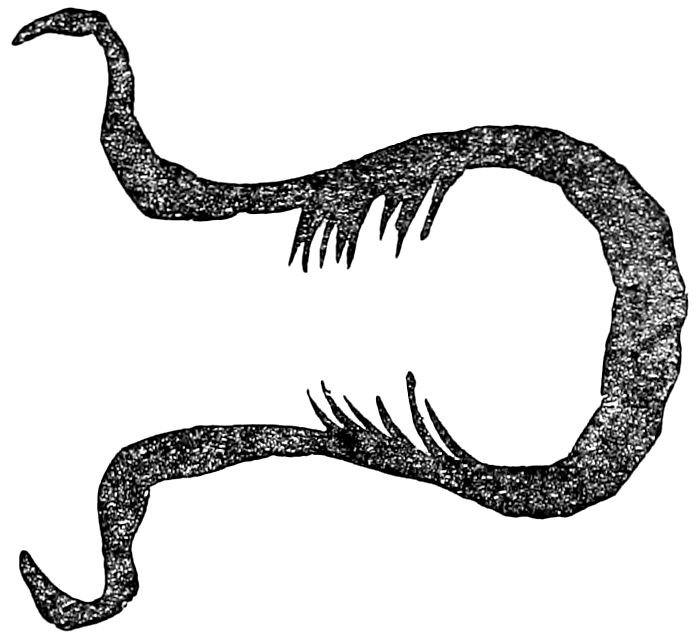
Star at the Antarctic as sketched by Marco Polo[10].
“In the country of the Zinghi there is seen a star as big as a sack. I know a man who has seen it, and he told me it had a faint light like a piece of a cloud, and is always in the south.[11] I have been told of this and other matters by Marco the Venetian, the most extensive traveller and the most diligent inquirer whom I have ever known. He saw this same star under the Antarctic; he described it as having a great tail, and drew a figure of it thus. He also told me that he saw the Antarctic Pole at an altitude above the earth apparently equal to the length of a soldier’s lance, whilst the Arctic Pole was as much below the horizon. ’Tis from that place, he says, that they export to us camphor, lign-aloes, and brazil. He says the heat there is intense, and the habitations few. And these things he witnessed in a certain island at which he arrived by Sea. He tells me also that there are (wild?) men there, and also certain very great rams that have very coarse and stiff wool just like the bristles of our pigs.”[12]
In addition to these five I know no other contemporary references to Polo, nor indeed any other within the 14th century, though such there must surely be, excepting in a Chronicle written after the middle of that century by John of Ypres, Abbot of St. Bertin, otherwise known as Friar John the Long, and himself a person of very high merit in the history of Travel, as a precursor of the Ramusios, Hakluyts and Purchases, for he collected together and translated (when needful) into French all of the most valuable works of Eastern Travel and Geography produced in the age immediately preceding his own.[13] In his Chronicle the Abbot speaks at some length of the adventures of the Polo Family, concluding with a passage to which we have already had occasion to refer:
“And so Messers Nicolaus and Maffeus, with certain Tartars, were sent a second time to these parts; but Marcus Pauli was retained by the Emperor and employed in his military service, abiding with him for a space of 27 years. And the Cham, on account of his ability despatched him upon affairs of his to various parts of Tartary and India and the Islands, on which journeys he beheld many of the marvels of those regions. And concerning these he afterwards composed a book in the French vernacular, which said Book of Marvels, with others of the same kind, we do possess.” (Thesaur. Nov. Anecdot. III. 747.)
78. There is, however, a notable work which is ascribed to a rather early date in the 14th century, and which, though it contains no reference to Polo by name, shows a thorough acquaintance with his book, and borrows themes largely from it.Curious borrowings from Polo in the Romance of Bauduin de Sebourc. This is the poetical Romance of Bauduin de Sebourc, an exceedingly clever and vivacious production, partaking largely of that bantering, half-mocking spirit which is, I believe, characteristic of many of the later mediæval French Romances.[14] Bauduin is a knight who, after a very wild and loose youth, goes through an extraordinary series of adventures, displaying great faith and courage, and eventually becomes King of Jerusalem. I will cite some of the traits evidently derived from our Traveller, which I have met with in a short examination of this curious work.
Bauduin, embarked on a dromond in the Indian Sea, is wrecked in the territory of Baudas, and near a city called Falise, which stands on the River of Baudas. The people of this city were an unbelieving race.
“Il ne créoient Dieu, Mahon, né Tervogant, Ydole, cruchéfis, déable, né tirant.” P. 300.
Their only belief was this, that when a man died a great fire should be made beside his tomb, in which should be burned all his clothes, arms, and necessary furniture, whilst his horse and servant should be put to death, and then the dead man would have the benefit of all these useful properties in the other world.[15] Moreover, if it was the king that died—
“Sé li rois de la terre i aloit trespassant, * * * * * Si fasoit-on tuer, .viij. jour en un tenant, Tout chiaus c’on encontroit par la chité passant, Pour tenir compaingnie leur ségnor soffisant. Telle estoit le créanche ou païs dont je cant!”[16] P. 301.
Baudin arrives when the king has been dead three days, and through dread of this custom all the people of the city are shut up in their houses. He enters an inn, and helps himself to a vast repast, having been fasting for three days. He is then seized and carried before the king, Polibans by name. We might have quoted this prince at p. 87 as an instance of the diffusion of the French tongue:
“Polibans sot Fransois, car on le doctrina: j. renoiés de Franche .vij. ans i demora, Qui li aprist Fransois, si que bel en parla.” P. 309.
Bauduin exclaims against their barbarous belief, and declares the Christian doctrine to the king, who acknowledges good points in it, but concludes:
“Vassaus, dist Polibans, à le chière hardie, Jà ne crerrai vou Dieux, à nul jour de ma vie; Né vostre Loy ne vaut une pomme pourie!” P. 311.
Bauduin proposes to prove his Faith by fighting the prince, himself unarmed, the latter with all his arms. The prince agrees, but is rather dismayed at Bauduin’s confidence, and desires his followers, in case of his own death, to burn with him horses, armour, etc., asking at the same time which of them would consent to burn along with him, in order to be his companions in the other world:
“Là en i ot .ije. dont cascuns s’escria: Nous morons volentiers, quant vo corps mort sara!”[17] P. 313.
Bauduin’s prayer for help is miraculously granted; Polibans is beaten, and converted by a vision. He tells Bauduin that in his neighbourhood, beyond Baudas—
“ou .v. liewes, ou .vi. Ché un felles prinches, orgoellieus et despis; De la Rouge-Montaingne est Prinches et Marchis. Or vous dirai comment il a ses gens nouris: Je vous di que chius Roys a fait un Paradis Tant noble et gratieus, et plain de tels déliis, * * * * * Car en che Paradis est un riex establis, Qui se partist en trois, en che noble pourpris: En l’un coert li clarés, d’espises bien garnis; Et en l’autre li miés, qui les a resouffis; Et li vins di pieument i queurt par droit avis— * * * * * Il n’i vente, né gèle. Che liés est de samis, De riches dras de soie, bien ouvrés à devis. Et aveukes tout che que je chi vous devis, I a .ije. puchelles qui moult ont cler les vis, Carolans et tresquans, menans gales et ris. Et si est li dieuesse, dame et suppellatis, Qui doctrine les autres et en fais et en dis, Celle est la fille au Roy c’on dist des Haus-Assis.”[18] Pp. 319–320.
This Lady Ivorine, the Old Man’s daughter, is described among other points as having—
“Les iex vairs com faucons, nobles et agentis.”[19] P. 320.
The King of the Mountain collects all the young male children of the country, and has them brought up for nine or ten years:
“Dedens un lieu oscur: là les met-on toudis Aveukes males bestes; kiens, et cas, et soris, Culoères, et lisaerdes, escorpions petis. Là endroit ne peut nuls avoir joie, né ris.” Pp. 320–321.
And after this dreary life they are shown the Paradise, and told that such shall be their portion if they do their Lord’s behest.
“S’il disoit à son homme: ‘Va-t-ent droit à Paris; Si me fier d’un coutel le Roy de Saint Denis, Jamais n’aresteroit, né par nuit né par dis, S’aroit tué le Roy, voïant tous ches marchis; Et déuist estre à fources traïnés et mal mis.’” P. 321.
Bauduin determines to see this Paradise and the lovely Ivorine. The road led by Baudas:
“Or avoit à che tamps, sé l’istoire ne ment, En le chit de Baudas Kristiens jusqu’à cent; Qui manonent illoec par tréu d’argent, Que cascuns cristiens au Roy-Calife rent. Li pères du Calife, qui régna longement, Ama les Crestiens, et Dieu primièrement: * * * * * Et lor fist establir. j. monstier noble et gent, Où Crestien faisoient faire lor sacrement. Une mout noble pière lor donna proprement, Où on avoit posé Mahon moult longement.”[20] P. 322.
The story is, in fact, that which Marco relates of Samarkand.[21] The Caliph dies. His son hates the Christians. His people complain of the toleration of the Christians and their minister; but he says his father had pledged him not to interfere, and he dared not forswear himself. If, without doing so, he could do them an ill turn, he would gladly. The people then suggest their claim to the stone:
“Or leur donna vos pères, dont che fu mesprisons. Ceste pierre, biaus Sire, Crestiens demandons: Il ne le porront rendre, pour vrai le vous disons, Si li monstiers n’est mis et par pièches et par mons; Et s’il estoit desfais, jamais ne le larons Refaire chi-endroit. Ensément averons Faites et acomplies nostres ententions.” P. 324.
The Caliph accordingly sends for Maistre Thumas, the Priest of the Christians, and tells him the stone must be given up:
“Il a .c. ans ut plus c’on i mist à solas Mahon, le nostre Dieu: dont che n’est mie estas Que li vous monstiers soit fais de nostre harnas!” P. 324.
Master Thomas, in great trouble, collects his flock, mounts the pulpit, and announces the calamity. Bauduin and his convert Polibans then arrive. Bauduin recommends confession, fasting, and prayer. They follow his advice, and on the third day the miracle occurs:
“L’escripture le dist, qui nous achertéfie Que le pierre Mahon, qui ou mur fut fiquie, Sali hors du piler, coi que nul vous en die, Droit enmi le monstier, c’onques ne fut brisie. Et demoura li traus, dont le pière ert widie, Sans pière est sans quailliel, à cascune partie; Chou deseure soustient, par divine maistrie, Tout en air proprement, n’el tenés a falie. Encore le voit-on en ichelle partie: Qui croire ne m’en voelt, si voist; car je l’en prie!” P. 327.
The Caliph comes to see, and declares it to be the Devil’s doing. Seeing Polibans, who is his cousin, he hails him, but Polibans draws back, avowing his Christian faith. The Caliph in a rage has him off to prison. Bauduin becomes very ill, and has to sell his horse and arms. His disease is so offensive that he is thrust out of his hostel, and in his wretchedness sitting on a stone he still avows his faith, and confesses that even then he has not received his deserts. He goes to beg in the Christian quarter, and no one gives to him; but still his faith and love to God hold out:
“Ensément Bauduins chelle rue cherqua, Tant qu’à .j. chavetier Bauduins s’arresta, Qui chavates cousoit; son pain en garigna: Jones fu et plaisans, apertement ouvra. Bauduins le regarde, c’onques mot ne parla.” P. 334.
The cobler is charitable, gives him bread, shoes, and a grey coat that was a foot too short. He then asks Bauduin if he will not learn his trade; but that is too much for the knightly stomach:
“Et Bauduins respont, li preus et li membrus: J’ameroie trop miex que je fuisse pendus!” P. 335.
The Caliph now in his Council expresses his vexation about the miracle, and says he does not know how to disprove the faith of the Christians. A very sage old Saracen who knew Hebrew, and Latin, and some thirty languages, makes a suggestion, which is, in fact, that about the moving of the Mountain, as related by Marco Polo.[22] Master Thomas is sent for again, and told that they must transport the high mountain of Thir to the valley of Joaquin, which lies to the westward. He goes away in new despair and causes his clerk to sonner le clocke for his people. Whilst they are weeping and wailing in the church, a voice is heard desiring them to seek a certain holy man who is at the good cobler’s, and to do him honour. God at his prayer will do a miracle. They go in procession to Bauduin, who thinks they are mocking him. They treat him as a saint, and strive to touch his old coat. At last he consents to pray along with the whole congregation.
The Caliph is in his palace with his princes, taking his ease at a window. Suddenly he starts up exclaiming:
“‘Seignour, par Mahoumet que j’aoure et tieng chier, Le Mont de Thir enportent le déable d’enfeir!’ Li Califes s’écrie: ‘Seignour, franc palasin, Voïés le Mont de Thir qui ch’est mis au chemin! Vés-le-là tout en air, par mon Dieu Apolin; Jà bientost le verrons ens ou val Joaquin!’” P. 345.
The Caliph is converted, releases Polibans, and is baptised, taking the name of Bauduin, to whom he expresses his fear of the Viex de la Montagne with his Hauts-Assis, telling anew the story of the Assassin’s Paradise, and so enlarges on the beauty of Ivorine that Bauduin is smitten, and his love heals his malady. Toleration is not learned however:
“Bauduins, li Califes, fist baptisier sa gent, Et qui ne voilt Dieu crore, li teste on li pourfent!” P. 350.
The Caliph gives up his kingdom to Bauduin, proposing to follow him to the Wars of Syria. And Bauduin presents the Kingdom to the Cobler.
Bauduin, the Caliph, and Prince Polibans then proceed to visit the Mountain of the Old Man. The Caliph professes to him that they want help against Godfrey of Bouillon. The Viex says he does not give a bouton for Godfrey; he will send one of his Hauts-Assis straight to his tent, and give him a great knife of steel between fie et poumon!
After dinner they go out and witness the feat of devotion which we have quoted elsewhere.[23] They then see the Paradise and the lovely Ivorine, with whose beauty Bauduin is struck dumb. The lady had never smiled before; now she declares that he for whom she had long waited was come. Bauduin exclaims:
“‘Madame, fu-jou chou qui sui le vous soubgis?’ Quant la puchelle l’ot, lors li geta .j. ris; Et li dist: ‘Bauduins, vous estes mes amis!’” Pp. 362–363.
The Old One is vexed, but speaks pleasantly to his daughter, who replies with frightfully bad language, and declares herself to be a Christian. The father calls out to the Caliph to kill her. The Caliph pulls out a big knife and gives him a blow that nearly cuts him in two. The amiable Ivorine says she will go with Bauduin:
“‘Sé mes pères est mors, n’en donne .j. paresis!’” P. 364.
We need not follow the story further, as I did not trace beyond this point any distinct derivation from our Traveller, with the exception of that allusion to the incombustible covering of the napkin of St. Veronica, which I have quoted at p. 216 of this volume. But including this, here are at least seven different themes borrowed from Marco Polo’s book, on which to be sure his poetical contemporary plays the most extraordinary variations.
[78 bis.—In the third volume of The Complete Works of Geoffrey Chaucer, Oxford, 1894, the Rev. Walter W. Skeat gives (pp. 372 seqq.)Chaucer and Marco Polo. an Account of the Sources of the Canterbury Tales. Regarding The Squieres Tales, he says that one of his sources was the Travels of Marco; Mr. Keighley in his Tales and Popular Fictions, published in 1834, at p. 76, distinctly derives Chaucer’s Tale from the travels of Marco Polo. (Skeat, l. c., p. 463, note.) I cannot quote all the arguments given by the Rev. W. W. Skeat to support his theory, pp. 463–477.
Regarding the opinion of Professor Skeat of Chaucer’s indebtedness to Marco Polo, cf. Marco Polo and the Squire’s Tale, by Professor John Matthews Manly, vol. xi. of the Publications of the Modern Language Association of America, 1896, pp. 349–362. Mr. Manly says (p. 360): “It seems clear, upon reviewing the whole problem, that if Chaucer used Marco Polo’s narrative, he either carelessly or intentionally confused all the features of the setting that could possibly be confused, and retained not a single really characteristic trait of any person, place or event. It is only by twisting everything that any part of Chaucer’s story can be brought into relation with any part of Polo’s. To do this might be allowable, if any rational explanation could be given for Chaucer’s supposed treatment of his ‘author,’ or if there were any scarcity of sources from which Chaucer might have obtained as much information about Tartary as he seems really to have possessed; but such an explanation would be difficult to devise, and there is no such scarcity. Any one of half a dozen accessible accounts could be distorted into almost if not quite as great resemblance to the Squire’s Tale as Marco Polo’s can.”
Mr. A. W. Pollard, in his edition of The Squire’s Tale (Lond., 1899) writes: “A very able paper, by Prof. J. M. Manly, demonstrates the needlessness of Prof. Skeat’s theory, which has introduced fresh complications into an already complicated story. My own belief is that, though we may illustrate the Squire’s Tale from these old accounts of Tartary, and especially from Marco Polo, because he has been so well edited by Colonel Yule, there is very little probability that Chaucer consulted any of them. It is much more likely that he found these details where he found more important parts of his story, i.e. in some lost romance. But if we must suppose that he provided his own local colour, we have no right to pin him down to using Marco Polo to the exclusion of other accessible authorities.” Mr. Pollard adds in a note (p. xiii.): “There are some features in these narratives, e.g. the account of the gorgeous dresses worn at the Kaan’s feast, which Chaucer with his love of colour could hardly have helped reproducing if he had known them.”—H. C.]
XIII. Nature of Polo’s Influence on Geographical Knowledge.
79. Marco Polo contributed such a vast amount of new facts to the knowledge Tardy operation, and causes thereof. of the Earth’s surface, that one might have expected his book to have had a sudden effect upon the Science of Geography: but no such result occurred speedily, nor was its beneficial effect of any long duration.
No doubt several causes contributed to the slowness of its action upon the notions of Cosmographers, of which the unreal character attributed to the Book, as a collection of romantic marvels rather than of geographical and historical facts, may have been one, as Santarem urges. But the essential causes were no doubt the imperfect nature of publication before the invention of the press; the traditional character which clogged geography as well as all other branches of knowledge in the Middle Ages; and the entire absence of scientific principle in what passed for geography, so that there was no organ competent to the assimilation of a large mass of new knowledge.
Of the action of the first cause no examples can be more striking than we find in the false conception of the Caspian as a gulf of the Ocean, entertained by Strabo, and the opposite error in regard to the Indian Sea held by Ptolemy, who regards it as an enclosed basin, when we contrast these with the correct ideas on both subjects possessed by Herodotus. The later Geographers no doubt knew his statements, but did not appreciate them, probably from not possessing the evidence on which they were based.
80. As regards the second cause alleged, we may say that down nearly to the middle of the 15th century cosmographers, General characteristics of Mediæval Cosmography.as a rule, made scarcely any attempt to reform their maps by any elaborate search for new matter, or by lights that might be collected from recent travellers. Their world was in its outline that handed down by the traditions of their craft, as sanctioned by some Father of the Church, such as Orosius or Isidore, as sprinkled with a combination of classical and mediæval legend; Solinus being the great authority for the former. Almost universally the earth’s surface is represented as filling the greater part of a circular disk, rounded by the ocean; a fashion that already existed in the time of Aristotle and was ridiculed by him.[1] No dogma of false geography was more persistent or more pernicious than this. Jerusalem occupies the central point, because it was found written in the Prophet Ezekiel: “Haec dicit Dominus Deus: Ista est Jerusalem, in medio gentium posui eam, et in circuitu ejus terras;”[2] a declaration supposed to be corroborated by the Psalmist’s expression, regarded as prophetic of the death of Our Lord: “Deus autem, Rex noster, ante secula operatus est salutem in medio Terrae” (Ps. lxxiii. 12).[3] The Terrestrial Paradise was represented as occupying the extreme East, because it was found in Genesis that the Lord planted a garden eastward in Eden.[4] Gog and Magog were set in the far north or north-east, because it was said again in Ezekiel: “Ecce Ego super te Gog Principem capitis Mosoch et Thubal ... et ascendere te faciam de lateribus Aquilonis,” whilst probably the topography of those mysterious nationalities was completed by a girdle of mountains out of the Alexandrian Fables. The loose and scanty nomenclature was mainly borrowed from Pliny or Mela through such Fathers as we have named; whilst vacant spaces were occupied by Amazons, Arimaspians, and the realm of Prester John. A favourite representation of the inhabited earth was this ; a great O enclosing a , which thus divides the circle in three parts; the greater or half-circle being Asia, the two quarter circles Europe and Africa.[5] These Maps were known to St. Augustine.[6]


81. Even Ptolemy seems to have been almost unknown; and indeed had his Geography been studied it might, with all its errors, have tended to some greater endeavours after accuracy.Roger Bacon as a geographer. Roger Bacon, whilst lamenting the exceeding deficiency of geographical knowledge in the Latin world, and purposing to essay an exacter distribution of countries, says he will not attempt to do so by latitude and longitude, for that is a system of which the Latins have learned nothing. He himself, whilst still somewhat burdened by the authoritative dicta of “saints and sages” of past times, ventures at least to criticise some of the latter, such as Pliny and Ptolemy, and declares his intention to have recourse to the information of those who have travelled most extensively over the Earth’s surface. And judging from the good use he makes, in his description of the northern parts of the world, of the Travels of Rubruquis, whom he had known and questioned, besides diligently studying his narrative,[7] we might have expected much in Geography from this great man, had similar materials been available to him for other parts of the earth. He did attempt a map with mathematical determination of places, but it has not been preserved.[8]
It may be said with general truth that the world-maps current up to the end of the 13th century had more analogy to the mythical cosmography of the Hindus than to any thing properly geographical. Both, no doubt, were originally based in the main on real features. In the Hindu cosmography these genuine features are symmetrised as in a kaleidoscope; in the European cartography they are squeezed together in a manner that one can only compare to a pig in brawn. Here and there some feature strangely compressed and distorted is just recognisable. A splendid example of this kind of map is that famous one at Hereford, executed about A.D. 1275, of which a facsimile has lately been published, accompanied by a highly meritorious illustrative Essay.[9]
82. Among the Arabs many able men, from the early days of Islám, took an interest in Geography, and devoted labour to geographical compilations, in which they often made use of their own observations, of the itineraries of travellers, and of other fresh knowledge. But somehow or other their maps were always far behind their books. Though they appear to have had an early translation of Ptolemy, and elaborate Tables of Latitudes and Longitudes form a prominent feature in many of their geographical treatises, there appears to be no Arabic map in existence, laid down with meridians and parallels; whilst all of their best known maps are on the old system of the circular disk. This apparent incapacity for map-making appears to have acted as a heavy drag and bar upon progress in Geography among the Arabs, notwithstanding its early promise among them, and in spite of the application to its furtherance of the great intellects of some (such as Abu Rihán al-Biruni), and of the indefatigable spirit of travel and omnivorous curiosity of others (such as Mas’udi).
83. Some distinct trace of acquaintance with the Arabian Geography is to be found in the World-Map of Marino Sanudo the Elder,Marino Sanudo the Elder. constructed between 1300 and 1320; and this may be regarded as an exceptionally favourable specimen of the cosmography in vogue, for the author was a diligent investigator and compiler, who evidently took a considerable interest in geographical questions, and had a strong enjoyment and appreciation of a map.[10] Nor is the map in question without some result of these characteristics. His representation of Europe, Northern Africa, Syria, Asia Minor, Arabia and its two gulfs, is a fair approximation to general facts; his collected knowledge has enabled him to locate, with more or less of general truth, Georgia, the Iron Gates, Cathay, the Plain of Moghan, Euphrates and Tigris, Persia, Bagdad, Kais, Aden (though on the wrong side of the Red Sea), Abyssinia (Habesh), Zangibar (Zinz), Jidda (Zede), etc. But after all the traditional forms are too strong for him. Jerusalem is still the centre of the disk of the habitable earth, so that the distance is as great from Syria to Gades in the extreme West, as from Syria to the India Interior of Prester John which terminates the extreme East. And Africa beyond the Arabian Gulf is carried, according to the Arabian modification of Ptolemy’s misconception, far to the eastward until it almost meets the prominent shores of India.
84. The first genuine mediæval attempt at a geographical construction that I know of, absolutely free from the traditional idola, is the Map of the known World from the Portulano Mediceo (in the Laurentian Library), of which an extract is engraved in the atlas of Baldelli-Boni’s Polo. I need not describe it, however,The Catalan Map of 1375, the most complete mediæval embodiment of Polo’s Geography. because I cannot satisfy myself that it makes much use of Polo’s contributions, and its facts have been embodied in a more ambitious work of the next generation, the celebrated Catalan Map of 1375 in the great Library of Paris. This also, but on a larger scale and in a more comprehensive manner, is an honest endeavour to represent the known world on the basis of collected facts, casting aside all theories pseudo-scientific or pseudo-theological; and a very remarkable work it is. In this map it seems to me Marco Polo’s influence, I will not say on geography, but on map-making, is seen to the greatest advantage. His Book is the basis of the Map as regards Central and Further Asia, and partially as regards India. His names are often sadly perverted, and it is not always easy to understand the view that the compiler took of his itineraries. Still we have Cathay admirably placed in the true position of China, as a great Empire filling the south-east of Asia. The Eastern Peninsula of India is indeed absent altogether, but the Peninsula of Hither India is for the first time in the History of Geography represented with a fair approximation to its correct form and position,[11] and Sumatra also (Jaua) is not badly placed. Carajan, Vocian, Mien, and Bangala, are located with a happy conception of their relation to Cathay and to India. Many details in India foreign to Polo’s book,[12] and some in Cathay (as well as in Turkestan and Siberia, which have been entirely derived from other sources) have been embodied in the Map. But the study of his Book has, I conceive, been essentially the basis of those great portions which I have specified, and the additional matter has not been in mass sufficient to perplex the compiler. Hence we really see in this Map something like the idea of Asia that the Traveller himself would have presented, had he bequeathed a Map to us.
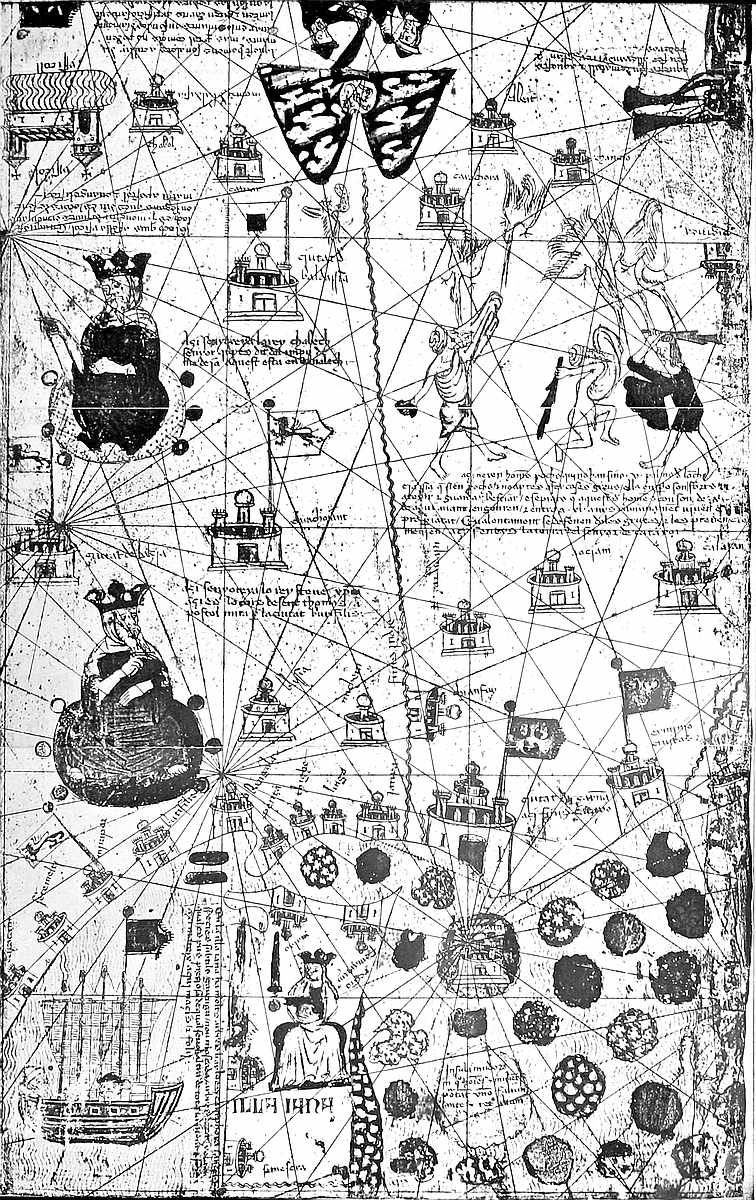
Part of the Catalan Map (1375).
[Some years ago, I made a special study of the Far East in the Catalan Map (L’Extrême-Orient dans l’Atlas catalan de Charles V., Paris, 1895), and I have come to the conclusion that the cartographer’s knowledge of Eastern Asia is drawn almost entirely from Marco Polo. We give a reproduction of part of the Catalan Map.—H. C.]
85. In the following age we find more frequent indications that Polo’s book was diffused and read. And now that the spirit of discovery began to stir,Confusions in Cartography of the 16th century, from the endeavour to combine new and old information. it was apparently regarded in a juster light as a Book of Facts, and not as a mere Romman du Grant Kaan.[13] But in fact this age produced new supplies of crude information in greater abundance than the knowledge of geographers was prepared to digest or co-ordinate, and the consequence is that the magnificent Work of Fra Mauro (1459), though the result of immense labour in the collection of facts and the endeavour to combine them, really gives a considerably less accurate idea of Asia than that which the Catalan Map had afforded.[14]
And when at a still later date the great burst of discovery eastward and westward took effect, the results of all attempts to combine the new knowledge with the old was most unhappy. The first and crudest forms of such combinations attempted to realise the ideas of Columbus regarding the identity of his discoveries with the regions of the Great Kaan’s dominion;[15] but even after America had vindicated its independent position on the surface of the globe, and the new knowledge of the Portuguese had introduced China where the Catalan Map of the 14th century had presented Cathay, the latter country, with the whole of Polo’s nomenclature, was shoved away to the north, forming a separate system.[16] Henceforward the influence of Polo’s work on maps was simply injurious; and when to his nomenclature was added a sprinkling of Ptolemy’s, as was usual throughout the 16th century, the result was a most extraordinary hotch-potch, conveying no approximation to any consistent representation of facts.
Thus, in a map of 1522,[17] running the eye along the north of Europe and Asia from West to East, we find the following succession of names: Groenlandia, or Greenland, as a great peninsula overlapping that of Norvegia and Suecia; Livonia, Plescovia and Moscovia, Tartaria bounded on the South by Scithia extra Imaum, and on the East, by the Rivers Ochardes and Bautisis (out of Ptolemy), which are made to flow into the Arctic Sea. South of these are Aureacithis and Asmirea (Ptolemy’s Auxacitis and Asmiræa), and Serica Regio. Then following the northern coast Balor Regio,[18] Judei Clausi, i.e. the Ten Tribes who are constantly associated or confounded with the Shut-up Nations of Gog and Magog. These impinge upon the River Polisacus, flowing into the Northern Ocean in Lat. 75°, but which is in fact no other than Polo’s Pulisanghin![19] Immediately south of this is Tholomon Provincia (Polo’s again), and on the coast Tangut, Cathaya, the Rivers Caramoran and Oman (a misreading of Polo’s Quian), Quinsay and Mangi.
86. The Maps of Mercator (1587) and Magini (1597) are similar in character, but more elaborate, introducing China as a separate system. Gradual disappearance of Polo’s nomenclature.Such indeed also is Blaeu’s Map (1663) excepting that Ptolemy’s contributions are reduced to one or two.
In Sanson’s Map (1659) the data of Polo and the mediæval Travellers are more cautiously handled, but a new element of confusion is introduced in the form of numerous features derived from Edrisi.
It is scarcely worth while to follow the matter further. With the increase of knowledge of Northern Asia from the Russian side, and that of China from the Maps of Martini, followed by the surveys of the Jesuits, and with the real science brought to bear on Asiatic Geography by such men as De l’Isle and D’Anville, mere traditional nomenclature gradually disappeared. And the task which the study of Polo has provided for the geographers of later days has been chiefly that of determining the true localities that his book describes under obsolete or corrupted names.
[My late illustrious friend, Baron A. E. Nordenskiöld, who has devoted much time and labour to the study of Marco Polo (see his Periplus, Stockholm, 1897), and published a facsimile edition of one of the French MSS. kept in the Stockholm Royal Library (see vol. ii. Bibliography, p. 570), has given to The Geographical Journal for April, 1899, pp. 396–406, a paper on The Influence of the “Travels of Marco Polo” on Jacobo Gastaldi’s Maps of Asia. He writes (p. 398) that as far as he knows, none “of the many learned men who have devoted their attention to the discoveries of Marco Polo, have been able to refer to any maps in which all or almost all those places mentioned by Marco Polo are given. All friends of the history of geography will therefore be glad to hear that such an atlas from the middle of the sixteenth century really does exist, viz. Gastaldi’s ‘Prima, seconda e terza parte dell’Asia.’” All the names of places in Ramusio’s Marco Polo are introduced in the maps of Asia of Jacobo Gastaldi (1561). Cf. Periplus, liv., lv., and lvi.
I may refer to what both Yule and myself say supra of the Catalan Map.—H. C.]
87. Before concluding, it may be desirable to say a few words on the subject of important knowledge other than geographical, Alleged introduction of Block-printed Books into Europe by Marco Polo.which various persons have supposed that Marco Polo must have introduced from Eastern Asia to Europe.
Respecting the mariner’s compass and gunpowder I shall say nothing, as no one now, I believe, imagines Marco to have had anything to do with their introduction. But from a highly respectable source in recent years we have seen the introduction of Block-printing into Europe connected with the name of our Traveller. The circumstances are stated as follows:[20]
“In the beginning of the 15th century a man named Pamphilo Castaldi, of Feltre ... was employed by the Seignory or Government of the Republic, to engross deeds and public edicts of various kinds ... the initial letters at the commencement of the writing being usually ornamented with red ink, or illuminated in gold and colours.
“According to Sansovino, certain stamps or types had been invented some time previously by Pietro di Natali, Bishop of Aquilœa.[21] These were made at Murano of glass, and were used to stamp or print the outline of the large initial letters of public documents, which were afterwards filled up by hand.... Pamphilo Castaldi improved on these glass types, by having others made of wood or metal, and having seen several Chinese books which the famous traveller Marco Polo had brought from China, and of which the entire text was printed with wooden blocks, he caused moveable wooden types to be made, each type containing a single letter; and with these he printed several broadsides and single leaves, at Venice, in the year 1426. Some of these single sheets are said to be preserved among the archives at Feltre....
“The tradition continues that John Faust, of Mayence ... became acquainted with Castaldi, and passed some time with him, at his Scriptorium, ... at Feltre;”
and in short developed from the knowledge so acquired the great invention of printing. Mr. Curzon goes on to say that Panfilo Castaldi was born in 1398, and died in 1490, and that he gives the story as he found it in an article written by Dr. Jacopo Facen, of Feltre, in a (Venetian?) newspaper called Il Gondoliere, No. 103, of 27th December, 1843.
In a later paper Mr. Curzon thus recurs to the subject:[22]
“Though none of the early block-books have dates affixed to them, many of them are with reason supposed to be more ancient than any books printed with moveable types. Their resemblance to Chinese block-books is so exact, that they would almost seem to be copied from the books commonly used in China. The impressions are taken off on one side of the paper only, and in binding, both the Chinese, and ancient German, or Dutch block-books, the blank sides of the pages are placed opposite each other, and sometimes pasted together.... The impressions are not taken off with printer’s ink, but with a brown paint or colour, of a much thinner description, more in the nature of Indian ink, as we call it, which is used in printing Chinese books. Altogether the German and Oriental block-books are so precisely alike, in almost every respect, that ... we must suppose that the process of printing then must have been copied from ancient Chinese specimens, brought from that country by some early travellers, whose names have not been handed down to our times.”
The writer then refers to the tradition about Guttemberg (so it is stated on this occasion, not Faust) having learned Castaldi’s art, etc., mentioning a circumstance which he supposes to indicate that Guttemberg had relations with Venice; and appears to assent to the probability of the story of the art having been founded on specimens brought home by Marco Polo.
This story was in recent years diligently propagated in Northern Italy, and resulted in the erection at Feltre of a public statue of Panfilo Castaldi, bearing this inscription (besides others of like tenor):—
“To Panfilo Castaldi the illustrious Inventor of Movable Printing Types, Italy renders this Tribute of Honour, too long deferred.”
In the first edition of this book I devoted a special note to the exposure of the worthlessness of the evidence for this story.[23] This note was, with the present Essay, translated and published at Venice by Comm. Berchet, but this challenge to the supporters of the patriotic romance, so far as I have heard, brought none of them into the lists in its defence.
But since Castaldi has got his statue from the printers of Lombardy, would it not be mere equity that the mariners of Spain should set up a statue at Huelva to the Pilot Alonzo Sanchez of that port, who, according to Spanish historians, after discovering the New World, died in the house of Columbus at Terceira, and left the crafty Genoese to appropriate his journals, and rob him of his fame?
Seriously; if anybody in Feltre cares for the real reputation of his native city, let him do his best to have that preposterous and discreditable fiction removed from the base of the statue. If Castaldi has deserved a statue on other and truer grounds let him stand; if not, let him be burnt into honest lime! I imagine that the original story that attracted Mr. Curzon was more jeu d’esprit than anything else; but that the author, finding what a stone he had set rolling, did not venture to retract.
88. Mr. Curzon’s own observations, which I have italicised about the resemblance of the two systems are, however, Frequent opportunities for such introduction in the age following Polo’s.very striking, and seem clearly to indicate the derivation of the art from China. But I should suppose that in the tradition, if there ever was any genuine tradition of the kind at Feltre (a circumstance worthy of all doubt), the name of Marco Polo was introduced merely because it was so prominent a name in Eastern Travel. The fact has been generally overlooked and forgotten[24] that, for many years in the course of the 14th century, not only were missionaries of the Roman Church and Houses of the Franciscan Order established in the chief cities of China, but a regular trade was carried on overland between Italy and China, by way of Tana (or Azov), Astracan, Otrar and Kamul, insomuch that instructions for the Italian merchant following that route form the two first chapters in the Mercantile Handbook of Balducci Pegolotti (circa 1340).[25] Many a traveller besides Marco Polo might therefore have brought home the block-books. And this is the less to be ascribed to him because he so curiously omits to speak of the art of printing, when his subject seems absolutely to challenge its description.
XIV. Explanations regarding the Basis adopted for the present Translation.
89. It remains to say a few words regarding the basis adopted for our English version of the Traveller’s record.
Ramusio’s recension was that which Marsden selected for translation. But at the date of his most meritorious publication nothing was known of the real Text followed by Marsden and by Pauthier. literary history of Polo’s Book, and no one was aware of the peculiar value and originality of the French manuscript texts, nor had Marsden seen any of them. A translation from one of those texts is a translation at first hand; a translation from Ramusio’s Italian is, as far as I can judge, the translation of a translated compilation from two or more translations, and therefore, whatever be the merits of its matter, inevitably carries us far away from the spirit and style of the original narrator. M. Pauthier, I think, did well in adopting for the text of his edition the MSS. which I have classed as of the second Type, the more as there had hitherto been no publication from those texts. But editing a text in the original language, and translating, are tasks substantially different in their demands.
90. It will be clear from what has been said in the preceding pages that I should not regard as a fair or full representation of Polo’s Work, a versionEclectic formation of the English Text of this Translation. on which the Geographic Text did not exercise a material influence. But to adopt that Text, with all its awkwardnesses and tautologies, as the absolute subject of translation, would have been a mistake. What I have done has been, in the first instance, to translate from Pauthier’s Text. The process of abridgment in this text, however it came about, has been on the whole judiciously executed, getting rid of the intolerable prolixities of manner which belong to many parts of the Original Dictation, but as a general rule preserving the matter. Having translated this,—not always from the Text adopted by Pauthier himself, but with the exercise of my own judgment on the various readings which that Editor lays before us,—I then compared the translation with the Geographic Text, and transferred from the latter not only all items of real substance that had been omitted, but also all expressions of special interest and character, and occasionally a greater fulness of phraseology where condensation in Pauthier’s text seemed to have been carried too far. And finally I introduced between brackets everything peculiar to Ramusio’s version that seemed to me to have a just claim to be reckoned authentic, and that could be so introduced without harshness or mutilation. Many passages from the same source which were of interest in themselves, but failed to meet one or other of these conditions, have been given in the notes.[1]
91. As regards the reading of proper names and foreign words, in which there is so much variation in the different MSS. and editions, Mode of rendering proper names.I have done my best to select what seemed to be the true reading from the G. T. and Pauthier’s three MSS., only in some rare instances transgressing this limit.
Where the MSS. in the repetition of a name afforded a choice of forms, I have selected that which came nearest the real name when known. Thus the G. T. affords Baldasciain, Badascian, Badasciam, Badausiam, Balasian. I adopt Badascian, or in English spelling Badashan, because it is closest to the real name Badakhshan. Another place appears as Cobinan, Cabanat, Cobian. I adopt the first because it is the truest expression of the real name Koh-benán. In chapters 23, 24 of Book I., we have in the G. T. Asisim, Asciscin, Asescin, and in Pauthier’s MSS. Hasisins, Harsisins, etc. I adopt Asciscin, or in English spelling Ashishin, for the same reason as before. So with Creman, Crerman, Crermain, Querman, Anglicè Kerman; Cormos, Hormos, and many more.[2]
In two or three cases I have adopted a reading which I cannot show literatim in any authority, but because such a form appears to be the just resultant from the variety of readings which are presented; as in surveying one takes the mean of a number of observations when no one can claim an absolute preference.
Polo’s proper names, even in the French Texts, are in the main formed on an Italian fashion of spelling.[3] I see no object in preserving such spelling in an English book, so after selecting the best reading of the name I express it in English spelling, printing Badashan, Pashai, Kerman, instead of Badascian, Pasciai, Querman, and so on.
And when a little trouble has been taken to ascertain the true form and force of Polo’s spelling of Oriental names and technical expressions, it will be found that they are in the main as accurate as Italian lips and orthography will admit, and not justly liable either to those disparaging epithets[4] or to those exegetical distortions which have been too often applied to them. Thus, for example, Cocacin, Ghel or Ghelan, Tonocain, Cobinan, Ondanique, Barguerlac, Argon, Sensin, Quescican, Toscaol, Bularguci, Zardandan, Anin, Caugigu, Coloman, Gauenispola, Mutfili, Avarian, Choiach, are not, it will be seen, the ignorant blunderings which the interpretations affixed by some commentators would imply them to be, but are, on the contrary, all but perfectly accurate utterances of the names and words intended.
The -tchéou (of French writers), -choo, -chow, or -chau[5] of English writers, which so frequently forms the terminal part in the names of Chinese cities, is almost invariably rendered by Polo as -giu. This has frequently in the MSS., and constantly in the printed editions, been converted into -gui, and thence into -guy. This is on the whole the most constant canon of Polo’s geographical orthography, and holds in Caagiu (Ho-chau), Singiu (Sining-chau), Cui-giu (Kwei-chau), Sin-giu (T’sining-chau), Pi-giu (Pei-chau), Coigangiu (Hwaingan-chau), Si-giu (Si-chau), Ti-giu (Tai-chau), Tin-giu (Tung-chau), Yan-giu (Yang-chau), Sin-giu (Chin-chau), Cai-giu (Kwa-chau), Chinghi-giu (Chang-chau), Su-giu (Su-chau), Vu-giu (Wu-chau), and perhaps a few more. In one or two instances only (as Sinda-ciu, Caiciu) he has -ciu instead of -giu.
The chapter-headings I have generally taken from Pauthier’s Text, but they are no essential part of the original work, and they have been slightly modified or enlarged where it seemed desirable.
“Behold! I see the Haven nigh at Hand, To which I meane my wearie Course to bend; Vere the maine Shete, and beare up with the Land, The which afore is fayrly to be kend, And seemeth safe from Storms that may offend. * * * * * There eke my Feeble Barke a while may stay, Till mery Wynd and Weather call her thence away.” —The Faerie Queene, I. xii. 1.
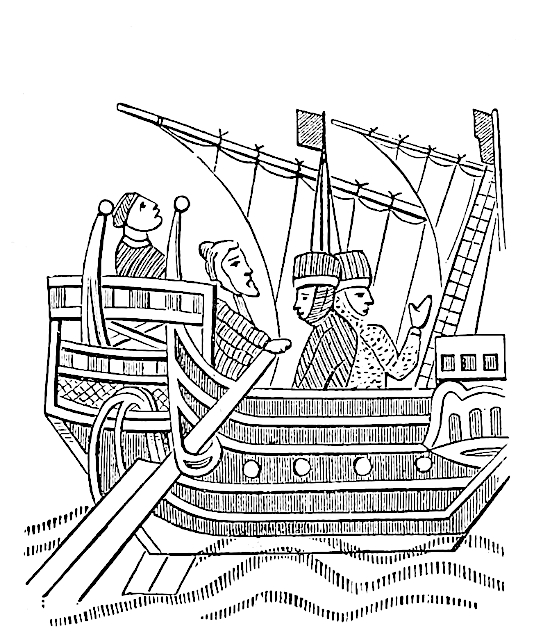
MARCO POLO’S ITINERARIES, No. I. (Prologue; Book I, Chapters 1–36; and Book IV.)
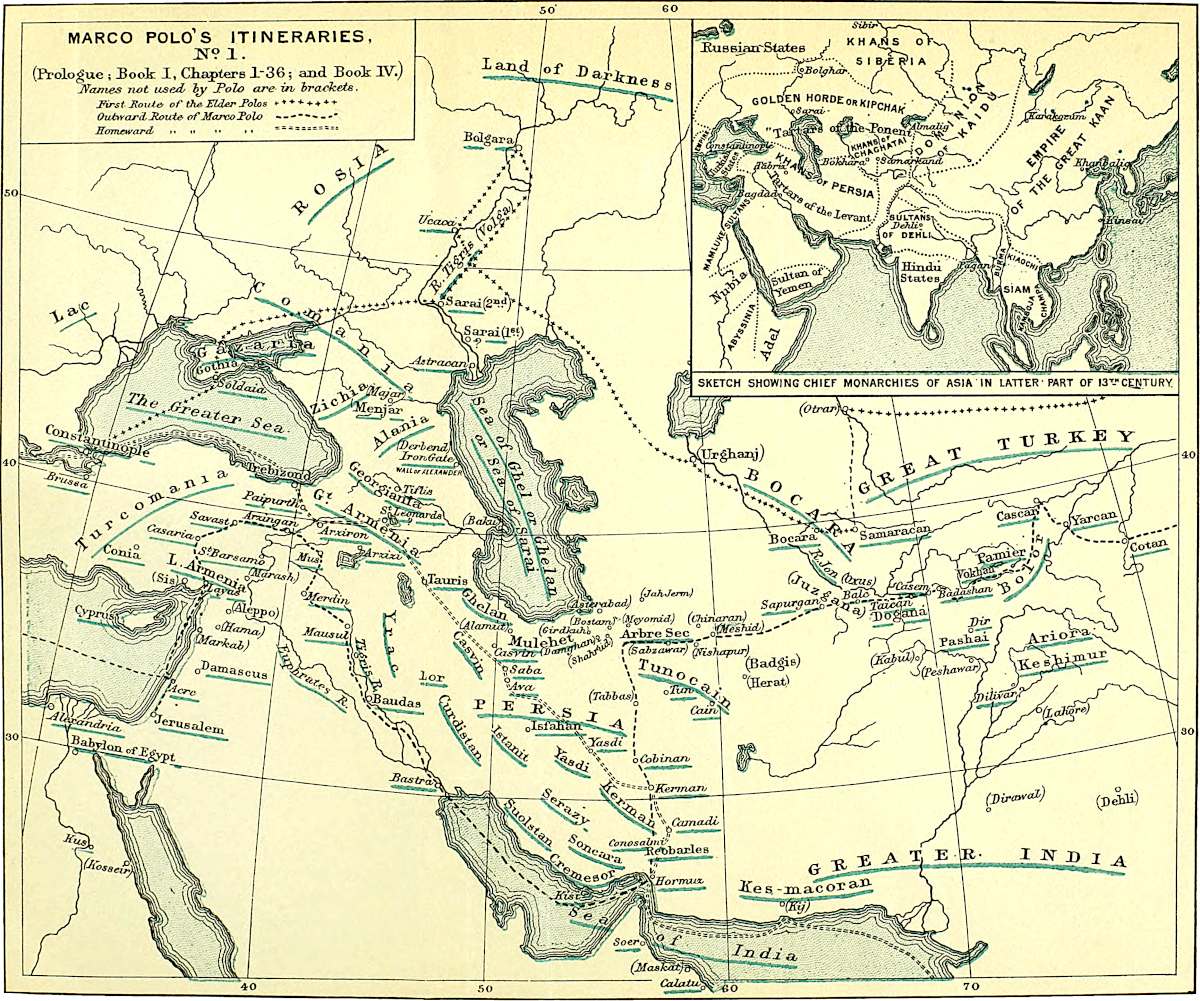
SKETCH SHOWING CHIEF MONARCHIES OF ASIA IN LATTER PART OF 13th CENTURY