Volume 1 — CHAPTER XLV.
Henry Yule translation
Of the City of Etzina.
When you leave the city of Campichu you ride for twelve days, and then reach a city called Etzina, which is towards the north on the verge of the Sandy Desert; it belongs to the Province of Tangut.{1} The people are Idolaters, and possess plenty of camels and cattle, and the country produces a number of good falcons, both Sakers and Lanners. The inhabitants live by their cultivation and their cattle, for they have no trade. At this city you must needs lay in victuals for forty days, because when you quit Etzina, you enter on a desert which extends forty days’ journey to the north, and on which you meet with no habitation nor baiting-place.{2} In the summer-time, indeed, you will fall in with people, but in the winter the cold is too great. You also meet with wild beasts (for there are some small pine-woods here and there), and with numbers of wild asses.{3} When you have travelled these forty days across the Desert you come to a certain province lying to the north. Its name you shall hear presently.
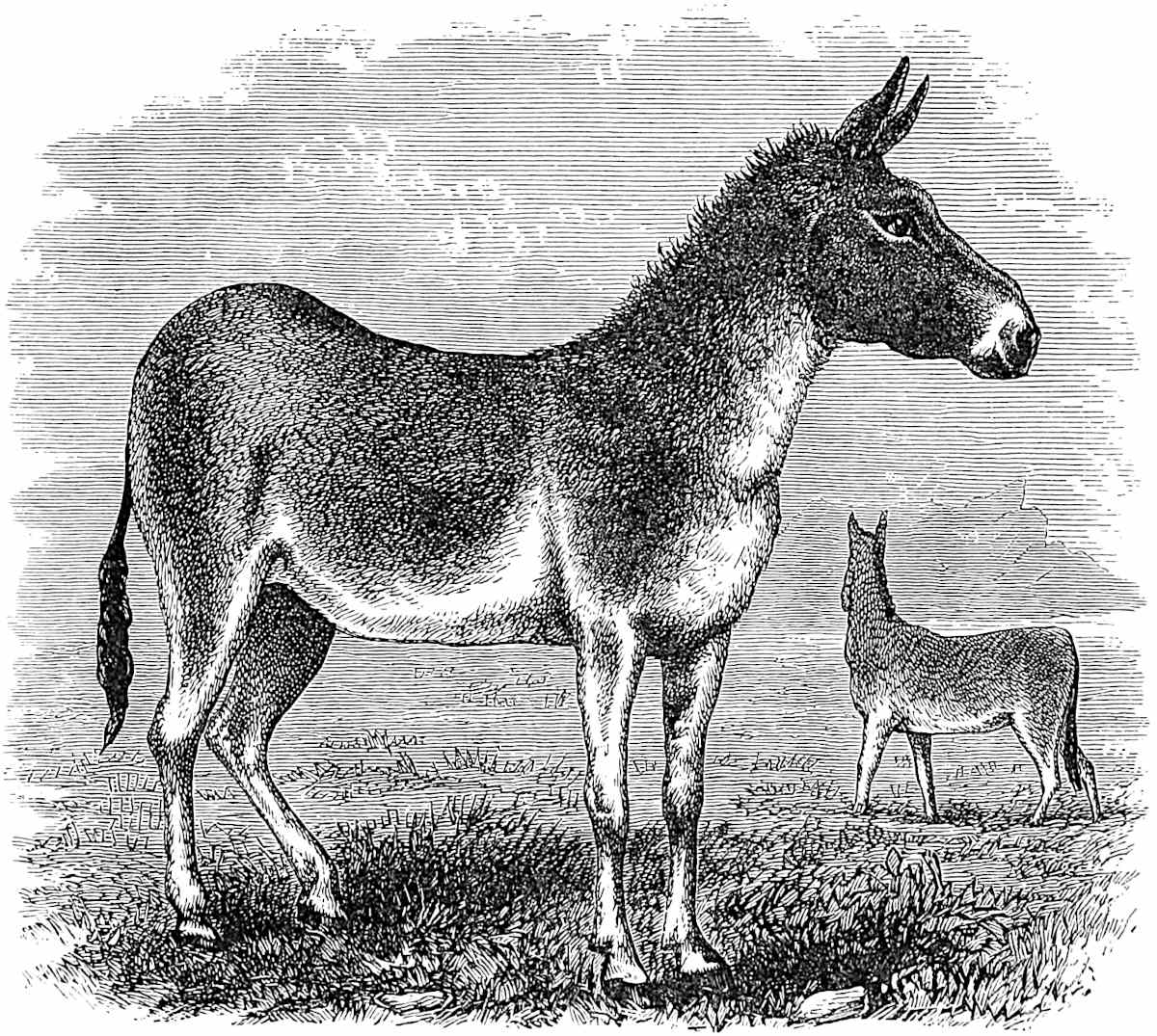
Wild Ass of Mongolia.
[I believe there can be no doubt that Etzina must be looked for on the river Hei-shui, called Etsina by the Mongols, east of Suhchau. This river empties its waters into the two lakes Soho-omo and Sopo-omo. Etzina would have been therefore situated on the river on the border of the Desert, at the top of a triangle whose bases would be Suhchau and Kanchau. This river was once part of the frontier of the kingdom of Tangut. (Cf. Devéria, Notes d’épigraphie mongolo-chinoise, p. 4.) Reclus (Géog. Univ., Asie Orientale, p. 159) says: “To the east [of Hami], beyond the Chukur Gobi, are to be found also some permanent villages and the remains of cities. One of them is perhaps the ‘cité d’Etzina’ of which Marco Polo speaks, and the name is to be found in that of the river Az-sind.”
“Through Kanchau was the shortest, and most direct and convenient road to I-tsi-nay.... I-tsi-nay, or Echiné, is properly the name of a lake. Khubilaï, disquieted by his factious relatives on the north, established a military post near lake I-tsi-nay, and built a town, or a fort on the south-western shore of this lake. The name of I-tsi-nay appears from that time; it does not occur in the chronicle of the Tangut kingdom; the lake had then another name. Vestiges of the town are seen to this day; the buildings were of large dimensions, and some of them were very fine. In Marco Polo’s time there existed a direct route from I-tsi-nay to Karakorum; traces of this road are still noticeable, but it is no more used. This circumstance, i.e. the existence of a road from I-tsi-nay to Karakorum, probably led Marco Polo to make an excursion (a mental one, I suppose) to the residence of the Khans in Northern Mongolia.” (Palladius, l.c. pp. 10–11.)—H. C.]
[Captain Younghusband (1886) saw in the Altaï Mountains “considerable numbers of wild asses, which appeared to be perfectly similar to the Kyang of Ladak and Tibet, and wild horses too—the Equus Prejevalskii—roaming about these great open plains.” (Proc. R. G. S. X. 1888, p. 495.) Dr. Sven Hedin says the habitat of the Kulan is the heights of Tibet as well as the valley of the Tarim; it looks like a mule with the mane and tail of an ass, but shorter ears, longer than those of a horse; he gives a picture of it.—H. C.]