Volume 1 — CHAPTER XVIII.
Henry Yule translation
How the Two Brothers and Messer Marco took leave of the Great Kaan, and returned to their own Country.
And when the Prince saw that the Two Brothers and Messer Marco were ready to set forth, he called them all three to his presence, and gave them two golden Tablets of Authority, which should secure them liberty of passage through all his dominions, and by means of which, whithersoever they should go, all necessaries would be provided for them, and for all their company, and whatever they might choose to order.{1} He charged them also with messages to the King of France, the King of England,{2} the King of Spain, and the other kings of Christendom. He then caused thirteen ships to be equipt, each of which had four masts, and often spread twelve sails.{3} And I could easily give you all particulars about these, but as it would be so long an affair I will not enter upon this now, but hereafter, when time and place are suitable. [Among the said ships were at least four or five that carried crews of 250 or 260 men.]
And when the ships had been equipt, the Three Barons and the Lady, and the Two Brothers and Messer Marco, took leave of the Great Kaan, and went on board their ships with a great company of people, and with all necessaries provided for two years by the Emperor. They put forth to sea, and after sailing for some three months they arrived at a certain Island towards the South, which is called Java,{4} and in which there are many wonderful things which we shall tell you all about by-and-bye. Quitting this Island they continued to navigate the Sea of India for eighteen months more before they arrived whither they were bound, meeting on their way also with many marvels, of which we shall tell hereafter.
And when they got thither they found that Argon was dead, so the Lady was delivered to Casan, his son.
But I should have told you that it is a fact that, when they embarked, they were in number some 600 persons, without counting the mariners; but nearly all died by the way, so that only eight survived.{5}
The sovereignty when they arrived was held by Kiacatu, so they commended the Lady to him, and executed all their commission. And when the Two Brothers and Messer Marco had executed their charge in full, and done all that the Great Kaan had enjoined on them in regard to the Lady, they took their leave and set out upon their journey.{6} And before their departure, Kiacatu gave them four golden tablets of authority, two of which bore gerfalcons, one bore lions, whilst the fourth was plain, and having on them inscriptions which directed that the three Ambassadors should receive honour and service all through the land as if rendered to the Prince in person, and that horses and all provisions, and everything necessary, should be supplied to them. And so they found in fact; for throughout the country they received ample and excellent supplies of everything needful; and many a time indeed, as I may tell you, they were furnished with 200 horsemen, more or less, to escort them on their way in safety. And this was all the more needful because Kiacatu was not the legitimate Lord, and therefore the people had less scruple to do mischief than if they had had a lawful prince.{7}
Another thing too must be mentioned, which does credit to those three Ambassadors, and shows for what great personages they were held. The Great Kaan regarded them with such trust and affection, that he had confided to their charge the Queen Cocachin, as well as the daughter of the King of Manzi,{8} to conduct to Argon the Lord of all the Levant. And those two great ladies who were thus entrusted to them they watched over and guarded as if they had been daughters of their own, until they had transferred them to the hands of their Lord; whilst the ladies, young and fair as they were, looked on each of those three as a father, and obeyed them accordingly. Indeed, both Casan, who is now the reigning prince, and the Queen Cocachin his wife, have such a regard for the Envoys that there is nothing they would not do for them. And when the three Ambassadors took leave of that Lady to return to their own country, she wept for sorrow at the parting.
What more shall I say? Having left Kiacatu they travelled day by day till they came to Trebizond, and thence to Constantinople, from Constantinople to Negropont, and from Negropont to Venice. And this was in the year 1295 of Christ’s Incarnation.
And now that I have rehearsed all the Prologue as you have heard, we shall begin the Book of the Description of the Divers Things that Messer Marco met with in his Travels.
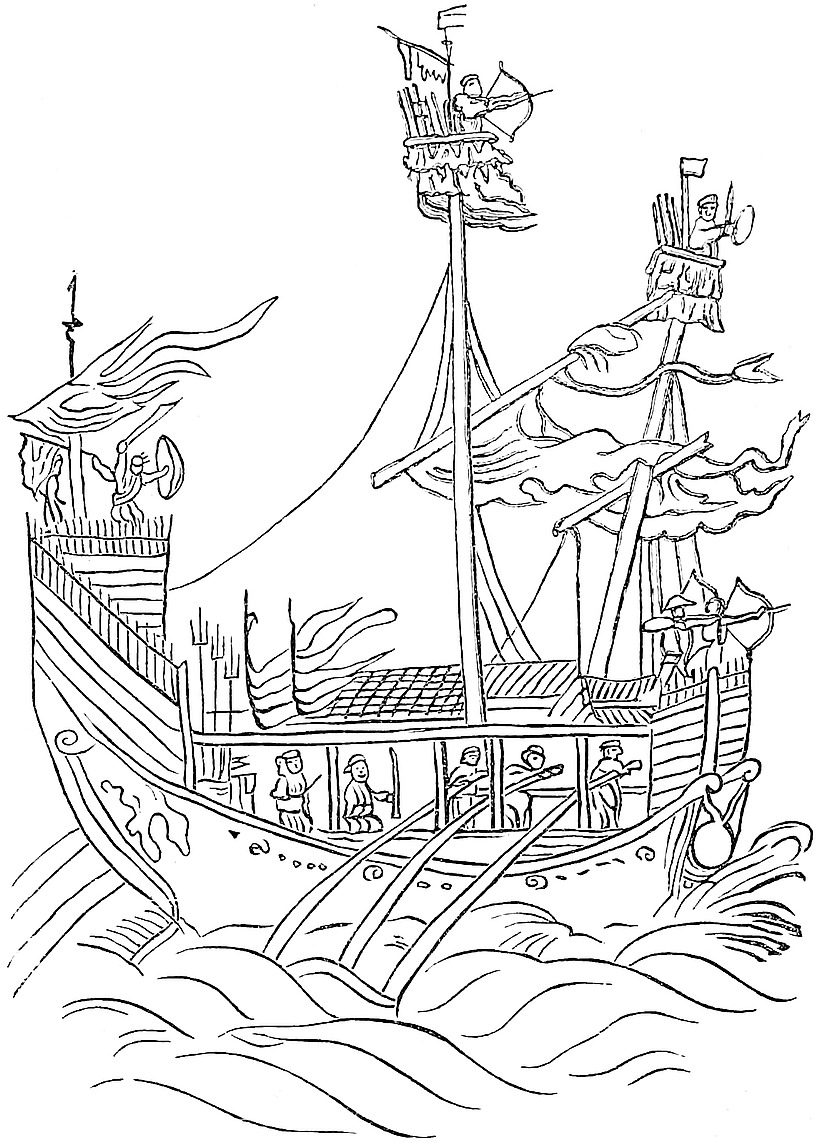
Ancient Chinese War Vessel.
It is worth noting that in the case of an embassy sent to Cathay a few years later by Gházán Khan, on the return by this same route to Persia, the chief of the two Persian ambassadors, and the Great Khan’s envoy, who was in company, both died by the way. Their voyage, too, seems to have been nearly as long as Polo’s; for they were seven years absent from Persia, and of these only four in China. (See Wassáf in Elliot, III. 47.)
Arghún Khan died 10th March, 1291. He was succeeded (23rd July) by his brother Kaikhátú (Quiacatu of Polo), who was put to death 24th March, 1295.
We learn from Hammer’s History of the Ilkhans that when Gházán, the son of Arghún (Casan of Polo), who had the government of the Khorasan frontier, was on his return to his post from Tabriz, where his uncle Kaikhatu had refused to see him, “he met at Abher the ambassador whom he had sent to the Great Khan to obtain in marriage a relative of the Great Lady Bulghán. This envoy brought with him the Lady Kúkáchin (our author’s Cocachin), with presents from the Emperor, and the marriage was celebrated with due festivity.” Abher lies a little west of Kazvín.
Hammer is not, I find, here copying from Wassáf, and I have not been able to procure a thorough search of the work of Rashiduddin, which probably was his authority. As well as the date can be made out from the History of the Ilkhans, Gházán must have met his bride towards the end of 1293, or quite the beginning of 1294. Rashiduddin in another place mentions the fair lady from Cathay; “The ordu (or establishment) of Tukiti Khatun was given to Kukachi Khatun, who had been brought from the Kaan’s Court, and who was a kinswoman of the late chief Queen Bulghán. Kúkáchi, the wife of the Padshah of Islam, Gházán Khan, died in the month of Shaban, 695,” i.e. in June, 1296, so that the poor girl did not long survive her promotion. (See Hammer’s Ilch. II. 20, and 8, and I. 273; and Quatremère’s Rashiduddin, p. 97.) Kukachin was the name also of the wife of Chingkim, Kublai’s favourite son; but she was of the Kungurát tribe. (Deguignes, IV. 179.)
On the fall of the capital of the Sung Dynasty—the Kinsay of Polo—in 1276, the Princesses of that Imperial family were sent to Peking, and were graciously treated by Kublai’s favourite Queen, the Lady Jamui. This young lady was, no doubt, one of those captive princesses who had been brought up at the Court of Khánbálik. (See De Mailla, IX. 376, and infra Bk. II. ch. lxv., note 6.)
BOOK FIRST.

ACCOUNT OF REGIONS VISITED OR HEARD OF ON THE JOURNEY FROM THE LESSER ARMENIA TO THE COURT OF THE GREAT KAAN AT CHANDU.
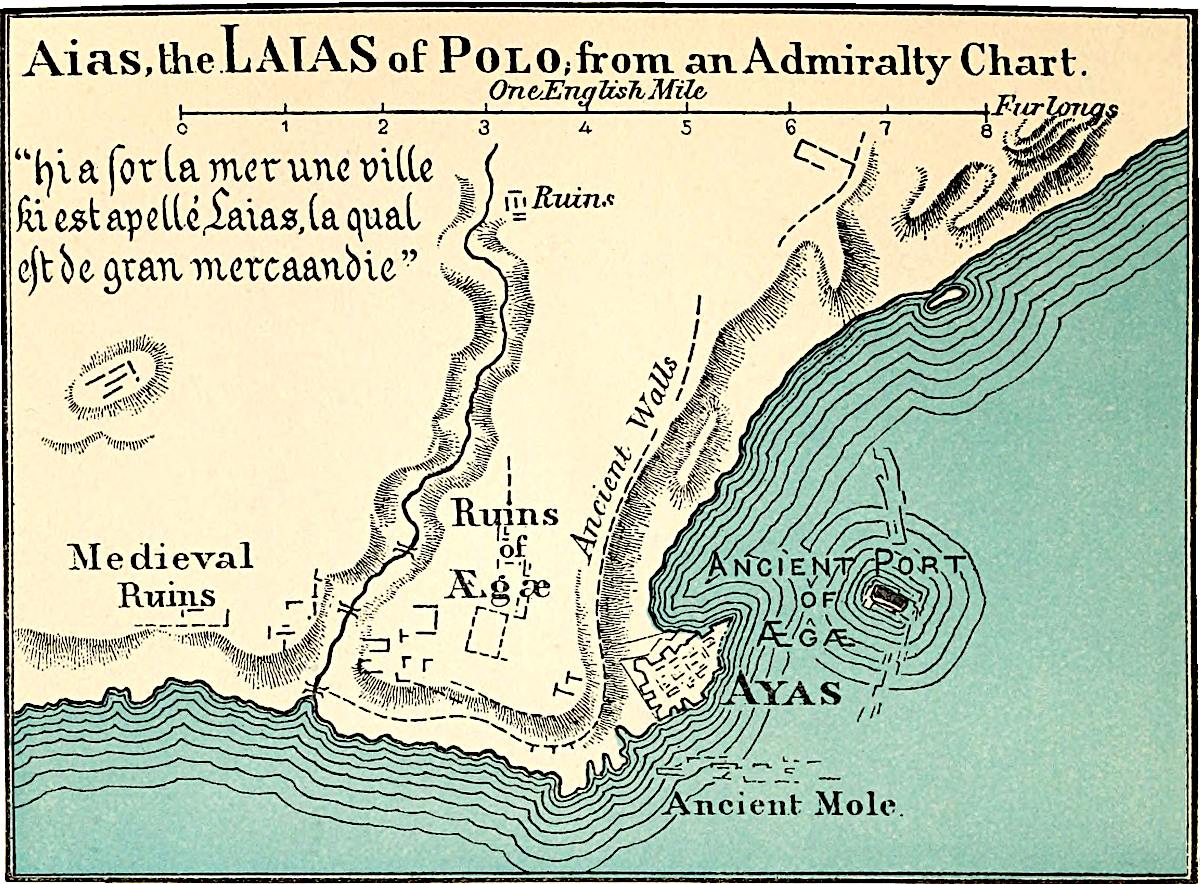
Aias, the Laias of Polo, from an Admiralty Chart.
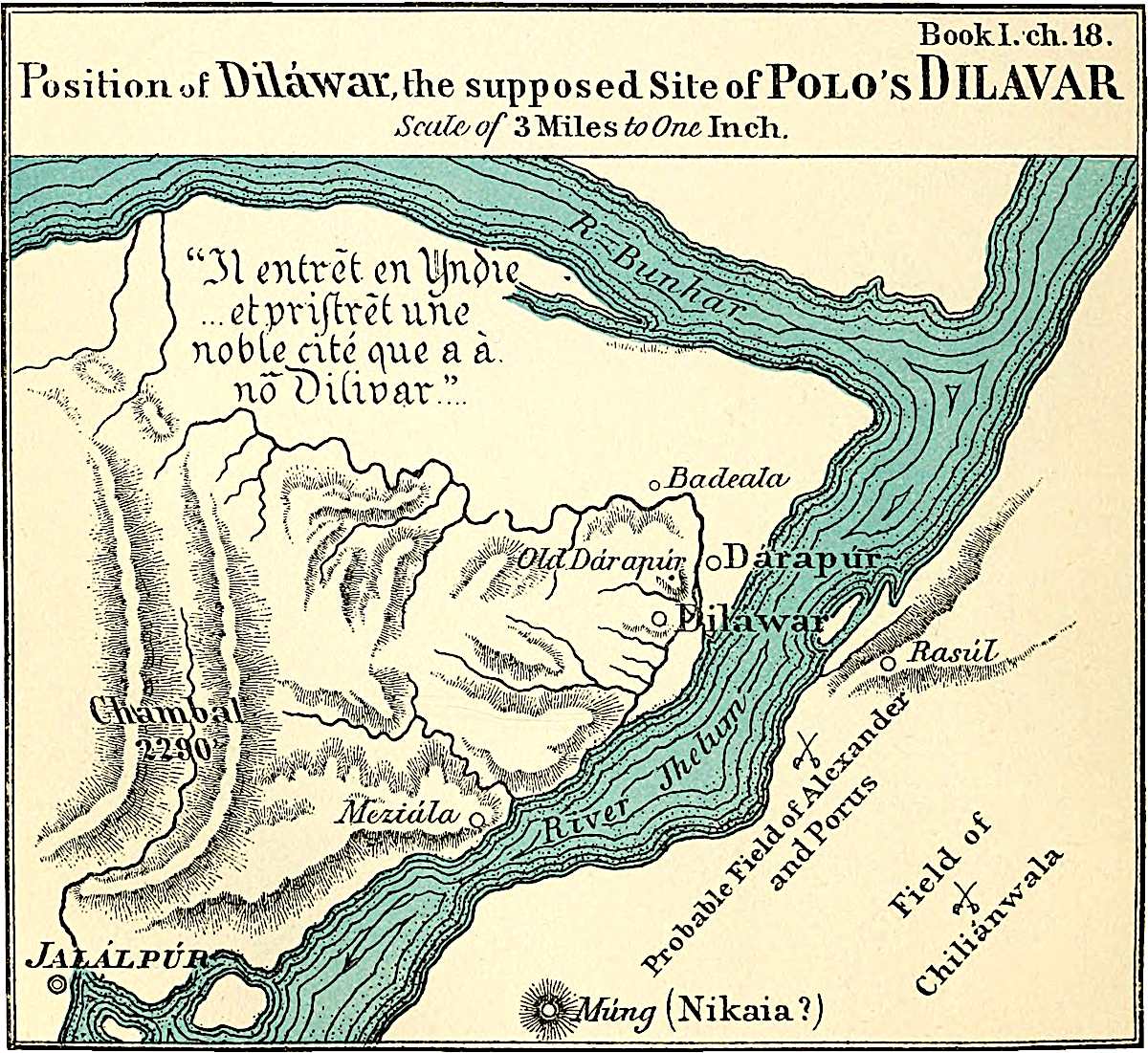
Position of Diláwar, the supposed Site of Polo’s Dilavar
Lit. Frauenfelder, Palermo
BOOK I.