Volume 1 — CHAPTER XX.
Henry Yule translation
How the Emperor goes on a Hunting Expedition.
After he has stopped at his capital city those three months that I mentioned, to wit, December, January, February, he starts off on the 1st day of March, and travels southward towards the Ocean Sea, a journey of two days.{1} He takes with him full 10,000 falconers, and some 500 gerfalcons besides peregrines, sakers, and other hawks in great numbers; and goshawks also to fly at the water-fowl.{2} But do not suppose that he keeps all these together by him; they are distributed about, hither and thither, one hundred together, or two hundred at the utmost, as he thinks proper. But they are always fowling as they advance, and the most part of the quarry taken is carried to the Emperor. And let me tell you when he goes thus a-fowling with his gerfalcons and other hawks, he is attended by full 10,000 men who are disposed in couples; and these are called Toscaol, which is as much as to say, “Watchers.” And the name describes their business.{3} They are posted from spot to spot, always in couples, and thus they cover a great deal of ground! Every man of them is provided with a whistle and hood, so as to be able to call in a hawk and hold it in hand. And when the Emperor makes a cast, there is no need that he follow it up, for those men I speak of keep so good a look out that they never lose sight of the birds, and if these have need of help they are ready to render it.
All the Emperor’s hawks, and those of the Barons as well, have a little label attached to the leg to mark them, on which is written the names of the owner and the keeper of the bird. And in this way the hawk, when caught, is at once identified and handed over to its owner. But if not, the bird is carried to a certain Baron, who is styled the Bularguchi, which is as much as to say “The Keeper of Lost Property.” And I tell you that whatever may be found without a known owner, whether it be a horse, or a sword, or a hawk, or what not, it is carried to that Baron straightway, and he takes charge of it. And if the finder neglects to carry his trover to the Baron, the latter punishes him. Likewise the loser of any article goes to the Baron, and if the thing be in his hands it is immediately given up to the owner. Moreover, the said Baron always pitches on the highest spot of the camp, with his banner displayed, in order that those who have lost or found anything may have no difficulty in finding their way to him. Thus nothing can be lost but it shall be incontinently found and restored.{4}
And so the Emperor follows this road that I have mentioned, leading along in the vicinity of the Ocean Sea (which is within two days’ journey of his capital city, Cambaluc), and as he goes there is many a fine sight to be seen, and plenty of the very best entertainment in hawking; in fact, there is no sport in the world to equal it!
The Emperor himself is carried upon four elephants in a fine chamber made of timber, lined inside with plates of beaten gold, and outside with lions’ skins [for he always travels in this way on his fowling expeditions, because he is troubled with gout]. He always keeps beside him a dozen of his choicest gerfalcons, and is attended by several of his Barons, who ride on horseback alongside. And sometimes, as they may be going along, and the Emperor from his chamber is holding discourse with the Barons, one of the latter shall exclaim: “Sire! Look out for Cranes!” Then the Emperor instantly has the top of his chamber thrown open, and having marked the cranes he casts one of his gerfalcons, whichever he pleases; and often the quarry is struck within his view, so that he has the most exquisite sport and diversion, there as he sits in his chamber or lies on his bed; and all the Barons with him get the enjoyment of it likewise! So it is not without reason I tell you that I do not believe there ever existed in the world or ever will exist, a man with such sport and enjoyment as he has, or with such rare opportunities.{5}
And when he has travelled till he reaches a place called Cachar Modun,{6} there he finds his tents pitched, with the tents of his Sons, and his Barons, and those of his Ladies and theirs, so that there shall be full 10,000 tents in all, and all fine and rich ones. And I will tell you how his own quarters are disposed. The tent in which he holds his courts is large enough to give cover easily to a thousand souls. It is pitched with its door to the south, and the Barons and Knights remain in waiting in it, whilst the Lord abides in another close to it on the west side. When he wishes to speak with any one he causes the person to be summoned to that other tent. Immediately behind the great tent there is a fine large chamber where the Lord sleeps; and there are also many other tents and chambers, but they are not in contact with the Great Tent as these are. The two audience-tents and the sleeping-chamber are constructed in this way. Each of the audience-tents has three poles, which are of spice-wood, and are most artfully covered with lions’ skins, striped with black and white and red, so that they do not suffer from any weather. All three apartments are also covered outside with similar skins of striped lions, a substance that lasts for ever.{7} And inside they are all lined with ermine and sable, these two being the finest and most costly furs in existence. For a robe of sable, large enough to line a mantle, is worth 2000 bezants of gold, or 1000 at least, and this kind of skin is called by the Tartars “The King of Furs.” The beast itself is about the size of a marten.{8} These two furs of which I speak are applied and inlaid so exquisitely, that it is really something worth seeing. All the tent-ropes are of silk. And in short I may say that those tents, to wit the two audience-halls and the sleeping-chamber, are so costly that it is not every king could pay for them.
Round about these tents are others, also fine ones and beautifully pitched, in which are the Emperor’s ladies, and the ladies of the other princes and officers. And then there are the tents for the hawks and their keepers, so that altogether the number of tents there on the plain is something wonderful. To see the many people that are thronging to and fro on every side and every day there, you would take the camp for a good big city. For you must reckon the Leeches, and the Astrologers, and the Falconers, and all the other attendants on so great a company; and add that everybody there has his whole family with him, for such is their custom.
The Lord remains encamped there until the spring, and all that time he does nothing but go hawking round about among the canebrakes along the lakes and rivers that abound in that region, and across fine plains on which are plenty of cranes and swans, and all sorts of other fowl. The other gentry of the camp also are never done with hunting and hawking, and every day they bring home great store of venison and feathered game of all sorts. Indeed, without having witnessed it, you would never believe what quantities of game are taken, and what marvellous sport and diversion they all have whilst they are in camp there.
There is another thing I should mention; to wit, that for 20 days’ journey round the spot nobody is allowed, be he who he may, to keep hawks or hounds, though anywhere else whosoever list may keep them. And furthermore throughout all the Emperor’s territories, nobody however audacious dares to hunt any of these four animals, to wit, hare, stag, buck, and roe, from the month of March to the month of October. Anybody who should do so would rue it bitterly. But those people are so obedient to their Lord’s command, that even if a man were to find one of those animals asleep by the roadside he would not touch it for the world! And thus the game multiplies at such a rate that the whole country swarms with it, and the Emperor gets as much as he could desire. Beyond the term I have mentioned, however, to wit that from March to October, everybody may take these animals as he list.{9}
After the Emperor has tarried in that place, enjoying his sport as I have related, from March to the middle of May, he moves with all his people, and returns straight to his capital city of Cambaluc (which is also the capital of Cathay, as you have been told), but all the while continuing to take his diversion in hunting and hawking as he goes along.
The Oriental practice seems to have assigned one man to the attendance on every hawk. This Kaempfer says was the case at the Court of Persia at the beginning of last century. There were about 800 hawks, and each had a special keeper. The same was the case with the Emperor Kanghi’s hawking establishment, according to Gerbillon. (Am. Exot. p. 83; Gerb. 1st Journey, in Duhalde.)
[Palladius (p. 47) says that he has heard from men well acquainted with the customs of the Mongols, that at the present day in “battues,” the leaders of the two flanks which surround the game, are called toscaul in Mongol.—H. C.]
[“There are two Mongol terms, which resemble this word Bularguchi, viz. Balagachi and Buluguchi. But the first was the name used for the door-keeper of the tent of the Khan. By Buluguchi the Mongols understood a hunter and especially sable hunters. No one of these terms can be made consistent with the accounts given by M. Polo regarding the Bularguchi. In the Kui sin tsa shi, written by Chow Mi, in the former part of the 14th century, interesting particulars regarding Mongol hunting are found.” (Palladius, 47.) In chapter 101, Djan-ch’i, of the Yuen-shi, Falconers are called Ying fang pu lie, and a certain class of the Falconers are termed Bo-lan-ghi. (Bretschneider, Med. Res. I. p. 188.)—H. C.]
[With regard to the gout of Kúblái Khan, Palladius (p. 48) writes: “In the Corean history allusion is made twice to the Khan’s suffering from this disease. Under the year 1267, it is there recorded that in the 9th month, envoys of the Khan with a letter to the King arrived in Corea. Kubilai asked for the skin of the Akirho munho, a fish resembling a cow. The envoy was informed that, as the Khan suffered from swollen feet it would be useful for him to wear boots made of the skin of this animal, and in the 10th month, the king of Corea forwarded to the Khan seventeen skins of it. It is further recorded in the Corean history, that in the 8th month of 1292, sorcerers and Shaman women from Corea were sent at the request of the Khan to cure him of a disease of the feet and hands. At that time the king of Corea was also in Peking, and the sorcerers and Shaman women were admitted during an audience the King had of the Khan. They took the Khan’s hands and feet and began to recite exorcisms, whilst Kubilai was laughing.”—H. C.]
[Captain Gill writes (River of Golden Sand, I. p. 111): “This country around Urh-Chuang is admirably described [in Marco Polo, pp. 403, 406], and I should almost imagine that the Kaan must have set off south-east from Peking, and enjoyed some of his hawking not far from here, before he travelled to Cachar Modun, wherever that may have been.”
“With respect to Cachar Modun, Marco Polo intends perhaps by this name Ho-si wu, which place, together with Yang-ts’un, were comprised in the general name Ma t’ou (perhaps the Modun of M. Polo). Ma-t’ou is even now a general term for a jetty in Chinese. Ho-si in the Mongol spelling was Ha-shin. D’Ohsson, in his translation of Rashid-eddin renders Ho-si by Co-shi (Hist. des Mongols, I. p. 95), but Rashid in that case speaks not of Ho-si wu, but of the Tangut Empire, which in Chinese was called Ho-si, meaning west of the (Yellow) River. (See supra, p. 205). Ho-si wu, as well as Yang-ts’un, both exist even now as villages on the Pei-ho River, and near the first ancient walls can be seen. Ho-si wu means: ‘Custom’s barrier west of the (Pei-ho) river.’” (Palladius, p. 45.) This identification cannot be accepted on account of the position of Ho-si wu.—H. C.]
Kúblái’s great tent, after all, was but a fraction of the size of Akbar’s audience-tents, the largest of which held 10,000 people, and took 1000 farráshes a week’s work to pitch it, with machines. But perhaps the manner of holding people is differently estimated. (Aín Akb. 53.)
In the description of the tent-poles, Pauthier’s text has “trois coulombes de fust de pieces moult bien encuierées,” etc. The G. T. has “de leing d’especies mout bien curés,” etc. The Crusca, “di spezie molto belle,” and Ramusio going off at a tangent, “di legno intagliate con grandissimo artificio e indorate.” I believe the translation in the text to indicate the true reading. It might mean camphor-wood, or the like. The tent-covering of tiger-skins is illustrated by a passage in Sanang Setzen, which speaks of a tent covered with panther-skins, sent to Chinghiz by the Khan of the Solongos (p. 77).
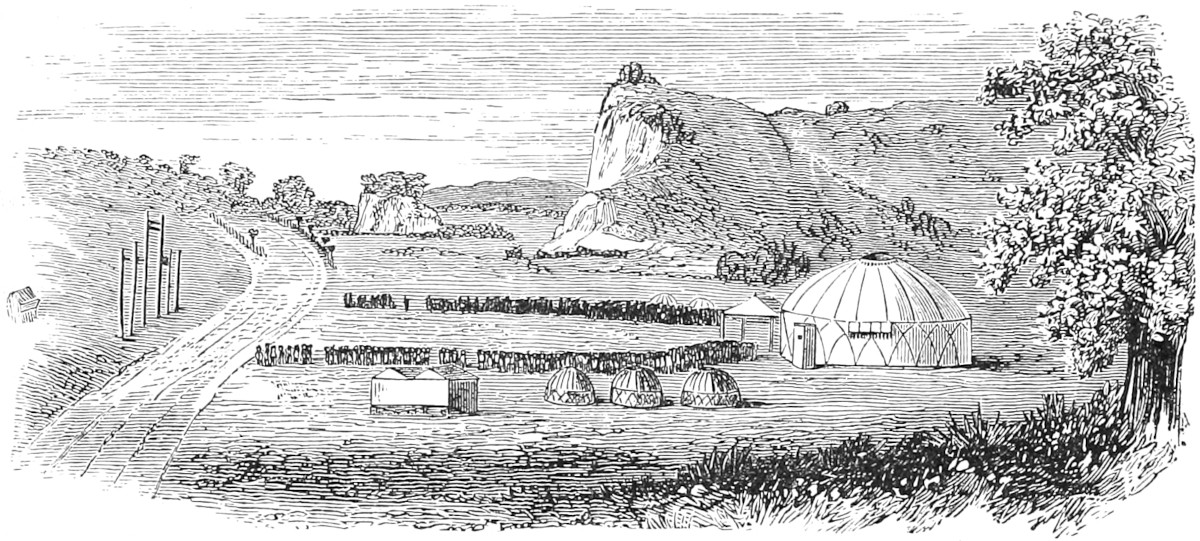
The Tents of the Emperor Kienlung.
[Grenard (pp. 160–162) gives us his experience of Tents in Central Asia (Khotan). “These Tents which we had purchased at Tashkent were the ‘tentes-abris’ which are used in campaign by Russian military workshops, only we made them larger by a third. They were made of grey Kirghiz felt, which cannot be procured at Khotan. The felt manufactured in this town not having enough consistency or solidity, we took Aksu felt, which is better than this of Khotan, though inferior to the felt of Russian Turkestan. These felt tents are extremely heavy, and, once damp, are dried with difficulty. These drawbacks are not compensated by any important advantage; it would be an illusion to believe that they preserve from the cold any better than other tents. In fact, I prefer the Manchu tent in use in the Chinese army, which is, perhaps, of all military tents the most practical and comfortable. It is made of a single piece of double cloth of cotton, very strong, waterproof for a long time, white inside, blue outside, and weighs with its three tipped sticks and its wooden poles, 25 kilog. Set up, it forms a ridge roof 7 feet high and shelters fully ten men. It suits servants perfectly well. For the master who wants to work, to write, to draw, occasionally to receive officials, the ideal tent would be one of the same material, but of larger proportions, and comprising two parallel vertical partitions and surmounted by a ridge roof. The round form of Kirghiz and Mongol tents is also very comfortable, but it requires a complicated and inconvenient wooden frame-work, owing to which it takes some considerable time to raise up the tent.”—H. C.]
Ibn Batuta puts the ermine above the sable. An ermine pelisse, he says, was worth in India 1000 dinárs of that country, whilst a sable one was worth only 400 dinárs. As Ibn Batuta’s Indian dinárs are Rupees, the estimate of price is greatly lower than Polo’s. Some years ago I find the price of a Sack, as it is technically called by the Russian traders, or robe of fine sables, stated to be in the Siberian market about 7000 banco rubels, i.e. I believe about 350l. The same authority mentions that in 1591 the Tzar Theodore Ivanovich made a present of a pelisse valued at the equivalent of 5000 silver rubels of modern Russian money, or upwards of 750l. Atkinson speaks of a single sable skin of the highest quality, for which the trapper demanded 18l. The great mart for fine sables is at Olekma on the Lena. (See I. B. II. 401–402; Baer’s Beiträge, VII. 215 seqq.; Upper and Lower Amoor, 390.)