Volume 1 — CHAPTER V.
Henry Yule translation
Of the Kingdom of Mausul.
On the frontier of Armenia towards the south-east is the kingdom of Mausul. It is a very great kingdom, and inhabited{1} by several different kinds of people whom we shall now describe.
First there is a kind of people called Arabi, and these worship Mahommet. Then there is another description of people who are Nestorian and Jacobite Christians. These have a Patriarch, whom they call the Jatolic, and this Patriarch creates Archbishops, and Abbots, and Prelates of all other degrees, and sends them into every quarter, as to India, to Baudas, or to Cathay, just as the Pope of Rome does in the Latin countries. For you must know that though there is a very great number of Christians in those countries, they are all Jacobites and Nestorians; Christians indeed, but not in the fashion enjoined by the Pope of Rome, for they come short in several points of the Faith.{2}
All the cloths of gold and silk that are called Mosolins are made in this country; and those great Merchants called Mosolins, who carry for sale such quantities of spicery and pearls and cloths of silk and gold, are also from this kingdom.{3}
There is yet another race of people who inhabit the mountains in that quarter, and are called Curds. Some of them are Christians, and some of them are Saracens; but they are an evil generation, whose delight it is to plunder merchants.{4}
[Near this province is another called Mus and Merdin, producing an immense quantity of cotton, from which they make a great deal of buckram{5} and other cloth. The people are craftsmen and traders, and all are subject to the Tartar King.]
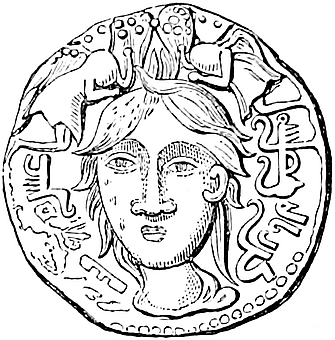
Coin of Badruddín of Mausul.
[The population of Mosul is to-day 61,000 inhabitants—(48,000 Musulmans, 10,000 Christians belonging to various churches, and 3000 Jews).—H. C.]
Játhalík, written in our text (from G. T.) Jatolic, by Fr. Burchard and Ricold Jaselic, stands for Καθολικóς. No doubt it was originally Gáthalík, but altered in pronunciation by the Arabs. The term was applied by Nestorians to their Patriarch; among the Jacobites to the Mafrián or Metropolitan. The Nestorian Patriarch at this time resided at Baghdad. (Assemani, vol. iii. pt. 2; Per. Quat. 91, 127.)
The Jacobites, or Jacobins, as they are called by writers of that age (Ar. Ya’úbkíy), received their name from Jacob Baradaeus or James Zanzale, Bishop of Edessa (so called, Mas’udi says, because he was a maker of barda’at or saddle-cloths), who gave a great impulse to their doctrine in the 6th century. [At some time between the years 541 and 578, he separated from the Church and became a follower of the doctrine of Eutyches.—H. C.] The Jacobites then formed an independent Church, which at one time spread over the East at least as far as Sístán, where they had a see under the Sassanian Kings. Their distinguishing tenet was Monophysitism, viz., that Our Lord had but one Nature, the Divine. It was in fact a rebound from Nestorian doctrine, but, as might be expected in such a case, there was a vast number of shades of opinion among both bodies. The chief locality of the Jacobites was in the districts of Mosul, Tekrit, and Jazírah, and their Patriarch was at this time settled at the Monastery of St. Matthew, near Mosul, but afterwards, and to the present day, at or near Mardin. [They have at present two patriarchates: the Monastery of Zapharan near Baghdad and Etchmiadzin.—H. C.] The Armenian, Coptic, Abyssinian, and Malabar Churches all hold some shade of the Jacobite doctrine, though the first two at least have Patriarchs apart.
(Assemani, vol. ii.; Le Quien, II. 1596; Mas’udi, II. 329–330; Per. Quat. 124–129.)
Mush and Mardin are in very different regions, but as their actual interval is only about 120 miles, they may have been under one provincial government. Mush is essentially Armenian, and, though the seat of a Pashalik, is now a wretched place. Mardin, on the verge of the Mesopotamian Plain, rises in terraces on a lofty hill, and there, says Hammer, “Sunnis and Shias, Catholic and Schismatic Armenians, Jacobites, Nestorians, Chaldæans, Sun-, Fire-, Calf-, and Devil-worshippers dwell one over the head of the other.” (Ilchan. I. 191.)