Part 2 — VII. OTHER INVERTEBRATE-ANIMAL STUDY
Reading edition
THE GARDEN SNAIL
Teacher’s Story
ERCHANCE if those who speak so glibly of a “snail’s pace” should study it, they would not sneer at it, for carefully observed, it seems the most wonderful method of locomotion ever devised by animal. Naturally enough, the snail cannot gallop since it has but one foot; but it is safe to assert that this foot, which is the entire lower side of the body, is a remarkable organ of locomotion. Let a snail crawl up the side of a tumbler and note how this foot stretches out and holds on. It has flanges along the sides, which secrete an adhesive substance that enables the snail to cling, and yet it also has the power of letting go at will. The slow, even, pushing forward, of the whole body, weighted by the unbalanced shell, is as mysterious and seemingly as inevitable, as the march of fate, so little is the motion connected with any apparent muscular effort. But when his snailship wishes to let go and retire from the world, this foot performs a feat which is certainly worthy of a juggler; it folds itself lengthwise, and the end on which the head is retires first into the shell, the tail end of the foot being the last to disappear. And now find your snail!
Never was an animal so capable of stretching out and then folding up all its organs, as is this little tramp who carries his house with him. Turn one on his back when he has withdrawn into his little hermitage, and watch what happens. Soon he concludes he will find out where he is, and why he is bottomside up; as the first evidence of this, the hind end of the foot, which was folded together, pushes forth; then the head and horns come bubbling out. The horns are not horns at all, but each is a stalk bearing an eye on the tip. This is arranged conveniently, like a marble fastened to the tip of a glove finger. When a snail wishes to see, it stretches forth the stalk as if it were made of rubber; but if danger is perceived, the eye is pulled back exactly as if the marble were pulled back through the middle of the glove finger; or as a boy would say, “it goes into the hole and pulls the hole in after it.” Just below the stalked eyes, is another pair of shorter horns, which are feelers, and which may be drawn back in the same manner; they are used constantly for testing the nature of the surface on which the snail is crawling. It is an interesting experiment to see how near to the eyes and the feelers we can place an object, before driving them back in. With these two pairs of sense organs pushed out in front of him, the snail is well equipped to observe the topography of his immediate vicinity; if he wishes to explore above, he can stand on the tip of his tail and reach far up; and if there is anything to take hold of, he can glue his toe fast to it and pull himself up. Moreover, I am convinced that snails have decided views about where they wish to go, for I have tried by the hour to keep them marching lengthwise on the piazza railing, so as to study them; and every snail was determined to go crosswise and crawl under the edge, where it was nice and dark.
It is interesting to observe through a lens, the way a snail takes his dinner; place before him a piece of sweet apple or other soft fruit, and he will lift himself on his front toe and begin to work his way into the fruit. He has an efficient set of upper teeth, which look like a saw and are colored as if he chewed tobacco; with these teeth and with his round tongue, which we can see popping out, he soon makes an appreciable hole in the pulp; but his table manners are not nice, since he is a hopeless slobberer.
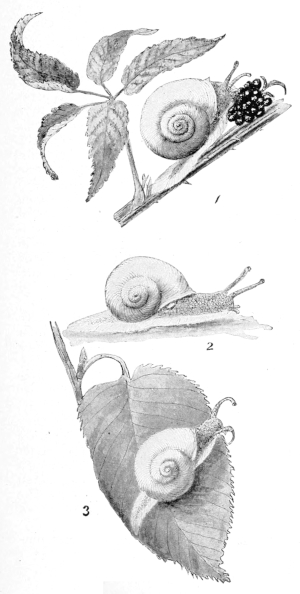
Snail sketches.
1. The thorny path to bliss; 2. Snail showing the breathing-pore; 3. Prospecting.
There are right and left spiraled snails. All those observed for this lesson show the spiral wound about the center from left over to right, or in the direction of the movement of the hands of a clock, and this is usually the case. With the spiral like this, the breathing pore is on the right side of the snail and may be seen as an opening where the snail joins the shell. This pore may be seen to open and contract slowly; by this motion, the air is sucked into the shell where it bathes the snail’s lung, and is then forced out—a process very similar to our own breathing.
The snail has good judgment when attacked; at the first scare, he simply draws in his eyes and feelers and withdraws his head, so that nothing can be seen of him from above, except a hard shell which would not attract the passing bird. But if the attack continues, he lets go all hold on the world, and nothing can be seen of him but a little mass which blocks the door to his house; and if he is obliged to experience a drought, he makes a pane of glass out of mucus across his door, and thus stops evaporation. This is a very wise precaution, because the snail is made up largely of moisture and much water is needed to keep his mucilage factory running.
The way the snail uses his eyes is comical; he goes to the edge of a leaf and pokes one eye over to see what the new territory is like; but if his eye strikes an object, he pulls that one back, and prospects for a time with the other. He can lengthen the eye-stalk amazingly if he has need. How convenient for us if we could thus see around a corner. If a small boy were as well off as a snail, he could see the entire ball game through a knot-hole in the fence. In fact, the more we study the snail, the more we admire, first his powers of ascertaining what there is in the world, and then his power of getting around in the world by climbing recklessly and relentlessly over obstacles, not caring whether he is right side up on the floor or hanging wrong side up from the ceiling; and, finally, we admire his utter reticence when things do not go to suit him. I think the reason I always call a snail “he” is because he seems such a philosopher—a Diogenes in his tub. However, since the snail combines both sexes in one individual the pronoun is surely applicable.
When observed through a lens, the snail’s skin looks like that of the alligator, rough and divided into plates, with a surface like pebbled leather; and no insect intruder can crawl up his foot and get into the shell “unbeknownst,” for the shell is grown fast to the flange, that grows out of the middle of the snail’s back. The smoother the surface the snail is crawling upon, the harder to make him let go. The reason for this lies in the mucus, which he secretes as he goes, and which enables him to fasten himself anywhere; he can crawl up walls or beneath any horizontal surface, shell downward, and he leaves a shining trail behind him wherever he goes.
Snail eggs are as large as small peas, almost transparent, covered with very soft shells, and fastened together by mucus. They are laid under stones and decaying leaves. As soon as the baby snail hatches, it has a shell with only one spiral turn in it; as it grows, it adds layer after layer to the shell on the rim about the opening—which is called the lip; these layers we can see as ridges on the shell. If we open an empty shell, we can see the progress of growth in the size of the spirals. Snails eat succulent leaves and other soft vegetable matter. During the winter, they bury themselves beneath objects or retire into soft humus. In preparing for the winter, the snail makes a door of mucus and lime, or sometimes three doors, one behind another, across the entrance to his shell, leaving a tiny hole to admit the air. There are varieties of snails which are eaten as dainties in Europe, and are grown on snail farms for the markets. The species most commonly used is the same as that which was regarded as a table luxury by the ancient Romans.
References—Wild Life, Ingersoll; The Natural History of Some Common Animals, Latter.
LESSON CVI
The Garden Snail
Leading thought—The snail carries his dwelling with him, and retires within it in time of danger. He can climb on any smooth surface.
Method—The pupils should make a snailery, which may consist of any glass jar, with a little soil and some moss or leaves at the bottom, and a shallow dish of water at one side. The moss and soil should be kept moist. Place the snails in this and give them fresh leaves or pulpy fruit, and they will live comfortably in confinement. A bit of cheese-cloth fastened with a rubber band should be placed over the top of the jar. A tumbler inverted over a dish, on which is a leaf or two, makes a good observation cage to pass around the room for closer examination. An empty shell should be at hand, which may be opened and examined.
Observations—1. Where do you find snails? Why do they like to live in such places?
2. How does a snail walk? Describe its “foot.” How can it move with only one foot? Describe how it climbs the side of the glass jar. How does it cling?
3. What sort of a track does a snail leave behind it? What is the use of this mucus?
4. Where are the snail’s eyes? Why is this arrangement convenient? If we touch one of the eyes what happens? What advantage is this to the snail? Can it pull in one eye and leave the other out?
5. Look below the eyes for a pair of feelers. What happens to these if you touch them?
6. What is the use of its shell to a snail? What does the snail do if startled? If attacked? When a snail is withdrawn into its shell can you see any part of the body? Is the shell attached to the middle of the foot? How did the shell grow on the snail’s back? How many spiral turns are there in the full-grown shell? Are there as many in the shell of a young snail? Can you see the little ridges on the shell? Do you think that these show the way the shell grew?
7. Can you find the opening through which the snail draws its breath? Where is this opening? Describe its action.
8. Put the snail in a dry place for two or three days, and see what happens. Do you think this is for the purpose of keeping in moisture? What does the snail do during the winter?
9. Place a snail on its back and see how it rights itself. Describe the way it eats. Can you see the horny upper jaw? Can you see the rasping tongue? What do snails live on?
10. Do you know how the snail eggs look and where they are laid? How large is the shell of the smallest garden snail you ever saw? How many spiral turns were there in it? Open an empty snail shell and see how the spirals widened as the snail grew. Do you think the shell grew by layers added to the lip?
11. Do all snails have shells? Describe all the kinds of snails you know. What people consider snails a table delicacy?
TO A SNAIL Little Diogenes bearing your tub, whither away so gay, With your eyes on stalks, and a foot that walks, tell me this I pray! Is it an honest snail you seek that makes you go so slow, And over the edges of all things peek? Have you found him, I want to know; Or do you go slow because you knew, your house is near and tight? And there is no hurry and surely no worry lest you stay out late at night.
THE EARTHWORM
Teacher’s Story
LTHOUGH not generally considered attractive, for two reasons the earthworm has an important place in nature-study: it furnishes an interesting example of lowly organized creatures, and it is of great economic importance to the agriculturist. The lesson should have special reference to the work done by earthworms and to the simplicity of the tools with which the work is done.
The earthworm is, among lower animals, essentially the farmer. Long before man conceived the idea of tilling the soil, this seemingly insignificant creature was busily at work plowing, harrowing, and fertilizing the land. Nor did it overlook the importance of drainage and the addition of amendments—factors of comparatively recent development in the management of the soil by man.
Down into the depths, sometimes as far as seven or eight feet, but usually from twelve to eighteen inches, goes the little plowman, bringing to the surface the subsoil, which is exactly what we do when we plow deeply. To break up the soil as our harrows do, the earthworm grinds it in a gizzard stocked with grains of sand or fine gravel, which act as millstones. Thus it turns out soil of much finer texture than we, by harrowing or raking, can produce. In its stomach it adds the lime amendment, so much used by the modern farmer. The earthworm is apparently an adept in the use of fertilizers; it even shows discrimination in keeping the organic matter near the surface, where it may be incorporated into the soil of the root zone. It drags into its burrows dead leaves, flowers and grasses, with which to line the upper part. Bones of dead animals, shells, and twigs are buried by it, and, being more or less decayed, furnish food for plants. These minute agriculturists have never studied any system of drainage, but they bore holes to some depth which carry off the surplus water. They plant seeds by covering those that lie on the ground with soil from below the surface—good, enriched, well granulated soil it is, too. They further care for the growing plants by cultivating, that is keeping fine and granular, the soil about the roots.
It was estimated by Darwin that, in garden soil in England, there are more than 50,000 earthworms in an acre, and that the whole superficial layer of vegetable mold passes through their bodies in the course of every few years, at the rate of eighteen tons per acre yearly.
This agricultural work of the earthworm has been going on for ages. Wild land owes much of its beauty to this diminutive creature which keeps the soil in good condition. The earthworm has undermined and buried rocks, changing greatly the aspect of the landscape. It has preserved ruins and ancient works of art. Several Roman villas in England owe their preservation to the earthworm. All this work is accomplished with the most primitive tools, a tiny proboscis, a distensible pharynx, a rather indeterminate tail, a gizzard and the calcareous glands peculiar to this lowly creature.
An earthworm has a peculiar, crawling movement. Unlike the snake, which also moves without legs, it has no scales to function in part as legs; but it has a very special provision for locomotion. On the under side of a worm are found numerous setæ—tiny, bristlelike projections. These will be seen to be in double rows on each segment, excepting the first three and the last. The setæ turn so that they point in the opposite direction from which the worm is moving. It is this use of these clinging bristles, together with strong muscles, which enables a worm to hold tightly to its burrow when bird or man attempts its removal. A piece of round elastic furnishes an excellent example of contraction and extension, such as the earthworm exhibits. Under the skin of the worm are two sets of muscles; the outer passing in circular direction around the body, the inner running lengthwise. The movement of these may be easily seen in a good-sized, living specimen. The body is lengthened by the contraction of circular and the extension of longitudinal muscles, and shortened by the opposite movement.
The number of segments may vary with the age of the worm. In the immature, the clitellum, a thick, whitish ring near the end, is absent. The laying of the earthworm’s egg is an interesting performance. A sac-like ring is formed about the body in the region of the clitellum. This girdle is gradually worked forward and, as it is cast over the head, the sac-ends snap together enclosing the eggs. These capsules, yellowish-brown, football-shaped, about the size of a grain of wheat, may be found in May or June about manure piles or under stones.
Earthworms are completely deaf, although sensitive to vibration. They have no eyes, but can distinguish between light and darkness. The power of smell is feeble. The sense of taste is well developed; the sense of touch is very acute; and we are not so sure as is Dr. Jordan, that the angleworm is at ease on the hook.
Any garden furnishes good examples of the home of the earthworm. The burrows are made straight down at first, then wind about irregularly. Usually they are about one or two feet deep, but may reach even eight feet. The burrow terminates generally in an enlargement where one or several worms pass the winter. Toward the surface, the burrow is lined with a thin layer of fine, dark colored earth, voided by the worm. This creature is an excavator and builder of no mean ability. The towerlike “castings” so characteristic of the earthworm, are formed with excreted earth. Using the tail as a trowel, it places earth, now on one side and now on the other. In this work, of course, the tail protrudes; in the search for food, the head is out. A worm, then, must make its home, narrow as it is, with a view to being able to turn in it.
An earthworm will bury itself in loose earth in two or three minutes, and in compact soil, in fifteen minutes. Pupils should be able to make these observations easily either in the terrarium or in the garden.
In plugging the mouths of their burrows, earthworms show something that seems like intelligence. Triangular leaves are invariably drawn in by the apex, pine-needles by the common base, the manner varying with the shape of the leaf. They do not drag in a leaf by the footstalk, unless its basal part is as narrow as the apex. The mouth of the burrow may be lined with leaves for several inches.
The burrows are not found in dry ground nor in loose sand. The earthworm lives in the finer, moderately wet soils. It must have moisture since it breathes through the skin, and it has sufficient knowledge of soil texture and plasticity to recognize the futility of attempts at burrow building with unmanageable, large grains of sand.
These creatures are nocturnal, rarely appearing by day unless “drowned out” of the burrows. During the day they lie near the surface extended at full length, the head uppermost. Here they are discovered by keen-eyed birds and sacrificed by thousands, notwithstanding the strong muscular protest of which they are capable.
Seemingly conscious of its inability to find the way back to its home, an earthworm anchors tight by its tail while stretching its elastic length in a foraging expedition. It is an omnivorous creature, including in its diet earth, leaves, flowers, raw meat, fat, and even showing cannibalistic designs on fellow earthworms. In the schoolroom, earthworms may be fed on pieces of lettuce or cabbage leaves. A feeding worm will show the proboscis, an extension of the upper lip used to push food into the mouth. The earthworm has no hard jaws or teeth, yet it eats through the hardest soil. Inside the mouth opening is a very muscular pharynx, which can be extended or withdrawn. Applied to the surface of any small object it acts as a suction pump, drawing food into the food tube. The earth taken in furnishes some organic matter for food; calcareous matter is added to the remainder before being voided. This process is unique among animals. The calcareous matter is supposed to be derived from leaves which the worms eat. Generally the earth is swallowed at some distance below the surface, and finally ejected in characteristic “castings.” Thus, the soil is slowly worked over and kept in good condition by earthworms, of which Darwin says: “It may be doubted whether there are many other animals which have played so important a part in the history of the world as have these lowly organized creatures.”
References—The Earthworm, Darwin; The Natural History of Some Common Animals, Latter.
“Fly fishing is an art, a fine art beyond a doubt, but it is an art and, like all art, it is artificial. Fishing with an angleworm is natural. It fits into the need of the occasion. It fits in with the spirit of the boy. It is not by chance that the angleworm, earthworm, fishworm, is found in every damp bank, in every handy bit of sod, the green earth over, where there are races whose boys are real boys with energy enough to catch a fish. It is not by chance that the angleworm makes a perfect fit on a hook, with no anatomy with which to feel pains, and no arms or legs to be broken off or to be waved helplessly in the air. Its skin is tough enough so as not to tear, not so tough as to receive unseemly bruises, when the boy is placing it on the hook. The angleworm is perfectly at home on the hook. It is not quite comfortable anywhere else. It crawls about on sidewalks after rain, bleached and emaciated. It is never quite at ease even in the ground, but on the hook it rests peacefully, with the apparent feeling that its natural mission is performed.”—“Boys’ Fish and Boys’ Fishing,” by David Starr Jordan.
LESSON CVII
The Earthworm
Leading thought—The earthworm is a creature of the soil and is of much economic importance.
Method—Any garden furnishes abundant material for the study of earthworms. They are nocturnal workers and may be observed by lantern light. To form some estimate of the work done in a single night, remove the “casts” from a square yard of earth one day, and examine that piece of earth the next. It is well to have a terrarium in the schoolroom for frequent observation. Scatter grass or dead leaves on top of the soil, and note what happens. For the study of the individual worm and its movements, each pupil should have a worm with some earth upon his desk.
Observations—1. How does the earthworm crawl? How does it turn over? Has it legs? Compare its movement with that of a snake, another legless animal. What special provision for locomotion has the earthworm?
2. Compare the lengths of the contracted and extended body. How accounted for?
3. Describe the body—its shape and color, above and below. Examine the segments. Do all the worms have the same number? Compare the head end with the tail end of the body. Has every worm a “saddle,” or clitellum?
4. Does the earthworm hear easily? Has it eyes? Is it sensible to smell or to touch? What sense is most strongly developed?
5. Describe the home of the earthworm. Is it occupied by more than one worm? How long does it take a worm to make a burrow? How does it protect its home? How does it make a burrow? In what kind of soil do you find earthworms at work?
6. Is the earthworm seen most often at night or by day? Where is it the rest of the time? How does it hold to its burrow? When is the tail end at the top? When the head end?
7. What is the food of the earthworm? How does it get its food?
8. Look for the eggs of the earthworm about manure piles or under stones.
9. What are the enemies of the earthworm? Is it a friend or an enemy to us? Why?
10. The earthworm is a good agriculturist. Why?
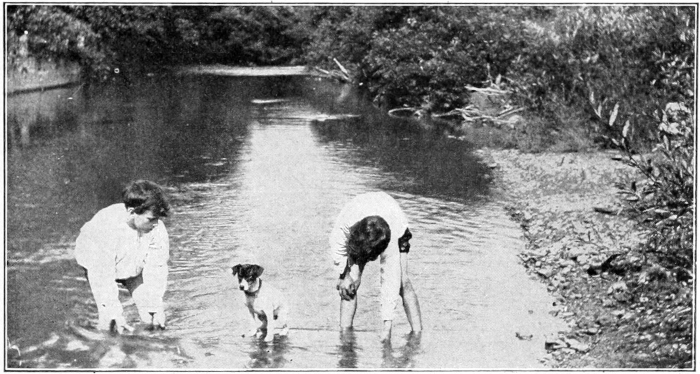
Where the crayfish lurks.
THE CRAYFISH
Teacher’s Story
HEN I look at a crayfish I envy it, so rich is it in organs with which to do all that it has to do. From the head to the tail, it is crowded with a large assortment of executive appendages. In this day of multiplicity of duties, if we poor human creatures only had the crayfish’s capabilities, then might we hope to achieve what lies before us.
The most striking thing in the appearance of the crayfish is the great pair of nippers on each of the front legs. Wonderfully are its “thumb and finger” put together; the “thumb” is jointed so that it can move back and forth freely; and both are armed, along the inside edge, with saw teeth and with a sharp claw at the tip so that they can get a firm grip upon an object. Five segments in these great legs can be easily seen; that joining the body is small, but each successive one is wider and larger, to the great forceps at the end. The two stout segments behind the nippers give strength, and also a suppleness that enables the claws to be bent in any direction.
The legs of the pair behind the big nippers have five segments readily visible; but these legs are slender and the nippers at the end are small; the third pair of legs is armed like the second pair; but the fourth and fifth pairs lack the pincers, and end in a single claw.
But the tale of the crayfish’s legs is by no means told; for between and above the great pincers is a pair of short, small legs tipped with single claws, and fringed on their inner edges. These are the maxillapeds, or jaw-feet; and behind them, but too close to be seen easily, are two more pairs of jaw-feet. As all of these jaw-feet assist at meals, the crayfish apparently always has a “three fork” dinner; and as if to provide accommodations for so many eating utensils, it has three pairs of jaws all working sidewise, one behind the other. Two of these pairs are maxillæ and one, mandibles. The mandibles are the only ones we see as we look in between the jaw-feet; they are notched along the biting edge. Connected with the maxillæ, on each side, are two pairs of threadlike flappers, that wave back and forth vigorously and have to do with setting up currents of water over the gills.
Thus we see that, in all, the crayfish has three pairs of jaw-feet, one pair of great nippers and four pairs of walking feet, two of which also have nippers and are used for digging and carrying.
When we look upon the crayfish from above, we see that the head and thorax are fastened solidly together, making what is called a cephalothorax. The cephalothorax is covered with a shell called the carapace, which is the name given also to the upper part of the turtle’s shell. The suture where the head joins the thorax is quite evident. In looking at the head, the eyes first attract our attention; each is black and oval and placed on the tip of a stalk, so it can be extended or retracted or pushed in any direction, to look for danger. These eyes are like the compound eyes of insects, in that they are made up of many small eyes, set together in a honeycomb pattern.
The long antennæ are as flexible as braided whiplashes, large at the base and ending in a threadlike tip. They are composed of many segments, the basal ones being quite large. Above the antennæ on each side, is a pair of shorter ones called antennules, which come from the same basal segment; the lower one is the more slender and is usually directed forward; the upper one is stouter, curves upward, and is kept always moving, as if it were constantly on the alert for impressions. The antennæ are used for exploring far ahead or behind the creature, and are often thrust down into the mud and gravel at the bottom of the aquarium, as if probing for treasure. The antennules seem to give warning of things closer at hand. Between the antennæ and antennules is a pair of finger-like organs, that are hinged at the outer ends and can be lifted back, if we do it carefully.
In looking down upon a crayfish, we can see six abdominal segments and the flaring tail at the end, which is really another segment greatly modified. The first segment, or that next to the cephalothorax, is narrow; the others are about equal in size, each graceful in shape, with a widened part at each side which extends down along the sides of the creature. These segments are well hinged together so that the abdomen may be completely curled beneath the cephalothorax. The plates along the sides are edged with fringe. The tail consists of five parts, one semicircular in the center, and two fan-shaped pieces at each side, and all are margined with fringe. This tail is a remarkable organ. It can be closed or extended sidewise like a fan; it can be lifted up or curled beneath.
Looking at the crayfish from below, we see on the abdomen some very beautiful featherlike organs called swimmerets. Each swimmeret consists of a basal segment with twin paddles joined to its tip, each paddle being narrow and long and fringed with hairs. The mother crayfish has four pairs of these, one pair on each of the second, third, fourth and fifth segments; her mate has an additional larger pair on the first segment. These swimmerets, when at rest, lie close to the abdomen and are directed forward and slightly inward. When in motion, they paddle with a backward, rhythmic motion, the first pair setting the stroke and the other pairs following in succession. This motion sends the body forward, and the swimmerets are chiefly used to aid the legs in forward locomotion. A crayfish, on the bottom of a pond, seems to glide about with great ease; but place it on land, and it is an awkward walker. The reason for this difference lies, I believe, in the aid given by the swimmerets when the creature is in water. Latter says: “In walking, the first three pairs of legs pull and the fourth pair pushes. Their order of movement is as follows: The first on the right and the third on the left side move together, next the third right and the first left, then the second right and fourth left, and lastly the fourth right and second left.”
When the crayfish really wishes to swim, the tail is suddenly brought into use; it is thrust out backward, lays hold of the water by spreading out widely, and then doubles under with a spasmodic jerk which pulls the creature swiftly backward.
The crayfish’s appearance is magically transformed when it begins to swim; it is no longer a creature of sprawling awkward legs and great clumsy nippers; now, its many legs lie side by side supinely and the great claws are limp and flow along in graceful lines after the body, all obedient to the force which sends the creature flying through the water. I cannot discover that the swimmerets help in this movement.
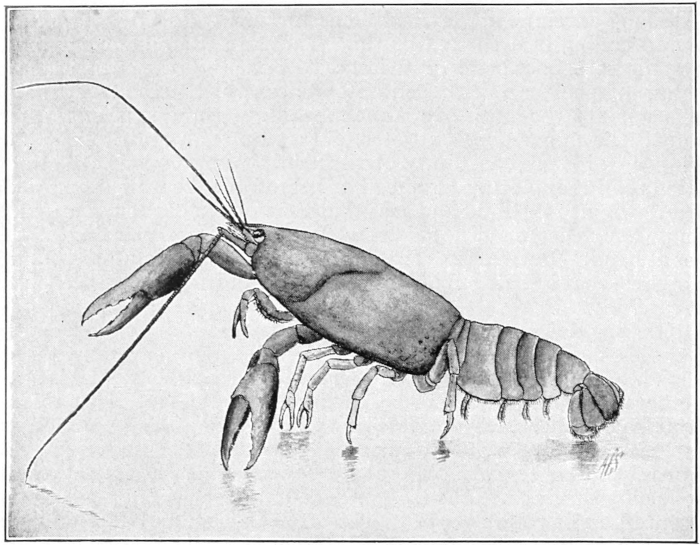
A crayfish.
Drawn by Anna C. Stryke.
The mother crayfish has another use for her swimmerets; in the spring, when she is ready to lay eggs, she cleans off her paddles with her hind legs, covers them with waterproof glue, and then plasters her eggs on them in grapelike clusters of little dark globules. What a nice way to look after her family! The little ones hatch, but remain clinging to the maternal swimmerets, until they are large enough to scuttle around on the brook bottom and look out for themselves.
The breathing apparatus of the crayfish cannot be seen without dissection. All the walking legs, except the last pair, have gills attached to that portion of them which joins the body, and which lies hidden underneath the sides of the carapace or shell. The blood is forced into these gills, sends off its impurities through their thin walls and takes in the oxygen from the water, currents of which are kept steadily flowing forward.
Crayfishes haunt still pools along brooksides and river margins and the shallow ponds of our fresh waters. There they hide beneath sticks and stones, or in caves of their own making, the doors of which they guard with the big and threatening nippers, which stand ready to grapple with anybody that comes to inquire if the folks are at home. The upper surface of the crayfish’s body is always so nearly the color of the brook bottom, that the eye seldom detects the creature until it moves; and if some enemy surprises one, it swims off with terrific jerks which roil all the water around and thus covers its retreat. In the winter, our brook forms hibernate in the muddy bottoms of their summer haunts. There are many species; some in our Southern States, when the dry season comes on, live in little wells which they dig deep enough to reach water. They heap up the soil which they excavate around the mouth of the well, making well-curbs of mud; these are ordinarily called “crawfish chimneys.” The crayfishes find their food in the flotsam and jetsam of the pool. They seem fond of the flesh of dead fishes and are often trapped by its use as bait.
The growth of the crayfish is like that of insects; as its outer covering is a hard skeleton that will not stretch, it is shed as often as necessary; it breaks open down the middle of the back of the carapace, and the soft bodied creature pulls itself out, even to the last one of its claws. While its new skin is yet elastic, it stretches to its utmost; but this skin also hardens after a time and is, in its turn, shed. Woe to the crayfish caught in this helpless, soft condition after molting! For it then has no way to protect itself. We sometimes find the old skin floating, perfect in every detail, and so transparent that it seems the ghost of a crayfish.
Not only is the crayfish armed in the beginning with a great number of legs, antennæ, etc., but if it happens to lose any of these organs, they will grow again. It is said that, when attacked, it can voluntarily throw off one or more of its legs. We have often found one of these creatures with one of the front claws much larger than the other; it had probably lost its big claw in a fight, and the new growth was not yet completed.
I have been greatly entertained by watching a female crayfish make her nest in my aquarium which has, for her comfort, a bottom of three inches of clean gravel. She always commences at one side by thrusting down her antennæ and nippers between the glass and stones; she seizes a pebble in each claw and pulls it up and in this way starts her excavation; but when she gets ready to carry off her load, she comes to the task with her tail tucked under her body, as a lady tucks up her skirts when she has something to do that requires freedom of movement. Then with her great nippers and the two pairs of walking feet, also armed with nippers, she loads up as much as she can carry between her great claws and her breast. She keeps her load from overflowing by holding it down with her first pair of jaw-feet, just as I have seen a schoolboy use his chin, when carrying a too large load of books; and she keeps the load from falling out by supporting it from beneath with her first pair of walking legs. Thus, she starts off with her “apron” full, walking on three pairs of feet, until she gets to the dumping place; then she suddenly lets go and at the same time her tail straightens out with a gesture which says plainly, “There!” Sometimes when she gets a very large load, she uses her second pair of walking legs to hold up the burden, and crawls off successfully, if not with ease, on two pairs of legs,—a most unnatural quadruped.
I had two crayfishes in a cage in an aquarium, and each made a nest in the gravel at opposite ends of the cage, heaping up the debris into a partition between them. I gave one an earthworm, which she promptly seized with her nippers; she then took up a good sized pebble in the nippers of her front pair of walking legs, glided over to the other nest, spitefully threw down both worm and pebble on top of her fellow prisoner, and then sped homeward. Her victim responded to the act by rising up and expressing perfectly, in his attitude and the gestures of his great claws, the most eloquent of crayfish profanity. In watching crayfishes carry pebbles, I have been astonished to see how constantly the larger pair of jaw-feet are used to help pick up and carry the loads.
LESSON CVIII
The Crayfish
Leading thought—The crayfish, or crawfish, as it is sometimes called, has one pair of legs developed into great pincers for seizing and tearing its food and for defending itself from enemies. It can live in mud or water. It belongs to the same animal group as do the insects, and it is a near cousin of the lobster.
Method—Place a crayfish in an aquarium (a battery jar or a two-quart Mason jar) in the schoolroom, keeping it in clear water until the pupils have studied its form. It will rise to explore the sides of the aquarium at first, and thus show its mouth parts, legs and swimmerets. Afterwards, place gravel and stone in the bottom of the aquarium, so that it can hide itself in a little cavity which it will make by carrying pebbles from one side. Wash the gravel well before it is put in, so that the water will be unclouded and the children can watch the process of excavation.
Observations—1. What is there peculiar about the crayfish which makes it difficult to pick it up? Examine one of these great front legs carefully and see how wonderfully it is made. How many parts are there to it? Note how each succeeding part is larger from the body to the claws. Note the tips which form the nippers or chelæ, as they are called. How are they armed? How are the gripping edges formed to take hold of an object? How wide can the nippers be opened, and how is this done? Note the two segments behind the great claw and describe how they help the work of the nippers.
2. Study the pair of legs behind the great claws or chelæ, and compare the two pairs, segment by segment. How do they differ except as to size? How do the nippers at the end compare with the big ones? Look at the next pair of legs behind these; are they similar? How do the two pairs of hind legs differ in shape from the two pairs in front of them?
3. Look between the great front claws and see if you can find another pair of small legs. Can you see anything more behind or above these little legs?
4. When the crayfish lifts itself up against the side of the jar, study its mouth. Can you see a pair of notched jaws that work sidewise? Can you see two or three pairs of threadlike organs that wave back and forth in and out the mouth?
5. How many legs, in all, has the crayfish? What are the short legs near the mouth used for? What are the great nippers used for? How many legs does the crayfish use when walking? In what order are they moved? Is the hind pair used for pushing? What use does it make of the pincers on the first and second pairs of walking legs?
6. Look at the crayfish from above; the head and the covering of the thorax are soldered together into one piece. When this occurs, the whole is called a cephalothorax; and the cover is called by the same name as the upper shell of the turtle, the carapace. Can you see where the head is joined to the thorax?
7. Look carefully at the eyes. Describe how they are set. Can they be pushed out or pulled in? Can they be moved in all directions? Of what advantage is this to the crayfish?
8. How many antennæ has the crayfish? Describe the long ones and tell how they are used. Do the two short ones on each side come from the same basal segment? These little ones are called the antennules. Describe the antennules of each side and tell how they differ. Can you see the little fingerlike organs which clasp above the antennæ and below the antennules on each side of the head? Can these be moved?
9. Look at the crayfish from above. How many segments are there in the abdomen? Note how graceful the shape of each segment. Note that each has a fan-shaped piece down the side. Describe how the edges of the segments along the sides are margined.
10. Of how many pieces is the tail made? Make a sketch of it. How are the pieces bordered? Can the pieces shut and spread out sidewise? Is the tail hinged so it can be lifted up against the back or curled under the body?
11. Look underneath the abdomen and describe the little fringed organs called the swimmerets. How many are there?
12. How does the crayfish swim? With what does it make the stroke? Describe carefully this action of the tail. When it is swimming, does it use its swimmerets? Why do not the many legs and big nippers obstruct the progress of the crayfish, when it is swimming?
13. When does the crayfish use its swimmerets? Do they work so as to push the body backward or forward? Do you know to what use the mother crayfish puts her swimmerets?
14. Do you know how crayfishes breathe? Do you know what they eat and where they find it?
15. Where do you find crayfishes? Where do they like to hide? Do they go headfirst into their hiding place, or do they back in? Do they stand ready to defend their retreat? When you look down into the brook, are the crayfishes usually seen until they move? Why is this? Where do the crayfishes pass the winter? Did you ever see the crayfish burrows or mud chimnies?
16. If the crayfish loses one of its legs or antennæ, does it grow out again? How does the crayfish grow?
17. Put a crayfish in an aquarium which has three inches of coarse gravel on the bottom, and watch it make its den. How does it loosen up a stone? With how many legs does it carry its burden of pebbles when digging its cave? How does it use its jaw-feet, its nippers, and its first and second pairs of walking legs in this work?
“A rock-lined, wood-embosomed nook, Dim cloister of the chanting brook! A chamber within the channelled hills, Where the cold crystal brims and spills, By dark-browed caverns blackly flows, Falls from the cleft like crumbling snows, And purls and splashes, breathing round A soft, suffusing mist of sound.” —J. T. Trowbridge.
DADDY-LONGLEGS, OR GRANDFATHER GREYBEARD
Teacher’s Story
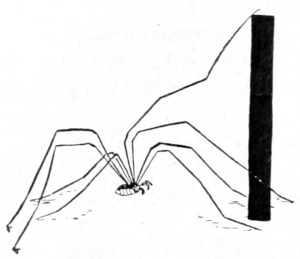
WONDER if there ever was a country child who has not grasped firmly the leg of one of these little sprawling creatures and demanded: “Grandfather Greybeard, tell me where the cows are or I’ll kill you,” and Grandfather Greybeard, striving to get away, puts out one of his long legs this way, and another that way, and points in so many directions that he usually saves his life, since the cows must be somewhere. It would be more interesting to the children and less embarrassing to the “daddy” if they were taught to look more closely at those slender, hairlike legs.
“Daddy’s” long legs are seven jointed. The first segment is seemingly soldered fast to the lower side of his body, and is called the coxa. The next segment is a mere knob, usually black and ornamental, and is called the trochanter. Then comes the femur, a rather long segment directed upward; next is a short swollen segment—the “knee joint” or patella; next the tibia, which is also rather long. Then comes the metatarsus and tarsus, which seemingly make one long downward-directed segment, outcurving at the tips, on which the “daddy” tip-toes along.
I have seen a “daddy” walk into a drop of water and his foot was never wetted, so light was his touch on the water surface film. The second pair of legs is the longest; the fourth pair next, and the first pair usually the shortest. The legs of the second pair are ordinarily used in exploring the surroundings. Notice that, when the “daddy” is running, these two legs are spread wide apart and keep in rapid motion; their tips, far more sensitive than any nerves of our own, tell him the nature of his surroundings, by a touch so light that we cannot feel it on the hand. We have more respect for one of these hairlike legs, when we know it is capable of transmitting intelligence from its tip.
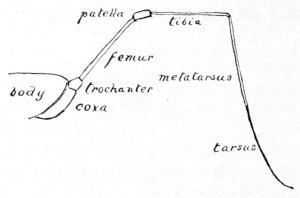
One of “daddy’s” long legs with segments named.
The “daddy” is a good traveler and moves with remarkable rapidity. And why not? If our legs were as long in comparison as his, they would be about forty feet in length. When the “daddy” is running, the body is always held a little distance above the ground; but when the second pair of legs suggests to him that there may be something good to eat in the neighborhood, he commences a peculiar teetering motion of the body, apparently touching it to the ground at every step; as the body is carried tilted with the head down, this movement enables the creature to explore the surface below him with his palpi, which he ordinarily carries bent beneath his face, with the ends curled up under his “chin.” The palpi have four segments that are easily seen, and although they are ordinarily carried bent up beneath the head, they can be extended out quite a distance if “daddy” wishes to test a substance. The end segment of the palpus is tipped with a single claw.
Beneath the palpi is a pair of jaws; these, in some species, extend beyond the palpi. I have seen a daddy-longlegs hold food to his jaws with his palpi and he seemed also to use them for stuffing it into his mouth.
The body of the daddy-longlegs is a little oblong object, looking more like a big grain of wheat than anything else, because in these creatures the head, thorax and abdomen are all grown together compactly. On top of the body, between the feeler-legs, is a little black dot, and to the naked eye it would seem that if this were an organ of sight the creature must be a Cyclops with only one eye. But under the lens this is seen to be a raised knob and there is on each side of it, a little shining black eye. We hardly see the use of two eyes set so closely together, but probably the “daddy” does.
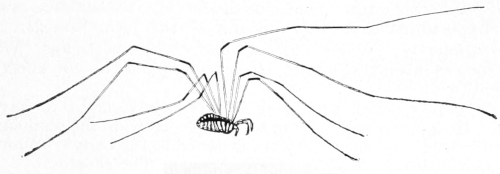
Grandfather-greybeard.
Comstock’s Manual.
The most entertaining thing which a “daddy” in captivity is likely to do, is to clean his legs; he is very particular about his legs, and he will grasp one close to the basal joint in his jaws and slowly pull it through, meanwhile holding the leg up to the jaws with the palpi, while he industriously nibbles it clean for the whole length to the very toe. Owing to the likelihood of his losing one of his legs, he has the power of growing a new one; so we often see a “daddy” with one or more legs only half grown.
There are many species of daddy-longlegs in the United States, and some of them do not have the characteristic long legs. In the North, all except one species die at the approach of winter; but not until after the female, which, by the way, ought to be called “granny-longlegs,” has laid her eggs in the ground, or under some protecting stone, or in some safe crevice of wood or bark. In the spring the eggs hatch into tiny little creatures which look just like the old daddy-longlegs, except for their size. They get their growth like insects, by shedding their skins as fast as they outgrow them. It is interesting to study one of these cast skins with a lens. There it stands with a slit down its back, and with the skin of each leg absolutely perfect to the tiny claw! Again we marvel at these legs that seem so threadlike, and which have an outer covering that can be shed. Some say that the daddy-longlegs live on small insects which they straddle over and pounce down upon, and some say they feed upon decaying matter and vegetable juices. This would be an interesting line of investigation for pupils, since they might be able to give many new facts about the food of these creatures. The “daddies” are night prowlers, and like to hide in crevices by day, waiting for the dark to hunt for their food. They have several common names. Besides the two given they are called “harvestmen” and the French call them “haymakers.” Both of these names were very probably given, because the creatures appear in greater numbers at the time of haying and harvesting.
LESSON CIX
The Daddy-Longlegs
Leading thought—These long-legged creatures have one pair of legs too many to allow them to be classed with the insects. They are more nearly related to the spiders, who also have eight legs. They are pretty creatures when examined closely, and they do many interesting things.
Method—Put a grandfather greybeard in a breeding cage or under a large tumbler, and let the pupils observe him at leisure. If you place a few drops of sweetened water at one side of the cage, the children will surely have an opportunity to see this amusing creature clean his legs.
Observations—1. Where did you find the harvestman? What did it do as soon as it was disturbed? How many names do you know for this little creature?
2. A “daddy” with such long legs certainly ought to have them studied. How many segments in each leg? How do the segments look? How do the legs look where they are fastened to the body? Which is the longest pair of legs? The next? The next? The shortest?
3. If you had such long stilts as he has, they would be about forty feet long. Would you lift yourself that high in the air? Does the “daddy” lift his body high or swing it near the ground? What shape is the body? Can you see if there is a distinct head? Can you see a black dot on top of the front end of the body? If you should see this dot through a microscope it would prove to be two bright black eyes. Why should the daddy’s eyes be on top?
4. Do you see a pair of organs that look like feelers at the front end of the body? These are called palpi. How does he use his palpi? Give him a little bruised or decaying fruit, and see him eat. Where do you think his mouth is? Where does he keep his palpi when he is not using them for eating?
5. Note what care he takes of his legs. How does he clean them? Which does he clean the oftenest? Do you think the very long second pair of legs is used as much for feeling as for walking? Put some object in front of the “daddy” and see him explore it with his legs. How much of the leg is used as a foot when the “daddy” stands or runs?
6. When running fast, how does the “daddy” carry his body? When exploring how does he carry it? Do you ever find the “daddy” with his body resting on the surface on which he is standing? When resting, are all eight of his legs on the ground? Which are in the air? Is the head end usually tilted up or down?
7. Do you see the daddy-longlegs early in the spring? When do you find him most often? How do you suppose he passes the winter in our climate? Have you ever seen a “daddy” with one leg much shorter than the other? How could you explain this?
8. Try and discover what the daddy-longlegs eats, and where he finds his food.
SPIDERS
Teacher’s Story
HE spiders are the civil engineers among the small inhabitants of our fields and woods. They build strong suspension bridges, from which they hang nets made with exquisite precision; and they build aeroplanes and balloons, which are more efficient than any that we have yet constructed; for although they are not exactly dirigible, yet they carry the little balloonists where they wish to go, and there are few fatal accidents. Moreover, the spiders are of much economic importance, since they destroy countless millions of insects every year, most of which are noxious—like flies, mosquitoes, bugs and grasshoppers.
There is an impression abroad that all spiders are dangerous to handle. This is a mistake; the bite of any of our common spiders is not nearly so dangerous as the bite of a malaria-laden mosquito. Although there is a little venom injected into the wound by the bite of any spider, yet there is no species found in the Northern States whose bite is sufficiently venomous to be feared.
There is no need for studying the anatomy of the spider closely in nature-study. Our interest lies much more in the wonderful structures made by the spiders, than in a detailed study of the little creatures themselves.
Cobwebs “Here shy Arachne winds her endless thread, And weaves her silken tapestry unseen, Veiling the rough-hewn timbers overhead, And looping gossamer festoons between.” —Elizabeth Akers.
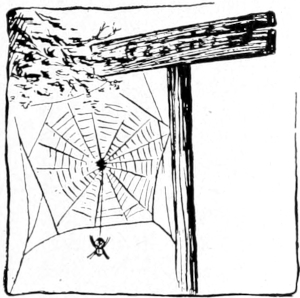
Our house spiders are indefatigable curtain-weavers. We never suspect their presence, until suddenly their curtains appear before our eyes, in the angles of the ceilings—invisible until laden with dust. The cobwebs are made of crisscrossed lines, which are so placed as to entangle any fly that comes near. The lines are stayed to the sides of the wall and to each other quite firmly, and thus they are able to hold a fly that touches them. The spider is likely to be in its little den at the side of the web; this den may be in a crevice in the corner or in a tunnel made of the silk. As soon as a fly becomes entangled in the web the spider runs to it, seizes it in its jaws, sucks its blood, and then throws away the shell, the wings and legs. If a spider is frightened, it at first tries to hide and then may drop by a thread to the floor. If we catch the little acrobat it will usually “play possum” and we may examine it more closely through a lens. We shall find it is quite different in form from an insect. First to be noted, it has eight legs; but most important of all, it has only two parts to the body. The head and thorax are consolidated into one piece, which is called the cephalothorax. The abdomen has no segments like that of the insects, and is joined to the cephalothorax by a short, narrow stalk. At the front of the head is the mouth, guarded by two mandibles, each ending in a sharp claw, at the tip of which the poison gland opens. It is by thrusting these mandibles into its prey that it kills its victims. On each side of the mandible is a palpus, which in the males is of very strange shape. The eyes are situated on the top of the head. There are usually four pairs of these eyes, and each looks as beady and alert as if it were the only one.
The spinning organs of the spider are situated near the tip of the abdomen, while the spinning organ of the caterpillar is situated near its lower lip. The spider’s silk comes from two or three pairs of spinnerets which are fingerlike in form, and upon the end of each are many small tubes from which the silk is spun. The silk is in a fluid state as it issues from the spinnerets, but it hardens immediately on contact with the air. In making their webs, spiders produce two kinds of silk, one is dry and inelastic, making the framework of the web; the other is sticky and elastic, clinging to anything that it touches. The body and the legs of spiders are usually hairy.
LESSON CX
Cobwebs
Leading thought—The cobwebs which are found in the corners of ceilings and in other dark places in our houses, are made by the house spider which spins its web in these situations for the purpose of catching insects.
Method—The pupils should have under observation a cobweb in a corner of a room, preferably with a spider in it.
Observations—1. Is the web in a sheet or is it a mass of crisscrossed, tangled threads? How are the threads held in place?
2. What is the purpose of this web? Where does the spider hide? Describe its den.
3. If a fly becomes tangled in a web, describe the action of the spider. Does the spider eat all of the fly? What does it do with the remains?
4. If the spider is frightened, what does it do? Where does the silken thread come from, and how does its source differ from the source of the silken thread spun by caterpillars?
5. Imprison a spider under a tumbler or in a vial, and look at it very carefully. How many legs has it? How does the spider differ from insects in this respect? How many sections are there to the body? How does the spider differ from insects in this respect?
6. Look closely at the head. Can you see the hooked jaws, or fangs? Can you see the palpi on each side of the jaws? Where are the spider’s eyes? How many pairs has it?
When the tangled cobweb pulls The cornflower’s cap awry, And the lilies tall lean over the wall To bow to the butterfly It is July. —Susan Hartley Swett.
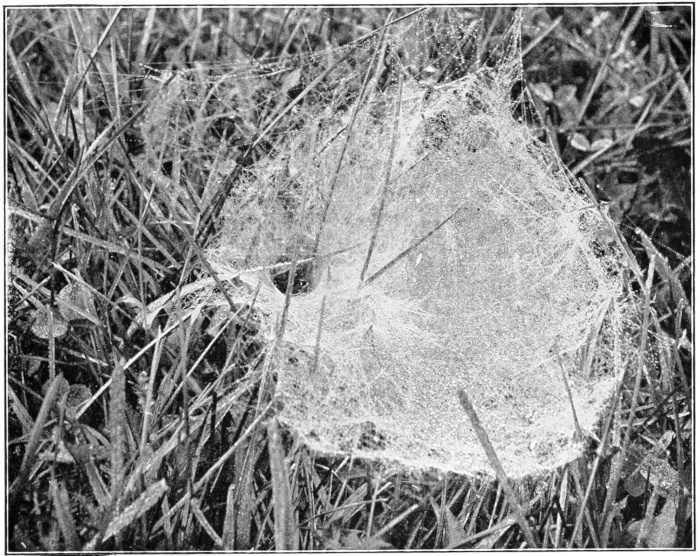
Photo by J. H. Comstock.
A funnel web.
THE FUNNEL WEB
Teacher’s Story
“And dew-bright webs festoon the grass In roadside fields at morning.” —Elizabeth Akers.
Sometimes on a dewy morning, a field will seem carpeted with these webs, each with its opening stretched wide, and each with its narrow hallway of retreat. The general shape of the web is like that of a broad funnel with a tube leading down at one side. This tube is used as a hiding place for the spider, which thus escapes the eyes of its enemies, and also keeps out of sight of any insects that might be frightened at seeing it, and so avoid the web. But the tube is no cul-de-sac; quite to the contrary, it has a rear exit, through which the spider, if frightened, escapes from attack.
The web is formed of many lines of silk crossing each other irregularly, forming a firm sheet. This sheet is held in place by many guy-lines, which fasten it to surrounding objects. If the web is touched lightly, the spider rushes forth from its lair to seize its prey; but if the web be jarred roughly, the spider speeds out through its back door and can be found only with difficulty. The smaller insects of the field, such as flies and bugs, are the chief food of this spider; it rarely attempts to seize a grown grasshopper.
The funnel-shaped webs in dark corners of cellars are made by a species which is closely related to the grass spider and has the same general habits, but which builds in these locations instead of in the grass.
LESSON CXI
The Funnel Web
Leading thought—The grass spider spins funnel-shaped webs in the grass to entrap the insects of the field. This web has a back door.
Method—Ask the pupils to observe a web on the grass with a spider within it.
Observations—1. What is the general shape of the web? Is there a tunnel leading down from it? Why is it called a funnel web?
2. Of what use is the funnel tube, and what is its shape? Where does it lead, and of what use is it to the spider? Can you corner a spider in its funnel tube? Why not?
3. How is the web made? Is there any regularity in the position of the threads that make it? How is it stayed in place?
4. Touch the web lightly, and note how the spider acts? Jar the web roughly, and what does the spider do?
5. What insects become entangled in this web?
6. Compare this web with similar funnel webs found in corners of cellars, sheds or piazzas, and see if you think the same kind of spider made both.
THE ORB-WEB
Teacher’s Story
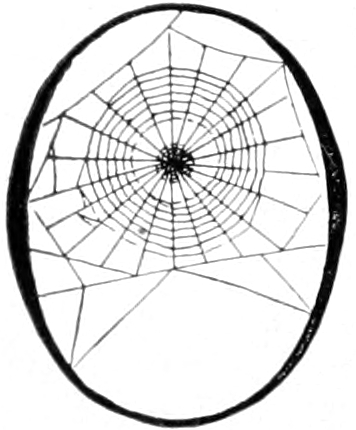
F all the structures made by the lower creatures, the orb-web of the spider is, beyond question, the most intricate and beautiful in design, and the most exquisite in workmanship. The watching of the construction of one of these webs is an experience that brings us close to those mysteries which seem to be as fundamental as they are inexplicable in the plan of the universe. It is akin to watching the growth of a crystal, or the stars wheeling across the heavens in their appointed courses.
The orb-web of the large, black and yellow garden spider is, perhaps, the best subject for this study, although many of the smaller orbs are far more delicate in structure. These orb-webs are most often placed vertically, since they are thus more likely to be in the path of flying insects. The number of radii, or spokes, differs with the different species of spiders, and they are usually fastened to a silken framework, which in turn is fastened by guy-lines to surrounding objects. These radii or spokes are connected by a continuous spiral line, spaced regularly except at the center or hub; this hub or center is of more solid silk, and is usually surrounded by an open space; and it may be merely an irregular network, or it may have wide bands of silk laid across it.
The radii or spokes, the guy-lines, the framework and the center of the web are all made of inelastic silk, which does not adhere to an object that touches it. The spiral line, on the contrary, is very elastic, and adheres to any object brought in contact with it. An insect which touches one of these spirals and tries to escape, becomes entangled in the neighboring lines and is thus held fast until the spider can reach it. If one of these elastic lines be examined with a microscope, it is a most beautiful object. There are strung upon it, like pearls, little drops of sticky fluid, which render it not only elastic but adhesive.
Some species of orb-weavers remain at the center of the web, while others hide in some little retreat near at hand. If in the middle, the spider always keeps watchful claws upon the radii of the web so that if there is any jarring of the structure by an entrapped insect, it is at once apprised of the fact; if the spider is in a den at one side, it keeps a claw upon a trap line which is stretched tightly from the hub of the web to the den, and thus communicates any vibration of the web to the hidden sentinel. When the insect becomes entangled, the spider rushes out and envelops it in a band of silk, which feat it accomplishes, by turning the insect over and over rapidly, meanwhile spinning a broad, silken band which swathes it. It may bite the insect before it begins to swathe it in silk, or afterwards. It usually hangs the swathed insect to the web near where it was caught, until ready to eat it; it then takes the prey to the center of the web, if there is where the spider usually sits, or to its den at one side, if it is a den-making species, and there sucks the insect’s blood, carefully throwing away the hard parts.
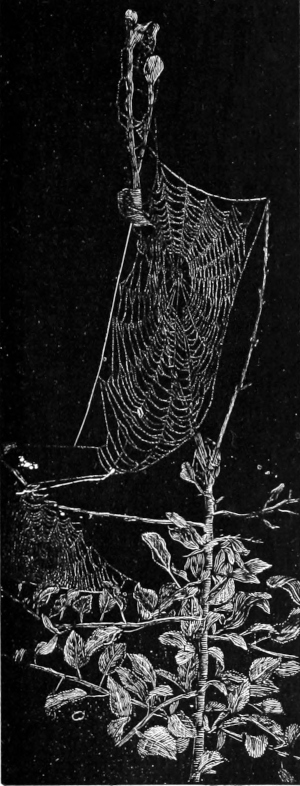
A dewy morning.
Insect Life, Comstock.
The spider does not become entangled in the web, because, when it runs it steps upon the dry radii and not upon the sticky spiral lines. During the busy season, the spider is likely to make a new web every twenty-four hours, but this depends largely upon whether the web has meanwhile been destroyed by large insects.
The spider’s method of making its first bridge is to place itself upon some high point and, lifting its abdomen in the air, to spin out on the breeze a thread of silk. When this touches any object, it adheres, and the spider draws in the slack until the line is “taut;” it then travels across this bridge, which is to support its web, and makes it stronger by doubling the line. From this line, it stretches other lines by fastening a thread to one point, and then walking along to some other point, spinning the thread as it goes and holding the line clear of the object on which it is walking by means of one of its hind legs. When the right point is reached, it pulls the line tight; fastens it, and then, in a similar fashion, proceeds to make another. It may make its first radius by dropping from its bridge to some point below; then climbing back to the center, it fastens the line for another radius, and spinning as it goes, walks down and out to some other point, holding the thread clear and then pulling it tight before fastening it. Having thus selected the center of the web, it goes back and forth to and from it, spinning lines until all of the radii are completed and fastened at one center. It then starts at the center and spins a spiral, laying it onto the radii to hold them firm. However, the lines of this spiral are farther apart and much more irregular than the final spiral. Thus far, all of the threads the spider has spun are inelastic and not sticky; and this first, or temporary spiral is used by the spider to walk upon when spinning the final spiral. It begins the latter at the outer edge instead of at the center, and works toward the middle. As the second spiral progresses, the spider with its jaws cuts away the spiral which it first made, and which it has used as a scaffolding. A careful observer may often see remnants of this first spiral on the radii between the lines of the permanent spiral. The spider works very rapidly and will complete a web in a very short time. The final spiral is made of the elastic and adhesive silk.
References—Comstock’s Manual; Common Spiders, Emerton; The Spider Book, Comstock; Nature’s Craftsmen, McCook.
LESSON CXII
The Orb-web
Leading thought—No structure made by a creature lower than man is so exquisitely perfect as the orb-web of the spider.
Method—There should be an orb-web where the pupils can observe it, preferably with the spider in attendance.
Observations—1. Is the orb-web usually hung horizontally or vertically?
2. Observe the radii, or “spokes,” of the web. How many are there? How are they fastened to surrounding objects? Is each spoke fastened to some object or to a framework of silken lines?
3. Observe the silken thread laid around the spokes. Is it a spiral line or is each circle complete? Are the lines the same distance apart on the outer part of the web as at the center? How many of the circling lines are there?
4. Is the center of the web merely an irregular net, or are there bands of silk put on in zigzag shape?
5. Touch any of the “spokes” lightly with the point of a pencil. Does it adhere to the pencil and stretch out as you pull the pencil away? Touch one of the circling lines with a pencil point, and see if it adheres to the point and is elastic. What is the reason for this difference in the stickiness and elasticity of the different kinds of silk in the orb-web?
6. If an insect touches the web, how does it become more entangled by seeking to get away?
7. Where does the spider stay, at the center of the web or in a little retreat at one side?
8. If an insect becomes entangled in the web, how does the spider discover the fact and act?
9. If the spider sits at the middle of the orb, it has a different method for discovering when an insect strikes the web than does the spider that hides in a den at one side. Describe the methods of each.
10. How does the spider make fast an insect? Does it bite the insect before it envelops it in silk? Where does it carry the insect to feed upon it?
11. How does the spider manage to run about its web without becoming entangled in the sticky thread? How often does the orb-weaver make a new web?
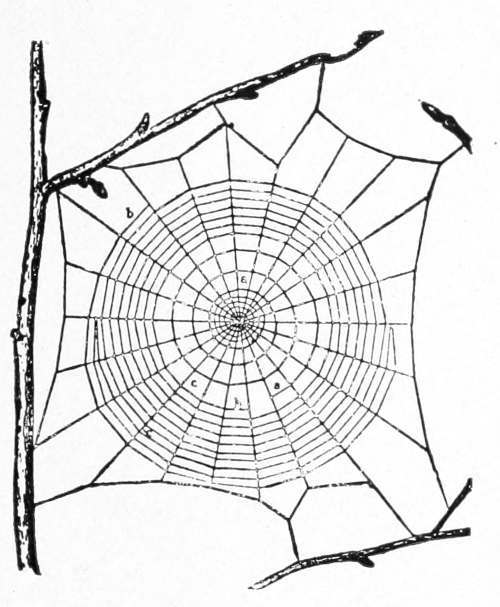
A partially completed orb-web.
a, the temporary spiral stay line; b, the sticky spiral line; c, the fragments of the temporary spiral hanging to a radius.
Comstock’s Manual.
How an Orb-web is Made
Spiders may be seen making their webs in the early morning or in the evening. Find an orb-web with a spider in attendance; break the web without frightening the spider and see it replace it in the early evening, or in the morning about daybreak. An orb-weaver may be brought into the house on its web, when the web is on a branch, and placed where it will not be disturbed, and thus be watched at leisure.
Observations—1. How does the spider manage to place the supporting line between two points?
2. How does it make the framework for holding the web in place?
3. How does it make the first radius?
4. How does it make the other radii and select the point which is to be the center of the web?
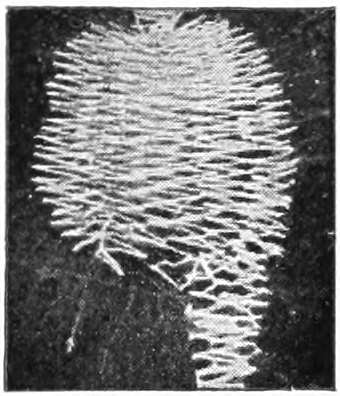
The zigzag strengthening band at center of an orb-web.
5. How does it keep the line which it is spinning clear of the line it walks upon?
6. After the radii are all made, are they fastened at the center?
7. How and where does the spider first begin to spin a spiral? Are the lines of this spiral close together or far apart? For what is the first spiral used?
8. Where does it begin to spin the permanent spiral? Where does it walk when spinning it? By the way it walks on the first spiral, do you think it is sticky and elastic? What does it do with the first spiral while the second one is being finished?
9. If the center of the web has a zigzag ribbon of silk, when was it put on?
10. How many minutes did it take the spider to complete the web?
Supplementary reading—“Argiope of The Silver Shield,” Insect Stories, Kellogg.
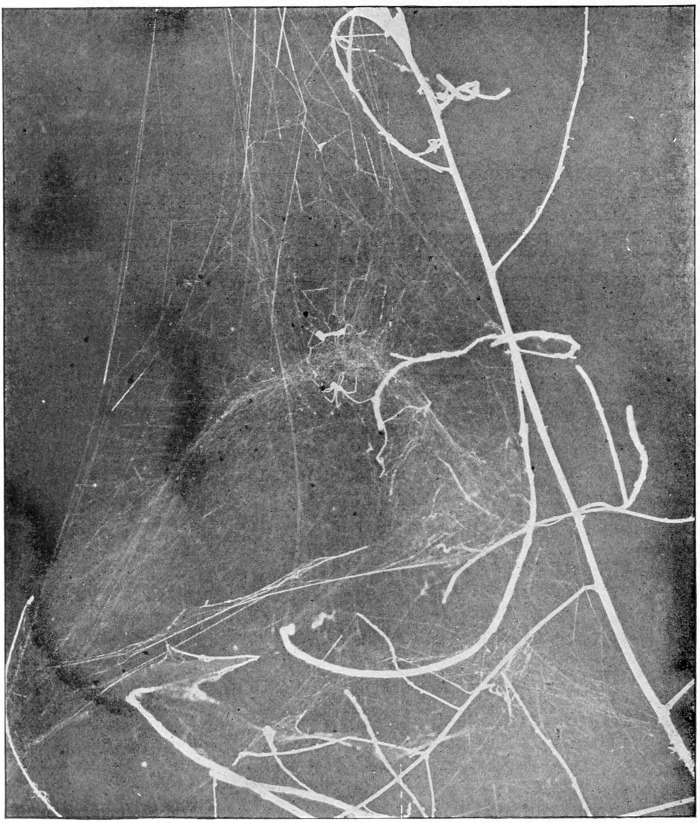
A filmy-dome web with its maker.
Photo by J. H. Comstock.
THE FILMY DOME
Teacher’s Story
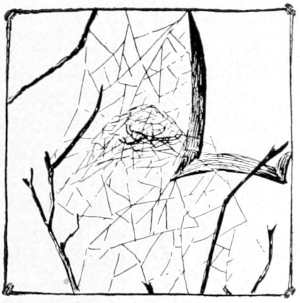
IKE bubbles cut in half, these delicate domes catch the light rays and separate them like a prism into waves of rainbow colors. One of these domes is usually about the size of an ordinary bowl, and is suspended with the opening on the lower side. It is held in place by many guy-lines which attach it to surrounding objects. Above a filmy dome are always stretched many crisscrossed threads for some distance up. These are for the purpose of hindering the flight of insects, so that they will fall into the web. The little spider, which always hangs, back downward, just below the center of the dome, rushes to its prey from the lower side, pulls it through the meshes of the web, and feeds upon it. But any remains of the insect or pieces of sticks or leaves which may drop upon the web, it carefully cuts out and drops to the ground, mending the hole very neatly.
LESSON CXIII
The Filmy Dome
Leading thought—One little spider spins a filmy dome, beneath the apex of which it hangs, back downward, awaiting its prey.
Method—On a sunny day in late summer or early autumn, while walking along woodland paths, the careful observer is sure to see suspended among the bushes or in the tops of weeds, or among dead branches of young hemlocks, the filmy dome webs. They are about as large as a small bowl, and usually so delicate that they cannot be seen unless the sun shines upon them; they are likely to be exquisitely iridescent under the sun’s rays. Such a dome may be studied by a class or by the pupils individually.
Observations—1. Where did you discover the filmy dome? What is the size of the dome? Does it open above or below? How is it held in place?
2. Are there many crisscrossed threads extending above the dome? If so, what do you think they are for?
3. Where does the spider stay? Is the spider large and heavy, or small and delicate?
4. What does the spider do if an insect becomes entangled in its web?
5. Throw a bit of stick or leaf upon a filmy dome web, and note what becomes of it.
“With spiders I had friendship made, And watch’d them in their sullen trade.” —Prisoner of Chillon.
BALLOONING SPIDERS
Teacher’s Story
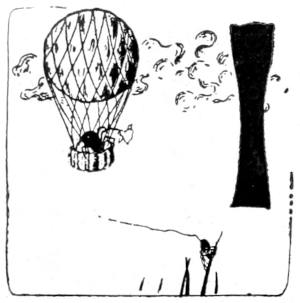
F we look across the grass some warm sunny morning or evening of early fall, we see threads of spider silk clinging everywhere; these are not regular webs for trapping insects, but are single threads spun from grass stalk to grass stalk until the fields are carpeted with glistening silk. We have a photograph of a plowed field, taken in autumn, which looks likes the waves of a lake; so completely is the ground covered with spider threads that it shows the “path of the sun” like water.
When we see so many of these random threads, it is a sign that the young spiders have started on their travels, and it is not difficult then to find one in the act. The spiderling climbs up some tall object, like a twig or a blade of grass, and sends out its thread of silk upon the air. If the thread becomes entangled, the spiderling sometimes walks off on it, using it as a bridge, or sometimes it begins again. If the thread does not become entangled with any object, there is soon enough given off, so that the friction of the air current upon it supports the weight of the body of the little creature, which promptly lets go its hold of earth as soon as it feels safely buoyed up, and off it floats to lands unknown. Spiders thus sailing through the air have been discovered in mid-ocean.
Thus we see that the spiders have the same way of distributing their species over the globe, as have the thistles and dandelions. It has been asked what the spiders live upon while they are making these long journeys, especially those that have drifted out to sea. The spider has very convenient habits of eating. When it finds plenty of food it eats a great deal; but in time of famine it lives on, apparently comfortably, without eating. One of our captive spiders was mislaid for six months and when we found her she was as full of “grit” as ever, and she did not seem to be abnormally hungry when food was offered her.
“A noiseless, patient spider, I mark’d where, on a little promontory, it stood isolated: Mark’d how to explore the vacant, vast surrounding, It launch’d forth filament out of itself: Ever unreeling them—ever tirelessly speeding them. “And you, O my soul, where you stand, Surrounded, surrounded, in measureless oceans of space, Ceaselessly, musing, venturing, throwing, seeking the spheres to connect them; Till the bridge you will need be form’d—till the ductile anchor hold; Till the gossamer thread you fling catch somewhere, O my soul.” —Walt Whitman.
LESSON CXIV
Ballooning Spiders
Leading thought—The young of many species of spiders scatter themselves like thistle seeds in balloons which they make of silk.
Method—These observations should be made out of doors during some warm sunny day in October. Read Nature’s Craftsmen, McCook, p. 182.
Observations—1. Look across the grass some warm sunny morning or evening of early fall, and note the threads of spider silk gleaming everywhere, not regular webs, but single threads spun from grass stalk to grass stalk, or from one object to another, until the ground seems glistening with silk threads.
2. Find a small spider on a bush, fence post, or at the top of some tall grass stalk; watch it until it begins to spin out its thread.
3. What happens to the thread as it is spun out?
4. If the thread does not become entangled in any surrounding object what happens? If the thread does become entangled, what happens?
5. How far do you suppose a spider can travel on this silken aeroplane? Why should the young spider wish to travel?
THE WHITE CRAB-SPIDER
Teacher’s Story
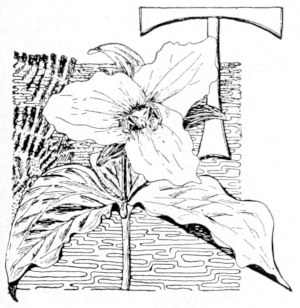
HERE are certain spiders which are crablike in form, and their legs are so arranged that they can walk more easily sidewise or backward than forward. These spiders spin no webs, but lie in wait for their prey. Many of them live upon plants and fences and, in winter, hide in protected places.
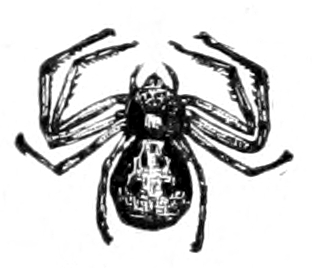
A common crab-spider.
The white crab-spider is a little rascal that has discovered the advantage of protective coloring as a means of hiding itself from the view of its victims, until too late to save themselves; the small assassin always takes on the color of the flower in which it lies concealed. In the white trillium, it is greenish white; while in the golden-rod its decorations are yellow. It waits in the heart of the flower, or in the flower clusters, until the visiting insect alights and seeks to probe for the nectar; it then leaps forward and fastens its fangs into its struggling victim. I have seen a crab-spider in a milkweed attack a bee three times its size. This spider was white with lilac or purple markings. If disturbed, the crab-spider can walk off awkwardly or it may drop by a silken thread. It is especially interesting, since it illustrates another use for protective coloring; and also because this species seems to be able to change its colors to suit its surroundings.
LESSON CXV
The White Crab-spider
Leading thought—1. The white crab spider has markings upon its body of the same color as the flower in which it rests and is thus enabled to hide in ambush out of the sight of its victims—the insects which come to the flower for nectar.
Method—Ask the children to bring one of these spiders to school in the flower in which it was found; note how inconspicuous it is, and arouse an interest in the different colors which these spiders assume in different flowers.
Observations—1. What is the shape of the body of the crab-spider? Which of the legs are the longest? Are these legs directed forward or backward?
2. How is the body marked? What colors do you find upon it? Are the colors the same in the spiders found in the trilliums, as those in other flowers? Why is this? Do you think that the color of the spider keeps it from being seen?
3. Place the white spider which you may find in a trillium in a daffodil, and note if the color changes.
4. Do the crab-spiders make webs? How do they trap their prey?
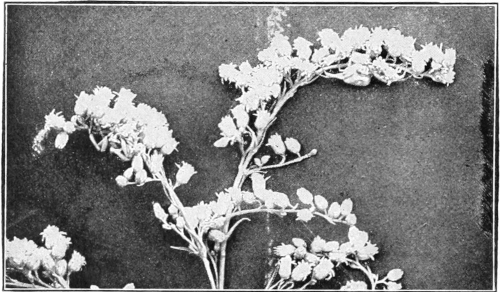
Crab-spiders on golden-rod.
This species is white when lurking in the white trillium and yellow when among flowers of the golden-rod.
Photo by Slingerland.
HOW THE SPIDER MOTHERS TAKE CARE OF THEIR EGGS
Teacher’s Story
ROTECTING her eggs from the vicissitudes of the weather seems to be the spider mother’s chief care; though at the same time and by the same means, she protects them from the attacks of predacious insects. Many of the species make silken egg-sacs, which are often elaborate in construction, and are carefully placed in protected situations.
Often a little silvery disk may be seen attached to a stone in a field. It resembles a circular lichen on the stone, but if it is examined it is found to consist of an upper, very smooth, waterproof coat, while below is a soft, downy nest, completely enfolding the spider’s eggs.
The egg-sacs of the cobweb weavers are often found suspended in their webs. One of the large orbweavers makes a very remarkable nest, which it attaches to the branches of weeds or shrubs. This sac is about as large as a hickory nut, and opens like a vase at the top. It is very securely suspended by many strong threads of silk, so that the blasts of winter cannot tear it loose. The outside is shining and waterproof, while inside it has a fit lining for a spiderling cradle.
Dr. Burt G. Wilder studied the development of the inmates of one of these nests by cutting open different nests at different periods of the winter. In the autumn, the nest contained five hundred or more eggs. These eggs hatched in early winter but it seemed foreordained that some of the little spiders were born for food for their stronger brethren. They seemed resigned to their fate, for when one of these victims was seized by its cannibalistic brother, it curled up its legs and submitted meekly. The result of this process was that, out of the five hundred little spiders hatched from the eggs, only a few healthy and apparently happy young spiders emerged from the nest in the spring, sustained by the nourishment afforded them by their own family, and fitted for their life in the outside world.
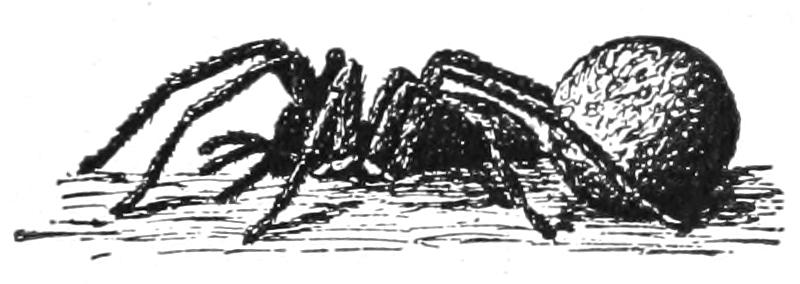
A wolf-spider carrying her egg-sac.
Some spiders make a nest for their eggs within folded leaves, and some build them in crevices of rocks and boards.
The running spiders, which are the large ones found under stones, make globular egg-sacs; the mother spider drags after her this egg-sac attached to her spinnerets; the young, when they hatch, climb upon their mother’s back, and there remain for a time.
LESSON CXVI
The Nests of Spiders
Leading thought—The spider mothers have many interesting ways of protecting their eggs, which they envelop in silken sacs and place in safety.
Method—Ask the pupils to bring in all the spider egg-sacs that they can find. Keep some of them unopened, and open others of the same kind, and thus discover how many eggs are in the sac, and how many spiderlings come out. This is a good lesson for September and October.
Observations—1. In what situation did you find the nest? How was it protected from rain and snow? To what was it attached?
2. Of what texture is the outside of the sac? Is the outside made of waterproof silk? What is the texture of the lining?
3. How many eggs in this sac? What is the color of the eggs? When do the spiderlings hatch? Do as many spiders come out of the sac as there were eggs? Why is this?
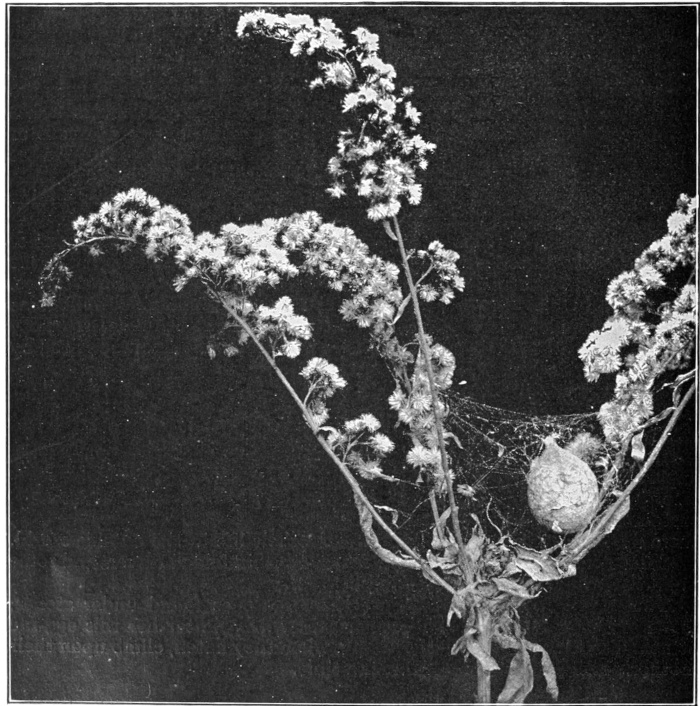
The egg-sac of the large, black and yellow garden-spider suspended for the winter in a branch of golden-rod.
Photo by Slingerland.