Part 2 — V. MAMMAL STUDY (continued 2)
Reading edition
There are many senseless fears about the bat; for instance, that he likes to get tangled in a lady’s tresses, a situation which would frighten him far more than the lady; or that he brings bedbugs into the house, when he enters on his quest for mosquitoes, which is an ungrateful slander. Some people believe that all bats are vampires, and only await an opportunity to suck blood from their victims. It is true that in South America there are two species which occasionally attack people who are careless enough to sleep with their toes uncovered, but feet thus injured seem to recover speedily; and these bats do little damage to people, although they sometimes pester animals; but there are no vampires in the United States. Our bats, on the contrary, are innocent and beneficial to man; and if we had more of them we should have less malaria. There a few species in our country, which have little, leaf-like growths on the end of the nose; and when scientists study the bat from a nature-study instead of an anatomical standpoint, we shall know what these leafy appendages are used for.
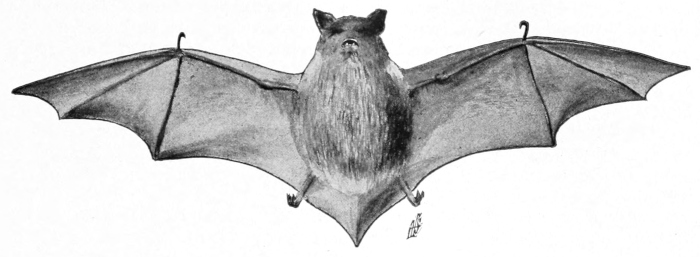
The little brown bat.
LESSON LIX
The Bat
Leading thought—Although the bat’s wings are very different from those of the bird’s yet it is a rapid and agile flier. It flies in the dusk and catches great numbers of mosquitoes and other troublesome insects, upon which it feeds.
Method—This lesson should not be given unless there is a live bat to illustrate it; the little creature can be cared for comfortably in a cage in the schoolroom, as it will soon learn to take flies or bits of raw meat when presented on the point of a pencil or toothpick. Any bat will do for this study, although the little brown bat is the one on which my observations were made.
Observations—1. At what time of day do we see bats flying? Describe how the bat’s flight differs from that of birds. Why do bats dart about so rapidly?
2. Look at a captive bat and describe its wings. Can you see what makes the framework of the wings? Do you see the three finger bones extending out into the wings? How do the hind legs support the wing? The tail? Is the wing membrane covered with fur? Is it thick and leathery or thin and silky and elastic? How does the bat fold up its wings?
3. In what position does the bat rest? Does it ever hang by his thumb hooks?
4. Can you see whether the knees of the hind legs bend upward or downward? How does the bat act when trying to walk or crawl? How does it use its thumb hooks in doing this?
5. What does the bat do daytimes? Where does it stay during the day? Do many bats congregate together in their roosts?
6. Describe the bat’s head, including the ears, eyes, nose and mouth. What is its general expression? Do you think it can see and hear well? How is its mouth fitted for catching insects? Does it shut its mouth while chewing or keep it open? Do you think that bats can see by daylight?
7. What noises does a bat make? How does it act if you try to touch it? Can it bite severely? Can you understand why the Germans call it a flitter-mouse?
8. Do you know how the mother bat cares for her young? How does she carry them? At what time of year may we expect to find them?
9. When making its toilet, how does a bat clean its wings? Its face? Its back? Its feet? Do you know if it is very clean in his habits?
10. How and where do the bats pass the winter? How are they beneficial to us? Are they ever harmful?
Supplementary reading—American Animals, Stone and Cram.
Nature-study should not be unrelated to the child’s life and circumstances. It stands for directness and naturalness. It is astonishing when one comes to think of it, how indirect and how remote from the lives of pupils much of our education has been. Geography still often begins with the universe, and finally, perhaps, comes down to some concrete and familiar object or scene that the pupil can understand. Arithmetic has to do with brokerage and partnerships and partial payments and other things that mean nothing to the child. Botany begins with cells and protoplasm and cryptogams. History deals with political and military affairs, and only rarely comes down to physical facts and to those events that express the real lives of the people; and yet political and social affairs are only the results of expressions of the way in which people live. Readers begin with mere literature or with stories of scenes the child will never see. Of course these statements are meant to be only general, as illustrating what is even yet a great fault in educational methods. There are many exceptions, and these are becoming commoner. Surely, the best education is that which begins with the materials at hand. A child knows a stone before it knows the earth. —L. H. Bailey in “The Nature-Study Idea.”
THE SKUNK
Teacher’s Story
HOSE who have had experience with this animal, surely are glad that it is small; and the wonder always is, that so little a creature can make such a large impression upon the atmosphere. A fully grown skunk is about two feet long: its body is covered with long, shining, rather coarse hair, and the tail which is carried like a flag in the air, is very large and bushy. In color, the fur is sometimes entirely black, but most often has a white patch on the back of the neck, with two stripes extending down the back and along the sides to the tail; the face, also, has a white stripe.
The skunk has a long head and a rather pointed snout; its front legs are very much shorter than its hind legs, which gives it a very peculiar gait. Its forefeet are armed with long, strong claws, with which it digs its burrow, which is usually made in light soil. It also often makes its home in some crevice in rocks, or even takes possession of an abandoned woodchuck’s hole; or trusting to its immunity from danger, makes its home under the barn. In the fall, it becomes very fat, and during the early part of winter, hibernates within its den; it comes out during the thaws of winter and early spring.
The young skunks appear in May; they are born in an enlarged portion of the burrow, where a nice bed of grass and leaves is made for them; the skunk is scrupulously neat about its own nest. The young skunks are very active, and interesting to watch, when playing together like kittens.
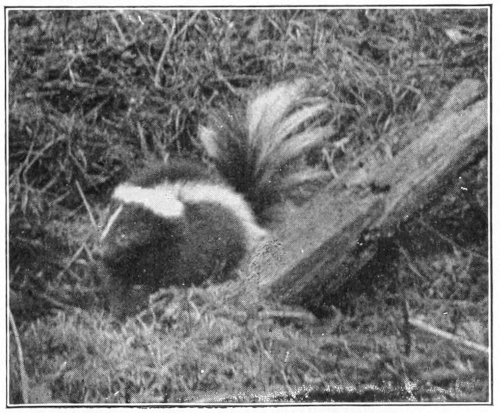
Photo by Verne Morton.
The skunk.
The skunk belongs to the same family as the mink and weasel, which also give off a disagreeable odor when angry. The fetid material which is the skunk’s defence, is contained in two capsules under the root of the tail. These little capsules are not larger than peas, and the quantity of liquid forced from them in a discharge is scarcely more than a large drop; yet it will permeate the atmosphere with its odor for a distance of a mile. The fact that this discharge is so disagreeable to all other animals, has had a retarding influence upon the skunk’s intelligence. It has not been obliged to rely upon its cunning to escape its enemies, and has therefore never developed either fear or cleverness. It marches abroad without haste, confident that every creature which sees it will give it plenty of room. It is a night prowler, although it is not averse to a daytime promenade. The white upon its fur gives warning at night, that here is an animal which had best be left alone. This immunity from attack makes the skunk careless in learning wisdom from experience; it never learns to avoid a trap or a railway or trolley track.
The skunk’s food consists largely of insects, mice, snakes and other small animals. It also destroys the eggs and young of birds which nest upon the ground. It uses its strong forepaws in securing its prey. Dr. Merriam, who made pets of young skunks after removing their scent capsules, found them very interesting. He says of one which was named “Meph”: “We used to walk through the woods to a large meadow that abounded in grasshoppers. Here, Meph would fairly revel in his favorite food, and it was rich sport to watch his manœuvres. When a grasshopper jumped, he jumped, and I have seen him with as many as three in his mouth and two under his forepaws at the same time.”
The only injury which the skunk is likely to do to the farmers, is the raiding of the hens’ nests, and this can be obviated by properly housing the poultry. On the other hand, the skunk is of great use in destroying injurious insects and mice. Often when skunks burrow beneath barns, they completely rid the place of mice. Skunk fur is very valuable and is sold under the name of Alaskan sable. The skunk takes short steps, and goes so slowly that it makes a double track, the imprints being very close together. The foot makes a longer track than that of the cat, as the skunk is plantigrade; that is, it walks upon its palms and heels as well as its toes.

Skunk tracks.
References—Wild Neighbors, Ingersoll; Familiar Life in Field and Forest, Mathews; American Animals, Stone and Cram; Squirrels and Other Fur Bearers, Burroughs.
LESSON LX
The Skunk
Leading thought—The skunk has depended so long upon protecting itself from its enemies by its disagreeable odor, that it has become stupid in this respect, and seems never to be able to learn to keep off of railroad tracks. It is a very beneficial animal to the farmer because its food consists so largely of injurious insects and rodents.
Method—The questions should be given the pupils and they should answer them from personal observations or inquiries.
Observations—1. How large is a skunk? Describe its fur. Where does the black and white occur in the fur? Of what use is the white to the skunk? Is the fur valuable? What is its commercial name?
2. What is the shape of the skunk’s head? The general shape of the body? The tail? Are the front legs longer or shorter than the hind legs? Describe the front feet. For what are they used?
3. Where and how does the skunk make its nest? Does it sleep like a woodchuck during the winter? What is its food? How does it catch its prey? Does it hunt for its food during the day or the night? Does the skunk ever hurry? Is it afraid? How does it protect itself from its enemies? Do you think that the skunk’s freedom from fear has rendered the animal less intelligent?
4. At what time do the skunk kittens appear? Have you ever seen little skunks playing? If so, describe their antics. How is the nest made soft for the young ones?
5. How does the skunk benefit farmers? Does it ever do them any injury? Do you think that it does more good than harm?
6. Describe the skunk’s track as follows: How many toes show in the track? Does the palm or heel show? Are the tracks near together? Do they form a single or a double line?
Supplementary reading—Squirrels and Other Fur Bearers, Burroughs.
Saw a little skunk coming up the river bank in the woods at the white oak, a funny little fellow, about six inches long and nearly as broad. It faced me and actually compelled me to retreat before it for five minutes. Perhaps I was between it and its hole. Its broad black tail, tipped with white, was erect like a kitten’s. It had what looked like a broad white band drawn tight across its forehand or top-head, from which two lines of white ran down, one on each side of its back, and there was a narrow white line down its snout. It raised its back, sometimes ran a few feet forward, sometimes backward, and repeatedly turned its tail to me, prepared to discharge its fluid, like the old ones. Such was its instinct, and all the while it kept up a fine grunting like a little pig or a red squirrel.—Henry Thoreau.
Few animals are so silent as the skunk. Zoological works contain no information as to its voice, and the essayists rarely mention it except by implication. Mr. Burroughs says: “The most silent creature known to me, he makes no sound, so far as I have observed, save a diffuse, impatient noise, like that produced by beating your hand with a whisk-broom, when the farm-dog has discovered his retreat in the stone fence.” Rowland Robinson tells us that: “The voiceless creature sometimes frightens the belated farm-boy, whom he curiously follows with a mysterious hollow beating of his feet upon the ground.” Thoreau, as has been mentioned, heard one keep up a “fine grunting, like a little pig or a squirrel;” but he seems to have misunderstood altogether a singular loud patting sound heard repeatedly on the frozen ground under the wall, which he also listened to, for he thought it “had to do with getting its food, patting the earth to get the insects or worms.” Probably he would have omitted this guess if he could have edited his diary instead of leaving that to be done after his death. The patting is evidently merely a nervous sign of impatience or apprehension, similar to the well-known stamping with the hind feet indulged in by rabbits, in this case probably a menace like a doubling of the fists, as the hind legs, with which they kick, are their only weapons. The skunk, then, is not voiceless, but its voice is weak and querulous, and it is rarely if ever heard except in the expression of anger. —Ernest Ingersol in “Wild Neighbors.”
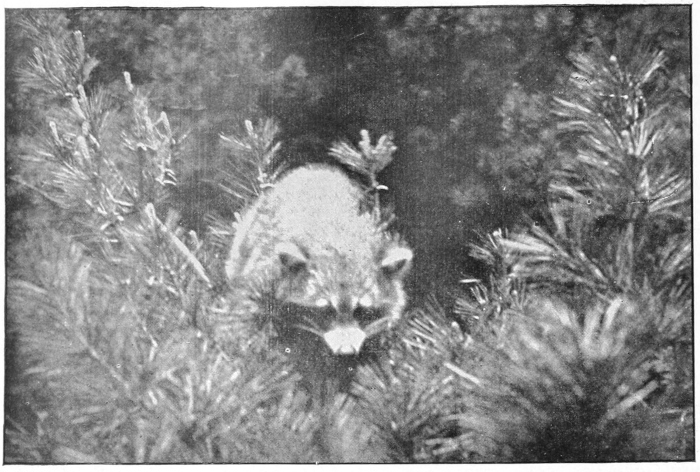
The raccoon.
Photo by George Fiske, Jr.
THE RACCOON
Teacher’s Story
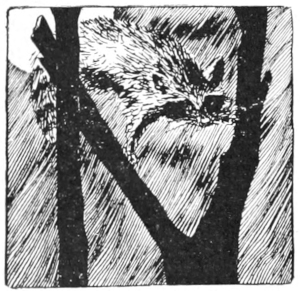
ONE other of our little brothers of the forest, has such a mischievous countenance as the coon. The black patch across the face and surrounding the eyes, like large goggles, and the black line extending from the long, inquisitive nose directly up the forehead give the coon’s face an anxious expression; and the keenness of the big, beady, black eyes and the alert, “sassy” looking, broadly triangular ears, convince one that the anxiety depicted in the face is anxiety lest something that should not be done be left undone; and I am sure that anyone who has had experience with pet coons will aver that their acts do not belie their looks.
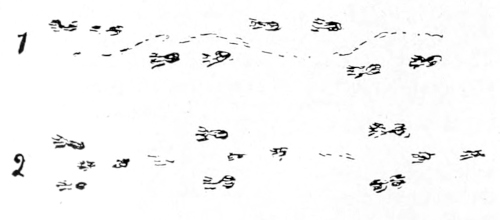
Coon tracks.
1 Walking 2 Jumping
What country child, wandering by the brook and watching its turbulence in early spring, has not viewed with awe, a footprint on the muddy banks looking as if it were made by the foot of a very little baby. The first one I ever saw, I promptly concluded was made by the foot of a brook fairy. However, the coon is no fairy; it is a rather heavy, logy animal and, like the bear and skunk, is plantigrade, walking on the entire foot instead of on the toes, like a cat or dog. The hind foot is long, with a well-marked heel, and five comparatively short toes, giving it a remarkable resemblance to a human foot. The front foot is smaller and looks like a wide, little hand, with four long fingers and a rather short thumb. The claws are strong and sharp. The soles of the feet and the palms of the hands look as if they were covered with black kid, while the feet above and the backs of the hands are covered with short fur. Coon tracks are likely to be found during the first thawing days of winter, along some stream or the borders of swamps, often following the path made by cattle. The full-length track is about 2 inches long; as the coon puts the hind foot in the track made by the front foot on the same side, only the print of the hind feet is left, showing plainly five toe prints and the heel. The tracks may vary from one-half inch to one foot or more apart, depending on how fast the animal is going; when it runs it goes on its toes, but when walking sets the heel down; the tracks are not in so straight a line as those made by the cat. Sometimes it goes at a slow jump, when the prints of the hind feet are paired, and between and behind them are the prints of the two front feet.
The coon is covered with long, rather coarse hair, so long as to almost drag when the animal is walking; it really has two different kinds of hair, the long, coarse, gray hair, blackened at the tips, covering the fine, short, grayish or brownish under coat. The very handsome bushy tail is ringed with black and gray.
The raccoon feeds on almost anything eatable, except herbage. It has a special predilection for corn in the milk stage and, in attaining this sweet and toothsome luxury, it strips down the husks and often breaks the plant, doing much damage. It is also fond of poultry and often raids hen houses; it also destroys birds’ nests and the young, thus damaging the farmer by killing both domestic and wild birds. It is especially fond of fish and is an adept at sitting on the shore and catching them with its hands; it likes turtle eggs, crayfish and snakes; it haunts the bayous of the Gulf Coast for the oysters which grow there; it is also a skillful frog catcher. Although fond of animal diet, it is also fond of fruit, especially of berries and wild grapes.
It usually chooses for a nest a hollow tree or a cavern in a ledge near a stream, because of its liking for water creatures; and also because of its strange habit of washing its meat before eating it. I have watched a pet coon performing this act; he would take a piece of meat in his hands, dump it into the pan of drinking water and souse it up and down a few times; then he would get into the pan with his splay feet and roll the meat beneath and between them, meanwhile looking quite unconcernedly at his surroundings, as if washing the meat were an act too mechanical to occupy his mind. After the meat had become soaked until white and flabby, he would take it in his hands and hang on to it with a tight grip while he pulled off pieces with his teeth; or sometimes he would hold it with his feet, and use hands as well as teeth in tearing it apart. The coon’s teeth are very much like those of the cat, having long, sharp tushes or canines, and sharp, wedge-shaped grinding teeth, which cut as well as grind. After eating, the pet coon always washed his feet by splashing them in the pan.
It is a funny sight to watch a coon arrange itself for a nap, on a branch or in the fork of a tree, it adapts its fat body to the unevenness of the bed with apparent comfort; it then tucks its nose down between its paws and curls its tail about itself, making a huge, furry ball. In all probability, the rings of gray and black on the tail, serve as protective color to the animal sleeping in a tree during the daytime, when sunshine and shadow glance down between the leaves with ever-changing light. The coon spends much of its days asleep in some such situation, and comes forth at night to seek its food.
In the fall, the coon lays on fat enough to last it during its winter sleep. Usually several inhabit the same nest in winter, lying curled up together in a hollow tree, and remaining dormant all winter except when awakened by the warmth of a thaw. They then may come forth to see what is happening, but return shortly to wait until March or April; then they issue to hunt for the scant food, and are so lean and weak that they fall easy prey to their enemies.
The young are born in April and May; there are from three to six in a litter; they are blind and helpless at first, and are cared for carefully by their parents, the family remaining together for a year, until the young are fully grown. If removed from their parents the young ones cry pitifully, almost like babies. The cry or whistle of the fully grown coon is anything but a happy sound, and is quite impossible to describe. I have been awakened by it many a night in camp, and it always sounded strange, taking on each time new quavers and whimperings. As a cry, it is first cousin to that of the screech-owl.
The stories of pet coons are many. I knew one which, chained in a yard, would lie curled up near its post looking like an innocent stone except for one eye kept watchfully open. Soon a hen, filled with curiosity would come warily near, looking longingly at remains of food in the pan; the coon made no move until the disarmed biddy came close to the pan. Then, there was a scramble and a squawk and with astonishing celerity he would wring her neck and strip off her feathers. Another pet coon was allowed to range over the house at will, and finally had to be sent away because he had learned to open every door in the house, including cupboard doors, and could also open boxes and drawers left unlocked; and I have always believed he could have learned to unlock drawers if he had been given the key. All coons are very curious, and one way of trapping them is to suspend above the trap a bit of bright tin; in solving this glittering mystery, traps are forgotten.
LESSON LXI
The Raccoon
Leading thought—The raccoon lives in hollow trees or caves along the banks of streams. It sleeps during the day and seeks its food at night. It sleeps during the winter.
Method—If there are raccoons in the vicinity, ask the older boys to look for their tracks near the streams and to describe them very carefully to the class. The ideal method of studying the animal, is to have a pet coon where the children may watch at leisure its entertaining and funny performances. If this is impossible, then follow the less desirable method of having the pupils read about the habits of the coon and thus arouse their interest and open their eyes, so that they may make observations of their own when opportunity offers. I would suggest the following topics for oral or written work in English:
“How and Where Coons Live and What They Do;” “The Autobiography of a Coon One Year Old;” “The Queer Antics of Pet Coons;” “Stories of the Coon’s Relative, the Bear.”
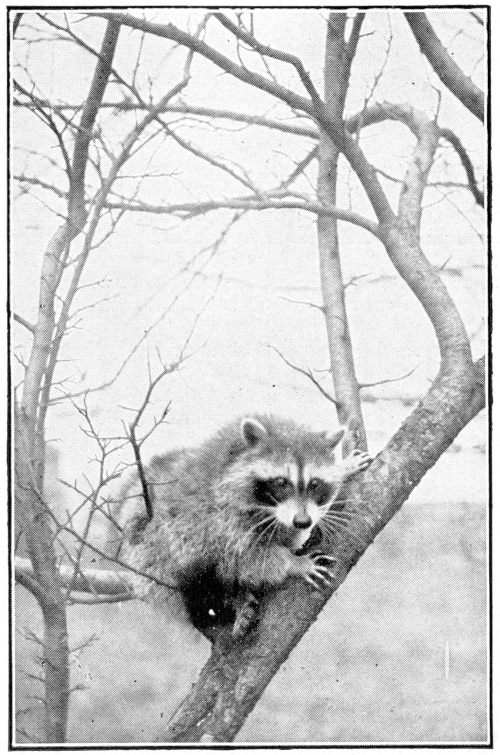
Treed.
Observations—1. Where have you found raccoon tracks? How do they differ from those of fox or dog? How far are the footprints apart? Can you see the heel and toe prints? Do you see the tracks of all four feet? Are the tracks in a straight line like those of the cat? What is the size of the track, the length, the breadth?
2. What do coons eat and how do they get their food? Which of our crops are they likely to damage? What other damage do they do? Have you ever heard coons cry or whistle during August nights in the cornfields?
3. Why do raccoons like to live near the water? What do they find of interest there? How do they prepare their meat before eating it? How does a coon handle its meat while eating it?
4. What kind of fur has the coon? Why does it need such a heavy covering? Describe the color of the fur. Describe the tail. Of what use is such a large and bushy tail to this animal?
5. Describe the coon’s face. How is it marked? What is its expression? Describe the eyes and ears. The nose. Has it teeth resembling those of the cat and dog?
6. Describe the coon’s feet. How many toes on the front feet? How many on the hind feet? How does this differ from the cat and dog? How do the front and hind feet differ in appearance? Can both be used as hands?
7. How do coons arrange themselves for a nap in a tree? How do they cover the head? How is the tail used? Do you think this bushy tail used in this way would help to keep the animal warm in winter? Do coons sleep most daytimes or nights?
8. At what time of year are coons fattest? Leanest? Why? Do they ever come out of their nests in winter? Do they live together or singly in winter?
9. At what time of year are the young coons born? Do you know how they look when they are young? How are they cared for by their parents?
10. Are the coon’s movements slow or fast? What large animal is a near relative of the coon?
Supplementary reading—American Animals, Stone and Cram; Wild Neighbors, Ingersoll; Familiar Life of Field and Forest, Mathews; Little People of the Sycamore, Roberts; Life of Animals, Ingersoll; “Mux” in Roof and Meadow, Sharp; Little Brother of the Bear, Long.
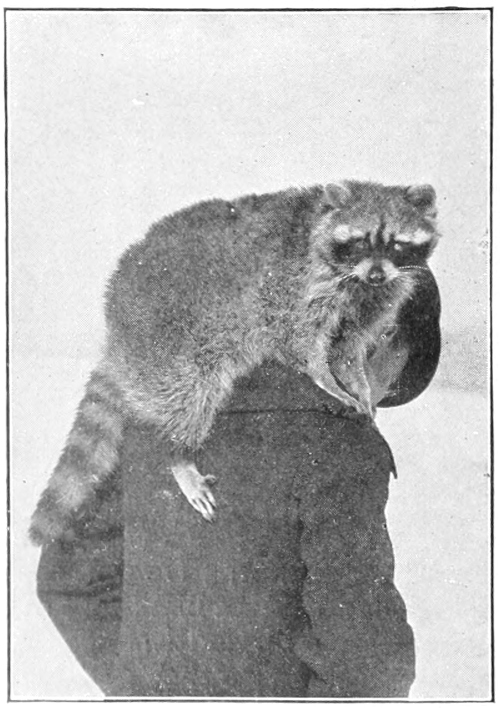
Professor Fred S. Charles and his pet coon, “Dick”.
THE WOLF
HE study of the wolf should precede the lessons on the fox and the dog. After becoming familiar with the habits of wolves, the pupils will be much better able to understand the nature of the dog and its life as a wild animal. In most localities, the study of the wolf must, of course, be a matter of reading, unless the pupils have an opportunity to study the animal in traveling manageries or in zoological gardens. However, in all the government preserves, the timber wolf has multiplied to such an extent, that it may become a factor in the lives of many people in the United States. This wolf ranged in packs over New York State a hundred years ago, but was finally practically exterminated in most of the eastern forests, except in remote and mountainous localities. A glance at Bulletin 72 by Vernon Bailey, published by the U. S. Department of Agriculture, Forest Service, is a revelation of the success of the timber wolf, in coming back to his own, as soon as the forest preserves furnished plenty of game, and forbade hunters. Timber wolves are returning of late years to Western Maine and Northern New Hampshire; Northern Michigan and Wisconsin have them in greater numbers; some have also been killed in the Appalachian Mountains of Tennessee, Virginia and West Virginia, but their stronghold is in the great Rocky Mountain Region and the Northwestern Sierras, from which they have never been driven.
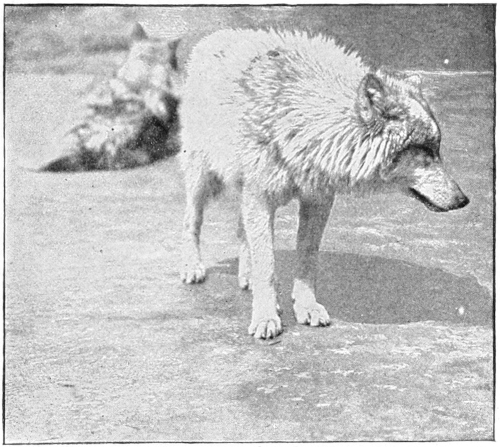
Gray Wolf
It might be well to begin this lesson on the wolf with a talk about the gray wolves which our ancestors had to contend with, and also with stories of the coyote or prairie wolf which has learned to adapt itself to civilization and flourishes in the regions west of the Rocky Mountains, despite men and dogs. Literature is rich in wolf stories. Although Kipling’s famous Mowgli Stories belong to the realm of fiction, yet they contain interesting accounts of the habits of the wolves of India, and are based upon the hunter’s and tracker’s knowledge of these animals. We have many thrillingly interesting stories in our own literature which deal with our native wolves. The following are among the best:
“Lobo” in Wild Animals I Have Known; “Tito” in Lives of the Hunted; “Bad Lands Billy and the Winnipeg Wolf” in Animal Heroes all by Thompson Seton; “The Passing of Black Whelps” in Watchers of the Trail by Roberts; Northern Trails by Long; “Pico, Coyote” by Coolidge in True Tales of Birds and Beasts.
For more serious accounts of the wolves see American Animals, p. 277; The “Hound of the Plains,” in Wild Neighbors, and page 188 in the Life of Animals, both by Ingersoll. “The Coyote” by Bret Harte and “The Law of the Pack” in the Second Jungle Book bring the wolf into poetry.
From some or all of these stories, the pupils should get information about the habits of the wolves. This information should be incorporated in an essay or an oral exercise and should cover the following points: Where do the wolves live? On what do they feed? How do they get their prey? Do they hunt alone or in packs? How do they call to each other? Description of the den where the young are reared. The wolf’s cleverness in eluding hunters and traps.
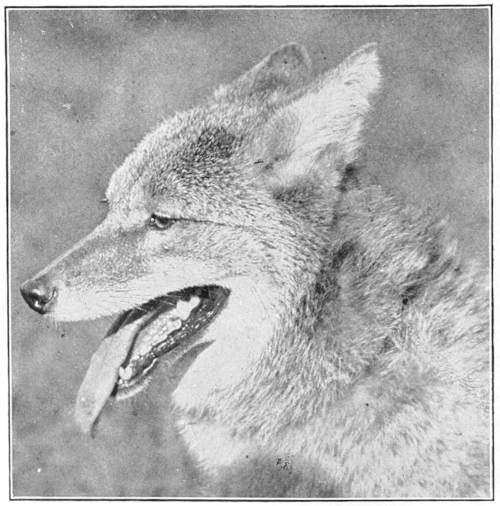
“Katrina Wolfchen”, the pet coyote of Professor Fred S. Charles.
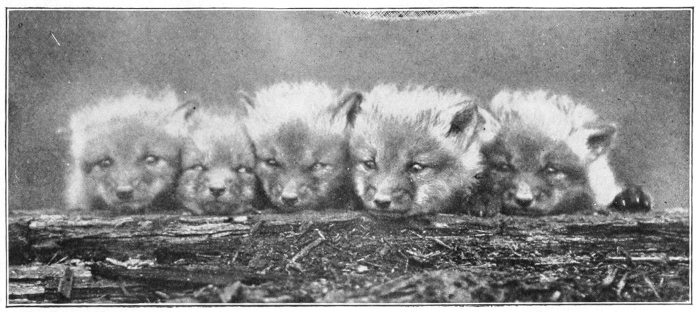
Fox cubs.
THE FOX
Teacher’s Story
O WE not always, on a clear morning of winter, feel a thrill that must have something primitive in its quality, at seeing certain tracks in the snow that somehow suggest wildness and freedom! Such is the track of the fox. Although it is somewhat like that of a small dog yet it is very different. The fox has longer legs than most dogs of his weight, and there is more of freedom in his track and more of strength and agility expressed in it. His gait is usually an easy lope; this places the imprint of three feet in a line, one ahead of another, but the fourth is off a little at one side, as if to keep the balance. The fox lives in a den or burrow. The only fox home which I ever saw, was a rather deep cave beneath the roots of a stump, and there was no burrow or retreat beyond it. However, foxes often select woodchuck burrows, or make burrows of their own, and if they are caught within, they can dig rapidly, as many a hunter can attest. The mother usually selects an open place for a den for the young foxes; often an open field or side-hill is chosen for this. The den is carpeted with grass and is a very comfortable place for the fox puppies. The den of the father fox is usually not far away.
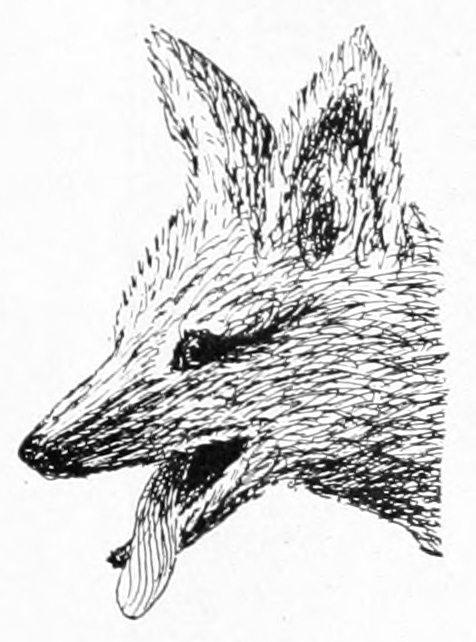
The face of the red fox shows plainly why he has been able to cope with man, and thrive despite and because of him. If ever a face showed cunning, it is his. Its pointed, slender nose gives it an expression of extreme cleverness, while the width of the head between the upstanding, triangular ears gives room for a brain of power. In color the fox is russet-red, the hind quarters being grayish. The legs are black outside and white inside; the throat is white, and the broad, triangular ears are tipped with black. The glory of the fox is his “brush,” as the beautiful, bushy tail is called. This is red, with black toward the end and white-tipped. This tail is not merely for beauty, for it affords the fox warmth during the winter, as any one may see who has observed the way it is wrapped around the sleeping animal. But this bushy tail is a disadvantage, if it becomes bedraggled and heavy with snow and sleet, when the hounds are giving close chase to its owner. The silver fox and the black fox are the same species as the red fox.
The fox is an inveterate hunter of the animals of the field; meadow mice, rabbits, woodchucks, frogs, snakes and grasshoppers, are all acceptable food; he is also destructive of birds. His fondness for the latter has given him a bad reputation with the farmer because of his attacks on poultry. Not only will he raid hen-roosts if he can force entrance, but he catches many fowls in the summer when they are wandering through the fields. The way he carries the heavy burden of his larger prey shows his cleverness: He slings a hen or a goose over his shoulders, keeping the head in his mouth to steady the burden. Mr. Cram says, in American Animals:
“Yet, although the farmer and the fox are such inveterate enemies, they manage to benefit each other in a great many ways quite unintentionally. The fox destroys numberless field mice and woodchucks for the farmer and in return the farmer supplies him with poultry, and builds convenient bridges over streams and wet places, which the fox crosses oftener than the farmer, for he is as sensitive as a cat about getting his feet wet. On the whole, I am inclined to believe that the fox gets the best part of the exchange, for, while the farmer shoots at him on every occasion, and hunts him with dogs in the winter, he has cleared the land of wolves and panthers, so that foxes are probably safer than before any land was ploughed.”
The bark of the fox is a high, sharp yelp, more like the bark of the coyote than of the dog. There is no doubt a considerable range of meaning in the fox’s language, of which we are ignorant. He growls when angry, and when pleased he smiles like a dog and wags his beautiful tail.
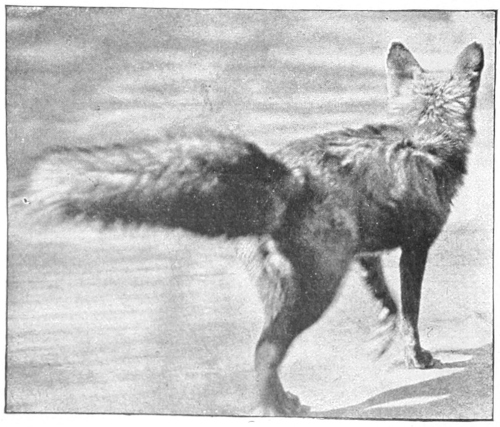
Red Fox.
Many are the wiles of the fox to head off dogs following his track: he often retraces his own steps for a few yards and then makes a long sidewise jump; the dogs go on, up to the end of the trail pocket, and try in vain to get the scent from that point. Sometimes he walks along the top rails of fences or takes the high and dry ridges where the scent will not remain; he often follows roads and beaten paths and also goes around and around in the midst of a herd of cattle, so that his scent is hidden; he crosses streams on logs and invents various other devices too numerous and intricate to describe. When chased by dogs, he naturally runs in a circle, probably so as not to be too far from home. If there are young ones in the den, the father fox leads the hounds far away, in the next county, if possible. Perhaps one of the most clever tricks of the fox, is to make friends with the dogs. I have known of two instances where a dog and fox were daily companions and playfellows.
The young foxes are born in the spring. They are black at first and are fascinating little creatures, being exceedingly playful and active. Their parents are very devoted to them, and during all their puppyhood, the mother fox is a menace to the poultry of the region, because the necessity is upon her of feeding her rapidly growing litter.
In my opinion, the best story of animal fiction is “Red Fox” by Roberts. Like all good fiction, it is based upon facts and it presents a wholesome picture of the life of the successful fox. “The Silver Fox” by Thompson Seton is another interesting and delightful story. Although the Nights with Uncle Remus could scarcely be called nature stories, yet they are interesting in showing how the fox has become a part of folk-lore.

Fox tracks.
LESSON LXII
The Fox
Leading thought—The red fox is so clever that it has been able, in many parts of our country, to maintain itself despite dogs and men.
Method—This lesson is likely to be given largely from hearsay or reading. However, if the school is in a rural district, there will be plenty of hunters’ stories afloat, from which may be elicited facts concerning the cunning and cleverness of the red fox. In such places there is also the opportunity in winter to study fox tracks upon the snow. The lesson may well be given when there are fox tracks for observation. The close relationship between foxes and dogs should be emphasized.
Observations and reading—1. Describe the fox’s track. How does it differ from the track of a small dog?
2. Where does the fox make its home? Describe the den. Describe the den in which the young foxes live.
3. Describe the red fox, its color and form as completely as you can. What is the expression of its face? What is there peculiar about its tail? What is the use of this great bushy tail in the winter?
4. What is the food of the fox? How does it get its food? Is it a day or a night hunter? How does the fox benefit the farmer? How does it injure him? How does the fox carry home its heavy game, such as a goose or a hen?
5. Have you ever heard the fox bark? Did it sound like the bark of a dog? How does the fox express anger? Pleasure?
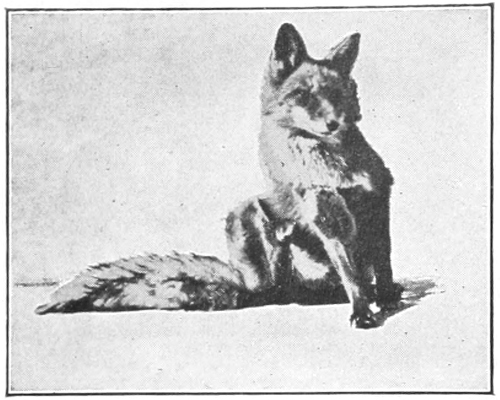
“Got a bite.”
6. When chased by dogs, in what direction does the fox run? Describe all of the tricks which you know by which the fox throws the dog off the scent.
7. When are the young foxes born? How many in a litter? What color are they? How do they play with each other? How do they learn to hunt?
Supplementary reading—Red Fox by Roberts; Silver Fox by Thompson Seton; Little Beasts of Field and Wood, page 25; Squirrels and Other Fur Bearers, chapter 7; Fox Ways in Ways of Wood Folk; The Springfield Fox in Wild Animals I Have Known; Familiar Wild Animals; Familiar Life in Field and Forest, page 213; American Animals, page 264; Nights with Uncle Remus.
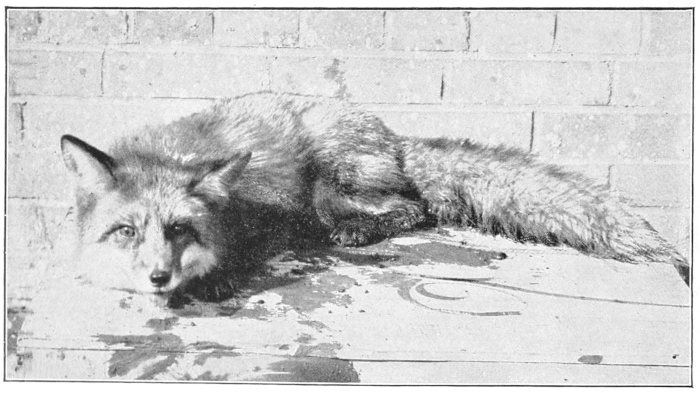
A pet red fox.
Photo by Fred S. Charles.
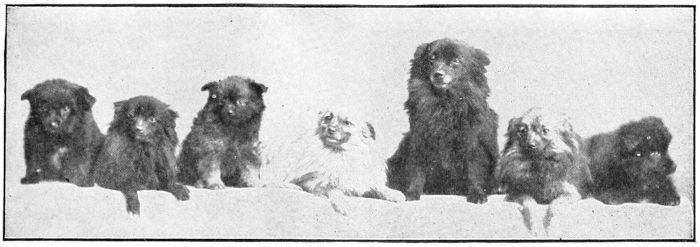
DOGS
Teacher’s Story
OT only to-day but in ancient days, before the dawn of history, the dog was the companion of man. Whether the wild species from whence he sprang, was wolf or jackal or some other similar animal, we do not know, but we do know that many types of dogs have been tamed independently by savages, in the region where their untamed relatives run wild. As the whelps of wolves, jackals and foxes are all easily tamed, and are most interesting little creatures, we can understand how they became companions to the children of the savage and barbarous peoples who hunted them.
In the earliest records of cave dwellers, in the picture writing of the ancient Egyptians and of other ancient peoples, we find record of the presence and value of the dog. But man, in historical times, has been able to evolve breeds that vary more in form than do the wild species of the present. There are 200 distinct breeds of dogs known to-day, and many of these have been bred for special purposes. The paleontologists, moreover, assure us that there has been a decided advance in the size and quality of the dog’s brain since the days of his savagery; thus, he has been the companion of man’s civilization also. It is not, therefore, to be wondered at that the dog is now the most companionable, and has the most human qualities and intelligence of all our domesticated animals.
Dogs run down their prey; it is a necessity, therefore, that they be equipped with legs that are long, strong and muscular. The cat, which jumps for her prey, has much more delicate legs but has powerful hips to enable her to leap. The dog’s feet are much more heavily padded than those of the cat, because in running, he must not stop to save his feet. Hounds often return from a chase with bleeding feet, despite the heavy pads, but the wounds are usually cuts between the toes. The claws are heavy and are not retractile; thus, they afford a protection to the feet when running, and they are also used for digging out game which burrows into the ground. They are not used for grasping prey like those of the cat and are used only incidentally in fighting, while the cat’s claws are the most important weapons in her armory. It is an interesting fact that Newfoundland dogs, which are such famous swimmers, have their toes somewhat webbed.
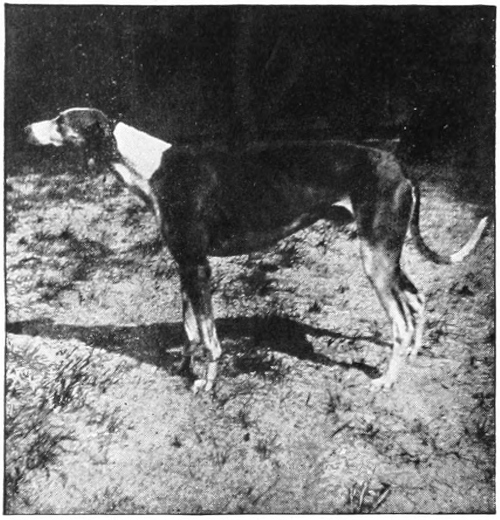
Greyhound.
The dog’s body is long, lean, and very muscular, a fat dog being usually pampered and old. The coat is of hair and is not of fine fur like that of the cat. It is of interest to note that the Newfoundland dog has an inner coat of fine hair comparable to that of the mink or muskrat. When a dog is running, his body is extended to its fullest length; in fact, it seems to “lie flat,” the outstretched legs heightening the effect of extreme muscular effort of forward movement. A dog is master of several gaits; he can run, walk, trot, bound and crawl.
The iris of the dog’s eye is usually of a beautiful brown, although this varies with breeds; in puppies, the iris is usually blue. The pupil is round like our own; and dogs cannot see well in the dark like the cat, but in daylight they have keen sight. The nose is so much more efficient than the eyes, that it is on the sense of smell the dog depends for following his prey and for recognizing friend and foe. The damp, soft skin that covers the nose, has in its dampness the conditions for carrying the scent to the wide nostrils; these are situated at the most forward part of the face, and thus may be lifted in any direction to receive the marvelous impressions, so completely beyond our comprehension. Think of being able to scent the track of a fox made several hours previously. Not only to scent it, but to follow by scent for many miles without ever having a glimpse of the fleeing foe! In fact, while running, the dog’s attention seems to be focused entirely upon the sense of smell, for I have seen hounds pass within a few rods to the windward of the fox they were chasing, without observing him at all. When the nose of any of the moist-nosed beasts, such as cattle and dogs, becomes dry it is a sign of illness.
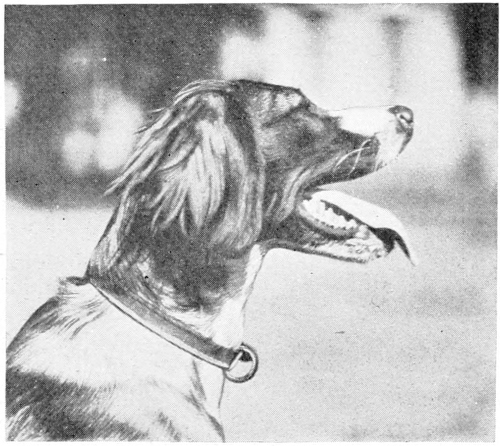
Bird dog.
A light fall of damp snow gives the dog the best conditions for following a track by scent and a hound, when on the trail, will run until exhausted. There are many authentic observations which show that hounds have followed a fox for twenty-four hours without food, and probably with little rest.
The dog’s weapons for battle, like those of the wolf, are his tushes: with these, he holds and tears his prey; with them, he seizes the woodchuck or other small animal through the back and shakes its life out. In fighting a larger animal, the dog leaps against it and often incidentally tears its flesh with his strong claws; but he does not strike a blow with his foot like the cat, nor can he hold his quarry with it.
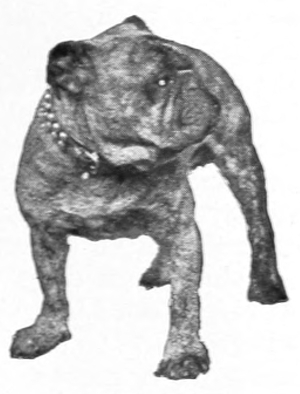
Bulldog.
Dog’s teeth are especially fitted for their work. The incisors are small and sharp; the canine teeth or tushes are very long, but there are bare spaces on the jaws so that they are able to cross past each other; the molar teeth are not fitted for grinding, like the teeth of a cow, but are especially fitted for cutting, as may be noted if we watch the way a dog gnaws bones, first gnawing with the back teeth on one side and then on the other. In fact, a dog does not seem to need to chew anything, but simply needs to cut his meat in small enough pieces so that he can gulp them down without chewing. His powers of digesting unchewed food are something that the hustling American may well envy.
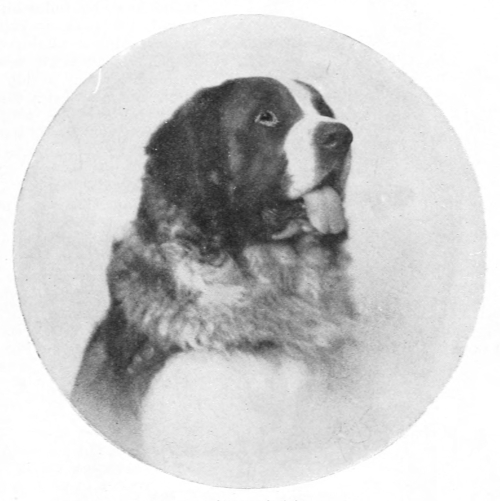
“Mateo”, a St. Bernard of long pedigree.
Of all domestic animals, the dog is most humanly understandable in expressing emotions. If delighted, he leaps about giving ecstatic little barks and squeals, his tail in the air and his eyes full of happy anticipation. If he wishes to be friendly, he looks at us interestedly, comes over to smell of us in order to assure himself whether he has ever met us before, and then wags his tail as a sign of good faith. If he wishes to show affection, he leaps upon us and licks our face or hands with his soft, deft tongue and follows us jealously. When he stands at attention, he holds his tail stiff in the air, and looks up with one ear lifted as if to say, “Well, what’s doing?” When angry, he growls and shows his teeth and the tail is held rigidly out behind, as if to convince us that it is really a continuation of his backbone. When afraid, he whines and lies flat upon his belly, often looking beseechingly up toward his master as if begging not to be punished; or he crawls away out of sight. When ashamed, he drops his tail between his legs and with drooping head and sidewise glance slinks away. When excited, he barks and every bark expresses high nervous tension.
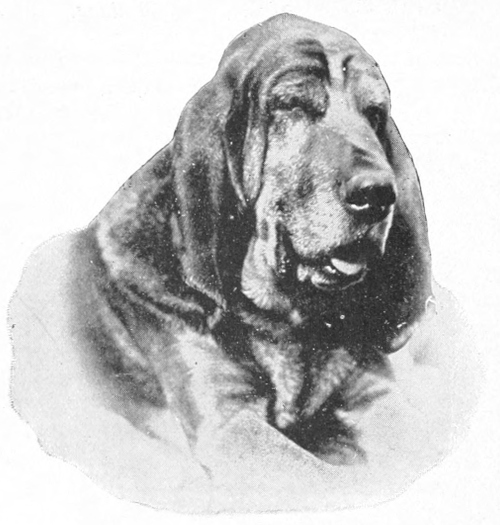
Bloodhound.
Almost all dogs that chase their prey, bark when so doing, which would seem at first sight to be a foolish thing to do, in that it reveals their whereabouts to their victims and also adds an incentive to flight. But it must be borne in mind that dogs are descended from wolves, which naturally hunt in packs and do not stalk their prey. The baying of the hound is a most common example of the habit, and as we listen we can understand how, by following this sound, the pack is kept together. Almost all breeds of dogs have an acute sense of hearing. When a dog bays at the moon or howls when he hears music, it is simply a reversion to the wild habit of howling to call together the pack or in answer “to the music of the pack.” It is interesting that our music, which is the flower of our civilization, should awaken the sleeping ancestral traits in the canine breast. But perhaps that, too, is why we respond to music, because it awakens in us the strong, primitive emotions, and for the time, enables us to free ourselves from all conventional shackles and trammels.
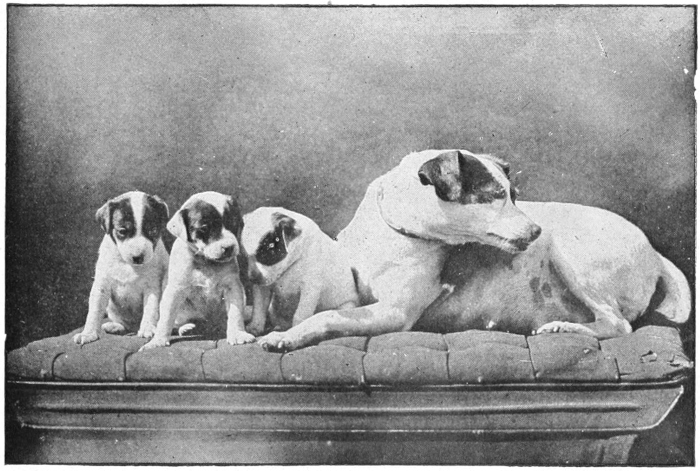
Fox terrier and pups.
LESSON LXIII
DOGS
Leading thought—The dog is a domesticated descendant of wolf-like animals and has retained certain of the habits and characteristics of his ancestors.
Method—For the observation lesson it would be well to have at hand, a well-disposed dog which would not object to being handled; a collie or a hound would be preferable. Many of the questions should be given to the pupils to answer from observations at home, and the lesson should be built upon the experience of the pupils with dogs.
Observations—1. Why are the legs of the dog long and strong in proportion to the body compared with those of the cat?
2. Compare the feet of the cat with those of the dog and note which has the heavier pads. Why is this of use to each?
3. Which has the stronger and heavier claws, the dog or the cat? Can the dog retract his claws so that they are not visible, as does the cat? Of what use is this arrangement to the dog? Are the front feet just like the hind feet? How many toe impressions show in the track of the dog?
4. What is the general characteristic of the body of the dog? Is it soft like that of the cat, or lean and muscular? What is the difference between the hair covering of the dog and cat? What is the attitude of the dog when running fast? How many kinds of gaits has he?
5. In general, how do the eyes of the dog differ from those of the cat? Does he rely as much upon his eyes for finding his prey as does the cat? Can a dog see in the dark? What is the color of the dog’s eyes?
6. Study the ear of the dog; is it covered? Is this outer ear movable, is it a flap, or is it cornucopia shaped? How is this flap used when the dog is listening? Roll a sheet of paper into a flaring tube and place the small end upon your own ear, and note if it helps you to hear better the sounds in the direction toward which the tube opens? Note how the hound lifts his long earlaps, so as to make a tube for conveying sounds to his inner ear. Do you think that dogs can hear well?
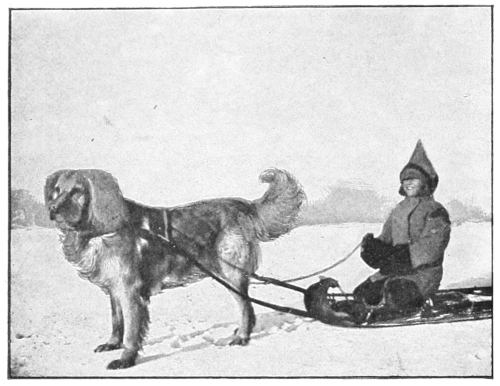
“Klondike Jack”.
The dog that pulled four hundred fifty pounds five hundred miles through the White Horse Pass in the winter of the first gold excitement.
7. What is the position of the nose in the dog’s face? Of what use is this? Describe the nostrils; are they placed on the foremost point of the face? What is the condition of the skin that surrounds them? How does this condition of the nose aid the dog? What other animals have it? Does the dog recognize his friends or become acquainted with strangers by means of his sight or of his powers of smelling?
8. How long after a fox or rabbit has passed can a hound follow the track? Does he follow it by sight or by smell? What are the conditions most favorable for retaining the scent? The most unfavorable? How long will a hound follow a fox trail without stopping for rest or food? Do you think the dog is your superior in ability to smell?
9. How does a dog seize and kill his prey? How does he use his feet and claws when fighting? What are his especially strong weapons? Describe a dog’s teeth and explain the reason for the bare spaces on the jaw next to the tushes. Does the dog use his tushes when chewing? What teeth does he use when gnawing a bone? Make a diagram of the arrangement of the dog’s teeth.
10. How by action, voice, and especially by the movement of the tail does the dog express the following emotions: Delight, friendliness, affection, attention, anger, fear, shame, excitement? How does he act when chasing his prey? Why do wolves and dogs bark when following the trail? Do you think of a reason why dogs often howl at night or when listening to music? What should we feed to our pet dogs? What should we do to make them comfortable in other ways?
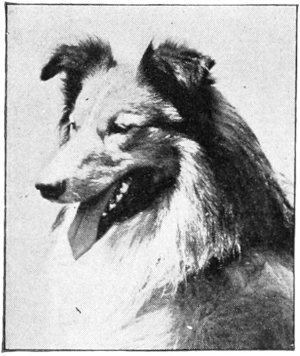
In pleasant mood.
A collie.
11. Tell or write a story of some dog of which you know by experience or hearsay. Of what use was the dog to the pioneer? How are dogs used in the Arctic regions? In Holland?
12. How many breeds of dogs do you know? Describe characters of such as follows: The length of the legs as compared with the body; the general shape of the body, head, ears, nose; color and character of hair on head, body and tail.
13. Find if you can the reasons which have led to the developing of the following breeds: Newfoundland, St. Bernard, mastiffs, hounds, collies, spaniels, setters, pointers, bulldogs, terriers, and pugs.
Supplementary reading—“Stories of Brave Dogs” from St. Nicholas, the Century Co.; the following three stories from Thompson-Seton: “Chink” in Lives of the Hunted, “Snap” in Animal Heroes, “Wully” in Wild Animals I Have Known; Bob, Son of Battle; Mack, His Book, by Florence Leigh; Rab and his Friends; The Dog of Flanders; “Red Dog” in Kipling’s Jungle Stories; Animals of the World, Knight and Jenks, p. 80; Life of Animals, Ingersoll, p. 187.
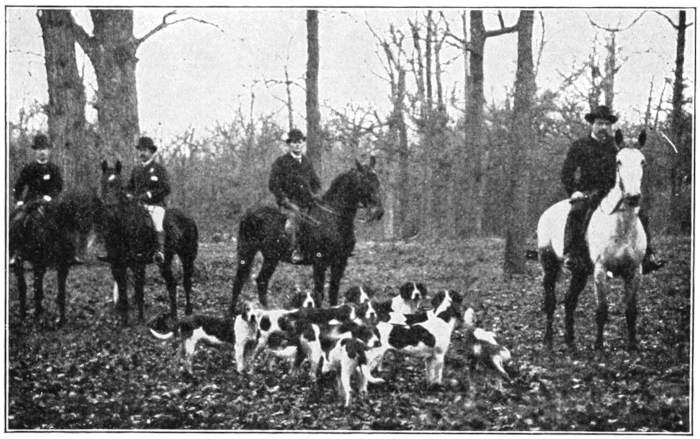
Fox hunting, in the Genesee Valley, N. Y.
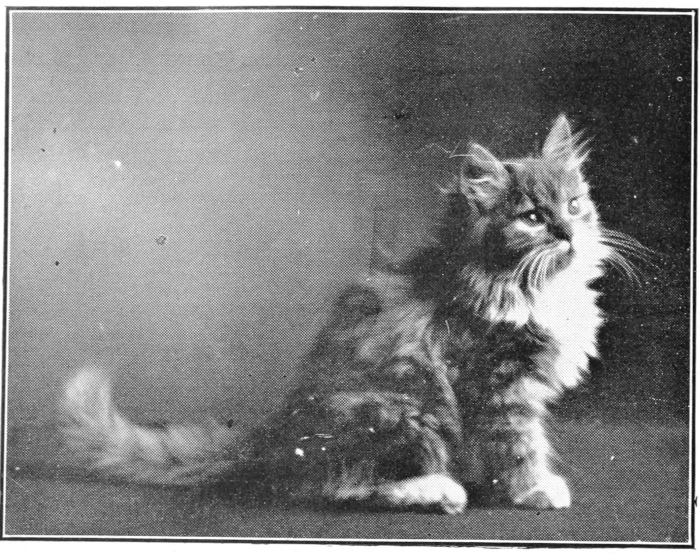
An aristocrat.
THE CAT
Teacher’s Story
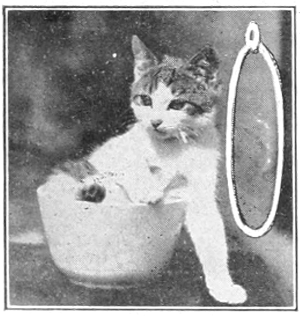
F all people, the writer should regard the cat sympathetically, for when she was a baby of five months she was adopted by a cat. My self-elected foster-mother was Jenny, a handsome black and white cat, which at that time lost her first litter of kittens, through the attack of a savage cat from the woods. She was as Rachel crying for her children, when she seemed suddenly to comprehend that I, although larger than she, was an infant. She haunted my cradle, trying to give me milk from her own breasts; and later she brought half-killed mice and placed them enticingly in my cradle, coaxing me to play with them, a performance which pleased me much more than it did my real mother. Jenny always came to comfort me when I cried, rubbing against me, purring loudly, and licking me with her tongue in a way to drive mad the modern mother, wise as to the sources of children’s internal parasites. This maternal attitude toward me lasted as long as Jenny lived, which was until I was nine years old. Never during those years did I lift my voice in wailing, that she did not come to comfort me; and even to-day I can remember how great that comfort was, especially when my naughtiness was the cause of my weeping, and when, therefore, I felt that the whole world, except Jenny, was against me.
Jenny was a cat of remarkable intelligence and was very obedient and useful. Coming down the kitchen stairs one day, she played with the latch and someone hearing her, opened the door. She did this several times, when one day she chanced to push down the latch, and thus opened the door herself. After that, she always opened it herself. A little later, she tried the trick on other doors, and soon succeeded in opening all the latched doors in the house, by thrusting one front leg through the handle, and thus supporting her weight and pressing down with the foot of the other on the thumb-piece of the latch. I remember, guests were greatly astonished to see her coming thus swinging into the sitting-room. Later she tried the latches from the other side, jumping up and trying to lift the hook; but now, her weight was thrown against the wrong side of the door for opening, and she soon ceased this futile waste of energy; but for several years, she let herself into all the rooms in this clever manner, and taught a few of her bright kittens to do the same.
A pet cat enjoys long conversations with favored members of the household. She will sit in front of her mistress and mew, with every appearance of answering the questions addressed her; and since the cat and the mistress each knows her own part of the conversation, it is perhaps more typical of society chatter than we might like to confess. Of our language, the cat learns to understand the call to food, its own name, “scat,” and “No, No,” probably inferring the meaning of the latter from the tone of voice. On the other hand, we understand when it asks to go out, and its polite recognition to the one who opens the door. I knew one cat which invariably thanked us when we let him in as well as out. When the cat is hungry, it mews pleadingly; when happy in front of the fire, it looks at us sleepily out of half-closed eyes and gives a short mew expressive of affection and content; or it purrs, a noise which we do not know how to imitate and which expresses perfectly the happiness of intimate companionship. When frightened the cat yowls, and when hurt squalls shrilly; when fighting, it is like a savage warrior in that it howls a war-song in blood-curdling strains, punctuated with a spitting expressive of fear and contempt; and unfortunately, its love song is scarcely less agonizing to the listener. The cat’s whole body enters into the expression of its emotions. When feeling affectionate toward its mistress, it rubs against her gown, with tail erect, and vibrating with a purr which seems fundamental. When angry, it lays its ears back and lashes its tail back and forth, the latter being a sign of excitement; when frightened, its hair stands on end, especially the hair of the tail, making that expressive appendage twice its natural size; when caught in disobedience, the cat lets its tail droop, and when running lifts it in a curve.
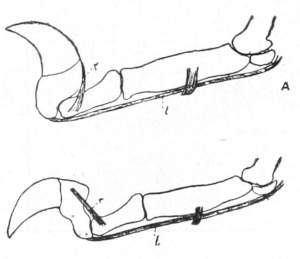
Bones and ligaments of cat’s claw.
A Claw up. B Claw thrust out.
While we feed cats milk and scraps from our own table, they have never become entirely civilized in their tastes. They always catch mice and other small animals and prove pestiferous in destroying birds. Jenny was wont to bring her quarry, as an offering, to the front steps of our home every night; one morning we found seven mice, a cotton-tail rabbit and two snakes, which represented her night’s catch. The cat never chases its prey like the dog. It discovers the haunts of its victims, and then lies in ambush, flattened out as still as a statue and all its feet beneath it, ready to make the spring. The weight of the body is a factor which enters in the blow with which the cat strikes down its victim, and thus stuns and which it later kills by gripping the throat with the strong tushes. She carries her victims as she does her kittens, by the back.
The cat’s legs are not long compared with the body, and it runs with a leaping gallop; the upper legs are armed with powerful muscles. It walks on the padded toes, five on the front feet and four of the hind feet. The cat needs its claws to be sharp and hooked, in order to seize and hold its prey, so they are kept safely sheathed when not thus used. If the claws struck the earth during walking, as do the dog’s, they would soon become dulled. When sharpening its claws it reaches high up against a tree or post, and strikes them into the wood with a downward scratch; this act is probably more for exercising the muscles which control the claws than for sharpening them.
The cat’s track is in a single line as if it had only two feet, one set directly ahead of the other. It accomplishes this by setting its hind feet exactly in the tracks made by the front feet. The cat can easily leap upward, landing on a window-sill five feet from the ground. The jump is made with the hind legs and the alighting is done silently on the front feet.
Cats’ eyes are fitted for seeing in the dark; in the daytime the pupil is simply a narrow, up and down slit; under excitement, and at night, the pupil covers almost the entire eye. At the back of the eye is a reflecting surface, which catches such dim light as there is, and by reflecting it enables the cat to use it twice. It is this reflected light, which gives the peculiar green glare to the eyes of all the cats when seen in the dark. Some night-flying moths have a like arrangement for utilizing the light, and their eyes glow like living coals. Of course, since the cat is a night hunter, this power of multiplying the rays of light is of great use. The iris of the eye is usually yellow, but in kittens it may be blue or green.
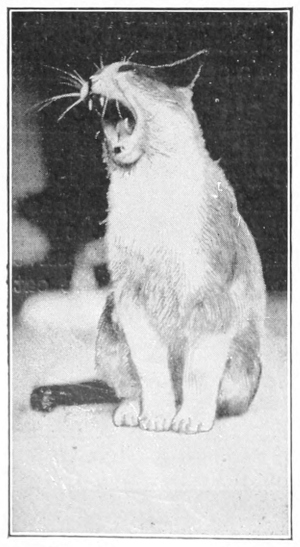
“Folks are so tiresome.”
The cat’s teeth are peculiarly fitted for its needs. The six doll-like incisors of the upper and lower jaw are merely for scraping meat from bones. The two great tushes, or canines, on each jaw, with a bare place behind so that they pass each other freely, are sharp and hooked, and are for seizing and carrying prey. The cat is able to open its mouth as wide as a right angle, in order to better hold and carry prey. The back teeth, or molars, are four on each side in the upper jaw and three, below. They are sharp-edged wedges made for cutting meat fine enough, so that it may be swallowed.
The tongue is covered with sharp papillæ directed backwards, also used for rasping juices from meat. The cat’s nose is moist, and her sense of smell very keen, as is also her sense of hearing. The ears rise like two hollow half-cones on either side of the head and are filled with sensitive hairs; they ordinarily open forward, but are capable of movement. The cat’s whiskers consist of from twenty-five to thirty long hairs set in four lines, above and at the sides of the mouth; they are connected with sensitive nerves and are therefore true feelers. The cat’s fur is very fine and thick, and is also sensitive; as can readily be proved, by trying to stroke it the wrong way. While the wild cats have gray or tawny fur, variously mottled or shaded, the more striking colors we see in the domestic cats are the result of man’s breeding.
Cats are very cleanly in their habits. Puss always washes her face directly after eating, using one paw for a wash-cloth and licking it clean after she rubs her face. She cleans her fur with her rough tongue and also by biting; and she promptly buries objectionable matter. The mother cat is very attentive to the cleanliness of her kittens, licking them clean from nose tip to tail tip. The ways of the mother cat with her kittens do much to sustain the assertions of Mr. Seton and Mr. Long that young animals are trained and educated by their parents. The cat brings half-dazed mice to her kittens, that they may learn to follow and catch them with their own little claws. When she punishes them, she cuffs the ears by holding one side of the kitten’s head firm with the claws of one foot, while she lays on the blows with the other. She carries her kittens by the nape of the neck, never hurting them. She takes them into the field when they are old enough, and shows them the haunts of mice, and does many things for their education and welfare. The kittens meantime train themselves to agility and dexterity, by playing rough and tumble with each other, and by chasing every small moving object, even to their own tails.
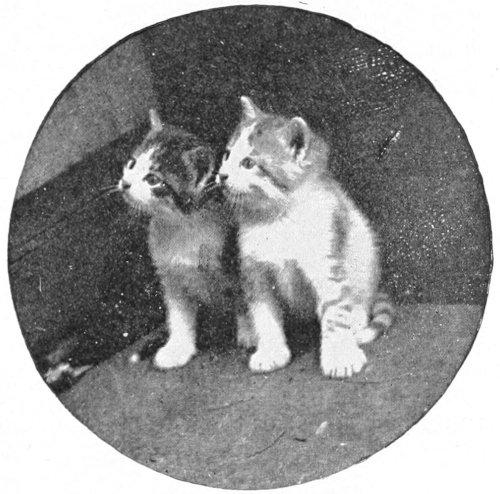
“Interested!”
The cat loves warmth and finds her place beneath the stove or at the hearthside. She likes some people, and dislikes others, for no reason we can detect. She can be educated to be friendly with dogs and with birds. In feeding her, we should give her plenty of sweet milk, some cooked meat and fish of which she is very fond; and we should keep a bundle of catnip to make her happy, for even the larger cats of the wilderness seem to have a passionate liking for this herb. The cat laps milk with her rough tongue, and when eating meat, she turns the head this way and that, to cut the tough muscle with her back teeth.
Cats Should be Trained to Leave Birds Alone
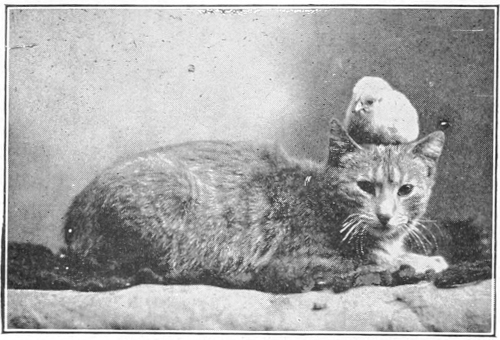
This cat has been trained to be friendly with birds.
Every owner of a cat owes it to the world to train puss to leave birds alone. If this training is begun during kittenhood, by switching the culprit every time it even looks at a bird, it will soon learn to leave them severely alone. I have tried this many times, and I know it is efficacious, if the cat is intelligent. We have never had a cat whose early training we controlled, that could ever be induced to even watch birds. If a cat is not thus trained as a kitten, it is likely to be always treacherous in this respect. But in case any one has a valuable cat which is given to catching birds, I strongly advise the following treatment which has been proved practicable by a friend of mine. When a cat has made the catch, take the bird away and sprinkle it with red pepper, and then give it back. One such treatment as this resulted in making one cat, which was an inveterate bird hunter, run and hide every time he saw a bird thereafter. Any persons taking cats with them to their summer homes, and abandoning them there to prey upon the birds of the vicinity, and to become poor, half-starved, wild creatures, ought to be arrested and fined. It is not only cruelty to the cats, but it is positive injury and damage to the community, because of the slaughter of beneficial birds which it entails.
LESSON LXIV
The Cat
Leading thought—The cat was made a domestic animal before man wrote histories. It gets prey by springing from ambush and is fitted by form of body and teeth to do this. It naturally hunts at night and has eyes fitted to see in the dark.
Method—This lesson may be used in primary grades by asking a few questions at a time and allowing the children to make their observations on their own kittens at home, or a kitten may be brought to school for this purpose. The upper grade work consists of reading and retelling or writing exciting stories of the great, wild, savage cats, like the tiger, lion, leopard, lynx and panther.
Observations—1. How much of Pussy’s language do you understand? What does she say when she wishes you to open the door for her? How does she ask for something to eat? What does she say when she feels like conversing with you? How does she cry when hurt? When frightened? What noise does she make when fighting? When calling other cats? What are her feelings when she purrs? When she spits? How many things which you say does she understand?
2. How else than by voice does she express affection, pleasure and anger? When she carries her tail straight up in the air is she in a pleasant mood? When her tail “bristles up” how does she feel? What is it a sign of, when she lashes her tail back and forth?
3. What do you feed to cats? What do they catch for themselves? What do the cats that are wild live upon? How does the cat help us? How does she injure us?
4. How does a cat catch her prey? Does she track mice by the scent? Does she catch them by running after them as a dog does? Describe how she lies in ambush. How does she hold the mouse as she pounces upon it? How does she carry it home to her kittens?
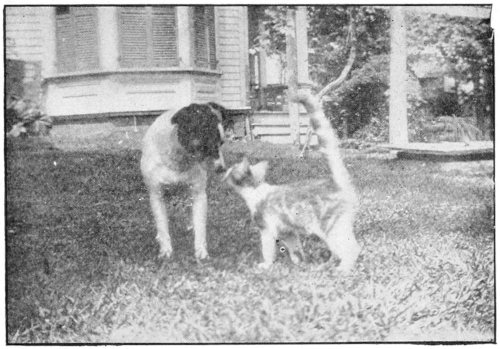
Amicable advances.
5. Study the cat’s paws to see how she holds her prey. Where are the sharp claws? Are they always in sight like a dog’s? Does she touch them to the ground when she walks? Which walks the more silently, a dog or a cat? Why? Describe the cat’s foot, including the toe-pads. Are there as many toes on the hind feet as on the front feet? What kind of a track does the cat make in the snow? How does she set her feet to make such a track? How does she sharpen her claws? How does she use her claws for climbing? How far have you ever seen a cat jump? Does she use her front or her hind feet in making the jump? On which feet does she alight? Does she make much noise when she alights?
6. What is there peculiar about a cat’s eyes? What is their color? What is the color of kittens’ eyes? What is the shape of the pupil in daylight? In the dark? Describe the inner lid which comes from the corner of the eye.
7. How many teeth has Puss? What is the use of the long tushes? Why is there a bare space behind these? What does she use her little front teeth for? Does she use her back teeth for chewing or for cutting meat?
8. How many whiskers has she? How long are they? What is their use? Do you think that puss has a keen sense of smell? Why do you think so? Do you think she has a keen sense of hearing? How do the shape and position of the ears help in listening? In what position are the ears when puss is angry?
9. How many colors do you find in our domestic cats. What is the color of wild cats? Why would it not be beneficial to the wild-cat to have as striking colors as our tame cats? Compare the fur of the cat with the hair of the dog. How do they differ? If a cat chased her prey like the dog do you think her fur would be a too warm covering?
10. Describe how the cat washes her face. How does she clean her fur? How does her rough tongue help in this? How does the mother cat wash her kittens?
11. How does a little kitten look when a day or two old? How long before its eyes open? How does the cat carry her kittens? How does a kitten act when it is being carried? How does the mother cat punish her kittens? How does she teach them to catch mice? How do kittens play? How does the exercise they get in playing fit them to become hunters?
12. How should cats be trained not to touch birds? When must this training begin? Why should a person be punished for injury to the public who takes cats to summer cottages and leaves them there to run wild?
13. Where in the room does puss best like to lie? How does she sun herself? What herb does she like best? Does she like some people and not others? What strange companions have you known a cat to have? What is the cat’s chief enemy? How should we care for and make her comfortable?
14. Write or tell stories on the following subjects: (1) The things which my pet cat does; (2) The Wild Cat; (3) The Lion; (4) The Tiger; (5) The Leopard; (6) The Panther and the Mountain Lion; (7) The Lynx; (8) The History of Domestic Cats; (9) The Different Races of Cats, describing the Manx, the Persian and the Angora Cats.
Supplementary reading—The Life of Animals, Ingersoll; American Animals, Stone and Cram; Our Domestic Animals, Burkett; The Fireside Sphinx, Repplier; Concerning Cats, Winslow; The following animal stories from St. Nicholas Magazine: Cat Stories, Lion and Tiger Stories, Panther Stories.
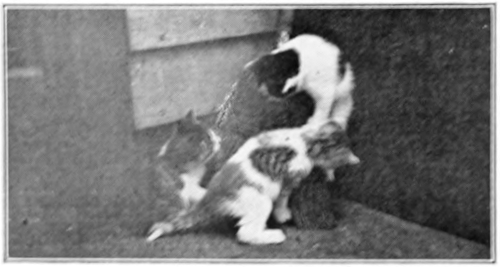
Photo by Verne Morton.
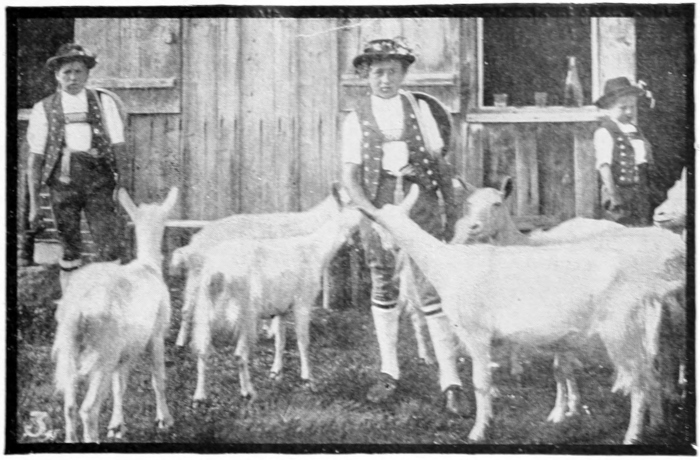
Saanen goats in Switzerland.
Peer, Twenty-first Annual Report Bureau of Animal Industry, U. S. Department of Agriculture.
THE GOAT
Teacher’s Story
Little do we in America realize the close companionship that has existed in older countries, from time immemorial, between goats and people. This association began when man was a nomad, and took with him in his wanderings, his flocks, of which goats formed the larger part. He then drank their milk, ate their flesh, wove their hair into raiment, or made cloth of their pelts, and used their skins for water bags. Among peoples of the East all these uses continue to the present day. In the streets of Cairo, old Arabs may be seen with goat skins filled with water upon their backs; and in any city of Western Asia or Southern Europe, flocks of goats are driven along the streets to be milked in sight of the consumer.
In order to understand the goat’s peculiarities of form and habit, we should consider it as a wild animal, living upon the mountain heights amid rocks and snow and scant vegetation. It is marvelously sure-footed and when on its native mountains, it can climb the sharpest crags and leap chasms. This peculiarity has been seized upon by showmen who often exhibit goats which walk on the tight rope with ease, and even turn themselves upon it without falling. The instinct for climbing still lingers in the domestic breeds, and in the country the goat may be seen on top of stone piles or other objects, while in city suburbs, its form may be discerned on the roofs of shanties and stables.
It is a common saying that a goat will eat anything, and much sport is made of this peculiarity. This fact has more meaning for us when we realize that wild goats live in high altitudes, where there is little plant life, and are therefore, obliged to find sustenance on lichens, moss and such scant vegetation as they can find.
The goat is closely allied to the sheep, differing from it in only a few particulars; its horns rise from the forehead curving over backward and do not form a spiral like those of the ram; its covering is usually of hair, and the male has a beard from which we get the name goatee; the goat has no gland between the toes, and it does have a rank and disagreeable odor. In a wild state, it usually lives a little higher up the mountains than do the sheep, and it is a far more intelligent animal. Mary Austin says: “Goats lead naturally by reason of a quicker instinct, forage more freely and can find water on their own account, and give voice in case of alarm. Goat leaders exhibit jealousy of their rights to be first over the stepping-stones or to walk the teetering log bridges at the roaring creeks.” On the great plains, it is a common usage to place a few goats in a flock of sheep, because of the greater sagacity of these animals as leaders, and also as defenders in case of attack.
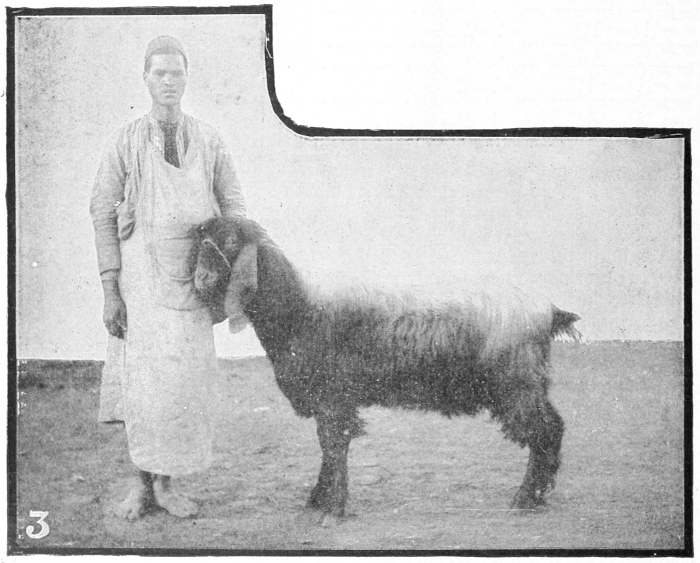
Zaraibi milch goats of Egypt.
Thompson. Twenty-first Annual Report Bureau of Animal Industry, U. S. Department of Agriculture.
Goats’ teeth are arranged for cropping herbage and especially for browsing. There are six molar teeth on each side of each jaw; there are eight lower incisors and none above. The goat’s sense of smell is very acute; the ears are movable and the sense of hearing is keen; the eyes are full and very intelligent; the horns are somewhat flattened and angular and often knobbed somewhat in front, and curve backward above the neck; they are, however, very efficient as weapons of defence. The legs are strong, though not large, and are well fitted for leaping and running. The feet have two hoofs, that is, the animal walks upon two toe-nails. There are two smaller toes behind and above the hoofs. The goat can run with great rapidity. The tail of the goat is short like that of the deer, and does not need to be amputated like that of the sheep. Although the normal covering of the goat is hair, there are some species which have a more or less woolly coat. When angry the goat shakes its head, and defends itself by butting with the head, also by striking with the horns, which are very sharp. Goats are very tractable and make affectionate pets when treated with kindness; they display far more affection for their owner than do sheep.
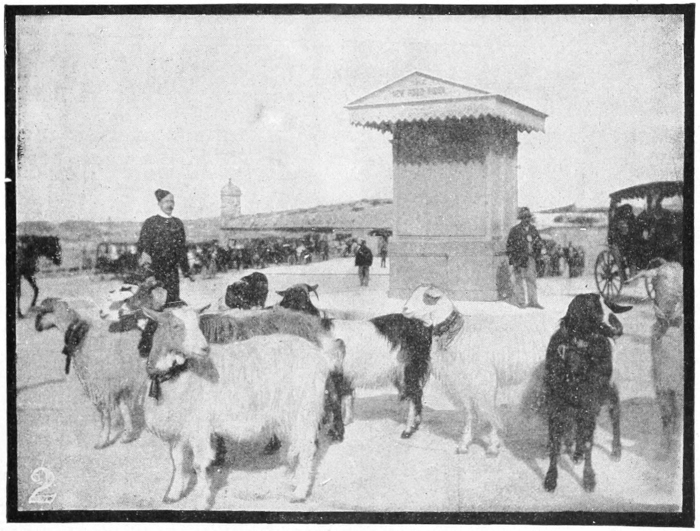
Milch goats in Malta.
Thompson. Twenty-first Annual Report Bureau of Animal Industry, Department of Agriculture.
Our famous Rocky Mountain goat, although it belongs rather to the antelope family, is a large animal, and is the special prize of the hunter; however, it still holds its own in the high mountains of the Rocky and Cascade Ranges. Both sexes have slender black horns, white hair, and black feet, eyes and nose. Owen Wister says of this animal: “He is white, all white, and shaggy, and twice as large as any goat you ever saw. His white hair hangs long all over him like a Spitz dog’s or an Angora cat’s; and against its shaggy white mass the blackness of his hoofs and horns, and nose looks particularly black. His legs are thick, his neck is thick, everything about him is thick, save only his thin black horns. They’re generally about six (often more than nine) inches long, they spread very slightly, and they curve slightly backward. At their base they are a little rough, but as they rise they become cylindrically smooth and taper to an ugly point. His hoofs are heavy, broad and blunt. The female is lighter than the male, and with horns more slender, a trifle. And (to return to the question of diet) we visited the pasture where the herd (of thirty-five) had been, and found no signs of grass growing or grass eaten; there was no grass on that mountain. The only edible substance was a moss, tufted, stiff and dry to the touch. I also learned that the goat is safe from predatory animals. With his impenetrable hide and his disemboweling horns he is left by the wolves and mountain lions respectfully alone.” (See American Animals, p. 57; Camp Fires of a Naturalist, chapters VIII and XIII).
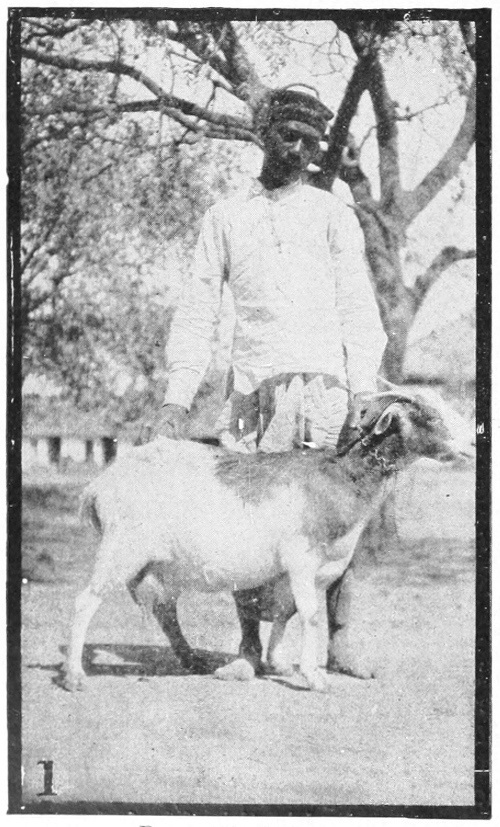
Poona (India) goat.
Thompson. Twenty-first Annual Report Bureau of Animal Industry, U. S. Department of Agriculture.
Milch Goats—Many breeds of these have been developed, and the highest type is, perhaps, found in Switzerland. The Swiss farmers have found the goat particularly adapted to their high mountains and have used it extensively; thus, goats developed in the Saane and Toggenburg valleys have a world-wide reputation. Above these valleys the high mountains are covered with perpetual snow, and winter sets in about November 1st, lasting until the last of May. The goats are kept with the cows in barns and fed upon hay; but as soon as the snow is gone from the valleys and the lower foot-hills, the cattle and goats are sent with the herders and boy assistants, to the grazing grounds. A bell is put upon the cow that leads the herd so as to keep it together and the boys, in their gay peasant dresses, are as happy as the playful calves and goats to get out in the spring sunshine. The herds follow the receding snows up the mountains until about midsummer, when they reach the high places of scanty vegetation; then they start on the downward journey, returning to the home and stables about November 1st. The milk from goats is mixed with that from cows to make cheese, and this cheese has a wide reputation; some of the varieties are: Roquefort, Schweitzer and Altenburger. Although the cheese is excellent, the butter made from goat’s milk is quite inferior to that made from the cow’s. The milk, when the animals are well taken care of, is exceedingly nourishing; it is thought to be the best milk in the world for children. Usually, the trouble with goat’s milk is, that the animals are not kept clean nor is care taken in milking. Germany has produced many distinct and excellent breeds of milch goats; the Island of Malta, Spain, England, Ireland, Egypt and Nubia have each developed noted breeds. Of all these, the Nubias give the most milk, sometimes yielding from four to six quarts pet day, while an ordinary goat is considered fairly good if it yields two quarts per day.
The Mohair Goats—There are two noted breeds of goats whose hair is used extensively for weaving into fabrics; one of these is the Cashmere and the other the Angora. The Cashmere goat has long, straight, silky hair for an outside coat and has a winter under-coat of very delicate wool. There are not more than two or three ounces of this wool upon one goat, and this is made into the famous Cashmere shawls; ten goats furnish barely enough of this wool for one shawl. The Cashmere goats are grown most largely in Thibet, and the wool is shipped from the high tableland to the Valley of Cashmere, and is made into shawls. It requires the work of several people for a year to produce one of these famous shawls.
The Angora goat has a long, silky and very curly fleece. These goats were first discovered in Angora, a city of Asia Minor south of the Black Sea, and some 200 miles southeast from Constantinople. The Angora goat is a beautiful and delicate animal, and furnishes most of the mohair, which is made into the cloths known as mohair, alpaca, camel’s hair and many other fabrics. The Angora goat has been introduced into America, in California, Texas, Arizona, and to some extent in the Middle West. It promises to be a very profitable industry. (See Farmers’ Bulletin No. 137, “The Angora Goat,” United States Department of Agriculture.)
The skins of goats are used extensively; morocco, gloves and many other articles are made from them. In the Orient, the skin of the goat is used as a bag in which to carry water and wine.
References—American Animals, p. 55; Neighbors with Claws and Hoofs, p. 190; Familiar Animals, pp. 169 and 183; Camp Fires of a Naturalist, chapters VIII and XIII; Lives of Animals.
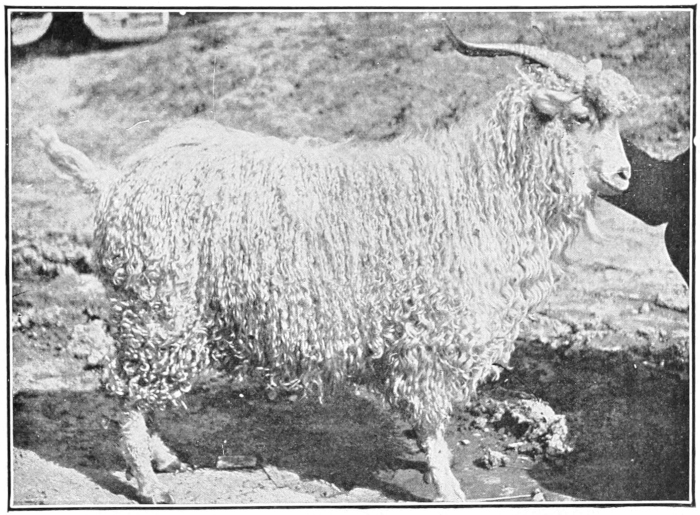
Angora goat.
Thompson, Twenty-first Annual Report Bureau of Animal Industry U. S. Department of Agriculture.
LESSON LXV
The Goat
Leading thought—Goats are among our most interesting domesticated animals, and their history is closely interwoven with the history of the development of civilization. In Europe, their milk is made into cheese that has a world-wide fame; and from the hair of some of the species, beautiful fabrics are woven. The goat is naturally an animal of the high mountains.
Method—A span of goats harnessed to a cart is second only to ponies, in a child’s estimation; therefore, the beginning of this lesson may well be a span of goats thus employed. The lesson should not be given unless the pupils have an opportunity for making direct observations on the animal’s appearance and habits. There should be some oral and written work in English done with this lesson. Following are topics for such work: “The Milch Goat of Switzerland,” “How Cashmere Shawls are Made,” “The Angora Goat,” “The Chamois.”
Observations—1. Do you think that goats like to climb to high points? Are they fitted to climb steep, inaccessible places? Can they jump off steep places in safety? How does it happen the goat is sure-footed? How do its legs and feet compare with those of the sheep?
2. What does the goat eat? Where does it find its natural food on mountains? How are the teeth arranged for cutting its food? Does a goat chew its cud like a cow?
3. What is the covering of the goat? Describe a billy-goat’s beard. Do you suppose this is for ornament? For what is goat’s hair used?
4. Do you think the goat has a keen sense of sight, of hearing and of smell? Why? Why did it need to be alert and keen when it lived wild upon the mountains? Do you think the goat is intelligent? Give instances of this.
5. Describe the horns. Do they differ from the horns of the sheep? How does a goat fight? Does he strike head on, like the sheep, or sidewise? How does he show anger?
6. What noises does a goat make? Do you understand what they mean?
7. Describe the goat, its looks and actions. Is the goat’s tail short at first or does it have to be cut off like the lamb’s tail? Where and how is goat’s milk used? What kinds of cheese are made from it? For what is its skin used? Is its flesh ever eaten?
Everyone knows the gayety of young kids, which prompts them to cut the most amusing and burlesque capers. The goat is naturally capricious and inquisitive, and one might say crazy for every species of adventure. It positively delights in perilous ascensions. At times it will rear and threaten you with its head and horns, apparently, with the worst intentions, whereas it is usually an invitation to play. The bucks, however, fight violently with each other; they seem to have no consciousness of the most terrible blows. The ewes themselves are not exempt from this vice.
They know very well whether or not they have deserved punishment. Drive them out of the garden, where they are forbidden to go, with a whip and they will flee without uttering a sound; but strike them without just cause and they will send forth lamentable cries. Charles William Burkett in “Our Domestic Animals.”
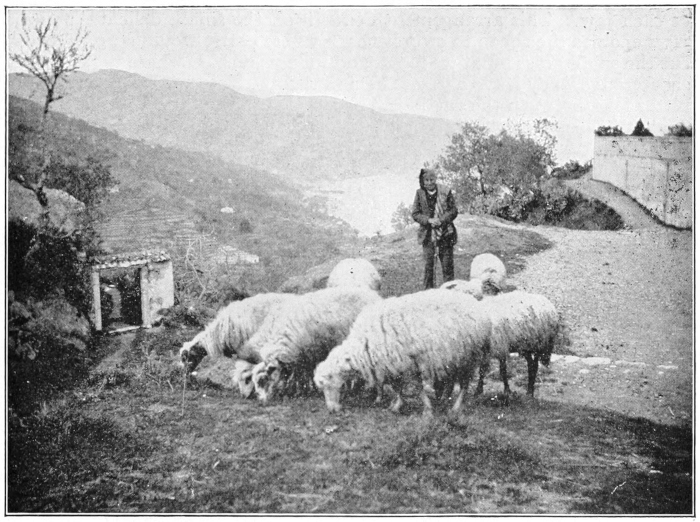
A Sicilian shepherd.
Photo by J. H. Comstock.
THE SHEEP
Teacher’s Story
“The earliest important achievement of ovine intelligence is to know whether its own notion or another’s is most worth while, and if the other’s, which one? Individual sheep have certain qualities, instincts, competences, but in the man-herded flocks these are superseded by something which I shall call the flock mind, though I cannot say very well what it is, except that it is less than the sum of all their intelligences. This is why there have never been any notable changes in the management of flocks since the first herder girt himself with a wallet of sheep-skin and went out of his cave-dwelling to the pastures.”—“The Flock,” by Mary Austin.
Both sheep and goats are at home on mountains, and sheep especially, thrive best in cool, dry locations. As wild animals, they were creatures of the mountain crag and chasm, although they frequented more open places than the mountain goats, and their wool was developed to protect them from the bitter cold of high altitudes. They naturally gathered in flocks, and sentinels were set to give warning of the approach of danger; as soon as the signal came, they made their escape, not in the straight away race like the deer, but in following the leader over rock, ledge and precipice to mountain fastnesses where wolf nor bear could follow. Thus, the instinct of following the leader blindly, came to be the salvation of the individual sheep.
The teeth of the sheep are like those of the goat, eight incisors below and none on the upper row, and six grinding teeth at the back of each side of each jaw. This arrangement of teeth on the small, delicate, pointed jaws enables the sheep to crop herbage where cattle would starve; it can cut the small grass off at its roots, and for this reason, where vast herds of sheep range, they leave a desert behind them. This fact brought about a bitter feud between the cattle and sheep men in the far West. In forests, flocks of sheep completely kill all underbrush, and now they are not permitted to run in government reserves.
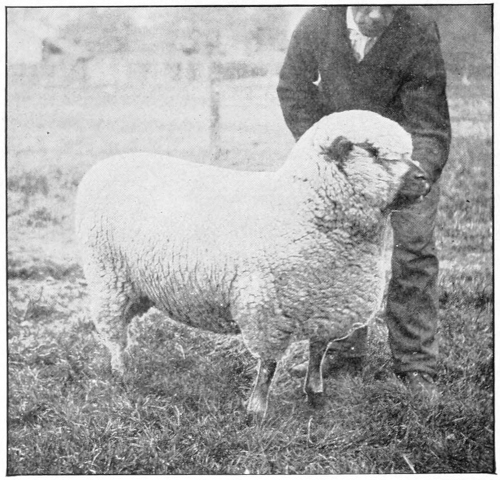
A sheep of pedigree, Shropshire ram.
The sheep’s legs are short and delicate below the ankle. The upper portion is greatly developed to help the animal in leaping, a peculiarity to which we owe the “leg of lamb” as a table delicacy. The hoof is cloven, that is, the sheep walks upon two toes; it has two smaller toes above and behind these. There is a little gland between the front toes which secretes an oily substance, which perhaps serves in preventing the hoof from becoming too dry. The ears are large and are moved to catch better the direction of sound. The eyes are peculiar; in the sunlight the pupil is a mere slit, while the iris is yellow or brownish, but in the dark, even of the stable, the pupils enlarge, almost covering the eye. The ewes either lack horns or have small ones, but the horns of wild rams are large, placed at the side of the head and curled outward in a spiral. These horns are perhaps not so much for fighting the enemy as for rival rams. The ram can strike a hard blow with head and horns, coming at the foe head on, while the goat always strikes sidewise. So fierce is the blow of the angry sheep, that an ancient instrument of war was fashioned like a ram’s head and used to knock down walls, and was called a battering ram. A sheep shows anger by stamping the ground with the front feet. The habit of rumination enables the sheep to feed in a flock and then retire to some place to rest and chew the cud, a performance peculiarly funny in the sheep.
Sheep under attack and danger are silent; ordinarily they keep up a constant, gentle bleating to keep each other informed of their whereabouts; they also give a peculiar call when water is discovered, and another to inform the flock that there is a stranger in the midst; they also give a peculiar bleat, when a snake or other enemy which they conquer, is observed. Their sense of smell is very acute. Mary Austin says, “Young lambs are principally legs, the connecting body being simply a contrivance for converting milk into more leg, so you understand how it is that they will follow the flock in two days and are able to take the trail in a fortnight, traveling four and five miles a day, falling asleep on their feet and tottering forward in the way.”
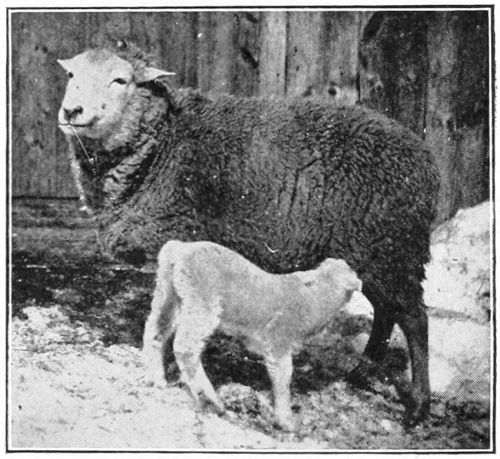
Mutual contentment.
The older lambs have games which they play untiringly, and which fit them to become active members of the flock; one, is the regular game of “Follow My Leader,” each lamb striving to push ahead and attain the place of leader. In playing this the head lamb leads the chase over most difficult places, such as logs, stones and across brooks; thus is a training begun which later in life may save the flock. The other game is peculiar to stony pastures; a lamb climbs to the top of a boulder and its comrades gather around and try to butt it off; the one which succeeds in doing this, climbs the rock and is “it.” This game leads to agility and sure-footedness. A lamb’s tail is long and is most expressive of lambkin bliss, when feeding time comes; but, alas! it has to be cut off so that later it will not become matted with burrs and filth. In southern Russia there is a breed of sheep with large, flat, fat tails which are esteemed as a great table delicacy. This tail becomes so cumbersome that wheels are placed beneath it, so that it trundles along behind its owner.
We have a noble species of wild sheep in the Rocky Mountains which is likely to become extinct soon. The different breeds of domesticated sheep are supposed to have been derived from different wild species. Of the domesticated varieties, we have the Merinos which originated in Spain and which give beautiful, long, fine wool for our fabrics; but their flesh is not very attractive. The Merinos have wool on their faces and legs and have wrinkled skins. The English breeds of sheep have been especially developed for mutton, although their wool is valuable. Some of these like the Southdown, Shropshire, and Dorset, give a medium length of wool, while the Cotswold has very long wool, the ewes having long strings of wool over their eyes in the fashion of “bangs.”
The dog, as descended from the wolf, is the ancient enemy of sheep; and even now after hundreds of years of domestication, some of our dogs will revert to savagery and chase and kill sheep. This, in fact, has been one of the great drawbacks to sheep raising in the Eastern United States. The collie, or sheep-dog, has been bred so many years as the special care-taker of sheep, that a beautiful relationship has been established between these dogs and their flocks. For instances of this, read the chapter on sheep-dogs in A Country Reader; “Wully” in Wild Animals I Have Known, and “Bob, Son of Battle.”
LESSON LXVI
The Sheep
Leading thought—Sheep live naturally in high altitudes. When attacked by enemies, they follow their leader over difficult and dangerous mountain places.
Method—The questions of this lesson should be given to the pupils and the observations should be made upon the sheep in pasture or stable. Much written work may be done in connection with this lesson. The following topics are suggested for themes: “The Methods by which Wool is Made into Cloth,” “The Rocky Mountain Sheep,” “The Sheep-herders of California and their Flocks,” “The True Story of a Cosset Lamb.”
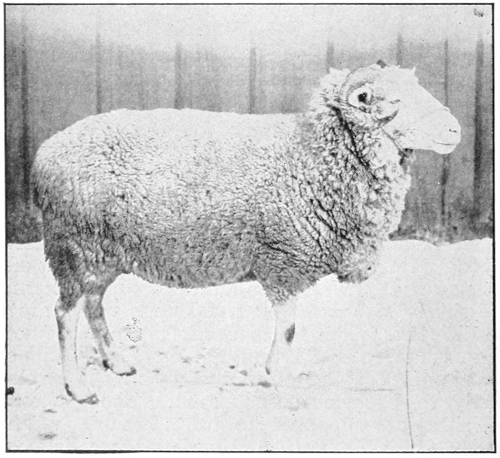
Horned Dorset ram.
Observations—1. What is the chief character that separates sheep from other animals? What is the difference between wool and hair? Why is wool of special use to sheep in their native haunts? Is there any hair on sheep?
2. Where do the wild sheep live? What is the climate in these places? Does wool serve them well on this account? What sort of pasturage do sheep find on mountains? Could cows live where sheep thrive? Describe the sheep’s teeth and how they are arranged to enable it to crop vegetation closely. What happens to the vegetation on the range, when a great flock of sheep passes over it? Why are sheep not allowed in our forest preserves?
3. What are the chief enemies of sheep in the wilderness? How do the sheep escape them? Describe the foot and leg of the sheep and explain how they help the animal to escape its enemies. We say of certain men that they “follow like a flock of sheep.” Why do we make this comparison? What has this habit of following the leader to do with the escape of sheep from wolves and bears?
4. How do sheep fight? Do both rams and ewes have horns? Do they both fight? How does the sheep show anger? Give your experience with a cross cosset lamb.
5. Do you think that sheep can see and hear well? What is the position of the sheep’s ears when it is peaceful? When there is danger? How do the sheep’s eyes differ from those of the cow?
6. Does the sheep chew its cud like the cow? Describe the action as performed by the sheep. How is this habit of cud chewing of use to the wild sheep?
7. Describe a young lamb. Why has it such long legs? How does it use its tail to express joy? What happens to this tail later? What games have you seen lambs play? Tell all the stories of lambs that you know.
8. How much of sheep language do you understand? What is the use to the wild flock of the constant bleating?
9. For what purposes do we keep sheep? How many breeds of sheep do you know? What are the chief differences between the English breeds and the Merinos? Where and for what purposes is the milk of sheep used?
10. Have you ever seen a collie looking after a herd of sheep? If so, describe his actions. Did you ever know of dogs killing sheep? At what time of day or night was this done? Did you ever know of one dog attacking a flock of sheep alone? What is there in the dog’s ancestry which makes two or three dogs, when hunting, give chase and attack sheep?