Part 3 — FLOWERLESS-PLANT STUDY (continued 3)
Reading edition
Although willow wood is soft and exceedingly light, it is very tough when seasoned and is used for many things. The wooden shoes of the European peasant, artificial limbs, willowware, and charcoal of the finest grain used in the manufacture of gunpowder, are all made from the willow wood. The toughness and flexibility of the willow twigs have given rise to many industries; baskets, hampers, carriage bodies and furniture are made of them. To get these twigs the willow trees are pollarded, or cut back every year between the fall of the leaves and the flow of the sap in the spring. This pruning results in many twigs. The use of willow twigs in basketry is ancient. The Britons fought the Roman soldiers from behind shields of basket work; and the wattled huts in which they lived were woven of willow saplings smeared with clay. Salicylic acid, used widely in medicine, is made from willow bark, which produces also tannin and some unfading dyes.
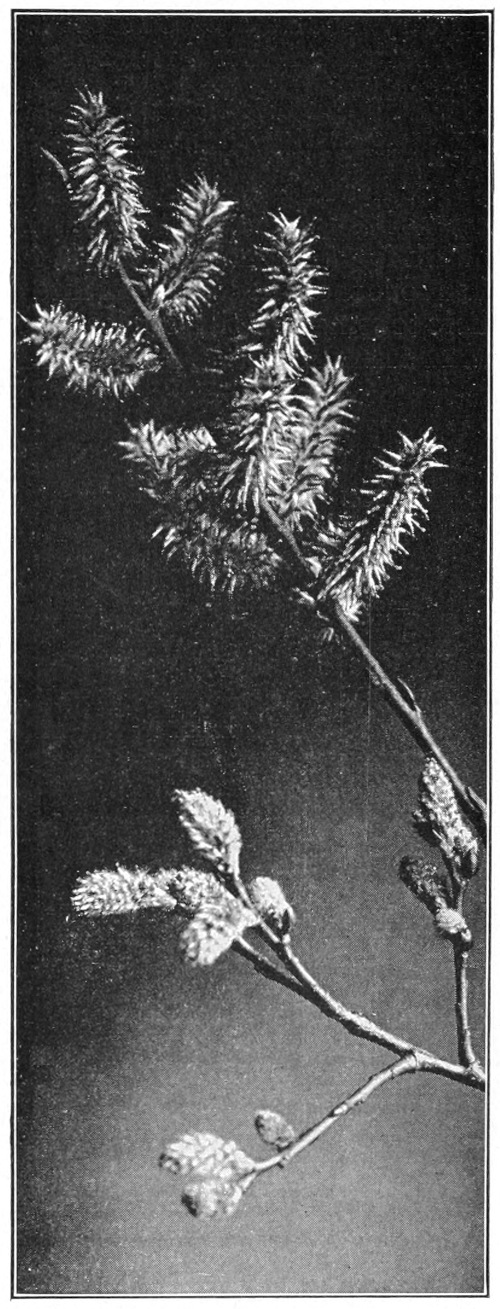
The pistillate blossoms of the willow.
Photo by Verne Morton.
There are many insect inhabitants of the willow, but perhaps the most interesting is the little chap which makes a conelike object on the twig of certain species of willow growing along our streams. This cone is naturally considered a fruit by the ignorant, but we know that the willow seeds are grown in catkins instead of cones. This willow cone is made by a small gnat which lays its egg in the tip of the twig; as soon as the little grub hatches, it begins to gnaw the twig, and this irritation for some reason stops the growth. The leaves instead of developing along the stem are dwarfed and overlap each other. Just in the center of the cone at the tip of the twig the little larva lives its whole life surrounded by food and protected from enemies; it remains in the cone all winter, in the spring changes to a pupa, and after a time comes forth—a very delicate little fly. The larva in this gall is very hospitable. It has its own little apartment at the center but does not object to having a tenant in its outer chambers, a fact which is taken advantage of by another gall-gnat which breeds there in large numbers. It is well to gather these cones in winter; examine one by cutting it open to find the larva, and place others in a fruit jar with a cover so as to see the little flies when they shall issue in the spring. (See p. 362). For supplementary reading see “Outdoor Studies,” page 24.
There is another interesting winter tenant of willow leaves, but it is rather difficult to find. On the lower branches may be discovered, during winter and spring, leaves rolled lengthwise and fastened, making elongated cups. Each little cup is very full of a caterpillar which just fits it, the caterpillar’s head forming the plug of the opening. This is the partially grown larva of the viceroy butterfly. It eats off the tip of the leaf each side of the midrib for about half its length, fastens the petiole fast to the twig with silk, then rolls the base of the leaf into a cup, lines it with silk and backs into it, there to remain until fresh leaves on the willow in spring afford it new food.
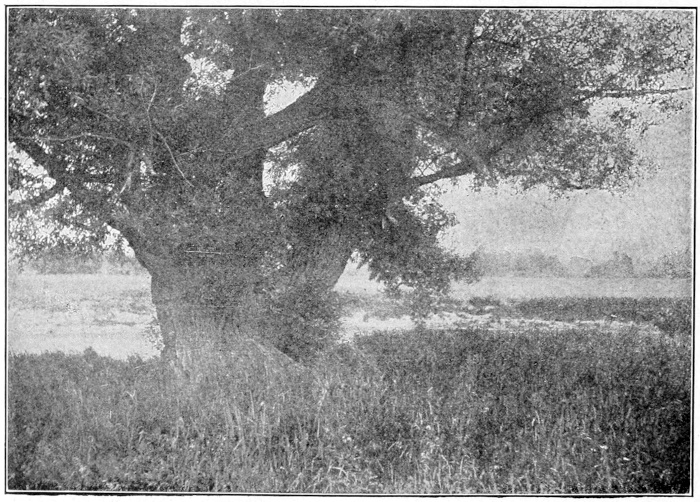
“My willow-tent.”
Photo by W. C. Baker.
LESSON CXCVI
The Willows
Leading thought—The willows have their pollen-bearing flowers and their seed-bearing flowers on separate trees; the bees carry the pollen from one to the other. The willow pussies are the pollen-bearing flowers.
Method—As early in March as is practicable, have the pupils gather twigs of as many different kinds of willows as can be found; these should be put in jars of water and placed in a warm, sunny window. The catkins will soon begin to push out from the bud-scales, and the whole process of flowering may be watched.
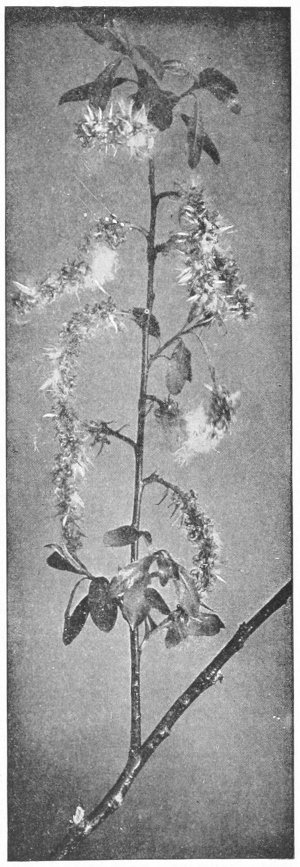
Seeds of willow.
Photo by Verne Morton.
Observations—1. How can you tell the common willow tree from afar? In what localities do these trees grow? What is the general shape of the big willow? How high is the trunk, or bole? What sort of bark has it? Are the main branches large or small? Do they stand out at a wide angle or lift up sharply? What color are the terminal shoots, or spray?
2. Are the buds opposite or alternate on the twigs? Is there a bud at exactly the end of any twig? How many bracts are there covering the bud?
3. Which appear first, the leaves or the blossoms? Study the pussies on your twigs and see if they are all alike. Is one kind more soft and furry than the other? Are they of different colors?
4. Take one of the furry pussies. Describe the little bract, which is like a protecting hood at its base. What color is the fur? After a few days, what color is the pussy? Why does it change from silver color to yellow? Pick one of the catkins apart and see how the fur protects the stamens.
5. Take one of the pussies which is not so furry. Can you see the little pistils with the Y-shaped stigmas set in it? Is each little pistil set at the base of a little scale with fringed edges?
6. Since the pollen-bearing catkins are on one tree and the seed-bearing catkins are on the other, and since the seeds cannot be developed without the pollen, how is the pollen carried to the pistils? For this answer, visit the willows when the pussies are all in bloom and listen. Tell what you hear. What insects do you see working on the willow blossoms? What are they after?
7. What sort of seed has the willow? How is it scattered? Do you think the wind or water has most to do with planting willow seed?
Work for May or September—8. Describe willow foliage and leaves. How can you tell willow foliage at a distance?
9. What sort of roots has the willow? Why are the willows planted along the banks of streams? If you wished to plant some willow trees how would you do it? Would you plant seeds or twigs?
10. For what purposes is willow wood used? How are the twigs used? Why are they specially fitted for this use? What is pollarding a tree? What medicine do we get from willow bark?
11. Do you find willow cones on your willows? Cut one of these cones through and see if you can find any seeds? What is in the middle of it? What do you think made the scales of the cone? Do you think this little insect remains in here all winter?
12. In winter, hunt the lower branches of willows for leaves rolled lengthwise making a winter cradle for the young caterpillars of the viceroy.
Supplementary reading—Trees in Prose and Poetry, p. 137.
THE COTTONWOOD, OR CAROLINA POPLAR
Teacher’s Story
HE sojourner on our western plains where streams are few and sluggish, disappearing entirely in summer, soon learns to love the cottonwoods, for they will grow and cast their shade for men and cattle where no other tree could endure. The cottonwood may be unkempt and ragged, but it is a tree, and we are grateful to it for its ability to grow in unfavorable situations. In the Middle West it attains its perfection, although in New York we have some superb specimens—trees which are more than one hundred feet in height and with majestic trunks, perhaps five or six feet through. The deep-furrowed, pale gray bark makes a handsome covering. The trunk divides into great out-swinging, widely spaced branches, which bear a fine spray on their drooping ends. Sargent declares that at its best the cottonwood is one of the statliest inhabitants of our eastern forests. The variety we plant in cities we call the Carolina poplar, but it is a cottonwood. It is a rapid grower, and therefore a great help to the “boom towns” of the West and to the boom suburbs in the East; although for a city tree its weak branches break too readily in wind storms in old age. However, it keeps its foliage clean, the varnished leaves shedding the dust and smoke; because of this latter quality it is of special use in towns that burn soft coal.
The cottonwood twigs which we gather for study in the spring are yellowish or reddish, those of last year’s growth being smooth and round, while those showing previous growth are angular. The buds are red-brown and shining, and covered with resin which the bees like to collect for their glue. The leaf buds are slender and sharp-pointed; the flower buds are wider and plumper.
The two sexes of the flowers are borne on separate trees. The trees bearing pollen catkins are so completely covered with them that they take on a very furry, purplish appearance when in blossom. These catkins are from three to five inches long and half an inch thick, looking fat and pendulous; each fringed scale of the catkin has at its base a disc looking like a white bracket, from which hang the reddish purple anthers; these catkins fall after the pollen is shed and look like red caterpillars upon the ground.
The seed-bearing flowers are very different; they look like a string of little, greenish beads loosely strung. Each pistil is globular and set in a tiny cup, and it has three or four stigmas which are widened or lobed; as it matures, it becomes larger and darker green, and the string elongates to six or even ten inches. The little pointed pods open into two or more valves and set free the seeds, which are provided with a fluff of pappus to sail them off on the breeze; so many of the seeds develop that every object in the neighborhood is covered with their fuzz, and thus the tree has gained its name “cottonwood.”
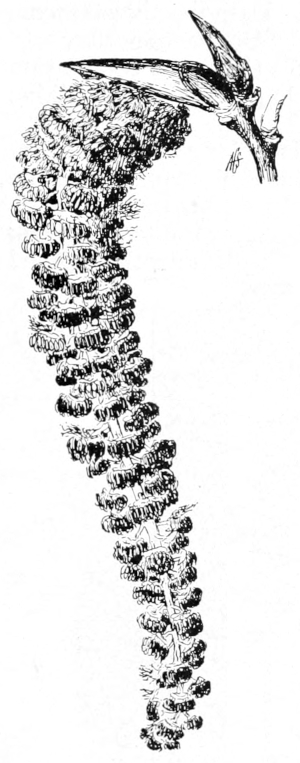
Staminate catkin of cottonwood.
Drawn by Anna Stryke.
The foliage of the cottonwood is like that of other poplars, trembling with the breeze. The heavy, subcircular leaf is supported on the sidewise flattened petiole, so that the slightest breath of air sets it quaking; a gentle breeze sets the whole tree twinkling and gives the eye a fascinating impression as of leaves beckoning. The leaf is in itself pretty. It is from three to five inches long, broad, slightly angular at the base and has a long, tapering, pointed tip. The edge is saw-toothed, and also slightly ruffled except near the stem where it is smooth; it is thick and shining green above and paler beneath. The long, slender petiole is red or yellowish, and the leaves are placed alternate on the twigs.
In the autumn the leaves are brilliant yellow. The wood is soft, weak, fine-grained, whitish or yellowish, and has a satiny luster; it is not durable. It is used somewhat for building and for furniture, in some kinds of cooperage, and also for crates and woodenware; but its greatest use is for making the pulp for paper. Many newspapers and books are printed on cottonwood paper. It is common from the Middle States to the Rocky Mountains and from Manitoba to Texas.
LESSON CXCVII
The Cottonwood
Leading thought—The cottonwood is a poplar. It grows rapidly and flourishes on the dry western plains where other trees fail to gain a foothold. It grows well in the dusty city, its shining leaves shedding the smoke and dirt.
Method—Begin this study in spring before the cottonwoods bloom. Bring in twigs in February, give them water and warmth, and watch the development of the catkins. Afterwards watch the unfolding of the leaves and study the tree.
Observations—1. What is the color of the bark on the cottonwood? Is it ridged deeply? What is the color of the twigs? Are they round or angular, or both? Describe the winter buds and bud-scales. Can you tell which bud will produce leaves and which flowers?
2. Describe the catkin as it comes out. Has this catkin anthers and pollen, or will it produce seed? Do you think the seeds are produced on the same trees as the pollen?
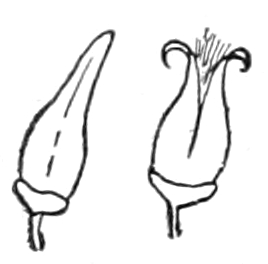
Seed-pod of poplar, shut and open.
3. Find a pollen-bearing catkin. Describe the stamens. Can you see anything but the anthers? On what are they set? What color are they? What color do they give to the tree when they are in blossom? What happens to the catkins after their pollen is shed?
4. Find a seed-bearing catkin. How long is it? Do you see why this tree is called the necklace poplar? Describe the pistils which make the beads on the necklace.
5. When do the seeds ripen? If you have been near the tree, how do you know when they are ripe? How long is the catkin with the ripened seeds? How many balls on the necklace now? What is the color? How many seeds come out of each little pod? How are the seeds floated on the air? Why do we call this tree “cottonwood?”
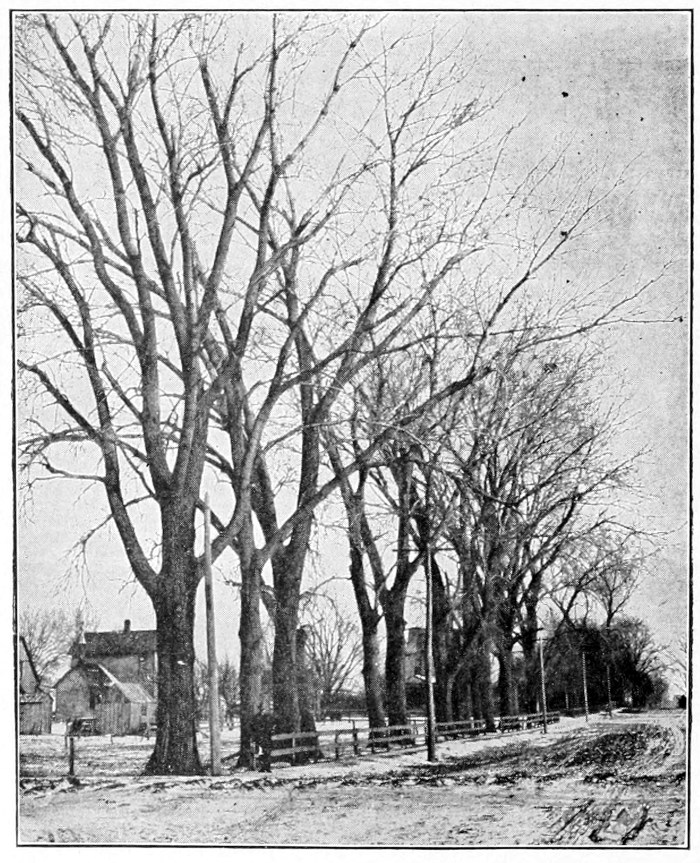
Cottonwoods.
Courtesy of U. S. Forest Service.
6. How large is the largest cottonwood that you know? Sketch it to show the shape of the tree. Are the main branches large? Do they droop at the tips?
7. How does the foliage of the cottonwood look? Does it twinkle with the wind? Examine the leaves upon a branch and see why they twinkle. Are the petioles round or flat? Are they flattened sidewise or up and down? Are they stiff or slender? Describe the leaves, giving their shape, veins, edges, color and texture above and below. Are the edges ruffled as well as toothed? Is the leaf heavy? If a breeze comes along how would it affect such a heavy, broad leaf on such a slender, thin petiole? Blow against the leaves and see how they move? Do you understand, now, why they twinkle? Can you see why the leaves shed smoke and dust, when used for shading city streets?
8. Why is the cottonwood used as a shade tree? Do you think it makes a beautiful shade tree? How long does it take it to grow? What kind of wood does it produce? For what is it used?
Supplementary reading—Trees in Prose and Poetry, pp. 139–149.
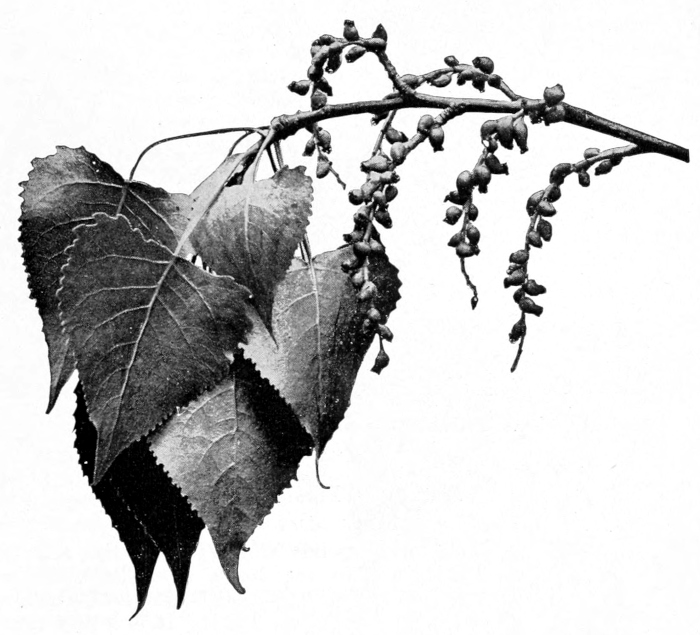
The growing fruit of the cottonwood.
Photo by Cyrus Crosby.
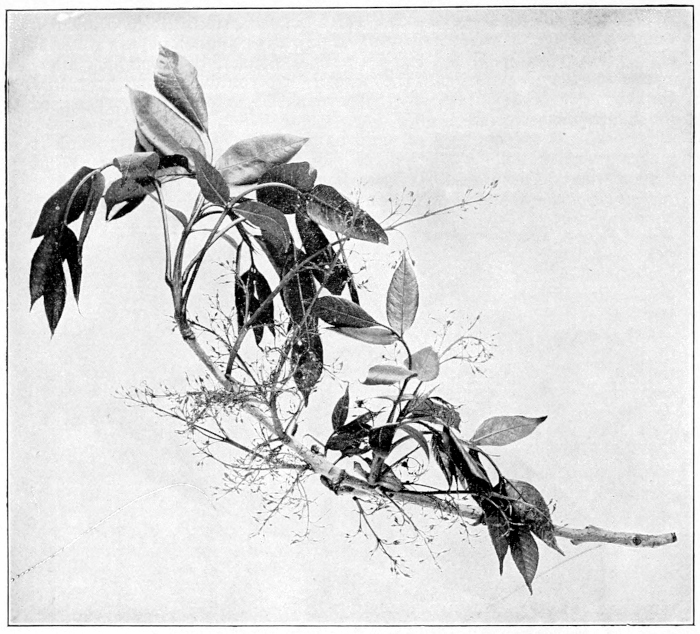
Pistillate blossoms of white ash.
Photo by G. F. Morgan.
THE WHITE ASH
Teacher’s Story
YTHS and legends cluster about the ash tree. It was, in the Norse mythology, the tree “Igdrasil,” the tree of the universe, which was the origin of all things. It is a pity that it was not the Tree of Life in the Garden of Eden, for if another myth is true, no snake will go near it or cross its branches. There is a widespread belief that it draws lightning, just as the beech repels the thunderbolts. “As straight as a white ash tree” was the highest compliment that could be paid to the young pioneer; so straight is its fiber and so strong its quality, that the American Indians made their canoe paddles from it.
The ashes have the most beautiful bark in the world. It is divided into fine, vertical ridges, giving the trunks the look of being shaded with pencil lines; the bark smooths out on the lower branches. But even more characteristic than the bark, are the ash branches and twigs; the latter are sparse, coarse and clumsy, those of the white ash being pale orange or gray and seemingly warped into curves at the ends; they are covered with whitish gray dots, which reveal themselves under the lens to be breathing-pores.
The white ash loves to grow in rich woods or in rich soil anywhere, even though it be shallow; at its best, it reaches the height of 130 feet, with a trunk six feet through. Its foliage is peculiarly graceful; the leaves are from eight to twelve inches long and are composed of from five to nine leaflets. The leaflets have little petioles connecting them with the middle stem; in shape they are ovate with edges obscurely toothed or entire; the two basal leaflets are smaller than the others and the end one largest; in texture, they are satiny, dark green above, whitish beneath, with feather-like veins, often hairy on the lower side. The petioles are swollen at the base. The leaves are set opposite upon the twig; except the horsechestnut, the ashes are our only trees with compound leaves which have the leaves opposite. This character alone readily distinguishes the ashes from the hickories. The autumn foliage has a very peculiar color; the leaves are dull purple above and pale yellow below; this brings the sunshine color into the shadowy parts of the tree, and gives a curious effect of no perspective. Notwithstanding this, the autumn coloring is a joy to the artistic eye and is very characteristic.
The seeds of the ash are borne in crowded clusters; the delicate stem, from three to five inches long, is branched into smaller stems to which are joined two or three keys, and often several of these main stems come from the same bud at the tip of last year’s wood so that they seem crowded. The seed is winged, the wing being almost twice as long as the seed set at its base. Thoreau says: “The keys of the white ash cover the trees profusely, a sort of mulberry brown, an inch and a half long, and handsome.” The seeds cling persistently to the tree, and I have often observed them being blown over the surface of the snow as if they were skating to a planting place.
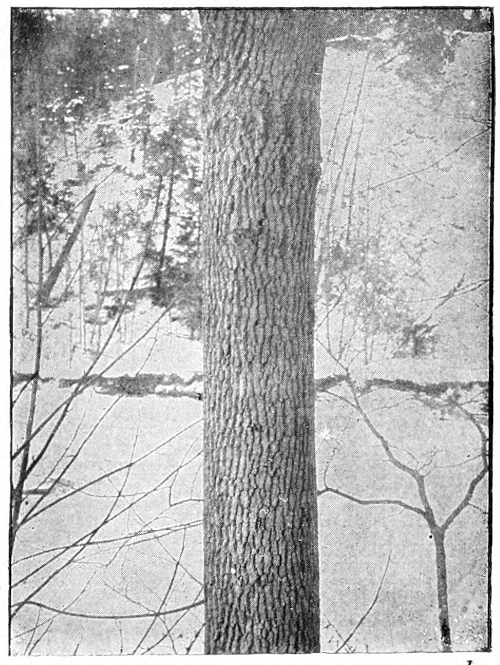
Bole of white ash showing the beautiful bark.
Photo by Ralph Curtis.
The flowers appear in April or May, before the leaves. The pistillate flowers make an untidy fringe, curling in every direction around the twigs. The chief flower stem is three to four inches long, quite stout, pale green, and from this arise short, fringed stems, each carrying along its sides the knobs on little stems—which are the pistillate flowers. Each tiny flower seems to be bristling with individuality, standing off at its own angle to get its own pollen. The flower has the calyx four-lobed; the style is long and slender and is divided into a V-shaped purple stigma.
The staminate flowers appear early in the spring, and look like knobs on the tips of the coarse, sparse twigs; they consist of masses of thick, green anthers with very short, stout filaments; each calyx is four-lobed. These flowers are attached to a five-branching stem; but the stem and its branches cannot be seen unless the anthers are plucked off, because they hang in such a crowded mass. Later the leaves come out beyond them.
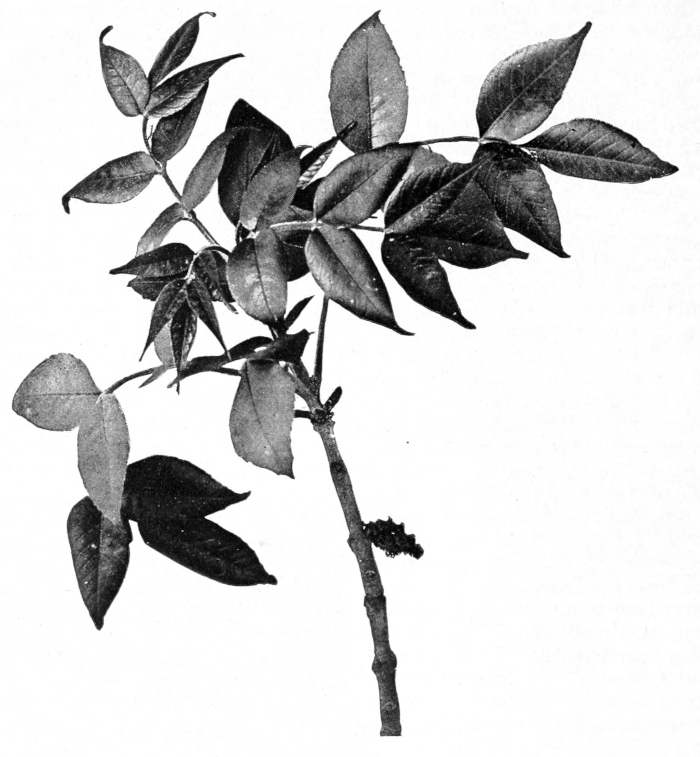
Staminate blossoms of white ash.
Photo by G. F. Morgan.
The leaf buds in winter are very pretty; they are white, bluntly pointed, with a pale gray half-circle below, on which was set last year’s leaf. Another one of nature’s miracles is the bouquet of leaves coming from one of the big four-parted terminal buds, which is made up of four scales, two of which are longer and narrower than the others. Within the bud each little compound leaflet is folded like a sheet of paper lengthwise, and folded with the other leaflets like the leaves of a book; and when they first appear they look like tiny, scrawny, birds’ claws. But it is not merely one pair of leaves that comes from this bud, but many, each pair being set on a twig opposite and at right angles to the next pair on either side. Even as many as five pairs of these splendid compound leaves come from this one prolific bud. As they push out, the green stem of the new wood grows, thus spacing the pairs properly for the making of beautiful foliage.
LESSON CXCVIII
Ash Trees
Leading thought—The ashes are our most valuable timber trees; the white ash is one of the most beautiful and useful of them all. It does not make forests, but it grows in them, and its wood is of great value for many things.
Method—The pupils should all see the tree where it grows. The questions should be given to them for their field note-books. The lesson should begin in the fall and be continued in the spring.
Observations—1. What is there about the bark of the ash tree which distinguishes it from other trees? Where does the white ash grow? What is the height and thickness of the ash tree you are studying?
2. The ash leaf is a compound leaf; of how many leaflets is it composed? What is the texture and shape of the leaflets? Describe the veins. Do the leaflets have petioles (petiolules)? Are the edges of the leaflets toothed? Which of the leaflets is largest? Which smallest? Is the petiole swollen at the base? How are the leaves arranged on the twigs? How does this distinguish the ashes from all other of our trees having compound leaves? How do the hickories have their leaves arranged? What color is the ash foliage in autumn?
3. Describe the seeds of the ash and the way they are arranged on their stems. Where are they placed on the tree? How long do they cling? How does the snow help to scatter them?
4. When does the white ash blossom? Are the pistillate and staminate flowers together or separate? Find and describe them.
5. What are our uses for ash timber? For what are the saplings used? How did the Indians use the white ash? Write a theme on all the interesting things you can find about the ash trees.
6. How many species of the ash trees do you know?
Supplementary reading—Trees in Prose and Poetry, pp. 60–71.
“I care not how men trace their ancestry, To ape or Adam; let them please their whim; But I in June am midway to believe A tree among my far progenitors, Such sympathy is mine with all the race, Such mutual recognition vaguely sweet There is between us. Surely there are times When they consent to own me of their kin, And condescend to me and call me cousin, Murmuring faint lullabies of eldest time, Forgotten, and yet dumbly felt with thrills Moving the lips, though fruitless of the words.” —From “Under the Willows,” Lowell.
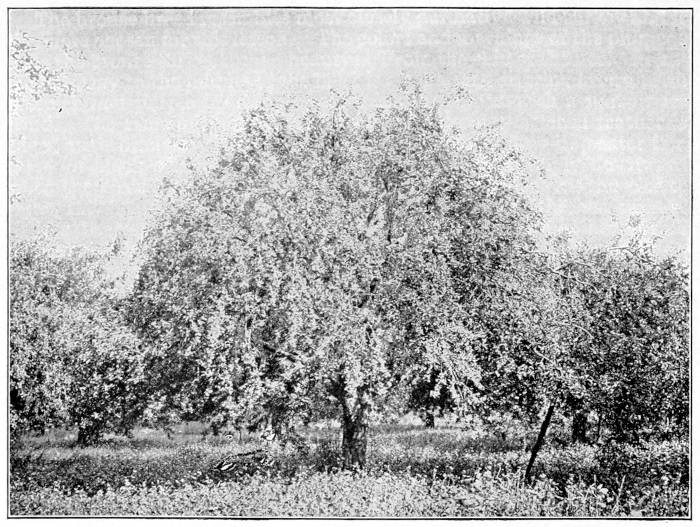
A baldwin apple tree.
THE APPLE TREE
Teacher’s Story
As the apple tree among the trees of the wood, so is my beloved among the sons. I sat down under his shadow with great delight, and his fruit was sweet to my taste. —The Song of Solomon.
N old-fashioned orchard is always a delight to those of us who love the picturesque. The venerable apple tree with its great twisted and gnarled branches, rearing aloft its rounded head, and casting its shadow on the green turf below, is a picture well worthy of the artist’s brush. And that is the kind of orchard I should always have, because it suits me, just as it does bluebirds, downies and chickadees, as a place to live in. However, if I wished to make money by selling apples, I should need to have an orchard of comparatively young trees, which should be straight and well pruned, and the ground beneath them well cultivated; for there is no plant that responds more generously to cultivation than does the apple tree. In such an orchard, a few annual crops might be grown while the trees were young, and each year there should be planted in August or September the seed of crimson clover or of some other good cover-crop. This would grow so as to protect the ground from washing during the heavy rains and thaws of fall and winter, and in the spring it would be plowed under to add more humus to the soil.
The apple originally came from southwestern Asia and the neighboring parts of Europe, but it has been cultivated so long that we have no accounts of how it began. The prehistoric lake-dwellers of Switzerland ate this fruit. In this country the apple thrives best on clay loam, although it grows on a great variety of soils; where wheat and corn grow, there will the apple also grow. In general, the shape of the apple tree head is rounded or broadly pyramidal; however, this differs somewhat with varieties. The trunk is short and rather stocky, the bark is a beautiful soft gray and is decidedly scaly, flaking off in pieces which are more or less quadrangular. The wood is very fine-grained and heavy. On this account for many years it was used for wood-engraving and is also a favorite wood for wood-carving; it makes a most excellent fuel. The spray is fine, and while at the tips of the limbs it may be drooping or horizontal, it often grows erect along the upper sides of the limbs, each shoot looking as if it were determined to be a tree in itself. The leaves are oval, with toothed edges and long petioles. When the leaves first appear each has two stipules at its base. The shape of the apple leaves depends to some extent upon the variety of the apple.
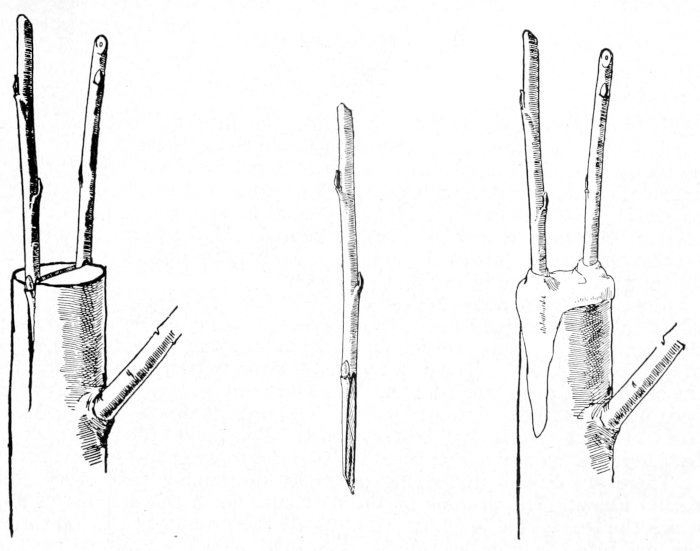
Cleft-graft. Scion for cleft-grafting. The graft waxed.
One-half natural size. One-half natural size.
It has long been the practice not to depend upon the seeds for reproducing a variety; for, since the bees do such a large work in pollenating the apple flowers, it would be quite difficult to be sure that a seed would not be a result of a cross between two varieties. Therefore, the matter is made certain by the process of grafting or budding. There are several modes of grafting, but perhaps the one in most common use is the cleft-graft. A scion which is a twig bearing several buds, is cut from a tree of the desired variety, and its lower end is cut wedge-shaped. The branch of the tree to be grafted is cut off across and split down through the end to the depth of about two inches; the wedge-shaped end of the scion is pressed into this cleft, so that its bark will come in contact with the inner edge of the bark on one side of the cleft branch. The reason for this is that the growing part of the tree is the cambium layer, which is just inside of the bark, and if the cambium of the scion does not come in contact with the cambium of the branch they will not grow together. After the graft becomes well-established, the other branches of the tree are cut off and the tree produces apples only from that part of it which grows from the graft. After the scion has been set in the stock, all of the wounded parts are covered with grafting wax, which keeps in the moisture and keeps out disease germs.
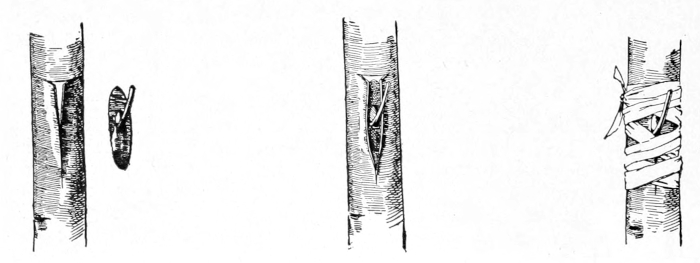
Shield-budding. The bud set in the slit. The bud tied.
The T-shaped slit and the bud. One-half natural size. One-half natural size.
Budding is done on a similar principle, but in a different fashion. A seedling apple tree about a year and a half old has a T-shaped slit cut into its bark; into this suture a bud, cut from a tree of the desired variety is inserted, and is bound in with yarn. The next spring this tree is cut back to just above the place where the bud was set in, and this bud-shoot grows several feet; the next year the tree may be sold to the orchardist. Budding is done on a large scale in the nurseries, for it is by this method that the different varieties are placed on the market.
Most varieties of apple trees should be set forty feet apart each way. It is possible, if done judiciously, to raise some small crops on the land with the young orchard, but care should be taken that they do not rob the trees of their rightful food. The dwarf varieties begin to bear much sooner than the others, but an orchard does not come into full bearing until after it has been planted fifteen or twenty years. The present practice is to prune a tree so that the trunk shall be very short. This makes the picking of the fruit much easier and also exposes the tree less to wind and sun-scald.
There are certain underlying principles of pruning that every child should know: The pruning of the root cuts down the amount of food which the tree is able to get from the soil. The pruning of the top throws the food into the branches which are left and makes them more vigorous. If the buds at the tips of the twigs are pruned off, the food is forced into the side buds and into the fruit, which make greater growth. Thinning the branches allows more light to reach down into the tree, and gives greater vigor to the branches which are left. A limb should be pruned off smoothly where it joins the larger limb, and there should be no stump projecting; the wound should be painted so as not to allow fungus spores to enter.
We should not forget that we have a native apple, which we know as the thornapple. Its low, broad head in winter makes a picturesque point along the fences; its fine, thick spray, spread horizontally, makes a fit framework for the bridal bouquet which will grow upon it in June; and it is scarcely less beautiful in autumn, when covered with the little, red apples called “haws.” Though we may refrain from eating these native apples, which consist of a bit of sweet pulp around large seeds, the codling-moth finds them most acceptable.
LESSON CXCIX
The Apple Tree
Leading thought—The tree of each variety of apple has its own characteristic shape, although all apple trees belong to one general type. The variety of the apple grown upon the tree is not determined by the kind of seed which is planted to produce the tree, but by the process of grafting or budding the young tree.
Method—A visit to a large, well-grown orchard in spring or autumn will aid in making this work interesting. Any apple tree near at hand may be used for the lesson.
Observations—1. How tall is the largest apple tree you know? What variety is it? How old is it? How can you distinguish old apple trees from young ones at a glance?
2. Choose a tree for study: How thick is its trunk? What is the shape of its head? Does the trunk divide into large branches or does it extend up through the center of the head?
3. What sort of bark has it? What is the color of the bark?
4. Does the spray stand erect or is it gnarled and querly? Does the spray grow simply at the ends of the branches or along the sides of the branches?
5. Are the leaves borne at the tip of the spray? Are the leaves opposite or alternate? Describe or sketch an apple leaf. Does it have stipules at its base when it first appears?
6. What is the character of apple-tree wood? What is it used for?
7. Did this tree come from a seed borne in an apple of the same variety which it produces? What is the purpose of grafting a tree? What is a scion? How and why do we choose a scion? How do we prepare a branch to receive the scion? If you should place the scion at the center of the branch would it grow? Where must it be placed in order to grow? How do we protect the cut-end of the branch after it is grafted? Why?
8. What is meant by the term “budding?” What is the difference between grafting and budding? Describe the process of budding.
9. Where is budding done on a large scale? How do nurserymen know what special varieties of apples their nursery stock will bear? How old is a tree when it is budded? How old when it is sold to the orchardist?
10. Why should the soil around apple trees be tilled? Is this the practice in the best-paying orchards?
11. What is often used as a cover crop in orchards? When is this planted? For what purpose?
12. How far apart should apple trees be set? How may the land be utilized while the trees are growing? How old must the apple tree be to come into bearing?
13. Is the practice now to allow an apple tree to grow tall? Why is an apple tree with a short trunk better?
14. What does it do to a tree to prune its roots? What does it do to a tree to prune its branches?
15. How does it affect a tree to prune the buds at the tips of the twigs?
16. How does it affect a tree to thin the branches? Describe how a limb should be pruned and how the wound thus made should be treated. Why?
HOW AN APPLE GROWS
Teacher’s Story
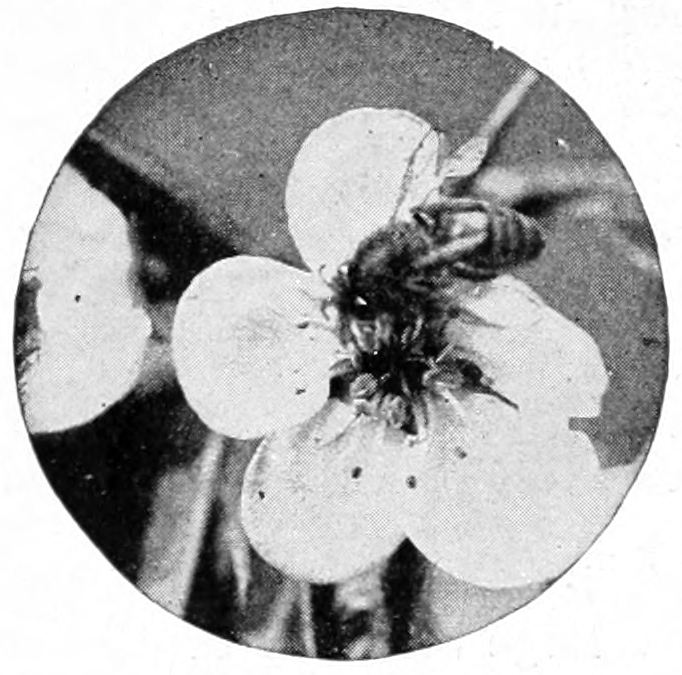
An apple tree in full blossom is a beautiful sight. If we try to analyze its beauty we find that on the tip of each twig there is a cluster of blossoms, and set around them, as in a conventional bouquet, are the pale, soft, downy leaves. These leaves and blossoms come from the terminal winter buds, which are protected during winter by little scales which are more or less downy. With the bursting of the bud, these scales fall off, each one leaving its mark crosswise on the twig, marking the end of the year’s growth; these little ridges close together and in groups mark the winters which the twig has experienced, and thus reveal its age.
There is a difference in varieties of apples and in the season as to whether the blossoms or the leaves push out first. The white, downy leaves at first have two narrow stipules at the base of their petioles. They are soft, whitish and fuzzy, as are also the flower stem and the calyx, which holds fast in its slender, pointed lobes the globular flower bud. We speak of the lobes of the calyx because they are joined at the base, and are not entirely separate as are sepals. The basal part of the calyx is cup-shaped, and upon its rim are set the large, oval petals, each narrowing to a slender stem at its base. The petals are set between the sepals or lobes of the calyx, the latter appearing as a beautiful, pale green, five-pointed star at the bottom of the flower. The petals are pink on the outside and white on the inside, and are veined from base to edge like a leaf; they are crumpled more than are the cherry petals.
The many pale, greenish white stamens of different lengths and heights stand up like a column at the center of the flower. They are tipped with pale yellow anthers, and are attached to the rim of the calyx-cup. They are really attached in ten different groups but this is not easy to see.
The five pale green styles are very silky and downy and are tipped with green stigmas. The pistils all unite at their bases making a five-lobed, compound ovary. The upper part of this ovary may be seen above the calyx-cup, but the lower portion is grown fast to it and is hidden within it. The calyx-cup is what develops into the pulp of the apple, and each of these pistils becomes one of the five cells in the apple core. If one of the stigmas does not receive pollen, its ovary will develop no seed; this often makes the apple lop-sided. When the petals first fall, the calyx-lobes are spread wide apart; later they close in toward the center, making a tube. To note exactly the time of this change is important; since the time of spraying for the codling moth is before the calyx-lobes close. These lobes may be seen in any ripe apple as five little, wrinkled scales at the blossom end; within them may be seen the dried and wrinkled stamens, and within the circle of stamens, the sere and blackened styles.
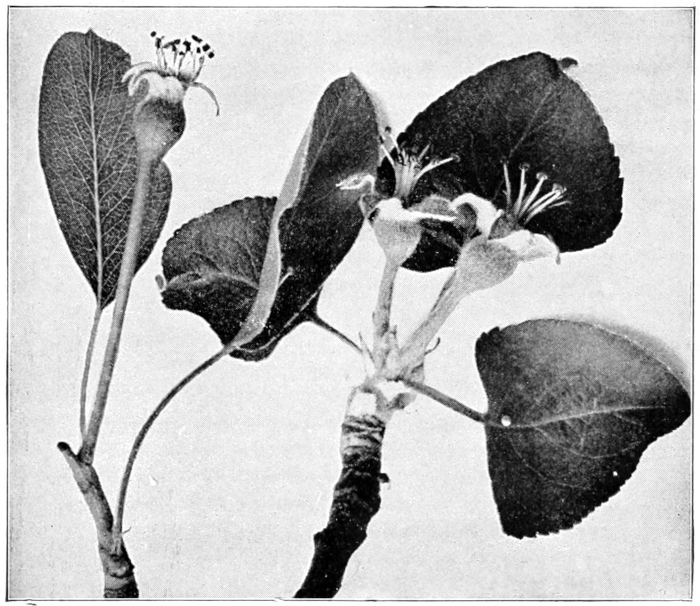
Just ready to spray. A pear and two apples from which the petals have recently fallen and with calyx lobes widely spread.
Photo by M. V. Slingerland.
There may be five or six, or even more blossoms developed from one winter bud, and there may be as many leaves encircling them, forming a bouquet at the tip of the twig. However, rarely more than two of these blossoms develop into fruit, and the fruit is much better when only one blossom of the bouquet produces an apple; if a tree bears too many apples it cannot perfect them.
The blossoms and fruit are always at the end of the twigs and spurs of the apple tree, and do not grow along the sides of the branches as do the cherry and the peach. However, there are many buds which produce only leaves; and just at the side and below the spur, where the apple is borne, a bud is developed, which pushes on and continues the growth of the twig, and will in turn be a spur and bear blossoms the following year.
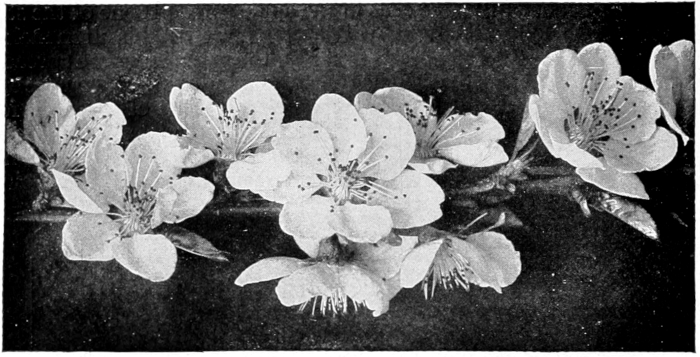
Apple blossoms.
Photo by Verne Morton.
LESSON CC
How an Apple Grows
Leading thought—The purpose of the apple blossom is to produce apples which shall contain seeds to grow into more apple trees.
Method—This lesson should begin with the apple blossoms in the spring and should continue, with occasional observations, until the apples are well grown. If this is not possible, the blossom may be studied, and directly afterward, the apple may be observed carefully, noting its relation to the blossom.
The Apple Blossom
Observations—1. How are the apple buds protected in the winter? As the buds open what becomes of the protecting scales? Can you see the scars left by the scales after they have fallen. How does this help us to tell the age of a twig or branch?
2. As the winter buds open, which appear first—the flowers or the leaves? Do they both come from the same bud? Do all the buds produce both flowers and leaves?
3. Study the bud of the apple blossom. Describe its stem; its stipules; its calyx. What is the shape and position of the lobes, or sepals, of the calyx? Why do we usually call them the “lobes of the calyx” instead of sepals?
4. Sketch or describe an open apple blossom. How many petals? What is their shape and arrangement? Can you see the calyx-lobes between the petals as you look down into the blossom? What sort of a figure do they make? Are the petals usually cup-shaped? What is their color outside and inside? Why do the buds seem so pink and the blossoms so white?
5. How many stamens are there? Are they all of the same length? What is the color of the filaments and anthers? On what are they set?
6. How many pistils do you see? How many stigmas are there? Are the ovaries united? Are they attached to the calyx?
7. Describe the young leaves as they appear around the blossoms. What is their color? Have they any stipules? Why do they make the flowers look like a bouquet?
8. After the petals fall, what of the blossom remains? What part develops into the apple? Does this part enclose the ovaries of the pistils? How can you tell in the ripe apple if any stigma failed to receive pollen?
9. What is the position of the calyx-lobes directly after the petals fall? Do they change later? How does this affect spraying for the codling moth?
10. Watch an apple develop; look at it once a week and tell what parts of the blossom remain with the apple.
11. How many blossoms come from one winter bud? How many leaves? Do the blossoms ever appear along the sides of the branches, as in the cherries? How many blossoms from a single bud develop into apples?
12. Since the apple is developed on the tip of the twig how does the twig keep on growing?
13. Compare the apple with the pear, the plum, the cherry and the peach in the following particulars; position on the twigs; number of petals; number and color of stamens; number of pistils; whether the pistils are attached to the calyx-cup at the base.
THE APPLE
Teacher’s Story
“Man fell with apples and with apples rose, If this be true; for we must deem the mode In which Sir Isaac Newton could disclose, Through the then unpaved stars, the turnpike road, A thing to counterbalance human woes.” —Byron.
PPLES seem to have played a very important part in human history, and from the first had much effect upon human destiny, judging from the trouble that ensued both to Adam and to Helen of Troy from meddling, even though indirectly, with this much esteemed fruit. It is surely no more than just to humanity—shut out from the Garden of Eden—that the apple should have led Sir Isaac Newton to discover the law which holds us in the universe; and that, in these later centuries, apples have been developed, so beautiful and so luscious as almost to reconcile us to the closing of the gates of Paradise.
While it is true that no two apples were ever exactly alike, any more than any two leaves, yet their shapes are often very characteristic of the varieties. From the big, round Baldwin to the cone-shaped gillyflower, each has its own peculiar form, and also its own colors and markings and its own texture and flavor. Some have tough skins, others bruise readily even with careful handling; but to all kinds, the skin is an armor against those ever-present foes, the fungus spores, myriads of which are floating in the air ready to enter the smallest breach, and by their growth bring about decay. Even the tip of a branch or twig swayed by the wind, may bruise an apple and cause it to rot; windfalls are always bruised and will not keep. Greater care in packing, wrapping, picking and storing, so as to avoid contact with other apples, is a paying investment of labor to the apple grower.
The cavities at the stem and basin-ends of the fruit are also likely to have, in the same variety, a likeness in their depth or shallowness, and thus prove a help in identifying an apple. At the blossom, or basin, end of the fruit may be seen five scales, which are all that remain of the calyx-lobes which enclosed the blossom; and within them are the withered and shrunken stamens and styles.
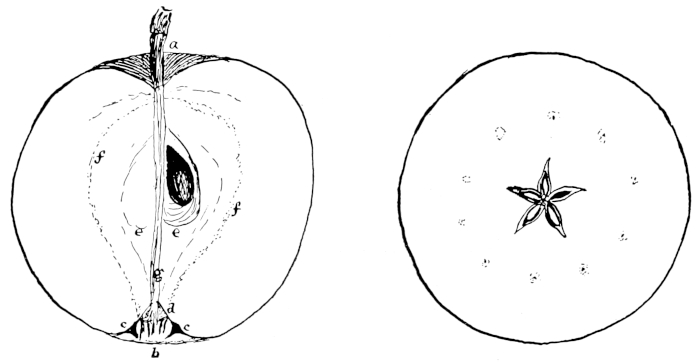
a, cavity; b, basin; c, calyx lobes; d, calyx tube with the withered stamens attached; e, carpels; f, outer core-lines, terminating at a point where stamens are attached; g, fibres extending from stem to basin. Transverse section of apple showing the five carpels and the ten outer core-lines.
When the fruit is cut, we see that the inner parts differ as much in the different varieties as do the outer parts. Some have large cores, others small. The carpels, or seed-cells, are five in number, and when the fruit is cut across through the center these carpels show as a pretty, five-pointed star; in them the seeds lie, all pointing toward the stem. Some apples have both seeds and carpels smooth and shining, while in others they are tufted with a soft, fuzzy outgrowth. The number of seeds in each cell varies; the usual number is two. In case a carpel is empty, the apple is often lopsided, and this signifies that the stigma of that ovary received no pollen. The apple seed is oval, plump and pointed, with an outer shell, and a delicate inner skin covering the white meat; this separates readily into two parts, between which, at the point, may be seen the germ. The entire core, with the pulp immediately surrounding the seed cells, is marked off from the rest of the pulp by the core-lines, faint in some varieties but distinct in others. In our native crab-apples this separation is so complete that, when the fruit is ripe, the core may be plucked out leaving a globular cavity at the center of the apple.
Extending from the stem to the basin, through the center of the apple, is a bundle of fibers, five in number, each attached to the inner edge of a carpel, or seed-box. Other bundles of fibers pass through the flesh about half way between the core and the skin. Delicate as they are, so that no one observes them in eating the fruit, they show clearly as a second core-line, and each terminates at a point in the calyx-tube where the stamens were attached—as can be easily seen by dissecting an apple. In transverse section, these show as ten faint dots placed opposite each outer point and inner angle of the star at the center formed by the carpels. Sometimes the seed-cells are very close to the stem, and the apple is said to have a sessile core; if at the center of the fruit, it has a medium core; if nearest to the blossom end, it has a distant core. This position of the core marks different varieties.
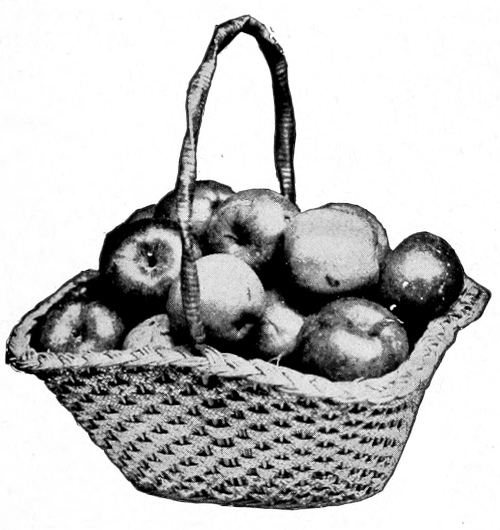
Basket of apples.
Apples even of the same variety, differ much in yield and quality according to the soil and climate in which they grow. The snow apple grows best in the St. Lawrence Valley, and New York State is noted for the fine flavor of the Esopus spitzenburg, the northern spy, and the Newtown pippin, all of which originated and grow best within its boundaries. Thus, each locality has its favorite variety.
Too often in passing through the country, we see neglected and unprofitable orchards, with soil untilled, the trees unpruned and scale-infested, yielding scanty fruit, fit only for the cider mill and the vinegar barrel. This kind of orchard must pass away and give place to the new horticulture.
References—Popular Apple Growing, Green; The American Apple Orchard, Waugh; The Apple and How to Grow It, Farmers’ Bulletin 113, U.S. Department of Agriculture.
LESSON CCI
The Apple
Leading thought—The apple is a nutritious fruit, wholesome and easily digested. The varieties of apple differ in shape, size, color, texture and flavor. A perfect apple has no bruise upon it and no worm-holes in it.
Method—Typical blossoms of different varieties of apples should be brought into the schoolroom, where the pupils may closely observe and make notes about their appearance. Each pupil should have one or two apples that may be cut in vertical and transverse sections, so that the pulp, core-lines, carpels and seeds may be observed. After this lesson there should be an apple exhibit, and the pupils should be taught how to score the apples according to size, shape, color, flavor and texture.
Observations—1. Sketch the shape of your apple. Is it almost spherical, or flattened, or long and egg-shaped, or with unequal tapering sides? How does the shape of the apple help in determining its variety?
2. What is the color of the skin? Is it varied by streaks, freckles or blotches? Has it one blushing cheek the rest being of a different color?
3. Is the stem thick and fleshy, or short and knobby, or slender and woody and long? Does each variety have a characteristic stem?
4. Is the cavity or depression where the stem grew narrow and deep like a tunnel, or shallow like a saucer?
5. Examine the blossom end, or basin. What is its shape? Can you find within it the remnants of the calyx-lobes, the stamens and the pistils of the flower?
6. What is the texture of the skin of the apple? Is it thin, tough, waxy or oily? Has it a bloom that may be rubbed off? From what sort of injury does the skin protect the apple?
Experiment 1. Take three apples of equal soundness and peel one of them; place them on a shelf. Place one of the unpeeled apples against the peeled one, and the other a little distance from it. Does the peeled apple begin to rot before the other two? Does the unpeeled apple touching the peeled one begin to decay first at the point of contact?
Experiment 2. Take an apple with a smooth, unblemished skin and vaccinate it with some juice from an apple that has begun to decay; perform the operation with a pin or needle, pricking first the unsound fruit and then the sound one; this may be done in patterns around the apple or with the initials of the operator’s name. Where does this apple begin to decay? What should these two experiments teach us as to the care and storage of fruit?
7. Cut an apple through its center from stem to blossom end. Describe the color, texture and taste of the pulp. Is it coarse or fine-grained? Crisp or smooth? Juicy, or dry and mealy? Sweet or sour? Does it exhale a fragrance or have a spicy flavor?
8. Is the flesh immediately surrounding the core separated from the rest of the pulp by a line more or less distinct? This is called the core-line and differs in size and outline in different varieties. Can you find any connection between the stem and blossom ends and the core? Can you see the fibrous threads which connect them?
9. Cut an apple transversely across the middle. In what shape are the seed-cells arranged in the center? Do the carpels, or seed-cells, vary in shape in different varieties? Are they closed, or do they all open into a common cavity? Can you see, between the core-lines and the skin, faint little dots? Count, and tell how they are arranged in relation to the star formed by the core.
10. The stiff, parchment-like walls of the seed-cells are called carpels. How many of these does the apple contain? Do all apples have the same number of carpels? Are the carpels of all varieties smooth and glossy, or velvety? How many seeds do you find in a carpel? Do they lie with the points toward the stem-end or the blossom-end of the apple? Where are they attached to the apple? Describe the apple seed—its outer and inner coat and its “meat.” Can you find the germ within it which will, after the seed is planted, produce another apple tree?
11. Is the core at the center of the apple, or is it nearer to the stem-end or to the blossom-end of the fruit? Are all apples alike in this particular?
12. Describe fully all the varieties of apples which you know, giving the average size, texture and color of the skin, the shape of the cavities at the stem and blossom ends, the color, texture and flavor of the pulp, and the position within the apple of the core.
Supplementary reading—Trees in Prose and Poetry, pp. 43–59.
THE PINE
Teacher’s Story
ONE other of our native trees is more beautiful than the pine. In the East, we have the white pine with its fine-tasselled foliage, growing often 150 to 200 feet in height and reaching an age of from two to three hundred years. On the Pacific coast, the splendid sugar pine lifts its straight trunk from two to three hundred feet in height; and although the trunk may be from six to ten feet in diameter yet it looks slender, so tall is the tree. A sugar pine cone on my desk measures 22 inches in length and weighs almost one pound, although it is dried and emptied of seed.
There is something majestic about the pines, which even the most ignorant feel. Their dark foliage outlined against wintry skies appeals to the imagination, and well it may, for it represents an ancient tree-costume. The pines are among the most ancient of trees, and were the contemporaries of those plants which were put to sleep, during the Devonian age, in the coal beds. It is because the pines and the other evergreens belong essentially to earlier ages, when the climate was far different than it is to-day, that they do not shed their leaves like the more recent, deciduous trees. They stand among us, representatives of an ancient race, and wrap their green foliage about them as an Indian sachem does his blanket, in calm disregard of modern fashion of attire.
All cone-bearing trees have typically a central stem from which the branches come off in whorls, but so many things have happened to the old pine trees that the evidence of the whorls is not very plain; the young trees show this method of growth clearly, the white pine having five branches in each whorl. Sometimes pines are seen which have two or three stems near the top; but this is a story of injury to the tree and its later victory.
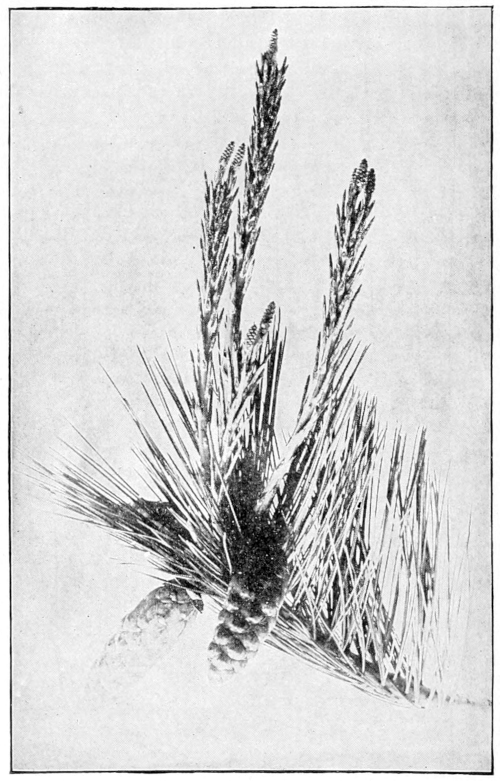
The young and the mature cones of white pine.
Photo by Ralph Curtis.
The very tip of the central stem in the evergreens is called “the leader,” because it leads the growth of the tree upward; it stretches up from the center of the whorl of last year’s young branches, and there at its tip are the buds which produce this year’s branches. There is a little beetle which seems possessed of evil, for it likes best of all to lay its rascally eggs in the very tip of this leader; the grub, after hatching, feeds upon the bud and bores down into the shoot, killing it. Then comes the question of which branch of the upper whorl shall be elected to rise up and take the place of the dead leader; but this is an election which we know less about than we do of those resulting from our blanket ballots. Whether the tree chooses, or whether the branches aspire, we may not know; but we do know that one branch of this upper whorl arises and continues the growth of the tree. Sometimes there are two candidates for this position, and they each make such a good struggle for the place that the tree grows on with two stems instead of one—and sometimes with even three. This evil insect injures the leaders of other conifers also, but these are less likely to allow two competitors to take the place of the dead leader.
The lower branches of many of the pines come off almost at right angles from the bole; the foliage is borne above the branches, which gives the pines a very different appearance from that of other trees. The foliage of most of the pines is dark green, looking almost black in winter; the pitch pine has the foliage yellowish green, and the white pine, bluish green; each species has its own peculiar shade. There is great variation in the color and form of the bark of different species. The white pine has nearly smooth bark on the young trees, but on the older ones it has ridges that are rather broad, flat and scaly, separated by shallow sutures, while the pitch pine has its bark in scales like the covering of a giant alligator.
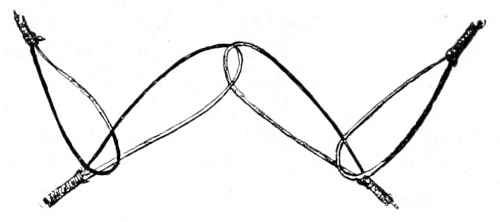
A part of a necklace of pitch pine needles.
The foliage of the pine consists of pine needles set in little bundles on raised points which look like little brackets along the twigs. When the pine needles are young, the bundle is enclosed in a sheath making the twig look as if it were covered with pin-feathers. In many of the species this sheath remains, encasing the base of the bundle of needles; but in the white pine it is shed early. The number of leaves in the bundle helps to determine the tree; the white pine has five needles in each bunch, the pitch pine has three, while the Austrian pine has two. There is a great difference in the length and the color of the needles of different species of pine. Those of the white pine are soft, delicate and pliable, and from three to four inches in length; the needles of the pitch pine are stiff and coarse and about the same length; the white pine needles are triangular in section, and are set so as to form distinct tassels, while those of the Austrian pine simply clothe the ends of the twigs. The needles of the pine act like the strings of an aeolian harp; and the wind, in passing through the tree, sets them into vibration, making a sighing sound which seems to the listener like the voice of the tree. Therefore, the pine is the most companionable of all our trees and, to one who observes them closely, each tree has its own tones and whispers a different story.
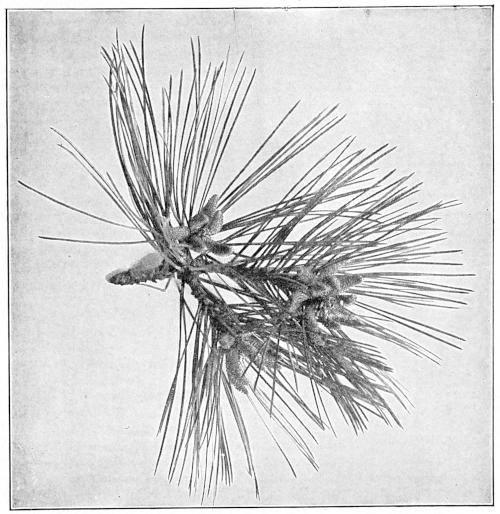
Austrian pine in blossom showing staminate flowers.
Photo by G. F. Morgan.
The appearance of the unripe cone is another convincing evidence that mathematics is the basis of the beautiful. The pattern of the overlapping scales is intricate and yet regular—to appreciate it one needs to try to sketch it. Beneath each scale, when it opens wide, we find nestled at its base two little seeds in twin boxes; each provided with a little wing so that it can sail off with the wind to find a place to grow. The shape of the scales of the cone is another distinguishing character of the pine, and sketching the outside of scales from several different species of pine cones will develop the pupils’ powers of observation; the tip of the scale may be thickened or armed with a spine, and one wonders if these spines are for the purpose of discouraging the squirrels from stealing the green seeds.
The pine cone requires two years for maturing; the pistillate flower from which it is developed is a tiny cone with each scale spread wide and standing upright to catch the pollen for the tiny ovule nestled within it. The pistillate flower of the white pine grows near the tip of the new twig, and is pinkish in color. In the Austrian pine it is the merest pink dot at first, but after a little shows itself to be a true cone with pink-purple scales, which stand up very erect and makes a pretty object when viewed through a lens; each scale is pink at its three-pointed tip, with pink wings just below, the inner portions being pale green. The cone is set just beside the growing tip of the twig, is pointed upward, and its sheath-scales are turned back like chaff around its base.
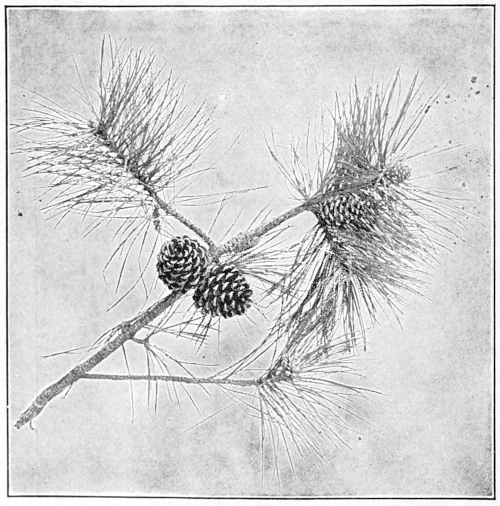
White pine, staminate blossoms and empty cones.
Photo by Morgan.
In June when the new shoots of the pine twigs stand up like pale green candles on a Christmas tree, at their bases may be found the staminate catkins set in radiating whorls, making galaxies of golden stars against the dark green background of foliage. In the Austrian pine, one of these pollen catkins may be an inch or two long and a half-inch in width; each little scale of this cone is an anther sac, filled to bursting with yellow pollen. From these starry pollen cones there descends a yellow shower every time a breeze passes; for the pine trees depend upon the wind to sift their pollen dust into the lifted cups of the cone scales, which will close upon the treasure soon. The pollen grains of pine are very beautiful when seen through a microscope; and it seems almost incredible that the masses of yellow dust sifted in showers from the pines when in blossom, should be composed of these beautiful structures. When the pine forests on the shores of the Great Lakes are in bloom, the pollen covers the waves for miles out from the shores.
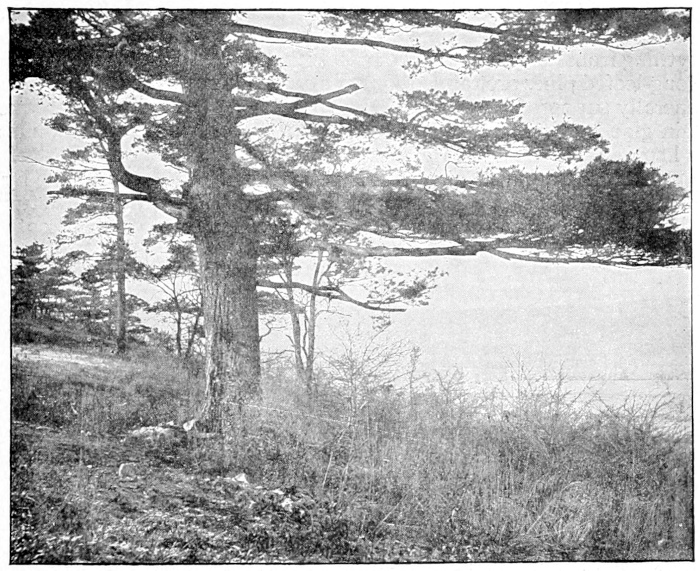
White pine.
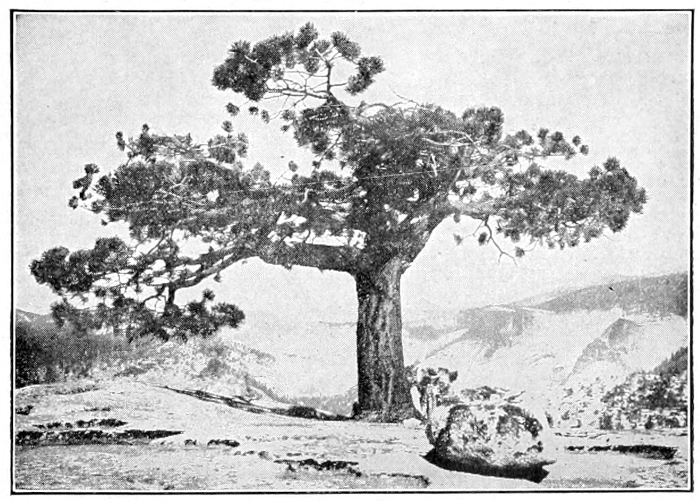
Yellow pine on the brink of the Little Yosemite Valley.
Photo by G. K. Gilbert. Courtesy of U. S. Geological Survey.
If we examine the growing tips of the pine branches, we find the leaves look callow and pin-feathery. The entire leaf is wrapped in a smooth, shining, silken sheath, at the tip of which its green point protrudes. The sheath is tough like parchment and is cylindrical because the pine needles within it are perfectly adjusted one to another in cylindrical form. The sheath is made up of several layers, one over the other, and may be pulled apart. The new leaves are borne on the new, pale green wood.
The uses of pines are many. The lumber of many of the species, especially that of the white pine, is free from knots and is used for almost everything from house-building to masts for ships. In the Southern States, the long-leafed pines are tapped for resin, which is not the sap of the tree, as is generally supposed. Pine sap is like other sap; the resin is a product of certain glands of the tree, and is of great use to it in closing wounds and thus keeping out the spores of destructive fungi. It is this effort of the tree to heal its wounds that makes it pour resin into the cuts made by the turpentine gatherers. This resin is taken to a distillery, where the turpentine is given off as a vapor and condensed in a coiled tube which is kept cold. What is left is known as “rosin.”
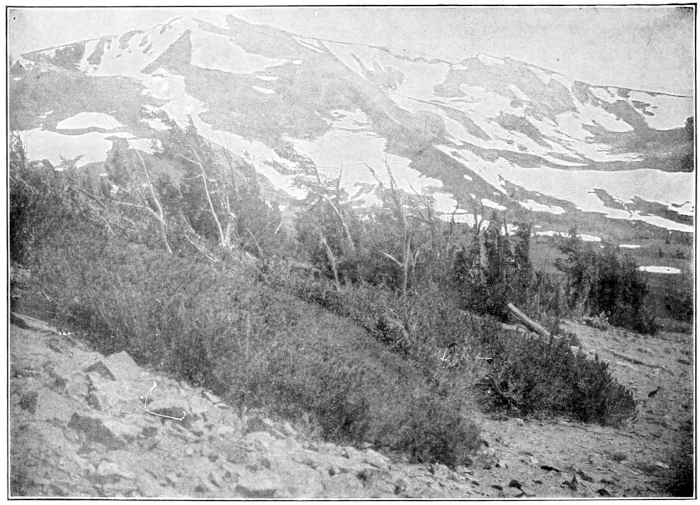
The mountain pine of the Sierras. This species stands upright normally and is often over one hundred feet high; but on the mountain tops, exposed to wind and snow, its trunk reclines on the ground and its branches look like shrubs, as shown in the foreground. Trees of the same species, wind-beaten but standing are shown in the background. Photo by G. K. Gilbert. Courtesy of the U. S. Geological Survey.
LESSON CCII
The Pine
Leading thought—The pines are among our most ancient trees. Their foliage is evergreen but is shed gradually. The pollen-bearing and the seed-bearing flowers are separate on the tree. The seeds are winged and are developed in cones.
Method—At least one pine tree should be studied in the field. Any species will do but the white pine is the most interesting. The Austrian pine which is commonly planted in parks is a good subject. The leaves and cones may be studied in the schoolroom, each pupil having a specimen.
Observations—1. What is the general shape of the pine tree? Is there one central stem running straight up through the center of the tree to the top. Do you find any trees where this stem is divided into two or three near the top? Describe how the pine tree grows. What is the “leader?” What happens if the leader is injured? How do the topmost branches of the young pine look? Do they all come off from the same part of the stem? How many are there in a whorl?
2. What color is the bark? Is it ridged or in scales?
3. Do the branches come off the main stem at right angles or do they lift up or droop down? Where is the foliage borne on the branches? What is the color of the foliage? Is the pine foliage ever shed or does the pine leaf, when it comes, stay on as long as the tree lives?
4. Study the pine leaves. Why are they called needles? Note that they grow several together in what we call a bundle. How many in one bundle? Is the bundle enclosed in a little sheath at the base? Are the bundles grouped to make distinct tassels? Study one of the needles. How long is it? Is it straight or curved? Flexible or coarse and stiff? Cut it across and examine it with a lens. What is the outline in cross section? Why does the wind make a moaning sound in the pines?
5. Study a pine cone. Does it grow near the tip of the branch or along the sides? Does it hang down or stand out stiffly? What is its length? Sketch or describe its general shape. Note that it is made up of short, over-lapping scales. What pattern do the scales make as they are set together? Describe or sketch one scale; has it a thickened tip? Is there a spine at the tip of the scale?
6. Where in the cone are the seeds? Describe or sketch a pine seed. How long is its wing? How is it carried and planted? When the cone opens, how are the seeds scattered? What creatures feed upon the pine seed?
7. Study the pine when in blossom, which is likely to occur in June. This time is easily determined because the air around the tree is then filled with the yellow pollen dust. Study the pollen-bearing flower. Is it conelike in form? Does it produce a great deal of pollen? If you have a microscope, look at the pollen through a high objective and describe it. How many of the pollen catkins are clustered together? On what part of the twigs are they borne? Where are the pistillate flowers which are to form the young cones? How large are they and how do they look at the time the pollen is flying? Do they point upward or droop downward? Why? Look beneath the scales of a little cone with a lens and see if you can find the flowers. What carries the pine pollen to the flowers in the cone?
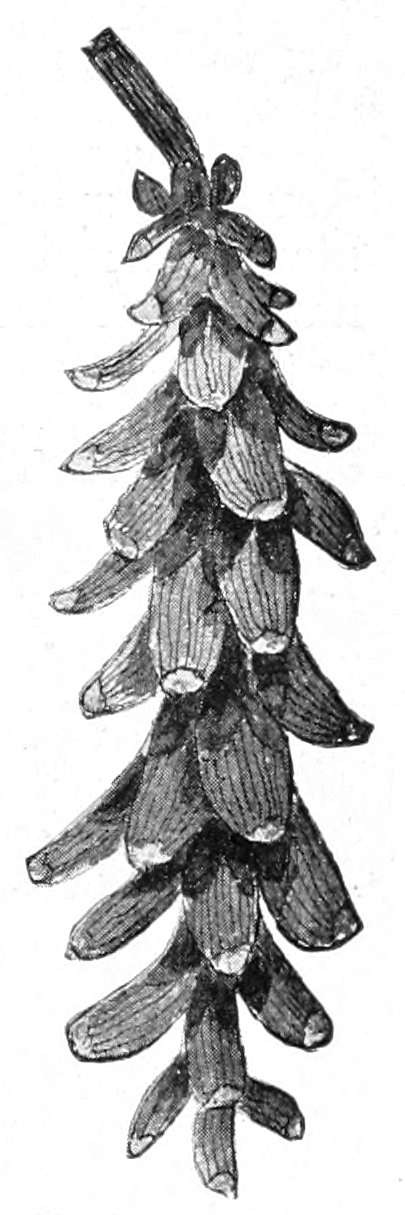
White pine cone.
8. Name all the uses for pine lumber that you know. Write an English theme on how turpentine is produced from pines and the effect of this industry upon pine forests. Where does resin appear on the pine? Of what use is it to the tree? Do you think it is pine sap? What is the difference between resin and rosin?
9. How long do the pine trees live? Write a story of all that has happened to your neighborhood since the pine tree which you have been studying was planted.
10. Make the following drawings: A bundle of pine needles showing the sheath and its attachment to the twig; the cone; the cone scale; the seed. Sketch a pine tree.
Supplementary reading—Trees in Prose and Poetry, pp. 32, 151, 152; The Spirit of the Pine, Bayard Taylor; To a Pine Tree, Lowell; Nature in Verse, pp. 15, 288.
THE NORWAY SPRUCE
Teacher’s Story
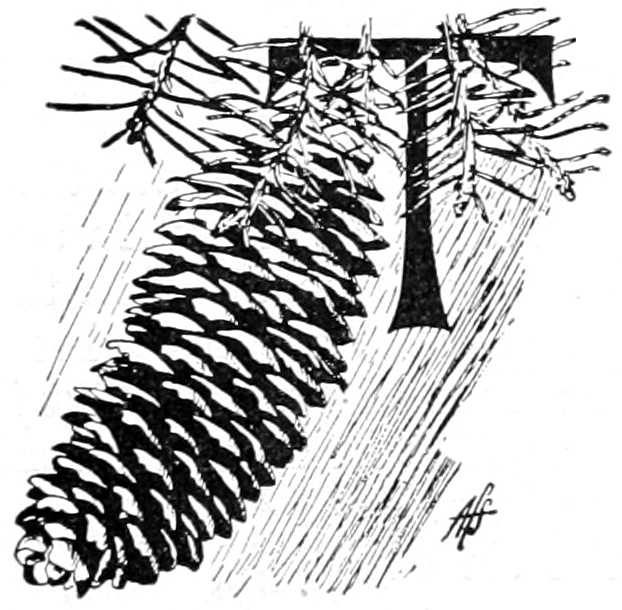
HE Norway spruce is a native of Europe, and we find it in America the most satisfactory of all spruces for ornamental planting; it lifts its slender cone from almost every park and private estate in our country, and is easily distinguished from all other evergreens by the drooping, pendant habit of its twigs, which seem to hang down from the straight, uplifted branches. We have spruces of our own—the black, the white and the red spruces; and it will add much to the interest of this lesson for the pupils to read in the tree and forestry books concerning these American species. Chewing gum and spruce beer are the products of the black and red spruce of our eastern forests. The Douglas spruce, which is a fir and not a spruce, is also commonly planted as an ornamental tree, but it is only at its best on the Pacific Coast, where it is one of the most magnificent of trees.
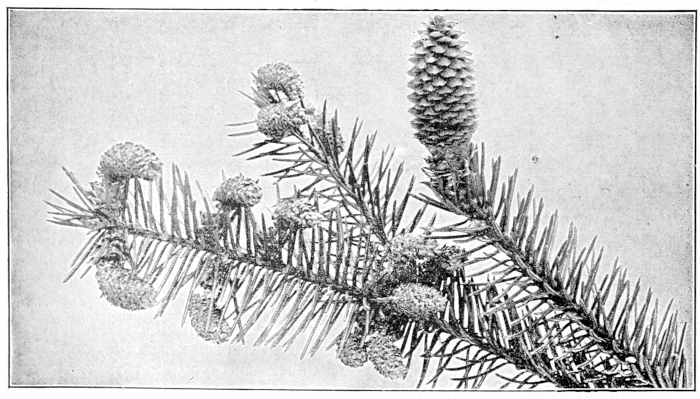
Staminate blossoms and young cone of a Norway spruce.
Photo by G. F. Morgan.
The Norway spruce tree is in form a beautiful cone, slanting from its slender tip to the ground, on which its lower drooping branches rest; the upper branches come off at a narrower angle from the sturdy central stem than do the widespreading lower branches. On the older trees, the twigs hang like pendulous fringes from the branches, enabling them to shed the snow more readily—a peculiarity which is of much use to the tree, because it is a native of the snowy northern countries of Europe and also grows successfully in the high altitudes of the Alps and other mountains. If we stroke a spruce branch toward the tip, the hand slides smoothly over it; but brush backward from the tip, and the hand is pricked by hundreds of the sharp, bayonet-pointed leaves; this is another arrangement for letting the snow slide off.
If we examine a twig of the present year’s growth, we can see on every side of its brown stem the pointed leaves, each growing from a short ridge; but the leaves on the lower side stretch out sidewise to get the light, and those above lift up angularly. Perhaps the twig of last year’s growth has shed its leaves which grew on the under side and thus failed to reach the sun. The leaf of the spruce is curved, stiff, four-sided and ends in a sharp point. It is dark yellowish above and lighter beneath and is set stiffly on the twig. The winter buds for next year’s growth may be seen at the tips of the twigs, covered with little, recurved, brown scales quite flowerlike in form. In the balsam fir, which is often planted with the Norway spruce, these buds are varnished.
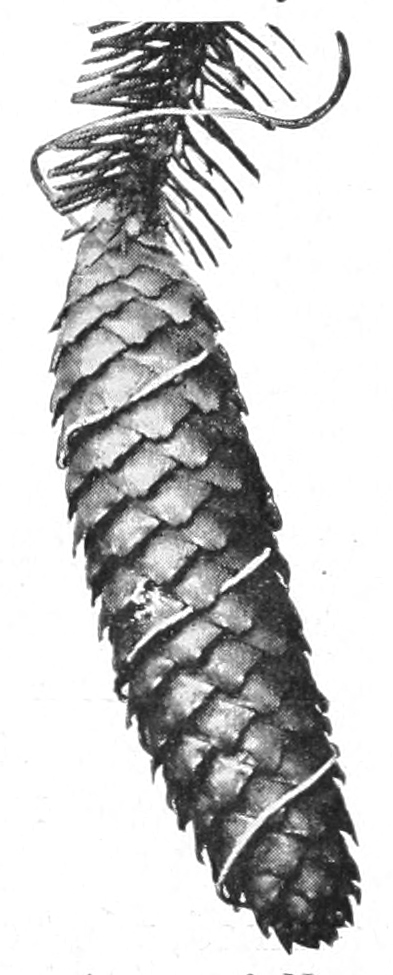
A cone of Norway spruce, showing that the spiral of the scales is in rows of five.
Photo by Cyrus Crosby.
The cones are borne on the tips of the branches and hang down. In color they are pale, wood-brown; they are from four to six inches long, and are very conspicuous. They are made up of broad scales that are thin toward the notched tips; they are set around the central stem in spirals of five rows. If we follow one spiral around marking it with a winding string, it will prove to be the fifth row above the place where we started. These manifold spirals can be seen sometimes by looking into the tip end of a cone. The cone has much resin on it, and is a very safe box for seeds; but when it begins to open, squirrels impatiently tear it to pieces, harvesting the seeds and leaving a pile of cone-scales beneath the tree to tell of their piracy.
A Norway spruce in blossom is a beautiful sight; the little, wine-red pistillate cones are lifted upwards from the tips of the twigs, while short, terminal branches are laden with the pollen-bearing catkins, which are soft and caterpillarish, growing on soft, white stems from the base of scales which enclosed and protected them during the winter; these catkins are filled with the yellow dust. The young cones continue to stand upright after the scales have closed on the pollen which has been sifted by the wind to the ovules which they guard; and for some time they remain most ornamentally purplish red. Before the cone is heavy enough to bend from its own weight, it turns deliberately around and downward, as if the act were a wilful deed, and then changes its color to green, ripening into brown in the fall.
The Norway spruce grows on the Alps abundantly, and like the youth with the banner, “excelsior” is not only its motto but its scientific name, (Picea excelsa). Here it grows to the height of one hundred to one hundred and fifty feet. Its wood is valuable and its pitch is marketed. In this country, it is used chiefly for ornamental planting and for wind-breaks.
LESSON CCIII
The Norway Spruce
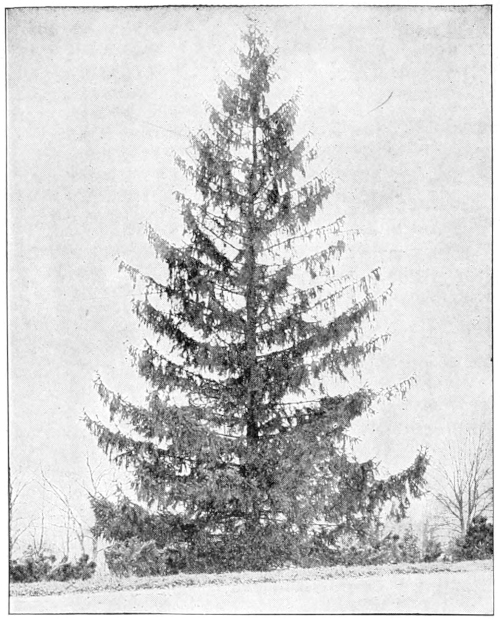
A Norway spruce.
Photo by Cyrus Crosby.
Leading thought—The Norway spruce is one of the most valuable of the trees which have come to America from Europe. It grows naturally in high places and in northern countries where there is much snow; its drooping twigs cannot hold a great burden of snow, and thus it escapes being crushed.
Method—This lesson should begin in the autumn when the cones are ripe. The tree should be observed by all of the pupils, and they should bring in twigs and cones for study in the schoolroom. The lesson should be taken up again in May when the trees are in blossom.
Observations—1. What is the general shape of the tree? Do the lower branches come off at the same angle as the upper? If untrimmed, what can you see of the trunk? Do the lower branches rest upon the ground? What advantage would this be to the tree in winter? Do the twigs stand out, or droop from the branches? Of what advantage is this in case of heavy snow? What is the color of the foliage? Where did the Norway spruce come from?
2. What is the color of the twig? How are the leaves set upon it? Are there more leaves on the upper than on the under side of the twigs of this year’s growth? Of last year’s growth? Brush your hand along a branch toward the tip. Do the leaves prick? Brush from the tip backward. Is the result the same? Why is this angle of the leaves to the twig a benefit during snowstorms?
3. Take a single leaf. What is its shape? How many sides has it? Is it soft or stiff? Is it sharp at the tip? Describe the buds which are forming for next year’s growth. Look along the twigs and see if you can discover the scales of the bud which produced last year’s growth?
4. Where are the cones borne? How long does it take a cone to grow? Is it heavy? Is there resin on it? Note that the scales are set in a spiral around the center of the cone. Wind a string around a cone following the same row of scales. How many rows between those marked with a string? Look into the tip of a cone and see the spiral arrangement. Sketch and describe a cone-scale, paying special attention to the shape of the tip. Try to tear a cone apart. Is this easily done? Hang a closed cone in a dry place and note what happens.
5. Describe the seed, its wings and where it is placed at the base of the scale. How many seeds under each scale? When do the cones open of themselves to scatter the seed? Do you observe squirrels tearing these apart to get the seed?
6. The Norway spruce blossoms in May. Find the little flower which will produce the cone, and describe it. What color is it? Is it upright or hanging down? Do the scales turn toward the tip or backward? Why is this? Where are the pollen-catkins borne? How many of them arise from the same place on the twig? Can you see the little scales at the base of each pistillate catkin? What are they? Are they very full of pollen? Do the insects carry the pollen for the Norway spruce, or does the wind sift it over the pistillate blossoms? After the pollen is shed, note if the scales of the young cones close up. How long before the cones begin to droop? Do you think it is their weight which causes them to droop?
7. What use do we make of the Norway spruce? What is it used for in Europe?
“All outward wisdom yields to that within, Whereof nor creed nor canon holds the key; We only feel that we have ever been And evermore shall be. And thus I know, by memories unfurled In rarer moods, and many a nameless sign, That once in Time, and somewhere in the world, I was a towering pine. Rooted upon a cape that overhung The entrance to a mountain gorge; whereon The wintry shade of a peak was flung, Long after rise of sun. There did I clutch the granite with firm feet, There shake my boughs above the roaring gulf, When mountain whirlwinds through the passes beat, And howled the mountain wolf. There did I louder sing than all the floods Whirled in white foam adown the precipice, And the sharp sleet that stung the naked woods, Answer with sullen hiss. I held the eagle till the mountain mist Rolled from the azure paths he came to soar, And like a hunter, on my gnarled wrist The dappled falcon bore.” —From “The Spirit of the Pine,” Bayard Taylor.
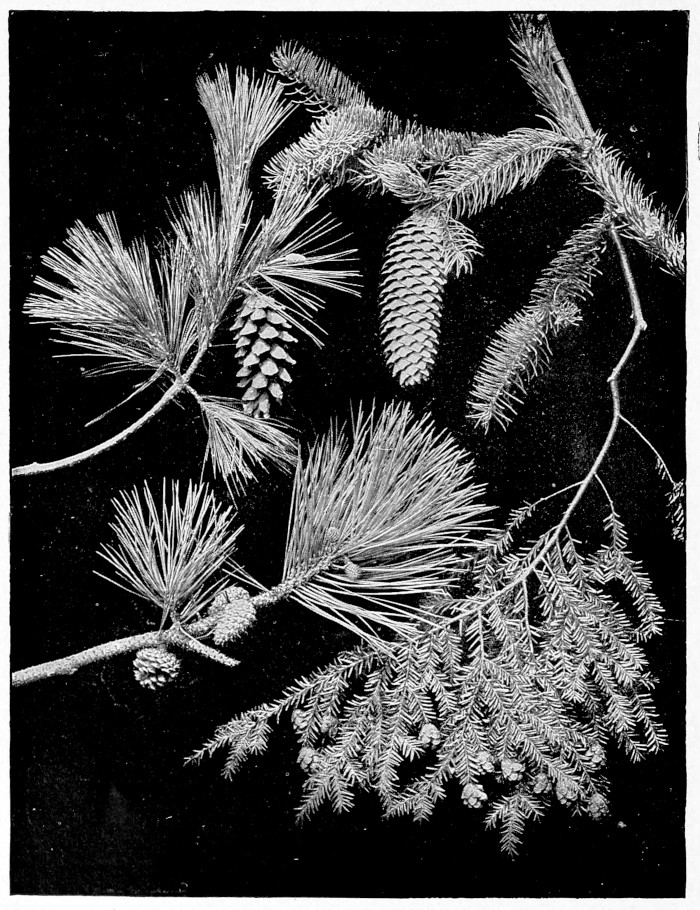
White pine. Norway spruce
Pitch pine Hemlock
THE HEMLOCK
Teacher’s Story
“O’er lonely lakes that wild and nameless lie, Black, shaggy, vast and still as Barca’s sands A hemlock forest stands. Oh forest like a pall! Oh hemlock of the wild, Oh brother of my soul I love thy mantle black, thy shaggy bole, Thy form grotesque, thy spreading arms of steel.” —Pattee.
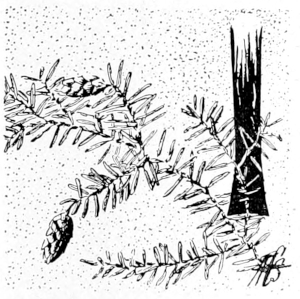
N ITS prime, the hemlock is a magnificent tree. It reaches the height of from sixty to one hundred feet, is cone-shaped, its fine, dense foliage and its drooping branches giving to its appearance exquisite delicacy; and I have yet to see elsewhere such graceful tree-spires as are the hemlocks of the Sierras, albeit they have bending tips. However, an old hemlock becomes very ragged and rugged in appearance; and dying, it rears its wind-broken branches against the sky, a gaunt figure of stark loneliness. The hemlock branches are seldom broken by snow; they droop to let the burden slide off. The bark is reddish, or sometimes gray, and is furrowed into wide, scaly ridges. The foliage is a rich dark green, but whitish when seen from below. The leaves of the hemlock are really arranged in a spiral, but this is hard to demonstrate. They look as though they were arranged in double rows along each side of the little twig; but they are not in the same plane and there is usually a row of short leaves on the upper side of the twig. The leaf is blunt at the tip and has a little petiole of its own which distinguishes it from the leaves of any other species of conifer; it is dark, glossy green above, pale green beneath, marked with two white, lengthwise lines. In June, the tip of every twig grows and puts forth new leaves which are greenish yellow in color, making the tree very beautiful and giving it the appearance of blossoming. The leaves are shed during the third year. The hemlock cones are small and are borne on the tips of the twigs. The seeds are borne, two beneath each scale, and they have wings nearly as large as the scale itself. Squirrels are so fond of them that probably but few have an opportunity to try their wings. The cones mature in one year, and usually fall in the spring. The hemlock blossoms in May; the pistillate flowers are very difficult to observe as they are tiny and greenish and are placed at the tip of the twig. The pollen-bearing flowers are little, yellowish balls on delicate, short stems, borne along the sides of the twig.
Hemlock bark is rich in tannin and is used in great quantities for the tanning of leather. The timber, which is coarse-grained, is stiff and is used in framing buildings and for railroad ties; nails and spikes driven into it cling with great tenacity and the wood does not split in nailing. Oil distilled from the leaves of hemlock is used as an antiseptic.
The dense foliage of the hemlock offers a shelter to birds of all kinds in winter; even the partridges roost in the young trees. These young trees often have branches drooping to the ground, making an evergreen tent which forms a winter harbor for mice and other beasties. The seed-eating birds which remain with us during the winter, feed upon the seeds; and as the cones grow on the tips of the delicate twigs, the red squirrels display their utmost powers as acrobats when gathering this, their favorite food.
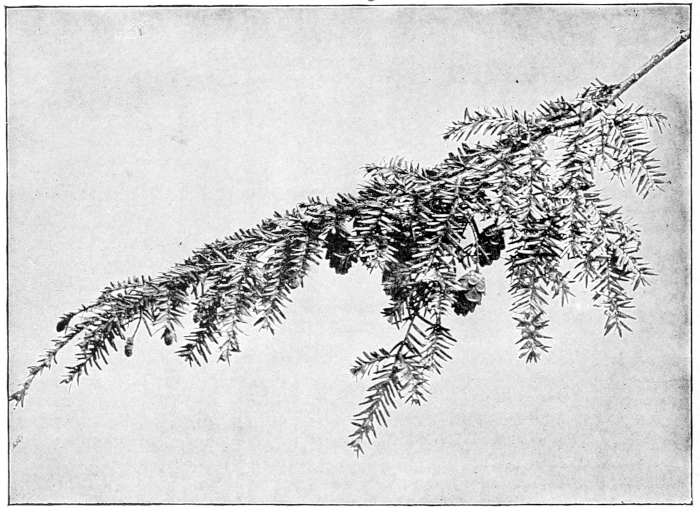
Hemlock branch showing young and mature cones.
LESSON CCIV
The Hemlock
Leading thought—This is one of the most common and useful and beautiful of our evergreen trees. Its fine foliage makes it an efficient winter shelter for birds.
Method—Ask the children the questions and request them to make notes on the hemlock trees of the neighborhood. The study of the leaves and the cones may be made in the schoolroom.
Observations—1. Where does the hemlock tree grow in your neighborhood? What is the general shape of the tree? What sort of bark has it? How tall does it grow? How are its branches arranged to shed the snow?
2. What is the color of the foliage? How are the leaves arranged on the twigs? Are all the leaves of about the same size? What is the position of the smaller leaves?
3. Break off a leaf and describe its shape; its petiole. Does the leaf of any other evergreen have a petiole? What is the color and marking of the hemlock leaf above? Below? At what time of year are the new leaves developed? How does the hemlock tree look at this time? Does the hemlock ever shed its leaves?
4. Are the hemlock cones borne on the tip of the twigs or along the side? How long does it take a cone to mature? When does it fall? How many scales has it? Where are the seeds borne? How many seeds beneath each scale? Describe and sketch a hemlock seed. How are the seeds scattered? Study the tree in May, and see if you can find the blossom?
5. Make drawings of the following: The hemlock twig, showing the arrangement of the leaves; single leaf, enlarged; cone; cone scale; seed.
6. What creatures feed upon the hemlock seed? What birds find protection in the hemlock foliage in winter?
7. For what purposes is hemlock bark used? What is the timber good for? Is a nail easily pulled out from a hemlock board?
THE DOGWOOD
Teacher’s Story
Through cloud rifts the sunlight is streaming in floods to far depths of the wood, Retouching the velvet-leafed dogwood to crimson as vital as blood.
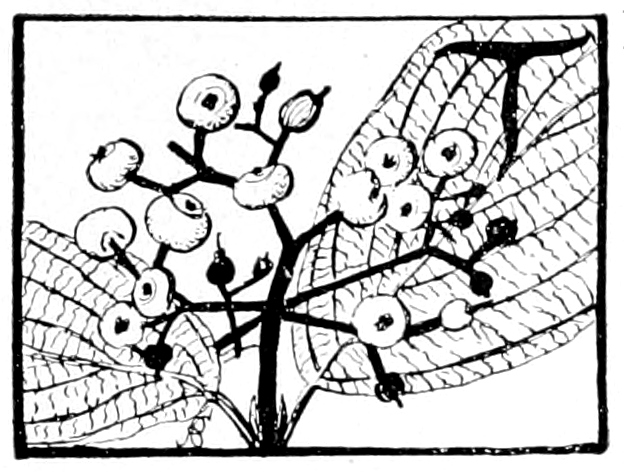
HERE is no prettier story among the flowers than that of the bracts of the dogwood, and it is a subject for investigation which any child can work out for himself. I shall never forget the thrill of triumph I experienced when I discovered for myself the cause of the mysterious dark notch at the tip of each great white bract, which I had for years idly noticed. One day my curiosity mastered my inertia, and I hunted a tree over for a flower bud, for it was rather late in the season; finally I was rewarded by finding the bracts in all stages of development.
The flowering dogwood forms its buds during the summer, and of course they must have winter protection; therefore, they are wrapped in four, close-clasping, purplish brown scales, one pair inside and one pair outside, both thick and well fitted to protect the bunch of tiny flower buds at their center. But when spring comes, these motherly bud-scales change their duties, and by rapid growth become four beautiful white or pinkish bracts calling aloud to all the insect world that here at their hearts is something sweet. For months they brood the flowers and then display them to an admiring world. The artistic eye loves the little notch at the tip of the bracts, even before it has read in it the story of winter protection, of which it is an evidence.
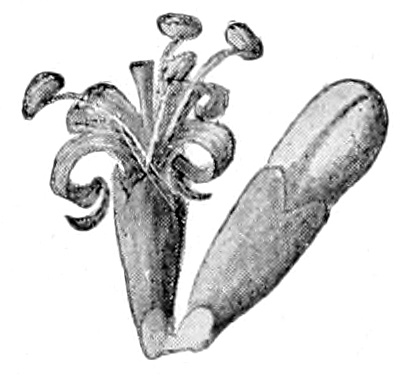
Blossom and bud of dogwood, enlarged.
The study of the flowers at the center is more interesting if aided by a lens. Within each blossom can be seen its tube, set in the four-lobed calyx. It has four slender petals curled back, its four chubby, greenish yellow anthers set on filaments which lift them up between the petals; and at the center of all is the tiny green pistil. There may be twenty, more or less, of these perfect flowers in this tiny, greenish yellow bunch at the center of the four great, flaring bracts. These flowers do not open simultaneously, and the yellow buds and open flowers are mingled together in the rosette. The calyx shows better on the bud than on the open flower. It might be well to explain to the pupils that a bract is simply a leaf in some other business than that ordinarily performed by leaves.
The twigs have a beautiful, smooth bark, purplish brown above and greenish below. The flowers grow at the tips of the twigs; and the young leaves are just below the flowers and also at the tips of the twigs. These twigs are spread and bent in a peculiar way, so that each white flower-head may be seen by the admiring world and not be hidden behind any of its neighbors. This habit makes this tree a favorite for planting, since it forms a mass of white bloom.
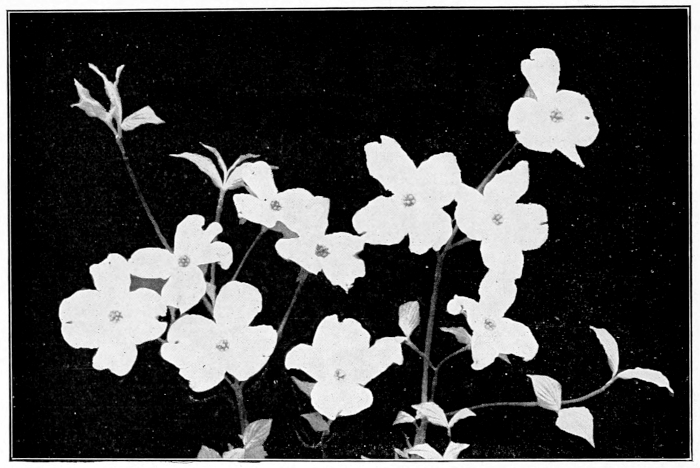
The flowers of dogwood.
Photo by Cyrus Crosby.
The dogwood banners unfurl before the flowers at their hearts open, and they remain after the last flower has received within itself the gracious, vital pollen which will enable it to mature into a beautiful berry. This long period of bloom is another quality which adds to the value of the dogwood as an ornamental tree. At the time the bracts fall, the curly petals also fall out leaving the little calyx-tubes standing with style and stigma projecting from their centers, making them look like a bunch of liliputian churns with dashers. In autumn, the foliage turns to a rich, purplish crimson—a most satisfying color.
During the winter, the flowering dogwood, which renders our forests so beautiful in early spring, may be readily recognized by its bark, which is broken up into small scales and mottled like the skin of a serpent; and on the tips of its branches are the beautiful clusters of red berries, or speaking more exactly, drupes. This fruit is oval, with a brilliant, shining, red, pulpy covering which must be attractive to birds. At its tip it has a little purple crown, in the center of which may be seen the remnant of the style, but this attractive outside covers a seed with a very thick, hard shell, which is quite indigestible and fully able to protect, even from the attack of the digestive juices of the bird’s stomach, the tender white kernel within it, which includes the stored food and the embryo. There are in the North two other common species of dogwood which have dark blue fruit.
LESSON CCV
The Dogwood
Leading thought—The petals are not the only means of attracting insects to the flowers. Sometimes other parts of the plant are made into banners to show insects where the nectar is to be found.
Method—Bring in a branch of the dogwood when it is in flower. The branch should have upon it some flowers that are unopened. Study the flower first, and ask the pupils to discover for themselves why the great white bracts have a notch in the tip. A lens is a great help to the interest in studying these tiny flowers.
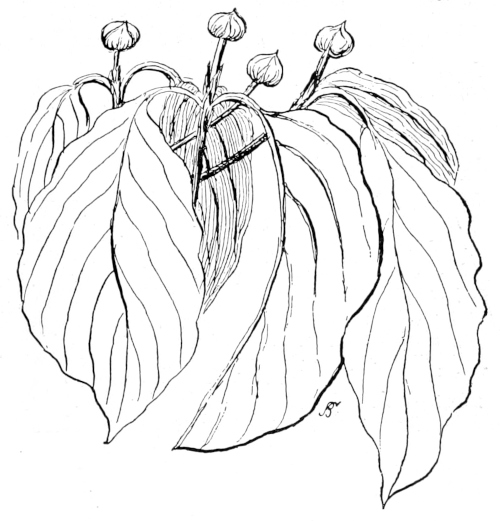
The flower buds of the dogwood are formed during the previous season.
Observations—1. What is there at the center of the dogwood flower? How do the parts at the center look? Are they of the same shape? Are some opened and others not? Take a penknife and cut out one that is opened and describe it. Can you see how many petals this tiny flower has? Describe its calyx. How many stamens has it? Can you see the pistil? If a flower has a calyx and stamens and a pistil, has it not all that a flower needs?
2. How many of these flowers are there at the center of the dogwood “blossom?” What color are they? Would they show off much if it were not for the great white banners around them? Do we not think of these great white bracts as the dogwood flower?
3. Study one of these banners. What is its shape? Are the four white bracts the same shape and size? Make a sketch of these four bracts with the bunch of flowers at the center. What is there peculiar about each one of these white bracts. Why should this notch be there? Find one of the flower-heads which is not yet opened and watch it develop, and then write a little story of the work done in the winter for the flowers by these bracts and the different work done by them in the spring, all for the sake of the precious blossoms.
4. Sketch the bracts from below. Is one pair wider than the other? Is the wider pair inside or outside? Why is this so?
5. Where are the flowers of the dogwood borne? How are the twigs arranged so as to unfurl all the banners and not hide one behind another, so that the whole tree is a mass of white?
6. While studying the flowers, study where the young leaves come from. Can you still see the scales which protected the leaf buds?
7. What kind of fruit develops from the dogwood blossoms? What colors are its leaves in autumn?
THE VELVET, OR STAGHORN, SUMAC
Teacher’s Story
The sumacs with flame leaves at half-mast, like wildfire spread over the glade; Above them, the crows on frayed pinions move northward in ragged parade.
HE sumacs, in early autumn, form a “firing line” along the borders of woodlands and fences, before any other plant but the Virginia creeper has thought of taking on brighter colors. No other leaves can emulate the burning scarlet of their hues. The sumacs are a glory to our hills; and sometime, when Americans have time to cultivate a true artistic sense, these shrubs will play an important part in landscape gardening. They are beautiful in summer, when each crimson “bob” (a homely New England name for the fruit panicle) is set at the center of the bouquet of spreading, fernlike leaves. In winter nakedness they are most picturesque, with their broadly branching twigs bearing aloft the wine-colored pompons against the background of snow, and calling to the winter birds to come and partake of the pleasantly acid drupes. In spring, they put out their soft leaves in exquisite shades of pale pinkish green, and when in blossom their staminate panicles of greenish white cover them with loose pyramids of delicate bloom.
Well may it be called velvet sumac, for this year’s growth of wood and the leaf stems are covered with fine hairs, pinkish at first, but soon white; if we slip our fingers down a branch, we can tell even without looking where last year’s growth began and ended, because of the velvety feel. The name staghorn sumac is just as fitting, for its upper branches spread widely like a stag’s horns and, like them, the new growth is covered with velvet.
The leaves are borne on the new wood, and therefore at the ends of branches; they are alternate; the petiole broadens where it clasps the branch, making a perfect nursery for the little next-year’s bud, which is nestled below it. The leaves are compound and the number of leaflets varies from eleven to thirty-one. Each leaflet is set close to the midrib, with a base that is not symmetrical; the leaflets have their edges toothed, and are long and narrow; they do not spread out on either side the midrib like a fern, but naturally droop somewhat, and thus conceal their undersides, which are much lighter in color. The leaflets are not always set exactly opposite; the basal ones are bent back toward the main stem, making a fold in the base of each. The end leaflets are not always three, symmetrically set, but sometimes are two and sometimes one, with two basal lobes.
The wine-colored “bob” is cone-shaped, but with a bunchy surface. Remove all the seeds from it and note its framework of tiny branches, and again pay admiring tribute to nature’s way of doing up compact packages. Each seed is a drupe, as is also the cherry. A drupe is merely a seed within a fleshy layer, all being enclosed in a firmer outside covering; here, the outside case is covered with dark red fuzz, a clothing of furs for winter, the fur standing out in all directions. The fleshy part around the seed has a pleasantly acid taste, and one of my childhood diversions was to share these fruits in winter with the birds. I probably inadvertently ate also many a little six-footed brother hidden away for winter safe-keeping, for every sumac panicle is a crowded insect-tenement.
It is only in its winter aspect that we can see the peculiar way of the sumac’s branching, which is in picturesque zigzags, ending with coarse, wide-spreading twigs. As each terminal twig was a stem for the bouquet of blossom and fruit set about with graceful leaves, it needed room and this is reason enough for the coarse branching. The wood of the sumac has a pith, and is coarse in texture.
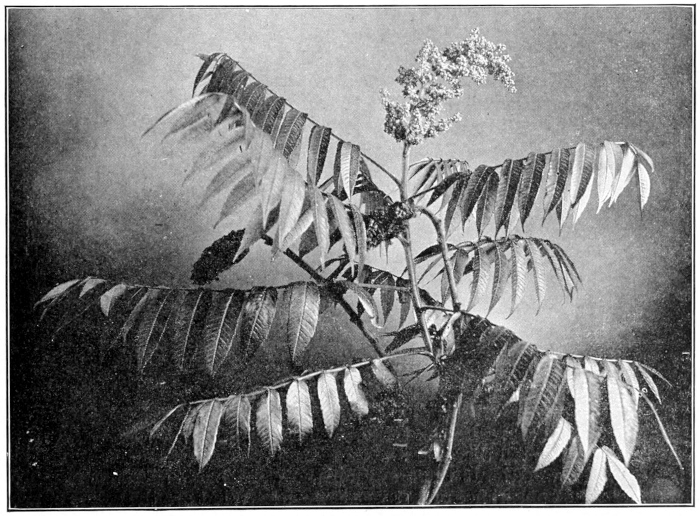
The stag-horn sumac.
Photo by Verne Morton.
During late May the new growth starts near the end of last year’s twig; the buds are yellowish and show off against the dark gray twigs. From the center of these buds comes the fuzzy new growth, which is usually reddish purple; the tiny leaves are folded, each leaflet creased at its midrib and folded tightly against itself; as the leaves unfold, they are olive-green tinted with red, and look like tassels coming out around the old dark red “bob.” When the sumacs are in blossom, we see in every group of them, two kinds; one with pyramids of white flowers, and the other with pinkish callow bobs. The structure of these two different flower-clusters is really the same, except that the white ones are looser and more widely spread. Each flower of the white panicle is staminate, and has five greenish, somewhat hairy sepals and five yellowish white petals, at the center of which are five large anthers. A flower from the bob is quite different; it has the five hairy sepals alternating with five narrow, yellowish white petals, both clasping the globular base, or ovary, which is now quite covered with pinkish plush, and bears at its tip the three styles flaring into stigmas.
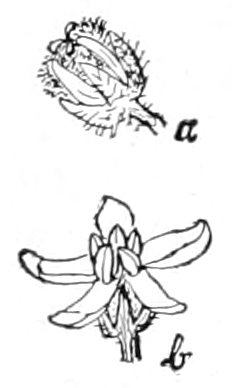
a, Pistillate flower from a “bob.”
b, Staminate flower from the greenish panicle.
The velvet sumac is larger than the smooth species (Rhus glabra), and is easily distinguished from it, since the new wood of the latter is smooth and covered with bloom but is not at all velvety. The poison sumac, which is very dangerous to many people when handled, is a swamp species and its fruit is a loose, drooping panicle of whitish berries, very much like that of poison ivy; therefore, any sumac that has the red bob is not dangerous. The poison species has the edges of its leaflets entire and each leaflet has a distinct petiole of its own where it joins the midrib.