PART II. (continued 4)
Reading edition
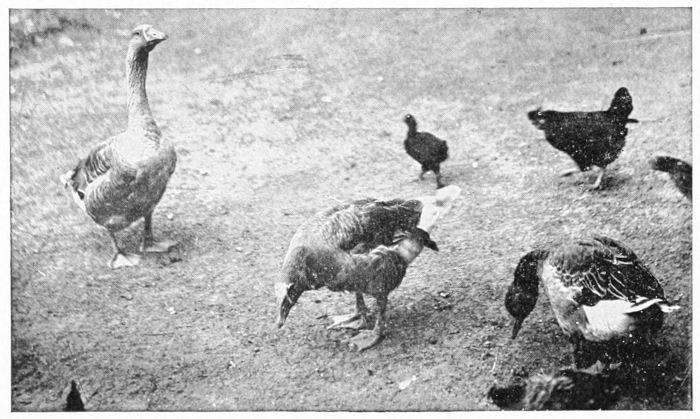
In ancient Greece maidens made pets of geese; and often there was such a devotion between the bird and girl that when the latter died her statue with that of the goose was carved on her burial tablet. The loyalty of a pet goose came under the observation of Miss Ada Georgia. A lone gander was the special pet of a small boy in Elmira, N. Y., who took sole care of him. The bird obeyed commands like a dog but would never let his little master out of his sight if he could avoid it; occasionally he would appear in the school yard, where the pupils would tease him by pretending to attack his master at the risk of being whipped with his wings so severely that it was a test of bravery among the boys to so challenge him. His fidelity to his master was extreme; once when the boy was ill in bed, the bird wandered about the yard honking disconsolately and refused to eat; he was driven to the side of the house where his master could look from the window and he immediately cheered up, took his food and refused to leave his post beneath the window while the illness lasted.
The goose is a stately bird whether on land or water; its long legs give it good proportions when walking, and the neck being so much longer than that of the duck gives an appearance of grace and dignity. The duck on the other hand is beautiful only when on the water or on the wing; its short legs, placed far back and far out at the sides, make it a most ungraceful walker. The beak of the goose is harder in texture and is not flat like the duck’s; no wonder the bird was a favorite with the ancient Greeks for the high ridge from the beak to the forehead resembles much the famous Grecian nose. The plumage of geese is very beautiful and abundant and for this reason they are profitable domestic birds. The “picking” occurs late in summer when the feathers are nearly ready to be molted; at this time the geese flap their wings often and set showers of loose feathers flying. A stocking or a bag is slipped over the bird’s head and she is turned breast side up, with her head firmly between the knees or under the arm of the picker. The tips of the feathers are seized with the fingers and come out easily; only the breast, the under parts and the feathers beneath the wings are plucked. Geese do not seem to suffer while being plucked except through the temporary inconvenience and ignominy of having their heads thrust into a bag; it hurts their dignity more than their bodies.
The wings of geese are very large and beautiful; although our domestic geese have lost their powers of flight to a great extent, yet they often stretch their wings and take little flying hops, teetering along as if they can scarcely keep to earth; this must surely be reminiscent of the old instinct for traveling in the skies. The tail of the goose is a half circle and is spread when flying; although it is short, it seems to be sufficiently long to act as a rudder. The legs of the goose are much longer than those of the duck; they are not set so far back toward the rear of the body, and, therefore, the goose is the much better runner of the two. The track made by the goose’s foot is a triangle with two scallops on one side made by the webs between the three front toes; the hind toe is placed high up; the foot and the unfeathered portion of the leg, protected by scales, are used as oars when the bird is swimming. When she swims forward rapidly, her feet extend out behind her and act on the principle of a propeller; but when swimming around in the pond she uses them at almost right angles to the body. Although they are such excellent oars they are also efficient on land; although when running, her body may waddle somewhat, her head and neck are held aloft in stately dignity.
The Toulouse are our common gray geese; the Embdens are pure white with orange bill and bright blue eyes. The African geese have a black head with a large black knob on the base of the black bill; the neck is long, snakelike, light gray, with a dark stripe down the back; the wings and tail are dark gray; there is a dewlap at the throat. The brown Chinese geese have also a black beak and a black knob at the base of the bill. The neck is light brown with a dull yellowish stripe down the neck. The back is dark brown, breast, wings and tail grayish brown. The white Chinese are shaped like the brown Chinese but the knob and bill are orange and the eyes light blue.
The Habits of Geese
Geese are monogamous and are loyal to their mates. Old-fashioned people declare that they choose their mates on Saint Valentine’s Day, but this is probably a pretty myth; when once mated, the pair live together year after year until one dies; an interesting instance of this is one of the traditions in my own family. A fine pair of geese belonging to my pioneer grandfather had been mated for several years and had reared handsome families; but one spring a conceited young gander fell in love with the old goose, and as he was young and lusty, he whipped her legitimate lord and master and triumphantly carried her away, although she was manifestly disgusted with this change in her domestic fortunes. The old gander sulked and refused to be comforted by the blandishments of any young goose whatever. Later the old pair disappeared from the farmyard and the upstart gander was left wifeless. It was inferred that the old couple had run away with each other into the encompassing wilderness and much sympathy was felt for them because of this sacrifice of their lives for loyalty. However, this was misplaced sentiment, for later in the summer the happy pair was discovered in a distant “slashing” with a fine family of goslings and were all brought home in triumph. The old gander, while not able to cope with his rival, was still able to trounce any of the animal marauders which approached his home and family.
The goose lines her nest with down and the soft feathers which she plucks from her breast. The gander is very devoted to his goose while she is sitting; he talks to her in gentle tones and is fierce in her defence. The eggs are about twice as large as those of the hen and have the ends more rounded. The period of incubation is four weeks. The goslings are beautiful little creatures, covered with soft down, and have large, bright eyes. The parents give them most careful attention from the first. One family which I studied consisted of the parents and eighteen goslings. The mother was a splendid African bird; she walked with dignified step, her graceful neck assuming serpentine curves; and she always carried her beak “lifted,” which gave her an appearance of majestic haughtiness. The father was just a plebeian white gander, probably of Embden descent but he was a most efficient protector. The family always formed a procession in going to the creek, the majestic mother at the head, the goslings following her and the gander bringing up the rear to be sure there were no stragglers; if a gosling strayed away or fell behind, the male went after it, pushing it back into the family circle. When entering the coop at night he pushed the little ones in gently with his bill; when the goslings took their first swim both parents gently pushed them into the water, “rooted them in,” as the farmer said. Any attempt to take liberties with the brood was met with bristling anger and defiance on the part of the gander; the mistress of the farm told me that he had whipped her black and blue when she tried to interfere with the goslings.
The gander and goose always show suspicion and resentment by opening the mouth wide, making a hissing noise, showing the whole round tongue in mocking defiance. When the gander attacks, he thrusts his head forward, even with or below the level of his back, and seizes his victim firmly with his hard, toothed bill so that it cannot get away, and then with his strong wings beats the life out of it. I remember vividly a whipping which a gander gave me when I was a child, holding me fast by the blouse while he laid on the blows.
Geese feed much more largely upon land vegetation than do ducks; a good growth of clover and grass make excellent pasture for them; in the water, they feed upon water plants but do not eat insects and animals to any extent.
Undoubtedly goose language is varied and expresses many things. Geese talk to each other and call from afar; they shriek in warning and in general make such a turmoil that people do not enjoy it. The goslings, even when almost grown, keep up a constant “pee wee, pee wee,” which is nerve-racking. There is a good opportunity for some interesting investigations in studying out just what the different notes of the geese mean.
The goose is very particular about her toilet; she cleans her breast and back and beneath her wings with her bill, and she cleans her bill with her foot; she also cleans the top of her head with her foot and the under side of her wing with the foot of that side. When oiling her feathers, she starts the oil gland flowing with her beak, then rubs her head over the gland until it is well oiled; she then uses her head as a “dauber” to apply the oil to the feathers of her back and breast. When thus polishing her feathers, she twists the head over and over and back and forth to add to its efficiency.
WILD GEESE
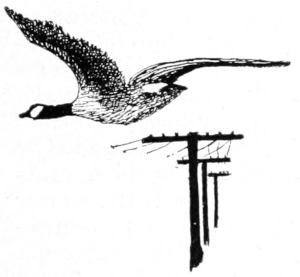
HERE is a sound, that, to the weather-wise farmer, means cold and snow, even though it is heard through the hazy atmosphere of an Indian summer day; and that is the honking of wild geese as they pass on their southward journey. And there is not a more interesting sight anywhere in the autumn landscape than the wedge-shaped flock of these long-necked birds with their leader at the front apex. “The wild goose trails his harrow,” sings the poet; but only the aged can remember the old-fashioned harrow which makes this simile graphic. The honking which reveals to us the passing flock, before our eyes can discern the birds against the sky, is the call of the wise old gander who is the leader, to those following him, and their return salute. He knows the way on this long thousand-mile journey, and knows it by the topography of the country. If ever fog or storm hides the earth from his view, he is likely to become confused, to the dismay of his flock, which follows him to the earth with many lonely and distressful cries.
The northern migration takes place in April and May, and the southern from October to December. The journey is made with stops for rest and refreshment at certain selected places, usually some secluded pond or lake. The food of wild geese consists of water plants, seeds and corn, and some of the smaller animals living in water. Although the geese come to rest on the water, they go to the shore to feed. In California, the wild geese are dreaded visitors of the cornfields, and men with guns are employed regularly to keep them off.
The nests are made of sticks lined with down, usually along the shores of streams, sometimes on tree stumps and sometimes in deserted nests of the osprey. There are only four or five eggs laid and both parents are devoted to the young, the gander bravely defending his nest and family from the attacks of any enemies.
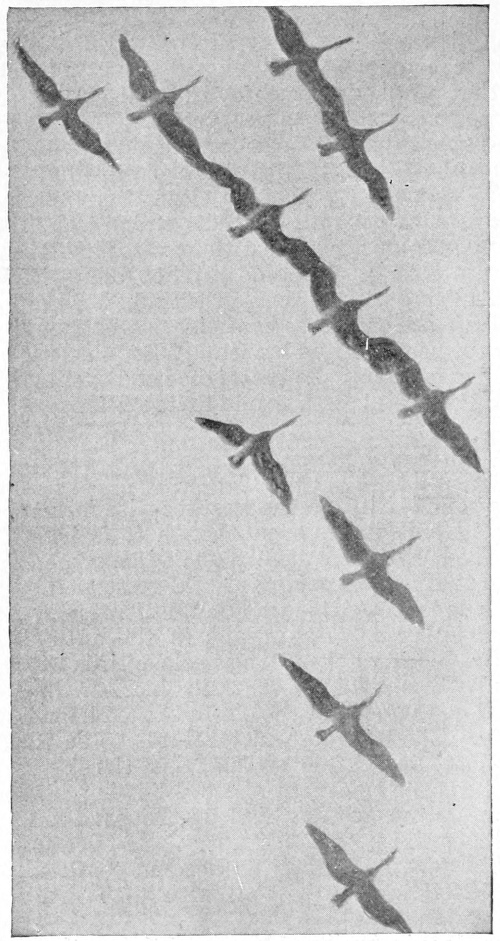
Wild geese flying in even ranks. Photographed directly underneath by A. R. Dugmore. Courtesy of Country Life in America.
Although there are several species of wild geese on the Atlantic Coast, the one called by this name is usually the Canada goose. This bird is a superb creature, brown above and gray beneath, with head, neck, tail, bill and feet of black. These black trimmings are highly ornamental and, as if to emphasize them, there is a white crescent-shaped “bib” extending from just back of the eyes underneath the head. This white patch is very striking, and gives one the impression of a bandage for sore throat. It is regarded as a call-color, and is supposed to help keep the flock together; the side tail-coverts are also white and make another guide to follow.
Often some wounded or wearied bird of the migrating flock spends the winter in farmyards with domestic geese. One morning a neighbor of mine found that during the night a wild gander, injured in some way, had joined his flock. The stranger was treated with much courtesy by its new companions as well as by the farmer’s family and soon seemed perfectly at home. The next spring he mated with one of the domestic geese. In the late summer, my neighbor, mindful of wild geese habits, clipped the wings of the gander so that he would be unable to join any passing flock of his wild relatives. As the migrating season approached, the gander became very uneasy; not only was he uneasy and unhappy always but he insisted that his wife share his misery of unrest. He spent days in earnest remonstrance with her and, lifting himself by his cropped wings to the top of the barnyard fence, he insisted that she keep him company on this, for web feet, uneasy resting-place. Finally, after many days of tribulation, the two valiantly started south on foot. News was received of their progress for some distance and then they were lost to us. During the winter our neighbor visited a friend living eighteen miles to the southward and found in his barnyard the errant pair. They had become tired of migrating by tramping and had joined the farmer’s flock; but we were never able to determine the length of time required for this journey.
LESSON XXXIII
Geese
Leading thought—Geese are the most intelligent of the domesticated birds, and they have many interesting habits.
Method—This lesson should not be given unless there are geese where the pupils may observe them. The questions should be given a few at a time and answered individually by the pupils after the observations are made.
Observations—1. What is the chief difference between the appearance of a goose and a duck? How does the beak of the goose differ from that of the duck in shape and in texture? Describe the nostrils and their situation.
2. What is the difference in shape between the neck of the goose and that of the duck?
3. What can you say about the plumage of geese? How are geese “picked?” At what time of year? From what parts of the body are the feathers plucked?
4. Are the wings of the goose large compared with the body? How do geese exercise their wings? Describe the tail of the goose and how it is used.
5. How do the legs and feet of the goose differ from those of the duck? Describe the goose’s foot. How many toes are webbed? Where is the other toe? What is the shape of the track made by the goose’s foot? Which portions of the legs are used for oars? When the goose is swimming forward where are her feet? When turning around how does she use them? Does the goose waddle when walking or running as a duck does? Why? Does a goose toe-in when walking? Why?
6. Describe the shape and color of the following breeds of domestic geese: The Toulouse, the Embden, the African, and Chinese.
Habits of Geese
1. What is the chief food of geese? What do they find in the water to eat? How does their food differ from that of ducks?
2. How do geese differ from hens in the matter of mating and nesting? At what time of year do geese mate? Does a pair usually remain mated for life?
3. Describe the nest and compare the eggs with those of hens. Describe the young goslings in general appearance. With what are they covered? What care do the parents give to their goslings? Describe how the parents take their family afield. How do they induce their goslings to go into the water for the first time? How do they protect them from enemies?
4. How does the gander or goose fight? What are the chief weapons? How is the head held when the attack is made?
5. How does the goose clean her feathers, wings and feet? How does she oil her feathers? Where does she get the oil and with what does she apply it?
6. How much of goose language do you understand? What is the note of alarm? How is defiance and distrust expressed? How does a goose look when hissing? What is the constant note of the gosling?
7. Give such instances as you may know illustrating the intelligence of geese, their loyalty and bravery.
8. Write an English Theme on “The Canada Goose, its appearance, nesting habits, and migrations.”
Supplementary reading—Birds that Hunt and are Hunted, Blanchan; “Tn Quest of Waptonk The Wild,” Northern Trails, Long; “The Homesickness of Kehonka,” Kindred of the Wild, Roberts; Wild Geese, Celia Thaxter.
A sea-gull. Photo by G. K. Gilbert.
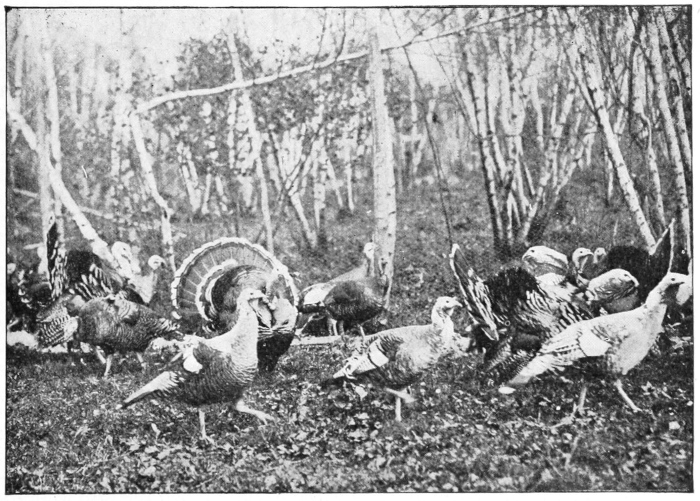
THE TURKEY
Teacher’s Story
HAT the turkey and not the eagle should have been chosen for our national bird, was the conviction of Benjamin Franklin. It is a native of our country, it is beautiful as to plumage, and like the American Indian, it has never yielded entirely to the influences of civilization. Through the hundreds of years of domestication it still retains many of its wild habits. In fact, it has many qualities in common with the red man. Take for instance its sun dance, which any one can witness who is willing to get up early enough in the morning and who has a flock of turkeys at hand. Miss Ada Georgia made a pilgrimage to witness this dance and she describes it thus: “While the dawn was still faint and gray, the long row of birds on the ridge-pole stood up, stretched legs and wings and flew down into the orchard beside the barnyard and began a curious, high-stepping, ‘flip-flop’ dance on the frosty grass. It consisted of little, awkward, up-and-down jumps, varied by forward springs of about a foot, with lifted wings. Both hens and males danced, the latter alternately strutting and hopping and all ‘singing,’ the hens calling ‘Quit, quit,’ the males accompanying with a high-keyed rattle, sounding like a hard wood stick drawn rapidly along a picket fence. As the sun came up and the sky brightened, the exhibition ended suddenly when ‘The Captain,’ a great thirty pound gobbler and leader of the flock, made a rush at one of his younger brethren who had dared to be spreading a tail too near to his majesty.”
The bronze breed resembles most closely our native wild turkey and is therefore chosen for this lesson. The colors and markings of the plumage form the bronze turkey’s chief beauty. From the skin of the neck, reaching half way to the middle of the back is a collar of glittering bronze with greenish and purple iridescence, each feather tipped with a narrow jet band. The remainder of the back is black except that each feather is edged with bronze. The breast is like the collar and at its center is a tassel of black bristles called the beard which hangs limply downward when the birds are feeding; but when the gobbler stiffens his muscles to strut, this beard is thrust proudly forth. Occasionally the hen turkeys have a beard. The long quills, or primaries, of the wings are barred across with bands of black and white; the secondaries are very dark, luminous brown, with narrower bars of white. Each feather of the fan-shaped tail is banded with black and brown and ends with a black bar tipped with white; the tail coverts are lighter brown but also have the black margin edged with white. The colors of the hen are like those of the gobbler except that the bronze brilliance of breast, neck and wings is dimmed by the faint line of white which tips each feather.
The heads of all are covered with a warty wrinkled skin, bluish white on the crown, grayish blue about the eyes, and the other parts red. Beneath the throat is a hanging fold called the wattle, and above the beak a fleshy pointed knob called the caruncle, which on the gobbler is prolonged so that it hangs over and below the beak. When the bird is angry these carunculated parts swell and grow more vivid in color, seeming to be gorged with blood. The color of the skin about the head is more extensive and brilliant in the gobblers than in the hens. The beak is slightly curved, short, stout, and sharp-pointed, yellowish at the tip and dark at the base.
The eyes are bright, dark hazel with a thin red line of iris. Just back of the eye is the ear, seemingly a mere hole, and yet it leads to a very efficient ear, upon which every smallest sound impinges.
The legs of the young turkeys are nearly black, fading to a brownish gray when mature. The legs and feet are large and stout, the middle toe of the three front ones being nearly twice the length of the one on either side; the hind toe is the shortest of the four. On the inner side of the gobbler’s legs, about one-third the bare space above the foot, is a wicked looking spur which is a most effective weapon. The wings are large and powerful; the turkey flies well for such a large bird and usually roosts high, choosing trees or the ridge-pole of the barn for this purpose.
In many ways the turkeys are not more than half domesticated. They insistently prefer to spend their nights out of doors instead of under a roof. They are also great wanderers and thrive best when allowed to forage in the fields and woods for a part of their food.
The gobbler is the most vainglorious bird known to us; when he struts to show his flock of admiring hens how beautiful he is, he lowers his wings and spreads the stiff primary quills until their tips scrape the ground, lifting meanwhile into a semi-circular fan his beautiful tail feathers; he protrudes his chest, raises the iridescent plumage of his neck like a ruff to make a background against which he throws back his red, white and blue decorated head. He moves forward with slow and mincing steps and calls attention to his grandeur by a series of most aggressive “gobbles.” But we must say for the gobbler that although he is vain he is also a brave fighter. When beginning a fight he advances with wings lowered and sidewise as if guarding his body with the spread wing. The neck and the sharp beak are outstretched and he makes the attack so suddenly, that it is impossible to see whether he strikes with both wing and beak or only with the latter, as with fury he pounces upon his adversary apparently striving to rip his neck open with his spurs.
Turkey hens usually begin to lay in April in this latitude and much earlier in more southern states. At nesting time each turkey hen strays off alone, seeking the most secluded spot she can find to lay the large, oval, brown-speckled eggs. Silent and sly, she slips away to the place daily, by the most round-about ways, and never moving in the direction of the nest when she thinks herself observed. Sometimes the sight of any person near her nest will cause her to desert it. The writer has spent many hours when a child, sneaking in fence corners and behind stumps and tree trunks, stalking turkeys’ nests. Incubation takes four weeks. The female is a most persistent sitter and care should be taken to see that she gets a good supply of food and water at this time. Good sound corn or wheat is the best food for her at this period. When sitting she is very cross and will fight most courageously when molested on her nest.
Turkey nestlings are rather large, with long, bare legs and scrawny thin necks, and they are very delicate during the first six weeks of their lives. Their call is a plaintive “peep, weep,” and when a little turkey feels lost its cry is expressive of great fear and misery. But if the mother is freely ranging she does not seem to be much affected by the needs of her brood; she will fight savagely for them if they are near her, but if they stray, and they usually do, she does not seem to miss or hunt for them, but strides serenely on her way, keeping up a constant crooning “kr-rit, kr-rit,” to encourage them to follow. As a consequence, the chicks are lost or get draggled and chilled by struggling through wet grass and leaves, that are no obstacle to the mother’s strong legs, and thus many die. If the mother is confined in a coop it should be so large and roomy that she can move about without trampling on the chicks, and it should have a dry floor since dampness is fatal to the little ones.
For the first week the chicks should be fed five times a day, and for the next five weeks they should have three meals a day. They should be given only just about enough to fill each little crop and none left over to be trodden under their awkward little feet. Their quarters should be kept clean and free from vermin.
LESSON XXXIV
Turkeys
Leading thought—The turkey is a native of America. It was introduced into Spain from Mexico in about 1518, and since then has been domesticated. However, there are still in some parts of the country flocks of wild turkeys. It is a beautiful bird and has interesting habits.
Method—If the pupils could visit a flock of turkeys the lesson would be given to a better advantage. If this is impossible, ask the questions a few at a time and let those pupils who have opportunities for observing the turkeys give their answers before the class.
Observations—1. Of what breed are the turkeys you are studying, Bronze, Black, Buff, White Holland or Narragansett?
2. What is the general shape and size of the turkey? Describe its plumage, noting every color which you can see in it. Does the plumage of the hen turkey differ from that of the gobbler?
3. What is the covering of the head of the turkey, what is its color and how far does it extend down the neck of the bird? Is it always the same color, and if not, what causes the change? Is the head covering alike in shape and size on the male and the female? What is the part called that hangs from the front of the throat below the beak? From above the beak?
4. What is the color of the beak? Is it short or long, straight or curved? Where are the nostrils situated?
5. What is the color of the turkey’s eyes? Do you think it is a keen-sighted bird?
6. Where are the ears? Do they show as plainly as a chicken’s ears do? Are turkeys quick of hearing?
7. Do turkeys scratch like hens? Are they good runners? Describe the feet and legs as to shape, size and color. Has the male a spur on his legs, and if so, where is it situated? For what is it used?
8. Can turkeys fly well? Are the wings small or comparatively large and strong for the weight of the body? Do turkeys prefer high or low places for perching when they sleep? Is it well to house and confine them in small buildings and parks as is done with other fowls?
9. Tell, as nearly as you can discover by close observation, how the gobbler sets each part of his plumage when he is “showing off” or strutting. What do you think is the bird’s purpose in thus exhibiting his fine feathers? Does the “King of the flock” permit any such action by other “gobblers” in his company?
10. Are turkeys timid and cowardly or independent and brave, ready to meet and fight anything which they think is threatening to their comfort and safety?
11. When turkeys fight, what parts of their bodies seem to be used as weapons? Does the male “gobble” during a fight, or only as a challenge or in triumph when victorious? Do the hen turkeys ever fight, or only the males?
12. How early in the spring does the turkey hen begin to lay? Does she nest about the poultry yard and the barns or is she likely to seek some secret and distant spot where she may hide her eggs? Describe the turkey’s egg, as well as you can, as to color, shape and size. Can one tell it by the taste from an ordinary hen’s egg? About how many eggs does the turkey hen lay in her nest before she begins to “get broody” and want to sit?
13. How many days of incubation are required to hatch the turkey chick? Is it as downy and pretty as other little chicks? How often should the young chicks be fed, and what food do you think is best for them? Are turkey chicks as hardy as other chicks?
14. Is the turkey hen generally a good mother? Is she cross or gentle when sitting and when brooding her young? Is it possible to keep the mother turkey as closely confined with her brood as it is with the mother hen? What supplies should be given to her in the way of food, grits, dust-baths, etc.?
Supplementary reading—Birds that Hunt and are Hunted, Blanchan.
LESSON XXXV
The Study of Birds’ Nests in Winter
There are very good reasons for not studying birds’ nests in summer, since too much familiarity on the part of eager children is something the birds do not understand and are likely, in consequence, to abandon both nest and locality. But after the birds have gone to sunnier climes and the empty nests are the only mementos we have of them, then we may study these habitations carefully and learn how to properly appreciate the small architects which made them. I think that every one of us who carefully examines the way that a nest is made must have a feeling of respect for its clever little builder.
I know of certain schools where the children make large collections of these winter nests, properly labelling each, and thus gaining a new interest in the bird life of their locality. A nest when collected should be labelled in the following manner:
Name of the bird which built the nest.
Where the nest was found.
If in a tree, what kind?
How high from the ground?
Bird Homes, by A. R. Dugmore is a book which affords practical help in determining the species of birds which made the nests.
After a collection of nests has been made let the pupils study them according to the following outline:
1. Where was the nest found?
a. If on the ground, describe the locality.
b. If on a plant, tree or shrub, tell the species, if possible.
c. If on a tree, tell where it was on a branch, in a fork, or hanging by the end of the twigs.
d. How high from the ground, and what was the locality?
e. If on or in a building, how situated?
2. Did the nest have any arrangement to protect it from rain?
3. Give the size of the nest, the diameter of the inside and the outside; also the depth of the inside.
4. What is the form of the nest? Are its sides flaring or straight? Is the nest shaped like a cup, basket or pocket?
5. What materials compose the outside of the nest and how are they arranged?
6. Of what materials is the lining made, and how are they arranged? If hair or feathers are used, on what creature did they grow?
7. How are the materials of the nest held together, that is, are they woven, plastered, or held in place by environment?
8. Had the nest anything peculiar about it either in situation, construction or material that would tend to render it invisible to the casual glance?
“
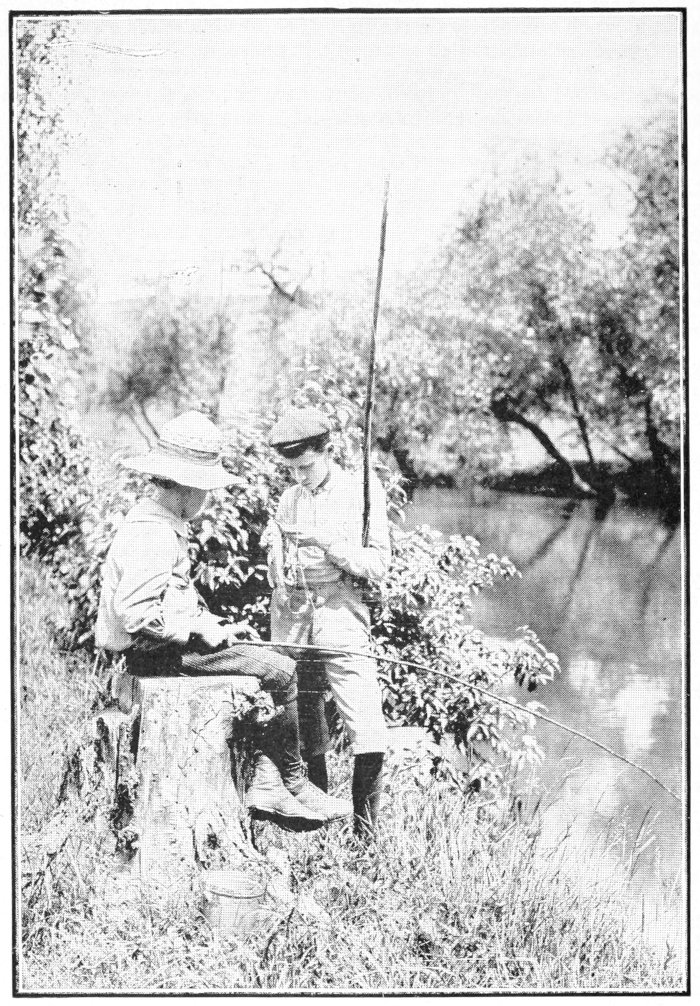
Noon time and June time down around the river.
”