PART IV (continued 3)
Reading edition
Supplementary reading—The Wonderbook of the Atmosphere, Houston, Chapters XIV-XXIII.
How to Keep a Daily Weather Map
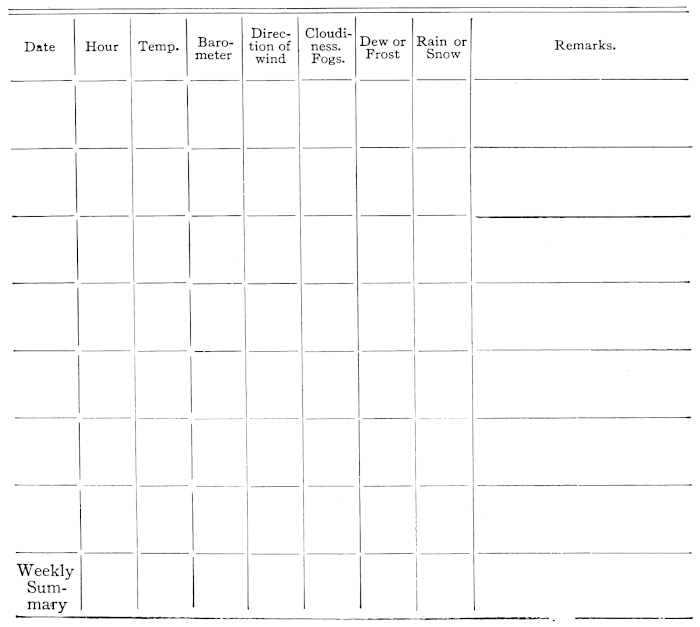
The pupils should keep a daily weather map record for at least six months. The observations should be made twice each day and always at the same hours. While it would be better if these records could be made at 8 o’clock in the morning and again at 8 o’clock in the evening, this is hardly practicable and they should, therefore, be made at 9 o’clock and at 4. The accompanying chart may be drawn enlarged. Sheets of manila paper are often used, so that one chart may cover the observations for a month.
Few schools are able to have a working barometer, but observations of temperature and sky should be made in every school. Almost any boy can make a weather vane, which should be placed on a high building or tree where the wind will not be deflected from its true direction when striking it. A thermometer should be placed on the north side of a post and on a level with the eyes; it should not be hung to a building, as the temperature of the building might affect it.
The direction of the wind and the cloudiness of the day may be indicated on the chart, as it is on the weather maps, by a circle attached to an arrow which points in the direction in which the wind is blowing.
References—Elementary Meteorology, Waldo, American Book Co., $1.50; Elementary Meteorology, Davis, Ginn and Co., $2.50; Bulletins from the United States Weather Bureau, Washington, D. C.
Chart for School Weather-Records.
“Though I know not what you are, twinkle, twinkle little star.”
THE STORY OF THE STARS
Teacher’s Story
“Why did not somebody teach me the constellations and make me at home in the starry heavens, which are always overhead, and which I don’t half know to this day.” —Thomas Carlyle.
For many reasons aside from the mere knowledge acquired, children should be taught to know something of the stars. It is an investment for future years; the stars are a constant reminder to us of the thousands of worlds outside our own, and looking at them intelligently, lifts us out of ourselves in wonder and admiration for the infinity of the universe, and serves to make our own cares and trials seem trivial. The author has not a wide knowledge of the stars; a dozen constellations were taught to her as a little child by her mother, who loved the sky as well as the earth; but perhaps nothing she has ever learned has been to her such a constant source of satisfaction and pleasure as this ability to call a few stars by the names they have borne since the men of ancient times first mapped the heavens. It has given her a sense of friendliness with the night sky, that can only be understood by those who have had a similar experience.
There are three ways in which the mysteries of the skies are made plain to us: First, by the telescope; second, by geometry, trigonometry and calculations—a proof that mathematics is even more of a heavenly than an earthly science; and third, by the use of the spectroscope, which can only be understood after we study physics. It is an instrument which tells us, by analyzing the light of the stars, what chemical elements compose them; and also, by the means of the light, it estimates the rate at which the stars are moving and the direction of their motion.
Thus, we have learned many things about the stars; we know that every shining star is a great blazing sun, and there is no reason to doubt that many of these suns have worlds, like the earth, spinning around them although, of course, so far away as to be invisible to us; for our world could not be seen at all from even the nearest star. We also know that many of the stars which seem single to us are really double—made up of two vast suns swinging around a common center; and although they may be millions of miles apart, they are so far away that they seem to us as one star. The telescope reveals many of these double stars and shows that they circle around their orbits in various periods of time, the most rapid making the circle in five years, another in sixteen years, another in forty-six years; while there is at least one lazy pair which seems to require fully sixteen hundred years to complete their circle. And the spectroscope has revealed to us that many of the stars which seem single through the largest telescope are really double, and some of these great suns race around each other in the period of a few hours, which is a rate of speed we could hardly imagine.
Astronomers have been able to measure the distance from us to many of the stars, but when this distance is expressed in miles it is too much for us to grasp. Thus, they have come to measure heavenly distance in terms of the rate at which light travels, which is 186,400 miles per second or about six trillions of miles per year; this distance is called a light-year. Light reaches us from the sun in about eight minutes, but it takes more than four years for a ray to reach us from the nearest star. It adds new interest to the Pole-star to know that the light which reaches our eyes left that star almost half a century ago, and that the light we get from the Pleiades may have started on its journey before America was discovered. Most of the stars are so far away that we cannot measure the distance.
Although the stars seem always to be in the same places, they are all moving through space just as our sun and its family are doing; but the stars are so far away that, although one may move a million miles a day, it would require many years of observation for us to detect that it moved at all. We know the rate at which some of the stars are moving but have no idea of their goal; nor do we have any idea where our sun is dragging us at the rate of nearly 800 miles per minute. It is thought that our sun and the other suns are whirling around some greater center or centers; but if so, the orbits are so many trillions of miles across that the suns all seem to be going somewhere in a straight line, each attending strictly to its own business.
Through the spectroscope we know something of the life of stars; we know that when they are young they are composed of thin gases and shine white or blue; and as they grow older, they become more solid and shine yellow, like our sun; and when older still, they grow red and are yet more condensed, like Bethelguese in Orion, which is an aged sun and which will, in time, grow cold and dark and invisible to us. The spectroscope reveals many dark stars whirling through space—vast, dead suns with their fires extinguished, never to be lighted again unless, in its swift course, one of them should hurl itself against another star with a fearful force which shall shatter it into gaseous atoms, and these be thrown into fierce spiral whirlpools, from which it shall again be fashioned into a white-hot sun and become a star in our sky.
The scientists are coming to understand a little of how the stars are made; for scattered through the skies are masses of misty light, called nebulæ, which means clouds; nebulæ are vast gaseous bodies composed of the stuff of which stars are made. Each nebula keeps its own special place in the heavens—just like a star, and is moving through space—like a star. The spectroscope shows that many of these shining, misty masses are made up of glowing gases, largely hydrogen; and many are disk-shaped, twisted into a spiral. There are grounds for believing that these spiral nebulæ are stars in the process of forming. Nebulæ are mostly telescopic, although two or three may be detected by the keen, unaided eye as a little blur of light, like that surrounding the third star of Orion’s sword. There are eight thousand or more nebulæ which have been discovered and mapped. Some idea of their tremendous size is given by Ball when speaking of the ring nebula of Lyra, which we cannot see with the naked eye, and yet if a railroad train started to cross its diameter at the middle, and went at the rate of a mile a minute, one thousand years would not complete the journey.
The number of stars that may be seen with the unaided eye, if one were to travel from the southern to the northern polar region, would be between six and seven thousand; but it would require very keen eyes to see two thousand at one time. With the help of the telescope, about eight hundred thousand stars have been discovered, classified and catalogued, while photography of the skies reveals millions. It is thought that the new international photographic chart, which shall cover all the space seen from our globe may show thirty millions of stars. The Milky Way or Galaxy, that great, white band across the heavens, is made up of stars which are so far away that we cannot see them, but see only their diffused light. It is well called a “River of Stars” flowing in a circle around our whole solar system; and, except during the spring months, one-half of it may be seen directly above us while the other half is hidden below us. The place of the Milky Way in the heavens seems fixed and eternal; any star within its borders is always seen at the same point. When the Northern Cross lifts itself toward the zenith we are able to see that, near that constellation, the star river divides into three streams with long, blue islands between.
Reference books—There are a large number of excellent text-books and popular books on astronomy. The following are a few which I have used most often: Astronomy for Everybody, Newcomb; Todd’s New Astronomy; The Friendly Stars, Martin; Starland, Ball; The Stars Through an Opera Glass, Serviss; Other Suns than Ours, Proctor; Other Worlds than Ours, Proctor.
For children—Earth and Sky, Holden; Stories of Starland, Proctor; The Children’s Book of Stars, G. E. Mitton; Story land of the Stars, Pratt; Stars in Song and Legend, Porter; The Planisphere, Thos. Whittaker.
HOW TO BEGIN STAR STUDY
The Pole-star and the Dippers
Teacher’s Story
The way to begin star study is to learn to know the Big Dipper, and through its pointers to distinguish the Pole-star; for whenever we try to find any star we have to find the Big Dipper and Pole-star first so as to have some fixed point to start from. There are four stars in the bowl of the Big Dipper and three in the curved handle. A line drawn through the outer two stars of the bowl, if extended, will touch the North Star, or Pole-star. It is very important for us to know the Pole-star, because the northern end of the earth’s axis is directed toward it, and it is therefore situated in the heavens almost directly above our North Pole. For those of us who live in the northern Hemisphere, the North Star never sets, but is always in our sky. Of course, the North Star has nothing to do with the axis of our earth any more than the figure on the blackboard has to do with the pointer; it simply happens to lie in the direction toward which the northern end of the earth’s axis points. In the southern skies, there is no convenient star which lies directly above the South Pole, so there is no South Pole-star. It is also a coincidence that the needle of the mariner’s compass points toward the North Star; the earth being a large magnet exercises its influence on all substances which can be magnetized, and since the poles of our great earth-magnet are nearly in line with the poles of the earth’s axis, the magnetic needle naturally points north and south, and the North Star chances to be nearly in the direction toward which the northern end of the compass needle points.
The Pole-star cannot be seen from the southern hemisphere; but if we should start from Florida, on a journey toward Baffin’s Bay, we should discover that each night this star would seem higher in the sky. And if we should succeed in reaching the North Pole, we would find the Pole-star directly over our heads, and what a wonderful sight the stars would be from this point! For none of the stars which we could see would rise or set, but would move around us in circles parallel to the horizon.
The Big Dipper points towards the Pole-star, and to us seems to revolve around it every twenty-four hours but, of course, this appearance is caused by the fact that we ourselves are revolving from west to east. Therefore, the stars seems to revolve from west to east under the Pole-star and from east to west above it, or in exactly the opposite direction in which the hands of a clock turn. Owing to the movement of the earth in its orbit, the Big Dipper and all the other stars arrive at a certain point in our sky four minutes earlier each day or about two hours earlier each month; thus, the Big Dipper is east of the Pole-star with handle down in the evenings of January, while at the same time of night in July, it is west of the Pole-star with the handle up. But the time of year that a certain star reaches a certain point is so invariable, that if we know star time, or sidereal time as it is called, we can tell just what hour of the night it is when a star passes this point. Thus, the Big Dipper and the other polar constellations are the night clock of the sailors of the northern hemisphere; for though this great polar clock has its hands moving around the wrong way, it gains time with such regularity that anyone who understands is able to compute exact time by it.
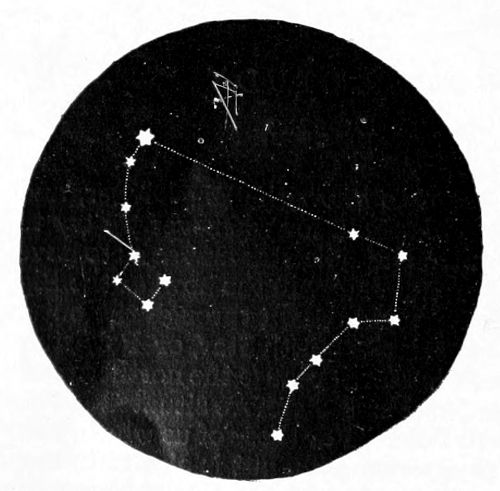
The Pole-star and the Big and Little Dippers.
The Little Dipper lies much nearer the Pole-star than does the Big Dipper; in fact, the Pole-star itself is the end of the handle of the Little Dipper. Besides the Pole-star, there are two more stars in the handle of the Little Dipper, and of the four stars which make the bowl, the two that form the outer edge are much the brighter. The bowl of the Little Dipper is above or below the Pole-star according to the hour of the evening, or the night of the year, for it apparently revolves about the Pole-star as does the Big Dipper. The two Dippers open toward each other, and some one said “they pour into each other.”
The Big Dipper is a part of a constellation called Ursa Major, the Great Bear; and the Little Dipper is the Little Bear, the handle of the dipper being the bear’s tail.
There is an ancient myth telling the story of the Big and Little Bears: A beautiful mother called Callisto had a little son whom she named Arcas. Callisto was so beautiful that she awakened the anger of Juno, who changed her to a bear; and when her son grew up he became a hunter, and one day would have killed his transformed mother; but Jupiter seeing the danger of this crime caught the two up into the heavens, and set them there as shining stars. But Juno was still vindictive, so she wrought a spell which never allowed these stars to rise and set like other stars, but kept them always moving around and around.
References—The Friendly Stars by Martin is a most delightful book and at the same time gives explicit directions for finding the stars and much interesting information concerning them. The planisphere is a little chart with a mechanical device which enables us to find what stars are in sight every night of the year, or at any time of night. It is published by Thos. Whittaker, Bible House, New York, and costs seventy-five cents.
LESSON CCXXV
The Two Dippers
Leading thought—The North Star or Pole-star may always be found by the stars known as the pointers in the Big Dipper; the stars of the Big Dipper seem to revolve around the Pole-star once in twenty-four hours.
Method—The time to begin these observations is when the moon is in its last quarter, so that the moonlight will not make pale the stars in early evening. Draw upon the blackboard, from the chart shown on page 890, the Big Dipper and the Pole-star, with a line extending through the pointers. Say to the pupils that this Big Dipper is above or below or at one side of the Pole-star, and that you wish them to observe for themselves where it is and tell you about it the next day. After they surely know the Big Dipper, ask the following questions:
Observations—1. Can you find the Big Dipper among the stars?
2. Is it in the north, south, east or west?
3. Which stars are the “pointers” in the dipper, and why are they called so?
4. Make a drawing showing how you can always find the Pole-star, if you can see the Big Dipper.
5. How many stars make the bowl of the Dipper?
6. How many stars in the handle?
7. Is the handle straight or is it curved?
8. Does the Big Dipper open toward the Pole-star, or away from it?
9. Is it above or below the Pole-star at eight o’clock in the evening, or at the right or the left of it?
10. Does the Big Dipper remain in the same direction from the Pole-star all night? Look at it at seven o’clock and again at nine o’clock and see if it has changed position?
11. Do you think it moves around the Pole-star once every twenty-four hours? In which direction? How could you tell the time of night by the Big Dipper and the Pole-star?
12. Does the Big Dipper ever rise and set?
13. The Big Dipper is also called the Great Bear. Can you find the stars which make the bear’s head and front legs?
After the pupils surely know the Big Dipper and Pole-star draw the complete diagram upon the board to show the Little Dipper and where it may be found, and call attention to the fact that the end of the Little Dipper’s handle is the Pole-star itself and that its bowl is not flaring, like that of the Big Dipper and that the two pour into each other. Let the pupils find the Little Dipper in the sky for themselves and ask the following questions:
Observations—14. Is the Little Dipper nearer or farther from the Pole-star than the Big Dipper?
15. How many stars in the handle of the Little Dipper?
16. How many stars make the bowl of the Little Dipper? Which of these stars are the brightest? Is the bowl of the Little Dipper above or below the Pole-star?
17. Does the Little Dipper extend in the same direction in relation to the Pole-star all night?
18. Make observations on the relation to each other of the two dippers at eight o’clock in the evening of January, February, March and April.
After the above lessons are well learned, give the following questions, and try to have the pupils answer by thinking:
Questions about Polaris (the North Star) for the pupils to think about and answer:
19. How many names has the Pole-star? Can the Pole-star be seen from the southern hemisphere? If not, why not?
20. If you should start from southern Florida and travel straight north, how would the Pole-star seem to change position each succeeding night?
21. If you could stand at the North Pole, where would the Pole-star seem to be?
22. If you were at the North Pole, would any of the stars rise and set? In what direction would the stars seem to move and why?
23. How does the North Star help the sailors to navigate the seas and why?
24. How do astronomers reckon distances between us and the stars? What is a light-year?
Topics for English lesson—(a) What a star is. (b) What a constellation is. (c) How the stars and constellations received their names in ancient times. In ancient times the Big and Little Dippers were named the Big and Little Bears, and that is their Latin name to this day. Write a story about what the ancient Greeks told about these Bears and how they came to be in the sky.
Supplementary reading—Stories of Starland, Proctor, pp. 117–121; Storyland of the Stars, Pratt, p. 75; Child’s Study of the Classics, p. 33.
CASSIOPEIA’S CHAIR, CEPHEUS, AND THE DRAGON
Teacher’s Story
There are other constellations besides the two Dippers, which never rise and set in this latitude, because they are so near to the Pole-star that, when revolving around it, they do not fall below the horizon. There is one very brilliant star, called Capella, which almost belongs to the polar constellations but not quite, for it is far enough away from Polaris to dip below the horizon for four hours of the twenty-four.
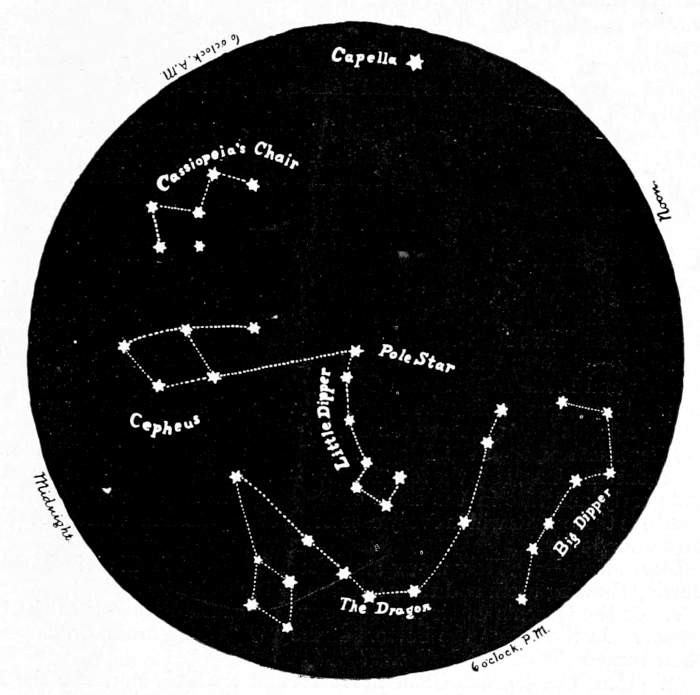
The polar constellations as they appear at about 8 o’clock January 20, the Dragon being south of the Pole-star. By revolving this chart as indicated, the positions of the stars is shown for 6 p. m., midnight, 6 a. m. and noon of January 20th.
Queen Cassiopeia’s Chair is on the opposite side of the Pole-star from the Big Dipper and at about equal distance from it. It consists of five brilliant stars that form a W with the top toward Polaris, one-half of the W being wider than the other. There is a less brilliant sixth star which finishes out half of the W into a chair seat, making of the figure a very uneasy looking throne for a poor queen to sit upon.
King Cepheus is Queen Cassiopeia’s husband, and he sits with one foot on the Pole-star quite near to his royal spouse. His constellation is marked by five stars, four of which form a lozenge, and a line connecting the two stars on the side of the lozenge farthest from Cassiopeia, if extended, will reach the Pole-star as surely as a line from the Big Dipper pointers. Cepheus is not such a shining light in the heavens as is his wife, for his stars are not so brilliant. Perhaps this is because he was only incidentally put in the skies. He was merely the consort of Queen Cassiopeia, who being a vain and jealous lady boasted that she and her daughter, Andromeda, were far more beautiful than any other goddesses that ever were, and thus incurred the wrath of Juno and Jupiter who set the whole family “sky high” and quite out of the way, a punishment which must have had its compensations since they are where the world of men may look at and admire them for all ages.
Lying between the Big and Little Dippers and extending beyond the latter is a straggling line of stars, which, if connected by a line, make a very satisfactory dragon. Nine stars form his body, three his head, the two brighter ones being the eyes.
LESSON CCXXVI
Cassiopeia’s Chair, Cepheus, and the Dragon
Leading thought—To learn to know and to map the constellations which are so near the Pole-star that they never rise or set in our latitude, but seem to swing around the North Star once in twenty-four hours.
Method—Place on the blackboard the diagram given showing the Pole-star, Big and Little Dippers and Cassiopeia’s Chair, and ask for observations and sketches showing their position in the skies the following evening. After the pupils have observed the Chair and know it, add to your diagram, first Cepheus and then the Dragon. After you are sure the pupils know these constellations, give the following lesson. The observations should be made early and late in the same evening and at different times of the month, so that pupils will in every case note the apparent movement of these stars around Polaris.
Observations—1. How many stars form Cassiopeia’s Chair? Make a drawing showing them and their relation to the Pole-star.
2. Is the Queen’s Chair on the same side of the Pole-star as the Big Dipper? Is the top or the bottom of the “W” which forms Cassiopeia’s Chair turned toward the Pole-star?
3. Does Cassiopeia’s Chair move around the Pole-star, like the Big Dipper?
4. How many stars mark the constellation of Cepheus?
5. Make a sketch of these stars and show the two which are pointers toward the North Star.
6. Does Cepheus also move around the Pole-star, and in which direction?
7. Describe where the Dragon lies, and where are his tail and his head in relation to the two Dippers. Make a sketch of the Dragon.
8. Why do all the polar constellations seem to move around the Pole-star every twenty-four hours, and why do they seem to go in a direction opposite the movement of the hands of a clock? What do we mean by “Polar constellations”?
Topics for English Themes—The Story of Queen Cassiopeia, King Cepheus and their daughter, Andromeda; the story of the Dragon.
Supplementary reading—Storyland of the Stars, Pratt.
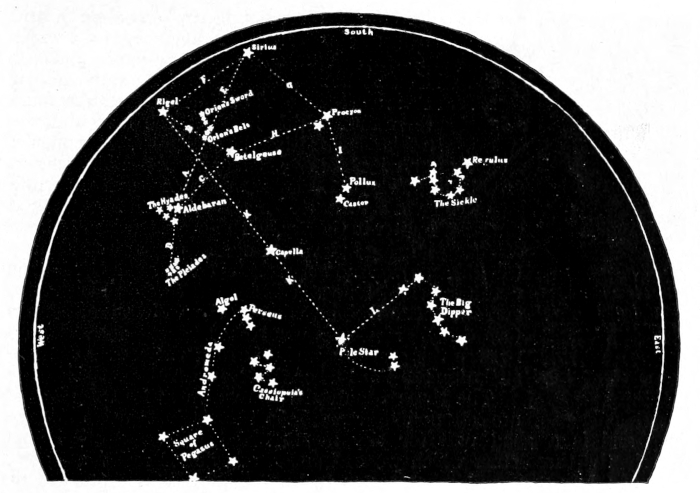
A diagram of the principal stars of winter as seen in early evening late in February.
To use the chart take it in the hands, face the Pole-star and hold the chart above the head so that the side marked east will extend eastward.
THE WINTER STARS
Teacher’s Story
The natural time for beginning star study is in the autumn when the days are shortening and the early evenings give us opportunity for observation. After the polar constellations are learned, we are then ready for further study in the still earlier evenings of winter, when the clear atmosphere and beautiful blue of the heavens make the stars seem more alive, more sparkling, and more beautiful than at any other period of the year. One of the first lessons should be to instruct the pupils how to draw an imaginary straight line from one star to another, and to perceive the angles which such lines make when they meet at a given star. A rule, or what is just as effective, a postal card or some other piece of stiff paper which shows right-angled corners, is very useful in this work. It should be held between the eyes and the stars which we wish to connect, and thus make us certain of a straight line and a right angle.
Orion (o-ri´on)
During the evenings of January, February and March the splendid constellation of Orion takes possession of the southern half of the heavens; and so striking is it that we find other stars by referring to it instead of to the Pole-star. Orion is a constellation which almost everyone knows; three stars in a row outline his belt, and a curving line of stars, set obliquely below the belt, outline the sword. Above the belt in the evening sky we can see the splendid red star Betelgeuse (bet-el-gerz), and below the belt, at about an equal distance, is the white star Rigel (re-jel). West of the red star above, and east of the white star below, are two fainter stars, and if these four stars are connected by lines, an irregular four-sided figure results, which includes the belt and the sword. In this constellation the ancients saw Orion, the great hunter, with his belt and his sword; Betelgeuse was set like a glowing ruby on his shoulder, and the white star Rigel was set like a spur on his heel. Thus, stood the great hunter in the sky, with his club raised to keep oft the plunging bull whose eye is the red Aldebaran (al-deb´a-ran). And beyond him follows the Great Dog with the bright blue star Sirius (sir´i-us) in his mouth, and the Little Dog branded by the white star Procyon (pro´si-on). However, our New England ancestors did not see this grand figure in the sky; they called the constellation the Yard-ell or the Ell-yard.
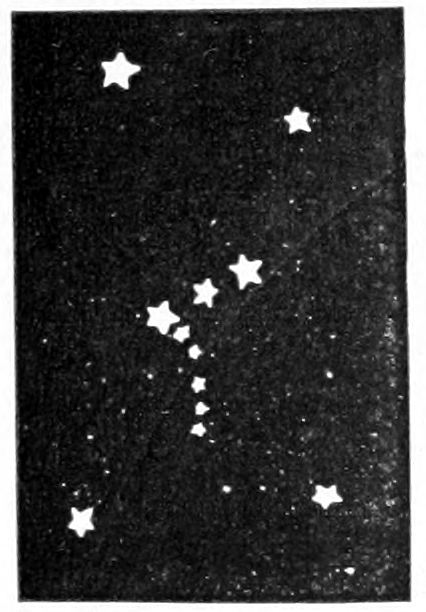
Orion, the three large stars in a line forming the belt, the curved line of smaller stars below forming the sword, Betelgeuse above, Rigel below.
The three beautiful stars which make Orion’s belt are all double stars; the belt is just three degrees long and is a good unit for sky measurement. The sword is not merely the three stars which we ordinarily see, but is really a curved line of five stars; and what seems to be the third star from the tip of the sword and which looks hazy, is in fact a great nebula. Through the telescope this nebula seems a splash of light with six beautiful stars within it. Betelgeuse is a brilliant red star, and is the first star in the constellation to appear above the horizon. It is an old, old star and is growing cold, as is shown by its red glow. It glows redder sometimes than at others; it is so far away that we have not been able to measure its distance from us surely, and it is receding from us all the time. About fifteen minutes after Betelgeuse rises, and after the belt and sword are in sight, a white sparkling star appears at the southwest of the belt. This is Rigel, and this star, too, is so far from us that we do not know the distance, and it is also receding.
LESSON CCXXVII
Orion
Leading thought—Orion is one of the most beautiful constellations in the heavens. It is especially marked by the three stars which form Orion’s belt, and the line of stars below the belt which form the sword.
Method—Place on the blackboard the outline of Orion as given in the diagram. Ask the pupils to make the following observations in the evening and give their report the next day.
Observations—1. Where is Orion in relation to the Pole-star?
2. How many stars in the belt of Orion? How many stars in the sword? Can you see plainly the third star from the bottom of the sword?
3. Notice above the belt, about three times its length, a bright star; this is Betelgeuse. What is the color of this star? What do we know about the age of a star if it is red?
4. Look below the belt and observe another bright star at about the same distance below that Betelgeuse is above. What is the color of this star? What does its color signify? The name of this star is Rigel.
5. Note that west of the red star above and east of the white star below are two fainter stars. If we connect these four stars by lines we shall make an irregular four-sided figure, fencing in the belt and sword. Sketch this figure with the belt and sword, and write on your diagram the name of the red star above and the white star below and also the name of the constellation.
6. Which star of the constellation rises first in the evening? Which last?
7. Write an English theme on the story of Orion, the great hunter.
Supplementary reading—Stories of Starland, Proctor; The Stars in Song and Legend, Porter; Storyland of the Stars, Pratt.
ALDEBARAN AND THE PLEIADES
Teacher’s Story
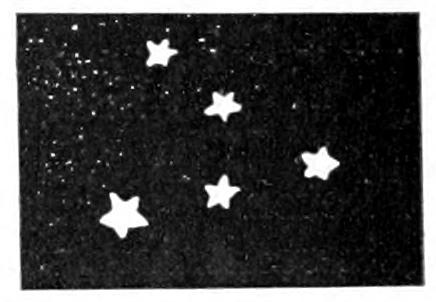
Aldebaran in the V-shaped constellation called the Hyades. This is a part of the constellation, Taurus.
Almost in a line with the belt of Orion, up in the skies northwest from it, is the rosy star Aldebaran. This ruddy star, which is not so red as Betelgeuse, marks the end of the lower arm of a V-shaped constellation composed of this and four other stars. This constellation is the Hyades (hi´a-dez). The Hyades is a part of the constellation called by the ancients Taurus, the bull, and is the head of the infuriated animal. Aldebaran is a comparatively near neighbor of ours, since it takes light only thirty-two years to pass from it to us. It gives off about forty-five times as much light as does our sun; it lies in the path traversed by the moon as it crosses the sky, and is often thus hidden from our view.
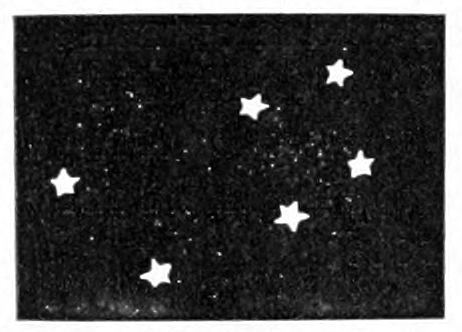
The Pleiades, a group of six small stars surrounded by a misty light.
Although we are attracted by many bright stars in the winter sky, yet there is a little misty group of stars, which has ever held the human attention enthralled, and of which the poets of all the ages have sung. These stars are called the Pleiades (ple´ya-dees); most eyes can count only six stars in the constellation. There are nine stars large enough to be seen through the telescope, and which have been given names; but sky photography has revealed to us that there are more than three thousand stars in this little group. Perhaps no stars in the heavens give us such a feeling of the infinity of the universe as do the Pleiades; for astronomers believe that they form a great star system which is now being evolved from a nebula. The reason for this belief is that these stars seem to be surrounded by a brilliant mist which sometimes seems to be looped from one to another; and, too, the stars are all in the same stage of development and have the same chemical composition, and they are all moving together in the same direction. These stars which look so close together to us are so far apart really that our own sun and all its planets could roll in between them and never be noticed. It would require several years for light to travel from one of these stars in the Pleiades to another. The Pleiades are so far from us that we cannot estimate the distance, but we know that it takes light several hundred years to reach us from them. There is a mythical story found in literature, that once the unaided eye could see seven instead of six stars in the Pleiades, and much poetic imagining has been developed to account for the “lost Pleiad.”
LESSON CCXXVIII
Aldebaran and the Pleiades
Leading thought—The Pleiades seem to be a little misty group of six stars, but instead there are in it three thousand stars. Half way between the Pleiades and Orion’s belt is Aldebaran, an ageing ruddy star.
Method—Draw the diagram (p. 895) on the blackboard showing Orion, Aldebaran and the Pleiades, and the lines B, C, D. Give an outline of the observations to be made by the pupils, and let them work out the answers when they have opportunity. Each pupil should prepare a chart of these constellations.
Observations—1. Imagine a line drawn from Rigel to Betelgeuse and then another line just as long extending to the west of the latter at a little less than a right angle, and it will end in a bright, rosy star, not so red as Betelgeuse.
2. What is the name of this star? Write it on your chart.
3. Can you see the figure V formed by Aldebaran and four fainter stars? Sketch the V and show where in it Aldebaran belongs. This V-shaped constellation is called the Hyades.
4. Imagine a line drawn from Orion’s belt to Aldebaran and extend it to not quite an equal length beyond it, and it will end near a “fuzzy little bunch” of stars which are called the Pleiades. Place the Pleiades on your chart.
5. How many stars can you see in the Pleiades?
6. Why are they called the seven sisters?
7. How many stars in the Pleiades which are named, and how many does photography show that there really are in the group?
8. How far apart from each other are the nearest neighbors of the Pleiades?
9. What do the astronomers think about the Pleiades and why do they think this?
THE TWO DOG STARS, SIRIUS AND PROCYON
Teacher’s Story
If a line from Aldebaran pass through the belt of Orion and is extended about as far on the other side, it will reach the Great Dog Star, following at Orion’s heels. This is Sirius, (Sir´-e-us) the most brilliant of all the stars in our skies, glinting with ever changing colors, sometimes blue, at others rosy or white. It must have been of this star that Browning wrote:
“All that I know Of, a certain star Is, it can throw (Like the angled spar) Now a dart of red, Now a dart of blue.”
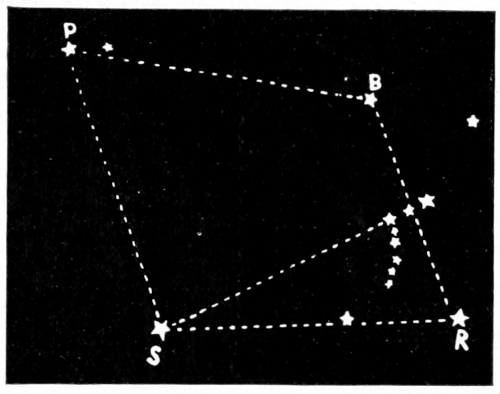
Orion and the Dog Stars.
B, Betelgeuse; R, Rigel; S, Sirius, the Great Dog Star; P, Procyon, the Little Dog Star.
Sirius is a comparatively young star, and is estimated by Proctor to have a diameter of about twelve million miles or fourteen times that of our own sun; it is only eight and one-half light-years away from us and is the most celebrated star in literature. The ancients knew it, the Egyptians worshipped it, Homer sang of it, and it has had its place in the poetry of all ages.
Procyon, (pro´-se-on) the Little Dog Star, was so-called perhaps because it trots up the eastern skies a little ahead of the magnificent Great Dog Star; it gives out eight times as much light as our sun, and is only ten light-years away from us. It has a fainter companion about three or four degrees to the northwest of it.
LESSON CCXXIX
The Two Dog Stars
Leading thought—The Great Dog Star, Sirius, is the most famous of all stars in the literature of the ages. The Two Dog Stars were supposed by the ancients to be following the great hunter, Orion.
Method—Draw upon the board from the chart shown on this page, the constellation of Orion with Sirius and Procyon. Ask the pupils to note that after Orion is well up in the sky a straight line drawn through Orion’s belt and dropping down toward the eastern horizon ends in a beautiful white star, which is Sirius. And that if we draw a line from Betelgeuse to Rigel from Rigel to Sirius and then draw lines to complete a quadrangle, we shall find our lines meet at a bright star just a little too far away to make the figure a square, but making it somewhat kite-shaped instead. This is the Little Dog Star, Procyon, and it has a twin star near it. After giving these directions let the children make the following observations:
1. How do you find Sirius? Which rises first, Orion or Sirius?
2. What color is Sirius? Judging from its color what stage of development do you think it is in?
3. Try and find out how large Sirius is compared with our sun and how near it is to us.
4. Why is Sirius called the Great Dog Star? Is the Little Dog Star nearer to the North Star than Sirius? Which is the brighter, the Great Dog Star or the Little Dog Star? Can you see any fainter star near Procyon?
5. Why is Procyon called the Little Dog Star?
6. Make a chart showing Orion and the two Dog Stars.
CAPELLA AND THE HEAVENLY TWINS
Teacher’s Story
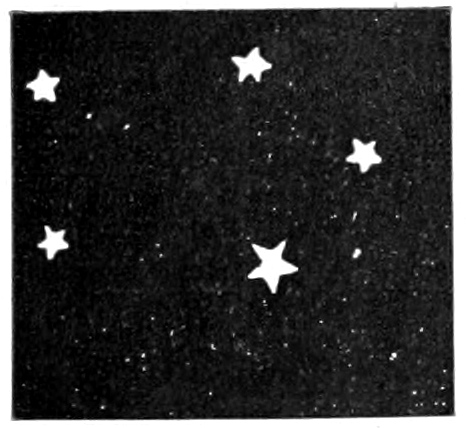
Capella in the constellation Auriga.
Capella is nearer to the North Star than any other of the bright stars and it comes very near belonging to the strictly polar constellations, since it falls below the horizon only four hours out of twenty-four. In composition it much resembles our sun, as do all the bright yellow stars; but it is much larger; it gives off one hundred and twenty times as much light as our sun, and it is forty light-years away from us. Capella is always a beautiful feature of the northern skies, being almost in the zenith during the evenings of January and February. It is in a brilliant shield-shaped constellation known as Auriga.
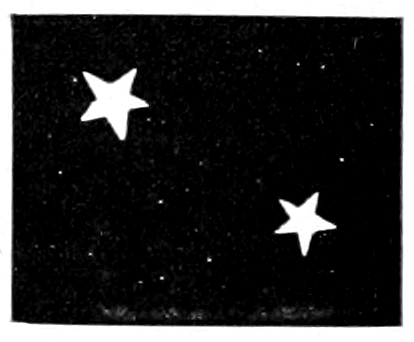
Gemini, the heavenly twins, the larger one is Pollux and the other is Castor.
During the winter evenings we see two stars set like glowing eyes almost in the zenith, and in a region of the sky where there are no other bright stars. These twin stars are set just a little closer together than are the pointers of the Big Dipper. To this brilliant pair the ancients gave the names of Castor and Pollux. Pollux is the brighter of the two and is the more southward in situation. Pollux and Castor were two beautiful twin boys who loved each other so much that, after they were dead, they were placed in the skies where they could always be near each other. The twin stars are supposed to exert a benign influence on oceans and seas and are, therefore, beloved by sailors. Although they seem to us so near together, they are separated by a space so great that we cannot conceive of it and they are going in opposite directions.
Pollux is a yellow star, and supposed to be in the same stage of development as our sun, while Castor is white and according to star ages is young. When a boy says “By Jimminy,” he does not realize that he is using an ancient expletive “By Gemini,” which is the Latin name of these twin stars and was a favorite ancient oath, especially of sailors.
LESSON CCXXX
Capella and the Heavenly Twins
Leading thought—There are, during the evenings of January and February, three brilliant stars almost directly overhead. One of these is Capella, the other two are the Heavenly Twins.
Method—Place on the board the part of the chart (p. 895) showing the Big Dipper, Pole-star, Capella and the Twins. Draw a line, L, from the pointers of the Big Dipper, and extend it to the Pole-star. Draw another line, K, from the Pole-star at right angles to the line L, and on the side away from the Big Dipper’s handle, and it will pass through a large, brilliant, yellow star which is Capella. Ask the pupils to imagine similar lines drawn across the sky, when they are making their observations and thus find these stars, and to place them on their charts, making the following observations:
1. What color is Capella, and how does its color compare with that of our sun?
2. Is Capella as near to the Pole-star as the Big Dipper? Is it near enough so that it never sets?
3. Can you see the shield-like constellation of which Capella is a part? Do you know the name of this constellation?
4. How do you find the Heavenly Twins after you have found Capella?
5. Why are these stars called the Heavenly Twins? What is their Latin name? What are the names of the two stars? Are these twins set nearer together than the pointers of the Big Dipper?
6. How can you tell the Heavenly Twins from the Little Dog Star and its companion?
7. Read in the books all that you can find about the Heavenly Twins. Try and find if they are the same age, if they are as near together as they seem, and if they are going in the same direction. What did the ancient sailors think of these twin stars?
THE STARS OF SUMMER
To us, who dwell in a world of change, the stars give the comfort of abidingness; they remain ever the same to our eyes and the teacher should make much of this. When we once come to know a star, we know exactly where to find it in the heavens, wherever we may be. A star which a person knows during childhood will, in later life and in other lands, seem a staunch friend and a bond, drawing him back to his early home and associations.
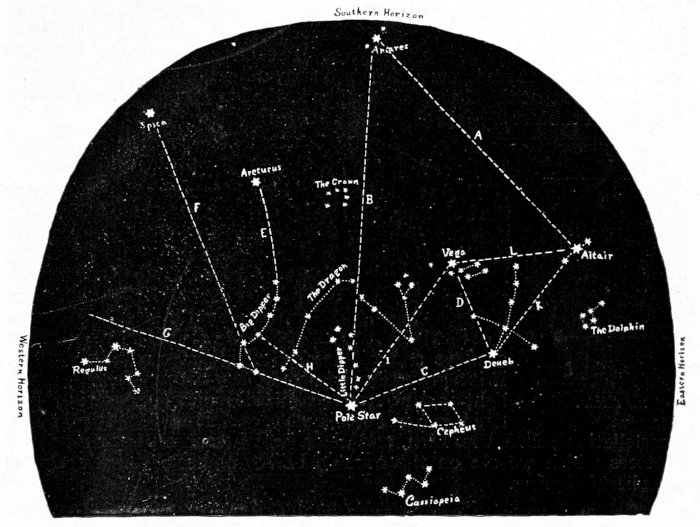
A chart of the brightest stars of summer, showing their positions in early evenings of June. To find the stars hold the chart above the head and face the north.
The summer is an enticing season for making the acquaintance of eight of the fifteen brightest stars visible in northern latitudes. Few midsummer entertainments rival that of lying on one’s back on the grass of some open space which commands a wide view of the heavens, and there with a planisphere and an intermittently lighted candle with which to consult it, learn by sight, by name and by heart those brilliant stars which will ever after meet with friendly greeting our uplifted eyes. To teach the children in a true informing way about the stars, the teacher should know them, and nowhere in nature’s realm is there a more thought-awakening lesson.
LESSON CCXXXI
The Bright Stars of Summer
Leading thought—The stars which we see shining during summer evenings are not the same ones that we see during the winter evenings, except those in the polar constellations. There are eight of the brilliant summer stars, which we should be able to distinguish and call by name.
Method—Begin by the middle of May when the Big Dipper is well above the Pole-star in the early evening, and when, therefore, Regulus, Spica, Arcturus and the Crown are high in the sky. The others may be learned in June, although July is the best month for observing them. In teaching the pupils how to find the stars, again instruct them how to draw an imaginary straight line from one star to another and to observe the angles made by such lines connecting three or four stars.
Place upon the blackboard the figures from the chart (page 901), as indicated, leaving each one there until the pupils have observed and learned it. Then erase and place another figure. In each case try to get the pupils interested in what we know about each star, a brief summary of which is given. Note that the observations given in the lessons are for early in the evenings of the last of May, of June, and of early July.
Regulus (reg´-u-lus)
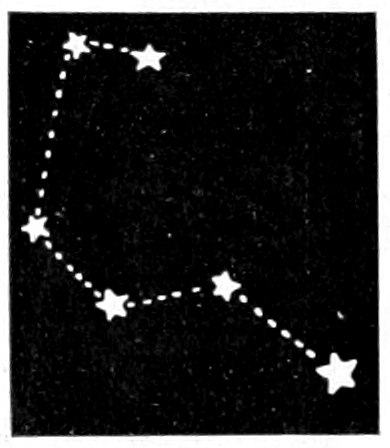
Regulus, the large star in the handle of the sickle.
Draw upon the blackboard from the chart (p. 901) the Pole-star, the Big Dipper, the line G and the Sickle shown just below the outer end of the line. Extend the line that passes through the pointers of the Big Dipper to the North Star backward into the western skies; just west of this line lies a constellation called the Sickle, and the stars that form it outline this implement. The Sickle has a jewel at the end of the handle, which is a white and diamond-glittering star called Regulus. It is a great sun giving out one thousand times as much light as our own sun, and this light reaches us in about one hundred and sixty years. The Sickle is part of a constellation called the Lion, and from which comes the shower of meteors which we see on the evening of November 13th. Regulus is seen best in Spring.
Arcturus (ark-tu´rus)
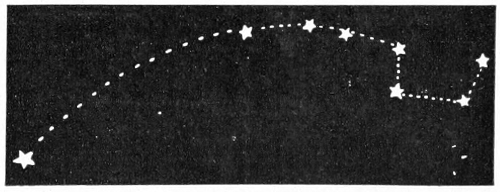
Arcturus and the Big Dipper.
Place on the blackboard the Big Dipper, the Pole-star and the line E, Arcturus and the Crown. Extend the handle of the Big Dipper following its own curve for about twice its length and it will end in a beautiful, yellow star, the only very bright one in that region. It is a thousand times brighter than our own sun, but its light does not reach us for a hundred years after it is given off. Arcturus is supposed to be one of the largest of all the suns, having a diameter of several millions of miles. During the latter part of June and July it is almost overhead in the early evening.
The Crown
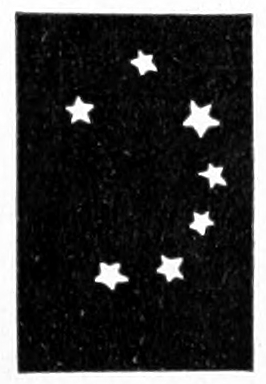
The Northern Crown.
Between Arcturus and Vega, but much nearer the former, is a circle of smaller stars that is called the Northern Crown, and which because of its form is quite noticeable.
Spica (spi´-ka)
Place on the blackboard the Big Dipper, the Pole-star, the line F and Spica. To find Spica draw a line through the star on the outer edge of the top of the bowl of the Big Dipper, through the star at the bottom of the bowl next the handle, and extend this line far over to the southwest, during the evenings of June and July. (See page 901) In August, this star sets at ten o’clock. Spica is a white star, and is the only bright one in that part of the sky. It is so far away from us that the distance has never been measured. Spica is in the constellation called the Virgin.
Vega (vee´-ga)
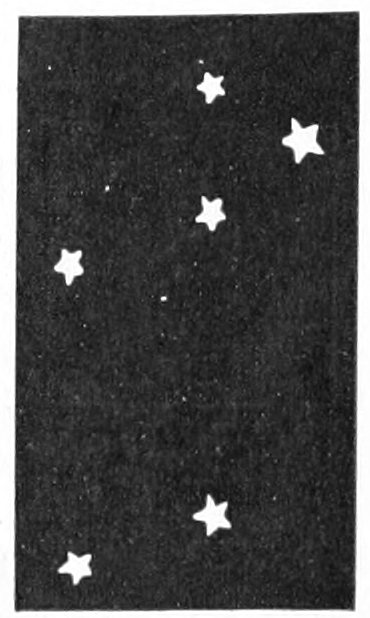
Vega and her train of five stars.
Place on the blackboard the Pole-star, the Big Dipper, the lines H and I and Vega with her five attendant stars, as shown in the chart. Teach that these stars are the chief ones in the constellation called The Lyre. To find Vega, draw a line from the Pole-star to the star in the Big Dipper which joins the bowl to the handle. Then draw a line at right angles to this (see chart lines H, I) and extend the line I a little farther from the North-star than is the end star of the Dipper handle; this line will reach a bright star, bluish in color, which can always be identified by four smaller attendant stars which lie near it and outline a parallelogram with slanting ends. Vega is the most brilliant summer star that we see in the northern hemisphere. It is a very large sun, giving out ninety times as much light as our sun; it is so far away that it requires twenty-nine years for a ray of light to reach us from it. Vega’s chief interest for us, aside from its beauty, is that toward it our sun and all its planets, including our earth, are moving at the rate of thirteen miles per second.
Antares (an-ta´-rees)
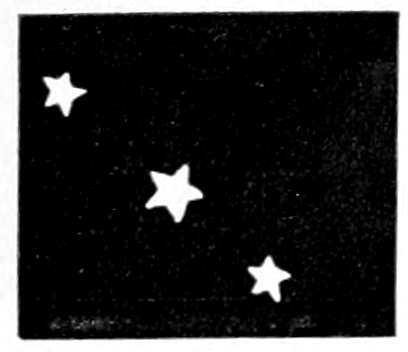
Antares, a brilliant star in the southern skies.
Add to the last diagram on the blackboard the line E, Arcturus, the line B and Antares. To find this star, draw a line half way between Arcturus and Vega from the Pole-star straight across the sky to the south, and just above the southern horizon it will point to the glowing star, Antares, in the constellation of the Scorpion. Also a line drawn at right angles to the line connecting Altair with its companions and extending toward the south will reach Antares. Late June and July about ten o’clock in the evening is the best for viewing this beautiful star. An interesting thing about Antares is that, although it is red, it has, whirling around it, a companion star which is bright green.
Deneb, or Arided (den´-eb; a´-ri-ded)
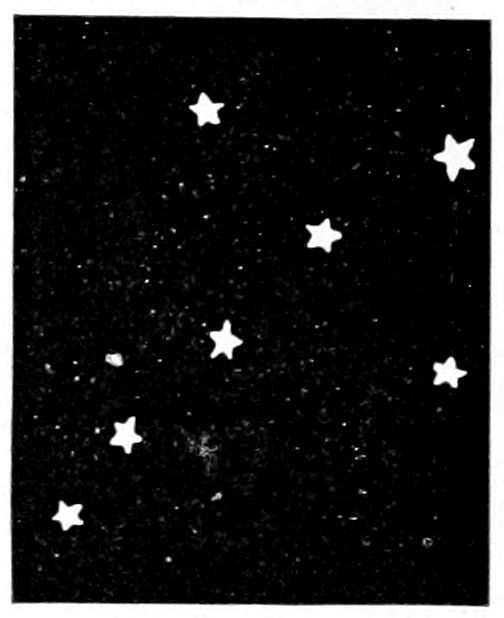
The Northern Cross, in the constellation of the Swan.
Erase from the last diagram Antares and the line B. Add to it the lines C and D making a right angle at Deneb; and the Cross—the head of which is Deneb, the foot ending near the letter on line L. This star is at the head of the Northern Cross, which is a very shaky looking cross and appears upside down in the eastern skies during the evenings of June and July. Deneb is white in color and is a very large sun, because it seems to us a bright star although it is so far away from us that the distance has never been surely measured; but it has been estimated that a ray of light would need at least three hundred and twenty-five years to reach us from Deneb. It and the cross are a part of the constellation of Cygnus, or the Swan.
Altair
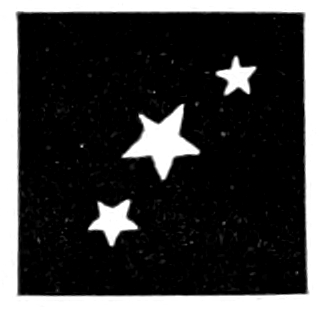
Altair in the constellation of the Eagle.
Add to the last diagram on the board the lines L, K, Altair and its two attendant stars and the Dolphin. Emphasize the fact that Altair marks the constellation of Aquila, or the Eagle. This beautiful star is easily distinguished because of its small companions, one on each side, all three in a line. The three belong to a constellation called the Eagle, and may be seen in early evening from June to December. Altair, Deneb and Vega form a triangle with the most acute angle at Altair. (See chart L, K.) Just northeast of Altair is a little diamond-shaped cluster of stars called the Dolphin, which is a good name for it, since it looks like a Dolphin, the fifth star forming the tail. It is also called Job’s Coffin, but the reason for this is uncertain, unless Job’s trials extended to a coffin which could not possibly fit him. If the line C on the chart drawn from the Pole-star to Deneb be extended, it will touch the Dolphin. Altair is always low in the sky; it is a great sun giving off nearly ten times as much light as our own sun; light reaches us from it in fifteen years.
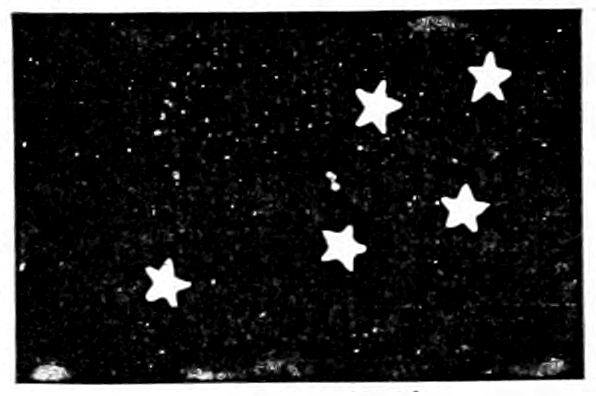
The Dolphin or Job’s Coffin.
THE SUN
Teacher’s Story To be retold to pupils.
If, only once in a century, there came to us from our great sun, light and heat, bringing the power to awaken dormant life, to lift the plant from the seed and clothe the earth with verdure, then it would indeed be a miracle. But the sun by shining every day cheapens its miracles in the eyes of the thoughtless. While it hardly comes within the province of the nature-study teacher to make a careful study of the sun, yet she may surely stimulate in her pupils a desire to know something of this great luminous center of our system.
Our sun is a great shining globe about one hundred and ten times as thick through as the earth, and more than a million times as large. If we look at the sun in a clear sky, it is so brilliant that it hurts our eyes. Thus, it is better to look at it through a smoked glass, or when the atmosphere is very hazy. If we should see the sun through a telescope, we should find that its surface is not one great glare of light but is mottled, looking like a plate of rice soup, and at times there are dark spots to be seen upon its surface. Some of these spots are so large that during very “smoky weather” we can see them with the naked eye. In September, 1908, a sun-spot was plainly visible; it was ten thousand miles across, and our whole world could have been dropped into it with a thousand miles to spare all around it. We do not know the cause of these sun-spots, but we know they appear in greater numbers in certain regions of the sun, above and below the equator. And since each sun-spot retains its place on the surface of the sun, just as a hole dug in the surface of our earth would retain its place, we have been able to tell by the apparent movement of these spots how rapidly and in which direction the sun is turning on its axis; it revolves once in about twenty-six days and, since the sun is so much larger than our earth, a spot on the equator travels at a rate of more than a mile a second. There is a queer thing about the outside surface of the sun—the equator rotates more rapidly than the parts lying nearer the poles; this shows that the sun is a gaseous or liquid body, for if it were solid, like our earth, all its parts would have to rotate at the same rate. At periods of eleven years the greatest number of spots appear upon the sun.
Another interesting feature of the sun is the tremendous explosion of hydrogen gas mixed with the vapors of calcium and magnesium, which shoot out flames from twenty-five thousand to three hundred thousand miles high, at a rate of speed two hundred times as swift as a rifle bullet travels. Think what fireworks one might see from the sun’s surface all the time! One would not need to wait until the Fourth of July for fireworks there. These great, explosive flames can be seen by the telescope when the moon eclipses the sun, and they have been analyzed by means of the spectroscope. Besides these magnificent explosions, there is surrounding the sun a glow which is brighter near the sun’s surface and paler at the edges; it is a magnificent solar halo, some of its streamers being millions of miles long. This halo is called the Corona, and is visible during total eclipses. By means of the spectroscope we know that there are about forty chemical elements in the sun, which are the same as those we find upon our earth.
As the sun weighs 330,000 times as much as the earth, the force of gravity upon its surface is twenty-seven and two-thirds times as much as it is here. A letter which weighs an ounce here would weigh almost a pound and three quarters on the sun; and a man of ordinary size in this world would weigh more than two tons there, and would be crushed to death by his own weight. Find how much your watch, your book, your pencil, your baseball, your football would weigh on the sun.
Our Sun and its Family
First of all we shall have to acknowledge that our great, blazing sun is simply a medium-sized star, not nearly so large as Vega, nor even as large as the Pole-star; but it happens to be our own particular star and so is of the greatest importance to us. The sun has several other worlds, more or less like our own, revolving around it on almost the same level or plane in which our world revolves, but some of these worlds are much nearer the sun and others much farther away than ours. Nearest of all is Mercury, but it is not half so thick through as our earth, and it is so close to the sun that it circles around in 88 days; that is, its year is only 88 days long. Next comes Venus, almost as large as the earth, with a year 225 days long; next comes our earth, which completes its year in 365 days; next beyond us is Mars, a little more than half as thick as the earth and with a year 687 days long; beyond Mars is a group of small planets which are not large enough to be seen with the telescope, but we know that one of the largest of the group is only 490 miles through; beyond this mysterious swarm of little worlds is great Jupiter almost ten times as thick through as the earth, and it is so far away that it does not circle about the sun but once in 11 years; beyond great Jupiter comes Saturn, not quite ten times the diameter of the earth and so far from the sun that it takes 29½ years for it to move around its orbit; beyond Saturn is Uranus, only about four times as thick through as our world, and it has a year 84 years long; but the outermost of all our sun’s planets is Neptune, a little larger than Mars, but so far from the sun that 165 years are required for it to complete its circle. Just think of a spring or a winter 41 years long! If Methuselah had lived on Neptune, he would have died before he was five and one-half years old.
Almost all of the Earth’s sister planets are better off for moons than she; neither Venus nor Mercury has any moons. Mars has two moons, Jupiter five and Saturn has nine besides some splendid rings; and a queer thing about one of Saturn’s moons is that it revolves in an opposite direction from the others. Uranus has four moons, while Neptune is not any better off than we are, unless, there are some we have not been able to discover because they are so far away.
One peculiar thing about all of the planets of the sun’s family and all of their moons is that they all shine by reflecting the light of the sun, and none of them are hot enough to give off light independently; but these sister worlds of ours are so near us that they often seem larger and brighter than the stars, which are true suns and give off much more light than our own sun. After a little experience the young astronomer learns to distinguish the planets from the true stars; the planets always follow closely the path of the sun and moon through the sky; they often seem larger and brighter than the true stars and do not twinkle so much. The so-called morning and evening stars are other planets of our sun’s family and are not stars at all.
Dr. Simon Newcomb in his delightful book, “Astronomy for Everybody,” gives the best illustration to make us understand the place of our sun and its planets and its relation to the stars in space. He explains that if here in the Atlantic States we should make a model of our solar system by putting an apple down in a field to represent the sun; then our earth could be represented by a mustard seed forty feet away revolving around the apple; and Neptune, our outermost planet, could be represented as a small pea circling around the apple at the distance of a quarter of a mile. Thus, our whole solar system could be modeled in a field one-half mile square, except for comets which might extend out in their long orbits for several miles. But to find the star nearest to our earth, the star that is only four and one-half light-years away from us, we should have to travel from this field across the whole of North America to California, and then take a steamer and go out into the Pacific Ocean before we should reach our nearest star neighbor, which would be another sun like our own and be represented by another apple.
Comets
Besides planets and stars there are in space other bodies spinning around our great sun, and following paths shaped quite differently than those followed by our earth and its sister planets. We move around the sun nearly in a circle with the sun at the center, but these other heavenly bodies swing around in great ellipses, the sun being near one end of the ellipse and the other end being out in space beyond our farthest planet. These bodies do not revolve around the sun in the same plane as our world and the other planets, and indeed they often move in quite the opposite direction. The most noticeable of these bodies whose race-track around the sun is long instead of circular are the comets, and we know that some of these almost brush the sun when turning at the end of their course. The astronomers have been able to measure the length of the race-tracks of some of the comets and thus tell when they will come back. Encke’s comet, named after the German astronomer, makes its course in three and one-half years and this is the shortest period of any we know. There are about thirty comets whose courses have been thus measured; the longest period belongs to Halley’s comet, which makes such a long trip that it comes back only once in seventy-six years; but there are other comets which astronomers are sure travel such long routes that they come back only once in hundreds or even thousands of years. About nine hundred comets have been discovered, many of them so small that they can only be seen through the aid of the telescope; and it has been found that in one instance, at least, three comets are racing around the sun on the same track.
A comet is a beautiful object, usually having a head which is a point of brilliant light and a long, flaring tail of fainter light, which always extends out from it on the side opposite the sun. The head of a comet must be nearly twice as thick through as the earth in order to be large enough for our telescopes to discover it. Some of the comet heads have been measured, and one was thirty-one times, and another one hundred and fifty times, as wide as our earth. If the heads are this large, imagine how long the tails must be! Some of them are far longer than the distance from our earth to the sun.
The head of a comet is supposed to be a mass of gas which is made to glow by the sun’s heat, and is so volatile and thin that the heat evaporates it. In fact, this gas has so little weight that light can push it; one would never believe that light could push anything because we cannot feel it strike against us; but the physicists have found that it does push, and by pushing against the particles of the gas of comets it sends them out into a streamer away from the sun, just as the heat pushes out a flaring cloud of steam from the spout of a teakettle.
Another thing we know about comets is that they are not able to hold together, but break into pieces; and these pieces become cold out in space and condense and harden into lumps of metallic stone; and these lumps, each one whirling, follows the same track that the comet followed. If a comet should break into many pieces it would make a whole flock of these lumps all going in the same direction and in the same path about the sun.
Since comets are moving around the sun in every direction, it is possible that the earth may sometime meet one; and if this proves to be a “head on collision” there are those who prophesy that there will be no people left to tell the story; but the tails of comets are so thin and ethereal that our earth actually passed through one once, and no one but the astronomers knew anything about it.
Shooting Stars
When we look up during an evening walk and see a star falling through space, sometimes leaving a track of light behind it, we wonder which of the beautiful stars of the heavens has fallen. But astronomers tell us that no real star ever fell, but that what we saw was a lump of the matter of which worlds and comets are made; and it was following its own swift path around the sun, when by chance it crossed our earth’s path, and was drawn toward us by that mysterious power called gravitation, which makes us fall down if we lose our balance, and which also made this bit of world-stuff fall to earth when it came so near us that its balance was disturbed. Although this shooting star was just a dark, cold lump of metal, too small for us to see, yet it was moving so swiftly along its path around the sun that the friction caused by its passing through our air, lighted it and burned it up, just as a match scratched on sandpaper lights and burns; as soon as it blazed we saw it and said, “There is a shooting star!” Sometimes the lump is so big that it does not have time to burn up while passing through the hundred miles or more of our atmosphere, and what is left of it strikes the earth usually with such force as to bury itself deep in the soil. Such lumps are called “meteoroids” before they fall and “meteors” while plunging white-hot through the air, but when they reach our earth we call what is left of them “meteorites.” There are, in museums, many meteorites of this so-called stone, which is largely iron. Chemists find no new metals or elements in these strangers from space, but they do find new kinds of chemical partnerships and combinations. Some of these meteorites weigh hundreds of pounds, one in the Yale Museum weighing 1635 pounds. It surely would not be safe for a person to be on the spot where and when one of these meteorites strikes the earth; but there are so few of the meteors large enough to last until they become meteorites, that we may safely continue to enjoy the sight of shooting stars. If it were not for the air that wraps our globe, like a great, kindly blanket, and by its friction sets fire to the meteors and destroys them, no one could live on this earth because we all should be pelted to death. Prof. Newton estimated that every twenty-four hours our world meets seven millions of these shooting stars, some of them no larger than shot and others weighing tons.
The Relation Between Comets and Meteors
It has been discovered that many of the shooting stars are gathered in great flocks and move about the sun in elongated paths, like the comets. We have learned the times of year when the path our earth follows comes close to these flocks of meteors which are flying around the sun like birds. One of these flocks is straggling, and we begin to meet it about the end of July and reach the center of the crowd on August 10th, and then continue to take stragglers until the last of August. We can see the point where we meet this flock of meteors, if we look for it in the direction of the constellation Perseus (see planisphere). On November 13th, we meet another flock which we find in the direction of the constellation Leo, of which the great star Regulus is the heart (see chart); but this flock is usually all in a bunch and we pass it in two days. Once there was a splendid flock which our world met every thirty-three years, and we took so many stragglers from it that our skies were filled with shooting stars, and ignorant people were greatly frightened; but for some reason, this flock has changed its path and we looked in vain for the great display of fireworks which was due to occur in 1899.
While we know from observation that the flocks of shooting stars, which make our star showers, are just broken pieces of comets which once traveled the same path, yet it does not follow that all our shooting stars are comet fragments. Prof. Elkins has shown by photographing meteors that some of them must be wanderers in the vast spaces which lie between the stars.
THE RELATION BETWEEN THE TROPIC OF CANCER AND THE PLANTING OF THE GARDEN
[A]THE RELATION BETWEEN THE TROPIC OF CANCER AND THE PLANTING OF THE GARDEN
By John W. Spencer A story to be read to the pupils
In years gone by, many farmers had a favorite phase of the moon when they planted certain crops, usually spoken of as the “dark” or the “light” of the moon. I once knew a woman who picked her geese by the “sign of the moon.” Hogs were butchered in the “light” of the moon, and then the pork would not “fry away” so much in the skillet. It is true some pork from some hogs wastes faster than that of others, but the difference is due to the kind of food given the hogs. Many farmers hold to those old superstitions yet, but the number is much less now than twenty-five years ago. I wish I might impress on you young agriculturists that the moon has no influence on plant life, or pork, or geese, but the position of the sun most decidedly has. We have some plants that had best be planted when the sun’s rays strike the state of New York slantingly, which means in early spring or late fall. We have other plants that should not be put in the open ground until the rays of the sun strike the state more direct blows, which means the hotter weather of summer. If I were in close touch with you pupils, I should be glad to tell some things that happen to three young friends of mine, hoping that thereby my statement might give the boys and girls an interest in three geographical lines concerning the tropics, and lead them to find their location on the map, particularly when later they learn what happens to my three young friends, whom we will call by the following names: There is one in Quito, Ecuador, of whom we will speak as Equator Shem; the one on the Island of Cuba is named Tropic of Cancer Ham; and the other in San Paulo, Brazil, answers to the name of Tropic of Capricorn Japhet.
What happens to these three boys, Shem, Ham and Japhet, is this. At certain times of the year they have no shadow when they go home for dinner at noon. This state of affairs is no fault of theirs. It is not because they are too thin to make shadows. It is due to the position of the sun. If the boys should look for that luminary at noon, they would find it as directly over their heads as a plumb line. It is a case of direct or straight blows from rays of the sun, and, oh, how hot—hotter than any Fourth of July the oldest inhabitant can remember! These three boys are not hit squarely on the head on one and the same day. Each is hit three months after the other. The first boy to be hit this year in the above manner will be the Equator Shem. The time will be during the last half of March. Can any of my young friends in this grade tell me the exact day of March that Equator Shem has no shadow? If no one of you can answer that question at this time, you had best talk it over with your friends, and bring your answers tomorrow. It happens at a time when our days are of about equal length.
Another thing about this particular day is that our almanacs call it the first day of spring. All because no boy or anything else has a shadow on the equator at noon time. People and bluebirds and robins in the state of New York will see squalls of snow about that time, and there will be some freezing nights. But after the first day of spring the cold storms do not last so long, as was the case during December, January, and early February, when the sun’s rays hit us with very glancing blows. Watch to see how much faster the sun melts the snow on the last days of March than it did at Christmas time. The light is also stronger and brighter, and plants in greenhouses and our homes have more life, and are not so shiftless, so to speak. Even the hens feel the influence, for they begin to lay more eggs and cackle, and down goes the price of eggs. Do not forget to learn what day in March spring begins, when the Equator boy finds it so hot that he would like to take off his flesh, and sit in his bones. After a few days, Equator Shem will find he again has a shadow at noon. A short one it is true, but it will get longer and longer each day. Now his shadow will be on the south side of him. Is this a queer thing to happen? On which side of you is your noon-time shadow? I will give every one of you a red apple that finds it anywhere but on the north side of him at twelve o’clock. Every time the sun shines at noon, watch to find your old uncle in the wrong, and thereby get the apple. Each day that the shadow of Equator Shem becomes longer and longer, the noon-day shadow of Tropic of Cancer Ham, living on the Island of Cuba, will be getting shorter and shorter, until at last there comes a day during the last of June that he, too, will have no shadow, and the almanac says that that day is the beginning of summer.
Now it will be the turn of the Tropic of Cancer Ham, on the Island of Cuba, to say the weather is hotter than two Fourths of July beat into one, and he too will wish that he could take off his flesh, and sit in his bones. Everybody in the state of New York will say that the first summer day is the longest day of the year. It is on this day that Equator Shem will have as long a shadow as he ever had in his life. No United States boy will ever be without a shadow at noon so long as he remains in his own country. When the eight o’clock curfew bell says it is time for boys and girls to go to bed, it will yet be light enough to read the papers. The sun not only sets late on that first summer day, but it appears early next morning. What a beautiful spectacle a sunrise in June is! Men of wealth will pay thousands of dollars for pictures showing its glory, yet I suppose that not one boy in five hundred ever saw the beauty of the birth of a new day in the sixth month of the year, and with no price of admission at that.
For only one day do the sun’s rays fall directly on top of the head of Tropic of Cancer Ham, who lives on the Island of Cuba—just for one day, after which the up and down rays travel back towards the Equator Shem. On the twenty-first of September Shem again has no shadow at noon, and the almanac makers say that is the last day of summer, and tomorrow will be the first day of autumn. Again it is very hot where Shem lives, but the alligators and monkeys and the parrots do not seem to mind it. Where do the up and down rays of the sun go next? They keep going south, hunting for the boy named Tropic of Capricorn Japhet, to warm him up, as was the case with the boys in Cuba and at the Equator. The up and down rays do not find the top of the head of the lad in the City of San Paulo, Brazil until the last part of December, just four days before Christmas, and then the almanac says this is the beginning of winter, and the shorter days of the year, when we in the state of New York light the lamp at five o’clock in the afternoon. Now, my boys and girls, do you understand why we have a change of seasons? Do you understand that the sun changes his manner of pitching his rays at us? That in winter, when he is over the head of the Tropic of Capricorn Japhet in San Paulo, and making summer on that part of the earth, to us people in the north, in the State of New York, he pitches only slanting rays that do not hit us hard, and have but little power? Thus you will see that the rays of the sun that strike the earth direct blows, swing back and forth like a pendulum, year after year, and century after century, coming north as far as Tropic of Cancer Shem, but no farther, and then swinging south as far as the boy named Tropic of Capricorn Japhet, and no farther, just stopping and swinging back again towards the north.
THE ZODIAC AND ITS SIGNS
Teacher’s Story To be retold to pupils.
The mysterious symbols of the Zodiac on the first pages of almanacs are always a source of wonder and awe to children, and remain a life-long mystery to most people except fortune tellers; and yet the Zodiac is the simplest thing in the world to understand. However, the lesson should not be given until after the children have had their lessons on the sun and the shadow-stick, and also the lessons on the stars.
The ancients who believed the earth stood still and the sun moved around it, noticed inevitably that the path through the heavens pursued by the sun reached in summer a point farther north and higher up than in the winter, and they naturally wished to map this path, so as to fix it in their minds and writings. Nothing could be easier, for there in the skies were the eternal stars always following the same fixed path through the heavens and never wobbling up and down like the sun. So they chose the constellation which marked the highest point in the sun’s path for each month, and these constellations might be likened to a stairway with six steps down toward the south and six steps up toward the north, the highest stair being reached by the sun in June, for then the sun is highest in the heavens and the farthest north. So beginning in June with Cancer, (the Crab), which is high in the heavens, it steps down to Leo, (the Lion) in July, takes another step lower to the Virgin in August, another down to the Scorpion in September, and comes to the lowest step of all, Sagittarius, (the Archer), in November; for at the last of November, the sun’s path reaches its lowest point farthest south in the heavens and then the days are shortest. But in December it begins to climb and takes a short step up to Capricornus, (the Goat), in January it rises to Aquarius, (the Water Carrier), and in February rises another step to Pisces, (the Fishes). In March it reaches up to Aries, (the Ram), in April attains Taurus, (the Bull), and in May reaches Gemini, (the Twins), which step is almost as high and as near to the North Star as was the Cancer, where the journey began the June before.
It may be difficult for the pupils to learn to know all these constellations, as some of them are not very well marked; however, if they wish to learn them they can do so by the use of the planisphere. Some of the Zodiac constellations are marked by brilliant stars which have already been learned. Regulus is the heart of Leo, the Lion; Spica which means “ear” is the ear of wheat which the Virgin is holding in the constellation Virgo. Red Antares lies in the Scorpion; and the Milk Dipper, which is shaped like the Big Dipper, but smaller, marks Sagittarius. Red Aldebaran is the fiery eye of Taurus, the Bull, while the Gemini, or Twins, are the most conspicuous of the stars in the evening skies of February and March. It should be noted, however, that at the present day, owing to the peculiar movement of our earth, the path of the sun in climbing up and down these constellation steps is not quite the same as it seemed to the ancients.
From Todd’s New Astronomy.
THE RELATIONS OF THE SUN TO THE EARTH
Teacher’s Story
“Whether we look or whether we listen, We hear life murmur or see it glisten.” —Lowell.
All this murmuring and glistening life on our earth planet has its source in the great sun which swings through our skies daily, sending to us through the friendly ether his messages of light and warmth—messages that kindle life in the seed and perfect the existence of every living organism, whether it be the weed in the field or the king on his throne.
At sunrise this heat which the sun sends out equally at all times of day and night, is tempered when it reaches us because it passes obliquely through our atmosphere-blanket, and thus traverses a greater distance in the cooling air. The same is true at sunset; but at noon, when the sun is most directly over our heads its rays pass through the least possible distance of the atmosphere-blanket and, therefore, lose less heat on the way. It is true that often about three o’clock in the afternoon is the hottest period of the day, but this is because the air-blanket has become thoroughly heated; but we receive the most heat directly from the sun at noon.
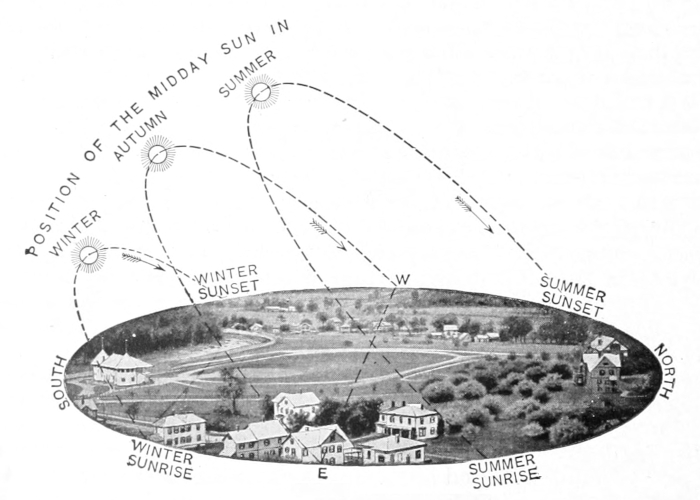
The variations in the time of the rising and the setting of the sun may be made a most interesting investigation on the part of the pupils. They should keep a record for a month in the winter; and with this as a basis, use the almanac to complete the lesson. Thus, each one may learn for himself which is the shortest and which the longest day of the year. There is a slight variation in different years; the shortest day of the year when this lesson was written, as computed from a current almanac, was the 22d of December; it was nine hours and fourteen minutes long. The longest day of the year was the 22d of June, and it was fifteen hours and six minutes in duration. On the longest day of the year the sun reaches its farthest point north and is, therefore, most nearly above us at mid-day. On the shortest day of the year, the sun reaches its farthest point south and is, therefore, farther from the point directly above us at mid-day than during any other day of the year.
Also the movement of the sun north and south is an interesting subject for personal investigation, as suggested in the lesson. Through quite involuntary observation, I have become so accustomed to the arc traversed by the points of sunrise as seen from my home, that I can tell what month of the year it is, by simply noting the place where the sun rises. When it first peeps at us over a certain pine tree far to the south, it is December; when it rises over the reservoir it is February or October; and when it rises over Beebe pond it is July. Only at the equinox of spring and fall does it rise exactly in the east and set directly in the west. Equinox means equal nights, that is, the length of the night is equal to that of the day.
So vast is the weight of the sun that the force of gravity upon its surface is so great that even if it were not for the white-hot fireworks there so constantly active, we could not live upon it, for our own weight would crush us to death. But this multiplying the weight of common objects by twenty-seven and two-thirds to find how much they would weigh on the sun is an interesting diversion for the pupils, and incidentally teaches them how to weigh objects, and something about that mysterious force called gravity; and it is also an excellent lesson in fractions.
LESSON CCXXXII
The Relation of the Sun to the Earth.
Leading thought—The sun which is the source of all our light and heat and, therefore, of all life on our globe travels a path that is higher across the sky in June than the path which it follows in December, and hence we experience changes of seasons. The lesson should be given to the pupils of the upper grades and should be correlated with reading, arithmetic and thinking.
Observations—1. What does the sun do for us?
2. At what time of the day after the sun rises do we get the least heat from it? What hour of the day do we get the most heat from it?
3. Is the sun equally hot all day? Why does it seem hotter to us at one time of the day than at another?
4. At what hour does the sun rise and set on the first of the following months; February, March, April, May and June?
5. Which is the shortest day of the year, and how long is it?
6. Which is the longest day of the year, and how many hours and minutes are there in it?
7. What day of the year is the sun nearest a point directly over our heads at mid-day?
8. Which day of the year is the sun at mid-day farthest from the point directly above our heads? Explain why this is so.
9. Standing in a certain place, mark by some building, tree or other object just where the sun rises in the east and sets in the west on the first of February. Observe the rising and setting of the sun from the same place on the first day of March and again on the first of April. Does it rise and set in the same place always or does it move northward or southward?
10. Is the sun farthest south on the shortest day of the year? If so, is it farthest north on the longest day of the year?
11. At what time of the year does the sun rise due east and set due west?
12. The sun is so much larger than the earth that its force of gravity is twenty-seven and two-thirds times that of the earth. How much would your watch weigh if you were living on the sun? How much would you yourself weigh if you were there?
13. Experiment. A shadow stick—Place a peg two or three inches high upright in a board and place the board lengthwise on the sill of a south window or where it will get the south light. Note the length cast by the shadow of the peg during a sunny day and draw a line with pencil or chalk outlining the tip of the shadow of the stick from 9 a. m. to 4 p. m. Make a similar outline a month later and again a month later and note whether the shadow traces the same line during each of these days of observation. Note especially the length of the shadow at noon.
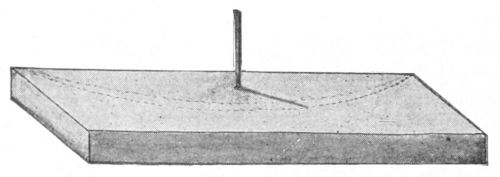
A shadow-stick.
Another excellent observation lesson for teaching the fact that the sun travels farther south in the winter, is to measure the shadow of a tree on the school grounds at noonday once a month during the school year. The length of the tree shadow can be measured from the base of the tree trunk, a memorandum being made of it.
14. When does the stick or tree cast its longest shadow at noon—in December or February? February or April? April or June? Why?
Topics for English themes—The size and distance of the sun. The heat of the sun and its effect upon the earth. What we know about the sun spots. Our path around the sun.
Supplementary reading—Starland, Ball; The Earth and Sky, Holden.
LESSON CCXXXIII
How to Make a Sundial
Method—The diagram for the dial is a lesson in mechanical drawing. Each pupil should construct a gnomon (no-mon) of cardboard, and should make a drawing of the face of the dial upon paper. Then the sundial may be constructed by the help of the more skillful in the class. It should be made and set up by the pupils. A sundial in the school grounds may be made a center of interest and an object of beauty as well.
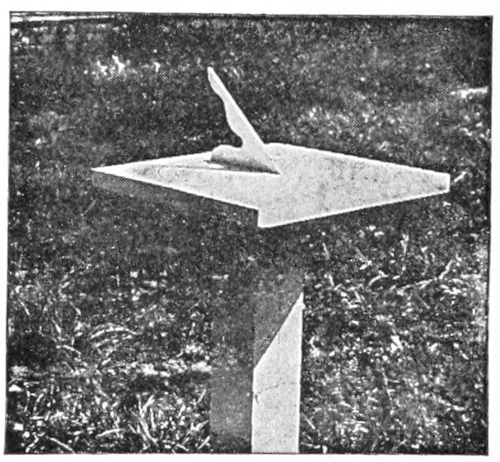
A sundial made by pupils.
Materials—For the gnomon a piece of board a half inch thick and six inches square is required. It should be given several coats of white paint so that it will not warp. For the dial, take a board about 14 inches square and an inch or more thick. The lower edge may be bevelled if desired. This should be given three coats of white paint, so that it will not warp and check.
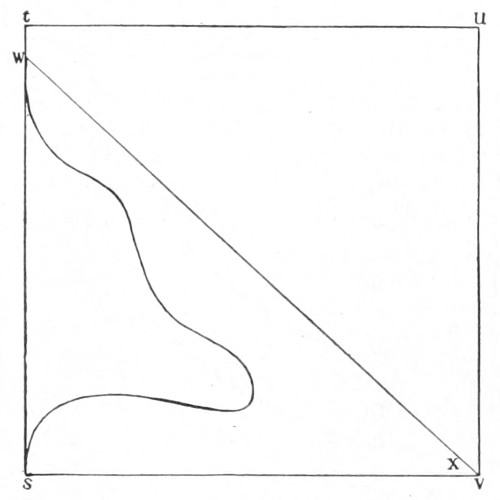
The gnomon.
To make the gnomon—The word gnomon is from a Greek word meaning “one who knows.” It is the hand of the sundial, which throws its shadow on the face of the dial, indicating the hour. Take a piece of board six inches square, and be very sure its angles are right angles. Let s, t, u, v represent the four angles; draw on it a quarter of a circle from s to u with a radius equal to the line vs. Then with a cardboard protractor, costing fifteen cents, or by working it out without any help except knowing that a right angle is 900, draw the line vw making the angle at x the same as the degree of latitude where the sundial is to be placed. At Ithaca the latitude is 42°, 27′ and the angle at x measures 42° 27′. Then the board should be cut off at the line vw, and later the edge sw may be cut in some ornamental pattern.
To make the dial—Take the painted board 14 inches square and find its exact center, y. Draw on it with a pencil the line A A″ a foot long and one-fourth inch at the left of the center. Then draw the line B B″ exactly parallel to the line A A″ and a half inch to the right of it. These lines should be one-half inch apart—which is just the thickness of the gnomon. If the gnomon were only one-fourth inch thick, then these lines should be one-fourth inch apart, etc.
With a compass, or a pencil fastened to a string, draw the half-circle A A′ A″ with a radius of six inches with the point C for its center. Draw a similar half-circle B B′ B″ opposite with c′ for its center. Then draw the half-circle from D, D′, D″, from c with a radius of five and three-quarter inches. Then draw similarly from c′ the half-circle E, E′, E″. Then draw from c the half-circle F, F′, F″ with a radius of five inches and a similar half-circle G, G′, G″ from c′ as a center.
The face of the sundial.
Find the points M, M′ just six inches from the points F, G; draw the line J, K through M, M′ exactly at right angles to the line A, A′. This will mark the six o’clock point so the figures VI may be placed on it in the space between the two inner circles. The noon mark XII should be placed as indicated (the “X” at D, F, the “II” at E, G). With black paint outline all the semi-circles and figures.
To set up the sundial—Fasten the base of the gnomon by screws or brads to the dial with the point s of the gnomon at F, G, and the point v of the gnomon at M, M′, so that the point W is up in the air. Set the dial on some perfectly level standard with the line A, A″ extending exactly north and south. If no compass is available, wait until noon and set the dial so that the shadow from W will fall exactly between the points A, B, and this will mean that the dial is set exactly right. Then with a good watch note the points on the arc E, K′, on which the shadow falls at one, two, three, four, and five o’clock: and in the morning the points on the arc J′ D on which the shadow falls at seven, eight, nine, ten and eleven o’clock. Draw lines from M to these points, and lines from M′ to the points on the arc E K′. Then place the figures on the dial as indicated in the spaces between the two inner circles. The space between the two outer circles may be marked with lines indicating the half and quarter hours. The figures should be outlined in pencil and then painted with black paint, or carved in the wood and then painted.