Part 2 — II. FISH STUDY
Reading edition
“It remains yet unresolved whether the happiness of a man in this world doth consist more in contemplation or action. Concerning which two opinions I shall forebear to add a third by declaring my own, and rest myself contented in telling you that both of these meet together, and do most properly belong to the most honest, ingenious, quiet and harmless art of angling. And first I tell you what some have observed, and I have found to be a real truth, that the very sitting by the riverside is not only the quietest and the fittest place for contemplation, but will invite an angler to it.”—Isaak Walton.

EAR, human, old Isaak Walton discovered that nature-study, fishing, and philosophy were akin and as inevitably related as the three angles of a triangle. And yet it is surprising how little the fish have been used as subjects for nature lessons. Every brook and pond is a treasure to the teacher who will find what there is in it and who knows what may be gotten out of it.
Luckily there are some very good books on fishes which will assist materially in making the fish lessons interesting: Fishes, by David Starr Jordan, is a magnificent popular work in two volumes; American Food and Game Fishes, by Jordan and Evermann, is one of the volumes of the valuable Nature Library. While for supplementary reading the following will prove instructive and entertaining: The Story of the Fishes, Baskett; Fish Stories, by Holder and Jordan; “The Story of a Salmon,” in Science Sketches, by Jordan; Neighbors with Wings and Fins, Johonnot; Half Hours with Fishes, Reptiles and Birds, Holder.
Almost any of the fishes found in brook or pond may be kept in an aquarium for a few days of observation in the schoolroom. A water pail or bucket does very well if there is no glass aquarium. The water should be changed every day and at least once a day it should be aerated by dipping it up and pouring it back from some distance above. The practice should be established, once for all, of putting these finny prisoners back into the brook after they have been studied.
THE GOLDFISH
Teacher’s Story
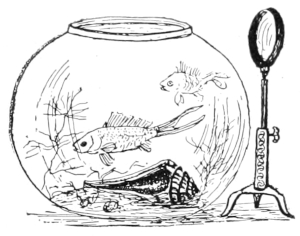
NCE upon a time, if stories are true, there lived a king called Midas, whose touch turned everything to gold. Whenever I see goldfish, I wonder if, perhaps, King Midas were not a Chinese and if he perchance did not handle some of the little fish in Orient streams. But common man has learned a magic as wonderful as that of King Midas, although it does not act so immediately, for it is through his agency in selecting and breeding that we have gained these exquisite fish for our aquaria. In the streams of China the goldfish, which were the ancestors of these effulgent creatures, wore safe green colors like the shiners in our brooks; and if any goldfish escape from our fountains and run wild, their progeny return to their native olive-green color. There are many such dull-colored goldfish in the Delaware and Potomac and other eastern rivers. It is almost inconceivable that one of the brilliant colored fishes, if it chanced to escape into our ponds, should escape the fate of being eaten by some larger fish attracted by such glittering bait.
The goldfish, as we see it in the aquarium, is brilliant orange above and pale lemon-yellow below; there are many specimens that are adorned with black patches. And as if this fish were bound to imitate the precious metals, there are individuals which are silver instead of gold: they are oxydized silver above and polished silver below. The goldfish are closely related to the carp and can live in waters that are stale. However, the water in the aquarium should be changed at least twice a week to keep it clear. Goldfish should not be fed too lavishly. An inch square of one of the sheets of prepared fish food, we have found a fair daily ration for five medium sized fish; these fish are more likely to die from overfeeding than from starving. Goldfish are naturally long-lived; Miss Ada Georgia has kept them until seven years old in a school aquarium; and there is on record one goldfish that lived nine years.
Too often the wonderful common things are never noticed because of their commonness; and there is no better instance of this than the form and movements of a fish. It is an animal in many ways similar to animals that live on land; but its form and structure are such that it is perfectly adapted to live in water all its life; there are none of the true fishes which live portions of their lives on land as do the frogs. The first peculiarity of the fish is its shape. Looked at from above, the broader part of the body is near the front end which is rounded or pointed so as to cut the water readily. The long, narrow, hind portion of the body with the tail acts as a propeller. Seen from the side, the body is a smooth, graceful oval and this form is especially adapted to move through the water swiftly, as can be demonstrated to the pupil by cutting a model of the fish from wood and trying to move it through the water sidewise.
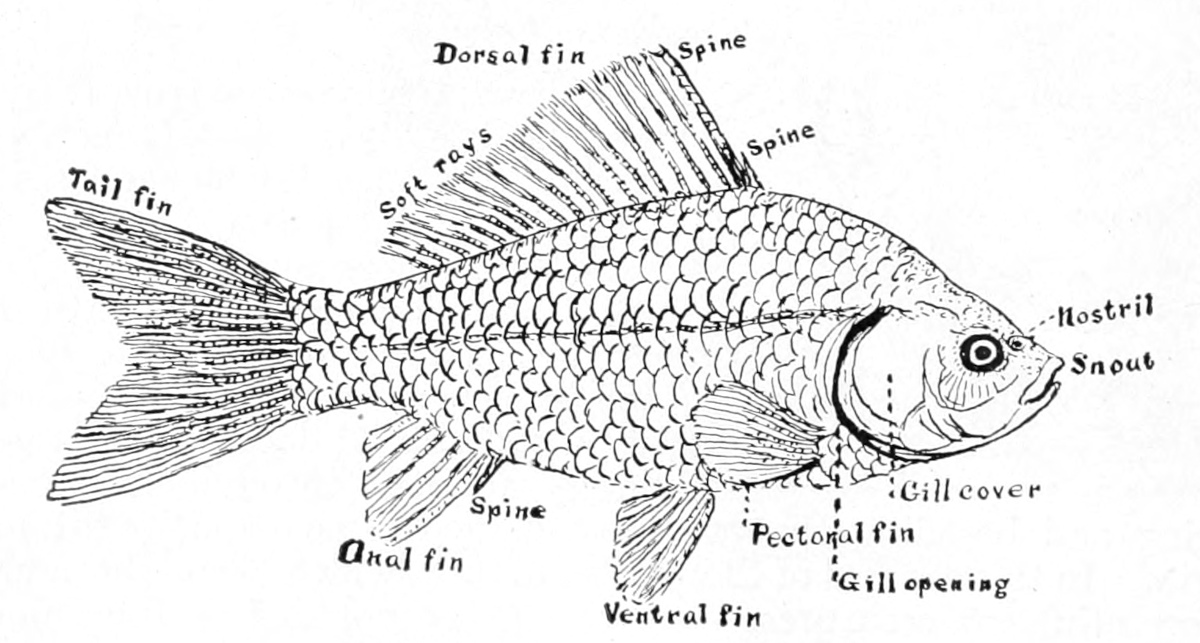
Goldfish with the parts named. This figure should be copied on the blackboard for reference.
Normally, the fish has seven fins, one along the back called the dorsal, one at the end of the tail called the tail or caudal fin, one beneath the rear end of the body called the anal, a pair on the lower side of the body called the ventrals, and a pair just back of the gill openings called the pectorals. All these fins play their own parts in the movements of the fish. The dorsal fin is usually higher in front than behind and can be lifted or shut down like a fan. This fin when it is lifted gives the fish greater height and it can be twisted to one side or the other and thus be made a factor in steering. The anal fin on the lower side acts in a similar manner. The tail fin is the propeller and sends the body forward by pressing backward on the water, first on one side and then on the other, being used like a scull. The tail fin varies in shape very much in different species. In the goldfish it is fanlike, with a deeply notched hind edge, but in some it is rounded or square.
The paired fins correspond anatomically to our arms and legs, the pectorals representing the arms, the ventrals the legs. Fins are made up of rays, as the bony rods are called which support the membrane; these rays are of two kinds, those which are soft, flexible, many jointed and usually branched at the tip; and those which are bony, not jointed and which are usually stiff spines. When the spines are present in a fin they precede the soft rays.
Fishes’ eyes have no eyelid but the eyeball is movable, and this often gives the impression that the fish winks. Fishes are necessarily near-sighted since the lens of the eye has to be spherical in order to see in the water. The sense of smell is located in a little sac to which the nostril leads; the nostrils are small and often partitioned and may be seen on either side of the snout. The nostrils have no connection whatever with breathing, in the fish.
The tongue of the fish is very bony or bristly and immovable. There is very little sense of taste developed in it. The shape, number and position of the teeth vary according to the food habits of the fish. The commonest type of teeth are fine, sharp and short and are arranged in pads, as seen in the bullhead. Some fish have blunt teeth suitable for crushing shells. Herbivorous fishes have sharp teeth with serrated edges, while those living upon crabs and snails have incisor-like teeth. In some specimens we find several types of teeth, in others the teeth may be entirely absent. The teeth are borne not only on the jaws but also in the roof of the mouth, on the tongue and in the throat.
The ear of the fish has neither outside form nor opening and is very imperfect in comparison with that of man. Extending along the sides of the body from head to tail is a line of modified scales containing small tubes connecting with nerves; this is called the lateral line and it is believed that it is in some way connected with the fish’s senses, perhaps with the sense of hearing.
Since fishes must push through water, which is more difficult than moving through air, they need to have the body well protected. This protection is, in most fishes, in the form of an armor of scales which are smooth and allow the body to pass through the water with little friction. These scales overlap like shingles in a roof and are all directed backward. The study of the fish scale shows that it grows in layers.
In order to understand how the fish breathes we must examine its gills. In front, just above the entrance to the gullet are several bony ridges which bear two rows of pinkish fringes; these are the gill arches and the fringes are the gills. The gills are filled with tiny blood vessels, and as the water passes over them, the impurities of the blood pass out through the thin skin of the gills and the life-giving oxygen passes in. Since fish cannot make use of air unless it is dissolved in water, it is very important that the water in the aquarium jar should often be replenished. The gill arches also bear a series of bony processes called gill-rakers. Their function is to prevent the escape of food through the gills while it is being swallowed, and they vary in size according to the food habits of the fish. We note that the fish in the aquarium constantly opens and closes the mouth; this action draws the water into the throat and forces it out over the gills and through the gill openings; this then, is the act of breathing.
LESSON XXXVI
A Study of the Fish
Leading thought—A fish lives in the water where it must breathe, move and find its food. The water world is quite different from the air world and the fish have developed forms, senses and habits which fit them for life in the water.
Method—The goldfish is used as a subject for this lesson because it is so conveniently kept where the children may see it. However, a shiner or minnow would do as well.
Before the pupils begin the study, place the diagram shown on p. 150 on the blackboard, with all the parts labelled; thus the pupils will be able to learn the parts of the fish by consulting it, and not be compelled to commit them to memory arbitrarily. It would be well to associate the goldfish with a geography lesson on China.
Observations—1. Where do fishes live? Do any fishes ever live any part of their lives on land like the frogs? Could a salt-water fish live in fresh water, or vice versa?
2. What is the shape of a fish when seen from above? Where is the widest part? What is its shape seen from the side? Think if you can in how many ways the shape of the fish is adapted for moving swiftly through the water.
3. How many fins has the fish? Make a sketch of the goldfish with all its fins and name them from the diagram on the blackboard.
4. How many fins are there in all? Four of these fins are in pairs; where are they situated? What are they called? Which pair corresponds to our arms? Which to our legs?
5. Describe the pectoral fins. How are they used? Are they kept constantly moving? Do they move together or alternately? How are they used when the fish swims backwards?
6. How are the ventral fins used? How do they assist the fish when swimming?
7. Sketch a dorsal fin. How many spines has it? How many soft rays are there in it? What is the difference in structure between the stiff spines in the front of the dorsal fin and the rays in the hind portion? Of what use to the fish are these two different kinds of fin supports?
8. Sketch the anal fin. Has it any spines in front? How many rays has it? How is this fin used when the fish is swimming?
9. With what fin does the fish push itself through the water? Make a sketch of the tail. Note if it is square, rounded, or notched at the end. Are the rays of the tail fin spiny or soft in character?
10. Watch the goldfish swim and describe the action of all the fins while it is in motion. In what position are the fins when the fish is at rest?
11. What is the nature of the covering of the fish? Are the scales large or small? In which direction do they seem to overlap? Of what use to the fish is this scaly covering?
12. Can you see a line which extends from the upper part of the gill opening, along the side to the tail? This is called the lateral line. Do you think it is of any use to the fish?
13. Note carefully the eyes of the fish. Describe the pupil and the iris. Are the eyes placed so that the fish can see in all directions? Can they be moved so as to see better in any direction? Does the fish wink? Has it any eyelids? Do you know why fish are near-sighted?
14. Can you see the nostrils? Is there a little wartlike projection connected with the nostril? Do you think fishes breathe through their nostrils?
15. Describe the mouth of the fish. Does it open upward, downward, or directly in front? What sort of teeth have fish? How does the fish catch its prey? Does the lower or upper jaw move in the process of eating?
16. Is the mouth kept always in motion? Do you think the fish is swallowing water all the time? Do you know why it does this? Can you see a wide opening along the sides of the head behind the gill cover? Does the gill cover move with the movement of the mouth? How does a fish breathe?
17. What are the colors of the goldfish above and below? What would happen to our beautiful goldfish if they were put in a brook with other fish? Why could they not hide? Do you know what happens to the colors of the goldfish when they run wild in our streams and ponds?
18. Can you find in books or cyclopedias where the goldfish came from? Are they gold and silver in color in the streams where they are native? Do you think that they had originally the long, slender, swallow tails which we see sometimes in goldfish? How have the beautiful colors and graceful forms of the gold and silver fishes been developed?
“I have my world, and so have you, A tiny universe for two, A bubble by the artist blown, Scarcely more fragile than our own, Where you have all a whale could wish, Happy as Eden’s primal fish. Manna is dropt you thrice a day From some kind heaven not far away, And still you snatch its softening crumbs, Nor, more than we, think whence it comes. No toil seems yours but to explore Your cloistered realm from shore to shore; Sometimes you trace its limits round, Sometimes its limpid depths you sound, Or hover motionless midway, Like gold-red clouds at set of day; Erelong you whirl with sudden whim Off to your globe’s most distant rim, Where, greatened by the watery lens, Methinks no dragon of the fens Flashed huger scales against the sky, Roused by Sir Bevis or Sir Guy; And the one eye that meets my view, Lidless and strangely largening, too, Like that of conscience in the dark, Seems to make me its single mark. What a benignant lot is yours That have an own All-out-of-doors, No words to spell, no sums to do, No Nepos and no parlyvoo! How happy you, without a thought Of such cross things as Must and Ought— I too the happiest of boys To see and share your golden joys!” —“The Oracle of the Goldfishes,” Lowell.
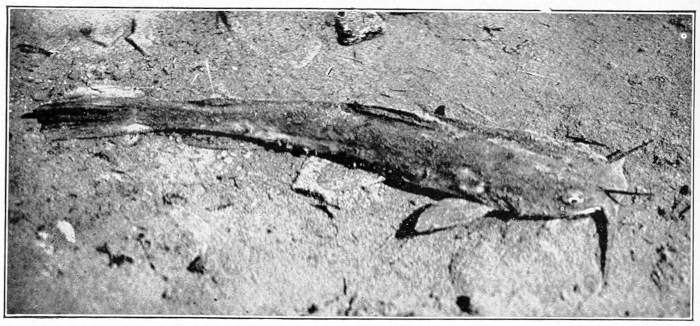
Bullhead at bottom of a pond. Photo by Verne Morton.
THE BULLHEAD
Teacher’s Story
“The bull-head does usually dwell and hide himself in holes or amongst stones in clear water; and in very hot days will lie a long time very still and sun himself and will be easy to be seen on any flat stone or gravel; at which time he will suffer an angler to put a hook baited with a small worm very near into his mouth; and he never refuses to bite, nor indeed, to be caught with the worst of anglers.”—Isaak Walton.
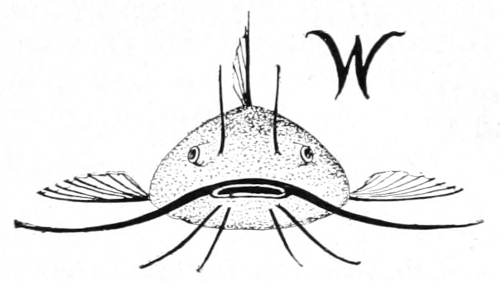
HEN one looks a bullhead in the face one is glad that it is not a real bull for its barbels give it an appearance quite fit for the making of a nightmare; and yet from the standpoint of the bullhead, how truly beautiful those fleshy feelers are! For without them how could it feel its way about searching for food in the mud where it lives? Two of these barbels stand straight up; the two largest ones stand out on each side of the mouth, and two pairs of short ones adorn the lower lip, the smallest pair at the middle.
As the fish moves about, it is easy to see that the large barbels at the side of the mouth are of the greatest use; it keeps them in a constantly advancing movement, feeling of everything it meets. The upper ones stand straight up, keeping watch for whatever news there may be from above; the two lower ones spread apart and follow rather than precede the fish, seeming to test what lies below. The upper and lower pairs seem to test things as they are, while the large side pair deal with what is going to be. The broad mouth seems to be formed for taking in all things eatable, for the bullhead lives on almost anything alive or dead that it discovers as it noses about in the mud. Nevertheless, it has its notions about its food for I have repeatedly seen one draw material into its mouth through its breathing motion and then spew it out with a vehemence one would hardly expect from such a phlegmatic fish.
Although it has feelers which are very efficient, it also has perfectly good eyes which it uses to excellent purpose; note how promptly it moves to the other side of the aquarium when we are trying to study it. The eyes are not large; the pupils are black and oval and are rimmed with a narrow band of shiny pale yellow. The eyes are prominent so that when moved backward and forward they gain a view of the enemy in the rear or at the front while the head is motionless. It seems strange to see such a pair of pale yellow, almost white eyes in such a dark body.
The general shape of the front part of the body is flat, in fact, it is decidedly polywogy; this shape is especially fitted for groping about muddy bottoms. The flat effect of the body is emphasized by the gill covers opening below rather than at the sides, every pulsation widening the broad neck. The pectoral fins also open out on the same plane as the body although they can be turned at an angle if necessary; they are thick and fleshy and the sharp tips of their spines offer punishment to whomsoever touches them. The dorsal fin is far forward and not large; it is usually raised at a threatening angle.
There is a little fleshy dorsal fin near the tail which stands in line with the body and one wonders what is its special use. The ventral fins are small. The anal fin is far back and rather strong, and this with the long, strong tail gives the fish good motor power and it can swim very rapidly if occasion requires.
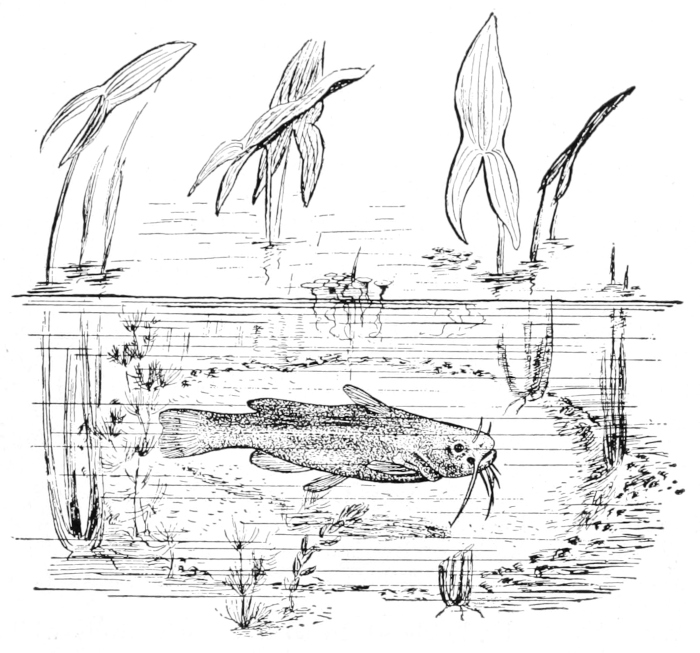
Bullhead guarding his nest. After Gill.
The bullhead is mud-colored and has no scales; and since it lives in the mud, it does not need scales to protect it; but because of its scaleless condition it is a constant victim of the lampreys, and it would do well, indeed, if it could develop an armor of scales against this parasite. The skin is very thick and leathery so that it is always removed before the fish is cooked. The bullhead is the earliest fish of the spring. This is probably because it burrows deep into the mud in the fall and remains there all winter; when the spring freshets come, it emerges and is hungry for fresh meat.
The family life of the bullheads and other catfishes seems to be quite ideal. Dr. Theodore Gill tells us that bullheads make their nests by removing stones and gravel from a more or less irregularly circular area in shallow water, and on sandy or gravelly ground. The nest is somewhat excavated, both parents removing the pebbles by sucking them into the mouth and carrying them off for some distance. After the eggs are laid, the male watches over and guards the nest and seems to have great family responsibilities. He is the more active of the two in stirring and mixing the young fry after they are hatched. Smith and Harron describe the process thus: “With their chins on the bottom, the old fish brush the corners where the fry were banked, and with the barbels all directed forward, and flexed where they touch the bottom, thoroughly agitate the mass of fry, bringing the deepest individuals to the surface. This act is usually repeated several times in quick succession.”
“The nests are usually made beneath logs or other protecting objects and in shallow water. The paternal care is continued for many days after the birth of the young. At first these may be crowded together in a dense mass, but as time passes they disperse more and more and spread around the father. Frequently, especially when the old one is feeding, some—one or more—of the young are taken into the mouth, but they are instinctively separated from the food and spit out. At last the young swarm venture farther from their birthplace, or perhaps they are led away by their parents.”
LESSON XXXVII
The Bullhead, or Horned Pout
Leading thought—The bullhead lives in mud bottoms of streams and ponds and is particularly adapted for life in such locations.
Method—A small bullhead may be placed in a small aquarium jar. At first let the water be clear and add a little pond weed so as to observe the natural tendency of the fish to hide. Later add mud and gravel to the aquarium and note the behavior of the fish.
Observations—1. What at the first glance distinguishes the bullhead from other fish? Describe these strange “whiskers” growing about the mouth; how many are there and where are they situated? Which are the longest pair? Can the fish move them in any direction at will?
2. Where do we find bullheads? On what do they feed? Would their eyes help them to find their food in the mud? How do they find it?
3. Explain, if you can, why the bullhead has barbels, or feelers, while the trout and bass have none.
4. What is the shape of the bullhead’s mouth?
5. What is the general shape of the body? What is its color? Has it any scales?
6. Why should the bullhead be so flat horizontally while the sunfish is so flat in the opposite direction?
7. Describe the bullhead’s eyes. Are they large? What is their color? Where are they placed?
8. Describe the dorsal fin, giving its comparative size and position. Do you see another dorsal fin? Where is this peculiar fin and how does it differ from the others?
9. Describe the tail fin. Does it seem long and strong? Is the bullhead a good swimmer?
10. Is the anal fin large or small as compared with that of the goldfish?
11. How do the pectoral fins move as compared with those of the sunfish? Why is the position of the pectoral and dorsal fins of benefit to this fish?
12. How does the bullhead inflict wounds when it is handled? Tell how these spines protect it from its natural enemies.
13. When is the best season for fishing for bullheads? Does the place where they are found affect the flavor of their flesh? Why?
14. What is the spawning season? Do you know about the nests the bullheads build and the care they give their young?
15. Write an essay on the nest-making habits of the bullheads and the care given the young by the parents.
“And what fish will the natural boy naturally take? In America, there is but one fish which enters fully into the spirit of the occasion. It is a fish of many species according to the part of the country, and of as many sizes as there are sizes of boys. This fish is the horned pout, and all the rest of the species of Ameiurus. Horned pout is its Boston name. Bullhead is good enough for New York; and for the rest of the country, big and little, all the fishes of this tribe are called catfish. A catfish is a jolly blundering sort of a fish, a regular Falstaff of the ponds. It has a fat jowl, and a fat belly, which it is always trying to fill. Smooth and sleek, its skin is almost human in its delicacy. It wears a long mustache, with scattering whiskers of other sort. Meanwhile it always goes armed with a sword, three swords, and these it has always on hand, always ready for a struggle on land as well as in the water. The small boy often gets badly stuck on these poisoned daggers, but, as the fish knows how to set them by a muscular twist, the small boy learns how, by a like untwist, he may unset and leave them harmless.”
“The catfish lives in sluggish waters. It loves the millpond best of all, and it has no foolish dread of hooks when it goes forth to bite. Its mouth is wide. It swallows the hook, and very soon it is in the air, its white throat gasping in the untried element. Soon it joins its fellows on the forked stick, and even then, uncomfortable as it may find its new relations, it never loses sight of the humor of the occasion. Its large head and expansive forehead betoken a large mind. It is the only fish whose brain contains a Sylvian fissure, a piling up of tissue consequent on the abundance of gray matter. So it understands and makes no complaint. After it has dried in the sun for an hour, pour a little water over its gills, and it will wag its tail, and squeak with gratitude. And the best of all is, there are horned pouts enough to go around.”
“The female horned pout lays thousands of eggs, and when these hatch, she goes about near the shore with her school of little fishes, like a hen with myriad chicks. She should be respected and let alone, for on her success in rearing this breed of “bullying little rangers” depends the sport of the small boy of the future.” —David Starr Jordan, in Fish Stories.
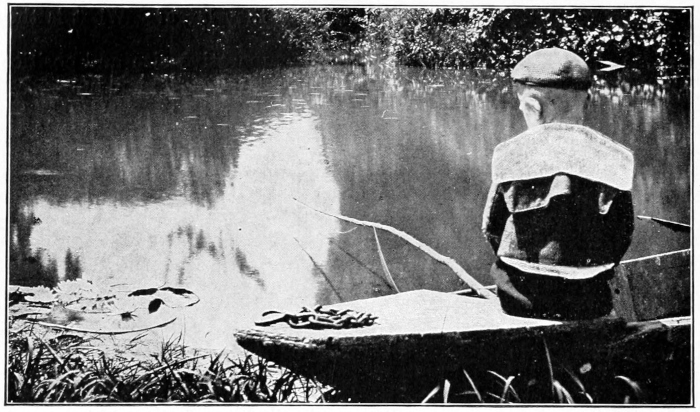
Fishing for suckers. Photo by Verne Morton.
THE COMMON SUCKER
Teacher’s Story
E who loves to peer down into the depths of still waters, often sees upon the sandy, muddy or rocky bottom several long, wedge-shaped sticks lying at various angles one to another. But if he thrust down a real stick, behold, these inert, water-logged sticks move off deftly! And then he knows that they are suckers. He may drop a hook baited with a worm in front of the nose of one, and if he waits long enough before he pulls up he may catch this fish, not by its gills but by the pit of its stomach; for it not only swallows the hook completely but tries to digest it along with the worm. Its food is made up of soft-bodied insects and other small water creatures; it is also a mud eater and manages to make a digestive selection from the organic material of silt. For this latter reason, it is not a desirable food fish although its flesh varies in flavor with the locality where it is found. The suckers taken along the rocky shores of Cayuga Lake are fairly palatable, while those taken in the mud of the Cayuga Inlet are very inferior in flavor and often uneatable.
Seen from above, the sucker is wedge-shaped, being widest at the eyes; seen from the side it has a flat lower surface and an ungracefully rounded contour above which tapers only slightly toward the tail. The profile of the face gives the impression of a Roman nose. The young specimens have an irregular scale-mosaic pattern of olive-green blotches on a paler ground color, while the old ones are quite brown above and on the sides. The suckers differ from most other fishes in having the markings of the back extend down the sides almost to the belly. This is a help in concealing the fish, since its sides show from above quite as distinctly as its back because of its peculiar form. The scales are rather large and are noticeably larger behind than in the region of the head. Like other fish it is white below.
The dorsal fin is placed about midway the length of the fish as measured from nose to tail. It is not large and appears to have twelve rays; but there is a short spine in front and a delicate soft ray behind so that it really has fourteen. The tail is long and strong and deeply notched: the anal fin extends back to where the tail begins. The ventral fins are small and are directly opposite the hind half of the dorsal fin. The pectorals are not large but are strong and are placed low down. The sucker has not a lavish equipment of fins but its tail is strong and it can swim swiftly; it is also a tremendous jumper; it will jump from the aquarium more successfully than any other fish. When resting on the bottom, it is supported by its extended pectoral and ventral fins, which are strong although not large.
The eyes are fairly large but the iris is not shiny; they are placed so that the fish can easily see above it as well as at the sides; the eyes move so as to look up or down and are very well adapted to serve a fish that lives upon the bottom. The nostrils are divided, the partition projecting until it seems a tubercle on the face. The mouth opens below and looks like the puckered opening of a bag. The lips are thick but are very sensitive; it is by projecting these lips, in a way that reminds one of a very short elephant’s trunk, that it is enabled to reach and find its food in the mud or gravel; so although the sucker’s mouth is not a beautiful feature, it is doubly useful. The sucker has the habit of remaining motionless for long periods of time. It breathes very slowly and appears sluggish; it never seizes its food with any spirit but simply slowly engulfs it; and for this reason it is considered poor game. It is only in the spring when they may be speared through the ice that there is any fun in catching suckers; it is at this season of the year that they move to shallow water to spawn; those in the lakes move to the rivers, those in the rivers to the creeks, those in the creeks to the brooks. Even so lowly a creature as the sucker seems to respond to influences of the springtime, for at that period the male has a faint rosy stripe along his sides. In the winter these fish burrow in the mud of the river or pond bottoms; they may be frozen and thawed without harming them.
There are many species of suckers and they vary in size from six inches to three feet in length. They inhabit all sorts of waters, but they do not like a strong current and are, therefore, found in still pools. The common sucker (Catostomus commersoni), which is the subject of this lesson, sometimes attains the length of twenty-two inches and the weight of five pounds. The ones under observation were about eight inches long, and proved to be the acrobats of the aquarium, since they were likely at any moment to jump out; several times I found one languishing on the floor.
LESSON XXXVIII
The Common Sucker
Leading thought—The sucker is especially adapted by shape for lying on the bottom of ponds under still water where its food is abundant.
Method—If still water pools along river or lakesides are accessible, it is far more interesting to study a sucker in its native haunts, as an introduction to the study of its form and colors when it is in the aquarium.
Observations—1. Where do you find suckers? How do you catch them? Do they take the hook quickly? What is the natural food of the sucker?
2. What is the shape of this fish’s body when seen from above? From the side? What is the color above? On the sides? Below? Does the sucker differ from most other fishes in the coloring along its sides? What is the reason for this? What do suckers look like on the bottom of the pond? Are they easily seen?
3. Describe or sketch a sucker, showing the position, size and shape of the fins and tail. Are its scales large or small? How does it use its fins when at rest? When moving? Is it a strong swimmer? Is it a high jumper?
4. Describe the eyes; how are they especially adapted in position and in movement to the needs of a fish that lives on the bottom of streams and ponds?
5. Note the nostrils; what is there peculiar about them?
6. Where is the mouth of the sucker situated? What is its form? How is it adapted to get the food which the sucker likes best?
7. Tell all you know about the habits of the suckers. When do you see them first in the spring? Where do they spend the winter? Where do they go to spawn? How large is the largest one you have ever seen? Why is their flesh usually considered poor in quality as food? Is there a difference in the flavor of its flesh depending upon the locality in which the fish lives? Why?
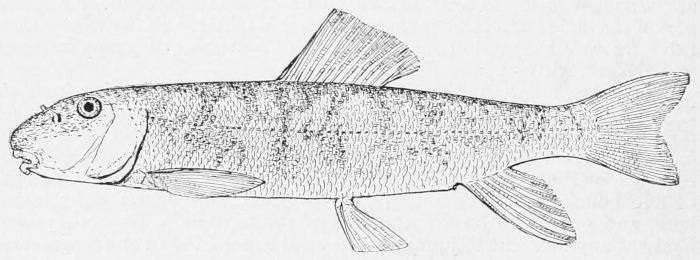
The common sucker.
“
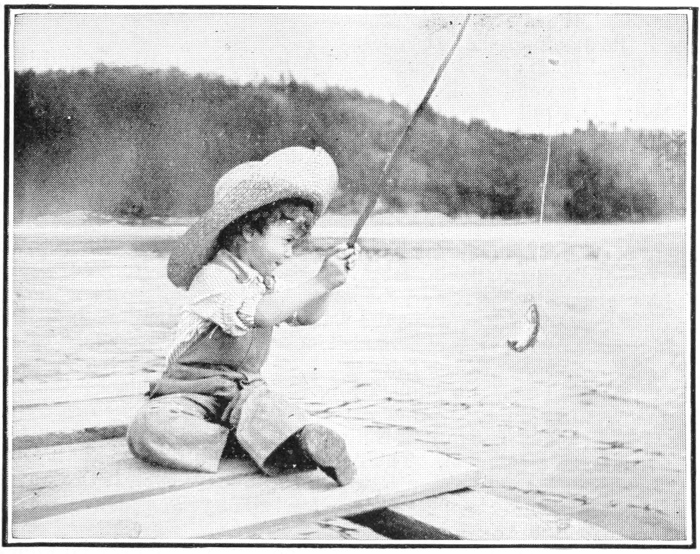
I’m only wishing to go a fishing.
”
THE SHINER
Teacher’s Story
“This is a noteworthy and characteristic lineament, or cipher, or hieroglyphic, or type of spring. You look into some clear, sandy bottomed brook where it spreads into a deeper bay, yet flowing cold from ice and snow not far off, and see indistinctly poised over the sand on invisible fins, the outlines of the shiner, scarcely to be distinguished from the sands behind it as if it were transparent.”—Thoreau.
HERE are many species of shiners and it is by no means easy to recognize them nor to distinguish them from chub, dace and minnows since all these belong to one family; they all have the same arrangement of fins and live in the same water; and the plan of this lesson can with few changes be applied to any of them.
Never were seen more exquisite colors than shimmer along the sides of the common shiner (Notropis cornutus). It is pale olive-green above, just a sunny brook-color; this is bordered at the sides by a line of iridescent blue-purple, while the shining silver scales on the sides below, flash and glimmer with the changing hues of the rainbow. The minnows are darker than the shiners; the horned dace develops little tubercles on the head during the breeding season, which are lost later.
The body of the shiner is ideal for slipping through the water. Seen from above it is a narrow wedge, rounded in front and tapering to a point behind; from the side, it is long, oval, lance-shaped. The scales are large and beautiful, the lateral line looks like a series of dots embroidered at the center of the diamond-shaped scales.
The dorsal fin is placed just back of the center of the body and is not very large; it is composed of soft rays, the first two being stiff and unbranched. The tail is long, large, graceful and deeply notched. The anal fin is almost as large as the dorsal. The ventral pair is placed on the lower side, opposite the dorsal fin; the pectorals are set at the lower margin of the body, just behind the gill openings. The shiner and its relatives use the pectoral fins to aid in swimming, and keep them constantly in motion when moving through the water. The ventrals are moved only now and then and evidently help in keeping the balance. When the fish moves rapidly forward, the dorsal fin is raised so that its front edge stands at right angles to the body and the ventral and anal fins are expanded to their fullest extent. But when the fish is lounging, the dorsal, anal and ventral fins are more or less closed, although the tip of the dorsal fin swings with every movement of the fish.
The eyes are large, the pupils being very large and black; the iris is pale yellow and shining; the whole eye is capable of much movement forward and back. The nostril is divided by a little projecting partition which looks like a tubercle. The mouth is at the front of the head; to see the capabilities of this mouth, watch the shiner yawn, if the water of the aquarium becomes stale. Poor fellow! He yawns just as we do in the effort to get more oxygen.
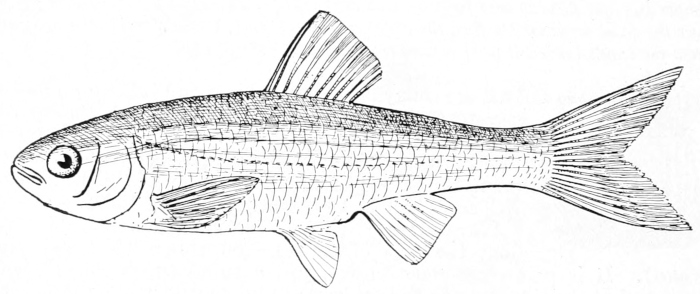
The common shiner.
The shiners are essentially brook fish although they may be found in larger bodies of water. They lead a precarious existence, for the larger fish eat them in all their stages. They only hold their own by laying countless numbers of eggs. They feed on water insects and get even with their big fish enemies by eating their eggs. They are pretty and graceful little creatures and may be seen swimming up the current in the middle of the brook. They often occur in schools or flocks, especially when young.
LESSON XXXIX
The Shiner
Leading thought—The shiners are among the most common of the little fish in our small streams. They are beautiful in form and play an important part in the life of our streams.
Method—Place in the aquarium shiners and as many as possible of the other species of small fish found in our creeks and brooks. The aquarium should stand where the pupil may see it often. The following questions may be asked, giving the children plenty of time for the work of observation:
Observations—1. Do you know how the shiner differs in appearance from the minnow and chub and dace?
2. What is the shape of the shiner’s body when seen from above? When seen from the side? Do you think that its shape fits it for moving rapidly through the water?
3. What is the coloring above? On the sides? Below?
4. Are the scales large and distinct, or very small? Can you see the lateral line? Where are the tiny holes, which make this line, placed in the scales?
5. Describe or sketch the fish, showing position, relative size and shape of all the fins and the tail.
6. Describe the use and movements of each of the fins when the fish is swimming.
7. Describe the eyes. Do they move?
8. Describe the nostrils. Do you think each one is double?
9. Does the mouth open upwards, downwards or forwards? Have you ever seen the shiner yawn? Why does it yawn? Why do you yawn?
10. Where do you find the shiners living? Do they haunt the middle of the stream or the edges? Do you ever see them in flocks or schools?
MINNOWS How silent comes the water round that bend; Not the minutest whisper does it send To the o’er hanging sallows; blades of grass Slowly across the chequer’d shadows pass, Why, you might read two sonnets, ere they reach To where the hurrying freshnesses aye preach A natural sermon o’er their pebbly beds; Where swarms of minnows show their little heads, Staying their wavy bodies ’gainst the streams, To taste the luxury of sunny beams Tempered with coolness. How they ever wrestle With their own sweet delight, and ever nestle Their silver bellies on the pebbly sand! If you but scantily hold out the hand, That very instant not one will remain; But turn your eye, and there they are again. The ripples seem right glad to reach those cresses, And cool themselves among the em’rald tresses; The while they cool themselves, they freshness give, And moisture, that the bowery green may live. —John Keats.
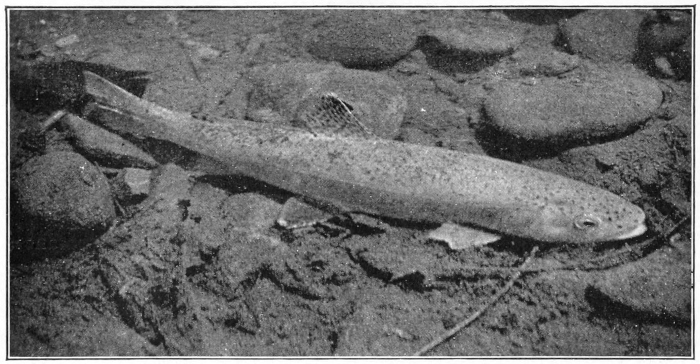
A speckled trout on a brook bottom. Photo by Verne Morton.
THE BROOK TROUT
Teacher’s Story
“Up and down the brook I ran, where beneath the banks so steep, Lie the spotted trout asleep.” —Whittier.
UT they were probably not asleep as Mr. Whittier might have observed if he had cast a fly near one of them. There is in the very haunts of the trout, a suggestion of where it gets its vigor and wariness: The cold, clear streams where the water is pure; brooks that wind in and out over rocky and pebbly beds, here shaded by trees and there dashing through the open,—it makes us feel vigorous even to think of such streams. Under the overhanging bank or in the shade of some fallen log or shelving rock, the brook trout hides where he may see all that goes on in the world above and around him without being himself seen. Woe to the unfortunate insect that falls upon the surface of the water in his vicinity or even that flies low over the surface for the trout will jump easily far out of the water to seize its prey! It is this habit of taking the insect upon and above the water’s surface which has made trout fly-fishing the sport that it is. Man’s ingenuity is fairly matched against the trout’s cunning in this contest. I know of one old trout that has kept fishermen in the region around on the qui vive for years; and up to date he is still alive, making a dash now and then at a tempting bait, showing himself enough to tantalize his would-be captors with his splendid size, but always retiring at the sight of the line.
The brook trout varies much in color, depending upon the soil and the rocks of the streams in which it lives. Its back is marbled with dark olive or black, making it just the color of shaded water. This marbled coloration also marks the dorsal and the tail fins. The sides, which vary much in color, are marked with beautiful vermilion spots, each placed in the center of a larger, brownish spot. In some instances the lower surface is reddish, in others whitish. All the fins on the lower side of the body have the front edges creamy or yellowish white, with a darker streak behind.
The trout’s head is quite large and somewhat blunt. The large eye is a little in front of the middle of the head. The dorsal fin is at about the middle of the body, and when raised is squarish in outline. Behind the dorsal fin, and near to the tail is the little, fleshy adipose fin, so called because it has no rays. The tail is fan-shaped, slightly notched at the end and is large and strong. The anal fin is rather large, being shaped much like the dorsal fin, only slightly smaller. The ventral fins are directly below the dorsal fin and a little behind its middle. The pectorals are low down, being below and just behind the gill arches.
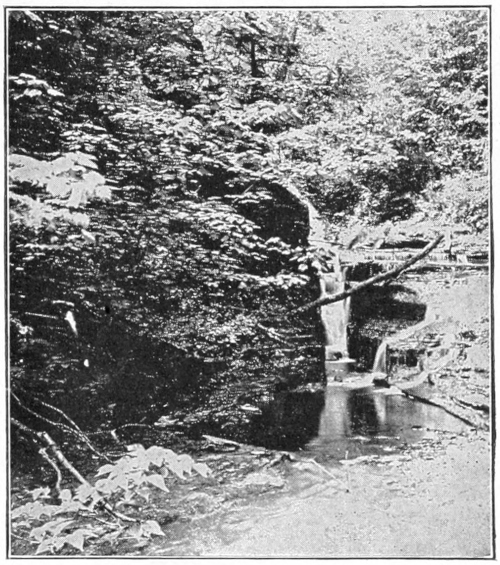
Where the trout hide.
In size the brook trout seldom is longer than seven or eight inches, but in the rivers of the Northeastern United States specimens weighing from six to eleven pounds are sometimes taken. It does not flourish in water which is warmer than 68°, but prefers a temperature of about 50°. It must have the pure water of mountain streams and cannot endure water of rivers which is polluted by mills or the refuse of cities. Where it has access to streams that flow into the ocean, it forms the salt water habit, going out to sea and remaining there during the winter. Such specimens become very large.
The trout can lay eggs when about six inches in length. The eggs are laid from September until late November, although, as Mr. Bream says, the brook trout are spawned at some locality in almost every month of the year except mid-summer. One mother trout lays from 400 to 600 eggs, but the large-sized ones lay more. The period of hatching depends upon the temperature of the water. In depositing their eggs the trout seek water with gravelly bottom, often where some mountain brook opens into a larger stream. The nest is shaped by the tail of the fish, the larger stones being carried away in the mouth. To make the precious eggs secure they are covered with gravel.
There have been strict laws enacted by almost all of our states with a view to protecting the brook trout and preserving it in our streams. The open season in New York is from the 15th of April to the 1st of September, and it is illegal to take from a stream a fish that is less than five inches in length. It is the duty of every decent citizen to abide by these laws and to see to it that his neighbors observe them. The teacher cannot emphasize enough upon the child the moral value of being law-abiding. There should be in every school in the Union children’s clubs which should have for their purpose civic honesty and the enforcement of laws which affect the city, village or township.
Almost any stream with suitable water may be stocked with trout from the national or the state hatcheries, but what is the use of this expense if the game laws are not observed and these fish are caught before they reach maturity, as is so often the case?
References—American Food and Game Fishes, Jordan & Everman; Guide to American Fishes, Jordan.
LESSON XL
The Brook Trout
Leading thought—The brook trout have been exterminated in our streams largely because the game laws have not been observed. The trout is the most cunning and beautiful of our common fishes and the most valuable for food. If properly guarded, every pure mountain stream in our country, could be well stocked with the brook trout.
Method—A trout may be kept in an aquarium of flowing water indefinitely and should be fed upon liver and hard clams chopped. If there is no aquarium with running water, the trout may be kept in an ordinary jar long enough for this lesson. The object of this lesson should be not only the study of the habits of the fish, but also a lesson in its preservation.
Observations—1. In what streams are the brook trout found? Must the water be warm or cold? Can the trout live in impure water? Can it live in salt water?
2. Do the trout swim about in schools or do they live solitary? Where do they like to hide?
3. With what kind of bait is trout caught? Why does it afford such excellent sport for fly-fishing? Can you tell what the food of the trout is?
4. What is the color of the trout above? What colors along its sides? What markings make the fish so beautiful? What is its color below? Has the trout scales? Do you see the lateral line?
5. What is the general shape of the brook trout? Describe the shape, position and color of the dorsal fin. Describe the little fin behind the dorsal. Why is it unlike the other fins? What is the shape of the tail fin? Is it rounded, square or crescent-shaped across the end? What is the position and size of the anal fin compared with the dorsal? What colors on the ventral fins and where are they placed in relation to the dorsal fin? What color are the pectoral fins and how are they placed in relation to the gill arches?
6. Describe the trout’s eyes. Are they large and alert? Do you think the trout is keen-sighted?
7. When and where are the eggs laid? Describe how the nest is made. How are the eggs covered and protected?
8. Why are there no trout in the streams of your neighborhood? Could a trout live in these streams? Can you get state aid in stocking the streams?
9. What are the game laws concerning trout fishing? When is the open season? How long must the trout be to be taken legally? If you are a good citizen what do you do about the game laws?
10. Write a story telling all you know about the wariness, cunning and strength of the brook trout.
Supplementary reading—The following from Fish Stories by Holder and Jordan: “The Trout of Los Laurelles;” “The Golden Trout of the High Sierras;” “The Lure of the Rainbow.” “The Story of the Salmon” in Science Sketches; “The Master of the Golden Pool” in Watchers of the Trails; The Story of the Fishes, Baskett; Neighbors with Wings and Fins, Johonnet.
TROUT
“It is well for anglers not to make trout, of all fishes, the prime objective of a day’s sport, as no more uncertain game loves the sunlight. Today he is yours for the very asking; tomorrow, the most luscious lure will not tempt him. One hour he defies you, the next, gazes at you from some ensconcement of the fishes, and knows you not, as you pass him, casting, by.
I believe I accumulated some of this angling wisdom years ago, in a certain trout domain in New England, where there were streams and pools, ripples, cascades and drooping trees; where everything was fair and promising to the eyes for trout; but it required superhuman patience to lure them, and many a day I scored a blank. Yet on these very days when lures were unavailing, the creel empty save for fern leaves, I found they were not for naught; that the real fishing day was a composite of the weather, the wind, even if it was from the east, the splendid colors of forest trees, the blue tourmaline of the sky that topped the stream amid the trees, the flecks of cloud mirrored on the surface. The delight of anticipation, the casting, the play of the rod, the exercise of skill, the quick turns in the steam opening up new vistas, the little openings in the forest, through which were seen distant meadows and nodding flowers—all these went to make up the real trout fishing, the actual catch being but an incident among many delights.
Just how long one could be content with mere scenery in lieu of trout, I am not prepared to say; if pushed to the wall, I confess that when fishing I prefer trout to scenic effects. Still, it is a very impracticable and delightful sentiment with some truth to it, the moral being that the angler should be resourceful, and not be entirely cast down on the days when the wind is in the east.
I am aware that this method of angling is not in vogue with some, and would be deemed fanciful, indeed inane, by many more; yet it is based upon a true and homely philosophy, not of today, the philosophy of patience and contentment. “How poor are they that have not patience,” said Othello. It is well to be content with things as we find them, and it is well to go a-fishing, not to catch fish alone, but every offering the day has to give. This should be an easy matter for the angler, as Walton tells us that Angling is somewhat like poetry, men are to be born so.” —Fish Stories, Jordan and Holder.
THE STICKLEBACK
Teacher’s Story
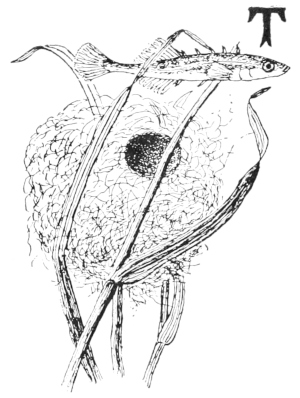
Stickleback guarding his nest. Drawn from nature.
HIS is certainly the most sagacious of the Lilliputian vertebrates; scarcely more than an inch in length when full-grown, it gazes at you with large, keen, shining-rimmed eyes, takes your measure and darts off with a flirt of the tail that says plainly, “Catch me if you can.” The sticklebacks are delightful aquarium pets because their natural home is in still water sufficiently stagnant for algæ to grow luxuriously; thus we but seldom need to change the water in the aquarium, which, however, should be well stocked with water plants and have gravel at the bottom.
When the stickleback is not resting he is always going somewhere and he knows just where he is going and what he is going to do, and earthquakes shall not deter him. He is the most dynamic creature in all creation, I think, except perhaps the dragon fly, and he is so ferocious that if he were as large as a shark he would destroy all other fishes. Place an earthworm, cut into small sections, in the aquarium and while each section is wriggingly considering whether it may be able to grow both ends into another worm, the stickleback takes hold with a will and settles the matter in the negative. His ferocity is frightful to behold as he seizes his prey and shakes it as a terrier does a rat.
Well is this fish named stickleback, for along the ridge of its back are sharp, strong spines—five of them in our tiny, brook species. These spines may be laid back flat or they may be erected stiffly, making an efficient saw which does great damage to fish many times larger than the stickleback. When we find the minnows in the aquarium losing their scales we may be sure they are being raked off by this saw-back; and if the shiner or sunfish undertakes to make a stickleback meal, there is only one way to do it, and that is to catch the quarry by the tail, since he is too alert to be caught in any other way. But swallowing a stickleback tail first is a dangerous performance, for the sharp spines rip open the throat or stomach of the captor. Dr. Jordan says that the sticklebacks of the Puget Sound region are called “salmon killers” and that they well earn the name; these fierce midgets unhesitatingly attack the salmon, biting off pieces of their fins and also destroying their spawn.
As seen from the side, the stickleback is slender and graceful, pointed like an arrow at the front end, and with the body behind the dorsal fin forming a long and slender pedicel to support the beautifully rounded tail fin. The dorsal fin is placed well back and is triangular in shape; the anal fin makes a similar triangle opposite it below and has a sharp spine at its front edge. The color of the body varies with the light; when floating among the water weed the back is greenish mottled with paler green, but when the fish is down on the gravel it is much darker. The lateral line is marked by a rather broad silver stripe.
If large eyes count for beauty, then the stickleback deserves “the apple,” for its eyes are not only large but gemlike, with a broad iris of golden brown around the black pupil. I am convinced that the stickleback has a keener vision than most fish; it can move its eyes backward and forward rapidly and alertly. The mouth opens almost upward and is a wicked little mouth, both in appearance and action.
When swimming, the stickleback darts about rapidly, its dorsal and anal fins extended, its spines all abristle, its tail lashing the water with strong strokes and the pectorals flying so fast that they make a blur; the ventral fins are rarely extended, in fact they are nothing but two little spines. When the fish wishes to lift itself through the water it seems to depend entirely upon its pectoral fins and these are also used for balancing. Its favorite position is hanging motionless among the pond weeds, with the tail, the dorsal and ventral fins partially closed; it usually rests upon the pectoral fins which are braced against some stem; in one case I saw the ventrals and pectorals used together to clasp a stem and hold the fish in place. In moving backward the pectorals do the work, with a little beckoning motion of the tail occasionally. When resting upon the bottom of the aquarium, it closes its fins and makes itself quite inconspicuous. It can dig with much power accomplishing this by a comical augerlike motion; it plunges head first into the gravel and then by twisting the body and tail around and around, it soon forms a hiding place.
But it is as a house builder and father and home protector that the stickleback shines. In the early spring he builds him a nest made from the fine green algæ called frog-spittle. This would seem a too delicate material for the house construction, but he is a clever builder. He fastens his filmy walls to some stems of reed or grass, using as a platform a supporting stem; the ones which I have especially studied were fastened to grass stems. The stickleback has a little cement plant of his own, supposed to be situated in the kidneys, which at this time of year secrete the glue for building purposes. The glue is waterproof. It is spun out in fine threads or in filmy masses through an opening near the anal fin. One species weights his platform with sand which he scoops up from the bottom, but I cannot detect that our brook stickleback does this. In his case, home is his sphere literally, for he builds a spherical house about the size of a glass marble, three-quarters of an inch in diameter; it is a hollow sphere and he cements the inside walls so as to hold them back and give room, and he finishes his pretty structure with a circular door at the side. When finished, the nest is like a bubble, made of threads of down and yet it holds together strongly.
In the case of the best known species, the male, as soon as he has finished his bower to his satisfaction, goes a-wooing; he selects some lady stickleback, and in his own way tells her of the beautiful nest he has made and convinces her of his ability to take care of a family. He certainly has fetching ways for he soon conducts her to his home. She enters the nest through the little circular door, lays her eggs within it, and then being a flighty creature, she sheds responsibilities and flits off care free. He follows her into the nest, scatters the fertilizing milt over the eggs and then starts off again and rolls his golden eyes on some other lady stickleback and invites her also to his home; she comes without any jealousy because she was not first choice, and she also enters the nest and lays her eggs and then swims off unconcernedly. Again he enters the nest and drops more milt upon the eggs and then fares forth again, a still energetic wooer. If there was ever a justified polygamist, he is one, since it is only the cares and responsibilities of the home that he desires. He only stops wooing when his nest holds as many eggs as he feels equal to caring for. He now stands on guard by the door, and with his winnowing pectoral fins, sets up a current of water over the eggs; he drives off all intruders with the most vicious attacks, and keeps off many an enemy simply by a display of reckless fury; thus he stands guard until the eggs hatch and the tiny little sticklebacks come out of the nest and float off, attaching themselves by their mouths to the pond weeds until they become strong enough to scurry around in the water.
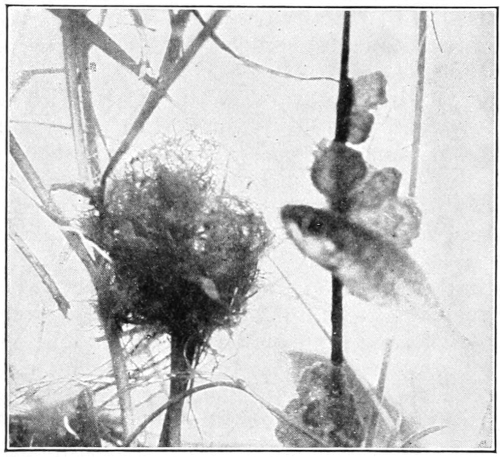
The five-spined stickleback and his nest. Photo by Eugene Barker.
Some species arrange two doors in this spherical nest so that a current of water can flow through and over the eggs. Mr. Eugene Barker, who has made a special study of the little five-spined sticklebacks of the Cayuga Basin, has failed to find more than one door to their nests. Mr. Barker made a most interesting observation on this stickleback’s obsession for fatherhood. He placed in the aquarium two nests, one of which was guarded by its loyal builder, which allowed himself to be caught rather than desert his post; the little guardian soon discovered the unprotected nest and began to move the eggs from it to his own, carrying them carefully in his mouth. This addition made his own nest so full that the eggs persistently crowded out of the door, and he spent much of his time nudging them back with his snout. We saw this stickleback fill his mouth with algæ from the bottom of the aquarium, and holding himself steady a short distance away, apparently blow the algæ at the nest from a distance of half an inch, and we wondered if this was his method of laying on his building materials before he cemented them.
The eggs of this species are white and shining like minute pearls, and seem to be fastened together in small packages with gelatinous matter. The mating habits of this species have not been thoroughly studied; therefore, here is an opportunity for investigation on the part of the boys and girls.
LESSON XLI
The Stickleback
Leading thought—The stickleback is the smallest of our common fish. It lives in stagnant water. The father stickleback builds his pretty nest of frog-spittle which he watches very carefully.
Method—To find sticklebacks go to a pond of stagnant water which does not dry up during the year. If it is partly shaded by bushes so much the better. Take a dip net and dip deeply; carefully examine all the little fish in the net by putting them in a Mason jar of water so that you can see what they are like. The stickleback is easily distinguished by the five spines along its back. If you collect these fish as early as the first of May and place several of them in the aquarium with plenty of the algæ known as frog-spittle and other water plants they may perhaps build a nest for you. They may be fed upon bits of meat or liver chopped very fine or upon earthworms cut into small sections.
Observations—1. How did the stickleback get its name? How many spines has it? Where are they situated? Are they always carried erect? How are these spines used as weapons? How do they act as a means of safety to the stickleback?
2. Describe or make a sketch showing the shape and position of the dorsal, the anal, the ventral and the pectoral fins. What is the shape of the tail? What is the general shape of the fish?
3. What is the color of the sticklebacks? Is the color always the same? What is the color and position of the lateral line?
4. Describe the eyes. Are they large or small? Can they be moved? Do you think they can see far?
5. Describe the mouth. Does it open upward, straight ahead or downward?
6. When the stickleback is swimming what are the positions and motions of the dorsal, anal, tail and pectoral fins? Can you see the ventral pair? Are they extended when the fish is swimming?
7. When resting among the pond weed of the aquarium what fins does the stickleback use for keeping afloat? How are the other fins held? What fins does it use to move backward? Which ones are used when it lifts itself from the bottom to the top of the aquarium? How are its fins placed when it is at rest on the bottom?
8. Drop a piece of earthworm or some liver or fresh meat cut finely into the aquarium and describe the action of the sticklebacks as they eat it. How large is a full-grown stickleback?
9. In what kind of ponds do we find sticklebacks? Do you know how the stickleback nest looks? Of what is it built? How is it supported? Is there one door or two? Does the father or mother stickleback build the nest? Are the young in the nest cared for? At what time is the nest built?
Supplementary reading—Fish-stories, Chap. XXXVI, Jordan and Holder.
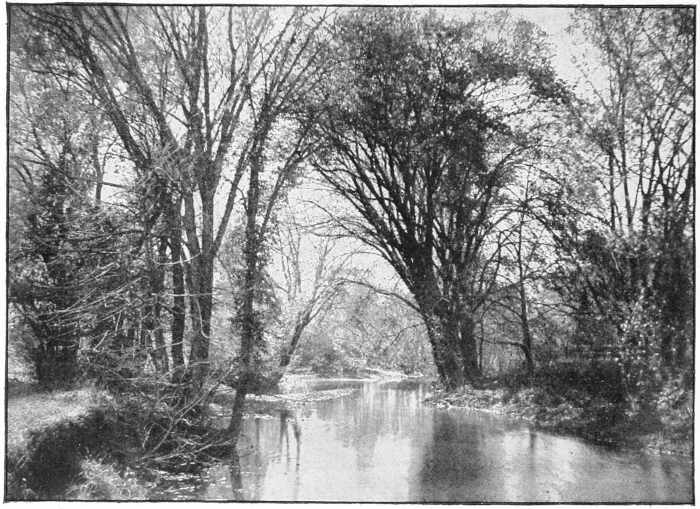
The sunfish likes quiet waters for nesting.
THE SUNFISH
Teacher’s Story
HIS little disc of gay color has won many popular names. It is called pumpkin seed, tobacco box and sunfish because of its shape, and it is also called bream and pondfish. I have always wondered that it was not called chieftain also, for when it raises its dorsal fin with its saw crest of spines, it looks like the head-dress of an Indian chief; and surely no warrior ever had a greater enjoyment in a battle than does this indomitable little fish.
The sunfish lives in the eddies of our clear brooks and ponds. It is a near relative to the rock bass and also of the black bass and it has, according to its size, just as gamey qualities as the latter. I once had a sunfish on my line which made me think I had caught a bass and I do not know whether I or the mad little pumpkin seed was the most disgusted when I discovered the truth. I threw him back in the water but his fighting spirit was up, and he grabbed my hook again within five minutes, which showed that he had more courage than wisdom; it would have served him right if I had fried him in a pan, but I never could make up my mind to kill a fish for the sake of one mouthful of food.
Perhaps of all its names, “pumpkin seed” is the most graphic, for it resembles this seed in the outlines of its body when seen from the side. Looked at from above, it has the shape of a powerful craft with smooth, rounded nose and gently swelling and tapering sides; it is widest at the eyes and this is a canny arrangement, for these great eyes turn alertly in every direction; and thus placed they are able to discern the enemy or the dinner coming from any quarter.
The dorsal fin is a most militant looking organ. It consists of ten spines, the hind one closely joined to the hind dorsal fin, which is supported by the soft rays. The three front spines rise successively, one above another and all are united by the membrane, the upper edge of which is deeply toothed. The hind dorsal fin is gracefully rounded and the front and hind fin work independently of each other, the latter often winnowing the water when the former is laid flat. The tail is strong and has a notch in the end; the anal fin has three spines on its front edge and ten soft rays. Each ventral fin also has a spine at the front edge and is placed below and slightly behind the pectorals. The pectoral fins, I have often thought, were the most exquisite and gauzelike in texture of any fins I have ever seen; they are kept almost constantly in motion and move in such graceful flowing undulations that it is a joy to look at them.
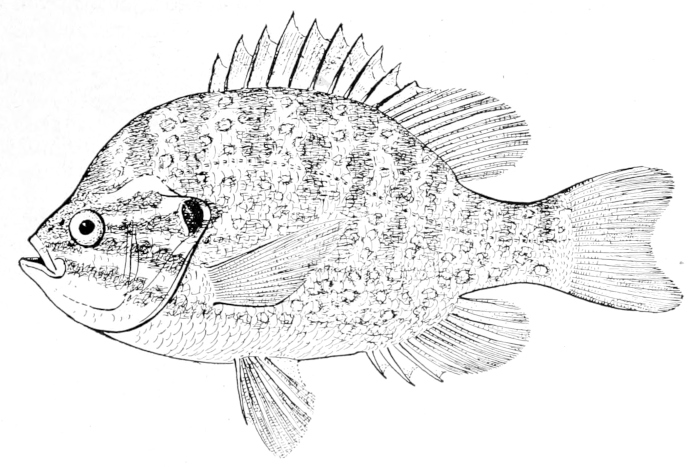
The pumpkin seed, the most common sunfish.
The eye of the sunfish is very large and quite prominent; the large black pupil is surrounded by an iris that has shining lavender and bronze in it, but is more or less clouded above; the young ones have a pale silver iris. The eyes move in every direction and are eager and alert in their expression. The mouth is at the front of the body but it opens upward. The gill opening is prolonged backward at the upper corner, making an earlike flap; this, of course, has nothing to do with the fish’s ears, but it is highly ornamental as it is greenish-black in color, bordered by iridescent, pale green, with a brilliant orange spot on its hind edge. The colors of the sunfish are too varied for description and too beautiful to reduce to mere words. There are dark, dull, greenish or purplish cross-bands worked out in patterns of scale-mosaic, and between them are bands of pale iridescent-green, set with black-edged orange spots. But just as we have described his colors our sunfish darts off and all sorts of shimmering, shining blue, green and purple tints play over his body and he settles down into another corner of the aquarium and his colors seem much paler and we have to describe him over again. The body below is brassy-yellow.
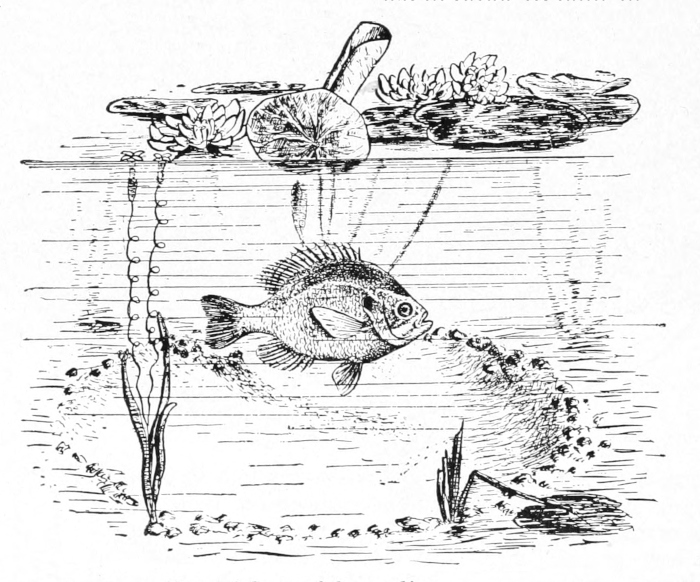
Male of the sunfish guarding his nest. After Gill.
The beautiful colors which the male sunfish dons in spring, he puts at once to practical use. Professor Reighard says that when courting and trying to persuade his chosen one to come to his nest and there deposit her eggs, he faces her, with his gill covers puffed out, the scarlet or orange spot on the ear-flap standing out bravely, and his black ventral fins spread wide to show off their patent-leather finish. Thus, does he display himself before her and persuade her; but he is rarely allowed to do this in peace. Other males as brilliant as he arrive on the scene and he must forsooth stop parading before his lady love in order to fight his rival, and he fights with as much display of color as he courts. But in the sunfish duel the participants do not seek to destroy each other but to mutilate spitefully each other’s fins. The vanquished one with his fins all torn retires from the field. Professor Gill says: “Meanwhile the male has selected a spot in very shallow water near the shore, and generally in a mass of aquatic vegetation, not too large or close together to entirely exclude the light and heat of the sun, and mostly under an over-hanging plant. The choice is apt to be in some general strip of shallow water close by the shore which is favored by many others so that a number of similar nests may be found close together, although never encroaching on each other. Each fish slightly excavates and makes a saucer-like basin in the chosen area which is carefully cleared of all pebbles. Such are removed by violent jerks of the caudal fin or are taken up by the mouth and carried to the circular boundary of the nest. An area of fine, clean sand or gravel is generally the result, but not infrequently, according to Dr. Reighard, the nest bottom is composed of the rootlets of water plants. The nest has a diameter of about twice the length of the fish.”
On the nest thus formed, the sunfish belle is invited to deposit her eggs, which as soon as laid fall to the bottom and become attached to the gravel at the bottom of the nest by the viscid substance which surrounds them. Her duty is then done and she departs, leaving the master in charge of his home and the eggs. If truth be told, he is not a strict monogamist. Professor Reighard noticed one of these males which reared in one nest two broods laid at quite different times by two females. For about a week, depending upon the temperature, the male is absorbed in his care of the eggs and defends his nest with much ferocity, but after the eggs have hatched he considers his duty done and lets his progeny take care of themselves as best they may.
Sunfish are easily taken care of in an aquarium, but each should be kept by himself as they are likely to attack any smaller fish and are most uncomfortable neighbors. I have kept one of these beautiful, shimmering pumpkin seeds for nearly a year, by feeding him every alternate day with an earthworm; these unfortunate creatures are kept stored in damp soil in an iron kettle during the winter. When I threw one of them into the aquarium he would seize it and shake it as a terrier shakes a rat; but this was perhaps to make sure of his hold. Once he attempted to take the second worm directly after the first; but it was a doubtful proceeding, and the worm reappeared as often as a prima donna, waving each time a frenzied farewell to the world.
LESSON XLII
The Sunfish
Leading thought—The pumpkin seeds are very gamey little fishes which seize the hook with much fierceness. They live in the still waters of our streams or in ponds and build nests in the spring, in which the eggs are laid and which they defend valiantly.
Method—The common pumpkin seed in the jar aquarium is all that is necessary for this lesson. However, it will add much to the interest of the lesson if the boys who have fished for pumpkin seeds will tell of their experiences. The children should be stimulated by this lesson to a keen interest in the nesting habits of the sunfishes.
Observations—1. Where are the sunfish found? How do they act when they take the hook?
2. What is the general shape of the sunfish’s body as seen from above? As seen from the side? Why is it called pumpkin seed?
3. Describe the dorsal fin. How many spines has it? How many soft rays? What is the difference in appearance between the front and hind dorsal fin? Do the two act together or separately? Describe the tail fin. Describe the anal fin. Has it any spines? If so, where are they? Where are the ventral fins in relation to the pectorals? What is there peculiar about the appearance and movements of the pectoral fins?
4. Describe the eye of the sunfish. Is it large or small? Is it placed so that the fish can see on each side? Does the eye move in all directions?
5. Describe the position of the mouth. In which direction does it open?
6. What is the color of the upper portion of the gill opening or operculum? What is the general color of the sunfish? Above? Below? Along the sides? What markings do you see?
7. Where does the sunfish make its nest? Does the father or mother sunfish make the nest? Do one or both protect it? Describe the nest.
8. How many names do you know for the sunfish? Describe the actions of your sunfish in the aquarium. How does he act when eating an earthworm?
Supplementary reading—Chapters XXX, XXXVI, in Fish Stories, Jordan and Holder.
“The lamprey is not a fish at all, only a wicked imitation of one which can deceive nobody. But there are fishes which are unquestionably fish—fish from gills to tail, from head to fin, and of these the little sunfish may stand first. He comes up the brook in the spring, fresh as “coin just from the mint,” finny arms and legs wide spread, his gills moving, his mouth opening and shutting rhythmically, his tail wide spread, and ready for any sudden motion for which his erratic little brain may give the order. The scales of the sunfish shine with all sorts of scarlet, blue, green and purple and golden colors. There is a black spot on his head which looks like an ear, and sometimes grows out in a long black flap, which makes the imitation still closer. There are many species of the sunfish, and there may be half a dozen of them in the same brook, but that makes no difference; for our purposes they are all one.
They lie poised in the water, with all fins spread, strutting like turkey-cocks, snapping at worms and little crustaceans and insects whose only business in the brook is that the fishes may eat them. When the time comes, the sunfish makes its nest in the fine gravel, building it with some care—for a fish. When the female has laid her eggs the male stands guard until the eggs are hatched. His sharp teeth and snappish ways, and the bigness of his appearance when the fins are all displayed, keep the little fishes away. Sometimes, in his zeal, he snaps at a hook baited with a worm. He then makes a fierce fight, and the boy who holds the rod is sure that he has a real fish this time. But when the sunfish is out of the water, strung on a willow rod, and dried in the sun, the boy sees that a very little fish can make a good deal of a fuss.” —David Starr Jordan.
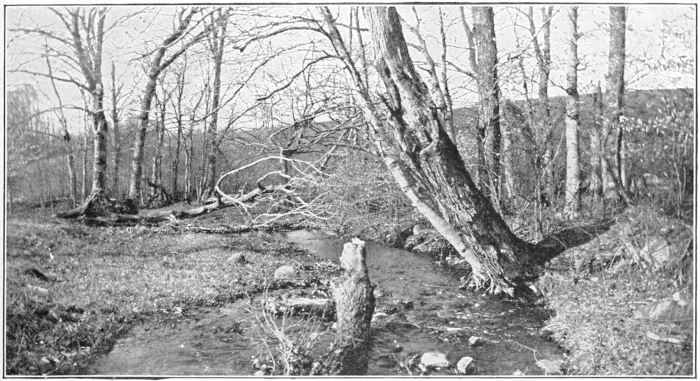
The johnny darter likes a swift-flowing brook
THE JOHNNY DARTER
Teacher’s Story
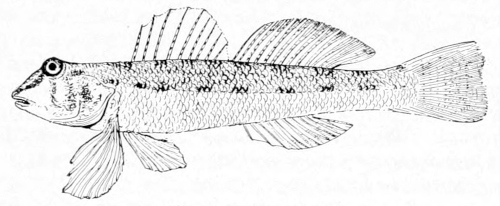
“We never tired of watching the little Johnny, or Tessellated darter (Boleosoma nigrum), although our earliest aquarium friend, (and the very first specimens showed us by a rapid ascent of the river weed how ‘a Johnny could climb trees,’) he has still many resources which we have never learned. Whenever we try to catch him with the hand we begin with all the uncertainty that characterized our first attempts, even if we have him in a two-quart pail. We may know him by his short fins, his first dorsal having but nine spines, and by the absence of all color save a soft, yellowish brown, which is freckled with darker markings. The dark brown on the sides is arranged in seven or eight W-shaped marks, below which are a few flecks of the same color. Covering the sides of the back are the wavy markings and dark specks which have given the name of the “Tessellated Darter;” but Boleosoma is a preferred name, and we even prefer ‘boly’ for short. In the spring the males have the head jet black; and this dark color often extends on the back part of the body, so that the fish looks as if he had been taken by the tail and dipped into a bottle of ink. But with the end of the nuptial season this color disappears and the fish regains his normal, strawy hue.
His actions are rather bird-like; for he will strike attitudes like a tufted titmouse and he flies rather than swims through the water. He will, with much perseverance, push his body between a plant and the sides of the aquarium and balance himself on a slender stem. Crouching catlike before a snail shell, he will snap off a horn which the unlucky owner pushes timidly out. But he is also less dainty and seizing the animal by the head, he dashes the shell against the glass or stones until he pulls the body out and breaks the shell.”—David Starr Jordan.
The johnny darters are, with the sticklebacks, the most amusing little fish in the aquarium. They are well called darters since their movements are so rapid when they are frightened that the eye can scarcely follow them; and there is something so irresistibly comical in their bright, saucy eyes, placed almost on top of the head, that no one could help calling one of them “Johnny.” A “johnny” will look at you from one side, and then as quick as a flash, will flounce around and study you with the other eye and then come toward you head-on so that he may take you in with both eyes; he seems just as interested in the Johnny out of the jar as is the latter, in the johnny within.
The johnny darter has a queer shaped body for a fish, for the head and shoulders are the larger part of him; not that he suddenly disappears into nothingness, by no means! His body is long and very slightly tapering to the tail; along his lateral line he has a row of olive-brown W’s worked out in scale-mosaics; and he has some other scale-mosaics also following a pattern of angular lines and making blotches along his back. The whole upper part of his body is pale olive, which is a good imitation of the color of the brook.
The astonished and anxious look on the johnny darter’s face comes from the peculiar position of the eyes which are set in the top of his forehead; they are big, alert eyes, with large black pupils, surrounded by a shining, pale yellow line at the inner edge of the green iris; and as the pupil is not set in the center of the eye, the iris above being wider than below, the result is an astonished look, as from raised eyebrows. The eyes move, often so swiftly that it gives the impression of winking. The eyes, the short snout, and the wide mouth give johnny a decidedly froglike aspect.
The johnny darter.
Although he is no frog, yet johnny darter seems to be in a fair way to develop something to walk upon. His pectoral fins are large and strong and the ventral pair are situated very close to them; when he rests upon the gravel he supports himself upon one or both of these pairs of fins. He rests with the pectoral fins outspread, the sharp points of the rays taking hold of the gravel like toenails and thus give him the appearance of walking on his fins; if you poke him gently, you will find that he is very firmly planted on his fins so that you can turn him around as if he were on a pivot. He also uses the pectorals for swimming and jerks himself along with them in a way that makes one wonder if he could not swim well without any tail at all. The tail is large and almost straight across the end and is a most vigorous pusher. There are two dorsal fins; the front one has only nine rays; these are not branched and are therefore spines; when the fin is raised it appears almost semi-circular in shape. The hind dorsal fin is much longer and when lifted stands higher than the front one; its rays are all branched except the front one. As soon as the johnny stops swimming he shuts the front dorsal fin so that it can scarcely be detected; when frightened he shuts both the dorsal fins and closes the tail and the anal fin and spreads out his paired fins so that his body lies flat on the bottom; this act always reminds one of the “freezing” habit of the rabbit. But johnny does not stay scared very long; he lifts his head up inquisitively, stretching up as far as he is able on his front feet, that is, his pectorals, in such a comical way that one can hardly realize he is a fish.
The tail and the dorsal fin of the johnny darter are marked with silver dots which give them an exquisite spun-glass look; they are as transparent as gauze.
The johnny darters live in clear, swift streams where they rest on the bottom, with the head up stream. Dr. Jordan has said they can climb up water weed with their paired fins. I have never observed them doing this but I have often seen one walk around the aquarium on his fins as if they were little fan-shaped feet; and when swimming he uses his fins as a bird uses its wings. There are many species of darters, some of them the most brilliantly colored of any of our fresh-water fishes. The darters are perch-like in form.
Dr. Jordan says of the breeding habits of the darters: “On the bottom, among the stones, the female casts her spawn. Neither she nor the male pays any further attention to it, but in the breeding season the male is painted in colors as beautiful as those of the wood warblers. When you go to the brook in the spring you will find him there, and if you catch him and turn him over on his side you will see the colors that he shows to his mate, and which observation shows are most useful in frightening away his younger rivals. But do not hurt him. Put him back in the brook and let him paint its bottom with colors of a rainbow, a sunset or a garden of roses. All that can be done with blue, crimson and green pigments, in fish ornamentation, you will find in some brook in which the darters live.”
LESSON XLIII
Johnny Darter
Leading thought—The johnny darter naturally rests upon the bottom of the stream where the current is swift. It uses its two pairs of paired fins somewhat as feet in a way interesting to observe.
Method—Johnny darters may be caught in nets with other small fry and placed in the aquarium. Place one or two of them in individual aquaria where the pupils may observe them at their leisure. They do best in running water.
Observations—1. Describe or sketch the johnny darter from above. From the side. Can you see the W-shaped marks along its side? How is it colored above?
2. How are the pectoral fins placed? Are they large or small? How are they used in swimming? Where are the ventral fins placed? How are the ventrals and dorsals used together? When resting on the bottom how are the pectoral fins used?
3. What is there peculiar about the dorsal fins of the johnny darter? When he is resting, what is the attitude of the dorsal fins? What is the difference in shape of the rays of the front and hind dorsal fins?
4. When resting on the bottom of the aquarium how is the body held? On what does it rest? In moving about the bottom slowly why does it seem to walk? How does it climb up water weed?
5. When frightened how does it act? Why is it called a darter? What is the attitude of all the fins when the fish is moving swiftly?
6. What is the shape of the tail?
7. What is there peculiar about the eyes of the johnny? Describe the eyes and their position. What reason is there in the life of the fish that makes this position of the eyes advantageous?
8. Where do we find the johnny darters? In what part of the stream do they live? Are they usually near the surface of the water or at the bottom?
“To my mind, the best of all subjects for nature-study is a brook. It affords studies of many kinds. It is near and dear to every child. It is an epitome of the nature in which we live. In miniature, it illustrates the forces which have shaped much of the earth’s surface. It reflects the sky. It is kissed by the sun. It is rippled by the wind. The minnows play in the pools. The soft weeds grow in the shallows. The grass and the dandelions lie on its sunny banks. The moss and the fern are sheltered in the nooks. It comes from one knows not whence; it flows to one knows not whither. It awakens the desire to explore. It is fraught with mysteries. It typifies the flood of life. It goes on forever.
In other words, the reason why the brook is such a perfect nature-study subject is the fact that it is the central theme in a scene of life. Living things appeal to children.”
“Nature-study not only educates, but it educates nature-ward; and nature is ever our companion, whether we will or no. Even though we are determined to shut ourselves in an office, nature sends her messengers. The light, the dark, the moon, the cloud, the rain, the wind, the falling leaf, the fly, the bouquet, the bird, the cockroach—they are all ours.
If one is to be happy, he must be in sympathy with common things. He must live in harmony with his environment. One cannot be happy yonder nor tomorrow: he is happy here and now, or never. Our stock of knowledge of common things should be great. Few of us can travel. We must know the things at home.
Nature-love tends toward naturalness, and toward simplicity of living. It tends country-ward. One word from the fields is worth two from the city. “God made the country.”
I expect, therefore, that much good will come from nature-study. It ought to revolutionize the school life, for it is capable of putting new force and enthusiasm into the school and the child. It is new, and therefore, is called a fad. A movement is a fad until it succeeds. We shall learn much, and shall outgrow some of our present notions, but nature-study has come to stay. It is in much the same stage of development that manual-training and kindergarten work were twenty-five years ago. We must take care that it does not crystallize into science-teaching on the one hand, nor fall into mere sentimentalism on the other.
I would again emphasize the importance of obtaining our fact before we let loose the imagination, for on this point will largely turn the results—the failure or the success of the experiment. We must not allow our fancy to run away with us. If we hitch our wagon to a star, we must ride with mind and soul and body all alert. When we ride in such a wagon, we must not forget to put in the tail-board.” —L. H. Bailey in The Nature-Study Idea.