PART IV
Reading edition
EARTH AND SKY
THE BROOK
Teacher’s Story
“Little brook, sing a song of a leaf that sailed along, Down the golden braided center of your current swift and strong.” —J. W. Riley.
A brook is undoubtedly the most fascinating bit of geography which the child encounters; and yet how few children who happily play in the brook—wading, making dams, drawing out the crayfish by his own grip from his lurking place under the log, or watching schools of tiny minnows—ever dream that they are dealing with real geography. The geography lesson on the brook should not be given for the purpose of making work out of play, but to conserve all of the natural interest in the brook, and add to it by revealing other and more interesting facts concerning it. A child who thus studies the brook will master some of the fundamental facts of physical geography, so that ever after he will know and understand all streams, whether they are brooks or rivers. An interesting time to study a brook is after a rain; and May or October give attractive surroundings for the study. However, the work should be continued now and then during the entire year, for each season gives it some new features of interest.
Each brook has its own history, which can be revealed only to the eyes of those that follow it from its beginning to where it empties its water into a larger stream or pond. At its source the brook usually is a small stream with narrow banks; not until it receives water from surrounding hills does it gain enough power to cut its bed deeper into the earth, thus making its banks higher. Where it flows with swift current down a hillside, it cuts its bed deeper, because swift-moving water has more power for cutting and carrying away the soil. However, if the hillside happens to be in the woods, the roots of trees or bushes will help to keep the soil from being washed away. Unless there are obstacles, the course of the brook is likely to be more direct in flowing down a hillside than when crossing level fields. The delightful way in which brooks meander crookedly across the level areas is due to the inequalities of the surface, which interfere more with water on a plain than on a hillside, since the gravity which pulls it forever down has less chance to act upon it forcibly in these situations. After a stream has thus started its crooked course, in time of flood the current strikes with more force against the curves, and cutting them deeper, makes the course still more crooked. The places on the banks where the soil is bare and exposed to the force of the current, are the points where the banks are cut most deeply at flood time.
But the brook is not simply an object to look at and admire; it is a very busy worker, its chief labor being that of a digger and carrier. When it is not carrying anything—that is, when its waters are perfectly clear—the stream is doing the least work. The poets, as well as common people, speak of the playing of the brook when its limpid waters catch the sunbeams on their dimpling surface; but when the waters are roily the brook is working very hard. This usually occurs after a rain, which adds much more water to the volume of the brook; the action of gravity upon this larger and heavier body forces it to flow more swiftly and every drop in the stream that touches the bank or bottom, snatches up a tiny load of earth and carries it along. And every drop thus laden, when it strikes against a corner of the bank, tears more soil loose through the impact, and other drops snatch it up and carry it on down the stream. And after a time there are so many drops carrying loads and bumping along, knocking loose more earth, that the whole brook, which is made up of drops, looks muddy. In its work as a digger, every drop of water that touches the soil at the bottom or on the banks of the brook uses its own little load of earth or gravel as a crowbar or pickaxe to pry up other bits of dirt and gravel; and all of the drops hastening on, working hard together, dig the channel of the brook wider and deeper. In some steep places, so many of the drops are working together that they are able to pick up pebbles or stones, with which they batter and tear down larger pieces of the bank and scrape out greater holes in the bottom of the stream. On and on the brook flows, a gang of workmen each of which is using its own load as a tool, all in close procession and working double quick. But as soon as the brook reaches a plain or level, its activity ceases; the drops act tired and seem to have no ambition to pick up more soil, and each lets fall its own load as soon as possible, dropping the larger pieces of gravel and rock first, carrying the finer soil farther, but finally letting that down also. If we examine the sediment of a flooded brook, we find that the gravel is always dropped first, and that the fine mud is carried farthest before it is deposited.
The roar of a flooded stream is very different from the murmur of its waters when they are low. It is not to be wondered at, when we once think of all that is going on in the brook during periods of flood. There are some simple experiments to show what the force of water can do when turned against the soil. Pour water from a pitcher into a bed of soft soil, and note how quickly a hole will be made; if the pitcher is held near the soil, less of a hole will be formed than if the pitcher is held high up, which shows that the farther the water falls, the greater is its force. This explains why the banks of streams are undermined when a strong current is driven against them. The swift current, of course, breaks away more earth at bends and curves than when it is flowing in a straight line; for ordinarily, when flowing straight, the current is swiftest in the bed of the stream, and is therefore only digging at the bottom; but when it flows around curves, it is directed against the banks, and therefore has much more surface to work upon. Thus it is that bends are cut deeper and deeper. If the bare arm is thrust into a flooded brook, we find that many pieces of gravel strike against it; and if we reach the bottom, we can feel the pebbles being moved along over the brook bed.
LESSON CCIX
The Brook
Leading thought—The water from the little brook near our schoolhouse is flowing toward the ocean, and is meanwhile digging out and carrying along with it the soil through which it flows.
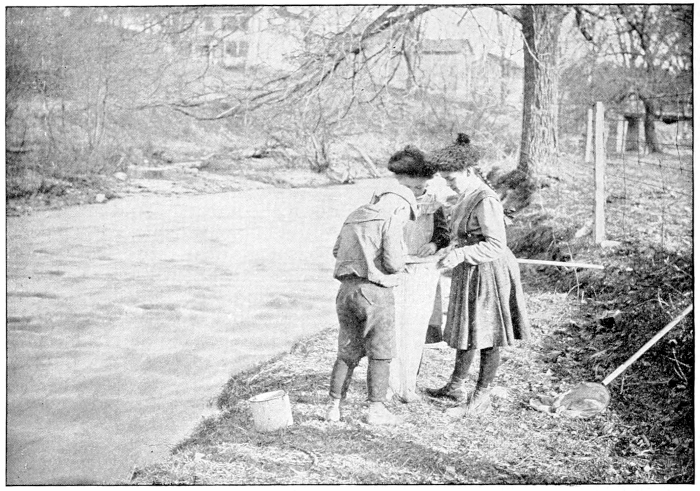
What the children find living in the brook.
Method—The best time to study a brook is after a rain, and October or May is an interesting time for beginning this lesson. The work should be continued during the entire year. It may be done at noon or recess, if the brook is near at hand; or there may be excursions after school, if the brook is at some distance. The observations should be made by the class as a whole.
Observations—1. Does the brook have its source in a spring or a swamp, or does it receive its water as drainage from surrounding hills? Follow it back to its very beginning. Do you find this in open fields or woods? Is the land about it level or hilly?
2. Are its banks deeper at the beginning, or is the brook at first almost on a level with the surrounding fields? Do the banks become deeper farther from the source? Are the banks higher where the brook flows down hill, or where it is on a level?
3. Is the course of the brook more crooked on a hillside or when flowing through a level area? Are the banks more worn away and steep where the brook flows through woods or bushes than through the open fields?
4. Can you find the places where the water is cutting the banks most, when the brook is flooded? Why does it cut the banks at these particular points?
5. Into what stream, pond or lake does the brook flow? If you should launch a toy boat upon the waters of this brook, and it should keep afloat, through what streams would it pass to reach the ocean? Through what townships, counties, states or countries would it pass?
6. When is the brook working and when is it playing? What is the difference between the color of the water ordinarily and when the brook is flooded? What causes this difference?
7. Make the following experiment to show what the brook is carrying after a storm when the water is roily. Dip from the swift portion of the stream a glass fruit jar full of water. Place it on a window-sill and do not disturb it until the water is clear. How much sediment has settled at the bottom of the jar? Where was this sediment when you dipped up the water? If this quart of water could carry so much soil or sediment, how much, do you think, would the whole brook carry?
8. Where did the brook get the soil to make the water roily? Study its banks in order to answer this question. Do you think the soil in the water came from the banks that are covered by vegetation or from those which are bare?
9. How did the brook pick up the soil that it carried when it was flooded? Do you think that one of the tools that the brook digs with is the current? Try to find a place where the swift current strikes the bank, and note if the latter is being worn away.
10. Does the swift current take more soil where it is flowing straight, or where there are sharp bends? How are the bends in the brook or creek made?
11. Thrust your bare hand or arm into the swift current of the brook when it is flooded. Do you feel the gravel strike against your arm or hand? Wade in the water. Do you feel the pebbles strike against the feet or legs, as they are being rolled along the bed of the stream?
12. Does the water, loaded with soil and pebbles, dig into the banks more vigorously than just the water alone could do? Which washes away more earth and carries it down stream—a fast or a slow current?
13. Does the water of the brook flow fastest when its waters are low or high? When the brook is at its highest flood, do you think it is working the hardest? If so, explain why? When it is working the hardest and carrying most soil and gravel, does it make a different sound than when it is flowing slowly and its waters are clear?
14. How does the brook look when it is doing the least amount of work possible?
15. Make a map of your brook showing every pool, indicating the places where the current is swiftest and showing the bends in its course. To test the rapidity of the current, put something afloat on it and measure how far it will go in a minute.
16. How many kinds of trees, bushes and plants grow along the banks of your brook? How many kinds of fish and insects do you find living in it? How many kinds of birds do you see frequently near it?
A brook puzzle for pupils to solve—When we have a load to carry we go slowly because we are obliged to; and the heavier the load, the slower we go. On the other hand, when we wish to run very swiftly we drop the load so as not to be weighted down; when college or high school boys run races in athletic games, they do not wear even their ordinary clothing, but dress as lightly as possible in trunks and tights; they also train severely so that they do not have to carry any more flesh on their bones than is necessary. How is it that in the case of a brook just opposite is true? The faster the brook runs, the more it can carry; and the heavier it becomes the faster it runs; and the faster it runs the more work it can do.
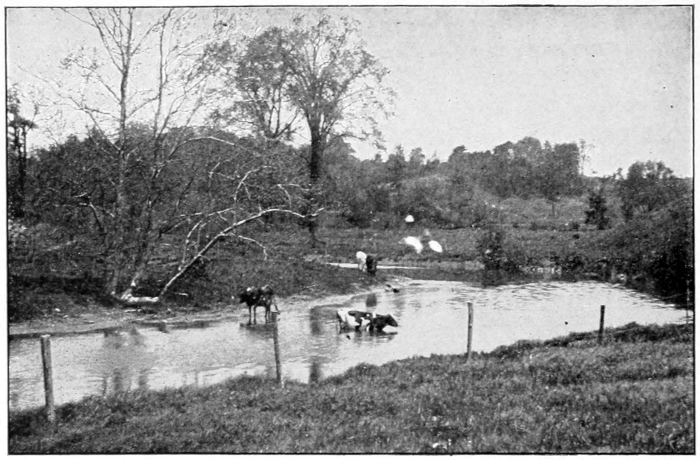
Where the stream drops its load.
HOW A BROOK DROPS ITS LOAD
Teacher’s Story
The brook is most discriminating in the way it takes up its burdens, and also in the way it lays them down. It, with quite superhuman wisdom, selects the lightest material first, leaving the heaviest to the last; and when depositing the load, it promptly drops the heaviest part first. And thus the flowing waters of the earth are eternally lifting, selecting, and sifting the soils on its surface.
The action of rain upon the surface of the ground is in itself an excellent lesson in erosion. If there is on a hillside a bit of bare ground which has been recently cultivated or graded, we can plainly see, after a heavy rain, where the finer material has been sorted out and carried away, leaving the larger gravel and stones. And if we examine the pools in the brook, we shall find deltas as well as many examples of the way the soil is sifted as it is dropped. The water of a rill flowing through pasture and meadow is clear, even after a hard rain. This is owing, not so much to the fact that the roots hold the banks of the brook firmly, as that the grass on the surface of the ground acts as a mulch and protects the soil from the erosive impact of the raindrops. On the other hand, and for a reverse reason, a rill through plowed ground is muddy. On a hillside, therefore, contour plowing is practiced—that is, plowing crosswise the hillside instead of up and down. When the furrow is carried crosswise, the water after showers can not dash away, carrying off in it all the finer and more fertile portions of the soil. There are many instances in our Southern States where this difference in the direction of plowing has saved or destroyed the fertility of hillside farms.
The little experiment suggested at the beginning of the following lesson, should show the pupils clearly the following points: It is through motion that water takes up soil and holds it in suspension. The tendency of still water is to drop all the load which it is carrying and it drops the heaviest part first. We find the pebbles at the bottom of the jar, the sand and gravel next, and the fine mud on top. The water may become perfectly clear in the jar and yet, when stirred a little, it will become roily again because of the movement. Every child who wades in a brook, knows that the edges and the still pools are more comfortable for the feet than is the center of the stream under the swift current. This is because, where the water is less swift at the sides, it deposits its mud and makes a soft bottom; while under the swifter part of the current, mud is washed away leaving the larger stones bare. For the same reason, the bottom of a stream crossing a level field is soft, because the silt, washed down from the hills by the swift current, is dropped when the waters come to a more quiet place. If, across a stony brook, the pupils can build a dam that will hold for two or three months in the fall or spring when the brook is flooded, they will be able to note that the stones will soon be more or less covered with soft mud; for the dam, stopping the current, causes the water to drop its load of silt. It would have to be a very recently made pool in a stream, which would not have a soft mud bottom. The water at times of flood is forced to the side of the streams in eddies, and its current is thus checked, and its load of mud dropped.
It should be noted that at points where the brook is narrowest the current is swiftest, and where the current is swiftest the bottom is more stony. Also, where there is a bend in the stream the brook digs deeper into the bank where it strikes the curve, and much of the soil thus washed out is removed to the other side of the stream where the current is very slow, and there is dropped. (See Introduction to Physical Geography, Gilbert and Brigham, pp. 51 and 52.) If possible, note that where a muddy stream empties into a pond or lake, the waters of the latter are made roily for some distance out, but beyond this the water remains clear. The pupils should be made to see that the swift current of the brook is checked when its waters empty into a pond or lake, and because of this they drop their load. This happens year after year, and a point extending out into the lake or pond is thus built up. In this manner the great river deltas are formed.
References—The Brook Book, Mary Rogers Miller; Brooks and Brook Basins, Frye; Up and Down the Brooks, Bamford; Physical Geography, Tarr; Introduction to Physical Geography, Gilbert and Brigham.
LESSON CCX
How a Brook Drops Its Load
Leading thought—The brook carries its load only when it is flowing rapidly. As soon as the current is checked, it drops the larger stones and gravel first and then the finer sediment. It is thus that deltas are built up where streams empty into lakes and ponds.
Method—Study the rills made in freshly graded soil directly after a heavy rain. Ask the pupils individually to make observations on the flooded brook.
Experiment—Take a glass fruit jar nearly full of water from the brook, add gravel and small stones from the bed of the brook, sand from its borders and mud from its quiet pools. Have it brought into the schoolroom, and shake it thoroughly. Then place in a window and ask the pupils to observe the following things:
(a) Does the mud begin to settle while the water is in motion; that is, while it is being shaken?
(b) As soon as it is quiet, does the settling process begin?
(c) Which settles first—the pebbles, the sand or the mud? Which settles on top—that is, which settles last?
(d) Notice that as long as the water is in the least roily, it means that the soil in it has not all settled; if the water is disturbed even a little it becomes roily again, which means that as soon as the water is in motion it takes up its load.
Observations—1. Where is the current swiftest, in the middle or at the side of the stream?
2. What is the difference, in the bottom of the brook, between the place below the swift current and the edges? That is, if you were wading in the brook, where would it be more comfortable for your feet—at the sides or in the swiftest part of the current? Why?
3. Does the brook have a more stony bed where it flows down a hillside than where flowing through a level place?
4. Place a dam across your brook where the bottom is stony, and note how soon it will have a soft mud bottom. Why is this?
5. Can you find a still pool in your brook that has not a soft, muddy bottom? Why is this?
6. Does the brook flow more swiftly in the steep and narrow places than in the wide portions and where it is dammed?
7. Do you think if water, flowing swiftly and carrying a load of mud, were to come to a wider or more level place, like a pool or millpond dam, that it would drop some of its load? Why?
8. If the water flows less swiftly along the edges than in the middle, would this make the bottom below softer and more comfortable to the feet than where the current is swiftest? If so, why?
9. If you can see the place where a brook empties into a pond or lake, how does it make the waters of the latter look after a storm? What is the water of the brook doing to give this appearance, and why?
10. What becomes of the soil dropped by the brook as it enters a pond or lake? Do you know of any points of land extending out into a lake or pond where the stream enters it? What is a stream delta?
“In the bottom of the valley is a brook that saunters between oozing banks. It falls over stones and dips under fences. It marks an open place on the face of the earth, and the trees and soft herbs bend their branches into the sunlight. The hangbird swings her nest over it. Mossy logs are crumbling into it. There are still pools where the minnows play. The brook runs away and away into the forest. As a boy I explored it but never found its source. It came somewhere from the Beyond and its name was Mystery.
The mystery of this brook was its changing moods. It had its own way of recording the passing of the weeks and months. I remember never to have seen it twice in the same mood, nor to have got the same lesson from it on two successive days: yet, with all its variety, it always left that same feeling of mystery and that same vague longing to follow to its source and to know the great world that I was sure must lie beyond. I felt that the brook was greater and wiser than I. It became my teacher. I wondered how it knew when March came, and why its round of life recurred so regularly with the returning seasons. I remember that I was anxious for the spring to come, that I might see it again. I longed for the earthy smell when the snow settled away and left bare brown margins along its banks. I watched for the suckers that came up from the river to spawn. I made a note when the first frog peeped. I waited for the unfolding spray to soften the bare trunks. I watched the greening of the banks and looked eagerly for the bluebird when I heard his curling note somewhere high in the air.” —“The Nature-Study Idea,” L. H. Bailey.
CRYSTAL GROWTH
Teacher’s Story
To watch the growth of a crystal is to witness a miracle; involuntarily we stand in awe before it, as a proof that of all truths mathematics is the most divine and inherent in the universe. The teacher will fail to make the best use of this lesson if she does not reveal to the child through it something of the marvel of crystal growth.
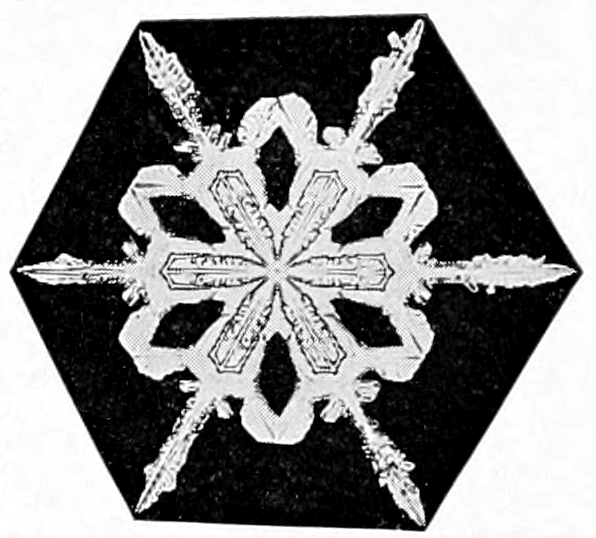
A snow crystal.
Photomicrograph by W. A. Bentley.
That a substance which has been dissolved in water should, when the water evaporates, assemble its particles in solid form of a certain shape, with its plane surfaces set exactly at certain angles one to another, always the same whether the crystal be large or small, is quite beyond our understanding. Perhaps it is no more miraculous than the growth of living beings, but it seems so. The fact that when an imperfect crystal, unfinished or broken, is placed in water which is saturated with the same substance, it will be built out and made perfect, shows a law of growth so exquisitely exemplified as to again make us glad to be a part of a universe so perfectly governed. Moreover, when crystals show a variation in numbers of angles and planes it is merely a matter of division or multiplication. A snow crystal is a six-rayed star, yet sometimes it has three rays.
The window-sill of a schoolroom may be a place for the working of greater wonders than those claimed by the astrologists of old, when they transmuted baser metals to gold and worthless stones to diamonds. It may be a place where strings of gems are made before the wondering eyes of the children; gems fit to make necklaces for any naiad of the brook or oread of the caves.
It adds much to the interest of this lesson if different colored substances are used for the forming of the crystals. Blue vitriol, potassium bichromate, and alum give beautiful crystals, contrasting in shape as well as in colors.
Copper sulphate and blue vitriol are two names for one substance; it is a poison when taken internally and, therefore, it is best for the teacher to carry on the experiment before the pupils instead of trusting the substance to them indiscriminately. Blue vitriol forms an exquisitely beautiful blue crystal, which is lozenge-shaped with oblique edges. Often, as purchased from the drug store, we find it in the form of rather large, broken, or imperfect crystals. One of the pretty experiments is to place some of these broken crystals in a saucer containing a saturated solution of the vitriol, and note that they straightway assert crystal nature by building out the broken places, and growing into perfect crystals. Blue vitriol is used much in the dyeing and in the printing of cotton and linen cloths. It has quite wonderful preservative qualities; if either animal or vegetable tissues are permeated by it they will remain dry and unchanged.
Potassium bichromate is also a poison and, therefore, the teacher should make the solution in the presence of the class. It forms orange-red crystals, more or less needle-shaped. It crystallizes so readily that if one drop of the solution be placed on a saucer the pupils may see the formation of the crystals by watching it for a few moments through a lens.
The common alum we buy in crystal form, however, it is very much broken. Its crystals are eight-sided and pretty. Alum is widely used in dyes, in medicines, and in many other ways. It is very astringent, as every child knows who has tried to eat it, and has found the lips and tongue much puckered thereby.
Although we are more familiar with crystals formed from substances dissolved in water, yet there are some minerals, like iron which crystallize only when they are melted by heat; and there are other crystals, like the snow, which are formed from vapor. Thus, substances must be molten hot, or dissolved in a liquid, or in form of gas, in order to grow into crystals.
LESSON CCXI
Crystal Growth
Leading thought—Different substances when dissolved in water will re-form as crystals; each substance forms crystals of its own peculiar color and shape.
Method—Take three test tubes, long vials or clear bottles. Fill one with a solution made by dissolving one part of blue vitriol in three parts of water; fill another by dissolving one part of bichromate of potash with twenty-five parts of water; fill another with one part of alum in three parts of water. Suspend from the mouth of each test tube or vial, a piece of white twine, the upper end tied to a tooth pick, which is placed across the mouth of the vial; the other end should reach the bottom of the vial. If necessary, tie a pebble to the lower end so that it will hang straight. Place the bottles on the window sill of the schoolroom, where the children may observe what is happening. Allow them to stand for a time, until the string in each case is encrusted with crystals; then pull out the string and the crystals. Dry them with a blotter, and let the children observe them closely. Care should be taken to prevent the children from trying to eat these beautiful crystals, by telling them that the red and blue crystals are poisonous.
Observations—1. In which bottle did the crystals form first? Which string is the heaviest with the crystals?
2. What was the color of the water in which the blue vitriol was dissolved? Is it as brilliant in color now as it was when it was first made? Do you think that the growth of the crystals took away from the blue material of the water? Look at the blue vitriol crystals with a lens, and describe their shape. Are the shapes of the large crystals of the vitriol the same as those of the small ones?
3. What is the shape of the crystals of the potassium bichromate? What is the color? Are these crystals as large as those of the blue vitriol or of the alum?
4. What shapes do you find among the crystals of alum?
5. Do you think that vitriol and potassium bichromate and alum will, under favorable circumstances, always form each its own shape of crystal wherever it occurs in the world? Do you think crystals could be formed without the aid of water?
6. How many kinds of crystals do you know? What is rock candy? Do you think you could make a string of rock candy if you dissolved sugar in water and placed a string in it?
SALT
Teacher’s Story
A “saturated solution” is an uninspiring term to one not chemically trained; and yet it merely means water which holds as much as it can take of the dissolved substance; if the water is hot, it dissolves more of most substances. To make a saturated solution of salt we need two parts of salt or a little more, for good measure, to five parts of water; the water should be stirred until it will take up no more salt.
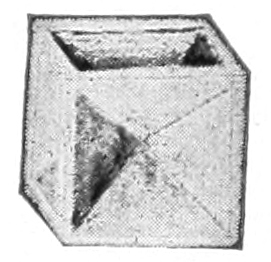
Form of a salt crystal.
A slip of paper placed in a saucer of this solution will prove a resting place for the crystals as they form. In about two days the miracle will be working, and the pupils should now and then observe its progress. Those saucers set in a draft or in a warm place will show crystals sooner than others, but the crystals will be smaller; for the faster a crystal grows, the smaller is its stature. If the water evaporates rapidly, the crystals are smaller, because so many crystals are started which do not have material for large growth. When the water is evaporated, to appreciate the beauty of the crystals we should look at them with a lens or microscope. Each crystal is a beautiful little cube, often with a pyramid-shaped depression in each face or side. After the pupils have seen these crystals, the story of where salt is found should be told them.
Salt is obtained by two methods: by mining large deposits of rock salt, and by evaporating water containing a strong solution of salt. The oldest salt works in this country are in Syracuse, New York, where the salt comes from salt springs which were famous among the American Indians. At Ithaca, N. Y., the salt deposits are about 2000 feet below the surface of the earth. Water is forced down into the stratum of rock, which was evidently once the bottom of a briny sea; the water dissolves the salt, and it is then pumped up to the surface and evaporated, leaving the salt in crystals. In Michigan and Louisiana there are other large salt works of a similar character. The largest salt mines in the world are those in Poland, which have been used for hundreds of years. In these mines there are fifty miles of corridors, and the salt has been carved into beautiful chambers with statues and other decorations, all cut from the solid salt. One of these chambers represents a chapel beautifully ornamented.
When the United States was first settled, salt was brought over from England; but this was so expensive that people could not afford it and they soon began to make their own salt by evaporating sea water in kettles on the beach. In those countries where it is scarce, salt is said to be literally worth its weight in gold. The necessity for salt to preserve the health of both people and animals has tempted the governments of some countries to place a special tax upon it; in Italy, especially, the poor people suffer greatly on account of the high price of salt from this cause.
Salt lakes are found in natural basins of arid lands, and are always without outlets. The water which runs in escapes by evaporation, but the salt it brings cannot escape, and accumulates. A salt lick is a place where salt is found on the surface of the earth, usually near a salt spring. Animals will travel a long distance to visit a salt lick which gained its name through their attentions.
LESSON CCXII
Salt
Leading thought—Salt dissolves in water, and as the water evaporates the salt appears in beautiful crystals.
Method—Let each pupil, if possible, have a cup and saucer, a square of paper small enough to go into the saucer, some salt and water. Let each pupil take five teaspoonfuls of water and add to this two spoonfuls of salt, stirring the mixture until dissolved. When the water will take no more salt let each pupil write his name and the date on the square of paper, lay it in the saucer, pressing it down beneath the surface. Let some place their saucers in a warm place, others where they may be kept cool, and others in a draft. If it is impossible for each pupil to have a saucer, two or three pupils may be selected to perform the experiments.
Observations—1. When you pour the salt into the water, what becomes of it? How do you know when the water will hold no more salt?
2. After a saucer, filled with the salt water, stands exposed to the air for several days, what becomes of the water? From which saucers did the water evaporate fastest—those in the warm places, or those in the cold? In which did the crystals form first?
3. Which saucers contained the largest crystals—those from which the water evaporated first, or those from which it evaporated more slowly?
4. Could you see how the crystals began? What is the shape of the perfect salt crystal? Do the smallest crystals have the same shape as the largest ones?
5. What happens to people who cannot get salt to eat?
6. How is dairy salt and table salt obtained? What is rock salt? What are salt licks? Where are the salt mines found? Why is the ocean called “the briny deep?”
7. Name and locate the salt lakes. Why are lakes salt?
LESSON CCXIII
How to Study Minerals
Many children are naturally interested in stones. I once knew two children, aged seven and five, who could invariably select the boulders and pebbles of metamorphic rock in the region about Ithaca. They also could tell, when the pebbles were broken, which parts were quartz and which mica. They had incidentally asked about one of these stones, and I had told them the story of the glacial period and how these stones were torn away from the mountains in Canada and brought down by ice and dropped in Ithaca. It was a story they liked, and their interest in these granite voyagers was always a delightful element of our walks in the field.
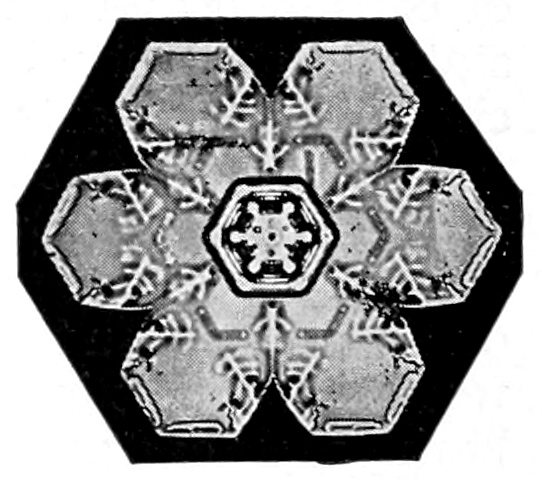
A snow crystal.
Photomicrograph by W. A. Bentley.
For the pupils in the elementary grades it seems best to limit the study of minerals to those which make up our granite and common rocks. In order to teach about these minerals well, the teacher should have at least one set of labelled specimens. Such a collection may be obtained from Edward E. Howell, 612 17th St., N. W., Washington, D. C., and also from Ward’s Natural Science Establishment, College Avenue Rochester, N. Y. These collections vary in number of specimens and price from one to two dollars and are excellent. The teacher should have one or two perfect crystals of quartz, feldspar and calcite. An excellent practice for a boy is to copy these crystals in wood for the use of the teacher.
The physical characteristics used in identifying minerals are briefly as follows:
1. Form. This may be crystalline, which shows the shape of the crystals definitely; granular, like marble, the grains having the internal structure, but not the external form, of crystals; compact, which is without crystalline form, as limestone or flint.
2. Color.
3. Luster or shine, which may be glassy like quartz, pearly like the inside of a shell; silky like asbestos; dull; or metallic like gold.
4. Hardness or resistance to scratching, thus: Easily scratched with the finger nail; cannot be scratched by the finger nail; easily scratched with steel; with difficulty scratched with steel; not to be scratched by steel. A pocket knife is usually the implement used for scratching.
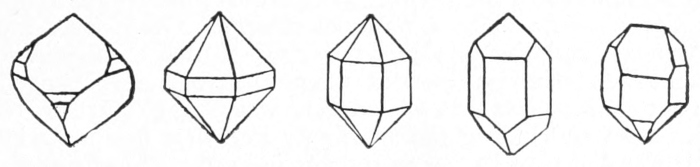
Forms of quartz crystals.
QUARTZ
Teacher’s Story
There is in the Cornell University Museum a great quartz crystal, a six-sided prism several inches in thickness. One-half of it is muddy and the other half clear, transparent and beautiful. The professor in charge, who has the imagination necessary to the expert crystallographer, said to his class: “This crystal was begun under conditions which made it cloudy; then something happened, perhaps some cataclysm that changed all the conditions around the half-grown crystal, and it may have lain a hundred or a thousand years unfinished, when, some other change occurring, there came about conditions which permitted it to resume growth, and the work began again exactly where it was left off, the shaft being perfected even to its six-sided pyramidal tip.” And ever afterwards that crystal, half clouded and half clear, remained in the minds of his pupils as a witness of the eternal endurance of the laws which govern the growth of crystals.
Quartz is the least destructible and is one of the most abundant materials in the crust of the earth as we know it. It is made up of two elements chemically united—the solid silicon and the gas oxygen. It is the chief material of sand and sandstones, and it occurs, mixed with grains of other minerals, in granite, gneiss, and many lavas; it also occurs in thick masses or sheets, and sometimes in crystals ornamenting the walls of cavities in the rocks. Subterranean waters often contain a small amount of silica, the substance of quartz, in solution; from such solutions it may be deposited in fissures or cracks in the rock, thus forming bodies called “veins.” Other materials are often deposited at the same time, and in this way the ores of the precious metals came to be associated with quartz. Sometimes quartz is deposited from hot springs or geysers, forming a spongy substance called sinter. In this case, some of the water is combined with the quartz, making what is called opal. Quartz crystal will cut glass.
Quartz occurs in many varieties: (a) In crystals like glass. If colorless and transparent it is called rock crystal; if smoky brown, it is called smoky quartz; if purple, amethyst. (b) In crystals, glassy but not transparent. If white, it is milky quartz; if pink, rose quartz. (c) As a compact crystalline structure without luster, waxy or dull, opaque or translucent, when polished. If bright red, it is carnelian; if brownish red, sard; if in various colors in bands, agate; if in horizontal layers, onyx; if dull red or brown, jasper; if green with red spots, bloodstone; if smoky or gray, breaking with small, shell-like or conchoidal fractures, flint.
Rock crystals are used in jewelry and especially are made to imitate diamonds. The amethyst is much prized as a semi-precious stone. Carnelian, bloodstone and agate are also used in jewelry; agate is used also in making many ornamental objects, and to make little mortars and pestles for grinding hard substances.
One of the marvels of the world is the petrified forest of Arizona, now set aside by the government as a national reserve. Great trees have been changed to agate and flint, the silica being substituted for the tissues of the wood so that the texture is preserved though the material is changed.
When our country was first settled, flint was used to start fires by striking it with steel and letting the sparks fly into dry, fine material, called tinder. It was also used in guns before the invention of cartridges, and the guns were called flintlocks. The Indians used flint to make hatchets and for tips to their arrows. The making of flint implements dates far back into prehistoric times; it was probably one of the first steps upward which man achieved in his long, hard climb from a level with the brute creation to the heights attained by our present civilization.
Quartz sand is used in making glass. It is melted with soda or potash or lead, and the glass varies in hardness according to the minerals added. Quartz is also used for sandpaper and glass paper; and ground to a fine powder, it is combined with Japans and oils and used as a finish for wood surfaces. Mineral wool is made from the slag refuse of furnaces where glass is made, and is used for rat-proof and fireproof padding for the walls of houses. Quartz combined with sodium or potassium and water, forms a liquid called water-glass, which is used for waterproof surfaces; it is also fireproof to a certain degree. Water-glass is the best substance in which to preserve eggs; one part of commercial water-glass to ten parts of water makes a proper solution for this purpose.
LESSON CCXIV
Quartz
Leading thought—Quartz is one of the most common of minerals. It occurs in many forms. As a crystal it is six-sided, and the ends terminate in a six-sided pyramid. It is very hard and will scratch and cut glass. When broken, it has a glassy luster and it does not break smoothly but shows an uneven surface.
Method—The pupils should have before them as many varieties of quartz as possible; at least they should have rock crystal, amethyst, rose and smoky quartz and flint.
Observations—1. What is the shape of quartz crystals? Are the sides all of the same size? Has the pyramid-shaped end the same number of plane surfaces as the sides?
2. What is the luster of quartz? Is this luster the same in all the different colored kinds of quartz?
3. Can you scratch quartz with the point of a knife? Can you scratch glass with a corner or piece of the quartz? Can you cut glass with quartz?
4. Describe the following kinds of quartz and their uses: amethyst, agate, flint.
5. How many varieties of quartz do you know? What has quartz to do with the petrified forests of Arizona?
FELDSPAR
Teacher’s Story
We most commonly see feldspar as the pinkish portion of granite. This does not mean that feldspar is always pink, for it may be the lime-soda form known as labradorite, which is dark gray, brown or greenish brown, or white; or it may be the soda-lime feldspar called oligoclase, which is grayish green, grayish white, or white; but the most common feldspar of all is the potash feldspar—orthoclase—which may be white, nearly transparent, or pinkish. Orthoclase is different from other feldspars in that, when it splits, its plane surfaces form right angles. Feldspar is next in the scale of hardness to quartz, and will with effort and perseverance scratch glass but will not cut it; it can be scratched with a steel point. Its luster is glassy and often somewhat pearly.
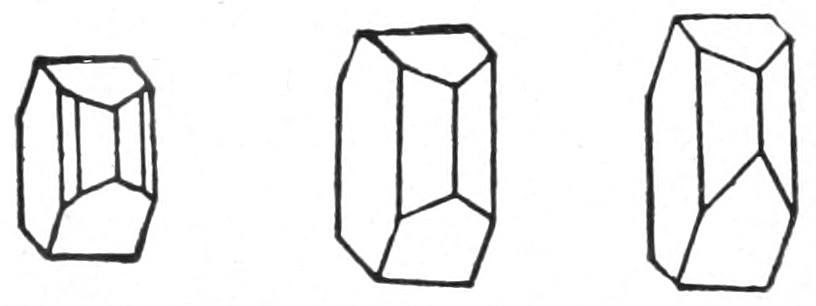
Forms of feldspar crystals.
Maine leads all other states in the production of feldspar. It is quarried and crushed and ground to powder, as fine as flour, to make the clay from which china and all kinds of pottery are made. Our clayey soils are made chiefly from the potash feldspar which is weathered to fine dust. Kaolin, which has been used so extensively in making the finest porcelain, is the purest of all clays, and is formed of weathered feldspar; floor tiling and sewer pipes are also made from ground feldspar. Moonstone is clean, soda-lime feldspar, whitish in color and with a reflection something like an opal.
LESSON CCXV
Feldspar
Leading thought—Feldspar is about five times as common as quartz. The crystal is obliquely brick-shaped, and when broken splits in two directions at right angles to each other. It is next in hardness to quartz, and will scratch glass but will not cut it.
Method—If possible, have the common feldspar (orthoclase), the soda-lime feldspar (oligoclase) and the lime-soda feldspar (labradorite).
Observations—1. What is the shape of the feldspar crystal?
2. What colors are your specimens of feldspar? How many kinds have you?
3. What is the luster of feldspar?
4. Can you scratch feldspar with the point of a knife? Can you scratch it with quartz? Can you scratch glass with it?
5. When you scratch feldspar with steel what is the color of the streak left upon it?
6. If feldspar is broken, does it break along certain lines, leaving smooth faces? At what angles do these smooth faces stand to each other?
7. How can you tell feldspar from quartz? Write a comparison of feldspar and quartz, giving clearly the characteristics of both.
8. Hunt over the pebbles found in a sand-bank. Which ones are quartz? Do you find any of feldspar?
9. When there is so much more feldspar than quartz in the earth’s crust, why is there so much more quartz than feldspar in sand?
MICA
Teacher’s Story
The mica crystal when perfect is a flat crystal with six straight edges. These crystals separate in thin layers parallel with the base. In color mica varies, through shades of brown, from a pale smoked pearl to black. Its luster is pearly, and it can be scratched with the thumb nail. Its distinguishing characteristic is that the thin layers into which it splits bend without breaking and endure great heat.
Mica was used in antiquity for windows. Because it is transparent and not affected by heat, it is used in the doors of stoves and furnaces and for lamp chimneys. Its strength makes it of use for automobile goggles. Diamond dust is powdered mica, as is also the artificial snow scattered over cotton batting for the decoration of Christmas trees. When ground finely, it is used as an absorbent for nitroglycerine in the manufacture of dynamite.
Mica mines are scarce in this country. There is an interesting one in North Carolina which had evidently been worked centuries before the advent of the white man in America. There are other mica mines in New Hampshire and Canada. The entire production of this mineral in the United States for the year 1908, was valued at a little more than a quarter of a million dollars. Nearly all of this output was used in the electrical industries, since mica is one of the best insulating materials known.
LESSON CCXVI
Mica
Leading thought—Mica is a crystal which flakes off in thin scales parallel with the base of the crystal. We rarely see a complete mica crystal but simply the thin plates which have split off. The ordinary mica is light colored, but there is a black form.
Method—If it is not possible to obtain a mica crystal, get a thick piece of mica which the pupils may split off into layers.
Observations—1. Describe your piece of mica. Pull off a layer with the point of your knife. See if you can separate this layer into two layers or more.
2. Can you see through mica? Can you bend it? Does it break easily? What is the color of your specimen? What is its luster? Can you cut it with a knife? Can you scratch it with the thumb nail? What color is the streak left by scratching it with steel?
3. What are some of the uses of mica? How is it especially fitted for some uses?
4. Write a theme on how and where mica is obtained.
GRANITE
Teacher’s Story
In granite, the quartz may be detected by its fracture, which is always conchoidal and never flat; that is, it has no cleavage planes. It is usually white or smoky, and is glassy in luster. It cannot be scratched with a knife. The feldspar is usually whitish or flesh-colored and the smooth surface of its cleavage planes shines brilliantly as the light strikes upon it; it can be scratched with a knife but this requires effort. The mica is in pearly scales, sometimes whitish and sometimes black. The scales of these mica particles may be lifted off with a knife, and it may thus be distinguished. If there are black particles in the granite which do not separate, like the mica, into thin layers, they probably consist of hornblende.
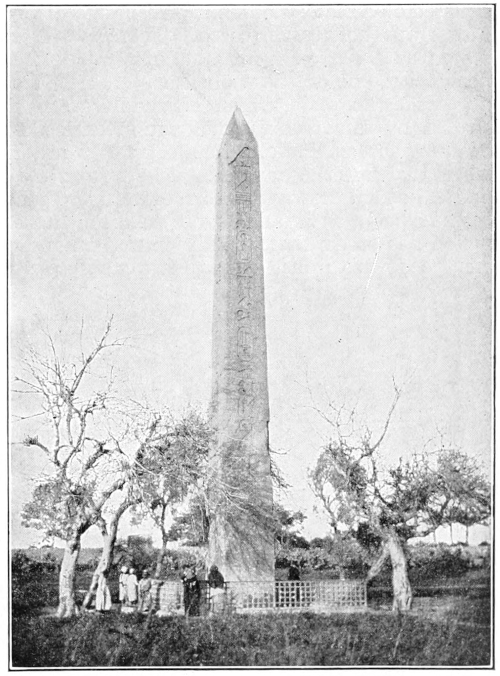
The granite obelisk still standing on the site of the ancient city of On.
Photo by J. H. Comstock.
Granite is used extensively for building purposes and for monuments. It is a very durable stone but in the northeastern United States where there is much rain and cold weather, the stone decays. Mica is the weakest, hornblende next, and feldspar is next to quartz, the strongest constituent of granite. Water permeates the mica, hornblende, feldspar and sometimes the quartz, and by its expansion in freezing causes the stone to crumble. The reason why polished granite endures better than the rough finished, is that the smooth surface gives less opportunity for the water to lodge and freeze. When the weathered granite is cut up into small particles by the waters of streams, they are sifted and all the parts which are soluble are carried off, leaving a sand composed of quartz and mica, which are insoluble. This sand is washed by streams into lakes, and then is dropped to the bottom; if enough is thus carried and dropped, it forms sandstone rock. All of our sandstones used for building purposes were thus laid down.
Cleopatra’s Needle, which stood for thousands of years in the dry climate of Egypt, soon commenced to weather and crumble when placed in Central Park, N. Y. This shaft has a most interesting history. It was quarried near Assuan, in the most famous of all granite quarries of ancient Egypt. It was cut as a solid shaft in the quarry and carried down the Nile River for 500 miles—an engineering feat which would be hard to accomplish to-day, with all our modern appliances. It was one of the obelisks that graced the ancient city of On, later called Heliopolis, situated on a plateau near the present city of Cairo; On was the city where Moses was born and reared. There is still standing where it was first placed as a part of a magnificent temple, the temple a part of a magnificent city, one of these obelisks. It now stands alone in the middle of a great fertile plain, which is vividly green with growing crops; a road shaded by tamarisk and lebbakh trees leads to it; nearby is a sakiah, creaking as the blindfolded bullock walks around and around, turning the wheel that lifts the chain of buckets from the well to irrigate the crops; and a hooded crow, whose ancestors were contemporaries of its erection, caws hoarsely as it alights on the beautiful apex of this ancient shaft, which has stood there nearly four thousand years and has seen a great city go down to dust to fertilize a grassy plain.
LESSON CCXVII
Granite
Leading thought—Granite is composed of feldspar, quartz and mica, and often contains hornblende.
Method—Specimens of coarse granite and a pocket knife are needed.
Observations—1. What minerals do you find in granite? How can you tell what these minerals are? Look at the granite with a lens. How can you tell the quartz from feldspar? Take a knife and scratch the two. Can you tell them apart in that way? How can you tell the mica? How can you tell the hornblende?
2. What buildings have you seen made of granite? What monuments have you seen made from it?
3. Which mineral in granite is especially affected by water? Which remains unharmed the longest?
4. What is weathering? Mention some of the characteristics of weathering. Why does the rough-finished granite weather sooner than that which is polished?
5. Examine some sand with a lens. What mineral do you find present in it in the greatest quantity?
6. Write the story of the Cleopatra’s Needle in Central Park, New York City.
CALCITE, MARBLE AND LIMESTONE
Teacher’s Story
Calc spar, or calcium carbonate, is a mineral and is the material of which marble, limestone and chalk are made. The faces of the calcite crystal are always arranged in groups of three or multiples of three—a three-sided pyramid or two pyramids joined base to base. The pyramids may be obtuse or acute. When acute and formed of three pairs of faces, the crystals are called dog-tooth spar. The crystals appear in a great variety of forms, but they all have the common quality of splitting readily in three directions, the fragments resembling cubes which are oblique instead of rectangular. When these cleaved, or split pieces, are transparent, they are called Iceland spar. When an object is viewed through Iceland spar at least one-quarter inch thick, it appears double. The calcite crystal is often transparent with a slight yellowish tinge, but it also shows other colors; and it has a slightly cloudy or slightly pearly or almost glassy luster like feldspar. It is easily scratched with a knife and will not scratch glass. If a drop of strong vinegar or weak hydrochloric acid falls upon it, it will effervesce.
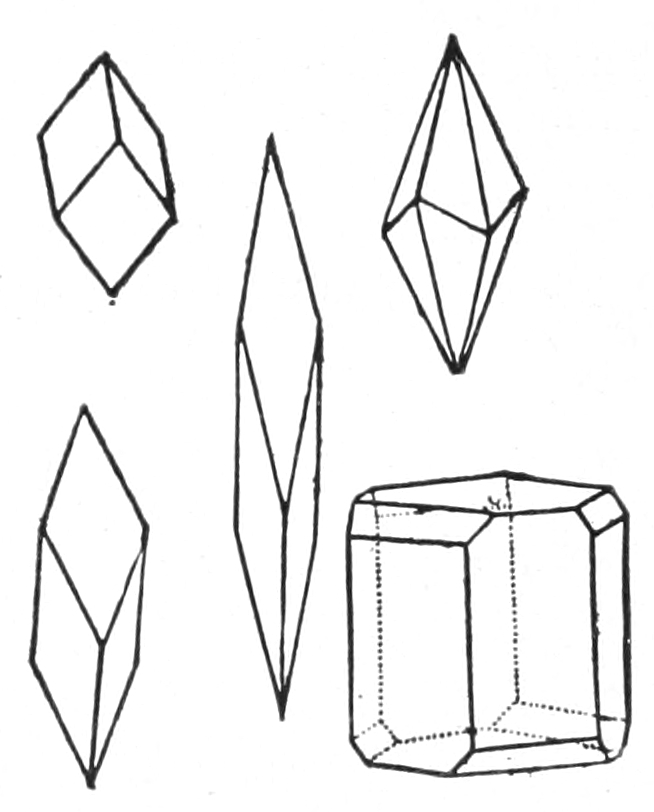
Forms of calcite crystals.
Limestone—so called because it is burned to make quicklime—was formed on the bottoms of oceans; its substance came chiefly from the skeletons of corals and the shells of other sea creatures, since sea-shells and coral stems are pure calcium carbonate in composition. In the water, the shells and corals were broken down, and then deposited in layers on the bottom of the sea. So wherever we find limestone, we know that there was once the bottom of a great sea. Such layers of limestone are now being deposited off the shores of Florida, where corals grow in great abundance. Limestone is used extensively for building purposes, and in most climates is very durable. The great pyramids of Egypt are of limestone. It is not a good material for making roads, since it is so soft that it wears out readily, making a fine easily-blown dust. It is slowly dissolved in water, especially if the water be acid; thus, in limestone regions, there are caves where the water has dissolved out the rock; and attached to their roofs and piled upon their floors may be large icicle-shaped stalactites and stalagmites, which were made by the lime-bearing water dripping down and evaporating, leaving its burden in crystals behind it. When the roof of a cave falls in, the cavity thus made is called a sink hole and is often dangerous. The famous Natural Bridge in Virginia is all that is left of what was once the roof of such a cavern. The water in limestone regions is always hard, because of the lime which it holds in solution; and in such regions the streams usually have no silt, but have clean bottoms; moreover, the springs are likely to become contaminated because the water has run through long caves instead of filtering through sand.
Chalk is similar in origin to limestone; it is made up of the shells of minute sea creatures, so small that we can only see them with the aid of a microscope. Try and think how many years it must have required for the shells of such tiny beings to build up the beds which make the great chalk cliffs of England!
Marble is formed inside of the earth from limestone, under the influence of heat and pressure; it differs from limestone chiefly in that the grains are of crystalline structure, and are larger; it is usually white or gray in color, and sometimes is found in differing colors. At Cadiz in California, marble is found showing twenty or more quite different colors. The most famous marbles are the Carrara of Italy, the Parian from the Island of Paros, and the Pentelican from the mountain of that name near Athens. The reason why these marbles are so famous is that in ancient times sculptors carved beautiful statues from them, and the architects used them for building magnificent temples. The principal marble deposits in the United States are in Vermont, Georgia, Tennessee and California. Marble deteriorates when it is exposed to air which is filled with smoke and gases. It is also used to make lime. When either marble or limestone is heated very hot, it separates into two parts, one of which is lime, and the other carbonic acid gas—the same that is used for charging soda-water fountains.
LESSON CCXVIII
Calcite, Marble and Limestone
Leading thought—Calcite or calc spar is formed more than half of lime. The best known forms of its crystals are cubelike, but instead of having twelve right-angled edges, the sides are lozenge-shaped, and are set together with six obtuse angles and six acute. Dog-tooth spar is one form of calcite crystal. Limestone is a solid form of calcite. Marble is granular limestone which shows the broken crystals of calcite. Chalk is very fine, pulverized calcite.
Method—Specimens of dog-tooth spar, limestone, marble, shells of oysters or other sea creatures and coral should be provided for this lesson; also a bottle of dilute hydrochloric acid, and a piece of glass tubing about six inches long with which to drop the acid on the stones. Some strong vinegar will do instead of the acid.
Observations—1. What is the form of the calcite crystal? What is the luster of the crystal? Is it the same as the inside of sea-shells? Will calcite scratch glass? Can you scratch it with a knife? What happens to calcite if you put a drop of weak hydrochloric acid upon it?
2. Is marble made up of crystals? Examine it with a lens to see. What is its color? Have you seen marble of other colors than white? Do you know the reason why marble is sometimes clouded and streaked?
3. Put a drop of weak hydrochloric acid on the marble. What happens?
4. What are the uses of marble? What have you ever seen made from marble? Why is it used for sculpture? What famous statues have you seen which were made of marble? Name some of the famous ancient marble buildings.
5. Test a piece of limestone for hardness. Can you scratch it with a knife? Is it as soft as marble? Put on it a drop of acid. Does it effervesce? If there are any fossils in your piece of limestone, test them with acid and see if they will effervesce. Any other mineral that you have which will effervesce when touched with acid, is probably some form of calcite.
6. Are there any buildings in your town made of limestone? How do you know the stone is limestone? Where was it obtained? Is it affected by the weather?
7. Is limestone a good material for making or mending roads? Give a reason.
8. Why is water in limestone regions hard? Why are limestone regions likely to have caves within the rocks? How are stalactites and stalagmites formed in caves? What are sink holes? How are they formed? In what county of your state is limestone found?
9. How is the lime which is used for plastering houses made?
10. Write a theme on how the chalk rocks are made?
11. Test a shell with acid; test a piece of coral with acid. How does it happen that these, which were once a part of living creatures, are now limestone? Of what are our own bones made?
“A great chapter in the history of the world is written in the chalk. Few passages in the history of man can be supported by such an overwhelming mass of direct and indirect evidence as that which testifies to the truth of the fragment of the history of the globe, which I hope to enable you to read, with your own eyes, to-night. Let me add, that few chapters of human history have a more profound significance for ourselves. I weigh my words well when I assert, that the man who should know the true history of the bit of chalk which every carpenter carries about in his breeches-pocket, though ignorant of all other history, is likely, if he will think his knowledge out to its ultimate results, to have a truer, and therefore a better, conception of this wonderful universe, and of man’s relation to it, than the most learned student who is deep-read in the records of humanity and ignorant of those of Nature.”
“During the chalk period, or ‘cretaceous epoch,’ not one of the present great physical features of the globe was in existence. Our great mountain ranges, Pyrenees, Alps, Himalayas, Andes, have all been upheaved since the chalk was deposited, and the cretaceous sea flowed over the sites of Sinai and Ararat. All this is certain, because rocks of cretaceous or still later date, have shared in the elevatory movements which give rise to these mountain chains; and may be found perched up, in some cases, many thousand feet high upon their flanks.”—Thomas Huxley.
THE MAGNET
Teacher’s Story
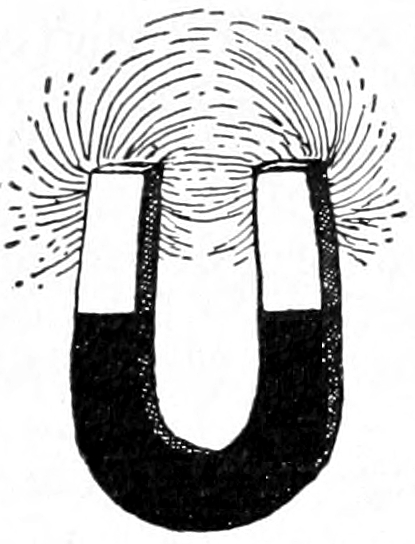
NTIL comparatively recent times, the power of the magnet was so inexplicable that it was regarded as the working of magic. The tale of the Great Black Mountain Island magnet described in the “Arabian Nights Entertainments”—the story of the island that pulled the nails from passing ships and thus wrecked them—was believed by the mariners of the Middle Ages. Professor George L. Burr assures me that this mountain of lodestone and the fear which it inspired were potent factors in the development of Medieval navigation. Even yet, with all our scientific knowledge, the magnet is a mystery. We know what it does, but we do not know what it is. That a force unseen by us is flowing off the ends of a bar magnet, the force flowing from one end attracted to the force flowing from the other and repellent to a force similar to itself, we perceive clearly. We also know that there is less of this force at a point in the magnet half-way between the poles; and we know that the force of the magnet acts more strongly if we offer it more surface to act upon, as is shown in the experiment in drawing a needle to a magnet by trying to attract it first at its point and then along its length. That this force extends out beyond the ends of the magnet, the child likes to demonstrate by seeing across how wide a space the magnet, without touching the objects, can draw to it iron filings or tacks. That the magnet can impart this force to iron objects is demonstrated with curious interest, as the child takes up a chain of tacks at the end of the magnet; and yet the tacks when removed from the magnet have no such power of cohesion. That some magnets are stronger than others is shown in the favorite game of “stealing tacks,” the stronger magnet taking them away from the weaker; it can also be demonstrated by a competition between magnets, noting how many tacks each will hold.
One of the most interesting things about a magnet is that like poles repel and opposite poles attract each other. How hard must we pull to separate two magnets that have the south pole of one against the north pole of the other! Even more interesting is the repellent power of two similar poles, which is shown by approaching a suspended magnetized needle with a magnet. These attractive and repellent forces are most interestingly demonstrated by the experiment in question 13 of the lesson. These needles floating on cork join the magnet or flee from it, according to which pole is presented to them.
Not only does this power reside in the magnet, but it can be imparted to other objects of iron and steel. By rubbing one pole of the magnet over a needle several times, always in the same direction, the needle becomes a magnet. If we suspend such a needle by a bit of thread from its center, and the needle is not affected by the nearness of a magnet, it will soon arrange itself nearly north and south. It is well to thrust the needle through a cork, so it will hang horizontally, and then suspend the cork by a thread. The magnetized needle will not point exactly north, for the magnet poles of the earth do not quite coincide with the poles of the earth’s axis.
The direction assumed by the magnetized needle may be explained by the fact that the earth is a great magnet, but the south pole of the great earth magnet lies near the North Pole of the earth. Thus, a magnet on the earth’s surface, if allowed to move freely, will turn its north pole toward the south pole of the great earth magnet. Then, we might ask, why not call the earth’s magnetic pole that lies nearest our North Pole its north magnetic pole? That is merely a matter of convenience for us. We see that the compass needle points north and south, and the arm of the needle which points north we conveniently call its north pole.
The above experiment with a suspended needle shows how the mariner’s compass is made. This most useful instrument is said to have been invented by the Chinese, at least 1400 B. C., and perhaps even longer ago. It was used by them to guide armies over the great plains, and the needle was made of lodestone. The compass was introduced into Europe about 1300 A. D., and has been used by mariners ever since. To “box the compass” is to tell all the points on the compass dial, and is an exercise which the children will enjoy.
We are able to tell the direction of the lines of force flowing from a magnet, by placing fine iron filings on a pane of glass or a sheet of paper and holding close beneath one or both poles of a magnet; instantly the filings assume certain lines. If the two ends of a horseshoe magnet are used, we can see the direction of the lines of force that flow from one pole to the other. It is supposed that these lines of magnetic force streaming from the ends of the great earth magnet cause the Northern Lights, or Aurora Borealis.
Lodestone is a form of iron with a special chemical composition, and it is a natural magnet. Most interesting stories are told of the way the ancients discovered this apparently bewitched material, because it clung to the iron ends of their staffs or pulled the iron nails from their shoes. In the Ward’s collection of minerals sent out to schools, which costs only one dollar, there is included a piece of lodestone, which is of perennial interest to the children.
Magnets made from lodestone are called natural magnets. A bar magnet or a horseshoe magnet has received its magnetism from some other magnet or from electrical sources. An electro magnet is of soft iron, and is only a magnet when under the influence of a coil of wire charged with electricity. As soon as the current is shut off the iron immediately ceases to be a magnet.
LESSON CCXIX
The Magnet
Leading thought—Any substance that will attract iron is called a magnet, and the force which enables it to attract iron is called magnetism. This force resides chiefly at the ends of magnets, called the poles. The forces residing at the opposite ends of a magnet act in opposite directions; in two magnets the like poles repel and the unlike poles attract each other. The needle of the mariner’s compass points north and south, because the earth is a great magnet which has its south pole as a magnet at the North Pole of the world.
Method—Cheap toy horseshoe magnets are sufficiently good for this lesson, but the teacher should have a bar magnet, also a cheap toy compass, and a specimen of lodestone, which can be procured from any dealer in minerals. In addition, there should be nails, iron filings and tacks of both iron and brass, pins, darning needles or knitting needles, pens, etc. Each child, during play time, should have a chance to test the action of the magnets on these objects, and thus be able to answer for himself the questions which should be given a few at a time.
Observations—1. How do we know that an object is a magnet? How many kinds of magnets do you know? Of what substance are the objects made which the magnets can pick up? Does a magnet pick up as many iron filings at its middle as at its ends? What does this show?
2. How far away from a needle must one end of the magnet be before the needle leaps toward it? Does it make any difference in this respect, if the magnet approaches the needle toward the point or along its length? Does this show that the magnetic force extends out beyond the magnet? Does it show that the magnetic force works more strongly where it has more surface to act upon?
3. Take a tack and see if it will pick up iron filings or another tack. Place a tack on one end of the magnet, does it pick up iron filings now? What do you think is the reason for this difference in the powers of the tack?
4. Are some magnets stronger than others? Will some magnets pull the iron filings off from others? In the game of “stealing tacks,” which can be played with two magnets, does each end of the magnet work equally well in pulling the tacks away from the other magnet?
5. Pick up a tack with a magnet. Hang another tack to this one end to end. How many tacks will it thus hold? Can you hang more tacks to some magnets than to others? Will the last tack picked up attract iron filings as strongly as the first next to the magnet? Why? Pull off the tack which is next to the magnet. Do the other tacks continue to hold together? Why? Instead of placing the tacks end to end, pick up one tack with the magnet and place others around it. Will it hold more tacks in this way? Why? If a magnet is covered with iron filings will it hold as many tacks without dropping the filings?
6. Take two horseshoe magnets and bring their ends together. Then turn one over and again bring the ends together. Will they cling to each other more or less strongly than before? Bring two ends of two bar magnets together; do they hold fast to each other? Change ends with one, now do the two magnets cling more or less closely than before? Does this show that the force in the two ends of a magnet is different in character?
7. Magnetize a knitting needle or a long sewing needle by rubbing one end of a magnet along its length twelve times, always in the same direction, and not back and forth. Does a needle thus treated pick up iron filings? Why?
8. Suspend this magnetized needle by a thread from some object where it can swing clear. When it finally rests does it point north and south or east and west?
9. Bring one end of a bar magnet or of a horseshoe magnet near to the north end of the suspended needle; what happens? Bring the other end of the magnet near the north end of the needle; what happens?
10. Magnetize two needles so that their eyes point in the same direction when they are suspended. Then bring the point of one of these needles toward the eye of the other, what happens? Bring the eye of one toward the eye of the other, what happens? When a needle is thus magnetized the end which turns toward the north is called the north pole, and the end pointing south is called the south pole.
11. Try this same experiment by thrusting the needles through the top of a cork and float them on a pan of water. Do the north poles of these needles attract or repel each other? Do the south poles of these needles attract or repel each other? If you place the north pole of one needle at the south pole of the other do they join and make one long magnet pointing north and south?
12. Take a pocket compass; place the north end of one of the magnetized needles near the north arm of the compass needle; what happens? Place the south pole of the needle near the north arm of the compass needle, what happens? Can you tell by the action of your magnet upon the compass needle which end of your magnet is the north pole and which the south pole?
13. Magnetize several long sewing needles by rubbing some of them toward the eye with the magnet and some from the eye toward the point. Take some small corks, cut them in cross sections about one-fourth inch thick, thrust a needle down through the center of each leaving only the eye above the cork. Then set them afloat on a pan of water. How do they act toward each other? Try them with a bar magnet first with one end and then with the other, how do they act?
14. Describe how the needle in the mariner’s compass is used in navigation.
15. Place fine iron filings on a pane of glass or on a stiff paper. Pass a magnet underneath; what forms do the filings assume? Do they make a picture of the direction of the lines of force which come from the magnet? Describe or sketch the direction of these lines of force, when the poles of a horseshoe magnet are placed below the filings. Place two similar poles of a bar magnet beneath the filings; what form do they take now?
16. What is lodestone? Why is it so called?
17. What is the difference between lodestone and a bar magnet? What is an electro magnet?
18. Write an English theme on “The Discovery and Early Use of the Mariner’s Compass.”
Supplementary reading—Electrical Experiments, Bonney; The Wonder Book of Magnetism, Houston; “The Third Royal Calendar” from Arabian Nights Entertainments.
“Now, chief of all, the magnet’s power I sing, And from what laws the attractive functions spring; The magnet’s name the observing Grecians drew From the magnetic regions where it grew; Its viewless potent virtues men surprise, Its strange effects they view with wondering eyes, When, without aid of hinges, links, or springs, A pendant chain we hold of steely rings Dropt from the stone—the stone the binding source,— Ring cleaves to ring, and owes magnetic force: Those held superior, those below maintain, Circle ’neath circle downward draws in vain, Whilst free in air disports the oscillating chain.” —“De Rerum Naturæ,” Lucretius, 93–52 B. C.
A tiller of the soil.
THE SOIL
Teacher’s Story
The soil is the sepulcher and the resurrection of all life in the past. The greater the sepulcher the greater the resurrection. The greater the resurrection the greater the growth. The life of yesterday seeks the earth to-day that new life may come from it tomorrow. The soil is composed of stone flour and organic matter (humus) mixed; the greater the store of organic matter the greater the fertility.—John Walton Spencer.
Because the child, after making mud pies, is told that his face is dirty, he naturally concludes that all soil is dirt. But it is only when out of place that it is dirt; for, in place, it is the home of miracles—the matrix from which comes that wonderful force which we call life. After the study of the brook, the crystals, the minerals and the rocks, the pupils are ready for a more careful study of the soil. However, most of the study in soils belongs to agriculture rather than to nature-study.
The Soil Makers
If we could go back to the very beginning, we should find that the soil consisted solely of broken off particles of rock—particles so finely ground by nature’s forces that we might properly call them “rock flour.” In our study of the brook, we noted that those stones with sharp corners were just beginning their experience in the brook mill, and those that were rounded out, forming pebbles, had their corners ground off in the making of the soil grist. And in the work of the brook we saw how this grinding was done, and how the soil grist is sifted, sorted, carried and dropped.
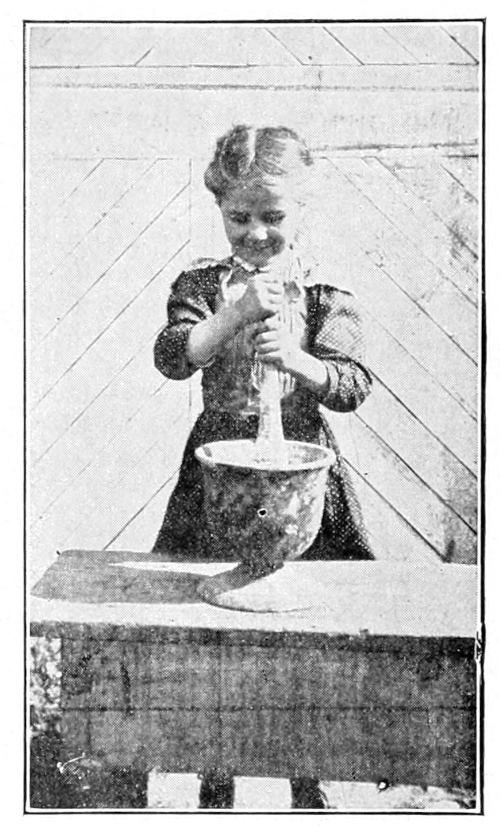
One of Uncle John’s nieces making stone flour.
But there are other agencies besides water that help in grinding the stone flour. If we visit some rocky cliff, we are sure to find at its base a heap of stones, gravel and soil, which the geologists call talus. In our eastern country we know that these pebbles and soil were pried loose by Jack Frost with his ice wedges. The water filters into all the cracks and crevices of the rock, and since water, when freezing, is obliged to expand, the particles of rock were thereby torn loose and forced off and fell to the bottom of the cliff. Moreover, rocks expand when hot, and are often thus broken without the aid of water and frost. In the rocks of the desert, the changes in temperature pry off the rock particles, which the winds carry away to make up the sands of the desert. The winds hurl these sands against other rocks which are still standing, and hurl them with such force that more particles are torn off, making more sand. In fact, the wind, in some regions, grinds the rocks into stone flour as effectually as does the water in other places. Then, too, the gases of the air also cause rocks to decay. We know how iron rusts and falls to pieces through contact with the gases of the air. Some rocks decompose in a similar way. We often see that the inscriptions on old headstones have been almost obliterated, because the gases in the air have so decomposed the marble.
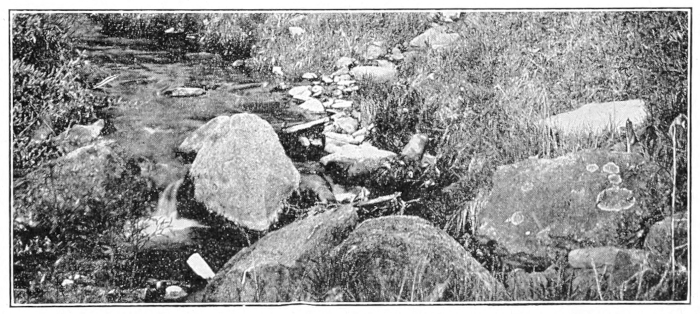
Lichens growing on rocks.
Photo by Verne Morton.
In addition to the other soil makers, there are the little plants which we call lichens. The spores of these plants are so minute that we cannot see them, and they drift about in the air until they find resting place upon some rock. Here they begin to grow, and as they grow they become strongly acid; they are thus enabled to eat a foothold into the rock, softening its surface and powdering it into stone flour. And in these situations other plants grow later, sending their roots down into every crack and crevice and thus prying off more of the rock.
The Soil Carriers
In the study of the brook we have seen how the water lifts, carries and deposits the soils; and since, at one time or another, the entire surface of the earth has been under water, we can see that water has been the most important of the soil carriers and has done the greatest work. The wind carries much soil, especially in the arid regions; the movements of the sand dunes in the deserts and on the seashores bear witness to what the wind can do as a soil carrier. But in the northern United States, from New England to the Dakotas, much of our soil has been carried by a great ice river that once upon a time flowed down upon our lands from the North. This great, slow-moving river, perhaps a mile or more high, plowed up the soil and stones, and freezing them fast carried and shoved them along under its great weight. After a time the ice melted and dropped its burden. Many of the stones were of granite taken up from the old mountains of northern Canada and ground off and rounded during their journey. We call these stones which were brought down to us from the North, “boulders;” and the soils which were brought along on the bottoms of glaciers and dropped and pressed down by the tremendous ice weight and thus made compact although unsorted, we call “hardpan.”
The Kinds of Soil
By the work of these soil makers and soil carriers, the rock flour was made. But if we should take some of it and plant our seeds in it, we should find that they would not grow thriftily, even though we watered them and gave them every care. The reason for this is that most rock flour does not have in it the substances which the plants most need for their growth. But if we should go to the woods and get some of the black woods-earth and mix it with rock flour, we should find that our plants would thrive. This rich, earth mold in the forest is almost wholly made up of matter once alive, but which is now decayed, and which we call “humus.” The more humus that we have in the rock flour, the richer it is in plant food, and the more plant growth it will support.
In general, soils may be divided into clay, sand, gravel, loam and humus.
Clay in its purest state is kaolinite, the result of weathering of feldspar, or mica. It is finely powdered and is used for pottery, while the less pure clays are used for brickmaking. Clayey soil is sticky and slippery when wet, and bakes hard and cracks when dry. It is hard to cultivate, but it absorbs moisture from the air and holds fast to its fertility, and is especially good for permanent pastures and meadows.
Sand, in a pure state, is made up mostly of finely broken particles of quartz and feldspar, and is used for the making of glass. A sandy soil is light and open and easy to work. It absorbs little water from the air and has little power for holding plant food, since the water washes it out. It is especially valuable for truck gardening, because it is a warm soil. It is warm because water does not evaporate from its surface rapidly.
Humus is composed of decayed animal and vegetable matter. It is very rich in plant food. Wherever there is humus in the soil it is likely to be darker in color than the stone flour.
Loam is a mixture of clay, sand and humus. For many crops it is the most desirable soil.
LESSON CCXX
The Soil
Leading thought—The soil is composed of rock flour and humus. Soil, to support life, must be porous, so that the roots of the plants may receive through it both water and air.
Method—The children should bring in specimens of soils from various localities near the school. Parts of each specimen should be wet to see if they are clayey, that quality showing quickly in the puttylike adhesiveness when rubbed between the fingers. It would be well to get some pure blue clay, and let the children make marbles of it to impress upon them this quality of clay. They should try and make marbles of other soils to show the lack of adhesiveness in them. They should examine sand through a lens and should examine humus in a similar way. After they are familiar with these three kinds of soils, they are ready for the lesson.
Observations—1. Look at any kind of soil with a lens, and tell why you think it is made up of small pieces of stone and rock.
2. Take a piece of rock and pound it fine. What does it look like? Do you think that your plants will grow well if you plant them in the rock flour which you have just made? Try the experiment and describe the results.
3. How does the water grind off the stones and make soil? How does the wind do it?
4. How do water and frost pry off pieces of rock? Is there a cliff in your neighborhood that has at its foot a heap of soil and stones? Where did these come from?
5. How do the lichens and other plants pry off the outside of rocks? Have you ever found lichens growing on stones?
6. Have you ever noticed old headstones in the cemetery that were falling to pieces? What causes them to decay?
7. Write an English theme on the great glacier that formerly covered the northeastern portion of the United States.
8. Go to the woods, scrape off the leaves and get some of the black earth beneath them. Of what is this soil composed? Is it rock flour? What makes it so black? Why do you call this soil rich? What does it do if you add it to the soil in the pots where your flowers are growing?
9. Find a railroad cut or some other place where the earth is exposed for some distance up and down. Is there solid rock at the bottom? How deep is the soil above the rock? Is the soil the same color at the surface as it is below? Why is this?
10. Experiment 1: To show which kinds of soil hold most water—Take three lamp chimneys, or bottles from which the bottoms have been broken. Place in one loam, in another clay, in another fine-grained sand, using in each case the same amount. Tie cheesecloth over the bottom, so that the soil will not fall out; make the soil compact by jarring down. Place each over a tumbler. From a cup of water, held as near as possible to the soil, pour water into one of the bottles slowly, so as to keep the surface of the soil covered. Consult a watch and note how long before the water begins dripping below. Do the same with the other two. Compare the results. Which soil takes the water most rapidly? Which lets it through first? Which lets through the most? How would rain affect fields of clayey soil? Of sandy soil? Of loam?
Hints for teacher on Experiment No. 1—Through sand the water passes very rapidly—in less than a minute if the sand is coarse. It takes several minutes (14 min.) to go through loam, but requires some hours to appear below the clay. It requires more water to saturate clay. Care should be taken to use the same amount of water on the three kinds of soil. More than one application will be required for clay, since the amount of water accommodated in the chimney above the soil will not be sufficient to saturate clay.
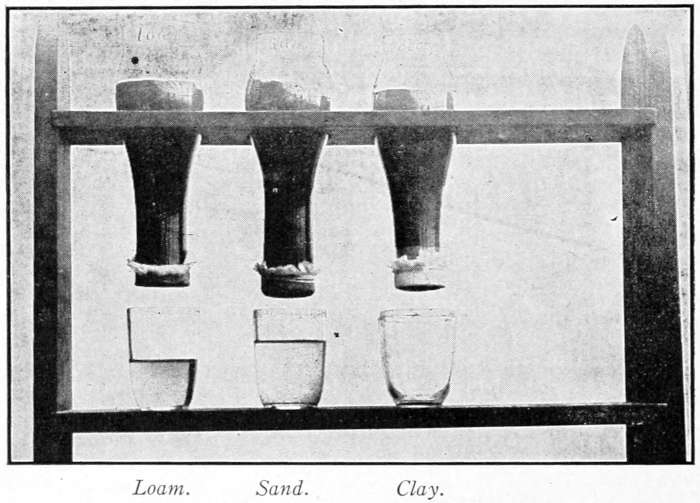
Loam. Sand. Clay.
Note that the sand has allowed the most water to drip through it, the loam next, while no water has passed through the clay.
More water will be found to have percolated through sand than through loam or clay. The latter are more retentive of moisture than is sand, although absorbing rain less readily than sand. The mixture of sand and clay in loam is most ideal for cultivated fields, absorbing moisture more readily than clay and retaining it better than sand.
Experiment 2—Fill a glass tumbler with very small marbles or buckshot. Pour water over them to fill the glass. Placing cheesecloth over the top of the tumbler pour off all the water that easily drains away. Remove the cheesecloth, and immediately examine the marbles for the film of water which surrounds each one and can clearly be seen where one marble comes in contact with another marble or the side of the glass.
Hints for teacher on Experiment 2—It is such a film of water as remains on the marbles that on each particle of soil supplies the plant with water and food. The water between the marbles has been drained off. This water corresponds to that carried out of the soil by drainage; it is injurious to the plant, keeping “its feet too wet,” and should be removed.
Experiment 3—To show that soil lifts water up from below—Use the same soils arranged in the same way as for Experiment 1, but instead of pouring water in at the top, place the three lamp chimneys in a pan which has water in it about an inch deep. In which soil does the water rise most rapidly? In which does it rise the highest? After the water has been taken up, let the soil stand in the lamp chimneys for several days. Which soil dries out the soonest? If we had three fields, one of loam, one of clay, and one of sand, in which would the most water be lifted from below for the use of the plants? Which would retain the water longest?
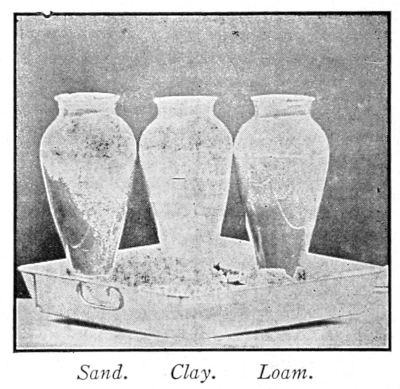
Sand. Clay. Loam.
The water has nearly reached the upper surface of the sand and is halfway up the loam; in the clay it has climbed but a short distance.
Hints for teacher on Experiment 3—Water rises through the sand in a short time; if rather fine sand is used it requires less than half an hour. To rise through loam it will require three or four times as long, and may not reach the top of the clay for several days. If the glass tubes were three or four feet long and allowed to stand for several days, we would find that although the water climbs very slowly through the clay it will climb to a greater height in clay than in loam or sand. Under field conditions clay will retain moisture for a longer time than sand or loam.
Experiment 4—To show that mulch keeps the water from evaporating from soils—Take two of the lamp chimneys filled half full with loam. Pour in the same amount of water in each until the soil is thoroughly wet. Cover the top of one with an inch deep of dry, loose earth. Which dries out first? What does the loosening and pulverizing of the soil in our fields by harrowing do for our planted crops? What is a mulch?
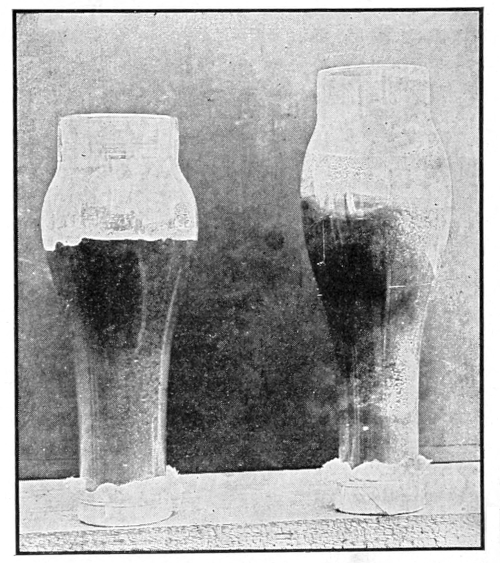
The unmulched loam in the chimney at the left dried out in four days. The loam covered with a dust mulch in the other chimney retained moisture for a month.
Hints for teacher on Experiment 4—The soil covered with a layer of dry soil—a dust mulch—will retain moisture much longer than the unmulched soil. Hence, the farmer or gardener loosens and pulverizes the top soil by harrowing, hoeing or raking in order to retain moisture for plant roots. A mulch may also be of straw, boards, leaves or stones. Fallen leaves form a natural mulch in the woods. There, at any time, under this covering, may be found moist earth. A mulch is a soil cover which breaks the capillary connection, so that water will not rise to the surface to be evaporated. To be efficient a mulch must be dry. After rain the “dust blanket” on the garden bed should be renewed by cultivation.
Experiment 5—Fill several vials with different soils from fields in the neighborhood. If the soil in any of the vials is dry, moisten it. Take a piece of blue litmus paper and press down into the soil in each vial. Does the litmus paper turn red as it becomes dampened by the soil in any of the vials? If so, this soil is acid. Add a little lime and mix it in thoroughly with the soil in the vial that shows the acid soil. Test it again with the litmus paper. Does the paper remain blue or turn red? Does alfalfa and clover grow on acid soils? Why should we add lime to such soils?
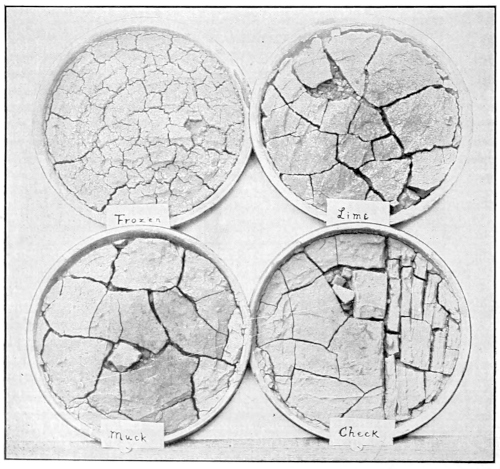
Experiment to show the proper treatment of clay soil.
Hints for teacher on Experiment 5—A slightly acid soil may show no reaction with litmus paper. It may be well to have a prepared soil with a few drops of vinegar or other acid added, which will show the reaction. The addition of lime will correct the acid condition. Soils for alfalfa or clover should never be acid. They are usually well limed before an attempt is made to grow these legumes.
Experiment 6, which indicates the proper treatment of clay soils—Fill four pie tins with clay which has been wet and smoothly puddled. In one mix with the clay a small portion of lime; in another add a larger portion of muck; leave two with pure clay, and place one of these out-of-doors where it will freeze hard. Then place the four tins on a shelf and allow to dry. In which of these is the clay most friable? In which is it the hardest?
Hints to the teacher on Experiment 6—This experiment shows that freezing the clay rendered it finer, so that it may be broken easily into particles small enough to set closely about the plant’s roots. The clay mixed with lime is much more friable than the one mixed with muck, showing that clay needs lime more than organic matter to make it of greatest use. The pure clay which is dried without freezing hardens into large, flat pieces, each being almost as hard as stone.
Supplementary reading—Ch. I, II, III in The Great World’s Farm, Gaye: Ch. IV. in Practical Forestry, Gifford.
Beside the moist clods the slender flags arise filled with the sweetness of the earth. Out of the darkness—under that darkness which knows no day save when the ploughshare opens its chinks—they have come to the light. To the light they have brought a colour which will attract the sunbeams from now till harvest.—Richard Jefferies.
“Here is a problem, a wonder for all to see. Look at this marvelous thing I hold in my hand! This is a magic surprising, a mystery Strange as a miracle, harder to understand. What is it? Only a handful of dust: to your touch A dry, rough powder you trample beneath your feet, Dark and lifeless; but think for a moment, how much It hides and holds that is beautiful, bitter, or sweet. Think of the glory of color! The red of the rose, Green of the myriad leaves and the fields of grass, Yellow as bright as the sun where the daffodil blows, Purple where violets nod as the breezes pass. Strange, that this lifeless thing gives vine, flower, tree, Color and shape and character, fragrance too; That the timber that builds the house, the ship for the sea, Out of this powder its strength and its toughness drew!” —From “Dust,” Celia Thaxter.