PART II. (continued 3)
Reading edition
In appearance the catbird is tailor-made, belonging to the same social class as the cedar-bird and the barn swallow. However, it affects quiet colors, and its well-fitting costume is all slate-gray except the top of the head and the tail which are black; the feathers beneath the base of the tail are brownish. The catbird is not so large as the robin, and is of very different shape; it is far more slender and has a long, emotional tail. The way the catbird twitches and tilts its tail, as it hops along the ground or alights in a bush, is very characteristic. It is a particularly alert and nervous bird, always on the watch for intruders, and the first to give warning to all other birds of their approach. It is a good fighter in defending its nest, and there are several observed instances where it has fought to defend the nest of other species of birds; and it has gone even further in its philanthropy, by feeding their orphaned nestlings.
The catbird chooses a nesting site in a low tree or shrub or brier, where the nest is built usually about four feet from the ground. The nest looks untidy, but is strongly made of sticks, coarse grass, weeds, bark strips and occasionally paper; it is lined with soft roots and is almost always well hidden in dense foliage. The eggs are from three to five in number and are dark greenish blue. Both parents work hard feeding the young and for this purpose destroy many insects which we can well spare. Sixty-two per cent. of the food of the young has been found in one instance to be cutworms, showing what a splendid work the parents do in our gardens. In fact, during a large part of the summer, while these birds are rearing their two broods, they benefit us greatly by destroying the insect pests; and although later they may attack our fruits and berries, it almost seems as if they had earned the right to their share. If we only had the wisdom to plant along the fences some elderberries or Russian mulberries, the catbirds as well as the robins would feed upon them instead of the cultivated fruits.
The catbirds afford a striking example for impressing upon children that each species of birds haunts certain kinds of places. The catbirds are never found in deep woods nor in open fields, but always near low thickets along streams, and in shrubbery along fences, in tangles of vines, and especially do they like to build about our gardens, if we protect them. They are very fond of bathing, and if fresh water is given them for this purpose, we may have opportunity to witness the most thorough bath a bird can take. A catbird takes a long time to bathe and preen its feathers and indulges in most luxurious sun baths and thus deservedly earns the epithet of “well-groomed;” it is one of the most intelligent of all our birds and soon learns “what is what,” and repays in the most surprising way the trouble of careful observation.
LESSON XXIII
The Catbird
Leading thought—The catbird has a beautiful song as well as the harsh “miou,” and can imitate other birds, although not so well as the mockingbird. It builds in low thickets and shrubbery and during the nesting season is of great benefit to our gardens.
Methods—First, let the pupils study and report upon the songs, scoldings and other notes of this our northern mockingbird; then let them describe its appearance and habits. Of course, the study must be made outside of school hours in the field.
Observations—1. Do you think the squall of the catbird sounds like the mew of a cat? When does the bird use this note and what for? What other notes have you heard it utter?
2. Describe as well as you can the catbird’s true song. Are there any harsh notes in it? Where does he sit while singing? Describe his actions while singing.
3. Have you ever heard the catbird imitate the songs of other birds or other noises?
4. Describe the catbird as follows: its size and shape compared to the robin; the color and shape of head, beak, wings, tail, breast and under parts.
5. Describe its peculiar actions and its characteristic movements.
6. Where do catbirds build their nests? How high from the ground? What material is used? Is the nest compact and carefully finished? Is it hidden?
7. What is the color of the eggs? Do both parents care for the young?
8. What is the food of the catbird? Why is it an advantage to us to have catbirds build in our gardens?
9. Do you ever find catbirds in the deep woods or out in the open meadows? Where do you find them?
10. Put out a pan of water where the catbirds can use it and then watch them make their toilets and describe the process. Describe how they take sun baths.
Supplementary reading—“Monsieur Mischief,” Nestlings of Forest and Marsh, Wheelock; Our Birds and Their Nestlings, Walker, pp. 167, 174; Second Book of Birds, Miller, p. 37; Songs of Nature, Burroughs, p. 172; Birds of Song and Story, Grinnell, p. 36.
“He sits on a branch of yon blossoming bush, This madcap cousin of robin and thrush, And sings without ceasing the whole morning long; Now wild, now tender, the wayward song That flows from his soft, gray, fluttering throat; But often he stops in his sweetest note, And, shaking a flower from the blossoming bough, Drawls out, “Mi-eu, mi-ow!”” —“The Catbird”, Edith M. Thomas.
THE BELTED KINGFISHER
Teacher’s Story
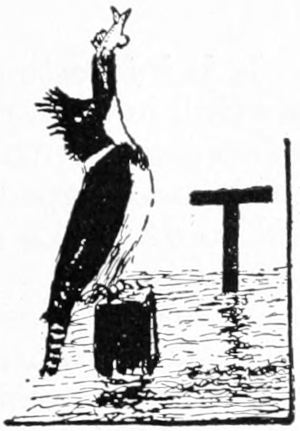
HIS patrol of our streams and lake shores, in his cadet uniform, is indeed a military figure as well as a militant personality. As he sits upon his chosen branch overhanging some stream or lake shore, his crest abristle, his keen eye fixed on the water below, his whole bearing alert, one must acknowledge that this fellow puts “ginger” into his environment, and that the spirit which animates him is very far from the “dolce far niente” which permeates the ordinary fisherman. However, he does not fish for fun but for business; his keen eye catches the gleam of a moving fin and he darts from his perch, holds himself for a moment on steady wings above the surface of the water, to be sure of his quarry, and then there is a dash and a splash and he returns to his perch with the wriggling fish in his strong beak; he at once proceeds to beat its life out against a branch and then to swallow it sensibly, head first, so that the fins will not prick his throat nor the scales rasp it. He swallows the entire fish, trusting to his internal organs to select the nourishing part; and later he gulps up a ball of the indigestible scales and bones.
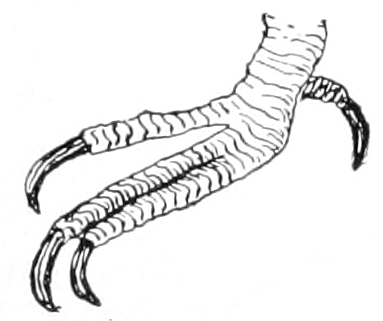
Kingfisher’s foot.
This shows the weak toes; the third and fourth are joined together, which undoubtedly assists the bird in pushing out soil when excavating.
The kingfisher is very different in form from an ordinary bird; he is larger than a robin, and his head and fore parts are much larger in proportion; this is the more noticeable because of the long feathers of the head which he lifts into a crest, and because of the shortness of the tail. The beak is very long and strong in order to seize the fish and hold it fast; but the legs are short and weak; the third and fourth toes are grown together for a part of their length; perhaps this is of use to the bird in pushing earth from the burrow, when excavating. The kingfisher has no need for running and hopping, like the robin and, therefore, does not need the robin’s strong legs and feet. His colors are beautiful and harmonious; the upper parts are grayish blue, the throat and collar white, as is also the breast, which has a bluish gray band across the upper part, this giving the name of the Belted Kingfisher to the bird. The feathers of the wings are tipped with white and the tail feathers narrowly barred with white. The under side of the body is white in the males, while in the females it is somewhat chestnut in color. There is a striking white spot just in front of the eye.
The kingfisher parents build their nest in a burrow which they tunnel horizontally in a bank; sometimes there is a vestibule of several feet before the nest is reached, and at other times it is built very close to the opening. Both parents are industrious in catching fish for their nestlings, but the burden of this duty falls heaviest upon the male. Many fish bones are found in the nest, and they seem so clean and white that they have been regarded as nest lining. Wonderful tales are told of the way the English kingfishers use fish bones to support the earth above their nests, and tributes have been paid to their architectural skill. But it is generally conceded that the lining of fish bones in nests of our kingfisher is incidental, since the food of the young is largely fish, although frogs, insects and other creatures are often eaten with relish. It is interesting to note the process by which the young kingfisher gets its skill in fishing. I have often seen one dive horizontally for a yard or two beneath the water and come up indignant and sputtering because the fish had escaped. It was fully two weeks after this before this one learned to drop like a bullet on its quarry.
The note of the kingfisher is a loud rattle, not especially pleasant close at hand, but not unmusical at a little distance. It is a curious coincidence that it sounds very much like the clicking of the fisherman’s reel; it is a sound that conjures visions of shade-dappled streams and the dancing, blue waters of tree-fringed lakes and ponds.
There seems to be a division of fishing ground among the kingfishers, one bird never trespassing upon its neighbor’s preserves. Unless it be the parent pair working near each other for the nestlings, or the nestlings still under their care, we never see two kingfishers in the same immediate locality.
References—The Bird, p. 97; The Bird Book, pp. 154, 444.
LESSON XXIV
The Kingfisher
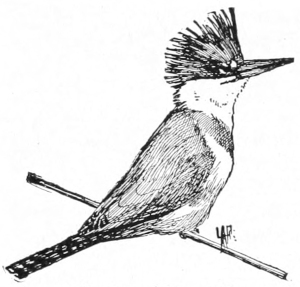
The belted kingfisher Drawn by L. A. Fuertes.
Leading thought—The kingfisher is fitted by form of body and beak to be a fisherman.
Methods—If the school be near a stream or pond the following observations may be made by the pupils; otherwise let the boys who go fishing make a study of the bird and report to the school.
Observations—1. Where have you seen the kingfisher? Have you often seen it on a certain branch which is its favorite perch? Is this perch near the water? What is the advantage of this position to the bird?
2. What does the kingfisher feed upon? How does it obtain its food? Describe the actions of one of these birds while fishing.
3. With what weapons does the kingfisher secure the fish? How long is its beak compared with the rest of its body? How does it kill the fish? Does it swallow the fish head or tail first? Why? Does it tear off the scales or fins before swallowing it? How does it get rid of these and the bones of the fish?
4. Which is the larger, the kingfisher or the robin? Describe the difference in shape of the bodies of these two birds; also in the size and shape of feet and beaks and explain why they are so different in form. What is there peculiar about the kingfisher’s feet? Do you know which two toes are grown together?
5. What are the colors of the kingfisher in general? The colors of head, sides of head, collar, back, tail, wings, throat, breast and under parts? Is there a white spot near the eye? If so, where? Do you know the difference in colors between the parent birds?
6. Where is the nest built? How is it lined?
7. What is the note of the kingfisher? Does it give it while perching or while on the wing? Do you ever find more than one kingfisher on the same fishing grounds?
Supplementary reading—The Second Book of Birds, Chapter XXX; “The Halcyon Birds,” Child’s Study of the Classics; Audubon Leaflet No. 19; “Kooskosemus,” Long; American Birds, Finley.
THE KINGFISHER (OF ENGLAND) For the handsome Kingfisher, go not to the tree, No bird of the field or the forest is he; In the dry river rock he did never abide, And not on the brown heath all barren and wide. He lives where the fresh, sparkling waters are flowing, Where the tall heavy Typha and Loosestrife are growing; By the bright little streams that all joyfully run Awhile in the shadow, and then in the sun. He lives in a hole that is quite to his mind, With the green mossy Hazel roots firmly entwined; Where the dark Alder-bough waves gracefully o’er, And the Sword-flag and Arrow-head grow at his door. There busily, busily, all the day long, He seeks for small fishes the shallows among; For he builds his nest of the pearly fish-bone, Deep, deep, in the bank, far retired, and alone. Then the brown Water-Rat from his burrow looks out, To see what his neighbor Kingfisher’s about; And the green Dragon-fly, flitting slowly away, Just pauses one moment to bid him good-day. O happy Kingfisher! What care should he know, By the clear, pleasant streams, as he skims to and fro, Now lost in the shadow, now bright in the sheen Of the hot summer sun, glancing scarlet and green! —Mary Howitt.
THE SCREECH OWL
Teacher’s Story
“Disquiet yourselves not: ’Tis nothing but a little, downy owl.”—Shelley.
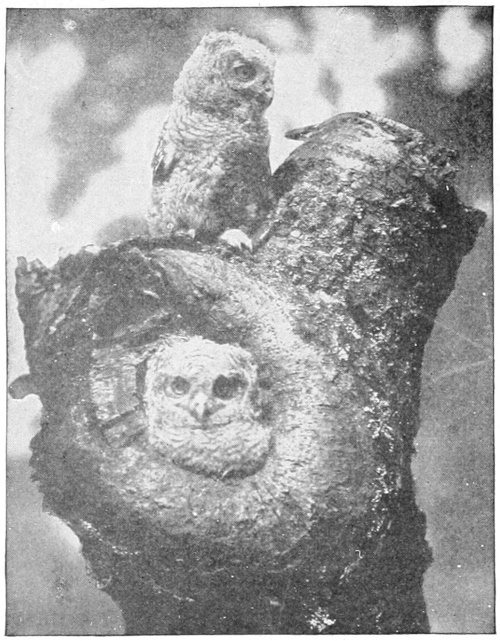
Screech owls. From Country Life in America.
Of all the fascinating sounds to be heard at night in the woods, the screech owl’s song is surely the most so; its fascination does not depend on music but upon the chills which it sends up and down the spine of the listener, thus attacking a quite different set of nerves than do other bird songs. The weird wail, tremulous and long drawn out, although so bloodcurdling, is from the standpoint of the owlet the most beautiful music in the world; by means of it he calls to his mate, cheering her with the assurance of his presence in the world; evidently she is not a nervous creature. The screech owls are likely to sing at night during any part of the year; nor should we infer that when they are singing they are not hunting, for perchance their music frightens their victims into fatal activity. Although the note is so unmistakable, yet there is great variation in the songs of individuals; the great variety of quavers in the song offering ample opportunity for the expression of individuality. Moreover, these owls often give themselves over to tremulous whispering and they emphasize excitement by snapping their beaks in an alarming manner.
Any bird that is flying about and singing in the night time must be able to see where it is going, and the owls have special adaptations for this. The eyes are very large and the yellow iris opens and closes about the pupil quite similar to the arrangement in the cat’s eye, except that the pupil in the owl’s eye is round when contracted instead of elongated; in the night this pupil is expanded until it covers most of the eye. The owl does not need to see behind and at the sides, since it does not belong to the birds which are the victims of other birds and animals of prey. The owl is a bird that hunts instead of being hunted, and it needs only to focus its eyes on the creature it is chasing. Thus, its eyes are in the front of the head like our own; but it can see behind, in case of need, for the head turns upon the neck as if it were fitted on a ball-bearing joint. I have often amused myself by walking around a captive screech owl, which would follow me with its eyes by turning the head until it almost made the circle, then the head would twist back with such lightning rapidity that I could hardly detect the movement; it seemed almost as if the head was on a pivot and could be moved around and around indefinitely. Although the owl, like the cat, has eyes fitted for night hunting, it can also see fairly well during the daytime.
A beak with the upper mandible ending in a sharp hook signifies that its owner lives upon other animals and needs to rend and tear flesh. The owl’s beak thus formed is somewhat buried in the feathers of the face, which gives it a striking resemblance to a Roman nose. This, with the great, staring, round eyes, bestows upon the owl an appearance of great wisdom. But it is not the beak which the owl uses for a weapon of attack; its strong feet and sharp, curved claws are its weapons for striking the enemy and also for grappling with its prey. The outer toe can be moved back at will, so that in grasping its prey or its perch, two toes may be directed forward and two backward, thus giving a stronger hold.
The ear is very different in form from the ear of other birds; instead of being a mere hole opening into the internal ear, it consists of a fold of skin forming a channel which extends from above the eye around to the side of the throat. (See The Bird, Beebe, p. 217). Thus equipped, while hunting in the dark the owl is able to hear any least rustle of mouse or bird and to know in which direction to descend upon it. There has been no relation established between the ear tufts of the screech owl and its ears, so far as I know, but the way the bird lifts the tufts when it is alert, always suggests that this movement in some way opens up the ear.
In color there are two types among the screech owls, one reddish brown, the other gray. The back is streaked with black, the breast is marked with many shaft-lines of black. The whole effect of the owl’s plumage makes it resemble a branch of a tree or a part of the bark, and thus it is protected from prying eyes, during the daytime when it is sleeping. Its plumage is very fluffy and its wing feathers, instead of being stiff to the very edge, have soft fringes which cushion the stroke upon the air. The owl’s flight is, therefore, absolutely noiseless and the bird is thus able to swoop down upon its prey without giving warning of its approach.
The screech owls are partial to old apple orchards for nesting sites. They will often use an abandoned nest of a woodpecker; the eggs are almost as round as marbles and as white as chalk, showing very clearly that they are laid within a dark hole, otherwise their color would attract the eyes of enemies. There are usually four eggs; the fubsy little owlets climb out of their home cave by the end of May and are the funniest little creatures imaginable. They make interesting but decidedly snappy pets; they can be fed on insects and raw beef. It is most interesting to see one wake up late in the afternoon after its daytime sleep. All day it has sat motionless upon its perch with its toes completely covered with its fluffy feather skirt. Suddenly its eyes open, the round pupils enlarging or contracting with great rapidity as if adjusting themselves to the amount of light. When the owl winks it is like a moon in eclipse, so large are the eyes, and so entirely are they obscured by the lids which seem like circular curtains. When it yawns, its wide bill absurdly resembles a human mouth, and the yawn is very human in its expression. It then stretches its wings and it is astonishing how long this wing can be extended below the feet. It then begins its toilet. It dresses its feathers with its short beak, nibbling industriously in the fluff; it scratches its under parts and breast with its bill, then cleans the bill with its foot, meanwhile moving the head up and down as if in an attempt to see better its surroundings.
The owls are loyal lovers and are said to remain mated through life, the twain being very devoted to their nests and nestlings. Sometimes the two wise-looking little parents sit together on the eggs, a most happy way to pass the wearisome incubation period.
The screech owls winter in the north and they are distinctly foresighted in preparing for winter. They have often been observed catching mice, during the late fall, and placing them in some hollow tree for cold storage, whence they may be taken in time of need. Their food consists to some extent of insects, especially night-flying moths and beetles, also caterpillars and grasshoppers. However, the larger part of their food is mice; sometimes small birds are caught and the English sparrow is a frequent victim. Chickens are rarely taken, except when small, since this owlet is not as long as a robin. It swallows its quarry as whole as possible, trusting to its inner organs to do the sifting and selecting. Later it throws up pellets of the indigestible bones, hair, etc. By the study of these pellets, found under owl roosts, the scientists have been able to determine the natural food of the bird, and they all unite in assuring us that the screech owl does the farmer much more good than harm, since it feeds so largely upon creatures which destroy his crops.
LESSON XXV
The Screech Owl
Leading thought—This owl is especially adapted to get its prey at night. It feeds largely on field mice, grasshoppers, caterpillars and other injurious insects and is therefore the friend of the farmer.
Method—This lesson should begin when the children first hear the cry of this owl; and an owlet in captivity is a fascinating object for the children to observe. However, it is so important that the children learn the habits of this owl that the teacher is advised to hinge the lesson on any observation whatever made by the pupils, and illustrate it with pictures and stories.
Observations—1. Have you ever heard the screech owl? At what time of the day or night? Why was this? Why does the owl screech? How did you feel when listening to the owl’s song?
2. Describe the owl’s eyes. Are they adapted to see by night? What changes take place in them to enable the owl to see by daytime also? In what way are the owl’s eyes similar to the cat’s? Why is it necessary for an owl to see at night? Are the owl’s eyes placed so that they can see at the sides like other birds? How does it see an object at the sides or behind it?
3. Note the owl’s beak. For what purpose is a hooked beak? How does the owl use its beak? Why do we think that the owl looks wise?
4. Describe the feet and claws of the screech owl. What are such sharp hooked claws meant for? Does an owl on a perch always have three toes directed forward and one backward?
5. Describe the colors of the screech owl. Are all these owls of the same color? How do these colors protect the bird from its enemies?
6. How is the owl’s plumage adapted to silent flight? Why is silent flight advantageous to this bird?
7. How does the owl’s ear differ from the ears of other birds? Of what special advantage is this? As the owl hunts during the night, what does it do in the daytime? How and by what means does it hide itself?
8. Where does the screech owl make its nest? Do you know anything about the devotion of the parent owls to each other and to their young? How many eggs are laid? What is their color? At what time of year do the little owls appear?
9. Where does the screech owl spend the winter? What do the screech owls feed upon? Do they chew their food? How do they get rid of the indigestible portion of their food? How does this habit help the scientists to know the food of the owls?
10. How does the screech owl work injury to the farmers? How does it benefit them? Does not the benefit outweigh the injury?
11. How many other kinds of owls do you know? What do you know of their habits?
Supplementary reading—Audubon Educational Leaflets, Nos. 22, 12, 14; Second Book of Birds, Miller, Chap. 32–3; Familiar Wild Animals, Lottridge; “The Boy and Hushwing,” Kindred of the Wild; “Koos, Koos, Koos” in Wilderness Ways; Wings and Fins, chap. 19; Heart of Oak Books, Vol. 4, p. 51; The Aziola, Shelley; American Birds, Finley.
TWO WISE OWLS We are two dusky owls, and we live in a tree; Look at her,—look at me! Look at her,—she’s my mate, and the mother of three Pretty owlets, and we Have a warm cosy nest, just as snug as can be. We are both very wise; for our heads, as you see, (Look at her—look at me!) Are as large as the heads of four birds ought to be; And our horns, you’ll agree, Make us look wiser still, sitting here on the tree. And we care not how gloomy the night-time may be; We can see,—we can see Through the forest to roam, it suits her, it suits me; And we’re free,—we are free To bring back what we find, to our nest in the tree. —Anonymous.
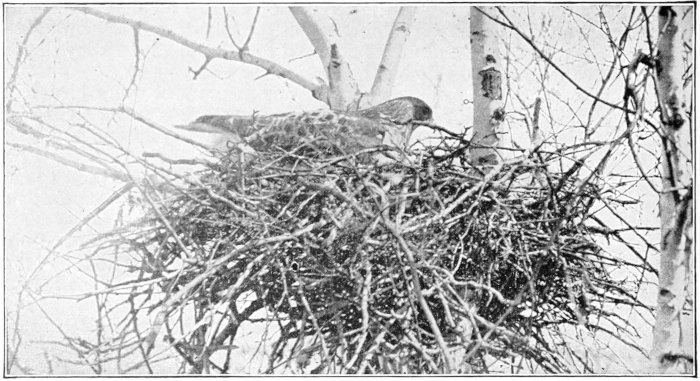
Red-tailed hawk on nest. Photo by R. W. Hegner.
THE HEN HAWKS
Teacher’s Story
“Above the tumult of the cañon lifted, the gray hawk breathless hung, Or on the hill a winged shadow drifted where furze and thornbush clung.” —Bret Harte.
It is the teacher’s duty and privilege to try to revolutionize some popular misconceptions about birds, and two birds, in great need in this respect, are the so-called hen hawks. They are most unjustly treated, largely because most farmers consider that a “hawk is a hawk,” and should always be shot to save the poultry, although there is as much difference in the habits of hawks as there is in those of men. The so-called hen hawks are the red-shouldered and the red-tailed species, the latter being somewhat the larger and rarer of the two; both are very large birds; the red-shouldered has cinnamon brown epaulets, the tail blackish, crossed by five or six narrow white bars, and the wing feathers are also barred. The red-tailed species has dark brown wings, the feathers not barred, and is distinguished by its tail which is brilliant cinnamon color with a black bar across it near the end; it is silvery white beneath. When the hawk is soaring, its tail shows reddish as it wheels in the air. Both birds are brown above and whitish below, streaked with brown.
The flight of these hawks is alike and is very beautiful; it consists of soaring on outstretched wings in wide circles high in the air, and is the ideal of graceful aerial motion. In rising, the bird faces the wind and drops a little in the circle as its back turns to the leeward, and thus it climbs an invisible winding stair until it is a mere speck in the sky. This wonderful flight, on motionless wings, is what has driven to despair our inventors of airships who have not been able to fathom the mystery of it from a practical standpoint. When the bird wishes to drop, it lifts and holds its wings above its back, and comes down like a lump of lead, only to catch itself whenever it chooses to begin again to climb the invisible spiral. And all this is done without fatigue, for these birds have been observed to soar thus for hours together without coming to earth. When thus soaring the two species may be distinguished from each other by their cries; the red-tailed gives a high sputtering scream, which Chapman likens to the sound of escaping steam; while the red-shouldered calls in a high not unmusical note “kee-you, kee-you” or “tee-ur, tee-ur.”
The popular fallacy for the teacher to correct about these birds, is that they are enemies of the farmers. Not until one has actually been seen to catch the chickens should it be shot, for very few of them are guilty of this sin. Sixty-six per cent. of the food of the red-tailed species consists of injurious animals, i. e., mice and gophers, etc., and only 7 per cent. consists of poultry; the victims are probably old or disabled fowls, and fall an easy prey; this bird much prefers mice and reptiles to poultry. The more common red-shouldered hawk feeds generally on mice, snakes, frogs, fish and is very fond of grasshoppers. Ninety per cent. of its food consists of creatures which injure our crops or pastures and scarcely 1½ per cent. is made up of poultry and game. These facts have been ascertained by the experts in the department of Agriculture at Washington who have examined the stomachs of hundreds of these hawks taken from different localities. Furthermore, Dr. Fisher states that a pair of the red-shouldered hawks bred for successive years within a few hundred yards of a poultry farm, containing 800 young chickens and 400 ducks, and the owner never saw them attempt to catch a fowl.
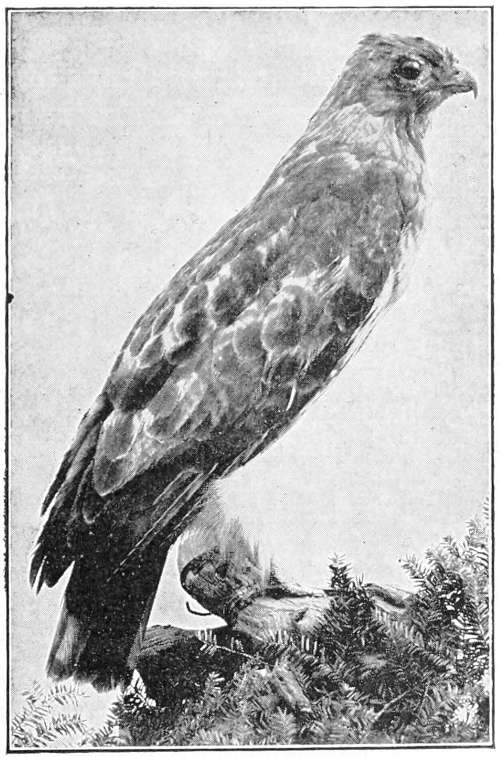
The red-tailed hawk.
However, there are certain species of hawks which are to be feared; these are the Cooper’s hawk and the sharp-shinned hawk, the first being very destructive to poultry and the latter killing many wild birds. These are both somewhat smaller than the species we are studying. They are dark gray above and have very long tails, and when flying, they flap their wings for a time and then glide a distance. They do not soar on motionless outspread pinions by the hour.
When hawks are seen soaring, they are likely to be hunting for mice in the meadows below them; their eyes are remarkably keen; they can see a moving creature from a great height, and can suddenly drop upon it like a thunder bolt out of a clear sky. Their wonderful eyes are far-sighted when they are circling in the sky, but as they drop, the focus of the eyes changes automatically with great rapidity, so that by the time they reach the earth they are near-sighted, a feat quite impossible for our eyes unless aided by glasses or telescope.
These so-called hen hawks will often sit motionless, for hours at a time, on some dead branch or dead tree; they are probably watching for something eatable to stir within the range of their keen vision. When seizing its prey, a hawk uses its strong feet and sharp, curved talons. All hawks keep their claws sharp and polished, even as the warrior keeps his sword bright, so as to be ready for use; the legs are covered by a growth of feathers extending down from above, looking like feather trousers. The beak is hooked and very sharp and is used for tearing apart the flesh of the quarry. When a hawk fights some larger animal or man, it throws itself over upon its back and strikes its assailant with its strong claws as well as with its beak; but the talons are its chief weapons.
Both species build a large, shallow nest of coarse sticks and grass, lined with moss, feathers, etc.; it is a rude, rough structure, and is placed in tall trees from fifty to seventy-five feet from the ground. Only two to four eggs are laid; these are whitish spotted with brown. These hawks are said to remain mated for life and are devoted to each other and their young. Hawks and eagles are very similar in form and habits, and if the eagle is a noble bird so is the hawk.
LESSON XXVI
The Red-shouldered and Red-tailed Hawks
Leading thought—Ignorant people consider all hawks dangerous neighbors because they are supposed to feed exclusively on poultry. This idea is false and we should study carefully the habits of hawks before we shoot them. The ordinary large reddish “hen-hawks,” which circle high above meadows, are doing great good to the farmer by feeding upon the mice and other creatures which steal his grain and girdle his trees.
Methods—Begin by observations on the flight of one of these hawks and supplement this with such observations as the pupils are able to make, or facts which they can discover by talking with hunters or others and by reading.
Observations—1. How can you tell a hawk, when flying, from a crow or other large bird? Describe how it soars. Does it move off in any direction; if so, does it move off in circles? How often does it make strokes with its wings? Does it rise when it is facing the wind and fall as it turns its back to the wind?
2. Have you seen a hawk flap its wings many times and then soar for a time? If so, what hawk do you think it was? How does it differ in habits from the “hen-hawks?”
3. Have you noticed a hawk when soaring drop suddenly to earth? If so, why did it do this?
4. How does a hawk hunt? How can it see a mouse in a meadow when it is so high in the air that it looks like a circling speck in the sky? If it is so far-sighted as this, how can it be near-sighted enough to catch the mouse when it is close to it? Would you not have to use field glasses or telescope to do this?
5. When a hawk alights what sort of a place does it choose? How does it act?
6. Do hawks seize their prey with their claws or their beaks? What sort of feet and claws has the hawk? Describe the beak. What do you think this shaped beak is meant for?
7. Why do people shoot hawks? Why is it a sign of ignorance in people to wish to shoot all hawks?
8. What is the food of the red-shouldered hawk as shown by the bulletin of the U. S. Department of Agriculture or by the Audubon leaflets?
9. Where does the hawk place its nest? Of what does it build its nest?
10. Compare the food and the nesting habits of the red-shouldered and red-tailed hawks.
11. How devoted are the hawks to their mates and their young? Does a hawk, losing its mate, live alone ever after?
12. Describe the colors of the hen hawks and describe how you can tell the two species apart by the colors and markings of the tail.
13. What is the cry of the hawk? How can you tell the two species apart by this cry? Does the hawk give its cry only when on the wing?
14. Why should an eagle be considered so noble a bird and the hawk be so scorned? What difference is there between them in habits?
Supplementary reading—Audubon Educational Leaflets Nos. 8, 9 and 10; “The Sparrow Hawk,” Familiar Wild Animals, Lottridge; “Eyes as Cameras,” also pp. 101–102 The Bird Book, Eckstorm; pp. 317–319, 326, Birds that Hunt and are Hunted; “Cloud Wings, The Eagle,” in Wilderness Ways; “The Sky King and His Family,” “Hannah Lomond’s Bairn,” in Neighbors with Wings and Fins, American Birds, Finley.
Reference books—The Bird, Beebe, pp. 389, 376, 208–211; Hawks and Owls from the Standpoint of the Farmer, Fisher, U. S. Department of Agriculture.
Yet, ere the noon, as brass the heaven turns, The cruel sun smites with unerring aim, The sight and touch of all things blinds and burns, And bare, hot hills seem shimmering into flame! On outspread wings a hawk, far poised on high, Quick swooping screams, and then is heard no more: The strident shrilling of a locust nigh Breaks forth, and dies in silence as before. —“Summer Drought,” by J. P. Irvine.
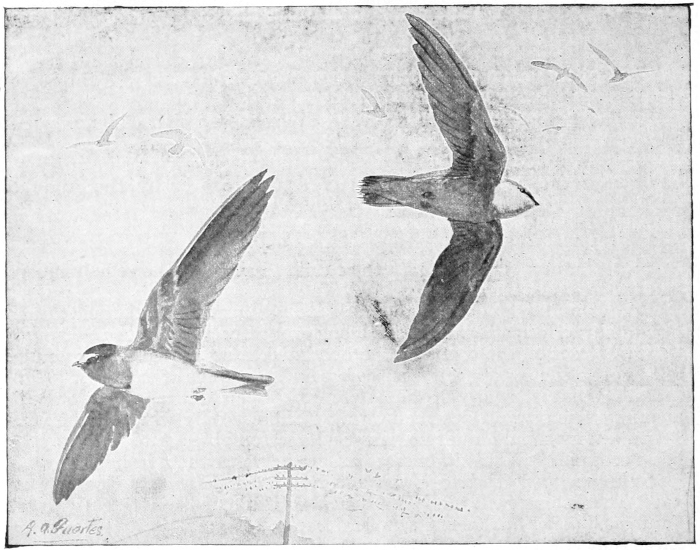
Swallows and swifts. Drawn by L. A. Fuertes for General Biology by J. G. Needham.
THE SWALLOWS AND THE CHIMNEY SWIFT
Teacher’s Story
HESE friendly little birds spend their time darting through the air on swift wings, seeking and destroying insects which are foes to us and our various crops. However, it is safe to assume that they are not thinking of us as they skim above our meadows and ponds, hawking our tiny foes; for like most of us, they are simply intent upon getting a living. Would that we might perform this necessary duty as gracefully as they.
In general, the swallows have a long, slender, graceful body, with a long tail which is forked or notched, except in the case of the eave swallow. The beak is short but wide where it joins the head; this enables the bird to open its mouth wide and gives it more scope in the matter of catching insects; the swift flight of the swallows enables them to catch insects on the wing; their legs are short, the feet are weak and fitted for perching; it would be quite impossible for a swallow to walk or hop like a robin or blackbird.
The eave, or cliff, swallows—These swallows build under the eaves of barns or in similar locations. In early times they built against the sides of cliffs; but when man came and built barns, they chose them for their dwelling sites. The nest is made of mud pellets and is somewhat globular in shape, with an entrance at one side. When building on the sides of cliffs or in unprotected portions of a barn, a covered passage is built around the door, which gives the nest the shape of a gourd or retort; but when protected beneath the eaves the birds seem to think this vestibule is unnecessary. The mud nest is warmly lined with feathers and soft materials, and there are often many nests built so closely together that they touch. The eave swallow comes north about May 1st, and soon after that, may be seen along streams or other damp places gathering mud for the nests. It seems necessary for the bird to find clay mud in order to render the nest strong enough to support the eggs and nestlings. The eggs are white, blotched with reddish brown. The parents cling to the edge of the nest when feeding the young. Both the barn and eave swallows are blue above but the eave swallow has the forehead cream white and the rump of pale brick-red, and its tail is square across the end as seen in flight. The barn swallow has a chestnut forehead and its outer tail feathers are long, making a distinct fork during flight, and it is not red upon the rump.
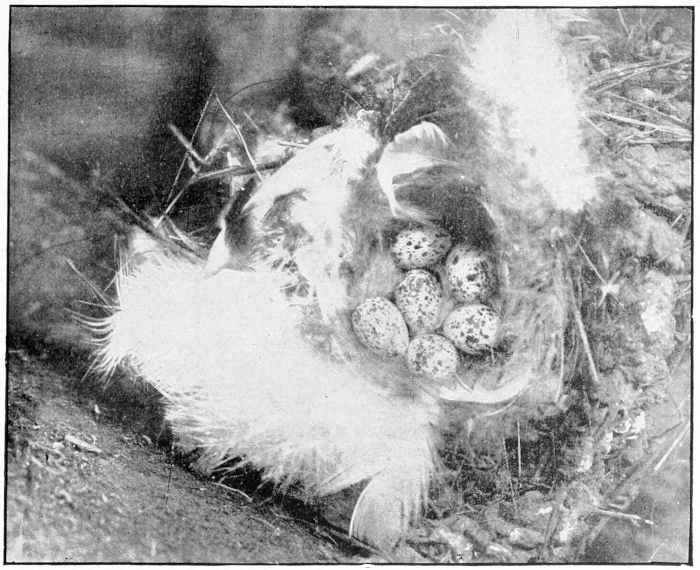
The barn swallow’s feather bed.
The barn swallows—These birds choose a barn where there is a hole in the gable or where the doors are kept open all the time. They build upon beams or rafters, making a cup-shaped nest of layers of pellets of mud, with grass between; it is well lined with feathers. The nest is usually the shape of half of a shallow cup which has been cut in two lengthwise, the cut side being plastered against the side of the rafter. Sometimes the nests are more or less supported upon a beam or rafter; the eggs are white and dotted with reddish brown. The barn swallows, aside from their constant twittering, have also a pretty song. Both parents work at building the nest and feeding the young; there are likely to be several pairs nesting in the same building. The parents continue to feed the young long after they have left the nest; often a whole family may be seen sitting on a telegraph wire or wire fence, the parents still feeding the well-grown youngsters. This species comes north in the latter part of April and leaves early in September. It winters as far south as Brazil.
The barn swallow has a distinctly tailor-made appearance; its red-brown vest and iridescent blue coat, with deeply forked “coat tails” give it an elegance of style which no other bird, not even the chic cedar waxwing can emulate.
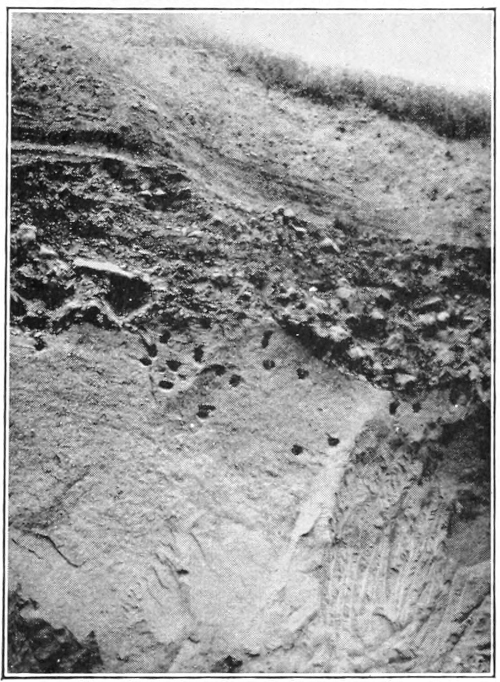
A bank swallow tenement. Photo by J. T. Lloyd.
The Bank Swallow—When we see a sandy bank apparently shot full of holes as by small cannon balls, we may know that we have found a tenement of bank swallows. These birds always choose the perpendicular banks of creeks or of railroad cuts or of sand pits for their nesting sites; they require a soil sufficiently soft to be tunneled by their weak feet, and yet not so loose as to cave in upon the nest. The tunnel may extend from one to four feet horizontally in the bank with just enough diameter to admit the body of the rather small bird. The nest is situated at the extreme end of the tunnel and is lined with soft feathers and grasses.
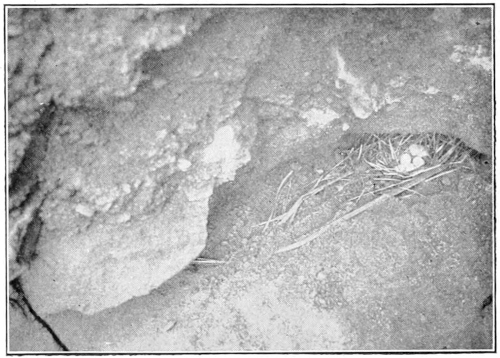
Bank swallow’s nest with earth removed showing the upward direction of the tunnel. Photo by J. T. Lloyd.
The bank swallows arrive late in April and leave early in September. They may be distinguished from the other species by their grayish color above; the throat and breast are white with a broad, brownish band across the breast; the tail is slightly forked. The rough-winged swallow, which is similar in habits to the bank swallow, may be distinguished from it by its gray breast which has no dark band.
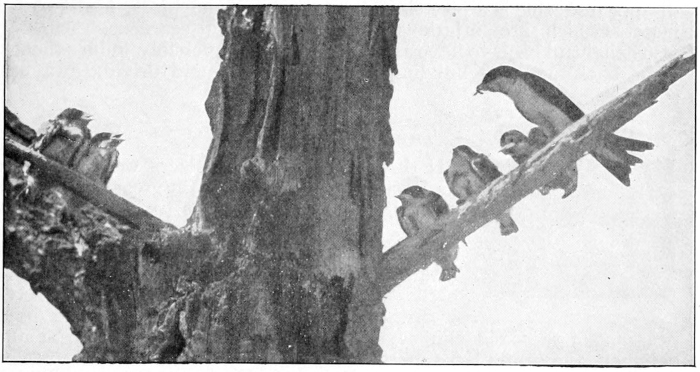
Tree swallows. Photo by A. A. Allen.
The Tree Swallow—This graceful little bird builds naturally in holes in trees, but readily accepts a box if it is provided. It begins to build soon after it comes north in late April and it is well for us to encourage the tree swallows to live near our houses by building houses for them and driving away the English sparrows. The tree swallows live upon many insects which annoy us and injure our gardens and damage our orchards; they are, therefore, much more desirable neighbors than the English sparrows. The tree swallows congregate in great numbers for the southern migration very early in the season, often in early August. They are likely to congregate in marshes, as are also the other swallows. In color the tree swallow has a green metallic back and head, a pure white breast with no band across it, and these peculiarities distinguish it from all other species.
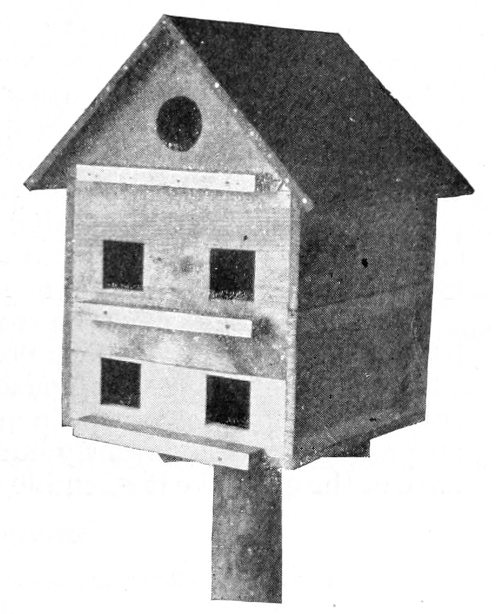
A martin house.
The Purple Martin—The martin is a larger bird than the largest swallow, being eight inches in length, while the barn swallow does not measure quite seven. The male is shining, steel-blue above and below; the female is brownish above, has a gray throat, brownish breast and is white beneath. The martins originally nested in hollow trees but for centuries have been cared for by man. The Indians were wont to put out empty gourds for them to nest in; and as soon as America was settled by Europeans, martin boxes were built extensively. But when the English sparrows came, they took possession of the boxes, and the martins have to a large extent disappeared; this is a pity since they are beneficial birds, feeding upon insects which are injurious to our farms and gardens. They are also delightful birds to have around, and we may possibly induce them to come back to us by building houses for them and driving away the sparrows.
The Chimney Swift
HEN the old-fashioned fire-places went out of use and were walled up, leaving the great old chimneys useless, these sociable birds took possession of them. Here they built their nests and reared their young, and twittered and scrambled about, awakening all sleepers in the neighborhood at earliest dawn, and in many ways made themselves a distinct part of family life. With the disappearance of these old chimneys and the growing use of the smaller chimney, the swifts have been more or less driven from their close association with people; and now their nests are often found in hay barns or other secluded buildings, although they still gather in chimneys when opportunity offers.
The chimney swifts originally built nests in hollow trees and caves; but with the coming of civilization they took possession of the chimneys disused during the summer, and here is where we know them best. The nests are shaped like little wall pockets; they are made of small sticks of nearly uniform size which are glued together and glued fast to the chimney wall by means of the saliva secreted in the mouth of the bird. After the nesting season, the swifts often gather in great flocks and live together in some large chimney; toward night-fall they may be seen circling about in great numbers and dropping into the mouth of the chimney, one by one, as if they were being poured into a funnel. In the morning they leave in reverse manner, each swift flying about in widening circles as it leaves the chimney. The swifts are never seen to alight anywhere except in hollow trees or chimneys or similar places; their tiny feet have sharp claws for clinging to the slightest roughness of the upright wall; the tail acts as a prop, each tail feather ending in a spine which is pressed against the chimney side when the bird alights and thus enables it to cling more firmly. In this fashion the swifts roost, practically hung up against a wall.
The swift has a short beak and wide mouth which it opens broadly to engulf insects as it darts through the air. Chimney swifts have been known to travel at the rate of 110 miles an hour.
This bird should never be confused with the swallows, for when flying, its tail seems simply a sharp point, making the whole body cigar-shaped. This character alone distinguishes it from the long tailed swallows. In color it is sooty brown, with a gray throat and breast; the wings are long and narrow and apparently curved. The manner of flight and appearance in the air make it resemble the bat more than it does the swallow.
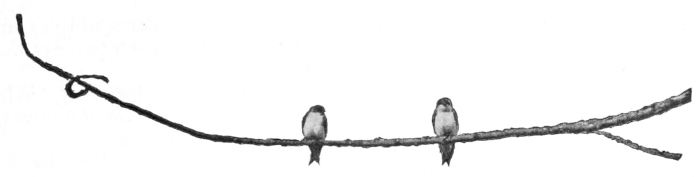
Tree swallows.
Photo by A. A. Allen.
LESSON XXVII
The Swallows and Swifts
Leading thought—The swallows are very graceful birds and are exceedingly swift fliers. They feed upon insects which they catch upon the wing. There are five native swallows which are common—the eave, or cliff, the barn, the bank, the tree swallow and the purple martin. The chimney swift, although often called so, is not a swallow; it is more nearly related to the hummingbird than to the swallows.
Method—The questions should be given as an outline for observation, and may be written on the blackboard or placed in the field notebook. The pupils should answer them individually and from field observation. We study the swifts and swallows together to teach the pupils to distinguish them apart.
Observations—1. What is the general shape of the swallow? What is the color of the forehead, throat, upper breast, neck, rump and tail?
2. Is the tail noticeably forked especially during flight?
3. Describe the flight of the swallow. What is the purpose of its long, swift flight? How are the swallow’s wings fitted for carrying the bird swiftly?
4. Describe the form of the beak of the swallow. How does it get its food? What is its food?
5. In what particular locations do you see the swallows darting about? At what time of day do they seem most active?
6. Describe the swallow’s legs and feet and explain why they look so different from those of the robin and blackbird.
The Eave, or Cliff Swallow
7. Where do the eave swallows build their nests? Of what material is the outside? The lining? Describe the shape of the nest and how it is supported.
8. How early in the spring do the eave swallows begin to make their nests? Where and by what means do they get the material for nest building? Are there a number of nests usually grouped together?
9. Describe the eave swallow’s egg. Where do the parents sit when feeding the young? What is the note of the eave swallow?
10. What are the differences between the barn and the eave swallow in color and shape of tail?
The Barn Swallow
11. Where does the barn swallow place its nest? What is the shape of the nest? Of what material is it made?
12. What is the color of the eggs? Describe the feeding of the young and the sounds made by them and their parents. Do both parents work together to build the nest and feed the young?
13. Is there usually more than one nest in the same locality? When the young swallows are large enough to leave the nest, describe how the parents continue to care for them.
14. Have you ever heard the barn swallows sing? Describe their conversational notes.
15. When do the barn swallows migrate and where do they go during the winter? How can you distinguish the barn swallow from the eave swallow?
The Bank Swallow
16. Where do the bank swallows build? What sort of soil do they choose?
17. How does a bank look which is tenanted by these birds?
18. How far do the bank swallows tunnel into the earth? What is the diameter of one of these tunnels? Do they extend straight or do they rise or deflect?
19. With what tools is the tunnel excavated? Where is the nest situated in the tunnel and how is it lined?
20. How can you distinguish this species from the barn and eave and tree swallows? At what time do the bank swallows leave us for migration south?
The Tree Swallow
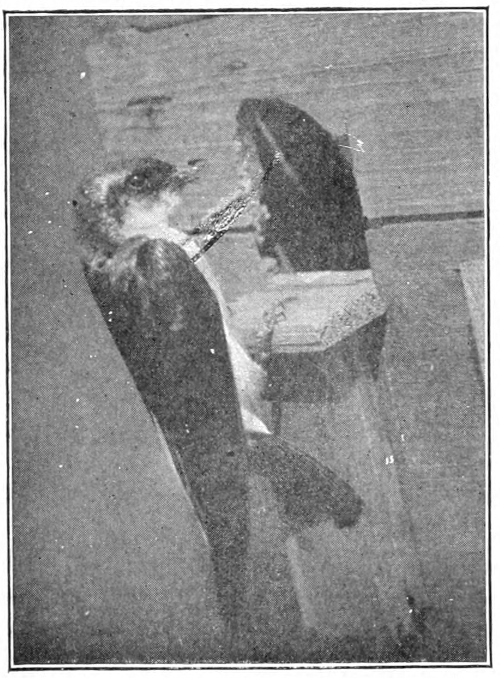
A tree swallow. Photo by Geo. Fiske, Jr.
21. Where does the tree swallow make its nest? How does its nest differ from that of the barn, eave, or bank swallow? When does it begin to build?
22. How can we encourage the tree swallow to build near our houses? Why is the tree swallow a much more desirable bird to have in bird houses than the English sparrow?
23. Describe the peculiar migrating habits of the tree swallow. How can you tell this species from the barn, the eave and the bank swallows?
The Purple Martin
24. Compare the purple martin with the swallows and describe how it differs, in size and color.
25. Where did the martins build their nests before America was civilized? Where do they like to nest now? How do the purple martins benefit us and how can we induce them to come to us?
The Chimney Swift
26. Where do the chimney swifts build their nests? Of what materials is the nest made? What is its shape and how is it supported? Where does the chimney swift get its glue for nest building?
27. Describe how the chimney swifts enter their nesting place at night. Where and how do they perch? Describe the shape of the swift’s tail and its use to the bird when roosting.
28. On what does the chimney swift feed and how does it procure this food? Describe how its beak is especially fitted for this?
29. How can you distinguish the chimney swift from the swallows? In what respect does the chimney swift resemble the swallows? In what respects does it differ from them?
Supplementary reading—“Chimney Swifts,” Familiar Wild Animals, Lottridge; The Chimney Swifts, Washington Irving; Nestlings of Forest and Marsh, Wheelock, p. 191; “The Eave Swallow” and “The Purple Martin” in The Bird Book, Eckstorm; The Second Bird Book, Miller; True Bird Stories, Miller, p. 118; Our Birds and Their Nestlings, p. 155; A Watcher in the Woods, Sharp, p. 163.
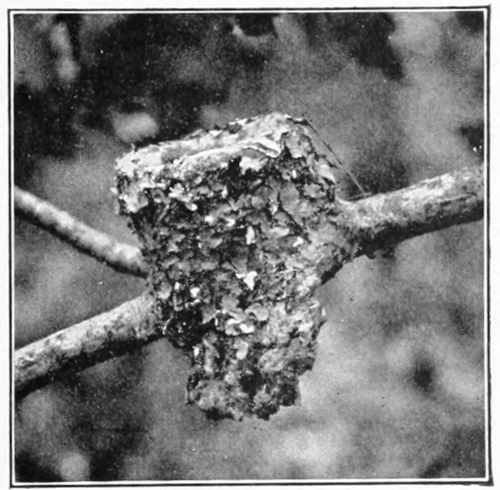
Nest of the ruby-throat hummingbird. Photo by Geo. Fiske, Jr.
THE HUMMINGBIRD
Teacher’s Story
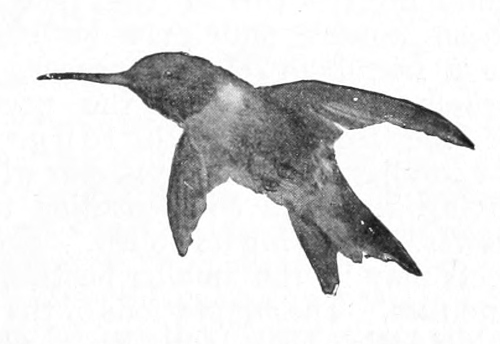
Formerly it was believed that this daintiest of birds found the nectar of flowers ample support for its active life; but the later methods of discovering what birds eat by examining the contents of their stomachs, show that the hummingbird is an insect eater of most ravenous appetite. Not only does it catch insects in mid air, but undoubtedly takes them while they are feasting on the nectar of the tubular flowers which the hummingbird loves to visit. Incidentally, the hummingbird carries the pollen for these flowers and may be counted as a friend in every respect, since usually the insects in the nectaries of the flowers with long tubular corollas, are stealing nectar without giving in return compensation to the flower by carrying its pollen. Such insects may be the smaller beetles, ants and flies. The adaptations of the hummingbird’s beak and long, double-tubed tongue, are especially for securing this mingled diet of insects and nectar. It is interesting to note that the young hummingbirds have the beak much shorter than when mature. Its beak is exactly fitted to probe those flowers where the hummingbird finds its food. The tongue has the outer edges curved over making a tube on each side. These tubes are provided with minute brushes at the tips and thus are fitted both for sucking nectar and for sweeping up the insects.
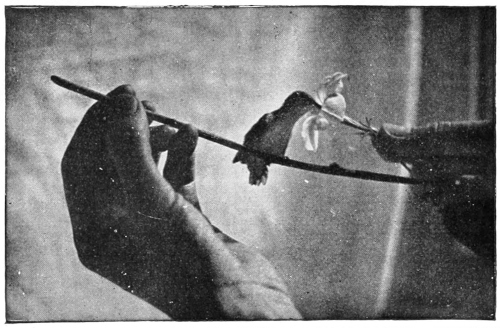
A hummingbird taking sweetened water from a flower. Photo by Mary Pierson Allen. Courtesy of Bird Lore.
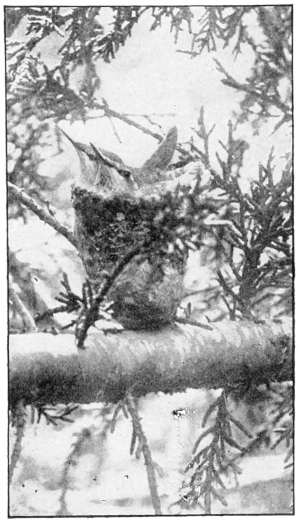
Two young hummingbirds in nest. Half natural size.
The natural home of the hummingbird seems to have been in the American tropics. Our one species east of the Rocky Mountains with which we are all familiar has a ruby throat. This comes to us after a very long journey each year. One species on the Pacific Coast is known to travel three thousand miles to the north for the summer and back again in winter.
Hummingbirds are not supposed to sing, but to use their voices for squeaking when angry or frightened. However, I once had the privilege of listening to a true song by a hummingbird on the Pacific Coast. The midget was perched upon a twig and lifted up his voice with every appearance of ecstasy in pouring forth his lay. To my uncultured ear this song was a fine, shrill, erratic succession of squeaks, “as fine as a cambric needle,” said my companion.
The nest of the hummingbird is a most exquisite structure; it is about three-fourths of an inch in diameter on the inside and about half an inch deep. It is, in shape, a symmetrical cup; the outside is covered with lichens to make it exactly resemble the branch on which it rests; the inside is lined with the down of plant seeds and plant fibres. The lichens are often fastened to the outside with the silk web of spiders or caterpillars. The nest is usually saddled on a branch of a tree from 10 to 50 feet above the ground. The eggs are two in number and white; they look like tiny beans. The young are black and look, at first glance, more like insects than like birds.
LESSON XXVIII
The Hummingbird
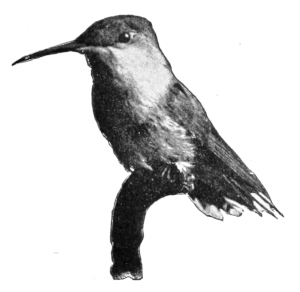
Leading thought—The hummingbird in flight moves its wings so rapidly that we cannot see them. It can hold itself poised above flowers while it thrusts its long beak into them for nectar and insects.
Method—Give the questions to the pupils and let them make the observations when they have the opportunity.
Observations—1. Where do you find the hummingbird? What flowers was it visiting? At what time of day? Can you tell whether it is a hummingbird or a hawk-moth which is visiting the flowers? At what time of day do the hawk-moths appear?
2. Does the hummingbird ever come to rest? Describe its actions while resting.
3. What are the colors of the back, throat, breast and under parts? How do you distinguish the mother hummingbird from her mate?
4. How does the hummingbird act when extracting the nectar? How does it balance itself in front of a flower? Have you ever seen hummingbirds catch insects in the air? If so, describe how they did it.
5. Describe the hummingbird’s nest. How large is it in diameter? What is the covering outside? With what is it lined?
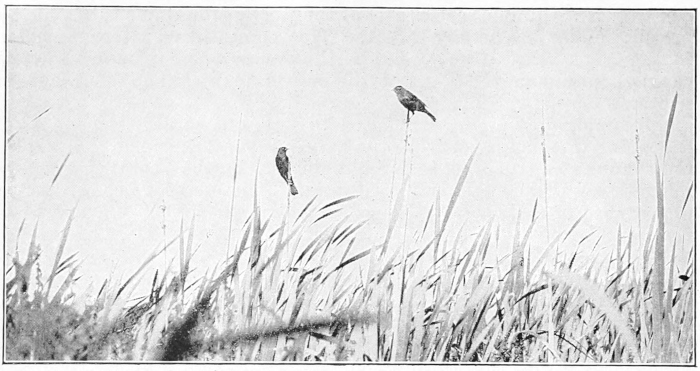
Photo by A. A. Allen.
THE RED-WINGED BLACKBIRD
Teacher’s Story
The blackbirds are among our earliest visitors in the spring; they come in flocks and beset our leafless trees like punctuation marks, meanwhile squeaking like musical wheelbarrows. What they are, where they come from, where they are going and what they are going to do, are the questions that naturally arise at the sight of these sable flocks. It is not easy to distinguish grackles, cowbirds and rusty blackbirds at a glance, but the red-wing proclaims his identity from afar. The bright red epaulets, margined behind with pale yellow, is a uniform to catch the admiring eye. The bird’s glossy black plumage brings into greater contrast his bright decorations. That he is fully aware of his beauty, who can doubt who has seen him come sailing down at the end of his strong, swift flight, and balancing himself on some bending reed, drop his long tail as if it were the crank of his music box, and holding both wings lifted to show his scarlet decorations, sing his “quong quer ee-ee.” Little wonder that such a handsome, military looking fellow should be able now and then to win more than his share of feminine admiration. But what though he become an entirely successful bigamist or even trigamist, he has proven himself to be a good protector of each and all of his wives and nestlings; however, he often has but one mate.
“The red-wing flutes his O-ka-lee” is Emerson’s graphic description of the sweet song of the red-wing; he also has many other notes. He clucks to his mates and clucks more sharply when suspicious, and has one alarm note that is truly alarming. The male red-wings come from the South in March; they appear in flocks, often three weeks before their mates arrive. The female looks as though she belonged to quite a different species. Although her head and back are black, the black is decidedly rusty; it is quite impossible to describe her, she is so inconspicuously speckled with brown, black, whitish buff and orange. Most of us never recognize her unless we see her with her spouse. As she probably does most of the nest building, her suit of salt, pepper and mustard renders her invisible to the keen eyes of birds of prey. Only when she is flying, does she show her blackbird characteristics,—her tail being long and of obvious use as a steering organ; and she walks with long, stiff strides. The red-wings are ever to be found in and about swamps and marshes. The nest is built usually in May; it is made of grasses, stalks of weeds and is lined with finer grass or reeds. It is bulky and is placed in low bushes or among the reeds. The eggs are pale blue, streaked and spotted with purple or black. The young resemble the mother in color, the males being obliged to wait a year for their epaulets. As to the food of the red-wings here in the North, Mr. Forbush says:
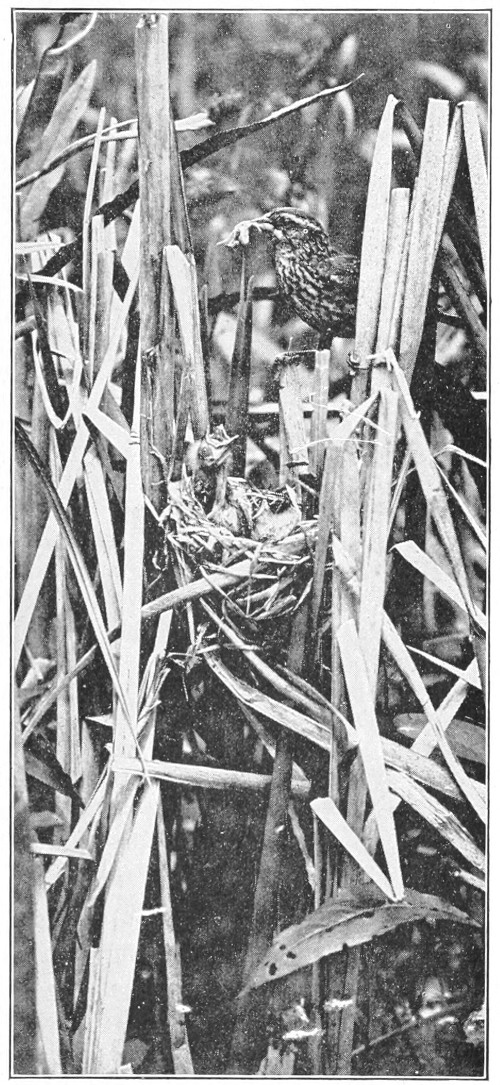
The mother red-wing, her nest and nestlings. Photo by A. A. Allen.
“Although the red-wings almost invariably breed in the swamp or marsh, they have a partiality for open fields and plowed lands; however, most of the blackbirds that nest in the smaller swamps adjacent to farm lands get a large share of their food from the farmer’s fields. They forage about the fields and meadows when they first come north in the spring. Later, they follow the plow, picking up grubs, worms and caterpillars; and should there be an outbreak of canker-worms in the orchard, the blackbirds will fly at least half a mile to get canker-worms for their young. Wilson estimated that the red-wings of the United States would in four months destroy sixteen thousand two hundred million larvæ. They eat the caterpillars of the gypsy moth, the forest tent-caterpillar, and other hairy larvæ. They are among the most destructive birds to weevils, click beetles, and wireworms. Grasshoppers, ants, bugs, and flies form a portion of the red-wing’s food. They eat comparatively little grain in Massachusetts although they get some from newly sown fields in spring, as well as from the autumn harvest; but they feed very largely on the seeds of weeds and wild rice in the fall. In the South they join with the bobolink in devastating the rice fields, and in the West they are often so numerous as to destroy the grain in the fields; but here the good they do far outweighs the injury, and for this reason they are protected by law.”
LESSON XXIX
The Red-winged Blackbird
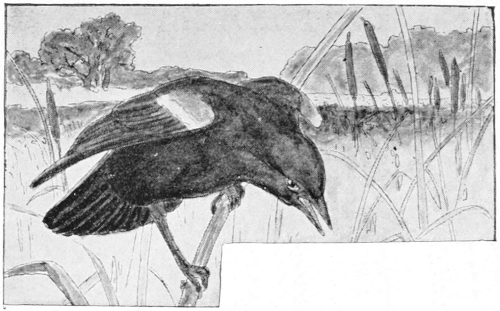
The red-winged blackbird. After Audubon Leaflet No. 25.
Leading thought—The red-winged blackbird lives in the marshes where it builds its nest. However, it comes over to our plowed lands and pastures and helps the farmer by destroying many insects which injure the meadows, crops and trees.
Method—The observations should be made by the pupils individually in the field. These birds may be looked for in flocks early in the spring, but the study should be made in May or June when they will be found in numbers in almost any swamp. The questions may be given to the pupils a few at a time or written in their field notebooks and the answers discussed when discovered.
Observations—1. How can you distinguish the red-winged blackbird from all other blackbirds? Where is the red on his wings? Is there any other color besides black on the wings? Where? What is the color of the rest of the plumage?
2. What is there peculiar in the flight of the red-wing? Is its tail long or short? How does it use its tail in flight? What is its position when the bird alights on a reed?
3. What is the song of the red-wing? Describe the way he holds his wings and tail when singing, balanced on a reed or some other swamp grass. Does he show off his epaulets when singing? Why? What note does he give when he is surprised or suspicious? When frightened?
4. When does the red-wing first appear in the spring? Does he come alone or in flocks? Does his mate come with him? Where do the red-wings winter? In what localities do the red-wing blackbirds live? Why do they live there? What is the color of the mother red-wing? Would you know by her looks that she was a blackbird? What advantage is it to the pair that the female is so dull in color?
5. At what time do these birds nest? Where is the nest built? Of what material? How is it concealed? What is the color of the eggs?
6. Do the young birds resemble in color their father or their mother? Why is this an advantage?
7. Is the red-wing ever seen in fields adjoining the marshes? What is he doing there? Does he walk or hop when looking for food? What is the food of the red-wings? Do they ever damage grain? Do they not protect grain more than they damage it?
8. What great good do the red-wings do for forest trees? For orchards?
9. At what time in the summer do the red-wings disappear from the swamps? Where do they gather in flocks? Where is their special feeding ground on the way south for the winter?
THE BALTIMORE ORIOLE
Teacher’s Story
“I know his name, I know his note, That so with rapture takes my soul; Like flame the gold beneath his throat, His glossy cope is black as coal. O Oriole, it is the song You sang me from the cottonwood, Too young to feel that I was young, Too glad to guess if life were good.” —William Dean Howells.
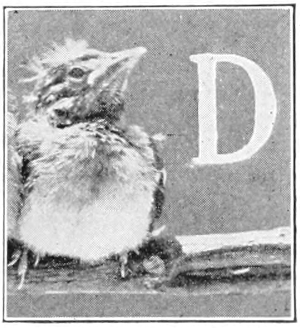
ANGLING from the slender, drooping branches of the elm in winter, these pocket nests look like some strange persistent fruit; and, indeed, they are the fruit of much labor on the part of the oriole weavers, those skilled artisans of the bird world. Sometimes the oriole “For the summer voyage his hammock swings” in a sapling, placing it near the main stem and near the top, otherwise it is almost invariably hung at the end of branches and is rarely less than twenty feet from the ground. The nest is pocket-shaped, and usually about seven inches long, and four and a half inches wide at the largest part, which is the bottom. The top is attached to forked twigs at the Y so that the mouth or door will be kept open to allow the bird to pass in and out; when within, the weight of the bird causes the opening to contract somewhat and protects the inmate from prying eyes. Often the pocket hangs free so that the breezes may rock it, but in one case we found a nest with the bottom stayed to a twig by guy lines. The bottom is much more closely woven than the upper part for a very good reason, since the open meshes admit air to the sitting bird. The nest is lined with hair or other soft material, and although this is added last, the inside of the nest is woven first. The orioles like to build the framework of twine, and it is marvellous how they will loop this around a twig almost as evenly knotted as if crocheted; in and out of this net the mother bird with her long, sharp beak weaves bits of wood fibre, strong, fine grass and scraps of weeds. The favorite lining is horse hair, which simply cushions the bottom of the pocket. Dr. Detwiler had a pet oriole which built her nest of his hair which she pulled from his head; is it possible that orioles get their supply of horse hair in a similar way? If we put in convenient places, bright colored twine or narrow ribbons the orioles will weave them into the nest, but the strings should not be long, lest the birds become entangled. If the nest is strong the birds will use it a second year.
That Lord Baltimore found in new America a bird wearing his colors, must have cheered him greatly; and it is well for us that this brilliant bird brings to our minds kindly thoughts of that tolerant, high-minded English nobleman. The oriole’s head, neck, throat and part of the back are black; the wings are black but the feathers are margined with white; the tail is black except that the ends of the outer feathers are yellow; all the rest of the bird is golden orange, a luminous color which makes him seem a splash of brilliant sunshine. The female, although marked much the same, has the back so dull and mottled that it looks olive-brown; the rump, breast, and under parts are yellow but by no means showy. The advantage of these quiet colors to the mother bird is obvious since it is she that makes the nest and sits in it without attracting attention to its location. In fact, when she is sitting, her brilliant mate places himself far enough away to distract the attention of meddlers, yet near enough for her to see the flash of his breast in the sunshine and to hear his rich and cheering song. He is a good spouse and brings her the materials for the nest which she weaves in, hanging head downward from a twig and using her long sharp beak for a shuttle. And his glorious song is for her alone; some hold that no two orioles have the same song; I know of two individuals at least whose songs were sung by no other birds; one gave a phrase from the Waldvogel’s song in Sigfried; the other whistled over and over, “Sweet birdie, hello, hello.” The orioles can chatter and scold as well as sing.
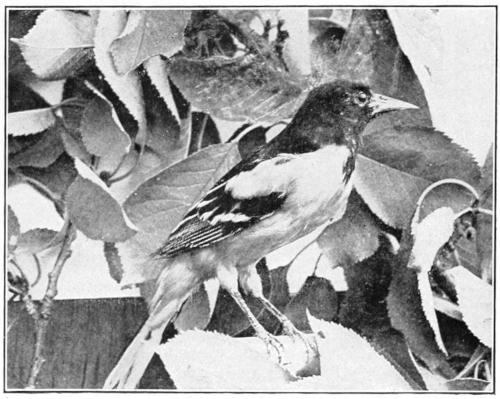
The Baltimore oriole.
The oriole is a brave defender of his nest and a most devoted father, working hard to feed his ever hungry nestlings; we can hear these hollow mites peeping for more food, “Tee dee dee, Tee dee dee”, shrill and constant, if we stop for a moment under the nest in June. The young birds dress in the safe colors of the mother, the males not donning their bright plumage until the second year. A brilliant colored fledgling would not live long in a world where sharp eyes are in constant quest for little birds to fill empty stomachs.
The food of the oriole places it among our most beneficial birds, since it is always ready to cope with the hairy caterpillars avoided by most birds; it has learned to abstract the caterpillar from his spines and is thus able to swallow him minus his “whiskers.” The orioles are waging a great war against the terrible brown-tail and gipsy moths in New England; they also eat click beetles and many other noxious insects. Once when we were breeding big caterpillars in the Cornell insectary, an oriole came in through the open windows of the greenhouse, and thinking he had found a bonanza proceeded to work it, carrying off our precious crawlers before we discovered what he was at.
The orioles winter in Central America and give us scarcely four months of their company. They do not usually appear before May and leave in early September.
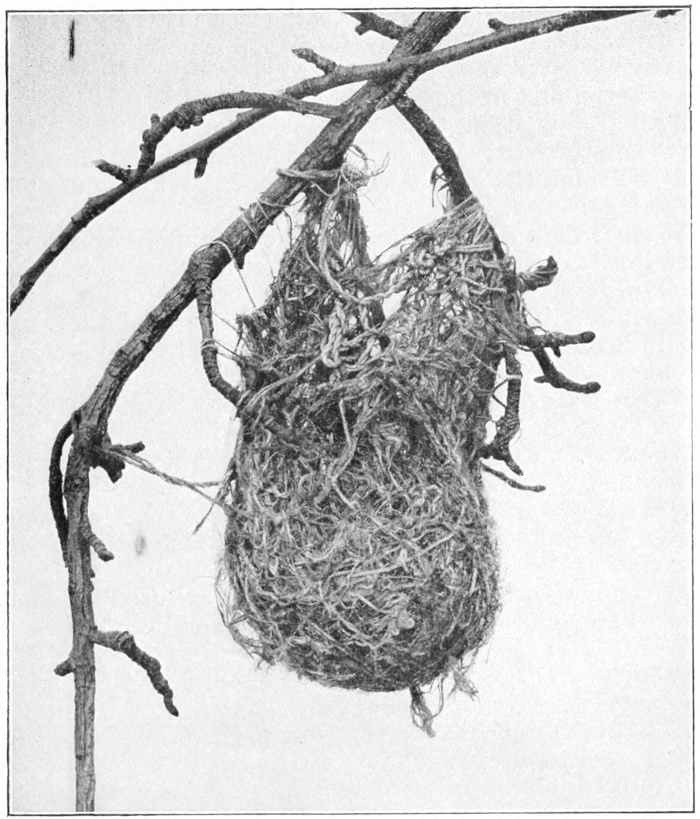
An oriole nest. An anchor to the windward. Photo by C. R. Crosby.
LESSON XXX
The Oriole
Leading thought—The oriole is the most skillful of all our bird architects. It is also one of our prized song birds and is very beneficial to the farmer and fruit grower because of the insect pests which it destroys.
Method—Begin during winter or early spring with a study of the nest, which may be obtained from the elms of the roadsides. During the first week in May, give the questions concerning the birds and their habits. Let the pupils keep the questions in their note-books and answer them when they have opportunity. The observations should be summed up once a week.
Observations by pupils—1. Where did you find the nest? On what species of tree? Was it near the trunk of the tree or the tip of the branch?
2. What is the shape of the nest? How long is it? How wide? Is the opening as large as the bottom of the nest? How is it hung to the twigs so that the opening remains open and does not pull together with the weight of the bird at the bottom? Is the bottom of the nest stayed to a twig or does it hang loose?
3. With what material and how is the nest fastened to the branches? Of what material is the outside made? How is it woven together? Is it more loosely woven at the top than at the bottom? How many kinds of material can you find in the outside of the nest?
4. With what is the nest lined? How far up is it lined? With what tool was the nest woven? If you put out bright colored bits of ribbon and string do you think the orioles will use them? Why should you not put out long strings?
5. At what date did you first see the Baltimore oriole? Why is it called the Baltimore oriole? How many other names has it? Describe in the following way the colors of the male oriole: top of head, back, wings, tail, throat, breast, under parts. What are the colors of his mate? How would it endanger the nest and nestlings if the mother bird were as bright colored as the father bird?
6. Which weaves the nest, the father or the mother bird? Does the former assist in any way in nest building?
7. Where does the father bird stay and what does he do while the mother bird is sitting on the eggs?
8. What is the oriole’s song? Has he more than one song? What other notes has he? After the young birds hatch does the father bird help take care of them?
9. By the middle of June the young birds are usually hatched and if you know where an oriole nest is hung, listen and describe the call of the nestlings for food.
10. Which parent do the young birds resemble in their colors? Why is this a benefit?
11. What is the oriole’s food? How is the oriole of benefit to us in ways which other birds are not?
12. Do the orioles use the same nest two years in succession? How long does the oriole stay in the North? Where does it spend its winters?
“Hush! ’tis he! My oriole, my glance of summer fire, Is come at last, and, ever on the watch, Twitches the packthread I had lightly wound About the bough to help his housekeeping,— Twitches and scouts by turns, blessing his luck, Yet fearing me who laid it in his way, Nor, more than wiser we in our affairs. Divines the Providence that hides and helps. Heave, ho! Heave, ho! he whistles as the twine Slackens its hold; once more, now! and a flash Lightens across the sunlight to the elm Where his mate dangles at her cup of felt.” —“Under the Willows”, Lowell.
THE CROW
Teacher’s Story
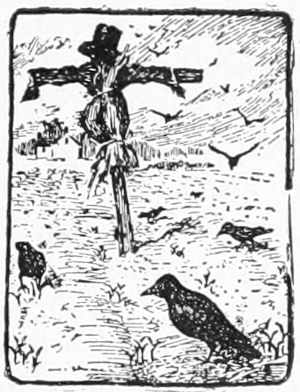
HOREAU says: “What a perfectly New England sound is this voice of the crow! If you stand still anywhere in the outskirts of the town and listen, this is perhaps the sound which you will be most sure to hear, rising above all sounds of human industry and leading your thoughts to some far-away bay in the woods. The bird sees the white man come and the Indian withdraw, but it withdraws not. Its untamed voice is still heard above the tinkling of the forge. It sees a race pass away, but it passes not away. It remains to remind us of aboriginal nature.”
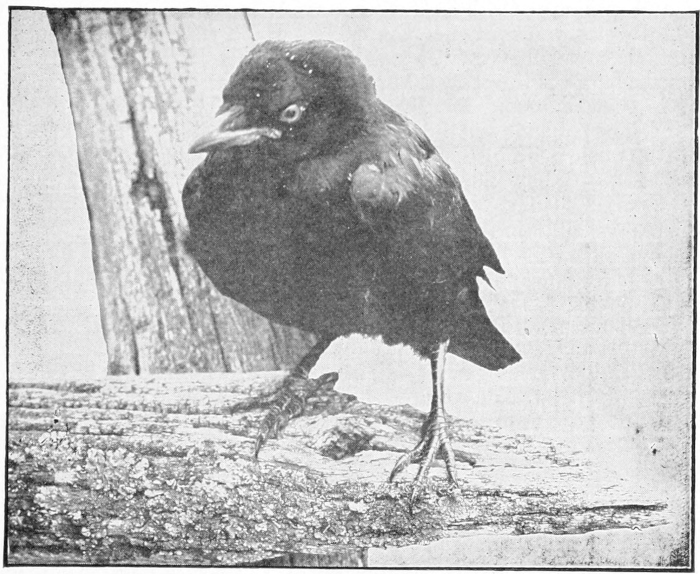
A pet crow. Photo by S. A. Lottride.
The crow is probably the most intelligent of all our native birds. It is quick to learn and clever in action, as many a farmer will testify who has tried to keep it out of corn fields with various devices, the harmless character of which the crow soon understood perfectly. Of all our birds, this one has the longest list of virtues and of sins, as judged from our standpoint; but we should listen to both sides of the case before we pass judgment. I find with crows, as with people, I like some more than I do others. I do not like at all the cunning old crow which steals the suet I put on the trees in winter for the chickadees and nuthatches; and I have hired a boy with a shotgun to protect the eggs and nestlings of the robins and other birds in my neighborhood from the ravages of one or two cruel old crows that have developed the nest-hunting habit. On the other hand, I became a sincere admirer of a crow flock which worked in a field close to my country home, and I have been the chosen friend of several tame crows who were even more interesting than they were mischievous.
The crow is larger than any other of our common blackbirds; the northern raven is still larger, but is very rarely seen. Although the crow’s feathers are black, yet in the sunlight a beautiful purple iridescence plays over the plumage, especially about the neck and back; it has a compact but not ungraceful body, and long, powerful wings; its tail is medium sized and is not notched at the end; its feet are long and strong: the track shows three toes directed forward and one long one directed backward. The crow does not sail through the air as does the hawk, but progresses with an almost constant flapping of the wings. Its beak is very strong and is used for tearing the flesh of its prey and for defense, and in fact, for almost anything that a beak could be used for; its eye is all black and is very keen and intelligent. When hunting for food in the field, it usually walks, but sometimes hops. The raven and the fish crows are the nearest relatives of the American crow, and next to them the jays. We should hardly think that the bluejay and the crow were related to look at them, but when we come to study their habits, much is to be found in common.
The crow’s nest is usually very large; it is made of sticks, of grape vines and bark, sod, horse-hair, moss and grasses. It is placed in trees or in tall bushes rarely less than twenty feet from the ground. The eggs are pale bluish green or nearly white with brownish markings. The young crows hatch in April or May. Both parents are devoted to the care of the young, and remain with them during most of the summer. I have often seen a mother crow feeding her young ones which were following her with obstreperous caws, although they were as large as she.
While the note of the crow is harsh when close at hand, it has a musical quality in the distance. Mr. Mathews says: “The crow when he sings is nothing short of a clown; he ruffles his feathers, stretches his neck, like a cat with a fish bone in her throat, and with a most tremendous effort delivers a series of hen-like squawks.” But aside from his caw, the crow has some very seductive soft notes. I have held long conversations with two pet crows, talking with them in a high, soft tone and finding that they answered readily in a like tone in a most responsive way. I have also heard these same tones among the wild crows when they were talking together; one note is a gutteral tremolo, most grotesque.
Crows gather in flocks for the winter; these flocks number from fifty to several hundred individuals, all having a common roosting place, usually in pine or hemlock forests or among other evergreens. They go out from these roosts during the day to get food, often making a journey of many miles. During the nesting season they scatter in pairs and do not gather again in flocks until the young are fully grown.
When crows are feeding in the fields there is usually, if not always, a sentinel posted on some high point so that he can give warning of danger. This sentinel is always an experienced bird and is keen to detect a dangerous from a harmless intruder. I once made many experiments with these sentinels; I finally became known to those of a particular flock and I was allowed to approach within a few yards of where the birds were feeding, a privilege not accorded to any other person in the neighborhood.
The crow is a general feeder and will eat almost any food; generally, however, it finds its food upon the ground. The food given to nestlings is very largely insects, and many pests are thus destroyed. The crows damage the farmer by pulling the sprouting corn and by destroying the eggs and young of poultry. They also do much harm by destroying the eggs and nestlings of our native birds which are beneficial to the farmer; they also do some harm by distributing the seeds of poison ivy and other noxious plants. All these must be set down in the account against the crow, but on the credit side must be placed the fact that it does a tremendous amount of good work for the farmer by eating injurious insects, especially the grubs and cut-worms which work in the ground, destroying the roots of grasses and grains. It also kills many mice and other rodents which are destructive to crops.
The best method of preventing crows from taking sprouting corn is to tar the seed corn, which is planted around the edge of the field.
If any of the pupils in your school have had any experience with tame crows they will relate interesting incidents of the love of the crow for glittering objects. I once knew a tame crow which stole all of the thimbles in the house and buried them in the garden; he would watch to see when a thimble was laid aside when the sewing was dropped, and would seize it almost immediately. This same crow persisted in taking the clothes-pins off the line and burying them, so that he was finally imprisoned on washdays. He was fond of playing marbles with a little boy of the family. The boy would shoot a marble into a hole and then Billy, the crow, would take a marble in his beak and drop it into the hole. The bird understood the game perfectly and was highly indignant if the boy took his turn and made shots twice in succession.
References—The American Crow, Barrows & Schwartz, Bulletin No. 6, Division of Ornithology, U. S. Department of Agriculture; Birds in Relation to Man, Weed & Dearborn; Bird Neighbors, Blanchan; Birds of Villages and Field, Merriam; Outdoor Studies, Needham.
LESSON XXXI
The Crow
Leading thought—The crow has the keenest intelligence of any of our common birds. It does good work for us and also does damage. We should study its ways before we pronounce judgment, for in some localities it may be a true friend and in others an enemy.
Methods—This work should begin in winter with an effort on the part of the boys to discover the food of the crows while snow is on the ground. This is a good time to study their habits and their roosts. The nests are also often found in winter, although usually built in evergreens. The nesting season is in early April, and the questions about the nests should be given then. Let the other questions be given when convenient. The flight, the notes, the sentinels, the food, the benefit and damage may all be taken as separate topics.
The following topics for essays should be given to correlate with work in English: “What a pet crow of my acquaintance did;” “Evidences of crow intelligence;” “A plea a crow might make in self-defence to the farmer who wished to shoot him;” “The best methods of preventing crows from stealing planted corn.”
Observations—1. How large is the crow compared with other blackbirds?
2. Describe its colors when seen in the sunlight?
3. Describe the general shape of the crow.
4. Are its wings long and slender or short and stout?
5. Is the tail long or short? Is it notched or straight across the end?
6. Describe the crow’s feet. Are they large and strong or slender? How many toes does the track show in the snow or mud? How many are directed forward and how many backward?
7. Describe a crow’s flight compared with that of the hawk.
8. Describe its beak and what it is used for.
9. What is the color of the crow’s eye?
10. When hunting for food does the crow hop or walk?
11. Which are the crow’s nearest relatives?
12. Where and of what material do the crows build their nests?
13. Describe the eggs. At what time of the year do the young crows hatch? Do both parents take care of and feed the young? How long do the parents care for the young after they leave the nest?
14. What are the notes of the crow? If you have heard one give any note except “caw,” describe it.
15. Where and how do crows live in winter? Where do they live in summer?
16. Do they post sentinels if they are feeding in the fields? If so, describe the action of the sentinel on the approach of people.
17. Upon what do the crows feed? What is fed to the nestlings?
18. How do the crows work injury to the farmer? How do they benefit the farmer? Do you think they do more benefit than harm to the farmer and fruit-grower?
19. Have you known of instances of the crow’s fondness for shining or glittering articles, like pieces of crockery or tin?
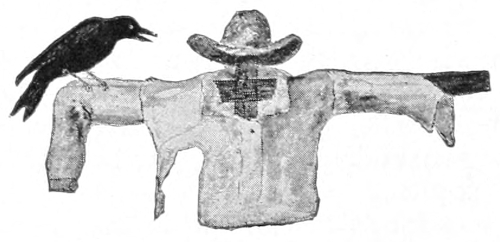
Supplementary reading—“The Story of Silver Spot” in Wild Animals I have Known, Seton; Second Book of Birds, p. 117; “Jim’s Babies” in Nestlings of Forest and Marsh; “How the Crow Baby was Punished,” True Bird Stories; “The Children of a Crow,” and “The Scare Crow” by Celia Thaxter; Our Birds and their Nestlings; “Crow Ways,” Ways of Wood Folk, Long; “Not so Black as he is Painted,” Outdoor Studies, Needham; The Crows, John Hay; “Jack Crow,” American Birds, Finley.
THE CARDINAL GROSBEAK
Teacher’s Story
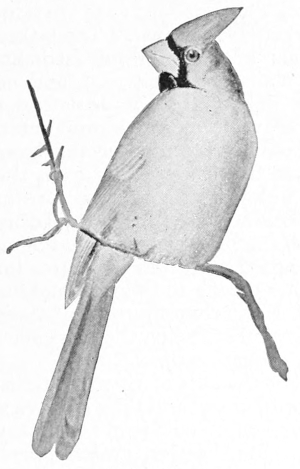
The cardinal grosbeak. After Audubon Leaflet No. 18.
There never lived a Lord Cardinal who possessed robes of state more brilliant in color than the plumage of this bird. By the way, I wonder how many of us ever think when we see the peculiar red, called cardinal, that it gained its name from the dress of this high functionary of the church? The cardinal grosbeak is the best name for the redbird because that describes it exactly, both as to its color and its chief characteristic, since its beak is thick and large; the beak is also red, which is a rare color in beaks, and in order to make its redness more emphatic it is set in a frame of black feathers. The use of such a large beak is unmistakable, for it is strong enough to crush the hardest of seed shells or to crack the hardest and driest of grains.
“What cheer! What cheer! That is the grosbeak’s way, With his sooty face and his coat of red”
sings Maurice Thompson. But besides the name given above, this bird has been called in different localities the redbird, Virginia redbird, crested redbird, winter redbird, Virginia nightingale, the red corn-cracker; but it remained for James Lane Allen to give it another name in his masterpiece, “The Kentucky Cardinal.”
The cardinal is a trifle smaller than the robin and is by no means slim and graceful, like the catbird or the scarlet tanager, but is quite stout and is a veritable chunk of brilliant color and bird dignity. The only other bird that rivals him in redness is the scarlet tanager which has black wings; the summer tanager is also a red bird, but is not so vermilion and is more slender and lacks the crest. The cardinal surely finds his crest useful in expressing his emotions; when all is serene, it lies back flat on the head, but with any excitement, whether of joy or surprise or anger, it lifts until it is as peaked as an old-fashioned nightcap. The cardinal’s mate is of quiet color; her back is greenish gray and breast buffy, while her crest, wings and tail reflect in faint ways the brilliancy of his costume.
The redbird’s song is a stirring succession of syllables uttered in a rich, ringing tone, and may be translated in a variety of ways. I have heard him sing a thousand times “tor-re’-do, tor-re’-do, tor-re’-do,” but Dr. Dawson has heard him sing “che’-pew, che’-pew, we’-woo, we’-woo;” “bird-ie, bird-ie, bird-ie; tschew, tschew, tschew;” and “chit-e-kew, chit-e-kew; he-weet, he-weet.” His mate breaks the custom of other birds of her sex and sings a sweet song, somewhat softer than his. Both birds utter a sharp note “tsip, tsip.”
The nest is built in bushes, vines or low trees, often in holly, laurel or other low evergreens, and is rarely more than six or eight feet above the ground. It is made of twigs, weed stems, tendrils, the bark of the grape vine and coarse grass; it is lined with fine grass and rootlets; it is rather loosely constructed but firm and is well hidden, for it causes these birds great anguish to have their nest discovered. Three or four eggs are laid, which are bluish white or grayish, dully marked with brown. The father cardinal is an exemplary husband and father; he cares for and feeds his mate tenderly and sings to her gloriously while she is sitting; and he works hard catching insects for the nestlings. He is also a brave defender of his nest and will attack any intruder, however large, with undaunted courage. The fledglings all have the dull color of the mother and have dark-colored bills. Their dull color protects the young birds from the keen eyes of their enemies while they are not yet able to take care of themselves. If the male fledglings were the color of their father, probably not one would escape a tragic death. While the mother bird is hatching the second brood the father keeps the first brood with him and cares for them; often the whole family remains together during the winter, making a small flock. However, the flocking habit is not characteristic of these birds, and we only see them in considerable numbers when the exigencies of seeking food in the winter naturally bring them together.
The cardinals are fond of the shrubbery and thickets of river bottoms, near grain fields, or where there is plenty of wild grass, and they only visit our premises when driven to us by winter hunger. Their food consists of the seeds of rank weeds, corn, wheat, rye, oats, beetles, grasshoppers, flies, and to some extent, wild and garden berries; but they never occur in sufficient numbers to be a menace to our crops. The cardinals may often be seen in the corn fields after the harvest, and will husk an overlooked ear of corn and crack the kernels with their beaks in a most dexterous manner. During the winter we may coax them to our grounds by scattering corn in some place not frequented by cats; thus, we may induce them to nest near us, since the cardinal is not naturally a migrant but likes to stay in one locality summer and winter. It has been known to come as far north as Boston and southern New York, but it is found in greatest numbers in our Southern States. Many nestlings were formerly taken, to ship in cages to Europe, but the National Association for Bird Protection has put a stop to this. In Ohio, no cardinal is allowed to be caged, and this same law should protect this beautiful bird in every Southern state, since it does not live long or happily in confinement. The cardinal’s song is not at its best in a cage, but as the poet Naylor says:
“Along the dust-white river road, The saucy redbird chirps and trills; His liquid notes resound and rise Until they meet the cloudless skies, And echo o’er the distant hills.”
LESSON XXXII
The Cardinal Grosbeak
Leading thought—The cardinal is the most brilliantly colored of all our birds and because of its color and song, it has been destroyed by thousands as cage birds. We should seek to preserve it as a beautiful ornament to our groves and grounds.
Methods—This work must be done by personal observation in the field. The field notes should be discussed in school. The effect of the whole lesson should be to stimulate an interest in protecting these beautiful birds. If possible, send for outline figures of the cardinal for the children to color; these outlines may be had at the cost of fifteen cents per dozen from the Audubon Society, 141 Broadway, New York City.
Observations—1. Do you know the cardinal? Why is it so called?
2. How many names do you know for this bird?
3. Is the cardinal as large as the robin? Is it graceful in shape or stout?
4. Is there any color except red upon it? If so, where?
5. What other vividly red birds have we and how can we distinguish them from the cardinal?
6. Describe the cardinal’s crest and how it looks when lifted. Why do you think it lifts it?
7. Describe its beak as to color, shape and size. What work is such a heavy beak made for?
8. Is the cardinal’s mate the same color as he? Describe the color of her head, back, wings, tail, breast.
9. Can you imitate the cardinal’s song? What words do you think he seems to sing? Does his mate sing also? Is it usual for mother birds to sing? What other notes besides songs do you hear him utter?
10. Where does the cardinal usually build its nest? How high from the ground? Of what materials? Is it compact or bulky? How many eggs and what are their colors?
11. How does the father bird act while his mate is brooding? How does he help take care of the young in the nest?
12. How do the fledglings differ in color from their father? From their mother? Of what use to the young birds is their sober color?
13. What happens to the fledglings of the first brood while the mother is hatching the eggs of the second brood?
14. In what localities do you most often see the cardinals? Do you ever see them in flocks?
15. What is the food of the cardinals? What do they feed their nestlings?
16. How can you induce the cardinals to build near your home?
17. What do you know about the laws protecting the redbirds?
Supplementary reading—The Second Book of Birds, Miller, p. 83; True Bird Stories, Miller, p. 86; The Song of the Cardinal, Porter; Audubon Educational Leaflet No. 18.
“Upon the gray old forest’s rim I snuffed the crab-tree’s sweet perfume; And farther, where the light was dim, I saw the bloom Of May apples, beneath the tent Of umbrel leaves above them bent; Where oft was shifting light and shade The blue-eyed ivy wildly strayed; The Solomon’s seal, in graceful play, Swung where the straggling sunlight lay The same as when I earliest heard The Cardinal bird.” —W. S. Gallagher.
GEESE
Teacher’s Story
O be called a goose should be considered most complimentary, for of all the birds the goose is probably the most intelligent. An observant lady who keeps geese on her farm assures me that no animal, not even dog or horse, has the intelligence of the goose. She says that these birds learn a lesson after a few repetitions, and surely her geese were patterns of obedience. While I was watching them one morning, they started for the brook via the corn field; she called to them sharply, “No, no, you mustn’t go that way!” They stopped and conferred; she spoke again and they waited, looking at her as if to make up their minds to this exercise of self-sacrifice; but when she spoke the third time they left the corn field and took the other path to the brook. She could bring her geese into their house at any time of day by calling to them, “Home, home!” As soon as they heard these words, they would start and not stop until the last one was housed.