Part 2 — IV. REPTILE STUDY
Reading edition
Yet when a child and barefoot; I more than once, at morn, Have passed, I thought, a whiplash unbraided in the sun, When, stooping to secure it, it wrinkled, and was gone. —Emily Dickinson.
F the teacher could bring herself to take as much interest as did Mother Eve in that “subtile animal,” as the Bible calls the serpent, she might, through such interest, enter the paradise of the boyish heart instead of losing a paradise of her own. How many teachers, who have an aversion for snakes, are obliged to teach small boys whose pet diversion is capturing these living ribbons and bringing them into the schoolroom stowed away not too securely in pockets! In one of the suburban Brooklyn schools, boys of this ilk sought to frighten their teacher with their weird prisoners. But she was equal to the occasion, and surprised them by declaring that there were many interesting things to be studied about snakes, and forthwith sent to the library for books which discussed these reptiles; and this was the beginning of a nature-study club of rare efficiency and enterprise.
There are abroad in the land, many errors concerning snakes. Most people believe that they are all venomous, which is far from true. The rattlesnake still holds its own in rocky, mountainous places and the moccasin haunts the bayous of the southern coast; however, in most localities, snakes are not only harmless but are beneficial to the farmer. The superstition that if a snake is killed, its tail will live until sun-down, is general and has but slender foundation in the fact that snakes, being lower in their nerve-organization than mammals, the process of death is a slow one. Some people firmly believe that snakes spring or jump from the ground to seize their prey, which is quite false since no snake jumps clear of the ground as it strikes, nor does it spring from a perfect coil. Nor are snakes slimy, quite to the contrary, they are covered with perfectly dry scales. But the most general superstition of all is that, when a snake thrusts out its tongue, it is an act of animosity; the fact is, the tongue is a sense organ and is used as an insect uses its feelers or antennæ, and the act is also supposed to aid the creature in hearing; thus when a snake thrusts out its tongue, it is simply trying to find out about its surroundings and what is going on.
Snakes are the only creatures able to swallow objects larger than themselves. This is rendered possible by the elasticity of the body walls, and the fact that snakes have an extra bone hinging the upper to the lower jaw, allowing them to spread widely; the lower jaw also separates at the middle of its front edge and spreads apart sidewise. In order to force a creature into a “bag” so manifestly too small, a special mechanism is needed; the teeth supply this by pointing backward, and thus assist in the swallowing. The snake moves by literally walking on the ends of its ribs, which are connected with the crosswise plates on its lower side; each of these crosswise plates has the hind edge projecting down so that it can hold to an object. Thus, the graceful, noiseless progress of the snake, is brought about by many of these crosswise plates worked by the movement of the ribs.
Some species of snakes simply chase their prey, striking at it and catching it in the open mouth, while others, like the black snake, wind themselves about their victims crushing them to death. Snakes can live a long time without food; many instances on record show that they have been able to exist a year or more without anything to eat. In our northern climate they hibernate in winter, going to sleep as soon as the weather becomes cold and not waking up until spring. As snakes grow, they shed their skins; this occurs only two or three times a year. The crested fly-catcher adorns its nest with these phantom snakes.
References—The Reptile Book, by Ditmars, gives interesting accounts of our common snakes; Mathew’s Familiar Life of Field and Forest is also valuable. To add interest to the snake lessons let the children read “Kaas Hunting” and “Rikki Tikki Tavi” from Kipling’s Jungle Books.
THE GARTER, OR GARDEN, SNAKE
Teacher’s Story
A chipmunk, or a sudden-whirring quail, Is startled by my step as on I fare. A gartersnake across the dusty trail, Glances and — is not there. —Riley.
ARTER snakes can be easily tamed, and are ready to meet friendly advances half way. A handsome yellow-striped, black garter lived for four years beneath our piazza and was very friendly and unafraid of the family. The children of the campus made it frequent visits, and never seemed to be weary of watching it; but the birds objected to it very much, although it never attempted to reach their nests in the vine above. The garter snakes are the most common of all, in our Northeastern States. They vary much in color; the ground color may be olive, brown or black, and down the center of the back is usually a yellow, green or whitish stripe, usually bordered by a darker band of ground-color. On each side is a similar stripe, but not so brightly colored; sometimes the middle stripe, and sometimes the side stripes are broken into spots or absent; the lower side is greenish white or yellow. When fully grown this snake is about three feet in length.
The garters are likely to congregate in numbers in places favorable for hibernation, like rocky ledges or stony side-hills. Here each snake finds a safe crevice, or makes a burrow which sometimes extends a yard or more under ground. During the warm days of Indian summer, these winter hermits crawl out in the middle of the day and sun themselves, retiring again to their hermitages when the air grows chilly toward night; and when the cold weather arrives, they go to sleep and do not awaken until the first warm days of spring; then, if the sun shines hot, they crawl out and bask in its welcome rays.
After the warm weather comes, the snakes scatter to other localities more favorable for finding food, and thus these hibernating places are deserted during the summer. The banks of streams, and the edges of woods are places which furnish snakes their food, which consists of earthworms, insects, toads, salamanders, frogs, etc. The young are born late in July and are about six inches long at birth; one mother may have in her brood from eleven to fifty snakelings; she stays with them during the fall to protect them, and there are many stories about the way the young ones run down the mother’s throat in case of attack; but, as yet, no scientist has seen this act, or placed it on record. The little snakes shift for their own food, catching small toads, earthworms and insects. If it finds food in plenty, the garter snake will mature in one year. Hawks, crows, skunks, weasels and other predacious animals seem to find the garter snake attractive food.
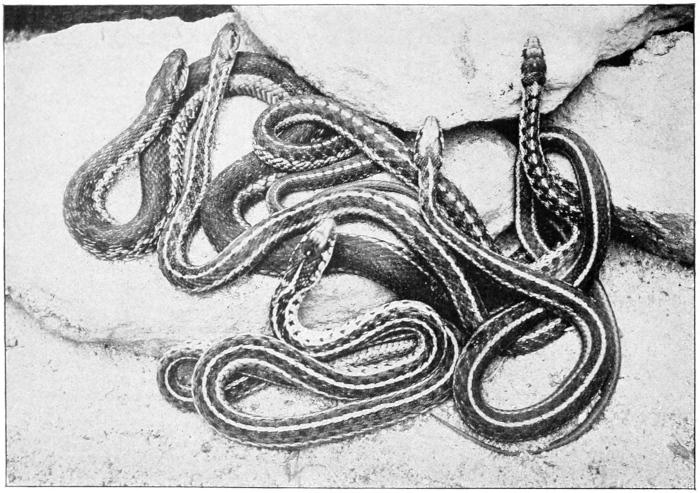
Garter snakes.
LESSON XLIX
The Garter, or Garden, Snake
Leading thought—The garter snake is a common and harmless little creature and has many interesting habits which are worth studying.
Method—A garter snake may be captured and placed in a box with a glass cover and thus studied in detail in the schoolroom, but the lesson should begin with observations made by the children on the snakes in their native haunts.
Observations—1. What are the colors and markings of your garter snake? Do the stripes extend along the head as well as the body? How long is it?
2. Describe its eyes, its ears, its nostrils and its mouth.
3. If you disturb it how does it act? Why does it thrust its tongue out? What shape is its tongue?
4. In what position is the snake when it rests? Can you see how it moves? Look upon the lower side. Can you see the little plates extending crosswise? Do you think it moves by moving these plates? Let it crawl across your hand, and see if you can tell how it moves.
5. What does the garter snake eat? Did you ever see one swallow a toad? A frog? Did it take it head first or tail first?
6. Where does the garter spend the winter? How early does it appear in the spring?
7. At what time of year do you see the young snakes? Do the young ones run down the throat of the mother for safety when attacked? Does the mother snake defend her young?
8. What enemies has the garter snake?
“No life in earth or air or sky; The sunbeams, broken silently, On the bared rocks around me lie,— Cold rocks with half-warmed lichens scarred, And scales of moss; and scarce a yard Away, one long strip, yellow-barred. Lost in a cleft! ’Tis but a stride To reach it, thrust its roots aside, And lift it on thy stick astride! Yet stay! That moment is thy grace! For round thee, thrilling air and space, A chattering terror fills the place! A sound as of dry bones that stir, In the dead valley! By yon fir The locust stops its noon-day whir! The wild bird hears; smote with the sound. As if by bullet brought to ground On broken wing, dips, wheeling round! The hare, transfixed, with trembling lip, Halts breathless, on pulsating hip, And palsied tread, and heels that slip. Enough, old friend!—’tis thou. Forget My heedless foot, nor longer fret The peace with thy grim castanet!” From “Crotalus” (The Rattlesnake), Bret Harte.
THE MILK SNAKE, OR SPOTTED ADDER
Teacher’s Story
The grass divides as with a comb, a spotted shaft is seen, And then it closes at your feet, and opens farther on. —Emily Dickinson.
HIS is the snake which is said to milk cows, a most absurd belief; it would not milk a cow if it could, and it could not if it would. It has never yet been induced to drink milk when in captivity; and if it were very thirsty, it could not drink more than two teaspoonfuls of milk at most; thus in any case, its depredations upon the milk supply need not be feared. Its object, in frequenting milk houses and stables, is far other than the milking of cows, for it is an inveterate hunter of rats and mice and is thus of great benefit to the farmer. It is a constrictor, and squeezes its prey to death in its coils.
The ground color of the milk snake is pale gray, but it is covered with so many brown or dark gray saddle-shaped blotches, that they seem rather to form the ground-color; the lower side is white, marked with square black spots and blotches. The snake attains a length of about three feet when fully grown. Although it is called commonly the spotted adder, it does not belong to the adders at all, but to the family of the king snakes.
During July and August, the mother snake lays from seven to twenty eggs; they are deposited in loose soil, in moist rubbish, in compost heaps, etc. The egg is a symmetrical oval in shape and is about one and one-eighth inches long by a half inch in diameter. The shell is soft and white, like kid leather, and the egg resembles a puffball. The young hatch nearly two months after the eggs are laid, meanwhile the eggs have increased in size so that the snakelings are nearly eight inches long when they hatch. The saddle-shaped blotches on the young have much red in them. The milk snake is not venomous; it will sometimes, in defence, try to chew the hand of the captor, but the wounds it can inflict are very slight and heal quickly.
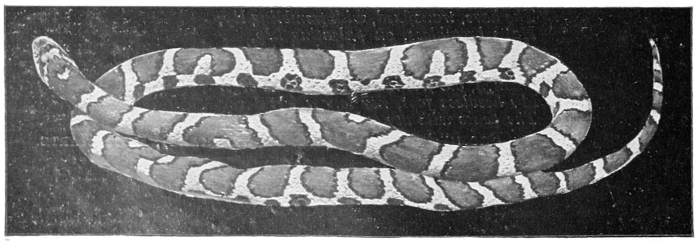
The milk snake, or spotted adder.
LESSON L
The Milk Snake, or Spotted Adder
Leading thought—The milk snake is found around stables where it hunts for rats and mice but never milks the cows.
Method—Although the snake acts fiercely, it is perfectly harmless and may be captured in the hands and placed in a glass-covered box for a study in the schoolroom.
Observations—1. Where is the milk snake found? Why is it called milk snake? Look at its mouth and see if you think it could possibly suck a cow. See if you can get the snake to drink milk.
2. What does it live upon? How does it kill its prey? Can the milk snake climb a tree?
3. Where does the mother snake lay her eggs? How do the eggs look? How large are they? How long are the little snakes when they hatch from the egg? Are they the same color as the old ones?
4. Describe carefully the colors and markings of the milk snake and explain how its colors protect it from observation. What are its colors on the under side?
5. Have you ever seen a snake shed its skin? Describe how it was done. How does the sloughed-off skin look? What bird always puts snake skins around its nest?
I have the same objection to killing a snake that I have to the killing of any other animal, yet the most humane man I know never omits to kill one.
Aug. 5, 1853.
The mower on the river meadows, when he comes to open his hay these days, encounters some overgrown water adder, full of young (?) and bold in defense of its progeny, and tells a tale when he comes home at night which causes a shudder to run through the village—how it came at him and he ran, and it pursued and overtook him, and he transfixed it with a pitchfork and laid it on a cock of hay, but it revived and came at him again. This is the story he tells in the shops at evening. The big snake is a sort of fabulous animal. It is always as big as a man’s arm and of indefinite length. Nobody knows exactly how deadly is its bite but nobody is known to have been bitten and recovered. Irishmen introduced into these meadows for the first time, on seeing a snake, a creature which they have seen only in pictures before, lay down their scythes and run as if it were the Evil One himself and cannot be induced to return to their work. They sigh for Ireland, where they say there is no venomous thing that can hurt you.
—Thoreau’s Journal.
THE WATER SNAKE
Teacher’s Story
VERY boy that goes fishing, knows the snake found commonly about mill-dams and wharves or on rocks and bushes near the water. The teacher will have accomplished a great work, if these boys are made to realize that this snake is a more interesting creature for study, than as an object to pelt with stones.
The water snake is a dingy brown in color, with cross-bands of brownish or reddish brown which spread out into blotches at the side. Its color is very protective as it lies on stones or logs in its favorite attitude of sunning itself. It is very local in its habits, and generally has a favorite place for basking and returns to it year after year on sunny days.
This snake lives mostly upon frogs and salamanders and fish; however, it preys usually upon fish of small value, so it is of little economic importance. It catches its victims by chasing, and seizing them in its jaws. It has a very keen sense of smell and probably traces its prey in this manner, something as a hound follows a fox. It is an expert swimmer, usually lifting the head a few inches above the water when swimming, although it is able to dive and remain below the water for a short time.
The water snake is a bluffer, and, when cornered, it flattens itself and strikes fiercely. But its teeth contain no poison and it can inflict only slight and harmless wounds. When acting as if it would “rather fight than eat,” if given a slight chance to escape, it will flee to the water like a “streak of greased lightning,” as any boy will assure you.
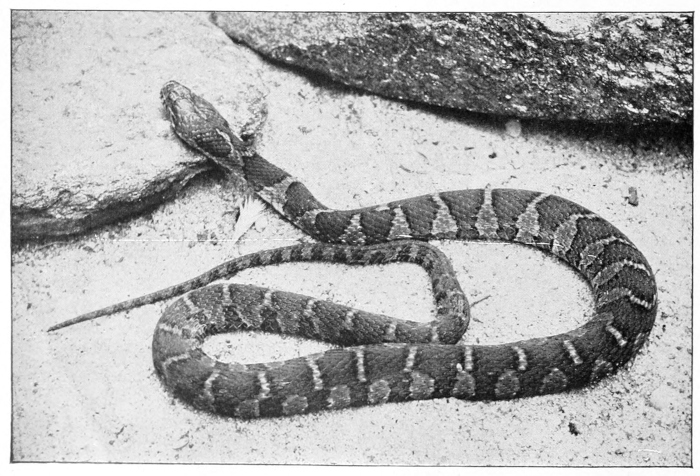
The water snake.
The water snake attains a length of about four feet. The young do not hatch from eggs, but are born alive in August and September; they differ much in appearance from their parents as they are pale gray in color, with jet-black cross-bands.
LESSON LI
The Water Snake
Leading thought—The water snake haunts the banks of streams because its food consists of creatures that live in and about water.
Method—If water snakes are found in the locality, encourage the boys to capture one without harming it, and bring it to school for observation. However, as the water snake is very local in its habits, and haunts the same place year after year, it will be better nature-study to get the children to observe it in its native surroundings.
Observations—1. Where is the water snake found? How large is the largest one you ever saw?
2. Why does the water snake live near water? What is its food? How does it catch its prey?
3. Describe how the water snake swims. How far does its head project above the water when swimming? How long can it stay completely beneath the water?
4. Describe the markings and colors of the water snake. How do these colors protect it from observation? How do the young look?
5. Does each water snake have a favorite place for sunning itself?
6. Where do the water snakes spend the winter?
May 12, 1858.
Found a large water adder by the edge of Farmer’s large mudhole, which abounds with tadpoles and frogs, on which it was probably feeding. It was sunning on the bank and would face me and dart its head toward me when I tried to drive it from the water. It is barred above, but indistinctly when out of the water, so that it appears almost uniformly dark brown, but in the water, broad, reddish brown bars are seen, very distinctly alternating with very dark-brown ones. The head was very flat and suddenly broader than the neck behind. Beneath, it was whitish and reddish flesh-color. It was about two inches in diameter at the thickest part. The inside of its mouth and throat was pink. They are the biggest and most formidable-looking snakes that we have. It was awful to see it wind along the bottom of the ditch at last, raising wreaths of mud amid the tadpoles, to which it must be a very sea-serpent. I afterward saw another, running under Sam Barrett’s grist-mill, the same afternoon. He said that he saw a water-snake, which he distinguished from a black snake, in an apple tree near by, last year, with a young robin in its mouth, having taken it from the nest. There was a cleft or fork in the tree which enabled it to ascend.
—Thoreau’s Journal.
THE TURTLE
Teacher’s Story
TURTLE is at heart a misanthrope; its shell is in itself proof of its owner’s distrust of this world. But we need not wonder at this misanthropy, if we think for a moment of the creatures that lived on this earth, at the time when turtles first appeared. Almost any of us would have been glad of a shell in which to retire, if we had been contemporaries of the smilodon and other monsters of earlier geologic times.
When the turtle feels safe and walks abroad for pleasure, his head projects far from the front end of his shell, and the legs, so wide, and soft that they look as if they had no bones in them, project out at the side, while the little, pointed tail brings up an undignified rear; but frighten him and at once head, legs and tail all disappear, and even if we turn him over, we see nothing but the tip of the nose, the claws of the feet and the tail turned deftly sidewise. When frightened, he hisses threateningly; the noise seems to be made while the mouth is shut, and the breath emitted through the nostrils.
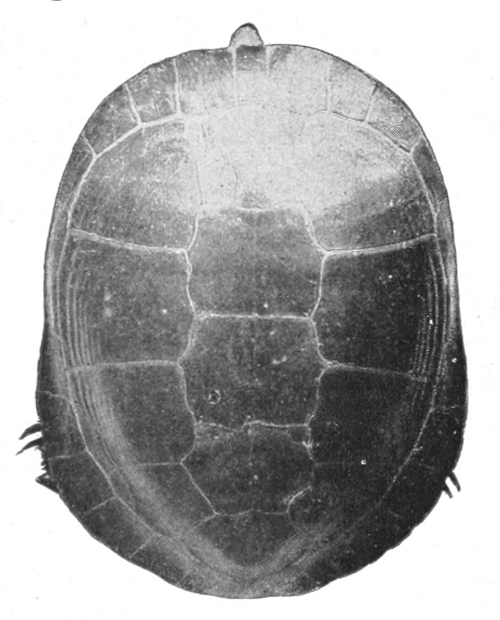
Carapace of painted terrapin in retirement.
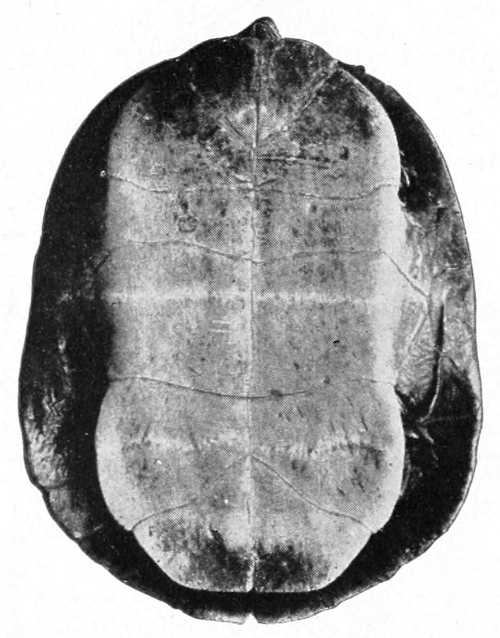
Plastron of same terrapin.
The upper shell of the turtle is called the carapace and the lower shell, the plastron. There is much difference in the different species of turtles in the shape of the upper shell and the size and shape of the lower one. In most species the carapace is sub-globular but in some it is quite flat. The upper shell is grown fast to the backbone of the animal, and the lower shell to the breast bone. The markings and colors of the shell offer excellent subjects for drawing. The painted terrapin has a red-mottled border to the shell, very ornamental; the wood turtle has a shell made up of plates each of which is ornamented with concentric ridges; and the box-turtle has a front and rear trap-door, hinged to the plastron, which can be pulled up against the carapace when the turtle wishes to retire, thus covering it entirely.
The turtle’s head is decidedly snakelike. Its color differs with different species. The wood turtle has a triangular, horny covering on the top of the head, in which the color and beautiful pattern of the shell are repeated; the underparts are brick-red with indistinct yellowish lines under the jaw. The eyes are black with a yellowish iris, which somehow gives them a look of intelligence. The turtle has no eyelids like our own, but has a nictitating membrane which comes up from below and completely covers the eye; if we seize the turtle by the head and attempt to touch its eyes, we can see the use of this eyelid. When the turtle winks, it seems to turn the eyeball down against the lower lid.
The sense of smell in turtles is not well developed, as may be guessed by the very small nostrils, which are mere pin-holes in the snout. The mouth is a more or less hooked beak, and is armed with cutting edges instead of teeth. The constant pulsation in the throat is caused by the turtle swallowing air for breathing.
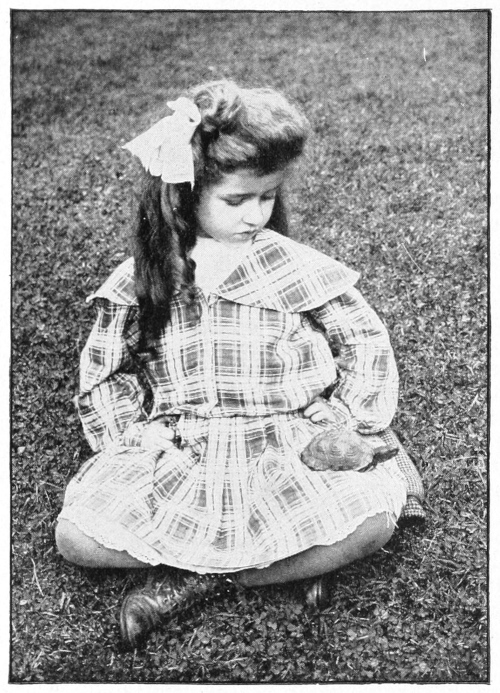
Boxy, a trained turtle. Photo by Silas Lottridge.
The turtle’s legs, although so large and soft, have bones within them, as the skeleton shows. The claws are long and strong; there are five claws on the front and four on the hind feet. Some species have a distinct web between the toes; in others, it is less marked, depending upon whether the species lives mostly in water or out of it. The color of the turtle’s body varies with the species; the body is covered with coarse, rough skin made up of various-sized plates.
The enemies of turtles are the larger fishes and other turtles. Two turtles should never be kept in the same aquarium, since they eat each others’ tails and legs with great relish. They feed upon insects, small fish, or almost anything soft-bodied which they can find in the water; they are especially fond of earthworms. The species which frequent the land, feed upon tender vegetation and also eat berries. In an aquarium, a turtle should be fed earthworms, chopped fresh beef, lettuce leaves and berries. The wood turtle is especially fond of cherries.
The aquarium should always have in it a stone or some other object projecting above the water, so that the turtle may climb out, if it chooses. In winter, turtles bury themselves in the ooze at the bottom of ponds and streams. Their eggs have white leathery shells, are oblong in shape, and are buried by the mother in the sand or soil near a stream or pond. The long life of turtles is a well authenticated fact, dates carved upon their shells show them to have attained the age of thirty or forty years.
The following are, perhaps, the most common species of turtles:
(a) The Snapping Turtle—This sometimes attains a shell 14 inches long and a weight of forty pounds. It is a vicious creature and inflicts a severe wound with its sharp, hooked beak; it should not be used for a nature-study lesson unless the specimen is very young.
(b) The Mud Turtle—The musk turtle and the common mud turtle both inhabit slow streams and ponds; they are truly aquatic and only come to shore to deposit their eggs. They cannot eat, unless they are under water, and they seek their food in the muddy bottoms. The musk turtle when handled, emits a very strong odor; it has on each side of the head two broad yellow stripes. The mud turtle has no odor. Its head is ornamented with greenish yellow spots.
(c) The Painted Terrapin, or Pond Turtle—This can be determined by the red mottled border of its shell. It makes a good pet, if kept in an aquarium by itself, but will destroy other creatures. It will eat meat or chopped fish, and is fond of earthworms and soft insects.
(d) The Spotted Turtle—This has the upper shell black with numerous round yellow spots upon it. It is common in ponds and marshy streams and its favorite perch is, with many of its companions, upon a log. It feeds under water, eating insect larvæ, dead fish and vegetation. It likes fresh lettuce.
(e) The Wood Terrapin—This is our most common turtle; it is found in damp woods and wet places, since it lives largely upon the land. Its upper shell often reaches a length of six and one-half inches and is made up of many plates, ornamented with concentric ridges. This is the turtle upon whose shell people carve initials and dates and then set it free. All the fleshy parts of this turtle, except the top of the head and the limbs, are brick-red. It feeds on tender vegetables, berries and insects. It makes an interesting pet and will soon learn to eat from the fingers of its master.
(f) The Box-Turtle—This is easily distinguished from the others, because the front and rear portions of the lower shell are hinged so that they can be pulled up against the upper shell. When this turtle is attacked, it draws into the shell and closes both front and back doors, and is very safe from its enemies. It lives entirely upon land and feeds upon berries, tender vegetation and insects. It lives to a great age.
(g) The Soft-shelled Turtle—These are found in streams and canals. The upper shell looks as if it were of one piece of soft leather, and resembles a griddle-cake. Although soft-shelled, these turtles are far from soft-tempered, and must be handled with care.
LESSON LII
The Turtle
Leading thought—The turtle’s shell is for the purpose of protecting its owner from the attack of enemies. Some turtles live upon land and others in water.
Method—A turtle of any kind, in the schoolroom, is all that is needed to make this lesson interesting.
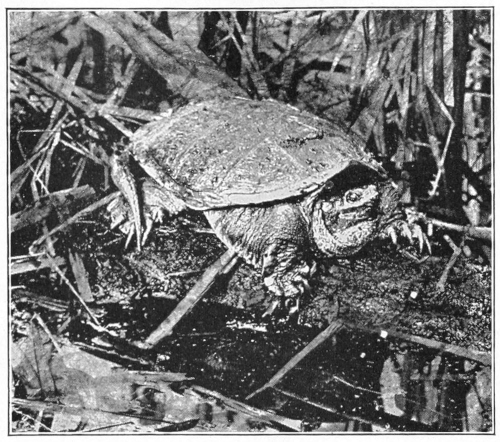
A snapping turtle. Photo by J. T. Lloyd.
Observations—1. How much can you see of the turtle when it is walking? If you disturb it what does it do? How much of it can you see then? Can you see more of it from the lower side than the upper? What is the advantage to the turtle of having such a shell?
2. Compare the upper shell with the lower as follows: How are they shaped differently? What is their difference in color? Would it be a disadvantage to the turtle if the upper shell were as light colored as the lower? Why? Make a drawing of the upper and the lower shell showing the shape of the plates of which they are composed. Where are the two grown together?
3. Is the border of the upper shell different from the central portion in color and markings? Is the edge smooth or scalloped?
4. How far does the turtle’s head project from the front of the shell? What is the shape of the head? With what colors and pattern is it marked? Describe the eyes. How are they protected? How does the turtle wink? Can you discover the little eyelid which comes up from below to cover the eye?
5. Describe the nose and nostrils. Do you think it has a keen sense of smell?
6. Describe the mouth. Are there any teeth? With what does it bite off its food? Describe the movement of the throat. Why is this constant pulsation?
7. What is the shape of the leg? How is it marked? How many claws on the front feet? Are any of the toes webbed? On which feet are the webbed toes? Why should they be webbed? Describe the way a turtle swims. Which feet are used for oars?
8. Describe the tail. How much can be seen from above when the turtle is walking? What becomes of it, when the turtle withdraws into its shell?
9. How much of the turtle’s body can you see? What is its color? Is it rough or smooth?
10. What are the turtle’s enemies? How does it escape from them? What noise does the turtle make when frightened or angry?
11. Do all turtles live for part of the time in water? What is their food and where do they find it? Write an account of all the species of turtles that you know.
12. How do turtle eggs look? Where are they laid? How are they hidden?
Supplementary reading—“Turtle Eggs for Agassiz,” Dalles Lore Sharp, Atlantic Monthly, Feb., 1910.