Part 2 — VI. INSECT STUDY
Reading edition
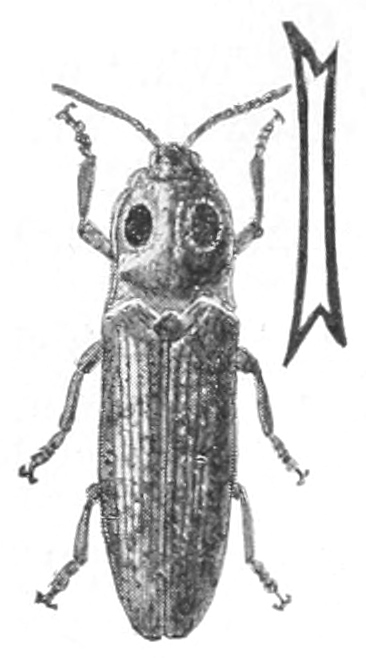
NSECTS are among the most interesting and available of all living creatures for nature-study. The lives of many of them afford more interesting stories than are found in fairy lore; many of them show exquisite colors and, more than all, they are small and are, therefore, easily confined for observation.
While the young pupils should not be drilled in insect anatomy, as if they were embryo zoologists, yet it is necessary for the teacher, who would teach intelligently, to know something of the life stories, habits and structure of the common insects. Generally speaking, all insects develop from eggs. To most of us the word egg brings before us the picture of the egg of the hen or of some other bird. But insect eggs are often far more beautiful than those of any bird; they are of widely differing forms, and are often exquisitely colored and the shells may be ornately ribbed and pitted, sometimes adorned with spines, and are as beautiful to look at through a microscope as the most artistic piece of mosaic.
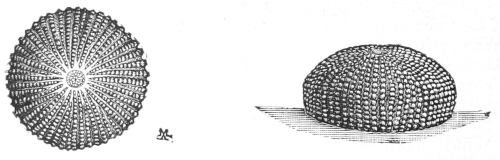
The egg of the cotton moth, greatly enlarged.
From Manual for the Study of Insects.
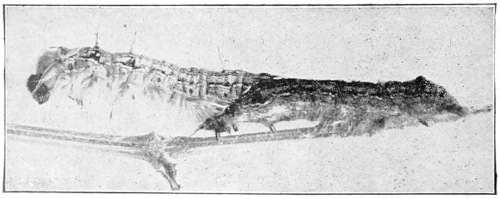
The forest tent-caterpillar shedding its skin.
Photo by M. V. Slingerland.
From the eggs, larvæ (sing. larva) issue. These larvæ may be caterpillars, or the creatures commonly called worms, or may be maggots or grubs. The larval stage is always devoted to feeding and to growth. It is the chief business of the larva to eat diligently and to attain maturity as soon as possible; for often the length of the larval period depends more upon food than upon lapse of time. All insects have their skeletons on the outside of the body; that is, the outer covering of the body is chitinous, and the soft and inner parts are attached to it and supported by it. This skin is so firm that it cannot stretch to accommodate the increasing size of the growing insect, thus from time to time it is shed. But before this is done, a new skin is formed beneath the old one. After the old skin bursts open and the insect crawls forth, the new skin is sufficiently soft and elastic to allow for the increase in the size of the insect. Soon, the new skin becomes hardened like the old one, and after a time, is shed. This shedding of the skin is called molting. Some insects shed their skins only four or five times during the period of attaining their growth, while other species may molt twenty times or more.
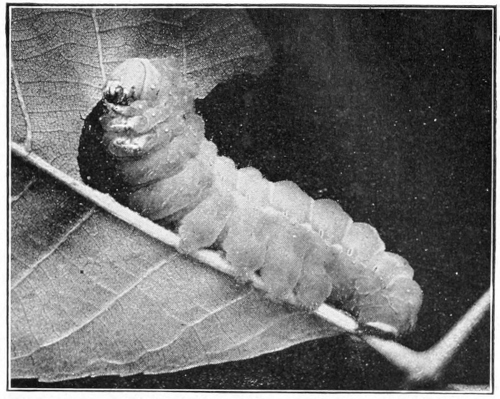
Full-grown caterpillar of the luna moth.
Photo by M. V. Slingerland.
After the larva has attained its full growth, it changes its skin and its form, and becomes a pupa. The pupa stage is ordinarily one of inaction, except that very wonderful changes take place within the body itself. Usually the pupa has no power of moving around, but in many cases it can squirm somewhat, if disturbed. The pupa of the mosquito is active and is an exception to the rule. The pupa is usually an oblong object and seems to be without head, feet or wings; but if it is examined closely, especially in the case of butterflies and moths, the antennæ, wings and legs may be seen, folded down beneath the pupa skin.
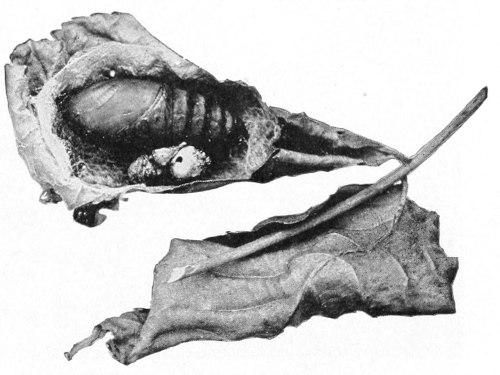
A luna cocoon cut open, showing the pupa.
Photo by M. V. Slingerland.
Many larvæ, especially those of moths, weave about themselves a covering of silk which serves to protect them from their enemies and the weather, during the helpless pupa period. This silken covering is called a cocoon. The larvæ of butterflies do not make a silken cocoon, but the pupa is suspended to some object by a silken knob, and in some cases by a halter of silk, and remains entirely naked. The pupa of a butterfly is called a chrysalis. Care should be taken to have the children use the words—pupa, chrysalis and cocoon—understandingly.
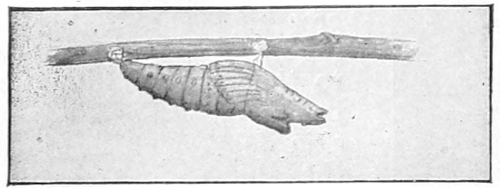
A butterfly chrysalis.
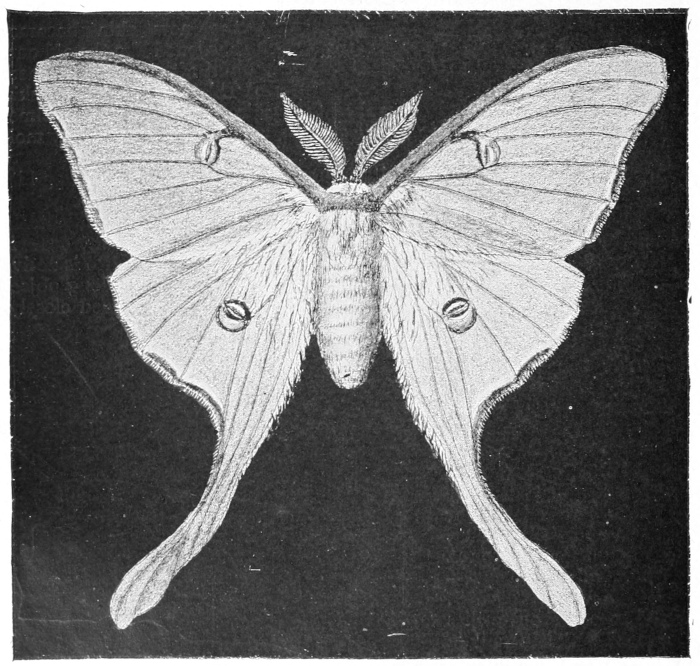
A luna moth.
The delicate, exquisite green of the luna’s wings is set off by the rose-purple, velvet border of the front and the white fur on the body and inner edge of the hind wings. Little wonder that it has been called the “Empress of the night”. The long swallow tail of the hind wings give the moth a most graceful shape, at the same time probably afford it protection from observation. During the day time the moth hangs wings down beneath the green leaves, and these long projections of the hind wings folded together resemble a petiole, making the insect look very much like a large leaf.
After a period varying from days to months, depending upon the species of insect and the climate, the pupa skin bursts open and from it emerges the adult insect, often equipped with large and beautiful wings and always provided with six legs and a far more complex structure of body than characterized it as a larva. The insect never grows after it reaches this adult stage and, therefore, never molts. Some people seem to believe that a small fly will grow into a large fly, and a small beetle into a large beetle; but after an insect attains its perfect wings, it does not grow larger. Many adult insects take very little food, although some continue to eat in order to support life. The adult stage is ordinarily shorter than the larval stage; it seems a part of nature’s economic plan that the grown-up insects should live only long enough to lay eggs, and thus secure the continuation of the species. Insects having the four distinct stages in their growth, egg, larva, pupa and adult, are said to undergo complete metamorphosis.
But not all insects pass through an inactive pupa stage. With some insects, like the grasshoppers, the young, as soon as they are hatched, resemble the adult forms in appearance. These insects, like the larvæ, shed their skins to accommodate their growth, but they continue to feed and move about actively until the final molt when the perfect insect appears. Such insects are said to have incomplete metamorphosis, which simply means that the form of the body of the adult insect is not greatly different from that of the young; the dragon-flies, crickets, grasshoppers and bugs are of this type. The young of insects with an incomplete metamorphosis are called nymphs instead of larvæ.
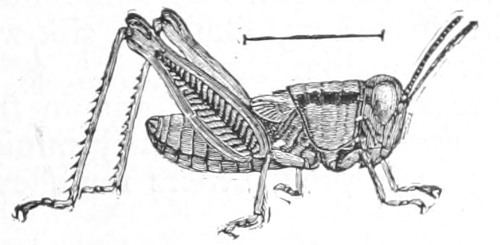
A young grasshopper, enlarged.
The line shows its actual length.
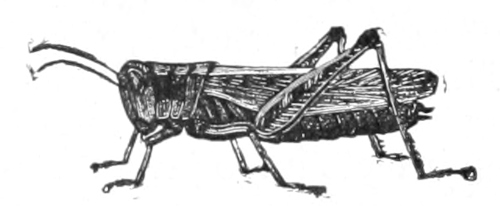
The adult of the same grasshopper, natural size.
Summary of the Metamorphoses of Insects
I. Complete metamorphosis
Egg.
Larva.
Pupa. (The pupa is sometimes enclosed in a cocoon.)
Adult or winged insect.
II. Incomplete metamorphosis
Egg.
Nymph (several stages).
Adult, or imago.
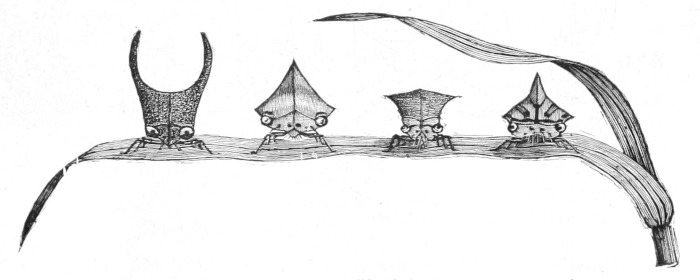
Insect brownies; tree-hoppers as seen through a lens.
The Structure of Insects
The insect body is made up of ring-like segments which are grown together. These segments are divided into groups according to their use and the organs which they bear. Thus the segments of an insect’s body are grouped into three regions, the head, the thorax and the abdomen. The head bears the eyes, the antennæ, and the mouth-parts. On each side of the head of the adult insect may be seen the compound eyes; these are so called, because they are made up of many small eyes set together, much like the cells of the honeycomb. These compound eyes are not found in larvæ. In addition to the compound eyes, many adult insects possess simple eyes; these are placed between the compound eyes and are usually three in number. Often they cannot be seen without the aid of a lens.
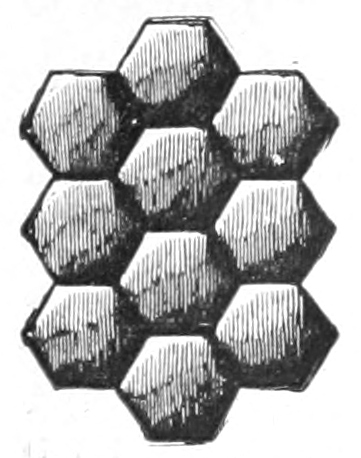
A part of the compound eye of an insect, enlarged.
The antennæ or feelers are composed of many segments and are inserted in front of the eyes or between them. They vary greatly in form. In some insects they are mere threads; in others, like the silk-worm moths, they are large, feather-like organs.
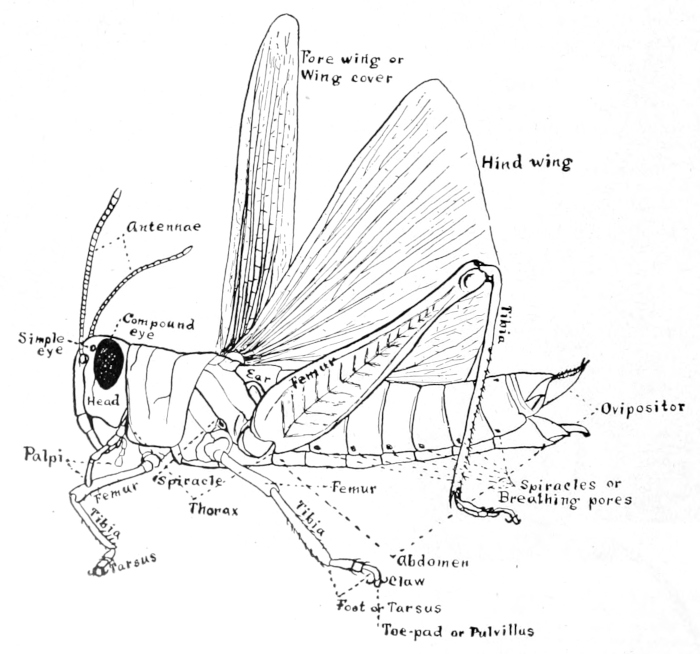
Grasshopper, with the parts of the external anatomy named.
The mouth-parts of insects vary greatly in structure and in form, being adapted to the life of the insect species to which they minister. Some insects have jaws fitted for seizing their prey, others for chewing leaves, others have a sucking tube for getting the juices from plants or the blood from animals, and others long delicate tubes for sipping the nectar from flowers.
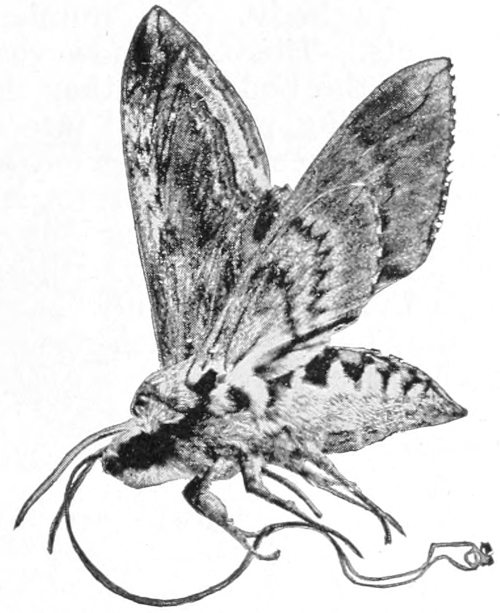
A sphinx moth with the sucking tongue unrolled.
Photo by M. V. Slingerland.
In the biting insects, the mouth-parts consist of an upper lip, the labrum, and under lip, the labium, and two pairs of jaws between them. The upper pair of jaws is called the mandibles and the lower pair, the maxillæ (sing. maxilla). There may be also within the mouth, one or two tongue-like organs. Upon the maxillæ and upon the lower lip there may also be feelers which are called palpi (sing. palpus). The jaws of insects, when working, do not move up and down, as do ours, but move sidewise like shears. In many of the insects, the children are able to observe the mandibles and the palpi without the aid of a lens.
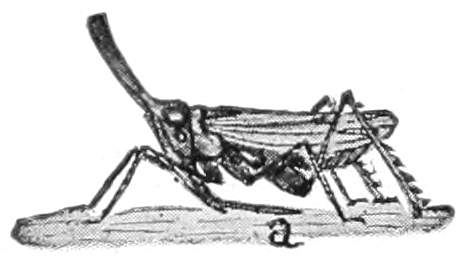
A tree-hopper, showing the mouth as a long, three-jointed sucking tube, at a.
The thorax is the middle region of the insect body. It is composed of three of the body segments more or less firmly joined together. The segment next the head is called the prothorax, the middle one, the mesothorax, and the hind one, the metathorax. Each of these segments bears a pair of legs and, in the winged insects, the second and third segments bear the wings. Each leg consists of two small segments next to the body, next to them a longer segment, called the femur, beyond this a segment called the tibia, and beyond this the tarsus or foot. The tarsus is made up of a number of segments, varying from one to six, the most common number being five. The last segment of the tarsus usually bears one or two claws.
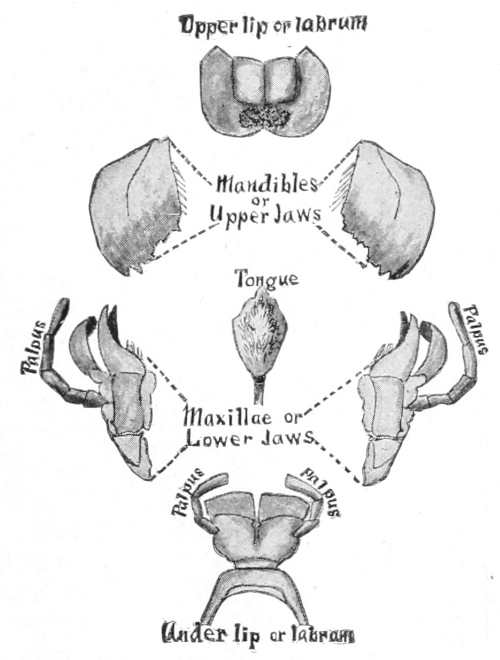
The mouth-parts of a grasshopper dissected off, enlarged and named.
While we have little to do with the internal anatomy of insects in elementary nature-study, the children should be taught something of the way that insects breathe. The child naturally believes that the insect, like himself, breathes through the mouth, while as a matter of fact, insects breathe through their sides. If we examine almost any insect carefully, we can find along the sides of the body a series of openings. These are called the spiracles, and through them the air passes into the insect’s body. The number of spiracles varies greatly in different insects. There is, however, never more than one pair on a single segment of the body, and they do not occur on the head. The spiracles, or breathing pores, lead into a system of air tubes which are called tracheæ (tra’-ke-ee), which permeate the insect’s body and thus carry the air to every smallest part of its anatomy. The blood of the insect bathes these thin-walled air tubes and thus becomes purified, just as our blood becomes purified by bathing the air tubes of our lungs. Thus, although the insects do not have localized breathing organs, like our lungs, they have, if the expression may be permitted, lungs in every part of their little bodies.
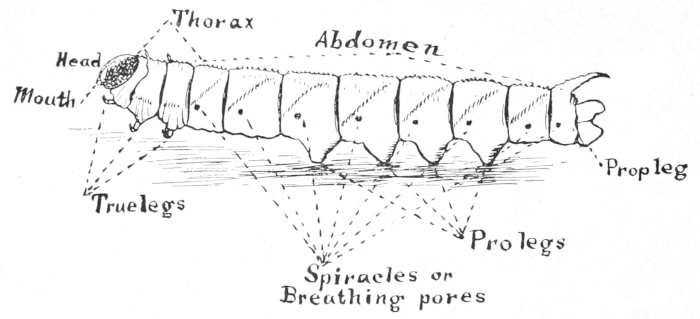
The sphinx caterpillar, with the parts of the external anatomy named.
Summary of Structure of an Insect
Head
Antennæ.
Compound eyes.
Simple eyes or ocelli.
Mouth-parts
Labrum, or upper lip.
Mandibles, or upper jaws.
Maxillæ, or lower jaws, and maxillary palpi.
Labium and labial palpi.
Thorax
Prothorax and first pair of legs.
Mesothora and
second pair of legs.
first pair of wings.
Metathorax and
third pair of legs.
second pair of wings.
Wing
veins.
cells.
Leg
Two small segments called coxa and trochanter.
Femur.
Tibia.
Tarsus and claws.
Abdomen
The abdomen bears
ears (in locusts only).
spiracles.
ovipositor.
References.—Manual for the Study of Insects and Insect Life, Comstock.
THE BLACK SWALLOW-TAIL BUTTERFLY
Teacher’s Story
HIS graceful butterfly is a very good friend to the flowers, being a most efficient pollen carrier. It haunts the gardens and sips nectar from all the blossom cups held out for its refreshment; and it is found throughout almost all parts of the United States. The grace of its appearance is much enhanced by the “swallow-tails,” two projections from the hind margins of the hind wings. The wings are velvety black with three rows of yellow spots across them, the outer row being little crescents set in the margin of the wing; and each triplet of yellow spots is in the same cell of the wing between the same two veins. The hind wings are more elaborate, for between the two inside rows of yellow spots, there are exquisite metallic blue splashes, more vivid and more sharply outlined toward the inside of the wing and shading off to black at the outside. And just above the inner angle of the hind wing is an orange eye-spot with a black center. On the lower surface of the wings, most of the yellow spots are replaced with orange.
The mother butterfly is larger than her mate and has more blue on her wings, while he has the yellow markings of the hind wings much more conspicuous. She lays her egg, just the color of a drop of honey, on the under surface of the leaf of the food plant. After about ten days there hatches from this egg a spiny little fellow, black and angular, with a saddle-shaped, whitish blotch in the middle of its back. But it would take an elfin rider to sit in this warty, spiny saddle. The caterpillar has six spines on each segment, making six rows of spines, the whole length of the body; the spines on the black portions are black and those on the saddle white, but they all have orange-colored bases.
When little, spiny saddle-back gets ready to change its skin to one more commodious for its increased size, it seeks some convenient spot on the leaf or stem and spins a little silken carpet from the silk gland opening in its under lip; on this carpet it rests quietly for some time, and then the old tight skin splits down the back, the head portion coming off separately. Swelling out to fill its new skin to the utmost, it leaves its cast-off clothes clinging to the silken carpet and marches back to its supper.
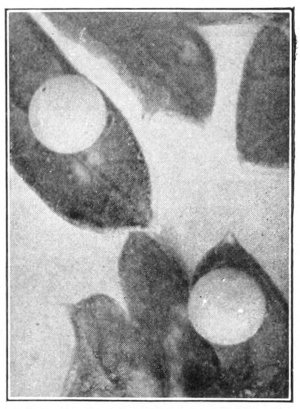
The eggs of the black swallow-tail butterfly, enlarged.
Photo-micrograph by M. V. Slingerland.
But after one of these changes of skin it becomes a very different looking caterpillar, for now it is as smooth as it was formerly spiny; it is now brilliant caraway green, ornamented with roundwise stripes of velvety black; and set in the front margin of each of these stripes are six yellow spots. In shape, the caterpillar is larger toward the head; its true feet have little, sharp claws and look very different from the four pairs of prolegs and the hind prop-leg, all of which enable him to hold fast to the stem or the leaf; these fat legs are green, each ornamented with a black, velvety polka-dot.
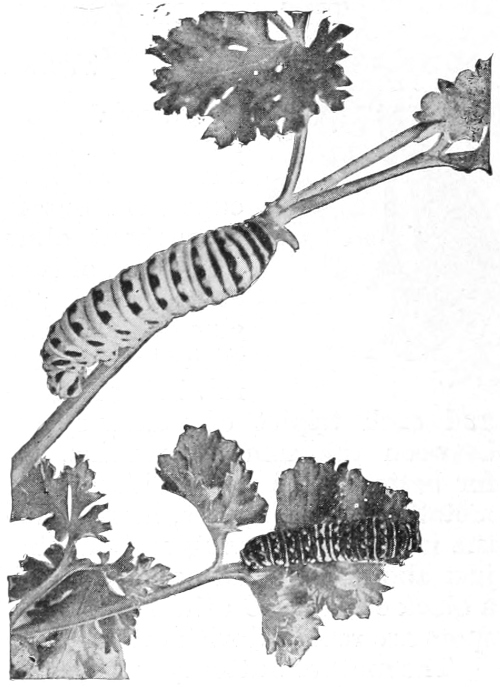
Black swallow-tail caterpillars, showing two stages of growth. The larger one has the scent organs protruded.
Photo by M. V. Slingerland.
When we were children we spent hours poking these interesting creatures with straws to see them push forth their brilliant orange horns. We knew this was an act of resentment, but we did not realize that from these horns was exhaled the nauseating odor of caraway which greeted our nostrils. We incidentally discovered that they did not waste this odor upon each other, for once we saw two of the full-grown caterpillars meet on a caraway stem. Neither seemed to know that the other was there until they touched; then both drew back the head and butted each other like billy-goats, Whack! whack! Then both turned laboriously around and hurried off in a panic.
The scent organs of these caterpillars are really little Y-shaped pockets in the segment back of the head, pockets full of this peculiar caterpillar perfume. Under the stimulus of attack, the pocket is turned wrong side out and pushed far out making the “horns,” and at the same time throwing the strong odor upon the air. This spoils the flavor of these caterpillars as bird food, so they live on in serene peace, never hiding under the leaves but trusting, like the skunk, to a peculiar power of repelling the enemy.
We must admire this caterpillar for the methodical way in which it eats the leaf: Beginning near the base, it does not burn its bridges behind it by eating through the midrib, but eats everything down to the midrib; after it arrives at the tip of the leaf it finishes midrib and all on its return journey, doing a clean job, and finishing everything as it moves along. (See Moths and Butterflies, Dickerson, p. 42.)
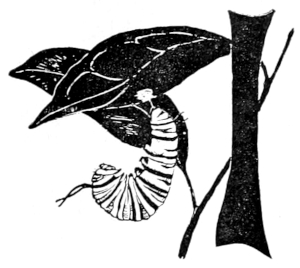
When the caterpillar has completed its growth, it is two inches long; it then seeks some sheltered spot, the lower edge of a clapboard or fence rail being a favorite place; it there spins a button of silk which it grasps firmly with its hind prop-leg, and then, with head up, or perhaps horizontal, it spins a strong loop or halter of silk, fastening each end of it firmly to the object on which it rests. It thrusts its head through, so that the halter acts as a sling holding the insect from falling. There it sheds its last caterpillar skin, which shrinks back around the button, revealing the chrysalis which is angular with ear-like projections in front. Then comes the critical moment, for the chrysalis lets go of the button with its caterpillar feet, and trusting to the sling for support, pushes off the shrunken skin just shed and inserts the hooks, with which it is furnished, firmly in the button of silk. Sometimes during this process, the chrysalis loses its hold entirely and falls to the ground, which is a fatal disaster. The chrysalis is yellowish brown and usually looks very much like the object to which it is attached, and is thus undoubtedly protected from sight of possible enemies. Then some day it breaks open, and from it issues a crumpled mass of very damp insect velvet, which soon expands into a beautiful butterfly.
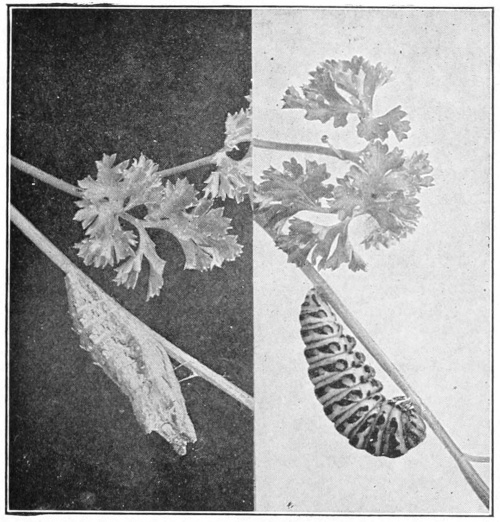
The chrysalis. The caterpillar of the black swallow-tail ready to change to a chrysalis.
Photo by M. V. Slingerland.
References.—Everyday Butterflies, Scudder; Moths and Butterflies, Dickerson; How to Know the Butterflies, Comstock; Moths and Butterflies, Ballard.
LESSON LXX
The Black Swallow-Tail Butterfly
Leading thought—The caterpillars of the swallow-tail butterflies have scent organs near the head which they thrust forth when attacked, thus giving off a disagreeable odor which is nauseating to birds.
Method—In September, bring into the schoolroom and place in the terrarium, or breeding cage, a caraway or parsley plant on which these caterpillars are feeding, giving them fresh food day by day, and allow the pupils to observe them at recess and thus complete the lesson.
The Caterpillar and Chrysalis.
Observations.—1. Touch the caterpillar on the head with a bit of grass. What does it do? What color are the horns? Where do they come from? Are there two separate horns or two branches of one horn? What odor comes from these horns? How does this protect the caterpillar? Does the caterpillar try to hide under the leaves when feeding? Is this evidence that it is not afraid of birds?
2. Describe the caterpillar as follows: What is its shape? Is it larger toward the head or the rear end? What is its ground color? How is it striped? How many black stripes? How many yellow spots in each black stripe? Are the yellow spots in the middle, or at each edge of the stripe?
3. How do the front three pairs of legs look? How do they compare with the prolegs? How many prop-legs are there? What is the color of the prolegs? How are they marked? Describe the prop-leg. What is its use?
4. Observe the caterpillar eating a leaf. How does it manage so as not to waste any?
5. Have you found the egg from which the caterpillar came? What color is it? Where is it laid?
6. How does the young caterpillar look? What are its colors? How many fleshy spines has it on each segment? Are these white on the white segments and black on the black segments? What is the color of the spines at their base?
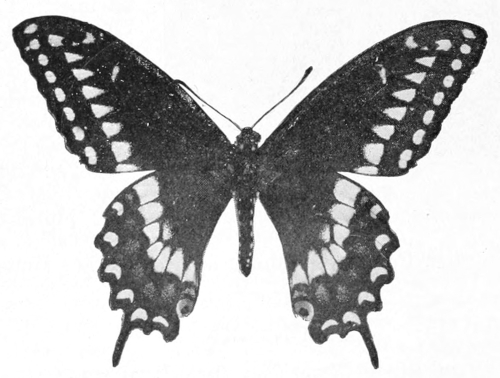
Black swallow-tail butterfly.
Photo by M. V. Slingerland.
7. Watch one of these caterpillars shed its skin. How does it prepare for this? How does it spin its carpet? Where does the silk come from? Describe how it acts when shedding its skin?
8. When a caterpillar is full grown, how does it hang itself up to change to a chrysalis? How does it make the silk button? How does it weave the loop or halter? How does it fasten it? When the halter is woven what does the caterpillar do with it? Describe how the last caterpillar skin is shed. How does the insect use its loop or halter while getting free from the molted skin?
9. Describe the chrysalis. What is its general shape? What is its color? Is it easily seen? Can you see where the wings are, within the chrysalis? How is the chrysalis supported?
10. How does the chrysalis look when the butterfly is about to emerge? Where does it break open? How does the butterfly look at first?
The Butterfly
1. Why is this butterfly called the black swallow-tail? What is the ground color of the wings? How many rows of yellow spots on the front wings? Are they all the same shape? How are they arranged between each two veins? Describe the hind wings. What colors are on them that are not on the front wings? Describe where this color is placed. Describe the eye-spot on the hind wing. Where is it? How do the markings on the lower side of the wing differ from those above? How does the ground color differ from the upper side?
2. What is the color of the body of the butterfly? Has it any marks? Has it the same number of legs as the Monarch? Describe its antennæ. Watch the butterfly getting nectar from the petunia blossom and describe the tongue. Where is the tongue when not in use?
3. How does the butterfly pass the winter? How does the mother butterfly differ in size and in markings from her mate?

“The ‘caraway worms’ were the ones that revealed to us the mystery of the pupa and butterfly. We saw one climb up the side of a house, and watched it as with many slow, graceful movements of the head, it wove for itself the loop of silk which we called the ‘swing’ and which held it in place after it changed to a chrysalis. We wondered why such a brilliant caterpillar should change to such a dull-colored object, almost the color of the clapboard against which it hung. Then, one day, we found a damp, crumpled, black butterfly hanging to the empty chrysalis skin, its wings ‘all mussed’ as we termed it; and we gazed at it pityingly; but even as we gazed, the crumpled wings expanded and then there came to our childish minds a dim realization of the miracle wrought within that little, dingy, empty shell.” —How to Know the Butterflies, Comstock.
The Monarch Butterfly
Teacher’s Story
T IS a great advantage to an insect to have the bird problem eliminated, and the monarch butterfly enjoys this advantage to the utmost. Its method of flight proclaims it, for it drifts about in a lazy, leisurely manner, its glowing red making it like a gleaming jewel in the air, a very different flight indeed from the zigzag dodging movements of other butterflies. The monarch has an interesting race history. It is a native of tropic America, and has probably learned through some race instinct, that by following its food plant north with the opening season, it gains immunity from special enemies other than birds, which attack it in some stage in its native haunts. Each mother butterfly follows the spring northward as it advances, as far as she finds the milkweed sprouted. There she deposits her eggs, from which hatch individuals which carry on the migration as far to the north as possible. It usually arrives in New York State early in July. As cold weather approaches, the monarchs often gather in large flocks and move back to the South. How they find their way we cannot understand, since there are among them none of the individuals which pressed northward early in the season.
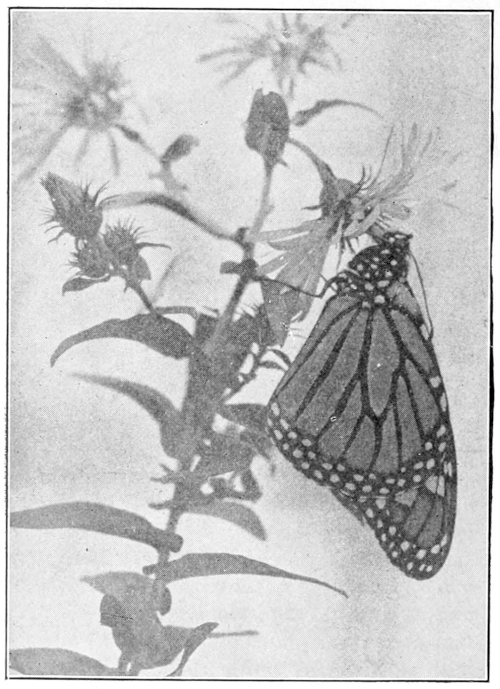
The monarch butterfly.
The very brilliant copper-red color of the upper sides of the wings of the monarch is made even more brilliant by the contrasting black markings which outline the veins and border the wings, and also cover the tips of the front wings with a triangular patch; this latter seems to be an especially planned background for showing off the pale orange and white dots set within it. There are white dots set, two pairs in two rows, between each two veins in the black margin of the wings; and the fringe at the edge of the wings shows corresponding white markings. The hind wings and the front portions of the front wings have, on their lower sides, a ground color of pale yellow, which makes the insect less conspicuous when it alights and folds its wings above its back, upper surfaces together. The black veins, on the lower surface of the hind wings, are outlined with white, and the white spots are much larger than on the upper surface. The body is black, ornamented with a few pairs of white spots above and with many large white dots below. The chief distinguishing characteristic of insects, is the presence of six legs; but in this butterfly, the front legs are so small that they scarcely look like legs.
It is easy to observe the long, coiled tongue of the butterfly. If the act is done gently, the tongue may be uncoiled by lifting it out with a pin. To see a butterfly feeding upon nectar, is a very interesting process and may be observed in the garden almost any day. I have also observed it indoors, by bringing in petunias and nasturtiums for my imprisoned butterflies, but they are not so likely to eat when in confinement. The antennæ are about two-thirds as long as the body and each ends in a long knob; this knob, in some form, is what distinguishes the antennæ of the butterflies from those of moths. The male monarch has a black spot upon one of the veins of the hind wing; this is a perfume pocket and is filled with what are called scent scales; these are scales of peculiar shape which cover the wing at this place and give forth an odor, which we with our coarse sense of smell cannot perceive; but the lady monarch is attracted by this odor. The male monarch may be described to the children, as a dandy carrying a perfume pocket to attract his sweetheart.
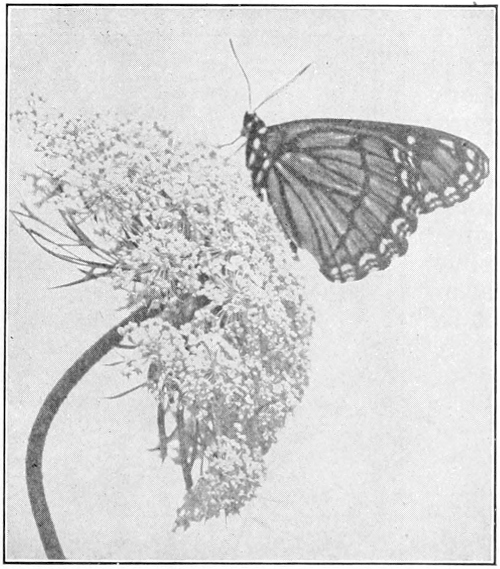
The viceroy butterfly.
Note the black band on the hind wings which distinguishes it from the monarch, which it imitates in color and markings.
It is very interesting to the pupils if they are able to see a bit of the butterfly’s wing through a three-fourths objective; the covering of scales, arranged in such perfect rows, is very beautiful and also very wonderful. The children know that they get dust upon their fingers from butterflies’ wings, and they should know that each grain of this dust is an exquisite scale with notched edges and a ribbed surface.
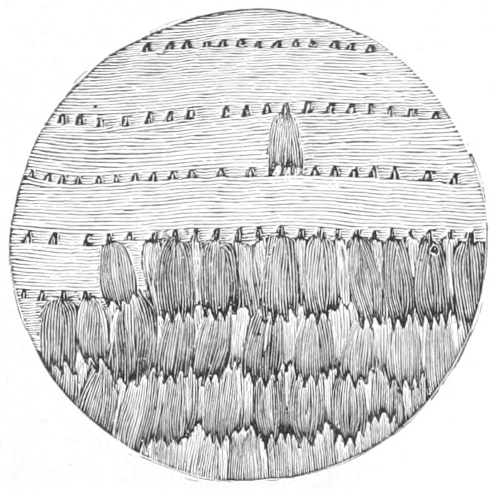
The scales on a butterfly’s wing, as seen through a microscope.
The monarch is, for some reason unknown to us, distasteful to birds, and its brilliant colors are an advertisement to all birds of discretion, that here is an insect which tastes most disagreeably and that, therefore, should be left severely alone. There is another butterfly called the viceroy, which has taken advantage of this immunity from bird attack on the part of the monarch and has imitated its colors in a truly remarkable way, differing from it only in being smaller in size and having a black band across the middle of the hind wing. (See The Ways of the Six Footed, “A Sheep in Wolf’s Clothing”).
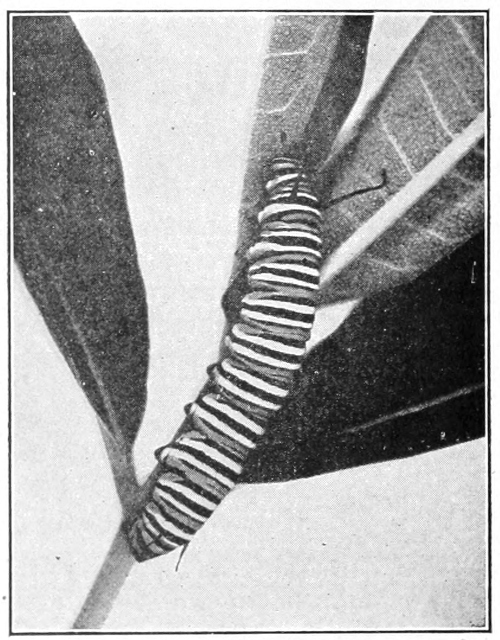
The monarch caterpillar.
Photo by M. V. Slingerland.
The milkweed caterpillar, which is the young of the monarch butterfly, is a striking object, and when fully grown is about two inches long. The milkweed is a succulent food and the caterpillar may mature in eleven days; it is a gay creature, with ground color of green and cross stripes of yellow and black. On top of the second segment, back of the head, are two long, slender whiplash-like organs, and on the seventh segment of the abdomen is a similar pair. When the caterpillar is frightened, the whiplashes at the front of the body twitch excitedly; when it walks, they move back and forth. Those at the rear of the body are more quiet and not so expressive of caterpillar emotions. These filaments are undoubtedly of use in frightening away the little parasitic flies, that lay their eggs upon the backs of caterpillars; these eggs hatch into little grubs that feed upon the internal fatty portions of the caterpillar and bring about its death through weakness. I remember well when I was a child, the creepy feeling with which I beheld these black and yellow-ringed caterpillars waving and lashing their whips back and forth after I had disturbed them; if the ichneumon flies were as frightened as I, the caterpillars were surely safe.
The caterpillar will feed upon no plant except milkweed; it feeds both day and night, with intervals of rest, and when resting, hides beneath the leaf. Its striking colors undoubtedly defend it from birds, because it is as distasteful to them as is the butterfly. However, when frightened, these caterpillars fall to the ground where their stripes make them very inconspicuous among the grass and thus perhaps save them from the attack of animals less fastidious than birds. These caterpillars, like all others, grow by shedding the skeleton skin as often as it becomes too tight.
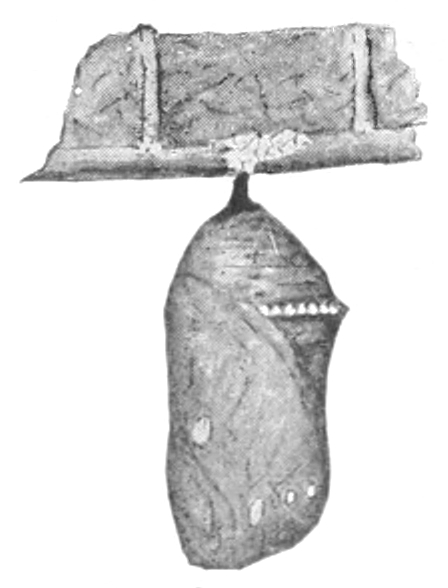
Monarch chrysalis.
A jewel of living jade and gold.
The monarch chrysalis is, I maintain, the most beautiful gem in Nature’s jewel casket; it is an oblong jewel of jade, darker at the upper end and shading to the most exquisite whitish green below; outlining this lower paler portion are shining flecks of gold. If we look at these gold flecks with a lens, we cannot but believe that they are bits of polished gold-foil. There may be other gold dots also, and outlining the apex of the jewel, is a band of gold with a dotted lower edge of jet; and the knob at the top, to which the silk which suspends the chrysalis is fastened, is also jet. The chrysalis changes to a darker blue-green after two days, and black dots appear in the gold garniture. As this chrysalis is usually hung to the under side of a fence rail or overhanging rock, or to a leaf, it is usually surrounded by green vegetation, so that its green color protects it from prying eyes. Yet it is hardly from birds that it hides; perhaps its little gilt buttons are a hint to birds that this jewel is not palatable. As it nears the time for the butterfly to emerge, the chrysalis changes to a duller and darker hue. The butterfly emerges about twelve days after the change to a chrysalis.
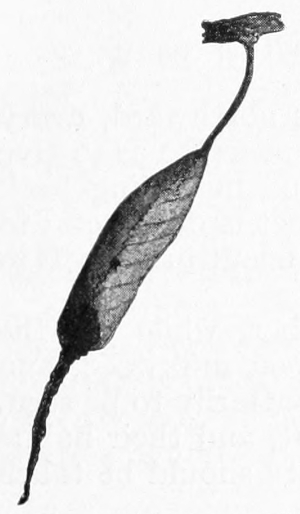
The winter home of the viceroy caterpillar.
References—Every Day Butterflies, Scudder; How to Know the Butterflies, Comstock; Moths and Butterflies, Dickerson; Ways of the Six Footed, Comstock; Moths and Butterflies, Ballard.
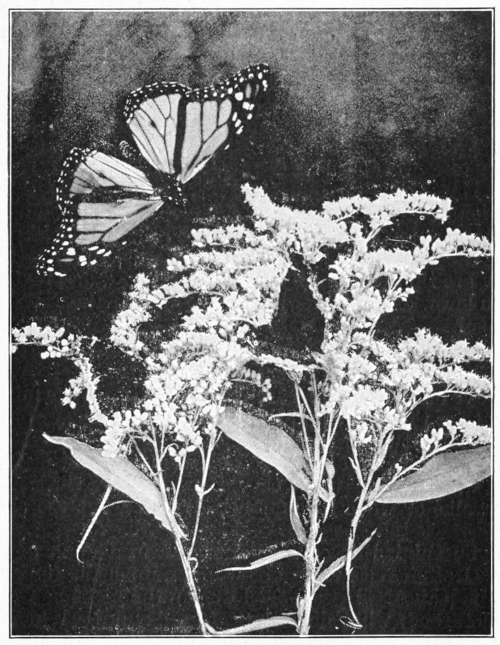
The male monarch butterfly, showing the scent pockets on the hind wings.
Photo by M. V. Slingerland.
LESSON LXXI
The Monarch Butterfly
Leading thought—The monarch butterfly migrates northward, every spring and summer, moving up as fast as milkweed appears, so as to give food to its caterpillar; and it has often been noticed migrating back southward in the autumn in large swarms. This insect is distasteful to birds in all its stages. Its chrysalis is one of the most beautiful objects in all nature.
Method—This lesson should be given in September, while yet the caterpillars of the monarch may be found feeding upon milkweed, and while there are yet many specimens of this gorgeous butterfly to be seen. The caterpillars may be brought in, on the food plant, and their habits and performances studied in the schoolroom; but care should be taken not to have the atmosphere too dry.
The Butterfly
Observations—1. How can you tell the monarch butterfly from all others? What part of the wings is red? What portions are black? What portions are white? What are the colors and markings on the lower side of the wings? What is the color of the body and how is it ornamented?
2. Is the flight of the monarch rapid or slow and leisurely? Is it a very showy insect when flying? Are its colors more brilliant in the sunshine when it is flying than at any other time? Why is it not afraid of birds?
3. When the butterfly alights, how does it hold its wings? Do you think it is as conspicuous when its wings are folded as when they are open?
4. Can you see the butterfly’s tongue? Describe the antennæ. How do they differ from the antennæ of moths? How many legs has this butterfly? How does this differ from other insects? Note if you can see any indications of front legs.
5. Is there on the butterfly you are studying, a black spot near one of the veins on each hind wing? Do you know what this is? What is it for?
6. Why are the striking colors of this butterfly a great advantage to it? Do you know of any other butterfly which imitates it and thus gains an advantage?
The Monarch Caterpillar
1. Where did you find the Monarch caterpillar? Was it feeding below or above on the leaves? Describe how it eats the milkweed leaf.
2. What are the colors and the markings of the caterpillar? Do you think these make it conspicuous?
3. How many whiplash shaped filaments do you find on the caterpillar? On which segments are they situated? Do these move when the caterpillar walks or when it is disturbed? Of what use are they to the caterpillar?
4. Do you think this caterpillar would feed upon anything except milkweed? Does it rest, when not feeding, upon the upper or the lower surface of the leaves? Does it feed during the night as well as the day?
5. If disturbed, what does the caterpillar do? When it falls down among the grass how do its cross stripes protect it from observation?
6. Tell all the interesting things which you have seen this caterpillar do.
The Chrysalis
1. When the caterpillar gets ready to change to a chrysalis what does it do? How does it hang up? Describe how it sheds its skin.
2. Describe the chrysalis. What is its color? How and where is it ornamented? Can you see, in the chrysalis, those parts which cover the wings of the future butterfly?
3. To what is the chrysalis attached? Is it in a position where it does not attract attention? How is it attached to the object?
4. After three or four days, how does the chrysalis change in color? Observe, if you can, the butterfly come out from the chrysalis, noting the following points: Where does the chrysalis skin open? How does the butterfly look when it first comes out? How does it act for the first two or three hours? How does the empty chrysalis skin look?
A BUTTERFLY AT SEA Far out at sea—the sun was high, While veered the wind and flapped the sail; We saw a snow-white butterfly Dancing before the fitful gale Far out at sea. The little wanderer, who had lost His way, of danger nothing knew; Settled a while upon the mast; Then fluttered o’er the waters blue Far out at sea. Above, there gleamed the boundless sky; Beneath, the boundless ocean sheen; Between them danced the butterfly, The spirit-life of this fair scene, Far out at sea. The tiny soul that soared away, Seeking the clouds on fragile wings, Lured by the brighter, purer ray Which hope’s ecstatic morning brings— Far out at sea. Away he sped, with shimmering glee, Scarce seen, now lost, yet onward borne! Night comes with wind and rain, and he No more will dance before the morn, Far out at sea. He dies, unlike his mates, I ween, Perhaps not sooner or worse crossed; And he hath felt and known and seen A larger life and hope, though lost Far out at sea. —R. H. Horne.
THE ISABELLA TIGER MOTH OR WOOLLY BEAR
Teacher’s Story
“Brown and furry, Caterpillar in a hurry, Take your walk To the shady leaf or stalk, Or what not, Which may be the chosen spot, No toad spy you, Hovering bird of prey pass by you; Spin and die, To live again a butterfly.” —Christina Rosetti.
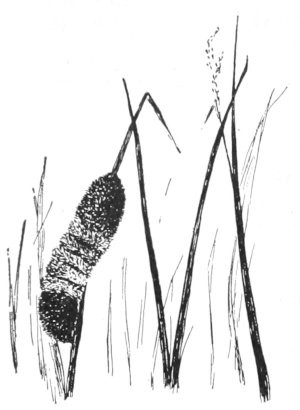
ANY times during autumn, the children find and bring in the very noticeable caterpillar which they call the “woolly bear.” It seems to them a companion of the road and the sunshine; it usually seems in a hurry, and if the children know that it is thus hastening to secure some safe place in which to hide during the season of cold and snow, they are far more interested in its future fate. If the caterpillar is already curled up for the winter, it will “come to” if warmed in the hand or in the sunshine.
The woolly bear is variable in appearance; sometimes there are five of the front segments black, four of the middle reddish brown, and three of the hind segments black. In others there are only four front segments black, six reddish ones, and two that are black at the end of the body; there are still other variations, so that each individual will tell its own story of color. There are really thirteen segments in this caterpillar, not counting the head; but the last two are so joined that probably the children will only count twelve. There are a regular number of tubercles on each side of each segment, and from each of these arises a little rosette of hairs; but the tubercles are packed so closely together, that it is difficult for the children to see how many rosettes there are on each side. While the body of the caterpillar looks as if it were covered with evenly clipped fur, there are usually a few longer hairs on the rear segment.
There is a pair of true legs on each of the three front segments which form the thorax, and there are four pairs of prolegs. All of the segments behind the front three, belong to the abdomen, and the prolegs are on the 3d, 4th, 5th and 6th abdominal segments; the prop-leg is at the rear end of the body. The true legs of this caterpillar have little claws, and are as shining as if encased in patent leather; but the prolegs and prop-leg are merely prolongations of the sides of the body to assist the insect in holding to the leaf. The yellow spot on either side of the first segment is a spiracle; this is an opening leading into the air tubes within the body, around which the blood flows and is thus purified. There are no spiracles on the second and third segments of the thorax, but eight of the abdominal segments have a spiracle on either side.
The woolly bear’s head is polished black; its antennæ are two tiny, yellow projections which can easily be seen with the naked eye. The eyes are too small to be thus seen; because of its minute eyes, the woolly bear cannot see very far and, therefore, it is obliged to feel its way. It does this by stretching out the front end of the body and reaching in every direction, to observe if there is anything to cling to in its neighborhood. When we try to seize the woolly bear, it rolls up in a little ball, and the hairs are so elastic that we take it up with great difficulty. These hairs are a protection from the attacks of birds which do not like bristles for food; and when the caterpillar is safely rolled up, the bird sees only a little bundle of bristles and lets it alone. The woolly bear feeds upon many plants, grass, clover, dandelion and others. It does not eat very much after we find it in autumn, because its growth is completed. The woolly bear should be kept in a box which should be placed out of doors, so that it may be protected from storms but have the ordinary winter temperature. Keeping it in a warm room during the winter often proves fatal.
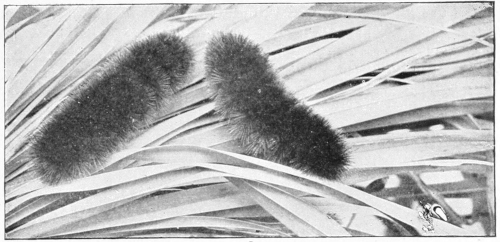
Woolly bears.
Photo by M. V. Slingerland.
Normally, the woolly bear does not make its cocoon until April or May. It finds some secluded spot in the fall, and there curls up in safety for the long winter nap; when the warm weather comes in the spring, it makes its cocoon by spinning silk about itself; in this silk are woven the hairs which it sheds easily at that time, and the whole cocoon seems made of felt. It seems amazing that such a large caterpillar can spin about itself and squeeze itself into such a small cocoon; and it is quite as amazing to see the smooth little pupa within the cocoon, in which is condensed all that was essential of the caterpillar. Sometimes when the caterpillars are kept in a warm room, they make their cocoons in the fall, but this is not natural.
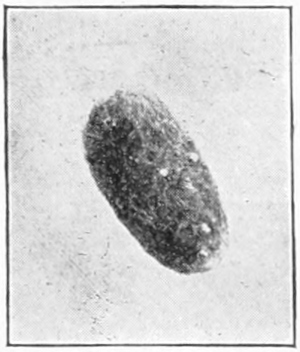
The cocoon of the woolly bear.
Photo by M. V. Slingerland.
The issuing of the moth from the cocoon is an interesting lesson for the last of May. The size of the moth which comes from the cocoon is quite comparable as a miracle with the size of the caterpillar that went into it. The moth is in color dull, grayish, tawny yellow with a few black dots on the wings; sometimes the hind wings are tinted with dull orange-red. On the middle of the back of the moth’s body there is a row of six black dots; and on each side of the body is a similar row. The legs are reddish above and tipped with black. The antennæ are small and inconspicuous. The moths are night fliers, and the mother moth seeks some plant on which to lay her eggs, that will be suitable food for the little caterpillar as soon as it is hatched.
References—Moths and Butterflies, Ballard.
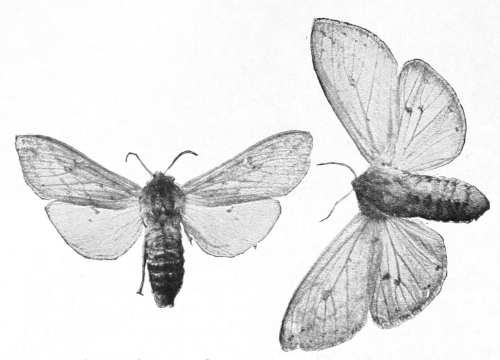
The Isabella tiger-moths, the adults of the woolly bear. The larger is the female.
Photo by M. V. Slingerland.
LESSON LXXII
The Isabella Tiger-Moth, or Woolly Bear
Leading thought—When we see the woolly bear hurrying along in the fall, it is hunting for some cozy place in which to pass the winter. It makes its cocoon of silk woven with its own hair. In May, it comes forth a yellowish moth with black dots on its wings.
Method—Have the children bring in woolly bears as they find them, place them in boxes or breeding jars which have grass or clover growing in them. The children can handle the caterpillars while they are studying them, and then they should be put back into the breeding jars and be set out of doors where they can have natural conditions; thus the entire history may be studied.
The Caterpillar
Observations—1. How can you tell the woolly bear from all other caterpillars? Are they all colored alike? How many segments of the body are black at the front end? How many are red? How many segments are black at the rear end of the body? How many segments does this make in all?
2. Look closely at the hairs of the woolly bear. Are they set separately or in rosettes? Are any of the hairs of the body longer than others or are they all even?
3. Can you see, just back of the head, the true legs with their little sharp claws? How many are there?
4. Can you see the fleshy legs along the sides of the body? How many are there of these?
5. Can you see the prop-leg, or the hindmost leg of all? Of what use to the caterpillar are these fleshy legs?
6. Describe the woolly bear’s head. How does it act when eating?
7. Can you see a small, bright yellow spot on each side of the segment just behind the head? What do you suppose this is? Can you see little openings along each side of all the segments of the body, except the second and third? What are they? Describe how the woolly bear breathes.
8. On what does the woolly bear feed? If you can find a little woolly bear, give it fresh grass to eat and see how it grows. Why does it shed its skin?
9. When the woolly bear is hurrying along, does it lift its head and the front end of its body now and then? Why does it do this? Do you think it can see far?
10. What does the woolly bear do when you try to pick it up? Do you find you can pick it up easily? Do you think that these stiff hairs protect woolly bear from its enemies? What are its enemies?
11. Where should the woolly bear be kept in winter to make it comfortable?
The Cocoon
1. When does the woolly bear make its cocoon?
2. Of what material is it made? How does the woolly bear get into its cocoon?
3. What happens to it inside the cocoon?
4. Cut open a cocoon and describe how woolly bear looks now.
The Moth
1. Where did the moth come from?
2. How did it come out of the cocoon? See if you can find the empty pupa case in the cocoon.
3. What is the color of the moth and how is it marked? Are the front and hind wings the same color?
4. What are the markings and colors of the body? Of the legs?
5. What do you think that the Mother Isabella will do, if you give her liberty?
The mute insect, fix’t upon the plant On whose soft leaves it hangs, and from whose cup Drains imperceptibly its nourishment, Endear’d my wanderings. —Wordsworth.
Before your sight, Mounts on the breeze the butterfly, and soars, Small creature as she is, from earth’s bright flowers Into the dewy clouds. —Wordsworth.
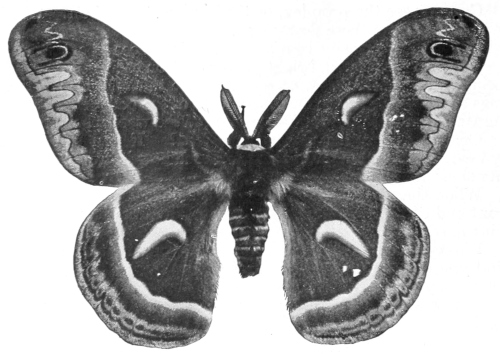
The cecropia moth.
Photo by M. V. Slingerland.
THE CECROPIA
Teacher’s Story
HE silk-worm which gives us the silk of commerce, has been domesticated for centuries in China. Because of this domestication, it is willing to be handled and is reared successfully in captivity, and has thus come to be the source of most of our silken fabrics. However, we have in America native silk-worms which produce a silk that is stronger and makes a more lustrous cloth than does that made from the Chinese species. But we have never had the time and the patience, here in America, to domesticate these giant silk-worms of ours, and so they are, as yet, of no commercial importance.
The names of our common native silk-worms are: The cecropia, promethea, polyphemus, and luna. In all of these species the moths are large and beautiful, attracting the attention of everyone who sees them. The caterpillars are rarely found, since their varied green colors render them inconspicuous among leaves on which they feed. None of the caterpillars of the giant silk-worms occur in sufficient numbers to injure the foliage of our trees to any extent; they simply help nature to do a little needful pruning. All of the moths are night flyers and are, therefore, seldom seen except by those who are interested in the visitors to our street lights.
The cecropia is the largest of our giant silk-worms, the wings of the moth expanding sometimes six and one-half inches. It occurs from the Atlantic Coast to the Rocky Mountains.
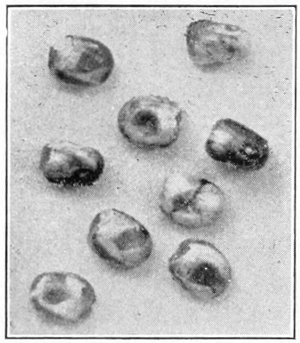
The eggs of the cecropia moth.
Photo by M. V. Slingerland.
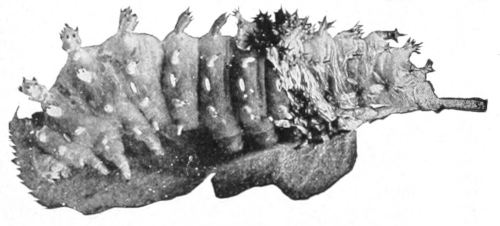
The cecropia caterpillar molting.
Photo by M. V. Slingerland.
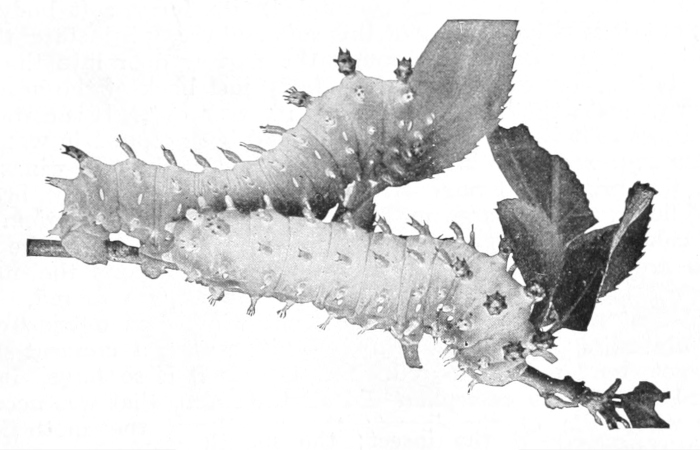
Full-grown cecropia caterpillars.
Photo by M. V. Slingerland.
The cecropia cocoon is found most abundantly on our orchard and shade trees; it is called by the children the “cradle cocoon,” since it is shaped like a hammock and hung close below a branch, and it is a very safe shelter for the helpless creature within it. It is made of two walls of silk, the outer one being thick and paperlike and the inner one thin and firm; between these walls is a matting of loose silk, showing that the insect knows how to make a home that will protect it from winter weather. It is a clever builder in another respect, since at one end of the cocoon it spins the silk lengthwise instead of crosswise, thus making a valve through which the moth can push, when it issues in the spring. It is very interesting to watch one of these caterpillars spin its cocoon. It first makes a framework by stretching a few strands of silk, which it spins from a gland opening in the lower lip; it then makes a loose net-work upon the supporting strands, and then begins laying on the silk by moving its head back and forth, leaving the sticky thread in the shape of connecting M’s or of figure 8’s. Very industriously does it work, and after a short time it is so screened by the silk, that the rest of its performance remains to us a mystery. It is especially mysterious, since the inner wall of the cocoon encloses so small a cell that the caterpillar is obliged to compress itself in order to fit within it. This achievement would be something like that of a man who should build around himself a box only a few inches longer, wider and thicker than himself. After the cocoon is entirely finished, the caterpillar sheds its skin for the last time and changes into a pupa.
Very different, indeed, does the pupa look from the brilliant colored, warty caterpillar. It is compact, brown, oval and smooth, with ability to move but very little when disturbed. The cases which contain the wings, which are later to be the objects of our admiration, are now folded down like a tight cape around the body; and the antennæ, like great feathers, are outlined just in front of the wing cases. There is nothing more wonderful in all nature than the changes which are worked within one of these little, brown pupa cases; for within it, processes go on which change the creature from a crawler among the leaves to a winged inhabitant of the air. When we see how helpless this pupa is, we can understand better how much the strong silken cocoon is needed for protection from enemies, as well as from inclement weather.
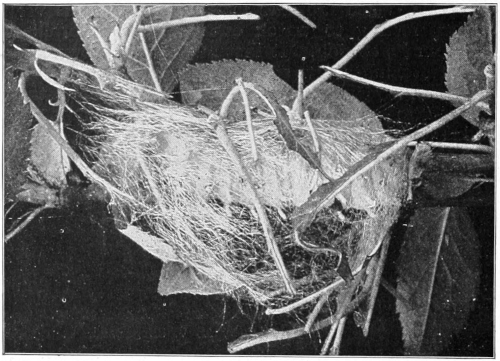
Cecropia caterpillar weaving its cocoon.
Photo by M. V. Slingerland.
In spring, usually in May, after the leaves are well out on the trees, the pupa skin is shed in its turn, and out of it comes the wet and wrinkled moth, its wings all crumpled, its furry, soft body very untidy; but it is only because of this soft and crumpled state that it is able to push its way out through the narrow door into the outer world. It has, on each side of its body just back of the head, two little horny hooks that help it to work its way out. It is certainly a sorry object as it issues, looking as if it had been dipped in water and had been squeezed in an inconsiderate hand. But the wet wings soon spread, the bright antennæ stretch out, the furry body becomes dry and fluffy, and the large moth appears in all its perfection. The ground color of the wings is a dusky, grayish brown while the outer margins are clay colored; the wings are crossed, beyond the middle, by a white band which has a broad outside margin of red. There is a red spot near the apex of the front wing, just outside of the zigzag white line; each wing bears, near its center, a crescent-shaped white spot bordered with red. But though it is so large, it does not need to eat; the caterpillar did all the eating that was necessary for the whole life of the insect; the mouth of the moth is not sufficiently perfected to take food.
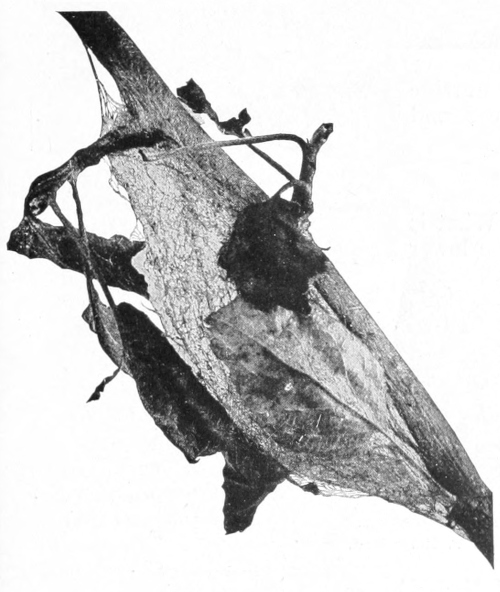
A cecropia cocoon.
Photo by M. V. Slingerland.
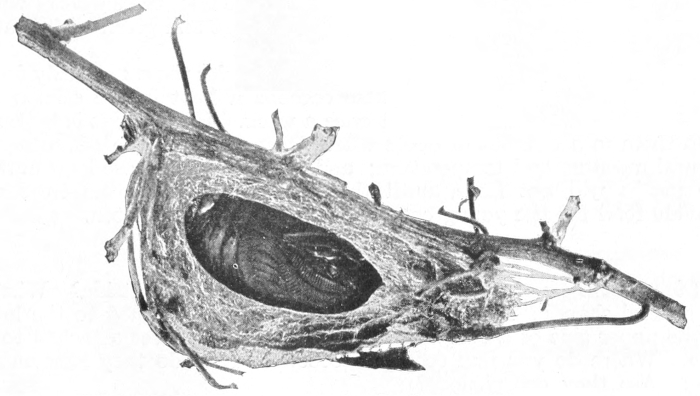
The cecropia cocoon cut open, showing the pupa within it.
Photo by M. V. Slingerland.
When the cecropia caterpillar hatches from the egg, it is about a quarter of an inch long and is black; each segment is ornamented with six spiny tubercles. Like all other caterpillars, it has to grow by shedding its horny, skeleton skin, the soft skin beneath stretching to give more room at first, then finally hardening and being shed in its turn. This first molt of the cecropia caterpillar occurs about four days after it is hatched, and the caterpillar which issues looks quite different than it did before; it is now dull orange or yellow with black tubercles. After six or seven days more of feeding, the skin is again shed and now the caterpillar appears with a yellow body; the two tubercles on the top of each segment are now larger and more noticeable. They are blue on the first segment, large and orange-red on the second and third segments, and greenish blue with blackish spots and spines on all the other segments except the eleventh, which has on top, instead of a pair of tubercles, one large, yellow tubercle, ringed with black. The tubercles along the side of the insect are blue during this stage. The next molt occurs five or six days later; this time the caterpillar is bluish green in color, the large tubercles on the second and third segments being deep orange, those on the upper part of the other segments yellow, except those on the first and last segments, which are blue. All the other tubercles along the sides are blue. After the fourth molt it appears as an enormous caterpillar, often attaining the length of three inches, and is as large through as a man’s thumb; its colors are the same as in the preceding stage. There is some variation in the colors of the tubercles on the caterpillars during these different molts; in the third stage, it has been observed that the tubercles usually blue are sometimes black. After the last molt the caterpillar eats voraciously for perhaps two weeks or longer and then begins to spin its cocoon.
References—Moths and Butterflies, Ballard; Moths and Butterflies, Dickerson; Caterpillars and their Moths, Elliot and Soule.
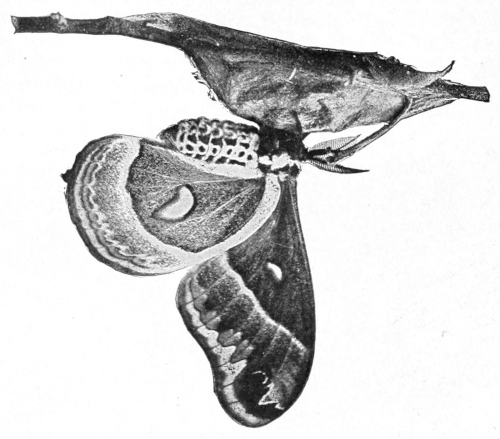
Just out of the cocoon.
Photo by M. V. Slingerland.
LESSON LXXIII
The Cecropia
Leading thought—The cecropia moth passes the winter as a pupa in a cocoon which the caterpillar builds out of silk for the purpose. In the spring the moth issues and lays her eggs on some tree, the leaves of which the caterpillar relishes. The caterpillars are large and green with beautiful blue and orange tubercles.
Method—It is best to begin with the cocoons, for these are easily found after the leaves have fallen. These cocoons if kept in the schoolroom should be thoroughly wet at least once a week. However, it is better to keep them in a box out of doors where they can have the advantage of natural moisture and temperature; and from those that are kept outside the moths will not issue, until the leaves open upon the trees and provide food for the young caterpillars when the eggs hatch.
The Cocoon
Observations—1. How does the cocoon look on the outside? What is its general shape? To what is it fastened? Is it fastened to the lower or the upper side of a twig? Are there any dried leaves attached to it?
2. Where do you find cecropia cocoons? How do they look on the tree? Are they conspicuous?
3. Cut open the cocoon, being careful not to hurt the inmate. Can you see that it has an outer wall which is firm? What lies next to this? Describe the wall next to the pupa. How does this structure protect the pupa from changes of temperature and dampness?
4. Is the outside covering easy to tear? What birds are strong enough to tear this cocoon apart?
5. Are both ends of the cocoon alike? Do you find one end where the silk is not woven across but is placed lengthwise? Why is this so? Do you think that the moth can push out at this end better than at the other? Do you think the caterpillar, when it wove the cocoon, made it this way so that the moth could get out easily?
The Pupa
1. Take a pupa out of a cocoon carefully and place it on cotton in a wide-mouthed fruit jar where it may be observed. Can the pupa move at all? Is it unable to defend itself? Why does it not need to defend itself?
2. Can you see in the pupa the parts that will be the antennæ and the mouth?
3. Describe how the wing coverings look. Count the rings in the abdomen.
4. Why does the pupa need to be protected by a cocoon?
The Moth
1. What is the first sign which you discover that the moth is coming out of the cocoon? Can you hear the little scratching noise? What do you suppose makes it? How does the moth look when it first comes out? If it were not all soft and wet how could it come out from so small an opening?
2. Describe how the crumpled wings spread out and dry. How does the covering of the wings change in looks?
3. Make a water-color drawing or describe in detail the fully expanded moth, showing the color and markings of wings, body and antennæ.
4. Do the moths eat anything? Why do they not need to eat?
5. If one of the moths lays eggs, describe the eggs, noting color, size and the way they are placed.
The Caterpillar
1. On what do you find the cecropia caterpillar feeding? Describe its actions while feeding.
2. What is the color of the caterpillar? Describe how it is ornamented.
3. Can you see the breathing pores, or spiracles, along the sides of the body? How many of these on each segment? How do they help the caterpillar to breathe?
4. Describe the three pairs of true legs on the three segments just back of the head. Do these differ in form from the prolegs along the sides of the body? What is the special use of the prolegs? Describe the prop-leg which is the hindmost leg of all.
5. Do you know how many times the cecropia caterpillar sheds its skin while it is growing? Is it always the same color?
6. Watch the caterpillar spin its cocoon, describe how it begins and how it acts as long as you can see it. Where does the silk come from?
THE PROMETHEA
Teacher’s Story
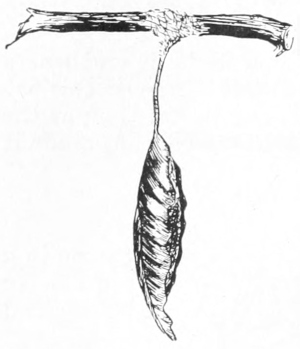
HE promethea is not so large as the cecropia, although the female resembles the latter somewhat. It is the most common of all our giant silk-worms. Its caterpillars feed upon wild cherry, lilac, ash, sassafras, buttonwood and many other forest trees.
During the winter, leaves may often be seen hanging straight down from the branches of wild cherry, lilac and ash. If these leaves are examined, they will be found to be wrapped around a silken case containing the pupa of the promethea. It is certainly a canny insect which hides itself during the winter in so good a disguise, that only the very wisest of birds ever suspect its presence. When the promethea caterpillar begins to spin, it selects a leaf and covers the upper side with silk, then it covers the petiole with silk, fastening it with a strong band to the twig, so that not even most violent winter winds will be able to tear it off. Then it draws the two edges of the leaf about itself like a cloak as far as it will reach, and inside this folded leaf it makes its cocoon, which always has an opening in the shape of a conical valve at the upper end, through which the moth may emerge in the spring. This caterpillar knows more botany than some people do, for it makes no mistake in distinguishing a compound leaf from a simple one. When it uses a leaflet of hickory for its cocoon, it fastens the leaflet to the mid stem of the leaf and then fastens the stem to the twig. The male pupa is much more slender than that of the female. The moths do not issue until May or June.
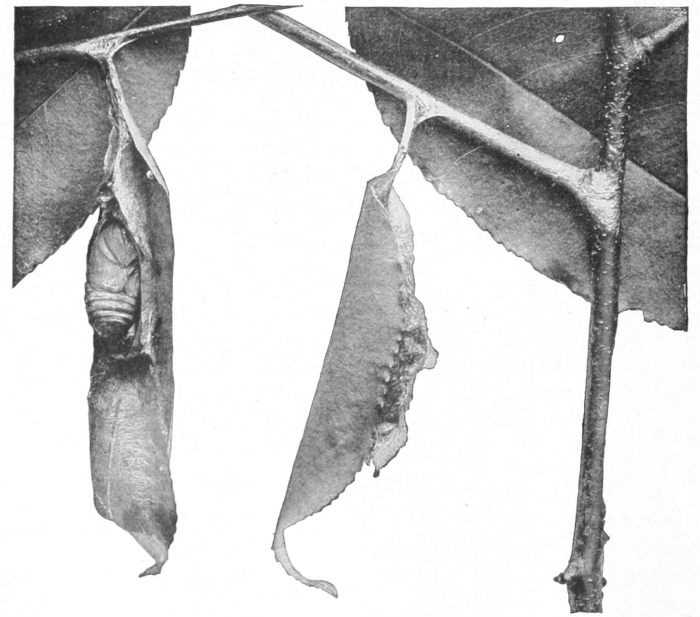
Promethea cocoons.
Note how the leaves are fastened by silk to the twigs.
Photo by M. V. Slingerland.
The moth works its way out through the valve at the top of the cocoon. The female is a large, reddish brown moth with markings resembling somewhat those of the cecropia. The male is very different in appearance; its front wings have very graceful, prolonged tips, and both wings are almost black, bordered with ash color. The promethea moths differ somewhat in habit from the other silk-worms, in that they fly during the late afternoon as well as at night. The eggs are whitish with brown stain, and are laid in rows, a good many on the same leaf.
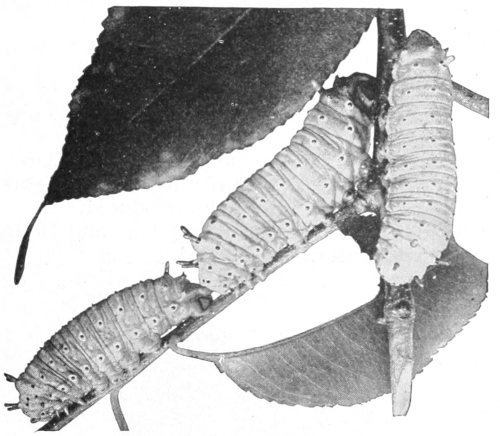
Promethea caterpillars.
Photo by M. V. Slingerland.
The caterpillars, as they hatch from the eggs, have bodies ringed with black and yellow. They are sociable little fellows and live together side by side amicably, not exactly “toeing the mark” like a spelling class, but all heads in a row at the edge of the leaf where each is eating as fast as possible. When they are small, the caterpillars remain on the under side of the leaves out of sight. In about five days, the first skin is shed and the color of the caterpillar remains about the same. Four or five days later, the second molt occurs, and then the caterpillar appears in a beautiful bluish green costume, with black tubercles, except four large ones on the second and third segments, and one large one on the eleventh segment, which are yellow. This caterpillar has an interesting habit of weaving a carpet of silk on which to change its skin; it seems to be better able to hold on while pushing off the old skin, if it has the silken rug to cling to. After the third molt, the color is a deeper greenish blue and the black tubercles are smaller, and the five big ones are larger and bright orange in color. After the fourth molt, which occurs after a period of about five or six days, the caterpillar appears in its last stage. It is now over two inches long, quite smooth and most prosperous looking. Its color is a beautiful, light, greenish blue, and its head is yellow. It has six rows of short, round, black tubercles. The four large tubercles at the front end of the body are red, and the large tubercle on the rear end of the body is yellow.
The cynthia is a beautiful moth which has come to us from Asia; it is very large with a ground color of olive-green, with lavender tints and white markings; there are white tufts of hairs on the abdomen. It builds its cocoon like the promethea, fastening the petiole to the twig, therefore the lesson indicated for the promethea will serve as well for the cynthia. The cynthia caterpillars live upon the ailanthus tree and are found only in the regions where this tree has been introduced.
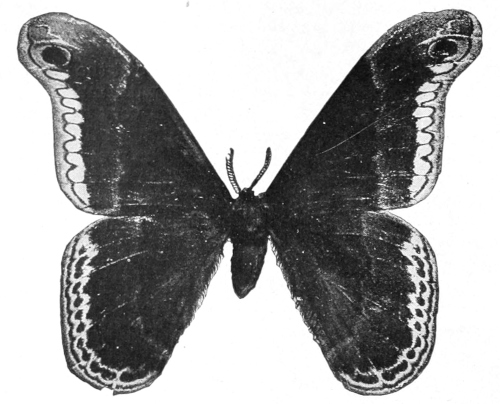
The male promethea.
Photo by M. V. Slingerland.
References—Moths and Butterflies, Dickerson; Caterpillars and Their Moths, Elliot and Soule; Moths and Butterflies, Ballard.
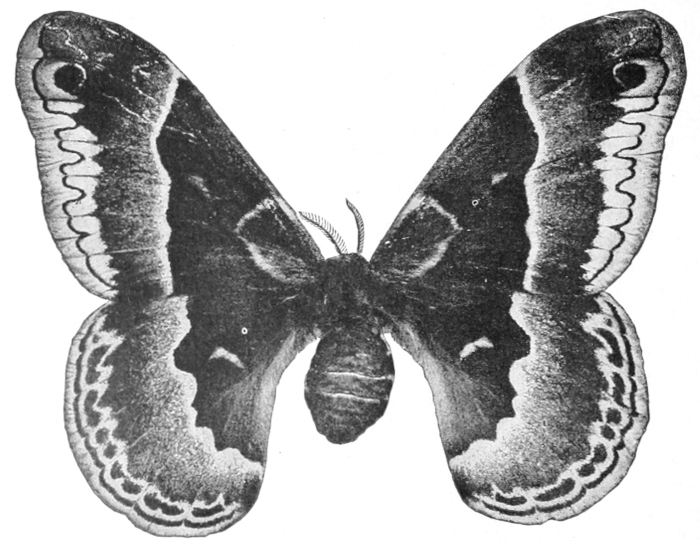
The female promethea.
Photo by M. V. Slingerland.
LESSON LXXIV
The Promethea
Leading thought—The promethea caterpillar fastens a leaf to a twig with silk and then makes its cocoon within this leaf. The male and female moths are very different in appearance.
Method—This work should begin in the late fall, when the children bring in these cocoons which they find dangling on the lilac bushes or wild cherry trees. Much attention should be paid to the way the leaf is fastened to the twig so it will not fall. The cocoons should be kept out of doors, so that the moths will issue late in the spring when they can have natural conditions for laying their eggs, and the young caterpillars are supplied with plenty of food consisting of new and tender leaves.
The Cocoon
Observations—1. On what tree did you find it? Does it look like a cocoon? Does it not look like a dried leaf still clinging to the tree? Do you think that this disguise keeps the birds from attacking it? Do you know which birds are clever enough to see through this disguise?
2. How is the leaf fastened to the twig? Could you pull it off readily? What fastened the leaf to the twig?
3. Tear off the leaf and study the cocoon. Is there an opening to it? At which end? What is this for?
4. Cut open a cocoon. Is it as thick as that of the cecropia?
5. Study the pupa. Is it as large as that of the cecropia?
6. Can you see where the antennæ of the moth are? Can you see the wing covers? Can the pupa move?
The Moth
1. Are there two kinds of moths that come from the promethea cocoons? Does one of them look something like the cecropia? This is the mother promethea.
2. Are any of the moths almost black in color with wings bordered with gray and with graceful prolonged tips to the front wings? This is the father moth.
3. Make water color drawings of promethea moths, male and female.
4. If a promethea mother lays eggs, describe them.
The Caterpillar
1. How do the promethea caterpillars look when they first hatch from the eggs? Do they stay together when they are very young? How do they act? Where do they hide?
2. How do they change color as they grow older? Do they remain together or scatter? Do they continue to hide on the lower sides of leaves?
3. What preparation does a promethea caterpillar make before changing its skin? Why does it shed its skin? Does its colors change with every change of skin?
4. Describe the caterpillar when it is full-grown. What is its ground color? What are the colors of its ornamental tubercles? The color of its head?
5. Describe how a promethea caterpillar makes its cocoon.
THE HUMMINGBIRD, OR SPHINX, MOTHS
Teacher’s Story
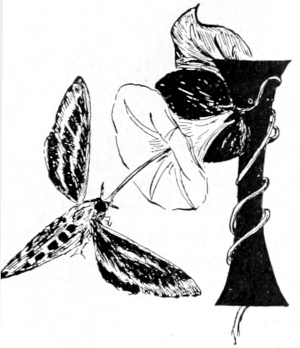
F during the early evening, when all the swift humming birds are abed, we hear the whirr of rapidly moving wings and detect the blur of them in the twilight, as if the creature carried by them hung entranced before some deep-throated flower, and then whizzed away like a bullet, we know that it was a hummingbird, or sphinx, moth. And when we see a caterpillar with a horn on the wrong end of the body, a caterpillar which, when disturbed, rears threateningly, then we may know it is the sphinx larva. And when we find a strange, brown segmented shell, with a long jug handle at one side, buried in the earth as we spade up the garden in the spring, then we know we have the sphinx pupa.
The sphinx was a vaudeville person of ancient mythology who went about boring people by asking them riddles; and, if they could not give the right answers, very promptly ate them up. Although Linnaeus gave the name of sphinx to these moths, because he fancied he saw a resemblance in the resting or threatening attitude of the larvæ to the Egyptian Sphinx, there are still other resemblances. These insects present three riddles: The first one is, “Am I a humming-bird?” the second, “Why do I wear a horn or an eye-spot on the rear end of my body where horns and eyes are surely useless?” and the third, “Why do I look like a jug with a handle and no spout?”
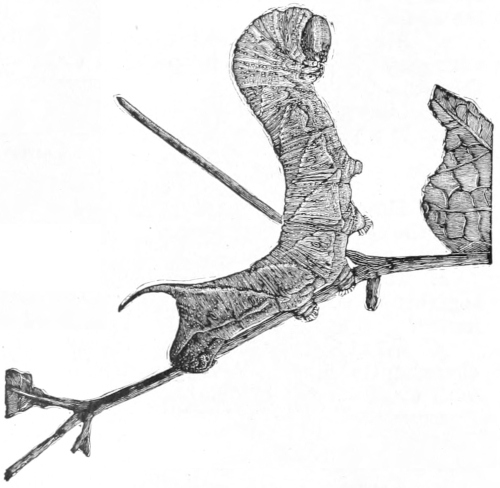
Sphinx larva in sphinx attitude.
From Manual for the Study of Insects.
The sphinx moths are beautiful and elegant creatures. They have a distinctly tailor-made appearance, their colors are so genteel and “the cut” so perfect. They have long, rather narrow, strong wings which enable them to fly with extraordinary rapidity. The hind wings are shorter, but act as one with the front wings. The body is stout and spindle-shaped. The antennæ are thickened in the middle or toward the tip, and in many species have the tip recurved into a hook. Their colors show most harmonious combinations and most exquisite contrasts; the pattern, although often complex, shows perfect refinement. Olive, tan, brown and ochre, black and yellow, and the whole gamut of greys, with eye-spots or bands athwart the hind wings of rose color or crimson, are some of the sphinx color schemes.
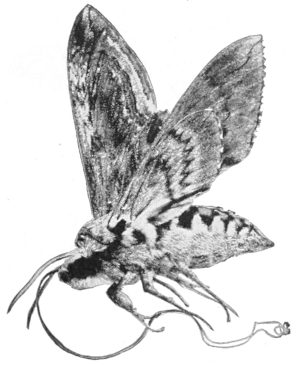
The tobacco sphinx moth with tongue extended.
Photo by M. V. Slingerland.
Most of the sphinx moths have remarkable long tongues, being sometimes twice the length of the body. When not in use, the tongue is curled like a watch spring in front and beneath the head; but of what possible use is such a long tongue! That is a story for certain flowers to tell, the flowers which have the nectar wells far down at the base of tubular corollas, like the petunia, the morning glory or the nasturtium; such flowers were evidently developed to match the long-tongued insects. Some of these flowers, like the jimson weed and nicotina, open late in the day so as to be ready for these evening visitors. In some cases, especially in the orchids, there is a special partnership established between one species of flower and one species of sphinx moths. The tobacco sphinx is an instance of such partnership; this moth visits tobacco flowers and helps develop the seeds by carrying pollen from flower to flower; and in turn it lays its eggs upon the leaves of this plant, on which its great caterpillar feeds and waxes fat, and in high dudgeon often disputes the smoker’s sole right to the “weed.” Tobacco probably receives enough benefit from the ministrations of the moth to compensate for the injury it suffers from the caterpillars; but the owner of the tobacco field, not being a plant, does not look at it in this equitable manner.
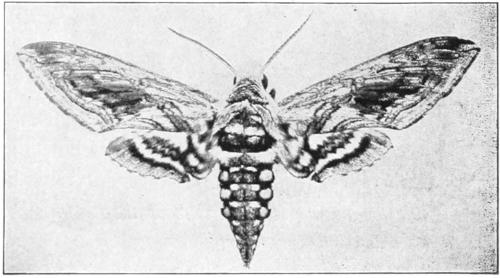
The moth of the sphinx caterpillar, which feeds on tomato.
Photo by M. V. Slingerland.
The sphinx caterpillars are leaf eaters and each species feeds upon a limited number of plants which are usually related; for instance, one feeds upon both the potato and tomato; another upon the Virginia creeper and grapes. In color these caterpillars so resemble the leaves that they are discovered with difficulty. Those on the Virginia creeper, which shades porches, may be located by the black pellets of waste material which fall from them to the ground; but even after this unmistakable hint I have searched a long time to find the caterpillar in the leaves above; its color serves to hide the insect from birds which feed upon it eagerly. In some species, the caterpillars are ornamented with oblique stripes along the sides, and in others the stripes are lengthwise. There is often a great variation in color between the caterpillars of the same species; the tomato worm is sometimes green and sometimes black.
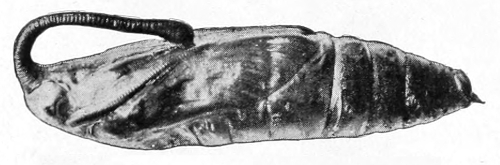
The pupa of the common tomato sphinx caterpillar.
Note that the part encasing the long tongue is free and looks like the handle of a jug.
Photo by M. V. Slingerland.
The horn on the rear end is often in the young larva of different color than the body; in some species it stands straight up and in some it is curled toward the back. It is an absolutely harmless projection and does not sting nor is it poisonous. However, it looks awe-inspiring and perhaps protects its owner in that way. The Pandora sphinx has its horn curled over its back in the young stage but when fully grown the horn is shed; in its place is an eye-spot which, if seen between the leaves, is enough to frighten away any cautious bird fearing the evil eye of serpents. The sphinx caterpillars have a habit, when disturbed or when resting, of rearing up the front part of the body, telescoping the head back into the thoracic segments, which in most species are enlarged, and assuming a most threatening and ferocious aspect. If attacked they will swing sidewise, this way and then that, making a fierce crackling sound meanwhile, well calculated to fill the trespasser with terror. When resting they often remain in this lifted attitude for hours, absolutely rigid.
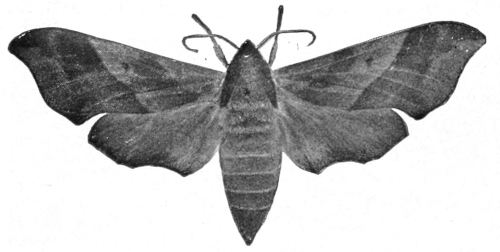
Tailor-made moth, the adult of the Myron sphinx.
The six true legs are short with sharp, little claws. There are four pairs of fleshy prolegs, each foot being armed with hooks for holding on to leaf or twig; and the large, fleshy prop-leg on the rear segment is able to clasp a twig like a vise. All these fleshy legs are used for holding on, while the true legs are used for holding the edges of the leaf where the sidewise working jaws can cut it freely. These caterpillars do clean work, leaving only the harder and more woody ribs of the leaves. The myron caterpillar seems to go out of its way to cut off the stems of both the grape and Virginia creeper.
There are nine pairs of spiracles, a pair on each segment of the abdomen and on the first thoracic segment. The edges of these air openings are often strikingly colored. Through the spiracles the air is admitted into all the breathing tubes of the body around which the blood flows and is purified; no insect breathes through its mouth. These caterpillars, like all others, grow by shedding the skeleton skin, which splits down the back.
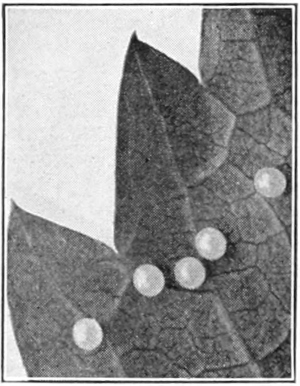
The eggs of the Myron sphinx.
Photo by M. V. Slingerland.
Often one of these caterpillars is seen covered with white objects which the ignorant, who do not know that caterpillars never lay eggs, have called, eggs. But the sphinx moths at any stage would have horror of such eggs as these! They are not eggs but are little silken cocoons spun by the larvæ of a hymenopterous parasite. It is a tiny, four-winged “fly” which lays its eggs within the caterpillar. The little grubs which hatch from these eggs feed upon the fleshy portions of the caterpillar until they get their growth, at which time the poor caterpillar is almost exhausted; and then they have the impudence to come out and spin their silken cocoons and fasten them to the back of their victim. Later, they cut a little lid to their silken cells which they lift up as they come out into the world to search for more caterpillars.
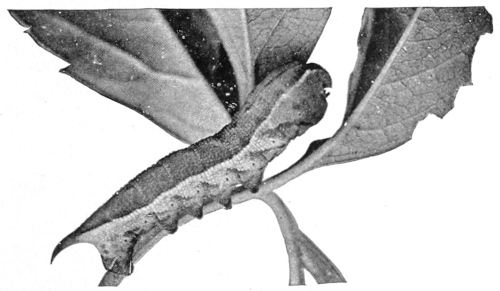
A full-grown caterpillar of the Myron sphinx.
As soon as the sphinx larva has obtained its growth, it descends and burrows into the earth. It does not spin any cocoon but packs the soil into a smooth-walled cell in which it changes to a pupa. In the spring the pupa works its way to the surface of the ground and the moth issues. In the case of the tomato and tobacco sphinx pupa, the enormously long tongue has its case separate from the body of the pupa, which makes the “jug handle.” The wing cases and the antennæ cases can be distinctly seen. In the case of the other species the pupæ have the tongue case fast to the body. The larva of the myron sphinx does not enter the ground, but draws a few leaves about it on the surface of the ground, fastens them with silk and there changes to a pupa.
References—Caterpillars and their Moths, Elliot and Soule; Moths and Butterflies, Dickerson; Moths and Butterflies, Ballard; Manual for the Study of Insects, Comstock.
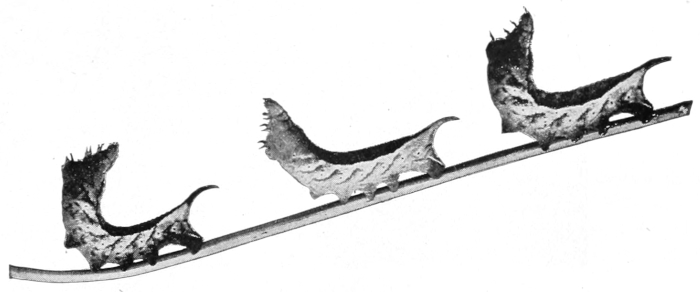
A “cake walk.” The caterpillars of the Myron sphinx in attitude of defence.
Photo by M. V. Slingerland.
LESSON LXXV
The Humming-bird, or Sphinx, Moths
Leading thought—The sphinx caterpillars have a slender horn or eye-spot on the last segment of the body. When disturbed or when resting they rear the front part of the body in a threatening attitude. They spin no cocoons but change to pupæ in the ground. The adults are called humming-bird moths, because of their swift and purring flight. Many flowers depend upon the sphinx moths for carrying their pollen.
Method—The sphinx caterpillar found on the potato or tobacco, or one of the species feeding upon the Virginia creeper is in September available in almost any locality for this lesson. The caterpillars should be placed in a breeding cage in the schoolroom. Fresh food should be given them every day and moist earth be placed in the bottom of the cages. It is useless for the amateur to try to rear the adults from the pupæ in breeding cages. The moths may be caught in nets during the evening when they are hovering over the petunia beds. These may be placed on leaves in a tumbler or jar for observation.
The Caterpillar
Observations—1. On what plant is it feeding? What is its general color? Is it striped? What colors in the stripes? Are they oblique or lengthwise stripes? Are all the caterpillars the same color?
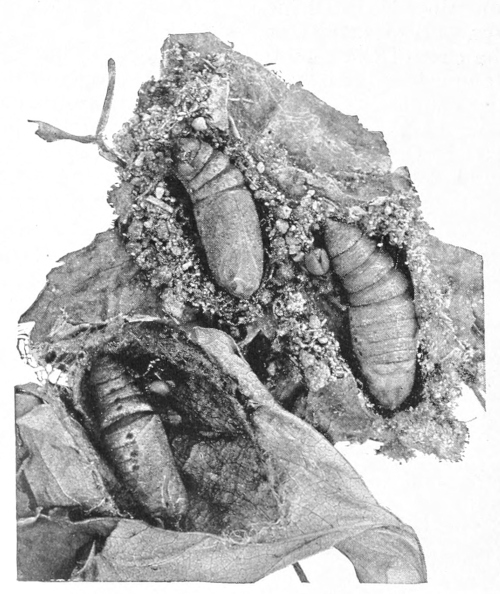
The pupæ of the Myron sphinx within the cocoons.
Photo by M. V. Slingerland.
2. Can you find the caterpillar easily when feeding? Why is it not conspicuous when on the plant? Of what use is this to the caterpillar?
3. Note the horn on the end of the caterpillar. Is it straight or curled? Is it on the head end? What color is it? Do you think it is of any use to the caterpillar? Do you think it is a sting? If there is no horn, is there an eye-spot on the last segment? What color is it? Can you think of any way in which this eye-spot protects the caterpillar?
4. Which segments of the caterpillar are the largest? When the creature is disturbed what position does it assume? How does it move? What noise does it make? Do you think this attitude scares away enemies? What position does it assume when resting? Do you think that it resembles the Egyptian Sphinx when resting?
5. How many true legs has this caterpillar? How does it use them when feeding? How many prolegs has it? How are these fleshy legs used? How are they armed to hold fast to the leaf or twig? Describe the hind or prop-leg. How is it used?
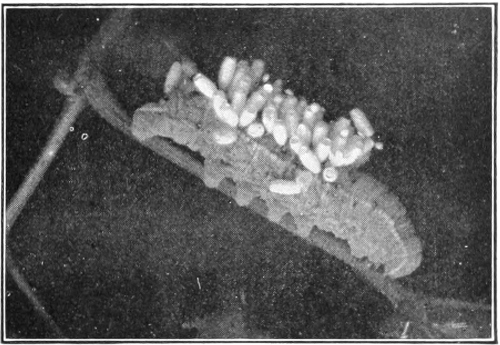
A Myron caterpillar that has been parasitized. The white objects upon it are the cocoons of the little grubs which feed upon the fatty parts of the caterpillar.
Photo by M. V. Slingerland.
6. Do you see the breathing pores or spiracles along the sides of the body? How many are there? How are they colored? How does the caterpillar breathe? Do you think it can breathe through its mouth?
7. How does the sphinx caterpillar grow? Watch your caterpillar and see it shed its skin. Where does the old skin break open? How does the new, soft skin look? Do the young caterpillars resemble the full-grown ones?
8. Describe how the caterpillar eats. Can you see the jaws move? Does it eat up the plant clean as it goes?
9. Have you ever found the sphinx caterpillar covered with whitish, oval objects? What are these? Does the caterpillar look plump or emaciated? Explain what these objects are and how they came to be there.
10. Where does the caterpillar go to change to a pupa? Does it make cocoons? How does the pupa look? Can you see the long tongue case, the wing cases, the antennæ cases?
The Moth
1. Where did you find this moth? Was it flying by daylight or in the dusk? How did its swift moving wings sound? Was it visiting flowers? What flowers? Where is the nectar in these flowers?
2. What is the shape of the moth’s body? Is it stout or slender? What colors has it? How is it marked?
3. The wings of which pair are longer? Sketch or describe the form of the front and the hind wings? Are the outer edges scalloped, notched or even? What colors are on the front wing? On the hind one? Are these colors harmonious and beautiful? Make a sketch of the moth in water-color.
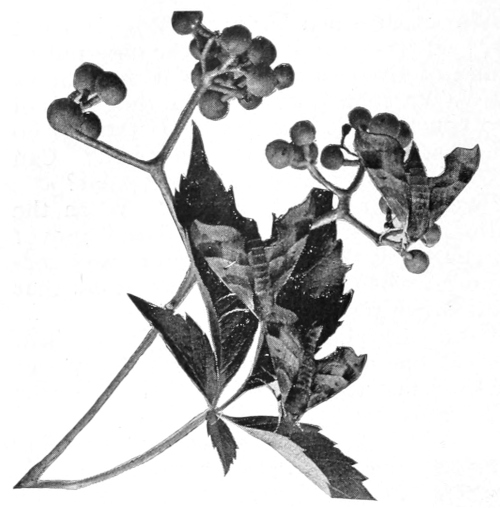
The moths of the Myron sphinx on Virginia creeper.
Photo by M. V. Slingerland.
4. What is the shape of the antennæ? Describe the eyes. Can you see the coiled tongue? Uncoil it with a pin and note how long it is. Why does this moth need such a long tongue?
5. From what flowers do the sphinx moths get nectar? How does the moth support itself when probing for nectar? Do you know any flowers which are dependent on the sphinx moths for carrying their pollen? How many kinds of sphinx moths do you know?
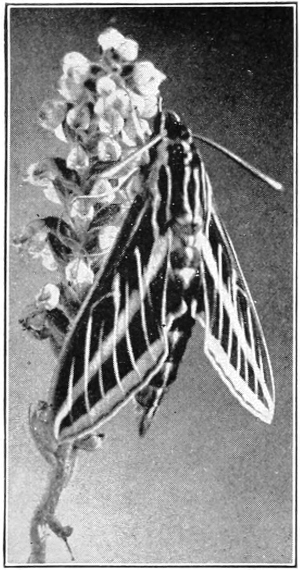
The white-lined sphinx moth.
Hurt no living thing: Ladybird, nor butterfly, Nor moth with dusty wing, Nor cricket chirping cheerily, Nor grasshopper so light of leap, Nor dancing gnat, nor beetle fat, Nor harmless worms that creep. —Christina Rossetti.
THE CODLING MOTH
Teacher’s Story
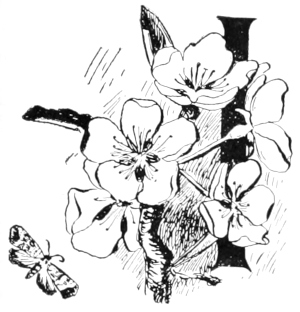
T is difficult to decide which seems the most disturbed, the person who bites into an apple and uncovers a worm, or the worm which is uncovered. From our standpoint, there is nothing attractive about the worm which destroys the beauty and appetizing qualities of our fruit, but from the insect standpoint the codling caterpillar (which is not a worm at all), is not at all bad. When full-grown, it is about three-fourths of an inch long, and is likely to be flesh color, or even rose color, with brownish head; as a young larva, it has a number of darker rose spots on each segment and is whitish in color; the shield on the first segment behind the head, and that on the last segment of the body, are black. When full-grown, the apple worm is plump and lively; and while jerking angrily at being disturbed, we can see its true legs, one pair to each of the three segments of the body behind the head. These true legs have sharp, single claws. Behind these the third, fourth, fifth and sixth segments of the abdomen are each furnished with a pair of fleshy prolegs and the hind segment has a prop-leg. These fleshy legs are mere makeshifts on the part of the caterpillar for carrying the long body; since the three pairs of front legs are the ones from which develop the legs of the moth. The noticing of the legs of the codling moth is an important observation on the part of the pupils, since, by their presence, this insect may be distinguished from the young of the plum curculio, which is also found in apples but which is legless. The codling moth has twelve segments in the body, back of the head.
The codling larva usually enters the apple at the blossom end and tunnels down by the side of the core until it reaches the middle, before making its way out into the pulp. The larva weaves a web as it goes, but this is probably incidental, since many caterpillars spin silk as they go, “street yarn” our grandmothers might have called it. In this web are entangled the pellets of indigestible matter, making a very unsavory looking mass. The place of exit is usually circular, large enough to accommodate the body of the larva, and it leads out from a tunnel which may be a half inch or more in diameter beneath the rind. Often the larva makes the door sometime before it is ready to leave the apple, and plugs it with a mass of debris, fastened together with the silk. As it leaves the apple, the remnants of this plug may be seen streaming out of the opening. Often also, there is a mass of waste pellets pushed out by the young larva from its burrow, as it enters the apple; thus it injures the appearance of the apple, at both entrance and exit. If the apple has not received infection by lying next to another rotting apple, it first begins to rot around the burrow of the worm, especially near the place of exit.
The codling caterpillar injures the fruit in the following ways: The apples are likely to be stunted and fall early; the apples rot about the injured places and thus cannot be stored successfully; the apples thus injured look unattractive and, therefore, their market value is lessened; wormy apples, packed in barrels with others, rot and contaminate all the neighboring apples. This insect also attacks pears and sometimes peaches. It has been carefully estimated that every year the codling moth does three million dollars worth of injury to the apple and pear crops in New York State. Think of paying three million dollars a year for the sake of having wormy apples!
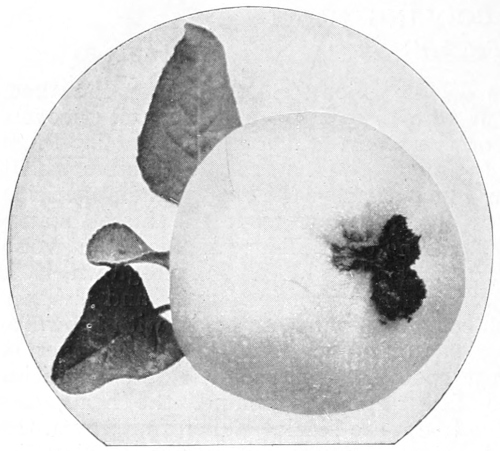
A wormy apple.
Photo by M. V. Slingerland.
The larvæ usually leave the apples before winter. If the apples have fallen, they crawl up the tree and there make their cocoons beneath the loose bark; but if they leave the apples while they are on the trees, they spin silk and swing down. If carried into the storeroom or placed in barrels, they seek quarters in protected crevices. In fact, while they particularly like the loose bark of the apple trees, they are likely to build their cocoons on nearby fences or on brush, wherever they can find the needed protection. The cocoon is made of fine but rather rough silk which is spun from a gland opening near the mouth of the caterpillar; the cocoon is not beautiful although it is smooth inside. It is usually spun between a loose bit of bark and the body of the tree; but after making it, the insect seems in no hurry to change its condition and remains a quite lively caterpillar until spring. It is while the codling larvæ are in their winter quarters that our bird friends of the winter, the nuthatches, woodpeckers and chickadees, destroy them in great numbers, hunting eagerly for them in every crevice of the trees. It is therefore good policy for us to coax these birds to our orchards by placing beef fat on the branches and thus entice these little caterpillar hunters to visit the trees every day.
It is an interesting fact that the codling caterpillars, which make cocoons before August first, change immediately to pupæ which soon change to moths, and thus another generation gets in its work before the apples are harvested.
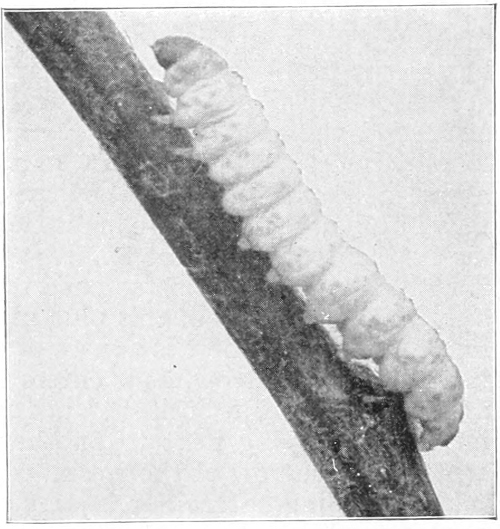
The larva of the codling moth, much enlarged.
Photomicrograph by M. V. Slingerland.
The codling moth is a beautiful little creature with delicate antennæ and a brown, mottled and banded body; its wings are graced by wavy bands of ashy and brown lines, and the tips of the front wings are dark brown with a pattern of gold bronze wrought into them; the hind wings are shiny brown with darker edges and little fringes. The moths issue in the spring and lay their eggs on the young apples just after the petals fall. The egg looks like a minute drop of dried milk and is laid on the side of the bud; but the little larva, soon after it is hatched, crawls to the blossom and finds entrance there; and it is therefore important that its first lunch should include a bit of arsenic and thus end its career before it fairly begins. The trees should be sprayed with some arsenical poison directly after the petals fall, and before the five lobes of the calyx close up around the stamens. If the trees are sprayed while blossoming, the pollen is washed away and the apples do not set; moreover, the bees which help us much in carrying pollen are killed. If the trees are sprayed directly after the calyx closes up around the stamens the poison does not lodge at the base of the stamens and the little rascals get into the apples without getting a dose. (See Lesson on the Apple).
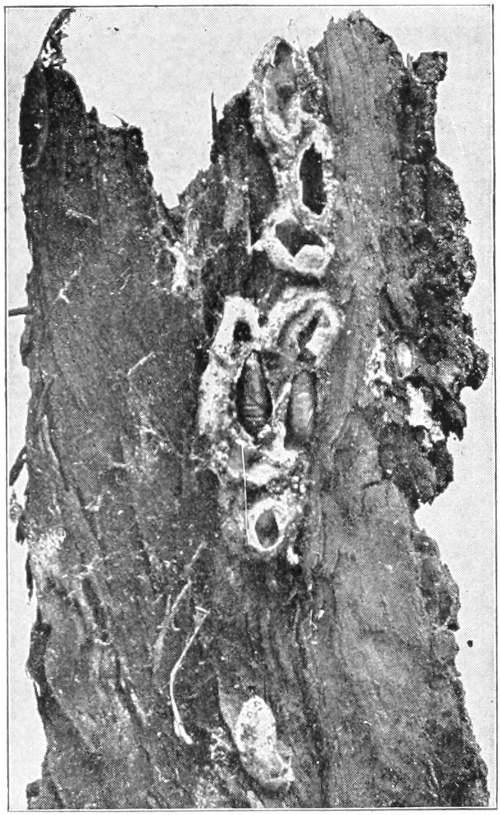
The pupæ and cocoons of the codling moths.
Photo by M. V. Slingerland.
LESSON LXXVI
The Codling Moth
Leading thought—The codling moth is a tiny brown moth with bronze markings which lays its egg on the apple. The larva hatching from the egg enters the blossom end and feeds upon the pulp of the apple, injuring it greatly. After attaining its growth it leaves the apple and hides beneath the bark of the tree or in other protected places, and in the spring makes the cocoon from which the moth issues in time to lay eggs upon the young apples.
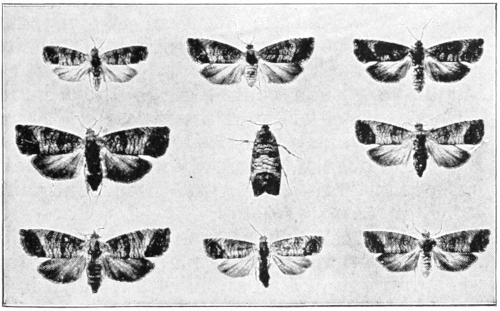
The adult of the codling moth, showing the variations of its markings. The two larger are twice natural size.
Photo by M. V. Slingerland.
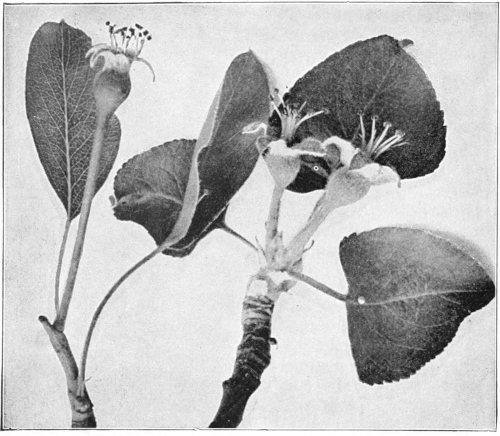
Just ready to spray. A pear and two apples from which the petals have recently fallen and with calyx lobes widely spread.
Photo by M. V. Slingerland.
Method—The lesson should begin with a study of wormy apples, preferably in the fall when the worms are still within their burrows. After the pupils become familiar with the appearance of the insect and its methods of work, a prize of some sort might be offered for the one who will bring to school the greatest number of hibernating larvæ found in their winter quarters. Place these larvæ in a box with cheese-cloth tacked over its open side; place this box out of doors in a protected position. Examine the cocoons to find the pupæ about the last of April; after the pupæ appear, look for the moths in about five days.
It would be a very good idea for the pupils to prepare a Riker mount showing specimens of the moths, of the cocoons showing the cast pupa skin, and of the caterpillar in a homeopathic vial of alcohol; pictures illustrating the work of the insect may be added. The pictures should be drawn by the pupils, showing the wormy apple, both the outside and in section. The pupils can also sketch, from the pictures here given, the young apple when just in the right condition to spray, with a note explaining why.
Observations—1. Find an apple with a codling moth larva in it. How large is the worm? How does it act when disturbed?
2. What is the color of the caterpillar’s body? Its head?
3. How many segments are there in the body? How many of these bear legs? What is the difference in form between the three front pairs of legs and the others?
4. Look at a wormy apple. How can you tell it is wormy from the outside? Can you see where the worm entered the apple? Was the burrow large or small at first? Can you find an apple with a worm in it which has the door for exit made, but closed with waste matter? How is this matter fastened together? If the apple has no worm in it, can you see where it left the apple? Make a sketch or describe the evidence of the caterpillar’s progress through the apple. Do you find a web of silk in the wormy part? Why is this? Does the worm eat the seeds as well as the pulp of the apple?
5. Take a dozen rotting apples, how many of them are wormy? Do the parts of the apple injured by the worm begin to rot first? In how many ways does the codling moth injure the apple? Does it injure other fruits than apples?
6. How late in the fall do you find the codling larvæ in the apple? Where do these larvæ go when they leave the apple?
Work to be done in March or early April—Visit an orchard and look under the loose bark on old trees, or along protected sections of fences or brush piles and bring in all the cocoons you can find. Do not injure the cocoons by tearing them from the places where they are woven, but bring them in on bits of the bark or other material to which they are attached.
1. How does the cocoon look outside and inside? What is in the cocoon? Why was the cocoon made? When was it made?
2. Place the cocoons in a box covered with cheese-cloth and place the box out of doors where the contents can be frequently observed and make the following notes:
3. When does the larva change to the pupa? Describe the pupa. How does the cocoon look after the moth issues from it?
4. Describe the moth, noting color of head, thorax, body, front and hind wings?
5. If these moths were free to fly around the orchard, when and where would they lay their eggs?
6. When should the trees be sprayed to kill the young codling moth? With what should they be sprayed? Why should they not be sprayed during the blossoming period? Why not after the calyx closes?
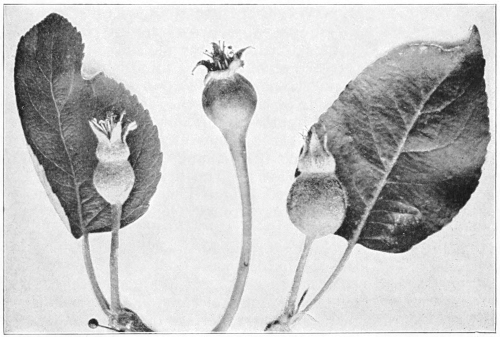
Almost too late to spray. The apples on each side have the calyx lobes nearly drawn together. The pear in the middle still has the calyx cavity open.
Photo by M. V. Slingerland.
7. How do the nuthatches, downy woodpeckers and chickadees help us in getting rid of the codling moth?
8. Write an essay on the life history of the codling moth, the damage done by it, and the best methods of keeping it in check.