PART II. (continued 2)
Reading edition
THE WHITE-BREASTED NUTHATCH
Teacher’s Story
“The busy nuthatch climbs his tree Around the great hole spirally, Peeping into wrinkles gray, Under ruffled lichens gay, Lazily piping one sharp note From his silver mailèd throat.” —Maurice Thompson.
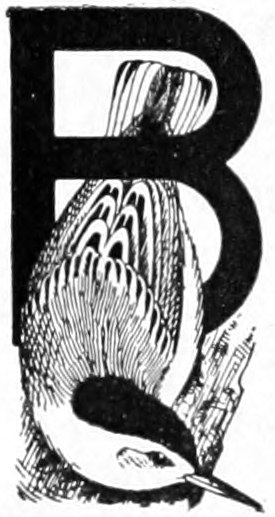
LITHE and mellow is the ringing “ank, ank” note of the nuthatch, and why need we allude to its nasal timbre! While it is not a strictly musical note, it has a most enticing quality and translates into sound the picture of bare-branched trees and the feeling of enchantment which permeates the forest in winter; it is one of the most “woodsy” notes in the bird repertoire. And while the singer of this note is not so bewitching as his constant chum the chickadee, yet it has many interesting ways quite its own. Nor is this “ank, ank,” its only note. I have often heard a pair talking to each other in sweet confidential syllables, “wit, wit, wit” very different from the loud note meant for the world at large. The nuthatches and chickadees hunt together all winter; it is no mere business partnership but a matter of congenial tastes. The chickadees hunt over the twigs and smaller branches, while the nuthatches usually prefer the tree trunks and the bases of the branches; both birds like the looks of the world upside down, and while the chickadee hangs head down from a twig, the nuthatch is quite likely to alight head down on a tree bole, holding itself safely in this position by thrusting its toes out at right angles to the body, thus getting a firm hold upon the bark. Sometimes its foot will be twisted completely around, the front toes pointed up the tree. The foot is well adapted for clinging to the bark as the front toes are strong and the hind toe is very long and is armed with a strong claw. Thus equipped, this bird runs about on the tree so rapidly, it has earned the name of “tree mouse”. It often ascends a tree trunk spirally but is not so hidebound in this habit as is the brown creeper. It runs up or down freely head first and never flops down backwards like a woodpecker.
In color the nuthatch is bluish gray above with white throat and breast and reddish underparts. The sides of the head are white; the black cap extends back upon the neck but is not “pulled down” to the eyes like the chickadees. The wing feathers are dark brown edged with pale gray. The upper middle tail feathers are bluish like the back; the others are dark brown and tipped with white in such a manner that the tail when spread shows a broad white border on both sides. The most striking contrast between the chickadee and nuthatch in markings is that the latter lacks the black bib. However, its entire shape is very different from that of the chickadee and its beak is long and slender, being as long or longer than its head, while the beak of the chickadee is a short, sharp, little pick. The bill of the nuthatch is exactly fitted to reach in crevices of the bark and pull out hiding insects, or to hammer open the shell of nut or acorn and get both the meat of the nut and the grub feeding upon it. It will wedge an acorn into a seam in the bark and then throw back its head, woodpecker fashion, and drive home its chisel beak. But it does not always use common sense in this habit. I have often seen one cut off a piece of suet, fly off and thrust it into some crevice and hammer it as hard as if it were encased in a walnut shell. This always seems bad manners, like carrying off fruit from table d’hote; but the nuthatch is polite enough in using a napkin, for after eating the suet, it invariably wipes its bill on a branch, first one side then the other most assiduously until it is perfectly clean.
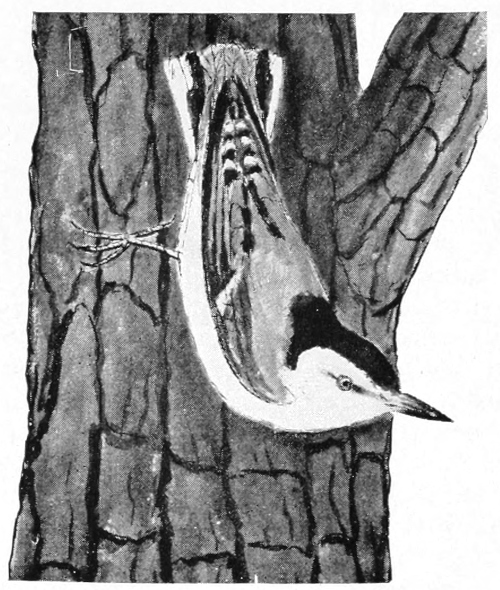
The white breasted nuthatch.
The nuthatches are a great benefit to our trees in winter, for then is when they hunt for hiding pests on their trunks. Their food consists of beetles, caterpillars, pupæ of various insects, also seeds of ragweed, sunflowers, acorns, etc. While the nuthatch finds much of its food on trees, yet Mr. Torrey has seen it awkwardly turning over fallen leaves hunting for insects, and Mr. Baskett says it sometimes catches insects on the wing and gets quite out of breath from this unusual exercise.
It is only during the winter that we commonly see the nuthatches, for during the nesting season, they usually retire to the deep woods where they may occupy a cavity in a tree used by a woodpecker last year, or may make a hole for themselves with their sharp beaks. The nest is lined with leaves, feathers and hair; from five to nine creamy, speckled eggs are the treasure of this cave.
LESSON XII
The Nuthatch
Leading thought—The nuthatch is often a companion of the chickadees and woodpeckers. It has no black bib, like the chickadee, and it alights on a tree trunk head downward, which distinguishes it from woodpeckers.
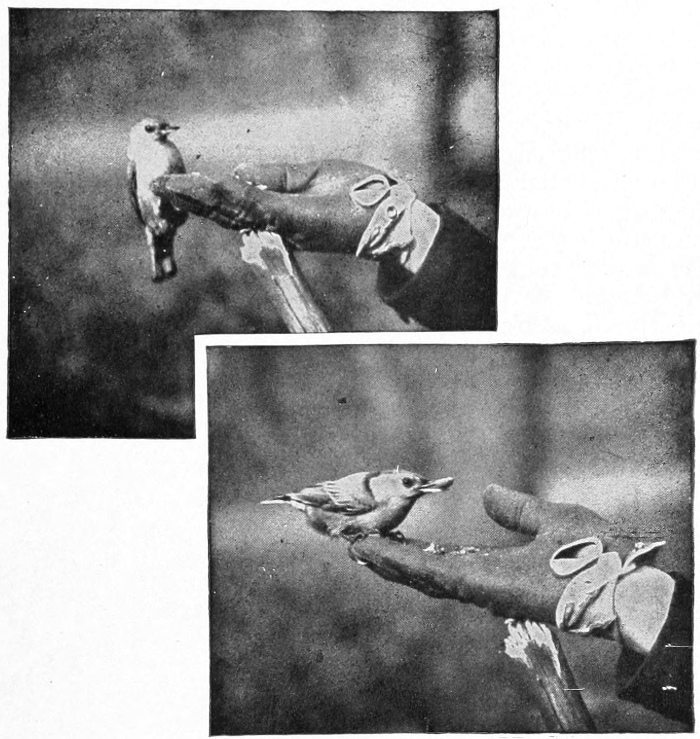
Methods—This bird, like the chickadee and downy, gladly shares the suet banquet we prepare for them and may be observed at leisure while “at table.” The contrast between the habits of the nuthatch and those of its companions make it a most valuable aid in stimulating close and keen observation on the part of the pupils.
Observations—1. Where have you seen the nuthatches? Were they with other birds? What other birds?
2. Does a nuthatch usually alight on the ends of the branches of a tree or on the trunk and larger limbs? Does it usually alight head down or up? When it runs down the tree, does it go head first or does it back down? When it ascends the tree does it follow a spiral path? Does it use its tail for a brace when climbing, as does the downy?
3. How are the nuthatch’s toes arranged to assist it in climbing? Are the three front toes of each foot directed downward when the bird alights head downward? How does it manage its feet when in this position?
4. What is the general color of the nuthatch above and below? The color of the top and sides of head? Color of Back? Wings? Tail? Throat? Breast?
5. Does the black cap come down to the eyes on the nuthatch as on the chickadee? Has the nuthatch a black bib?
6. What is the shape of the beak of the nuthatch? For what is it adapted? How does it differ from the beak of the chickadee?
7. What is the food of the nuthatch? Where is it found? Does it open nuts for the grubs or the nut meat? Observe the way it strikes its beak into the suet, why does it strike so hard?
8. How would you spell this bird’s note? Have you heard it give more than one note?
9. How does the nuthatch benefit our trees? At what season does it benefit them most? Why?
10. Where do the nuthatches build their nests? Why do we see the nuthatches oftener in winter than in summer?
THE CHICKADEE
Teacher’s Story
“He is the hero of the woods; there are courage and good nature enough in that compact little body, which you may hide in your fist, to supply a whole groveful of May songsters. He has the Spartan virtue of an eagle, the cheerfulness of a thrush, the nimbleness of Cock Sparrow, the endurance of the sea-birds condensed into his tiny frame, and there have been added a pertness and ingenuity all his own. His curiosity is immense, and his audacity equal to it; I have even had one alight upon the barrel of the gun over my shoulders as I sat quietly under his tree.” —Ernest Ingersoll.
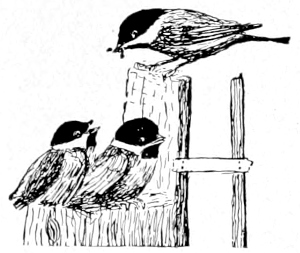
OWEVER careless we may be of our bird friends when we are in the midst of the luxurious life of summer, even the most careless among us give pleased attention to the birds that bravely endure with us the rigors of winter. And when this winged companion of winter proves to be the most fascinating little ball of feathers ever created, constantly overflowing with cheerful song, our pleased attention changes to active delight. Thus it is, that in all the lands of snowy winters the chickadee is a loved comrade of the country wayfarer; that happy song “chick-a-dee-dee-dee” finds its way to the dullest consciousness and the most callous heart.
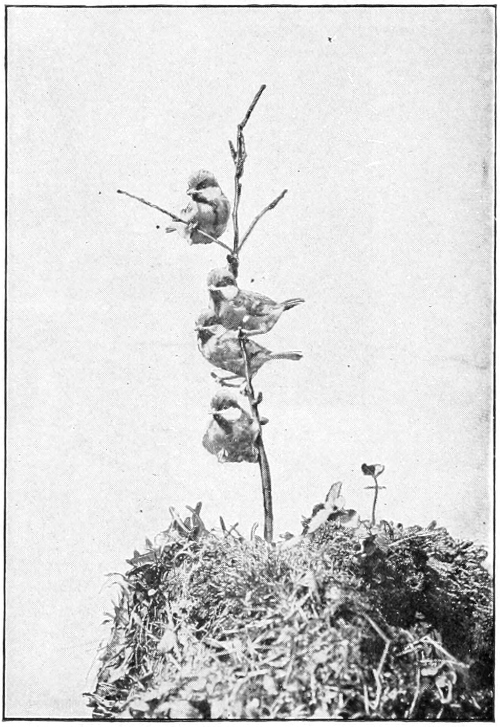
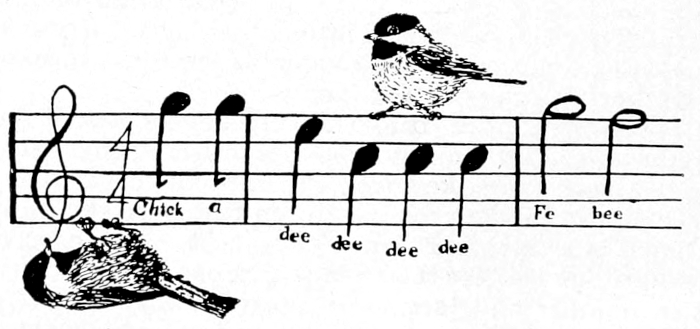
Chick-a-dee-dee-dee
The chickadees appear in small flocks in the winter and often in company with the nuthatches. The chickadees work on the twigs and ends of branches, while the nuthatches usually mine the bark of the trunk and larger branches, the former hunting insect eggs and the latter, insects tucked away in winter quarters. When the chickadee is prospecting for eggs, it looks the twig over, first above and then hangs head down and inspects it from below; it is a thorough worker and doesn’t intend to overlook anything whatever; and however busily it is hunting, it always finds time for singing; whether on the wing or perched upon a twig or hanging from it like an acrobat, head down, it sends forth its happy “chickadeedee” to assure us that this world is all right and good enough for anybody. Besides this song, it begins in February to sing a most seductive “fee-bee,” giving a rising inflection to the first syllable and a long, falling inflection to the last, which makes it a very different song from the short, jerky notes of the phœbe-bird, which cuts the last syllable short and gives it a rising inflection. More than this, the chickadee has some chatty conversational notes, and now and then performs a bewitching little yodle, which is a fit expression of its own delicious personality.
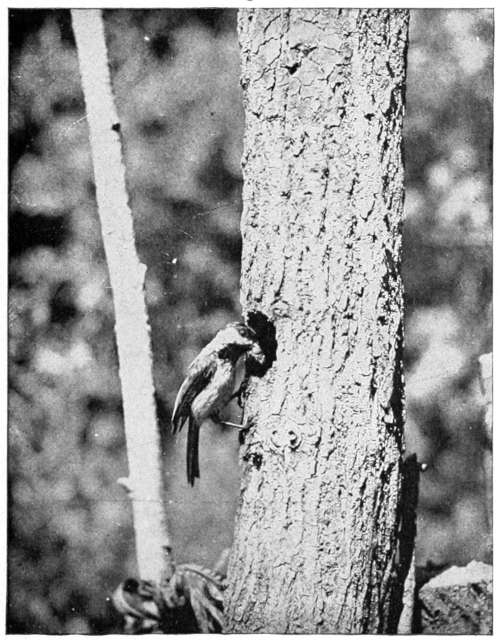
Chickadee entering her nest.
The general effect of the colors of the chickadee is grayish brown above and grayish white below. The top of the head is black, the sides white, and it has a seductive little black bib under its chin. The back is grayish, the wings and tail are dark gray, the feathers having white margins. The breast is grayish white changing to buff or brownish at the sides and below. It is often called the “Black-capped Titmouse,” and it may always be distinguished by black cap and black bib. It is smaller than the English sparrow; its beak is a sharp little pick just fitted for taking insect eggs off twigs and from under bark. Insects are obliged to pass the winter in some stage of their existence, and many of them wisely remain in the egg until there is something worth doing in the way of eating. These eggs are glued fast to the food trees by the mother insect and thus provides abundant food for the chickadees. It has been estimated that one chickadee will destroy several hundred insect eggs in one day, and it has been proven that orchards frequented by these birds are much more free from insect pests than other orchards in the same locality. They can be enticed into orchards by putting up beef fat or bones and thus we can secure their valuable service. In summer these birds attack caterpillars and other insects.
When it comes to nest building, if the chickadees cannot find a house to rent they proceed to dig out a proper hole from some decaying tree, which they line with moss, feathers, fur or some other soft material. The nest is often not higher than six to ten feet from the ground. One which I studied was in a decaying fence post. The eggs are white, sparsely speckled and spotted with lilac or rufous. The young birds are often eight in number and how these fubsy birdlings manage to pack themselves in such a small hole is a wonder, and probably gives them good discipline in bearing hardships cheerfully.
Reference—Useful Birds and Their Protection, Forbush, p. 163; Birds of Village and Field, Merriams; Bird Neighbors, Blancham.
LESSON XIII
The Chickadee
Leading thought—The chickadee is as useful as it is delightful; it remains in the North during winter, working hard to clear our trees of insect eggs and singing cheerily all day. It is so friendly that we can induce it to come even to the window sill, by putting out suet to show our friendly interest.
Methods—Put beef fat on the trees near the schoolhouse in December and replenish it afresh about every two or three weeks. The chickadees will come to the feast and may be observed all winter. Give the questions a few at a time and let the children read in the bird books a record of the benefits derived from this bird.
Observations—1. Where have you seen the chickadees? What were they doing? Were there several together?
2. What is the common song of the chickadee? What other notes has it? Have you heard it yodle? Have you heard it sing “fe-bee, fee-bee.” How does this song differ from that of the phœbe-bird? Does it sing on the wing or when at rest?
3. What is the color of the chickadee: Top and sides of head, back, wings, tail, throat, breast, under parts?
Compare size of chickadee with that of English sparrow.
4. What is the shape of the chickadee’s bill and for what is it adapted? What is the food in winter? Where does the bird find it? How does it act when feeding and hunting for food?
5. Does the chickadee usually alight on the ends of the branches or on the larger portions near the trunk of the tree?
6. How can you distinguish the chickadees from their companions, the nuthatches?
7. Does the chickadee ever seem discouraged by the snow and cold weather? Do you know another name for the chickadee?
8. Where does it build its nest? Of what material? Have you ever watched one of these nests? If so, tell about it.
9. How does the chickadee benefit our orchards and shade trees? How can we induce it to feel at home with us and work for us?
Supplementary reading—“Foster Baby,” Nestlings of Forest and Marsh; “Ch’-geegee-lokh-sis,” Ways of Wood Folk; “Why a Chickadee Goes Crazy,” Animal Heroes, Seton; “The Titmouse,” a poem, by Emerson.
[Audio content is not currently supported on your device.
THE DOWNY WOODPECKER
Teacher’s Story
RIEND Downy is the name this attractive little neighbor has earned, because it is so friendly to those of us who love trees. Watch it as it hunts each crack and crevice of the bark of your favorite apple or shade tree, seeking assiduously for cocoons and insects hiding there, and you will soon, of your own accord, call it friend; you will soon love its black and white uniform, which consists of a black coat speckled and barred with white and whitish gray vest and trousers. The front of the head is black and there is a black streak extending backward from the eye with a white streak above and also below it. The male has a vivid red patch on the back of the head, but his wife shows no such giddiness; plain black and white are good enough for her. In both sexes the throat and breast are white, the middle tail feathers black, while the side tail feathers are white, barred with black at their tips.
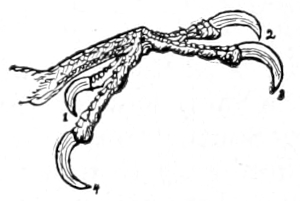
Friend Downy’s foot.
The downy has a way of alighting low down on a tree trunk or at the base of a larger branch and climbing upward in a jerky fashion; it never runs about over the tree nor does it turn around and go down head first, like the nuthatch; if it wishes to go down a short distance it accomplishes this by a few awkward, backward hops; but when it really wishes to descend, it flies off and down. The downy, as other woodpeckers, has a special arrangement of its physical machinery to enable it to climb trees in its own manner. In order to grasp the bark on the side of the tree more firmly, its fourth toe is turned backward to work as companion with the thumb. Thus it is able to clutch the bark as with a pair of nippers, two claws in front and two claws behind; and as another aid, the tail is arranged to prop the bird, like a bracket. The tail is rounded in shape and the middle feathers have rather strong quills; but the secret of the adhesion of the tail to the bark lies in the great profusion of barbs which, at the edge of the feathers, offer bristling tips, and when applied to the side of the tree act like a wire brush with all the wires pushing downward. This explains why the woodpecker cannot go backward without lifting the tail.
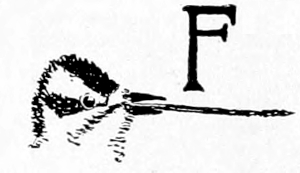
But even more wonderful than this, is the mechanism by which the downy and hairy woodpeckers get their food, which consists largely of wood-borers or larvæ working under the bark. When the woodpecker wishes to get a grub in the wood, it seizes the bark firmly with its feet, uses its tail as a brace, throws its head and upper part of the body as far back as possible, and then drives a powerful blow with its strong beak. The beak is adapted for just this purpose, as it is wedge-shaped at the end, and is used like a mason’s drill sometimes, and sometimes like a pick. When the bird uses its beak as a pick, it strikes hard, deliberate blows and the chips fly; but when it is drilling, it strikes rapidly and not so hard and quickly drills a small, deep hole leading directly to the burrow of the grub. When finally the grub is reached, it would seem well nigh impossible to pull it out through a hole which is too small and deep to admit of the beak being used as pincers. This is another story and a very interesting one; the downy and hairy can both extend their tongues far beyond the point of the beak, and the tip of the tongue is hard and horny and covered with short backward-slanting hooks acting like a spear or harpoon, and when thrust into the grub pulls it out easily (see initial). The bones of the tongue have a spring arrangement; when not in use, the tongue lies soft in the mouth, like a wrinkled earthworm, but when in use, the bones spring out, stretching it to its full length and it is then slim and small. The process is like fastening a pencil to the tip of a glove finger; when drawn back the finger is wrinkled together, but when thrust out, straightens. This spring arrangement of the bones of the woodpecker’s tongue is a marvellous mechanism and should be studied through pictures; see Birds, Eckstorm, Chapter XIV; The Bird, Beebe, p. 122; “The Tongues of Woodpeckers,” Lucas, U. S. Department of Agriculture.
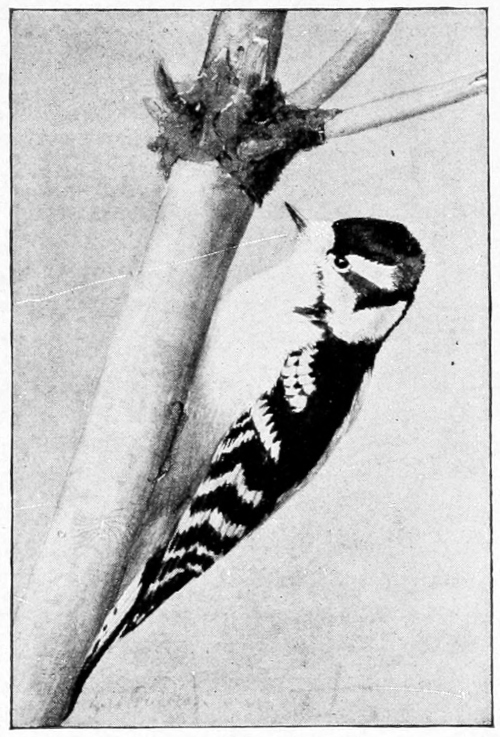
Friend Downy. Drawing by A. L. Fuertes.
Since the food of the downy and the hairy is where they can get it all winter, there is no need for them to go South; thus they stay with us and work for us the entire year. We should try to make them feel at home with us in our orchards and shade trees by putting up pieces of beef fat, to convince them of their welcome. No amount of free food will pauperize these birds, for as soon as they have eaten of the fat, they commence to hunt for grubs on the tree and thus earn their feast. They never injure live wood.
James Whitcomb Riley describes the drumming of the woodpecker as “weeding out the lonesomeness” and that is exactly what the drumming of the woodpecker means. The male selects some dried limb of hard wood and there beats out his well-known signal which advertises far and near, “Wanted, a wife.” And after he wins her, he still drums on for a time to cheer her while she is busy with her family cares. The woodpecker has no voice for singing, like the robin or thrush; and luckily, he does not insist on singing, like the peacock whether he can or not. He chooses rather to devote his voice to terse and business-like conversation; and when he is musically inclined, he turns drummer. He is rather particular about his instrument and having found one that is sufficiently resonant he returns to it day after day. While it is ordinarily the male that drums I once observed a female drumming. I told her that she was a bold minx and ought to be ashamed of herself; but within twenty minutes she had drummed up two red-capped suitors who chased each other about with great animosity, so her performance was evidently not considered improper in woodpecker society. I have watched a rival pair of male downies fight for hours at a time, but their duel was of the French brand,—much fuss and no bloodshed. They advanced upon each other with much haughty glaring and scornful bobs of the head, but when they were sufficiently near to stab each other they beat a mutual and circumspect retreat. Although we hear the male downies drumming every spring, I doubt if they are calling for new wives; I believe they are, instead, calling the attention of their lawful spouses to the fact that it is time for nest building to begin. I have come to this conclusion because the downies and hairies which I have watched for years have always come in pairs to partake of suet during the entire winter; and while only one at a time sits at meat and the lord and master is somewhat bossy, yet they seem to get along as well as most married pairs.
The downy’s nest is a hole, usually in a partly decayed tree; an old apple tree is a favorite site and a fresh excavation is made each year. There are from four to six white eggs, which are laid on a nice bed of chips as fine almost as sawdust. The door to the nest is a perfect circle and about an inch and a quarter across.
The hairy woodpecker is fully one-third larger than the downy, measuring nine inches from tip of beak to tip of tail, while the downy measures only about six inches. The tail feathers at the side are white for the entire length, while they are barred at the tips in the downy. There is a black “parting” through the middle of the red patch on the back of the hairy’s head. The two species are so much alike that it is difficult for the beginner to tell them apart. Their habits are very similar, except that the hairy lives in the woods and is not so commonly seen in orchards or on shade trees. The food of the hairy is much like that of the downy and it is, therefore, a beneficial bird and should be protected.
LESSON XIV
The Downy Woodpecker
Leading thought—The downy woodpecker remains with us all winter, feeding upon insects that are wintering in crevices and beneath the bark of our trees. It is fitted especially by shape of beak, tongue, feet and tail to get such food and it is a “friend in need” to our forest, shade and orchard trees.
Methods—If a piece of beef fat be fastened upon the trunk or branch of a tree, which can be seen from the schoolroom windows, there will be no lack of interest in this friendly little bird; for the downy will sooner or later find this feast spread for it and will come every day to partake. Give out the questions, a few at a time, and discuss the answers with the pupils.
Observations—1. What is the general color of the downy above and below? The color of the top of the head? Sides of the head? The throat and breast? The color and markings of the wings? Color and markings of the middle and side tail-feathers?
2. Do all downy woodpeckers have the red patch at the back of the head? If not, why?
3. What is the note of the downy? Does it make any other sound? Have you ever seen one drumming? At what time of the year? On what did it drum? What did it use for a drumstick? What do you suppose was the purpose of this music?
4. How does the downy climb a tree trunk? How does it descend? How do its actions differ from those of the nuthatch?
5. How are the woodpecker’s toes arranged to help it climb a tree trunk? How does this arrangement of toes differ from that of other birds?
6. How does the downy use its tail to assist it in climbing? What is the shape of the tail and how is it adapted to assist?
7. What does the downy eat and where does it find its food? Describe how it gets at its food. What is the shape of its bill and how is it fitted for getting the food? Tell how the downy’s tongue is used to spear the grub.
8. Why does the downy not go South in winter?
9. Of what use is this bird to us? How should we protect it and entice it into our orchards?
10. Write an English theme on the subject “How the downy builds its nest and rears its young”.
Supplementary reading—The Woodpeckers, Eckstorm; Bird Neighbors, Blanchan; Winter Neighbors, Burroughs.
A few seasons ago a downy woodpecker, probably the individual one who is now my winter neighbor, began to drum early in March in a partly decayed apple-tree that stands in the edge of a narrow strip of woodland near me. When the morning was still and mild I would often hear him through my window before I was up, or by half-past six o’clock, and he would keep it up pretty briskly till nine or ten o’clock, in this respect resembling the grouse, which do most of their drumming in the forenoon. His drum was the stub of a dry limb about the size of one’s wrist. The heart was decayed and gone, but the outer shell was loud and resonant. The bird would keep his position there for an hour at a time. Between his drummings he would preen his plumage and listen as if for the response of the female, or for the drum of some rival. How swift his head would go when he was delivering his blows upon the limb! His beak wore the surface perceptibly. When he wished to change the key, which was quite often, he would shift his position an inch or two to a knot which gave out a higher, shriller note. When I climbed up to examine his drum he was much disturbed. I did not know he was in the vicinity, but it seems he saw me from a near tree, and came in haste to the neighboring branches, and with spread plumage and a sharp note demanded plainly enough what my business was with his drum. I was invading his privacy, desecrating his shrine, and the bird was much put out. After some weeks the female appeared; he had literally drummed up a mate; his urgent and oft-repeated advertisement was answered. Still the drumming did not cease, but was quite as fervent as before. If a mate could be won by drumming she could be kept and entertained by more drumming; courtship should not end with marriage. If the bird felt musical before, of course he felt much more so now. Besides that, the gentle deities needed propitiating in behalf of the nest and young as well as in behalf of the mate. After a time a second female came, when there was war between the two. I did not see them come to blows, but I saw one female pursuing the other about the place, and giving her no rest for several days. She was evidently trying to run her out of the neighborhood. Now and then she, too, would drum briefly as if sending a triumphant message to her mate.—Winter Neighbors, John Burroughs.
THE SAPSUCKER
Teacher’s Story
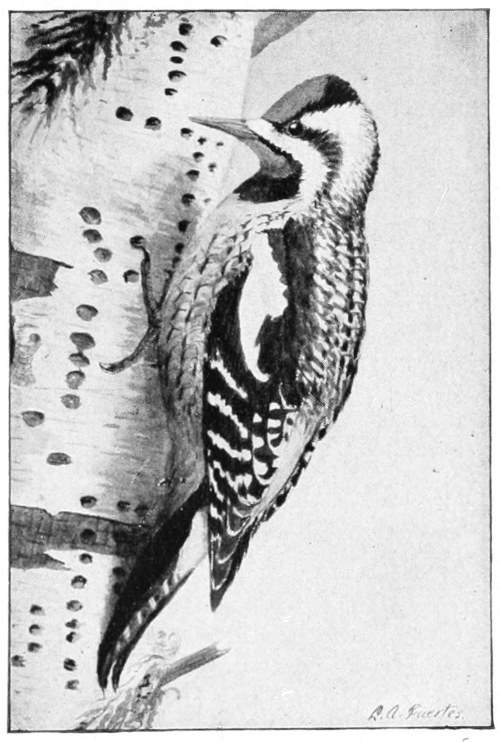
The yellow bellied sapsucker. Drawing by L. A. Fuertes.
The sapsucker is a woodpecker that has strayed from the paths of virtue; he has fallen into temptation by the wayside, and instead of drilling a hole for the sake of the grub at the end of it, he drills for drink. He is a tippler, and sap is his beverage; and he is also fond of the soft, inner bark. He often drills his holes in regular rows and thus girdles a limb or a tree, and for this is pronounced a rascal by men who have themselves ruthlessly cut from our land millions of trees that should now be standing. It is amusing to see a sapsucker take his tipple, unless his saloon happens to be one of our prized young trees. He uses his bill as a pick and makes the chips fly as he taps the tree; then he goes away and taps another tree. After a time he comes back and holding his beak close to the hole for a long time seems to be sucking up the sap; he then throws back his head and “swigs” it down with every sign of delirious enjoyment. The avidity with which these birds come to the bleeding wells which they have made, has in it all the fierceness of a toper crazy for drink; they are particularly fond of the sap of the mountain ash, apple, thorn apple, canoe birch, cut-leaf birch, red maple, red oak, white ash and young pines. However, the sapsucker does not live solely on sap, he also feeds upon insects whenever he can find them. When feeding their young, the sapsuckers are true flycatchers snatching insects while on the wing. The male has the crown and throat crimson, edged with black with a black line extending back of the eye, bordered with white above and below. There is a large, black circular patch on the breast which is bordered at the sides and below with lemon yellow. The female is similar to the male and has a red forehead, but she has a white bib instead of a red one beneath the chin. The distinguishing marks of the sapsucker should be learned by the pupils. The red is on the front of the head instead of on the crown, as is the case with the downy and hairy; when it is flying the broad, white stripes extending from the shoulders backward, form a long, oval figure, which is very characteristic.
The sapsuckers spend the winter in the Southern States where they drill wells in the white oak and other trees. From Virginia to Northern New York and New England, where they breed, they are seen only during migration, which occurs in April; then the birds appear two and three together and are very bold in attacking shade trees, especially the white birch. They nest only in the Northern United States and northward. The nest is usually a hole in a tree about forty feet from the ground, and is likely to be in a dead birch.
LESSON XV
The Sapsucker
Leading thought—The sapsucker has a red cap, a red bib and a yellow breast; it is our only woodpecker that does injury to trees. We should learn to distinguish it from the downy and hairy, as the latter are among the best bird friends of the trees.
Methods—Let the observations begin with the study of the trees which have been attacked by the sapsucker, which are almost everywhere common, and thus lead to an interest in the culprit.
Observations—1. Have you seen the work of the sapsucker? Are the holes drilled in rows completely around the tree? If there are two rows or more, are the holes set evenly one below another?
2. Do the holes sink into the wood, or are they simply through the bark? Why does it injure or kill a tree to be girdled with these holes? Have you ever seen the sapsuckers making these holes? If so, how did they act?
3. How many kinds of trees can you find punctured by these holes? Are they likely to be young trees?
4. How can you distinguish the sapsucker from the other woodpeckers? How have the hairy and downy which are such good friends of the trees been made to suffer for the sapsucker’s sins?
5. What is the color of the sapsucker as follows: Forehead, sides of head, back, wings, throat, upper and lower breast? What is the difference in color between the male and female?
6. In what part of the country do the sapsuckers build their nests? Where do they make their nests and how?
Supplementary reading—Bird Neighbors, Blanchan; Birds, Bees and Sharp Eyes, John Burroughs.
In the following winter the same bird (a sapsucker) tapped a maple-tree in front of my window in fifty-six places; and, when the day was sunny and the sap oozed out he spent most of his time there. He knew the good sap-days, and was on hand promptly for his tipple; cold and cloudy days he did not appear. He knew which side of the tree to tap, too, and avoided the sunless northern exposure. When one series of well-holes failed to supply him, he would sink another, drilling through the bark with great ease and quickness. Then, when the day was warm, and the sap ran freely, he would have a regular sugar-maple debauch, sitting there by his wells hour after hour, and as fast as they became filled sipping out the sap. This he did in a gentle, caressing manner that was very suggestive. He made a row of wells near the foot of the tree, and other rows higher up, and he would hop up and down the trunk as they became filled.—Winter Neighbors, John Burroughs.
THE RED-HEADED WOODPECKER
Teacher’s Story
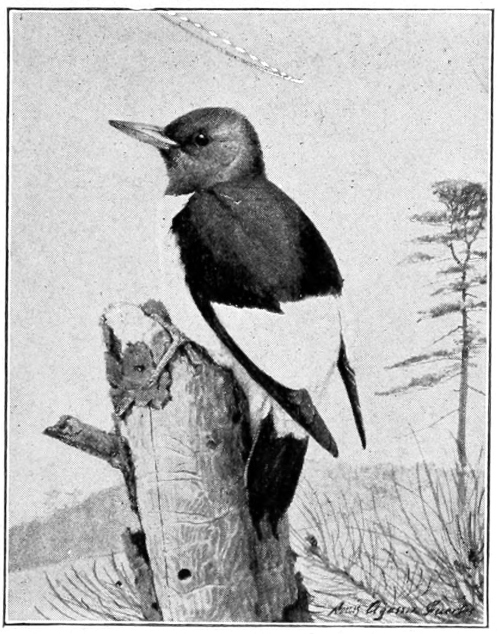
The red-headed woodpecker. Drawing by L. A. Fuertes.
The red-head is well named, for his helmet and visor show a vivid glowing crimson that stirs the sensibilities of the color lover. It is readily distinguished from the other woodpeckers because its entire head and bib are red. For the rest, it is a beautiful dark metallic blue with the lower back, a band across the wing, and the under parts white; its outer tail feathers are tipped with white. The female is colored like the male, but the young have the head and breast gray, streaked with black and white, and the wings barred with black. It may make its nest by excavating a hole in a tree or a stump or even in a telegraph pole; the eggs are glossy white. This woodpecker is quite different in habits from the hairy and downy, as it likes to flit along from stump to fence-post and catch insects on the wing, like a fly-catcher. The only time that it pecks wood is when it is making a hole for its nest.
As a drummer, the red-head is most adept and his roll is a long one. He is an adaptable fellow, and if there is no resonant dead limb at hand, he has been known to drum on tin roofs and lightning rods; and once we also observed him executing a most brilliant solo on the wire of a barbed fence. He is especially fond of beechnuts and acorns, and being a thrifty fellow as well as musical, in time of plenty he stores up food against time of need. He places his nuts in crevices and forks of the branches or in holes in trees or any other hiding place. He can shell a beechnut quite as cleverly as can the deer mouse; and he is own cousin to the Carpenter Woodpecker of the Pacific Coast, which is also red-headed and which drills holes in the oak trees wherein he drives acorns like pegs for later use.
LESSON XVI
The Red-headed Woodpecker
Leading thought—The red-headed woodpecker has very different habits from the downy and is not so useful to us. It lives upon nuts and fruit and such insects as it can catch upon the wing.
Methods—If there is a red-head in the vicinity of your school the children will be sure to see it. Write the following questions upon the blackboard and offer a prize to the first one who will make a note on where the red-head stores his winter food.
Observations—1. Can you tell the red-head from the other woodpeckers? What colors especially mark his plumage?
2. Where does the red-head nest? Describe eggs and nest?
3. What have you observed the red-head eating? Have you noticed it storing nuts and acorns for the winter? Have you noticed it flying off with cherries or other fruit?
4. What is the note of the red-head? Have you ever seen one drumming? What did he use for a drum? Did he come back often to this place to make his music?
Supplementary reading—“The House That Fell” in Nestlings of Forest and Marsh; Our Birds and their Nestlings, p. 90; Birds, Bees and Sharp Eyes, John Burroughs.
Another trait our woodpeckers have that endears them to me, and that has never been pointedly noticed by our ornithologists, is their habit of drumming in the spring. They are songless birds, and yet all are musicians; they make the dry limbs eloquent of the coming change. Did you think that loud, sonorous hammering which proceeded from the orchard or from the near woods on that still March or April morning was only some bird getting its breakfast? It is downy, but he is not rapping at the door of a grub; he is rapping at the door of spring, and the dry limb thrills beneath the ardor of his blows. Or, later in the season, in the dense forest or by some remote mountain lake, does that measured rhythmic beat that breaks upon the silence, first three strokes following each other rapidly, succeeded by two louder ones with longer intervals between them, and that has an effect upon the alert ear as if the solitude itself had at least found a voice—does that suggest anything less than a deliberate musical performance? In fact, our woodpeckers are just as characteristically drummers as is the ruffed grouse, and they have their particular limbs and stubs to which they resort for that purpose. Their need of expression is apparently just as great as that of the song-birds, and it is not surprising that they should have found out that there is music in a dry, seasoned limb which can be evoked beneath their beaks.
The woodpeckers do not each have a particular dry limb to which they resort at all times to drum, like the one I have described. The woods are full of suitable branches, and they drum more or less here and there as they are in quest of food; yet I am convinced each one has its favorite spot, like the grouse, to which it resorts, especially in the morning. The sugar-maker in the maple woods may notice that this sound proceeds from the same tree or trees about his camp with great regularity. A woodpecker in my vicinity has drummed for two seasons on a telegraph-pole, and he makes the wires and glass insulators ring. Another drums on a thin board on the end of a long grape-arbor, and on still mornings can be heard a long distance.
A friend of mine in a Southern city tells me of a red-headed woodpecker that drums upon a lightning-rod on his neighbor’s house. Nearly every clear, still morning at certain seasons, he says, this musical rapping may be heard. “He alternates his tapping with his stridulous call, and the effect on a cool, autumn-like morning is very pleasing.”—John Burroughs, in Birds, Bees and Sharp Eyes.
THE FLICKER OR YELLOW-HAMMER
Teacher’s Story
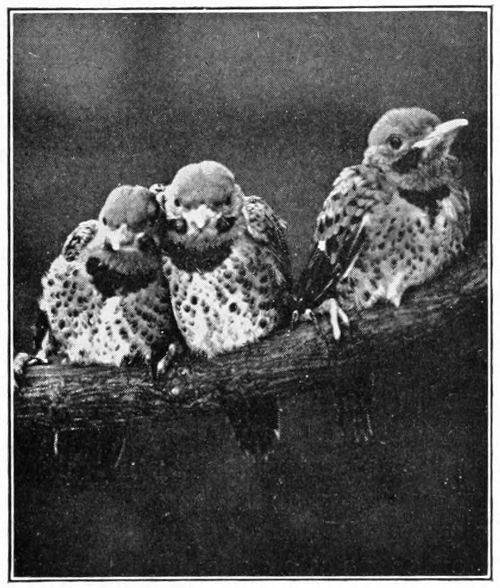
Young flickers “Two is company, three is a crowd.” Photo by J. M. Schreck.
The first time I ever saw a flicker I said, “What a wonderful meadow-lark and what is it doing on that ant hill?” But, another glance revealed to me a red spot on the back of the bird’s neck, and as soon as I was sure that it was not a bloody gash, I knew that it marked no meadow-lark. The top of the flicker’s head and its back are slaty-gray, which is much enlivened by a bright red band across the nape of the neck. The tail is black above and yellow tipped with black below; the wings are black, but have a beautiful luminous yellow beneath, which is very noticeable during flight. There is a locket adorning the breast which is a thin, black crescent, much narrower than that of the meadow-lark. Below the locket, the breast is yellowish white thickly marked with circular, black spots. The throat and sides of the head are pinkish brown, and the male has a black mustache extending backward from the beak with a very fashionable droop. Naturally enough the female, although she resembles her spouse, lacks his mustache. The beak is long, strong, somewhat curved and dark colored. This bird is distinctly larger than the robin. The white patch on the rump shows little or none when the bird is at rest, for this white mark is a “color call,” it being a rear signal by means of which the flock of migrating birds are able to keep together in the night. The yellow-hammer’s flight is wave-like and jerky and quite different from that of the meadow-lark; nor does it stay so constantly in the meadows but often frequents woods and orchards.
The flicker has many names, such as golden-winged woodpecker, yellow-hammer, high-hole, yarup, wake-up, clape and many others. It earned the name of high-hole because of its habit of excavating its nest high up in trees, usually between ten and twenty-five feet from the ground. It especially loves an old apple tree as a site for a nest, and most of our large old orchards can boast of a pair of these handsome birds during the nesting season of May and June. The flicker is not above renting any house he finds vacant, excavated by some other birds last year. He earned his name of yarup or wake-up from his spring song, which is a rollicking, jolly “wick-a, wick-a, wick-a-wick” a song commonly heard the last of March or early April. The chief food of the flicker is ants, although it also eats beetles, flies and wild fruit, but does little or no damage to planted crops. So long has it fed upon ants, that its tongue has become modified, like that of the ant-eater; it is covered with a sticky substance; and when it is thrust into an ant hill, all of the little citizens, disturbed in their communal labors, at once bravely attack the intruder and become glued fast to it, and are thus withdrawn and transferred to the capacious stomach of the bird. It has been known to eat three thousand ants at a single meal.
Those who have observed the flicker during the courting season declare him to be the most silly and vain of all bird wooers. Mr. Baskett says: “When he wishes to charm his sweetheart he mounts a small twig near her, and lifts his wings, spreads his tail, and begins to nod right and left as he exhibits his mustache to his charmer. He sets his jet locket first on one side of the twig and then on the other. He may even go so far as to turn his head half around to show her the pretty spot on his back hair. In doing all this he performs the most ludicrous antics and has the silliest expression of face and voice as if in losing his heart, as some one phrases it, he had lost his head also.”
The nest hole is quite deep and the white eggs are from four to ten in number. The feeding of the young flickers is a painful process to watch. The parent takes the food into its own stomach and partially digests it, then thrusting its own bill down the throat of the young one it pumps the soft food into it “kerchug, kerchug,” until it seems as if the young one must be shaken to its foundations. The young flickers as soon as they leave the nest climb around freely on the home tree in a delightful, playful manner.
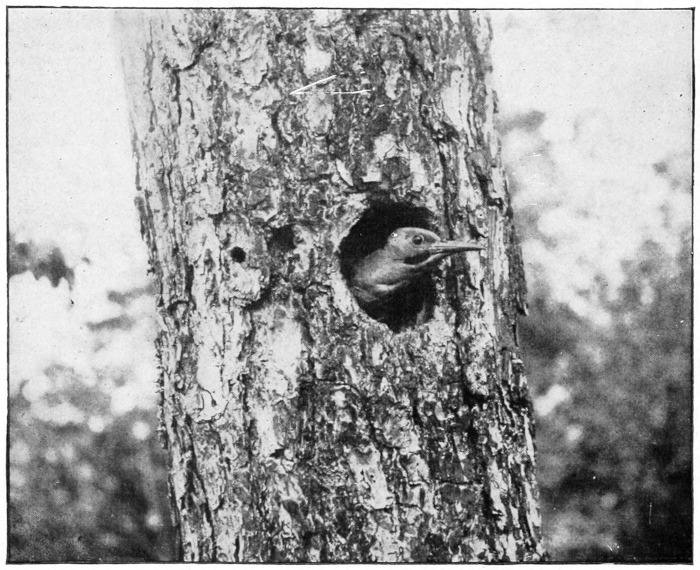
Flicker coming from the nest. Photo by George Fiske, Jr.
LESSON XVII
The Flicker
Leading thought—The flicker is a true woodpecker but has changed its habits and spends much of its time in meadows hunting for ants and other insects; it makes its nest in trees, like its relatives. It can be distinguished from the meadow-lark by the white patch above the tail which shows during flight.
Methods—This is one of the most important of birds of the meadow and the work may be done in September when there are plenty of young flickers, which have not learned to be wary. The observations may be made in the field, a few questions given at a time.
Observations—1. Where do you find the flicker in the summer and early autumn? How can you tell it from the meadow-lark in color and in flight?
2. What is it doing in the meadows? How does it manage to trap ants?
3. What is the size of the flicker as compared to the robin? What is its general color as compared to the meadow-lark?
4. Describe the colors of the flicker as follows: Top and sides of the head, back of the neck, lower back, tail, wings, throat and breast. The color and shape of the beak. Is there a difference in markings between the males and females?
5. Does the patch of white above the tail show, except when the bird is flying? Of what use is this to the bird?
6. What is the flicker’s note? At what time of spring do you hear it first?
7. Where does the flicker build its nest and how? What is the color of the eggs? How many are there?
8. How does it feed its young? How do the young flickers act?
9. How many names do you know for the flicker?
Supplementary reading—“The Bird of Many Names,” Nestlings of Forest and Marsh; A Fellow of Expedients, Long; Our Birds and Their Nestlings, p. 187; Audubon Leaflet No. 5.
The high-hole appears to drum more promiscuously than does the downy. He utters his long, loud spring call, whick-whick-whick, and then begins to rap with his beak upon his perch before the last note has reached your ear. I have seen him drum sitting upon the ridge of the barn. The log-cock, or pileated woodpecker, the largest and wildest of our Northern species, I have never heard drum. His blows should wake the echoes.
When the woodpecker is searching for food, or laying siege to some hidden grub, the sound of his hammering is dead or muffled, and is heard but a few yards. It is only upon dry, seasoned timber, freed of its bark, that he beats his reveille to spring and woos his mate. —John Burroughs, in Birds, Bees and Sharp Eyes.
THE MEADOW-LARK
Teacher’s Story
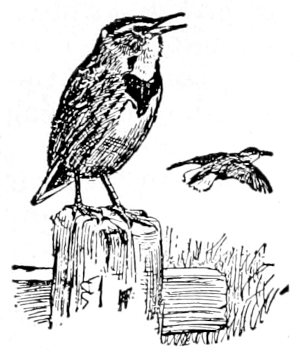
The first intimation we have in early spring, that the meadow-lark is again with us, comes to us through his soft, sweet, sad note which Van Dyke describes so graphically when he says it, “leaks slowly upward from the ground.” One wonders how a bird can express happiness in these melancholy, sweet, slurred notes and yet undoubtedly it is a song expressing joy, the joy of returning home, the happiness of love and of nest building. But after one has spent a winter in the Gulf States, and has witnessed the slaughter there of this most valuable bird; and after the northern stomach and heart have turned sick at the sight of breasts once so full of song done brown on the luncheon table, one no longer wonders that the meadow-lark’s song of joy is fraught with sadness. There should be national laws to protect the birds that are of value to one part of the United States from being slaughtered in their winter haunts, unless they are there a nuisance and injurious to crops, which is not the case with the meadow-lark.
The meadow-lark, as is indicated by its name, is a bird of the meadow. It is often confused with another bird of the meadow which has very different habits, the flicker. The two are approximately of the same size and color and each has a black crescent or locket on the breast and each shows the “white feather” during flight. The latter is the chief distinguishing character; the outer tail feathers of the meadow-lark are white, while the tail feathers of the flicker are not white at all, but it has a single patch of white on the rump. The flight of the two is quite different. The lark lifts itself by several sharp movements and then soars smoothly over the course, while the flicker makes a continuous up and down, wave-like flight. The songs of the two would surely never be confused, for the meadow-lark is among our sweetest singers, to which class the flicker with his “flick a flick” hardly belongs.
The colors of the meadow-lark are most harmonious shades of brown and yellow, well set off by the black locket on its breast. Its wings are light brown, each feather being streaked with black and brown; the line above the eye is yellow, bordered with black above and below; a buff line extends from the beak backward over the crown. The wings are light brown and have a mere suggestion of white bars; portions of the outer feathers on each side of the tail are white, but this white does not show except during flight. The sides of the throat are greenish, the middle part and breast are lemon-yellow, with the large, black crescent just below the throat. The beak is long, strong and black, and the meadow-lark is decidedly a low-browed bird, the forehead being only slightly higher than the upper part of the beak. It is a little larger than the robin which it rivals in plumpness.
The meadow-lark has a particular liking for meadows which border streams. It sings when on the ground, on the bush or fence and while on the wing; and it sings during the entire period of its northern stay, from April to November, except while it is moulting in late summer. Mr. Mathews, who is an eminent authority on bird songs, says that the meadow-larks of New York have a different song from those of Vermont or Nantucket, although the music has always the same general characteristics. The western species has a longer and more complex song than ours of the East. It is one of the few California birds that is a genuine joy to the eastern visitor; during February and March its heavenly music is as pervasive as the California sunshine.
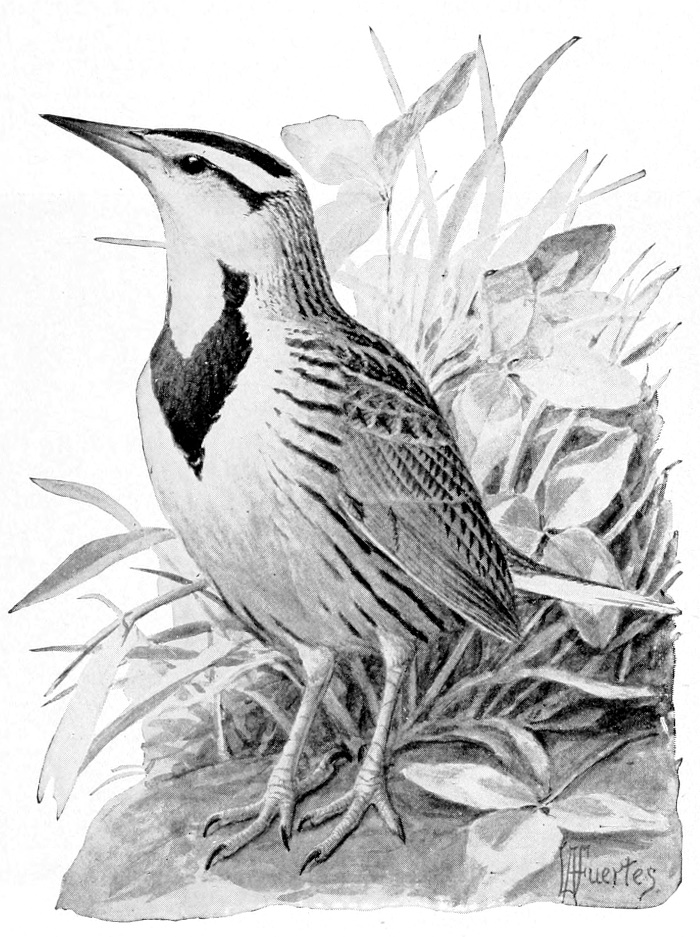
The meadow-lark. Drawing by L. A. Fuertes.
The nest is built in a depression in the ground near a tuft of grass; it is constructed of coarse grass and sticks and is lined with finer grass; there is usually a dome of grass blades woven above the nest; and often a long, covered vestibule leading to the nest is made in a similar fashion. This is evidently for protection from the keen eyes of hawks and crows. The eggs are laid about the last of May and are usually from five to seven in number; they are white, speckled with brown and purple. The young larks are usually large enough to be out of the way before haying time in July.
The food of the meadow-lark during the entire year, consists almost exclusively of insects which destroy the grass of our meadows. It eats great quantities of grasshoppers, cut worms, chinch bugs, army worms, wire worms, weevils, and also destroys some weed seeds. Each pupil should make a diagram in his note-book showing the proportions of the meadow-lark’s different kinds of food. This may be copied from Audubon Leaflet No. 3. The killing of the meadow-lark in New York State is a punishable offence, as it should be in every state of the Union. Everyone who owns a meadow should use his influence to the uttermost to protect this valuable bird. It has been estimated that the meadow-larks save to every township where hay is produced, twenty-five dollars each year on this crop alone.
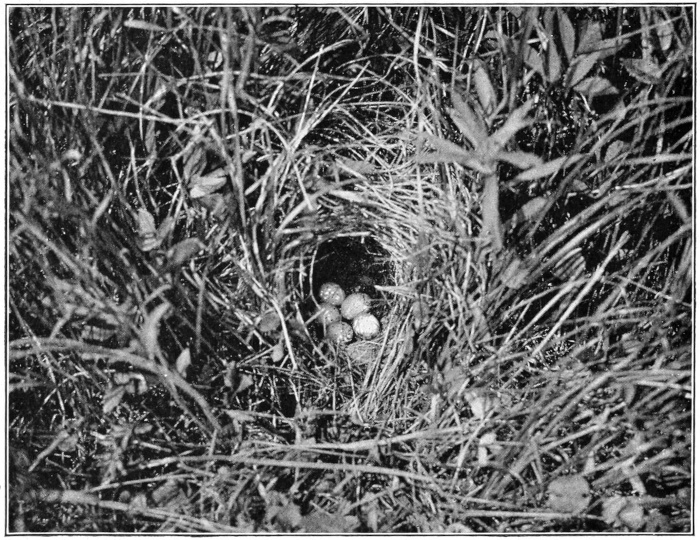
The meadow-lark’s covered nest. Photo by Robert Matheson.
LESSON XVIII
The Meadow-Lark
Leading thought—The meadow-lark is of great value in delivering the grass of our meadows from insect destroyers. It has a song which we all know; it can be identified by color as a large, light brown bird with white feathers on each side of the tail, and in flight, by its quick up and down movements finishing with long, low, smooth sailing.
Method—September and October are good months for observations on the flight, song and appearance of the meadow-lark, and also for learning how to distinguish it from the flicker. The notes must be made by the pupils in the field, and after they know the bird and its song let them, if they have opportunity, study the bird books and bulletins, and prepare written accounts of the way the meadow-lark builds its nest and of its economic value.
Observations—1. Where have you seen the meadow-lark? Did you ever see it in the woods? Describe its flight. How can you identify it by color when it is flying? How do its white patches and its flight differ from those of the flicker?
2. Try and imitate the meadow-lark’s notes by song or whistle. Does it sing while on the ground, or on a bush or fence, or during flight?
3. Note the day when you hear its last song in the fall and also its first song in the spring. Does it sing during August and September? Why? Where does it spend the winter? On what does it feed while in the South? How are our meadow-larks treated when on their southern sojourn?
4. Is the meadow-lark larger or smaller than the robin? Describe from your own observation, as far as possible, the colors of the meadow-lark as follows: Top of head; line above the eye; back; wings; tail; throat; breast; locket; color and shape of beak. Make a sketch of your own or a copy from Louis Fuertes’ excellent picture of the meadow-lark in the Audubon Leaflet, and color it accurately.
5. When is the nest built; where is it placed; of what material is it built? How is it protected from sight from above? Why this protection? How many eggs? What are their colors and markings?
6. What is the food of the meadow-lark? Copy the diagram from the Audubon leaflet, showing the proportions of the different kinds of insects which it destroys. Why should the farmers of the South also protect the meadow-lark by law?
Supplementary reading—Audubon Education Leaflet No. 3; Farmers’ Bulletin No. 54, U. S. Dept. of Agr.; “A Pioneer,” in Nestlings of Forest and Marsh, Wheelock.
Sweet, sweet, sweet! O happy that I am! (Listen to the meadow-larks, across the fields that sing!) Sweet, sweet, sweet! O subtle breath of balm, O winds that blow, O buds that grow, O rapture of the spring! Sweet, sweet, sweet! O happy world that is! Dear heart, I hear across the fields my mateling pipe and call. Sweet, sweet, sweet! O world so full of bliss, For life is love, the world is love, and love is over all! —Ina Coolbrith.
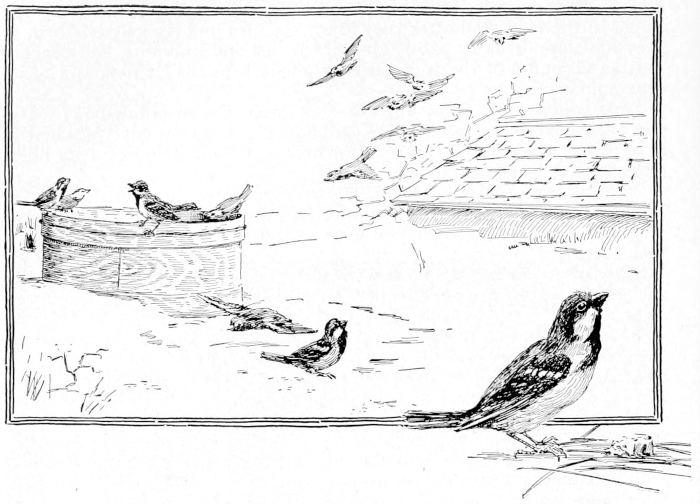
THE ENGLISH SPARROW
Teacher’s Story
So dainty in plumage and hue, A study in grey and in brown, How little, how little we knew The pest he would prove to the town! From dawn until daylight grows dim, Perpetual chatter and scold. No winter migration for him, Not even afraid of the cold! Scarce a song-bird he fails to molest, Belligerent, meddlesome thing! Wherever he goes as a guest He is sure to remain as a King. —Mary Isabella Forsyth.
The English sparrow, like the poor and the house-fly, is always with us; and since he is here to stay, let us make him useful if we can devise any means of doing so. There is no bird that gives the pupils a more difficult exercise in describing colors and markings than does he; and his wife is almost equally difficult. I have known fairly skilled ornithologists to be misled by some variation in color of the hen sparrow, and it is safe to assert that the majority of people “do not know her from Adam.” The male has the top of the head gray with a patch of reddish brown on either side; the middle of the throat and upper breast is black; the sides of the throat white; the lower breast and under parts grayish white; the back is brown streaked with black; the tail is brown, rather short, and not notched at the tip; the wings are brown with two white bars and a jaunty dash of reddish brown. The female has the head grayish brown, the breast, throat and under parts grayish white; the back is brown streaked with black and dirty yellow, and she is, on the whole, a “washed out” looking lady bird. The differences in color and size between the English sparrow and the chippy are quite noticeable, as the chippy is an inch shorter and far more slender in appearance, and is especially marked by the reddish brown crown.
When feeding, the English sparrows are aggressive, and their lack of table manners make them the “goops” among all birds; in the winter they settle in noisy flocks on the street to pick up the grain undigested by the horses, or in barnyards where the grain has been scattered by the cattle. They only eat weed seeds when other food fails them in the winter, for they are a civilized bird even if they do not act so, and they much prefer the cultivated grains. It is only during the nesting season that they destroy insects to any extent; over one-half the food of nestlings is insects, such as, weevils, grasshoppers, cutworms, etc.; but this good work is largely offset by the fact that these same nestlings will soon give their grown-up energies to attacking grain fields, taking the seed after sowing, later the new grain in the milk, and later still the ripened grain in the sheaf. Wheat, oats, rye, barley, corn, sorghum and rice are thus attacked. Once I saw on the upper Nile a native boat loaded with millet which was attacked by thousands of sparrows; when driven off by the sailors they would perch on the rigging, like flies, and as soon as the men turned their backs they would drop like bullets to the deck and gobble the grain before they were again driven off. English sparrows also destroy for us the buds and blossoms of fruit trees and often attack the ripening fruit.
The introduction of the English sparrow into America is one of the greatest arguments possible in favor of nature-study; for, ignorance of nature-study methods in this single instance, costs the United States millions of dollars every year. The English sparrow is the European house sparrow and people had a theory that it was an insect eater, but never took the pains to ascertain if this theory were a fact. About 1850, some people with more zeal than wisdom introduced these birds into New York, and for twenty years afterwards there were other importations of the sparrows. In twenty years more, people discovered that they had taken great pains to establish in our country one of the worst nuisances in all Europe. In addition to all the direct damage which the English sparrows do, they are so quarrelsome that they have driven away many of our native beneficial birds from our premises, and now vociferously acclaim their presence in places which were once the haunts of birds with sweet songs. After they drive off the other birds they quarrel among themselves, and there is no rest for tired ears in their vicinity. There are various noises made by these birds which we can understand if we are willing to take the pains: The harassing chirping is their song; they squall when frightened and peep plaintively when lonesome, and make a disagreeable racket when fighting.
But to “give the devil his due” we must admit that the house sparrow is as clever as it is obnoxious, and its success is doubtless partly due to its superior cleverness and keenness. It is quick to take a hint, if sufficiently pointed; firing a shotgun twice into a flock of these birds has driven them from our premises; and tearing down their nests assiduously for a month seems to convey to them the idea that they are not welcome. Another instance of their cleverness I witnessed one day; I was watching a robin, worn and nervous with her second brood, fervently hunting earthworms in the lawn to fill the gaping mouths in the nest in the Virginia creeper shading the piazza. She finally pulled up a large, pink worm and a hen sparrow flew at her viciously; the robin dropped the worm to protect herself, and the sparrow snatched it and carried it off triumphantly to the grape arbor where she had a nest of her own full of gaping mouths. She soon came back, and at a safe distance watched the robin pull out another worm, and by the same tactics again gained the squirming prize. Three times was this repeated in an hour, and then the robin, discouraged, flew up into a Norway spruce and in a monologue of sullen cluckings tried to reason out what had happened.
The English sparrow’s nest is quite in keeping with the bird’s other qualities; it is usually built in a hole or box or in some protected corner beneath the eaves; it is also often built in vines on buildings and occasionally in trees. It is a good example of “fuss and feathers”; coarse straw, or any other kind of material, and feathers of hens or of other birds, mixed together without fashion or form, constitute the nest. In these sprawling nests the whitish, brown or gray-flecked eggs are laid and the young reared; and so far as I can ascertain, no one has ever counted the number of broods reared in one season. The nesting begins almost as soon as the snow is off the ground and lasts until late fall.
During the winter, the sparrows gather in flocks in villages and cities, but in the spring they scatter out through the country where they can find more grain. The only place where this bird is welcome is possibly in the heart of a great city, where no other bird could pick up a livelihood. It is a true cosmopolite and is the first bird to greet the traveler in Europe or northern Africa. These sparrows will not build in boxes suspended by a wire; and they do not like a box where there is no resting place in front of the door leading to the nest.
After the pupils have made observations upon the habits of the house sparrow, they may find, in the following books and bulletins, facts which will teach further the economic importance of this bird: Birds in Their Relation to Man, by Weed and Dearborn, p. 144. The following bulletins of the U. S. Department of Agriculture: “English Sparrow in North America;” “Relation of Sparrows to Agriculture,” S. D. Judd, Bulletin 15; “The Food of Nestlings,” Yearbook 1900.
LESSON XIX
The English Sparrow
Leading thought—The English sparrow was introduced into America by people who knew nothing of its habits. It has finally over-run our whole country and, to a great extent, has driven out from towns and villages our useful American song birds and it should be discouraged and not allowed to nest around our houses and grounds. As a sparrow it has interesting habits which we should observe.
Methods—Let the pupils make their observations in the street or wherever they find the birds. The greatest value of this lesson is to teach the pupils to observe the coloring and markings of a bird accurately and describe them clearly. This is the best of training for later work with the wild birds.
Observations—1. How many kinds of birds do you find in a flock of English sparrows?
2. The ones with the black cravat are naturally the men of the family, while their sisters, wives and mothers are less ornamented. Describe in your note-book or from memory the colors of the cock sparrow as follows: Top of head; sides of the head; the back; the tail; the wings; wing bars; throat and upper breast; lower breast and under parts.
3. Describe the hen sparrow in the same manner and note the difference in markings between the two. Are the young birds, when they first fly, like the father or the mother?
4. Compare the English sparrow with the chippy and describe the differences in size and color.
5. Is the tail when the bird is not flying, square across the end or notched?
6. What is the shape of the beak? For what sort of food is this shaped beak meant?
7. What is the food of the English sparrows and where do they find it? Describe the actions of a flock feeding in the yard or street. Are the English sparrows kindly or quarrelsome in disposition?
8. Why do the English sparrows stay in the North during the coldest of winters? Do they winter out in the country or in villages?
9. Describe by observation how they try to drive away the robins or other native birds.
10. Describe the nest of this sparrow. Of what material is it made? How is it supported? How sheltered? Is it a well-built nest?
11. Describe the eggs? How many broods are raised a year? What kind of food do the parents give the nestlings?
12. If you have ever seen these sparrows do anything interesting describe the circumstance?
13. In what ways are these birds a nuisance to us?
14. How much of English sparrow talk do you understand?
15. How can we build bird-boxes so that the English sparrows will not try to take possession of them?
Supplementary reading—“A Street Troubadour,” in Lives of the Hunted, Thompson Seton. First Book of Birds, Miller, p. 81. “Blizzard” and “Three Sparrows that live in the House,” from True Bird Stories, Miller.
Do not tire the child with questions; lead him to question you, instead. Be sure, in any case, that he is more interested in the subject than in the questions about the subject.
THE CHIPPING SPARROW
Teacher’s Story
HIS midget lives in our midst, and yet, not among all bird kind, is there one which so ignores us as does the chippy. It builds its nest about our houses, it hunts for food all over our premises, it sings like a tuneful grasshopper in our ears, it brings up its young to disregard us, and every hour of the day it “tsip-tsips” us to scorn. And, although it has well earned the name of “doorstep sparrow,” since it frugally gathers the crumbs about our kitchen doors, yet it rarely becomes tame or can be induced to eat from the hand, unless it is trained so to do as a nestling.
Its cinnamon-brown cap and tiny black forehead, the gray streak over the eye and the black through it, the gray cheeks and the pale gray, unspotted breast distinguish it from the other sparrows, although its brown back streaked with darker, and brown wings and blackish tail have a very sparrowish look; the two whitish wing bars are not striking; it has a bill fitted for shelling seeds, a characteristic of all the sparrows. Despite its seed-eating bill, the chippy’s food is thirty-eight per-cent insects, and everyone should read what Mr. Forbush says about the good work this little bird does in our gardens and to our trees. It takes in large numbers cabbage caterpillars, the pea louse, the beet leaf-miners, leaf hoppers, grasshoppers, cut worms, and does its best to annihilate the caterpillars of the terrible gypsy and browntail moths. In fact, it works for our benefit even in its vegetable food, as this consists largely of the seeds of weeds and undesirable grasses. It will often fly up from its perch after flies or moths, like a flycatcher; and the next time we note it, it will be hopping around hunting for the crumbs we have scattered for it on the piazza floor. The song of the chippy is more interesting to it than to us; it is a continuous performance of high, shrill, rapid notes, all alike so far as I can detect; when it utters many of these in rapid succession it is singing, but when it gives them singly they are call notes or mere conversation.
One peculiarity of the nest has given this sparrow the common name of hair-bird, for the lining is almost always of long, coarse hair, usually treasure trove from the tails of horses or cattle switched off against boards, burs or other obstacles. Of the many nests I have examined, black horsehair was the usual lining; but two nests in our yard show the chippy to be a resourceful bird; evidently the hair market was exhausted and the soft, dead needles of the white pine were used instead and made a most satisfactory lining. The nest is tiny and shallow; the outside is of fine grass or rootlets carefully but not closely woven together; it is placed in vine or tree, usually not more than ten or fifteen feet from the ground; a vine of a piazza is a favorite nesting site. Once a bold pair built directly above the entrance to our front door and mingled cheerfully with other visitors. Usually, however, the nest is so hidden that it is not discovered until after the leaves have fallen. The eggs are light blue tinged with green, with fine, purplish brown specks or markings scrawled about the larger end.
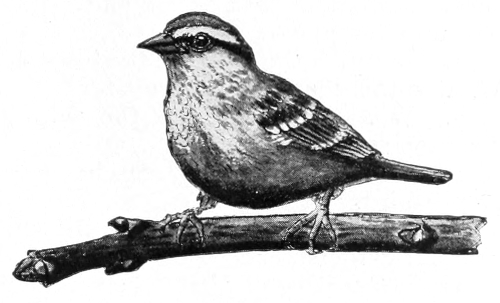
The chipping sparrow.
The chippy comes to us in April and usually raises two broods of from three to five “piggish” youngsters, which even after they are fully grown follow pertinaciously their tired and “frazzled out” parents and beg to be fed; the chippy parents evidently have no idea of discipline but indulge their teasing progeny until our patience, at least, is exhausted. The young differ from the parents in having streaked breasts and lacking the reddish crown. In the fall the chippy parents lose their red-brown caps and have streaked ones instead; and then they fare forth in flocks for a seed-harvest in the fields. Thereafter our chippy is a stranger to us; we do not know it in its new garb, and it dodges into the bushes as we pass, as if it had not tested our harmlessness on our own door-stone.
Reference—Wild Life, Ingersol, p. 132.
LESSON XX
Leading thought—The chipping sparrow is a cheerful and useful little neighbor. It builds a nest, lined with horsehair, in the shrubbery and vines about our homes and works hard in ridding our gardens of insect pests and seeds of weeds.
Methods—Begin this lesson with a nest of the chippy, which is so unmistakable that it may be identified when found in the winter. Make the study of this nest so interesting that the pupils will wait anxiously to watch for the birds which made it. As soon as the chippies appear, the questions should be asked, a few at a time, giving the children several weeks for the study.
The Nest
Observations—1. Where was this nest found? How high from the ground?
2. Was it under shelter? How was it supported?
3. Of what material is the outside of the nest? How is it fastened together? How do you suppose the bird wove this material together?
4. Of what material is the lining? Why is the bird that built this nest called the “hair bird?” From what animal do you think the lining of the nest came? How do you suppose the bird got it?
5. Do you think the nest was well hidden when the leaves were about it? Measure the nest across and also its depth; do you think the bird that made it is as large as the English sparrow?
The Bird
6. How can you tell the chippy from the English sparrow?
7. Describe in your note-book or orally the colors of the chippy as follows: beak, forehead, crown, marks above and through the eyes, cheeks, throat, breast, wings and tail. Note if the wings have whitish bars and how many.
8. Describe the shape of the beak as compared with that of the robin. What is this shaped bill meant for?
9. What is the food of the chippy? Why has it been called the doorstep-sparrow?
10. Note if the chippy catches flies or moths on the wing like the phœbe-bird.
11. Why should we protect the chippy and try to induce it to live near our gardens?
12. Does it run or hop when seeking food on the ground?
13. How early in the season does the chippy appear and where does it spend the winter?
14. Can you describe the chippy’s song? How do you think it won the name of chipping sparrow?
15. If you have the luck to find a pair of chippies nesting, keep a diary of your observations in your note-book covering the following points: Do both parents build the nest? How is the frame-work laid? How is the finishing done? The number and color of the eggs? Do both parents feed the young? How do young chippies act when they first leave the nest? How large are the young birds before the parents stop feeding them? What are the differences in color and markings between parents and young?
THE FIELD-SPARROW A bubble of music floats, the slope of the hillside over; A little wandering sparrow’s notes; and the bloom of yarrow and clover, And the smell of sweet-fern and the bayberry leaf, on his ripple of song are stealing, For he is a cheerful thief, the wealth of the fields revealing. One syllable, clear and soft as a raindrop’s silvery patter, Or a tinkling fairy-bell; heard aloft, in the midst of the merry chatter Of robin and linnet and wren and jay, one syllable, oft repeated; He has but a word to say, and of that he will not be cheated. The singer I have not seen; but the song I arise and follow The brown hills over, the pastures green, and into the sunlit hollow. With a joy that his life unto mine has lent, I can feel my glad eyes glisten, Though he hides in his happy tent, while I stand outside, and listen. This way would I also sing, my dear little hillside neighbor! A tender carol of peace to bring to the sunburnt fields of labor Is better than making a loud ado; trill on, amid clover and yarrow! There’s a heart-beat echoing you, and blessing you, blithe little sparrow! —Lucy Larcom.
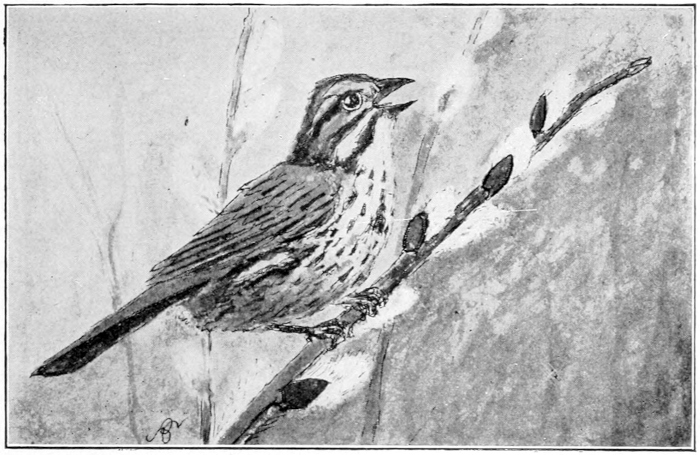
THE SONG SPARROW
Teachers’ Story
“He does not wear a Joseph’s coat of many colors, smart and gay His suit is Quaker brown and gray, with darker patches at his throat. And yet of all the well-dressed throng, not one can sing so brave a song. It makes the pride of looks appear a vain and foolish thing to hear His ‘Sweet, sweet, sweet, very merry cheer.’” “A lofty place he does not love, he sits by choice and well at ease In hedges and in little trees, that stretch their slender arms above The meadow brook; and then he sings till all the field with pleasure rings; And so he tells in every ear, that lowly homes to heaven are near In ‘Sweet, sweet, sweet, very merry cheer.’” —Henry Van Dyke.
Children should commit to memory the poem from which the above stanzas were taken; seldom in literature, have detailed accurate observation and poetry been so happily combined as in these verses. The lesson might begin in March when we are all listening eagerly for bird voices, and the children should be asked to look out for a little, brown bird which sings, “Sweet, sweet, sweet, very merry cheer,” or, as Thoreau interprets it, “Maids! Maids! Maids! Hang on the teakettle, teakettle-ettle-ettle.” In early childhood I learned to distinguish this sparrow by its “Teakettle” song. Besides this song, it has others quite as sweet; and when alarmed it utters a sharp “T’chink, t’chink.”
The song sparrow prefers the neighborhood of brooks and ponds which are bordered with bushes, and also the hedges planted by nature along rail or other field fences, and it has a special liking for the shrubbery about gardens. Its movements and flight are very characteristic; it usually sits on the tip-top of a shrub or low tree when it sings, but when disturbed never rises in the air but drops into a low flight and plunges into a thicket with a defiant twitch of the tail which says plainly, “find me if you can.”
The color and markings of this bird are typical of the sparrows. The head is a warm brown with a gray streak along the center of the crown and one above each eye, with a dark line through the eye. The back is brown with darker streaks. The throat is white with a dark spot on either side; the breast is white spotted with brown with a large, dark blotch at its very center; this breast blotch distinguishes this bird from all other sparrows. The tail and wings are brown and without buff or white bars or other markings. The tail is long, rounded and very expressive of emotions, and makes the bird look more slender than the English sparrow.
The nest is usually placed on the ground or in low bushes not more than five feet from the ground; it varies much in both size and material; it is sometimes constructed of coarse weeds and grasses; and sometimes only fine grass is used. Sometimes it is lined with hair, and again, with fine grass; sometimes it is deep, but occasionally is shallow. The eggs have a whitish ground-color tinged with blue or green, but are so blotched and marked with brown that they are safe from observation of enemies. The nesting season begins in May, and there are usually three and sometimes four broods; but so far as I have observed, a nest is never used for two consecutive broods. The song sparrow stays with us in New York State very late in the fall, and a few stay in sheltered places all winter. The quality in this bird which endears him to us all is the spirit of song which stays with him; his sweet trill may be heard almost any month of the year, and he has a charming habit of singing in his dreams, if sudden noise disturbs his slumber.
The song sparrow is not only the dearest of little neighbors, but it also works lustily for our good and for its own food at the same time. It destroys cutworms, plant-lice, caterpillars, canker-worms, ground beetles, grasshoppers and flies; in winter it destroys thousands of weed seeds, which otherwise would surely plant themselves to our undoing. Every boy and girl should take great pains to drive away stray cats and to teach the family puss not to meddle with birds; for cats are the worst of all the song sparrow’s enemies, destroying thousands of its nestlings every year.
LESSON XXI
The Song Sparrow
Leading thought—The beautiful song of this sparrow is heard earlier in the spring than the notes of bluebird or robin. The dark blotch in the center of its speckled breast distinguishes this sparrow from all others; it is very beneficial and should be protected from cats.
Methods—All the observations of the song sparrow must be made in the field, and they are easily made because the bird builds near houses, in gardens, and in the shrubbery. Poetry and other literature about the song sparrow should be given to the pupils to read or to memorize.
Observations—1. Have you noticed a little brown bird singing a very sweet song in the early spring? Did the song sound as if set to the words “Little Maid! Little Maid! Little Maid! Put on the teakettle, teakettle-ettle ettle?”
2. Where was this bird when you heard him singing? How high was he perched above the ground? What other notes did you hear him utter?
3. Describe the colors and markings of the song sparrow on head, back, throat, breast, wings and tail. Is this bird as large as the English sparrow? What makes it look more slim?
4. How can you distinguish the song sparrow from the other sparrows? When disturbed does it fly up or down? How does it gesture with its tail as it disappears in the bushes?
5. Where and of what material does the song sparrow build its nest?
6. What colors and markings are on the eggs? Do you think these colors and markings are useful in concealing the eggs when the mother bird leaves the nest?
7. How late in the season do you see the song sparrows and hear their songs? Does this bird, when disturbed, fly up or down?
8. How can we protect these charming little birds and induce them to build near our houses?
9. What is the food of the song sparrows and how do they benefit our fields and gardens?
Supplementary reading—Our Birds and Their Nestlings, Walker, pp. 43, 49, 50, 52; Second Book of Birds, Miller, p. 80; Birds of Song and Story, Grinnell, p. 73; The Song Sparrow, Van Dyke; Birds Through an Opera Glass, Merriam, p. 66; Field Book of Wild Birds, Mathews, p. 109; Wild Life, Ingersoll, p. 144; Audubon Leaflet No. 31.
THE SING-AWAY BIRD Have you ever heard of the Sing-away bird, That sings where the Runaway River Runs down with its rills from the bald-headed hills That stand in the sunshine and shiver? “Oh, sing! sing-away! sing-away!” How the pines and the birches are stirred By the trill of the Sing-away bird! And the bald-headed hills, with their rocks and their rills, To the tune of his rapture are ringing; And their faces grow young, all the gray mists among, While the forests break forth into singing. “Oh sing! sing-away! sing-away!” And the river runs singing along; And the flying winds catch up the song. ’Twas a white-throated sparrow, that sped a light arrow Of song from his musical quiver, And it pierced with its spell every valley and dell On the banks of the Runaway River. “Oh, sing! sing-away! sing-away!” The song of the wild singer had The sound of a soul that is glad. —Lucy Larcom.
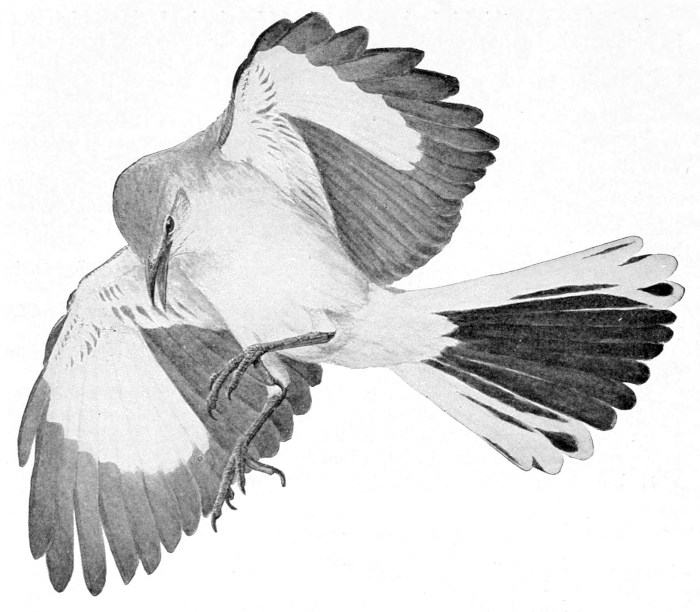
The mockingbird. Drawing by L. A. Fuertes.
THE MOCKINGBIRD
Teacher’s Story
Among all the vocalists in the bird world, the mockingbird is unrivaled in the variety and richness of his repertoire; and he has thus won his place among men, convincing many ignorant people by the means of his voice that a bird is good for something besides “victuals.” The mockingbirds go as far north as southern New England, but they are found at their best in the Southern States and in California. On the Gulf Coast the mockers begin singing in February; in warmer climates they sing almost the year through. During the nesting season, the father mocker is so busy with his cares and duties during the day, that he does not have time to sing and so devotes the nights to serenading; he may sing almost all night long if there is moonlight, but even on dark nights he gives now and then a happy, sleepy song. Not all mockingbirds are mockers; some sing their own song which is rich and beautiful; while others learn in addition, not only the songs of other birds, but their call notes as well. One authority noted a mocker which imitated the songs of twenty species of birds during a ten-minute performance. When singing, the mocker shows his relationship to the brown thrasher by lifting the head and depressing and jerking the tail. A good mocker will learn a tune, or parts of it, if it is whistled often enough in his hearing; he will also imitate other sounds and will often improve on a song he has learned from another bird by introducing frills of his own; when learning a song, he sits silent and listens intently, but will not try to sing it until it is learned.
Although the mockingbirds live in wild places, they prefer the haunts of men, taking up their home sites in gardens and cultivated grounds. Their flight is rarely higher than the tree tops and is decidedly jerky in character with much twitching of the long tail. For nesting sites, they choose thickets or the lower branches of trees, being especially fond of orange trees; the nest is usually from four to twenty feet from the ground. The foundation of the nest is made of sticks, grasses and weed stalks interlaced and crisscrossed; on these is built the nest of softer materials, such as, rootlets, horsehair, cotton, or in fact, anything suitable which is at hand. The nest is often in plain sight, since the mocker trusts to his strength as a fighter to protect it. He will attack cats with great ferocity and vanquish them; he will kill snakes; often good-sized black snakes have been known to end thus. The mocker, in making his attack, hovers above his enemy and strikes it at the back of the head or neck; he will also drive away birds much larger than himself.
The female lays from four to six pale greenish or bluish eggs blotched with brown and which hatch in about two weeks; then comes a period of hard work for the parents, as both are indefatigable in catching insects to feed the young. The mocker, by the way, is a funny sight when he is chasing a beetle on the ground, lifting his wings in a pugnacious fashion. The mockers often raise three broods a season; the young birds have spotted breasts, showing their relationship to the thrasher.
As a wooer, the mocker is a bird of much ceremony and dances into his lady’s graces. Mrs. F. W. Rowe, in describing this, says that the birds stand facing each other with heads and tails erect and wings drooping; “then the dance would begin, and this consisted of the two hopping sideways in the same direction and in rather a straight line a few inches at a time, always keeping directly opposite each other and about the same distance apart. They would chassez this way four or five feet, then go back over the same line in the same manner.” Mrs. Rowe also observed that the male mockers have hunting preserves of their own, not allowing any other males of their species in these precincts. The boundary was sustained by tactics of both offense and defense; but certain other species of birds were allowed to trespass without reproof.
Maurice Thompson describes in a delightful manner the “mounting” and “dropping” songs of the mocker which occur during the wooing season. The singer flits up from branch to branch of a tree, singing as he goes, and finally on the topmost bough gives his song of triumph to the world; then, reversing the process, he falls backward from spray to spray, as if drunk with the ecstasy of his own song, which is an exquisitely soft “gurgling series of notes, liquid and sweet, that seem to express utter rapture.”
The mockingbirds have the same colors in both sexes; the head is black, the back is ashy-gray; the tail and wings are so dark brown that they look black; the tail is very long and has the outer tail feathers entirely white and the two next inner ones are white for more than half their length; the wings have a strikingly broad, white bar, which is very noticeable when the bird is flying. The under parts and breast are grayish white; the beak and legs are blackish. The food of the mockingbirds is about half insects and half fruit. They live largely on the berries of the red cedar, myrtle and holly, and we must, confess are often too devoted to the fruits in our orchards and gardens; but let us put down to their credit that they do their best to exterminate the cotton boll caterpillars and moths, and also many other insects injurious to crops.
The mocker is full of tricks and is distinctly a bird of humor. He will frighten other birds by screaming like a hawk and then seem to chuckle over the joke.
Sidney Lanier describes him well.
Whate’er birds did or dreamed, this bird could say. Then down he shot, bounced airily along The sward, twitched in a grasshopper, made song Midflight, perched, prinked, and to his art again.
LESSON XXII
The Mocking Bird
Leading thought—The mockingbird is the only one of our common birds that sings regularly at night. It imitates the songs of other birds and has also a beautiful song of its own. When feeding their nestlings, the mockers do us great service by destroying insect pests.
Method—Studies of this bird are best made individually by the pupils through watching the mockers which haunt the houses and shrubbery. If there are mockingbirds near the schoolhouse the work can be done in the most ideal way by keeping records in the school of all the observations made by the pupils, thus bringing out an interesting mockingbird story. The experiment in teaching songs to the birds may best be made with pet mockers.
Observations—1. At what months of the year and for how many months does the mockingbird sing in this locality?
2. Does he sing only on moonlight nights? Does he sing all night?
3. Can you distinguish the true mockingbird song from the songs which he has learned from other birds? Describe the actions of a mocker when he is singing.
4. How many songs of other birds have you heard a mocker give and what are the names of these birds?
5. Have you ever taught a mocker a tune by whistling it in his presence? If so, tell how long before he learned it and how he acted while learning.
6. Describe the flight of the mockingbirds. Do they fly high in the air like crows?
7. Do these birds like best to live in wild places or about houses and gardens?
8. Where do they choose sites for their nests? Do they make an effort to hide the nest? If not, why?
9. Of what material is the nest made? How is it lined? How far from the ground is it placed?
10. What are the colors of the eggs? How many are usually laid? How long before they hatch?
11. Give instances of the parents’ devotion to the young birds.
12. Have you seen two mockingbirds dancing before each other just before the nesting season?
13. In the spring have you heard a mocker sing while mounting from the lower to the upper branches of a tree and then after pouring forth his best song fall backward with a sweet, gurgling song as if intoxicated with his music?
14. How many broods does a pair of mockers raise during one season? How does the color of the breast of the young differ from that of the parent?
15. How does the father bird protect the nestlings from other birds, cats and snakes?
16. Does the mocker select certain places for his own hunting grounds and drive off other mockers which trespass?
17. Describe the colors of the mockingbird as follows: Beak, head, back, tail, wings, throat, breast, under parts and feet.
18. What is the natural food of the mockingbirds and how do they benefit the farmer? How does the mocker act when attacking a ground beetle?
19. Have you seen mockingbirds frighten other birds by imitating the cry of a hawk? Have you seen them play other kinds of tricks?
20. Write a little story which shall include your own observations on the ways of pet mockingbirds which you have known.
Supplementary reading—True Bird Stories, Miller, p. 142; Bob, by Sidney Lanier; Second Book of Birds, Miller, p. 34; Birds of Song and Story, Grinnell, p. 29; Stories About Birds, Kirby, p. 94.
“Soft and low the song began: I scarcely caught it as it ran Through the melancholy trill of the plaintive whip-poor-will, Through the ringdove’s gentle wail, chattering jay and whistling quail, Sparrow’s twitter, catbird’s cry, redbird’s whistle, robin’s sigh; Blackbird, bluebird, swallow, lark, each his native note might mark. Oft he tried the lesson o’er, each time louder than before; Burst at length the finished song, loud and clear it poured along; All the choir in silence heard, hushed before this wondrous bird. All transported and amazed, scarcely breathing, long I gazed. Now it reached the loudest swell; lower, lower, now it fell,— Lower, lower, lower still, scarce it sounded o’er the rill.” —Joseph Rodman Drake.
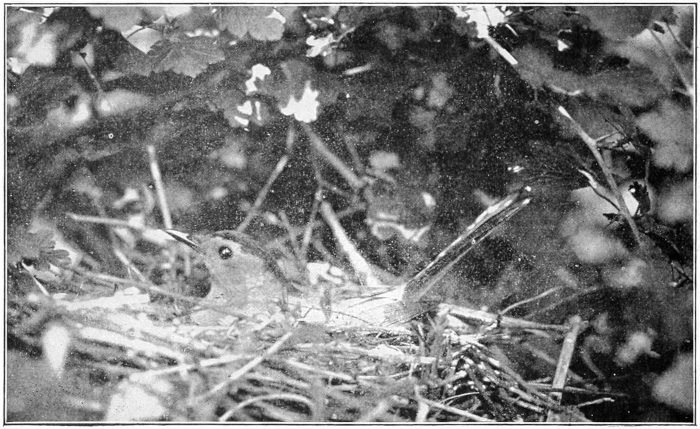
Catbird on nest. Photo by Robert Matheson.
THE CATBIRD
Teacher’s Story
“The Catbird sings a crooked song, in minors that are flat, And, when he can’t control his voice he mews just like a cat, Then nods his head and whisks his tail and lets it go at that.” —Oliver Davie.
As a performer, the catbird distinctly belongs to the vaudeville, even going so far as to appear in slate-colored tights. His specialties range from the most exquisite song to the most strident of scolding notes; his nasal “n-y-a-a-h, n-y-a-a-h” is not so very much like the cat’s mew after all, but when addressed to the intruder it means “get out;” and not in the whole gamut of bird notes is there another which so quickly inspires the listener with this desire. I once trespassed upon the territory of a well-grown catbird family and the squalling that ensued was ear-splitting; as I retreated, the triumphant youngsters followed me for a few rods with every sign of triumph in their actions and voices; they obviously enjoyed my apparent fright. The catbirds have rather a pleasant “cluck, cluck” when talking to each other, hidden in the bushes, and they also have a variety of other notes. The true song of the catbird, usually given in the early morning, is very beautiful. Mr. Mathews thinks it is a medley gathered from other birds, but it seems to me very individual. However, true to his vaudeville training, this bird is likely to introduce into the middle or at the end of his exquisite song some phrase that suggests his cat call. He is, without doubt, a true mocker and will often imitate the robin’s song, and also if opportunity offers learns to converse fluently in chicken language. One spring morning, I heard outside my window the mellow song of the cardinal, which is a rare visitor in New York, but there was no mistaking the “tor-re-do, tor-re-do.” I sprang from my bed and rushed to the window only to see a catbird singing the cardinal song, and thus telling me that he had come from the sunny South and the happy companionship of these brilliant birds. Often when the catbird is singing, he sits on the topmost spray of some shrub lifting his head and depressing his tail, like a brown thrasher; and again, he sings completely hidden in the thicket.