Part 2 — V. MAMMAL STUDY
Reading edition
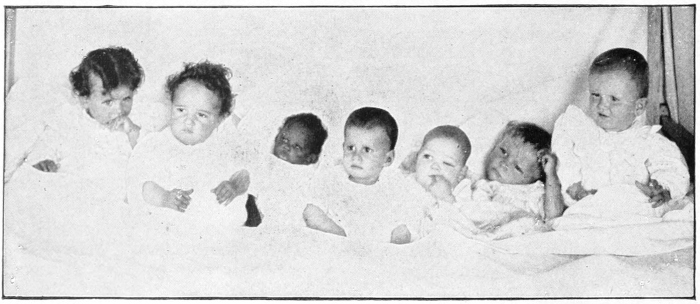
OR some inexplicable reason, the word animal, in common parlance, is restricted to the mammals. As a matter of fact, the bird, the fish, the insect and the snake have as much right to be called animals as has the squirrel or the deer. And while I believe that much freedom in the matter of scientific nomenclature is permissible in nature-study, I also believe that it is well for the child to have a clearly defined idea of the classes into which the animal kingdom is divided; and I would have him gain this knowledge by noting how one animal differs from another rather than by studying the classification of animals in books. He sees that the fish differs in many ways from the bird and that the toad differs from the snake; and it will be easy for him to grasp the fact that the mammals differ from all other animals in that the young are nourished by milk produced for this purpose in the breasts of the mother; when he understands this, he can comprehend how such diverse forms as the whale, the cow, the bat, and human beings are akin.
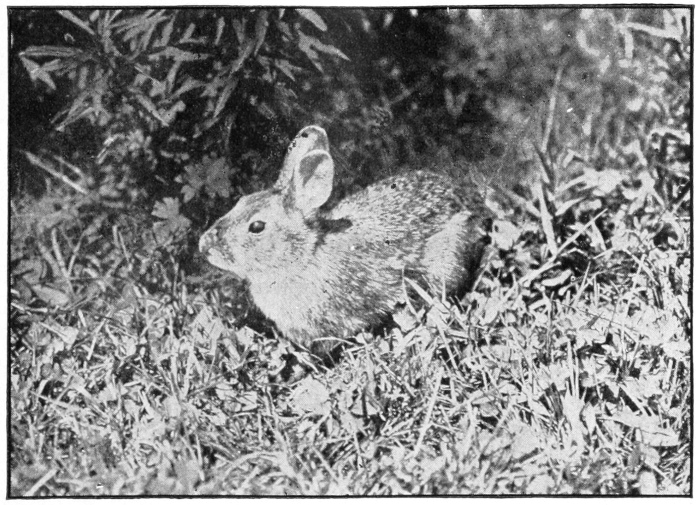
A cotton-tail rabbit.
THE COTTON-TAIL RABBIT
Teacher’s Story
“The Bunnies are a feeble folk whose weakness is their strength. To shun a gun a Bun will run to almost any length.” —Oliver Herford.
T is well for Molly Cotton-tail and her family that they have learned to shun more than guns for almost every predatory animal and bird makes a dinner of them on every possible occasion. But despite these enemies, moreover, with the addition of guns, men and dogs, the cotton-tail lives and flourishes in our midst. A “Molly” raised two families last year in a briar-patch back of our garden on the Cornell Campus, where dogs of many breeds abound; and after each fresh fall of snow this winter we have been able to trace our bunny neighbors in their night wanderings around the house, beneath the spruces and in the orchard. The track consists of two long splashes, paired, and between and a little behind them, two smaller ones; the rabbit uses its front feet as a boy uses a vaulting pole and lands both hind feet on each side and ahead of them; owing to the fact that the bottoms of the feet are hairy the print is not clear-cut. When the rabbit is not in a hurry it has a peculiar lope, but when frightened it makes long jumps. The cotton-tails are night wanderers and usually remain hidden during the day. In summer, they feed on clover or grass or other juicy herbs and show a fondness for sweet apples and fresh cabbage; in our garden last summer Molly was very considerate. She carefully pulled all the grass out of the garden-cress bed, leaving the salad for our enjoyment. In winter, the long, gnawing teeth of the cotton-tail are sometimes used to the damage of fruit trees and nursery stock since the rabbits are obliged to feed upon bark in order to keep alive.
The long, strong hind legs and the long ears tell the whole bunny story. Ears to hear the approach of the enemy, and legs to propel the listener by long jumps to a safe retreat. The attitude of the ears is a good indication of the bunny’s state of mind; if they are set back to back and directed backward, they indicate placidity, but a placidity that is always on guard; if lifted straight up they signify attention and anxiety; if one is bent forward and the other backward the meaning is: “Now just where did that sound come from?” When running or when resting in the form, the ears are laid back along the neck. When the cotton-tail stands up on its haunches with both ears erect, it looks very tall indeed.
Not only are the ears always alert, but also the nose; the nostrils are partially covered and in order to be always sure of getting every scent they wabble constantly, the split upper lip aiding in this performance; when the rabbit is trying to get a scent it moves its head up and down in a sagacious, apprehensive manner.
The rabbit has an upper and lower pair of incisors like other rodents, but on the upper jaw there is a short incisor on each side of the large teeth; these are of no use now but are inherited from some ancestor which found them useful. There are at the back of each side of the upper jaw six grinding teeth, and five on each side of the lower jaw. The split upper lip allows the free use of the upper incisors. The incisors are not only used for taking the bark from trees, but also for cutting grass and other food. The rabbit has a funny way of taking a stem of grass or clover at the end and with much wabbling of lips, finally taking it in, meanwhile chewing it with a sidewise motion of the jaws. The rabbits’ whiskers are valuable as feelers, and are always kept on the qui vive for impressions; when two cotton-tails meet each other amicably, they rub whiskers together. The eyes are large and dark and placed on the bulge at the side of the head, so as to command the view both ways. Probably a cotton-tail winks, but I never caught one in the act.
The strong hind legs of the rabbit enable it to make prodigious jumps, of eight feet or more; this is a valuable asset to an animal that escapes its enemies by running. The front feet are short and cannot be turned inward like those of the squirrel, to hold food. There are five toes on the front feet, and four on the hind feet; the hair on the bottom of the feet is a protection, much needed by an animal which sits for long periods upon the snow. When sleeping, the front paws are folded under and the rabbit rests on the entire hind foot, with the knee bent, ready for a spring at the slightest alarm; when awake, it rests on the hind feet and front toes; and when it wishes to see if the coast is clear, it rises on its hind feet, with front paws drooping.
The cotton-tail has a color well calculated to protect it from observation; it is brownish-gray on the back and a little lighter along the sides, grayish under the chin and whitish below; the ears are edged with black, and the tail when raised shows a large, white fluff at the rear. The general color of the rabbit fits in with natural surroundings; since the cotton-tail often escapes its enemies by “freezing,” this color makes the scheme work well. I once saw a marsh hare, on a stone in a brook, freezing most successfully. I could hardly believe that a living thing could seem so much like a stone; only its bright eyes revealed it to us.
The rabbit cleans itself in amusing ways. It shakes its feet, one at a time, with great vigor and rapidity to get off the dirt and then licks them clean. It washes its face with both front paws at once. It scratches its ear with the hind foot, and pushes it forward so that it can be licked; it takes hold of its fur with its front feet to pull it around within reach of the tongue.
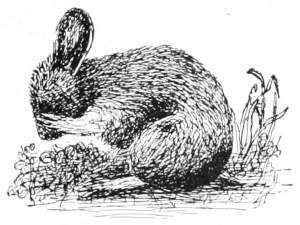
Washing up.
The cotton-tail does not dig a burrow, but sometimes occupies the deserted burrow of a woodchuck or skunk. Its nest is called a “form,” which simply means a place beneath a cover of grass or briars, where the grass is beaten down or eaten out for a space large enough for the animal to sit. The mother makes a soft bed for the young, using grass and her own hair for the purpose; and she constructs a coarse felted coverlet, under which she tucks her babies with care, every time she leaves them. Young rabbits are blind at first, but when about three weeks old, are sufficiently grown to run quite rapidly. Although there may be five or six in a litter, yet there are so many enemies that only a few escape.
Fox, mink, weasel, hawk, owl and snake all relish the young cotton-tail if they can get it. Nothing but its runways through the briars can save it. These roads wind in and out and across, twisting and turning perplexingly; they are made by cutting off the grass stems, and are just wide enough for the rabbit’s body. However, a rabbit has weapons and can fight if necessary; it leaps over its enemy, kicking it on the back fiercely with its great hind feet. Mr. Seton tells of this way of conquering the black snake, and Mr. Sharp saw a cat completely vanquished by the same method. The rabbit can also bite, and when two males are fighting, they bite each other savagely. Mr. E. W. Cleeves told me of a Belgian doe which showed her enmity to cats in a peculiar way. She would run after any cats that came in sight, butting them like a billy-goat. The cats soon learned her tricks, and would climb a tree as soon as they caught sight of her. The rabbit’s sound of defiance, is thumping the ground with the strong hind foot. Some have declared that the front feet are used also for stamping; although I have heard this indignant thumping more than once, I could not see the process. The cotton-tail is a hare, while the common domestic rabbit is a true rabbit. The two differ chiefly in the habits of nesting; the hares rest and nest in forms, while the rabbit makes burrows, digging rapidly with the front feet.

Rabbit tracks.
Not the least of tributes to the rabbit’s sagacity, are the negro folk-stories told by Uncle Remus, wherein Bre’r Rabbit, although often in trouble, is really the most clever of all the animals. I have often thought when I have seen the tactics which rabbits have adopted to escape dogs, that we in the North have under-rated the cleverness of this timid animal. In one instance at least that came under our observation, a cotton-tail led a dog to the verge of a precipice, then doubled back to safety, while the dog went over, landing on the rocks nearly three hundred feet below.
LESSON LIII
The Cotton-tail Rabbit
Leading thought—The cotton-tail thrives amid civilization; its color protects it from sight; its long ears give it warning of the approach of danger; and its long legs enable it to run by swift, long leaps. It feeds upon grasses, clover, vegetables and other herbs.
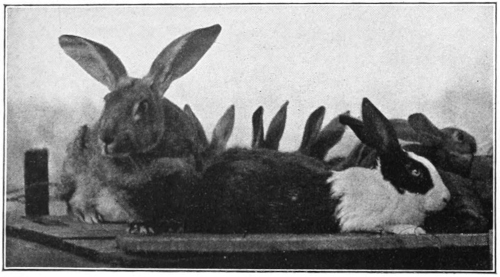
Belgian hares and Dutch rabbit.
Method—This study may be begun in the winter, when the rabbit tracks can be observed and the haunts of the cotton-tail discovered. If caught in a box trap, the cotton-tail will become tame if properly fed and cared for, and may thus be studied at close range. The cage I have used for rabbits as thus caught, is made of wire screen, nailed to a frame, making a wire-covered box, two feet high and two or three feet square, with a door at one side and no bottom. It should be placed upon oil-cloth or linoleum, and thus may be moved to another carpet when the floor needs cleaning. If it is impossible to study the cotton-tail, the domestic rabbit may be used instead.
Observations—1. What sort of tracks does the cotton-tail make in the snow? Describe and sketch them. Where do you find these tracks? How do you know which way the rabbit was going? Follow the track and see if you can find where the rabbit went. When were these tracks made, by night or by day? What does the rabbit do during the day? What does it find to eat during the winter? How are its feet protected so that they do not freeze in the snow?
2. What are the two most noticeable peculiarities of the rabbit? Of what use are such large ears? How are the ears held when the rabbit is resting? When startled? When not quite certain about the direction of the noise? Explain the reasons for these attitudes. When the rabbit wishes to make an observation to see if there is danger coming, what does it do? How does it hold its ears then? How are the ears held when the animal is running?
3. Do you think the rabbit has a keen sense of smell? Describe the movements of the nostrils and explain the reason. How does it move its head to be sure of getting the scent?
4. What peculiarity is there in the upper lip? How would this be an aid to the rabbit when gnawing? Describe the teeth; how do these differ from those of the mouse or squirrel? Of what advantage are the gnawing teeth to the rabbit? How does it eat a stem of grass? Note the rabbit’s whiskers. What do you think they are used for?
5. Describe the eyes. How are they placed so that the rabbit can see forward and backward? Do you think that it sleeps with its eyes open? Does it wink?
6. Why is it advantageous to the rabbit to have such long, strong, hind legs? Compare them in size with the front legs. Compare the front and hind feet. How many toes on each? How are the bottoms of the feet protected? Are the front feet ever used for holding food like the squirrel’s? In what position are the legs when the rabbit is resting? When it is standing? When lifted up for observation?
7. How does the cotton-tail escape being seen? Describe its coat. Of what use is the white fluff beneath the tail? Have you ever seen a wild rabbit “freeze”? What is meant by freezing and what is the use of it?
8. In making its toilet how does the rabbit clean its face, ears, feet, and fur?
9. What do the cotton-tails feed upon during the summer? During the winter? Do they ever do much damage?
10. Describe the cotton-tail’s nest. What is it called? Does it ever burrow in the ground? Does it ever use a second-hand burrow? Describe the nest made for the young by the mother. Of what is the bed composed? Of what is the coverlet made? What is the special use of the coverlet? How do the young cotton-tails look? How old are they before they are able to take care of themselves?
11. What are the cotton-tail’s enemies? How does it escape them? Have you ever seen the rabbit roads in a briar patch? Do you think that a dog or fox could follow them? Do rabbits ever fight their enemies? If so, how? How do they show anger? Do they stamp with the front or the hind foot?
12. Tell how the cotton-tail differs in looks and habits from the common tame rabbit. How do the latter dig their burrows? How many breeds of tame rabbits do you know?
13. Write or tell stories on the following topics: “A Cotton-tail’s Story of its Own Life Until it is a Year Old;” “The Jack-rabbit of the West;” “The Habits of the White Rabbit or Varying Hare;” “The Rabbit in Uncle Remus’ Tales.”
Supplementary reading—“Raggylug” and “Little War Horse,” Thompson-Seton; Squirrels and Other Fur Bearers, Burroughs; Watchers in the Woods, Sharp; American Animals, Stone & Cram; Familiar Life in Field and Forest, Mathews; Sharp Eyes, Gibson; Neighbors with Claws and Hoofs, Johonnot; True Tales of Birds and Beasts, Jordan; Uncle Remus Stories, especially The Tar Baby, which emphasizes the fact that the rabbits’ runways are in the protecting briar-patch.
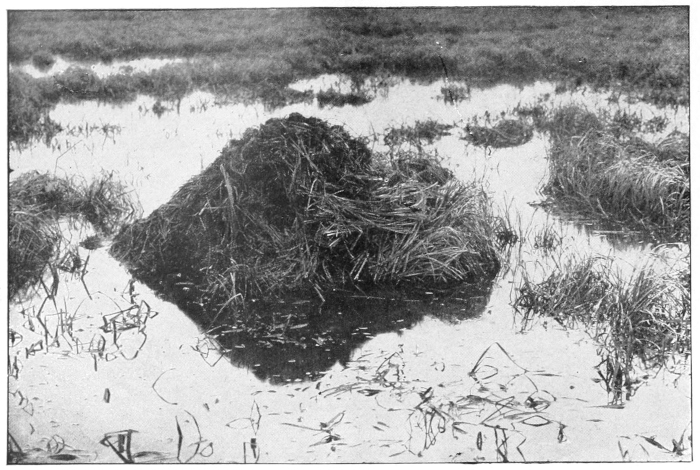
Winter lodge of muskrats.
Photo by Silas Lottridge.
THE MUSKRAT
Teacher’s Story
“Having finished this first course of big-neck clams, they were joined by a third muskrat, and, together, they filed over the bank and down into the meadow. Shortly two of them returned with great mouthfuls of the mud-bleached ends of calamus-blades. Then followed the washing.
They dropped their loads upon the plank, took up the stalks, pulled the blades apart, and soused them up and down in the water, rubbing them with their paws until they were as clean and white as the whitest celery one ever ate. What a dainty picture! Two little brown creatures, humped on the edge of a plank, washing calamus in moonlit water!”—Dallas Lore Sharp.
RACKING is a part of every boy’s education who aspires to a knowledge of wood lore; and a boy with this accomplishment is sure to be looked upon with great admiration by other boys, less skilled in the interpretation of that writing made by small feet, on the soft snow or on the mud of stream margins. To such a boy, the track of the muskrat is well known, and very easily recognized.
The muskrat is essentially a water animal, and therefore its tracks are to be looked for along the edges of ponds, streams or in marshes. Whether the tracks are made by walking or jumping, depends upon the depth of the snow or mud; if it is deep, the animal jumps, but in shallow snow or mud, it simply runs along. The tracks show the front feet to be smaller than the hind ones. The muskrat track is, however, characterized by the tail imprint. When the creature jumps through the snow, the mark of the tail follows the paired imprints of the feet; when it walks, there is a continuous line made by this strong, naked tail. This distinguishes the track of the muskrat from that of the mink, as the bushy tail of the latter does not make so distinct a mark. Measuring the track, is simply a device for making the pupils note its size and shape more carefully. The tracks may be looked for during the thaws of March or February, when the muskrats come out of the water to seek food.
In appearance the muskrat is peculiar. The body is usually about a foot in length and the tail about eight inches. The body is stout and thickset, the head is rounded and looks like that of a giant meadow mouse; the eyes are black and shining; the ears are short and close to the head; the teeth, like those of other rodents, consist of a pair of front teeth on each jaw, then a long, bare space and four grinders on each side. There are long sensitive hairs about the nose and mouth, like the whiskers of mice.
The muskrat’s hind legs are much larger and stronger than the front ones; and too, the hind feet are much longer than the front feet and have a web between the toes; there are also stiff hairs which fill the space between the toes, outside the web, thus making this large hind foot an excellent swimming organ. The front toes are not webbed and are used for digging. The claws are long, stout and sharp. The tail is long, stout and flattened at the sides; it has little or no fur upon it but is covered with scales; it is used as a scull and also as a rudder when the muskrat is swimming.
The muskrat’s outer coat consists of long, rather coarse hairs; its under coat is of fur, very thick and fine, and although short, it forms a waterproof protection for the body of the animal. In color, the fur is dark brown above with a darker streak along the middle of the back; beneath, the body is grayish changing to whitish on the throat and lips, with a brown spot on the chin. In preparing the pelts for commercial use, the long hairs are plucked out leaving the soft, fine under coat, which is dyed and sold under the name of “electric seal.”
The muskrat is far better fitted by form, for life in the water than upon the land. Since it is heavy-bodied and short-legged, it cannot run rapidly but its strong, webbed hind feet are most efficient oars, and it swims rapidly and easily; for rudder and propeller the strong, flattened tail serves admirably, while the fine fur next the body is so perfectly waterproof that, however much the muskrat swims or dives, it is never wet. It is a skillful diver and can stay under water for several minutes; when swimming, its nose and sometimes the head and the tip of the tail appear on the surface of the water.
The food of muskrats is largely roots, especially those of the sweet flag and the yellow lily. They also feed on other aquatic plants and are fond of the fresh-water shell-fish. Mr. Sharp tells us, in one of his delightful stories, how the muskrats wash their food by sousing it up and down in water many times before eating it. Often, a muskrat chooses some special place upon the shore which it uses for a dining-room, bringing there and eating pieces of lily root or fresh-water clams, and leaving the debris to show where it habitually dines. It does most of its hunting for food at night, although sometimes it may be seen thus employed during the day.
The winter lodge of the muskrat is a most interesting structure. A foundation of tussocks of rushes, in a stream or shallow pond, is built upon with reeds plastered with mud, making a rather regular dome which may be nearly two or three feet high; or, if many-chambered, it may be a grand affair of four or five feet elevation; but it always looks so much like a natural hummock that the eye of the uninitiated never regards it as a habitation. Always beneath this dome and above the water line, is a snug, covered chamber carpeted with a soft bed of leaves and moss, which has a passage leading down into the water below, and also has an air-hole for ventilation. In these cabins, closely cuddled together, three or four in a chamber, the muskrats pass the winter. After the pond is frozen they are safe from their enemies and are always able to go down into the water and feed upon the roots of water plants. These cabins are sometimes built in the low, drooping branches of willows or on other objects.
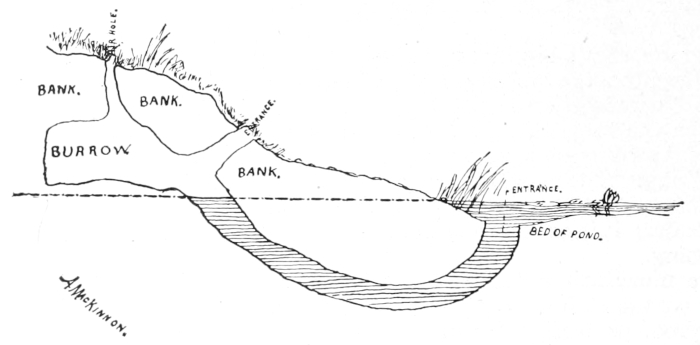
A muskrat’s summer home.
Drawn by A. MacKinnon, a boy of 13 years.
Whether the muskrat builds itself a winter lodge or not, depends upon the nature of the shore which it inhabits; if it is a place particularly fitted for burrows, then a burrow will be used as a winter retreat; but if the banks are shallow, the muskrats unite in building cabins. The main entrance to the muskrat burrow is always below the surface of the water, the burrow slanting upward and leading to a nest well lined, which is above the reach of high water; there is always an air hole above, for ventilating this nest, and there is also often a passage, with a hidden entrance, leading out to dry land.
The flesh of the muskrat is delicious, and therefore the animal has many enemies; foxes, weasels, dogs, minks and also hawks and owls prey upon it. It escapes the sight of its enemies as does the mouse, by having the color of its fur not noticeable; when discovered, it escapes its enemies by swimming, although when cornered, it is courageous and fights fiercely, using its strong incisors as weapons. In winter, it dwells in safety when the friendly ice protects it from all its enemies except the mink; but it is exposed to great danger when the streams break up in spring, for it is then often driven from its cabin by floods, and preyed upon while thus helplessly exposed. The muskrat gives warning of danger to its fellows by splashing the water with its strong tail.
It is called muskrat because of the odor, somewhat resembling musk, which it exhales from two glands on the lower side of the body between the hind legs; these glands may be seen when the skin is removed, which is the too common plight of this poor creature, since it is hunted mercilessly for its pelt.
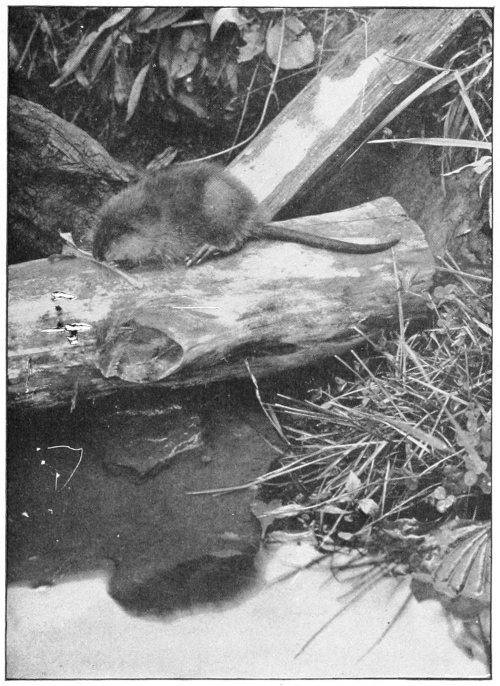
The muskrat.
Photo by Silas Lottridge.
The little muskrats are born in April and there are usually from six to eight in a litter. Another litter may be produced in June or July and a third in August or September. It is only thus, by rearing large families often, that the muskrats are able to hold their own against the hunters and trappers and their natural enemies.
References—Wild Animals, Stone & Cram; A Watcher in the Woods, Sharp; Wild Life, Ingersoll, Farmers’ Bulletin No. 396, U. S. Dept. of Agriculture.
LESSON LIV
The Muskrat
Leading thought—The muskrat, while a true rodent, is fitted for life in the water more than for life upon the land. Its hind feet are webbed for use as oars and its tail is used as a rudder. It builds lodges of mud, cat-tails and rushes in which it spends the winter.
Method—It might be well to begin this work by asking for observations on the tracks of the muskrat which may be found about the edges of almost any creek, pond or marsh. If there are muskrat lodges in the region they should be visited and described. For studying the muskrat’s form a live muskrat in captivity is almost necessary. If one is trapped with a “figure four” it will not be injured and it may be made more or less tame by feeding it with sweet apples, carrots and parsnips. The pupils can thus study it at leisure although they should not be allowed to handle the creature as it inflicts very severe wounds and is never willing to be handled. If a live muskrat cannot be obtained perhaps some hunter in the neighborhood will supply a dead one for this observation lesson.
While studying the muskrat the children should read all the stories of beavers which are available as the two animals are very much alike in their habits.
Observations—1. In what locality have you discovered the tracks of the muskrat? Describe its general appearance. Measure the muskrat’s track as follows: (a) Width and length of the print of one foot; (b) the width between the prints of the two hind feet; (c) the length between the prints made by the hind feet in several successive steps or jumps.
2. Was the muskrat’s track made when the animal was jumping or walking? Can you see in it a difference in the size of the front and hind feet? Judging from the track, where do you think the muskrat came from? What do you think it was hunting for?
3. What mark does the tail make in the snow or mud? Judging by its imprint, should you think the muskrat’s tail was long or short, bare or brushy, slender or strong?
4. How long is the largest muskrat you ever saw? How much of the whole length is tail? Is the general shape of the body short and heavy or long and slender?
5. Describe the muskrat’s eyes, ears and teeth. For what are the teeth especially fitted? Has the muskrat whiskers like mice and rats?
6. Compare the front and hind legs as to size and shape. Is there a web between the toes of the hind feet? What does this indicate? Do you think that the muskrat is a good swimmer?
7. Describe the muskrat fur. Compare the outer and under coat. What is its color above and below? What is the name of muskrat fur in the shops?
8. Describe the tail. What is its covering? How is it flattened? What do you think this strong, flattened tail is used for?
9. Do you think the muskrat is better fitted to live in the water than on land? How is it fitted to live in the water in the following particulars: Feet? Tail? Fur?
10. How much of the muskrat can you see when it is swimming? How long can it stay under water when diving?
11. What is the food of the muskrat? Where does it find it? How does it prepare the food for eating? Does it seek its food during the night or day? Have you ever observed the muskrat’s dining room? If so, describe it.
12. Describe the structure of the muskrat’s winter lodge, or cabin, in the following particulars: Its size. Where built? Of what material? How many rooms in it? Are these rooms above or below the water level? Of what is the bed made? How is the nest ventilated? How is it arranged so that the entrance is not closed by the ice? Is such a home built by one or more muskrats? How many live within it? Do the muskrats always build these winter cabins? What is the character of the shores where they are built?
13. Describe the muskrat’s burrow in the bank in the following particulars: Is the entrance above or below water? Where and how is the nest made? Is it ventilated? Does it have a back door leading out upon the land?
14. What are the muskrat’s enemies? How does it escape them? How does it fight? Is it a courageous animal? How does the muskrat give warning to its fellows when it perceives danger? At what time of year is it comparatively safe? At what time is it exposed to greatest danger?
15. Why is this animal called muskrat? Compare the habits of muskrats with those of beaver and write an English theme upon the similarity of the two.
16. At what time of year do you find the young muskrats? How many in a litter?
17. Read Farmers’ Bulletin No. 396 of the U. S. Dept. of Agriculture and write an English theme on the destructive habits of muskrats and the economic uses of these animals.
Supplementary reading—Familiar Wild Animals, Lottridge; Little Beasts of Field and Wood, Cram; Squirrels and other Fur-bearers, Burroughs; “The Builders” in Ways of Wood Folk, Long.
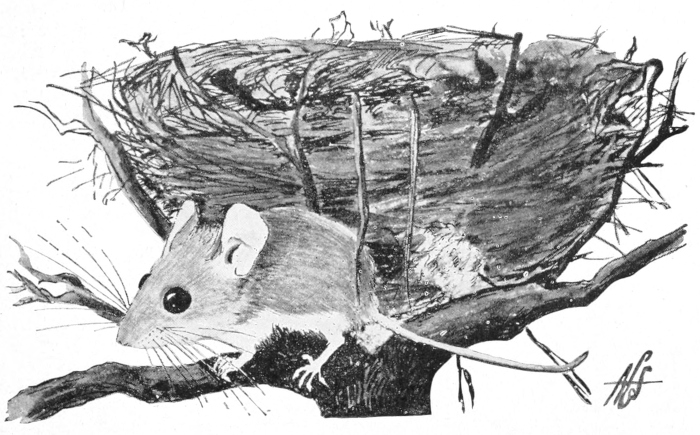
The white-footed, or deer, mouse.
Drawn by Anna Stryke.
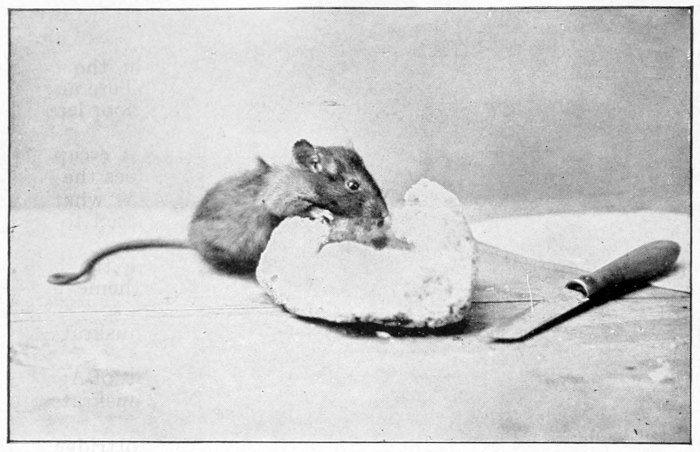
The house mouse feeds upon almost anything which people like to eat.
THE HOUSE MOUSE
Teacher’s Story
Somewhere in the darkness a clock strikes two; And there is no sound in the sad old house, But the long veranda dripping with dew, And in the wainscot—a mouse. —Bret Harte.
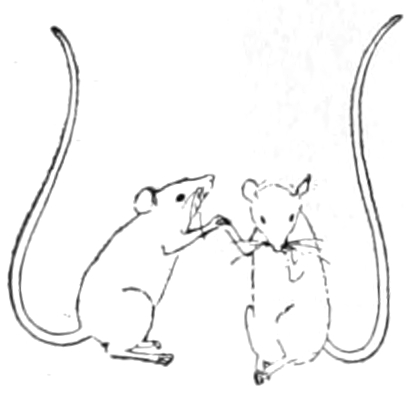
ERE mouse-gray a less inconspicuous color, there would be fewer mice; when a mouse is running along the floor, it is hardly discernible, it looks so like a flitting shadow; if it were black or white or any other color, it would be more often seen and destroyed. Undoubtedly, it is owing to the fact that its soft fur has this shadowy color, that this species has been able to spread over the world.
At first glance one wonders what possible use a mouse can make of a tail which is as long as its body, but a little careful observation will reveal the secret. The tail is covered with transverse ridges and is bare save for sparse hairs, except toward the tip. Dr. Ida Reveley first called my attention to the fact that the house mouse uses its tail in climbing. I verified this interesting observation, and found that my mouse used the tail for aid when climbing a string. He would go up the string, hand over hand, like a sailor, then in trying to stretch to the edge of his jar, he invariably wound his tail about the string two or three times, and hanging to the string with the hind feet and tail, would reach far out with his head and front feet. Also, when clinging to the edge of the cover of the jar, he invariably used his tail as a brace against the side of the glass, so that it pressed hard for more than half its length. Undoubtedly the tail is of great service when climbing up the sides of walls.
The tail is also of some use, when the mouse jumps directly upwards. The hind legs are very much longer and stronger than the front legs. The hind feet are also much longer and larger than the front feet; and although the mouse, when it makes its remarkable jumps, depends upon its strong hind legs, I am sure that often the tail is used as a brace to guide and assist the leap. The feet are free from hairs but are downy; the hind foot has three front toes, a long toe behind on the outside and a short one on the inside. The claws are fairly long and very sharp so that they are able to cling to almost anything but glass. When exploring, a mouse stands on its hind feet, folding its little front paws under its chin while it reaches up ready to catch anything in sight; it can stretch up to an amazing height. It feeds upon almost anything which people like to eat and, when eating, holds its food in its front paws like a squirrel.
The thin, velvety ears are flaring cornucopias for taking in sound; the large, rounded outer ear can be moved forward or back to test the direction of the noise. The eyes are like shining, black beads; and if a mouse can wink, it does it so rapidly as not to be discernible. The nose is long, inquisitive, and always sniffing for new impressions. The whiskers are delicate and probably sensitive. The mouth is furnished with two long, curved gnawing teeth at the front of each jaw, then a bare space, and four grinding teeth on each side, above and below, like the teeth of woodchucks and other rodents. The gnawing teeth are very strong and enable the mouse to gnaw through board partitions and other obstacles.
The energy with which the mouse cleans itself is inspiring to behold. It nibbles its fur and licks it with fervor, reaching around so as to get at it from behind, and taking hold with its little hands to hold firm while it cleans. When washing its face and head, it uses both front feet, licking them clean and rubbing them both simultaneously from behind the ears down over the face. It takes its hind foot in both front feet and nibbles and licks it. It scratches the back of its head with its hind foot.
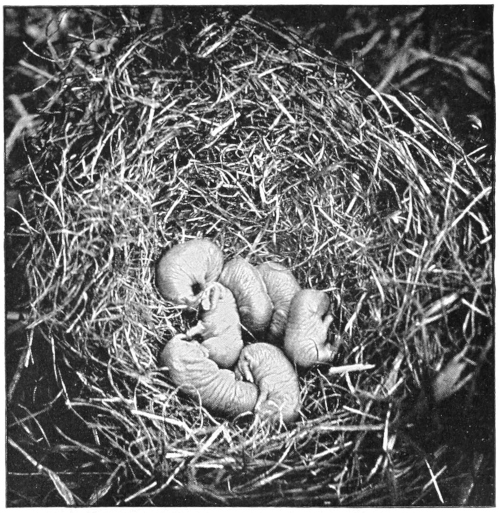
Young mice, blind, pink and hairless.
Young mice are small, downy, pink and blind when born. The mother makes for them a nice, soft nest of pieces of cloth, paper, grass, or whatever is at hand; the nest is round like a ball and at its center is nestled the family. Mice living in houses, have runways between the plaster and the outside, or between ceiling and floor. In winter they live on what food they can find, and upon flies or other insects hibernating in our houses. The house mice sometimes live under stacks of corn or grain in the fields, but usually confine themselves to houses or barns. They are thirsty little fellows and they like to make their nests within easy reach of water. Our house mice came from ancestors which lived in Asia originally; they have always been great travelers and they have followed men wherever they have gone, over the world. They came to America on ships with the first explorers and the Pilgrim fathers. They now travel back and forth, crossing the ocean in ships of all sorts. They also travel across the continent on trains. Wherever our food is carried they go; and the mouse, which you see in your room one day, may be a thousand miles away within a week. They are clever creatures, and learn quickly to connect cause and effect. For two years, I was in an office in Washington, and as soon as the bell rang for noon, the mice would appear instantly, hunting waste-baskets for scraps of lunch. They had learned to connect the sound of the bell with food.
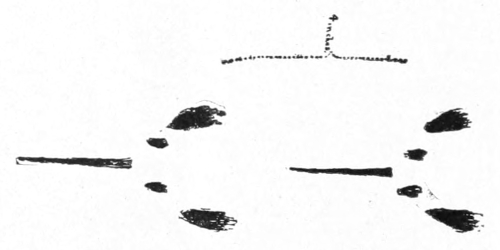
Track of white-footed mouse.
Notice tail-track.
Of all our wild mice, the white-footed or deer mouse is the most interesting and attractive. It is found almost exclusively in woods and is quite different in appearance from other mice. Its ears are very large; its fur is fine and beautiful and a most delicate gray color. It is white beneath the head and under the sides of the body. The feet are pinkish, the front paws have short thumbs, while the hind feet are very much longer and have a long thumb looking very much like an elfin hand in a gray-white silk glove. On the bottom of the feet are callous spots which are pink and serve as foot pads. It makes its nest in hollow trees and stores nuts for winter use. We once found two quarts of shelled beech nuts in such a nest. It also likes the hips of the wild rose and many kinds of berries; it sometimes makes its summer home in a bird’s nest, which it roofs over to suit itself. The young mice are carried, hanging to the mother’s breasts. As an inhabitant of summer cottages, white-foot is cunning and mischievous; it pulls cotton out of quilts, takes covers off of jars, and as an explorer, is equal to the squirrel. I once tried to rear some young deer mice by feeding them warm milk with a pipette; although their eyes were not open, they invariably washed their faces after each meal, showing that neatness was bred in the bone. This mouse has a musical voice and often chirps as sweetly as a bird. Like the house mouse it is more active at night.
The meadow mouse is the one that makes its run-ways under the snow, making strange corrugated patterns over the ground which attract our attention in spring. It has a heavy body, short legs, short ears and short tail. It is brownish or blackish in color. It sometimes digs burrows straight into the ground, but more often makes its nest beneath sticks and stones or stacks of corn. It is the nest of this field mouse which the bumblebee so often takes possession of, after it is deserted. The meadow mouse is a good fighter, sitting up like a woodchuck and facing its enemy bravely. It needs to be courageous, for it is preyed upon by almost every creature that feeds upon small animals; the hawks and owls especially are its enemies. It is well for the farmer that these mice have so many enemies, for they multiply rapidly and would otherwise soon overrun and destroy the grain fields. This mouse is an excellent swimmer.
A part of winter work, is to make the pupils familiar with the tracks of the meadow mice and how to distinguish them from other tracks.
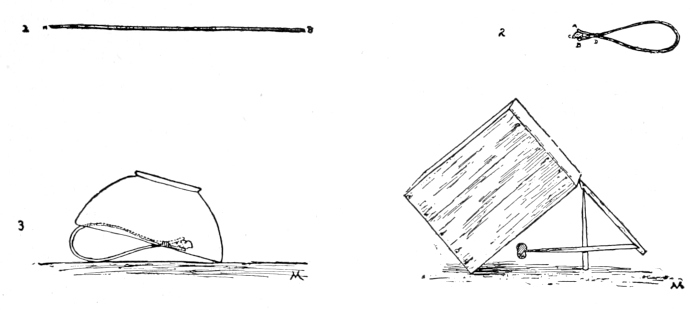
Mouse traps.
The bow trap. 1. A smooth splint or a peeled twig.
2. Splint bowed and tied at D, the bait inserted at C.
3. The inverted bowl balanced on splint bow.
Figure 4, trap.
Trapping Field Mice—Probably wild animals have endured more cruelty through the agency of traps than through any other form of human persecution. The savage steel traps often catch the animal by the leg, holding it until it gnaws off the imprisoned foot, and thus escapes maimed and handicapped for its future struggle for food; or if the trap gets a strong hold, the poor creature may suffer tortures during a long period, before the owner of the trap appears to put an end to its sufferings by death. If box traps are used, they are often neglected and the poor creature imprisoned, is left to languish and starve. The teacher cannot enforce too strongly upon the child the ethics of trapping. Impress upon him that the box traps are far less cruel; but that if set, they must be examined regularly and not neglected. The study of mice affords a good opportunity for giving the children a lesson in humane trapping. Let them set a figure 4 or a bowl trap, which they must examine every morning. The little prisoners may be brought to school and studied; meanwhile, they should be treated kindly and fed bountifully. After a mouse has been studied, it should be set free, even though it be one of the quite pestiferous field mice. The moral effect of killing an animal, after a child has become thoroughly interested in it and its life, is always bad.
References—Claws and Hoofs, Johomot; American Animals, Stone & Cram; Secrets of the Woods, Long; Wild Life, Ingersoll; Familiar Wild Animals, Lottridge.
LESSON LV
The House Mouse
Leading thought—The mouse is fitted by color, form, agility and habits to thrive upon the food which it steals from man, and to live in the midst of civilized people.
Method—A mouse cage can be easily made of wire window-screen tacked upon a wooden frame. I have even used aquarium jars with wire screen covers, and by placing one jar upon another, opening to opening, and then laying them horizontal, the mouse can be transferred to a fresh cage without trouble, and thus the mousey odor can be obviated, while the little creature is being studied. A little water in a wide-necked bottle can be lowered into this glass house by a string, and the food can be given in like manner. Stripped paper should be put into the jar for the comfort of the prisoner; a stiff string hanging down from the middle of the cage will afford the prisoner a chance to show his feats as an acrobat.
Observations—1. Why is the color of the mouse of special benefit to it? Do you think it protects it from the sight of its enemies? Can you see a mouse easily as it runs across the room? What is the nature of the fur of a mouse?
2. How long is a mouse’s tail as compared with its body? What is the covering of the tail? Of what use to the mouse is this long, ridged tail? Watch the mouse carefully and discover, if you can, the use of the tail in climbing.
3. Is the mouse a good jumper? Are the hind legs long and strong when compared with the front legs? How high do you think a mouse can jump? Do you think it uses its tail as an aid in jumping? How much of the legs are covered with hair? Compare the front and hind feet. What sort of claws have they? How does the mouse use its feet when climbing the string? How can it climb up the side of a wall?
4. Describe the eyes. Do you think the mouse can see very well? Does it wink? What is the shape of the ears? Do you think it can hear well? Can it move its ears forward or backward?
5. What is the shape of the snout? Of what advantage is this? Note the whiskers. What is their use? Describe the mouth. Do you know how the teeth are arranged? For what other use than to bite food does the mouse use its teeth? What other animals have their teeth arranged like those of the mouse? What food does the house mouse live upon? How does it get it?
6. How does the mouse act when it is reaching up to examine something? How does it hold its front feet? Describe how the mouse washes its face. Its back. Its feet.
7. Where does the house mouse build its nest? Of what material? How do the baby mice look? Can they see when they are first born?
8. House mice are great travelers. Can you tell how they manage to get from place to place? Write a story telling all you know of their habits.
9. How many kinds of mice do you know? Does the house mouse ever live in the field? What do you know of the habits of the white-footed mouse? Of the meadow mice? Of the jumping mice?
THE WOODCHUCK
Teacher’s Story
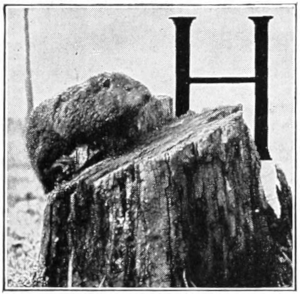
E who knows the ways of the woodchuck can readily guess where it is likely to be found; it loves meadows and pastures where grass or clover lushly grows. It is also fond of garden truck and has a special delectation for melons. The burrow is likely to be situated near a fence or stone heap, which gives easy access to the chosen food. The woodchuck makes its burrow by digging the earth loose with its front feet, and pushing it backward and out of the entrance with the hind feet. This method leaves the soil in a heap near the entrance, from which paths radiate into the grass in all directions. If one undertakes to dig out a woodchuck, one needs to be not only a husky individual, but something of an engineer; the direction of the burrow extends downward for a little way, and then rises at an easy angle, so that the inmate may be in no danger of flood. The nest is merely an enlargement of the burrow, lined with soft grass, which the woodchucks bring in in their mouths. During the early part of the season, the father and mother and the litter of young may inhabit the same burrow, although there are likely to be at least two separate nests. There is usually more than one back door to the woodchuck’s dwelling, through which it may escape, if pressed too closely by enemies; these back doors differ from the entrance, in that they are usually hidden and have no earth heaped near them.
The woodchuck usually feeds in the morning and again in the evening, and is likely to spend the middle of the day resting. It often goes some distance from its burrow to feed, and at short intervals, lifts itself upon its hind feet to see if the coast is clear; if assailed, it will seek to escape by running to its burrow; and when running, it has a peculiar gait well described as “pouring itself along.” If it reaches its burrow, it at once begins to dig deeply and throw the earth out behind it, thus making a wall to keep out the enemy. When cornered, the woodchuck is a courageous and fierce fighter; its sharp incisors prove a powerful weapon and it will often whip a dog much larger than itself. Every boy knows how to find whether the woodchuck is in its den or not, by rolling a stone into the burrow, and listening; if the animal is at home, the sound of its digging apprises the listener of the fact. In earlier times, the ground-hogs were much preyed upon by wolves, wildcats and foxes; now, only the fox remains and he is fast disappearing, so that at present, the farmer and his dog are about the only enemies this burrower has to contend with. It is an animal of resources and will climb a tree if attacked by a dog; it will also climb trees for fruit, like peaches. During the late summer, it is the ground-hog’s business to feed very constantly and become very fat. About the first of October, it retires to its den and sleeps until the end of March or April. During this dormant state, the beating of its heart is so faint as to be scarcely perceptible, and very little nourishment is required to keep it alive; this nourishment is supplied by the fat stored in its body, which it uses up by March, and comes out of its burrow in the spring, looking gaunt and lean. The old saying that the ground-hog comes out on Candlemas Day, and if it sees its shadow, goes back to sleep for six weeks more, may savor of meteorological truth, but it is certainly not true of the ground-hog.
The full-grown woodchuck ordinarily measures about two feet in length. Its color is grizzly or brownish, sometimes blackish in places; the under parts are reddish and the feet black. The fur is rather coarse, thick and brown, with longer hairs which are grayish. The skin is very thick and tough and seems to fit loosely, a condition which gives the peculiar “pouring along” appearance when it is running. The hind legs and feet are longer than those in front. Both pairs of feet are fitted for digging, the front ones being used for loosening the earth and the hind pair for kicking it out of the burrow.
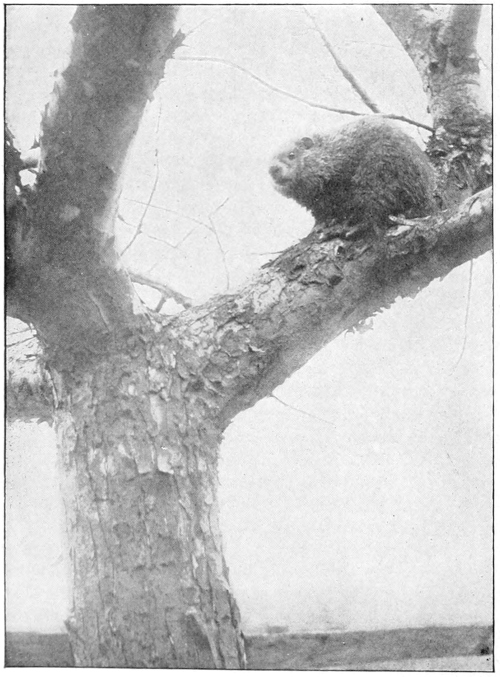
Treed!
Photo by Verne Morton.
The woodchuck’s ears are roundish and not prominent, and by muscular contraction they are closed when the animal is digging, so that no soil can enter; the sense of hearing is acute. The teeth consist of two large incisors at the front of each jaw, a bare space and four grinders on each side, above and below; the incisors are used for biting food and also for fighting. The eyes are full and bright. The tail is short and brushy, and it with the hind legs, form a tripod which supports the animal, as it sits with its forefeet lifted.
When feeding, the woodchuck often makes a contented grunting noise; when attacked and fighting, it growls; and when feeling happy and conversational, it sits up and whistles. I had a woodchuck acquaintance once which always gave a high, shrill, almost birdlike whistle when I came in view, a very jolly greeting. There are plenty of statements in books that woodchucks are fond of music, and Mr. Ingersoll states that at Wellesley College a woodchuck on the chapel lawn was wont to join the morning song exercises with a “clear soprano.” The young woodchucks are born about the first of May and the litter usually numbers four or five. In June the “chucklings” may be seen following the mother in the field with much babyish grunting. If captured at this period, they make every interesting pets. By August or September the young woodchucks leave the home burrow and start burrows of their own.
References—Wild Animals, Stone & Cram; Wild Neighbors, Ingersoll; Squirrels and Other Fur Bearers, Burroughs; Familiar Wild Animals, Lottridge.
LESSON LVI
The Woodchuck or Ground-Hog
Leading thought—The woodchuck has thriven with civilization, notwithstanding the farmer’s dog, gun, traps and poison. It makes its nest in a burrow in the earth and lives upon vegetation; it hibernates in winter.
Method—Within convenient distance for observation by the pupils of every country schoolhouse and of most village schoolhouses, maybe found a woodchuck and its dwelling. The pupils should be given the outline for observations which should be made individually through watching the woodchuck for weeks or months.
Observations—1. Where is the woodchuck found? On what does it live? At what time of day does it feed? How does it act when startled?
2. Is the woodchuck a good fighter? With what weapons does it fight? What are its enemies? How does it escape its enemies when in or out of its burrow? How does it look when running?
3. What noises does the woodchuck make and what do they mean? Play a “mouth-organ” near the woodchuck’s burrow and note if it likes music.
4. How does the woodchuck make its burrow? Where is it likely to be situated? Where is the earth placed which is taken from the burrow? How does the woodchuck bring it out? How is the burrow made so that the woodchuck is not drowned in case of heavy rains? In what direction do the underground galleries go? Where is the nest placed in relation to the galleries? Of what is the nest made? How is the bedding carried in? Of what special use is the nest?
5. Do you find paths leading to the entrances of the burrow? If so, describe them. How can you tell whether a woodchuck is at home or not if you do not see it enter? Where is the woodchuck likely to station itself when it sits up to look for intruders?
6. How many woodchucks inhabit the same burrow? Are there likely to be one or more back doors to the burrow? What for? How do the back doors differ from the front doors?
7. How long is the longest woodchuck that you have ever seen? What is the woodchuck’s color? Is its fur long or short? Coarse or fine? Thick or sparse? Is the skin thick or thin? Does it seem loose or close fitting?
8. Compare the front and hind feet and describe difference in size and shape. Are either or both slightly webbed? Explain how both front and hind feet and legs are adapted by their shape to help the woodchuck. Is the tail long or short? How does it assist the animal in sitting up?
9. What is the shape of the woodchuck’s ear? Can it hear well? Why are the ears not filled with soil when the animal is burrowing? Of what use are the long incisors? Describe the eyes.
10. How does the woodchuck prepare for winter? Where and how does it pass the winter? Did you ever know a woodchuck to come out on Candlemas Day to look for its shadow?
11. When does the woodchuck appear in the spring? Compare its general appearance in the fall and in the spring and explain the reason for the difference.
12. When are the young woodchucks born? What do you know of the way the mother woodchuck cares for her young?
As I turned round the corner of Hubbard’s Grove, saw a woodchuck, the first of the season, in the middle of the field six or seven rods from the fence which bounds the wood, and twenty rods distant. I ran along the fence and cut him off, or rather overtook him, though he started at the same time. When I was only a rod and a half off, he stopped, and I did the same; then he ran again, and I ran up within three feet of him, when he stopped again, the fence being between us. I squatted down and surveyed him at my leisure. His eyes were dull black and rather inobvious, with a faint chestnut iris, with but little expression and that more of resignation than of anger. The general aspect was a coarse grayish brown, a sort of grisel. A lighter brown next the skin, then black or very dark brown and tipped with whitish rather loosely. The head between a squirrel and a bear, flat on the top and dark brown, and darker still or black on the tip of the nose. The whiskers black, two inches long. The ears very small and roundish, set far back and nearly buried in the fur. Black feet, with long and slender claws for digging. It appeared to tremble, or perchance shivered with cold. When I moved, it gritted its teeth quite loud, sometimes striking the under jaw against the other chatteringly, sometimes grinding one jaw on the other, yet as if more from instinct than anger. Whichever way I turned, that way it headed. I took a twig a foot long and touched its snout, at which it started forward and bit the stick, lessening the distance between us to two feet, and still it held all the ground it gained. I played with it tenderly awhile with the stick, trying to open its gritting jaws. Ever its long incisors, two above and two below, were presented. But I thought it would go to sleep if I stayed long enough. It did not sit upright as sometimes, but standing on its fore feet with its head down, i. e., half sitting, half standing. We sat looking at one another about half an hour, till we began to feel mesmeric influences. When I was tired, I moved away, wishing to see him run, but I could not start him. He would not stir as long as I was looking at him or could see him. I walked around him; he turned as fast and fronted me still. I sat down by his side within a foot. I talked to him quasi forest lingo, baby-talk, at any rate in a conciliatory tone, and thought that I had some influence on him. He gritted his teeth less. I chewed checkerberry leaves and presented them to his nose at last without a grit; though I saw that by so much gritting of the teeth he had worn them rapidly and they were covered with a fine white powder, which, if you measured it thus, would have made his anger terrible. He did not mind any noise I might make. With a little stick I lifted one of his paws to examine it, and held it up at pleasure. I turned him over to see what color he was beneath (darker or most pusely brown), though he turned himself back again sooner than I could have wished. His tail was also brown, though not very dark, rat-tail like, with loose hairs standing out on all sides like a caterpillar brush. He had a rather mild look. I spoke kindly to him. I reached checkerberry leaves to his mouth. I stretched my hands over him, though he turned up his head and still gritted a little. I laid my hand on him, but immediately took it off again, instinct not being wholly overcome. If I had had a few fresh bean leaves, thus in advance of the season, I am sure I should have tamed him completely. It was a frizzly tail. His is a humble, terrestrial color like the partridge’s, well concealed where dead wiry grass rises above darker brown or chestnut dead leaves—a modest color. If I had had some food, I should have ended with stroking him at my leisure. Could easily have wrapped him in my handkerchief. He was not fat nor particularly lean. I finally had to leave him without seeing him move from the place. A large, clumsy, burrowing squirrel. Arctomys, bear-mouse. I respect him as one of the natives. He lies there, by his color and habits so naturalized amid the dry leaves, the withered grass, and the bushes. A sound nap, too, he has enjoyed in his native fields, the past winter. I think I might learn some wisdom of him. His ancestors have lived here longer than mine. He is more thoroughly acclimated and naturalized than I. Bean leaves the red man raised for him, but he can do without them.—Thoreau’s Journal.
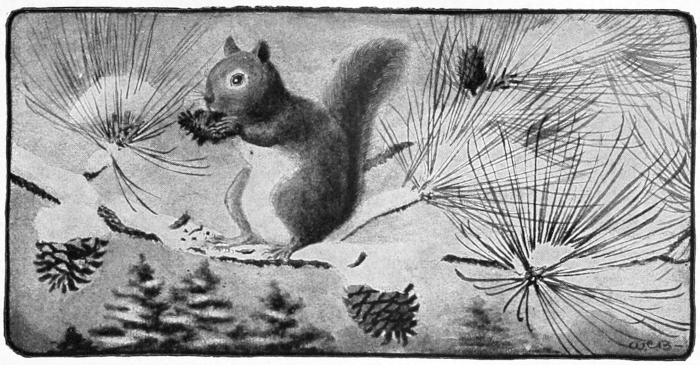
THE RED SQUIRREL OR CHICKAREE
Teacher’s Story
Just a tawny glimmer, a dash of red and gray, Was it a flitting shadow, or a sunbeam gone astray! It glances up a tree trunk, and a pair of bright eyes glow Where a little spy in ambush is measuring his foe. I hear a mocking chuckle, then wrathful, he grows bold And stays his pressing business to scold and scold and scold.
E ought to yield admiring tribute to those animals which have been able to flourish in our midst despite man and his gun, this weapon being the most cowardly and unfair invention of the human mind. The only time that man has been a fair fighter, in combating his four-footed brethren, was when he fought them with a weapon which he wielded in his hand. There is nothing in animal comprehension which can take into account a projectile, and much less a shot from a gun; but though it does not understand, it experiences a deathly fear at the noise. It is pathetic to note the hush in a forest that follows the sound of a gun; every song, every voice, every movement is stilled and every little heart filled with nameless terror. How any man or boy can feel manly when, with this scientific instrument of death in his hands, he takes the life of a little squirrel, bird or rabbit, is beyond my comprehension. In pioneer days when it was a fight for existence, man against the wilderness, the matter was quite different; but now it seems to me that anyone who hunts what few wild creatures we have left, and which are in nowise injurious, is, whatever he may think of himself, no believer in fair play.
Within my own memory, the beautiful black squirrel was as common in our woods as was his red cousin; the shot-gun has exterminated this splendid species. Well may we rejoice that the red squirrel has, through its lesser size and greater cunning, escaped a like fate; and that pugnacious and companionable and shy, it lives in our midst and climbs our very roofs to sit there and scold us for coming within its range of vision. It has succeeded not only in living despite of man, but because of man, for it rifles our grain bins and corn cribs and waxes opulent by levying tribute upon our stores.
Thoreau describes most graphically the movements of this squirrel. He says: “All day long the red squirrels came and went. One would approach at first warily, warily, through the shrub-oaks, running over the snow crust by fits and starts and like a leaf blown by the wind, now a few paces this way, with wonderful speed and waste of energy, making inconceivable haste with his “trotters,” as if it were for a wager, and now as many paces that way, but never getting on more than half a rod at a time; and then suddenly pausing with a ludicrous expression and a gratuitous somersault, as if all the eyes of the universe were fixed on him,... and then suddenly, before you could say Jack Robinson he would be in the top of a young pitch pine, winding up his clock, and chiding all imaginary spectators, soliloquizing and talking to all the universe at the same time.”
It is surely one of the most comical of sights to see a squirrel stop running and take observations; he lifts himself on his haunches, and with body bent forward, presses his little paws against his breast as if to say, “Be still, oh my beating heart!” which is all pure affectation because he knows he can scurry away in perfect safety. He is likely to take refuge on the far side of a tree, peeping out from this side and that, and whisking back like a flash as he catches our eye; we might never know he was there except as Riley puts it, “he lets his own tail tell on him.” When climbing up or down a tree, he goes head first and spreads his legs apart to clasp as much of the trunk as possible; meanwhile his sharp little claws cling securely to the bark. He can climb out on the smallest twigs quite as well, when he needs to do so, in passing from tree to tree or when gathering acorns.
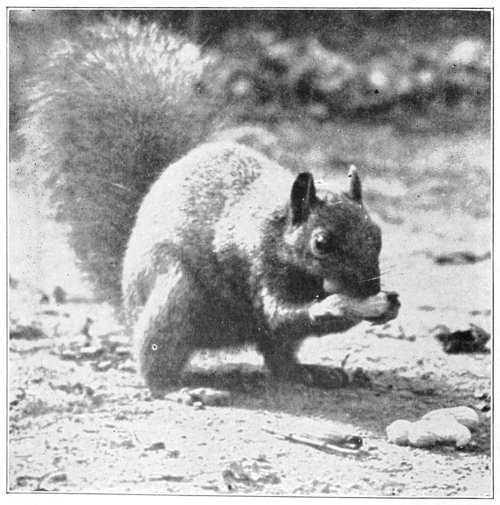
Red squirrel or Chickaree.
A squirrel always establishes certain roads to and from his abiding place and almost invariably follows them. Such a path may be entirely in the treetops, with air bridges from a certain branch of one tree to a certain branch of another, or it may be partially on the ground between trees. I have made notes of these paths in the vicinity of my own home, and have noted that if a squirrel leaves them for exploring, he goes warily; while, when following them, he is quite reckless in his haste. When making a jump from tree to tree, he flattens himself as widely as possible and his tail is held somewhat curved, but on a level with the body, as if its wide brush helped to buoy him up and perhaps to steer him also.
During the winter the chickaree is quite dingy in color and is an inconspicuous object, especially when he “humps himself up” so that he resembles a knot on a limb; but with the coming of spring, he dons a brighter coat of tawny-red and along his sides, where the red meets the grayish white of the under side, there is a dark line which is very ornamental; and now his tail is a shower of ruddiness. As the season advances, the colors seem to fade; they are probably a part of his wooing costume. When dashing up a tree trunk, his color is never very striking but looks like the glimmer of sunlight; this has probably saved many of his kind from the gunner, whose eyes being at the front of his head, cannot compare in efficiency with those of the squirrel, which being large and full and alert, are placed at the sides of the head so as to see equally well in all directions.
The squirrel’s legs are short because he is essentially a climber rather than a runner; the hips are very strong which insures his power as a jumper and his leaps are truly remarkable. A squirrel uses his front paws for hands in a most human way; with them he washes his face and holds his food up to his mouth while eating, and it is interesting to note the skill of his claws when used as fingers. The track he makes in the snow is quite characteristic. The tracks are paired and those of the large five-toed hind feet are always in front.

Squirrel tracks.
The squirrel has two pairs of gnawing teeth which are very long and strong, as in all rodents, and he needs to keep busy gnawing hard things with them, or they will grow so long that he cannot use them at all and will starve to death. He is very clever about opening nuts so as to get all the meats. He often opens a hickory nut with two holes which tap the places of the nut meats squarely; with walnuts or butternuts, which have much harder shells, he makes four small holes, one opposite each quarter of the kernel. He has no cheek-pouches like a chipmunk but he can carry corn and other grain. He often fills his mouth so full that his cheeks bulge out like those of a boy eating pop-corn; but anything as large as a nut he carries in his teeth. His food is far more varied than many suppose and he will eat almost anything eatable; he is a little pirate and enjoys stealing from others with keenest zest. In spring, he eats leaf buds and hunts our orchards for apple seeds. In winter, he feeds on nuts and cones; it is marvelous how he will take a cone apart, tearing off the scales and leaving them in a heap while searching for seeds; he is especially fond of the seeds of Norway spruce and hemlock. Of course, he is fond of nuts of all kinds and will cut the chestnut burs from the tree before they are ripe, so that he may get ahead of the other harvesters. He stores his food for winter in all sorts of odd places and often forgets where he puts it. We often find his winter stores untouched the next summer. He also likes birds’ eggs and nestlings, and if it were not for the chastisement he gets from the parent robins, he would work much damage in this way.
The squirrel is likely to be a luxurious fellow and have a winter and a summer home. The former is in some hollow tree or other protected place; the summer home consists of a platform of twigs in some tree-top, often built upon an abandoned crow or hawk nest; but just how he uses these two homes, is as yet, a matter of guessing and is a good subject for young naturalists to investigate. During the winter, he does not remain at home except in coldest weather, when he lies cozily with his tail wrapped around him like a boa to keep him warm. He is too full of interest in the world to lie quietly long, but comes out, hunts up some of his stores, and finds life worth while despite the cold. One squirrel adopted a bird house in one of our trees, and he or his kin have lived there for years; in winter, he takes his share of the suet put on the trees for birds, and because of his greediness, we have been compelled to use picture wire for tying on the suet.
The young are born in a protected nest, usually in the hollow of a tree. There are four to six young in a litter and they appear in April. If necessary to move the young, the mother carries the squirrel baby clinging to her breast with its arms around her neck.
The squirrel has several ways of expressing his emotions; one is by various curves in his long beautiful, bushy tail. If the creatures of the wood had a stage, the squirrel would have to be their chief actor. Surprise, incredulousness, indignation, fear, anger and joy are all perfectly expressed by tail gestures and also by voice. As a vocalist he excels; he chatters with curiosity, “chips” with surprise, scolds by giving a gutteral trill, finishing with a falsetto squeal. He is the only singer I know who can carry two parts at a time. Notice him sometimes in the top of a hickory or chestnut tree when nuts are ripe, and you will hear him singing a duet all by himself, a high shrill chatter with a chuckling accompaniment. Long may he abide with us as an uninvited guest at our cribs! For, though he be a freebooter and conscienceless, yet our world would lack its highest example of incarnate grace and activity, if he were not in it.
LESSON LVII
The Red Squirrel or Chickaree
Leading thought—The red squirrel by its agility and cleverness has lived on, despite its worst enemy—man. By form and color and activity it is fitted to elude the hunter.
Method—If a pet squirrel in a cage can be procured for observation at the school, the observations on the form and habits of the animal can be best studied thus; but a squirrel in a cage is an anomaly and it is far better to stimulate the pupils to observe the squirrels out of doors. Give the following questions, a few at a time, and ask the pupils to report the answers to the entire class. Much should be done with the supplementary reading, as there are many interesting squirrel stories illustrating its habits.
Observations—1. Where have you seen a squirrel? Does the squirrel trot along or leap when running on the ground? Does it run straight ahead or stop at intervals for observation? How does it look? How does it act when looking to see if the “coast is clear”?
2. When climbing a tree, does it go straight up, or move around the trunk? How does it hide itself behind a tree trunk and observe the passer-by? Describe how it manages to climb a tree. Does it go down the tree head first? Is it able to climb out on the smallest branches? Of what advantage is this to it?
3. Look closely and see if a squirrel follows the same route always when passing from one point to another. How does it pass from tree to tree? How does it act when preparing to jump? How does it hold its legs and tail when in the air during a jump from branch to branch?
4. Describe the colors of the red squirrel above and below. Is there a dark stripe along its side, if so, what color? How does the color of the squirrel protect it from its enemies? Is its color brighter in summer or in winter?
5. How are the squirrel’s eyes placed? Do you think it can see behind as well as in front all the time? Are its eyes bright and alert, or soft and tender?
6. Are its legs long or short? Are its hind legs stronger and longer than the front legs? Why? Why does it not need long legs? Do its paws have claws? How does it use its paws when eating and in making its toilet?
7. Describe the squirrel’s tail. Is it as long as the body? Is it used to express emotion? Of what use is it when the squirrel is jumping? Of what use is it in the winter in the nest?
8. What is the food of the squirrel during the autumn? Winter? Spring? Summer? Where does it store food for the winter? Does it steal food laid up by jays, chipmunks, mice or other squirrels? How does it carry nuts? Has it cheek-pouches like the chipmunk for carrying food? Does it stay in its nest all winter living on stored food like a chipmunk?
9. Where does the red squirrel make its winter home? Does it also have a summer home, if so, of what is it made and where built? In what sort of a nest are the young born and reared? At what time of the year are the young born? How does the mother squirrel carry her little ones if she wishes to move them?
10. How much of squirrel language can you understand? How does it express surprise, excitement, anger, or joy during the nut harvest? Note how many different sounds it makes and try to discover what they mean.
11. Describe or sketch the tracks made by the squirrel in the snow.
12. How does the squirrel get at the meats of the hickory nut and the walnut? How are its teeth arranged to gnaw holes in such hard substances as shells?
Supplementary reading—Squirrels and Other Fur Bearers, John Burroughs; American Animals, Stone & Cram; Secrets of the Woods, Long; Familiar Life in Field and Forest, Mathews; Little Beasts of Field and Wood, Cram; Wild Neighbors, Ingersoll; Familiar Wild Animals, Lottridge.
FURRY
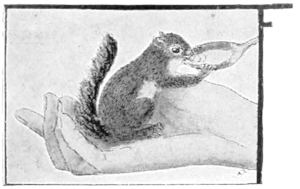
URRY was a baby red squirrel. One day in May his mother was moving him from one tree to another. He was clinging with his little arms around her neck and his body clasped tightly against her breast, when something frightened her and in her sudden movement, she dropped her heavy baby in the grass. Thus, I inherited him and entered upon the rather onerous duties of caring for a baby of whose needs I knew little; but I knew that every well cared for baby should have a book detailing all that happens to it, therefore, I made a book for Furry, writing in it each day the things he did. If the children who have pets keep similar books, they will find them most interesting reading afterward, and they will surely enjoy the writing very much.
Extracts from Furry’s Note-book
May 18, 1902—The baby squirrel is just large enough to cuddle in one hand. He cuddles all right when once he is captured; but he is a terrible fighter, and when I attempt to take him in my hand, he scratches and bites and growls so that I have been obliged to name him Fury. I told him, however, if he improved in temper I would change his name to Furry.
May 19—Fury greets me, when I open his box, with the most awe-inspiring little growls, which he calculates will make me turn pale with fear. He has not cut his teeth yet, so he cannot bite very severely, but that isn’t his fault, for he tries hard enough. The Naturalist said cold milk would kill him, so I warmed the milk and put it in a teaspoon and placed it in front of his nose; he batted the spoon with both forepaws and tried to bite it, and thus got a taste of the milk, which he drank eagerly lapping it up like a kitten. When I hold him in one hand and cover him with the other, he turns contented little somersaults over and over.
May 20—Fury bit me only once to-day, when I took him out to feed him. He is cutting his teeth on my devoted fingers. I tried giving him grape-nuts soaked in milk, but he spat it out in disgust. Evidently he does not believe he needs a food for brain and nerve. He always washes his face as soon as he is through eating.
May 21—Fury lies curled up under his blanket all day. Evidently good little squirrels stay quietly in the nest, when the mother is not at home to give them permission to run around. When Fury sleeps, he rolls himself up in a little ball with his tail wrapped closely around him. The squirrel’s tail is his “furs,” which he wraps around him to keep his back warm when he sleeps in winter.
May 23—Every time I meet Uncle John he asks, “Is his name Fury or Furry now?” Uncle John is much interested in the good behavior of even little squirrels. As Fury has not bitten me hard for two days, I think I will call him Furry after this. He ate some bread soaked in milk to-day, holding it in his hands in real squirrel fashion. I let him run around the room and he liked it.
May 25—Furry got away from me this morning and I did not find him for an hour. Then I discovered him in a pasteboard box of drawing paper with the cover on. How did he squeeze through?
May 26—He holds the bowl of the spoon with both front paws while he drinks the milk. When I try to draw the spoon away, to fill it again after he has emptied it, he objects and hangs on to it with all his little might, and scolds as hard as ever he can. He is such a funny, unreasonable baby.
May 28—To-night I gave Furry a walnut meat. As soon as he smelled it he became greatly excited; he grasped the meat in his hands and ran off and hid under my elbow, growling like a kitten with its first mouse.
May 30—Since he tasted nuts he has lost interest in milk. The nut meats are too hard for his new teeth, so I mash them and soak them in water and now he eats them like a little piggy-wig with no manners at all. He loves to have me stroke his back while he is eating. He uses his thumbs and fingers in such a human way that I always call his front paws hands. When his piece of nut is very small he holds it in one hand and clasps the other hand behind the one which holds the dainty morsel, so as to keep it safe.
May 31—When he is sleepy he scolds if I disturb him and turning over on his back bats my hand with all of his soft little paws and pretends that he is going to bite.
June 4—Furry ranges around the room now to please himself. He is a little mischief; he tips over his cup of milk and has commenced gnawing off the wall paper behind the book-shelf to make him a nest. The paper is green and will probably make him sorry.
June 5—This morning Furry was hidden in a roll of paper. I put my hand over one end of the roll and then reached in with the other hand to get him; but he got me instead, because he ran up my sleeve and was much more contented to be there than I was to have him. I was glad enough when he left his hiding place and climbed to the top shelf of the bookcase, far beyond my reach.
June 6—I have not seen Furry for twenty-four hours, but he is here surely enough. Last night he tipped over the ink bottle and scattered nut shells over the floor. He prefers pecans to any other nuts.
June 7—I caught Furry to-day and he bit my finger so it bled. But afterwards, he cuddled in my hand for a long time, and then climbed my shoulder and went hunting around in my hair and wanted to stay there and make a nest. When I took him away, he pulled out his two hands full of my devoted tresses. I’ll not employ him as a hairdresser.
June 9—Furry sleeps nights in the top drawer of my desk; he crawls in from behind. When I pull out the drawer he pops out and scares me nearly out of my wits; but he keeps his wits about him and gets away before I can catch him.
June 20—I keep the window open so Furry can run out and in and learn to take care of himself out-of-doors.
Furry soon learned to take care of himself, though he often returned for nuts, which I kept for him in a bowl. He does not come very near me out-of-doors, but he often speaks to me in a friendly manner from a certain pitch pine tree near the house.
There are many blank leaves in Furry’s note-book. I wish that he could have written on these of the things that he thought about me and my performances. It would certainly have been the most interesting book concerning squirrels in the world.
THE CHIPMUNK
Teacher’s Story
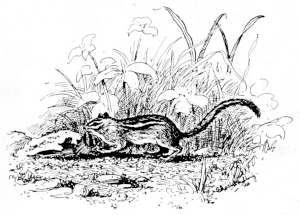
HILE the chipmunk is a good runner and jumper, it is not so able a climber as is the red squirrel, and it naturally stays nearer the ground. One windy day I was struck by the peculiar attitude of what, I first thought, was a red squirrel gathering green acorns from a chestnut oak in front of my window. A second glance showed me that it was a chipmunk lying close to the branch, hanging on for “dear life” and with an attitude of extreme caution, quite foreign to the red squirrel in a similar situation. It would creep out, seize an acorn in its teeth, creep back to a larger limb, take off the shell, and with its little paws stuff the kernel into its cheek pouches; it took hold of one side of its mouth with one hand to stretch it out, as if opening a bag, and stuffed the acorn in with the other. I do not know whether this process was necessary or not at the beginning, for his cheeks were distended when I first saw him; and he kept on stuffing them until he looked as if he had a hopeless case of mumps. Then with obvious care he descended the tree and retreated to his den in the side hill, the door of which I had already discovered, although it was well hidden by a bunch of orchard grass.
Chipmunks are more easily tamed than red squirrels and soon learn that pockets may contain nuts and other things good to eat. The first tame chipmunk of my acquaintance belonged to a species found in the California mountains. He was a beautiful little creature and loved to play about his mistress’ room; she being a naturalist as well as a poet, was able to understand her little companion, and the relations between them were full of mutual confidence. He was fond of English walnuts and would always hide away all that were placed in a dish on the table. One day his mistress, when taking off her bonnet after returning from church, discovered several of these nuts tucked safely in the velvet bows; they were invisible from the front but perfectly visible from the side. Even yet, she wonders what the people at church that day thought of her original ideas in millinery; and she wonders still more how “Chipsie” managed to get into the bonnet-box, the cover of which was always carefully closed.
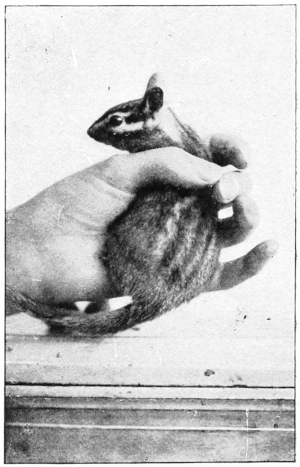
“Chipsie”, a chipmunk of the Sierras.
The chipmunk is a good home builder and carries off, presumably in its cheek pouches, all of the soil which it removes in making its burrow. The burrow is made usually in a dry hillside, the passageway just large enough for its own body, widening to a nest which is well bedded down. There is usually a back door also, so that in case of necessity, the inmate can escape. It retires to this nest in late November and does not appear again until March. In the nest, it stores nuts and other grains so that when it wakens, at long intervals, it can take refreshment.
If you really wish to know whether you see what you look at or not, test yourself by trying to describe the length, position and number of the chipmunk’s stripes. These stripes, like those of the tiger in the jungle, make the creature less conspicuous; when on the ground, where its stripes fall in with the general shape and color of the grass and underbrush, it is quite invisible until it stirs. Its tail is not so long nor nearly so bushy as that of the squirrel; it does not need a tail to balance and steer with in the tree tops; and since it lives in the ground, a bushy tail would soon be loaded with earth and would be an incubus instead of a thing of beauty.
The chipmunk is not a vocalist like the red squirrel, but he can cluck like a cuckoo and chatter gayly or cogently; and he can make himself into a little bunch with his tail curved up his back, while he eats a nut from both his hands, and is even more amusing than the red squirrel in this attitude; probably because he is more innocent and not so much of a poseur. His food consists of all kinds of nuts, grain and fruit, but he does little or no damage, as a rule. He is pretty and distinctly companionable, and I can rejoice, in that I have had him and his whole family as my near neighbors for many years. I always feel especially proud when he shows his confidence, by scampering around our piazza floor and peeping in at our windows, as if taking a reciprocal interest in us.
LESSON LVIII
The Chipmunk
Leading thought—The chipmunk lives more on the ground than does the squirrel; its colors are protective and it has cheek pouches in which it carries food, and also soil when digging its burrow. It stores food for winter in its den.
Method—The field note-book should be the basis for this work. Give the pupils an outline of observations to be made, and ask for reports now and then. Meanwhile stimulate interest in the little creatures by reading aloud from some of the references given.
Observations—1. Do you see the chipmunk climbing around in trees like the red squirrel? How high in a tree have you ever seen a chipmunk?
2. What are the chipmunk’s colors above and below? How many stripes has it? Where are they and what are their colors? Do you think that these stripes conceal the animal when among grasses and bushes?
3. Compare the tails of the chipmunk and the red squirrel. Which is the longer and bushier? Tell if you can the special advantage to the chipmunk in having this less bushy tail?
4. What does the chipmunk eat? How does it carry its food? How does it differ in this respect from the red squirrel? Does it store its food for winter use? How does it prepare its nuts? How does it hold its food while eating?
5. Where does the chipmunk make its home? How does it carry away soil from its burrow? How many entrances are there? How is the den arranged inside? Does it live in the same den the year round? When does it retire to its den in the fall? When does it come out in the spring?
6. Does the chipmunk do any damage to crops? What seeds does it distribute? At what time do the little chipmunks appear in the spring?
7. Observe carefully the different tones of the chipmunk and compare its chattering with that of the squirrel.
Supplementary reading—Squirrels and Other Fur-Bearers, John Burroughs; American Animals, Stone and Cram.
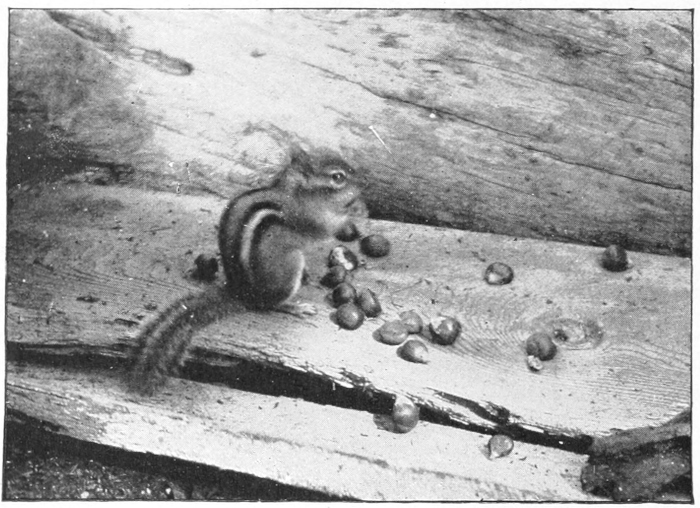
Photo by Verne Morton.
The Eastern Chipmunk.
TO A CAPTIVE CHIPMUNK OF THE SIERRAS Bright little comrade from the woods, come show Thy antic cheer about my sunlit room Of books, that stand in moods of gloom Because thought’s tide is out, heart’s rhythm is low With weariness. Friendly thou art and know Good friend in me, who yet did dare presume To take thee from thy home, thy little doom To make for thee, and longer life bestow. So, thou hast not been eaten by the snake; Thy gentle blood no weasel drank at night; Thou hast not starved ’mid winter’s frozen wood, Nor waited vainly for the sun to make Sweet the wild nuts for thee. Yet, little sprite, Thou still doth question if my deed were good? —Irene Hardy.
THE LITTLE BROWN BAT
Teacher’s Story
His small umbrella, quaintly halved, Describing in the air an arc alike inscrutable,— Elate philosopher! —Emily Dickenson.
HOEVER first said “as blind as a bat,” surely never looked a bat in the face, or he would not have said it. The deep-set, keen, observant eyes are quite in keeping with the alert attitude of the erect, pointed ears; while the pug-nose and the wide open, little, pink bag of a mouth, set with tiny, sharp teeth, give this anomalous little animal a deliciously impish look. Yet how have those old artists belied the bat, who fashioned their demons after his pattern, ears, eyes, nose, mouth, wings and all! Certain it is, if human beings ever get to be winged angels in this world, they are far more likely to have their wings fashioned like those of the bat than like those of the bird. As a matter of fact, there are no other wings so wonderful as the bat’s; the thin membrane is equipped with sensitive nerves which inform the flier of the objects in his path, so that he darts among the branches of trees at terrific speed and never touches a twig; a blinded bat was once set free in a room, across which threads were stretched, and he flew about without ever touching one. After we have tamed one of these little, silky flitter-mice we soon get reconciled to his wings for he proves the cunningest of pets; he soon learns who feeds him, and is a constant source of entertainment.
The flight of the bat is the highest ideal we may have, for the achievement of the aeroplane. It consists of darting hither and thither with incredible swiftness, and making sharp turns with no apparent effort. Swifts and swallows are the only birds that can compete with the bat in wing celerity and agility; it is interesting to note that these birds also catch insects on the wing, for food. The bat, like the swift, keeps his mouth open, scooping in all the insects in his way; more than this, he makes a collecting net of the wing membrane, stretched between the hind legs and tail, doubling it up like an apron on the unfortunate insects, and then reaching down and gobbling them up; and thus he is always doing good service to us on summer evenings by swallowing mosquitoes and gnats.
The short fur of the bat is as soft as silk, and covers the body but not the wings; the plan of the wing is something like that of the duck’s foot; it consists of a web stretched between very much elongated fingers. If a boy’s fingers were as long in proportion, as a bat’s, they would measure four feet. Stretched between the long fingers is a thin, rubbery membrane, which extends back to the ankles and thence back to the tip of the bony tail; thus, the bat has a winged margin all around his body. Since fingers make the framework, it is the thumb that projects from the front angle of the wing, in the form of a very serviceable hook, resembling that used by a one-armed man to replace the lost member. These hooks the bat uses in many ways. He drags himself along the floor with their aid, or he scratches the back of his head with them, if occasion requires. He is essentially a creature of the air and is not at all fitted for walking; his knees bend backward in an opposite direction from ours. This renders him unable to walk, and when attempting to do so, he has the appearance of “scrabbling” along on his feet and elbows. When thus moving he keeps his wings fluttering rapidly, as if feeling his way in the dark, and his movements are trembly. He uses his teeth to aid in climbing.
The little brown bat’s wings often measure nine inches from tip to tip, and yet he folds them so that they scarcely show, he does not fold them like a fan, but rather like a pocket knife. The hind legs merely act as a support for the side wing, and the little hip bones look pitifully sharp, the membrane reaches only to the ankle, the tiny emaciated foot projecting from it is armed with five, wirelike toes, tipped with sharp hooked claws. It is by these claws that he hangs when resting during the day, for he is upside-down-y in his sleeping habits, slumbering during the daytime, while hanging head downward, without any inconvenience from a rush of blood to the brain; when thus suspended, the tail is folded down. Sometimes he hangs by one hind foot and a front hook; and he is a wee thing when all folded together and hung up, with his nose tucked between his hooked thumbs, in a very babyish fashion.
The bat is very particular about his personal cleanliness. People who regard the bat as a dirty creature, had better look to it that they are even half as fastidious as he. He washes his face with the front part of his wing, and then licks his wash-cloth clean; he scratches the back of his head with his hind foot and then licks the foot; when hanging head down, he will reach one hind foot down and scratch behind his ear with an aplomb truly comical in such a mite; but it is most fun of all to see him clean his wings; he seizes the edges in his mouth and stretches and licks the membrane until we are sure it is made of silk elastic, for he pulls and hauls it in a way truly amazing.
The bat has a voice which sounds like the squeak of a toy wheelbarrow, and yet it is expressive of emotions. He squeaks in one tone when holding conversation with other bats, and squeaks quite differently when seized by the enemy.
The mother bat feeds her little ones from her breasts as a mouse does its young, only she cradles them in her soft wings while so doing; often she takes them with her when she goes out for insects in the evenings; they cling to her neck during these exciting rides; but when she wishes to work unencumbered, she hangs her tiny youngsters on some twig and goes back to them later. The little ones are born in July and usually occur as twins. During the winter, bats hibernate like woodchucks or chipmunks. They select for winter quarters some hollow tree or cave or other protected place. They go to sleep when the cold weather comes, and do not awake until the insects are flying; they then come forth in the evenings, or perhaps early in the morning, and do their best to rid the world of mosquitoes and other insect nuisances.