Part 2 — VI. INSECT STUDY (continued 4)
Reading edition
7. If you find a procession of ants carrying food to their nest, note if they follow the same path coming and going.
8. If you find winged ants in a nest, catch a few in a vial with a few of the workers, and compare the two. The winged ants are kings and queens, the kings being much smaller than the queens.
9. If you chance to encounter a swarm of winged ants taking flight, make observations as to the size of swarm, the height above the ground, and whether any are falling to the earth.
10. Look under the loose bark of trees for nests of the big, black carpenter ant. You may find in such situations a queen ant starting a colony, which will prove most desirable for stocking an artificial ant’s nest.
11. If you find ants climbing shrubs, trees or other plants, look upon the leaves for aphids and note the following points:
a. How does an ant act as she approaches an aphid?
b. If the aphids are crowded on the leaf, does she step on them?
c. Watch carefully to see how the ant touches the aphid when she wishes the honey-dew.
d. Watch how the aphid excretes the honey-dew, and note if the ant eats it.
e. If you disturb aphids which have ants tending them, note whether the ants attempt to defend or rescue their herds.
f. If there are aphis-lions or ladybird larvæ eating the aphids, note if the ants attack them.
12. If you find a colony of ants under stones where there are brown and black ants living together, the black members are the slaves of the brown. Observe as carefully as possible the actions of both the black and the brown inhabitants of the nest.
13. If you chance to see ants fighting, note how they make the attack. With what weapons do they fight? How do they try to get at the adversary?
14. Write an English theme covering the following points: How ants take their slaves; the attitude of masters and slaves toward each other; the work which the slaves do, and the story of the ant battle. How ants care for and use their herds.
References—American Insects, Kellogg, Manual for the Study of Insects, Comstock; Ants, McCook; True Tales, Jordan, page 6.
LESSON XCVI
How to Make the Lubbock Ant-nest
Material—Two pieces of window glass, 10 inches square; a sheet of tin, 11 inches square; a piece of plank, 1¼ inch thick, 20 inches long and at least 16 inches wide; a sheet of tin or a thin, flat board, 10 inches square.
To make the nest—Take the plank and on the upper side, a short distance from the edge, cut a deep furrow. This furrow is to be filled with water, as a moat, to keep the ants imprisoned. It is necessary, therefore, that the plank should have no knot holes, and that it be painted thoroughly to keep it from checking. Take the sheet of tin 11 inches square, and make it into a tray by turning up the edges three-eighths of an inch. Place this tray in the middle of the plank. Place within the tray one pane of glass. Lay around the edges of this glass four strips of wood about half an inch wide and a little thicker than the height of the ants which are to live in the nest. Cover the glass with a thin layer of fine earth. Take the remaining pane of glass and cut a triangular piece off of one corner, then place the pane on top of the other, resting upon the pieces of wood around the sides. The cover of the nest may be a piece of tin, with a handle soldered to the center, or a board with a screw-eye in the center with which to lift it. There should be a piece of blotter or of very thin sponge, introduced into the nest between the two panes of glass, in a position where it may be reached with a pipette, without removing the upper glass, for it must be kept always damp.
To establish a colony in this nest proceed as follows: Take a two-quart glass fruit jar and a garden trowel. Armed with these, visit some pasture or meadow near by, and find under some stone, a small colony of ants which have plenty of eggs and larvæ. Scoop up carefully eggs, ants, dirt and all and place in the jar, being as careful as possible not to injure the specimens. While digging, search carefully for the queen, which is a larger ant and is sometimes thus found. But if you have plenty of eggs, larvæ and pupæ, the ants will become very contented in their new nest while taking care of them. After you have taken all the ants desirable, place the cover on the jar, carry them to the Lubbock nest and carefully empty the contents of the fruit jar on top of the board which covers the nest. Of course the furrow around the plank has been filled with water, so the stragglers cannot escape. The ants will soon find the way into the nest through the cut corner of the upper pane of glass, and will transfer their larvæ to it because it is dark. After they are in the nest, which should be within two or three hours, remove the dirt on the cover, and the nest is ready for observation. But, since light disturbs the little prisoners, the cover should be removed only for short periods.
The Fielde nest is better adapted for a serious study of ants, but it is not so well adapted for the schoolroom as is the Lubbock nest.
Reference—Ants, W. M. Wheeler.
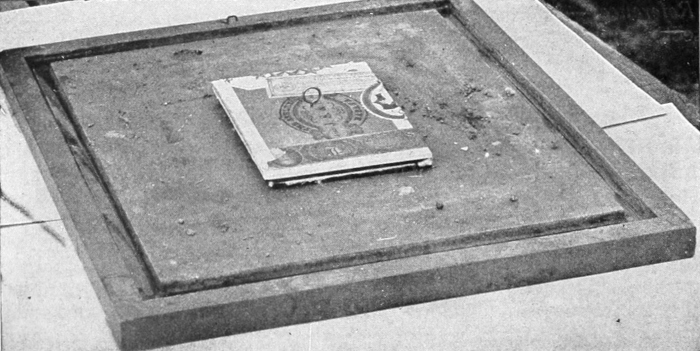
A Lubbock ant-nest.
THE ANT-NEST, AND WHAT MAY BE SEEN WITHIN IT
Teacher’s Story
NT anatomy becomes a very interesting study when we note the vigorous way the ant uses it—even to the least part. The slender waist characterizes the ant as well as the wasp; the three regions of the body are easily seen, the head with its ever moving antennæ, the slender thorax with its three pairs of most efficient legs, and the long abdomen. The ant’s legs are fairly long as compared with the size of the body and the ant can run with a rapidity that, comparatively, would soon outdistance any Marathon runner, however famed. I timed an ant one day when she was taking a constitutional on my foot rule. She was in no hurry, and yet she made time that if translated into human terms would mean 16 yards per second. In addition to running, many ants when frightened will make leaps with incredible swiftness.
The ant does not show her cleverness in her physiognomy, probably because her eyes seem small and dull and she has a decidedly “retreating forehead;” but the brain behind this unpromising appearance is far more active and efficient than that behind the gorgeous great eyes of the dragon-fly or behind the “high brow” of the grasshopper. The ant’s jaws are very large compared with her head; they work sidewise like a pair of shears and are armed with triangular teeth along the biting edges; these are not teeth in a vertebrate sense, but are like the teeth of a saw. These jaws are the ant’s chief utensils and weapons; with them she seizes the burdens of food which she carries home; with them she gently lifts her infant charges; with them she crushes and breaks up hard food; with them she carries out soil from her tunnel, and with them she fights her enemies. She also has a pair of long palpi, or feelers.
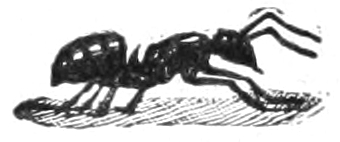
A common ant.
Although her eyes are so small and furnished with coarse facets, as compared with other insects, this fact need not count against her, for she has little need of eyes. Her home life is passed in dark burrows where her antennæ give her information of her surroundings. Note how these antennæ are always moving, seeming to be atremble in eagerness to receive sensations. But aside from their powers of telling things by the touch, wherein they are more delicate than the fingers of the blind, they have other sense organs which are comparable to our sense of smell. Miss Fielde has shown that the five end segments of the antennæ have each its own powers in detecting odor. The end segment detects the odor of the ant’s own nest and enables her to distinguish this from other nests. The next, or eleventh segment, detects the odor of any descendant of the same queen; by this, she recognizes her sisters wherever she finds them. Through the next, or tenth segment, she recognizes the odor of her own feet on the trail, and thus can retrace her own steps. The eighth and ninth segments convey to her the intelligence and means of caring for the young. If an ant is deprived of these five end-joints of the antennæ, she loses all power as a social ant and becomes completely disenfranchised. Miss Fielde gives her most interesting experiments in detail in the Proceedings of the Academy of Natural Sciences of Philadelphia, July and October, 1901.
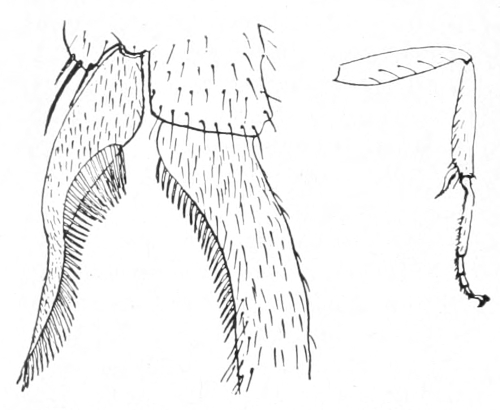
The antenna-comb on the front leg of an ant.
It is natural enough that the ant, depending so much on her antennæ for impressions and stimuli, should be very particular to keep them clean and in good order. She is well equipped to do this, for she has a most efficient antennæ brush on her wrist; it is practically a circular comb, which just fits over the antenna; and to see the ants using these brushes is one of the most common sights in the ant-nest and one of the most amusing. The ant usually commences by lifting her leg over one antenna and deftly passing it through the brush, and then licks the brush clean by passing it through her mouth, as a cat washes her face; then she cleans the other in a similar manner and possibly finishes by doing both alternately, winding up with a flourish, like a European gentleman curling his mustaches. Her antennæ cleaned, she starts promptly to do something, for she is a little six-footed Martha, always weighed down or buoyed up by many duties and cares. Keeping her antennæ on the qui vive, she assures herself, by touch, of the nature of any obstacle in her path. If she meets another ant, their antennæ cross and pat each other, and thus they learn whether they are sisters or aliens; if they are sisters, they may stand for some time with their antennæ fluttering. One who has watched ants carefully, is compelled to believe that they thus convey intelligence of some sort, one to the other. The ant is a good sister “according to her lights;” if her sister is hungry, she will give to her, even from her own partially digested food; the two will often stand mouth to mouth for some minutes during this process; if she feels inclined, she will also help a sister at her toilet, and lick her with her tongue as one cow licks another. The tongue of the ant is very useful in several ways; with it she takes up liquids, and also uses it with much vigor as a washcloth. Sometimes an ant will spend a half hour or more at her own toilet, licking every part of her own body that her tongue can reach, meanwhile going through all sorts of contortions to accomplish it; she uses her feet to scrub portions of her body, not to be reached by her tongue.
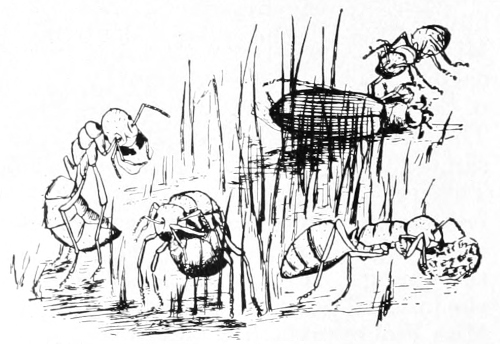
Ants making their toilets.
But it is as infant nurse that the ant is a shining example. No mother instinct is hers, for she has yielded the power of motherhood to the exigencies of business life, since all workers are females but are undeveloped sexually. She shows far more sense in the care of her infant sisters, than the mother instinct often supplies to human mothers. The ant nurse takes the eggs as soon as laid, and whether or not her care retards or hastens hatching we know not; but we do know, that although the queen ant may not lay more than two eggs per day, a goodly number of these seem to hatch at the same time. The eggs are massed in bundles and are sticky on the outside so as to hold the bundle together. Miss Fielde says, as the eggs are hatching, one ant will hold up the bundle, while another feeds those which have broken the shell. The larvæ, when young, also hang together by means of tiny hooks on their bodies. This habit of the eggs and young larvæ is a convenient one, since an ant is thus able to carry many at a time.
The larvæ are odd looking little creatures, shaped like crookneck squashes, the small end being the head and neck and the latter being very extensible. The ant nurses, by feeding some more than others, are able to keep a brood at the same stage of development; and in a well ordered ant-nest, we find those of the same size in one nursery. I have often thought of a graded school as I have noted in ant-nests the youngsters assorted according to size.
The ants seem to realize the cost and care of rearing their young; and when a nest is attacked, the oldest, which are usually in the pupa stage, are saved first. When the larvæ are young, they are fed on regurgitated food; but as they grow older, the food is brought to them, or they to the food, and they do their own eating. In one of my nests, I placed part of the yolk of an egg hard boiled, and the ant nurses dumped the larvæ down around the edges of it; there they munched industriously, until through their transparent bodies I could see the yellow of the egg the whole length of the alimentary canal. The ant nurses are very particular about temperatures for their young, and Miss Fielde says they are even more careful about draughts. Thus they are obliged to move them about in the ground nests, carrying them down to the lower nurseries in the heat of the day, and bringing them up, nearer to the warm stones, during the evenings. This moving is always done carefully, and though the ant’s jaws are such formidable nippers, she carries her baby sisters with gentleness; and if they be pupæ, she holds them by the loose pupal skin, like carrying a baby by its clothes. The pupæ look like plump little grain bags, tied at one end with a black string. They are the size of small grains of wheat, and are often called ants’ eggs, which is absurd, since they are almost as large as the ant. Ants’ eggs are not larger than pin points.
The ant nurses keep the larvæ and pupæ very clean by licking them; and when a youngster issues from the pupa skin, it is a matter of much interest to the nurses. I have often seen two or three of them help straighten out the cramped legs and antennæ of the young one, and hasten to feed her with regurgitated food. When ants first issue from the pupa skin they are pale in color, their eyes being very black in contrast; they are usually helpless and stupid, although they often try to clean their antennæ and make a toilet; but they do not know enough to follow their elders from one room to another, and they are a source of much care to the nurses. In case of moving, a nurse will lock jaws with a “callow,” as a freshly hatched adult ant is called, and drag her along, the legs of the callow sprawling helplessly meanwhile. If in haste, the nurse takes hold anywhere, by the neck or the leg, and hustles her charge along; if she takes her by the waist the callow curls up like a kitten, and is thus more easily moved. After moving them from one chamber to the next, I have noticed that the callows are herded together, their attendants ranged in a circle about them. Often we see one ant carrying another which is not a callow, and this means that a certain number of the colony have made up their minds to move, while the others are not awake to this necessity. In such a case, one of these energetic sisters will seize another by the waist, and carry her off with an air that says plainly, “Come along, you stupid!”
Ants are very cleanly in their nests, and we find the refuse piled in a heap at one corner, or as far as possible from the brood.
If we are fortunate enough to find a queen for the nest, then we may observe the attention she gets; she is always kept in a special compartment, and is surrounded by ladies in waiting, who feed her and lick her clean and show solicitude for her welfare; although I have never observed in an ants’ nest, that devotion to royalty which we see in a beehive.
Not the least interesting scene in an ants’ nest is when all, or some, are asleep and are as motionless as if dead.
LESSON XCVII
Observations of Ants in an Artificial Nest
Leading thought—The ants are very devoted to their young and perhaps the care of them is the most interesting feature in the study of the artificial nest.
Method—Have, in the schoolroom, a Lubbock’s nest with a colony of ants within it, with their larvæ in all stages, and if possible, their queen. For observing the form of the ant, pass one or two around in a vial.
Observations—1. What is there peculiar about the shape of the ant’s body? Can you see which section bears the legs? Are the ants’ legs long compared with her body? Can she run rapidly?
2. Look at the ant’s head through a lens, and describe the antennæ, the jaws and the eyes.
3. Note how the ant keeps her antennæ in motion. Note how she gropes with them as a blind person with his hands. Note how she uses them in conversing with her companions.
4. How does the ant clean her antennæ? Does she clean them more often than any other part of her body? How does she make her toilet?
5. See how an ant eats syrup. How do ants feed each other?
6. How does the ant carry an object? How does she carry a larva or a pupa? Have you ever seen one ant carry another? If so, describe it.
7. Note the way the ants feed their young. How do they keep them clean? Does an ant carry one egg or one small larva at a time or a bundle of them? How do you suppose the bundle is fastened together?
8. Describe an egg, a larva and a pupa of the ant and tell how they differ. Do you know which ant is the mother of the larvæ in the nest?
9. Do you find larvæ of different sizes all together in your nest? Do you find larvæ and pupæ in the same group? Do the ants move the young often from one nest to another? Why do you suppose they do this?
10. Note how the ant nurses take care of the callow ant when it is coming out from the pupa skin. How do they assist her and care for her? How do they lead her around? How do ants look when resting?
11. Note where the ants throw the refuse from the nest. Do they ever change the position of this dump heap?
THE MUD-DAUBER
Teacher’s Story
HIS little cement worker is a nervous and fidgety creature, jerking her wings constantly as she walks around in the sunshine; but perhaps this is not nervousness, but rather to show off the rainbow iridescence of her black wings; surely such a slim-waisted being as she, has a right to be vain. No tight lacing ever brought about such a long, slim waist as hers; it is a mere pedicel, and the abdomen is a mere knob at the end of it. The latter seen from the outside, would seem of little use as an abdomen; but if we watch the insect flying, we can see plainly that it is used to steer with.
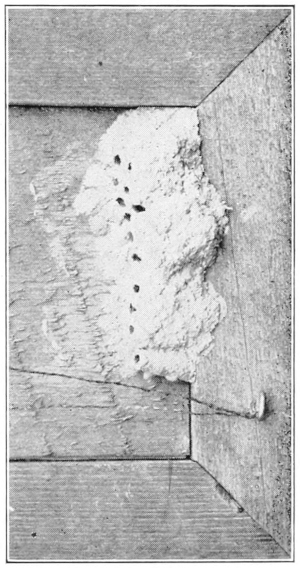
Nests of a mud-dauber on the back of a picture frame.
In early summer, we find this black wasp at her trade as a mason. She seeks the edges of pools or puddles where she works industriously, leaving many little holes whence she takes mud to mix with the saliva, which she secretes from her mouth to make firm her cement. This cement she plasters on the under side of some roof or rafter or other protected place, going back and forth until she has built a suitable foundation. She works methodically, making a tube about an inch long, smooth inside but rough outside, the walls about one-eighth of an inch thick. She does all of the plastering with her jaws, which she uses as a trowel. When the tube is completed except that the end is left open, she starts off in quest of spiders, and very earnestly does she seek them. I have seen her hunt every nook and corner of a piazza for this prey. When she finds a spider, she pounces upon it and stings it until it is helpless, and carries it to her cement tube, which is indeed a spider sarcophagus, and thrusts it within. She brings more spiders until her tube is nearly full; she then lays an egg within it and then makes more cement and neatly closes the door of the tube. She then places another tube by the side of this, which she provisions and closes in the same way; and then she may make another and another tube, often a half dozen, under one adobe roof.
The wasp in some mysterious way knows how to thrust her sting into the spider’s nervous system in a peculiar way, which renders her victim unable to move although it yet lives. The wasp is no vegetarian like the bee, and she must supply her young with wasp-meat instead of bee-bread. Since it is during the summer and hot weather when the young wasps are hatched and begin their growth, their meat must be kept fresh for a period of two or three weeks. So these paralyzed spiders do not die, although they are helpless. It is certainly a practical joke with justice in it, that these ferocious creatures lie helpless while being eaten by a fat little grub which they would gladly devour, if they could move.
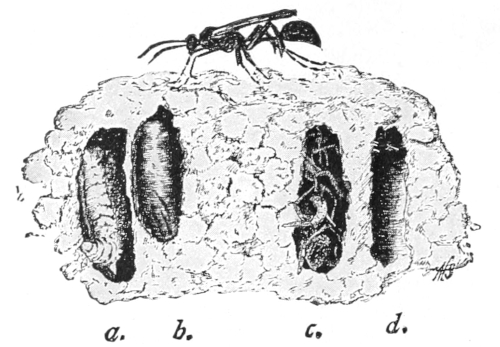
A mud-dauber and her nests, with cells cut open showing a, larva full grown; b, cocoon; c, young larva feeding on its spider-meat and d, an empty cell.
Drawn by Anna C. Stryke.
The wasp larva is a whitish, plump grub and it eats industriously until the spider meat is exhausted. It then weaves a cocoon of silk about itself which just covers the walls of its home tube, like a silken tapestry; within this cocoon the grub changes to a pupa. When it finally emerges, it is a full-grown wasp with jaws which are able to cut a door in the end of its tube, through which it comes out into the world, a free and accepted mason. The females or queens, which issue late in the season, hide in warm or protected places during the winter; they particularly like the folds of lace window curtains for hibernating quarters. There they remain until spring comes, when they go off to build their plaster houses.
There are about seventy species of mud wasps in our country. Some provision their nests with caterpillars instead of spiders. This is true of the jug-builder, which makes her nest jug-shaped and places two or three of them side by side upon a twig. She uses hair in her mortar, which makes it stronger. This is necessary, since the jug is saddled upon twigs and is more exposed to the rain than is the nest of the most common mud-dauber. The jug-builder is brown in color and has yellow markings on the abdomen; but she does not resemble the yellow-jackets, because she has a threadlike waist. There are other species of mud wasps which use any small cavity they can find for the nest, plastering up the opening after the nest has been provisioned and the egg laid. We often find keyholes, knot-holes and even the cavity in the telephone receiver, plastered up by these small opportunists.
The mud-dauber which is the most common, and most likely to be selected for this lesson, is a slender creature and looks as if she were made of black tinsel; her body gives off glints of steel and blue; her abdomen constantly vibrates with the movement of breathing. Her eyes are large and like black beads; her black antennæ curve gracefully outward, and her wings, corrugated with veins, shimmer with a smoky blue, green and purple. She stands on her black tip-toes when she walks, and she has a way of turning around constantly as if she expected an attack from the rear. Her wings, like those of other mud-wasps are not folded fan-wise like those of the yellow-jacket, but are folded by each other over her back.
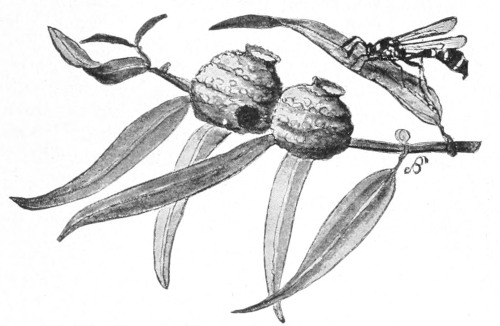
The Jug-builder and her nests.
LESSON XCVIII
The Mud-dauber
Leading thought—There are certain wasps which gather mud and mix it into mortar with which to build nests for their young. Within these nests, the mother wasp places spiders or insects which are disabled by her sting, for the food of the young wasps.
Method—Have the pupils bring the homes of the mud wasps to school for observation. The wasps themselves are very common in June and also in September, and they also may be studied at school and may be passed around in vials for closer observation; they do not sting severely when handled, the sting being a mere prick. The purpose of the lesson should be to stimulate the pupils to watch the mud-daubers while building their nests and capturing their prey.
Observations—1. Where did you find the mud-dauber’s nest? How was it protected from the rain? Was it easily removed? Could you remove it all, or did some of it remain stuck fast?
2. What is the shape of the nest? How does it look inside? Of how many tubes does it consist? How long is each tube? Were the tubes laid side by side?
3. Of what material was the nest made? Is it not much harder than mud? How did the wasp change the mud to cement? Where did she get the mud? How did she carry it? With what tools did she plaster it?
4. For what purpose was the nest made? Is the inside of the tubes smooth as compared with the outside of the nest?
5. Write a little story about all that happens in one of these tubes, including the following points: What did the mother wasp place in the tube? How and why did she close it? What hatched from the egg she placed within it? How does the young wasp look? On what does it feed? What sort of a cocoon does it spin? How does it get out of the nest when full-grown?
6. Describe the mud-dauber wasp. How large is she? What is the color of her body? Of her wings? How many wings has she? How are her wings folded differently from those of the yellow-jacket? Describe her eyes; her antennæ; her legs; her waist; her abdomen.
7. Where did you find the wasp? How did she act? Do you think that she can sting? How does she pass the winter?
8. Do you know the mud wasps which build the little, jug-shaped nests for their young? Do you know the mud wasps which utilize crevices and keyholes for their nests and plaster up the opening?
9. Do you know about the digger wasps which pack away grasshoppers or caterpillars in a hole in the ground, in which they lay their egg and then cover it?
Supplementary reading—Insect Stories, Kellogg; Wasps, Social and Solitary, Peckham; Wasps and their Ways, Morley; The Ways of the Six-footed, Comstock; Home Studies in Nature, Treat.
THE YELLOW-JACKET
Teacher’s Story
ANY wasps are not so waspish after all when we understand one important fact about them; i. e., although they are very nervous themselves, they detest that quality in others. For years the yellow-jackets have shared with us our meals at our summer camp on the lake shore. They make inquisitive tours of inspection over the viands on the table, often seeming to include ourselves, and coming so near that they fan our faces with their wings. They usually end by selecting the sweetened fruits, but they also carry off bits of roast beef, pouncing down upon the meat platter and seizing a tidbit as a hawk does a chicken. We always remain calm during these visitations, for we know that unless we inadvertently pinch one, we shall not be harmed; and it is great fun to watch one of these graceful creatures poising daintily on the side of the dish lapping up the fruit juice as a cat does milk, the slender, yellow-banded abdomen palpitating as she breathes. Occasionally, two desire the same place, and a wrestling match ensues which is fierce while it lasts, but the participants always come back to the dish unharmed. They are extra polite in their manners, for after one has delved eagerly into the fruit syrup, she proceeds to clean her front feet by passing them through her jaws, which is a wasp way of using a finger bowl.
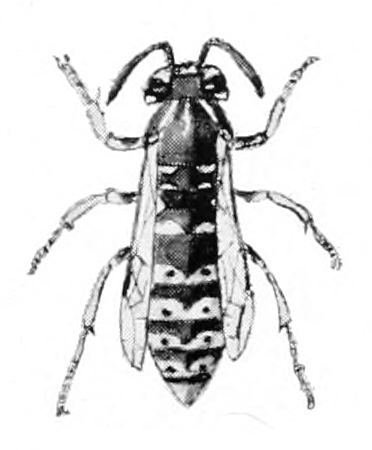
A yellow-jacket
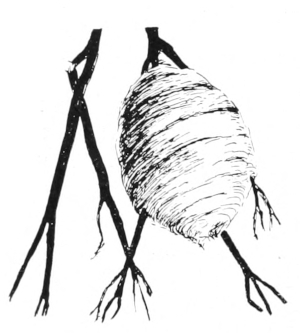
Both yellow-jackets and the white-faced black-hornets build in trees and similarly, although the paper made by the yellow-jackets is finer in texture. However, some species of yellow-jackets build their nests in the ground, but of similar form. The nest is of paper made of bits of wood which the wasps pull off with their jaws from weather-worn fences or boards. This wood is reduced to a pulp by saliva which is secreted from the wasp’s mouth, and is laid on in little layers which can be easily seen by examining the outside of the nest. These layers may be of different colors. A wasp will come with her load of paper pulp, and using her jaws and front feet for tools she will join a strip to the edge of the paper and pat it into shape. The paper tears more readily along the lines of the joining, than across. The cover of the nest is made of many layers of shell-like pieces fastened together and the outer layers are waterproof; the opening of a nest is at the bottom. Mr. Lubbock has shown that certain wasps are stationed at the door, as sentinels, to give warning on the approach of the enemy. The number of stories of combs in a nest depends upon the age and size of the colony. They are fastened together firmly near the center, by a central core or axis of very strong, firm paper, which at the top is attached to a branch or whatever supports the nest. The cells all open downward, in this respect differing from those of the honey-bee, which are usually placed horizontal. The wasp-comb differs from the honey-comb in that it is made of paper instead of wax, and that the rows of cells are single instead of double. The cells in the wasp-comb are not for storing honey, but are simply the cradles for the young wasps. (See Fig. p. 457.)
Sometimes a wasp family disaster makes it possible for us to examine one of these nests with its inmates. Here we find in some of the cells, the long white eggs fastened to the very bottom of the cell, in an inner angle, as if a larva when hatched needed to have a cozy corner. These wasp larvæ are the chubbiest little grubs imaginable and are very soft bodied. It was once a mystery to me how they were able to hang in the cells, head down, without getting “black in the face” or falling out; but this was made plain by studying the little disk at the rear end of the larva’s body, which is decidedly sticky; after a larva is dead, its heavy body can be lifted by pressing a match against this disk; thus it evidently suffices to keep the baby wasp stuck fast to its cradle. The larva’s body is mostly covered with a white, papery, soft skeleton skin; the head is yellowish and highly polished, looking like a drop of honey. At one side may be seen a pair of toothed jaws, showing that it is able to take and chew any food brought by the nurses. They seem to be well trained youngsters for they all face toward the center of the nest, so that a nurse, when feeding them, can move from one to another without having to pass to the other side of the cell. It is a funny sight to behold a combful of well grown larvæ, each fitting in its cell like meal in a bag and with head and several segments projecting out as if the bag were overflowing. It behooves the wasp larva to get its head as far out of the cell as possible, so that it will not be overlooked by the nurses; the little ones do this by holding themselves at the angle of the cell; this they accomplish by wedging the back into the corner. These young larvæ do not face inwards like the older ones, but they rest in an inner angle of the cell.
After a larva has reached the limit of its cell room, it spins a veil around itself and fastens it at the sides, so that it forms a lining to the upper part of the cell and makes a bag over the “head and shoulders” of the insect. This cocoon is very tough, and beneath its loose dome the larva skin is shed; the pupa takes on a decidedly waspish form, except that the color is all black; the legs and the wings are folded piously down the breast and the antennæ lie meekly each side of the face, with the “hands” folded outside of them; the strong toothed jaws are ready, so that when the pupa skin is molted, the insect can cut its silken curtain, and come out into its little nest world, as a full-fledged yellow-jacket.
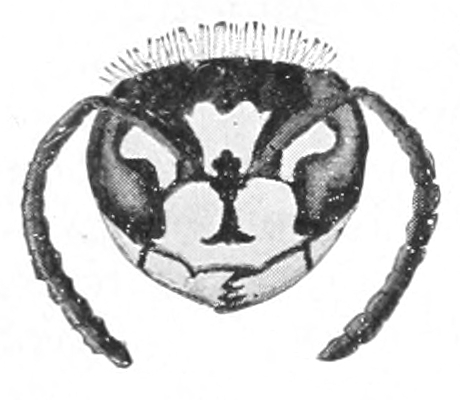
Looking a wasp in the face.
What a harlequin the wasp is, in her costume of yellow and black! Often in the invertebrate world these colors mean “sit up and take notice,” and the wasp’s costume is no exception. Whoever has had any experience in meddling with yellow-jackets, avoids acquaintance with all yellow and black insects. Yet we must confess that the lady wasp has good taste in dress. The yellow cross bands on her black skirt are scalloped, and, in fact, all her yellow is put on in a most chic manner; she, being slender, can well afford to dress in roundwise stripes, and she folds her wings prettily like a fan, and not over her back like the mud wasp, which would cover her decorations. There is a sensation coming to the one who, armed with a lens, looks a wasp in the face; she always does her hair pompadour, and the yellow is here put on with a most bizarre effect, in points and arabesques. Even her jaws are yellow with black borders and black notches. Her antennæ are velvety black, her legs are yellow, and her antennæ comb, on her wrist, is a real comb and quite ornate.
In the nest which we studied in late August, the queen cells were just being developed. They were placed in a story all by themselves, and they were a third larger than the cells of the workers. The queen of this nest was a most majestic wasp, fully twice as large as any of her subjects; her face was entirely black, and the yellow bands on her long abdomen were of quite a different pattern than those on the workers; her sting was not so long in proportion, but I must confess it looked efficient. In fact, a yellow-jacket’s sting is a formidable looking spear when seen through a microscope, since it has on one side some backward projecting barbs, meant to hold it firm when driving home the thrust.
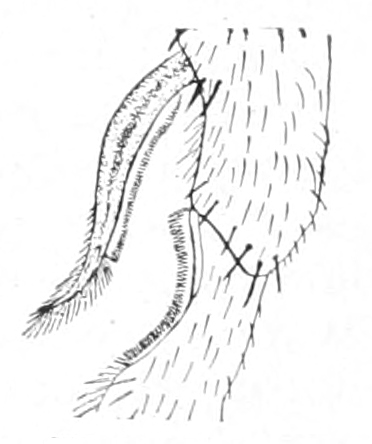
The antenna-comb on the wrist of my Lady Wasp
While wasps are fond of honey and other sweets, they are also fond of animal food and eat a great many insects, benefiting us greatly by destroying mosquitoes and flies. As no food is stored for their winter use, all wasps excepting the queens die of the cold. The queens crawl away to protected places and seem to be able to withstand the rigors of winter; each queen, in the spring, makes a little comb of a few cells, covering it with a thin layer of paper. She then lays eggs in these cells and gathers food for the young; but when these first members of the family, which are always workers, come to maturity, they take upon themselves the work of enlarging the nest and caring for the young. After that, the queen devotes her energies to laying eggs.
Wasps enlarge their houses by cutting away the paper from the inside of the covering, to give more room for building the combs wider; to compensate for this, they build additional layers on the outside of the nest. Thus it is, that every wasp’s nest, however large, began as a little comb of a few cells and was enlarged to meet the needs of the rapidly growing family. Ordinarily the nest made one year is not used again.
LESSON XCIX
The Yellow-jacket
Leading thought—The wasps were the original paper makers, using wood pulp for the purpose. Some species construct their houses of paper in the trees or bushes while others build in the ground.
Method—Take a deserted wasp-nest, the larger the better, with sharp scissors remove one side of the covering of the nest, leaving the combs exposed and follow with the questions and suggestions indicated. From this study of the nest encourage the children to observe more closely the wasps and their habits, which they can do in safety if they learn to move quietly while observing (See Fig. p. 457.)
Observations—1. Which kind of wasp do you think made this nest? Of what is the nest made? Where did the wasp get the material? How do the wasps make wood into paper?
2. What is the general shape of the nest? Is the nest well covered to protect it from rain? Where is the door where the wasps went in and out? Is the covering of the nest all of the same color? Do these differences in color give you any idea of how the wasps build the paper into the nest? Does the paper tear more easily one way than another? Is the covering of the nest solid or in layers?
3. How many combs or stories are there in the wasp house? How are they fastened together and how suspended?
4. Compare the combs of the wasp-nest with those of the honey-bee. How do they resemble each other and how differ? Do the cells open upward or downward? For what purpose are the combs in the wasp-nest used? Are all the cells of the same size? Do you know the reason for this difference in size?
5. How do the young wasp grubs manage to cling to the cells head downward? Are the cells lined with a different color and does this lining extend out over the opening in some cases? Is this lining of the cells made of paper also? Do you know how a young wasp looks and how the white lining of the cells is made?
6. Do you believe that some wasps of the colony are always posted as sentinels at the door to give warning if the colony is attacked?
7. Do wasps store food to sustain them during the winter? What happens to them during winter? Is the same nest used year after year?
8. Can you describe the beginning of this wasp-nest? When was it made? Tell the story of the wasp that made it. How large was the nest at first? How was the nest enlarged?
9. What is the food of wasps? How do these insects benefit us?
10. Write a story giving the life history of a wasp.
11. In the summer watch a yellow-jacket eat from a dish of sweetened fruit which you may place out of doors to coax her to come where you can carefully observe her. What are the colors of the yellow-jacket? Where is the yellow? How are the yellow bands made ornamental? How does she fold her wings? How many wings has she? What is the color of her legs? Describe her antennæ and eyes. How does she eat the fruit juice? Can you see the motion of her body when she breathes?
THE LEAF-CUTTER BEE
Teacher’s Story
NE beautiful day in late June when I was picking some roses, I saw a bee, almost as large as a honey-bee but different in shape and darker in color, alight on a leaf and moving with nervous rapidity, cut a circle out of a leaf with her jaws “quicker’n a wink;” then taking the piece between her fore-feet and perhaps holding it also with her jaws, she flew away, the green disk looking as large in proportion to her size as a big base drum hung to the neck of a small drummer. I waited long for her to come back, but she came not; meanwhile I examined the leaves of the rose bush and found many circlets, and also many oblong holes with the ends deeply rounded, cut from the leaflets.
I knew the story of the little bee and was glad I had seen her cut a leaflet with her jaw shears, which work sidewise like real shears. I knew that somewhere she had found a cavity big enough for her needs; perhaps she had tunneled it herself in the dead wood of some post or stump, using her jaws to cut away the chips; maybe she had found a crevice beneath the shingles of a roof or beneath a stone in the field, or she may have rolled a leaf; anyway, her little cave was several inches long, circular in outline and large enough to admit her body. She first cut a long piece from the rose leaf and folded it at the end of the tunnel; and then she brought another and another long piece and bent and shaped them into a little thimble-like cup, fastening them together with some saliva glue, from her mouth. After the cup was made to her liking, she went in search of food, which was found in the pollen of some flowers. This pollen was carried not as the honey-bees do, because she has no pollen baskets on her legs; but it was dusted into the fur on the lower side of her body; as she scraped the pollen off, she mixed it with some nectar which she had also found in the flowers, and made it into a pasty mass and heaped it at the bottom of the cup; she probably made many visits to flowers before she had a sufficient amount of this bee pastry, and then she laid an egg upon it; after this, she immediately flew back to the rose bush to cut a lid for her cup. She is a nice mathematician and she cuts the lid just a little larger than the rim of the cup, so that it may be pushed down in, making it fit very closely around the edges; she then cuts another and perhaps another of the same size and puts them over and fastened to the first cover. When finished, it is surely the prettiest baby basket ever made by a mother, all safely enclosed to keep out enemies. But her work is then only begun. She has other baby baskets to make and she perhaps makes ten or more, placing one cup just ahead of another in the little tunnel.
But what is happening meanwhile to the bee babies in the baskets? The egg hatches into a little white bee grub which falls to and eats the pollen and nectar paste with great eagerness. As it eats, it grows and sheds its skeleton skin as often as it becomes too tight, and then eats and grows some more. How many mothers would know just how much food it would require to develop a child from infancy until it grows up! This bee mother knows well this amount and when the food is all gone, the little bee grub is old enough to change to a pupa; it looks very different now, and although mummy-shaped we can see its folded wings and antennæ. After remaining a motionless pupa for a few days, it sheds its pupa skin and now it is a bee just like its mother; but as the oldest bee is at the bottom of the tunnel, even after it gets its wings and gnaws its way out of its basket, it very likely cannot escape and find its way out into the sunshiny world, until its younger brothers and sisters have gone out before it.
There are many species of these leaf-cutter bees and each species makes its own kind of a nest, always cutting the same size of circlets and usually choosing its own special kind of leaf to make this cradle. Some are daintier in their tastes and use rolled petals instead of leaves; and we have found some tiny cups made of gorgeous peony petals, and some of pansy petals, a most exquisite material.
At Chautauqua we found a species which rolled maple leaves into a tube which held three or four cups, and we also found there a bee stowing her cups in the open end of a tubular rod, used to hold up an awning. There are other species which make short tunnels in the ground for their nests, but perhaps the most common of all wedge their cups between or beneath the shingles on the roofs of summer cottages. But, however or wherever the leaf-cutter works, she is a master mechanic and does her work with niceness and daintiness.
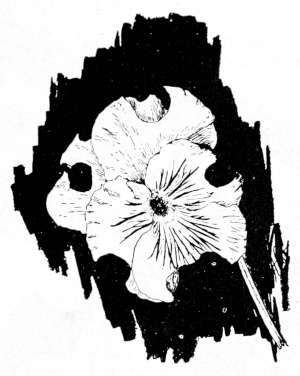
Pansy cut by leaf-cutter bee.
Drawing by Anna C. Stryke.
LESSON C
The Leaf-cutter Bee
Leading thought—When we see the edges of rose leaves with holes of regular pattern in them, some of the holes being oblong and some circular, we know the leaf-cutter bee has cut them to make her cradle cups.
Method—It is very easy to find in June or autumn the leaves from which the leaf-cutter bee has cut the bedding for her young. Encourage the pupils to look for the nest during the summer and to bring some of the cups to school when they return, where they may be studied in detail; meanwhile the teacher may tell the story of the nest. This is rather difficult for the pupils to work out.
Observations—1. Do you find rose leaves with round holes cut in their edges? Do you find on the same bush some leaflets with oblong holes in them? Sketch or describe the rose leaf thus cut, noting exactly the shape of the holes. Are the circular holes of the same size? Are the long holes about equal in size and shape? Do you find any other plants with holes like these cut in them? Do you find any petals of flowers thus cut?
2. What do you think made these holes? If an insect was taking a leaf for food would the holes be as regular? Watch the rose bush carefully and see if you can discover the insect which cuts the leaf.
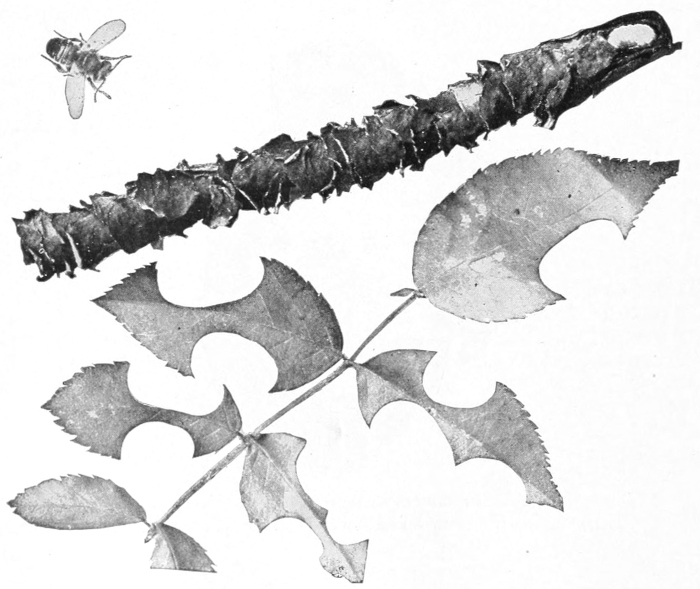
Leaf-cutter bee; the rose leaf cut by her; her nest-cups removed from the tube in which they were built, the cup made first cut open to show bee larva.
Photo by Slingerland.
3. Have you ever seen the little black bee carrying pieces of rose leaves between her front feet? With what instrument do you suppose she cut the leaves? Where do you think she was going?
4. Have you ever found the nest of the leaf-cutter bee? Was it in a tunnel made in dead wood or in some crack or cranny? How many of the little rose leaf cups are there in it? How are the cups placed? Are the little bees still in the cups or can you see the holes through which they crawled out?
5. Take one cup and study it carefully. How are the pieces of leaves folded to make the cups? How is the lid put on? Soak the cup in water until it comes apart easily. Describe how many of the long pieces were used and how they were bent to make a cup. Of how many thicknesses is the cover made? Are the covers just the same size or a little larger than the top of the cup? How does the cover fit so tightly?
6. If you find the nest in July or early August, examine one of the cups carefully and see what there is in it. Take off the cover without injuring it. What is at the bottom of the nest? Is there an insect within it? How does it look? What is it doing? Of what do you think its food was made? How and by whom was the food placed in the cup? Place the nest in a box or jar with mosquito netting over the top, and put it out of doors in a safe and shaded place. Look at it often and see what this insect changes into.
7. If the mother bee made each little nest cup and put in the bee-bread, and honey for her young, which cup contains the oldest of the family? Which the youngest? How do you think the full-grown bees get out of the cup?
8. Do you think that the same species of bee always cuts the same sized holes in a leaf? Is it the same species which cuts the rose leaves and the pansy petals?
THE LITTLE CARPENTER-BEE
Teacher’s Story
AKE a dozen dead twigs from almost any sumac or elder, split them lengthwise, and you will find in at least one or two of them, a little tunnel down the center where the pith once was. In the month of June or July, this narrow tunnel is made into an insect apartment house, one little creature in each apartment, partitioned off from the one above and the one below. The nature of this partition reveals to us whether the occupants are bees or wasps; if it is made of tiny chips, like fine sawdust glued together, a bee made it and there are little bees in the cells; if it is made of bits of sand or mud glued together, a wasp was the architect and young wasps are the inhabitants. Also, if the food in the cells is pollen paste, it was placed there by a bee; if of paralyzed insects or spiders, a wasp made the nest.
The little carpenter-bee (Ceratina dupla) is a beautiful creature, scarcely one quarter of an inch in length, with metallic blue body and rainbow tinted wings. In May, she selects some broken twig of sumac, elder or raspberry, which gives her access to the pith; this she at once begins to dig out, mouthful by mouthful, until she has made a smooth tunnel several inches long; she then gathers pollen and packs bee-bread in the bottom of the cell to the depth of a quarter-inch, and then lays upon it, a tiny white egg. She then brings back some of her chips of pith and glues them together, making a partition about one-tenth of an inch thick, which she fastens firmly to the sides of the tunnel; this is the roof for the first cell and the floor of the next one; she then gathers more pollen, lays another egg, and builds another partition.
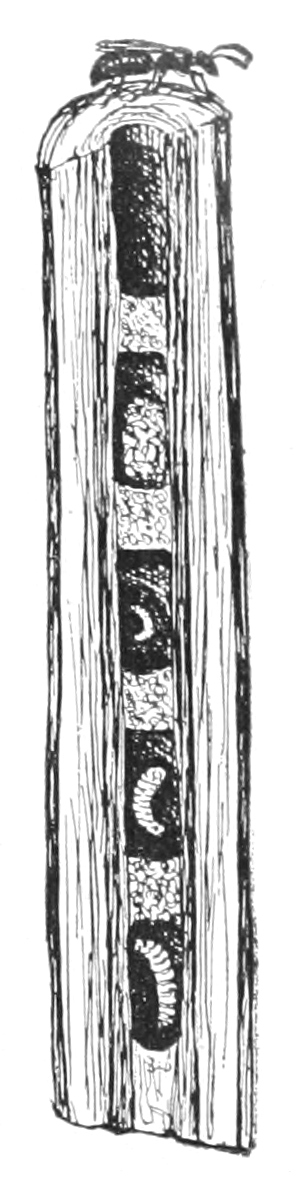
The little carpenter-bee; her nest, cut open, showing the eldest larva at the bottom and the youngest nearest the entrance.
Thus she fills the tunnel, almost to the opening, with cells, sometimes as many as fourteen; but she always leaves a space for a vestibule near the door, and in this she makes her home while her family below her are growing up.
The egg in the lowest cell of course hatches first; a little bee grub issues from it and eats the bee-bread industriously and grows by shedding his skin when it becomes too tight; then he changes to a pupa and later to a bee resembling his mother. But, though fully grown, he cannot get out into the sunshine, for all his younger brothers and sisters are blocking the tunnel ahead of him; so he simply tears down the partition above him and kicks the little pieces of it behind him, and bides his time until the next youngest brother tears down the partition above his head and pushes its fragments behind him into the very face of the elder which, in turn, performs a similar act; and thus, while he is waiting, he is kept more or less busy pushing behind him the broken bits of all the partitions above him. Finally, the youngest gets his growth, and there they all are in the tunnel, the broken partitions behind the hindmost at the bottom of the nest, and the young bees packed closely together in a row with heads toward the door. When we find the nest at this period, we know the mother because her head is toward her young ones and her back to the door. A little later, on some bright morning, they all come out into the sunshine and flit about on gauzy, rainbow wings, a very happy family, out of prison.
But if the brood is a late one, the home must be cleaned out and used as a winter nest, and still the loyal little mother bee stays true to her post; she is the last one to enter the nest; and not until they are all housed within, does she enter. It is easy to distinguish her for her poor wings are torn and frayed with her long labor of building the nest, until they scarcely serve to carry her afield; but despite this she remains on guard over her brood, for which she has worn out her own life.

Nest of carpenter-wasp.
Comstock’s Manual.
The story of the little carpenter-wasps is similar to that of the bee, except that we have reason to believe they often use her abandoned tunnels instead of making new ones. They make their little partitions out of mud; their pupæ are always in long, slender, silken cocoons, and we have no evidence that the mother remains in attendance.
LESSON CI
The Little Carpenter-bee
Leading thought—Not all bees live in colonies like the honey-bees and bumblebees. One tiny bee rears her brood within a tunnel which she makes in the pith of sumac, elder or raspberry.
Method—This lesson may be given in June or in October. In June, the whole family of bees in their apartments may be observed; in autumn, the empty tenement with the fragments of the partitions still clinging may be readily found and examined; and sometimes a whole family maybe found, stowed away in the home tunnel, for the winter.

Nest of large carpenter-wasp
Comstock’s Manual.
Observations—1. Collect dead twigs of sumac or elder and cut them in half, lengthwise. Do you find any with the pith tunneled out?
2. How long is the tunnel? Are its sides smooth? Can you see the partitions which divide the long narrow tunnel into cells? Look at the partitions with a lens, if necessary, to determine whether they are made of tiny bits of wood or of mud. If made of mud, what insect made them? If of little chips how and by what were they constructed?
3. Are there any insects in the cells? If so, describe them. Is there bee-bread in the cells?
4. For what was the tunnel made? With what tools was it made? How are the partitions fastened together? How does a young bee look?
5. Write the story of the oldest of the bee family which lived in this tunnel. Why did it hatch first? On what did it feed? When it became a full fledged bee, what did it do? How did it finally get out?
6. Take a glass tube, the hollow at the center being about one-eighth of an inch across, a tube which you can get in any drug-store. Break this tube into sections, six or seven inches long, wrap around each a black paper or cloth, made fast with rubber bands and suspend them in a hedge or among thick bushes in May. Examine these tubes each week to see if the wasps or bees are using them.
Supplementary reading—“The Story We Love Best,” in Ways of the Six-footed, Comstock.
THE BUMBLEBEE
Teacher’s Story
Thou, in sunny solitudes, Rover of the underwoods, The green silence dost replace With thy mellow, breezy bass. —Emerson.
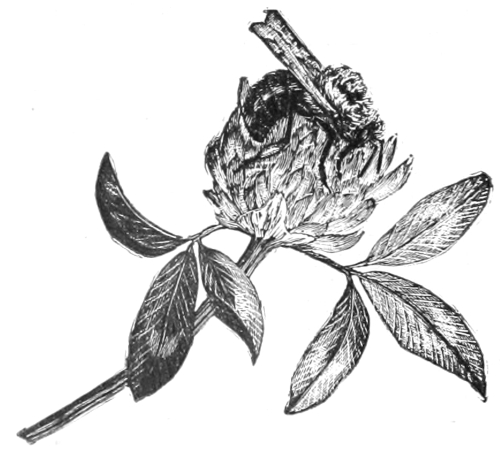
HERE seems to have been an hereditary war between the farm boy and the bumblebee, the hostilities usually initiated by the boy. Like many wars, it is very foolish and wicked, and has resulted in great harm to both parties. Luckily, the boys of to-day are more enlightened; and it is to be hoped that they will learn to endure a bee sting or two for the sake of protecting these diminishing hosts, upon which so many flowers depend for carrying their pollen; for of all the insects of the field, the bumblebees are the best and most needed friends of the flowers.
The bumblebees are not so thrifty and forehanded as are the honeybees, and do not provide enough honey to sustain the whole colony during the winter. Only the mother bees, or queens as they are called, survive the cold season. Just how they do it, we do not know, but probably they are better nourished and therefore have more endurance than the workers. In early May, one of the most delightful of spring visitants is one of these great buzzing queens, flying low over the freshening meadows, trying to find a suitable place for her nest; and the farmer or fruit grower who knows his business, is as anxious as she that she find suitable quarters, knowing well that she and her children will render him most efficient aid in growing his fruit and seed. She finally selects some cosy place, very likely a deserted nest of the field mouse, and there begins to build her home. She toils early and late, gathering pollen and nectar from the blossoms of the orchard and other flowers which she makes into a special kind of bee-bread, by mixing it with nectar. This is packed in an irregular mass and on it she lays a few eggs; each little bee grub, as soon as it hatches, burrows into the bee-bread, making a little cave for itself while satisfying its appetite. After it is fully grown, it spins about itself a cocoon and changes to a pupa, and later emerges a full-fledged worker bumblebee, being scarcely more than half as large as her queen mother. These workers or daughters of the family find full satisfaction in life in attending to the wants of the growing family. They gather more pollen and mix it with honey, making larger masses for the young to burrow in; meanwhile, the queen remains at home and devotes her energies to laying eggs for the enlargement of the colony. The workers not only care for the young, but later they strengthen the silken pupa cradles with wax, and thus make them into cells for storing honey. When we understand that the cells in the bumblebee’s nest are simply made by the young bees burrowing in any direction, we can understand why the bumblebee comb is so disorderly in the arrangement of its cells. Perhaps the boy of the farm would find the rank bumblebee honey less like the ambrosia of the gods, if he knew that it was stored in the deserted cradles and swaddling clothes of the bumblebee grubs.
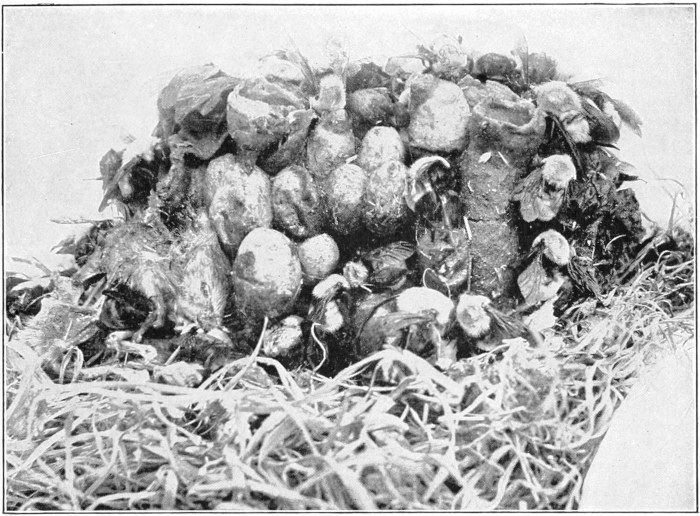
A bumblebee’s nest after a frost. Note the mummy of the first owner of the nest.
Photo by Slingerland.
All of the eggs in the bumblebee nest in the spring and early summer develop into workers which do incidentally the vast labor of carrying pollen for thousands of flowers; to these only is granted the privilege of carrying the pollen for the red clover, since the tongues of the other bees are not sufficiently long to reach the nectar. The red clover does not produce seed in sufficient quantity to be a profitable crop, unless there are bumblebees to pollinate its blossoms. Late in the summer, queens and drones are developed in the bumblebee nest, the drones, as with the honey-bees, being mates for the queens. But of all the numerous population of the bumblebee nest, only the queens survive the rigors of winter, and on them and their success depends the future of the bumblebee species.
There are many species of bumblebees, some much smaller than others, but they all have the thorax covered with plush above and the abdomen hairy, and their fur is usually marked in various patterns of pale yellow and black. The bumblebee of whatever species, has short but very active antennæ and a mouth fitted for biting as well as for sucking. Between the large compound eyes are three simple eyes. The wings are four in number and strong; the front legs are very short; all the legs have hairs over them and end in a three-jointed foot, tipped by a claw. On the hind leg, the tibia and the first tarsal joint are enlarged, making the pollen baskets on which the pollen is heaped in golden masses. One of the most interesting observations possible to make, is to note how the bumblebee brushes the pollen from her fur and packs it into her pollen baskets.
LESSON CII
The Bumblebee
Leading thought—The bumblebees are the chief pollen carriers for most of our wild flowers as well as for the clovers and other farm plants. They should, therefore, be kindly treated everywhere; and we should be careful not to hurt the big queen bumblebee which we see often in May.
Method—Ask the questions and encourage the pupils to answer them as they have opportunity to observe the bumblebees working in the flowers. A bumblebee may be imprisoned in a tumbler for a short period for observation, and then allowed to go unharmed. It is not advisable to study the nest, which is not only a dangerous proceeding for the pupil, but it also means the destruction of a colony of these very useful insects. However, if the location of a nest is discovered, it may be dug up and studied after the first heavy frost. Special stress should be laid upon the observations of the actions of the bees when visiting flowers.
Observations—1. In how many flowers do you find the bumblebee? Watch her closely and see how she gets the nectar. Notice how she “bumbles around” in a flower and becomes dusted with pollen. Watch her and note how she gets the pollen off her fur and packs it in her pollen baskets. On which legs are her pollen baskets? How does the pollen look when packed in them? What does she do with pollen and nectar?
2. Catch a bumblebee in a jelly glass and look at her closely. Can you see three little eyes between the big compound eyes? Describe her antennæ. Are they active? How many pairs of wings has she? Do you think they are strong? Which pair of legs is the shortest? How many segments are there in the leg? Do you see the claws on the foot?
3. What is the bumblebee’s covering? What is the color of her plush? Is she furry above and below?
4. Can you see that she can bite as well as suck with her mouth-parts? Will a bumblebee sting a person unless she is first attacked?
5. Have you seen the very large queen bumblebee in the spring, flying near the ground hunting for a place to build a nest? Why must you be very careful not to hurt her? How does she pass the winter? What does she do first, in starting the nest?
6. In how many ways does the bumblebee benefit us?
THE HONEY-BEE
Teacher’s Story
URING many years naturalists have been studying the habits and adaptations of the honey-bees, and, as yet, the story of their wonderful ways is not half told. Although we know fairly well what the bees do, yet we have no inkling of the processes which lead to a perfect government and management of the bee community; and even the beginner may discover things never known before about these fascinating little workers. In beginning this work it might be well to ask the pupils if they have ever heard of a republic that has many kings and only one queen; and where the citizens do all the governing without voting, and where the kings are powerless and the queen works as hard and longer than any of her subjects; and then tell them that the pages of history contain no account of a republic so wonderful as this; yet the nearest beehive is the home of just this sort of government.
In addition to the interest of the bee colony from a nature-study standpoint, it is well to get the children interested in bee-keeping as a commercial enterprise. A small apiary well managed may bring in an acceptable income; and it should be the source of a regular revenue to the boys and girls of the farm, for one hive should net the young bee-keeper from three to five dollars per year and prove a business education to him in the meantime.
Bees are perfect socialists. They have non-competitive labor, united capital, communal habitations and unity of interests. The bee commune is composed of castes as immutable as those of the Brahmins, but these castes exist for the benefit of the whole society instead of for the individuals belonging to them. These castes we have named queens, drones and workers, and perhaps, first of all, we should study the physical adaptations of the members of these castes for their special work in the community.
The Worker (p. 446, Fig. 3.)
There are three divisions to the body of the bee, as in all insects—head, thorax and abdomen. The head bears the eyes, antennæ and mouth-parts, (p. 448, W.) There are two large compound eyes on either side of the head and three simple eyes between them. The antennæ arise from the face, each consisting of two parts, one straight segment at the base, and the end portion which is curved and made up of many segments. There is also a short, bead-like segment where the antenna joins the face. A lens is needed to see the jaws of the bee, folded across, much like a pair of hooks, and below them the tongue, which is a sucking tube; the length of the tongue is very important, for upon this depends the ability of the bee to get nectar from the flowers.
The thorax bears three pairs of legs below and two pairs of wings above. Each leg consists of six segments, and the foot or tarsus has four segments and a pair of claws. The front leg has an antennæ comb between the tibia and tarsus, (p. 447, F, a,) the hind leg has a pollen basket, which is a long cavity bordered by hairs wherein the pollen is packed and carried (p. 447, A, pb.) On the other side of the large joint beyond the pollen basket are rows of spines which are used to remove the pollen from the baskets (p. 447, B, pc), and between these two large segments are the pincers for removing the wax (p. 447, B, wp.)
The front pair of wings is larger than the hind pair. The wings of the old bees that have done much work are always frayed at the edges.
There are six segments or rings to the abdomen, plainly visible from above. If the five segments next the thorax are marked above with yellow bands on their front edges, the bee is an Italian. On the lower side of the abdomen, each segment is made up of a central plate with an overlapping plate on each side; just at the front edge on each side of the central plate is a wax pocket which cannot be seen unless the bee is dissected under a microscope. From these pockets are secreted little flecks of wax (p. 448, X.)
The Queen
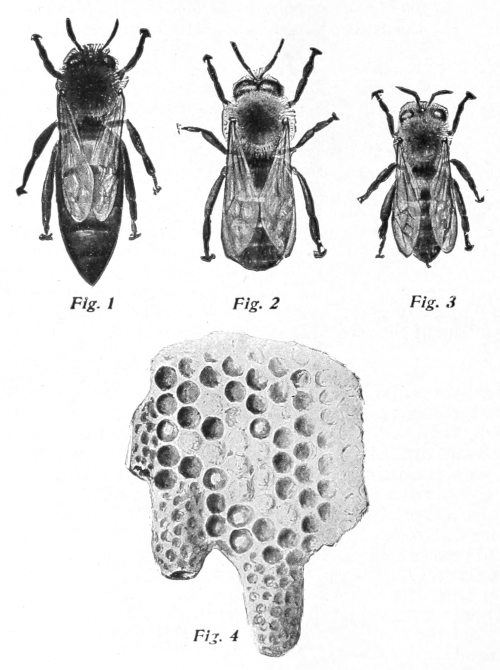
1. Queen bee. 2. Drone. 3. Worker; all enlarged. 4. Queen cells.
From How to Keep Bees—Comstock.
Drawn by A. J. Hammar.
The queen bee is a truly royal insect. She is much larger than the worker, her body being long, pointed, and extending far beyond the tips of her closed wings, giving her a graceful form. She has no pollen baskets or pollen comb upon her legs, because it is not a part of her work to gather pollen or honey. The queen bee starts life as an ordinary worker egg, which is selected for special development. The workers tear down the partitions of the cells around the chosen egg and build a projection over the top, making an apartment, (p. 446, Fig. 4.) The little white bee grub, as soon as it hatches, is fed for five days on the same food as is given to the worker grubs for three days; it is a special substance, secreted by the worker bees, called royal jelly. This food is very nourishing, and after being reared upon it, the princess larva weaves around herself a silken cocoon and changes to a pupa. Meanwhile the workers have sealed her cell with wax.
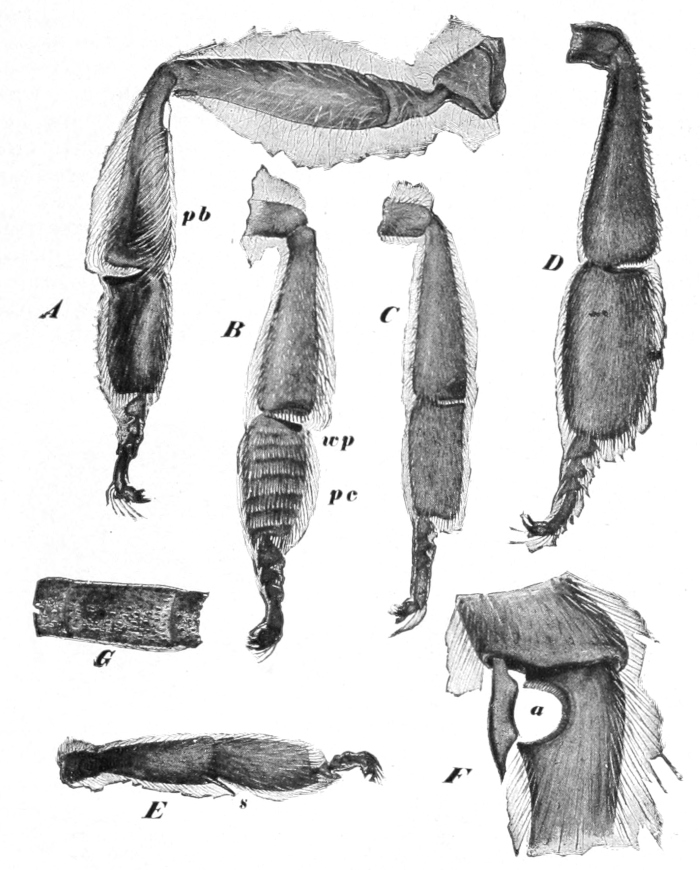
Legs of worker honey-bee.
A, outer surface of hind leg showing the nine segments and claws; pb, the pollen basket of tibia; B, inner surface of part of hind leg; wp, wax-pincers; pc, pollen-combs; C, inner surface of part of hind leg of queen; D, inner surface of part of hind leg of drone; E, part of middle leg of worker; s. spur; F, part of fore leg showing the antenna cleaner a; G, part of antenna showing sense-hairs and sense-pits.
From How to Keep Bees—Comstock.
Drawn by A. J. Hammar.
When the princess-pupa changes to the full-grown queen she cuts a circular door in the cover of the cell and pushes through it into the world. Her first real work is to hunt for other queen cells and if she finds one, she will, if not hindered, make a hole in its side and sting to death the poor princess within. If she finds another full-grown queen, the two fight until one succumbs. The queen never uses her sting upon anything or anyone except a rival queen.
After a few days she takes her marriage flight in the air, where she mates with some drone, and then returns to her hive and begins her great work as mother of the colony. She runs about on the comb, pokes her head into a cell to see if it is ready, then turning about thrusts her abdomen in and neatly glues an egg fast to the bottom.
When the honey season is at its height she works with great rapidity, sometimes laying at the rate of six eggs per minute, often producing 3,000 eggs during a day, which would equal twice her own weight. If the workers do not allow her to destroy the other queens, she then takes a portion of her colony with her and swarms out, seeking a home elsewhere.
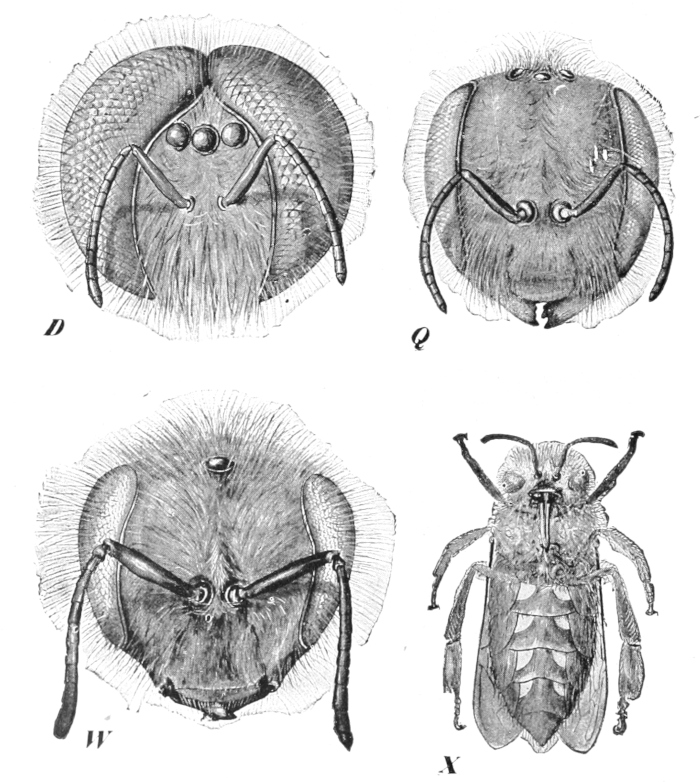
D, head of drone; Q, head of queen bee; W, head of worker; X, worker bee seen from below, showing plates of wax secreted from wax pockets.
From How to Keep Bees—Comstock.
Drawn by A. J. Hammar.
The Drone
The drone differs much in shape from the queen and the worker. He is broad and blunt, being very different in shape from the queen, and larger than the worker, (p. 446, Fig. 2.) He has no pollen baskets on his legs and has no sting. His eyes are very much larger than those of the queen or the worker and unite at the top of the head (p. 448, D.) His wings are larger and stronger than those of the worker or queen. It is not his business to go out and gather honey or to help in the work of the hive. His tongue is not long enough to get honey from the flowers; he has no pollen basket in which to carry pollen; he has no sting to fight enemies and no pockets for secreting wax; he is fed by his sister workers until the latter part of the season when the honey supply runs low, and then he is stung or bitten to death by these same sisters who have always given him such good care. The drone should be called a prince or king, since his particular office in the hive is to mate with the queen.
References—How to Keep Bees, Comstock; The Bee People, Morley.
LESSON CIII
The Honey-bee
Leading thought—In a colony of honey-bees there are three different forms of bees, the queens, the drones, and the workers. All of these have their own special work to do for the community.
Method—In almost every country or village community there is an apiary, or at least someone who keeps a few colonies of bees; to such the teacher must turn for material for this lesson. If this is not practical the teacher may purchase specimens from any bee dealer; she may, for instance, get an untested queen with attendant workers in a queen cage sent by mail for a small sum. These could be kept alive for some time by feeding them with honey, during which time the pupils can study the forms of the two castes. Any apiary during September will give enough dead drones for a class to observe. Although ordinarily we do not advocate the study of dead specimens, yet common sense surely has its place in nature-study; and in the case of the honey-bee, a closer study of the form of the insect is desirable than the living bee might see fit to permit. There are no more wonderful instances of adaptation of form to life than is found in the anatomy of the workers, queens and drones; moreover, it is highly desirable if the pupils are ever to become bee-keepers, that they shall know these adaptations.
A lens is almost necessary for these lessons and a compound microscope used with a low power would be a very desirable adjunct. This lesson should not be given below the fifth grade; and it is better adapted to eighth grade work.
The Worker
Observations—1. How many divisions of the body are there?
2. What organs are borne on the head?
3. Are there small, simple eyes between the large compound ones?
4. What is the difference between the large eyes and the small?
5. Describe the antennæ.
6. What can you see of the mouth? Describe it.
7. Look at the tongue under the microscope and see how it is fitted for getting nectar from flowers.
8. What organs are borne on the thorax?
9. Study the front or middle leg. How many joints has it?
10. With a lens find the antennæ cleaner on the front leg. Describe it.
11. Describe the feet and claws.
12. Compare the third segment of the hind leg with that of the front leg.
13. Note that this segment of the hind leg is much wider. Note its form and describe how it forms the pollen basket.
14. Study the next segment of the hind leg, and note the wax pincers and the pollen combs.
15. Compare the front and hind wing as to shape and size.
16. How many rings are there on the abdomen and how are the rings colored above.
17. Study the lower side of the body; do you know where the wax comes from?
18. Write an English theme on the development of the larva of the worker bee; the duties of a worker bee from the time it issues from its cocoon until it dies working for the colony.
The Queen Bee
1. How does the queen differ in size and shape from the worker?
2. Has she pollen baskets or pollen combs on her hind legs?
3. How does the shape of the abdomen differ from that of the worker?
4. Write an English theme on the life of a queen bee. This should cover the following points: The kind of cell in which the queen is developed; the kind of food on which she is reared; the fact that she never stings people but reserves her sting for other queens; why she does not go out to gather honey; how and by whom and on what she is fed; she would not use pollen baskets if she had them; the work she does for the colony; the length of her life compared with that of a worker; the time of year when new queens are developed, and what becomes of the old queen when a new one takes her place; why she is called a queen.
The Drone
1. How does the drone differ in size and form of body from the worker?
2. How does he differ in these respects from the queen?
3. Has he pollen baskets on his legs?
4. Has he a sting?
5. Compare his eyes with those of the queen and worker.
6. Compare the size of his wings with those of the queen and worker.
7. Write an English theme on the drone. This should cover the following points: In what sort of cell is the drone developed; does he go out to gather honey or help in the work of the hive; how he is fed; how he is unfitted for work for the colony in the following particulars: Tongue, lack of pollen baskets, lack of sting, and of wax pockets; why the drone should be called a prince or king; the death of the drones; when and by what means it occurs.
Honey-comb
Teacher’s Story
HE structure of honey-comb has been for ages admired by mathematicians, who have measured the angles of the cells and demonstrated the accurate manner in which the rhomb-shaped cell changes at its base to a three faced pyramid; and proven that, considering the material of construction, honey-comb exemplifies the strongest and most economic structure possible for the storing of liquid contents. While recent instruments of greater precision in measuring angles, show less perfection in honey-comb than the ancients believed, yet the fact still stands that the general plan of it is mathematically excellent.
Some have tried to detract from bee skill, by stating that the six-sided cell is simply the result of crowding cells together. Perhaps this was the remote origin of the hexagonal cell; but if we watch a bee build her comb, we find that she begins with a base laid out in triangular pyramids, on either side of which she builds out six-sided cells. A cell just begun, is as distinctly six-sided as when completed.
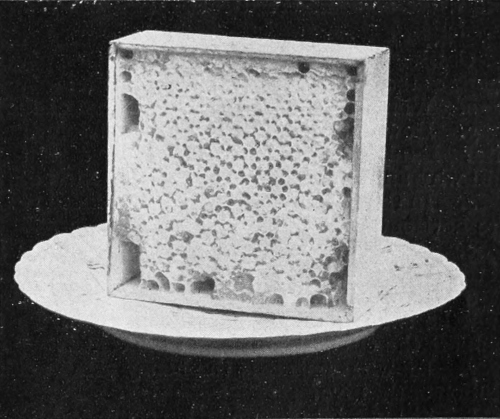
A section of honey. Note the caps to the cells, each supported by six girders.
The shape of the cell of a honey-comb is six-sided in cross section. The bottom is a three-sided pyramid and its sides help form pyramids at the bottom of the cells opposite, thus economizing every particle of space. In the hive, the cells lie horizontal usually, although sometimes the combs are twisted. The honey is retained in the cell by a cap of wax which is made in a very cunning fashion; it consists of a circular disc at the middle supported from the six angles of the cell by six tiny girders. The comb is made fast to the section of the hive by being plastered upon it. The foundation comb sold to apiarists is quite thick, so that the edges of the cell may be drawn out and almost complete the sides of the cell. However, the foundation comb is expensive and is ordinarily used by the bee-keeper simply as a starter, which means a little strip a few inches or so in width fastened to the top of a section just to give the bees a hint that this is the direction in which the comb should be built, a hint which the bees invariably take. The cells of honey-comb are used also for the storing of bee-bread and also as cradles for the young bees.
References—The Bee People, Morley; How to Keep Bees, Comstock.
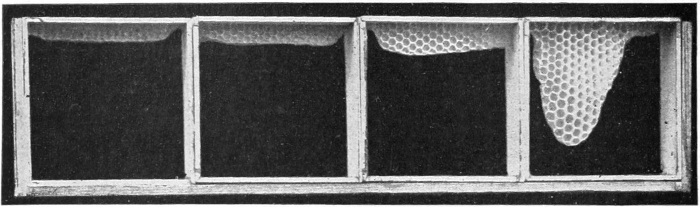
Starters of foundation comb in section boxes, partially built out by the bees. The section at the left has a “starter” of foundation comb. The other sections show the work of the bees in drawing out and building on the “starters.”
LESSON CIV
The Honey-comb
Leading thought—The cells of honey-comb are six-sided and in double rows and are very perfectly arranged for the storing of honey, so as to save room.
Materials—A section filled with honey and also a bit of empty comb and a bit of commercial foundation comb which may be obtained in any apiary.
Observations—1. Look at a bit of empty honey-comb; what is the shape of the cell as you look down into it?
2. What is the shape of the bottom of the cell?
3. How does the bottom of the cell join the bottom of the cell opposite? Explain how honey-comb economizes space as storage for honey, and why an economy of space is of use to bees in the wild state.
4. In the hive is the honey-comb placed so that the length of the cells are horizontal or up and down?
5. Observe honey-comb containing honey; how is the honey retained in the cells?
6. Carefully take off a cap from the honey cell and see if you can find the six girders that extend inward from the angles of the cell to support the circular portion in the center.
7. By what means is the honey-comb made fast to the sides of the section or the hive?
8. Study a bit of foundation comb and note where the bees will pull out the wax to form the cell.
9. Why and how is foundation comb used by the bee-keeper?
10. For what purpose besides storing honey are the cells of honey-comb used by the bees?
INDUSTRIES OF THE HIVE AND THE OBSERVATION HIVE
Teacher’s Story
EE-hives are the houses which man furnishes for the bee colonies, the wild bees ordinarily living in hollow trees or in caves. The usual hive consists of a box which is the lower story and of one or more upper stories, called “supers.” In the lower story are placed frames for the brood and for storing the honey for the winter use of the bees. In the supers are placed the sections, each of which is planned to hold a pound of honey. It is the habit of the bees to place their brood in the lower part of their nests and store honey in the upper portions. The bee-keepers have taken advantage of this habit of the bees and remove the supers with their filled sections and replace them with others to be filled, and thus get a large crop of honey. The number of bees in a colony varies; there should be at least 40,000 in a healthy colony. Of these a large proportion are workers; there may be a few hundred drones the latter part of the season but only one queen.
Honey-comb is built of wax and is hung from the frame so that the cells are horizontal; its purpose is to cradle the young and for the storage of pollen and honey. The wax used for building the comb is a secretion of the bees; when comb is needed, a number of self-elected bee citizens gorge themselves with honey and hang themselves up in a curtain, each bee reaching up with her fore feet and taking hold of the hind feet of the one above her. After remaining thus for some time the wax appears in little plates, one on each side of the second, third, fourth and fifth segments of the abdomen. This wax is chewed by the bees and made into comb.
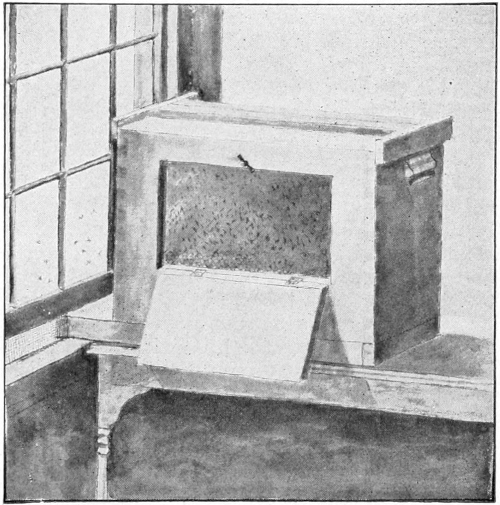
A home-made observation hive.
Honey is made from the nectar of flowers which the bee takes into her honey stomach. This, by the way, is not the true stomach of the bee and has nothing to do with digestion. It is simply a receptacle for storing the nectar, which is mixed with some secretion from the glands of the bee which brings about chemical changes, the chief of which is changing the cane sugar of the nectar into the more easily digested grape sugar of the honey. After the honey is emptied from the honey stomach into the cell, it remains exposed to the air for some time before the cell is capped, and thus ripens. It is an interesting fact that up to the seventeenth century honey was the only means people had for sweetening their food, as sugar was unknown.
Bee-bread is made from the pollen of flowers which is perhaps mixed with saliva so as to hold together; it is carried from the field on the pollen baskets of the hind legs of the workers; it is packed into the cell by the bees and is used for food. Propolis is bee glue; it is used as a cement and varnish; it is gathered by the bees from the leaf-buds of certain trees and plants, although when they can get it, the bees will take fresh varnish. It is used as a filler to make smooth the rough places of the hive; it often helps hold the combs in place; it calks every crack; it is applied as a varnish to the cells of the honey-comb if they remain unused for a time, and if the door of the observation hive be left open the bees will cover the inside of the glass with this glue, and thus make the interior of the hive dark.
The young bees are footless, white grubs. Each one lives in its own little cell and is fed by the nurse bees, which give it partly digested food from their own stomachs.
The removal of honey from the supers does not do any harm to the bee colony if there is enough honey left in the brood chambers to support the bees during the winter. There should be twenty-five or thirty pounds of honey left in the brood chamber for winter use. In winter, the hives should be protected from the cold by being placed in special houses or by being encased in larger boxes, leaving an opening so that the bees may come out in good weather. The chaff hive is best for both winter and summer, as it surrounds the hive with a space, which is filled with chaff, and keeps the hive warm in winter and cool in summer. Many bee-keepers put their bees in cellars during the winter, but this method is not as safe as the chaff hive. Care should be taken in summer to place the hives so that they are shaded at least part of the day. The grass should be mown around the hives so that the bees will not become entangled in it as they return from the fields laden with honey.
What may be seen in the observation hive—First of all, it is very interesting to watch the bees build their comb. When more comb is needed certain members of the colony gorge themselves with honey and remain suspended while it oozes out of the wax pockets on the lower side of the abdomen. This wax is collected and chewed to make it less brittle and then is carried to the place where the comb is being built and is molded into shape by the jaws of the workers. However, the bee that puts the wax in place is not always the one that molds it into comb.
A bee comes into the hive with her honey stomach filled with nectar and disgorges this into a cell. When a bee comes in loaded with pollen, she first brushes it from the pollen baskets on her hind legs into the cell; later another worker comes along and packs the pollen grains into the cell with her head, which is a comical sight.
The bee nurses run about on the comb feeding the young bee grubs partially digested honey and pollen regurgitated from their own stomachs. Whenever the queen moves about the comb she is followed by a retinue of devoted attendants which feed her on the rich and perfectly digested royal jelly and also take care of her royal person and give her every attention possible. The queen, when laying, thrusts her abdomen into the cell and glues a little white egg to the bottom. The specially interesting thing about this is that the queen always lays an egg which will produce a female, or worker in the smaller cells and will always lay an egg to produce a drone or male in the larger cells.
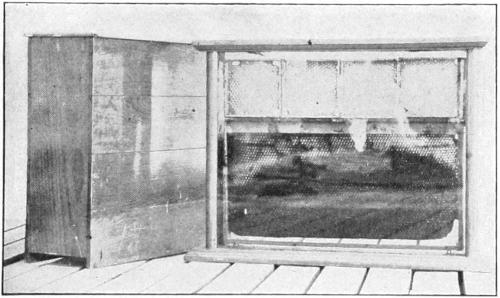
The observation hive made and sold by A. I. Root.
If there is any foreign substance in the observation hive it is interesting to see the bees go to work at once to remove it. They dump all of the debris out in front of the hive. They close all crevices in the hive; and they will always curtain the glass, if the door is kept open too much, with propolis or bee glue, which is a very sticky substance which they get from leaf buds and other vegetable sources. When bees fan to set up a current of air in the hive, they glide back and forth, moving the wings so rapidly that we can only see a blur about their bodies.
If drones are developed in the hive, it is interesting to see how tenderly they are fed by their sister workers, although they do not hesitate to help themselves to the honey stored in the cells; and if the observation hive is working during September, undoubtedly the pupils may be able to see the murder of the drones by their sisters. But the children should understand that this killing of the drones is necessary for the preservation of the colony, as the workers cannot store enough honey to keep the colony alive during the winter if the drones were allowed to go on feeding.
If you see the worker bees fighting, it means that robbers are attempting to get at the stores of the observation hive. The entrance to the hive should at once be contracted by placing a block of wood in front, so that there is room for only one bee at a time to pass in and out.
LESSON CV
The Industries of the Hive
Leading thought—In the hive are carried on the industries of wax-making, building of honey-comb, storing of honey and bee-bread, caring for the young, keeping the hive clean and ventilated and calking all crevices with bee glue.
Method—This lesson should be in the nature of a demonstration. If there is an apiary in the neighborhood, it is quite possible that the teacher may show the pupils a hive ready for occupancy by the bees; in any case she will have no difficulty in borrowing a frame of brood comb, and this with a section of honey which can be bought at the grocery store, is sufficient if there is no observation hive. This lesson should be an informal talk between teacher and pupils.
An observation hive in the schoolroom is an object of greatest interest to the pupils, as through its glass sides they may be able to verify for themselves the wonderful tales concerning the lives and doings of the bees which have been told us by naturalists. Moreover, the study thus made of the habits of the bees is an excellent preparation for the practical apiarist, and we sincerely believe that bee-keeping is one of the ways by which the boys and girls of the farm may obtain money for their own use.
The observation hive is very simply constructed and can be made by anyone who knows how to use ordinary carpenter tools. It is simply a small, ordinary hive with a pane of glass on each side which is covered by a hinged door. A hive thus made is placed so that the front end rests upon a window sill; the sash is lifted an inch or so, a strip of wood, or a piece of wire netting being inserted underneath the sash except in front of the entrance of the hive, to hinder the bees from coming back into the room. A covered passageway should extend from the entrance of the hive to the outside of the window sill. This window should be one which opens away from the playground so that the bees coming and going, will not come into collision with the pupils. The observation window should be kept carefully shut, except when the pupils are using it, since the bees object to light in their homes.
The A. I. Root Co., of Medina, Ohio, sell a pretty observation hive which we have used successfully by stocking it afresh each season, it being too small for a self-sustaining colony. But it has the advantage of smallness which enables us to see all that is going on within it, which would be impossible in a larger hive. This hive comes in several sizes, and will be shipped from the makers stocked with bees at prices ranging from $1.25 to $4.00.
Observations—Industries and care of the hive—1. What is the hive, and what do wild bees use instead of the hive? Describe as follows:
2. Describe a brood chamber and a super and the uses of each.
3. How many and what bees live in a hive.
4. How the honey-comb is made and placed and the purpose of it.
5. How the wax is produced and built into the comb.
6. How honey is made.