Part 3 — I. WILD-FLOWER STUDY
Reading edition
THE HEPATICA
Teacher’s Story
“The wise men say the hepatica flower has no petals but has pink, white or purple sepals instead: and they say, too, that the three leaflets of the cup which holds the flower are not sepals but are bracts; and they offer as proof the fact that they do not grow close to the blossom, but are placed a little way down the stem. But the hepatica does not care what names the wise men give to the parts of its blossom: it says as plainly as if it could talk: ‘The bees do not care whether they are sepals or petals since they are pretty in color, and show where the pollen is to be found. I will teach the world that bracts are just as good to wrap around flower-buds as are sepals, and that sepals may be just as beautiful as petals. Since my petticoat is pretty enough for a dress why should not I wear it thus?’”—“The Child’s Own Book of Wild Flowers.”
We seek the hepatica in its own haunts, because there is a longing for spring in our hearts that awakens with the first warm sunshine. As we thread our way into sodden woods, avoiding the streams and puddles which are little glacial rivers and lakes, having their sources in the snow-drifts still heaped on the north side of things, we look eagerly for signs of returning life. Our eyes slowly distinguish among the various shades of brown in the floor of the forest, a bit of pale-blue or pink-purple that at first seems like an optical delusion; but as we look again to make sure, Lo! it is the hepatica, lifting its delicate blossoms above its mass of purple-brown leaves. These leaves, moreover, are always beautiful in shape and color and suggest patterns for sculpture like the acanthus, or for rich tapestries like the palm-leaf in the Orient. It warms the heart to see these brave little flowers stand with their faces to the sun and their backs to the snow-drifts, looking out on a gray-brown world, nodding to it and calling it good.
The hepatica is forehanded in several ways. After the leaves have fallen from the trees in the autumn and let in the sunshine, it puts up new leaves which make food that is stored in the crown bud; the little flower buds are then started, and wrapped cozily, are cuddled down at the very center of the plant. These buds, perfected in the autumn, are ready to stretch up and blossom when the first warmth of spring shall reach them. The stems and the bracts of the flower are soft and downy, and are much more furry than those which appear later; while this down is not for the purpose of keeping the plant at a higher temperature, yet it acts as a blanket to prevent too rapid transpiration, which is a cooling process, and thus it does, as a matter of fact, keep the flower warmer. As the stems lift up, the buds are bent, which position protects them from the beating storms. The hepatica flowers are white, pink and lavender. The latter are sometimes called “blue.” The so-called “petals” number from six to twelve; there are usually six. The three outer ones are sepals and are exactly like the three inner ones, the petals, but may be distinguished by their outside position in the half-opened flower. The three green bracts which encase the flower bud, and later remain with the seed, are placed on the stem quite distinctly below the flower. On dark days and during the nights, the young blossoms close; but when they become old and faded, they remain open all the time. Thus, the flowers are closed except when bees are likely to visit them; but after they have shed their pollen, they do not need to remain closed any longer. Not all hepatica blossoms are fragrant; and those that are so, lose their fragrance as their colors begin to fade to white. If a snow-storm comes, the hepatica blossoms close and bow their heads.
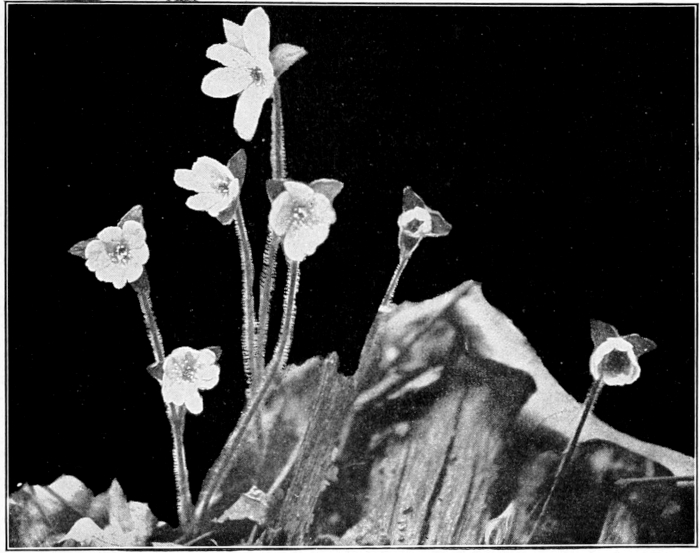
Hepaticas.
There are many stamens with greenish white anthers and pollen. They stand erect around the many pistils at the center of the flower. The number of pistils varies from six to twenty-four. Each pistil holds aloft the little horseshoe-shaped, whitish stigma and, if pollenated, develops into a seed. The hepatica is a perennial and grows only in rich, moist woods. It is so adapted to the shade, that it dies if transplanted to sunny places. The leaves which have passed the winter under the snow are rich purple beneath, and mottled green and purple above, making beautiful objects for water-color drawings. The new leaves are put forth in spring before the leaves of the trees create too much shade. In the fall, after the trees are bare, the leaves again become active. The roots are quite numerous and fine.
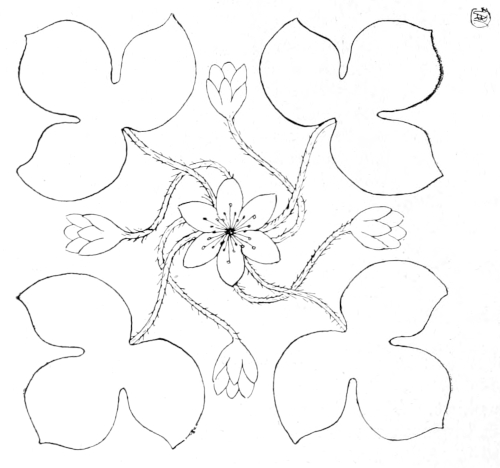
Embroidery design from the hepatica.
The Child’s Own Book of Wild Flowers, drawn by Evelyn Mitchell.
LESSON CXVII
The Hepatica
Leading thought—The hepatica flower buds are developed in the fall, so as to be ready to blossom early in the spring. This plant lives only in moist and shady woods.
Method—The pupils should have the questions before they go into the woods to gather spring flowers, and should answer them individually. However, the hepatica plant may be potted early in the spring, and the flowers may be watched during their development, and studied in the schoolroom.
Observations—1. Where do you find the hepaticas? Do you ever find them in the open fields? Do you ever find them in the pine woods?
2. How do the leaves look in early spring? Sketch in color one of these old leaves. How do the young leaves look? Are the leaves that come up late in the spring as fuzzy as those that appear early? What is the difference in texture and color between the leaves that were perfected in the fall and those that appear in the spring?
3. Find a hepatica plant before it begins to blossom. Look, if possible, at its very center. Describe these little flower buds. When were they formed?
4. How does the bud look when it begins to lift up? Describe the stems and the three little blankets that hold the bud. Ask your teacher how these fuzzy blankets keep the bud from being killed by cold.
5. Are the hepaticas in your woods all pink, or blue, or white? Do those which are at first pink or blue fade to white later? Do the blossoms keep open during the night and stormy weather? Why not? Are they all fragrant?
6. How many petals has your hepatica? Can you see that the outer ones are sepals, although they look just like the petals? Peel back the three sepal-like bracts and see that they are not a part of the flower at all but join the stem below the flower.
7. Describe the stamens in the hepatica. How many pistils are there? Does each pistil develop into a seed? How do the three bracts protect the seeds as they ripen?
8. What insects do you find visiting the hepaticas?
9. Describe a hepatica plant in the woods; mark it so that you will know it, and visit it occasionally during the summer and autumn, noting what happens to it.
THE YELLOW ADDER’S TONGUE
Teacher’s Story
“Once a prize was offered to a child if she would find two leaves of the adder’s tongue that were marked exactly alike: and she sought long and faithfully, but the only prize she won was a lesson in Nature’s book of variations, where no two leaves of any plant, shrub or tree are exactly alike: for even if they seemed so to our eyes, yet there would exist in them differences of strength and growth too subtle for us to detect. But this child was slow in learning this great fact, and, until she was a woman, the adder’s tongue leaves, so beautifully embroidered with purple and green, were to her a miracle, revealing the infinite diversity of Nature’s patterns.”—“The Child’s Own Book of Wild Flowers.”
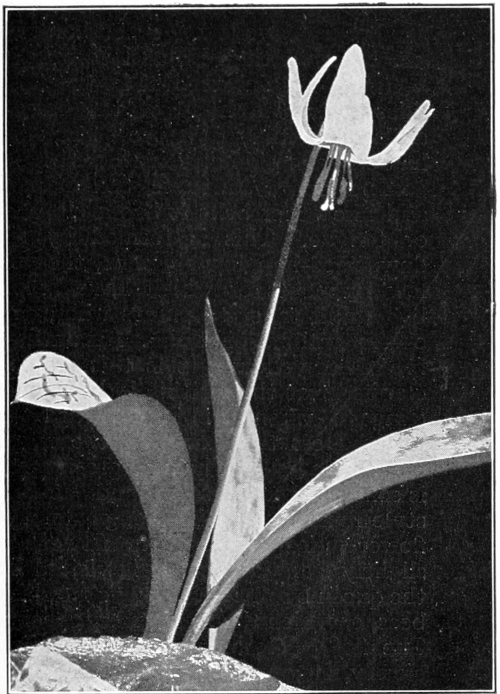
Adder’s tongue.
This little lily of the woods is a fascinating plant. Its leaves of pale green mottled with brownish purple often cover closely large irregular areas in the rich soil of our woodlands; and yet I doubt if the underground story of these forest rugs is often thought of. The leaves are twins, and to the one who plucks them carelessly they seem to come from one slender stem. It requires muscle as well as decision of character to follow this weak stem down several inches, by digging around it, until we find the corm at its base. A corm is the swollen base of a stem and is bulb-like in form; but it is not made up of layers, as is a bulb. It is a storehouse for food and also a means of spreading the species; for from the corms there grow little corms called cormels, and each cormel develops a separate plant. This underground method of reproduction is the secret of why the leaves of the adder’s tongue appear in patches, closely crowded together.
Only a few of the plants in a “patch” produce flowers, and it is interesting to see how cleverly these lily bells hide from the casual eye. Like many of the lilies, the three sepals are petal-like and are identified as sepals only by their outside position, although they are thicker in texture. They are purplish brown outside, which serves to render the flower inconspicuous as we look down upon it; on the inner side, they are a pure yellow, spotted with darker yellow near where they join the stem. The three petals are pure yellow, paler outside than in, and they have dark spots like the tiger lilies near the heart of the flower; and where they join the stem, each has on each side an ear-shaped lobe.
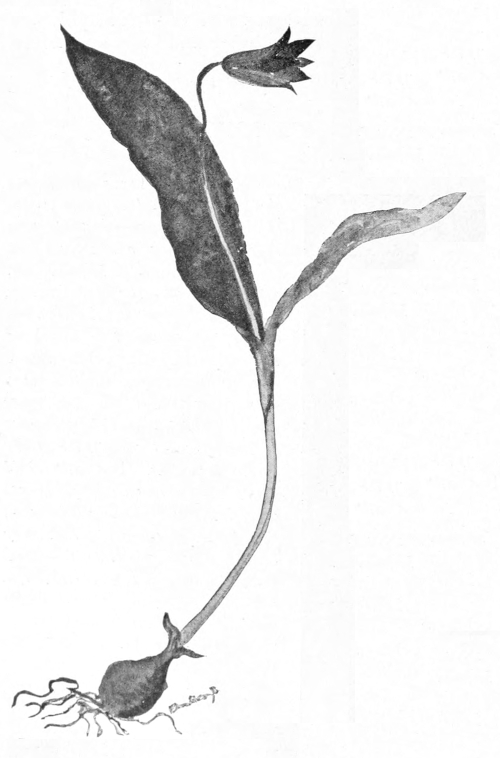
The adder’s tongue, showing its underground storehouse.
Drawn by F. Dana Gibson, a pupil in seventh grade.
The open flower is bell-shaped; and like other bells it has a clapper, or tongue. This is formed by six downward-hanging stamens, the yellow filaments of which have broad bases and taper to points where the oblong anthers join them. The anthers are red or yellow. It is this stamen clapper that the visiting insects must cling to when probing upward for nectar from this flower at the upper end of the bell. The pale green pistil is somewhat three-sided, and the long style remains attached long after the flower disappears. The flower is slightly fragrant, and it is visited by the queen bumblebees and the solitary bees, of which there are many species. The flower closes nights and during cloudy, stormy days. The seed capsule is plump and rather triangular, and splits into three sections when ripe. The seeds are numerous and are fleshy and crescent-shaped.
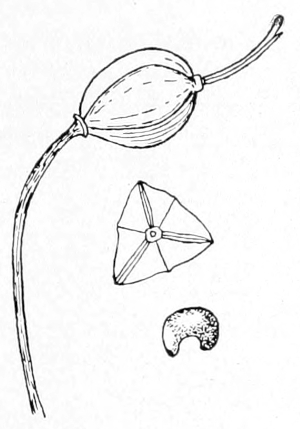
Fruit capsule and seed.
But the adder’s tongue, like many other early blooming flowers, is a child of the spring. The leaves, at first so prettily mottled, fade out to plain green; and by midsummer they have entirely disappeared, the place where they were, being covered with other foliage of far different pattern. But down in the rich woods soil are the plump globular corms filled with the food gathered by the spotted leaves during their brief stay, and next spring two pairs of spotted leaves may appear where there was but one pair this year.
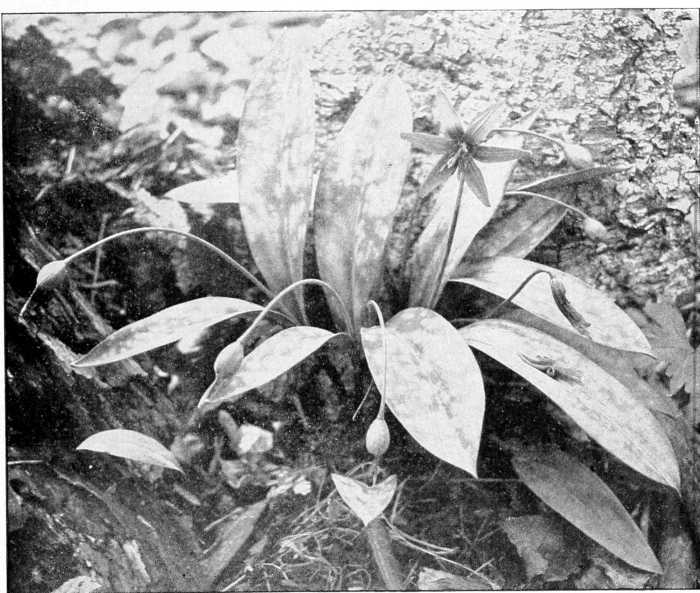
The adder’s tongue going to seed.
Photo by Verne Morton.
LESSON CXVIII
Adder’s Tongue, or Dog-tooth Violet
Leading thought—The adder’s tongue is a lily, and its mottled leaves appear early in the spring, each pair coming from a corm deep in the soil below. It has two ways of spreading, one underground by means of new corms growing from the larger ones, and the other by means of seeds, many of which are probably perfected through the pollen carried by insects.
Method—This plant should be studied in the woods, notes being made on it there. But a plant showing corm, roots, leaves and blossom should be brought to the schoolhouse for detailed study, and then planted in a shady place in the school garden.
Observations—1. Where does the adder’s tongue grow? Do you ever find it in open fields? How early do you find its leaves above ground? At what time does its blossoms appear?
2. How many leaves has each plant? What colors do you find in them? What is the color of their petioles? Do the leaves remain mottled later in the season?
3. Do the adder’s tongue plants occur singly or in patches? Dig out a plant and see if you can find why the plants grow so many together?
4. How far below the surface of the ground did you find the corm or bulb-like growth? Is this the root of the plant? How does it differ from the roots? How does it differ from a bulb? Of what use is it to the plant?
5. Is the flower lifted up, or is it drooping? What is its general shape? How many sepals? How would you know they were sepals? How do they differ in color, outside and in, from the petals? How are the petals marked? Can you see the lobes at the base of each petal? When sepals and petals are so much alike the botanists call them all together the perianth.
6. If the perianth, or the sepals and petals together, make a bell-shaped flower, what makes the clapper to the bell? How do the insects use this clapper when they visit the flower? Do the flowers stay open nights and dark days? Why?
7. How many stamens are there? Describe or sketch one, noting its peculiar shape. Are the stamens all the same length? Can you see the pistil and its stigma? Where is it situated in relation to the stamens? Do you think the stigma is ready for pollen at the time the anthers are shedding it?
8. After the petals and sepals fall what remains? How does the ripe seed-capsule look? How does it open to let out the seeds? Are there many seeds in a capsule? What is their shape?
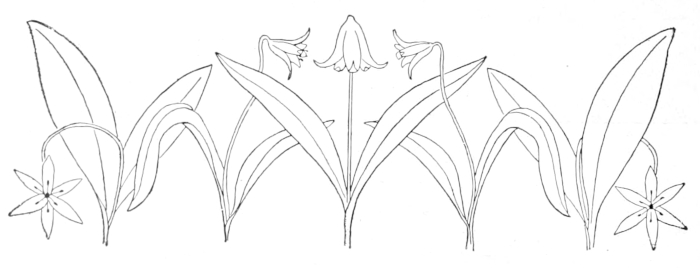
Design for embroidery from adder’s tongue.
Drawn by Evelyn Mitchell for Child’s Own Book of Wild Flowers.
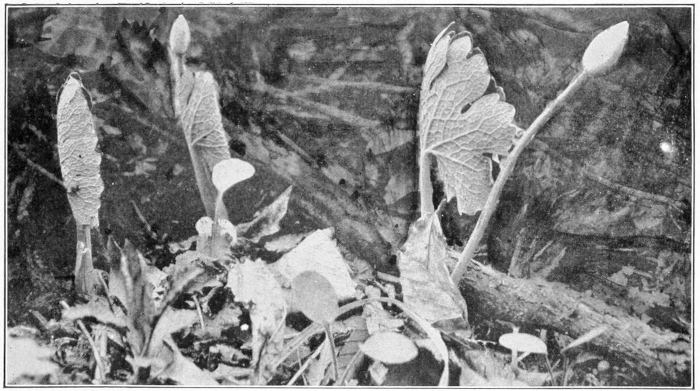
“Bloodroots, whose rolled-up leaves ef you oncurl Each on em’s cradle to a baby pearl.” —Lowell. Photo by O. L. Foster.
BLOODROOT
Teacher’s Story
“What time the earliest ferns unfold, And meadow cowslips count their gold; A countless multitude they stood, A Milky Way within the wood.” —Danske Dandridge.
NLY a few generations ago, and this land of ours was peopled by those who found it fitting to paint their bodies to represent their mental or spiritual conditions or intentions. For this purpose they had studied the plants of our forests to learn the secrets of the dyes which they yielded, and a dye that would remain on the flesh permanently, or until it wore off, was highly prized. Such a dye was found in the bloodroot, a dye appropriate in its color to represent a thirst for blood; and with it they made their war paint, and with it they ornamented their tomahawks to symbolize their sanguinary purpose.
The Indian warriors have passed away from our forests, and the forests themselves are passing away, but the bloodroot still lingers, growing abundantly in rich moist woods or in shaded areas in glades, borders of meadows and fence corners. Its beautiful white flowers open to the morning sun in early April, calling the hungry bees to come for pollen; for, like many other early flowers, it offers no nectar. Probably many of the little wild bees prefer pollen to nectar at this time of year, for it is an important element in the food of all kinds of bee brood. But the bloodroot’s fragile blossoms are elusive and do not remain long; like their relatives, the poppies, their petals soon fall, and their white masses disappear like the snow-drifts which so recently occupied the same nooks.
The way the bloodroot leaf enfolds the flower-bud seems like such an obvious plan for protection, that we are unthinkingly prone to attribute consciousness to the little plants.
Not only does the leaf enfold the bud, but it continues to enfold the flower stem after the blossom opens. There are two sepals which enclose the bud, but fall off as the flower opens. There are ordinarily eight white petals, although there may be twelve; usually every other one of the eight petals is longer than its neighbors, and this makes the blossom rather square than circular in outline. There are many stamens, often 24, and the anthers are brilliant yellow with whitish filaments. The two-lobed stigma opens to receive pollen before the pollen of its own flower is ripe. The stigma is large, yellow, and set directly on the ovary, and is quite noticeable in the freshly opened blossoms. It is likely to shrivel before its home-grown pollen is ripe. The blossoms open wide on sunny mornings; the petals rise up in the afternoon and close at night, and also remain closed during dark, stormy days until they are quite old, when they remain carelessly open; they are now ready to fall to the ground at the slightest jar, leaving the oblong, green seed-pod set on the stem at a neat bevel, and perhaps still crowned with the yellowish stigma. The seed-pod is oblong and pointed and remains below the protecting leaf. There are many yellowish or brownish seeds.
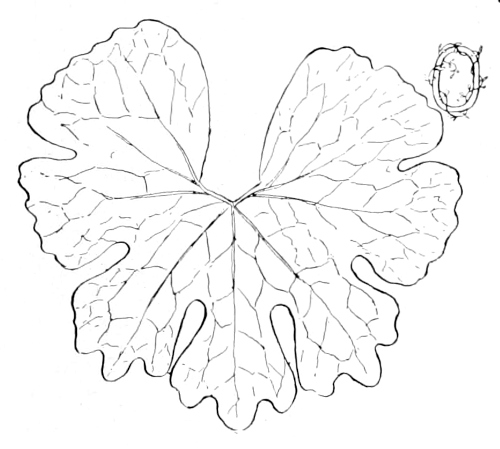
When the plant appears above ground, the leaf is wrapped in a cylinder about the bud, and it is a very pretty leaf, especially the “wrong side,” which forms the outside of the roll; it is pale green with a network of pinkish veins, and its edges are attractively lobed; the petiole is fleshy, stout and reddish amber in color. The flower stem is likewise fleshy and is tinged with raw sienna; the stems of both leaf and flower stand side by side, and are held together at the base by two scapes with parallel veins. Later in the season, the leaf having done its full duty as a nurse waxes opulent, often measuring six inches across and having a petiole ten inches long. It is then one of the most beautiful leaves in the forest carpet, its circular form and deeply lobed edges rendering it a fit subject for decorative design.
The rootstock is large and fleshy, and in it is stored the food which enables the flower to blossom early, before any food has been made by the new leaves. There are many stout and rather short roots that fringe the rootstock. Once in clearing a path through a woodland, we happened to hack off a mass of these rootstocks, and we stood aghast at the gory results. We had admired the bloodroot flowers in this place in the spring, and we felt as guilty as if we had inadvertently hacked into a friend.
LESSON CXIX
Bloodroot
Leading thought—The bloodroot has a fleshy rootstock, in which is stored food for the nourishment of the blossom in early spring. The flower bud is at first protected by the folded leaf. The juice of the rootstock is a vivid light crimson, and was used by Indians as a war paint. The juice is acrid, and the bloodroot is not relished as food by grazing animals, but it is used by us as a medicine.
Method—The bloodroot may, in the fall, be transplanted in a pot of woods earth, care being taken not to disturb its roots. It should be placed out of doors in a protected place where it may have natural conditions, and be brought to the schoolroom for study in March, so that the whole act of the unfolding of leaves and flowers may be observed by the pupils. Otherwise the questions must be given the pupils to answer as they find the plants blossoming in the woods in April. The blossoms are too fragile to be successfully transported for study at home or school.
Observations—1. At what time of year does bloodroot blossom? In what situations does it thrive?
2. What do we see first when the bloodroot puts its head above the soil? Where is the flower bud? How is it protected by the leaf? How does the leaf hold the flower stem after the flower is in blossom?
3. Study the flower. How many sepals has it? What is their color? What is the position of the sepals when the flower is in bud? What is their position when the flower opens? How many petals? What is their color and texture? Describe the position of the petals in the bud and in the open flower. Look straight into the flower; is its shape circular or square?
4. Do the flowers close nights and during dark days? Do the flowers longest open do this? Describe how the petals and sepals fall.
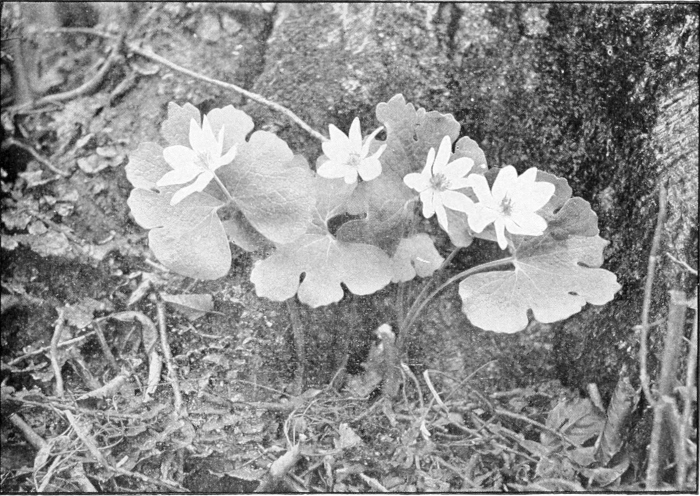
Bloodroot.
Photographed by Verne Morton.
5. Describe the stamens. What is the color of the anthers? Of the pollen? Describe the pistil. Does the two-grooved stigma open before the pollen is shed, or after? What insects do you find visiting the bloodroot?
6. Sketch or describe a bloodroot leaf as it is wrapped around the stem of the flower. How are both flower stem and leaf petiole protected at the base? Describe or sketch a leaf after it is unfolded and open. Describe the difference between the upper and lower surfaces of the leaf. What sort of petiole has it? Break the petiole; what sort of juice comes from it? Describe and measure the leaf later in the season; do they all have the same number of lobes?
7. Break a bit off the root of the plant and note the color of the juice.
8. Compare the bloodroot with the poppies; do you find any resemblance in habits?
THE TRILLIUM
Teacher’s Story
It would be well for the designer of tapestries to study the carpets of our forests for his patterns, for he would find there a new carpet every month, quite different in plan and design from the one spread there earlier or later. One of the most beautiful designs from Nature’s looms is a trillium carpet, which is at its best when the white trilliums are in blossom. It is a fine study of the artistic possibilities of the triangle when reduced to terms of leaves, petals and sepals.
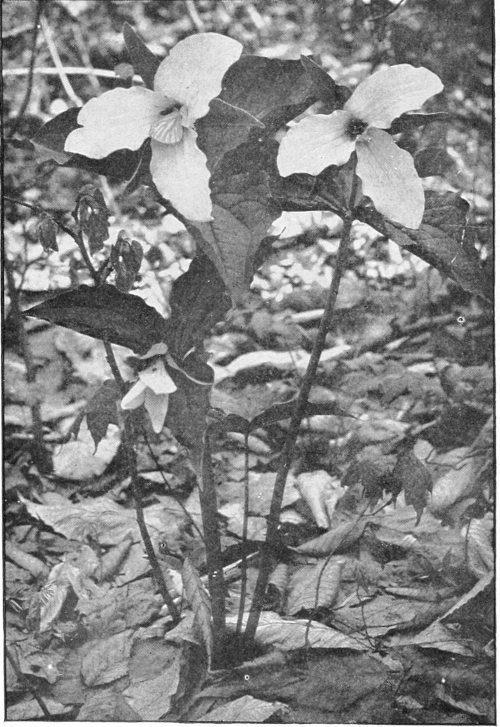
The white trillium. A white butterfly visiting the flower at the left.
Photo by Verne Morton.
The trillium season is a long one; it begins in April with the purple wake-robin or birthroot, the species with purple, red, or sometimes yellowish flowers. The season ends in June with the last of the great white trilliums, which flush pink instead of fading, when old age comes upon them.
The color of the trillium flower depends upon the species studied; there are three petals, and the white and painted trilliums have the edges of the petals ruffled; the red and nodding trilliums have petals and sepals nearly the same size, but in the white trillium the sepals are narrower and shorter than the petals. The sepals are alternate the petals, so that when we look straight into the flower we see it as a six-pointed star, three of the points being green sepals. The pistil of the trillium is six-lobed. It is dark red in the purple trillium and very large; in the white species, it is pale green and smaller; it opens at the top with three flaring stigmas. There are six stamens with long anthers, and they stand between the lobes of the pistil. The flower stalk rises from the center where three large leaves join. The flower stalk has a tendency to bend a little, and is rather delicate. The three leaves have an interesting venation, and make a good subject for careful drawing. The flower stem varies with different species, and so does the length of the stem of the plant, the latter being fleshy and green toward the top and reddish toward the root. The trilliums have a thick, fleshy, and much scarred rootstock from which extend rootlets which are often corrugated. The trilliums are perennial, and grow mostly in damp, rich woods. The painted trillium is found in cold, damp woods along the banks of brooks; the white trillium is likely to be found in large numbers in the same locality, while the purple trillium is found only here and there. Flies and beetles carry the pollen for the red trillium, being attracted to it by its rank odor, which is very disagreeable to us but very agreeable to them. The large white trillium is visited by bees and butterflies. The fruit of the trillium is a berry, that of the purple species is somewhat six-lobed and reddish. In late July the fruit of the white trillium is a cone with six sharp wings, or ridges, from apex to base, the latter being three-quarters of an inch across. These vertical ridges are not evenly spaced, and beneath them are packed as closely as possible the yellow-green seeds, which are as large as homeopathic pills. In cross section, it can be seen that the trillium berry is star-shaped with three compartments, the seeds growing on the partitions. This trillium fruit is very rough outside, but smooth inside, and the dried stamens often still cling to it.
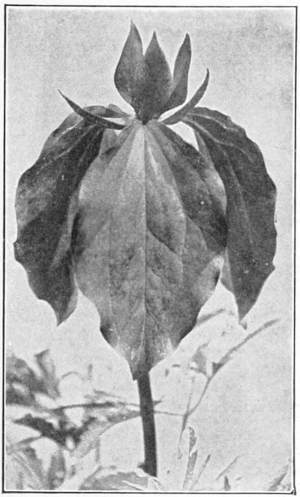
The stemless trillium
The trilliums are so called from the word triplum, meaning three, as there are three leaves, three petals, and three sepals.
LESSON CXX
The Trillium
Leading thought—The trilliums are lilies, and are often called wood lilies, because of their favorite haunts. There are several species, but they are all alike in that they have three sepals, three petals and three leaves.
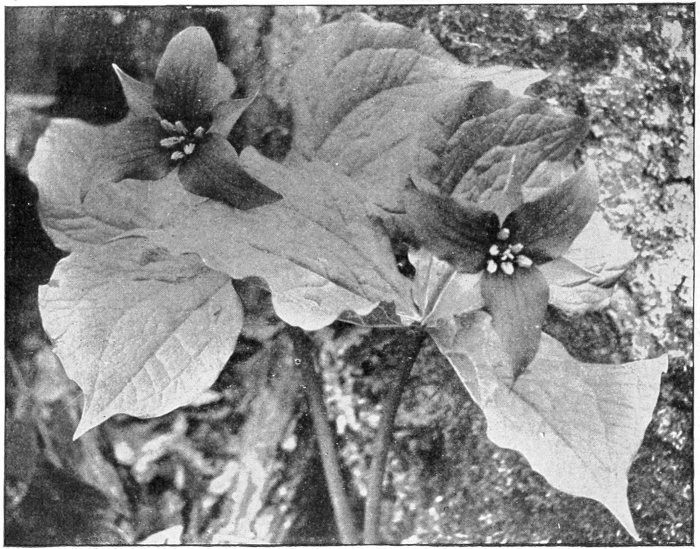
The purple trillium.
Photo by Verne Morton.
Method—This lesson may be given from trilliums brought to the schoolroom by the pupils, who should be encouraged to watch the development of the berry and also to learn all the different species common to a locality.
Observations—1. How many leaves has the trillium? How are they arranged? Draw a leaf showing its shape and veins. Describe the stem of the plant below the leaves, giving the length and color.
2. How far above the leaves does the flower stem or pedicel extend? Does the flower stand upright or droop? Describe or sketch the colors, shape and arrangement of the petals and sepals. Do the petals have ruffled margins?
3. Describe the pistil and the stigmas. Describe the stamens and how they are placed in relation to the pistil.
4. Do the flowers remain open during cloudy days and nights?
5. What insects do you find visiting the trilliums? Do the same insects visit the purple and the white trilliums? What is the difference in odor between the purple and the white trillium? Would this bring different kinds of insects to each?
6. How does the color of the white trillium change as the blossom matures? What is the color and shape of the fruit of each different species of trillium? When is the fruit ripe?
7. What kind of a root have the wake-robins? Do they grow from seed each year, or are they perennial? Where do you find them growing?
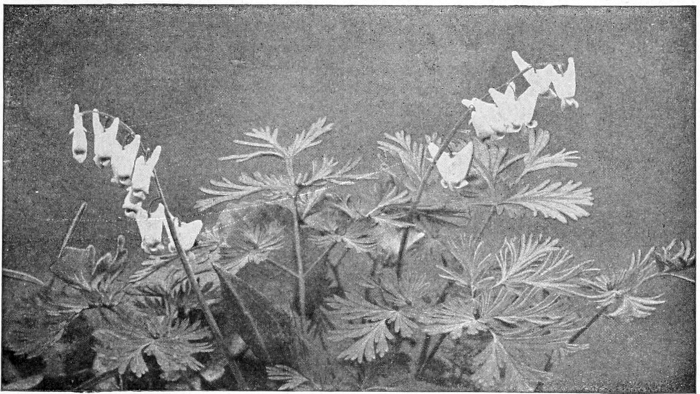
Dutchman’s breeches, or “boys and girls.”
Photo by O. L. Foster.
DUTCHMAN’S BREECHES AND SQUIRREL CORN
Teacher’s Story
“In a gymnasium where things grow, Jolly boys and girls in a row, Hanging down from cross-bar stem Builded purposely for them. Stout little legs up in the air, Kick at the breeze as it passes there; Dizzy heads in collars wide Look at the world from the underside; Happy acrobats a-swing, At the woodside show in early spring.” A. B. C. “And toward the sun, which kindlier burns, The earth awaking, looks and yearns, And still, as in all other Aprils, The annual miracle returns.” Elizabeth Akers.
There are many beautiful carpets spread before the feet of advancing spring, but perhaps none of them are so delicate in pattern as those woven by these two plants that spread their fernlike leaves in April and May. There is little difference in the foliage of the two; both are delicate green and lacelike above, and pale, bluish green on the underside. And each leaf, although so finely divided, is, after all, quite simple; for it has three chief divisions, and these in turn are divided into three, and all the leaves come directly from the root and not from stems. These plants love the woodlands, and by spreading their green leaves early, before the trees are in foliage, they have the advantage of the spring sunshine. Thus they make their food for maturing their seeds, and also store some of it in their roots for use early the following spring. By midsummer the leaves have entirely disappeared, and another carpet is spread in the place which they once covered.
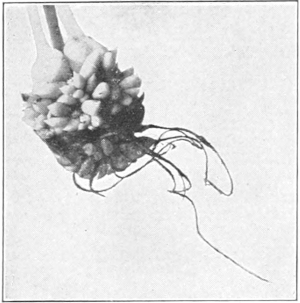
The underground store-house of Dutchman’s breeches.
Dutchman’s breeches and squirrel corn resemble each other so closely that they are often confused; however, they are quite different in form; the “legs” of the Dutchman’s breeches are quite long and spread wide apart, while the blossoms of the squirrel corn are rounded bags instead of “legs.” The roots of the two are quite different. The Dutchman’s breeches grows from a little bulb made up of grayish scales, while the squirrel corn develops from a round, yellow tuber; these yellow, kernel-like tubers are scattered along the roots, each capable of developing a plant next year. The Dutchman’s breeches likes thin woodlands and rocky hillsides, but the squirrel corn prefers rich, moist woods. The blossom of the Dutchman’s breeches comes the earlier of the two. These flowers are white with yellow tips, and are not fragrant. The flowers of the squirrel corn are grayish with a tinge of magenta, and are fragrant.
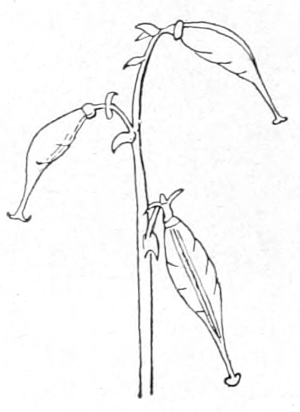
Seed capsule of squirrel corn.
The legs of the Dutchman’s breeches are nectar pockets with tubes leading to them, and are formed by two petals. Opposite these two petals are two others more or less spoon-shaped, with the spoon bowls united to protect the anthers and stigma. There are two little sepals which are scalelike.
The seed capsule of the Dutchman’s breeches is a long pod with a slender, pointed end, and it opens lengthwise. The seed capsules of the squirrel corn are similar and I have found in one capsule, 12 seeds, which were shaped like little kernels of corn, black in color and polished like patent leather.
LESSON CXXI
Dutchman’s Breeches and Squirrel Corn
Leading thought—The Dutchman’s breeches, or “boys and girls,” as it is often called, is one of the earliest flowers of rich woodlands. There are interesting differences between this flower and its close relative, squirrel corn. The flowers of both of these resemble in structure the flowers of the bleeding heart.
Method—As the Dutchman’s breeches blossoms in April and May and the squirrel corn in May and June, we naturally study the former first and compare the latter with it in form and in habits. The questions should be given the pupils, for them to answer for themselves during their spring walks in the woodlands.
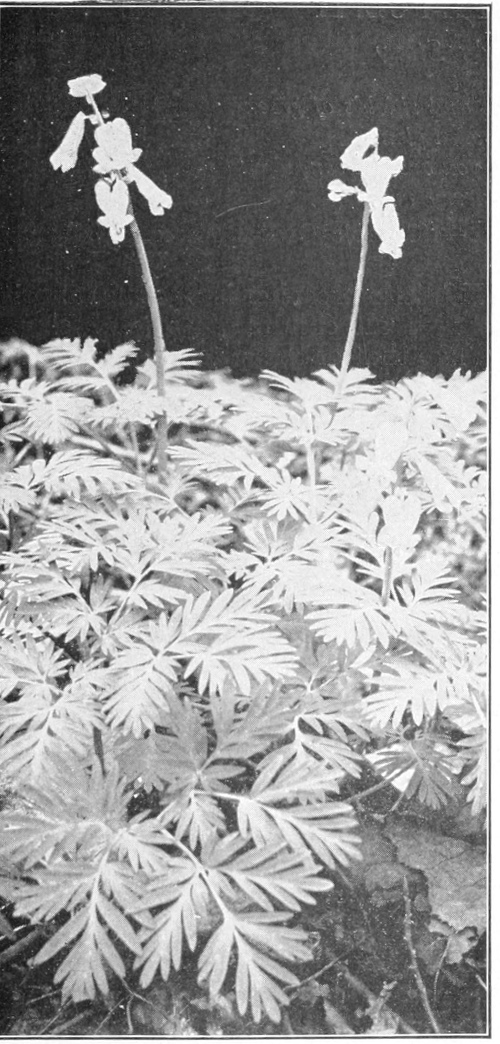
Squirrel corn.
Observations—1. Where do you find Dutchman’s breeches? Which do you prefer to call these flowers, Dutchman’s breeches or boys and girls? Are there leaves on the trees when these flowers are in bloom?
2. Which blossoms earlier in the season, Dutchman’s breeches or squirrel corn? How do the flowers of the two differ in shape? In odor?
3. In the flower of the Dutchman’s breeches find two petals which protect the nectar. How do they look? What part do they form of the breeches? Find two other petals which protect the pollen and stigma.
4. Find the two sepals. How many bracts do you find on the flower stem?
5. What insects visit these flowers? Describe how they get the nectar.
6. What sort of root has the Dutchman’s breeches? What is the difference between its root and that of the squirrel corn? Have you ever seen squirrels harvesting squirrel corn? What is the purpose of the kernels of the squirrel corn?
7. Study the leaf. How many main parts are there to it? How are these parts divided? Does the leaf come straight from the root or from a stem? What is the color of the leaf above? Below? Can you distinguish the leaves of the Dutchman’s breeches from those of the squirrel corn?
8. Describe the seed capsule of Dutchman’s breeches. How does it open? How many seeds has it? Compare this with the fruit of squirrel corn and describe the difference.
9. What happens to the leaves of these two plants late in summer? How do the plants manage to get enough sunlight to make food to mature their seed? What preparations have they made for early blossoming the next spring?
JACK-IN-THE-PULPIT
Teacher’s Story
“With hooded heads and shields of green, Monks of the wooded glen, I know you well; you are, I ween, Robin Hood’s merry men.” —“Child’s Own Book of Flowers.”
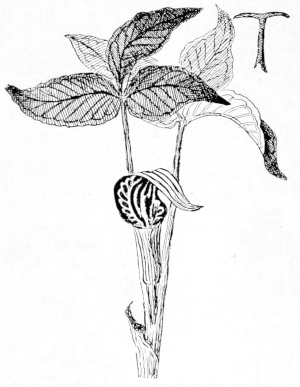
HIS little preacher is a prime favorite with all children, its very shape, like that of the pitcher plant, suggesting mystery; and what child could fail to lift the striped hood to discover what might be hidden beneath! And the interest is enhanced when it is discovered that the hood is but a protection for the true flowers, standing upon a club-shaped stem, which has been made through imagination into “Jack,” the little preacher.
Jack-in-the-pulpit prefers wet locations but is sometimes found on dry, wooded hillsides; the greater abundance of blossoms occurs in late May. This plant has another name, which it earned by being interesting below ground as well as above. It has a solid, flattened, food-storehouse called a corm with a fringe of coarse rootlets encircling its upper portion. This corm was used as a food by the Indians, which fact gave the plant the name of Indian turnip. I think all children test the corm as a food for curiosity, and retire from the field with a new respect for the stoicism of the Indian when enduring torture; but this is an undeserved tribute. When raw, these corms are peppery because they are filled with minute, needle-like spicules which, however, soften with boiling, and the Indians boiled them before eating them.
Jack-in-the-pulpit is a near cousin to the calla lily; the white part of the calla and the striped hood over “Jack” are both spathes, and a spathe is a leaf modified for the protection of a flower or flowers. “Jack” has but one leg and his flowers are set around it, all safely enfolded in the lower part of the spathe. The pistillate flowers which make the berries are round and greenish, and are packed like berries on the stalk; they have purple stigmas with whitish centers. The pollen-bearing flowers are mere little projections, almost white in color, each usually bearing four purplish, cup-like anthers filled with white pollen. Occasionally both kinds of flowers may be found on one spadix, (as “Jack” is called in the botanies), the pollen-bearing flowers being set below the others; but usually they are on separate plants. Professor Atkinson has demonstrated that when a plant becomes very strong and thrifty, its spadix will be set with the pistillate flowers and its berries will be many; but if the same plant becomes weak, it produces the pollen-bearing flowers the next year.
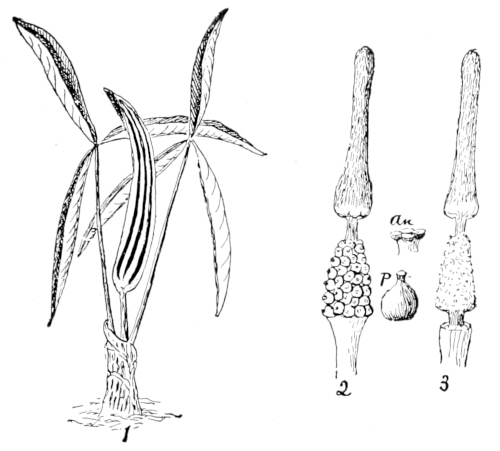
1. Jack-in-the-pulpit unfolding; 2. Spadix with pistillate flowers; P, pistillate flower enlarged; 3. Spadix with staminate flowers; an, a staminate flower enlarged, showing the four anthers.
When “Jack” first appears in the spring it looks like a mottled, pointed peg, for it is well sheathed. Within this sheath the leaves are rolled lengthwise to a point, and at the very center of the rolled leaves is a spathe, also rolled lengthwise, and holding at its heart the developing flower-buds. It is a most interesting process to watch the unfolding of one of these plants. On the older plants there are two, or sometimes three leaves, each with three large leaflets; on the younger plants there may be but one of these compound leaves, but the leaflets are so large that they seem like three entire leaves.
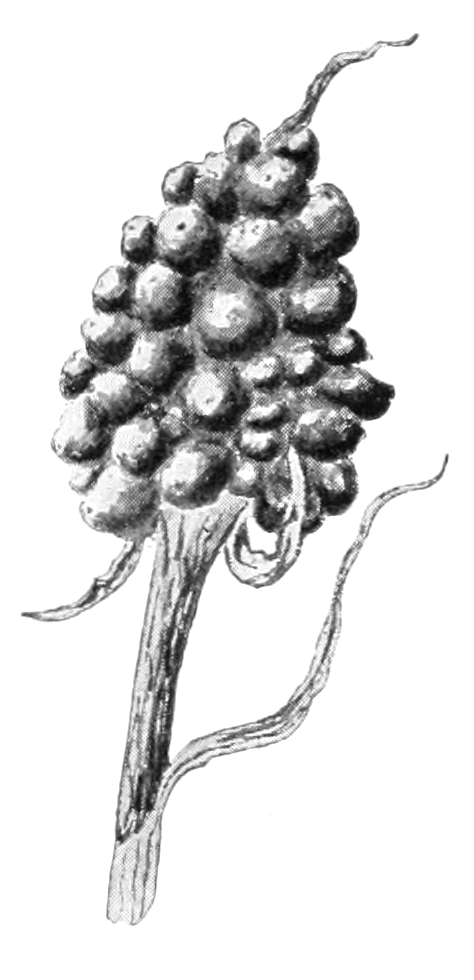
The berries of Jack-in-the-pulpit.
The spathes, or pulpits, vary in color, some being maroon and white or greenish, and some greenish and white. They are very pretty objects for water-color drawings.
Small flies and some beetles seem to be the pollen carriers for this plant. Various ingenious theories have been suggested to prove that our Jack-in-the-pulpit acts as a trap to imprison visiting insects, as does the English species; but I have studied the flowers in every stage, and have seen the insects crawl out of the hoods as easily as they crawled in, and by the same open, though somewhat narrow, passage between the spadix and the spathe.
After a time the spathe falls away showing the globular, green, shining berries. In August even the leaves may wither away, at which time the berries are brilliant scarlet. Jack-in-the-pulpit is a perennial. It does not blossom the first year after it is a seedling. I have known at least one case where blossoms were not produced until the third year. Below ground, the main corm gives off smaller corms and thus the plant spreads by this means as well as by seeds.
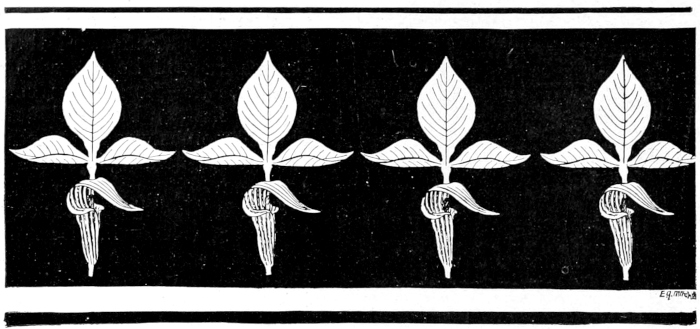
Border design by Evelyn Mitchell.
From the Child’s Own Book of Wild Flowers.
LESSON CXXII
Jack-in-the-pulpit
Leading thought—The real flowers of Jack-in-the-pulpit are hidden by the striped spathe which is usually spoken of as the flower. This plant has a peppery root which the Indians used for food.
Method—The questions should be answered from observation in the woods; a single plant may be dug up and brought to school for study, and later planted in some shady spot in the school garden.
Observations—1. Where do you find Jack-in-the-pulpit? Is the soil dry or damp? Do you ever find it in the fields?
2. How early in the season does this plant blossom? How late?
3. How does the Jack-in-the-pulpit look when it first pushes out from the ground? How are its leaves rolled in its spring overcoat?
4. How does the pulpit, or spathe, look when the plant first unfolds? Is its tip bent over or is it straight?
5. Describe or sketch the leaves of Jack-in-the-pulpit. How do they rise above and protect the flower? How many leaflets has each leaf? Sketch the leaflets to show the venation. How do these stand above the flower? Can you find any of the plants with only one leaf?
6. Why is the spathe called a pulpit? What are the colors of the spathe? Are all the spathes of the same colors?
7. Open up the spathe and see the rows of blossoms around the base of the spadix, or if you call the spadix, “Jack,” then the flowers clothe his one leg. Are all the blossoms alike? Describe, if you can, those flowers which will produce the seed and those which produce the pollen. Do you find the two on the same spadix or on different plants?
8. What insects do you find carrying the pollen for “Jack?” Do you know how its seeds look in June? How do they look in August? Do the leaves last as long as the seeds?
9. What sort of a root has “Jack?” How does it taste? Do you think the Indians boiled it before they ate it? What other name has “Jack?” How does the plant multiply below the ground?
10. Compare the Jack-in-the-pulpit with the calla lily.
11. Write an English theme on “The Sermon that Jack Preached from His Pulpit.”
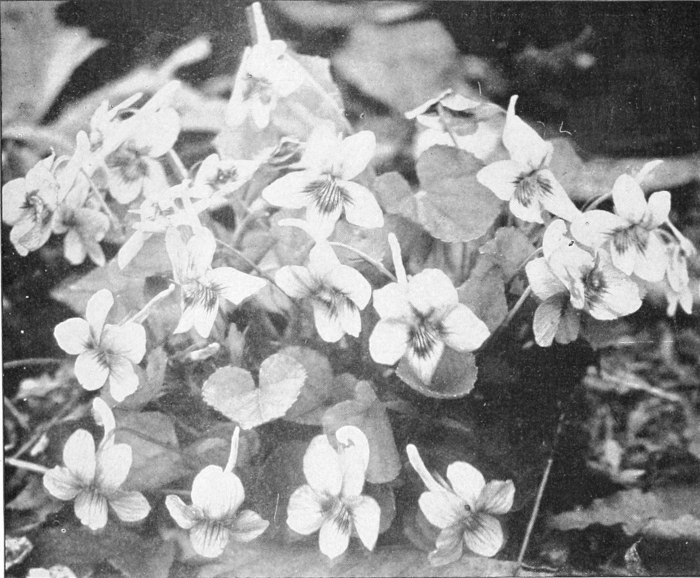
The Long-spurred violet. Color of flowers, pale lavender.
Photo by Verne Morton.
THE VIOLET
Teacher’s Story
It is interesting to note the flowers which have impinged upon the imagination of the poets; the violet more than most flowers has been loved by them, and they have sung in varied strains of its fragrance and lowliness.
Browning says:
“Such a starved bank of moss, ’Till that May morn, Blue ran the flash across; Violets were born.”
And Wordsworth sings:
“A violet by a mossy stone, Half hidden from the eye; Fair as a star, when only one Is shining in the sky.”
And Barry Cornwall declares that the violet
“Stands first with most, but always with the lover.”
But Shakespeare’s tribute is the most glowing of all, since the charms of both the goddesses of beauty and of love are made to pay tribute to it:
“Violets dim, but sweeter than the lids of Juno’s eyes, or Cytherea’s breath.”
However, the violets go on living their own lives, in their own way, quite unmindful of the poets. There are many different species, and they frequent quite different locations. Some live in the woods, others in meadows and others in damp, marshy ground. They are divided into two distinct groups—those where the leaf-stems come directly from the root, and those where the leaves come from a common stem, the latter being called the leafy-stemmed violets. Much attention should be given to sketching and studying the leaf accurately of the specimens under observation, for the differences in the shapes of the leaves, in many instances, determine the species; in some cases the size and shape of the stipules determines the species; and whether the leaves and stems are downy or smooth is another important characteristic. In the case of those species where the leaves spring from the root, the flower stems rise from the same situation; but in the leafy-stemmed violets the flower stems come off at the axils of the leaves. In some species the flower stems are long enough to lift the flowers far above the foliage, while in others they are so short that the flowers are hidden.
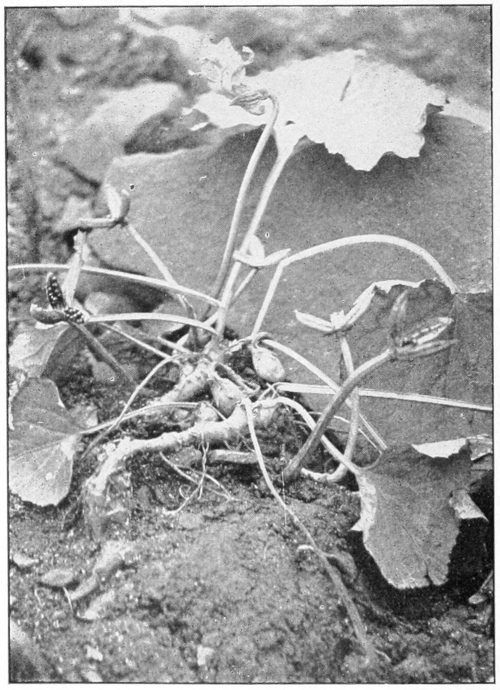
Common blue violet, showing two of the little flowers which never open, lying between the bare rootstocks. Note the three-valved seed capsules.
Photo by Verne Morton.
The violet has five sepals and their shape and length is a distinguishing mark. There are five petals, one pair above, a pair one at each side, and a broad lower petal which gives the bees and butterflies a resting place when they are seeking nectar. This lower petal is prolonged backward into a spur which holds the nectar.
The spur forms the nectary of the violet, and in order to reach the sweet treasure, which is at the rearmost point of the nectary, the insect must thrust its tongue through a little door guarded by both anthers and pistil; the insect thus becomes laden with pollen, and carries it from flower to flower. In many of the species, the side petals have at their bases a little fringe which forms an arch over the door or throat leading to the nectary. While this is considered a guard to keep out undesirable insects like ants, I am convinced that it is also useful in brushing the pollen from the tongues of the insect visitors.
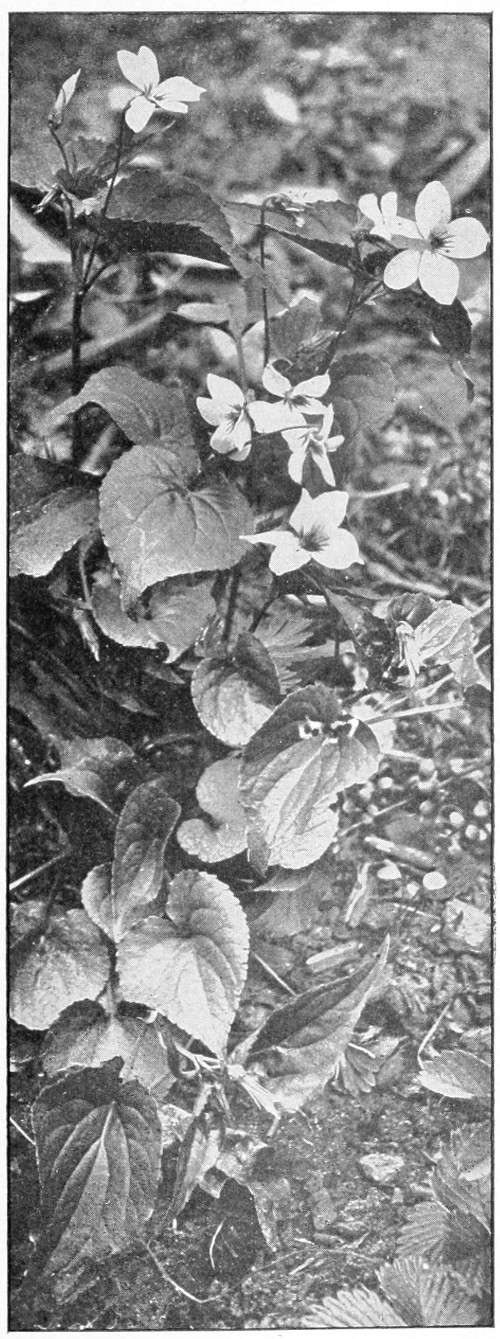
The Canada white violet, a leafy-stemmed species.
Photo by Verne Morton.
Some species of violets are very fragrant, while others have little odor. The color of the anthers also differs with different species. The children should be interested in watching the development of the seeds from the flower. The seed-pods are three-lobed, each one of these lobes dividing lengthwise, with a double row of seeds within. Each lobe curls back and thus scatters the seed.
At the base of most of the species of violets can be found the small flowers which never open; they have no petals, but within them the pollen and the pistil are fully developed. The flowers seem to be developed purposely for self-pollenation, and in the botanies they are called cleistogamous flowers; in some species they are on upright stems, in others they lie flat. There is much difference in the shape of the rootstock in the different species of violet; some are delicate and others are strong, and some are creeping.
LESSON CXXIII
The Violet
Leading thought—Each violet flower has a well of nectar, with lines pointing to it so that the insects may find it. They also have down near their roots, flowers which never open, which are self-pollenated and develop seeds.
Method—To make this work of the greatest use and interest, each pupil should make a portfolio of the violets of the locality. This may be in the form of pressed and mounted specimens, or of water-color drawings. In either case, the leaf, leaf-stem, flower, flower stem, and rootstock should be shown, and each blossom should be neatly labelled with name, locality and date. From the nature-study standpoint, a portfolio of drawings is the more desirable, since from making the drawings the pupils become more observant of the differences in structure and color which distinguish the species. Such a portfolio may be a most beautiful object; the cover of thick cardboard may have an original, conventionalized design made from the flowers and leaves of the violets. Each drawing may be followed by a page containing notes by the pupil and some appropriate quotation from botany, poetry or other literature.
Observations—1. Describe the locality and general nature of the soil where the violet was found. That is, was it in the woods, dry fields or near a stream?
2. Sketch or describe the shape of the leaf, paying particular attention to its margin and noting whether it is rolled toward the stem at its base. Is the petiole longer or shorter than the leaf? Does the leaf stem spring directly from the root, or does it branch from another? If the latter, are the leaves opposite or alternate? Is there a stipule where the leaf joins the main stem? If so, is it toothed on the edge?
3. What is the color of the leaf above? Are the leaves and stems downy and velvety, or smooth and glossy?
4. Does the flower stem come from the root of the plant, or does it grow from the main stem at the axil of the leaf? Are the flower stems long enough to lift the flowers above the foliage of the plant?
5. How many sepals has the violet? Are they long or short; pointed or rounded? How many petals has the violet? How are they arranged? Is the lower petal shaped like the others? What is the use of this broad lower petal? Are there any marks upon it? If you should follow one of these lines, where would it lead to?
6. Look at the spur at the back of the flower. Of which petal is it a part? How long is it, compared with the whole flower? What is the use of this spur?
7. Find the door that leads to the nectar-spur and note what the tongue of the bee or butterfly would brush against when reaching for the nectar. Are the side petals which form the arch over the door that leads to the nectar fringed at their bases? If so, what is the use of this fringe?
8. What colors are the petals? Are they the same on both sides? How are they marked and veined? Are the flowers fragrant?
9. What color are the anthers? What color is the stigma? Examine a fading violet, and describe how the seed is developed from the flower.
10. Find the seed-pods of the violet. How are the seeds arranged within them? How do the pods open? How are the seeds scattered?
11. Look at the base of the violet and find the little flowers there which never open. Examine one of these flowers and find if it has sepals, petals, anthers and pistil. Are these closed flowers on upright stems or do the stems lie flat on the earth? Of what use to the plant are these little closed flowers?
12. What sort of rootstock has the violet? Is it short and thick or slender? Is it erect, oblique or creeping?
THE MAY APPLE, OR MANDRAKE
Teacher’s Story
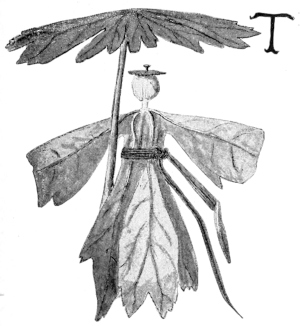
HIS is a study of parasols and, therefore, of perennial interest to the little girls who use the small ones for their dolls, and with many airs and graces hold the large ones above their own heads. And when this diversion palls, they make mandarin dolls of these fascinating plants. This is easily done by taking one of the small plant umbrellas and tying with a grass-sash all but two of the lobes closely around the stem, thus making a dress, the lobes left out being cut in proper shape for flowing sleeves; then for a head some other flower is robbed of its flower bud, which is put into place and surmounted with a clover leaflet hat, and a pin is then thrust through hat, head and neck into the stem of the dressed plant; the whole is properly finished by placing a small umbrella above the little green mandarin.
The mandrakes grow in open places where there is sun, and yet not too much of it; they like plenty of moisture, and grow luxuriantly in open glades or in meadows or pastures bordering woodlands, and they especially rejoice in the fence-corners, along roadsides. The first lesson of all should be how nature folds her little umbrellas. Study the plants when they first put their heads above ground, each parasol wrapped in its case, and note how similarly to a real umbrella it is folded around its stem. Later, after the umbrellas are fairly spread, they afford a most interesting study in varieties of form and size. Some of the parasols have only four lobes while others have many more. I have found them with as many as nine, although the botanies declare seven to be the normal number. One of the special joys afforded by nature-study is finding things different from the descriptions of them in the books.
One of these little parasols is a worthy object for careful observation. Its stem is stout and solid, and at its base may be seen the umbrella-case, now discarded like other umbrella-cases; the stem is pink wherever the sun touches it, but close up under the leaves it is likely to be green; it ends at the middle of the parasol by sending out strong, pale green, fuzzy ribs into each lobe. The lobes are narrow toward the stem but broad at the outer edge, each lobe being sparsely toothed on its outer margins and with a deep, smooth notch at the center. From the ribs of each lobe extend other ribs, an arrangement quite different from that we find in cloth umbrellas. The lobes of the mandrake parasol are divided almost to the center, and it is therefore evident that it is much better fitted for protection from the sun than from the rain. The parasol is a beautiful shining green on the upper side, and has a pale green lining that feels somewhat woolly.
In examining any patch of May apples, we find that many of the parasols are double; the secret of this is, that the mandrake baby needs two parasols to shield it from the sun; one of these twin parasols is always larger than the other and evidently belongs to the main stem, since its stem is stouter, and it is likely to have seven lobes while the smaller one may have but five. However, the number of lobes varies. Neither of these double parasols has its ribs extending out toward the other, and thus interfering; instead of having their “sticks” at the center of the parasol, they are at the side next each other, exactly as if the original single stem had been split and the whole parasol had been torn in twain.
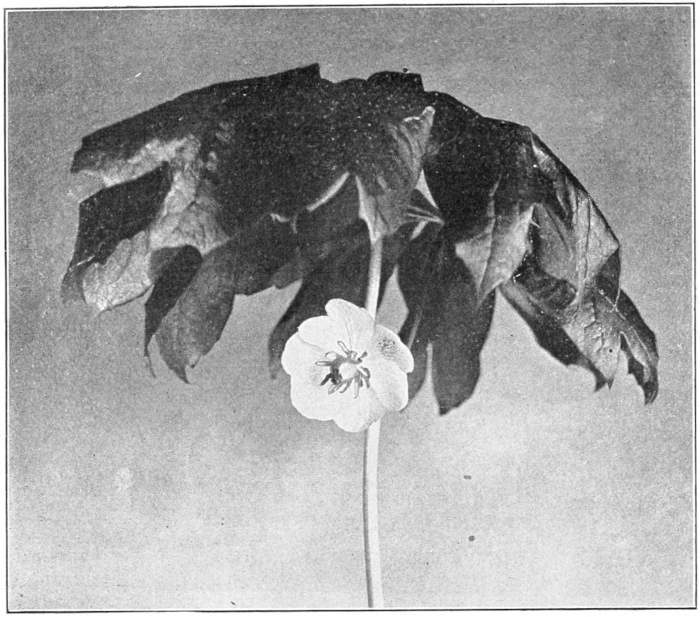
The blossom of the May apple.
But of greatest interest is the blossom-baby carried under this double parasol. At first it is a little, elongate, green ball on a rather stiff little stem, which droops because it wants to and not because it has to, and which arises just where the two branches fork. One of the strange things about this precocious baby-bud is, that when the plant is just coming from the ground, the bud pushes its head out from between the two folded parasols, and takes a look at the world before it retires under its green sunshade. As the bud unfolds, it looks as if it had three green sepals, each keeping its cup form and soon falling off, as a little girl drops her hood on a warm day; but each of these sepals, if examined, will be found to be two instead of one; the outer is the outside of the green hood while the inner is a soft, whitish membrane,
“A rabbit skin, To wrap the Baby Bunting in.”
As the greenish white petals spread out, they disclose a triangular mass of yellow stamens grouped about the big seed-box, each side of the triangle being opposite one of the inner petals. After the flower is fully open, the stamens spread and each anther is easily seen to be grooved, and each edge of the groove opens for the whole of its length; but because of its shape and position, it lets the pollen fall away from the pistil instead of toward it; nor do the tips of the anthers reach the waxy, white, ruffled stigma. There is no nectar in this flower; but the big queen bumblebee likes the pollen for her new nest, and she “bumbles” around in the flower while getting her load, so that she becomes well dusted with the pollen, and thus carries it from flower to flower. But the whole story of the pollen carriers of the May apple is, as yet, untold; and any child who is willing to give time and attention to discovering the different insects which visit this flower, may give to the world valuable and, as yet, unknown facts. It is said that a white moth is often found hanging to the flowers, but it is difficult to understand why the moth should be there if the flower does not have any nectar.
The seed-vessel at the center of the flower is large and chunky, and, although crowned with its ruffled stigma, looks as if it were surely going to “grow up” into a May apple. There are usually six wide, white, rounded petals, three on the outside and three on the inside; but sometimes there are as many as nine. There are usually twice as many stamens as petals, but I have often found thirteen stamens, which is not twice any possible number of petals. The petals soon fall, and, safely hidden from the eyes of enemies, the green fruit—which is a berry instead of an apple—has nothing to do but gather sweetness, until in July it is as juicy and luscious to the thirsty child as if it were the fruit of the gods. It is about two inches long, a rich yellow in color, and is sometimes called the “wild lemon,” although it is not sour. It is also called the hog-apple because the clever swine of the South know how to find it, despite its parasol. Riley thus celebrates this fruit:
“And will any poet sing of a lusher, richer thing, Than a ripe May apple, rolled like a pulpy lump of gold Under thumb and finger tips; and poured molten through the lips?”
If the May apple itself is edible, certainly its root is not, except when given by physicians as a medicine, for it is quite poisonous when eaten. When we see plants growing in colonies or patches, it usually means that very interesting things are going on underground beneath them, and the mandrake is no exception to this. Each plant has a running underground stem, straight and brown and fairly smooth; at intervals of a few inches, there are attached to it rosettes of stout, white roots, which divide into tiny, crooked rootlets. There is a large rosette of these roots under the plant we are studying, and we can always find a rosette of them under the place where the plant stood last year. Beneath the present plant we can find the bud from which will grow the root-stem for the coming year. The working out of the branching and the peculiarities of these root-stems, is an excellent lesson in this peculiar and interesting kind of plant reproduction.
LESSON CXXIV
The Mandrake
Leading thought—These interesting plants grow in colonies because of the spreading of their underground stems. Their odor and poisonous qualities protect them from being eaten by animals, and their fruit is well hidden by its green parasol until it is ripe.
Method—Begin the study just as the mandrakes are thrusting their heads up through the soil in April, and continue the work at intervals until the fruit is ripe.
Observations—1. How do the mandrakes look when they first appear above the ground? How are the little umbrellas folded in their cases? What do the cases look like? How can you tell from the first, the plants which are to bear the flowers and fruit?
2. Study a patch of mandrakes, and see how many varieties of parasols you can find? Do they all have the same number of main ribs and lobes? How many lobes do most of them have? Are there more single or double parasols in the patch?
3. Take a single plant and study it carefully. What sort of stem has it? Can you find at its base the old umbrella case? How high is the stem? What is its color at the bottom and at the top? How many ribs does it divide into at the top? Are these ribs as smooth as the stem? How does the parasol lining differ from its outside in color and feeling?
4. Study the parasol lobes. What is their general shape? Are they all notched at the wide end? How close to the stem does the division between them extend? Do you not think they are better fitted for keeping off the sun than the rain?
5. Take one of the double parasols. Where is the flower bud to be found? How is it protected from the sun? Does the stem divide equally on each side of it or is one part larger than the other? Are the twin parasols of the same size? How many lobes has each? What are the chief differences in shape between one of these twin parasols and one of the parasols which has no flower bud?
6. How does the flower bud look? Does it droop because its stem is weak? What happens to the green hood or sepals when the flower opens? Can you find six sepals in the hood?
7. Does the open flower bow downward? As the flower opens, what is the shape of the group of stamens at the center? Are there the same number of white, waxy petals in all the flowers? Are there always about twice as many stamens as petals? How do the anthers open to shed the pollen? Do they let the pollen fall away from the ruffled stigma of the “fat” little seed box at the center of the flower?
8. Does the flower have a strong odor? Does not the plant itself give off this odor? Do you think it is pleasant? Do the cattle eat the mandrake when it is in pastures?
9. What insects do you find visiting the mandrake flowers?
10. Do you like the May apple? When is it ripe? Cut a fruit across and see how the seeds are arranged.
11. Where are mandrakes found? Do they always grow in patches? Dig up a few plants and find why this is so?
12. Describe the underground stem. Can you find where the last year’s plant grew? How are the roots arranged upon the stem? Can you see places which will produce the stem for next year’s growth? How does the underground stem differ in appearance from the true roots? Why must we not taste of the mandrake root?
13. In late July, visit the mandrake patch again. Are there any umbrellas now? What is left of the plants? Look at the underground stems again and see if there are new growths, and if they are larger and stored with food for next year’s plants.
Bluets.
Photo by Cyrus Crosby.
THE BLUETS
Teacher’s Story
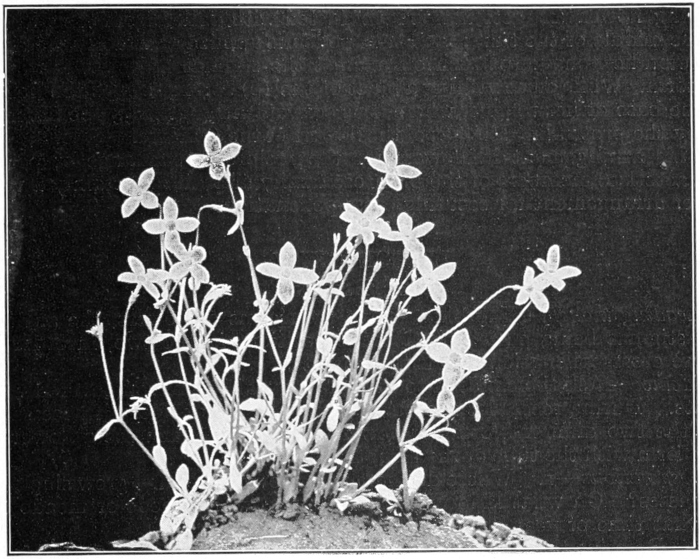
During April, great patches of blue appear in certain meadows, seeming almost like reflections from the sky; and yet when we look closely at the flowers which give this azure hue to the fields, we find that they are more lavender than blue. The corolla of the bluet is a tube, spreading out into four long, lavender, petal-like lobes; each lobe is paler toward its base and the opening of the tube has a ring of vivid yellow about it, the tube itself being yellow even to its very base, where the four delicate sepals clasp it fast to the ovary until the flower has done its work; and after the corolla has fallen the sepals remain; standing guard over the growing seed.
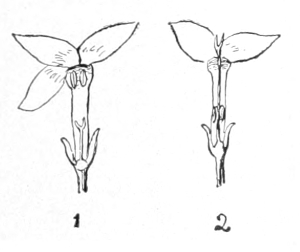
1. Section of a bluet blossom that has the anthers at the throat of the tube and the stigmas below.
2. Section of a bluet with the stigmas protruding and the anthers below.
If we look carefully at the bluets we find two forms of flowers: (a) Those with a two-lobed stigma protruding from the opening of the flower tube. (b) Those where the throat of the tube seems closed by four anthers which join like four fingertips pressed together. In opening the flower, we observe that those which have the stigmas protruding from the tube, have four anthers fastened to the sides of the tube about halfway down; while those that have the four anthers near the opening of the tube, have a pistil with a short style which brings the stigmas about half-way up the tube. Thus an insect visiting flower (a) gets her tongue dusted with pollen from the anthers at the middle of the tube; and this pollen is applied at exactly the right place on her tongue to brush off against the stigmas of a flower of the (b) form. While a bee visiting a bluet of the (b) form receives the pollen at the base of her tongue, where it is conveniently placed to be brushed off by the protruding stigmas of the flowers of the (a) form.
This arrangement in flowers for the reciprocal exchange of pollen characterizes members of the primrose family also; it is certainly a very clever arrangement for securing cross-pollenation.
LESSON CXXV
The Bluets
Leading thought—The bluets have two forms of flowers, the anthers and stigmas being placed in different positions in the two, in order to secure cross-pollenation by visiting insects.
Method—Ask the children to bring in several bits of sod covered with bluets. During recess let the pupils, with the aid of a lens if necessary, find the two different forms of flowers. Later, let each see a flower of each form with the tube opened lengthwise.
Observations—1. Where do the bluets grow? Do they grow singly or in masses? On what kind of soil do they grow, in woods or meadows? At what time of year do they bloom?
2. Describe the bluet flower, its color, the shape of its sepals, the form of the corolla, the color of the corolla-tube and lobes.
3. Where is the nectar in the bluet? What color shows where the nectar is to be found?
4. Look directly into the flowers. Do you see any with the stigmas thrust out of the corolla-tube? Is there more than one style? Has it one or two stigmas? Open this flower-tube and describe where the anthers are situated in it. How many anthers are there?
5. Look for a flower where the stigmas do not protrude and the anthers close the throat of the tube. Where are the stigmas in this flower, below or above the anthers? Where are the anthers attached?
6. Work out this problem: How do the insects gathering nectar from one form of the bluets become dusted with pollen in such a way as to leave it upon the stigma of the other form of the bluet flower?
7. How many sepals are there? Do they fall off when the blossom falls?
“So frail, these smiling babies, Near mossy pasture bars, Where the bloodroot now so coyly Puts forth her snowy stars; And the maple tall and slender, With blossoms red and sweet, Looks down upon the bluets Close nestled at her feet. ‘Innocents’, the children call them,— These floral babies small, Of Mother Nature olden, Whose broad lap holds them all.” —Ray Laurance.
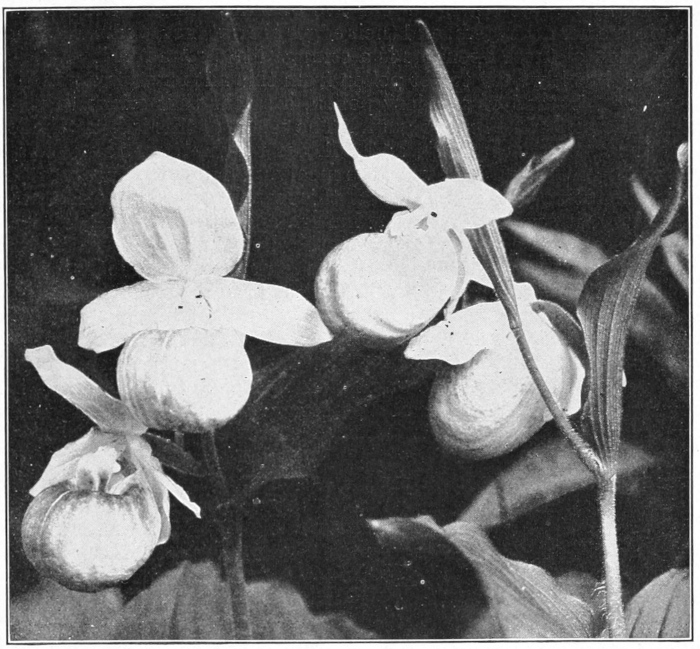
Showy ladies’ slipper
Photo by Verne Morton.
THE YELLOW LADY’S SLIPPER
Teacher’s Story
“Graceful and tall the slender drooping stem, With two broad leaves below, Shapely the flower so lightly poised between, And warm its rosy glow.” —Elaine Goodale.
These showy flowers look so strange in our woodlands that we gaze at them as curiously as we might upon a veiled lady from the Orient who had settled in our midst. There is something abnormal and mysterious in the shape of this flower, and though it be called the lady’s slipper, yet it would be a strange foot that could fit such a slipper; and if it is strange at the first glance, it is still more so as we try to compare it with other flowers. There are two long sepals that extend up and down, the lower one being made up of two grown together—but the “seam” does not show. The sepals are yellow, and are wider than the two long streamers that extend out at right angles to them, and which are petals; the brighter color of the latter, their markings of reddish dots, the hairs near their bases, all go to show that these petals, although so different in shape, belong to the same series as the big lower petal which is puffed out into a sac, shaped like a deep, long bowl, with its upper edges incurved. If we look carefully at this bowl, we find two openings besides the main one, these two are near the stem, and their edges are not incurved. Extending out into each of these openings is a strange little round object, which is an anther; but if we try to get pollen from this anther with a pencil or a knife we get, instead of powdery pollen, a smear that sticks to what it touches, like melted rubber or gum. The secret of this is, that the lower side of the anther is gummy, and adheres to whatever touches it and brings with it, when pulled away, the mealy pollen which lies loose above it. Another strange thing is that, if this lower part of the anther is not carried away, it seems to partially harden and opens downward, letting the pollen escape in a way usual with other flowers. We have to remove a side of the bowl to see the stigma; it is fan-shaped, and is bent at right angles to the flower stem; and above it, as if to protect it, is a stiff triangular piece which is really a strangely modified stamen. I think one reason why the lady’s slipper always is called “she” is because of this tendency on her part to divert an object from its natural use. Surely a hairpin used for a paper knife or a monkey-wrench for a hammer, is not nearly so feminine a diversion as a stamen grown wide and long to make an awning above a stigma.
The general color of the flower is yellow, and there are some seductive dark red spots on the stamen-awning and along the folded-in surface of the petal-sac which say plainly, “Come here, Madam Mining-bee, and see what these spots mean.” And the little bee alights on the flower and soon crawls into the well at the center, the recurved edges preventing it from returning by the same door. At the bottom of the sac there are delectable vegetable hairs to be browsed upon; if there is nectar, I have never been able to detect it with my coarse organs of taste; and Mr. Eugene Barker who has examined hundreds of the flowers has not been able to detect the presence of nectar in them at any stage; but he made no histological study of the glands.
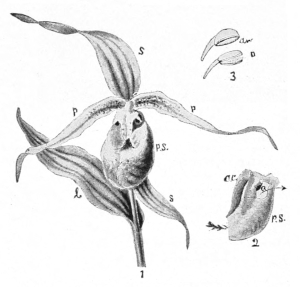
Detail of yellow lady’s slipper.
1, l, leaf; s, s, sepals; p, p, petals; p.s, petal-sac. 2, Side-view: ac, anther cover; p.s, petal-sac, a, anther. The arrow shows the path of the insect. 3, an, anther closed; o, anther open.
After a satisfying meal the bee, which is a lively crawler, seeks to get out where it sees the light shining through one of the openings near to the stem. In doing this, she presses her head and back, first against the projecting stigma and then against the sticky anther, which smears her with a queer kind of plaster; and it sticks there until she brushes it off on the stigma of another flower, when crowding past it; and there she again becomes smeared with pollen plaster from this flower’s anthers. Mr. Barker, who has especially studied these flowers, has found that the little mining bees of the genus Andrena were the most frequent visitors; he also found honey-bees and one stray young grasshopper in the sacs. The mining bees which he sent to me had their backs plastered with the pollen. Mr. Barker states that the flowers are not visited frequently by insects, and adds feelingly; “My long waiting was rewarded with little insect activity, aside from the mosquitoes which furnished plenty of entertainment.”
The ovary looks like a widened and ribbed portion of the flower-stem, and is hairy outside; its walls are thick and obscurely three-angled; seen in cross-section the seeds are arranged in a triangular fashion which is very pretty.
The leaves of the yellow lady’s slipper are oval or elliptic, with smooth edges and parallel veins; they often have narrow veins between each two heavier ones. The leaves are of vivid yellowish green and are scattered, in a picturesque manner, alternately along the stem, which their bases completely clasp. The stem is somewhat rough and ribbed and is likely to grow crooked; it grows from one to two feet in height. The roots are a mass of small rootlets. The species is found in woods and in thickets.
The pink moccasin flower, also called the stemless lady’s slipper (C. acaule,) is perhaps prettier than the yellow species, and differs from it in several particulars. The sac opens by the merest crevice, and there are plenty of dark-pink guiding lines which lead to the little opening of the well. The downward-folded edges prevent the visiting insect from getting out by this door even more surely than in the other species. The side petals are not so long as in the yellow species, and they extend forward as if to guide the insect to the well in the lower petal. The sepals are greenish purple, and are likewise shorter; and the lower one is wide, indicating that it is made up of two grown together. At the base of the ovary there is a pointed green bract or leaf, which lifts up and bends above the flower. There are but two leaves on the stemless lady’s slipper; they arise from the base of the stem. They are broadly ovate, and from six to seven inches long. This species grows in sandy or rocky woods.
Another species more beautiful than these is the showy lady’s slipper, which is white with a pink entrance to the petal sac. This grows in peaty bogs, and is not so common as the others.
The interesting points for observation in these flowers are the careful noting of the kinds of insects which visit them, and how they enter and leave the “slipper,” or sac.
LESSON CXXVI
The Yellow Lady’s Slipper
Leading thought—The moccasin flower belongs to that family of flowers known as orchids which especially depend upon insects for bringing and carrying pollen, and which have developed many strange devices to secure insect aid in pollenation.
Method—A bouquet of lady’s slippers should be brought to the schoolroom. Children who bring them should describe the place where they were found.
Observations—1. Where does the yellow lady’s slipper grow? Look carefully at its leaves and describe them. How do they join the stem? Are they opposite or alternate?
2. What is there peculiar about the sepals? How many are there?
3. Describe the three petals and the difference and likeness in their form and color. What is the shape of the lower petal? Is there a hole in this sac? Is there more than one hole leading into it? What is the color of the sac? Is there anything about it to attract insects? If an insect should enter the mouth of the well in the lower petal could it easily come out by the same opening? Why not? Where do you think it would emerge?
4. Note the two roundish objects projecting into the two openings of the sac near the stem. Thrust a pencil against the under side of one of these. What happens? How does this pollen differ from the pollen of ordinary flowers?
5. Cut away one side of the petal-sac and find the stigma. What shape is it? Where is it situated with relation to the anthers? How is the stigma protected above? Where is the ovary, or seed-box?
6. Explain how a bee visiting these flowers, one after another, must carry the pollen from one to another and deposit it on the waiting stigmas.
7. How is the insect attracted? How is it trapped and made to do the work?
8. Look at the seed-capsule and describe it from the outside. Cut it across, and describe the arrangement of the seeds. How many sides of the seed-capsule open, to let loose the seeds?
9. How many species of lady’s slippers do you know? Do you know the pink, or stemless species? How does it differ from the yellow species in the following particulars: The shape of the sac; its color and markings; the length and shape of sepals; the number and position of the leaves?
THE COMMON BUTTERCUP
Teacher’s Story
“The buttercups, bright-eyed and bold, Held up their chalices of gold To catch the sunshine and the dew.”
Buttercups and daisies are always associated in the minds of the children, because they grow in the same fields; yet the two are so widely different in structure that they may reveal to the child something of the marvelous differences between common flowers; for the buttercup is a single flower, while the single daisy is a large family of flowers.
The buttercup sepals are five elongated cups, about one-half as long as the petals; they are pale yellow with brownish tips, but in the globular buds, they are green. The petals are normally five in number, but have a tendency to double, so that often there are six or more; the petals are pale beneath, but on the inside they are most brilliant yellow, and shine as if varnished. Probably it is due to this luminous color that one child is able to determine whether another likes butter or not, by noting when the flower is held beneath the chin, if it makes a yellow reflection; it would be a sodden complexion indeed that would not reflect yellow under this provocation. Each petal is wedge-shaped, and its broad outer edge is curved so as to help make a cuplike flower; if a fallen petal be examined, a tiny scale will be found at its base, as if its point had been folded back a trifle. However, this is not a mere fold, but is a little scale growing there—a scale with a mission, for beneath it is developed the nectar.
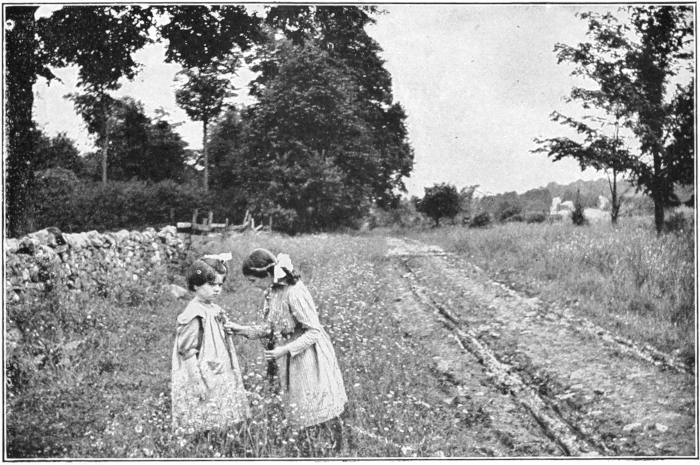
Do you like butter?
When the buttercup first opens, all of the anthers are huddled in the center, so that it looks like a golden nest full of golden eggs. Later the filaments stretch up, lifting the anthers into a loose, rounded tuft, almost concealing the bunch of pistils which are packed close together beneath every stigma, like Bre’r Rabbitt, “laying low.” Later, the filaments straighten back, throwing the anthers in a fringy ring about the pale green pistils; and each pistil sends up a short, yellowish stigma. The anthers open away from the pistils and thus prevent self-pollenation to some degree; they also seem to shed much of their pollen before the stigmas are ready to receive it.
Sometimes petals and sepals fall simultaneously and sometimes first one or the other; but they always leave the green bunch of pistils with a ragged fringe of old stamens clinging to them. Later the seeds mature, making a globular head. Each seed is a true akene; it is flattened and has at its upper end a short, recurved hook which may serve to help it to catch a ride on passers-by. However, the seeds are largely scattered by the winds.
The buttercup grows in sunny situations, in fields and along roadsides, but it cannot stand the shade of the woods. It is a pretty plant; its long stems are downy near the bottom, but smooth near the flower; the leaves show a variety of forms on the same plant; the lower ones have many, (often seven) deeply cut divisions, while the upper ones may have three irregular lobes, the middle one being the longest. Beetles are very fond of the nectar and pollen of buttercups, and therefore are its chief pollen carriers; but flies and small bees and other insects also find their food in these brilliant colored cups.
LESSON CXXVII
The Buttercup
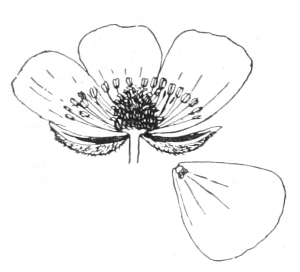
Buttercup flower enlarged. Note the scale covering the nectar at the base of the falling petal.
Leading thought—The buttercup grows with the white daisies, in sunny places, but each buttercup is a single flower, while each daisy is a flower family.
Method—Buttercups brought by the pupils to school may serve for this lesson.
Observations—1. Look at the back of a flower of the buttercup. What is there peculiar about the sepals? How do the sepals look on the buttercup bud? How do they look later?
2. Look into the flower. How many petals are there? Are there the same number of petals in all the flowers of the same plant? What is the shape of a petal? Compare its upper and lower sides. Take a fallen petal, and look at its pointed base with a lens and note what is there.
3. How do the stamens look? Do you think you can count them? When the flower first opens how are the stamens arranged? How, later? Do the anthers open towards, or away, from the pistils?
4. Note the bunch of pistils at the center of the flower. How do they look when the flower first opens? How, later?
5. When the petals fall, what is left? Can you see now how each little pistil will develop into a seed?
6. Describe the seed-ball and the seed.
7. Look at the buttercup’s stems. Are they as smooth near the base as near the flower? Compare the upper leaf with the lower leaf, and note the difference in shape and size.
8. Where do the buttercups grow? Do we find them in the woods? What insects do you find visiting the flowers?
THE EVENING PRIMROSE
Teacher’s Story
“Children came To watch the primrose blow. Silent they stood, Hand clasped in hand, in breathless hush around, And saw her shyly doff her soft green hood And blossom—with a silken burst of sound.” —Margaret Deland.
To the one who has seen the evening primrose unfold, life is richer by a beautiful, mysterious experience. Although it may be no more wonderful than the unfolding of any other flower, yet the suddenness of it makes it seem more marvelous. For two or three days it may have been getting ready; the long tube which looks like the flower stem has been turning yellow; pushing up between two of the sepals, which clasp tips beyond it, there appears a row of petals. Then some warm evening, usually about sunset, but varying from four o’clock in the afternoon to nine or ten in the evening, the petals begin to unfurl; they are wrapped around each other in the bud as an umbrella is folded, and thus one edge of each petal becomes free first. The petal first in freeing its edge seems to be doing all the work, but we may be sure that all the others are pushing for freedom; little by little the sepals are pushed downward, until their tips, still clasped, are left beneath; and the petals now free, suddenly flare open before our delighted eyes, with a movement so rapid that it is difficult for us not to attribute to them consciousness of action. Three or four of these flowers may open on a plant the same evening; and they, with their fellows on the neighboring plants, form constellations of starry bloom that invite attention from the winged creatures of the twilight and the night. There is a difference in the time required for a primrose flower to unfold, probably depending upon its vigor; once I watched for half an hour to see it accomplished, and again I have seen it done in two or three minutes. The garden species seems to unfold more rapidly than the wild species, and is much more fragrant. The rapidity of the opening of the blossom depends upon the petals getting free from the sepals, which seem to try to repress them. The bud is long, conical, obscurely four-sided, and is completely covered by the four sepals, the tips of which are cylindrical and twisted together; this is an interesting habit, and one wonders if they hold the petals back until the latter are obliged to burst out with the force of repressed energy; after they let go of the petals, they drop below the flower angularly, and finally their tips open and each sepal turns back lengthwise along the seed-tube.
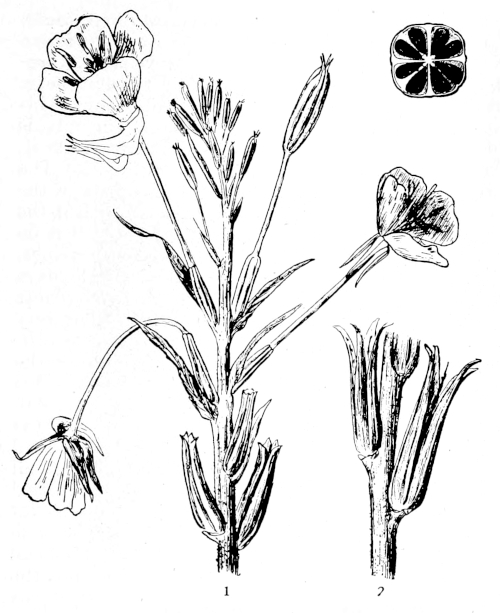
1, Evening primrose, showing buds, one ready to open, a flower just opened above at the left, an older flower at the right, a fading flower and seed-capsules below. 2, Seed-capsules. Cross section of seed-capsule with seeds above.
The four lemon-yellow petals are broad, with the outer margin notched. The eight stamens are stout, and set one at the middle of each petal and one between each two petals. The long, pale yellow anthers discharge their pollen in cobwebby strings. When the flower first opens, the stigma is egg-shaped and lies below the anthers; later, it opens into a cross and usually hangs off at one side of the anthers. If we try to trace the style back to the ovary, we find that it extends down into what seems to be the very base of the flower stem, where it joins the main stem. This base is enlarged and ribbed and is the seed-box, or ovary. The tube is rich in nectar, but only the long sucking-tubes of moths can reach it, although I have sometimes seen the ubiquitous bees attempting it. The butterflies may take the nectar in the daytime, for the blossoms of the wild species remain open, or partially open, for a day or two. But the night-flying moths which love nectar have the first chance, and it is on them the flower depends for carrying its pollen, threaded on filmy strings.
There are times when we may find the primrose blossoms with holes in the petals, which make them look very ragged. If we look at such plants carefully, we may find the culprit in the form of a green caterpillar very much resembling the green tube of the bud; and we may conclude, as Dr. Asa Fitch did, that this caterpillar is a rascal, because it crawls out on the bud-ends and nibbles into them, thus damaging several flowers. But this is only half the story. Later this caterpillar descends to the ground, digs down into it and there changes to a pupa; it remains there until the next summer, then, from this winter cell, emerges an exquisitely beautiful moth called the Alaria florida; its wings expand about an inch, and all except the outer edges of the front wings are rose-pink, slightly mottled with lemon-yellow, which latter color decorates the outer margins for about one-quarter of their length; the body and hind-wings are whitish and silky, the face and antennæ are pinkish. Coiled up beneath the head is a long sucking-tube which may be unfolded at will. This moth is the special pollen-carrier of the evening primrose; it flies about during the evening, and thrusts its long, tubular mouth into the flower to suck the nectar, meanwhile gathering strings of pollen upon the front part of its body. During the day, it hides within the partially closed flower, thus carrying the pollen to the ripened stigmas, its colors meanwhile protecting it almost completely from observation. The fading petals of the primrose turn pinkish, and the pink color of the moth renders it invisible when in the old flowers, while the lemon-yellow tips of its wings protruding from a flower still fresh and yellow, forms an equally perfect protection from observation.
The evening primrose is an ornamental plant in both summer and winter. It is straight, and is ordinarily three or four feet tall, although it sometimes reaches twice that height. It is branched somewhat, the lower portion being covered with leaves and the upper portion bearing the flowers. The leaves are pointed and lanceolate, with few whitish veins. The leaf edges are somewhat ruffled and obscurely toothed, especially in the lower leaves. The leaves stand up in a peculiar way, having a short, pink petiole, which is swollen and joins the stalk like a bracket. The upper leaves are narrower; the leafy bracts at the base of the flower grow from the merest slender leaflet at the base of the bud, to a leaf as long as the seed-pod, when the flower blooms.
The seed-capsules are four-sided, long and dark green. In winter they are crowded in purplish-brown masses on the dry stalks, each one a graceful vase with four flaring tips. At the center of each there projects a needlelike point; and within the flaring, pale, satin-lined divisions of these urns, we may see the brown seeds which are tossed by the winter winds far and near. The young plants develop into vigorous rosettes during the late summer and autumn, and thus discreetly pass the winter under the snow coverlet.
LESSON CXXVIII
The Evening Primrose
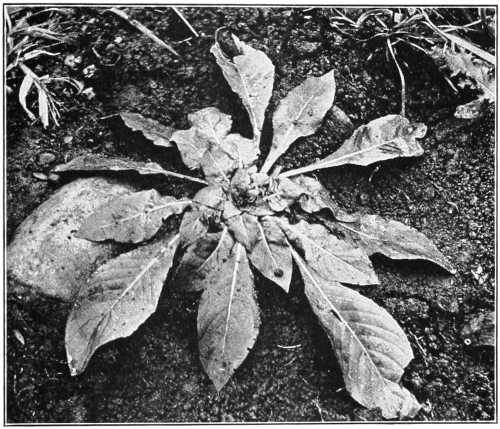
Winter rosette of evening primrose.
Photo by Verne Morton.
Leading thought—Some flowers have developed the habit of relying on the night-flying insects for carrying their pollen. The evening primrose is one of these; its flowers open in the evening and their pale yellow color makes them noticeable objects in the twilight, and even in the dark.
Method—The form of the evening primrose may be studied from plants brought to the schoolroom; but its special interest lies in the way its petals expand in the evening, so the study should be continued by the pupils individually in the field. This is one of the plants which is an especially fit subject for the summer note-book; but since it blossoms very late and the plants are available even in October, it is also a convenient plant to study during the school year. The garden species is well adapted for this lesson.
Observations—1. Look at the plant as a whole. How tall is it? Is the stem stiff and straight? Where do you find it growing? Does it grow in the woods?
2. Are the leaves near the base the same shape as those at the top of the plant? What is their shape? Are the edges toothed? What is there peculiar about the veins? How do the leaves join the stem? How do the leaves look which are at the base of the flower stem? Those at the base of the buds?
3. Where on the plant do the flowers grow? Which flowers blossom first, those above or below? Take a bud nearly ready to open; what is there peculiar in the appearance of the bud stem? What is the general shape of the bud? Describe the sepals. Look at their tips carefully, and see how they hold together. Cut a bud across and see how the petals are folded within it.
4. Take an open flower; where are the sepals now? Describe the open petals, their shape and color.
5. How many stamens are there? How are they placed? What is the shape of the anthers? How does the pollen look?
6. What is the shape and the position of the stigma in the freshly opened flower? Later? Open the flower-tube and find how far down the style extends. Where is the ovary? How does the ovary look on the outside? Taste the opened tube; can you detect the nectar? What sort of a tongue must an insect have to reach this nectar? How do the fading flowers look and act?
7. Describe the seed-pod. Cut it across, and see how many compartments there are within it. How are the seeds arranged in it? How do the pods open and how are the seeds scattered?
8. Watch the flower of the evening primrose open, and describe the process carefully. At what hour did it open? What was the movement of the petals? Can you see how they unfold in relation one to another? How do they get free from the sepals? How many minutes is required for the whole process of the opening of the flower? How many flowers on a plant expand during the same evening? Look at the open blossoms in the dark; can you see them? How do they look? What insects do you find visiting these flowers?
9. How long does the primrose blossom remain open? How do the young plants of the evening primrose pass the winter?
Supplementary reading—Blossom Hosts and Insect Guests, Gibson.
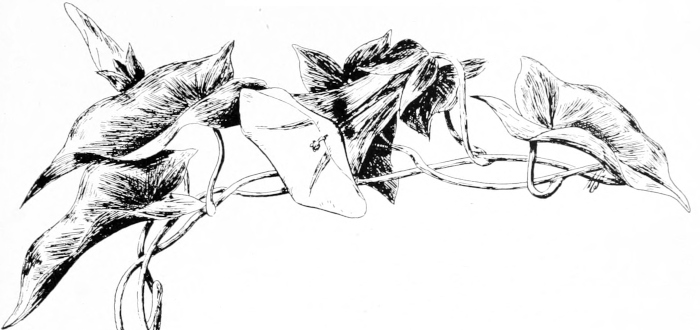
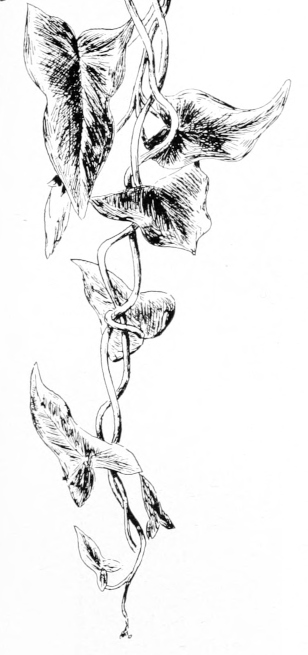
THE HEDGE BINDWEED
THE HEDGE BINDWEED
Teacher’s Story
I once saw by the roadside a beautiful pyramid, covered completely with green leaves and beset with pink flowers. I stopped to examine this bit of landscape gardening, and for the first time in my life I felt sorry for a burdock; for this burdock had met its match and more in standing up against a weakling plant which it must have scorned at first, had it been capable of this sensation. Its mighty leaves had withered, its flower-stems showed no burs, for the bindweed had caught it in its hundred embraces and had squeezed the life out of it. Once in Northern Florida our eyes were delighted with the most beautiful garden we had ever seen and which resolved itself later into a field of corn, in which every plant had been made a trellis for the bindweed; there it flaunted its pink and white flowers in the sunshine with a grace and charm that suggested nothing of the oppressor.
Sometimes the bindweed fails to find support to lift it into the air. Then it quite as cheerfully mats itself over the grass, making a carpet of exquisite pattern. This vine has quite an efficient way of taking hold. It lifts its growing tips into the air, swaying them joyously with every breeze; and the way each extreme tip is bent into a hook seems just a matter of grace and beauty, as do the two or three loose quirls below it; when during its graceful swaying the hook catches to some object, it makes fast with amazing rapidity; later the young arrow-shaped leaves manage to get an ear over the support, and in a very short time the vine makes its first loop, and the deed is done. It is very particular to twine and wind in one way, following the direction of the hands of the clock—from the right, under, and from the left, over the object to which it clings. If the support is firm, it only makes enough turns around it to hold itself firmly; but if it catches to something as unstable as its own tendrils, they twist until so hard-twisted that they form a support in themselves.
It is rather difficult to perceive the alternate arrangement of the leaves on the bindweed stem, so skillful are they in twisting under or over in order to spread their whole graceful length and breadth to the sun; to the careless observer they seem only to grow on the upper or outer side of the vine. The leaves are arrow-shaped, with two long, backward, and outward projecting points, or “ears,” which are often gracefully lobed. Early in the year the leaves are glossy and perfect; but many insects love to nibble them, so that by September, they are usually riddled with holes.
The flower bud is twisted as if the bindweed were so in the habit of twisting that it carried the matter farther than necessary. Enveloping the base of the flower bud are two large sepal-like bracts, each keeled like a duck’s breast down the center; if these are pulled back, it is seen that they are not part of the flower, because they join the stem below it. There are five pale green sepals of unequal sizes, so that some look like fragments of sepals. The corolla is long, bell-shaped, opening with five, starlike lobes; each lobe has a thickened white center; and while its margins are usually pink, they are sometimes a vivid pink-purple and sometimes entirely white. Looking down into this flower-bell, and following the way pointed out by the white star-points which hold out the lobes, we find five little nectar-wells; and each two of these wells are separated by a stamen which is joined to the corolla at its base and at its anther-end presses close about the style of the pistil. When the flower first opens, it shows the spoon-shaped stigmas close together, pushing up through the anther cluster; later, the style elongates, bringing the stigmas far beyond the anthers. The pollen is white, and through the lens looks like tiny pearls.
When we study the maturing seed-capsule, we can understand the uneven size of the sepals better; for after the corolla with the attached stamens falls, the sepals close up around the pistil; the smallest sepal wraps it first, and the larger ones in order of size, enfolding the precious parcel; and outside of all, the great, leafy bracts with their strong keels provide protection. The pod has two cells and two seeds in each cell. But it is not by seeds alone that the bindweed spreads; it is the running rootstock which, when the plant once gets a start, helps it to cover a large area. The bindweed is a relative of the morning-glory and it will prove an interesting study to compare the two in methods of twining, in the time of day of the opening of the flowers, the shape of the leaves, etc. So far as my own observations go, the bindweed flowers seem to remain open only during the middle of the day, but Müller says the flowers stay open on moonlight nights to invite the hawk-moths. This is an interesting question for investigation, and it may be settled by a child old enough to make and record truthful observations.