Part 2 — VI. INSECT STUDY (continued 3)
Reading edition
3. What does the caddis-worm do when it wishes to walk around? What is the color of the head and the two segments back of it? What is the color of the body? Why is this difference of color between the head and body protective? Is the caddis-worm grown fast to its case, as the turtle is to its shell?
4. Note the legs. Which is the shorter pair? How many pairs? What is the use of the legs so much shorter than the others? If the caddis-worm case happens to be wrong side up, how does it turn over?
5. When it wishes to come to the surface or swim, what does the caddis-worm do? When reaching far out of its case does it ever lose its hold? How does it hold on? Pull the caddis-worm out of its case and see the hooks at the end of the body with which it holds fast.
6. How does the caddis-worm breathe? When it reaches far out of its case, note the breathing gills. Describe them. Can you see how many there are on the segments? How is the blood purified through these gills?
7. What are the caddis-worm’s enemies? How does it escape them? Touch one when it is walking, what does it do?
8. On top of the first segment of the abdomen is a tubercle. Do you suppose that this helps to hold the caddis-worm in its case?
9. What does the caddis-worm eat? Describe how it acts when eating.
10. How does the caddis-worm build its case? Watch one when it makes an addition to its case, and describe all that you can see.
11. Can you find any of the cases with the front and back doors closed? How are they closed? Open one and see if there is a pupa within it. Can you see the growing wings, antennæ and legs? Has it breathing filaments like the larva? Cover the aquarium with mosquito netting so as to get all the moths which emerge. See if you can discover how the pupa changes into a caddis-fly.
12. How does the caddis-fly fold its wings? What is the general shape of the insect when seen from the side with wings closed? What is the texture of the wings? How many wings are there? Which pair is the longer?
13. Describe the eyes. The antennæ. Does the caddis-fly walk on its toes, or on its complete foot?
14. Examine the moths which come around the lights at night in the spring and summer. Can you tell the caddis-flies from other insects? Do they dash into the light? Do they seem anxious to burn themselves?
Supplementary reading—“A Little Fisherman,” Ways of the Six-Footed, Comstock.
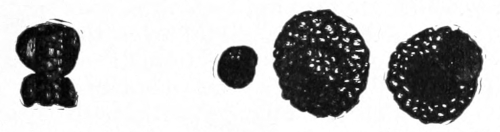
Spiral case of caddis-worm made of small pebbles and sand.
Comstock’s Manual.
Little brook, so simple so unassuming—and yet how many things love thee!
Lo! Sun and Moon look down and glass themselves in thy waters.
And the trout balances itself hour-long against the stream, watching for its prey; or retires under a stone to rest.
And the water-rats nibble off the willow leaves and carry them below the wave to their nests—or sit on a dry stone to trim their whiskers.
And the May-fly practices for the millionth time the miracle of the resurrection, floating up an ungainly grub from the mud below, and in an instant, in the twinkling of an eye (even from the jaws of the baffled trout) emerging, an aerial fairy with pearl-green wings.
And the caddis-fly from its quaint disguise likewise emerges.
And the prick-eared earth-people, the rabbits, in the stillness of early morning play beside thee undisturbed, while the level sunbeams yet grope through the dewy grass.
And the squirrel on a tree-root—its tail stretched far behind—leans forward to kiss thee,
Little brook, for so many things love thee.
Edward Carpenter.
THE APHIDS, OR PLANT-LICE
Teacher’s Story
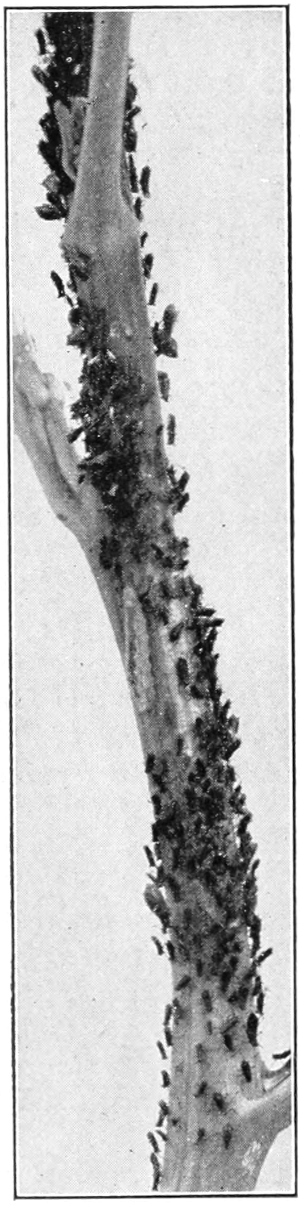
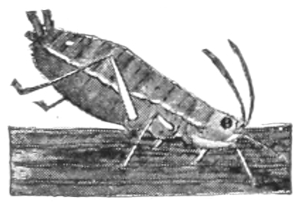
KNOW of no more diverting occupation than watching a colony of aphids through a lens; these insects are the most helpless and amiable little ninnies in the whole insect world; and they look the part, probably because their eyes, so large and wide apart, seem so innocent and wondering. The usual color of aphids is green. As they feed upon leaves, this color protects them from sight; but there are many species which are otherwise colored, and some have most bizarre and striking ornamentations. In looking along an infested leaf stalk, we see them in all stages and positions. One may have thrust its beak to the hilt in a plant stem, and is so satisfied and absorbed in sucking the juice that its hind feet are lifted high in the air and its antennæ curved backward, making altogether a gesture which seems an adequate expression of bliss; another may conclude to seek a new well, and pulls up its sucking tube, folding it back underneath the body so it will be out of the way, and walks off slowly on its six rather stiff legs; when thus moving, it thrusts the antennæ forward, patting its pathway to insure safety. Perhaps this pathway may lead over other aphids which are feeding, but this does not deter the traveler nor turn it aside; over the backs of the obstructionists it crawls, at which the disturbed ones kick the intruder with both hind legs; it is not a vicious kick but a push rather, which says, “This seat reserved, please!” It is comical to see a row of them sucking a plant stem for “dear life,” the heads all in the same direction, and they packed in and around each other as if there were no other plants in the world to give them room, the little ones wedged in between the big ones, until sometimes some of them are obliged to rest their hind legs on the antennæ of the neighbors next behind.
Perfect bliss!
Aphids on plant.
Photo by Slingerland.
Aphids are born for food for other creatures—they are simply little machines for making sap into honey-dew, which they produce from the alimentary canal for the delectation of ants; they are, in fact, merely little animated drops of sap on legs. How helpless they are when attacked by any one of their many enemies! All they do, when they are seized, is to claw the air with their six impotent legs and two antennæ, keeping up this performance as long as there is left a leg, and apparently to the very last, never realizing “what is doing.” But they are not without means of defence; those two little tubes at the end of the body are not for ornament nor for producing honey-dew for the ants, but for secreting at their tips a globule of waxy substance meant to smear the eyes of the attacking insect. I once saw an aphid perform this act, when confronted by a baby spider; a drop of yellow liquid oozed out of one tube, and the aphid almost stood on its head in order to thrust this offensive globule directly into the face of the spider—the whole performance reminding me of a boy who shakes his clenched fist in his opponent’s face and says, “Smell of that!” The spider beat a hasty retreat.
A German scientist, Mr. Busgen, discovered that a plant-louse smeared the eyes and jaws of its enemy, the aphis-lion, with this wax which dried as soon as applied. In action it was something like throwing a basin of paste at the head of the attacking party; the aphis-lion thus treated, was obliged to stop and clean itself before it could go on with its hunt, and the aphid walked off in safety. The aphids surely need this protection because they have two fierce enemies, the larvæ of the aphis-lions and of the ladybirds. They are also the victims of parasitic insects; a tiny four-winged “fly” lays an egg within an aphid; the larva hatching from it feeds upon the inner portions of the aphid, causing it to swell as if afflicted with dropsy. Later the aphid dies, and the interloper with malicious impertinence cuts a neat circular door in the poor aphid’s skeleton skin and issues from it a full fledged insect.
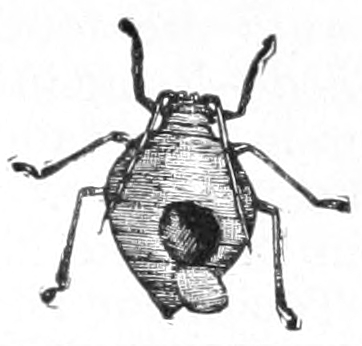
A parasitized aphid enlarged, showing the door cut by the parasite.
The aphids are not without their resources to meet the exigencies of their lives in colonies. There are several distinct forms in each species, and they seem to be needed for the general good. During the summer, we find most of the aphids on plants are without wings; these are females which give birth to living young and do not lay eggs. They do this until the plant is overstocked and the food supply seems to be giving out, then another form is produced which has four wings. These fly away to some other plant and start a colony there; but at the approach of cold weather, or if the food plants give out, there are male and female individuals developed, the females being always wingless, and it is their office to lay the eggs which shall last during the long winter months, when the living aphids must die for lack of food plants. The next spring each winter-egg hatches into a female which we call the “stem mother” since she with her descendants will populate the entire plant.
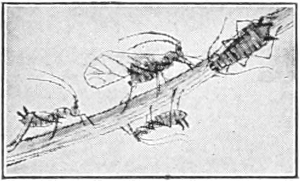
Winged and wingless forms of plant-lice.
Plant-lice vary in their habits. Some live in the ground on the roots of plants and are very destructive; but the greater number of species live on the foliage of plants and are very fond of the young, tender leaves and thus do great damage. Some aphids have their bodies covered with white powder or with tiny fringes, which give them the appearance of being covered with cotton.
The aphids injuring our flowers and plants may be killed by spraying them with soapsuds made in the proportion of one-quarter pound of ivory soap to one gallon of water. The spraying must be done very thoroughly so as to reach all the aphids hidden on the stems and beneath the leaves. It should be repeated every three days until the aphids are destroyed.
LESSON LXXXVII
The Aphids, or Plant-lice
Leading thought—Aphids have the mouth in the form of a sucking tube which is thrust into the stems and leaves of plants; through it the plant juices are drawn for nourishment. Aphids are the source of honey-dew of which ants are fond.
Method—Bring into the schoolroom a plant infested with aphids, place the stem in water and let the pupils examine the insects through the lens.
Observations—1. How are the aphids settled on the leaf? Are their heads in the same direction? What are they doing?
2. Touch one and make it move along. What does it do in order to leave its place? What does it do with its sucking tube as it walks off? On what part of the plant was it feeding? Why does not Paris green when applied to the leaves of plants kill aphids?
3. Describe an aphid, including its eyes, antennæ, legs and tubes upon the back. Does its color protect it from observation?
4. Can you see cast skins of aphids on the plant? Why does an aphid have to shed its skin?
5. Are all the aphids on a plant wingless? When a plant becomes dry are there, after several days, more winged aphids? Why do the aphids need wings?
6. Do you know what honey-dew is? Have you ever seen it upon the leaf? How is honey-dew made by the aphids? Does it come from the tubes on their back? What insects feed upon this honey-dew?
7. What enemies have the aphids?
8. What damage do aphids do to plants? How can you clean plants of plant-lice?
I saw it (an ant), at first, pass, without stopping, some aphids which it did not however disturb. It shortly after stationed itself near one of the smallest, and appeared to caress it, by touching the extremity of its body, alternately with its antennæ, with an extremely rapid movement. I saw, with much surprise, the fluid proceed from the body of the aphid, and the ant take it in its mouth. Its antennæ were afterwards directed to a much larger aphid than the first, which, on being caressed after the same manner, discharged the nourishing fluid in greater quantity, which the ant immediately swallowed: it then passed to a third which it caressed, like the preceding, by giving it several gentle blows, with the antennæ, on the posterior extremity of the body; and the liquid was ejected at the same moment, and the ant lapped it up. Pierre Huber, 1810.
THE ANT-LION
Teacher’s Story
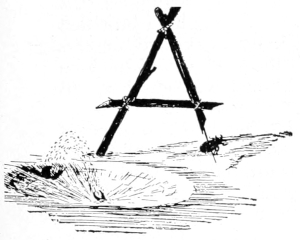
CHILD is thrilled with fairy stories of ogres in their dens, with the bones of their victims strewn around. The ants have real ogres, but luckily, they do not know about it and so cannot suffer from agonizing fears. The ant ogres seem to have depended upon the fact that the ant is so absorbed in her work that she carries her booty up hill and down dale with small regard for the topography of the country. Thus they build their pits, with instinctive faith that they will some day be entered by these creatures, obsessed by industry and careless of what lies in the path. The pits vary with the size of the ogre at the bottom; there are as many sized pits as are beds in the story of Golden Locks and the bears; often the pits are not more than an inch across, or even less, while others are two inches in diameter. They are always made in sandy or crumbly soil and in a place protected from wind and rain; they vary in depth in proportion to their width, for the slope is always as steep as the soil will stand without slipping.
All that can be seen of the ogre at the bottom, is a pair of long, curved jaws, looking innocent enough at the very center of the pit. If we dig the creature out, we find it a comical looking insect. It is humpbacked, with a big, spindle-shaped abdomen; from its great awkward body projects a flat, sneaking looking head, armed in front with the sickle jaws which are spiny and bristly near the base, and smooth, sharp and curved at the tip. The strange thing about these jaws is that they lead directly to the throat, since the ant-lion has no mouth. Each jaw is made up of two pieces which are grooved where they join and thus form a tube with a hole in the tip through which the industrious blood of the ants can be sucked; not only do the sharp sickle points hold the victim, but there are three teeth along the side of each jaw to help with this. The two front pairs of legs are small and spiny; the hind legs are strong and peculiarly twisted, and have a sharp spikelike claw at the end, which is so arranged as to push the insect backward vigorously if occasion requires; in fact, the ant-lion in walking about, moves more naturally backward than forward because of the peculiar structure of his legs.
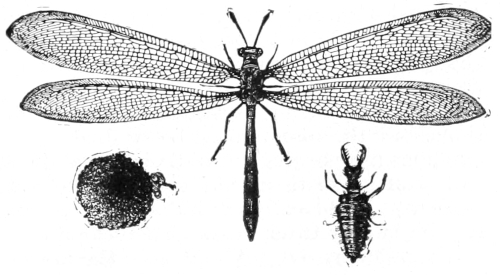
Ant-lion with its cocoon and larva.
Comstock’s Manual.
Having studied the ogre, we can see better how he manages to trap his victim. As the ant goes scurrying along, she rushes over the edge of the pit and at once begins to slide downward; she is frightened and struggles to get back; just then a jet of sand, aimed well from the bottom of the pit, hits her and knocks her back. She still struggles, and there follows a fusillade of sand jets, each hitting her from above and knocking her down to the fatal center where the sickle jaws await her and are promptly thrust into her; if she is large and still struggles, the big, unwieldy body of the ogre, buried in the sand, anchors him fast and his peculiar, crooked hind legs push his body backward in this strange tug of war; thus, the ant-ogre is not dragged out of his den by the struggles of the ant, and soon the loss of blood weakens her and she shrivels up.
The secret of the jets of sand, lies in the flat head of the ogre; if we look at it regarding it as a shovel, we can see that it is well fitted for its purpose; for it is a shovel with a strong mechanism working it. In fact, the whole pit is dug with this shovel head. Wonderful stories are told about the way that ant-lions dig their pits, marking out the outer margin in a circle, and working inward. However, our common ant-lion of the East simply digs down into the sand and flips the sand out until it makes a pit. If an ant-lion can be caught and put in a jar of sand it will soon make its pit, and the process may be noted carefully.
There is one quality in the ogre which merits praise, and that is his patience. There he lies in his hole for days or perhaps weeks, with nothing to eat and no ant coming that way; so when we see an absent-minded ant scrambling over into the pit, let us think of the empty stomach of this patient little engineer which has constructed his pit with such accuracy and so much labor. So precarious is the living picked up by the ant-lions, that it may require one, two or three years to bring one to maturity. At that time it makes a perfectly globular cocoon of silk and sand, the size of a large pea, and within it, changes to a pupa; and when finally ready to emerge, the pupa pushes itself part way out of the cocoon and the skin is shed and left at the cocoon door. The adult resembles a small dragon-fly; it has large net-veined wings and is a most graceful insect, as different as can be from the humpbacked ogre which it once was—a transformation quite as marvelous as that which occurred in Beauty and the Beast. Throughout the Middle West, the ant-lion in its pit is called the “doodle-bug.”
Reference—Manual for Study of Insects, Comstock.
LESSON LXXXVIII
The Ant-Lion
Leading thought—The ant-lion, or “doodle-bug” makes a little pit in the sand with very steep sides, and hidden at the bottom of it, waits for ants to tumble in to be seized by its waiting jaws. Later the ant-lion changes to a beautiful insect with gauzy wings, resembling a small dragon-fly.
Method—The pupils should see the ant-lion pits in their natural situations, but the insects may be studied in the schoolroom. Some of the ant-lions may be dug out of their pits and placed in a dish of sand. They will soon make their pits, and may be watched during this interesting process. It is hardly advisable to try to rear these insects, as they may require two or three years for development.
Observations—1. Where were the ant-lion pits out of doors? Were they in a windy place? Were they in a place protected from storms? In what kind of soil were they made?
2. Measure one of the pits. How broad across, and how deep? Are all the pits of the same size? Why?
3. What can you see as you look down into the ant-lion’s pit? Roll a tiny pebble in and see what happens? Watch until an ant comes hurrying along and slips into the pit. What happens then? As she struggles to get out how is she knocked back in? What happens to her if she falls to the bottom?
4. Take a trowel and dig out the doodle-bug. What is the shape of its body? What part of the insect did you see at the bottom of the pit? Do you know that these great sickle-shaped jaws are hollow tubes for sucking blood? Does the ant-lion eat anything except the blood of its victim?
5. Can you see that the ant-lion moves backward more easily than forward? How are its hind legs formed to help push it backward? How does this help the ant-lion in holding its prey? How does the big awkward body of the ant-lion help to hold it in place at the bottom of the pit when it seizes an ant in its jaws?
6. What shape is the ant-lion’s head? How does it use this head in taking its prey? In digging its pit?
7. Take a doodle-bug to the schoolroom, place it in a dish of sand, covered with glass, and watch it build its pit.
8. Read in the entomological books about the cocoon of the ant-lion and what the adult looks like, and then write an ant-lion autobiography.
Supplementary reading—Insect Stories, Kellogg, “The True Story of Morrowbie Jukes.”
THE MOTHER LACE-WING AND THE APHIS-LION
Teacher’s Story
LITTING leisurely through the air on her green gauze wings, the lace-wing seems like a filmy leaf, broken loose and drifting on the breeze. But there is purpose in her flight, and through some instinct she is enabled to seek out an aphis-ridden plant or tree, to which she comes as a friend in need. As she alights upon a leaf, she is scarcely discernible because of the pale green of her delicate body and wings; however, her great globular eyes that shine like gold attract the attention of the careful observer. But though she is so fairy-like in appearance, if you pick her up, you will be sorry if your sense of smell is keen, for she exhales a most disagreeable odor when disturbed—a habit which probably protects her from birds or other creatures which might otherwise eat her.
However, if we watch her we shall see that she is a canny creature despite her frivolous appearance; her actions are surely peculiar. A drop of sticky fluid issues from the tip of her body, and she presses it down on the surface of the leaf; then lifting up her slender abdomen like a distaff, she spins the drop into a thread a half inch long or more, which the air soon dries; and this silken thread is stiff enough to sustain an oblong egg, as large as the point of a pin, which she lays at the very tip of it. This done she lays another egg in a like manner, and when she is through, the leaf looks as if it were covered with spore cases of a glittering white mold. This done she flies off and disports herself in the sunshine, care free, knowing that she has done all she can for her family.
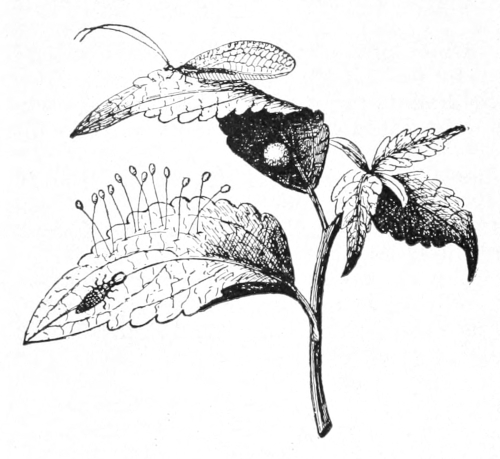
Aphis-lion, eggs, larva, cocoon and the adult, lace wing.
Comstock’s Manual.
After a few days the eggs begin to look dark, and then if we examine them with a lens, we may detect that they contain little doubled-up creatures. The first we see of the egg inmate as it hatches, is a pair of jaws thrust through the shell, opening it for a peep-hole; a little later the owner of the jaws, after resting a while with an eye on the world which he is so soon to enter, pushes out his head and legs and drags out a tiny, long body, very callow-looking and clothed in long, soft hairs. At first the little creature crawls about his egg-shell, clinging tightly with all his six claws, as if fearful of such a dizzy height above his green floor; then he squirms around a little and thrusts out a head inquiringly while still hanging on “for dear life.” Finally he gains courage and prospects around until he discovers his egg stalk, and then begins a rope climbing performance, rather difficult for a little chap not more than ten minutes old. He takes a careful hold with his front claws, the two other pairs of legs carefully balancing for a second, and then desperately seizing the stalk with all his clasping claws, and with many new grips and panics, he finally achieves the bottom in safety. As if dazed by his good luck, he stands still for a time, trying to make up his mind what has happened and what to do next; he settles the matter by trotting off to make his first breakfast of aphids; and now we can see that it is a lucky thing for his brothers and sisters, still unhatched, that they are high above his head and out of reach, for he might not be discriminating in the matter of his breakfast food, never having met any of his family before. He is a queer looking little insect, spindle-shaped and with peculiarly long, sickle-shaped jaws projecting from his head. Each of these jaws is made up of two pieces joined lengthwise so as to make a hollow tube, which has an opening at the tip of the jaw, and another one at the base which leads directly to the little lion’s throat. Watch him as he catches an aphid; seizing the stupid little bag of sap in his great pincers, he lifts it high in the air, as if drinking a bumper, and sucks its green blood until it shrivels up, kicking a remonstrating leg to the last. It is my conviction that aphids never realize when they are being eaten; they simply dimly wonder what is happening.
It takes a great many aphids to keep an aphis-lion nourished until he gets his growth; he grows like any other insect by shedding his skeleton skin when it becomes too tight. Finally he doubles up and spins around himself a cocoon of glistening white silk, leaving it fastened to the leaf; when it is finished, it looks like a seed pearl, round and polished. I wish some child would watch an aphis-lion weave its cocoon and tell us how it is done! After a time, a week or two perhaps, a round little hole is cut in the cocoon, and there issues from it a lively little green pupa, with wing pads on its back; but he very soon sheds his pupa skin and issues as a beautiful lace-wing fly with golden eyes and large, filmy, iridescent, pale green wings.
LESSON LXXXIX
The Mother Lace-wing and the Aphis-lion
Leading thought—The lace-wing fly or golden-eyes, as she is called, is the mother of the aphis-lion. She lays her eggs on the top of stiff, silken stalks. The young aphis-lions when hatched, clamber down upon the leaf and feed upon plant-lice, sucking their blood through their tubular jaws.
Method—Through July and until frost, the aphis-lions may be found on almost any plant infested with plant-lice; and the lace-wing’s eggs or egg-shells on the long stalks are also readily found. All these may be brought to the schoolroom. Place the stem of a plant infested with aphids in a jar of water, and the acts of the aphis-lions as well as the habits of the aphids may be observed during recess or at other convenient times, by all the pupils.
Observations—1. When you see a leaf with some white mold upon it, examine it with a lens; the mold is likely to be the eggs of the lace-wing. Is the egg as large as a pin head? What is its shape? What is its color? How long is the stalk on which it is placed? Of what material do you think the stalk is made? Why do you suppose the lace-wing mother lays her eggs on the tips of stalks? Are there any of these eggs near each other on the leaf?
2. If the egg is not empty, observe through a lens how the young aphis-lion breaks its egg-shell and climbs down.
3. Watch an aphis-lion among the plant-lice. How does it act? Do the aphids seem afraid? Does the aphis-lion move rapidly? How does it act when eating an aphid?
4. What is the general shape of the aphis-lion? Describe the jaws. Do you think these jaws are used for chewing, or merely as tubes through which the green blood of the aphids is sucked? Do the aphis-lions ever attack each other or other insects? How does the aphis-lion differ in appearance from the ladybird larva?
5. What happens to the aphis-lion after it gets its growth? Describe its cocoon if you can find one.
6. Describe the little lace-wing fly that comes from the cocoon. Why is she called, golden-eyes? Why lace-wing? Does she fly rapidly? Do you suppose that if she should lay her eggs flat on a leaf, that the first aphis-lion that hatched would run about and eat all its little brothers and sisters which were still in their egg-shells? How do the aphis-lions benefit our rose bushes and other cultivated plants?
Supplementary Reading—“A Tactful Mother” in Ways of the Six-Footed.
THE MOSQUITO
Teacher’s Story
N DEFIANCE of the adage, the mother of our most common mosquitoes does not hesitate to put her eggs all in one basket, but perhaps she knows it is about the safest little basket for eggs in this world of uncertainties. If it were possible to begin this lesson with the little boat-shaped egg baskets, I should advise it. They may be found in almost any rain barrel, and the eggs look like a lot of tiny cartridges set side by side, points up, and lashed or glued together, so there shall be no spilling. Like a certain famous soap, they “float,” coming up as dry as varnished corks when water is poured upon them.
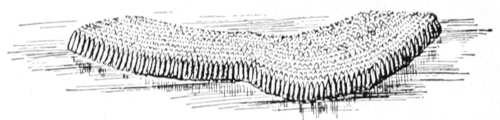
The egg-raft of a mosquito enlarged.
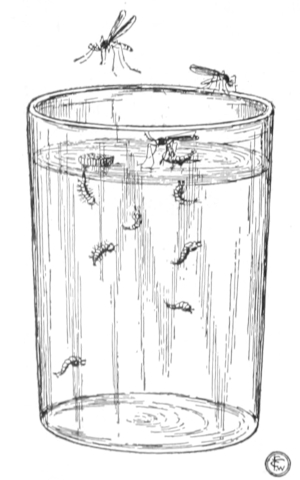
A mosquito aquarium.
The young mosquito, or wriggler, breaks through the shell of the lower end of the egg and passes down into the water, and from the first, it is a most interesting creature to view through a hand lens. The head and the thorax are rather large while the body is tapering and armed with bunches of hairs. At the rear of the body are two tubes very different in shape; one is long, straight and unadorned; this is the breathing tube through which air passes to the tracheæ of the body. This tube has a star-shaped valve at the tip, which can be opened and shut; when it is opened at the surface of the water, it keeps the little creature afloat and meanwhile allows air to pass into the body. When the wriggler is thus hanging at an angle of 45 degrees to the surface of the water, it feeds upon small particles of decaying vegetation; it has a remarkable pair of jaws which are armed with brushes, which in our common species, by moving rapidly, set up currents and bring the food to the mouth. This process can be seen plainly with a lens. When disturbed, the wriggler shuts the valve to its breathing tube, and sinks. However, it is not much heavier than the water; I have often seen one rise for some distance without apparent effort. The other tube at the end of the body, supports the swimming organs, which consist of four finger-like processes and various bunches of hairs. When swimming, the wriggler goes tail first, the swimming organs seeming to take hold of the water and to pull the creature backward, in a series of spasmodic jerks; in fact, the insect seems simply to “throw somersaults,” like an acrobat. I have often observed wrigglers standing on their heads in the bottom of the aquarium, with their jaws bent under, revolving their brushes briskly; but they never remain very long below the surface, as it is necessary for them to take in fresh air often.
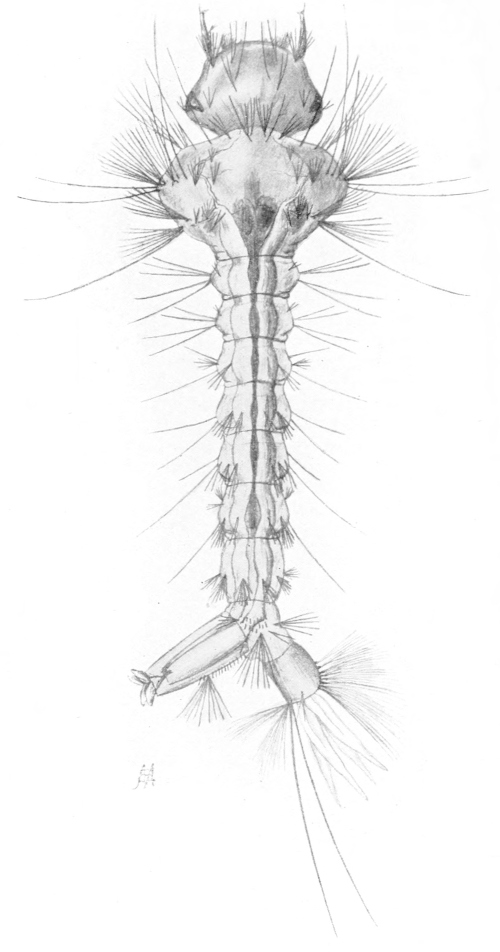
A wriggler or larva of mosquito (culex) greatly enlarged.
Drawn by Evelyn Mitchell.
The pupa has the head and thoracic segments much enlarged, making it all “head and shoulders” with a quite insignificant body attached. Upon the thorax are two breathing tubes, which look like two ears, and therefore when the pupa rests at the surface of the water, it remains head up so that these tubes may take in the air; at the end of the body are two swimming organs which are little, leaf-like projections. At this stage the insect is getting ready to live its life in the air, and for this reason probably, the pupa rests for long periods at the surface of the water and does not swim about much, unless disturbed. However, it is a very strange habit for a pupa to move about at all. In the case of other flies, butterflies, and moths, the pupa stage is quiet.
When fully mature, the pupa rises to the surface of the water, the skeleton skin breaks open down its back and the mosquito carefully works itself out, until its wings are free and dry, meanwhile resting upon the floating pupa skin. This is indeed a frail bark, and if the slightest breeze ruffles the water, the insect is likely to drown before its wings are hard enough for flight.
The reason that kerosene oil, put upon the surface of the water where mosquitoes breed, kills the insects is because both the larvæ and pupæ of mosquitoes are obliged to rise to the surface, and push their breathing tubes through the surface film so that they will open to the air; a coating of oil on the water prevents this, and they are suffocated. Also when the mosquito emerges from the pupa skin, if it is even touched by the oil, it is unable to fly and soon dies.
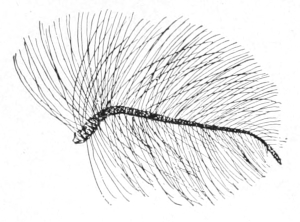
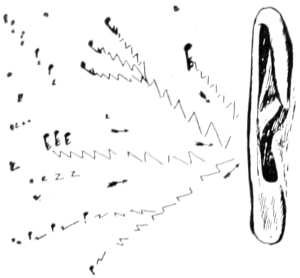
Antenna of male mosquito enlarged.
The male mosquitoes have bushy, or feathery, antennæ. These antennæ are hearing organs of very remarkable construction; (see Ways of the Six-Footed, p. 8.) The Anopheles may be distinguished from the Culex by the following characteristics: Its wings are spotted instead of plain. When at rest it is perfectly straight, and is likely to have the hind legs in the air. It may also rest at an angle to the surface to which it clings. The Culex is not spotted on the wings and is likely to be humped up when at rest. In our climate the Anopheles is more dangerous than the Culex because it carries the germs of malaria. A mosquito’s wing under a microscope is a most beautiful object, as it is “trimmed” with ornamental scales about the edges and along the veins. The male mosquitoes neither sing nor bite; the song of the female mosquito is supposed to be made by the rapid vibration of the wings, and her musical performances are for the purpose of attracting her mate, as it has been shown that he can hear through his antennæ a range of notes covering the middle and next higher octaves of the piano.
Of late we are learning that the mosquitoes are in a very strange way a menace to health. Through a heroism, as great as ever shown on field of battle, men have imperiled their lives to prove that the germs of the terrible yellow fever were transmitted by the biting mosquito, and with almost equal bravery other men have demonstrated that the germs of malaria are also thus carried.
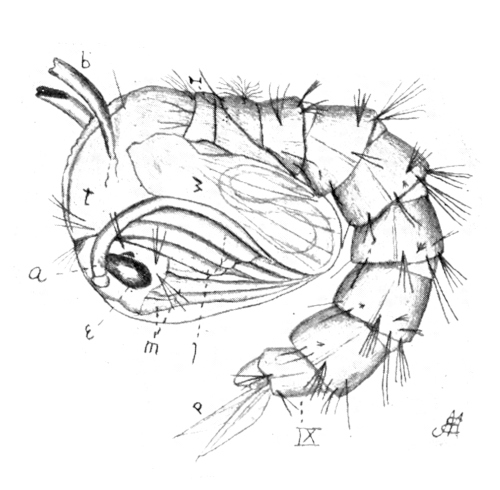
The pupa of a mosquito, greatly magnified. Note b the breathing tubes near the head.
Drawn by Evelyn Mitchell.
In the North, our greatest danger is from the mosquitoes which carry the malarial germs, and these are the mosquitoes with spotted wings and belong to the genus Anopheles. This mosquito, in order to be of danger to us must first feed upon the blood of some person suffering from malaria (ague) and thus take the germ of the disease into its stomach. Here the germ develops and multiplies into many minute germs, which pass through another stage and finally get into the blood of the mosquito and accumulate in the salivary glands. The reason any mosquito bite or insect bite swells and itches is because, as the insect’s beak is inserted into the flesh, it carries with it some of the saliva from the insect’s mouth. In the case of Anopheles these malarial germs are carried with the saliva into the blood of the victim. It has been proven that in the most malarial countries, like Italy and India, people are entirely free from malaria if they are not bitten by mosquitoes.
After this explanation has been made, it would be well for the teacher to take the pupils on a tour of inspection through the neighborhood to see if there are any mosquito larvæ in rain barrels, ponds or pools of stagnant water. If such places are found, let the pupils themselves apply the following remedies:
1. Rain barrels should be securely covered.
2. All stagnant pools should be drained and filled up if possible.
3. Wherever there are ponds or pools where mosquitoes breed that cannot be filled or drained, the surface of the water should be covered with a spray of kerosene oil. This may be applied with a spray pump or from a watering can.
4. If it is impracticable to cover such places with oil, introduce into such pools the following fish: Minnows, sticklebacks, sunfish and goldfish.
The effect of this lesson upon the children should be to impress them with the danger to life and health from mosquitoes and to implant in them a determination to rid the premises about their homes of these pests.
References—Farmers’ Bulletin No. 155, U. S. Department of Agriculture, by L. O. Howard; leaflet in Reading Course for Farmers’ Wives, series 2, No. 10, by M. V. Slingerland; American Insects, Kellogg; The Insect Book, Howard; Insect Life, The Manual for the Study of Insects, Comstock; Ways of the Six-Footed, Comstock.
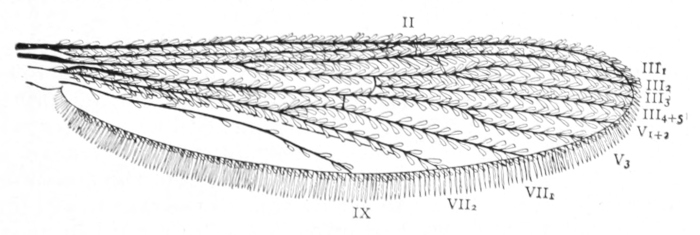
Wing of mosquito enlarged.
Comstock’s Manual.
LESSON XC
The Mosquito
Leading thought—The wrigglers, or wigglers, which we find in rain-barrels and stagnant water are the larvæ of mosquitoes. We should study their life history carefully if we would know how to get rid of mosquitoes.
Method—There is no better way to interest the pupils in mosquitoes than to place in an aquarium jar in the schoolroom a family of wrigglers from some pond or rain barrel. For the pupils’ personal observation, take some of the wrigglers from the aquarium with a pipette and place them in a homeopathic vial; fill the vial three-fourths full of water and cork it. Pass it around with a hand lens and give each pupil the opportunity to observe it for five or ten minutes. It would be well if this vial could be left on each desk for an hour or so during study periods, so that the observations may be made casually and leisurely. While the pupils are studying the wrigglers, the following questions should be placed upon the blackboard, and each pupil should make notes which may finally be given at a lesson period. This is particularly available work for September.
In studying the adult mosquito, a lens or microscope is necessary. But it is of great importance that the pupils be taught to discriminate between the comparatively harmless species of Culex and the dangerous Anopheles and therefore they should be taught to be observant of the way mosquitoes rest upon the walls, and whether they have mottled or clear wings.
The Larva
Observations: 1. Note if all the wrigglers are of the same general shape, or if some of them have a very large head; these latter are the pupæ and the former are the larvæ. We will study the larvæ first. Where do they rest when undisturbed? Do they rest head up or down? Is there any part of their body that comes to the surface of the water?
2. When disturbed what do they do? When they swim, do they go head or tail first? When they float do they go upward or downward?
3. Observe one resting at the top. At what angle does it hold itself to the surface of the water? Observe its head. Can you see the jaw brushes revolving rapidly? What is the purpose of this? Describe its eyes. Can you see its antennæ?
4. Note the two peculiar tubes at the end of the body and see if you can make out their use.
5. Note especially the tube that is thrust up to the surface of the water when the creatures are resting. Can you see how the opening of this tube helps to keep the wriggler afloat? What do you think is the purpose of this tube? Why does it not become filled with water when the wriggler is swimming? Can you see the two air vessels, or trachæ, extending from this tube along the back the whole length of the body?
6. Note the peculiarities of the other tube at the rear end of the body. Do you think the little finger-like projections are an aid in swimming? How many are there?
7. Can you see the long hairs along the side of the body?
8. Does the mosquito rest at the bottom of the bottle or aquarium?
The Pupa
9. What is the most noticeable difference in appearance between the larva and pupa?
10. When the pupa rests at the surface of the water, is it the same end up as the wriggler?
11. Note on the “head” of the pupa two little tubes extending up like ears. These are the breathing tubes. Note if these open to the air when the pupa rests at the surface of the water.
12. Can you see the swimming organs at the rear of the body of the pupa? Does the pupa spend a longer time resting at the surface than the larva? How does it act differently from the pupæ of other flies and moths and butterflies?
13. How does the mosquito emerge from the pupa skin? Why does kerosene oil poured on the surface of the water kill mosquitoes?
The Adult Mosquito
1. Has the mosquito feathery antennæ extending out in front? If so, what kind of mosquitoes are such?
2. Do the mosquitoes with bushy antennæ bite? Do they sing?
3. Are the wings of the mosquito spotted or plain? How many has it?
4. When at rest, is it shortened and humpbacked or does it stand straight out with perhaps its hind legs in the air?
5. What are the characteristics by which you can tell the dangerous Anopheles?
6. Why is the Anopheles more dangerous than the Culex?
7. Examine a mosquito’s wing under a microscope and describe it.
8. Examine the antennæ of a male and a female mosquito under a microscope, and describe the difference.
9. Which sex of the mosquito does the biting and the singing?
10. How is the singing done?
THE HOUSE-FLY
Teacher’s Story
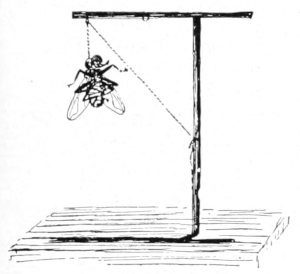
HE house-fly is surely an up-to-date member of that select class which evolutionists call the “fit.” It flourishes in every land, plumping itself down in front of us at table, whether we be eating rice in Hong Kong, dhura in Egypt, macaroni in Italy, pie in America, or tamales in Mexico. There it sits, impertinent and imperturbable, taking its toll, letting down its long elephant-trunk tongue, rasping and sucking up such of our meal as fits its needs. As long as we simply knew it as a thief we, during untold ages, merely slapped it and shooed it, which effort on our part apparently gave it exhilarating exercise. But during recent years we have begun trapping and poisoning, trying to match our brains against its agility; although we slay it by thousands, we seem only to make more room for its well-fed progeny of the future, and in the end we seem to have gained nothing. But the most recent discoveries of science have revealed to us, that what the house-fly takes of our food, is of little consequence to what it leaves behind. Because of this, we have girded up our loins and gone into battle in earnest.
I have always held that nature-study should follow its own peaceful path and not be the slave of economic science. But occasionally it seems necessary, when it is a question of creating public sentiment, and of cultivating public intelligence in combating a great peril, to make nature-study a handmaiden, if not a slave, in this work. If our woods were filled with wolves and bears, as they were in the days of my grandfather, I should give nature-study lessons on these animals, which would lead to their subjugation. Bears and wolves trouble us no more; but now we have enemies far more subtle, in the ever-present microbes, which we may never hope to conquer but which, with proper precautions, we may render comparatively harmless. Thus, our nature-study with insects which carry disease, like the mosquitoes, flies and fleas, must be a reconnaissance for a war of extermination; the fighting tactics may be given in lessons on health and hygiene.
Perhaps if a fly were less wonderfully made, it would be a less convenient vehicle for microbes. Its eyes are two great, brown spheres on either side of the head, and are composed of thousands of tiny six-sided eyes that give information of what is coming in any direction; in addition, it has on top of the head, looking straight up, three tiny, shining, simple eyes, which cannot be seen without a lens. Its antennæ are peculiar in shape, but are evidently sense organs; it is attracted from afar by certain odors, and so far as we can discover, its antennæ are all the nose it has. Its mouth-parts are all combined to make a most amazing and efficient organ for getting food; at the tip are two flaps, which can rasp a substance so as to set free the juices, and above this is a tube, through which the juices may be drawn to the stomach. This tube is extensible, being conveniently jointed so that it can be folded under the “chin” when not in use. This is usually called the fly’s tongue, but it is really all the mouth parts combined, as if a boy had his lips, teeth and tongue, standing out from his face, at the end of a tube a foot long.
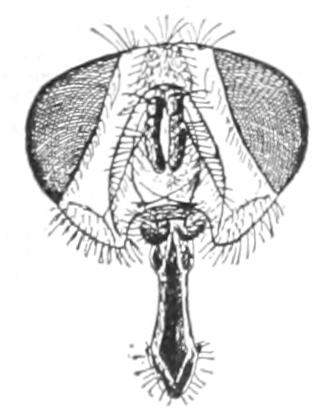
Head of fly showing eyes, antennæ and mouth-parts.
The thorax can be easily studied; it is striped black and white above and bears the two wings, and the two little flaps that are called balancers and which are probably remnants of hind wings which the remote ancestors of flies flew with. The fly’s wing is a transparent but strong membrane strengthened by veins, and is prettily iridescent. The thorax bears on its lower side the six pairs of legs. The abdomen consists of five segments and is covered with stiff hairs. The parts of the leg, seen when the fly is walking, consists of three segments, the last segment or tarsus being more slender, and if looked at with a lens, is seen to be composed of five segments, the last of which bears the claws; it is with these claws that the fly walks, although all of the five segments really form the foot; in other words, it walks on its tip-toes. But it clings to ceilings by means of the two little pads below the claws, which are covered with hairs that excrete at the tips, a sticky fluid. Because of the hairs on its feet, the fly becomes a carrier of microbes and a menace to health.
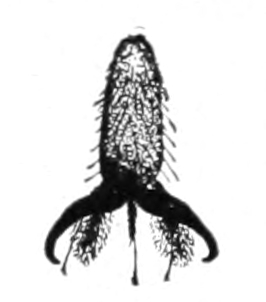
Foot of house-fly enlarged.
The greatest grudge I have against this little, persistent companion of our household is the way it has misled us by appearing to be so fastidious in its personal habits. We have all of us seen, with curiosity and admiration, its complex ablutions and brushings. It usually begins, logically, with its front feet, the hands; these it cleans by rubbing them against each other lengthwise. The hairs and spines on one leg act as a brush for the other, and then lest they be not clean, it nibbles them with its rasping disc, which is all the teeth it has. It then cleans its head with these clean hands, rubbing them over its big eyes with a vigor that makes us wink simply to contemplate; then bobbing its head down so as to reach what is literally its back hair, it brushes valiantly. After this is done, it reaches forward first one and then the other foot of the middle pair of legs, and taking each in turn between the front feet, brushes it vigorously, and maybe nibbles it. But as a pair of military brushes, its hind feet are conspicuously efficient; they clean each other by being rubbed together and then they work simultaneously on each side in cleaning the wings, first the under side and then the upper side. Then over they come and comb the top of the thorax; then they brush the sides, top and under sides of the abdomen, cleaning each other between the acts. Who, after witnessing all this, could believe that the fly could leave any tracks on our food, which would lead to our undoing! But the house-fly, like many housekeepers with the best intentions in the matter of keeping clean, has not mastered the art of getting rid of the microbes. Although it has so many little eyes, none of them can magnify a germ so as to make it visible; and thus it is that, when feeding around where there have been cases of typhoid and other enteric diseases, the house-fly’s little claws become infested with disease germs; and when it stops some day to clean up on our table, it leaves the germs with us. Thus our only safety lies in the final extermination of this little nuisance.
It is astonishing how few people know about the growth of flies. People of the highest intelligence in other matters, think that a small fly can grow into a large one. A fly, when it comes from the pupa stage, is as large as it will ever be, the young stages of flies being maggots. The house-fly’s eggs are little, white, elongated bodies about as large as the point of a pin. These are laid preferably in horse manure. After a few hours, they hatch into slender, pointed, white maggots which feed upon the excrement. After five or six days, the larval skin thickens, turns brown, making the insect look like a small grain of wheat. This is the pupal stage, which lasts about five days, and then the skin bursts open and the full-grown fly appears. Of course, not all the flies multiply according to the example given to the children. The house-fly has many enemies and, therefore, probably no one hibernating mother fly is the ancestress of billions by September; however, despite enemies, flies multiply with great rapidity.
I know of no more convincing experiment as an example of the dangerous trail of the fly, than that of letting a house-fly walk over a saucer of nutrient gelatin. After three or four days, each track is plainly visible as a little white growth of bacteria.
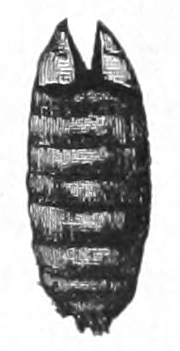
Empty pupa skin of fly, enlarged.
Much is being done now to eradicate the house-fly, and undoubtedly there will be new methods of fighting it devised every year. The teacher should keep in touch with the bulletins on this subject published by the United States Department of Agriculture, and should give the pupils instructions according to the latest ideas. At present the following are the methods of fighting this pest: Keep the stable clean and place the manure under cover. All of the windows of the house should be well screened. All the flies which get into the house should be killed by using the commercial fly papers.
LESSON XCI
The House-fly
Leading thought—The house-fly has conquered the world and is found everywhere. It breeds in filth and especially in horse manure. It is very prolific; the few flies that manage to pass the winter in this northern climate, are ancestors of the millions which attack us and our food later in the season. These are a menace to health because they carry germs of disease from sputa and excrementitious matter to our tables, leaving them upon our food.
Method—Give out the questions for observation and let the pupils answer them either orally or in their note-books. If possible, every pupil should look at a house-fly through a three-quarters objective. If this is not possible, pictures should be shown to demonstrate its appearance.
Observations—1. Look at a fly, using a lens if you have one. Describe its eyes. Do you see that they have a honeycomb arrangement of little eyes? Can you see, on top of the head between the big eyes, a dot? A microscope reveals this dot to be made of three tiny eyes, huddled together. After seeing a fly’s eyes, do you wonder that you have so much difficulty in hitting it or catching it?
2. Can you see the fly’s antennæ? Do you think that it has a keen sense of smell? Why?
3. How many wings has the fly? How does it differ from the bee in this respect? Can you see two little white objects, one just behind the base of each wing? These are called poisers, or balancers, and all flies have them in some form. What is the color of the wings? Are they transparent? Can you see the veins in them? On what part of the body do the wings grow?
4. Look at the fly from below. How many legs has it? From what part of the body do the legs come? What is that part of the insect’s body called, to which the legs and wings are attached?
5. How does the fly’s abdomen look? What is its color and its covering?
6. Look at the fly’s legs. How many segments can you see in a leg? Can you see that the segment on which the fly walks has several joints? Does it walk on all of these segments or on the one at the tip?
7. When the fly eats, can you see its tongue? Can you feel its tongue when it rasps your hand? Where does it keep its tongue usually?
8. Describe how a fly makes its toilet as follows: How does it clean its front feet? Its head? Its middle feet? Its hind feet? Its wings?
9. Do you know how flies carry disease? Did you ever see them making their toilet on your food at the table? Do you know what diseases are carried by flies? What must you do to prevent flies from bringing disease to your family?
10. Do you think that a small fly ever grows to be a large fly? How do the young of all kinds of flies look? Do you know where the house-fly lays its eggs? On what do the maggots feed? How long before they change to pupæ? How long does it take them to grow from eggs to flies? How do the house-flies in our northern climate pass the winter?
11. Lesson in Arithmetic—It requires perhaps twenty days to span the time from the eggs of one generation of the house-fly to the eggs of the next, and thus there might easily be five generations in one summer. Supposing the fly which wintered behind the window curtain in your home last winter, flew out to the stables about May 1st and laid 120 eggs in the sweepings from the horse stable, all of which hatched and matured. Supposing one-half of these were mother flies and each of them, in turn, laid 120 eggs, and so on for five generations, all eggs laid developing into flies, and one-half of the flies of each generation being mother flies. How many flies would the fly that wintered behind your curtain have produced by September?
12. Pour some gelatin unsweetened, on a clean plate. Let a house-fly walk around on the gelatin as soon as it is cool; cover the plate to keep out the dust and leave it for two or three days. Examine it then and see if you can tell where the fly walked. What did it leave in its tracks?
13. Write an essay on the house-fly, its dangers and how to combat it, basing the essay on Bulletins of the U. S. Department of Agriculture.
THE COLORADO POTATO-BEETLE
Teacher’s Story
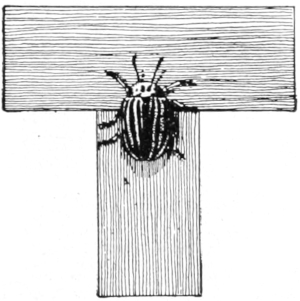
HE potato-beetle is not a very attractive insect, but it has many interesting peculiarities. No other common insect so clearly illustrates the advantage of warning colors. If we take a beetle in the hand, it at first promptly falls upon its back, folds its legs, and antennæ down close to its body, and “plays possum” in a very canny manner. But if we squeeze it a little, immediately an orange-red liquid is ejected on the hand, and a very ill-smelling liquid it is. If we press lightly, only a little of the secretion is thrown off; but if we squeeze harder it flows copiously. Thus a bird trying to swallow one of these beetles, would surely get a large dose. The liquid is very distasteful to birds, and it is indeed a stupid bird that does not soon learn to let severely alone orange and yellow beetles, striped with black. The source of this offensive and defensive juice is at first a mystery, but if we observe closely we can see it issuing along the hind edge of the thorax and the front portion of the wing-covers; the glands in these situations secrete the protective juice as it is needed. The larvæ are also equipped with similar glands and, therefore, have the brazen habit of eating the leaves of our precious potatoes without attempting to hide. They seem to know that they are far safer when seen by birds than when concealed from them.
The life history of the potato-beetle is briefly as follows: Some of the adult beetles or pupæ winter beneath the surface of the soil, burrowing down a foot or more to escape freezing. As soon as the potato plants appear above ground the mother beetle comes out and lays her eggs upon the under sides of the leaves. These orange-yellow eggs are usually laid in clusters. In about a week there hatches from the eggs little yellow or orange humpbacked larvæ, which begin at once to feed upon the leaves. These larvæ grow as do other insects, by shedding their skins. They do this four times, and during the last stages, are very conspicuous insects on the green leaves; they are orange or yellow with black dots along the sides, and so humpbacked are they that they seem to be “gathered with a puckering string” along the lower side. It requires from sixteen days to three weeks for a larva to complete its growth. It then descends into the earth and forms a little cell in which it changes to a pupa. It remains in this condition for one or two weeks, according to the temperature, and then the full-fledged beetle appears. The entire life cycle from egg to adult beetle may be passed in about a month, although if the weather is cold, this period will be longer. The beetles are very prolific, a mother beetle having been known to produce five hundred eggs, and there are two generations each year. These beetles not only damage the potato crop by stopping the growth through destroying the leaves, but they also cause the potatoes to be of inferior quality.
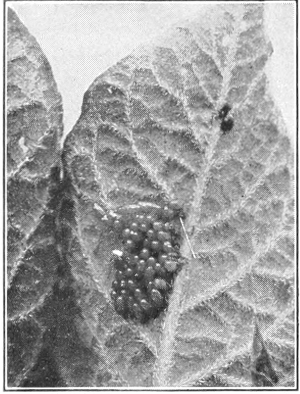
Eggs of Colorado potato-beetle.
Photo by Slingerland.
The adult beetle is an excellent object lesson in the study of beetle form. Attention should be called to the three regions of the body: A head which is bright orange; the compound eyes, which are black; and three simple eyes on the top of the head, which are difficult to see without a lens. The antennæ are short, their joints easily noted, and special attention should be paid to their use, for they are constantly moving to feel approaching objects. The two pairs of mouth palpi may be seen, and the beetle will eagerly eat raw potatoes, so that the pupils may see that it has biting mouth-parts. The thoracic shield is orange, ornamented with black. The three pairs of legs are short, which is a proof that these beetles do not migrate on foot. The claws and the pads beneath can be seen with the naked eye. Each wing-cover bears five yellow stripes, also five black ones, although the outside black stripe is rather narrow. These beetles are very successful flyers. During flight, the wing-covers are raised and held motionless while the gauzy wings beneath are unfolded and do the work. Children are always interested in seeing the way the beetles fold their wings beneath the wing-covers.
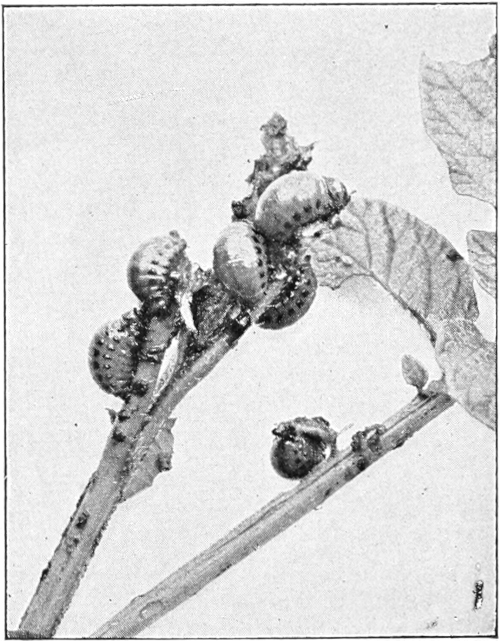
Larvæ of Colorado potato-beetle.
Photo by Slingerland.
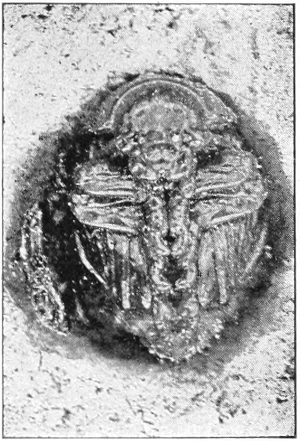
Pupa of potato-beetle, enlarged.
Photo by Slingerland.
One of the most remarkable things about the Colorado potato-beetle is its history. It is one of the few insect pests which is native to America. It formerly fed upon sandbur, a wild plant allied to the potato, which grows in the region of Colorado, Arizona and Mexico, and was a well behaved, harmless insect. With the advance of civilization westward, the potato came also, and proved to be an acceptable plant to this insect; and here we have an example of what an unlimited food supply will do for an insect species. The beetles multiplied so much faster than their parasites, that it seemed at one time as if they would conquer the earth by moving on from potato field to potato field. They started on their march to the Atlantic seaboard in 1859; in 1874, they reached the coast and judging by the numbers washed ashore, they sought to fly or swim across the Atlantic. By 1879, they had spread over an area consisting of more than one-third of the United States.
Reference—The Colorado Potato-Beetle, Chittenden, Bulletin of U. S. Department of Agriculture.
LESSON XCII
The Colorado Potato-beetle
Leading thought—The Colorado potato-beetle is a very important insect, since it affects the price of potatoes each year. It is disagreeable as a food for birds, because of an acrid juice which it secretes. We should learn its life-history and thus be able to deal with it intelligently in preventing its ravages.
Method—The study of the potato-beetle naturally follows and belongs to gardening. The larvæ should be brought into the schoolroom and placed in a breeding cage on leaves of the potato vine. Other plants may be put into the cage to prove that these insects will only eat the potato. The children should observe how the larvæ eat and how many leaves a full grown larva will destroy in a day. Earth should be put in the bottom of the breeding cage so that the children may see the larvæ descend and burrow into it. The adult beetles should be studied carefully, and especially, the children should see the excretion of the acrid juice.
Observations—1. At what time do you see the potato-beetles? Why are they more numerous in the fall than in the spring? Where do those which we find in the spring come from? What will they do if they are allowed to live?
2. What is the shape of the potato-beetle? Describe the markings on its head. What color are its eyes? Describe its antennæ. How are they constantly used? Can you see the palpi of the mouth? Give the beetle a bit of potato and note how it eats.
3. What is the color of the shield of the thorax? Describe the legs. Do you think the beetle can run fast? Why not? How many segments has the foot? Describe the claws. Describe how it clings to the sides of a tumbler or bottle.
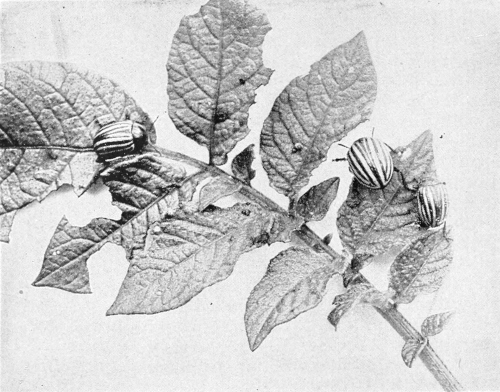
The Colorado potato-beetle.
Photo by Slingerland.
4. If the beetle cannot run rapidly, how does it travel? Describe the wing-covers. Why is this insect called the ten-lined potato beetle?
5. Describe the wings. How are they folded when at rest? How are the wing-covers carried when the beetle is flying?
6. Take a beetle in your hand. What does it do? Of what advantage is it to the insect to pretend that it is dead? If you squeeze the beetle what happens? How does the fluid which it ejects look and smell? Try and discover where this fluid comes from? Of what use is it to the beetle? Why will birds not eat the potato-beetle?
7. Where does the mother beetle lay her eggs? Are they laid singly or in clusters? What color are the eggs? How long after they are laid before they hatch?
8. Describe the young larva when it first hatches. What color is it at first? Does it change color later? Describe the colors and markings of a full grown larva.
9. How does this larva injure the potato vines? Does it remain in sight while it is feeding? Does it act as if it were afraid of birds? Why is it not eaten by birds?
10. Where does the larva go when it is full grown? How many times does it shed its skin during its growth? Does it make a little cell in the ground? How does the pupa look? Can you see in it the eyes, antennæ, legs and wings of the beetle?
11. Write an English theme giving the history of the Colorado potato-beetle, and the reasons for its migration from its native place.
THE LADYBIRD
Teacher’s Story
Ladybird, Ladybird, fly away home! Your house is on fire, your children are burning.
HIS incantation we, as children, repeated to this unhearing little beetle, probably because she is and ever has been, the incarnation of energetic indecision. She runs as fast as her short legs can carry her in one direction, as if her life depended on getting there, then she turns about and goes with quite as much vim in another direction. Thus, it is no wonder the children think that when she hears this news of her domestic disasters, she wheels about and starts for home; but she has not any home now nor did she ever have a home, and she does not carry even a trunk. Perhaps it would be truer to say that she has a home everywhere, whether she is cuddled under a leaf for a night’s lodging or industriously climbing out on twigs, only to scramble back again, or perchance to take flight from their tips.
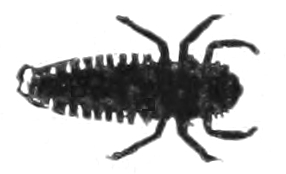
Ladybird larva.
There are many species of ladybirds, but in general they all resemble a tiny pill cut in half, with legs attached to the flat side. Sometimes it may be a round and sometimes an oval pill, but it is always shining and the colors are always dull dark red, or yellow, or whitish, and black. Sometimes she is black with red or yellow spots, sometimes red or yellow with black spots and the spots are usually on either side of the thorax and one on each snug little wing-cover. But if we look at the ladybird carefully we can see the head and the short, clublike antennæ. Behind the head is the thorax with its shield, broadening toward the rear, spotted and ornamented in various ways; the head and thorax together occupy scarcely a fourth of the length of the insect, and the remainder consists of the hemispherical body, encased with polished wing-covers. The little black legs, while quite efficient because they can be moved so rapidly, are not the ladybird’s only means of locomotion; she is a good flier and has a long pair of dark wings which she folds crosswise under her wing-covers. It is comical to see her pull up her wings, as a lady tucks up a long petticoat; and sometimes ladybird is rather slovenly about it and runs around with the tips of her wings hanging out behind, quite untidily.
But any untidiness must be inadvertent, because the ladybird takes very good care of herself and spends much time in “washing up.” She begins with her front legs, cleaning them with her mandibles, industriously nibbling off every grain of dust; she then cleans her middle and hind legs by rubbing the two on the same side, back and forth against each other, each acting as a whisk broom for the other; she cleans her wings by brushing them between the edges of the wing-cover above and the tarsus of her hind leg below.
The ladybird is a clever little creature, even if it does look like a pill, and if you disturb it, it will fold up its legs and drop as if dead, playing possum in a most deceptive manner. It will remain in this attitude of rigid death for at least a minute or two and then will begin to claw the air with all its six legs in an effort to turn right side up.
From our standpoint the ladybird is of great value, for during the larval as well as adult stages, all species except one, feed upon those insects which we are glad to be rid of. They are especially fond of aphids and scale insects. One of the greatest achievements of economic entomology was the introduction on the Pacific Coast of the ladybird from Australia, called the Vedalia, which preys upon the cottony cushion scale insect, a species very dangerous to orange and lemon trees. Within a few years the introduced ladybirds had completely exterminated this pest.
The ladybird’s history is as follows: The mother beetle, in the spring, lays her eggs here and there on plants: as soon as the larva hatches, it starts out to hunt for aphids and other insects. It is safe to say that no ladybird would recognize her own children in time to save them, even if the house were burning, for they do not in the least resemble her; they are neither roly-poly nor shiny, but are long and segmented and velvety, with six queer, short legs that look and act as if they were whittled out of wood; they seem only efficient for clinging around a stem. The larvæ are usually black, spotted with orange or yellow; there are six warts on each segment, which make the creature’s back look quite rough. The absorbing business of the larva is to crawl around on plants and chew up the foolish aphids or the scale insects. I have seen one use its front foot to push an aphid, which it was eating, closer to its jaws; but when one green leg of its victim still clung to its head, it did not try to rub it off as its mother would have done, but twisted its head over this way and that, wiping off the fragment on a plant stem and then gobbling it up.
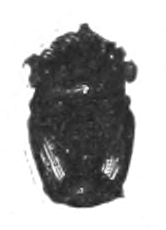
Ladybird pupa.
After the larva has shed its skeleton skin several times, and destroyed many times its own bulk of insects, it hunts for some quiet corner, hangs itself up by the tail and condenses itself into a sub-globular form; it sheds its spiny skin pushing it up around the point of attachment, and there lets it stay like the lion’s skin of Hercules. As a pupa, it is more nearly rectangular than round, and if we look closely, we can see the wing-cases, the spotted segments of the abdomen, and the eyes, all encased in the pupa skin; the latter bursts open after a few days and the shining, little half-globe emerges a full-grown ladybird, ready for hiding in some cozy spot to pass the winter, from which she will emerge in the spring, to stock our trees and vines, next year, with her busy little progeny.
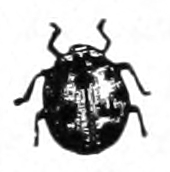
Ladybird beetle, “the nine-spotted ladybug.”
References—American Insects, Kellogg; Manual for the Study of Insects, Comstock.
LESSON XCIII
The Ladybird
Leading thought—The ladybird is a beetle. Its young are very different from the adult in appearance, and feed upon plant-lice.
Method—These little beetles are very common in autumn and may be brought to the schoolroom and passed around in vials for the children to observe. Their larvæ may be found on almost any plant infested with plant-lice. Plant and all may be brought into the schoolroom and the actions of the larvæ noted by the pupils during recess.
Observations—1. How large is the ladybird? What is its shape? Would two of them make a little globe if they were put flat sides together?
2. What colors do you find on your ladybird?
3. Do you see the ladybird’s head and antennæ? What is the broad shield directly back of the head called? How is it marked, and with what colors? What color are the wing-covers? Are there any spots upon them? How many? Does the ladybird use its wing-covers when it flies? Describe her true wings. Does she fold them beneath the wing-covers?
4. Note the legs and feet. Are the legs long? Are they fitted for running? To which part of the body are they attached?
5. If you disturb the ladybird how does she “play possum?” Describe how she makes her toilet.
The larva—1. Describe the ladybird larva. Does it look like its mother? What is its form? Is it warty and velvety or shiny?
2. Describe its head and jaws as far as you can see. How does it act when eating? Can you see its little stiff legs? Is there a claw at the end of each?
3. Describe the actions of the ladybird larva in attacking and eating the plant-lice. Does it shed its skin as it grows?
4. Watch a larva until it changes to a pupa. How does the pupa look? Can you see the shed skin? Where is it? To what is the pupa attached? When the pupa skin breaks open what comes out of it?
5. Why is the ladybird of great use to us? Write an English theme upon the ladybird, called Vedalia, which saved the orange orchards of California.
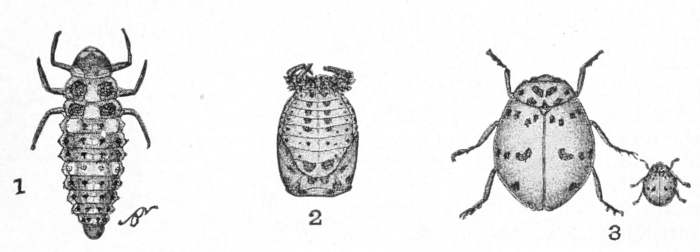
1, Larva; 2, pupa and 3, adult of a species of ladybird, enlarged.
The small beetle represents actual size.
THE FIREFLY
Teacher’s Story
And lavishly to left and right, The fireflies, like golden seeds, Are sown upon the night. —Riley.
HE time of this sowing is during warm, damp nights in July and August, and even in September, although they are sown less lavishly then. How little most of us know of the harvest, although we see the sowing which begins in the early twilight against the background of tree shadows, and lasts until the cold atmosphere of the later night dampens the firefly ardor! There is a difference in species as to the height from the ground of their flight; some species hover next to the grass, others fly above our heads, but rarely as high as the tree tops in northern latitudes. Some species give a short flash that might be called a refulgent blinking; others give a longer flash so that we get an idea of the direction of their flight; and there is a common species in the Gulf States which gives such long flashes that they mark the night with gleaming curlicues.
It is likely to be an exciting chase, before we are able to capture a few of these insects for closer inspection; but when once captured, they do not sulk but will keep on with their flashing and give us a most edifying display. The portion of the firefly which gives the light is in the abdomen, and it glows steadily like “phosphorescent wood”; then suddenly it gleams with a green light that is strong enough to reveal all its surroundings; and it is so evidently an act of will on the part of the beetle, that it is startling to members of our race, who cannot even blush or turn pale voluntarily. The fireflies may be truly said to be socially brilliant, for the flashing of their lights is for the attraction of their mates.
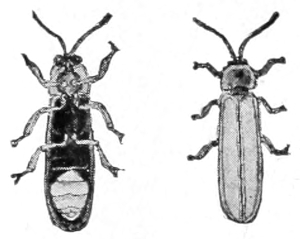
A common firefly—The view of the lower side shows the “lamp.”
The fireflies are beetles, and there are many species which are luminous. A common one is here figured (Photinus pyralis). It is pale gray above and the head is completely hidden by the big shield of the thorax. The legs are short; thus this beetle trusts mostly to its wings as a means of locomotion. The antennæ are rather long and are kept in constant motion, evidently conveying intelligence of surroundings to the insect. Beneath the gray elytra, or wing-covers, is a pair of large, dark-veined membranous wings which are folded in a very neat manner crosswise and lengthwise, when not in use. When in use, the wing-covers are lifted stiffly and the flying is done wholly with the membranous wings. Looked at from beneath, we can at once see that some of the segments of the abdomen are partly or entirely sulphur yellow, and we recognize them as the lamp. If the specimen is a male, the yellow area covers all of the end of the abdomen up to the fourth or fifth segment; but if it is a female, only the middle portion of the abdomen, especially the fifth segment, is converted into a lamp. These yellow areas, when dissected under the microscope, prove to be filled with fine tracheæ, or air-tubes; and although we know very little about the way the light is made, it is believed that by flooding the tubes with air, the oxygen in some way produces the light.
In some species, the female is wingless and has very short wing-covers, and a portion of her body emits a steady, greenish light which tells her lord and master where to find her. These wingless females are called glow-worms.
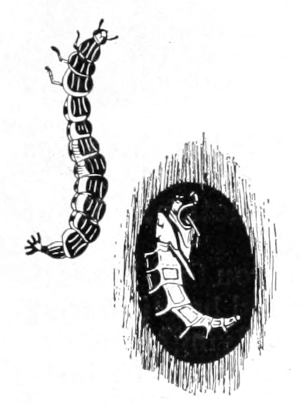
Larva and pupa of a common firefly.
After C. V. Riley.
Fireflies during their larval stages are popularly called wire worms, although there are many other beetle larvæ thus called. In many of the species, the firefly eggs, larvæ and pupæ are all luminescent, but not so brilliant as when adults. The larva of the species here figured, was studied by C. V. Riley, who gave us an interesting account of its habits. It lives in the ground and feeds on soft-bodied insects, probably earth-worms. Each segment of this wire worm has a horny, brown plate above, with a straight white line running through the middle and a slightly curved white line on each side; the sides of the larva are soft and rose-colored; the white spiracles show against little, oval, brown patches. Beneath, the larva is cream color with two brown comma-like dots at the center of each segment. The head can be pulled back completely beneath the first segment. The most interesting thing about this larva is the prop-leg at the end of its body, which naturally aids it in locomotion; but this prop-leg also functions as a brush; after the larva has become soiled with too eager delving into the tissues of some earthworm, it curls its body over, and with this fan-shaped hind foot scrubs its head and face very clean. This is a rare instance of a larva paying any attention to its toilet.
When full-grown, the larva makes a little oval cell within the earth and changes to a pupa; after about ten days, the pupa skin is shed and the full-fledged beetle comes forth. The larva and pupa of this species give off light, but are not so brilliant as the adult. The pupils should be encouraged to study the early stages of the fireflies, because very little is known concerning them.
In Cuba a large beetle called the cucujo has two great oval spots on its thorax, resembling eyes, which give off light. The Cuban ladies wear cucujos at the opera, in nets, in the hair. I once had a pair which I tethered with gold chains to the bodice of my ball gown. The eye-spots glowed steadily, but with the movement of dancing, they grew more brilliant until no glittering diamonds could compete with their glow.
LESSON XCIV
The Firefly
Leading thought—When the firefly wishes to make a light, it can produce one that, if we knew how to make, would greatly reduce the price of artificial light; for the light made by fireflies and other creatures, requires less energy than any other light known.
Method—After the outdoor observations have been made, collect some of these beetles in the evening with a sweep net; place them under a glass jar or tumbler, so that their light can be studied at close range. The next day give the observation lesson on the insects.
Observations—1. At what time of year do you see fireflies? Do they begin to lighten before it is dark? Do you see them high in the air or near the ground? Is the flash they give short, or long enough to make a streak of light? Do you see them on cold and windy nights or on warm, still, damp evenings? Make a note of the hour when you see the first one flash in an evening.
2. Catch a few fireflies in the night; put them under a glass jar. Can you see the light when they are not flashing? What color is it? When they make the flash can you see the outline of the “firefly lamp?” Watch closely and see if you think the flashing is a matter of will on the part of the firefly. Do you think the firefly is signaling to his mate when he flashes?
3. Study the firefly in daylight. Is it a fly or is it a beetle? What color is it above? When you look squarely down upon it, can you see its head and eyes?
4. Are the firefly’s legs long or short? When a beetle has short legs is it a sign that it usually walks, runs or flies?
5. Describe the antennæ. Are they in constant motion? What service do you think the firefly’s antennæ perform for it?
6. Lift one of the wing-covers carefully. What do you find beneath it? Does the beetle use its wing-covers to beat the air and help it during flight? How does the beetle hold its wing-covers when flying?
7. Turn the beetle on its back. Can you see the part of the body that flashes? What color is it?
8. Do you know the life history of the firefly? What is it like in its earlier stages? Where does it live? Does it have the power of making light when it is in the larval stage?
“There, in warm August gloaming, With quick silent brightenings, From meadow-lands roaming, The firefly twinkles His fitful heat-lightnings.” —Lowell
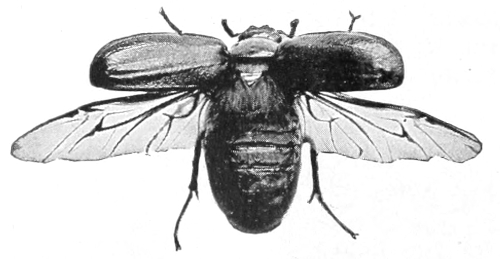
A Maybeetle flying, showing that the beetles hold the wing-covers stiff and still in flight, the hind wings doing the work.
Photo by M. V. Slingerland.
THE WAYS OF THE ANT
My child, behold the cheerful ant, How hard she works, each day; She works as hard as adamant Which is very hard, they say. —Oliver Herford.
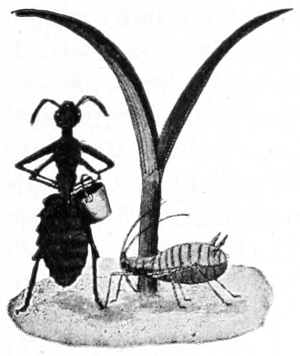
ERY many performances on the part of the ant seem to us without reason; undoubtedly many of our performances seem likewise to her. But the more understandingly we study her and her ways, the more we are forced to the conclusion that she knows what she is about; I am sure that none of us can sit down by an ant-nest and watch its citizens come and go, without discovering things to make us marvel.
By far the greater number of species of ants find exit from their underground burrows, beneath stones in fields. They like the stone for more reasons than one; it becomes hot under the noon sun and remains warm during the night, thus giving them a cozy nursery in the evening for their young. Some species make mounds, and often several neighboring mounds belong to the same colony, and are connected by underground galleries. There are usually several openings into these mounds. In case of some of the western species which make galleries beneath the ground, there is but one opening to the nest and Dr. McCook says that this gate is closed at night; at every gate in any ants’ nest, there are likely to be sentinels stationed, to give warning of intruders.
As soon as a nest is disturbed, the scared little citizens run helter skelter to get out of the way; but if there are any larvæ or pupæ about, they are never too frightened to take them up and make off with them; but when too hard pressed, they will in most cases drop the precious burden, although I have several times seen an ant, when she dropped a pupa, stand guard over it and refuse to budge without it. The ant’s eggs are very small objects, being oblong and about the size of a pin point. The larvæ are translucent creatures, like rice grains with one end pointed. The pupæ are yellowish, covered with a parchment-like sac, and resemble grains of wheat. When we lift stones in a field, we usually find directly beneath, the young of a certain size.
There are often, in the same species of ants, two sizes; the large ones are called majors and the smaller minors; sometimes there is a smaller size yet, called minims. The smaller sizes are probably the result of lack of nutrition. But whatever their size, they all work together to bring food for the young and in caring for the nest. We often see an ant carrying a dead insect or some other object larger than herself. If she cannot lift it or shove it, she turns around, and going backwards, pulls it along. It is rarely that we see two carrying the same load, although we have observed this several times. In one or two cases, the two seemed not to be in perfect accord as to which path to take. If the ants find some large supply of food, many of them will form a procession to bring it into the nest bit by bit; such processions go back by making a little detour so as not to meet and interfere with those coming. During most of the year, an ant colony consists only of workers and laying queens, but in early summer the nest may be found swarming with winged forms which are the kings and queens. Some warm day these will issue from the nest and take their marriage flight, the only time in their lives when they use their wings; for ants, like seeds, seem to be provided with wings simply for the sake of scattering wide the species. It is a strange fact, that often on the same day swarms will issue from all the nests of one species in the whole region; by what mysterious messenger, word is sent that brings about this unanimous exodus, is still a mystery to us. This seems to be a provision for cross-breeding; and as bearing upon this, Miss Fielde discovered that an alien king is not only made welcome in a nest, but is sometimes seized by workers and pulled into a nest; this is most significant, since no worker of any other colony of the same species, is permitted to live in any but its own nest.
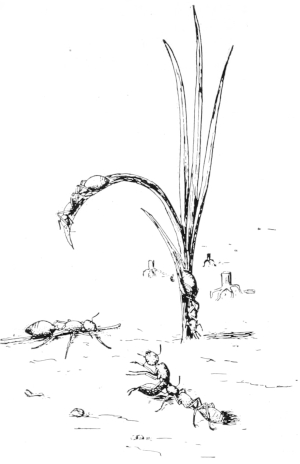
Agricultural ants. Note that one ant is carrying a sister.
Drawn by Evelyn Mitchell.
After the marriage flight, the ants fall to the ground and undoubtedly a large number perish; however, just here our knowledge is lamentably lacking, and observations on the part of pupils as to what happens to these winged forms will be valuable. In the case of most species, we know that a queen finds refuge in some shelter and there lays eggs. Mr. Comstock once studied a queen of the big, black carpenter ant which lives under the bark of trees. This queen, without taking any food herself, was able to lay her eggs and rear her first brood to maturity; she regurgitated food for this first brood, and then they went out foraging for the colony. However, Miss Fielde found that in the species she studied, the queen could not do this; a question most interesting to solve is whether any of the young queens, after the marriage flight, are adopted into other colonies of the same species. As soon as a queen begins laying eggs, she sheds her then useless wings, laying them aside as a bride does her veil.
When we are looking for ants’ nests beneath stones, we often stumble upon a colony consisting of citizens differing in color. One has the head and thorax rust-red with the abdomen and legs brown; associated with this brown ant, is a black or ash-colored species. These black ants are the slaves of the brown species; but slavery in the ant world has its ameliorations. When the slave makers attack the slave nest, they do not fight the inmates unless they are obliged to. They simply loot the nest of the larvæ or pupæ, which they carry off to their own nests; and there they are fed and reared, as carefully as are their own young. The slaves seem to be perfectly contented, and conduct the household affairs of their masters with apparent cheerfulness. They do all the taking care of the nest and feeding the young, but they are never permitted to go out with war parties; thus they never fight, unless their colony is attacked by marauders.
If one chances upon an ant battle, one must needs compare it to a battle of men before the invention of gunpowder; for in those days fighting was more gory and dreadful than now, since man fought man until one of the twain was slain. There is a great variation in military skill as well as in courage shown by different species of ants; the species most skilled in warfare, march to battle in a solid column and when they meet the enemy, the battle resolves itself into duels, although there is no code of ant honor which declares that one must fight the enemy single-handed. Although some ants are provided with venomous stings, our common species use their jaws for weapons; they also eject upon each other a very acid liquid which we know as formic acid. Two enemies approach each other, rear on their hind legs, throw this ant vitriol at each other, then close in deadly combat, each trying to cut the other in two. Woe to the one on which the jaws of her enemy are once set! For the ant has bulldog qualities, and if she once gets hold, she never lets go even though she be rent in pieces herself. At night the ant armies retreat to their citadels, but in the morning fare forth again to battle; and thus the war may be waged for days, and the battlefield be strewn with the remains of the dead and dying. So far as we are able to observe, there are two chief causes for ant wars; one is when two colonies desire the same ground, and the other is for the purpose of making slaves.
An aphid stable, built by ants to protect their herds.
Photo by Slingerland.
Perhaps the most interesting as well as most easily observed of all ant practices, are those that have to do with plant-lice, or aphids. If we find an ant climbing a plant of any sort, it is very likely that we shall find she is doing it for the purpose of tending her aphid herds. The aphid is a stupid little creature which lives by thrusting its bill or sucking tube into a stem or leaf of a plant, and thus settles down for life, nourished by the sap which it sucks up; it has a peculiar habit of exuding from its alimentary canal drops of honey-dew, when it feels the caress of the ant’s antennæ upon its back. I had one year under observation, a nest of elegant little ants with shining triangular abdomens which they waved in the air like pennants when excited. These ants were most devoted attendants on the plant-lice infesting an evening primrose; if I jarred the primrose stem, the ants had a panic, and often one would seize an aphid in her jaws and dash about madly, as if to rescue it at all hazards. When the ant wishes honey-dew, she approaches the aphid, stroking it or patting it gently with her antennæ, and if a drop of the sweet fluid is not at once forthcoming, it is probably because other ants have previously exhausted its individual supply; if the ant gets no response, she hurries on to some other aphid not yet milked dry.
This devotion of ants to aphids has been known for a hundred years, but only recently has it been discovered to be of economic importance. Professor Forbes, in studying the corn root-louse, discovered that the ants care for the eggs of this aphid in their own nests during the winter, and take the young aphids out early in the spring, placing them on the roots of smartweed; later, after the corn is planted, the ants move their charges to the roots of the corn. Ants have been seen to give battle to the enemies of the aphid. The aphids of one species living on dogwood are protected while feeding by stables, which a certain species of ant builds around them, from a mortar made of earth and vegetable matter.
References—Ants, W. M. Wheeler, Ant Communities, McCook.
LESSON XCV
Field Observations on Ants
Leading thought—However aimless to us may seem the course of the ant as we see her running about, undoubtedly if we understood her well enough, we should find that there is rational ant-sense in her performances. Therefore, whenever we are walking and have time, let us make careful observations as to the actions of the ants which we may see.
Method—The following questions should be written on the blackboard and copied by the pupils in their note-books. This should be done in May or June, and the answers to the questions worked out by observations made during the summer vacation.
Observations—1. Where do you find ants’ nests? Describe all the different kinds you have found. In what sort of soil do they make their nests? Describe the entrance to the nest. If the nest is a mound, is there more than one entrance? Are there many mounds near each other? If so, do you think they all belong to the same colony?
2. When the nest is disturbed, how do the ants act? Do they usually try to save themselves alone? Do they seek to save their young at the risk of their own lives? If an ant, carrying a young one is hard pressed, will she drop it?
3. Make notes on the difference in appearance of eggs, larvæ and pupæ in any ants’ nest.
4. In nests under stones, can you find larvæ and pupæ assorted according to sizes?
5. How many sizes of ants do you find living in the same nest?
6. What objects do you find ants carrying to their nests? Are these for food? How does an ant manage to carry an object larger than herself? Do you ever see two ants working together carrying the same load?