Part 3 — I. WILD-FLOWER STUDY (continued 3)
Reading edition
The following are the tactics by which the dandelion conquers us and takes possession of our lands: (a) It blossoms early in the spring and until snow falls, producing seed for a long season. (b) It is broadminded as to its location, and flourishes on all sorts of soils. (c) It thrusts its long tap-roots down into the soil, and thus gets moisture and food not reached by other plants. (d) Its leaves spread out from the base, and crowd and shade many neighboring plants out of existence. (e) It is on good terms with many insects, and so has plenty of pollen carriers to insure strong seeds; it can also develop seeds from its own pollen, and as a last resort it can develop seeds without any pollen. (f) It develops almost numberless seeds, and the wind scatters them far and wide and they thus take possession of new territory. (g) It forms vigorous leaf-rosettes in the fall, and thus is able to begin growth early in the spring.
LESSON CXLIII
The Dandelion
Leading thought—The dandelions flourish despite our determined efforts to exterminate them. Let us study the way in which they conquer.
Method—The study should be made with the dandelions on the school grounds. Questions should be given, a few at a time, and then let the pupils consult the dandelions as to the answers.
The dandelion is a composite flower and may be studied according to Lesson CXXXV. All the florets have banners or rays.
Observations—1. Where do you find dandelions growing? If they are on the lawn, how long are their blossom or seed stems? If in a meadow or among high grass, how long is the blossom stem? Why is this? Is the blossom stem solid or hollow? Does it break easily?
2. Dig up a dandelion root and then explain why this weed withstands drought, and why it remains, when once planted.
3. Sketch or describe a dandelion leaf. Why was the plant named “lion’s teeth?” How are the leaves arranged about the root? How does this help the dandelion and hinder other plants? In what condition do the leaves pass the winter under the snow? Why is this useful to the plant?
4. Take a blossom not yet open. Note the bracts that cover the unopened flower-head. Note the ones below and describe them.
5. Note the dandelion flower-head just open. Which flowers open first? How do the buds look at the center? Do all the florets have banners? Are the banners of the central florets the same color and length as of those outside? Examine a floret and note the young seed. Is the pappus attached to it or above it?
6. What happens to the dandelion blossom on rainy or dark days? How is the dandelion family hidden during the rain? When does it appear again? Do you think that this has anything to do with the insect visitors? Do bees and other insects gather nectar during dark or rainy days?
7. Note at what hour the dandelions on the lawn go to sleep and at what hour they awaken on pleasant days?
8. Make notes on a certain dandelion plant three times a day: How long does it take the dandelion head to open fully on a sunny morning? How long does it remain open? How long does it take the flower-head to close? What proportion of the flowers in the head, blossoms during the first day? What proportion of the flowers in the head, blossoms during the second day? How long before they all blossom? Does the flower-head remain open longer in the afternoon on some days than on others, equally sunny? Does the stem bend over before the blossom-head opens?
9. After all the little flowers of a dandelion family have blossomed, what happens to it? How long does it stay shut up in its house? Measure the stem, and see if it stretches up during the time. How does the dandelion look when it opens again? Look at a dandelion-head full of seed, and see how the seeds are arranged to make a perfect globe. Shake the seeds off and examine the “bald head” with a lens. Can you see where the seeds were set?
10. Examine a dandelion seed with a lens. Describe the balloon, the beak or stem of the balloon, and the seed. Why do you suppose the seed has these hooks?
11. How early in the spring, and how late in the fall, do dandelions blossom?
12. Watch a bee when she is working on a dandelion flower, and see where she thrusts her tongue and which flowers she probes.
13. Tell all the things that you can remember which the dandelion does in order to live and thrive in spite of us.
14. What use do we make of the dandelions?
THE PEARLY EVERLASTING
Teacher’s Story
These wraithlike flowers seem never to have been alive, rather than to have been endowed with everlasting life. The cattle share this opinion and would no sooner eat these plants than if they were made of cotton batting. The stems are covered with white felt; the long narrow leaves are very pale green, and when examined with a lens, look as if they were covered with a layer of cotton which disguises all venation except the thick midrib. The leaves are set alternate, and become shorter and narrower and whiter toward the top of the plant, where they are obliged to give their sustenance to the flower stems borne in their axils. All this cottony covering has its uses to prevent the evaporation of water from the plant during the long droughts. The everlasting never has much juice in its leaves but what it has, it keeps.
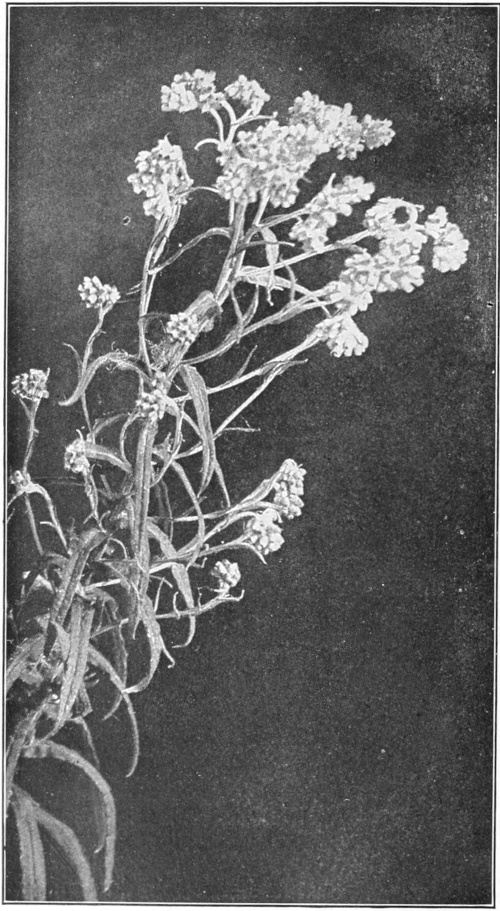
The pistillate flower-heads of the pearly everlasting.
Photo by Verne Morton.
The flower stems are rather stout, woolly, soft and pliable. They come off at the axils of the threadlike whitish leaves. The pistillate and the staminate flowers are borne on separate plants, and usually in separate patches. The pistillate, or seed-developing, plants have globular flower buds, almost egg-shaped, with a fluffy lemon-yellow knob at the tip; this fluff is made up of stigmas split at the end. At the center of this tassel of lemon-yellow stigma-plush, may often be seen a depression; at the bottom of this well, there are three or four perfect flowers. One of the secrets of the everlasting is, evidently, that it does not put all of its eggs in one basket; it has a few perfect flowers for insurance. This pistillate or seed-bearing flower has a long, delicate tube, ending in five needlelike points and surrounded by a pretty pappus. The bracts of the flower-cluster seem to cling around the base of the beautiful yellow tassel of fertile flowers, as if to emphasize it. They look as if they were made of white Japanese paper, and when looked at through a lens, they resemble the petals of a water lily. They are dry to begin with, so they cannot wither.
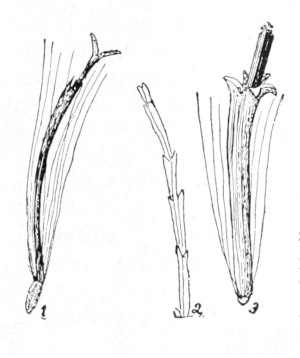
1, Pistillate floret, 2, pappus 3, staminate floret. All enlarged.
The staminate, or pollen-bearing, flower-heads are like white birds’ nests, the white bracts forming the nest and the little yellow flowers the eggs. The flower has a tubular, five-pointed starlike corolla, with five stamens joined in a tube at the middle, standing up like a barrel from the corolla. The anther-tube is ocher-yellow with brown stripes, and is closed at first with five little flaps, making a cone at the top. Later, the orange-yellow pollen bulges out as if it were boiling over. The flowers around the edges of the flower-disk open first.
LESSON CXLIV
The Pearly Everlasting
Leading thought—There are often found growing on the poor soil in dry pastures, clumps of soft, whitish plants which are never eaten by cattle. There is so little juice in them that they retain their form when dried and thus have won their name.
Method—The pupils should see these plants growing, so that they may observe the staminate and pistillate flowers, which are on separate plants and in separate clumps. If this is not practicable, bring both kinds of flowers into the schoolroom for study.
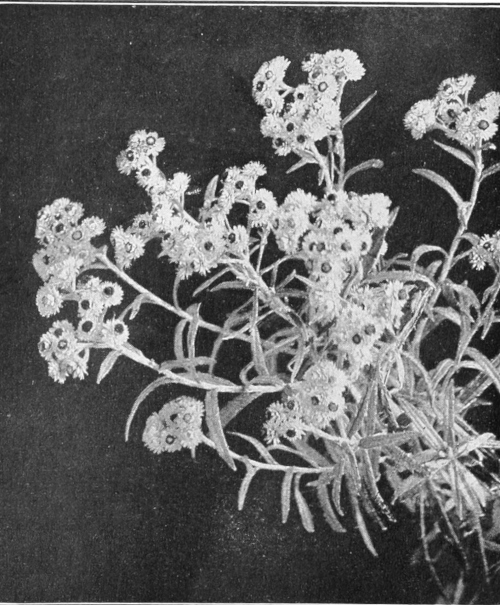
The staminate flower-head of pearly everlasting.
Observations—1. Where does the pearly everlasting grow? Do cattle eat it? Why is this? What is the general color of the plant? What is the stem covered with?
2. What is the shape of the leaves? How are they veined? With what are they covered? How are they placed on the stem? What is the relative size of the lower and upper leaves? Why is there a difference?
3. Do you see some plants which have egg-shaped blossoms, each with a yellow knob at the tip? Take one apart and look at it with a lens, and see what forms the white part and what forms the yellow knob. Do you see other flowers that look like little white birds’ nests filled with yellow eggs? Look at one of them with a lens, and tell what kind of a flower it is.
4. Except that the pistillate and staminate flowers are on different plants, the flowers of the pearly everlasting should be studied according to Lesson CXXXV.
5. What do you know of the edelweiss of the Alps? How does it resemble the pearly everlasting? Do you know another common kind of everlasting called pussy’s toes?
THE JEWELWEED, OR TOUCH-ME-NOT
Teacher’s Story
“Cup bearer to the summer, this floral Hebe shy Is loitering by the brookside as the season passes by; And she’s strung her golden ewers with spots of brown all flecked, O’er dainty emerald garments, like a queen with gems bedecked. She brooks not condescension from mortal hand, you know, For, touch her e’er so gently, impatiently she’ll throw Her tiny little jewels, concealed in pockets small Of her dainty, graceful garment, and o’er the ground they fall.” —Ray Laurence.
EWELS for the asking at the brookside, pendant jewels of pale-gold or red-gold and of strange design! And the pale and the red are different in design, although of the same general pattern. The pale ones seem more simple and open, and we may study them first. If the flowers of the jewelweed have been likened to ladies’ earrings, then the bud must be likened to the old-fashioned ear-bob; for it is done up in the neatest little triangular knob imaginable, with a little curly pig-tail appendage at one side, and protected above by two cup-shaped sepals, their pale green seeming like enamel on the pale gold of the bud. It is worth while to give a glance at the stem from which this jewel hangs; it is so delicate and so gracefully curved; and just above the twin sepals is a tiny green bract, elongate, and following the curve of the stem as if it were just a last artistic touch; and though the flowers fall, this little bract remains to keep guard above the seed-pod.
It would take a Yankee, very good at guessing, to make out the parts of this flower, so strange are they in form. We had best begin by looking at the blossom from the back side. The two little, greenish sepals are lifted back like butterfly wings, and we may guess from their position that there are two more sepals, making four in all. These latter are yellow; one is notched at the tip and is lifted above the flower; the other is below and is made into a wide-mouthed triangular sac, ending in a quirl at the bottom, which, if we test it, we shall find is the nectary, very full of sweetness. Now, if we look the flower in the face, perhaps we can find the petals; there are two of them “holding arms” around the mouth of the nectar-sac. And stiff arms they are too, two on a side, for each petal is two-lobed, the front lobe being very short and the posterior lobe widening out below into a long frill, very convenient for the bee to cling to, if she has learned the trick, when prospecting the nectar-sac behind for its treasure. The way this treasure-sac swings backward from its point of attachment above when the insect is probing it, must make the lady bee feel that the joys of life are elusive. Meanwhile, what is the knob projecting down above the entrance to the nectar-sac, as if it were a chandelier in a vestibule? If we look at it with a lens, we can see that it is made up of five chubby anthers, two in front, one at each side and one behind; their short, stout little filaments are crooked just right to bring the anthers together like five closed fingers holding a fist full of pollen-dust, just ready to sift it on the first one that chances to pass below. Thus it is that Madame Bumblebee, who dearly loves the nectar from these flowers, gets her back well dusted with the creamy-white pollen and does a great business for the jewelweed in transferring it. But after the pollen is shed, some day the bumblebee pushes up too hard against the anthers and they break loose, all in a bunch, looking like a crooked legged table; and there in their stead, thus left bare and ready for pollen, is the long green pistil with its pointed stigma ready to rake the pollen out of the fur of any bumblebee that calls.
The red-gold jewelweed is quite different in shape from the pale species. The sepal-sac is not nearly so flaring at the mouth, and the nectar-spur is half as long as the sac and curves and curls under in a most secretive fashion. The shape of the nectar-spur suggests that it was meant for an insect with a long, flexible sucking tube that could curl around and probe it to the bottom; and some butterflies do avail themselves of the contents of this bronze pitcher. Mr. Mathews mentions the Papilio troilus, and I have seen the yellow roadside butterfly partaking of the nectar. Professor Robertson believes that the form of the nectar-spur is especially adapted for the hummingbird. But I am sure that the flowers which I have had under observation are the special partners of a small species of bumblebee, which visits these flowers with avidity, celerity, and certainty, plunging into the nectar-sac “like a shot,” and out again and in again so rapidly that the eye can hardly follow. One day, one of them accommodatingly alighted on a leaf near me, while she combed from her fur a creamy-white mass of pollen, which matched in color the fuzz on her back, heaping it on her leg baskets. She seemed to know that the pollen was on her back, and it was comical to see her contortions to get it off. The action of these bumblebees in these flowers is in marked contrast to those of the large bumblebees and the honeybees. One medium-sized species of bumblebee has learned the trick of embracing with the front legs the narrow, stiff portion of the petals which encircles the opening to the sac, thus holding the flower firm while thrusting the head into the sac. While the huge species—black with very yellow plush—does not attempt to get the nectar in a legitimate manner, but systematically alights, back downward, below the sac of the flower, with head toward the curved spur, and cuts open the sac for the nectar. A nectar-robber of the most pronounced type! The honey-bees, Italian hybrids, are the most awkward in their attempts to get nectar from these flowers; they attempt to alight on the expanded portion of the petals and almost invariably slide off between the two petals. They then circle around and take observations with a note of determination in their buzzing, and finally succeed, as a rule, in gaining a foothold and securing the nectar. But the midget bumblebees show a savoir faire in probing the orange jewelweed that is convincing; they are so small that they are quite out of sight when in the nectar-sacs.
The jewelweed flowers of the pale species and the pale flowers of the orange species—for this latter has sometimes pale yellow flowers—are not invariably marked with freckles in the nectar-sac. But the most common forms are thus speckled. There is something particularly seductive to insects in these brownish or reddish flecks, and wherever we find them in flowers, we may with some confidence watch for the insects they were meant to allure. The orange jewelweed flower is a model for an artist in its strange, graceful form and its color combination of yellow spotted and marbled with red.
Gray’s Manual states that in the jewel weeds are often flowers of two sorts “The large ones which seldom ripen seeds, and very small ones which are fertilized early in the bud, their floral envelopes never expanding but forced off by the growing pod and carried upward on its apex.” My jewelweed patch has not given me the pleasure of observing these two kinds of flowers; my plants blossom luxuriously and profusely, and a large proportion of the flowers develop seed. The little, straight, elongated seed-pods are striped prettily and become quite plump from the large seeds within them. Impatiens? We should say so! This pod which looks so smug and straight-laced that we should never suspect it of being so touchy, at the slightest jar when it is ripe, splits lengthwise into five ribbon-like parts, all of which tear loose at the lower end and fly up in spirals around what was once the tip of the pod, but which now looks like a crazy little turbine wheel with five arms. And meanwhile, through this act the fat, wrinkled seeds have been flung, perhaps several feet away from the parent plant, and presumably to some congenial place for growth the following spring. This surprising method of throwing its seeds is the origin of the popular name touch-me-not, and the scientific name Impatiens by which these plants are known.
The jewelweed has other names—celandine and silver-leaf, and ladies’ ear-drop. It is an annual with a slight and surface-spreading growth of roots, seeming scarcely strong enough to anchor the branching stems, did not the plants have the habit of growing in a community, each helping to support its neighbor. The stem is round, hollow and much swollen at the joints; it is translucent, filled with moisture, and its outer covering is a smooth silken skin, which may be readily stripped off. Both species of jewelweed vary in the color of their stems, some being green, others red and some dark purple; and all the differing colors may be found within a few yards of each other.
The leaves are alternate, dark green above and a lighter shade below, ovate in form with scalloped edges, with midrib and veins very prominent beneath and depressed on the upper side; they are smooth on both sides to the unaided eye, but with a lens a film of fine, short hairs may be seen, particularly on the under side. When plunged beneath clear water, they immediately take on the appearance of burnished silver; when removed, no drop remains on their surface.
The flower stems spring from the axils of the leaves and are very slender and thread-like, and the flowers nod and swing with every breeze. They grow in open, drooping clusters, few blossoms open at a time, and with buds and seed-capsules present in various stages of growth.
The jewelweed is involuntarily most hospitable, and always houses many uninvited guests, as well as the bee-callers which are invited. Galls are formed on the leaves and flowers; the hollow stems are inhabited by stalk-borers; leaf-miners live between the upper and under surfaces of the leaves, making curious arabesque patterns and initials as if embroidering milady’s green gown.
LESSON CXLV
The Jewelweed, or Touch-me-not
Leading thought—The jewelweed may be found by the brookside, in swamps, or in any damp and well-shaded area. It is provided with a remarkable contrivance for scattering its seeds far afield. It has no liking for open sunny places, unless very damp. There are two kinds, often found growing together, though the spotted touch-me-not (Impatiens biflora) is said to be more widely distributed than its relative—the golden, or pale, touch-me-not (Impatiens aurea).
Method—The jewelweeds should be studied where they are growing; but if this is impracticable, a large bouquet of both kinds (if possible), bearing buds, blossoms, and seed-capsules, and one or two plants with roots, may be brought to the schoolroom.
In the fields the children may see how well the plant is provided with means to sustain itself in its chosen ground, and thus lead them to look with keener eyes at other common weeds.
Observations—1. Do you think the jewelweed is an annual, sustaining life in its seeds during winter, or do its roots survive?
2. Do the roots strike deeply into the soil, or spread near the surface?
3. Study the stem; is it hard and woody or juicy and translucent, rough or smooth, solid or hollow?
4. Note the shape and position of the leaves; do they grow opposite or alternately on the stalk? Are their edges entire, toothed or scalloped? Do they vary in color on upper and lower surface? Are they smooth or in the least degree rough or hairy? Plunge a plant under clear water in a good light and observe the beautiful transformation. Does the water cling to the leaves?
5. Where do the flower-stems spring from the main stalk? Do the flowers grow singly or in clusters? Do the blossoms all open at nearly the same time or form a succession of bud, flower and seed on the same stem?
6. Study the parts of the flower. Find the four sepals and describe the shape and position of each. Describe the nectar-sac in the nectar-horn. Can you find the two petals? Can you see that each petal has a lobe near where it joins the stem? Find the little knob hanging down above the entrance of the nectar-sac; of what is it composed? Look at it with a lens, and tell how many stamens unite to make the knob? Where is the pollen and what is its color? What insect do you think could reach the nectar at the bottom of the spurred sac? Could any insect get at the nectar without rubbing its back against the flat surface of the pollen boxes? What remains after the stamens fall off? Describe how the bees do the work of pollenation of the jewelweeds. Write or tell as a story your own observations on the actions of the different bees visiting these flowers.
7. Carefully observe a seed-capsule without touching it; can you see the lines of separation between its sections? How many are there? What happens when the pod is touched? Are the loosened sections attached at the stem, or at the apex of the pod? Hold a pod at arm’s length when discharging its contents and measure the distance to which the seeds are thrown. Of what use is this habit of seed-throwing to the plant?
8. Describe the differences in shape and color between the pale yellow and the orange jewelweeds. Watch to see if the same insects visit both. Which species do you think is best suited to the bumblebees?
MULLEIN
Teacher’s Story
“I like the plants that you call weeds,— Sedge, hardhack, mullein, yarrow,— Which knit their leaves and sift their seeds Where any grassy wheel-track leads Through country by-ways narrow.” —Lucy Larcom.
We take much pride unto ourselves because we belong to the chosen few of the “fittest,” which have survived in the struggle for existence. But, if we look around upon other members of this select band, we shall find many lowly beings which we do not ordinarily recognize as our peers. Mullein is one of them, and after we study its many ways of “winning out” then may we bow to it and call it “brother.”
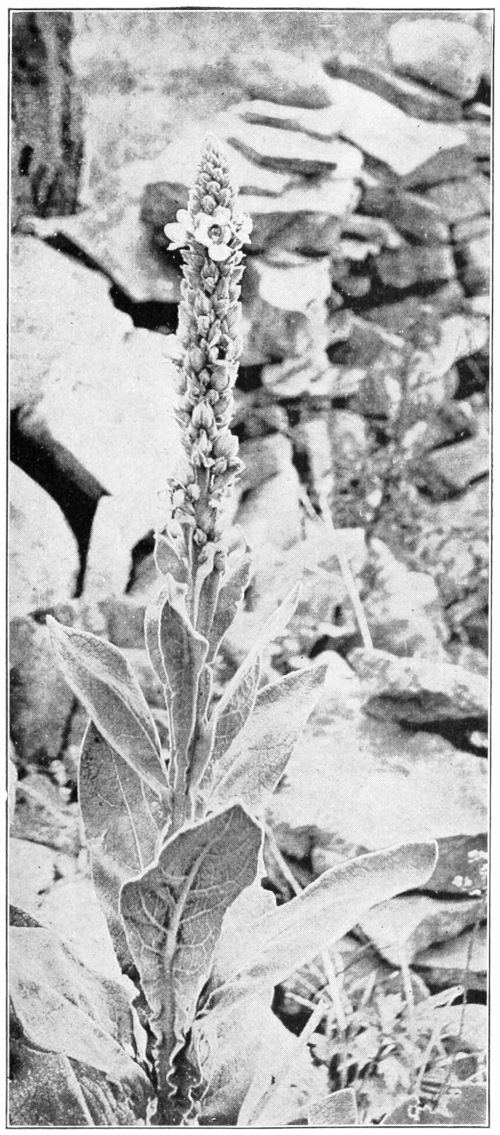
Mullein.
Photo by Verne Morton.
I was wandering one day in a sheep pasture and looking curiously at the few plants left uneaten. There was a great thistle with its sharp spines and the pearly everlasting—too woolly and anaemic to be appetizing even to a sheep; and besides these, there was an army of mullein stalks—tall, slim, and stiff-necked, or branching like great candelabra, their upper leaves adhering alternately to the stalks for half their length. I stopped before one of them and mentally asked, “Why do the sheep not relish you? Are you bitter?” I took a bite, Nebuchadnezzar-like, and to my untrained taste it seemed as good fodder as any; but my tongue smarted and burned for some time after, from being pricked by the felt which covered the leaf. I recalled the practical joke of which my grandmother once made me the victim; she told me that to be beautiful, I needed only to rub my cheeks with mullein leaves, an experience which convinced me that there were other things far more desirable than beauty—comfort, for instance. This felt on the mullein is beautiful, when looked at through a microscope; it consists of a fretwork of little, white, sharp spikes. No wonder my cheeks were red one day and purple the next, and no wonder the sheep will not eat it unless starved! This frostlike felt covering not only keeps the mullein safe from grazing animals but it also keeps the water from evaporating from the leaf and this enables the plant to withstand drought. I soon discovered another means devised by the mullein for this same purpose, when I tried to dig up the plant with a stick; I followed its taproot down far enough to understand that it was a subsoiler and reached below most other plants for moisture and food. Although it was late autumn, the mullein was still in blossom; there were flowers near the tip and also one here and there on the seed-crowded stem. I estimated there were hundreds of seed-capsules on that one plant; I opened one, still covered with the calyx-lobes, and found that the mullein was still battling for survival; for I found this capsule and many others inhabited by little brown-headed white grubs, which gave an exhibition of St. Vitus dance as I laid open their home. They were the young of a snout beetle, which is a far more dangerous enemy of the mullein than is the sheep.
The mullein plant is like the old woman who lived in a shoe in the matter of blossom-children; she has so many that they are unkempt and irregular, but there are normally four yellow or white petals and a five-lobed calyx. I have never been able to solve the problem of the five stamens which, when the flower opens, are folded together in a knock-kneed fashion. The upper three are bearded below the anthers, the middle being the shortest. The lower two are much longer and have no fuzz on their filaments; they at first stand straight out, with the stigma between them; but after the upper anthers have shed their pollen, these stamens curve up like boars’ teeth and splash their pollen on the upper petals, the stigma protruding desolately and one-sidedly below. Later the corolla, stamens and all, falls off, leaving the stigma and style attached to the seed-capsule.
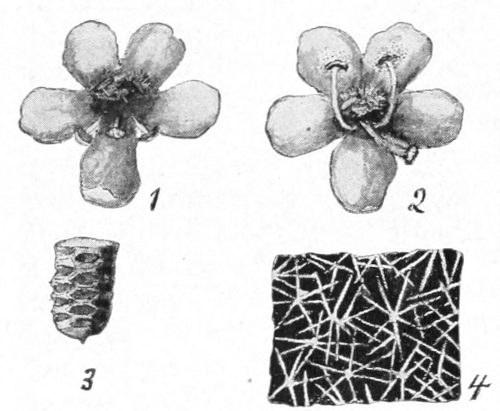
1, 2. Mullein flowers in different stages. 3. Mullein seed enlarged. 4. A bit of Mullein leaf enlarged.
The color of the mullein flowers varies from lemon-yellow to white. The filaments are pale yellow; the anthers and pollen, orange. The seed-capsule is encased in the long calyx-lobes, and is shaped like a blunt egg. Cutting it in two crosswise, the central core, tough and flattened and almost filling the capsule, is revealed and, growing upon its surface, are numberless tiny, brown seeds, as fine as gunpowder. Later the capsule divides partially in quarters, opening wide enough to shake out the tiny seeds with every wandering blast. The seed, when seen through a lens, is very pretty; it looks like a section of a corncob, pitted and ribbed. A nice point of investigation for some junior naturalist is to work out the fertilization of the mullein flower, and note what insects assist. The mullein has another spoke in the wheel of its success. The seed, scattered from the sere and dried plants, settles comfortably in any place where it can reach the soil, and during the first season grows a beautiful velvety rosette of frosted leaves. No wonder Europeans grow it in gardens under the name of the “American velvet plant.” These rosettes lie flat under the snow, with their tap-roots strong and already deep in the soil, and are ready to begin their work of food-making as soon as the spring sun gives them power.
LESSON CXLVI
Mullein
Leading thought—The mullein has its leaves covered with felt, which prevents evaporation during the dry weather and also prevents animals from grazing upon the plant. It has a deep root, and this gives moisture and food beyond the reach of most other plants. It blossoms all summer and until the snow comes in the autumn, and thus forms many, many seeds, which the wind plants for it; and here in our midst it lives and thrives despite us.
Method—The pupils should have a field trip to see what plants are left uneaten in pastures, and thus learn where mullein grows best. The flower or seed stalk, with basal leaves and root, may be brought to the schoolroom for the lesson.
Observations—1. Where does the mullein grow? Do you ever see it in swamps or woodlands? Do cattle or sheep eat it? Why? Does it flourish during the summer drought? How is it clothed to prevent the evaporation of its sap? Look at a mullein leaf with a lens and describe its appearance.
2. What sort of a root has the mullein? How is its root adapted to get moisture and plant food which other plants cannot reach? Describe the flowering stalk. How are the leaves arranged on it and attached to it? Are there several branching flower stalks or a single one?
3. Describe the flower bud. Do the mullein flowers nearest the base or the tip begin to blossom first? Is this invariable, or do flowers open here and there irregularly on the stem during the season?
4. Describe the mullein flower. How many lobes has the calyx? Are these covered with felt? How many petals? Are there always this number? Are the petals of the same size? Are they always regular in shape?
5. How many stamens? How do the upper three differ from the lower two? Describe the style and stigma. What are the colors of petals, anthers and stigma? What insects do you find visiting the flowers?
6. Describe the seed-capsule, its shape and covering. Cut it across and describe the inside. Where are the seeds borne? Are there many? Look at the seed with a lens, and describe it. How does the capsule open and by what means are the seeds scattered?
7. Does the mullein grow from the seed to maturity in one year? How does it look at the end of the first season? Describe the winter rosette, telling how it is fitted to live beneath the snows of winter. What is the advantage of this habit?
8. Write a theme telling all the ways the mullein has of flourishing and of combating other plants.
“The mullein’s pillar, tipped with golden flowers, Slim rises upward, and yon yellow bird Shoots to its top.” —“The Hill Hollow,” A. B. Street.
“Sober dress never yet made you sullen, Style or size never brought you a blush; You’re the envy of weavers, O, Mullein, For no shuttle can mimic your plush. With your feet in the sand you were born, Woolly monk of the thorn-field and fallow, But your heart holds the milk of the mallow, And your head wears the bloom of the corn.” —Theron Brown.
THE TEASEL
Teacher’s Story
The old teasel stalks standing gaunt and gray in the fields, braving the blasts of winter, seem like old suits of armor, which elicit admiration from us for the strength and beauty of the protecting visor, breast-plate and gauntlets, and at the same time veer our thoughts to the knights of old who once wore them in the fray. Thus, with the teasel, we admire this panoply of spears, and they recall the purple flowers and the ribbed seeds which were once the treasure of every spear-guarded cavity and the proud reason of every lance at rest.
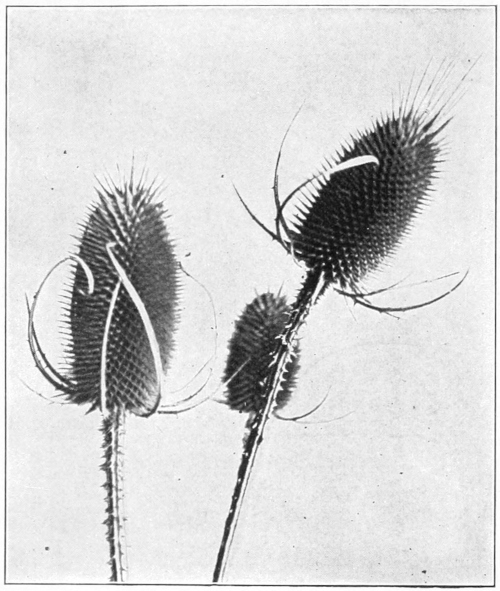
The teasel.
Let us study this plant in armor: First, its stem is tough, woody, hollow, with ridges extending its full length and each ridge armed with spines which are quite wide at the base and very sharp. It is impossible to take hold anywhere without being pricked by either large or small spines. The leaves are just fitted for such a stem. They are long, lanceolate, set opposite in pairs, rather coarse in texture, with a stiff, whitish midrib; the bases of the two leaves closely clasp the stem; the midrib is armed below with a row of long, white, recurved prickers, and woe unto the tongue of grazing beast that tries to lift this leaf into the mouth. If one pair of clasping leaves point east and west, the next pairs above and below point north and south.
The flower stems come off at the axils of the leaves and therefore each pair stands at right angles to the ones above and below. But if the teasel protects its stem and leaves with spikes, it does more for its flowers, which are set in dense heads armed with spines, and the head is set in an involucre of long, upcurving spiny prongs. If we look at it carefully, the teasel flower-head wins our admiration, because of the exquisite geometrical design made by the folded bases of the spines, set in diagonal rows. If we pull out a spine, we find that it enlarges toward the base to a triangular piece that is folded at right angles for holding the flower. Note that the spiny bracts at the tip of the flower-head are longer and more awesome than those at the sides; if we pass our hands down over the flower-head we feel how stiff the spines, or bracts are, and can hear them crackle as they spring back.
The teasel has a quite original method of blossoming. The goldenrod begins to blossom at the tip of the flowering branches and the blossom-tide runs inward and downward toward the base. The clover begins at the base and blossoms toward the tip, or the center. But the teasel begins at the middle and blossoms both ways, and how it knows just where to begin is more than we can tell. But some summer morning we will find its flower-head girt about its middle with a wide band of purple blossoms; after a few days, these fade and drop off, and then there are two bands, sometimes four rows of flowers in each, and sometimes only two. Below the lower band and above the upper band, the enfolding bracts are filled with little, round-headed lilac buds, while between the two rows of blossoms the protecting bracts hold the precious growing seed. Away from each other this double procession moves, until the lower band reaches the pronged involucre and the upper one forms a solid patch on the apex of the flower-head. Since the secondary blossom-heads starting from the leaf axils are younger, we may find all stages of this blossoming in the flower-heads of one plant.
No small flower pays better for close examination than does that of the teasel. If we do not pull the flower-head apart, what we see is a little purple flower consisting of a white tube with four purple lobes at the end, the lower lobe being a little longer than the others and turning up slightly at its tip; projecting from between each of the lobes, and fastened to the tube, are four stamens with long, white filaments and beautiful purple anthers filled with large, pearly white pollen grains; at the very heart of the flower, the white stigma may be seen far down the tube. But a little later, after the anthers have fallen or shriveled, the white stigma extends out of the blossom like a long, white tongue and is crowded with white pollen grains.
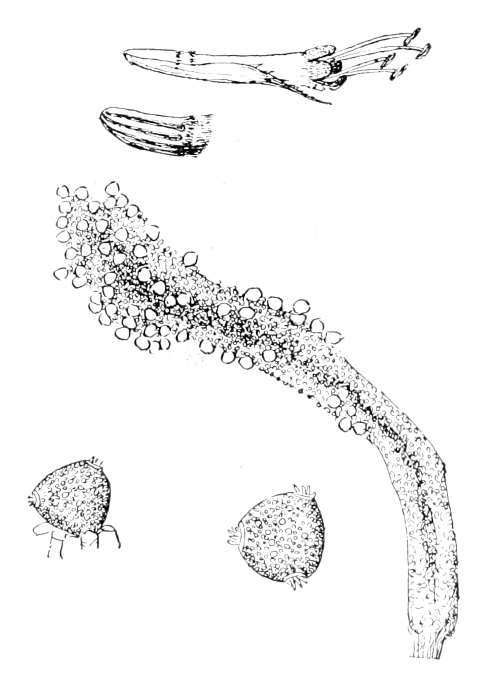
Teasel flower and seed enlarged. The stigma of a teasel floret much magnified to show the pollen adhering to it. Below, are pollen grains greatly magnified.
But to see the flower completely we need to break or cut a flower-head in two. Then we see that the long white tube is tipped at one end with purple lobes and a fringe of anthers, and at the other is set upon a little green, fluffy cushion which caps the ovary; the shape of the ovary in the flower tells us by its form how the seed will look later. Enfolding ovary and tube is the bract with its spiny edges, pushing its protecting spear outward, but not so far out as the opening of the flower, for that might keep away the insects which carry the teasel’s pollen. The pollen of the teasel is white and globular, with three little rosettes arranged at equal distances upon it like a bomb with three fuses. These little rosettes are the growing points of the pollen grains and from any of them may emerge the pollen tube to push down into the stigma. The teasel pollen is an excellent subject for the children to study, since it is so very large; and if examined with a microscope with a three-fourths objective, the tubes running from the pollen grains into the stigma may be easily seen.
In blossoming, the teasel does not always seem to count straight in the matter of rows of flowers. There may be more rows in the upper band than in the lower, or vice versa; this is especially true of the smaller secondary blossoms. But though the teasel flowers fade and the leaves fall off, still the spiny skeleton stands, the thorny stalks holding up the empty flower-heads like candelabra, from which the seeds are tossed far and wide, shaken out by the winds of autumn. But though battered by wintry blasts, the teasel staunchly stands; even until the ensuing summer, each bract on guard and its heart empty where once was cherished blossom and seed. Alas, because of this emptiness, it has been debased by practical New England housewives into a utensil for sprinkling clothes for ironing.
The spines of one species of teasel were, in earlier times, used for raising the nap on woolen cloth, and the plant was grown extensively for that purpose. The bees are fond of the teasel blossoms and teasel honey has an especially fine flavor.
The teasels are biennial, and during the first season, develop a rosette of crinkled leaves which have upon them short spines.
LESSON CXLVII
The Teasel
Leading thought—The teasel is a plant in armor, so protected that it can flourish and raise its seeds in pastures where cattle graze. It has a peculiar method of beginning to blossom in the middle of the flower-head and then blossoming upward and downward from this point.
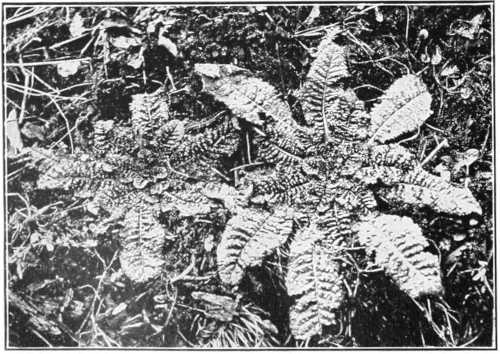
A teasel winter rosette.
Photo by Verne Morton.
Method—In September, bring in a teasel plant which shows all stages of blossoming, and let the pupils make observations in the schoolroom.
Observations—1. Where does the teasel grow? Is it ever eaten by cattle? Why not? How is it protected?
2. What sort of stem has it? Is it hollow or solid? Where upon it are the spines situated? Are the spines all of the same size? Can you take hold of the stem anywhere without being pricked?
3. What is the shape of the leaves? How do they join the stem? Are the leaves set opposite or alternate? If one pair points east and west in which direction will the pairs above and below point? How and where are the leaves armed? How does the cow or sheep draw the leaves into the mouth with the tongue? If either should try to do this with the teasel, how would the tongue be injured?
4. Where do the flower stems come off? Do they come off in pairs? How are the pairs set in relation to each other?
5. What is the general appearance of the teasel flower-head? Describe the long involucre prongs at the base. If the teasel is in blossom, where do you find the flowers? How many girdles of flowers are there around the flower-head? How many rows in one girdle? Where did the first flowers blossom in the teasel flower-head? Where on the head will the last blossoms appear? Where are the buds just ready to open? Where are the ripened seeds?
6. Examine a single flower. How is it protected? Cut out a flower and bract and see how the long-spined bract enfolds it. Is the bract spear long enough to keep the cattle from grazing on the blossom? Is it long enough to keep the bees and other insects from visiting the flowers? Where are the longest spines on the teasel head?
7. Study a single flower. What is the shape of its corolla? How is it colored? What color are the stamens? How many? Describe the pollen. If the pollen is being shed where is the stigma? After the pollen is shed, what happens to the stigma?
8. What do you find at the base of the flower? How does the young seed look? Later in the season take a teasel head and describe how it scatters its seed. How do the ripe seeds look? How long will the old teasel plants stand?
9. For what were teasels once used? How many years does a teasel plant live? How does it look at the end of its first season? How is this an advantage as a method of passing the winter?
QUEEN ANNE’S LACE, OR WILD CARROT
Teacher’s Story
Queen Anne was apparently given to wearing lace made in medallion patterns; and even though we grant that her lace is most exquisite in design as well as in execution, we wish most sincerely that there had been established in America such a high tariff on this royal fabric as to have prohibited its importation. It has for decades held us and our lands prisoners in its delicate meshes, it being one of the most stubborn and persistent weeds that ever came to us from over the seas.
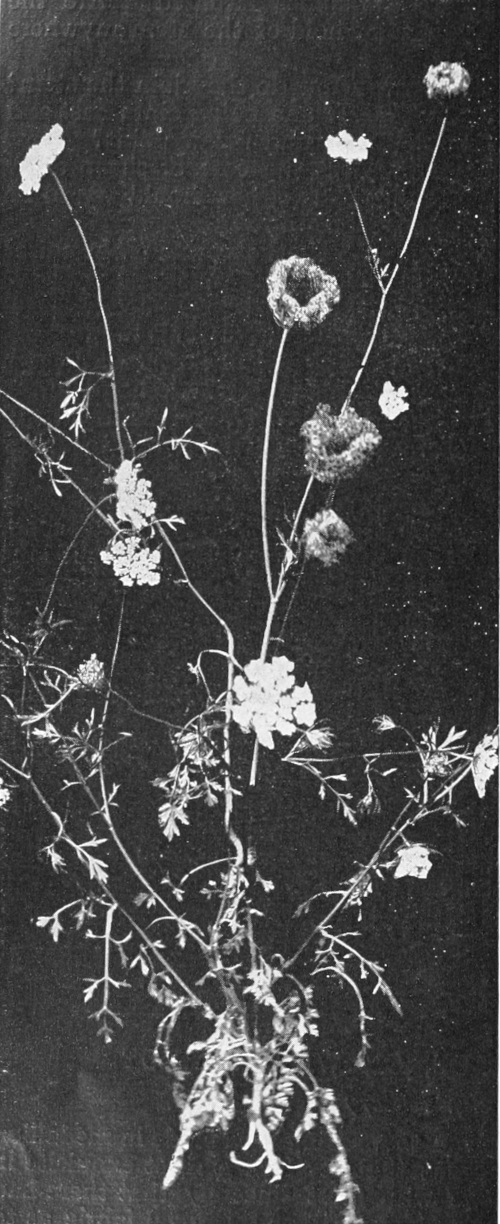
Queen Anne’s lace, or wild carrot
Photo by Verne Morton.
But for those people who admire lace of intricate pattern, and beautiful blossoms whether they grow on scalawag plants or not, this medallion flower attributed to Queen Anne is well worth studying. It belongs to the family Umbelliferæ, which one of my small pupils always called umbelliferæ because, he averred, they have umbrella blossoms. In the case of Queen Anne’s lace the flower-cluster, or umbel, is made up of many smaller umbels, each a most perfect flower-cluster in itself. Each tiny white floret has five petals and should have five stamens with creamy anthers, but often has only two. However, it has always at its center two fat little pistils set snugly together, and it rests in a solid, bristly, green, cuplike calyx. Twenty or thirty of these little blossoms are set in a rosette, the stems of graded length; and where the bases of the stems meet are some long, pointed, narrow bracts, which protectingly brood the flowers in the bud and the seeds as they ripen. Each of these little flower-clusters, or umbels, has a long stem, its length being just fit to bring it to its right place in the medallion pattern of this royal lace. And these stems also have set at their bases some bracts with long, thread-like lobes, which make a delicate, green background for the opening blossoms; these bracts curl up protectingly about the buds and the seeds. If we look straight into the large flower-cluster, we can see that each component cluster, or umbelicel, seems to have its own share in making the larger pattern; the outside blossoms of the outside clusters have the outside petals larger, thus forming a beautiful border and calling to mind the beautiful flowers of the Composites. At the very center of this flower medallion, there is often a larger floret with delicate wine-colored petals; this striking floret is not a part of a smaller flower-cluster, but stands in stately solitude upon its own isolated stem. The reason for this giant floret at the center of the wide, circular flower-cluster is a mystery; and so far as I know, the botanists have not yet explained the reason for its presence. May we not, then, be at liberty to explain its origin on the supposition that her Royal Highness, Queen Anne, was wont to fasten her lace medallions upon her royal person with garnet-headed pins?
When the flowers wither and the seeds begin to form, the flower-cluster then becomes very secretive; every one of the little umbels turns toward the center, its stem curving over so that the outside umbels reach over and “tuck in” the whole family; and the threadlike bracts at the base reach up as if they, too, were in the family councils, and must do their slender duty in helping to make the fading flowers into a little, tightfisted clump; and all of this is done so that the precious seeds may be safe while they are ripening. Such little porcupines as these seeds are! Each seed is clothed with long spines set in bristling rows, and is a most forbidding-looking youngster when examined through a lens; and yet there is method in its spininess, and we must grudgingly grant that it is not only beautiful in its ornamentation but is also well fitted to take hold with a will when wandering winds sift it down to the soil.
The wild carrot is known in some localities as the “bird’s-nest weed,” because the maturing seed-clusters, their edges curving inward, look like little birds’ nests. But no bird’s nest ever contained so many eggs as does this imitation one. In one we counted 34 tiny umbels on which ripened 782 seeds; and the plant, from which this “bird’s nest” was taken, developed nine more quite as large.
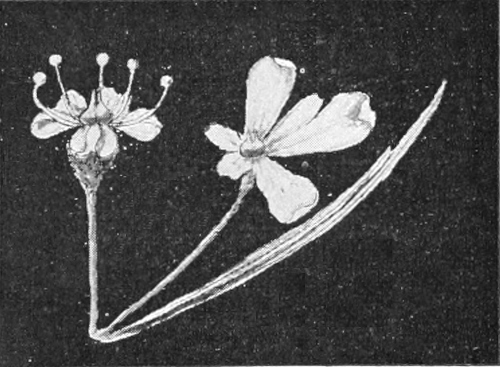
An inner and a border floret and a bract of Queen Anne’s lace, enlarged.
Altogether the wild carrot is well fitted to maintain itself in the struggle for existence, and is most successful in crowding out its betters in pasture and meadow. Birds do not like its spiny seeds; the stem of the plant is tough and its leaves are rough and have an unpleasant odor and acrid taste, which render it unpalatable to grazing animals. Winter’s cold cannot harm it, for it is a biennial; its seeds often germinate in the fall, sending down long, slender taproots crowned with tufts of inconspicuous leaves; it thus stores up a supply of starchy food which enables it to start early the next season with great vigor. The root, when the plant is fully grown, is six or eight inches long, as thick as a finger and yellowish white in color; it is very acrid and somewhat poisonous.
The surest way of exterminating the Queen Anne’s lace is to prevent its prolific seed production by cutting or uprooting the plants as soon as the first blossoms open.
“’Tis Eden everywhere to hearts that listen And watch the woods and meadows grow.” —Theron Brown.
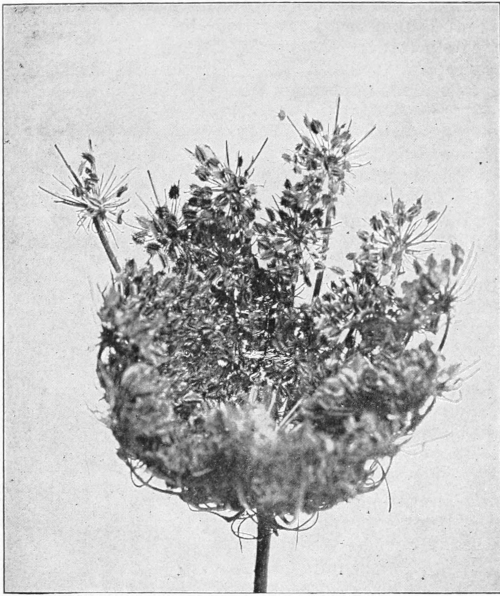
Seed-cluster, or “bird’s nest,” of wild carrot.
Photo by Charles F. Fudge.
LESSON CXLVIII
Queen Anne’s Lace, or Wild Carrot
Leading thought—Queen Anne’s lace is a weed which came to us from Europe and flourishes better here than on its native soil. It has beautiful blossoms set in clusters, and it matures many seeds which it manages to plant successfully.
Method—The object of this lesson should be to show the pupils how this weed survives the winter and how it is able to grow where it is not wanted, maintaining itself successfully, despite man’s enmity. The weed is very common along most country roadsides, and in many pastures and meadows. It blossoms very late in the autumn, and is available for lessons often as late as November. Its seed-clusters may be used for a lesson at almost any time during the winter.
Observations—1. Look at a wild carrot plant; how are its blossoms arranged? Take a flower-cluster, what is its shape? How many small flower-clusters make the large one? How are these arranged to make the large cluster symmetrical?
2. Take one of the little flower-clusters from near the center, and one from the outside, of the large cluster; how many little flowers, or florets make up the smaller cluster? Look at one of the florets through a lens; can you see the cup-shaped calyx? How many petals has it? Can you see its five anthers and its two white pistils?
3. Take one of the outer florets of the outside cluster; are all its flowers the same shape? How do they differ? Where are the florets with the large petals placed in the big flower-cluster? How does this help to make “the pattern?”
4. Do the outside or the central flowers of the large clusters open first? Can you find a cluster with an almost black or very dark red floret at its center? Is this dark flower a part of one of the little clusters or does it stand alone, its stem reaching directly to the main stalk? Do you think it makes the flowers of the Queen Anne’s lace prettier to have this dark red floret at the center?
5. Take a flower-cluster with the flowers not yet open. Can you see the threadlike green bracts that close up around each bud? Can you see finely divided, threadlike bracts that stand out around the whole cluster? What position do these bracts assume when the flowers are open? What do they do after the flowers fade and the seeds are being matured?
6. What is the general shape of the seed-cluster of the wild carrot? Have you ever found such a cluster broken off and blowing across the snow? Do you think this is one way the seed is planted?
7. Examine a single seed of the wild carrot with a lens. Is it round or oblong? Thin or flat? Is it ridged or grooved? Has it any hooks or spines by which it might cling to the clothing of passers-by, or to the hair or fleece of animals, and thus be scattered more widely? Does the seed cling to its stem or break away readily when it is touched?
8. Take one seed-cluster and count the number of seeds within it. How many seed-clusters do you find on a single plant? How many seeds do you, therefore, think a single plant produces?
9. What should you consider the best means of destroying this prolific weed?
10. What do you think is the reason that the wild carrot remains untouched, so that it grows vigorously and matures its seeds in lanes and pastures where cattle graze?
11. Have you noticed any birds feeding on the seeds of the wild carrot?
I do not want change: I want the same old and loved things, the same wild flowers, the same trees and soft ash-green; the turtle-doves, the blackbirds, the coloured yellow-hammer sing, sing, singing so long as there is light to cast a shadow on the dial, for such is the measure of his song, and I want them in the same place. Let me find them morning after morning, the starry-white petals radiating, striving upwards to their ideal. Let me see the idle shadows resting on the white dust; let me hear the humble-bees, and stay to look down on the rich dandelion disc. Let me see the very thistles opening their great crowns—I should miss the thistles; the reed-grasses hiding the moor-hen; the bryony bine, at first crudely ambitious and lifted by force of youthful sap straight above the hedgerow to sink of its own weight presently and progress with crafty tendrils; swifts shot through the air with outstretched wings like crescent-headed shaftless arrows darted from the clouds; the chaffinch with a feather in her bill; all the living staircase of the spring, step by step, upwards to the great gallery of the summer—let me watch the same succession year by year. —“The Pageant of Summer,” by Richard Jefferies.
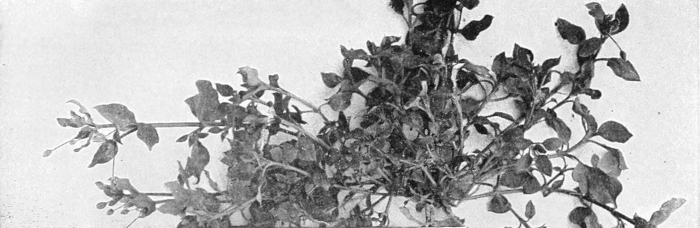
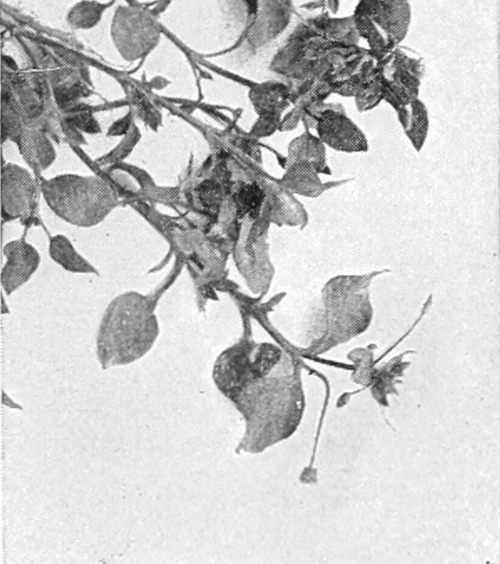
Chickweed.
Photo by Cyrus Crosby.
WEEDS
WEEDS
“The worst weed in corn may be—corn.” —Professor I. P. Roberts.
Nature is the great farmer. Continually she sows and reaps, making all the forces of the universe her tools and helpers; the sun’s rays, wind, rain and snow, insects and birds, animals small and great, even to the humble burrowing worms of the earth—all work mightily for her, and a harvest of some kind is absolutely sure. But if man interferes and insists that the crops shall be only such as may benefit and enrich himself, she seems to yield a willing obedience, and under his control does immensely better work than when unguided. But Dame Nature is an “eye-servant.” Let the master relax his vigilance for ever so short a time, and among the crops of his desire will come stealing in the hardy, aggressive, and to him, useless plants that seem to be her favorites.
A weed is a plant growing where we wish something else to grow, and a plant may, therefore, be a weed in some locations and not in others. The mullein is grown in greenhouses in England as the American velvet plant. Our grandmothers considered “butter-and-eggs,” a pretty posy, and planted it in their gardens, wherefrom it escaped, and is now a bad weed wherever it grows. A weed may crowd out our cultivated plants, by stealing the moisture and nourishment in the soil which they should have; or it may shade them out by putting out broad leaves and shutting off their sunlight. When harvested with a crop, weeds may be unpalatable to the stock which feed upon it; or in some cases, as in the wild parsnip, the plant may be poisonous.
Each weed has its own way of winning in the struggle with our crops, and it behooves us to find that way as soon as possible in order to circumvent it. This we can only do by a careful study of the peculiarities of the species. To do this we must know the plant’s life history; whether it is an annual, surviving the winter only in its seeds; or a biennial, storing in fleshy root or in broad, green leafy rosette the food drawn from the soil and air during the first season, to perfect its fruitage in the second year; or a perennial, surviving and springing up to spread its kind and pester the farmer year after year, unless he can destroy it “root and branch.” Purslane is an example of the first class, burdock or mullein of the second, and the field sorrel or Canada thistle of the third. According to their nature the farmer must use different means of extermination; he must strive to hinder the annuals and biennials from forming any seed whatever; and where perennials have made themselves a pest, he must put in a “hoed crop,” requiring such constant and thorough tillage that the weed roots will be deprived of all starchy food manufactured by green leaves and be starved out. Especially every one who plants a garden should know how the weeds look when young, for seedlings of all kinds are delicate and easy to kill before their roots are well established.
LESSON CXLIX
Outline for the Study of a Weed
1. Why do we call a plant a weed? Is a weed a weed wherever it grows? How about “butter and eggs” when it grew in Grandmother’s garden? Why do we call that a weed now? What did Grandmother call it?
2. In how many ways may a weed injure our cultivated crops?
3. Why must we study the habits of a weed before we know how to fight it?
We should ask of every weed in our garden or on our land the following questions, and let it answer them through our observations in order to know why the weed grows where it chooses, despite our efforts.
4. How did this weed plant itself where I find it growing? By what agency was its seed brought and dropped?
5. What kind of root has it? If it has a tap-root like the mullein, what advantage does it derive from it? If it has a spreading shallow-growing root like the purslane what advantage does it gain? If it has a creeping rootstock with underground buds like the Canada thistle, how is it thereby helped?
6. Is the stem woody or fleshy? Is it erect or reclining or climbing? Does it gain any advantage through the character of its stem?
7. Note carefully the leaves. Are they eaten by grazing animals? If not, why? Are they covered with prickles like the teazel or fuzz like the mullein, or are they bitter and acrid like the wild carrot?
8. Study the blossoms. How early does the weed bloom? How long does it remain in bloom? Do insects carry pollen for the flowers? If so, what insects? What do the insects get in return? How are the flower buds and the ripening seeds protected?
9. Does it ripen many seeds? Are these ripened at the same time or are they ripened during a long period? Of what advantage is this? How are the seeds scattered, carried and planted? Compute how many seeds one plant of this weed matures in one year.
“That which ye sow ye reap. See yonder fields! The sesamum was sesamum, the corn Was corn. The Silence and the Darkness know!” —Edwin Arnold.
Courtesy of Doubleday, Page & Co.
CULTIVATED-PLANT STUDY
THE CROCUS
Teacher’s Story
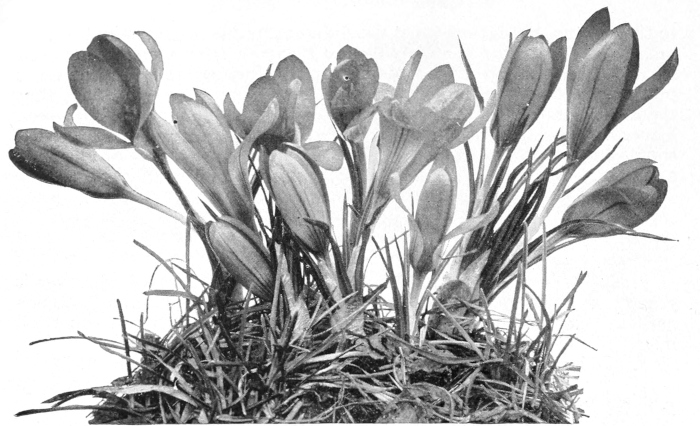
The crocus, like the snowdrop, cannot wait for the snow to be off the ground before it pushes up its gay blossoms, and it has thus earned the gratitude of those who are winter weary.
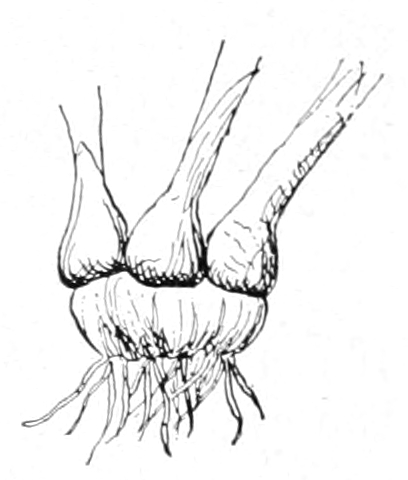
The old and young corms of the crocus.
The crocus has a corm instead of a bulb like the snowdrop or daffodil. A corm is a solid, thickened, underground stem, and is not in layers, like the onion. The roots come off the lower side of the corm. The corm of the crocus is well wrapped in several, usually five, white coats with papery tips. When the plant begins to grow the leaves push up through the coats. The leaves are grasslike and may be in number from two to eight, depending on the variety. Each leaf has its edge folded, and the white midrib has a plait on either side, giving it the appearance of being box-plaited on the under side. The bases of the leaves enclosed in the corm coats are yellow, since they have had no sunlight to start their starch factories and the green within their cells. At the center of the leaves appear the blossom buds, each enclosed in a sheath.
The petals and sepals are similar in color, but the three sepals are on the outside, and their texture, especially on the outer side, is coarser than that of the three protected petals. But sepals and petals unite into a long tube at the base. At the very base of this corolla tube, away down out of sight, even below the surface of the ground, is the seed-box, or ovary. From the tip of the ovary the style extends up through the corolla-tube and is tipped with a ruffled three-lobed stigma.
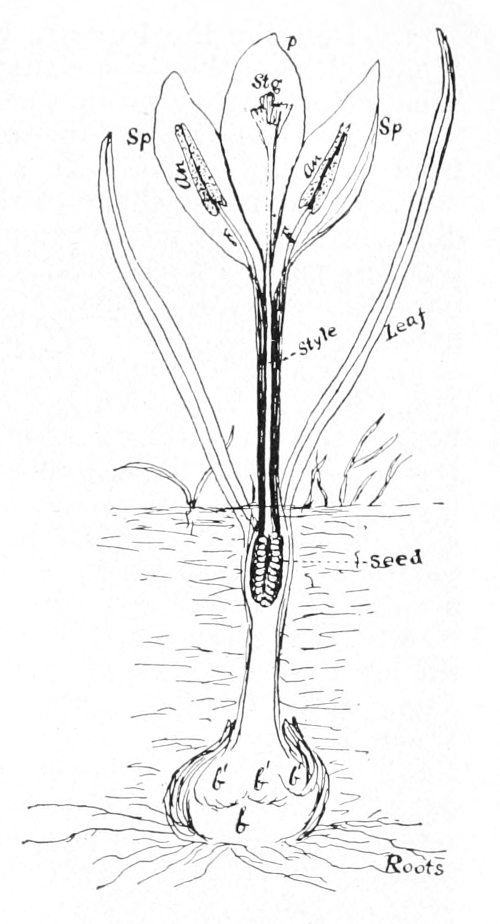
The crocus.
p, petal; sp, sepal; an, anther; f, filament; stg, stigma; b, mother corm; b¹ b¹ b¹, young corms.
The three stamens are set at the throat of the corolla tube. The anthers are very long and open along the sides. The anthers mature first, and shed their pollen in the cup of the blossom where any insect, seeking the nectar in the tube of the corolla, must become dusted with it. However, if the stigma lobes fail to get pollen from other flowers, they later spread apart and curl over until they reach some of the pollen of their own flower.
Crocus blossoms have varied colors: white, yellow, orange, purple, the latter often striped or feather-veined. And, while many seeds like tiny pearls, are developed in the oblong capsule, yet it is chiefly by its corms that the crocus multiplies. On top of the mother corm of this year develop several small corms, each capable of growing a plant next year. But after two years of this second-story sort of multiplication the young crocuses are pushed above the surface of the ground. Thus, they need to be replanted every two or three years. Crocuses may be planted from the first of October until the ground freezes. They make pretty borders to garden beds and paths. Or they may be planted in lawns without disturbing the grass, by punching a hole with a stick or dibble and dropping in a corm and then pressing back the soil in place above it. The plants will mature before the grass needs to be mowed.
LESSON CL
The Crocus
Leading thought—The crocuses appear so early in the spring, because they have food stored in underground storehouses. They multiply by seeds and by corms.
Method—If it is possible to have crocuses in boxes in the schoolroom windows, the flowers may thus best be studied. Otherwise, when crocuses are in bloom bring them into the schoolroom, bulbs and all, and place them where the children may study them at leisure.
Observations—1. At what date in the spring have you found crocuses in blossom? Why are they able to blossom so much earlier than other flowers?
2. Take a crocus just pushing up out of its bulb. How many overcoats protect its leaves? What is at the very center of the bulb? Has the flower bud a special overcoat?
3. Describe the leaves. How are they folded in their overcoats? What color are they where they have pushed out above their overcoats? What color are they within the overcoats? Why?
4. Do the flowers or the leaves have stems, or do they arise directly from the bulb?
5. What is the shape of the open crocus flower? Can you tell the difference between sepals and petals in color? Can you tell the difference by their position? Or by their texture above or below? As you look into the flower, which make the points of the triangle, the sepals or the petals?
6. Describe the anthers. How long are they? How many are there? How do they open? What is the color of the pollen? Describe how a bee becomes dusted with pollen? Why does the bee visit the crocus blossom? If she finds nectar there, where is it?
7. Describe the stigma. Open a flower and see how long the style is? How do the sepals and petals unite to protect the style? Where is the seed-box? Is it so far down that it is below ground? How many seeds are developed from a single blossom?
8. How many colors do you find in the crocus flowers? Which are the prettiest in the lawn? Which, in the flower beds?
9. How do the crocus blossoms act in dark and stormy weather? When do they open? How does this benefit them?
10. How do the crocus bulbs multiply? Why do they lift themselves out of the ground and thus need resetting?
11. Describe how to raise crocuses best; the kind of soil, the time of planting, and the best situations.
Out of the frozen earth below, Out of the melting of the snow, No flower, but a film, I push to light; No stem, no bud—yet I have burst The bars of winter, I am the first O Sun, to greet thee out of the night! Deep in the warm sleep underground Life is still, and the peace profound: Yet a beam that pierced, and a thrill that smote Call’d me and drew me from far away; I rose, I came, to the open day I have won, unshelter’d, alone, remote. —“The Crocus,” by Harriet E. H. King.
When first the crocus thrusts its point of gold, Up through the still snow-drifted garden-mould, And folded green things in dim woods unclose Their crinkled spears, a sudden tremor goes Into my veins and makes me kith and kin To every wild-born thing that thrills and blows. —“A Touch of Nature,” by T. D. Aldrich.
THE DAFFODILS AND THEIR RELATIVES
Teacher’s Story
“Daffydown Dilly came up in the cold from the brown mold, Although the March breezes blew keen in her face, Although the white snow lay on many a place.”
Thus, it is that Miss Warner’s stanzas tell us the special reason we so love the daffodils. They bring the sunshine color to the sodden earth, when the sun is chary of his favors in our northern latitude; and the sight of the daffodils floods the spirit with a sense of sunlight.
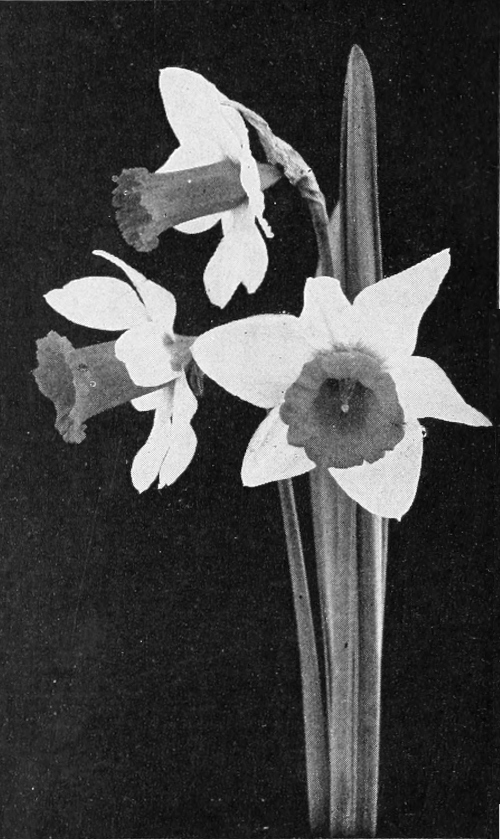
Daffodil.
The daffodils and their relatives, the jonquils and narcissus, are interesting when we stop to read their story in their form. The six segments of the perianth, or, as we would say, the three bright-colored sepals and the three inner petals of the flower, are different in shape; but they all look like petals and stand out in star-shape around the flaring end of the flower tube, which, because of its shape, is called the corona, or crown; however, it looks more like a stiff little petticoat extending out in the middle of the flower than it does like a crown. The crown is simply the widened end of the tube of the flower, as maybe seen by opening a flower lengthwise; the six seeming petals will peel off the tube, showing that they are fastened to the outside of it. When we look down into the crown of one of these flowers, we see the long style with its three-lobed stigma pushing out beyond the anthers, which are pressed close about it at the throat of the tube; between each two anthers may be seen a little deep passage, through which the tongues of the moth or butterfly can be thrust to reach the nectar. In a tube, slit open, we can see the nectar at the very bottom of it, and it is sweet to the taste and has a decided flavor. In this open tube we may see that the filaments of the stamens are grown fast to the sides of the tube for much of their length, enough remaining free to press the anthers close to the style. The ovary of the pistil is a green swelling at the base of the tube; by cutting it across we can see it is triangular in outline, and has a little cavity in each angle large enough to hold two rows of the little, white, shining, unripe seeds. Each of these cavities is partitioned from the others by a green wall; the partition is marked by a suture on the outside of the seed-pod.
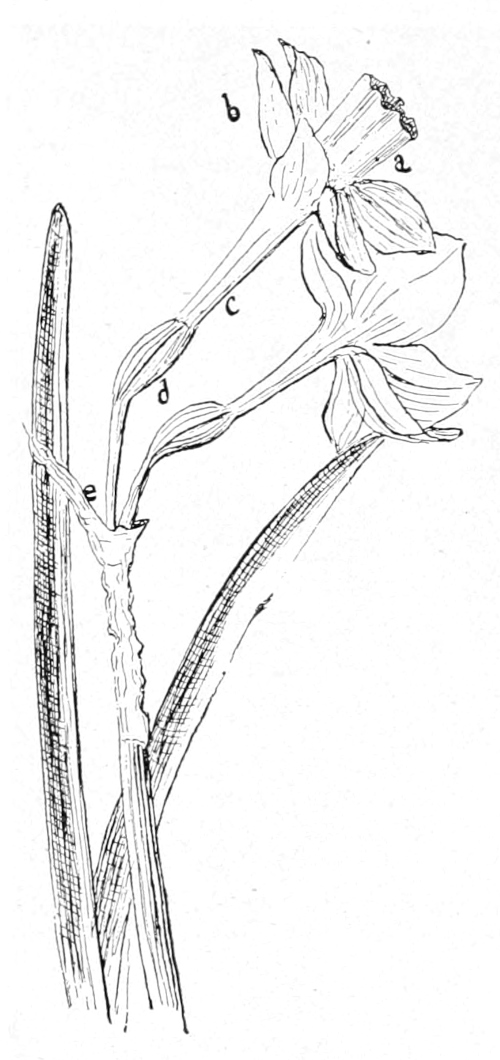
Daffodil showing detail of flower.
a, corona or crown; b, sepals and petals forming perianth; c, corolla tube; d, ovary or seed-case; e, sheath or spathe.
When the flower stalk first appears, it comes up like a sheathed sword, pointing toward the zenith, green, veined lengthwise, and with a noticeable thickening at each edge. As the petals grow, the sheath begins to round out; and then as if to confuse those people who are so stupid as to believe that plants do not really do things, the stiff stem at the base of the sheath bends at right angles. This brings a strain upon the sheath which bursts it, usually along the upper side, although sometimes it tears it off completely at the base. The slitted sheath, or spathe, hangs around the stem, wrinkled and parchment-like, very like the loose wrist of a suede glove. The stalk is a strong green tube; the leaves are fleshy and are grooved on the inner side, the groove being deep enough to clasp part way around the flower stem. The number of leaves varies with the variety, and they are usually as tall as the flower stalk. There is one flower on a stalk in the daffodils and the poet’s narcissus, but the jonquils and paper-white narcissus have two or more flowers on the same stalk.
A bed should be prepared by digging deep and fertilizing with stable manure. The bulbs should be planted in September or early October, and should be from four to six inches apart, the upper end of the bulbs at least four inches below the surface of the soil. They should not be disturbed but allowed to occupy the bed for a number of years, or as long as they give plenty of flowers. As soon as the surface of the ground is frozen in the winter, the beds should be covered from four to six inches in depth with straw-mixed stable manure, which can be raked off very early in the spring.
The new bulbs are formed at the sides of the old one; for this reason the daffodils will remain permanently planted, and do not lift themselves out of the ground like the crocuses. The leaves of the plant should be allowed to stand as long as they will after the flowers have disappeared, so that they may furnish the bulbs with plenty of food for storing. The seeds should not be allowed to ripen, as it costs the plant too much energy and thus robs the bulbs. The flowers should be cut just as they are opening. Of the white varieties, the poet’s narcissus is the most satisfactory, as it is very hardy and very pretty, its corona being a shallow, flaring, greenish yellow rosette with orange-red border, the anthers of its three longest stamens making a pretty center. No wonder Narcissus bent over the pool in joy at viewing himself, if he was as beautiful a man as the poet’s narcissus is as a flower.
LESSON CLI
Daffodils, Jonquils and Narcissus
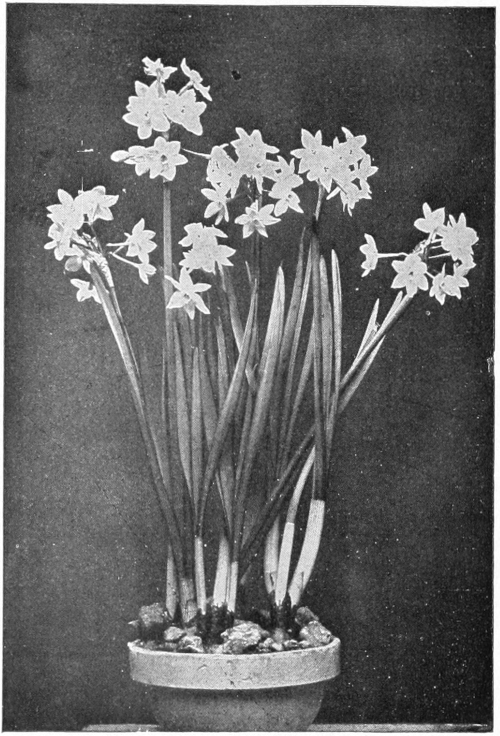
Paper-white narcissus.
Leading thought—The daffodil, jonquil and narcissus are very closely related, and quite similar. They all come from bulbs which should be planted in September; but after the first planting, they will flower on year after year, bringing much brightness to the gardens in the early spring.
Method—The flowers brought to school may be studied for form, and there should be a special study of the way the flower develops its seed, and how it is propagated by bulbs. The work should lead directly to an interest in the cultivation of the plants. In seedsmen’s catalogues or other books, the children will find methods of planting and cultivating these flowers in cities. Daffodils are especially adapted for both window gardens and school gardens.
Observations—1. Note the shape of the flower. Has it any sepals? What do we call the flowers that have their sepals colored like petals, thus forming a part of the beauty of the flower? Can you see any difference in color, position and texture between the petals and sepals?
2. How do the petal-like parts of these flowers look? How many of them are there? Do they make the most showy part of the flower?
3. What does the central part of the flower look like? Why is it called the corona, or crown? Is it a part of the tube which joins the flower to the stem? Do the petals and sepals peel off this tube? Peel them off one flower, and see that the tube is shaped like a trumpet.
4. Look down into the crown of the flower and tell what you see. Can you see where the insect’s tongue must go to reach the nectar?
5. Cut open a trumpet lengthwise to find where the nectar is. How far is it from the mouth of the tube? How long would the insect’s tongue have to be to reach it? What insects have tongues as long as this?
6. In order to reach the nectar how would an insect become dusted with pollen? Are the stamens loose in the flower-tube? Is the pistil longer than the stamens? How many parts to the stigma? Can you see how the flowers are arranged so that insects can carry pollen from flower to flower?
7. What is the green swelling in the stem at the base of the trumpet? Is it connected with the style? Cut it across and describe what you see. How do the young seeds look and how are they arranged?
8. Where the flower stem joins the stalk, what do you see? What is this dry spathe there for? Are there one or more flower stems coming from this spathe?
9. Describe the flower stalk? Are the leaves wide or narrow? Are they as long as the flower stalk, are they flat, or are they grooved to fit around the flower stalk?
10. What are the differences between daffodils, jonquils and poet’s narcissus? When should the bulbs for these flowers be planted? Will there be more bulbs formed around the one you plant? Will the same bulb ever send up flowers and leaves again? How do the bulbs divide to make new bulbs?
11. How should the bed for the bulbs be prepared? How near together should the bulbs be planted? How deep in the earth? How protect them in the North during the winter?
12. Why should you not cut the leaves off after the flowers have died? Why should you not let the seeds ripen? When should the flowers be cut for bouquets? Who was Narcissus, and why should these early spring flowers be named after him?
Supplementary reading—Green Things Growing, Mulock; The Daffodils, Wordsworth; The Story of Narcissus, Child’s Study of the Classics; Mary’s Garden, Duncan, Chapters XXVI and XXVII.
“I emphatically deny the common notion that the farm boy’s life is drudgery. Much of the work is laborious, and this it shares with all work that is productive; for the easier the job the less it is worth doing. But every piece of farm work is also an attempt to solve a problem, and therefore it should have its intellectual interest; and the problems are as many as the hours of the day and as varied as the face of nature. It needs but the informing of the mind and the quickening of the imagination to raise any constructive work above the level of drudgery. It is not mere dull work to follow the plow—I have followed it day after day—if one is conscious of all the myriad forces that are set at work by the breaking of the furrow; and there is always the landscape, the free fields, the clean soil, the rain, the promise of the crops. Of all men’s labor, the farmer’s is the most creative. I cannot help wondering why it is that men will eagerly seek work in the grease and grime of a noisy factory, but will recoil at what they call the dirty work of the farm. So much are we yet bound by tradition!” —L. H. Bailey.
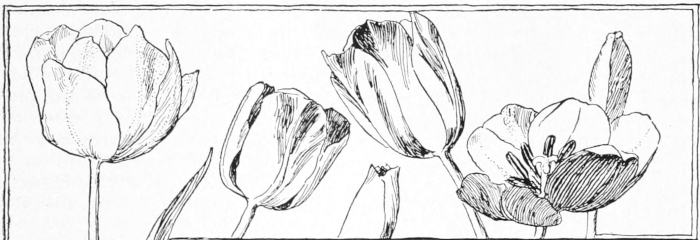
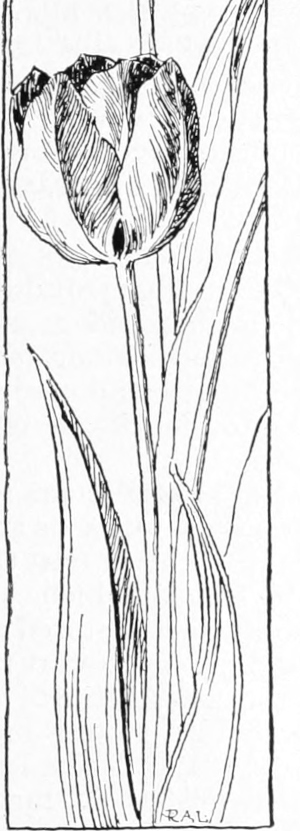
THE TULIP
THE TULIP
Teacher’s Story
We might expect that the Lady Tulip would be a stately flower, if we should consider her history. She made her way into Europe from the Orient during the sixteenth century, bringing with her the honor of being the chosen flower of Persia, where her colors and form were reproduced in priceless webs from looms of the most skilled weavers. No sooner was she seen than worshipped, and shortly all Europe was at her feet.
A hundred years later, the Netherlands was possessed with the tulip mania. Growers of bulbs, and brokers who bought and sold them, indulged in wild speculation. Rare varieties of the bulbs became more costly than jewels, one of the famous black tulips being sold for about $1800. Since then, the growing of tulips has been one of the noted industries of the Netherlands, and now the bulbs on our market are imported from Holland.
There are a great many varieties of tulips, and their brilliant colors make our gardens gorgeous in early spring. Although this flower is so prim, yet it bears well close observation. The three petals, or inner segments of the perianth, are more exquisite in texture and in satiny gloss on their inner surface than are the three outer segments or sepals; each petal is like grosgrain silk, the fine ridges uniting at the central thicker portion. In the red varieties, there is a six pointed star at the heart of the flower, usually yellow or yellow-margined, each point of the star being at the middle of a petal or sepal; the three points on the petals are longer than those on the sepals.
When the flower’s bud first appears, it is nestled down in the center of the plant, scarcely above the ground. It is protected by three green sepals. As it stretches up, the bud becomes larger and the green of the sepals takes on the color of the tulip flower, until when it opens there is little on the outside of the sepals to indicate that they once were green. But they still show that they are sepals, for they surround the petals, each standing out and making the flower triangular in shape as we look into it. During storms and dark days, the sepals again partially close about the flower.
The seed-vessel stands up, a stout, three-sided, pale green column at the center of the flower, in some varieties, its three-lobed yellowish stigma making a Doric capital; in others, the divisions are so curled as to make the capital almost Ionian. The six stout, paddle-shaped stamens have their bases expanded so as to encircle completely the base of the pistil column; these wide filaments are narrower just below the point where the large anthers join. The anther opens along each side to discharge the pollen; however, the anthers flare out around the seed vessel and do not reach half way to the stigma, which is probably the tulips’ way of inducing the insects to carry their pollen, since the bees cannot reach the nectar at the base of the pistil without dusting themselves with pollen.
The flower stem is stout, pale green, covered with a whitish bloom. The leaves are long, trough-shaped and narrow with parallel veins; the bases of the lower ones encircle the flower stem and have their edges more or less ruffled and their tips recurved; the upper leaves do not completely encircle the flower stem at their bases. The texture of the leaves is somewhat softer on the inside than on the outside, and both sides are grayish green.
After the petals and stamens are dropped the seed-vessel looks like an ornamental tip to the flower stem; it is three-sided, and has within double rows of seeds along each angle. The seeds should not be allowed to ripen as they thus take too much strength from the bulbs.
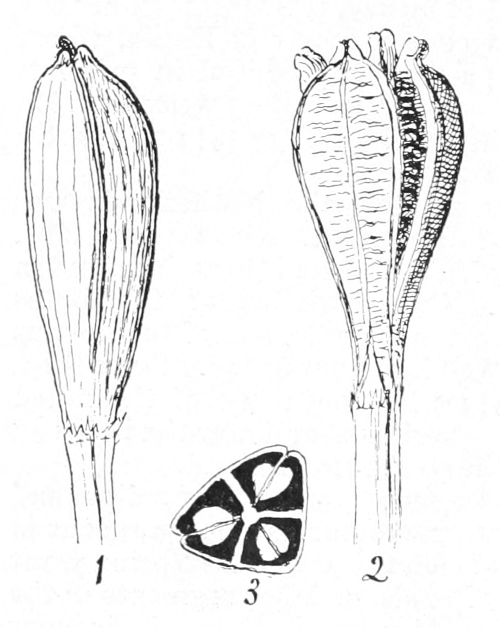
Tulip seed-capsule.
1, Tulip seed-capsule; 2, the same opened; 3, cross section of same.
The bulb is formed of several coats, or layers, each of which extends upwards and may grow into a leaf; this shows that the bulb is made up of leaves which are thickened with the food which is stored up in them during one season, so as to start the plant growing early the next spring. In the heart of each bulb is a flower bud, sheltered and cuddled by the fleshy leaf-layers around it, which protect it during the winter and furnish it food in the spring. This structure of the bulb explains why the leaves clasp the flower stem at their bases. The true roots are below the bulb, making a thick tassel of white rootlets, which reach deep into the soil for food and water.
Tulips are very accommodating; they will grow in almost any soil if it is well drained, so that excessive moisture may not rot the bulbs. In preparing a bed, it should be rounded up so as to shed water; it should also be worked deep and made rich. If the soil is stiff and clayey, set bulbs only three inches deep, with a handful of sand beneath each. If the soil is mellow loam, set the bulbs four inches deep and from four to six inches apart each way, depending on the size of the bulbs. They should be near enough so that when they blossom the bed will be covered and show no gaps. Take care that the pointed tip of the bulb is upward and that it does not fall to one side as it is covered. October is the usual time for planting as the beds are often used for other flowers during the summer. However, September is not too early for the planting, as the more root growth made before the ground freezes, the better; moreover, the early buyers have best choice of bulbs. The beds should be protected by a mulch of straw or leaves during the winter, which should be raked off as soon as the ground is thawed in the spring. The blossoms should be cut as soon as they wither, in order that the new bulbs which form within and at the sides of the parent bulb may have all of the plant food, which would otherwise go to form seed. Tulips may be grown from seed, but it takes from five to seven years to obtain blossoms, which may be quite unlike the parent and worthless. The bulblets grow to a size for blooming in two or three years; the large one which forms in the center of the plant will bloom the next season.
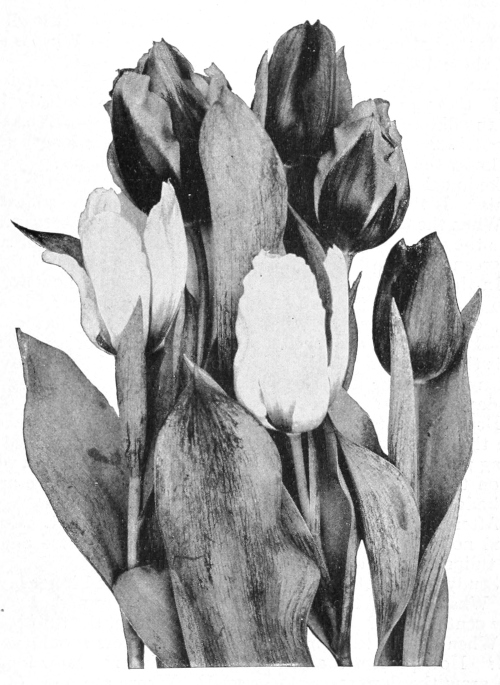
Tulips
Courtesy Doubleday, Page & Co.
LESSON CLII
The Tulips
Leading thought—The tulips blossom early, because they have food stored in the bulbs the year before, ready to use early in the spring. There are many varieties; each is worth studying carefully, and we should all know how to grow these beautiful flowers.
Methods—These observations may be made upon tulips in school gardens or bouquets. The best methods of cultivating should be a part of the garden training. For this, consult the seed catalogues; also let the pupils form some idea of the number of varieties from the seed catalogues. Water-color drawings should be a large factor in studying the tulip. The red varieties are best for beginning the study, and then follow with the other colors; note differences.
Observations—1. What is the color of your tulip? Is it all the same color? Is the bottom of the flower different in color? What is the pretty shape of these different colors at the heart of the flower?
2. Look at a tulip just opening. What causes it to appear so triangular? Can you see that the three sepals are placed outside the petals? Is there any difference in color between the sepals and petals on the inside? On the outside? Are the sepals and petals the same in length and shape? Do you know the name given to this arrangement when sepals and petals look alike in color? Are the three petals more satiny on the inside than the sepals? Is the center part of the petal as soft as the edges?
3. When the tulip flower bud first begins to show, where is it? What color are the sepals which cover it? Describe the opening of the flower? Do the green sepals fall off? What becomes of them?
4. In the open flower, where is the seed-pod, and how does it look? How do the anthers surround the seed-pod, or ovary? Describe the anthers, or pollen-boxes? What color are they? What color is the pollen? Do the anthers reach up to the stigma, or tip of seed-pod? Where is the nectar in tulips? How do the insects become covered with the pollen in reaching it? Do the flowers remain open during dark and stormy days? Why?
5. Describe the tulip stem and the leaves. Do the leaves completely encircle the flower stem at the base? Are their edges ruffled? In the sprouting plant, do these outer basal leaves enfold the leaves which grow higher on the stem? Are the leaves the same color above and below? What shade of green are they?
6. After the petals have dropped, study the seed-pod. Cut it crosswise and note how many angles it has. How are these angles filled? Should tulips be allowed to ripen seeds? Why not?
7. Study a bulb of a tulip. There are outer and inner layers and a heart. What part of the plant do the outer layers make? What part does the center make? Where are the true roots of the tulip?
8. When should tulip bulbs be planted? How should you prepare the soil? How protect the bed during the winter? How long would it take to grow the flowers from the seed? Where are most of our bulbs grown? Do you know about the history of tulips?
Supplementary reading—Bulbs and Bulb-Culture, Peter Henderson; Plants and their Children, Dana, p. 216; Mary’s Garden and How It Grew, Duncan, Ch. XXVI; Bulbs and How to Grow Them, Doubleday-Page Co.
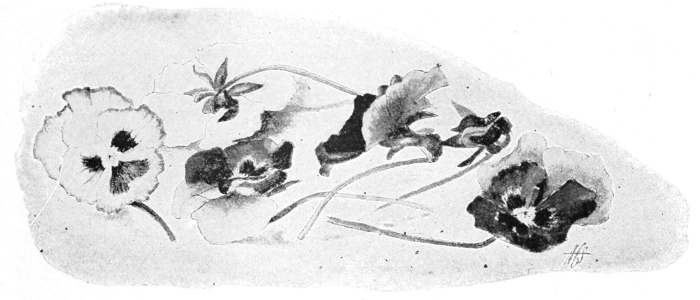
Pansies.
Drawn by Anna C. Stryke.
THE PANSY
Teacher’s Story
OME people are pansy-faced and some pansies are human-faced, and for some occult reason this puts people and pansies on a distinctly chummy basis. When we analyze the pansy face, we find that the dark spots at the bases of the side petals make the eyes, the lines radiating from them looking quite eyelashy. The opening to the nectar-tube makes the nose, while the spot near the base of the lower petal has to do for a mouth, the nectar guiding-lines being not unlike whiskers. Meanwhile, the two upper petals give a “high-browed” look to the pansy countenance, and make it a wise and knowing little face.
The pansy nectar is hidden in the spur made by the lower petal extending behind the flower. The guiding lines on the lower and side petals all converge, pointing directly to the opening which leads to this nectar-well, telling the secret to every bee that flies. Moreover, the broad lower petal is a platform for the lady bee to alight upon, while she probes the nectar-well with her tongue.
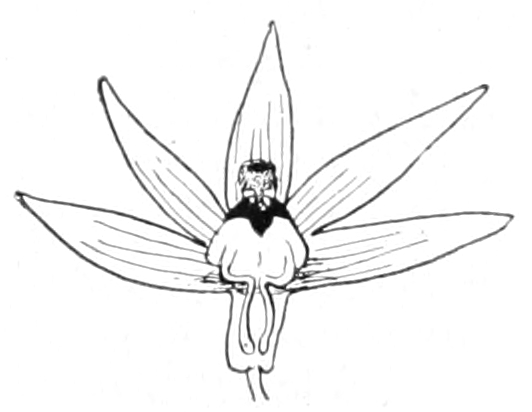
The little pansy-man.
But at the door leading to the nectar-well sits a little man; his head is green, he wears a white cape with a scalloped, reddish brown collar, and he sits with his bandy legs pushed back into the spur as if he were taking a foot bath in nectar. This little pansy man has plenty of work to do; for his mouth, which is large and at the top of his green head, is the stigma. The cape is made of five overlapping stamens, the brown, scalloped collar being the anthers; his legs consist of prolongations of the two lower stamens. And when the bee probes the nectar-well with her tongue, she tickles the little man’s feet so that his head and shoulders wriggle; and thus she brushes the pollen dust from his collar against her fuzzy face, and at the same time his mouth receives the pollen from her dusty coat.
As the pansy matures, the little man grows still more manlike; after a time he sheds his anther cape, and we can see that his body is the ribbed seed-pod. He did not eat pollen for nothing, for he is full of growing seeds. Sometimes the plush brushes, which are above his head in the pansy flower, become filled with pollen, and perhaps he gets a mouthful of it, although these brushes are supposed to keep out intruders.
The pansy sepals, five in number, are fastened at about one-third of their length, their heart-shaped bases making a little green ruffle around the stem where it joins the flower. There is one sepal above and two at each side, but none below the nectar-spur. The flower stem is quite short and always bends politely so the pansy can look sidewise at us instead of staring straight upward. The plant stem is angled and crooked and stout. In form, the leaves are most capricious; some are long and pointed, others wide and rounded. The edges are slightly scalloped and the leaf may have at its base a pair of large, deeply lobed stipules. In a whole pansy bed it would be quite impossible to find two leaves just alike.
The pansy ripens many seeds. The ribbed seed-capsule, with its base set comfortably in the faithful sepals, finally opens in three valves and the many seeds are scattered. To send them as far afield as possible, the edges of each valve of the pod curl inward, and snap the seeds out as boys snap apple seeds from the thumb and finger.
Pansies like deep, rich and cool, moist soil. They are best suited to a northern climate, and prefer the shady side of a garden to the full sunshine. The choice varieties are perpetuated through cuttings. They may be stuck in the open ground in summer in a half-shady place and should be well-watered in dry weather. All sorts of pansies are readily raised from seed sown in spring or early summer, and seedlings, when well established, do not suffer, as a rule, from winter frosts.
The general sowing for the production of early spring bloom is made out of doors in August, while seeds sown indoors from February to June will produce plants to flower intermittently during the late summer and fall months. When sowing pansy seed in August, sow the seed broadcast in a seed-bed out of doors, cover very lightly with fine soil or well-rotted manure, and press the seed in with a small board; then mulch the seed-bed with long, strawy horse manure, from which the small particles have been shaken off, to the thickness of one inch, so as to have the soil well and evenly covered. At the end of two weeks the plants will be up. Then remove the straw gradually, a little at a time, selecting a dull day if possible. Keep the bed moist.
If the pansies are allowed to ripen seeds the season of bloom will be short, for when its seeds are scattered the object of the plant’s life is accomplished. Besides, the plant has not vitality enough to perfect seeds and continue its bloom, and flowers borne with the forming seeds are smaller than the earlier ones. But if the flowers are kept plucked as they open, the plants persistently put forth new buds. The plucked flowers will remain in good condition longer if picked in the early morning before the bees begin paying calls, for a fertilized flower fades more quickly than one which has received no pollen.
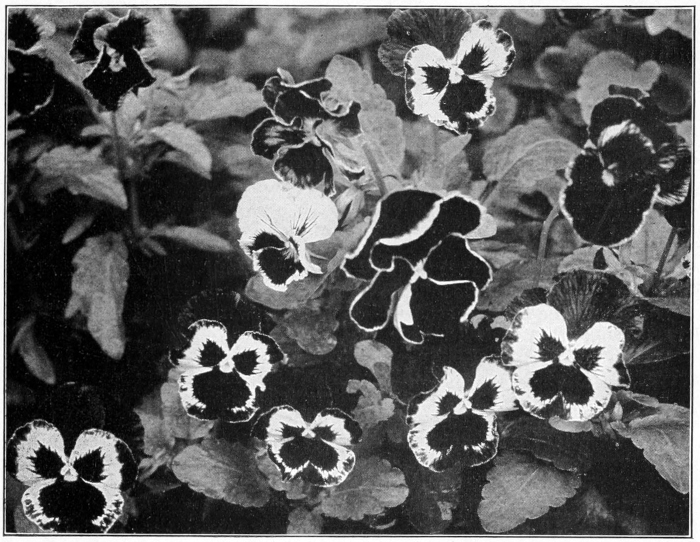
Photo by Verne Morton.
LESSON CLIII
The Pansy
Leading thought—The pansy is a member of the violet family. The flower often resembles a face; the colors, markings and fragrance all attract the bees, who visit it for the nectar hidden in the spur of the lower petal.
Method—The children naturally love pansies because of the resemblance of these flowers to quaint little faces. They become still more interested after they see the little man with the green head, which appears in the flower as it fades. A more practical interest may be cultivated by studying the great numbers of varieties in the seed catalogs and learning their names. This is one of the studies which leads directly to gardening. There are many beautiful pansy poems which should be read in connection with the lesson.
Observations—1. How does the pansy flower resemble a face? Where are the eyes? The nose? The mouth? How many petals make the pansy forehead? The cheeks? The chin?
2. Where is the nectar in the pansy? Which petal forms the nectar-tube?
3. Describe how a bee gets the nectar. Where does she stand while probing with her tongue?
4. Where is the pollen in the pansy? What is the peculiar shape of the anthers? How do the two lower stamens differ in form from the three upper ones?
5. Where is the stigma? Does the bee’s tongue go over it or under it to reach the nectar? Describe the pansy arrangement for dusting the bee with pollen and for getting pollen from her tongue.
6. Observe the soft little brushes at the base of the two side petals. What do you think they are for?
7. Take a fading flower; remove the petals, and see the little man sitting with his crooked legs in the nectar-tube. What part of the flower makes the man’s head? What parts form his cape? Of what is his pointed, scalloped collar formed?
8. How many sepals has the pansy? Describe them. How are they attached? When the flower fades and the petals fall, do the sepals also fall?
9. Where in the flower is the young seed-pod? Describe how this looks after the petals have fallen.
10. Describe how the seed-pod opens. How many seeds are there in it? How are they scattered?
11. Study the pansy stem. Is it solid? Is it smooth or rough? Is it curved? Does it stand up straight or partially recline on the ground?
12. Take a pansy leaf and sketch it with the stipules at its base. Can you find two pansy leaves exactly alike in shape, color and size?
13. At what time should the pansy seed be planted? How should the soil be prepared?
Supplementary reading—“April Fools” (p. 50), “Pansy Song” (p. 125), Nature in Verse, compiled by Mary J. Lovejoy; “Garden Folk” (p. 179), “Pansies” pp. 183–184, Among Flowers and Trees with the Poets, Wait & Leonard; “A Yellow Pansy” (p. 124), Nature Pictures by American Poets compiled by Annie Russell Marble.
I dropped a seed into the earth. It grew, and the plant was mine.
It was a wonderful thing, this plant of mine. I did not know its name, and the plant did not bloom. All I know is that I planted something apparently as lifeless as a grain of sand and there came forth a green and living thing unlike the seed, unlike the soil in which it stood, unlike the air into which it grew. No one could tell me why it grew, nor how. It had secrets all its own, secrets that baffle the wisest men; yet this plant was my friend. It faded when I withheld the light, it wilted when I neglected to give it water, it flourished when I supplied its simple needs. One week I went away on a vacation, and when I returned the plant was dead; and I missed it.
Although my little plant had died so soon, it had taught me a lesson; and the lesson is that it is worth while to have a plant.—The Nature-Study Idea, L. H. Bailey.