Part 2 — VI. INSECT STUDY (continued 2)
Reading edition
References—The following bulletins from the U. S. Dept, of Agriculture: Farmers’ Bulletin 247, “The Control of the Codling Moth and Apple Scab;” Bulletin 35, New Series, Bureau of Entomology, “Report on the Codling Moth Investigations,” price 10 cents; Bulletin 41, “The Codling Moth,” 105 pages, 15 cents, by Special Field Agent, C. B. Simpson; Bulletin 68, Part VII, “Demonstration Spraying for the Codling Moth,” price 5 cents. The Spraying of Plants, Lodeman, Macmillan Company; Economic Entomology, Smith.
LEAF-MINERS
Teacher’s Story
“And there’s never a leaf nor a blade too mean To be some happy creature’s palace.” —Lowell.
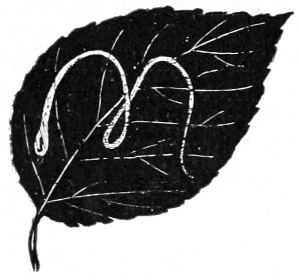
AY not Lowell have had in mind, when he wrote these lines, the canny little creatures which find sustenance for their complete growth between the upper and lower surfaces of a leaf, which seems to us as thin as a sheet of paper. To most children, it seems quite incredible that there is anything between the upper and lower surfaces of a leaf, and this lesson should hinge on the fact that in every leaf, however thin, there are rows of cells containing the living substance of the leaf, with a wall above and a wall below to protect them. Some of the smaller insects have discovered this hidden treasure, which they mine while safely protected from sight, and thus make strange figures upon the leaves.
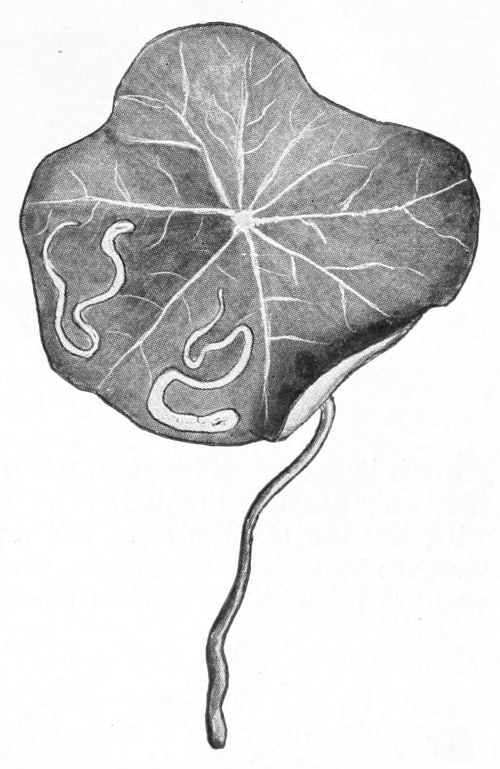
Serpentine mines in nasturtium leaf.
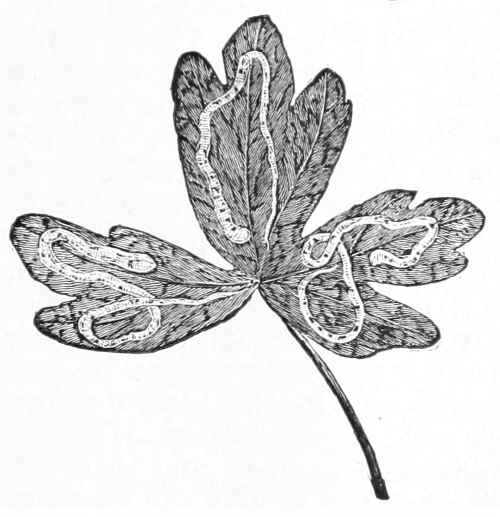
Serpentine mines in leaf of columbine.
Comstock’s Manual.
Among the most familiar of these are the serpentine mines, so called because the figure formed by the eating out of the green pulp of the leaf, curves like a serpent. These mines are made by the caterpillars of tiny moths, which have long fringes upon the hind wings. The life story of such a moth is as follows: The little moth, whose expanded wings measure scarcely a quarter of an inch across, lays an egg on the leaf; from this, there hatches a tiny caterpillar that soon eats its way into the midst of the leaf. In shape, the caterpillar is somewhat “square built,” being rather stocky and wide for its length; it feeds upon the juicy tissues of the leaf and divides, as it goes, the upper from the lower surface of the leaf; and it teaches us, if we choose to look, that these outer walls of the leaf are thin, colorless, and paper-like. We can trace the whole life history and wanderings of the little creature, from the time when, as small as a pin point, it began to feed, until it attained its full growth. As it increased in size, its appetite grew larger also, and these two forces working together naturally enlarged its house. When finally the little miner gets its growth, it makes a rather larger and more commodious room at the end of its mine, which to us looks like the head of the serpent; here it changes to a pupa, perhaps after nibbling a hole with its sharp little jaws, so that when it changes to a soft, fluffy little moth with mouth unfitted for biting, it is able to escape. In some species, the caterpillar comes out of the mine and goes into the ground to change to a pupa. By holding up to the light a leaf thus mined, we can see why this little chap was never obliged to clean house; it mined out a new room every day, and left the sweepings in the abandoned mine behind. Mines of this sort are often seen on the leaves of nasturtium, the smooth pigweed, columbine, and many other plants. There are mines of many shapes, each form being made by a different species of insect. Some flare suddenly from a point and are trumpet-shaped while some are mere blotches. The blotch mines are made, through the habits of the insect within them; it feeds around and around, instead of forging ahead, as is the case with the serpentine miners. The larvæ of beetles, flies and moths may mine leaves, each species having its own special food plant. Most of the smaller leaf mines are made by the caterpillars of the moths, which are fitly called the Tineina or Tineids. Most of these barely have a wing expanse that will reach a quarter of an inch and many are much smaller; they all have narrow wings, the hind wings being mere threads bordered with beautiful fringes. The specific names of these moths usually end in “ella;” thus, the one that mines in apple is malifoliella, the one in grain is granella. One of these little moths, Gelechia pinifoliella lives the whole of its growing life in half of a pine needle. The moth lays the egg at about the middle of the needle, and the little caterpillar that hatches from it, gnaws its way directly into the heart of the needle; and there, as snug as snug can be, it lives and feeds until it is almost a quarter of an inch long, think of it! Many a time I have held up to the light a pine needle thus inhabited, and have seen the little miner race up and down its abode as if it knew that something was happening. When it finally attains its growth it makes wider the little door, through which it entered; it does this very neatly, the door is an even oval, and looks as if it were made with the use of dividers. After thus opening the door, the caterpillar changes to a little, long pupa, very close to its exit; and later it emerges, as an exquisite little moth with silvery bands on its narrow, brown wings, and a luxurious fringe on the edges of its narrow, hind wings and also on the outer hind edges of the front wings.
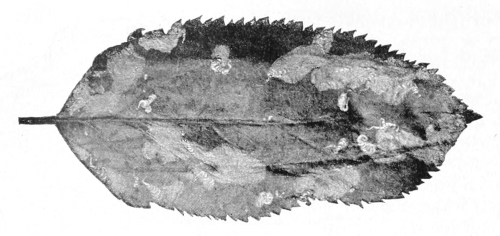
Trumpet mines in leaf of apple.
Photo by M. V. Slingerland.
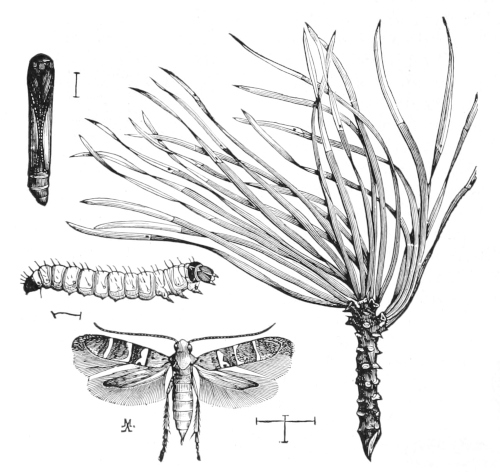
The pine-needle leaf-miner. The mined leaves of pine natural size. The caterpillar, pupa and moth of the leaf miner much enlarged. The lines show actual size of insect.
Comstock’s Manual.
The gross mines in the leaves of dock and beet are not pretty. The poor leaves are slitted, sometimes for their whole length, and soon turn brown and lie prone on the ground, or dangle pathetically from the stalk. These mines are made by the larvæ of a fly, and a whole family live in the same habitation. If we hold a leaf thus mined up to the light, while it is still green, we can see several of the larvæ working, each making a bag in the life substance of the leaf, and yet all joining together to make a great blister. The flies that do this mischief belong to the family Anthomyinæ; and there are several species which have the perturbing habit of mining the leaves of beets and spinach. It behooves those of us who are fond of these “greens,” as our New England ancestors called them, to hold every leaf up to the light before we put it into the skillet, lest we get more meat than vegetable in these viands. The flies, who thus take our greens ahead of us, are perhaps a little larger than house-flies, and are generally gray in color with the front of the head silver-white. These insects ought to teach us the value of clean culture in our gardens, since they also mine in the smooth pigweed.
References—Manual for the Study of Insects, Comstock.
LESSON LXXVII
Leaf-miners
Leading thought—The serpent-like markings and the blister-like blotches which we often see on leaves are made by the larvæ of insects which complete their growth by feeding upon the inner living substance of the leaf.
Method—The nasturtium leaf-miner is perhaps the most available for this lesson since it may be found in its mine in early September. However, the pupils should bring to the schoolroom all the leaves with mines in them, that they can find and study the different forms.
Observations—1. Sketch the leaf with the mine in it, showing the shape of the mine. What is the name of the plant on which the leaf grew?
2. Hold the leaf up to the light, can you see the insect within the mine? What is it doing? Are there more than one insect in the mine? Open the mine and see how the miner looks.
3. There are three general types of mines: Those that are long, curving lines called serpentine mines; those that begin small and flare out, called trumpet mines; and those that are blister-like called blotch mines. Which of these is the mine you are studying?
4. Study a serpentine mine. Note that where the little insect began to eat, the mine is small. Why does it widen from this point? What happened in the part which we call the serpent’s head?
5. Look closely with a lens and find if there is a break above the mine in the upper surface of the leaf or below the mine in the lower surface of the leaf. If the insect is no longer in the mine can you find where it escaped? Can you find a shed pupa-skin in the “serpent’s head?”
6. Why does an insect mine in a leaf? What does it find to eat? How is it protected from the birds or insects of prey while it is getting its growth?
7. Look on leaves of nasturtium, columbine, lamb’s quarters, dock and burdock, for serpentine mines. Are the mines on these different plants alike? Do you suppose they are made by the same insect?
8. Look on leaves of dock, burdock, beet and spinach for blotch mines. Are there more than one insect in these mines? If the insects are present, hold the leaf out to the light and watch them eat.
9. Look in the leaves of pitch or other thick leaved pines (not white pine), for pine needles which are yellow at the tip. Examine these for miners. If the miner is not within, can you find the little circular door by which it escaped? Would you think there was enough substance in a half a pine needle to support a little creature while it grew up?
10. If you find leaf-miners at work, do not pluck off the leaves being mined but cover each with a little bag of swiss muslin tied close about the petiole and thus capture the winged insect.
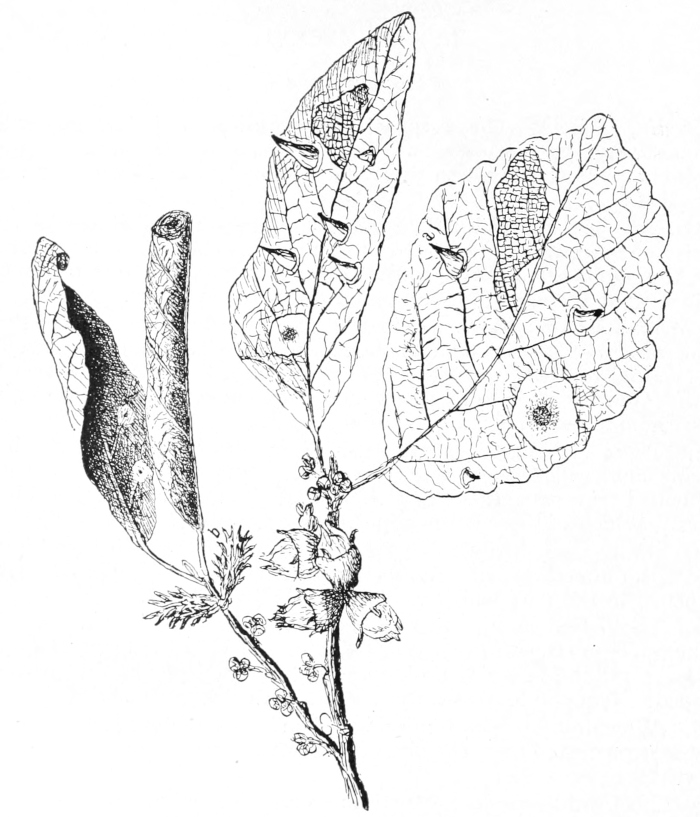
Witch-hazel, showing work of leaf-rollers, leaf-miners and gall-makers.
THE LEAF-ROLLERS
Teacher’s Story
F we look closely at sumac leaves before they are aflame from autumn’s torch, we find many of the leaflets rolled into little cornucopias fastened with silk. The silk is not in a web, like that of the spider, but the strands are twisted together, hundreds of threads combined in one strong cable, and these are fastened from roll to leaf, like tent ropes. If we look at the young basswoods, we find perhaps many of their leaves cut across, and the flap made into a roll and likewise fastened with silken ropes. The witch-hazel, which is a veritable insect tenement, also shows these rolls. In fact, we may find them upon the leaves of almost any species of tree or shrub, and each of these rolls has its own special maker or indweller. Each species of insect, which rolls the leaves, is limited to the species of plant on which it is found; and one of these caterpillars would sooner starve than take a mouthful from a leaf of any other plant. Some people think that insects will eat anything that comes in their way; but of all created animals, insects are the most fastidious as to their food.
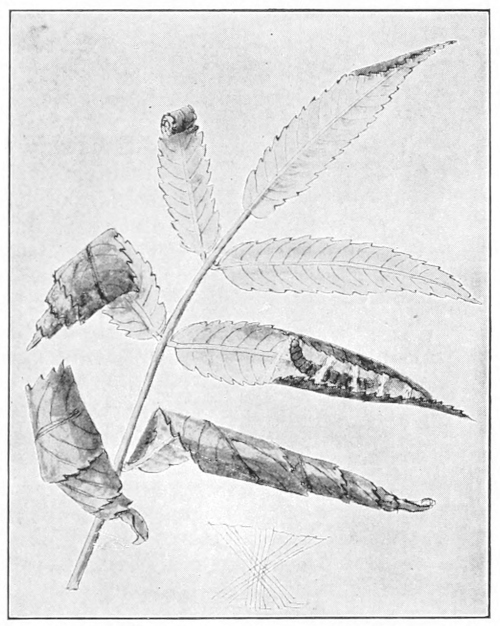
Leaf-rollers in sumac, with diagram showing the fastening of the silk-stay-ropes.
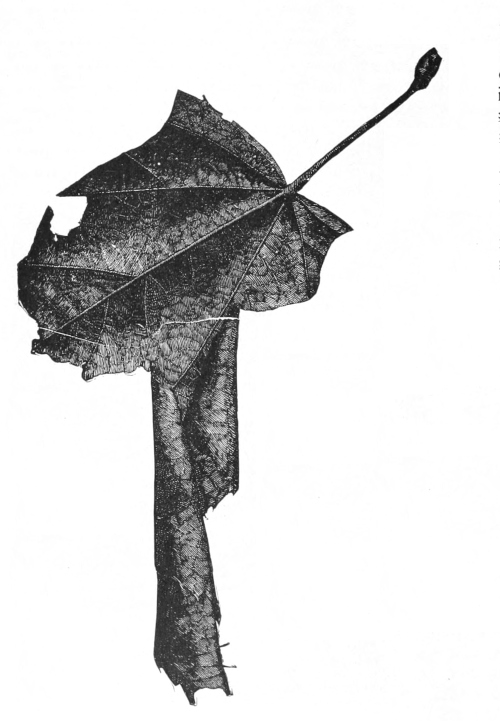
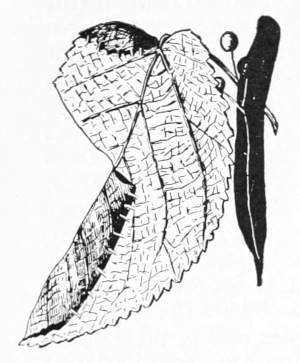
A leaf of basswood cut and rolled by the basswood leaf-roller.
Comstock. Manual.
Some species of leaf-rollers unite several leaflets together, while others use a single leaf. In the case of the sumac leaf-roller, it begins in a single leaf; but in its later stages, it fastens together two or three of the terminal leaflets in order to gain more pasturage. The little silken tent ropes which hold the folded leaves are well worth study with a lens. They are made of hundreds of threads of the finest silk, woven from a gland opening near the lower lip of the caterpillar. The rope is always larger where it is attached to the leaf than at the center, because the caterpillar crisscrosses the threads in order to make the attachment to the leaf larger and firmer. Unroll a tent carefully, and you may see the fastenings used in an earlier stage, and may even find the first turned-down edge of the leaf. However, the center of a leaf roller’s habitation is usually very much eaten, for the whole reason for making its little house is that the soft-bodied caterpillar may eat its fill completely hidden from the eyes of birds or other animals. When it first hatches from the egg, it feeds for a short time, usually on the under side of the leaf; but when still so small that we can barely see it with the naked eye, it somehow manages to fold over itself one edge of the leaf and peg it down. The problem of how so small a creature is able to pull over and fold down or to make in a roll a stiff leaf is hard to solve. I, myself, believe it is done by making many threads, each a little more taut than the last. I have watched several species working, and the leaf comes slowly together as the caterpillar stretches its head and sways back and forth hundreds of times, fastening the silk first to one side and then to the other. Some observers believe that the caterpillar throws its weight upon the silk, in order to pull the leaf together; but in the case of the sumac leaf-roller, I am sure this is not true, as I have watched the process again and again under a lens, and could detect no signs of this method. Many of the caterpillars which make rolls, change to small moths known as Tortricids. This is a very large family, containing a vast number of species and not all of the members are leaf-rollers. These little moths have the front wings rather wide and more or less rectangular in outline. The entomologists have a pleasing fashion of ending the names of all of these moths with “ana;” the one that rolls the currant leaves is Rosana, the one on juniper is Rutilana, etc. Since many of the caterpillars of this family seek the ground to pupate and do not appear as moths until the following spring, it is somewhat difficult to study their complete life histories, unless one has well-made breeding cages with earth at the bottom; and even then it is difficult to keep them under natural conditions, since in an ordinary living room the insects dry up and do not mature.
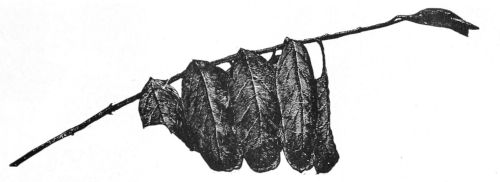
Leaflets of locust, fastened together to make a nest by the caterpillar of a butterfly.
LESSON LXXVIII
The Leaf-rollers
Leading thought—There are many kinds of insects which roll the leaves of trees and plants into tents, in which they dwell and feed during their early stages.
Method—This is an excellent lesson for early autumn when the pupils may find many of these rolled leaves, which they may bring to the schoolroom, and which will give material for the lesson. The rolls are found plentifully on sumac, basswood and witch-hazel.
Observations—1. What is the name of the trees and shrubs from which these rolled leaves which you have collected were taken?
2. Are more than one leaf or leaflet used in making the roll?
3. Is the leaf rolled crosswise or lengthwise? How large is the tube thus made?
4. Is the nest in the shape of a tube, or are several leaves fastened together, making a box-shaped nest?
5. How is the roll made fast? Examine the little silken ropes with a lens and describe one of them. Is it wider where it is attached to the leaf than at the middle? Why?
6. How many of these tent ropes are there which make fast the roll? Unroll a leaf carefully and see if you can find signs of the tent ropes that fastened the roll together when it was smaller. Can you find where it began?
7. As you unroll the leaves what do you see at the center? Has the leaf been eaten? Can you discover the reason why the caterpillar made this roll?
8. How do you think a caterpillar manages to roll a leaf so successfully? Where is the spinning gland of a caterpillar? How does the insect act when spinning threads back and forth when rolling the leaf? What sort of insect does the caterpillar which rolls the leaf change into? Do you suppose that the same kind of caterpillars makes the rolls on two different species of trees?
9. In July or early August get some of the rolls with the caterpillars in them, unroll a nest, take the caterpillar out and put it on a fresh leaf of the same kind of tree or shrub on which you found it, and watch it make its roll.
Supplementary reading—“A Dweller in Tents” and “A Little Nomad,” in Ways of the Six-Footed.
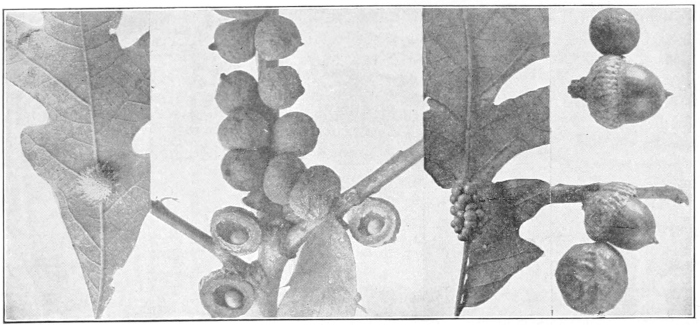
The spiny oak-gall. The pointed bullet-gall on oak twigs. A cluster of galls on midrib of oak leaf. The acorn plum-gall. Photo by L. H. Weld.
THE GALL-DWELLERS
He retired to his chamber, took his lamp, and summoned the genius as usual. “Genius,” said he, “build me a palace near the sultan’s, fit for the reception of my spouse, the princess; but instead of stone, let the walls be formed of massy gold and silver, laid in alternate rows; and let the interstices be enriched with diamonds and emeralds. The palace must have a delightful garden, planted with aromatic shrubs and plants, bearing the most delicious fruits and beautiful flowers. But, in particular, let there be an immense treasure of gold and silver coin. The palace, moreover, must be well provided with offices, storehouses, and stables full of the finest horses, and attended by equerries, grooms, and hunting equipage.” By the dawn of the ensuing morning, the genius presented himself to Aladdin, and said, “Sir, your palace is finished; come and see if it accords with your wishes.”—Arabian Nights Entertainments.
LTHOUGH Aladdin is out of fashion, we still have houses of magic that are even more wonderful than that produced by his resourceful lamp. These houses are built through an occult partnership between insects and plant tissues; and no one understands just how they are made, although we are beginning to understand a little concerning the reasons for the growth. These houses are called galls and are thus well named, since they grow because of an irritation to the plant caused by the insect.
There are many forms of these gall-dwellings, and they may grow upon the root, branch, leaf, blossom, or fruit. The miraculous thing about them is that each kind of insect builds its magical house on a certain part of a certain species of tree or plant; and the house is always of a certain definite form on the outside and of a certain particular pattern within. Many widely differing species of insects are gall-makers; and he who is skilled in gall lore knows, when he looks at the outside of the house, just what insect dwells within it.
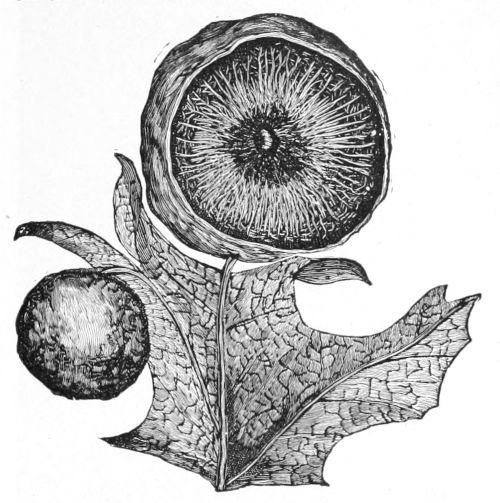
Oak apple, showing the larva of the gall insect.
Comstock’s Manual.
We may take the history of the common oak apple, as an example. A little, four-winged, fly-like creature lays its eggs, early in the season, on the leaf of the scarlet oak. As soon as the larva hatches, it begins to eat into the substance of one of the leaf veins. As it eats, it discharges through its mouth into the tissues of the leaf, a substance which is secreted from glands within its body. Immediately the building of the house commences; out around the little creature grow radiating vegetable fibers, showing by their position plainly that the grub is the center of all of this new growth; meanwhile, a smooth, thin covering completely encloses the globular house; larger and larger grows the house until we are accustomed to call it an oak apple, so large is it. The little chap inside is surely content and happy, for it is protected from the sight of all of its enemies, and it finds the walls of its house the best of food. It is comparable to a boy living in the middle of a giant sponge cake, and who when hungry would naturally eat out a larger cave in the heart of the cake. After the inmate of the oak apple completes its growth, it changes to a pupa and finally comes out into the world a tiny four-winged fly, scarcely a quarter of an inch in length.
The story of the willow cone-gall is quite different. A little gnat lays her eggs on the tip of the bud of a twig; as soon as the grub hatches and begins to eat, the growth of the twig is arrested, the leaves are stunted until they are mere scales and are obliged to overlap in rows around the little inmate, thus making for it a cone-shaped house which is very thoroughly shingled. The inhabitant of this gall is a hospitable little fellow, and his house shelters and feeds many other insect guests. He does not pay any attention to them, being a recluse in his own cell, but he civilly allows them to take care of themselves in his domain, and feed upon the walls of his house. He stays in his snug home all winter and comes out in the spring a tiny, two-winged fly.
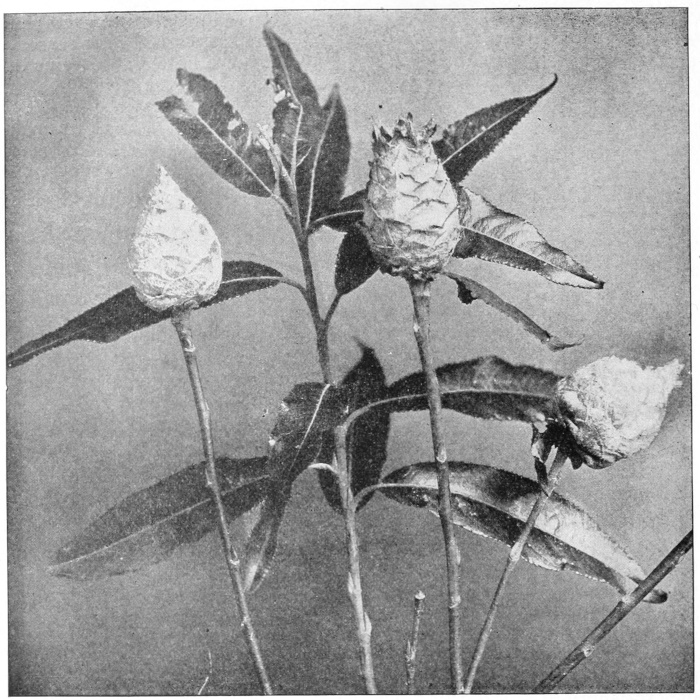
Willow cone-galls.
Photo by Verne Morton.
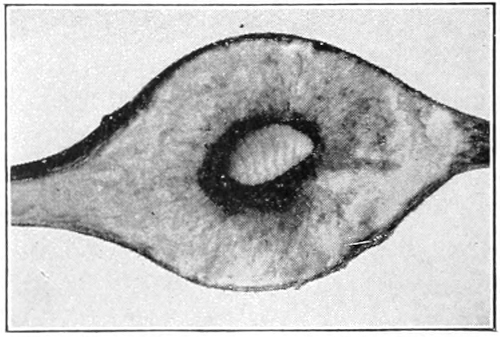
Spherical gall of goldenrod, opened, showing its prosperous looking owner.
Photo by M. V Slingerland.
There are two galls common on the stems of goldenrod. The more numerous is spherical in form and is made by a fat and prosperous looking little grub which later develops into a fly. But although it is a fly that makes the globular gall in the stem of goldenrod, the spindle-shaped gall often seen on the same stem has quite another story. A little brown and gray mottled moth, about three-fourths of an inch long, lays her egg on the stem of the young goldenrod. The caterpillar, when it hatches, lives inside the stem, which accommodatingly enlarges into an oblong room. The caterpillar feeds upon the substance of the stem until it attains its growth, and then seems to dimly realize something about its future needs. At least it cuts, with its sharp jaws, a little oval door at the upper end of its house and makes an even bevel by widening the opening toward the outside. It then makes a little plug of debris which completely fills the door; but because of the bevel, no intrusive beetle or ant can push it in. Thus the caterpillar changes to a helpless pupa in entire safety; and when the little moth issues from the pupa skin, all it has to do is to push its head against the door, and out it falls, and the recluse is now a creature of the outside world.
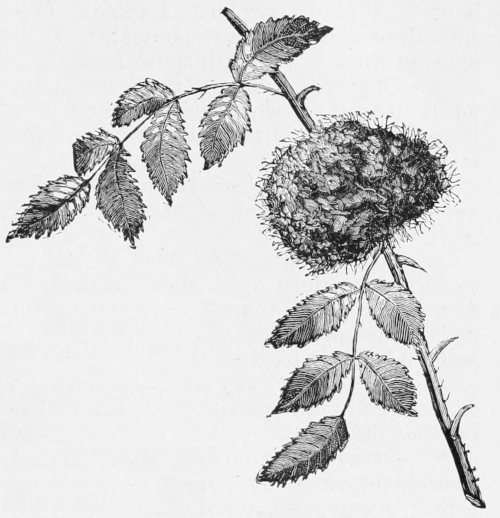
Mossy rose-gall.
Comstock’s Manual.
Many galls are compound, that is, they are made up of a community of larvæ, each in its own cell. The mossy rose-gall is an instance of this. The galls made by mites and aphids are open either below or above the surface of the leaf; the little conical galls on witch-hazel are examples of these. In fact, each gall has its own particular history, which proves a most interesting story if we seek to read it with our own eyes.
LESSON LXXIX
The Gall-dwellers
Leading thought—The galls are protective habitations for the little insects which dwell within them. Each kind of insect makes its own peculiar gall on a certain species of plant, and no one understands just how this is done or why it is so.
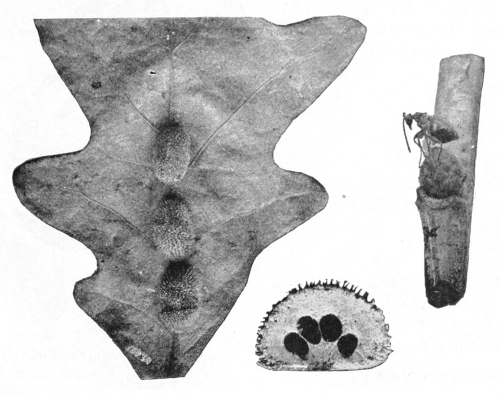
Porcupine gall on leaf of white oak. Section of same showing cells. Female gallfly laying eggs in oak bud.
Photo by C. J. Triggerson.
Method—Ask the pupils to bring in as many of these galls as possible. Note that some have open doors and some are entirely closed. Cut open a gall and see what sorts of insects are found within it. Place each kind of gall in a tumbler or jar covered with cheesecloth and place where they may be under observation for perhaps several months; note what sort of winged insect comes from each.
Observations—1. On what plant or tree did this gall grow? Were there many like it? Did they grow upon the root, stem, leaf, flower, or fruit? If on the leaf, did they grow upon the petiole or the blade?
2. What is the shape of the little house? What is its color? Its size? Is it smooth or wrinkled on the outside? Is it covered with fuzz or with spines?
3. Open the gall; is there an insect within it? If so, where is it and how does it look? What is the appearance of the inside of the gall?
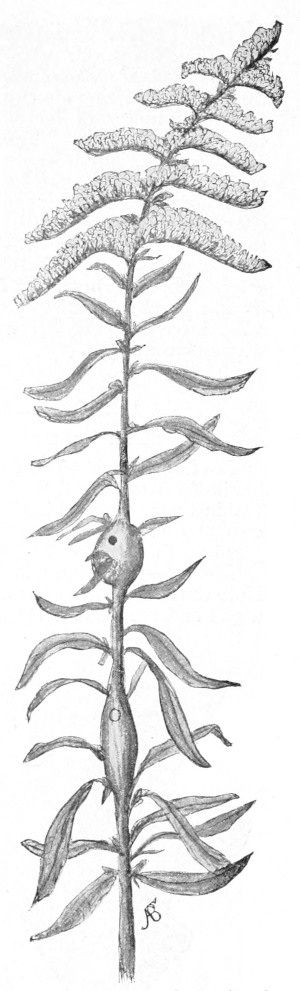
Stem of golden-rod, showing the spherical gall above, made by larva of a fly; and the spindle-shaped gall below, made by the caterpillar of a moth.
4. Is there a cell for the insect at the very center of the gall, or are there many such cells?
5. Has the house an open door? If so, does the door open above or below? Are there more than one insect in the galls with open doors? What sort of insect makes this kind of house?
6. Do you find any insects besides the original gall-maker within it? If so, what are they doing?
7. Of what use are these houses to their little inmates? How do they protect them from enemies? How do they furnish them with food?
8. Do the gall insects live all their lives within the galls or do they change to winged insects and come out into the world? If so, how do they get out?
9. How many kinds of galls can you find upon oaks? Upon goldenrod? Upon witch-hazel? Upon willow?
Supplementary reading—Outdoor Studies, Needham, pages 18 and 37; “Houses of Oak,” in Insect Stories, Kellogg; Manual for the Study of Insects.
A green little world With me at its heart! A house grown by magic, Of a green stem, a part. My walls give me food And protect me from foes, I eat at my leisure, In safety repose. My house hath no window, ’Tis dark as the night! But I make me a door And batten it tight. And when my wings grow I throw wide my door; And to my green castle I return nevermore.
THE GRASSHOPPER
Teacher’s Story
ECAUSE the grasshopper affords special facilities for the study of insect structure, it has indeed become a burden to the students in the laboratories of American universities. But in nature-study we must not make anything a burden, least of all the grasshopper, which being such a famous jumper as well as flier, does not long voluntarily burden any object.
Since we naturally select the most salient characteristic of a creature to present first to young pupils, we naturally begin this lesson with the peculiarity which makes this insect a “grasshopper.” When any creature has unusually strong hind legs, we may be sure it is a jumper, and the grasshopper shows this peculiarity at first glance. The front legs are short, the middle legs a trifle longer, but the femur of the hind leg is nearly as long as the entire body, and contains many powerful muscles which have the appearance of being braided, because of the way they are attached to the skeleton of the leg; the tibia of the hind leg is long and as stiff as if made of steel. When getting ready to jump the grasshopper lowers the great femur below the level of the closed wings and until the tibia is parallel with it and the entire foot is pressed against the ground. The pair of double spines at the end of the tibia, just back of the foot, are pressed against the ground like a spiked heel, and the whole attitude of the insect is tense. Then, like a steel spring, the long legs straighten and the insect is propelled high into the air and far away. This is a remarkable example of insect dynamics; and since so many species of birds feed upon the grasshopper, its leaping power is much needed to escape them. However, when the grasshopper makes a journey it uses its wings.
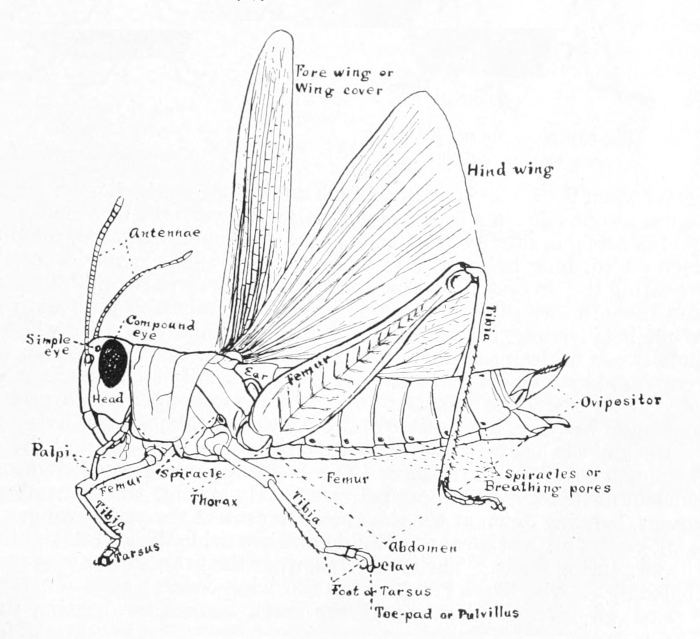
Grasshopper with parts of external anatomy named.
As we watch a grasshopper crawling up the side of a vial or tumbler we can examine its feet with a lens. Between and in front of the claws is an oval pad which clings to the glass, not by air pressure as was once supposed, but by means of microscopic hairs, called tenent hairs, which secrete a sticky fluid. Each foot consists of three segments and a claw; when the insect is quiet, the entire foot rests upon the ground; but when climbing on glass, the toe pads are used.
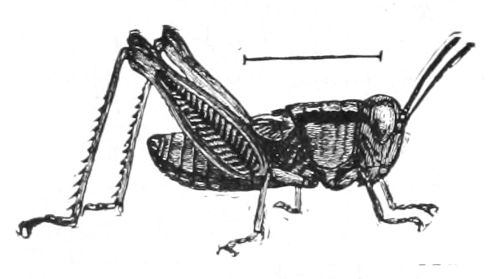
The nymph of the red-legged grasshopper, enlarged.
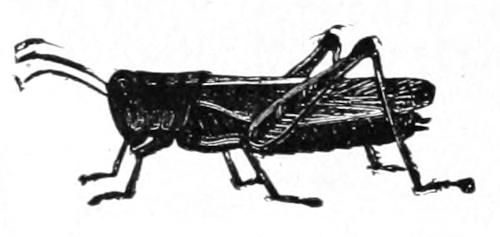
Adult of red-legged grasshopper
Comstock’s Manual.
The grasshopper’s face has a droll expression; would that some caricaturist could analyze it! It is a long face, and the compound eyes placed high upon it, give a look of solemnity. The simple eyes can be made out with a lens. There is one just in front of each big eye, and another, like the naughty little girl’s curl, is “right in the middle of the forehead.” The antennæ are short but alert. The two pairs of palpi connected with the mouth-parts are easily seen, likewise the two pairs of jaws, the notched mandibles looking like a pair of nippers. We can see these jaws much better when the insect is eating, which act is done methodically. First, it begins at one edge of a leaf, which it seizes between the front feet so as to hold it firm; it eats by reaching up and cutting downwards, making an even-edged, long hole on the leaf margin; the hole is made deeper by repeating the process. It sometimes makes a hole in the middle of a leaf and bites in any direction, but it prefers to move the jaws downward. While it is feeding, its palpi tap the leaf continually and its whole attitude is one of deep satisfaction. There is an uprolled expression to the compound eyes which reminds us of the way a child looks over the upper edge of its cup while drinking milk. The grasshopper has a preference for tender herbage, but in time of drouth will eat almost any living plant.
Back of the head is a sun-bonnet-shaped piece, bent down at the sides, forming a cover for the thorax. The grasshopper has excellent wings, as efficient as its legs; the upper pair are merely strong, thick, membranous covers, bending down at the sides so as to protect the under wings; these wing-covers are not meant for flying and are held stiff and straight up in the air, during flight. The true wings, when the grasshopper is at rest, are folded lengthwise like a fan beneath the wing-covers; they are strongly veined and circular in shape, giving much surface for beating the air. The grasshoppers’ flight is usually swift and short; but in years of famine they fly high in the air and for long distances, a fact recorded in the Bible regarding the plague of locusts. When they thus appear in vast hordes, they destroy all the vegetation in the region where they settle.
The wings of grasshoppers vary in color, those of the red-legged species being gray, while those of the Carolina locusts are black with yellow edges. The abdomen is segmented, as in all insects, and along the lower side there are two lengthwise sutures or creases which open and shut bellows-like, when the grasshopper breathes. The spiracles or breathing pores can be seen on each segment, just above this suture.
The grasshopper has its ears well protected; to find them, we must lift the wings in order to see the two large sounding disks, one on each side of the first segment of the abdomen. These are larger and much more like ears than are the little ears in the elbows of the katydids.
The singing of the short-horned grasshoppers is a varied performance, each species doing it in its own way. One species makes a most seductive little note by placing the femur and tibia of the hind legs together, and with the hind feet completely off the ground, the legs are moved up and down with great rapidity, giving off a little purr. The wings in this case, do not lift at all. There are other species that make the sound by rubbing the legs against the wing-covers.
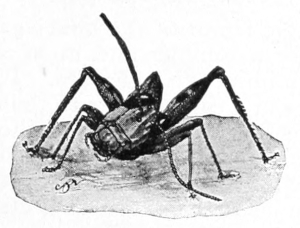
Grasshopper cleaning its antenna.
The grasshopper makes its toilet thus: It cleans first the hind feet by rubbing them together and also by reaching back and scrubbing them with the middle feet; the big hind femur it polishes with the bent elbow of the second pair of legs. It cleans the middle feet by nibbling and licking them, bending the head far beneath the body in order to do it. It polishes its eyes and face with the front feet, stopping to lick them clean between whiles, and it has a most comical manner of cleaning its antennæ; this is accomplished by tipping the head sidewise, and bending it down so that the antenna of one side rests upon the floor; it then plants the front foot of that side firmly upon the antenna and pulls it slowly backward between the foot and floor.
The grasshopper has some means of defence as well as of escape; it can give a painful nip with its mandibles; and when seized, it emits copiously from the mouth a brownish liquid which is acrid and ill-smelling. This performance interests children, who are wont to seize the insect by its jumping legs and hold it up, commanding it to “chew tobacco.”
Grasshoppers are insects with incomplete metamorphosis, which merely means that the baby grasshopper, as soon as it emerges from the egg, is similar in form to its parent except that it has a very large head and a funny little body, and that it has no quiet stage during life. When immature, the under wings or true wings have a position outside of the wing-covers and look like little fans.
The short-horned grasshoppers lay their eggs in oval masses protected by a tough overcoat. The ovipositor of the mother grasshopper is a very efficient tool, and with it she makes a deep hole in the ground, or sometimes in fence rails or other decaying wood; after placing her eggs in such a cavity, she covers the hiding place with a gummy substance so that no intruders or robbers may work harm to her progeny. Most species of grasshoppers pass the winter in the egg stage; but sometimes we find in early spring the young ones which hatched in the fall, and they seem as spry as if they had not been frozen stiff.
LESSON LXXX
The Red-Legged Grasshopper
Leading thought—The grasshopper feeds upon grass and other herbage and is especially fitted for living in grassy fields. Its color protects it from being seen by its enemies the birds. If attacked, it escapes by long jumps and by flight. It can make long journeys on the wing.
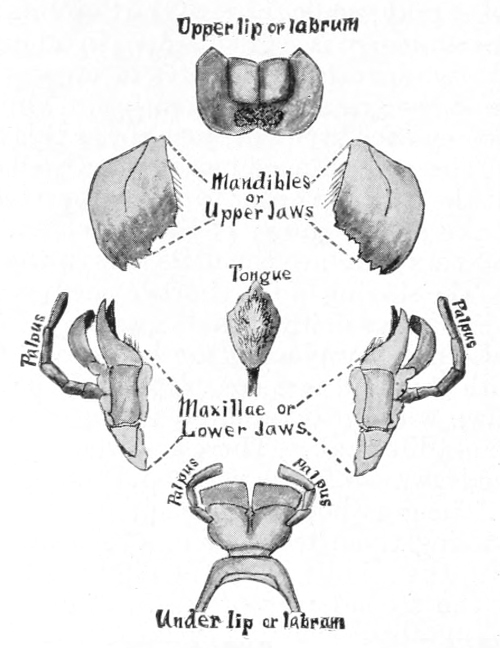
The mouth-parts of a grasshopper dissected off, enlarged and named.
Method—The red-legged grasshopper (M. femur-rubrum) has been selected for this lesson because it is the most common of all grasshoppers, though other species may be used as well. The red-legged locust, or grasshopper has, as is indicated by its name, the large femur of the hind legs reddish in color. Place the grasshopper under a tumbler and upon a spray of fresh herbage, and allow the pupils to observe it at leisure. It might be well to keep some of the grasshoppers in a cage similar to that described for crickets. When studying the feet, or other parts of the insect requiring close scrutiny, the grasshopper should be placed in a vial so that it may be passed around and observed with a lens. Give the questions a few at a time, and encourage the pupils to study these insects in the field.
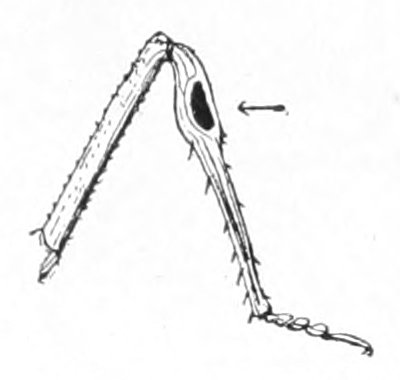
Front leg of katydid, showing ear near elbow.
Comstock’s Manual.
Observations—1. Since a grasshopper is such a high jumper, discover if you can how he does this “event.” Which pair of legs is the longest? Which the shortest? How long are the femur and tibia of the hind leg compared with the body. What do you think gives the braided appearance to the surface of the hind femur? What is there peculiar about the hind femur? Note the spines at the end of the tibia just behind the foot.
2. Watch the grasshopper prepare to jump and describe the process. How do you think it manages to throw itself so far? If a man were as good a jumper as a grasshopper in comparison to his size, he could jump 300 feet high or 500 feet in distance. Why do you think the grasshopper needs to jump so far?
3. As the grasshopper climbs up the side of a tumbler or vial, look at its feet through a lens and describe them. How many segments are there? Describe the claws. How does it cling to the glass? Describe the little pad between the claws.
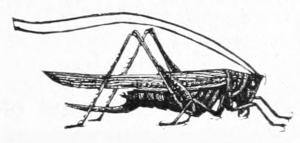
Long horned, or meadow grasshopper.
4. Look the grasshopper in the face. Where are the compound eyes situated? Can you see the tiny simple eyes like mere dots? How many are there? Where are they? How long are the antennæ? For what are they used?
5. How does a grasshopper eat? Do the jaws move up and down or sidewise? What does the grasshopper eat? How many pairs of palpi can you see connected with the mouth-parts? How are these used when the insect is eating? When there are many grasshoppers, what happens to the crops?
6. What do you see just back of the grasshopper’s head, when looked at from above?
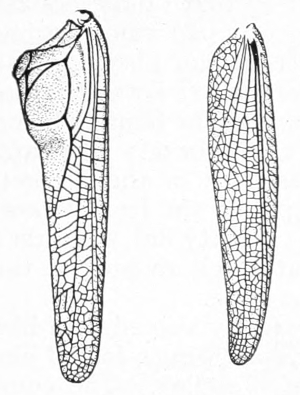
Wing of male and of female meadow grasshoppers.
Comstock’s Manual.
7. Can the grasshopper fly as well as jump? How many pairs of wings has it? Does it use the first pair of wings to fly with? How does it hold them when flying? Where is the lower or hind pair of wings when the grasshopper is walking? How do they differ in shape from the front wings?
8. Note the abdomen. It is made of many rings or segments. Are these rings continuous around the entire body? Where do their breaks occur? Describe the movement of the abdomen as the insect breathes. Can you see the spiracles or breathing pores? Lift the wings, and find the ear on the first segment of the abdomen.
9. If you seize the grasshopper how does it show that it is offended?
10. How does the grasshopper perform its toilet? Describe how it cleans its antennæ, face and legs.
11. What becomes of the grasshoppers in the winter? Where are the eggs laid? How can you tell a young from a full-grown grasshopper?
12. Do all grasshoppers have antennæ shorter than half the length of their bodies? Do some have antennæ longer than their bodies? Where are the long-horned grasshoppers found? Describe how they resemble the katydids in the way they make music and in the position of their ears.
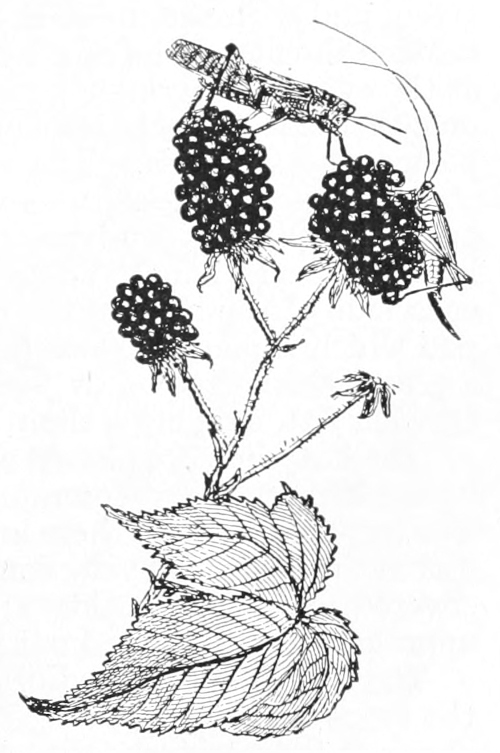
Short-horned and long-horned, or meadow, grasshoppers.
Supplementary reading—Chapters XVI-XVIII in Grasshopper Land, Morley.
THE KATYDID
Teacher’s Story
“I love to hear thine earnest voice Wherever thou art hid, Thou testy little dogmatist, Thou pretty katydid, Thou mindest me of gentle folks, Old gentle folks are they, Thou say’st an undisputed thing In such a solemn way.” Holmes.
ISTANCE, however, lends enchantment to the song of the katydid, for it grates on our nerves as well as on our ears, when at close quarters. The katydid makes his music in a manner similar to that of the cricket but is not, however, so well equipped since he has only one file and only one scraper for playing. As with the meadow grasshoppers and crickets, only the males make the music, the wings of the females being delicate and normally veined at the base. The ears, too, are in the same position as those of the cricket, and may be seen as a black spot in the front elbow. The song is persistent and may last the night long: “Katy did, she didn’t she did.” James Whitcomb Riley says, “The katydid is rasping at the silence,” and the word rasping well describes the note.
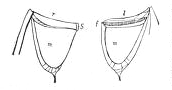
The front portions of the wings of a male katydid showing file on one wing and scraper on the other.
The katydids are beautiful insects, with green, finely veined, leaf-like wing-covers under which is a pair of well developed wings, folded like fans; they resemble in form the long-horned grasshoppers. The common northern species (Cyrtophyllus) is all green above except for the long, delicate, fawn-colored antennæ and the brownish fiddle of the male, which consists of a flat triangle just back of the thorax where the wing-covers overlap. Sometimes this region is pale brown and sometimes green, and with the unaided eye we can plainly see the strong cross-vein, bearing the file. The green eyes have darker centers and are not so large as the eyes of the grasshopper. The body is green with white lines below on either side. There is a suture the length of the abdomen in which are placed the spiracles. The insect breathes by sidewise expansion and contraction, and the sutures rhythmically open and shut; when they are open, the spiracles can be seen as black dots. The legs are slender and the hind pair, very long. The feet are provided with two little pads, one on each side of the base of the claw. In the grasshopper there is only one pad which is placed between the two hooks of the claw. The female has a green, sickle-shaped ovipositor at the end of the body. With this she lays her flat, oval eggs, slightly over-lapping in a neat row.
The katydids are almost all dwellers in trees and shrubs; although I have often found our common species upon asters and similar high weeds. The leaf-like wings of these insects are, in form and color, so similar to the leaves that they are very completely hidden. The katydid is rarely discovered except by accident; although when one is singing, it may be approached and ferreted out with the aid of a lantern.
The katydid, when feeding, often holds the leaf or the flower firmly with the front feet, while biting it off like a grazing cow, and if it is tough, chews it industriously with the sidewise working jaws. A katydid will often remain quiet a long time with one long antenna directed forward and the other backward, as if on the lookout for news from the front and the rear. But when the katydid “cleans up,” it does a thorough job. It nibbles its front feet, paying special attention to the pads, meanwhile holding the foot to its mandibles with the aid of the palpi. But once washing is not enough; I have seen a katydid go over the same foot a dozen times in succession, beginning always with the hind spurs of the tibia and nibbling along the tarsus to the claws. It cleans its face with its front foot, drawing it downward over the eye and then licking it clean. It cleans its antenna with its mandibles by beginning at the base and drawing it up in a loop as fast as finished. After watching the process of these lengthy ablutions, we must conclude that the katydid is among the most fastidious members of the insect “four hundred.”
References—Manual for Study of Insects, Comstock; American Insects, Kellogg; Ways of Six Footed, Comstock; Grasshopper Land, Morley.
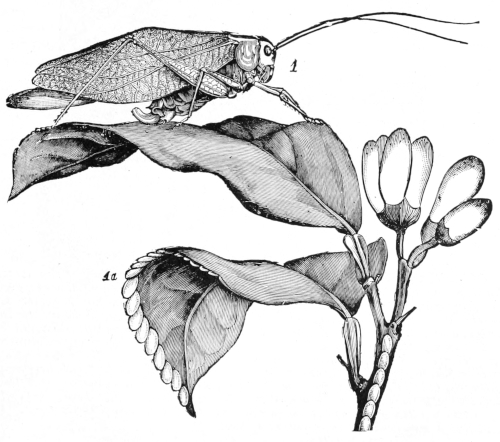
The angular-winged katydid and her eggs.
Comstock’s Manual.
LESSON LXXXI
The Katydid
Leading thought—The katydids resemble the long-horned grasshoppers and the crickets. They live in trees, and the male sings “katy-did” by means of a musical instrument similar to that of the cricket.
Method—Place a katydid in a cricket cage in the schoolroom, giving it fresh leaves or flowers each day, and encouraging the pupils to watch it at recess. It may be placed in a vial and passed around, for close observation. In studying this insect, use the lesson on the red-legged grasshopper and also that on the cricket. These lessons will serve to call the attention of the pupils to the differences and resemblances between the katydid and these two allied insects.
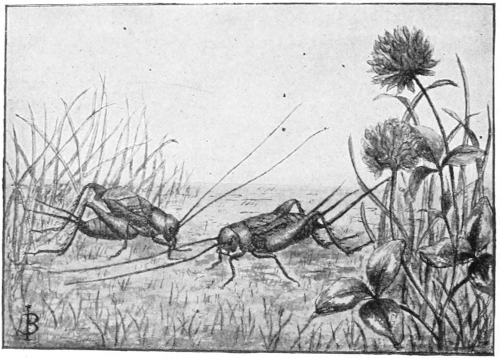
A pair of dusky lovers.
Drawing by Ida Baker.
THE BLACK CRICKETS
Of the insect musicians the cricket is easily the most popular. Long associated with man, as a companion of the hearth and the field, his song touches ever the chords of human experience. Although we, in America, do not have the house-cricket which English poets praise, yet our field-crickets have a liking for warm corners, and will, if encouraged, take up their abode among our hearthstones. The greatest tribute to the music of the cricket is the wide range of human emotion which it expresses. “As merry as a cricket” is a very old saying and is evidence that the cricket’s fiddling has ever chimed with the gay moods of dancers and merrymakers. Again, the cricket’s song is made an emblem of peace; and again we hear that the cricket’s “plaintive cry” is taken as the harbinger of the sere and dying year. From happiness to utter loneliness is the gamut covered by this sympathetic song. Leigh Hunt found him glad and thus addresses him:
“And you, little housekeeper who class With those who think the candles come too soon, Loving the fire, and with your tricksome tune Nick the glad, silent moments as they pass.” Ways of the Six-Footed.
THE BLACK CRICKET
Teacher’s Story
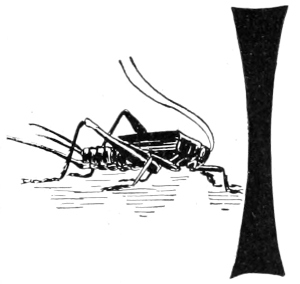
F we wish to become acquainted with these charming little troubadours of the field, we should have a cricket cage with a pair of them within it. They are most companionable, and it is interesting to note how quickly they respond to a musical sound. I had a pair in my room at one time, when I lived very near a cathedral. Almost every time that the bells rang during the night, my cricket would respond with a most vivacious and sympathetic chirping.
The patent leather finish to this cricket’s clothes is of great use; for, although the cricket is an efficient jumper, it is after all, mostly by running between grass blades that it escapes its enemies. If we try to catch one, we realize how slippery it is, and how efficiently it is thus able to slide through the fingers.
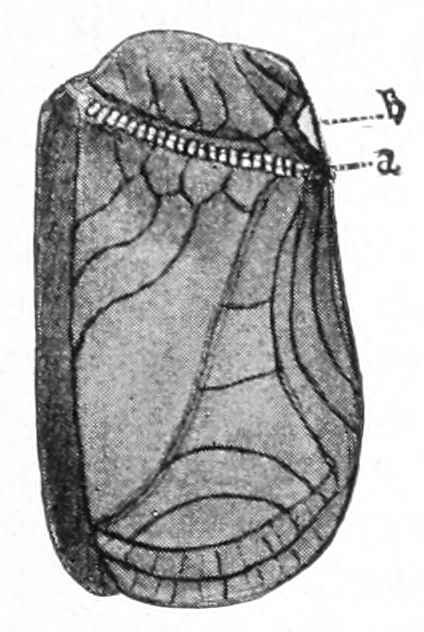
The wing of male cricket enlarged.
a, file b, scraper.
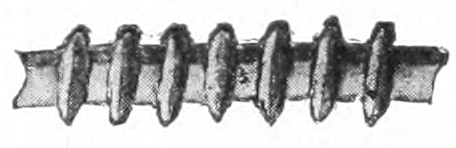
A section of the file enlarged.
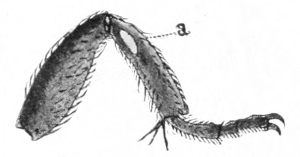
The front leg of a cricket enlarged showing ear at a.
The haunts of the cricket are usually sunny; it digs a little cave beneath a stone or clod in some field, where it can have the whole benefit of all the sunshine, when it issues from its door. These crickets cannot fly, since they have no wings under their wing-covers, as do the grasshoppers. The hind legs have a strong femur, and a short but strong tibia with downward slanting spines along the hind edge, which undoubtedly help the insect in scrambling through the grass. At the end of the tibia, next to the foot, is a rosette of five spines, the two longer ones slanting to meet the foot; these spines give the insect a firm hold, when making ready for its spring. When walking, the cricket places the whole hind foot flat on the ground, but rests only upon the claw and the segment next to it, of the front pairs of feet. The claws have no pads like those of the katydid or grasshopper; the segment of the tarsus next the claw has long spines on the hind feet and shorter spines on the middle and front feet, thus showing that the feet are not made for climbing, but for scrambling along the ground. When getting ready to jump, the cricket crouches so that the tibia and femur of the hind legs are shut together and almost on the ground. The dynamics of the cricket’s leap are well worth studying.
The cricket’s features are not so easily made out, because the head is polished and black; the eyes are not so polished as the head, and the simple eyes are present but are discerned with difficulty. The antennæ are longer than the body and very active; there is a globular segment where they join the face. I have not discovered that the crickets are so fastidious about keeping generally clean as are some other insects, but they are always cleaning their antennæ: I have seen a cricket play his wing mandolin lustily and at the same time carefully clean his antennæ; he polished these by putting up a foot and bending the antenna down so that his mouth reached it near the base; he then pulled the antenna through his jaws with great deliberation, nibbling it clean to the very end. The lens reveals to us that the flexibility of the antennæ is due to the fact that they are many jointed. The palpi are easily seen, a large pair above and a smaller pair beneath the “chin.” The palpi are used to test food and prove if it be palatable. The crickets are fond of melon or other sweet, juicy fruits, and by putting such food into the cage we can see them bite out pieces with their sidewise working jaws, chewing the toothsome morsel with gusto. They take hold of the substance they are eating with the front feet as if to make sure of it.
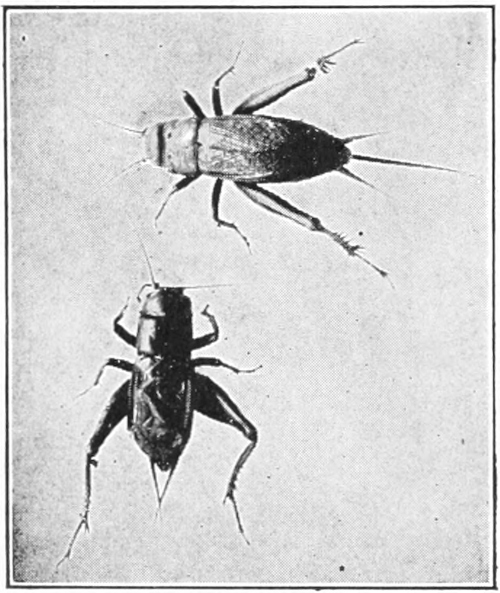
Male and female of the common black cricket, showing differences in their wings. The male is below.
Photo by M. V. Slingerland.
The wing-covers of the cricket are bent down at the sides at right angles, like a box cover. The wing-covers are much shorter than the abdomen and beneath them are vestiges of wings, which are never used. The male has larger wing-covers than the female, and they are veined in a peculiar scroll pattern. This veining seems to be a framework for the purpose of making a sounding board of the wing membrane, by stretching it out as a drum-head is stretched. Near the base of the wing-cover, there is a heavy cross-vein covered with transverse ridges, which is called the file; on the inner edge of the same wing, near the base, is a hardened portion called the scraper. When he makes his cry, the cricket lifts his wing-covers at an angle of forty-five degrees and draws the scraper of the under wing against the file of the overlapping one; lest his musical apparatus become worn out, he can change by putting the other wing-cover above. The wing-covers are excellent sounding boards and they quiver as the note is made, setting the air in vibration, and sending the sound a long distance. The female cricket’s wing-covers are more normal in venation; and she may always be distinguished from her spouse by the long sword-like ovipositor at the end of her body; this she thrusts into the ground when she lays her eggs, thus placing them where they will remain safely protected during the winter. Both sexes have a pair of “tail feathers,” as the children call them, which are known as the cerci (sing. cerca) and are fleshy prongs at the end of the abdomen.
There would be no use of the cricket’s playing his mandolin if there were not an appreciative ear to listen to his music. This ear is placed most conveniently in the tibia of the front leg, so that the crickets literally hear with their elbows, as do the katydids and the meadow grasshoppers. The ear is easily seen with the naked eye as a little white, disklike spot.
The chirp of the cricket is, in literature, usually associated with the coming of autumn; but the careful listener may hear it in early summer, although the song is not then so insistent as later in the season. He usually commences singing in the afternoon and keeps it up periodically all night. I have always been an admirer of the manly, dignified methods of this little “minnesinger,” who does not wander abroad to seek his lady love but stands sturdily at his own gate, playing his mandolin the best he is able; he has faith that his sable sweetheart is not far away, and that if she likes his song she will come to him of her own free will. The cricket is ever a lover of warmth and his mandolin gets out of tune soon after the evenings become frosty. He is a jealous musician. When he hears the note of a rival, he at once “bristles up,” lifting his wings at a higher angle and giving off a sharp militant note. If the two rivals come in sight of each other, there is a fierce duel. They rush at each other with wide open jaws, and fight until one is conquered and retreats, often minus an antenna, cerca, or even a leg. The cricket’s note has a wide range of expression. When waiting for his lady love, he keeps up a constant droning; if he hears his rival, the tone is sharp and defiant; but as the object of his affection approaches, the music changes to a seductive whispering, even having in it an uncertain quiver, as if his feelings were too strong for utterance.
References—Manual for Study of Insects, p. 115; Insect Musicians; Ways of the Six Footed, Comstock.
LESSON LXXXII
The Black Cricket
Leading thought—The crickets are among the most famous of the insect musicians. They live in the fields under stones and in burrows, and feed upon grass and clover. As with the song birds, the male only makes music; he has his wing-covers developed into a mandolin or violin, which he plays to attract his mate and also for his own pleasure.
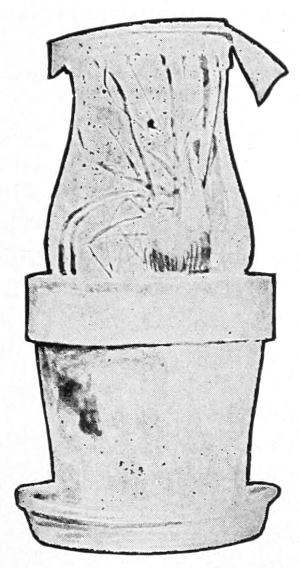
A cricket cage.
Method—Make some cricket cages as follows: Take a small flower-pot and plant in it a root of fresh grass or clover. Place over this and press well into the soil a lantern or lamp chimney. Cover the top with mosquito netting. Place the pot in its saucer, so that it may be watered by keeping the saucer filled. Ask the pupils to collect some crickets. In each cage, place a male and one or more females, the latter being readily distinguished by the long ovipositors. Place the cages in a sunny window, where the pupils may observe them at recess, and ask for the following observations. In studying the cricket closely, it may be well to put one in a vial and pass it around. In observing the crickets eat, it is well to give them a piece of sweet apple or melon rind, as they are very fond of pulpy fruits.
Observations—1. Is the covering of the cricket shining, like black patent leather, or is it dull? What portions are dull? Of what use do you think it is to the cricket to be so smoothly polished?
2. Where did you find the crickets? When you tried to catch them, how did they act? Did they fly like grasshoppers or did they run and leap?
3. Look carefully at the cricket’s legs. Which is the largest of the three pairs? Of what use are these strong legs? Look carefully at the tibia of the hind leg. Can you see the strong spines at the end, just behind the foot or tarsus? Watch the cricket jump and see if you can discover the use of these spines. How many joints in the tarsus? Has the cricket a pad like the grasshopper’s between its claws? When the cricket walks or jumps does it walk on all the tarsus of each pair of legs?
4. Study the cricket’s head. Can you see the eyes? Describe the antennæ—their color, length, and the way they are used. Watch the cricket clean its antennæ and describe the process. Can you see the little feelers, or palpi, connected with the mouth? How many are there? How does it use these feelers in tasting food before it eats? Watch the cricket eat, and see whether you can tell whether its mouth is made for biting or sucking.
5. Study the wings. Are the wings of the mother cricket the same size and shape as those of her mate? How do they differ? Does the cricket have any wings under these front wings, as the grasshopper does? Note the cricket when he is playing his wing mandolin to attract his mate. How does he make the noise? Can you see the wings vibrate? Ask your teacher to show you a picture of the musical wings of the cricket, or to show you the wings themselves under the microscope, so that you may see how the music is made.
6. Why does the mother cricket need such a long ovipositor? Where does she put her eggs in the fall to keep them safe until spring?
7. Look in the tibia, or elbow, of the front leg for a little white spot. What do you suppose this is? Are there any white spots like it on the other legs? Ask your teacher to tell you what this is.
8. Can you find the homes of the crickets in the fields? Do the black crickets chirp in the day-time or after dark? Do they chirp in cold or windy weather, or only when the sun shines?
Supplementary Reading—Grasshopper Land, Morley, Chapter XIX.
CRICKET SONG. Welcome with thy clicking, cricket! Clicking songs of sober mirth; Autumn, stripping field and thicket, Brings thee to my hearth, Where thy clicking shrills and quickens, While the mist of twilight thickens. No annoy, good-humored cricket, With thy trills is ever blent; Spleen of mine, how dost thou trick it To a calm content? So, by thicket, hearth, or wicket, Click thy little lifetime, cricket! Bayard Taylor.
THE SNOWY TREE-CRICKET
Teacher’s Story
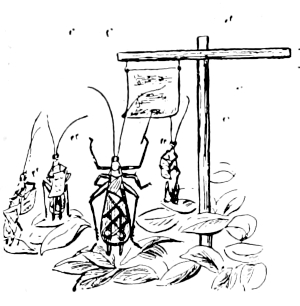
HIS is a slim, ghost-like cricket. It is pale green, almost white in color, and about three-fourths of an inch long. Its long, slender hind legs show that it is a good jumper. Its long antennæ, living threads, pale gray in color, join the head with amber globe-like segments. The pale eyes have a darker center and the palpi are very long. The male has the wing-covers shaped and veined like those of the black cricket, but they are not so broad and are whitish and very delicate. The wings beneath are wide, for these crickets can fly. The female has a long, sword-like ovipositor.
The snowy tree-cricket, like its relatives, spends much time at its toilet. It whips the front foot over an antenna and brings the base of the latter to the mandibles with the palpi and then cleans it carefully to the very tip. It washes its face with the front foot, always with a downward movement. If the hind foot becomes entangled in anything it first tries to kick it clean, and then drawing it beneath the body, bends the head so as to reach it with the mandibles and nibbles it clean. The middle foot it also thrusts beneath the body, bringing it forward between the front legs for cleaning. But when cleaning its front feet, the snowy tree-cricket puts on airs; it lifts the elbow high and draws the foot through the mouth with a gesture very like that of a young lady with a seal ring on her little finger, holding the ornate member out from its companions as if it were stiff with a consciousness of its own importance.
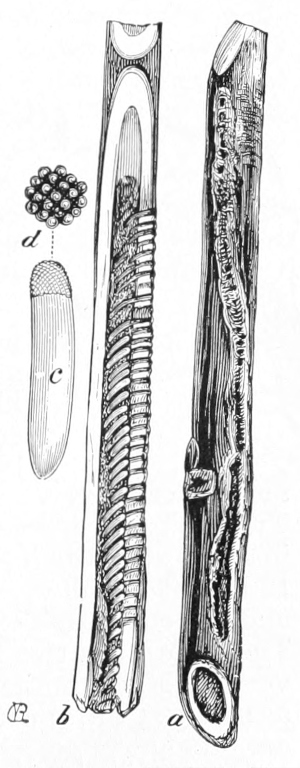
Eggs of snowy tree-cricket, laid in raspberry cane.
After C. V. Riley.
There are two common species of the snowy tree-crickets which can hardly be separated except by specialists or by watching their habits. One is called “the whistler” and lives on low shrubs or grass; it gives a clear, soft, prolonged, unbroken note. The other is called “the fiddler” and lives on shrubs and in trees and vines. Its note is a pianissimo performance of the katydid’s song; it is delightful, rhythmic and sleep-inspiring; it begins in the late afternoon and continues all night until the early, cold hours of the approaching dawn. The vivacity of the music depends upon the temperature, as the notes are given much more rapidly during the hot nights.
“So far as we know, this snowy tree-cricket is the only one of the insect musicians that seems conscious of the fact that he belongs to an orchestra. If you listen on a September evening, you will hear the first player begin; soon another will join, but not in harmony at first. For some time there may be a see-saw of accented and unaccented notes; but after a while the two will be in unison; perhaps not, however, until many more players have joined the concert. When the rhythmical beat is once established it is in as perfect time as if governed by the baton of a Damrosch or a Thomas. The throbbing of the cricket heart of September, it has been fitly named. Sometimes an injudicious player joins the chorus at the wrong beat, but he soon discovers his error and rectifies it. Sometimes, also, late at night, one part of the orchestra in an orchard gets out of time with the majority, and discord may continue for some moments, as if the players were too cold and too sleepy to pay good attention. This delectable concert begins usually in the late afternoons and continues without ceasing until just before dawn the next morning. Many times I have heard the close of the concert; with the “wee sma” hours the rhythmic beat becomes slower; toward dawn there is a falling off in the number of players; the beat is still slower, and the notes are hoarse, as if the fiddlers were tired and cold; finally, when only two or three are left the music stops abruptly.” (Ways of the Six-Footed, Comstock.)
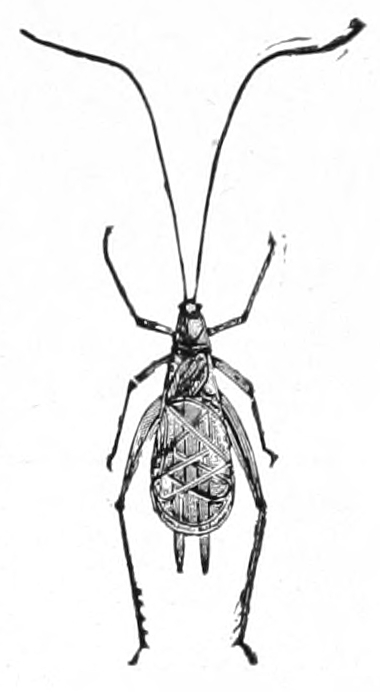
Snowy tree cricket.
The lesson on this cricket may be adapted from that on the black cricket.
THE COCKROACH
Teacher’s Story
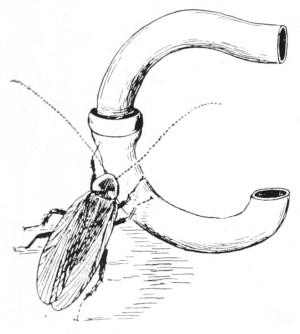
OCKROACHES in our kitchens are undoubtedly an unmitigated nuisance, and yet, as in many other instances, when we come to consider the individual cockroach, we find him an interesting fellow and exceedingly well adapted for living in our kitchens despite us.
In shape, the cockroach is flat, and is thus well adapted to slide beneath utensils and into crevices and corners. Its covering is smooth and polished like patent leather, and this makes it slippery and enables it to get into food without becoming clogged by the adherence of any sticky substance. The antennæ are very long and flexible and can be bent in any direction. They may be placed far forward to touch things which the insect is approaching, or may be placed over the back in order to be out of the way. They are like graceful, living threads, and the cockroach tests its whole environment with their aid. The mouth has two pairs of palpi or feelers, one of which is very long and noticeable; these are kept in constant motion as if to test the appetizing qualities of food. The mouth-parts are provided with jaws for biting and, like all insect jaws, these work sidewise instead of up and down. The eyes are black but not prominent or large, and seem to be merely a part of the sleek, polished head-covering.
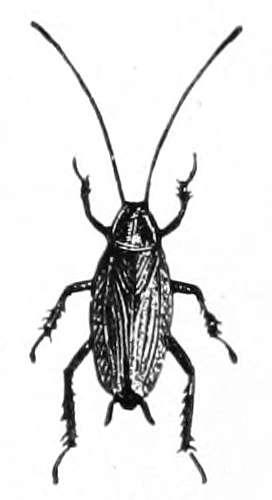
Croton bug.
Some species of cockroaches have wings, and some do not. Those which have wings, have the upper pair thickened and used for wing-covers. The under pair are thinner and are laid in plaits like a fan. The wing-covers are as polished as the body and quite as successful in shedding dirt.
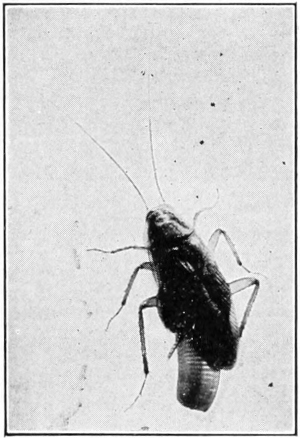
Cockroach laying her case of eggs. Photo by M. V. Slingerland.
The legs are armed with long spines which are very noticeable and might prove to be a disadvantage in accumulating filth; but they are polished also; and too, this insect spends much time at its toilet.
Cockroaches run “like a streak”, children say; so speedily, indeed, do they go that they escape our notice, although we may be looking directly at them. This celerity in vanishing, saves many a cockroach from being crushed by an avenging foot.
When making its toilet, the cockroach draws its long antenna through its jaws as if it were a whiplash, beginning at the base and finishing at the tip. It cleans each leg by beginning near the body and so stroking downward the long spines which seem to shut against the leg. It nibbles its feet clean to the very claws, and scrubs its head vigorously with the front femur.
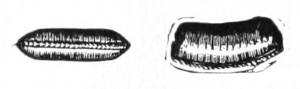
Egg-case of cockroach.
The cockroach’s eggs are laid in a mass enclosed in a pod-shaped covering, which is waterproof and polished and protects its contents from dampness. When the cockroaches, or the croton bugs, as the small introduced species of cockroach is called, once become established in a house, the only way to get rid of them is to fumigate the kitchen with carbon bisulphide which is a dangerous performance and should be done only by an expert.
LESSON LXXXIII
The Cockroach
Leading thought—The cockroach is adapted for living in crevices, and although its haunts may be anything but clean, the cockroach keeps itself quite clean. The American species live in fields and woods and under stones and sticks and only occasionally venture into dwellings. The species that infest our kitchens and water-pipes are European.
Method—Place a cockroach in a vial with bread, potato or some other food, cork the vial, and pass it around so that the children may observe the prisoner at their leisure.
Observations—1. What is the general shape of the cockroach? Why is this an advantage? What is the texture of its covering? Why is this an advantage?
2. Describe the antennæ and the way they are used. Note the two little pairs of feelers at the mouth. If possible, see how they are used when the cockroach is inspecting something to eat. Can you see whether its mouth is fitted for biting, lapping or sucking its food?
3. Note the eyes. Are they as large and prominent as those of the bees or butterflies?
4. Has this cockroach wings? If so, how many and what are they like? Note two little organs at the end of the body. These are the cerci, like those of the crickets.
5. Describe the general appearance of the cockroach’s legs, and tell what you think about its ability as a runner.
6. Note how the cockroach cleans itself and how completely and carefully this act is performed. Have you ever seen cockroach’s eggs? If so, describe them.
7. How can you get rid of cockroaches if they invade your kitchen?
LESSON LXXXIV
How to Make an Aquarium
HE schoolroom aquarium may be a very simple affair and still be effective. Almost any glass receptacle will do, glass being chosen because of its transparency, so that the life within may be observed. Tumblers, jelly tumblers, fruit jars, butter jars, candy jars and battery jars are all available for aquaria. The tumblers are especially recommended for observing the habits of aquatic insects.
To make an aquarium: 1. Place in the jar a layer of sand an inch or more in depth.
2. In this sand plant the water plants which you find growing under water in a pond or stream; the plants most available are Water-weed, Bladderwort, Water Starwort, Watercress, Stoneworts, Frog-spittle or Water-silk.
3. Place on top a layer of small stones or gravel; this is to hold the plants in place.
4. Tip the jar a little and pour in very gently at one side water taken from a pond or stream. Fill the jar to within two or three inches of the top; if it be a jelly tumbler, fill to within an inch of the top.
5. Let it settle.
6. Place it in a window which does not get too direct sunlight. A north window is the best place; if there is no north window to the school room, place it far enough at one side of some other window so that it will not receive too much sunlight.
7. To get living creatures for the aquarium use a dip-net, which is made like a shallow, insect net.
8. Dip deep into the edges of the pond and be sure to bring up some of the leaves and mud, for it is in these that the little water animals live.
9. As fast as dipped up, these should be placed in a pail of water, so that they may be carried to the schoolroom.
10. In introducing the water animals into the aquarium it is well to put but a few in each jar.
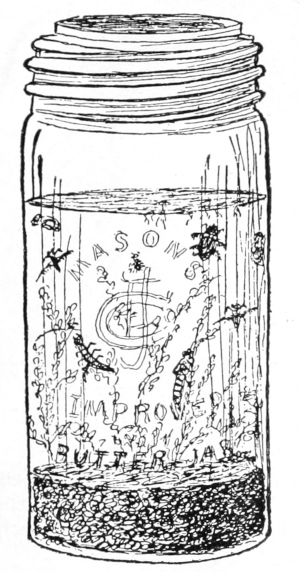
A humble, but useful, aquarium.
The care of the aquarium—Care should be taken to preserve the plant life in the aquarium, as the plants are necessary to the life of the animals. They not only supply the food, but they give off oxygen which the animals need for breathing, and they also take up from the water the poisonous carbonic acid gas given off from the bodies of the animals.
1. The aquarium should be kept where there is a free circulation of air.
2. If necessary to cover the aquarium to prevent the insects, like the water boatmen and water beetles, from escaping, tie over it a bit of mosquito netting, or lay upon the top a little square of wire netting used for window screens.
3. The temperature should be kept rather cool; it is better that the water of the aquarium should not be warmer than 50 deg. Fahrenheit, but this is not always possible in the schoolroom.
4. If any insects or animals die in the aquarium they should be removed at once, as the decomposing bodies render the water foul.
5. To feed the animals that live upon other animals take a bit of raw beef, tie a string to it and drop it in, leaving the free end of the string outside of the jar. After it has been in one day, pull it out; for if it remains longer it will make the water foul.
6. As the water evaporates it should be replaced with water from the pond.
References—The Fresh Water Aquarium, Eggeling and Ehrenberg; Insect Life, Comstock; The Brook Book, Miller; Nature Study and Life, Hodge; The Home Aquarium, How to Care for It, Eugene Smith.
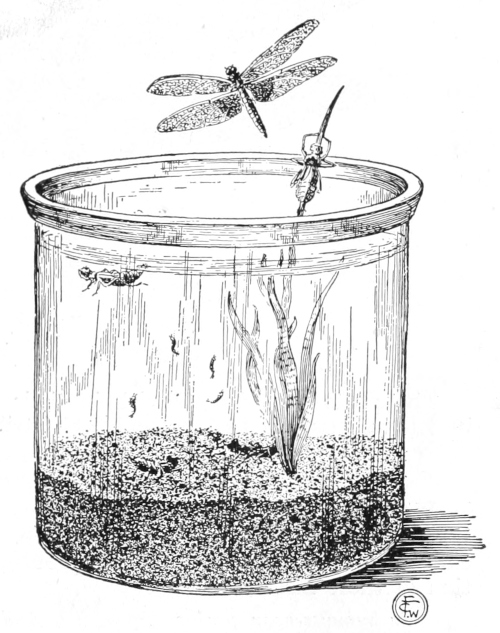
An inexpensive and durable aquarium.
THE DRAGON-FLIES AND DAMSEL-FLIES
Teacher’s Story
POND without dragon-flies darting above it, or without the exquisitely iridescent damsel-flies clinging to the leaves of its border would be a lonely place indeed. As one watches these beautiful insects, one wonders at the absurd errors which have crept into popular credence about them. Who could be so silly as to believe that they could sew up ears or that they could bring dead snakes to life! The queer names of these insects illustrate the prejudices of the ignorant—devil’s darning needles, snake doctors, snake feeders, etc. Despite all this slander, the dragon-flies remain not only entirely harmless to man, but in reality are his friends and allies in waging war against flies and mosquitoes; they are especially valuable in battling mosquitoes since the nymphs, or young, of the dragon-fly, take the wrigglers in the water, and the adults, on swiftest wings, take the mosquitoes while hovering over ponds laying their eggs.
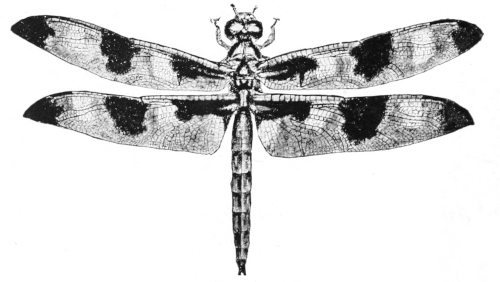
The ten-spot.
From Outdoor Studies, Needham.
The poets have been lavish in their attention to these interesting insects and have paid them delightful tributes. Riley says:
“Till the dragon fly, in light gauzy armor burnished bright, Came tilting down the waters in a wild, bewildered flight.”
While Tennyson drew inspiration for one of his most beautiful poems from the two stages of dragon-fly life. But perhaps Lowell in that exquisite poem, “The Fountain of Youth,” gives us the perfect description of these insects:
In summer-noon flushes When all the wood hushes, Blue dragon-flies knitting To and fro in the sun, With sidelong jerk flitting, Sink down on the rushes, And, motionless sitting, Hear it bubble and run, Hear its low inward singing, With level wings swinging On green tasselled rushes, To dream in the sun.
It is while we, ourselves, are dreaming in the sun by the margin of some pond, that these swift children of the air seem but a natural part of the dream. Yet if we waken to note them more closely, we find many things very real to interest us. First, they are truly children of the sun, and if some cloud throws its shadow on the waters for some moments, the dragon-flies disappear as if they wore the invisible cloak of the fairy tale. Only a few of the common species fly alike in shade and sunshine, and early and late. The best known of these is the big, green skimmer, which does not care so much for ponds, but darts over fields and even dashes into our houses, now and then. Probably it is this species which has started all of the dragon-fly slander, for it is full of curiosity, and will hold itself on wings whirring too rapidly to even make a blur, while it examines our faces or inspects the pictures or furniture or other objects which attract it.
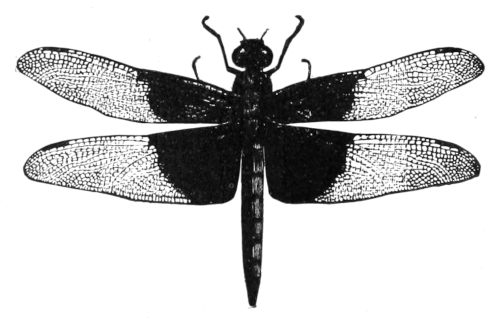
A common dragon-fly.
Comstock’s Manual.
Another thing we may note when dreaming by the pond is that the larger species of dragon-flies keep to the higher regions above the water, while the smaller species and the damsel-flies flit near its surface. Well may the smaller species keep below their fierce kindred, otherwise they would surely be utilized to sate their hunger, for these insects are well named dragons, and dragons do not stop to inquire whether their victims are relatives or not. It is when they are resting, that the dragon and damsel-flies reveal their most noticeable differences. The dragon-fly extends both wings as if in flight while it basks in the sun or rests in the shadow. There is a big, white-bodied species called the whitetail which slants its wings forward and down when it rests; but the damsel-flies fold their wings together over the back when resting. The damsel-flies have more brilliantly colored bodies than do the dragon-flies, many of them being iridescent green or coppery; they are more slender and delicate in form. The damsel-fly has eyes which are so placed on the sides of the head as to make it look like a cross on the front of the body fastened to the slender neck, and with an eye at the tip of each arm. There are very many species of dragon and damsel-flies, but they all have the same general habits.
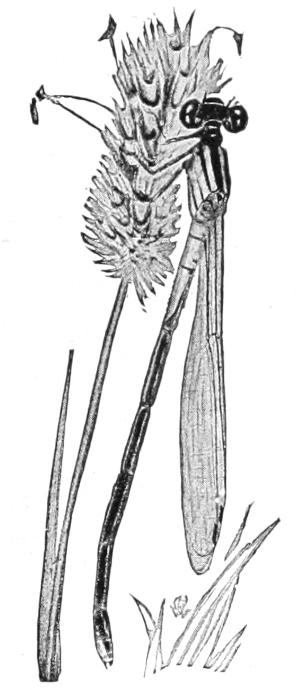
A damsel-fly.
Outdoor Studies, Needham.
The dragon-fly nymphs are the ogres of the pond or stream. To anyone unused to them and their ways in the aquarium, there is a surprise in store, so ferocious are they in their attacks upon creatures twice their size. The dragon-fly’s eggs are laid in the water; in some instances they are simply dropped and sink to the bottom; but in the case of damsel-flies, the mother punctures the stems of aquatic plants and places the eggs within them. The nymph in no wise resembles the parent dragon-fly. It is a dingy little creature, with six queer, spider-like legs and no wings; although there are four little wing-pads extending down its back, which encase the growing wings. It may remain hidden in the rubbish at the bottom of the pond or may cling to water weeds at the sides, for different species have different habits. But in them all we find a most amazing lower lip. This is so large that it covers the lower part of the face like a mask, and when folded back reaches down between the front legs. It is in reality a grappling organ with hooks and spines for holding prey; it is hinged in such a manner that it can be thrust out far beyond the head to seize some insect, unsuspecting of danger. These nymphs move so slowly and look so much like their background, that they are always practically in ambush awaiting their victims.
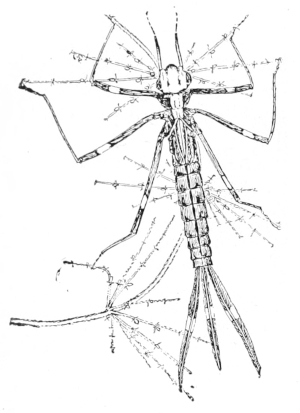
Nymph of a damsel-fly.
Outdoor Studies, Needham.
The breathing of the dragon-fly nymphs is peculiar; there is an enlargement of the rear end of the alimentary canal, in the walls of which tracheæ or breathing tubes extend in all directions. The nymph draws water into this cavity and then expels it, thus bathing the tracheæ with the air mixed with water and purifying the air within them. Expelling the water so forcibly, propels the nymph ahead, so this act serves as a method of swimming as well as of breathing. Damsel-fly larvæ, on the other hand, have at the rear end of the body, three long, plate-like gills, each ramified with tracheæ.
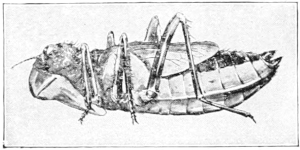
Nymph of a dragon-fly.
Seen from the side, showing the position of the great lower lip when folded beneath the head.
From Outdoor Studies, Needham.
Nymphs grow by shedding the skin as fast as it becomes too small; and when finally ready to emerge, they crawl up on some object out of the water, and molt for the last time, and are thereafter swift creatures of the air.
References—American Insects, Kellogg. Comstock’s Manual.
LESSON LXXXV
The Dragon-flies and Damsel-flies
Leading thought—The dragon-flies are among the swiftest of all winged creatures and their rapid, darting flight enables them to hawk their prey, which consists of other flying insects. Their first stages are passed in the bottoms of ponds where they feed voraciously on aquatic creatures. The dragon-flies are beneficial to us because, when very young and when full grown, they feed largely upon mosquitoes.
Method—The work of observing the habits of adult dragon-flies should be largely done in the field during late summer and early autumn. The points for observation should be given the pupils for summer vacation use, and the results placed in the field note-book.
The nymphs may be studied in the spring, when getting material for the aquarium. April and May are the best months for securing them. They are collected by using a dip-net, and are found in the bottoms of reedy ponds or along the edges of slow-flowing streams. These nymphs are so voracious that they cannot be trusted in the aquarium with other insects; each must be kept by itself. They may be fed by placing other water insects in the aquarium with them or by giving them pieces of fresh meat. In the latter case, tie the meat to a thread so that it may be removed after a few hours, if not eaten, since it soon renders the water foul.
The dragon-fly aquarium should have sand at the bottom and some water weeds planted in it, and there should be some object in it which extends above the surface of the water which the nymphs, when ready to change to adults, can climb upon while they are shedding the last nymphal skin, and spreading their new wings.
Observations on the young of dragon-flies—1. Where did you find these insects? Were they at the bottom of the pond or along the edges among the water weeds?
2. Are there any plume-like gills at the end of the body? If so, how many? Are these plate-like gills used for swimming? If there are three of these, which is the longer? Do you know whether the nymphs with these long gills develop into dragon or into damsel-flies?
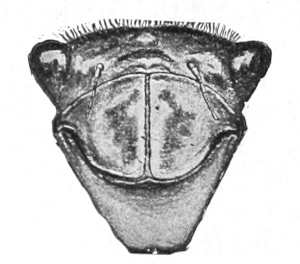
Front view of the same nymph.
Outdoor Studies, Needham.
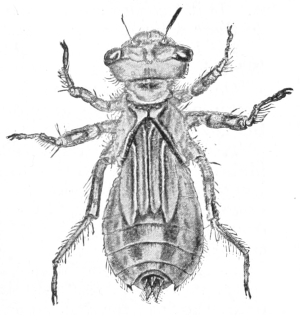
The same nymph seen from above.
Outdoor Studies, Needham.
3. If there are no plume-like gills at the end of the body, how do the insects move? Can they swim? What is the general color of the body? Explain how this color protects them from observation? What enemies does it protect them from?
4. Are the eyes large? Can you see the little wing-pads on the back in which the wings are developing? Are the antennæ long?
5. Observe how the nymphs of both dragon and damsel-flies seize their prey. Describe the great lower lip when extended for prey. How does it look when folded up?
6. Can you see how a nymph without the plume-like gills breathes? Notice if the water is drawn into the rear end of the body and then expelled. Does this process help the insect in swimming?
7. When the dragon or damsel-fly nymph has reached its full growth, where does it go to change to the winged form? How does this change take place? Look on the rushes and reeds along the pond margin, and see if you can find the empty nymph skins from which the adults emerged. Where is the opening in them?
Observations on the adult dragon-flies—1. Catch a dragon-fly, place it under a tumbler and see how it is fitted for life in the air. Which is the widest part of its body? Note the size of the eyes compared with the remainder of the head. Do they almost meet at the top of the head? How far do they extend down the sides of the head? Why does the dragon-fly need such large eyes? Why does a creature with such eyes not need long antennæ? Can you see the dragon-fly’s antennæ? Look with a lens at the little, swollen triangle between the place where the two eyes join and the forehead; can you see the little, simple eyes? Can you see the mouth-parts?
2. Next to the head, which is the widest and strongest part of the body? Why does the thorax need to be so big and strong? Study the wings. How do the hind wings differ in shape from the front wings? How is the thin membrane of the wings made strong? Are the wings spotted or colored? If so, how? Can you see if the wings are folded along the front edges? Does this give strength to the part of the wing which cuts the air? Take a piece of writing paper and see how easily it bends; fold it two or three times like a fan and note how much stiffer it is. Is it this principle which strengthens the dragon-fly’s wings? Why do these wings need to be strong?
3. Is the dragon-fly’s abdomen as wide as the front part of the body? What help is it to the insect when flying to have such a long abdomen?
Outline for field notes—Go to a pond or sluggish stream when the sun is shining, preferably at midday, and note as far as possible the following things:
1. Do you see dragon-flies darting over the pond? Describe their flight. They are hunting flies and mosquitoes and other insects on the wing; note how they do it. If the sky becomes cloudy, can you see the dragon-flies hunting? In looking over a pond where there are many dragon-flies darting about, do the larger species fly higher than the smaller ones?
2. Note the way the dragon-flies hold their wings when they are resting. Do they rest with their wings folded together over the abdomen or are they extended out at an angle to the abdomen? Do you know how this difference in attitude of resting determines one difference between the damsel-flies and the dragon-flies?
3. The damsel-flies are those which hold their wings folded above the back when resting. Are these as large and strong-bodied as the dragon-flies? Are their bodies more brilliantly colored? How does the shape of the head and eyes differ from those of the dragon-flies? How many different colored damsel-flies can you find?
4. Do you see some dragon-flies dipping down in the water as they fly? If so, they are laying their eggs. Note if you find others clinging to reeds or other plants with the abdomen thrust below the surface of the water. If so, these are inserting their eggs into the stem of the plant.
Supplementary reading—Outdoor Studies, Needham, p. 54; “The Dragon of Lagunita” in Insect Stories, Kellogg.
THE CADDIS-WORMS AND THE CADDIS-FLIES
Teacher’s Story
EOPLE are to be pitied who have never tried to fathom the mysteries of the bottom of brook or pond. Just to lie flat, face downward, and watch for a time all that happens down there in that water world, is far more interesting than witnessing any play ever given at matinee. At first one sees nothing, since all the swift-moving creatures have whisked out of sight, because they have learned to be shy of moving shadows; but soon the crayfish thrusts out his boxing gloves from some crevice, then a school of tiny minnows “stay their wavy bodies ’gainst the stream;” and then something strange happens! A bit of rubbish on the bottom of the brook walks off. Perhaps it is a dream, or we are under the enchantment of the water witches! But no, there goes another, and now a little bundle of sand and pebbles takes unto itself legs. These mysteries can only be solved with a dip-net and a pail half filled with water, in which we may carry home the treasure trove.
When we finally lodge our catch in the aquarium jar, our mysterious moving sticks and stones resolve themselves into little houses built in various fashions, and each containing one inmate. Some of the houses are made of sticks fastened together lengthwise; some are built like log cabins, crosswise; some consist simply of a hollow stem cut a convenient length; and some are made of sand and pebbles, and one, the liveliest of all, is a little tube made of bits of rubbish and silk spun in a spiral, making a little cornucopia.
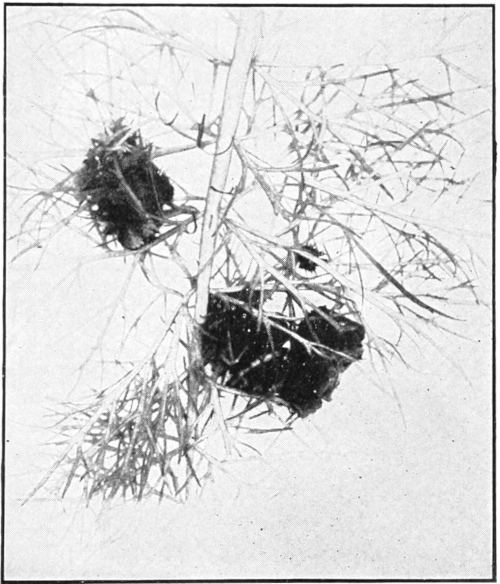
Log cabin caddis-worms in their cases feeding upon a water plant.
Photo by J. T. Lloyd.
On the whole, the species which live in the log cabins are the most convenient to study. Whatever the shape of the case or house, it has a very tough lining of silk, which is smooth within, and forms the framework to which the sticks and stones are fastened. These little dwellings always have a front door and a back door. Out of the front door may protrude the dark-colored head followed by two dark segments and six perfectly active legs, the front pair being so much shorter than the other two pairs that they look almost like mouth palpi. In time of utter peace, more of the little hermit is thrust out and we see the hind segment of the thorax which is whitish, and behind this the abdomen of nine segments. At the sides of the abdomen, and apparently between the segments, are little tassels of short, white thread-like gills. These are filled with air, impure from contact with the blood, and which exchanges its impurities speedily for the oxygen from the air which is mixed with the water. Water is kept flowing in at the front door of the cabin, over the gills and out at the back door, by the rhythmic movement of the body of the little hermit, and thus a supply of oxygen is steadily maintained.
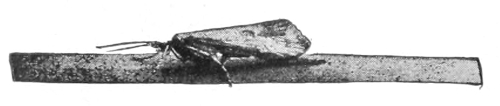
A caddis-fly.
Photo by J. T. Lloyd.
The caddis-worm is not grown fast to its case as is the snail to its shell. If we hold down with forceps a case in which the occupant is wrong side up, after a few struggles to turn itself over, case and all, it will turn over within the case. It keeps its hold upon the case by two forward-curving hooks, one on each side of the tip of the rear segment. These hooks are inserted in the tough silk and hold fast. It also has on top of the first segment of the abdomen a tubercle, which may be extended at will; this helps to brace the larva in its stronghold, and also permits the water to flow freely around the insect. So the little hermit is entrenched in its cell at both ends. When the log-cabin species wishes to swim, it pushes almost its entire body out of the case, thrusts back the head, spreads the legs wide apart, and then doubles up, thus moving through the water spasmodically, in a manner that reminds us of the crayfish’s swimming except that the caddis-worm goes head first. This log cabin species can turn its case over dexterously by movements of its legs.
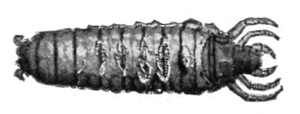
A caddis-worm removed from its case.
Showing gills and the hooks on the last segment for holding fast to the case.
The front legs of the caddis-worm are so much shorter than the other two pairs that they look like palpi, and their use is to hold close to the jaws bits of food, which are being eaten. The other legs are used for this too if the little legs cannot manage it; perhaps also these short front legs help hold the bits of building material in place while the web is woven to hold it there. The caddis-worm, like the true caterpillars, has the opening of the silk gland near the lower lip. The food of most caddis-worms is vegetable, usually the various species of water plants; but there are some species which are carnivorous, like the net-builder, which is a fisherman.
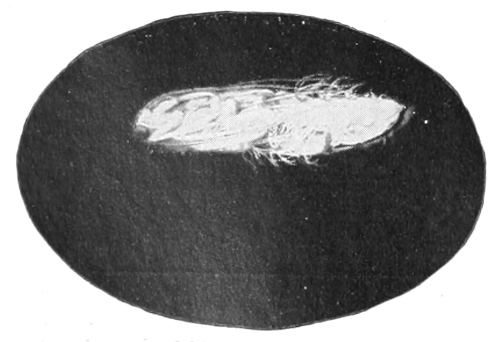
Pupa of caddis-fly removed from its case. Note the thread-like gills.
Photo by J. T. Lloyd.
The caddis-worm case protects its inmate in two ways: First, from the sight of the enemy, and second, from its jaws. A fish comes along and sees a nice white worm and darts after it, only to find a bundle of unappetizing sticks where the worm was. All of the hungry predatory creatures of the pond and stream would be glad to get the caddis-worm, if they knew where it went. Sometimes caddis-worm cases have been found in the stomachs of fishes; perhaps they serve as fish breakfast-food.
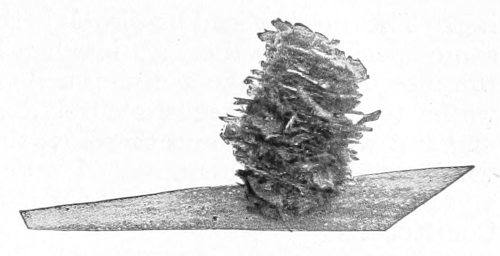
Caddis-worm case fastened to leaf for pupation period.
Photo by J. T. Lloyd.
While it is difficult to see the exact operation of building the caddis-worm house, the general proceeding may be readily observed. Take a vigorous half-grown larva, tear off part of the sticks and bits of leaves that make the log cabin, and then place the little builder in a tumbler with half an inch of water at the bottom, in which are many bright flower petals cut into strips, fit for caddis lumber. In a few hours the little house will look like a blossom with several rows of bright petals set around its doorway.
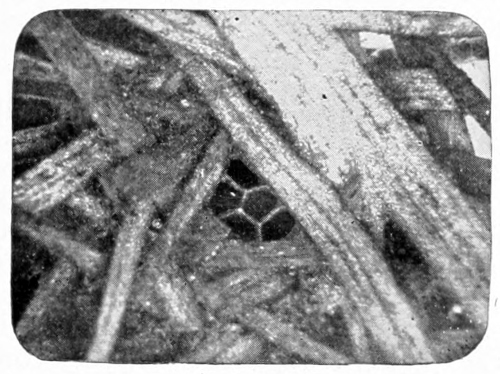
Grating of silk over the door of a caddis-worm case to protect the pupa.
Photomicrograph by J. T. Lloyd.
When the caddis-worm gets ready to pupate, it fastens its case to some object in the water and then closes its front and back doors. Different species accomplish this in different ways; some spin and fasten a silken covering over the doors; often this is in the form of a pretty grating; others simply fasten the material of which the case is made across the door. But though the door be shut, it is so arranged as to allow the water to flow through and to bring oxygen to the thread-like gills, which are on the pupæ as well as on the larvæ. When ready to emerge, the pupa crawls out of its case and climbs to some object above the water, sheds its pupa skin, and the adult insect flies off. In some species, living in swift water, the adult issues directly from the water, its wings expanding as soon as touched by the air.

Caddis-fly.
Photo by J. T. Lloyd.
Caddis-flies are familiar to us all even if we do not know them by name. They are night fliers and flame worshippers. Their parchment-like or leathery wings are folded like a roof over the back, and from the side the caddis-fly appears as an elongated triangle with unequal sides. The front wings are long and the hind ones shorter and wider; the antennæ are long and threadlike and always waving about for impressions; the eyes are round and beadlike; the tarsi, or feet, are long and these insects have an awkward way of walking on the entire tarsus which gives them an appearance of kneeling. Most of the species are dull-colored, brownish or gray, the entire insect often being of one color. Caddis-flies would not be so fond of burning themselves in lamps if they had the human sense of smell, for the stench they make when scorching is nauseating. The mother caddis-flies lay their eggs in the water. Perhaps some species drop the eggs in when hovering above, but in some cases the insect must make a diving bell of her wings and go down into the water to place her eggs securely. The wings are covered with hairs and not with scales, and therefore they are better fitted for diving than would be those of the moth. I have seen caddis-flies swim vigorously.
References—Aquatic Insects, Miall; Manual for the Study of Insects, Comstock.
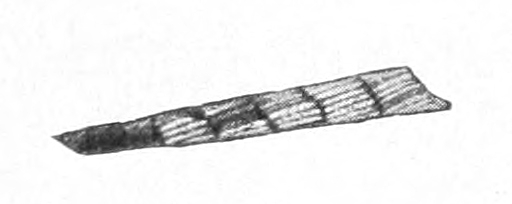
A spiral ribbon caddis-worm case. The inmate of this case is a rapid swimmer.
Photo by J. T. Lloyd.
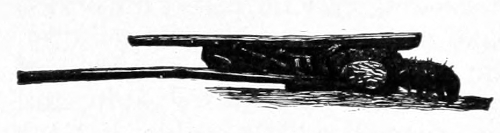
Case and caddis-worm.
Comstock’s Manual.
LESSON LXXXVI
The Caddis-worms and Caddis-flies
Leading thought—The caddis-worms build around themselves little houses out of bits of sticks, leaves or stones. They crawl about on the bottom of the pond or stream, protected from sight, and able to withdraw into their houses when attacked. The adult of the caddis-worm is a winged moth-like creature which comes in numbers to the light at night.
Method—With a dip-net the caddis-worms may be captured and then may be placed in the school aquarium. Duckweed and other water plants should be kept growing in the aquarium. The log cabin species is best for this study, because it lives in stagnant water and will therefore thrive in an aquarium.
Observations—1. Where do you find the caddis-worms? Can you see them easily on the bottom of the stream or pond? Why?
2. Of what are the caddis-worm houses made? How many kinds have you ever found? How many kinds of materials can you find on one case? Describe one as exactly as possible. Find an empty case and describe it inside. Why is it so smooth inside? How is it made so smooth? Are all the cases the same size?