Part 3 — FLOWERLESS-PLANT STUDY (continued 4)
Reading edition
There is much tannin in sumac and it is used extensively to tan leather. The bobs are used for coloring a certain shade of brown. The famous Japanese lacquer is made from the juice of a species of sumac.
LESSON CCVI
The Velvet, or Staghorn, Sumac
Leading thought—The sumac is a beautiful shrub in summer because of its fern-like leaves; it is picturesque in winter, and its colors in autumn are most brilliant. Its dark red fruit clusters remain upon it during the entire winter. In June it shows two kinds of blossoms on different shrubs, one is whitish and bears the pollen, the other is reddish and is a pistillate flower, later developing into the seed on the “bob,” or fruit cluster.
Method—Begin this study in October when the beautiful autumn color of the leaves attracts the eye. Observations to be made in the field should be outlined and should be answered in the field note-books. The study of the fruit and leaf may be made in the schoolroom, and an interest should be developed which will lead to the study of the interesting flowers the following spring. The sumacs in autumn make a beautiful subject for water-color sketches, and their peculiar method of branching with their dark red seed clusters or bobs, make them excellent subjects for winter sketching.
Observations—1. Why is this called the velvet sumac? Why is it called the staghorn sumac? Look at the stems with a lens and describe the velvet. Can you tell this year’s wood by the velvet? Is there any velvet on last year’s wood? Is there any on the wood below? What is there peculiar in the appearance of last year’s wood? What are the colors of the hairs that make the velvet on this year’s growth? On last year’s growth? What is the color of this year’s growth under the velvet? Where are the leaves borne?
2. Look at the leaves. How many come off the stem between two, one of which is above the other? Is the midrib velvety? What is its color at base and at tip? What is the shape of the petiole where it joins the stem? Remove the leaf. What do you find hidden and protected by its broad base?
3. How many leaflets are there on the longest leaf which you can find? How many on the shortest? Do the leaflets have little petioles, or are they set close to the midrib? How does the basal pair differ from the others? Are the leaflets the same color above as below? Are the pairs set exactly opposite each other? Look at the three leaflets at the tips of several leaves and see if they are all regular in form. Draw a leaflet showing its base, its veins and its margin. Draw an entire leaf, and color it as exactly as possible.
4. Study the fruit. Pick one of the bobs and note its general shape. Is it smooth or bunchy? Sketch it. Remove one of the little bunches and find out why it is of that shape. Remove all of the seeds from one of last year’s bobs and see how the fruit is borne. Sketch a part of such a bare stem.
5. Take a single seed; look at it through a lens and describe it. What are the colors? Cut or pare away the flesh, and describe the seed. What birds live on the sumac seeds in winter? How many kinds of insects can you find wintering in the bob? Find a seed free from insects and taste it.
Winter study of the Sumac—6. Study the sumac after the leaves have fallen and sketch it. What is there peculiar in its branching? Of what use to the plant is its method of branching? Break a branch and look at the end. Is there a pith? What color is the wood and pith?
May or June Study of the Sumac—7. Where on the branch does the new growth start? How are the tiny leaves folded? Look over a group of sumacs and see if their blossoms all look alike. Are the different kinds of blossoms found on the same tree or on different trees? Take one of the white pyramidal blossom clusters; look at one of these flowers with a lens and describe its sepals and petals. How many anthers has it and where are they? This is a pollen-bearing flower and has no pistil. How are its tiny staminate flowers arranged on the stem to give the beautiful pyramid shape? This kind of flower cluster is called a panicle.
8. Take one of the green bobs and see if it is made up of little round flowers. Through a lens study one of these. How many sepals? How many petals? Describe the middle of the flower around which the petals and sepals clasp. Is this the ovary, or seed box? Can you see the stigmas protruding beyond it? What insects visit these flowers?
9. How can you tell the velvet or staghorn sumac from the smooth sumac? How can you tell both of these from the poison sumac?
10. To what uses are the sumacs put?
“I see the partridges feed quite extensively upon the sumach berries, at my old house. They come to them after every snow, making fresh tracks, and have now stripped many bushes quite bare.” —Thoreau’s Journal, Feb. 4, 1856.
THE WITCH-HAZEL
Teacher’s Story
In the dusky, somber woodland, thwarting vistas dull and cold, Thrown in vivid constellations, gleam the hazel stars of gold, Gracious gift of wealth untold. Hazel blossoms brightly glowing through the forests dark and drear, Work sweet miracles, bestowing gladness on the dying year, Joy of life in woods grown sere.
ITCH-HAZEL is not only a most interesting shrub in itself, but it has connected with it many legends. From its forked twigs were made the divining rods by which hidden springs of water or mines of precious metals were found, as it was firmly believed that the twig would turn in the hand when the one who held it passed over the spring or mine. At the present day, its fresh leaves and twigs are used in large quantities for the distilling of the healing extract so much in demand as a remedy for cuts and bruises and for chapped or sunburned skins. It is said that the Oneida Indians first taught the white people concerning its medicinal qualities.
The witch-hazel is a large shrub, usually from six to twelve feet high, although under very advantageous circumstances it has been known to take a tree-like form and attain a height of more than twenty feet. Its bark is very dark grayish brown, smooth, specked with little dots, which are the lenticels, or breathing-pores. If the season’s growth has been rapid, the new twigs are lighter in color, but when stunted by drouth or poor soil, the new growth has a tint similar to the old. The wood is white, very tough and fibrous, with a pith or heart-wood of softer substance and yellow in color. The leaves are alternate, and the leaf buds appear at the tips of the season’s twigs, while the blossoms grow at the axils of the leaves.
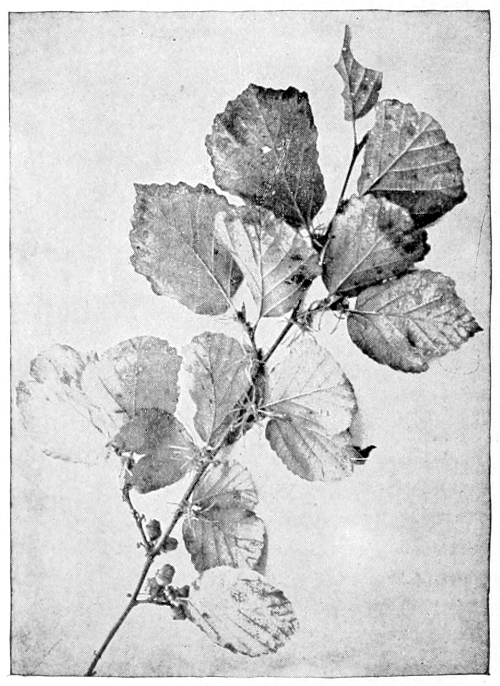
Witch-hazel.
The witch-hazel leaf is nearly as broad as it is long, bluntly pointed at its tip, with a stem generally less than one-half inch in length. The sides are unequal in size and shape, and the edges are roughly scalloped. The veins are straight, are depressed on the upper side but very prominent beneath, and they are lighter in color than the rest of the leaf. Witch-hazel leaves are likely to be apartment houses for insects, especially the insects that make galls. Of these there are many species, each making a different shaped gall. One of the most common is a gall, shaped like a little horn or spur on the upper side of the leaf and having a tiny door opening on the under side of the leaf. If one of these snug little homes is torn open, it will be found occupied by a community of little aphids, or plant-lice.
The witch-hazel blossoms appear at the axil of a leaf or immediately above the scar from which a leaf has fallen, the season of bloom being so late that often the bush is bare of leaves and is clothed only with the yellow, fringe-like flowers. Usually the flowers are in clusters of three, but occasionally four or five can be found on the same very short stem. The calyx is four-lobed, the petals are four in number, shaped like tiny, yellow ribbons, about one-half inch long and not much wider than a coarse thread. In the bud, these petals are rolled inward in a close spiral, like a watch-spring, and are coiled so tightly that each bud is a solid little ball no larger than a bird-shot. There are four stamens lying between the petals, and between each two of these stamens is a little scale just opposite the petal. The anthers are most interesting. Each has two little doors which fly open, as if by magic springs, and throw out the pollen which clings to them. The pistil has two stigmas, which are joined above the two-celled seed-box, or ovary. The blossoms sometimes open in late September, but the greater number appear in October and November. They are more beautiful in November after the leaves have fallen, since these yellow, starry flowers seem to bring light and warmth into the landscape. After the petals fall, the calyx forms a beautiful little urn, holding the growing fruit.
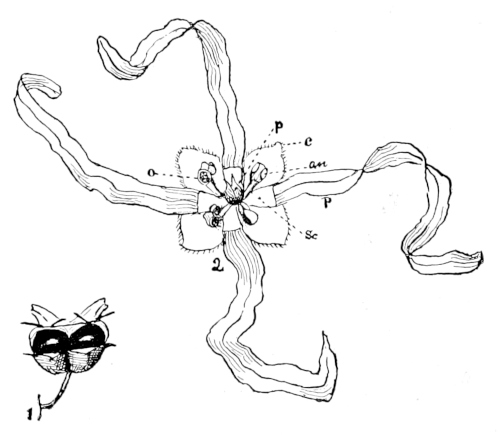
1, A queer little face—witch-hazelnut ready to shoot its seeds. 2, Enlarged flower of witch-hazel showing the long petals; p, with dotted line the pistil; an, anther; a, anther with doors open; c, lobes of calyx; sc, scale opposite the base of petal.
The nuts seem to require a sharp frost to separate the closely joined parts; it requires a complete year to mature them. One of these nuts is about half an inch long and is covered with a velvety green outer husk, until the frost turns it brown; cutting through it discloses a yellowish white inner shell, which is as hard as bone; within this are the two brown seeds each ornamented with a white dot; note particularly that these seeds lie in close-fitting cells. The fruit, if looked at when the husk is opening, bears an odd resemblance to a grotesque monkey-like face with staring eyes. Frosty nights will open the husks, and the dry warmth of sunny days or of the heated schoolroom, will cause the edges of the cups which hold the seeds, to curve inward with such force as to send the seeds many feet away; ordinarily they are thrown from ten to twenty feet, but Hamilton Gibson records one actual measurement of forty-five feet. The children should note that the surface of the seeds is very polished and smooth, and the way they are discharged may be likened to that by which an orange seed is shot from between the fingers.
LESSON CCVII
The Witch-Hazel
Leading thought—The witch-hazel blossoms during the autumn, and thus adds beauty to the landscape. It has an interesting mechanism by which it can shoot its seeds for a distance of many feet.
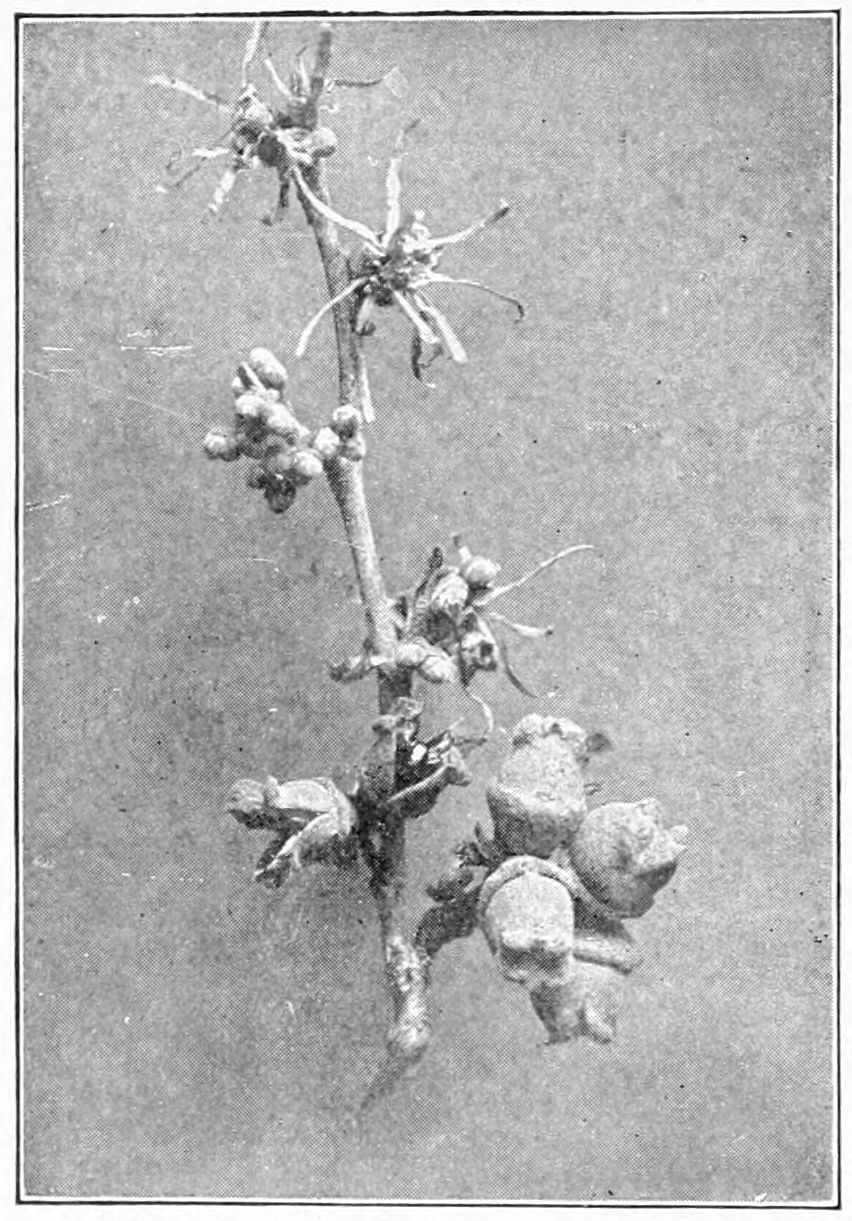
Flowers and fruit of witch-hazel.
Photo by G. F. Morgan.
Method—This lesson divides naturally into two parts; a study of the way the seeds are distributed is fitted for the primary grades, and a study of the flower for more advanced grades. For the primary grades the lesson should begin by the gathering of the twigs which bear the fruit. These should be brought to the schoolroom—there to await results. Soon the seeds will be popping all over the schoolroom, and then the question as to how this is done, and why, may be made the topic of the lesson. For the study of the flower and the shrub itself, the work should begin in October when the blossoms are still in bud. As they expand they may be studied, a lens being necessary for observing the interesting little doors to the anthers.
Observations—1. Is the witch-hazel a shrub or a tree?
2. What is the color of the bark? Is it thick or thin, rough or smooth, dark or light, or marked with dots or lines? Is there any difference in color between the older wood and the young twigs? Is the wood tough or brittle? Dark or light in color?
3. Do the leaves grow opposite each other or alternate? On what part of the plant do the leaf buds grow?
4. What is the general shape of the leaf? Is it more pointed at the base or at the tip? Are the leaves regular in form, or larger on one side than the other? Are the edges entire, toothed or wavy? Are the petioles short or long? Are the veins straight or branching? Are they prominent? Are the leaves of the same color on both sides?
5. Are there many queer-shaped little swellings on the leaf above and below? See how many of these you can find? Tell what you think they are.
6. Do the flowers grow singly or in clusters? What is the shape and color of the petals, and how many of them are there in each blossom? Describe the calyx. If there are any flower buds just opening, observe and describe the way the petals are folded within them.
7. How many stamens? With a lens observe the way the two little doors to the anther fly open; how is the pollen thrown out? What is the shape of the pistil? How many stigmas?
8. Does each individual flower have a stem or is there a common stem for a cluster of blossoms? Do the flowers grow at the tips or along the sides of the twigs? When do the witch-hazel flowers appear and how long do they last?
9. Make a drawing of a witch-hazel nut before it opens. What is the color of the outer husk when ripe? Cut into a closed nut and observe the extreme hardness and strength of the inner shell.
10. Where are the seeds situated? Can you see that the shell, when partially open, ready to throw out the seeds resembles a queer little face? Describe the color and marking of the seeds; are they rough or smooth? How far have you known the witch-hazel to throw its seeds? Study the nut and try to discover how it throws the seeds so far.
References—Tree Book, Rogers; Our Northern Shrubs, Keeler; Familiar Trees and Their Leaves, Mathews; Field, Forest and Wayside Botany, Gray.
THE MOUNTAIN LAUREL
Teacher’s Story
S a child I never doubted that the laurel wreaths of Grecian heroes were made from mountain laurel, and I supposed, of course, that the flowers were used also. My vision was of a hero crowned with huge wreaths of laurel bouquets, which I thought so beautiful. It was a shock to exchange this sumptuous headgear of my dreams for a plain wreath of leaves from the green-bay tree.
However, the mountain laurel leaf is evergreen and beautiful enough to crown a victor; in color it is a rich, lustrous green above, with a yellow midrib, the lower side being of a much lighter color. In shape, the leaf is long, narrow, pointed at each end and smooth-edged, with a rather short petiole. The leaves each year grow on the new wood, which is greenish and rough, in contrast with the old wood, which is rich brownish red. The leaves are arranged below the flower cluster, so that they make a shining green base for this natural bouquet.
The flowers grow on the tips of the branching twigs, which are huddled together in a manner that brings into a mass many flowers. I have counted seventy-five of them in a single bunch; the youngest flowers grow nearest the tip of the twig. The blossom stems are pink, and afford a rich background for the starry open flowers and knobby closed buds. The bud of the laurel blossom is very pretty and resembles a bit of rose-colored pottery; it has a five-sided, pyramidal top, and at the base of the pyramid are ten little buttresses which flare out from the calyx. The calyx is five-lobed, each lobe being green at the base and pink at the point. Each one of the ten little buttresses or ridges is a groove in which a stamen is growing, as we may see by looking into an opening flower; each anther is “headed” toward the pocket which ends the groove. The filament lengthens and shoves the anther into the pocket, and then keeps on growing until it forms a bow-shaped spring, like a sapling with the top bent to the ground. The opening flower is saucerlike, pinkish white, and in form is a five-pointed star. At the bottom of the saucer a ten-pointed star is outlined in crimson; and bowed above this crimson ring are the ten white filaments with their red-brown anthers stuffed cozily into the pockets, one pocket at the center of each lobe, and one half-way between; each pocket is marked with a splash of crimson with spotty edges. From the center of the flower projects the stigma, far from and above the pollen-pockets.
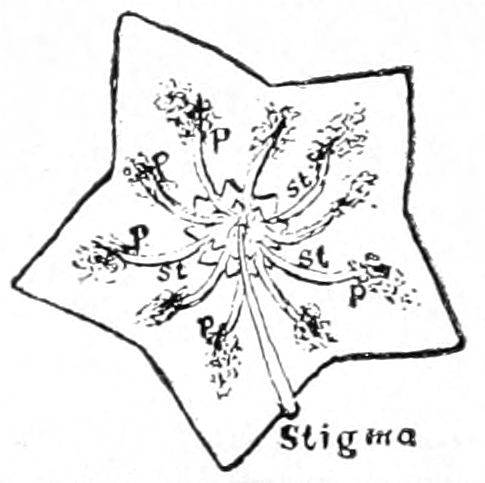
Diagram of flower of laurel.
p, pocket; st, stamen.
Each laurel flower is thus set with ten spring-traps all awaiting the visit of the unwary moth or bee which, when seeking the nectar at the center of the flower, is sure to touch one or all of these bent filaments. As soon as one is touched, up it springs and slings its pollen hard at the intruder. The pollen is not simply a shower of powder, but is in the form of a sticky string, as if the grains were strung on cobweb silk. When liberating these springs with a pencil point, I have seen the pollen thrown a distance of thirteen inches; thus, if the pollen ammunition does not strike the bee, it may fall upon some open flower in the neighborhood. The anthers spring back after this performance and the filaments curl over each other at the center of the flower below the pink stigma; but after a few hours they straighten out and each empty anther is suspended above its own pocket. The anthers open while in the pocket, each one is slit open at its tip so that it is like the leather pocket of a sling.
After the corollas fall, the long stigma still projects from the tip of the ripening ovary, and there it stays, until the capsule is ripe and open. The five-pointed calyx remains as an ornamental cup for the fruit. The capsule opens along five valves, and each section is stuffed with little, almost globular seeds.
The mountain laurel grows in woods and shows a preference for rocky mountain sides or sandy soil.
Another of the common species is the sheep laurel, which grows in swampy places, especially on hillsides. The flowers of this are smaller and pinker than the mountain laurel, and are set below the leaves on the twig. Another species called the pale, or swamp, laurel, has very small flowers, not more than half an inch in breadth and its leaves have rolled-back edges and are whitish green beneath. This species is found only in cold peat-bogs and swamps.
LESSON CCVIII
The Mountain Laurel
Leading thought—The laurel blossom is set with ten springs, and each spring acts as a sling in throwing pollen upon visiting insects, thus making sure that the visitor will carry pollen to other waiting flowers.
Method—Have the pupils bring to the schoolroom a branch of laurel which shows blossoms in all stages from the bud. Although this lesson is on the mountain laurel, any of the other species will do as well.
Observations—1. How are the laurel leaves set about the blossom clusters to make them beautiful? What is the shape of the laurel leaf? What are its colors above and below? How do the leaves grow with reference to the flowers? Do they grow on last year’s or this year’s wood? How can you tell the new wood from the old?
2. Take a blossom bud. What is its shape? How many sides to the pyramid-like tip? How many little flaring ridges at the base of the pyramid? Describe the calyx.
3. What is the shape of the flower when open? How many lobes has it? What is its color? Where is it marked with red?
4. In the open blossom, what do you see of the ten ridges, or keels, which you noticed in the bud? How does each one of these grooves end? What does the laurel blossom keep in these ten pockets? Touch one of the ten filaments with a pencil and note what happens.
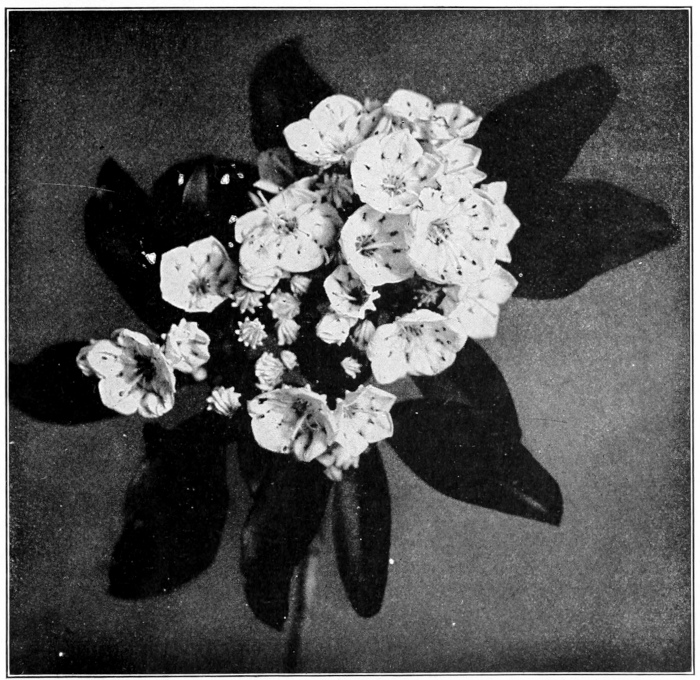
Mountain laurel.
Photo by Verne Morton.
5. Take a bud scarcely open. Where are the stamens? Can you see the anthers? Take a blossom somewhat more open. Where are the anthers now? From these observations explain how the stamens place their anthers in the pockets. How do the filaments grow into bent springs?
6. Are the anthers open when they are still in the pocket? Look at an anther with a lens and tell how many slits it has. How do they open? Are the pollen grains loose when they are thrown from the anther? How are they fastened together? Does this pollen mass stick to whatever it touches?
7. What is the use to the flower of this arrangement for throwing pollen? What insects set free the stamen-springs? Where is the nectar which the bee or moth is after? Can it get this nectar without setting free the springs? Touch the filaments with a pencil and see how far they will sling the pollen.
8. Describe the pistil in the open flower. Is the stigma near the anthers? Would they be likely to throw their pollen on the stigma of their own flower? Could they throw it on the stigmas of neighboring flowers?
9. How does the fruit of the laurel look? Does the style still cling after the corolla falls? Describe the fruit-capsule. How does it open? How do the seeds look? Are there many of them?
10. Where does the mountain laurel grow? What kind of soil does it like? Do you know any other species of laurel? If so, are they found in the same situations as the mountain laurel?
“A childish gladness stays my feet, As through the winter woods I go, Behind some frozen ledge to meet A kalmia shining through the snow. I see it, beauteous as it stood Ere autumn’s glories paled and fled, And sigh no more in pensive mood, ‘My leafy oreads are all dead.’ I hear its foliage move, like bells On rosaries strung, and listening there, Forget the icy wind that tells Of turfless fields, and forests bare. All gently with th’ inclement scene I feel its glossy verdure blend;— I bless that lovely evergreen As heart in exile hails a friend. Its boughs, by tempest scarcely stirred, Are tents beneath whose emerald fold The rabbit and the snowbound bird Forget the world is white and cold. And still, ’mid ruin undestroyed, Queen arbor with the fadeless crown, Its brightness warms the frosty void, And softens winter’s surliest frown.” —From “The Mountain Laurel,” Theron Brown.
Brook study.
Photo by Verne Morton.