Part 2 — V. MAMMAL STUDY (continued 3)
Reading edition
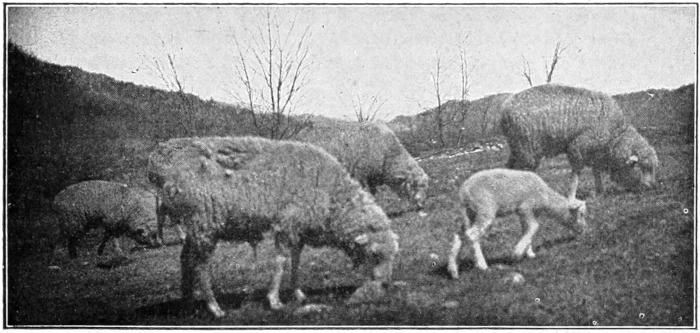
Photo by Gerrit Miller.
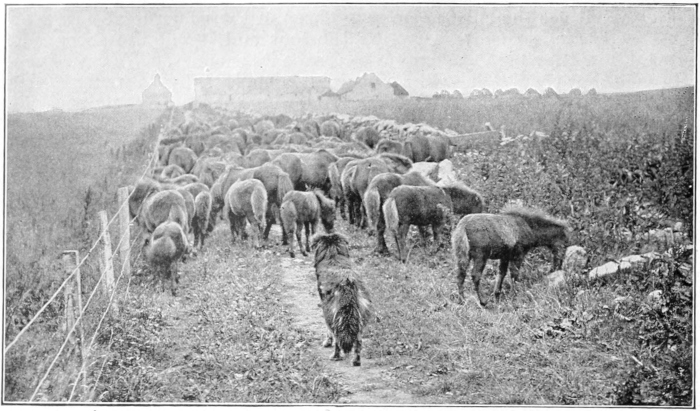
A herd of ponies in the Isle of Shetland guarded by a sheep-dog.
THE HORSE
Teacher’s Story
“There was once a little animal no bigger than a fox, And on five toes he scrambled over Tertiary rocks. They called him Eohippus, and they called him very small, And they thought him of no value when they thought of him at all. Said the little Eohippus, I am going to be a horse! And on my middle finger nails to run my earthly course! I am going to have a flowing tail! I am going to have a mane! And I am going to stand fourteen hands high on the Psychozooic plain!” —Mrs. Stetson.
It was some millions of years ago, that Eohippus lived out in the Rocky Mountain Range; its fore feet had four toes and the splint of the fifth; the hind feet had three toes and the splint of the fourth. Eohippus was followed down the geologic ages by the Orohippus and the Mesohippus and various other hippuses, which showed in each age a successive enlargement and specialization of the middle toe and the minimizing and final loss of the others. This first little horse with many toes, lived when the earth was a damp, warm place and when animals needed toes to spread out to prevent them from miring in the mud. But as the ages went on, the earth grew colder and drier, and a long leg ending in a single hoof, was very serviceable in running swiftly over the dry plains; and according to the story read in the fossils of the rocks, our little American horses migrated to South America; and also trotted dry-shod over to Asia in the Mid-pleocine age, arriving there sufficiently early to become the companion of prehistoric man. In the meantime, horses were first hunted by savage man for their flesh, but were later ridden. At present, there are wild horses in herds on the plains of Tartary; and there are still sporadic herds of mustangs on the great plains of our own country, although for the most part, they are branded and belong to someone, even though they live like wild horses; these American wild horses are supposed to be descendants of those brought over centuries ago by the Spaniards. The Shetland ponies are also wild in the islands north of Scotland, and the zebras roam the plains of Africa the most truly wild of all. In a state of wildness, there is always a stallion at the head of a herd of mares, and he has to win his position and keep it by superior strength and prowess. Fights between stallions are terrible to witness, and often result in the death of one of the participants. The horse is well armed for battle; his powerful teeth can inflict deep wounds and he can kick and strike hard with the front feet; still more efficient is the kick made with both hind feet while the weight of the body is borne on the front feet, and the head of the horse is turned so as to aim well the terrible blow. There are no wild beasts of prey which will not slink away to avoid a herd of horses. After attaining their growth in the herd with their mothers, the young males are forced by the leader to leave and go off by themselves; in turn, they must by their own strength and attractions, win their following of mares. However, there are times and places where many of these herds join, making large bands wandering together.
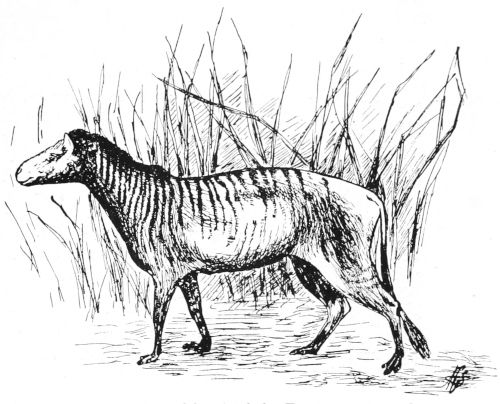
Four-toed horse of the Eocene period.
After Charles R. Knight.
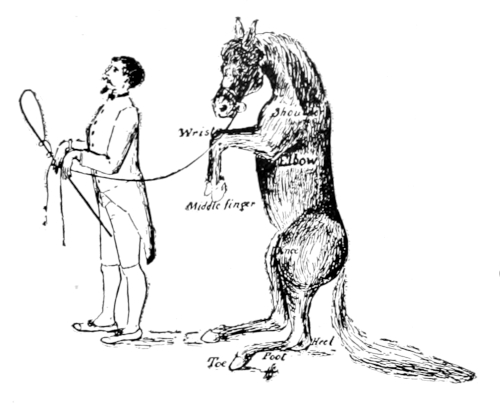
The length of the horse’s leg was evidently evolved to meet the need for flight before fierce and swift enemies, on the great ancient plains. The one toe, with its strong, sharp hoof, makes a fit foot for such a long leg, since it strikes the ground with little waste of energy and is sharp enough not to slip, but it is not a good foot for marshy places; a horse will mire where a cow can pass in safety. The development of the middle toe into a hoof results in lifting the heel and wrist far up the leg, making them appear to be the knee and elbow, when compared with the human body.
The length of neck and head are necessary in order that an animal, with such length of leg as the horse, may be able to graze. The head of the horse tells much of its disposition; a perfect head should be not too large, broad between the eyes and high between the ears, while below the eyes, it should be narrow. The ears, if lopped or turned back, denote a treacherous disposition. They should point upward or forward; the ears laid back is always a sign that the horse is angry; sensitive, quick-moving ears indicate a high-strung, sensitive animal. The eyes are placed so that the horse can see in front, at the side and behind, the last being necessary in order to aim a kick. Hazel eyes are usually preferred to dark ones, and they should be bright and prominent. The nostrils should be thin-skinned, wide-flaring and sensitive; as a wild animal, scent was one of the horse’s chief aids in detecting the enemy. The lips should not be too thick and the lower jaw should be narrow where it joins the head.
The horse’s teeth are peculiar; there are six incisors on both jaws; behind them is a bare space called the bar, of which we have made use for placing the bit. Back of the bar, there are six molars or grinders on each side of each jaw. At the age of about three years, canine teeth or tushes appear behind the incisors; these are more noticeable in males, and never seem to be of much use. Thus, the horse has on each jaw, when full-grown, six incisors, two canines, and twelve molars, making forty teeth in all. The incisors are prominent and enable the horse to bite the grass more closely than can the cow. The horse when chewing, does not have the sidewise motion of the jaws peculiar to the cow and sheep.
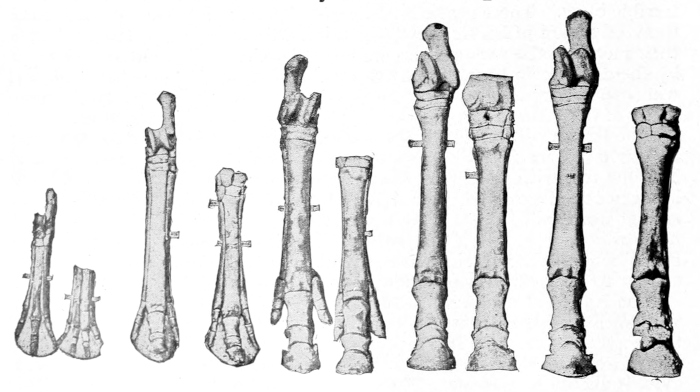
Hoofs of horses from earliest ages to the present time, arranged in pairs, hind and front.
The horse’s coat is, when rightly cared for, glossy and beautiful; but if the horse is allowed to run out in the pasture all winter, the coat becomes very shaggy, thus reverting to the condition of wild horses which stand in need of a warmer coat for winter; the hair is shed every year. The mane and the forelock are useful in protecting the head and neck from flies; the tail is also an efficient fly-brush. Although the mane and tail have thus a practical value, they add greatly to the animal’s beauty. To dock a horse’s tail as an ornament is as absurd as the sliced ears and welted cheeks of savages; and horses thus mutilated suffer greatly from the attacks of flies.
Owing to the fact that wild horses made swift flight from enemies, the colts could not be left behind at the mercy of wolves. Thus it is, the colt like the lamb, is equipped with long legs from the first, and can run very rapidly; as a runner, it could not be loaded with a big compound stomach full of food, like the calf, and therefore, must needs take its nourishment from the mother often. The colt’s legs are so long that, in order to graze, it spreads the front legs wide apart in order that it may reach the grass with its mouth. When the colt or the horse lies down out of doors and in perfect freedom, it lies flat upon the side. In lying down, the hind quarters go first, and in rising, the front legs are thrust out first.
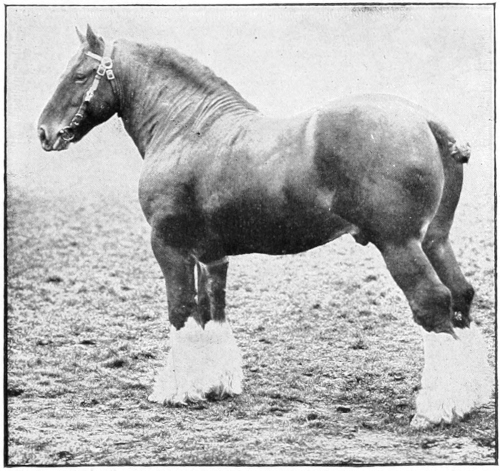
English draft-horse.
The horse has several natural gaits and some that are artificial. Its natural methods of progression are the walk, the trot, the amble, the gallop. When walking there are always two or more feet on the ground and the movement of the feet consists in placing successively the right hind foot, the right fore foot, left hind foot, left fore foot, right hind foot, etc. In trotting, each diagonal pair of legs is alternately lifted and thrust forward, the horse being unsupported twice during each stride. In ambling, the feet are moved as in the walk, only differing in that a hind foot or a fore foot is lifted from the ground, before its fellow fore foot or hind foot is set down. In a canter, the feet are landed on the ground in the same sequence as a walk but much more rapidly; and in the gallop, the spring is made from the fore foot and the landing is on the diagonal hind foot and just before landing, the body is in the air and the legs are all bent beneath it.
An excellent horseman once said to me, “The whip may teach a horse to obey the voice, but the voice and hand control the well-broken horse,” and this epitomizes the best horse training. He also said, “The horse knows a great deal, but he is too nervous to make use of his knowledge when he needs it most. It is the horse’s feelings that I rely on. He always has the use of his feelings and the quick use of them.” It is a well-known fact that those men who whip and scold and swear at their horses, are meantime showing to the world that they are fools in this particular business. Many of the qualities which we do not like in our domesticated horses, were most excellent and useful when the horses were wild, for instance, the habit of shying was the wild horse’s method of escaping the crouching foe in the grass. This habit as well as many others is best controlled by the voice of the driver instead of a blow from the whip.
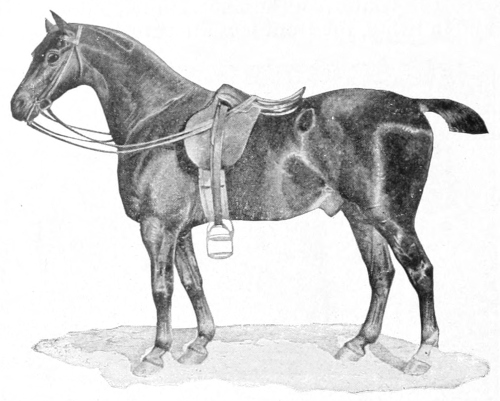
Saddle-horse.
Timothy hay, or hay mixed with clover, form good, bulky food for the horse, and oats and corn are the best concentrated food. Oats are best for driving-horses and corn for the working team. Dusty hay should not be fed to a horse; but if unavoidable, it should always be dampened before feeding. A horse should be fed with regularity, and should not be used for a short time after having eaten. If the horse is not warm, it should be watered before feeding, and in the winter the water should have the chill taken off. The frozen bit should be warmed before being placed in the horse’s mouth; if anyone doubts the wisdom of this, let him put a frozen piece of steel in his own mouth. The tight-drawn, cruel use of the over check-rein should not be permitted, although a moderate check is often needed and is not cruel. When the horse is sweating, it should be blanketed immediately if hitched outside in cold weather; but in the barn, the blanket should not be put on until the perspiration has stopped steaming. The grooming of a horse is a part of its rights, and its legs should receive more attention during this process than its body, a fact not always well understood.
The breeds of horses may always be classified more or less distinctly as follows: Racers or thoroughbreds, the saddle-horse, or hunter; the coach-horse; the draft-horse and the pony. For a description of breeds see dictionaries or cyclopedias. Of the draft-horses, the Percherons, Shires and Clydesdales are most common; of the carriage and coach-horses, the English hackney and the French and German coach-horses are famed examples. Of the roadster breeds, the American trotter, the American saddle-horse and the English thoroughbred are most famous.
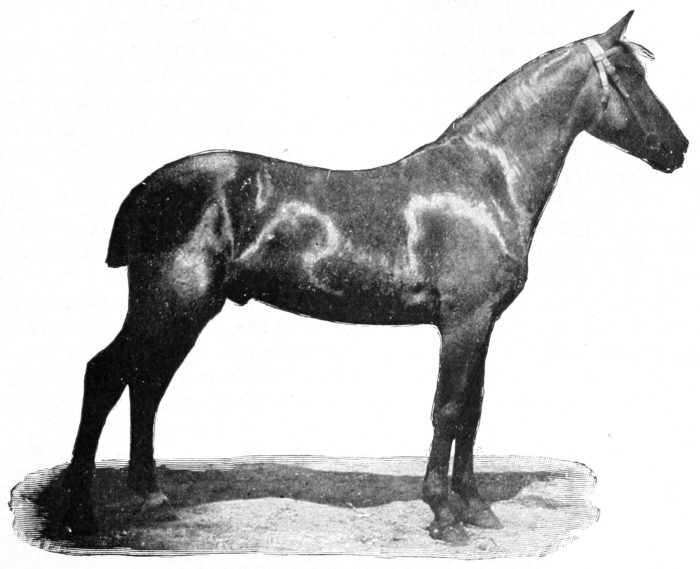
A good coacher.
LESSON LXVII
The Horse
Leading thought—The horse as a wild animal depended largely upon its strength and fleetness to escape its enemies, and these two qualities have made it of greatest use to man.
Method—Begin this study of the horse with the stories of wild horses. “The Pacing Mustang” in Wild Animals I Have Known, is an excellent story to show the habits of the herds of wild horses; Chapter first in A Country Reader and the story of horses in Life of Animals are excellent as a basis for study. Before beginning actual study of the domestic horses, ask for oral or written English exercises descriptive of the lives of the wild horses. Get Remington’s pictures illustrating the wild horses of America. After the interest has been thus aroused the following observations may be suggested, a few at a time, to be made incidentally in the street or in the stable.
Observations—1. Compare the length of the legs of the horse with its height. Has any other domestic animal legs as long in proportion? What habits of the ancestral wild horses led to the development of such long legs? Do you think the length of the horse’s neck and head correspond to the length of its legs? Why?
2. Study the horse’s leg and foot. The horse walks on one toe. Which toe do you think it is? What do we call the toe-nail of the horse? What advantage is this sort of a foot to the horse? Is it best fitted for running on dry plains or for marshy land? Does the hoof grow as our nails do? Do you know whether there were ever any horses with three toes or four toes on each foot? Make a sketch of the horse’s front and hind leg and label those places which correspond to our wrist, elbow, shoulder, hand, heel, knee and hip.
3. Where are the horse’s ears placed on the head? How do they move? Do they flap back and forth like the cow’s ears when they are moved, or do they turn as if on a pivot? What do the following different positions of the horse’s ears indicate: When lifted and pointing forward? When thrown back? Can you tell by the action of the ears whether a horse is nervous and high-strung or not?
4. What is the color of the horse’s eyes? The shape of the pupil? What advantage does the position of the eyes on the head give to the wild horse? Why do we put blinders on a horse? Can you tell by the expression of the eye the temper of the horse?
5. Look at the mouth and nose. Are the nostrils large and flaring? Has the horse a keen sense of smell? Are the lips thick or thin? When taking sugar from the hand, does the horse use teeth or lips?
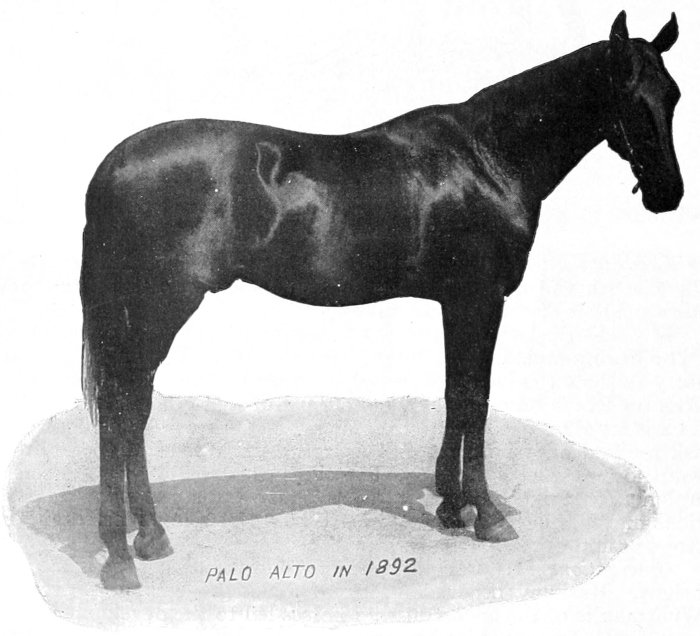
“Palo Alto”, a famous running horse.
6. Describe the horse’s teeth. How many front teeth? How many back teeth? Describe the bar where the bit is placed. Are there any canine teeth? If so, where? Do you know how to tell a horse’s age by its teeth? (See Elements of Agriculture, Warren, page 304, and The Horse, Roberts, page 246.) Can a horse graze the grass more closely than a cow? Why? When it chews does it move the jaws sidewise like the cow? Why? Why did the wild horses not need to develop a cud-chewing habit?
7. What is the nature of the horse’s coat in summer? If the horse runs in the pasture all winter, how does its coat change? When does the horse shed its coat? What is the use of the horse’s mane, forelock and tail? Do you think it is treating the horse well to dock its tail?
8. Why do colts need to be so long-legged? How does a colt have to place its front legs in order to reach down and eat the grass? Does the colt need to take its food from the mother often? How does it differ from the calf in this respect? How has this difference of habit resulted in a difference of form in the calf and colt?
9. When the horse lies down which part goes down first? When getting up which rises first? How does this differ from the method of the cow? When the horse lies down to sleep does it have its legs partially under it like the cow?
10. In walking which leg moves first? Second? Third? Fourth? How many gaits has the horse? Describe as well as you can all of these gaits. (See pictures illustrating the word “movement” in the Standard Dictionary.)
11. Make a sketch of a horse showing the parts. (See Webster’s Unabridged). When we say a horse is fourteen hands high what do we mean?
12. In fighting, what weapons does the horse use and how?
13. In training a horse, should the voice or the whip be used the most? What qualities should a man have to be a good horse trainer? Why is shying a good quality in wild horses? How should it be dealt with in the domestic horse?
14. What sort of feed is best for the horse? How and when should the horse be watered? Should the water be warmed in cold weather? Why? Should the bit be warmed in winter before putting it in a horse’s mouth? Why? Should a tight over check-rein be used when driving? Why? When the horse has been driven until it is sweating what are the rules for blanketing it when hitched out of doors and when hitched in the barn? What is your opinion of a man who lets his horse stand waiting in the cold, unblanketed in the village street? If horses were kept out of doors all the time would this treatment be so cruel and dangerous? Why? Why should dusty hay be dampened before it is fed to a horse? Why should a horse be groomed? Which should receive the most attention, the legs or the body?
15. How many breeds of horses do you know? What is the use of each? Describe as well as you can the characteristics of the following breeds: The thoroughbred, the hackney, and other coach-horses; the American trotter, the Percheron, the Clydesdale.
16. Write English themes on the following subjects: “The Prehistoric Horses of America,” “The Arabian Horse and Its Life With Its Master,” “The Bronchos and Mustangs of the West,” “The Wild Horses of Tartary,” “The Zebras of Africa,” “The Shetland Ponies and the Islands on Which They Run Wild.”
Supplementary reading—The Horse, Roberts; Elements of Agriculture, Warren; Life of Animals, Cram; Neighbors with Claws and Hoofs; A Country Reader; Agriculture for Beginners; Black Beauty; John Brent, by Theodore Withrop; Half Hours with Mammals, Holder; Chapters on Animals, Hammerton; “Kaweah’s Run” in Claws and Hoofs.
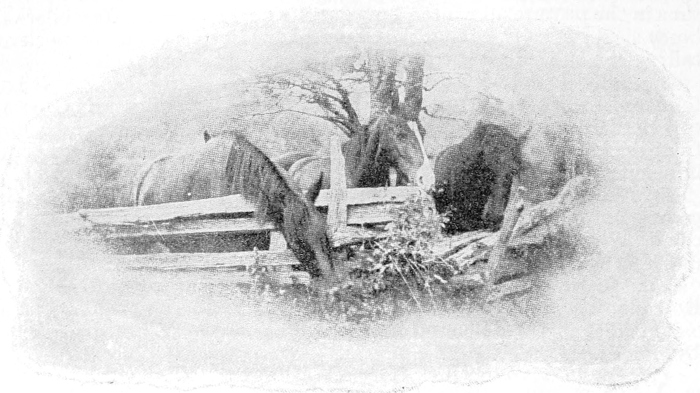
Many horses shy a good deal at objects they meet on the road. This mostly arises from nervousness, because the objects are not familiar to them. Therefore, to cure the habit, you must get your horse accustomed to what he sees, and so give him confidence.... Be careful never to stop a horse that is drawing a vehicle or load in the middle of a hill, except for a rest; and if for a rest, draw him across the hill and place a big stone behind the wheel, so that the strain on the shoulder may be eased. Unless absolutely necessary never stop a horse on a hill or in a rut, so that when he starts again it means a heavy tug. Many a horse has been made a jibber and his temper spoilt by not observing this rule.
—H. B. M. Buchanan in “A Country Reader.”
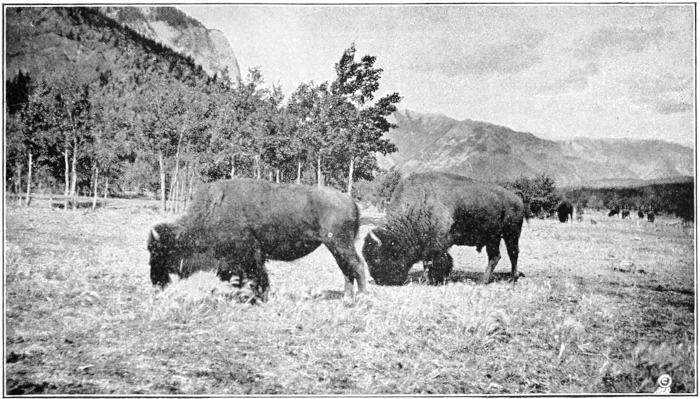
The original wild cattle of America.
Photo by John L. Rich.
CATTLE
Teacher’s Story
That in numbers there is safety, is a basic principle in the lives of wild cattle, probably because their chief enemies, the wolves, hunted in packs. It has often been related that, when the herd is attacked by wolves, the calves are placed at the center of the circle made by the cattle, standing with heads out and horns ready for attack from every quarter. But when a single animal, like a bear or tiger, attacks any of the herd, they all gather around it in a narrowing circle of clashing horns, and many of these great beasts of prey have thus met their death. The cow is as formidable as the bull to the enemy, since her horns are strong and sharp and she tosses her victim, unless it is too large. The heavy head, neck and short massive horns of the bull, are not so much for defence against enemies as against rival bulls. The bull not only tosses and gores his victim, but kneels or tramples upon it. Both have effective weapons of defence in the hind feet, which kick powerfully. The buffalo bull of India will attack a tiger single handed, and usually successfully. It is a strange thing that all cattle are driven mad by the smell of blood, and weird stories are told of the stampeding of herds from this cause, on the plains of our great West.
Cattle are essentially grass and herbage eaters, and their teeth are peculiarly arranged for this. There are eight front teeth on the lower jaw, and a horny pad opposite them on the upper jaw. Back of these on each jaw there is a bare place and six grinding teeth on each side. As a cow crops the herbage, her head is moved up and down to aid in severing the leaves, and the peculiar sound of the tearing of the leaves thus made is not soon forgotten by those who have heard it. In the wild or domesticated state the habit of cud-chewing is this: The cattle graze in mornings and evenings, swallowing the food as fast as cropped, and storing it in their ruminating stomachs. During the heat of the day, they move to the shade, preferably to the shady banks of streams, and there in quiet the food is brought up, a small portion at a time, and chewed with a peculiar sidewise movement of the jaws and then swallowed, passing to the true stomach. There is probably no more perfect picture of utter contentment, than a herd of cows chewing their cuds in the shade, or standing knee-deep in the cool stream on a summer’s day. The cattle in a herd when grazing, keep abreast and move along, heads in the same direction.
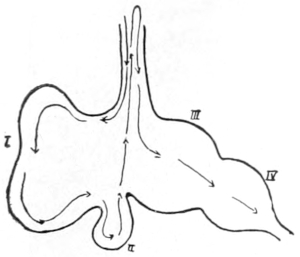
Course of food in a cow’s stomach.
I, ruminant stomach; II, where the cud-balls are formed; III, IV, true stomachs.
Connected with the grazing habit, is that of the hiding of the new-born calf by its mother; the young calf is a wabbly creature and ill-fitted for a long journey; so the mother hides it, and there it stays “frozen” and will never stir unless actually touched. As the mother is obliged to be absent for some time grazing with the herd, the calf is obliged to go without nourishment for a number of hours, and so it is provided with a large compound stomach which, if filled twice per day, suffices to insure health and growth. The cow, on the other hand, giving her milk out only twice per day, needs a large udder in which to store it. The size of the udder is what has made the cow useful to us as a milch animal.
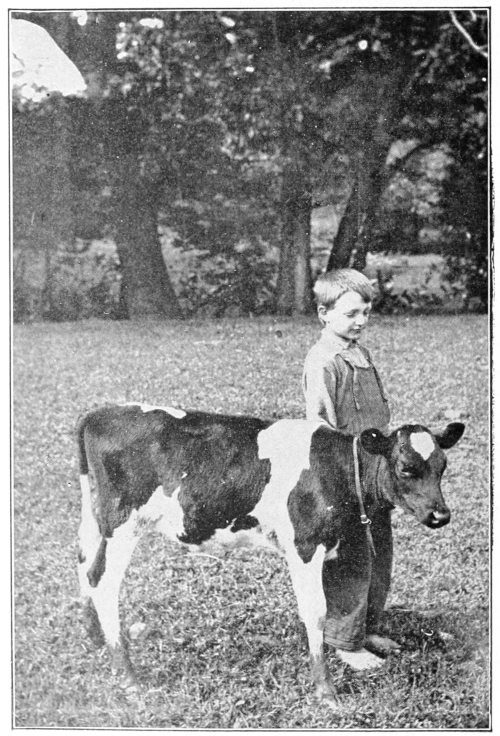
A pet Holstein.
A fine cow is a beautiful creature, her soft yellow skin beneath the sleek coat of short hair, the well proportioned body, the mild face, crowned with spreading, polished horns and illuminated with large gentle eyes, are all elements of beauty which artists have recognized, especially those of the Dutch school. The ancients also admired bovine eyes, and called their most beautiful goddess the ox-eyed Juno.
The cow’s ears can be turned in any direction, and her sense of hearing is keen; so is her sense of smell, aided by the moist, sensitive skin of the nose; she always sniffs danger and also thus tests her food. Although a cow if well kept has a sleek coat, when she is allowed to run out of doors during the winter, her hair grows long and shaggy as a protection. The cow walks on two toes, or as we say has a split hoof. She has two lesser toes above and behind the hoofs which we call dew-claws. The part of her leg which seems at first glance to be her knee, is really her wrist or ankle. Although short-legged, the cow is a good runner, as those who have chased her can bear witness. She can walk, gallop and has a pacing trot; she is a remarkable jumper, often taking a fence like a deer; she also has marvelous powers as a swimmer, a case being on record where a cow swam five miles. But a cow would be illy equipped for comfort if it were not for her peculiar tail, which is made after the most approved pattern of fly-brushes, and is thus used. Woe betide the fly she hits with it, if the blow is as efficient as that which she incidentally bestows on the head of the milker. It is to get rid of flies, that the cattle, and especially the buffaloes, wallow in the mud, and thus coat themselves with a fly-proof armor.
There is a fairly extensive range of emotions expressed in cattle language, from the sullen bellow of the angry animal to the lowing which is the call of the herd, and the mooing which is meant for the calf; and there are many other bellowings and mutterings which we can partially understand.
Every herd of cows has its leader, which has won the position by fair fight. Add a new cow to the herd, and there is at once a trial of strength, to adjust her to her proper place; and in a herd of cows, the leader leads; she goes first and no one may say her nay. In fact, each member of the herd has her place in it; and that is why it is so easy to teach cows each to take her own stanchion in the stable. In a herd of forty cows which I knew, each cow took her stanchion, no matter in what order she happened to enter the stable.
A cow at play is a funny sight; her tail is lifted aloft like a pennant and she kicks as lightly as if she were made of rubber. She is also a sure-footed beast, as anyone can attest who has seen her running down the rocky mountain sides of the Alps, at a headlong pace and never making a mistake. In lying down, the cow first kneels with the front legs, or rather drops on her wrists, and then the hind quarters go down, and then the front follow. She does not lie flat on her side when resting, like the horse when at ease, but with her legs partially under her. In getting up, she rests upon her wrists and then lifts the hind quarters.
The Usefulness of Cattle
When man emerged from the savage state, his first step toward civilization was domesticating wild animals and training them for his own use. During the nomad stage, when tribes wandered over the face of the earth, they took their cattle along. From the first, these animals have been used in three capacities: First, for carrying burdens and as draught animals; second, as meat; third, as givers of milk. They were also used in the earlier ages as sacrifices to the various deities, and in Egypt, some were held as sacred.
As beasts of burden and draft animals, oxen are still used in many parts of the United States. For logging, especially in pioneer days, oxen were far more valuable than horses. They are patient and will pull a few inches at a time, if necessary, a tedious work which the nervous horse refuses to endure. Cows too, have been used as draft animals, and are so used in China today, where they do most of the plowing; in these oriental countries milk is not consumed to any extent, so the cow is kept for the work she can do. In ancient times in the East, white oxen formed a part of royal processions.
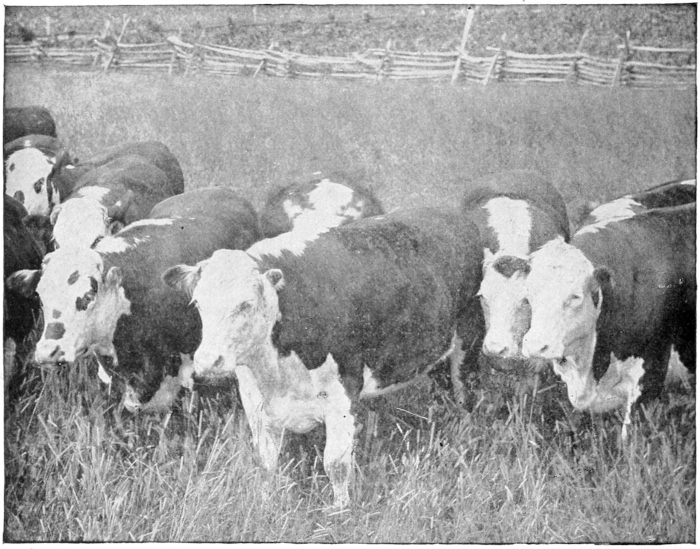
Beef cattle.
Because of two main uses of cattle by civilized man, he has bred them in two directions; one for producing beef, and one for milk. The beef cattle are chiefly Aberdeen-Angus, Galloway, Short-horn or Durham, and Hereford; the dairy breeds are the Jersey, Guernsey, Ayrshire, Holstein-Frisian and Brown Swiss. The beef animal is, in cross-section, approximately like a brick set sidewise. It should be big and full across the loins and back, the shoulders and hips covered heavily with flesh, the legs stout, the neck thick and short, and the face short; the line of the back is straight, and the stomach line parallel with it. Very different is the appearance of the milch cow. Her body is oval, instead of being approximately square in cross-section. The outline of her back is not straight, but sags in front of the hips, which are prominent and bony. The shoulders have little flesh on them; and if looked at from above, her body is wedge-shaped, widening from shoulders backward. The stomach line is not parallel with the back bone, but slants downward from the shoulder to the udder. The following are the points that indicate a good milch cow: Head high between the eyes, showing large air passages and indicating strong lungs. Eyes clear, large and placid, indicating good disposition. Mouth large, with a muscular lower jaw, showing ability to chew efficiently and rapidly. Neck, thin and fine, showing veins through the skin. Chest deep and wide, showing plenty of room for heart and lungs. Abdomen, large but well supported, and increasing in size toward the rear. Ribs, well spread, not meeting the spine like the peak of a roof, but the spine must be prominent, revealing to the touch the separate vertebræ. Hips, much broader than the shoulders. Udder, large, the four quarters of equal size, and not fat; the “milk veins” which carry the blood from the udder should be large and crooked, passing into the abdomen through large openings. Skin, soft, pliable and covered with fine, oily hair. She should have good digestion and great powers of assimilation. The milch cow is a milk-making machine, and the more fuel (food) she can use, the greater her production.
The physiological habits of the beef and milch cattle have been changed as much as their structure. The food given to the beef cow goes to make flesh; while that given to the milch cow goes to make milk, however abundant her food. Of course, there are all grades between the beef and the milch types, for many farmers use dual herds for both. However, if a farmer is producing milk it pays him well to get the best possible machine to make it, and that is always a cow of the right type.
A Geography Lesson
All the best breeds of cattle have been evolved in the British Isles and in Europe north of Italy and west of Russia. All our domesticated cattle were developed from wild cattle of Europe and Asia. The cattle which roam in our rapidly narrowing grazing lands of the far West are European cattle. America had no wild cattle except the bison. In geography supplementary readers, read about Scotland, England, the Channel Islands, the Netherlands, France and Switzerland and the different kinds of cattle developed in these countries; for example, “A Holland Dairy,” in Northern Europe, Ginn & Co.
How to Produce Good Milk
There are three main ingredients of milk—fat, curd and ash. The fat is for the purpose of supplying the animal with fat and we make it into butter; the curd supplies muscle, or the lean meat of the animal, and is the main ingredient of cheese, although cheese to be good should contain a full amount of butter fat; the ash which may be seen as residue when milk is evaporated, builds up the bone of the animal. The best butter cows are those which give a larger per cent. of fat and a small per cent. of curd, like the Jerseys; the best cheese cows are those which give a fair per cent. of fat and a larger yield of curd, like the Ayrshire and Holstein.
A cow for producing cheese, is not profitable, unless she gives seven thousand pounds of milk per year; a butter cow, a Jersey for instance, should produce five thousand pounds of milk per year to be really profitable.
The stable where milch cows are kept should be thoroughly cleaned before each milking, and should be swept each day; the cows’ udders should be brushed, and the milkers should wear clean aprons and should wash their hands before milking. Milk should never be strained in the barn, but in some place where the air is fresh. If milk is perfectly clean, it will keep sweet much longer; sterilized milk put in bottles will keep sweet for weeks and even months. Loud talking should not be permitted in the stables while the cows are being milked, and each cow should be milked by the same person for the entire season.
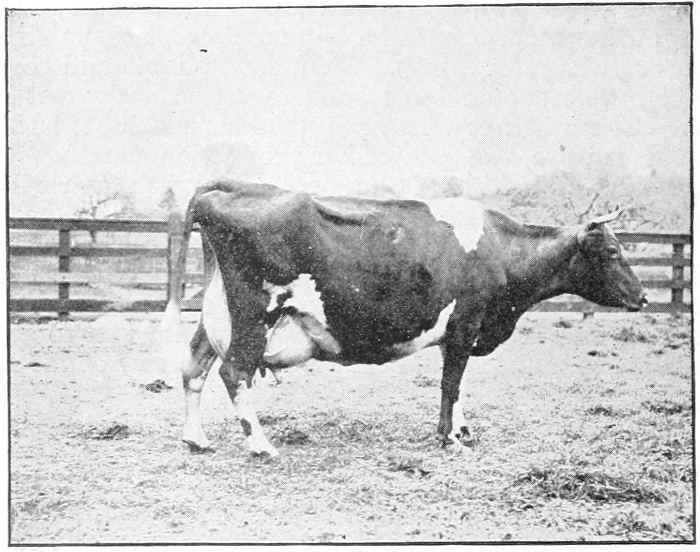
The perfect milch type.
Milk to be legally sold in New York State must possess three per cent. of butter fat. For upper grades or first year work in the high school, there could not be a more profitable exercise than teaching the pupils the use of the Babcock milk tester.
The Care of the Milch Cow
The importance cannot be over-estimated of teaching the pupils in rural districts, the proper care of milch cattle for the production of milk. The milch cow is a perfect machine, and should be regarded as such in producing milk. First, she should have plenty of food of the right kind, that is, a well-balanced ration. Second, she should have a warm, clean stable and be supplied with plenty of good, fresh air. A cold stable makes it necessary to provide much more food for the cow; a case on record shows that when a barn was opened up in cold weather for necessary repairing, the amount of milk from the cows stabled in it, decreased ten per cent. in twenty-four hours. There should be a protected place for drinking, if the cattle must be turned out of the barn for water in winter; it is far better to have the water piped into the barn, although the herd should be given a few hours each day in the open air. A dog should never be used for driving cows. To be profitable, a cow should give milk ten months of the year at least. Calves should be dehorned when they are a few days old by putting caustic potash on the budding horns, thus obviating the danger of damaging the cow by dehorning.
In a properly run dairy, a pair of scales stands near the can for receiving the milk; and as the milk from each cow is brought in, it is weighed and the amount set down opposite the cow’s name on a “milk sheet,” that is tacked on the wall, near by. At the end of each week, the figures on the milk sheet are added, and the farmer knows just how much milk each cow is giving him, and whether there are any in the herd which are not paying their board.
References—Elements of Agriculture, Warren; Agriculture for Beginners, Burkett, Stevens and Hill, p. 216; First Principles of Agriculture, Vorhees, p. 117; Elements of Agriculture, Sever, p. 57; Elements of Agriculture, Shepperd, chapters 15 and 22; First Principles of Agriculture, Goff and Maine, p. 154; Agriculture Through the Laboratory, School and Garden, Jackson and Dougherty, chapter 8; The Dairy Herd, Farmers’ Bulletin No. 55, U. S. Dept. of Agr.; Care of Milk on the Farm, Farmers’ Bulletin No. 63, U. S. Dept. of Agr.
LESSON LXVIII
The Cow
Leading thought—Certain characteristics which enable the cow to live successfully as a wild animal, have rendered her of great use to us as a domestic animal.
Method—Begin the lesson with leading the pupils to understand the peculiar adaptation of cattle for success, as wild animals. This will have to be done largely by reading and asking for oral or written work on the following topics: “The Aurochs,” “Wild Cattle of the Scottish Highlands,” “The Buffaloes of the Orient,” “The American Bison,” “The Cow-boys of the West and their Work with their Herds,” “The Breeds of Beef Cattle, Where they Came From, and Where Developed,” “The Breeds of Milch Cattle, their Origin and Names.” The following questions may be given out a few at a time and answered as the pupils have opportunity for observation.
Observations—1. What are the characteristics of a fine cow? Describe her horns, ears, eyes, nose and mouth. Do you think she can hear well? What is the attitude of her ears when she is listening? Do you think she has a keen sense of smell? Is her nose moist? Is her hair long or short? Smooth or rough?
2. The cow walks on two toes. Can you see any other toes which she does not walk on? Why is the cow’s foot better adapted than that of the horse, to walk in mud and marshes? What do we call the two hind toes which she does not walk on? Can you point out on the cow’s leg those parts which correspond with our elbow, wrist, knee and ankle? Is the cow a good runner? Is she a good jumper? Can she swim?
3. For what use was the cow’s tail evidently intended? How do the wild buffalos and bisons get rid of attacks of flies?
4. How much of cattle language do you understand? How does the cow express pleasure? Lonesomeness? Anger? How does the bull express anger? What does the calf express with the voice?
5. Is there always a leader in a herd of cows? Do certain cows of the herd always go first and others last? Do the cows readily learn to take each her own place in the stable? How is leadership of the herd attained? Describe cattle at play.
6. At what time of day do cattle feed in the pasture? When and where do they chew the cud? Do they stand or lie to do this? Describe how a cow lies down and gets up.
7. How do wild cattle defend themselves from wolves? From bears or other solitary animals?
8. For what purposes were cattle first domesticated? For how many purposes do we rear cattle today?
9. Name and give brief descriptions of the different breeds of cattle with which you are familiar. Which of these are beef and which milch types?
10. What are the distinguishing points of a good milch cow? Of a good beef animal? What does the food do for each of these? Which part of the United States produces most beef cattle? Which the most milch cattle?
11. What do we mean by a balanced ration? Do you know how to compute one? What is the advantage of feeding cattle a balanced ration?
12. How many pounds of milk should a dairy cow produce in a year to be profitable if the product is cheese? If the product is butter? Why this discrepancy? What must be the per cent. of butter fat in milk to make it legally salable in your state? How many months of the year should a good cow give milk?
13. Why should a cow be milked always by the same person? Does the milker always sit on the same side? Why should loud talking and other noise at milking time be avoided? Should a dog be used in driving dairy cows? Why?
14. Why is a cool draughty barn an expensive place in which to keep cattle? Why is a barn not well-ventilated, a danger?
15. Why and where is the dehorning of cattle practiced? When and how should a calf be dehorned?
16. Why should milk not be strained in the barn? Why is it profitable for the dairy farmer to keep his stable clean and to be cleanly in the care of milk? How does the food of cows affect the flavor of the milk? Why should a farmer keep a record of the number of pounds of milk which each cow in his dairy gives each day?
17. For what are oxen used? Wherein are they superior to horses as draft animals? Do you know of any place where oxen are used as riding animals?
18. How many industries are dependent upon cattle?
19. Give oral or written exercises on the following themes: “How the Best Butter is Made;” “The Use of Bacteria in Butter;” “How Dairy Cheese is Made;” “How Fancy Cheeses are Made.”
THE PIG
Teacher’s Story
“I wander through the underbresh, Where pig tracks pintin’ to’rds the crick, Is picked and printed in the fresh Black bottom-lands, like wimmen prick Their pie-crust with a fork.” —Riley.
Y a forest law of William the First of England in the eleventh century, it was ordained that any that were found guilty of killing the stag or the roebuck or the wild boar, should have their eyes put out. This shows that the hunting of the wild boar in England was considered a sport of gentlemen in an age when nothing was considered sport unless it was dangerous. The wild hog of Europe is the ancestor of our common domesticated breeds; although independent of these, the Chinese domesticated their own wild species, even before the dawn of history.
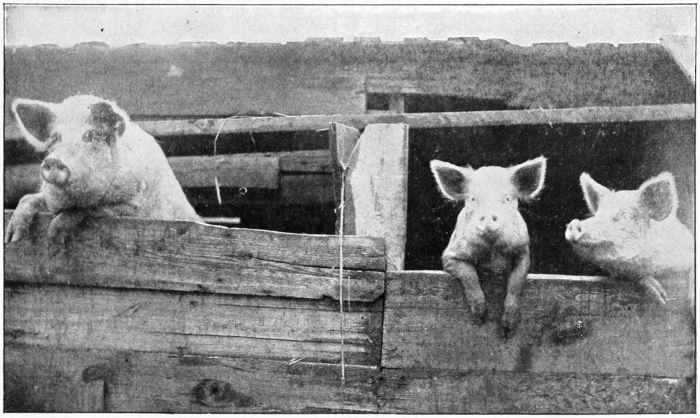
Anxious for dinner.
The wild hog likes damp situations where it may wallow in the water and mud; but it also likes to have, close by, woods, thicket or underbrush, to which it can retire for rest and also when in danger. The stiff, bristling hairs which cover its thick skin, are a great protection when it is pushing through thorny thickets. When excited or angry, these bristles rise and add to the fury of its appearance. Even in our own country, the wild hogs of the South whose ancestors escaped from domestication, have reverted to their original savagery, and are dangerous when infuriated. The only recorded instance when our great national hunter, Theodore Roosevelt, was forced ignominiously to climb a tree, was after he had emptied his rifle into a herd of “javelins,” as the wild pigs of Texas are called; the javelins are the peccaries, which are the American representatives of the wild hog.
That the hog has become synonymous with filth is the result of the influence of man upon this animal, for of all animals, the pig is naturally the neatest, keeping its bed clean, often in the most discouraging and ill-kept pens. The pig is sparsely clothed with bristles and hairs, which yield it no protection from the attacks of flies and other insects. Thus it is the pig, in order to rid itself of these pests, has learned to wallow in the mud. However, this is in the nature of a mud bath, and is for the purpose of keeping the body free from vermin. The wild hogs of India make for themselves grass huts, thatched above and with doors at the sides, which shows that the pig, if allowed to care for itself, understands well the art of nest-building.
One of the most interesting things about a pig, is its nose; this is a fleshy disc with nostrils in it and is a most sensitive organ of feeling; it can select grain from chaff, and yet is so strong that it can root up the ground in search for food. “Root” is a pig word, and was evidently coined to describe the act of the pig when digging for roots; the pig’s nose is almost as remarkable as the elephant’s trunk, and the pig’s sense of smell is very keen; it will follow a track almost as well as a dog. There are more instances than one of a pig being trained as a pointer for hunting birds, and showing a keener sense of smell, and keener intelligence in this capacity, than do dogs. French pigs are taught to hunt for truffles, which are fungi growing on tree roots, a long way below the surface of the ground; the pig detects their presence through the sense of smell.
The pig has a full set of teeth, having six incisors, two canines and seven grinding teeth on each jaw; although in some cases there are only four incisors on the upper jaw. A strange thing about a pig’s teeth, is the action of the upper canines, or tushes, which curve upward instead of downward; the lower canines grind up against them, and are thus sharpened. The females have no such development of upper tushes as do the males; these tushes, especially the upper ones, are used as weapons; with them, the wild boar slashes out and upward, inflicting terrible wounds, often disabling horses and killing men. Professor H. F. Button describes the fighting of hogs thus: “To oppose the terrible weapons of his rival, the boar has a shield of skin over his neck and shoulders, which may become two inches thick, and so hard as to defy a knife. When two of these animals fight, each tries to keep the tushes of his opponent against the shield, and to get his own tushes under the belly or flank of the other. Thus, each goes sidewise or in circles, which has given rise to the expression, ‘to go sidewise like a hog to war.’”
When, as a small girl, I essayed the difficult task of working buttonholes, I was told if I did not set my stitches more closely together, my buttonhole would look like a pig’s eye, a remark which made me observant of that organ ever after. But though the pig’s eyes are small, they certainly gleam with intelligence, and they take in all that is going on, which may in any way affect his pigship.
The pig is the most intelligent of all the farm animals, if it is only given a chance; it has excellent memory and can be taught tricks readily; it is affectionate and will follow its master around like a dog. Anyone who has seen a trained pig at a show picking out cards and counting, must grant that it has brains, although we stuff it so with fattening food, that it does not have a chance to use its brain, except now and then when it breaks out of the sty and we try to drive it back. Under these circumstances, we grant the pig all the sagacity usually imputed to the one who once possessed swine and drove them into the sea. Hunters of wild hogs proclaim that they are full of strategy and cunning, and are exceedingly fierce. We pay tribute to the pig’s cleverness when free to outwit us, when we say of other uncertain undertakings, that they are like “buying a pig in a poke.”
The head of the wild hog is wedge-shaped with pointed snout, and this form enables the animal to push into the thick underbrush along the river banks, whenever it is attacked. But civilization has changed this bold profile of the head, so that now in many breeds, there is a hollow between the snout and eyes, giving the form which we call “dished.” Some breeds have sharp, forward-opening ears, while others have ears that lop. The wild pig of Europe and Asia has large, open ears extending out wide and alert on each side of the head.
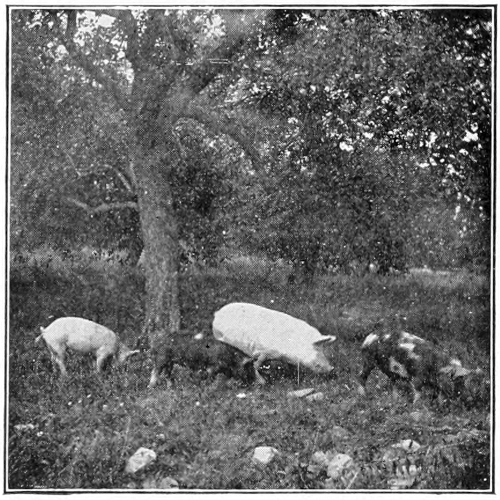
Good for the pigs and good for the orchard.
The covering of the pig is a thick skin beset with bristling hairs; when the hog is excited, the bristles rise and add to the fury of its appearance. The bristles aid in protecting the animal when it is pushing through thorny thickets. The pig’s querly tail is merely an ornament, although the tail of the wart hog of Africa, if pictures may be relied upon, might be used in a limited fashion as a fly-brush.
When the pig is allowed to roam in the woods, it lives on roots, nuts, and especially acorns and beech nuts; in the autumn it becomes very fat through feeding upon the latter. The mast-fed bacon of the semi-wild hogs of the Southern States is considered the best of all. But almost anything animal or vegetable, that comes in its way, is eaten by the hog, and it has been long noted that the hog has done good service on our frontier as a killer of rattlesnakes. The pig is well fitted for locomotion on either wet or dry soil, for the two large hoofed toes enable it to walk well on dry ground and the two hind toes, smaller and higher up, help to sustain it on marshy soil. Although the pig’s legs are short, it is a swift runner unless it is too fat. The razor-backs of the South are noted for their fleetness.
We understand somewhat the pig’s language; there is the constant grunting, which is a sound that keeps the pig herd together. We understand perfectly the complaining squeal of hunger, the satisfied grunt signifying enjoyment of food, the squeal of terror when seized, and the nasal growl when fighting. But there is much more to the pig’s conversation than this; I know a certain lady, who is a lover of animals, and who once undertook to talk pig language as best she could imitate it, to two of her sows when they were engaged in eating. They stopped eating, looked at each other a moment and forthwith began fighting, each evidently attributing the lady’s remark to the other, and obviously it was of an uncomplimentary character.
The pig’s ability to take on fat was evidently a provision, in the wild state, for storing up fat from mast that should help sustain the animal during the hardships of winter; and this character is what makes swine useful for our own food. Pigs, to do best, should be allowed to have pasture and plenty of fresh green food. Their troughs should be kept clean and they should have access to ashes, and above all, they should have plenty of pure water; and as the pig does not perspire freely, access to water where it can take its natural mud-baths helps to keep the body cool and the pig healthy in hot weather.
The breeds of hogs most common in America are the Berkshires, which are black with white markings, and have ears extending erect; the Poland Chinas, which are black and white with drooping ears; the Duroc-Jersey, which are red or chestnut with drooping ears; the Yorkshire and Cheshire, which are white with erect ears, while the Cheshire White is white with drooping ears. The Poland China and Duroc-Jersey are both pure American breeds.
References—Elementary Agriculture, Warren; Our Domestic Animals, Burkett; The Country Reader, Buchanan; Lives of Animals, Ingersoll; Types and Breeds of Farm Animals, Plumb; and the bulletins of the U. S. Department of Agriculture.
LESSON LXIX
The Pig
Leading thought—The pig is something more than a source of pork. It is a sagacious animal and naturally cleanly in its habits when not made prisoner by man.
Method—The questions in this lesson may be given to the pupils a few at a time, and those who have access to farms or other places where pigs are kept may make the observations and in giving them to the class they should be discussed. Supplementary reading should be given the pupils, which may inform them as to the habits and peculiarities of the wild hogs. Theodore Roosevelt’s experience in hunting the wart-hog in Africa will prove interesting reading.
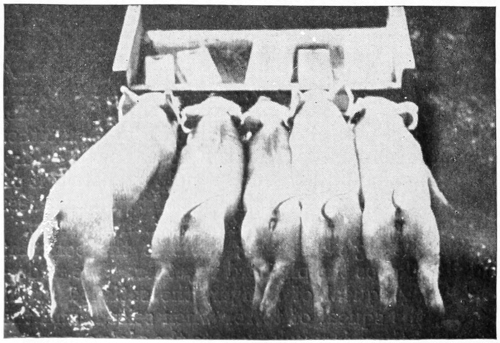
Bottle-fed babies.
Observations—1. How does the pig’s nose differ from that of other animals? What is it used for besides for smelling? Do you think the pig’s sense of smell is very keen? Why do pigs root?
2. Describe the pig’s teeth. For what are they fitted? What are the tushes for? Which way do the upper tushes turn? How do wild hogs use their tushes?
3. Do you think that a pig’s eyes look intelligent? What color are they? Do you think the pig can see well?
4. Is the pig’s head straight in front or is it dished? Is this dished appearance ever found in wild hogs? Do the ears stand out straight or are they lopped? What advantage is the wedge-shaped head to the wild hogs?
5. How is the pig covered? Do you think the hair is thick enough to keep off flies? Why does the pig wallow in the mud? Is it because the animal is dirty by nature or because it is trying to keep clean? Do the hog’s bristles stand up if it is angry?
6. If the pig could have its natural food what would it be and where would it be found? Why and on what should pigs be pastured? What do pigs find in the forest to eat? What kind of bacon is considered the best?
7. On how many toes does the pig walk? Are there other toes on which it does not walk? If wading in the mud are the two hind toes of use? Do wild pigs run rapidly? Do tame pigs run rapidly if they are not too fat? Do you think the pig can swim? Do you think that the pig’s tail is of any use or merely an ornament?
8. What cries and noises do the pigs make which we can understand?
9. How do hogs fight each other? When the boars fight, how do they attack or ward off the enemy? Where do we get the expression going “sidewise like a hog to war?”
10. How many breeds of pigs do you know? Describe them.
11. What instances have you heard that show the hog’s intelligence?
12. Give an oral or written English exercise on one of the following topics: “The antiquity of swine; how they were regarded by the ancient Egyptians, Greeks and Romans;” (see encyclopedia). “The story of hunting wild hogs in India;” “The razor-back hogs of the South;” “The wart-hog of Africa.”
“The nice little pig with a querly tail, All soft as satin and pinky pale Is a very different thing by far Than the lumps of iniquity, big pigs are.” —Nonsense Rhyme.