Part 3 — FLOWERLESS-PLANT STUDY (continued 2)
Reading edition
We have in our blood little cells whose business it is to destroy the harmful bacteria which get into the blood. These little fighting cells move everywhere with our blood, and if we keep healthy and vigorous by right living, right food and exercise, these cells may prove strong enough to kill the disease germs before they harm us. Direct sunlight also kills some of the bacteria. Seven or eight minutes exposure to bright sunlight is said to kill the germs of tuberculosis. Exposure to the air is also a help in subduing disease germs. Bichloride of mercury, carbolic acid, formaldehyde and burning sulphur also kill germs, and may be applied to clothing or to rooms in which patients suffering from these germ diseases have been. We can do much to protect ourselves from harmful bacteria by being very clean in our persons and in our homes, by bathing frequently and washing our hands with soap often. We should eat only pure and freshly cooked food, we should get plenty of sleep and admit the sunlight to our homes; we should spend all the time possible in the open air and be careful to drink pure water. If we are not sure that the water is pure, it should be boiled for twenty minutes and then cooled for drinking.
In Experiment A the milk vials and the corks are all boiled, so that we may be sure that no other bacteria than the ones we chose are present, since boiling kills these germs. As soon as the milk becomes discolored we know that it is full of bacteria.
Experiment B shows that bacteria can be transplanted to gelatin, which is a material favorable for its growth. But the point of this experiment is to show the child that a soiled finger will have upon it germs which, by growing, cloud the gelatin. They should thus learn the value of washing their hands often or of keeping their fingers out of their mouths.
Experiment C shows the way the destructive bacteria attack the potato. The discolored spots show where the decay begins, and the odor is suggestive of decay. If a potato thus attacked is put in the bright sunlight the bacteria are destroyed, and this should enforce the moral of the value of sunshine.
References—The Story of the Bacteria; Dust and its Dangers, M. T. Prudden, Putnam’s. Bacteria in Relation to Country Life, Lipman.
LESSON CLXXXVII
Bacteria
Leading thought—Bacteria are such small plants that we cannot see them without the aid of a microscope, but they can be planted and will grow. The object of this lesson is to enforce cleanliness.
Method—Experiment A—The bread used for the mold experiment is likely to develop spots of yellow, red or purple upon it, and cultures from these spots may be used in this lesson as follows: Take some vials, boil them and their corks, and nearly fill them with milk that has been boiled. Take the head of a pin or hairpin, sterilize the point by holding in a flame, let it cool, touch one of the yellow spots on the bread with the point, being careful to touch nothing else, and thrust the point with the bacteria on it into the milk; then cork the vials.
Experiment B—Prepare gelatin as for the table but do not sweeten. Pour some of this gelatin on clean plates or saucers. After it has cooled let one of the children touch lightly the gelatin in one saucer for a few seconds with his soiled finger. Note the place. Ask him to wash his hands thoroughly with soap and then apply a finger to the surface of the gelatin in the other plate. Cover both plates to keep out the dust and leave them for two or three days in a dark place. The plates touched by the soiled finger will show a clouded growth in the gelatin; the other plate will show a few irregular, scattered growths or none.
Experiment C—Take a slice of boiled potato, place in a saucer, leave it uncovered for a time or blow dust upon it, label with date, then cover with a tumbler to keep from drying and place in a cool, somewhat dark place.
The pupils should examine all these cultures every day and make the following notes:
Experiment A—How soon did you observe a change in the color of the milk? How can you tell when the milk is full of the bacteria? How do you know that the bacteria in the milk was transplanted by the pin?
Experiment B—Can you see that the gelatin is becoming clouded where the soiled finger touched it? This is a growth of the bacteria which were on the soiled finger.
Experiment C—What change has taken place in the appearance of the slice of potato? Are there any spots growing upon it? What is the odor? What makes the spots? Describe the shape of the spots. The color. Are any of them pimple-shaped? Make a drawing of the slice of potato showing the bacteria spots. What are the bacteria doing to the potato? Take a part of the slice of potato with the bacteria spots upon it, and put it in the sunshine. What happens? Compare this with the part kept in the dark.
After this lesson the children should be asked the following questions.
1. Why should the hands always be washed before eating?
2. Why should the finger nails be kept clean?
3. Why should we never bite the finger nails nor put the fingers in the mouth?
4. Why should we never put coins in the mouth?
5. Why should wounds be carefully cleansed and dressed at once?
6. Why should clothing, furniture and the house be kept free from dust?
7. Why should sweeping be done as far as possible without raising dust?
8. Why are hardwood floors more healthful than carpets?
9. Why is a damp cloth better than a feather duster for removing dust?
10. Why should the prohibition against spitting in public places be strictly enforced?
11. Why should the dishes, clothes and other articles used by sick persons be kept distinctly separate from those used by well members of the family?
12. Why should food not be exposed for sale on the street?
13. Why, during an epidemic, should water be boiled before drinking?
“This habit of looking first at what we call the beauty of objects is closely associated with the old conceit that everything is made to please man: man is only demanding his own. It is true that everything is man’s because he may use it or enjoy it, but not because it was designed and ‘made’ for ‘him’ in the beginning. This notion that all things were made for man’s special pleasure is colossal self-assurance. It has none of the humility of the psalmist, who exclaimed, ‘What is man, that thou art mindful of him?’”
“‘What were these things made for, then?’ asked my friend. Just for themselves! Each thing lives for itself and its kind, and to live is worth the effort of living for man or bug. But there are more homely reasons for believing that things were not made for man alone. There was logic in the farmer’s retort to the good man who told him that roses were made to make man happy. ‘No, they wa’n’t’, said the farmer, ‘or they wouldn’t a had prickers.’ A teacher asked me what snakes are ‘good for.’ Of course there is but one answer: they are good to be snakes.” —“The Nature Study Idea”, L. H. Bailey.
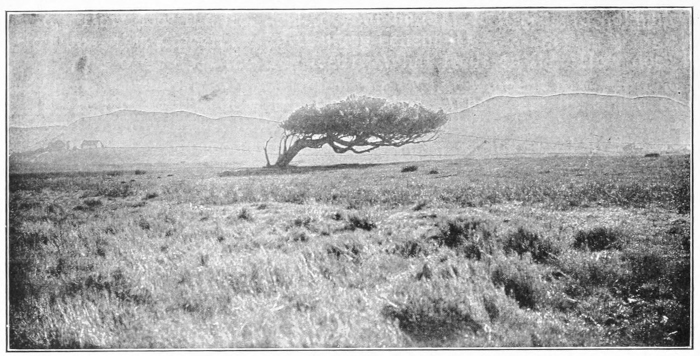
A Pacific Coast live oak showing the effects of constant, strong winds from one direction.
Photo by G. K. Gilbert. Courtesy of U. S. Geological Survey.
TREE STUDY
Teacher’s Story
“I wonder if they like it—being trees? I suppose they do. It must feel so good to have the ground so flat, And feel yourself stand straight up like that. So stiff in the middle, and then branch at ease, Big boughs that arch, small ones that bend and blow, And all those fringy leaves that flutter so. You’d think they’d break off at the lower end When the wind fills them, and their great heads bend. But when you think of all the roots they drop, As much at bottom as there is on top, A double tree, widespread in earth and air, Like a reflection in the water there.” —“Tree Feelings” by Charlotte Perkins Stetson.
ATURAL is our love for trees! A tree is a living being, with a life comparable to our own. In one way it differs from us greatly: it is stationary, and it has roots and trunk instead of legs and body; it is obliged to wait to have what it needs come to it, instead of being able to search the wide world over to satisfy its wants.
THE PARTS OF THE TREE
The head, or crown, is composed of the branches as a whole, which in turn are composed of the larger and smaller branches and twigs. The spray is the term given to the outer twigs, the finest divisions of the trunk, which bear the leaves and fruit. The branches are divisions of the bole, or trunk, which is the body, or stem, of the tree. The bole, at the base, divides into roots, and the roots into rootlets, which are covered with root-hairs. It is important to understand what each of the parts of a tree’s anatomy does to help carry on the life of the tree.
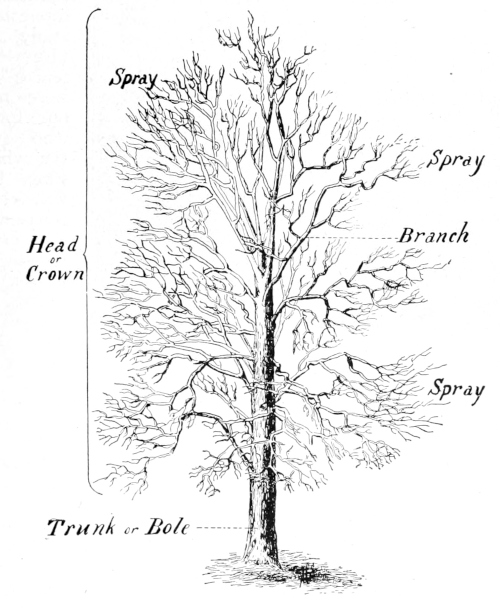
A tree with parts named.
The roots, which extend out in every direction beneath the surface of the ground, have two quite different offices to perform: First, they absorb the water which contains the tree food dissolved from the soil; second, they hold the tree in place against the onslaught of the winds. If we could see a tree standing on its head with its roots spread in the air in the same manner as they are in the ground, we could then better understand that there is as much of the tree hidden below ground as there is in sight above ground, although of quite different shape, being flatter and in a more dense mass. The roots seem to know in which direction to grow to reach water; thus, the larger number of the roots of a tree are often found to extend out toward a stream flowing perhaps some distance from the tree; when they find plenty of food and water the rootlets interlace forming a solid mat. On the Cornell Campus are certain elms which, every six or seven years, completely fill and clog the nearby sewers; these trees send most of their roots in the direction of the sewer pipe. The fine rootlets upon the tree-roots are covered with root-hairs, which really form the mouths by which the liquid food is taken into the tree.
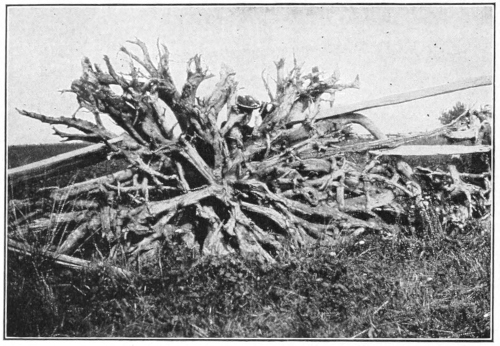
The upturned roots of a white pine; a part of a stump fence a century old.
To understand how firm a base the roots form to hold up the tall trunk, we need to see an uprooted tree. The great roots seem to be molded to take firm grasp upon the soil. It is interesting to study some of the “stump fences” which were made by our forefathers, who uprooted the white pines when the land was cleared of the primeval forest, and made fences of their widespreading but rather shallow extending roots. Many of these fences stand to-day with branching, out-reaching roots, white and weather-worn, but still staunch and massive as if in memory of their strong grasp upon the soil of the wilderness.
The trunk, or bole, or stem of the tree has also two chief offices: It holds the branches aloft, rising to a sufficient height in the forest so that its head shall push through the leaf canopy and expose the leaves to the sunlight. It also is a channel by which the water containing the food surges from root to leaf and back again through each growing part. The branches are divisions of the trunk, and have the same work to do.
In cross-section, the tree trunk shows on the outside the layer of protective bark; next to this comes the cambium layer, which is the vital part of the trunk; it builds on its outside a layer of bark, and on its inside a layer of wood around the trunk. Just within the cambium layer is a lighter colored portion of the trunk, which is called the sap-wood because it is filled with sap which moves up and down its cells in a mysterious manner; the sap-wood consists of the more recent annual rings of growth. Within the sap-wood are concentric rings to the very center or pith; this portion is usually darker in color and is called the heartwood; it no longer has anything to do with the life of the tree, but simply gives to it strength and staunchness. The larger branches, if cut across, show the same structure as the trunk,—the bark on the outside, the cambium layer next, and within this the rings of annual growth. Even the smaller branches and twigs show similar structure, but they are young and have not attained many annual rings.
The leaves are borne on the outermost parts of the tree. A leaf cannot grow, and if it could would be of no use, unless it can be reached by the sunlight. Therefore the trunk lifts the branches aloft, and the branches hold the twigs far out, and the twigs divide into the fine spray, so as to spread the leaves and hold them out into the sunshine. In structure, the leaf is made up of the stem, or petiole, and the blade, or widened portion of the leaf, which is sustained usually with a framework of many ribs or veins. The petioles and the veins are sap channels like the branches and twigs.
WOOD-GRAIN This is the way that the sap-river ran From the root to the top of the tree Silent and dark, Under the bark, Working a wonderful plan That the leaves never know, And the branches that grow On the brink of the tide never see. —John B. Tabb.
THE WAY A TREE GROWS
HE places of growth on a tree may be found at the tips of the twigs and the tips of the rootlets; each year through this growth the tree pushes up higher, down deeper and out farther at the sides. But in addition to all of these growing tips, there is a layer of growth over the entire tree—over every root, over the trunk, over the limbs and over each least twig, just as if a thick coat of paint had been put over the complete tree. It is a coat of growth instead, and these coats of growth make the concentric rings which we see when the trunks or branches are cut across. Such growth as this cannot be made without food; but the tree can take only liquid food from the soil; the root-hairs take up the water in which the “fertilizer” is dissolved, and it is carried up through the larger roots, up through the sap-wood of the trunk, out through the branches to the leaves, where in the leaf-factories the water and free oxygen is given off to the air, and the nourishing elements retained and mixed with certain chemical elements of the air, thus becoming tree food. The leaf is a factory; the green pulp in the leaf cells is part of the machinery; the machinery is set in motion by sunshine power; the raw materials are taken from the air and from the sap containing food from the soil; the finished product is largely starch. Thus, it is well, when we begin the study of the tree, to notice that the leaves are so arranged as to gain all the sunlight possible, for without sunlight the starch factories would be obliged to “shut down.” It has been estimated that on a mature maple of vigorous growth there is exposed to the sun nearly a half acre of leaf surface. Our tree appears to us in a new phase when we think of it as a starch factory covering half an acre.
Starch is plant food in a convenient form for storage, and it is stored in sap-wood of the limbs, the branches and trunk, to be used for the growth of the next year’s leaves. But starch cannot be assimilated by plants in this form, it must be changed to sugar before it may be used to build up the plant tissues. So the leaves are obliged to perform the office of stomach and digest the food they have made for the tree’s use. In the mysterious laboratory of the leaf-cells, the starch is changed to sugar; and nitrogen, sulphur, phosphorus and other substances are taken from the sap and starch added to them, and thus are made the proteids which form another part of the tree’s diet. It is interesting to note that while the starch factories can operate only in the sunlight, the leaves can digest the food and it can be transported and used in the growing tissues in the dark. The leaves are also an aid to the tree in breathing, but they are not especially the lungs of the tree. The tree breathes in certain respects as we do; it takes in oxygen and gives off carbon dioxide; but the air containing the oxygen is taken in through the numerous pores in the leaves called stomata, and also through lenticels in the bark; so the tree really breathes all over its active surface.
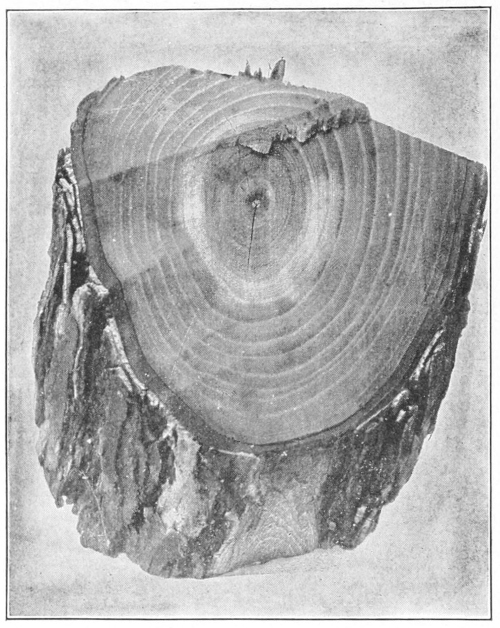
A stump showing rings of growth.
The tree is a rapid worker and achieves most of its growth and does most of its work by midsummer. The autumn leaf which is so beautiful has completed its work. The green starch-machinery or chlorophyl, the living protoplasm in the leaf cells, has been withdrawn and is safely secluded in the woody part of the tree. The autumn leaf which glows gold or red, has in it only the material which the tree can no longer use. It is a mistake to believe that the frost causes the brilliant colors of autumn foliage; they are caused by the natural old age and death of the leaves—and where is there to be found old age and death more beautiful? When the leaf assumes its bright colors, it is making ready to depart from the tree; a thin, corky layer is being developed between its petiole and the twig, and when this is perfected, the leaf drops from its own weight or the touch of the slightest breeze.
A tree, growing in open ground, records in its shape, the direction of the prevailing winds. It grows more luxuriantly on the leeward side. It touches the heart of the one who loves trees to note their sturdy endurance of the onslaughts of this, their most ancient enemy.
Reference Books for Tree Study—The Tree Book, Julia Rogers; Our Native Trees, Harriet Keeler; Our Northern Shrubs, Harriet Keeler; The Trees of the Northern States, Romayne Hough. The Trees, N. L. Britton; Getting Acquainted with the Trees, J. Horace McFarland; Familiar Trees and their Leaves, Schuyler Mathews; Our Trees and How to Know Them, Clarence Moores Weed; A Guide to the Trees, Alice Lounsberry; The First Book of Forestry, Filibert Roth; Practical Forestry, John Gifford; Trees in Prose and Poetry, Stone & Fickett; The Primers of Forestry, Pinchot.
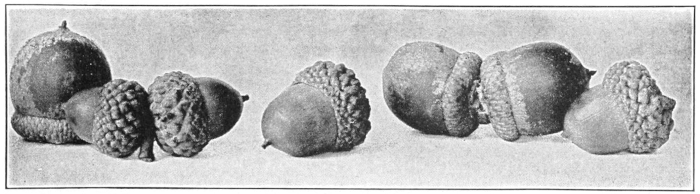
Acorns of the red and the scarlet oaks.
Photo by O. L. Foster.
HOW TO BEGIN TREE STUDY
Teacher’s Story
URING autumn the attention of the children should be attracted to the leaves by their gorgeous colors. It is well to use this interest to cultivate their knowledge of the forms of leaves of trees; but the teaching of the tree species to the young child should be done quite incidentally and guardedly. If the teacher says to the child bringing a leaf, “This is a white oak leaf,” the child will soon quite unconsciously learn that leaf by name. Thus, tree study may be begun in the kindergarten or the primary grades.
1. Let the pupils use their leaves as a color lesson by classifying them according to color, and thus train the eye to discriminate tints and color values.
2. Let them classify the leaves according to form, selecting those which resemble each other.
3. Let each child select a leaf of his own choosing and draw it. This may be done by placing the leaf flat on paper and outlining it with pencil or with colored crayon.
4. Let the pupils select paper of a color similar to the chosen leaf and cut a paper leaf like it.
5. Let each pupil select four leaves which are similar and arrange them on a card in a symmetrical design. This may be done while the leaves are fresh, and the card with leaves may be pressed and thus preserved.
In the fourth grade, begin with the study of a tree which grows near the schoolhouse. In selecting this tree and in speaking of it, impress upon the children that it is a living being, with a life and with needs of its own. I believe so much in making this tree seem an individual, that I would if necessary name it Pocahontas or Martha Washington. First, try to ascertain the age of the tree. Tell an interesting story of who planted it and who were children and attended school in the schoolhouse when the tree was planted. To begin the pupils’ work, let each have a little note-book in which shall be written, sketched or described all that happens to this particular tree for a year. The following words with their meaning should be given in the reading and spelling lessons: Head, bole, trunk, branches, twigs, spray, roots, bark, leaf, petiole, foliage, sap.
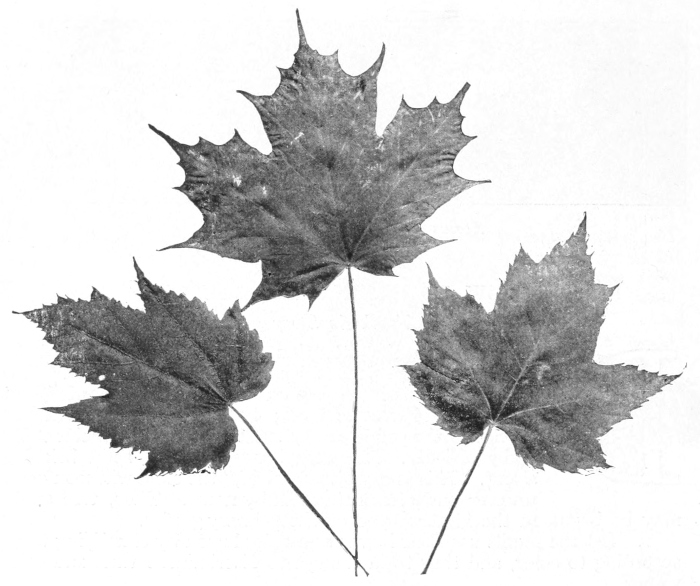
Mountain maple, sugar maple and red maple.
LESSON CLXXXVIII
Tree Study
Autumn Work—1. What is the color of the tree in its autumn foliage? Sketch it in water colors or crayons, showing the shape of the head, the relative proportions of head and trunk.
2. Describe what you can see of the tree’s roots. How far do you suppose the roots reach down? How far out at the sides? In how many ways are the roots useful to the tree? Do you suppose, if the tree were turned bottomside up, that it would show as many roots as it now shows branches?
3. How high on the trunk from the ground do the lower branches come off? How large around is the trunk three feet from the ground? If you know how large around it is, how can you get the distance through? What is the color of the bark? Is the bark smooth or rough? Are the ridges fine or coarse? Are the furrows between the ridges deep or shallow? Of what use is the bark to the tree?
4. Describe the leaf from your tree, paying special attention to its shape, its edges, its color above and below, its veins or ribs, and the relative length and thickness of its petiole. Are the leaves set opposite or alternate upon the twigs? As the leaves begin to fall, can you find two which are exactly the same in size and shape? Draw in your note-book the two leaves which differ most from each other of any that grew on your tree. At what date do the leaves begin to fall from your tree? At what date are they all off the tree?
5. Do you find any fruit or seed upon your tree? If so describe and sketch it, and tell how you think it is scattered and planted.
Winter Study of the Tree—1. Make a sketch of the tree in your notebook, showing its shape as it stands bare. Does the trunk divide into branches, or does it extend through the center of the tree and the branches come off from its sides? Of what use are the branches to a tree? Is the spray, or the twigs at the end of the branches, coarse or fine? Does it lift up or droop? Is the bark on the branches like that on the trunk? Is the color of the spray the same as of the large branches? Why does the tree drop its leaves in winter? Does the tree grow during the winter? Do you think that it sleeps during the winter?
2. Study the cut end of a log or stump and also study a slab. Which is the heart-wood and which is the sap-wood? Can you see the rings of growth? Can you count these rings and tell how old was the tree from which this log came? Describe if you can, how a tree trunk grows larger each year. What is it makes the grain in the wood which we use for furniture? If we girdle a tree why does it die? If we place a nail in a tree three feet from the ground this winter, will it be any higher from the ground ten years from now? How does the tree grow tall?
3. Take a twig of a tree in February and look carefully at the buds. What is their color? Are they shiny, rough, sticky or downy? Are they arranged on the twigs opposite or alternate? Can you see the scar below the buds where the last year’s leaf was borne? Place the twig in water and put in a light, warm place, and see what happens to the buds. As the leaves push out, what happens to the scales which protected the buds?
4. What birds do you find visiting your tree during winter? Tie some strips of beef fat upon its branches, and note all of the kinds of birds which come to feast upon it.
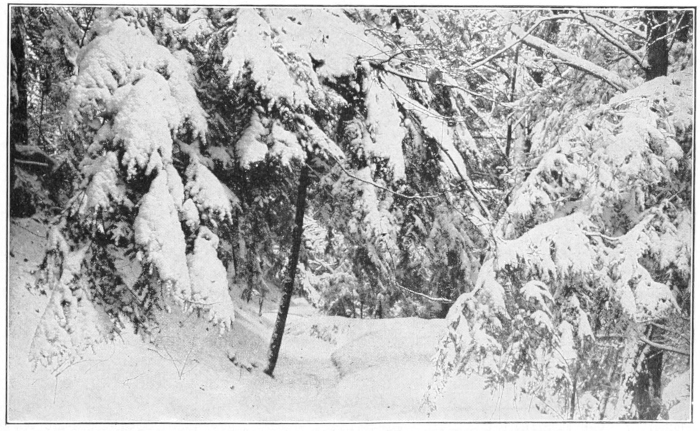
Trees in winter.
Spring Work—1. At what date do the young leaves appear upon your tree? What color are they? Look carefully to see how each leaf was folded in the bud. Were all the leaves folded in the same way? Are the young leaves thin, downy and tender? Do they stand out straight as did the old leaves last autumn, or do they droop? Why? Will they change position and stand out as they grow stronger? Why do the leaves stand out from the twigs in order to get sunshine? What would happen to a tree if it lost all its leaves in spring and summer? Tell all of the things you know which the leaves do for the tree.
2. Are there any blossoms on your tree in the spring? If so, how do they look? Are the blossoms which bear the fruit on different trees from those that bear the pollen, or are these flowers placed separately on the same tree? Or does the same flower which produces the pollen also produce the seed? Do the insects carry the pollen from flower to flower, or does the wind do this for your tree? What sort of seeds are formed by these flowers? How are the seeds scattered and planted?
3. At what date does your tree stand in full leaf? What color is it now? What birds do you find visiting it? What insects? What animals seek its shade? Do the squirrels live in it?
4. Measure the height of your tree as follows: Choose a bright, sunny morning for this. Take a stick 3½ feet long and thrust it in the ground so that three feet will project above the soil. Immediately measure the length of its shadow and of the shadow which your tree makes from its base to the shadow of its topmost twigs. Supposing that the shadow from the stick is 4 feet long and the shadow from your tree is 80 feet long, then your example will be: 4 ft.:3 ft.::80 ft.:? Which will make the tree 60 feet high.
To measure the circumference of the tree, take the trunk three feet from the ground and measure it exactly with a tape measure. To find the thickness of the trunk, divide the circumference just found by 3.15.
Supplementary Reading—Among Green Trees, Rogers; Chap. I in A Primer of Forestry, Pinchot; Part I in A First Book of Forestry, Roth; Chapter IV in Practical Forestry, Gifford.
LESSON CLXXXIX
How to Make Leaf Prints
A very practical help in interesting children in trees, is to encourage them to make portfolios of leaf-prints of all the trees of the region. Although the process is mechanical, yet the fact that every print must be correctly labeled makes for useful knowledge. One of my treasured possessions is such a portfolio made by the lads of St. Andrews School of Richmond, Va., who were guided and inspired in this work by their teacher, Professor W. W. Gillette. The impressions were made in green ink and the results are as beautiful as works of art. Professor Gillette gave me my first lesson in making leaf prints.
Material—1. A smooth slate, or better, a thick plate of glass, about 12 × 15 inches.
2. A tube of printer’s ink, either green or black, and costing 50 cents; one tube contains a sufficient supply of ink for making several hundred prints. Or a small quantity of printer’s ink may be purchased at any printing office.
3. Two six-inch rubber rollers, such as photographers use in mounting prints, which cost 15 cents each. A letter-press may be used instead of one roller.
4. A small bottle of kerosene to dilute the ink, and a bottle of benzine for cleaning the outfit after using, care being taken to store them safe from fire.
5. Sheets of paper 8½ × 11 inches. The paper should be of good quality, with smooth surface in order that it may take and hold a clear outline. The ordinary paper used in printers’ offices for printing newspapers works fairly well. I have used with success the paper from blank notebooks which cost five cents a piece.
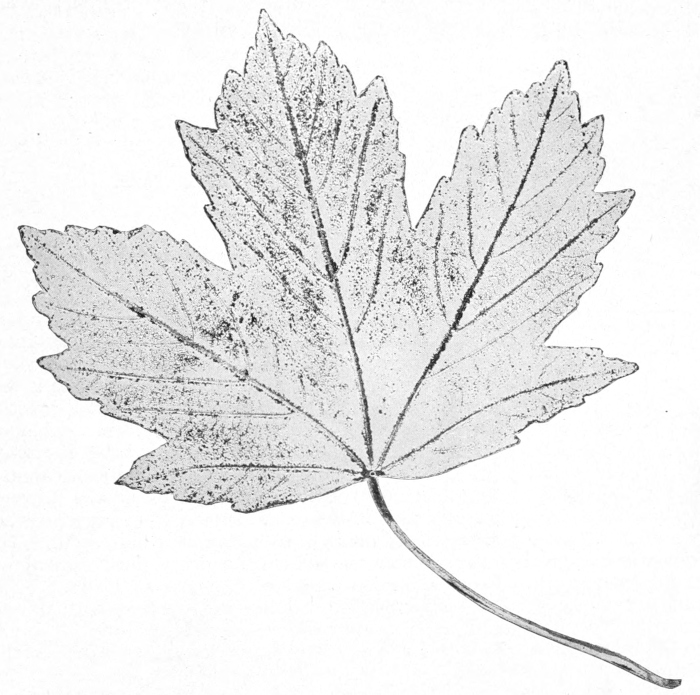
Leaf print of a sycamore maple.
To make a print, place a few drops of ink upon the glass or slate, and spread it about with the roller until there is a thin coat of ink upon the roller and a smooth patch in the center of the glass or slate. It should never be so liquid as to “run,” for then the outlines will be blurred. Ink the leaf by placing it on the inky surface of the glass and passing the inked roller over it once or twice until the veins show that they are smoothly filled. Now place the inked leaf between two sheets of paper and roll once with the clean roller, bearing on with all the strength possible; a second passage of the roller blurs the print. Two prints are made at each rolling, one of the upper, and one of the under side of the leaf. Dry and wrinkled leaves may be made pliant by soaking in water, drying between blotters before they are inked.
Prints may also be made a number at a time by pressing them under weights, being careful to put the sheets of paper with the leaves between the pages of old magazines or folded newspapers, in order that the impression of one set of leaves may not mar the others. If a letter-press is available for this purpose, it does the work quickly and well.
SAP Strong as the sea and silent as the grave, It flows and ebbs unseen, Flooding the earth, a fragrant tidal wave, With mists of deepening green. —John B. Tabb.
THE MAPLES
Teacher’s Story
HE sugar maple, combining beauty with many kinds of utility, is dear to the American heart. Its habits of growth are very accommodating; when planted where it has plenty of room, it shows a short trunk and oval head, which, like a dark green period, prettily punctuates the summer landscape; but when it occurs in the forest, its noble bole, a pillar of granite gray, rises to uphold the arches of the forest canopy; and it attains there the height of 100 feet. It grows rapidly and is a favorite shade tree, twenty years being long enough to make it thus useful. The foliage is deep green in the summer, the leaf being a glossy, dark green above and paler beneath. It has five main lobes, the two nearest the stem being smaller; the curved edges between the lobes are marked with a few, smoothly cut, large teeth; the main veins extend directly from the petiole to the sharp tips of the lobes; the petiole is long, slender, and occasionally red. The leaves are placed opposite. The shade made by the foliage of the maple is so dense that it shades down the plants beneath it, even grass growing but sparsely there. If a shade tree stands in an exposed position, it grows luxuriously to the leeward of the prevailing winds, and thus makes a one-sided record of their general direction.
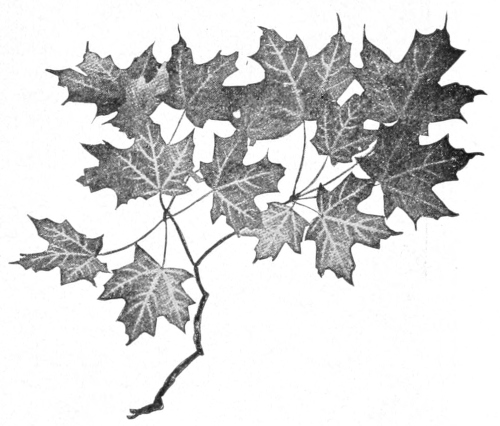
Sugar maple leaves.
It is its autumn transfiguration which has made people observant of the maple’s beauty; yellow, orange, crimson and scarlet foliage make these trees gorgeous when October comes. Nor do the trees get their color uniformly; even in September, the maple will show a scarlet branch in the midst of its green foliage. I believe this is a hectic flush and a premonition of death to the branch which, less vigorous than its neighbors, is being pruned out by Nature’s slow but sure method. After the vivid color is on the maple, it begins to shed its leaves. This is by no means the sad act which the poets would have us believe; the brilliant colors are an evidence that the trees have withdrawn from the leaves the green life-substance, the protoplasm-machinery for making the starch, and have stored it snugly in trunk and branch for winter keeping. Thus, only the mineral substances are left in the leaf, and they give the vivid hues. It is a mistake to think that frost causes this brilliance; it is caused by the natural, beautiful, old age of the leaf. When the leaves finally fall, they form a mulch-carpet for the tree that bore them, and add their substance to the humus from which the tree draws new powers for growth.
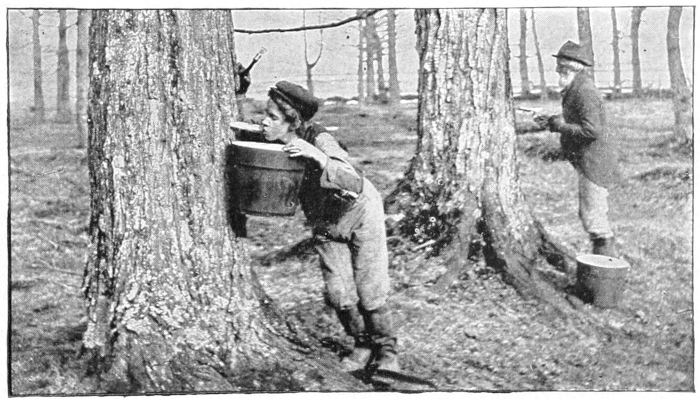
A foretaste.Photo by Verne Morton.
After every leaf has fallen, the maple shows why its shade is dense. It has many branches set close and at sharp angles to the trunk, dividing into fine, erect spray, giving the tree a resemblance to a giant whisk-broom. Its dark, deep-furrowed bark smoothes out and becomes light gray on the larger limbs, while the spray is purplish, a color given it by the winter buds. These buds are sharp-pointed and long. In February, their covering of scales shows premonitions of spring by enlarging, and as if due to the soft influence, they become downy, and take on a sunshine color before they are pushed off by the leaves. The leaves and the blossoms appear together. The leaves are at first, yellowish, downy and drooping, thus shunning the too hot sun and the violent pelting rains and fierce spring winds. The flowers appear in tassellike clusters, each downy drooping thread of the tassel bearing at its tip a five-lobed calyx, which may hold seven or eight long, drooping stamens or a pistil with long, double stigmas. The flowers are greenish yellow, and those that bear pollen and those that bear the seeds may be borne on separate trees or on the same tree, but they are always in different clusters. If on the same tree, the seed-bearing tassels are at the tips of the twigs, and those bearing pollen are along the sides.
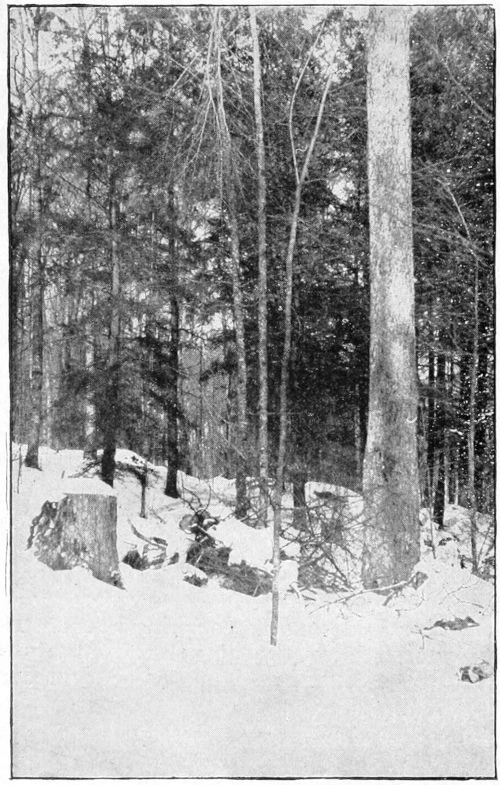
The trunk of sugar maple in forest.
The ovary is two-celled, but there is usually only one seed developed in the pair which forms a “key;” to observe this, however, we have to dissect the seeds; they have the appearance of two seeds joined together, each provided with a thin, closely veined wing and the two attached to the tree by a single long, drooping stem. This twin-winged form is well fitted to be whirled off by the autumn winds, for the seeds ripen in September. I have seen seedlings growing thickly for rods to the leeward of their parent tree, which stood in an open field. The maples bear blossoms and seeds every year. There are six species of native maples which are readily distinguishable. The silver and the red maples and the box elder are rather large trees; the mountain and the striped (or goosefoot) maples are scarcely more than shrubs, and mostly grow in woods along streams. The Norway and the sycamore maples have been introduced from Europe for ornamental planting. The cut-leaf silver maple comes from Japan.
The maple wood is hard, heavy, strong, tough and fine-grained; it is cream-color, the heart-wood showing shades of brown; it takes a fine polish and is used as a finishing timber for houses and furniture. It is used in construction of ships, cars, piano action and tool handles; its fine-grained quality makes it good for wood-carving; it is an excellent fuel and has many other uses.
MAPLE-SUGAR MAKING
Although we have tapped the trees in America for many hundred years, we do not as yet understand perfectly the mysteries of the sap flow. In 1903, the scientists at the Vermont Experiment Station did some very remarkable work in clearing up the mysteries of sap movement. Their results were published in their Bulletins 103 and 105, which are very interesting and instructive.
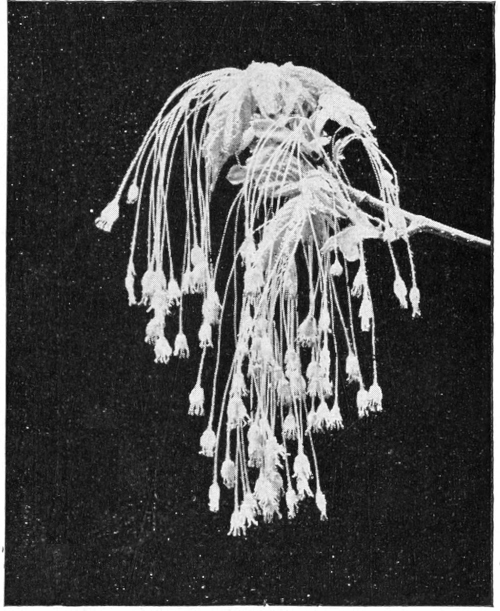
Sugar maple blossoms.
The starch which is changed to sugar in the sap of early spring was made the previous season and stored within the tree. If the foliage of the tree is injured by caterpillars one year, very little sugar can be made from that tree the next spring, because it has been unable to store enough starch in its sap-wood and in the outer ray-cells of its smaller branches to make a good supply of sugar. During the latter part of winter, the stored starch disappears, being converted into tree-food in the sap, and then begins that wonderful surging up and down of the sap tide. During the first part of a typical sugar season, more sap comes from above down than from below up; toward the end of the season, during poor sap days, there is more sap coming up from below than down from above. The ideal sugar weather consists of warm days and freezing nights. This change of temperature between day and night acts as a pump. During the day when the branches of the tree are warmed, the pressure forces into the hole bored into the trunk all the sap located in the adjacent cells of the wood. Then the suction which follows a freezing night drives more sap into those cells, which is in turn forced out when the top of the tree is again warmed. The tree is usually tapped on the south side, because the action of the sun and the consequent temperature-pump more readily affects that side.
“Tapping the sugar bush” are magical words to the country boy and girl. Well do we older folk remember those days in March when the south wind settled the snow into hard, marblelike drifts, and the father would say, “We will get the sap-buckets down from the stable loft and wash them, for we shall tap the sugar-bush soon.” In those days the buckets were made of staves and were by no means so easily washed as are the metal buckets of to-day. Well do we recall the sickish smell of musty sap that greeted our nostrils, when we poured in the boiling water to clean those old brown buckets. Previously during the winter evenings, we all had helped fashion sap-spiles from stems of sumac. With buckets and spiles ready when the momentous day came, the large, iron caldron kettle was loaded on a stoneboat together with a sap-cask, log-chain, ax and various other utensils, and as many children as could find standing room; then the oxen were hitched on and the procession started across the rough pasture to the woods, where it eventually arrived after numerous stops for reloading almost everything but the kettle.
When we came to the boiling place, we lifted the kettle into position and flanked it with two great logs against which the fire was to be kindled. Meanwhile the oxen and stoneboat returned to the house for a load of buckets. The oxen blinking, with bowed heads, or with noses lifted aloft to keep the underbrush from striking their faces, “gee’d and haw’d” up hill and down dale through the woods, stopping here and there while the men with augers bored holes in certain trees near other holes which had bled sweet juices in years gone by. When the auger was withdrawn, the sap followed it, and enthusiastic young tongues met it half way, though they received more chips than sweetness therefrom; then the spiles were driven in with a wooden mallet.
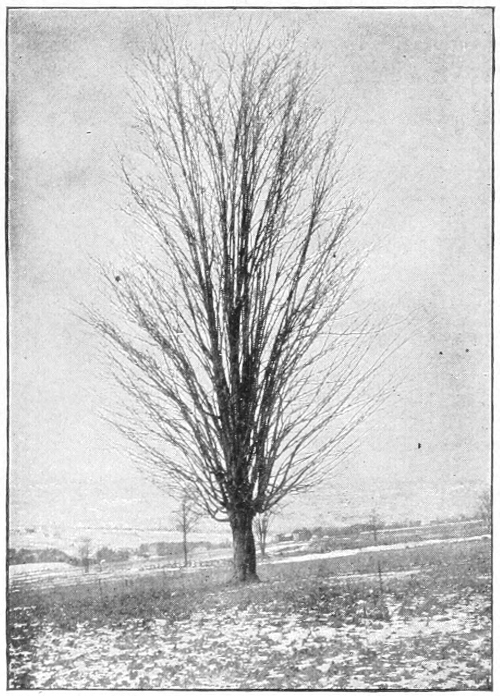
Sugar maple growing in the open.
The next day after “tapping,” those of us large enough to wear the neck-yoke donned cheerfully this badge of servitude and with its help brought pails of sap to the kettle, and the “boiling” began. As the evening shades gathered, how delicious was the odor of the sap steam, permeating the woods farther than the shafts of firelight pierced the gloom! How weird and delightful was this night experience in the woods! And how cheerfully we swallowed the smoke which the contrary wind seemed ever to turn toward us! We poked the fire to send the sparks upward, and now and then added more sap from a barrel, and removed the scum from the boiling liquid with a skimmer thrust into the cleft of a long stick for a handle. As the evening wore on, we drew closer to each other as we told stories of the Indians, bears, panthers and wolves which had roamed these woods when our father was a little boy; and came to each of us a disquieting suspicion that perhaps they were not all gone yet, for everything seemed possible in those night-shrouded woods; and our hearts suddenly “jumped into our throats” when near by there sounded the tremulous, blood-curdling cry of the screech owl.
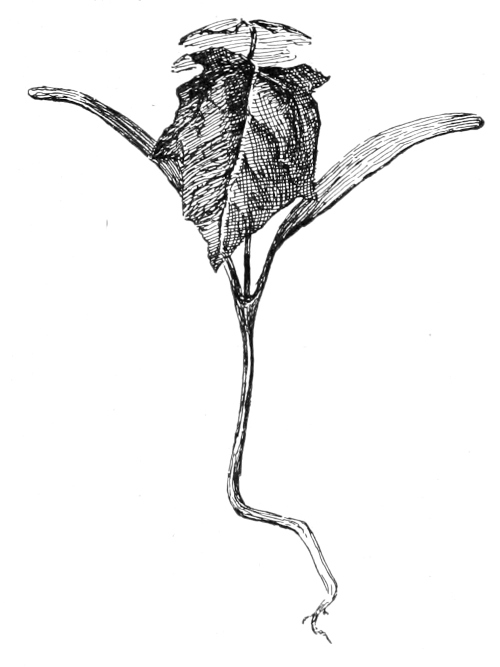
Maple seedling.
After about three days of gathering and boiling sap, came the “siruping down.” During all that afternoon we added no more sap and we watched carefully the tawny, steaming mass in the kettle; when it threatened to boil over, we threw in a thin slice of fat pork which seemed to have some mysterious calming influence. The odor grew more and more delicious and presently the sirup was pronounced sufficiently thick. The kettle was swung off the logs and the sirup dipped through a cloth strainer into a carrying-pail. Oh, the blackness of the residue left on that strainer! But it was clean woods-dirt and never destroyed our faith in the maple-sugar, any more than did the belief that our friends were made of dirt destroy our friendship for them. The next day our interests were transferred to the house where we “sugared off.” There we boiled the sirup to sugar on the stove and pouring it thick and hot upon snow made that most delicious of all sweets—the maple-wax; or we stirred it until it “grained,” before we poured it into the tins to make the “cakes” of maple-sugar.
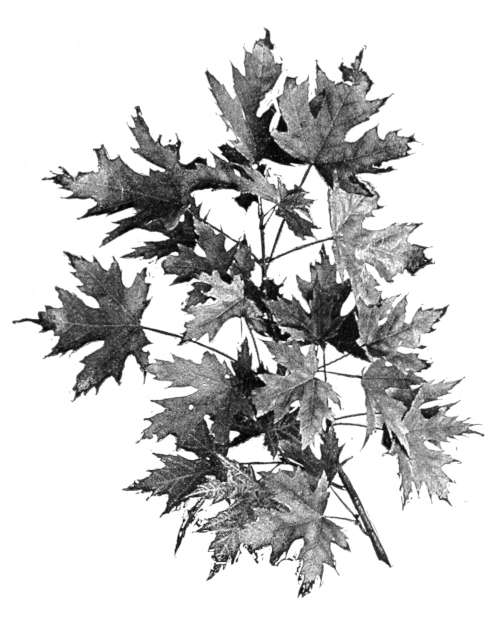
Photo by Slingerland.
Leaves of silver maple.
Now the old stave bucket and the sumac spile are gone; in their place the patent galvanized spile not only conducts the sap but holds in place a tin bucket carefully covered. The old caldron kettle is broken, or lies rusting in the shed. In its place, in the new-fangled sugar-houses, are evaporating vats, set over furnaces with chimneys. But we may as well confess that the maple-sirup of to-day seems to us a pale and anaemic liquid, lacking the delicious flavor of the rich, dark nectar which we, with the help of cinders, smoke and various other things, brewed of yore in the open woods.
LESSON CXC
The Sugar Maple
Leading thought—The sugar maple grows very rapidly, and is therefore a useful shade tree. Its wood is used for many purposes, and from its sap is made a delicious sugar.
Method—This study of the maple should be done by the pupils out of doors, with a tree to answer the questions. The study of the leaves, blossoms and fruit may be made in the schoolroom. The maple is an excellent subject for Lesson CLXXXVIII. The observations should begin in the fall and continue at intervals until June.
Observations. Fall Work—1. Where is the maple you are studying? Is it near other trees? What is the shape of the head? What is the height of the trunk below the branches? What is the height of the tree? How large around is the trunk three feet from the ground? Can you find when the tree was planted? Can you tell by the shape of the tree from which direction the wind blows most often?
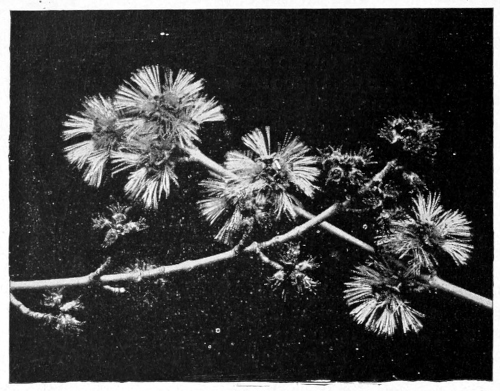
Blossoms of the silver maple.
Photo by Ralph Curtis.
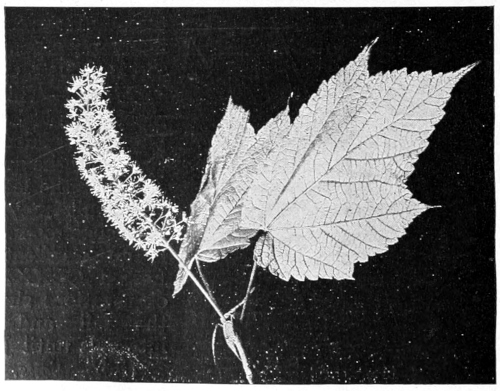
Blossoms of mountain maple.
Photo by Ralph Curtis.
2. Can you find seeds on your tree? Each pair of seeds is called a key. Sketch a key, showing the way the seeds are joined and the direction of the wings. Sketch the stem which holds the key to the twig. Are both seeds of the key good or is one empty? How are the seeds scattered and planted? How far will a maple key fly on its wings? Plant a maple seed where you can watch it grow next year.
3. Make leaf prints and describe a leaf of the maple, showing its shape, its veins and petiole. Are the leaves arranged opposite or alternate on the twig? Make leaf-prints or sketches of the leaves of all the other kinds of maples which you can find. How can you tell the different kinds of maples by their leaves?
4. If your tree stands alone, measure the ground covered by its shadow from morning until evening. Mark the space by stakes. What grows beneath the tree? Do grass and other plants grow thriftily beneath the tree? Do the same plants grow there as in the open field?
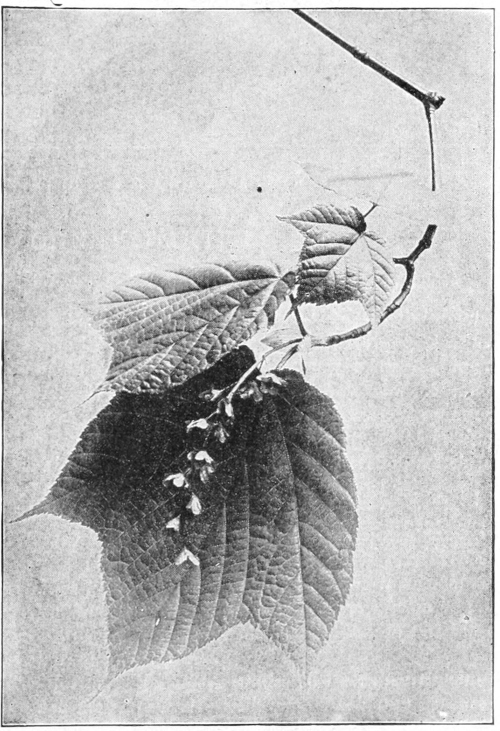
Blossom of striped maple.
Photo by Ralph Curtis.
5. Does your maple get its autumn colors all at once, or on one or two branches first? At what time do you see the first autumn colors on your tree? When is it completely clothed in its autumn dress? Is it all red or all yellow, or mixed? If it is yellow this year do you think it will be red next year? Watch and see. Sketch your maple in water-colors.
6. At what time do the leaves begin to fall? Do those branches which first colored brightly shed their leaves before the others? At what date does your tree stand bare?
7. Find a maple tree in the forest and compare it with one that grows as a shade tree in a field. Why this difference?
Winter Work—8. Make a sketch of your maple with the leaves off. What sort of bark has it? Is the bark on the branches like that on the trunk? Are the main branches large? At what angle do they come off the trunk? Does the trunk extend up through the entire tree? Is the spray fine or coarse? Is it straight or crooked?
9. Study the winter buds. Are they alternate or opposite on the twigs? Are they shining or dull?
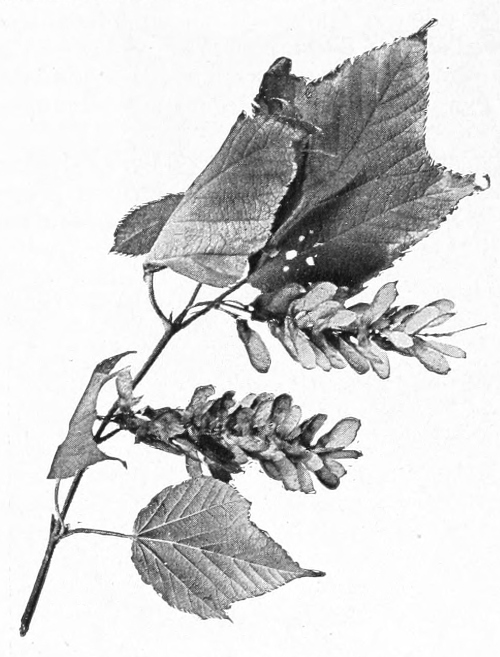
Leaves and fruit of striped maple.
Photo by Ralph Curtis.
Spring Study—10. At what time do we tap maple trees for sap? On which side of the tree do we make the hole? If we tapped the tree earlier would we get any sap? What kind of weather is the best for causing sap flow? Do you suppose that it is the sap going up from the root to the tree and the branches, or that coming down from the branches to the root which flows into the bucket? Why do we not make maple-sugar all summer? Do you suppose the sap ceases to run because there is no more sap in the tree?
11. Write a story telling all you can find in books or that you know from your own experience about the making of maple-sugar.
12. When do the leaves of your maple first appear? How do they then look? Do they stand out or droop?
13. Do the blossoms appear with the leaves or after them? How do the blossoms look? Can you tell the blossoms with stamens from those with pistils? Do you find them in the same cluster? Do you find them on the same tree?
14. What uses do we find for maple wood? What is the character of the wood?
Supplementary reading—Trees in Prose and Poetry pp. 25–41.
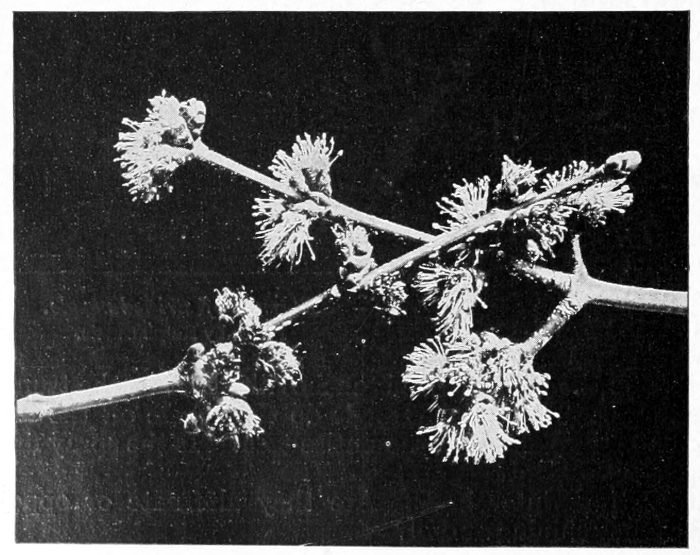
Blossoms of red maple.
Photo by Ralph Curtis.
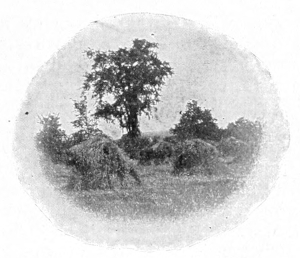
THE AMERICAN ELM
Teacher’s Story
LTHOUGH the American elm loves moist woods, it is one of those trees that enjoys gadding; and without knowing just how it has managed to do it, we can see plainly that it has planted its seeds along fence corners, and many elms now grace our fields on sites of fences long ago laid low. Because of its beautiful form and its rapid growth, the elm has been from earliest times a favorite shade tree in the Eastern and Middle States. Thirty years after being planted, the elms on the Cornell Campus clasped branches across the avenues; and the beauty of many a village and city is due chiefly to these graceful trees of bounteous shade. Moreover the elm is at no time more beautiful than when it traces its flowing lines against the background of snow and gray horizon. Whether the tree be shaped like a vase or a fountain, the trunk divides into great uplifting branches, which in turn divide into spray that oftentimes droops gracefully, as if it were made purposely to sustain from its fine tips the woven pocket-nest of the oriole. No wonder this bird so often chooses the elm for its roof-tree!
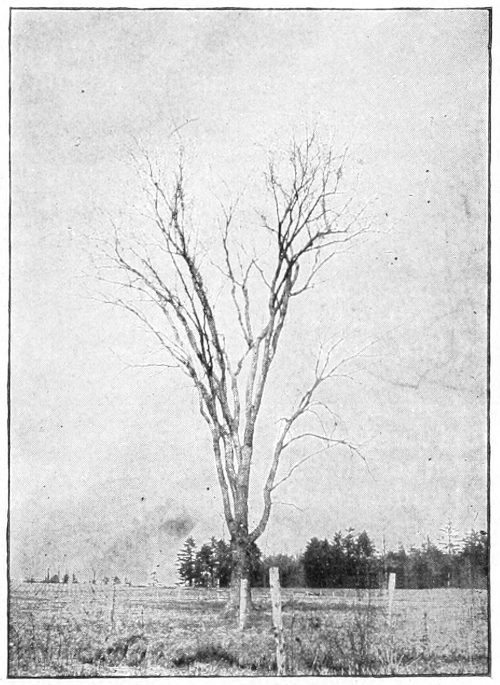
The elm in winter.
In winter, the dark, coarsely-ridged bark and the peculiar, wiry, thick spray, as well as the characteristic shape of the tree reveal to us its identity; it also has a peculiar habit of growing its short branches all the way down its trunk, making it look as if it were entwined with a vine. The elm leaf, although its ribs are straight and simple, shows a little quirk of its own in the uneven sides of its base where it joins the petiole; it is dark green and rough above, light green and somewhat rough below; but this leaf is rough only when stroked in certain directions, while the leaf of the slippery elm is rough whichever way it may be stroked. The leaf has the edges saw-toothed, which are in turn toothed; the petiole is short. The leaf comes out of the bud in the spring folded like a little fan; but before the fans are opened to the spring breezes, the elm twigs are furry with reddish green blossoms. The blossom consists of a calyx with an irregular number of lobes, and for every lobe, a stamen which consists of a threadlike filament from which hangs a bright red anther; at the center is a two-celled pistil with two light green styles. These blossoms appear in March or early April, before the leaves.
When full-grown the fruit hangs like beaded fringe from the twigs. The seed is flat and has a wide, much veined margin or wing, notched at the tip and edged with a white silken fringe; the seed is at the center, wrinkled and flat. Each seed shows at its base the old calyx and is attached by a slender threadlike stem to the twig at the axils of last year’s leaves. A little later the lusty breezes of spring break the frail threads and release the seeds, although few of them find places fit for growth.
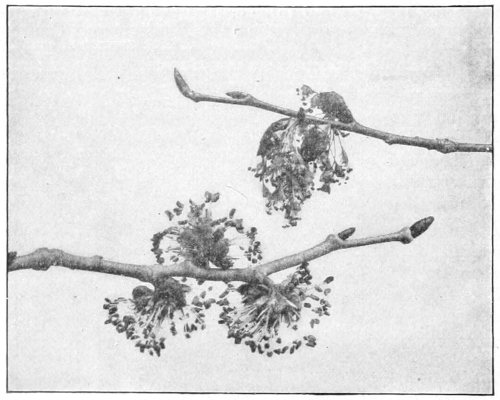
Elm blossoms.
Photo by Ralph Curtis.
The elm roots are water hunters and extend deep into the earth; they will grow towards water, seeming to know the way. The elm heart-wood is reddish, the sap-wood being broad and whitish in color; the wood is very tough because of the interlaced fibers, and therefore very hard to split. It is used for cooperage, wheel hubs, saddlery, and is now used more extensively for furniture; its grain is most ornamental. It is fairly durable as posts, but perhaps the greatest use of all for the tree is for shade. The slippery elm is much like the white elm, except that its inner bark is very mucilaginous, and children love to chew it. The cork elm has a peculiar corky growth on its branches, giving it a very unkempt look. The wahoo, or winged elm, is a small tree, and its twigs are ornamented on each side by a corky layer. The English elm has a solid, round head, very different from that of our graceful species. The elms are long-lived, some living for centuries. The Washington elm in Cambridge, and the William Penn elm in Philadelphia, which now has a monument to mark its place, were famous trees.
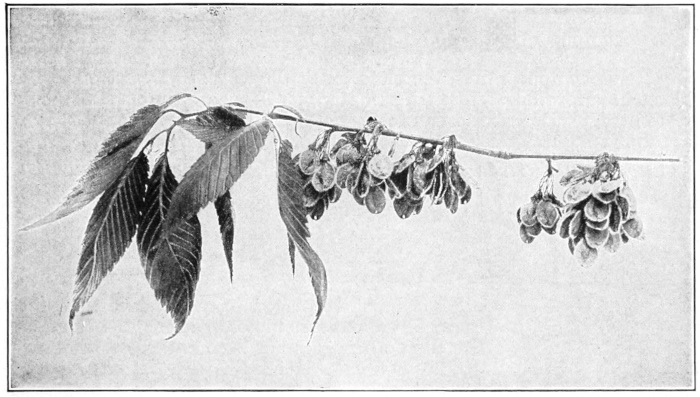
Elm seed.
Photo by Morgan.
LESSON CXCI
The Elm
Leading thought—The elm has a peculiarly graceful form, which makes it of value as a shade tree. It grows best in moist locations. Its wood is very tough.
Method—This work should be begun in the fall with the study of the shape of the tree and its foliage. Sketches should be made when the tree is clothed in autumn tints, and later it should be sketched again when its branches are naked. Its blossoms should be studied in March and April and its seeds in May.
Observations—1. Where does the elm grow? Does it thrive where there is little water? What is the usual shape of the elm? How does the trunk divide into branches to make this shape possible? What is the shape of the larger elms? Describe the spray. Describe the elm bark. How can you tell the elm from other trees in winter?
2. Study the elm leaf. What is its form? What kind of edges has it? How large is it? What is the difference in appearance and feeling between the upper and lower sides? Are the leaves rough above whichever way you stroke them? If a leaf is folded lengthwise are the two halves exactly alike? How are the leaves arranged on the twig? What is their color above and below? Describe the leafy growth along the trunk.
3. What is the color of the elm tree in autumn? Make a sketch of the elm tree you are studying.
4. What sort of roots has the elm? Do they grow deep into the earth? What is the character of its wood? Is it easy to split? Why? What are the chief uses of the elm?
5. Do you know what distinguishes the slippery elm, the cork elm, the winged elm, or wahoo, and the English elm from the common American or white elm which you have been studying?
6. Write an essay on two famous American elms.
7. What birds love to build in the elm trees?
Spring Study of the Elm
8. Which appear first, the blossoms or the leaves? Describe the elm blossom. How long before the seeds ripen? How are the seeds attached to the twig? Describe an elm seed. How are the seeds scattered? How are the young leaves folded as they come out of the bud?
Supplementary reading—Trees in Prose and Poetry, pp. 81–92.
THE OAK
Teacher’s Story
HE symbol of rugged strength since man first gazed upon its noble proportions, the oak more than other trees has been entangled in human myth, legend and imagination. It was regarded as the special tree of Zeus by the Greeks. Virgil sang of it thus:
“Full in the midst of his own strength he stands Stretching his brawny arms and leafy hands, His shade protects the plains, his head the hills commands.”
While in primitive England the strange worship of the Druids centered around it.
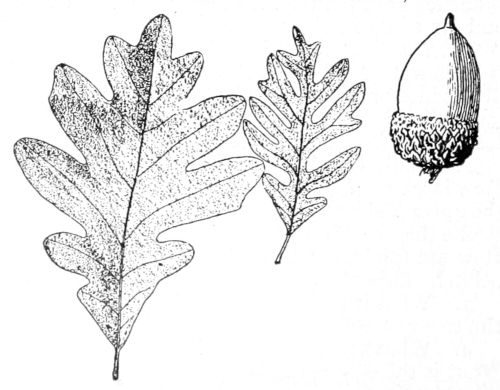
White oak leaves and acorn
Although the oak is a tree of grandeur when its broad branches are covered with leafage, yet it is only in winter when it stands stripped like an athlete that we realize wherein its supremacy lies. Then only can we appreciate the massive trunk and the strong limbs bent and gnarled with combating the blasts of centuries. But there are oaks and oaks, and each species fights time and tempest in his own peculiar armor and in his own way. Many of the oaks achieve the height of eighty to one hundred feet. The great branches come off the sturdy trunk at wide angles, branches that may be crooked or gnarled but are ever long and strong; the smaller branches also come off at wide angles, and in turn bear angular individual spray—all of which, when covered with leaves, make the broad, rounded head which characterizes this tree. The oaks are divided into two classes which the children soon learn to distinguish, as follows:
A. The white oak group, the leaves of which have rounded lobes and are rough and light-colored below; the wood is light-colored, the acorns have sweet kernels and mature in one year, so that there are no acorns on the branches in winter. To this class belong the white, chestnut, bur, and post oaks.
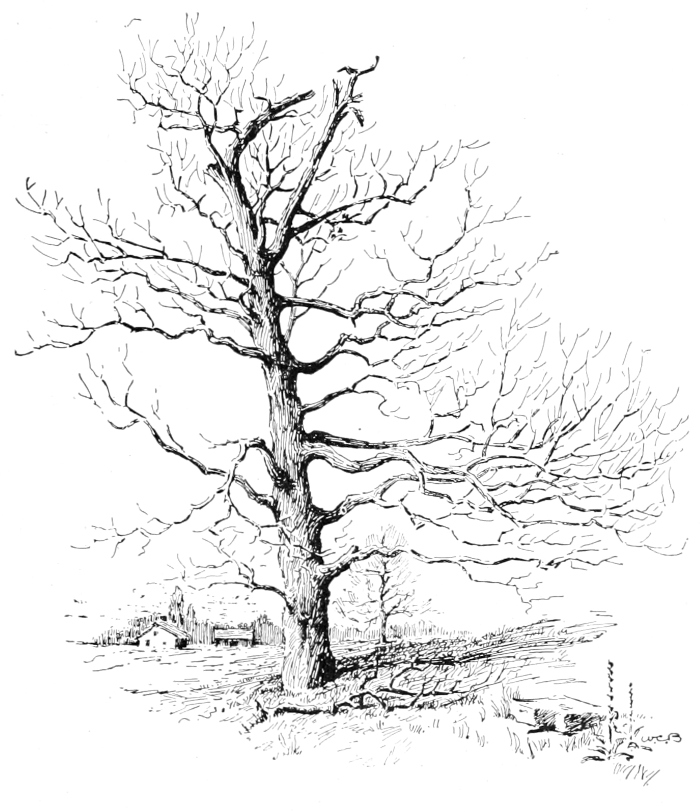
White oak in winter.
Drawing by W. C. Baker.
AA. The black oak group, the leaves of which are nearly as smooth below as above, and have angular lobes ending in sharp points. The bark is dark in color, the acorns have bitter kernels and require two years for maturing, so that they may be seen on the branches in winter. To this group belong the red, scarlet, Spanish, pin, scrub, black-jack, laurel and willow oaks.
There is a great variation in the shape of the leaves on the same tree, and while the black, the red and the scarlet oaks are well-marked species, it is possible to find leaves on these three different trees which are similar in shape. Oaks also hybridize, and thus their leaves are a puzzle to the botanist; but in general, the species can be determined by any of the tree books, and the pupils should learn to distinguish them.
The acorns and their scaly saucers are varied in shape, and are a delight to children as well as to pigs. The great acorns of the red oak are made into cups and saucers by the girls, and those of the scarlet oak into tops by the boys. The white oaks turn a rich wine-color in the autumn, while the bur and the chestnut are yellow. The red oak is a dark, wine-red; the black oak russet, and the scarlet a deep and brilliant red. When the oak leaves first come from the buds in the spring, they are soft and downy and drooping, those of the red and scarlet being reddish, and those of the white, pale green with red tints. Thoreau says of them, “They hang loosely, flaccidly down at the mercy of the wind, like a new-born butterfly or dragonfly.”
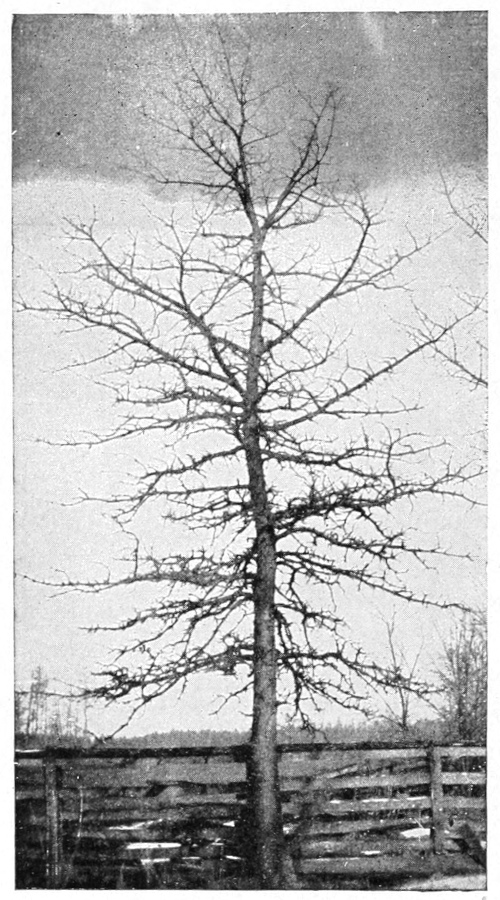
Swamp white oak in winter.
The pollen-bearing flowers are like beads on a string, several strings hanging down from the same point on the twig, making a fringe, and they are attractive to the eye that sees. The pistillate flowers are inconspicuous, at the axils of the leaves, and have irregular or curved stigmas; they are on the same branch as the pollen-bearing flowers.
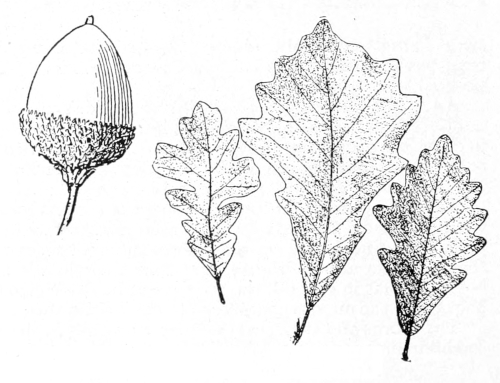
Leaves and acorn of the swamp white oak.
The oak is long-lived; it does not produce acorns until about twenty years of age and requires a century to mature. Although from two to three hundred years is the average age of most oaks, yet a scarlet oak of my acquaintance is about four hundred years old, and there are oaks still living in England which were there when William, the Conquerer came. The famous Wadsworth Oak at Geneseo, N. Y. had a circumference of twenty seven feet. This was a swamp white oak. One reason for their attaining great age is long, strong, tap-roots which plant them deep, also the great number of roots near the surface which act as braces, and their large and luxurious heads.
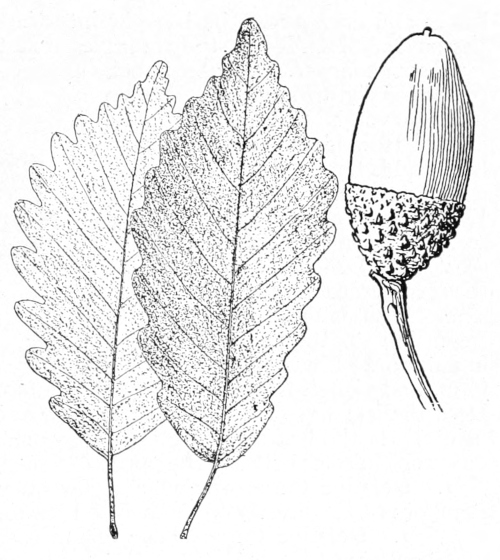
Leaves and acorn of chestnut oak.
Oak wood is usually heavy, very strong, tough and coarse. The heart is brown, the sap-wood whitish. It is used for many purposes—ships, furniture, wagons, cars, cooperage, farm implements, piles, wharves, railway ties, etc. The white and live oaks give the best wood. Oak bark is used extensively for tanning.
LESSON CXCII
The Oaks
Leading thought—The oak tree is the symbol of strength and loyalty. Let us study it and see what qualities in it have thus distinguished it.
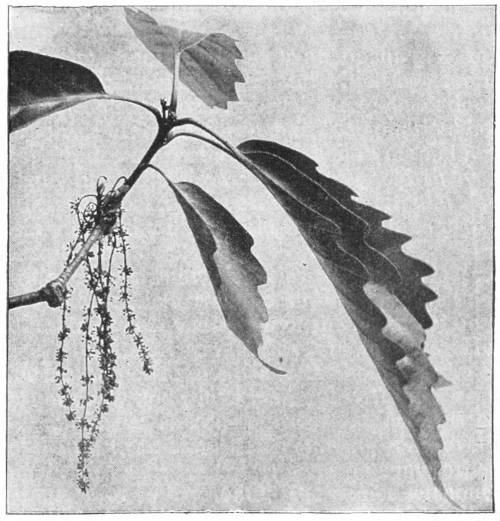
Blossoms of chestnut oak.
Method—Any oak tree may be used for this lesson; but whatever species is used, the lesson should lead to the knowledge of all the species of oaks in the neighborhood. The tree should be sketched, essays concerning the connection of the oak with human history should be written, while the leaves and acorns may be brought into the schoolroom for study. Use Lesson CLXXXIX for a study of leaves of all the oaks of the neighborhood.
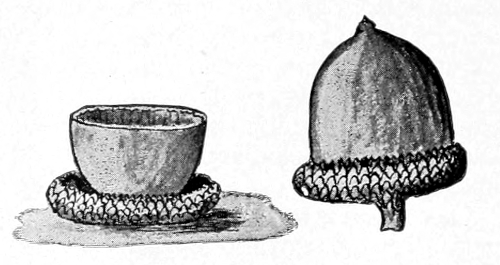
Cup and saucer made from the acorns of red oak
Observations—1. Describe the oak tree which you are studying. Where is it growing? What shape is its head? How high in proportion to the head is the trunk? What is the color and character of its bark? Describe its roots as far as you can see. Are the branches straight or crooked? Delicate or strong? Is the spray graceful or angular?
2. What is the name of your oak tree? What is the color of its foliage in autumn? Find three leaves from your tree which differ most widely in form, and sketch them or make leaf prints of them for your note-book. Does the leaf have the lobes rounded, or angular and tipped with sharp points? Is the leaf smooth on the lower side or rough? Is there much difference in color between the upper and the lower side?
3. Describe the acorns which grow on your oak. Has the acorn a stem, or is it set directly on the twig? How much of the acorn does the cup cover? Are the scales on the cup fine or coarse? Is the cup rounded inwards at its rim? What is the length of the acorn including the cup? The diameter? Are there acorns on your oak in winter? If so, why? Is the kernel of the acorn sweet or bitter? Plant an acorn and watch it sprout.
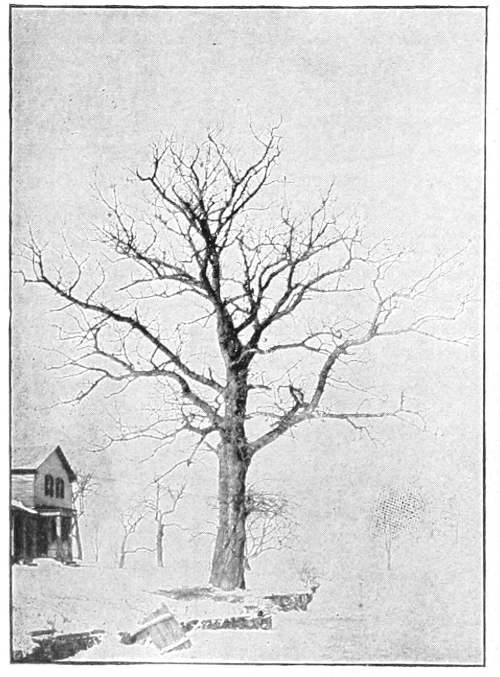
The red oak in winter.
Photo by Ralph Curtis.
4. Read all the stories you can find about oak trees, and write them in your note-book.
5. How great an age does the oak attain? Describe how the country round about looked when the oak tree you are studying was planted.
6. How many kinds of oaks do you know? What is the difference in leaves between the white and the black oak groups? What is the difference in the length of time required for the acorns to mature in these two groups? The difference in taste of the acorns? The difference in the general color of the bark? Why is the chestnut oak an exception to this latter rule?
7. How do the oak leaves look when they first come out of the bud in spring? What is the color of the tree covered with new leaves? When does your oak blossom? Find the pollen-bearing blossoms which are hung in long, fuzzy, beady strings. Find the pistillate flower which is to form the acorn. Where is it situated in relation to the pollen-bearing flower?
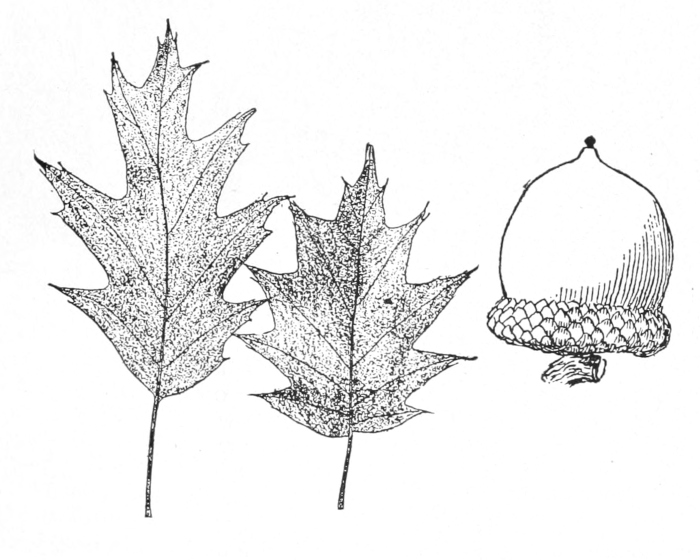
The leaves and acorn of red oak.
8. Make a sketch of your oak tree in the fall, and another in the winter. Write the autobiography of some old oak tree in your neighborhood.
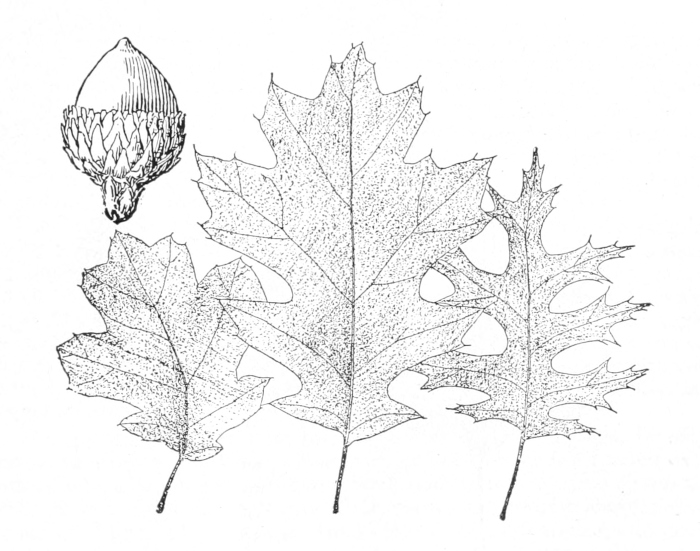
Leaves and acorn of black oak.
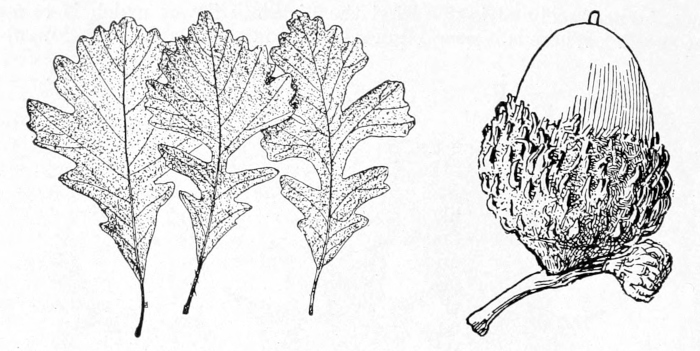
Leaves and acorn of bur oak.
9. For what is the oak wood used? How is the bark used?
Supplementary reading—Trees in Prose and Poetry, pp. 111–129.
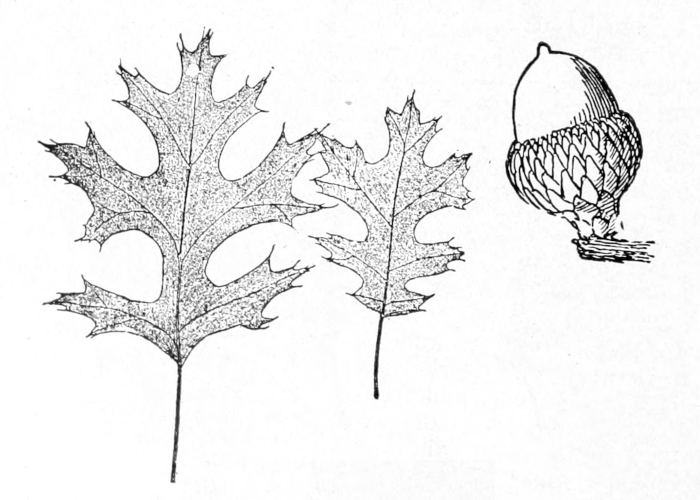
Leaves and acorn of scarlet oak.
THE SHAGBARK HICKORY
Teacher’s Story
OW pathetically the untidy bark of this dignified tree suggests the careless raiment of a great man! The shagbark is so busy being something worth while that it does not seem to have time or energy to clothe itself in tailor-made bark, like the beech, the white ash and the basswood. And just as we like a great man more because of his negligence to fashion’s demands, so do we esteem this noble tree, and involuntarily pay it admiring tribute as we note its trunk with the bark scaling off in long, thin plates that curve outward at the top and bottom and seem to be only slightly attached at the middle.
In general shape, the shagbark resembles the oak; the lower branches are large and, although rising as they leave the bole, their tips are deflected; and, for their whole length, they are gnarled and knotted as if to show their strength. The bark on the larger branches may be scaly toward their bases but above is remarkably smooth. The spray is angular and extends in almost every direction. The leaves, like those of other hickories, are compound. There are generally five leaflets, but sometimes only three and sometimes seven. The basal pair is smaller than the others. The hickory leaves are borne alternately on the twig, and from this character the hickory may be distinguished from the ashes, which have leaves of similar type, but which are placed opposite on the twigs. The shagbark usually has an unsymmetrical oblong head; the lower branches are usually shorter than the upper ones, and the latter are irregularly placed, causing gaps in the foliage.
The nut is large, with a thick, smooth, outer husk channeled at the seams and separating readily into sections; the inner shell is sharply angled and pointed and slightly flattened at the sides; the kernel is sweet. The winter buds of the shagbark are large, light brown, egg-shaped and downy; they swell greatly before they expand. There are from eight to ten bud-scales; the inner ones, which are red, increase to two or three inches in length before the leaves unfold, after which they fall away. The young branches are smooth, soft, delicate in color, and with conspicuous leaf scars.
The hickory bears its staminate and pistillate flowers on the same tree. The pollen-bearing flowers grow at the base of the season’s shoots in slender, pendulous, green catkins, which occur usually in clusters of three swinging from a common stem. The pistillate flowers grow at the tips of the season’s shoots singly or perhaps two or three on a common stem. In the shagbark the middle lobe of the staminate calyx is nearly twice as long as the other two, and is tipped with long bristles; it usually has four stamens with yellow anthers; its pistillate calyx is four-toothed and hairy, and has two large, fringed stigmas.
The big shagbark, or king nut, is similar to the shagbark in height, manner of growth, and bark. However, its leaves have from seven to nine leaflets, which are more oblong and wedgelike than are those of the shagbark; they are also more downy when young and remain slightly downy beneath. The nut is very large, thick-shelled, oblong, angled, and pointed at both ends. The kernel is large and sweet but inferior in flavor to the smaller shagbark. The big shagbark has larger buds than has the other. Their fringy, reddish purple, inner scales grow so large that they appear tuliplike before they fall away at the unfolding of the leaves.
Hickory wood ranks high in value; it is light-colored, close-grained, heavy, and very durable when not exposed to moisture. It is capable of resisting immense strain, and, therefore, it is used for the handles of spades, plows and other tools, and also for spokes and thills in carriage-making. As a fuel, it is superior to most woods, making a glowing, hot and quite lasting fire.
LESSON CXCIII
The Shagbark
Leading thought—The hickories are important trees commercially. They have compound leaves which are set alternately upon the twig. The shagbark can be told from the other hickories by its ragged, scaling bark.
Method—This lesson may be begun in the winter when the tree can be studied carefully as to its shape and method of branching. Later, the unfolding of the leaves from the large buds should be watched, as this is a most interesting process; and a little later the blossoms may be studied. The work should be taken up again in the fall, when the fruit is ripe.
Observations Winter study—1. What is the general shape of the whole tree? Are the lower branches very large? At what angle do the branches, in general, grow from the trunk? Are there many large branches?
2. Where is the spray borne? What is its character—that is, is it fine and smooth, or knotted and angled? What is its color?
3. Describe the bark. Is the bark on the limbs like that on the trunk?
4. What is the size and shape of the buds? Are the buds greenish-yellow, yellowish brown, or do they have a reddish tinge?
5. Count the bud-scales. Are they downy or smooth?
Spring study—6. Describe how the hickory leaf unfolds from its bud. How is each leaflet folded within the bud?
7. Describe the long greenish catkins which bear the pollen. On what part of the twigs do they grow? Do they grow singly or in clusters?
8. Take one of the tiny, pollen-bearing flowers and hold it under a lens on the point of a pin. How many lobes has the calyx? Count the stamens, and note the color of the anthers.
9. Upon what part of the twigs do the pistillate flowers grow? How many points or lobes has the pistillate calyx? Describe the growth of the nut from the flower.
Autumn study—10. Does the hickory you are studying grow in open field or wood?
11. Are the trunk and branches slender and lofty, or sturdy and wide spreading?
12. Note the number and shape of the leaflets. Are they slim and tapering, or do they swell to the width of half their length? Are they set directly upon or are they attached by tiny stems to the mid-stem? Are they smooth or downy on the under side? Are the leaves set upon the twigs alternately or opposite each other? How are the leaflets set upon the mid-stem?
13. Describe the outer husk of the nut. Into how many sections does it open? Does it cling to the nut and fall with it to the ground? Is the nut angled and pointed, or is it roundish and without angles? Is the kernel sweet or bitter?
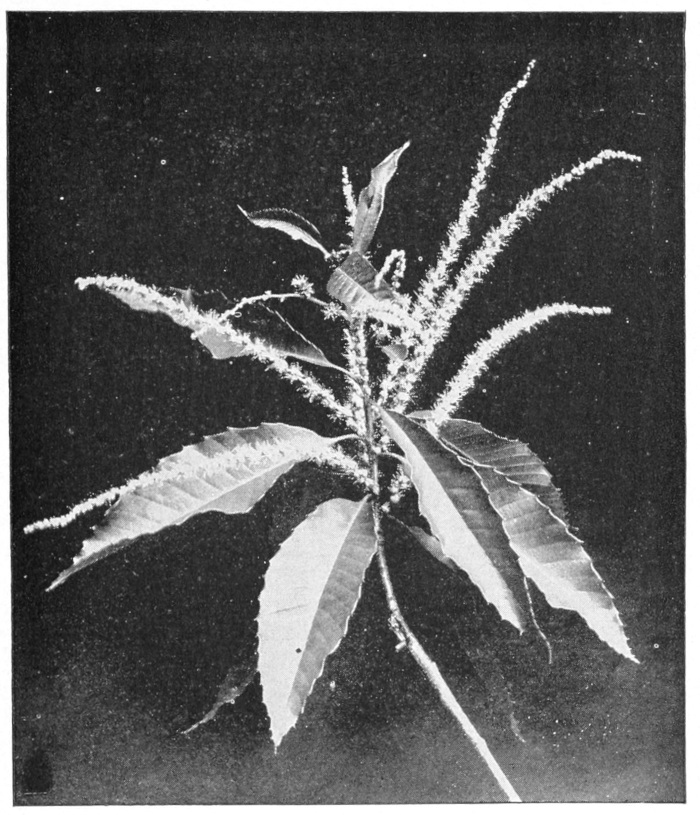
Photo by Verne Morton.
Chestnut blossoms.
Note the two pistillate flowers above the staminate catkins.
THE CHESTNUT
Teacher’s Story
HIS splendid tree, sometimes reaching the height of one hundred feet, seldom receives the admiration due to it, simply because humanity is so much more interested in food than in beauty. The fact that the chestnuts are sought so eagerly has taken away from interest in the appearance of the tree. The chestnut has a great round head set firmly on a handsome bole, which is covered with grayish brown bark divided into rather broad, flat, irregular ridges. The foliage is superb; the long, slender, graceful leaves, tapering at both ends, are glossy, brilliant green above and paler below; and they are placed near the ends of the twigs, those of the fruiting twigs seeming to be arranged in rosettes to make a background for blossom or fruit. The leaves are placed alternately and have deeply notched edges, the veins extending straight and unbroken from midrib to margin; the petiole is short. The leaf is like that of the beech, except that it is much longer and more pointed; it resembles in general shape the leaf of the chestnut oak, except that the edges of the latter have rounded scallops instead of being sharply toothed. The burs appear at the axils of the leaves near the end of the twig. Thoreau has given us a most admirable description of the chestnut fruit:
“What a perfect chest the chestnut is packed in! With such wonderful care Nature has secluded and defended these nuts as if they were her most precious fruits, while diamonds are left to take care of themselves. First, it bristles all over with sharp, green prickles, some nearly a half inch long, like a hedgehog rolled into a ball; these rest on a thick, stiff, barklike rind one-sixteenth to one-eighth of an inch thick, which again is most daintily lined with a kind of silvery fur or velvet plush one-sixteenth of an inch thick, even rising into a ridge between the nuts, like the lining of a casket in which the most precious commodities are kept. At last frost comes to unlock this chest; it alone holds the true key; and then Nature drops to the rustling leaves a ‘done’ nut, prepared to begin a chestnut’s course again. Within itself again each individual nut is lined with a reddish velvet, as if to preserve the seed from jar and injury in falling, and perchance from sudden damp and cold; and within that a thin, white skin envelops the germ. Thus, it has lining within lining and unwearied care, not to count closely, six coverings at least before you reach the contents.”
The red squirrels, as if to show their spite because of the protection of this treasure chest, have the reprehensible habit of cutting off the young burs and thus robbing themselves of a rich later harvest—which serves them right. There are usually two nuts in each bur, set with flat sides together; but sometimes there are three and then the middle one is squeezed so that it has two flat sides. Occasionally there is only one nut developed in a bur—an only child, so well cared for that it grows to be almost globular. The color we call chestnut is derived from the beautiful red-brown of the polished shell of the nut, polished except where the base joins the bur, and the apex which is gray and downy.
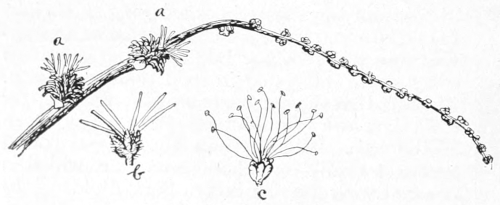
Detail of a chestnut blossom.
a. a., pistillate flowers set in a base of scales; b, pistillate flower enlarged; c, staminate flower enlarged.
The chestnut is always a beautiful tree, whether green in summer or glowing golden yellow in autumn; but it is most beautiful during late June and July, when covered with constellations of pale yellow stars. Each of these stars is a rosette of the pollen-bearing blossoms; each ray consists of a catkin often six or eight inches in length, looking like a thread of yellowish chenille fringe, clothing this thread in tufts for its whole length are the stamens, standing out like minute threads tipped with tiny anther balls. If we observe the blossom early enough, we can see these stamens curled up as they come forth from the tiny, pale yellow, six-lobed calyx. One calyx, although scarcely one-sixteenth of an inch across, develops from ten to twenty of these stamens; these tiny flowers are arranged in knots along the central thread of the catkin. No wonder it looks like chenille! There are often as many as thirty of these catkin rays in the star rosette; the lower ones come from the axils of the leaves; but toward the tips of the twig, the leaves are ignored and the catkins have possession. In one catkin I estimated that there were approximately 2,500 stamens developed, each anther packed with pollen. When we think that there may be thirty of the catkins in a blossom-star, we get a glimmering of the amount of pollen produced.
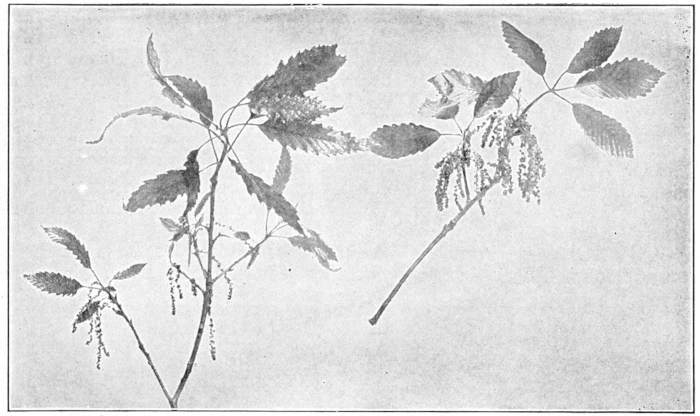
Leaves and flowers of chestnut and chestnut oak showing the differences.
Photo by G. F. Morgan.
And what is all this pollen for? Can it be simply to fertilize the three or four inconspicuous flowers at the tip of the twig beyond and at the center of the star? These pistillate flowers are little bunches of green scales with some short, white threads projecting from their centers; and beyond them a skimpy continuation of the stem with more little green bunches scattered along it, which are undeveloped pistillate blossoms. The one or two flowers at the base of the stem get all the nourishment and the others do not develop. If we examine one of these nests of green scales, we find that there are six threads belonging to one tiny, green flower with a six-lobed calyx; the six threads are the stigmas, each one reaching out and asking for no more than one grain of the rich shower of pollen.
Chestnut wood is light, rather soft, stiff, coarse and not strong. It is used in cabinet work, cooperage, for telegraph poles and railway ties. When burned as fuel, it snaps and crackles almost equal to hemlock.
LESSON CXCIV
The Chestnut
Leading thought—The chestnut is one of our most beautiful trees. We should learn to appreciate it by observing the beauty of its blossoms and of its foliage when green and when brilliant yellow in autumn. Until the chestnut fruit is ripe, it is well protected by its spiny bur.
Method—This study may be begun in the fall when chestnuts are ripe. Ask the boys to describe the trees from which they get this longed-for harvest. The leaves, burs and nuts may be studied in the schoolroom.
Observations—1. Where do chestnut trees grow? What is the general form of the head of the tree? How high is the trunk below the branches? Do the branches divide into fine twigs or spray at the tips?
2. Sketch and describe a chestnut leaf, showing the veins, edges and petiole. Are the leaves placed opposite or alternate? What is their color above and below? How do the chestnut leaves differ from those of the beech and of the chestnut oak? What is the color of the chestnut foliage in autumn?
3. Where on the branch is the bur borne? How does the green chestnut bur look? Why is this prickly exterior beneficial to the fruit? Does the bur open easily when green? What causes the chestnut bur to open? Into how many lobes does it open? Describe an open bur outside and in.
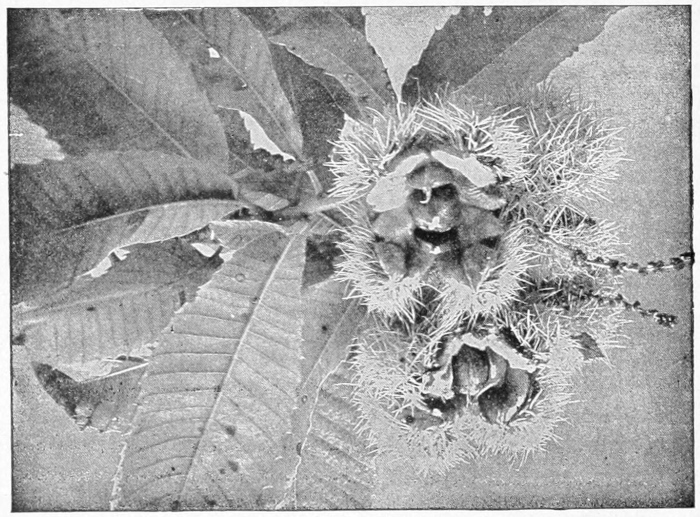
Chestnuts in burs.
Photo by Verne Morton.
4. Where in the bur are the chestnuts set? How many in one bur? How can you tell by the shape of the chestnut whether it grew as a twin or single in a bur? Are there ever three in a bur? If so, what shape is the middle one? Do the burs fall when the chestnuts are ripe?
5. Take a single chestnut. Describe its shape and color. What is the mark on its large end? Describe the coloring and covering of the tip. Open the shell and note the lining. Describe how the meat is finally protected. Can you see where the germ is? Plant a chestnut and watch it grow.
6. Study the chestnut blossom in late June or July. What kind of blossoms are those which look like yellow stars all over the tree? Study one of the catkins which makes a ray of the star, and describe it. Can you see the anthers and the pollen? How many of these pollen-bearing flowers are on one stem? Where are the pistillate flowers which will grow into young chestnuts? Describe them.
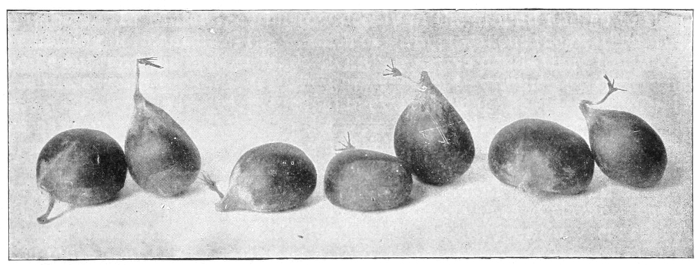
Chestnuts.
Photo by O. L. Foster.
7. How much are chestnuts worth per bushel? To what uses is chestnut timber put? What is the character of the wood?
THE HORSE-CHESTNUT
Teacher’s Story
HE wealth of children is, after all, the truest wealth in this world; and the horse-chestnuts, brown and smooth, looking so appetizing and so belying their looks, have been used from time immemorial by boys as legal tender—a fit use, for these handsome nuts seem coined purposely for boys’ pockets.
The horse-chestnut is a native of Asia Minor. It has also a home in the high mountains of Greece. In America, it is essentially a shade tree. Its head is a broad cone, its dark green foliage is dense and, when in blossom, the flower clusters stand out like little white pyramids against the rich back-ground in a most striking fashion. “A pyramid of green supporting a thousand pyramids of white” is a clever description of this tree’s blossoming. The brown bark of the trunk has a tendency to break into plates, and the trunk is just high enough to make a fitting base for the handsome head.
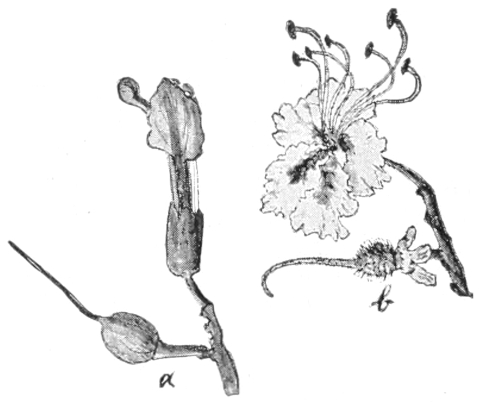
a, blossom of the sweet buck-eye and young fruit; b, blossom and young fruit of horse-chestnut.
The blossom panicle is at the tip end of the twig and stops its growth at that point; the side buds continue to grow thus making a forking branch. Each blossom panicle stands erect like a candle flame, and the flowers are arranged spirally around the central stem, each pedicel carrying from four to six flowers. The calyx has five unequal lobes, and it and the stem are downy. Five spreading and unequal petals with ruffled margins are raised on short claws, to form the corolla; seven stamens with orange colored anthers are thrust far out and up from the flower. The blossoms are creamy or pinkish white and have purple or yellow blotches in their throats. Not all the flowers have perfect pistils. The stigmas ripen before the pollen, and are often thrust forth from the unopened flower. The flowers are fragrant and are eagerly visited by bumblebees, honey-bees and wasps.
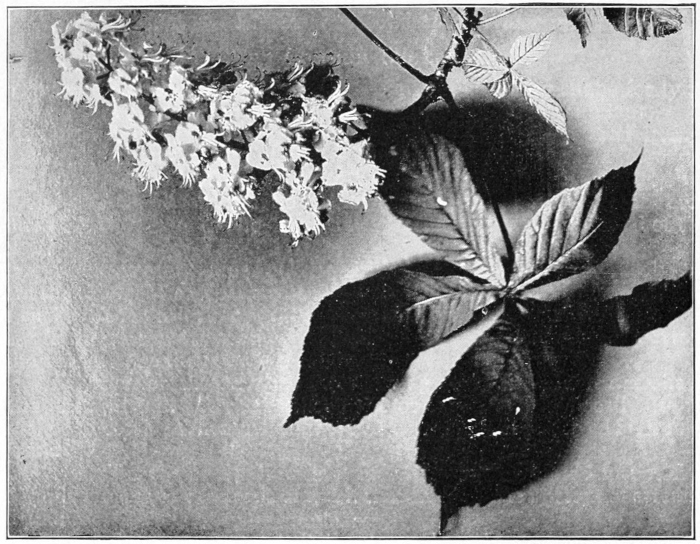
Horse-chestnut blossoms.
Photo by Verne Morton.
Very soon after the blossom falls, there may be seen one or two green, prickly balls which are all the fruits one flower cluster could afford to mature. By October the green, spherical husk breaks open in three parts, showing its white satin lining and the roundish, shining, smooth nut at its center. At first there were six little nuts in this husk, but all except one gave up to the burly occupant. The great, round, pale scar on the nut is where it joined the husk. Very few American animals will eat the nut; the squirrels scorn it and horses surely disown it.
In winter, the horse-chestnut twig has at its tip a large bud and looks like a knobbed antenna thrust forth to test the safety of the neighborhood. There are, besides the great varnished buds at the ends of the twigs, smaller buds opposite to each other along the sides of the twig, standing out stiffly. On each side of the end bud, and below each of the others, is a horseshoe-shaped scar left by the falling leaf of last year. The “nails” in this horseshoe are formed by the leafy fibres which joined the petiole to the twig. The great terminal buds hold both leaves and flowers. The buds in winter are brown and shining as if varnished; when they begin to swell, they open, displaying the silky gray floss which swaddles the tiny leaves. The leaves unfold rapidly and lift up their green leaflets, looking like partly opened umbrellas, and giving the tree a very downy appearance, which Lowell so well describes:
“And gray hoss-chestnut’s leetle hands unfold Softer’n a baby’s be at three days old.”
The leaf, when fully developed, has seven leaflets, of which the central ones are the larger. They are all attached around the tip of the petiole. The number of leaflets may vary from three to nine, but is usually seven. The leaflets are oval in shape, being attached to the petiole at the smaller end; their edges are irregularly toothed. The veins are large, straight and lighter in color; the upper surface is smooth and dark green, the under side is lighter in color and slightly rough. The petiole is long and shining and enlarges at both ends; when cut across, it shows a woody outer part encasing a bundle of fibres, one fiber to each leaflet. The places where these fibers were attached to the twig make the nails in the horseshoe scar. The leaves are placed opposite on the twigs.
Very different from that of the horse-chestnut is the flower of the yellow or sweet, buckeye; the calyx is tubular, long and five-lobed; the two side petals are on long stalks and are closed like spoons over the stamens and anthers; the two upper petals are also on long stalks, lifting themselves up and showing on their inner surfaces a bit of color to tell the wandering bee that here is a tube to be explored. The flowers are greenish yellow. The flowers of the Ohio buckeye show a stage between the sweet buckeye and the horse-chestnut. The Ohio buckeye is our most common native relative of the horse-chestnut. Its leaves have five leaflets instead of seven. The Sweet buckeye is also an American species and grows in the Alleghany mountains.
LESSON CXCV
The Horse-Chestnut
Leading thought—The horse-chestnut has been introduced into America as a shade tree from Asia Minor and southern Europe. Its foliage and its flowers are both beautiful.
Method—This tree is almost always at hand for the village teacher, as it is so often used as a shade tree. Watching the leaves develop from the buds is one of the most common of the nature-study lessons. The study of the buds, leaves and fruits may be made in school; but the children should observe the tree where it grows and pay special attention to its insect visitors when it is in bloom.
Observations—1. Describe the horse-chestnut tree when in blossom. At what time does this occur? What is there in its shape and foliage and flowers which make it a favorite shade tree? Where did it grow naturally? What relatives of the horse-chestnut are native to America?
2. Study the blossom cluster; are the flowers borne on the ends or on the sides of the twig? Describe the shape of the cluster. How are the flowers arranged on the main flower stalk to produce this form? Do the flowers open all at once from top to bottom of the cluster? Are all the flowers in the cluster the same color? Are they fragrant? What insects visit them?
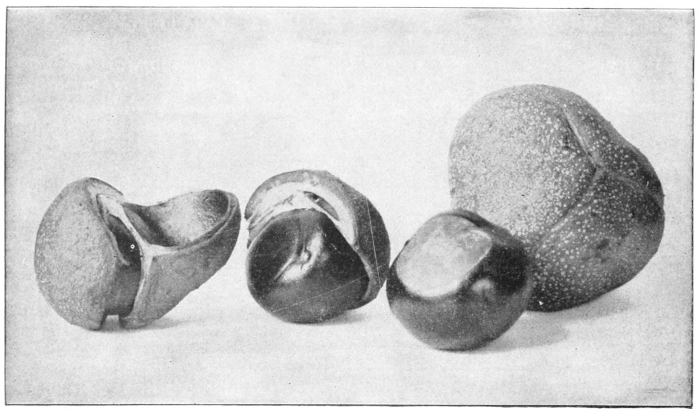
Horse-chestnuts, the coin of the small boy.
Photo by O. L. Foster.
3. Take a single flower; describe the form of the calyx. Is it smooth or downy? Are the lobes all the same size? Are the petals all alike in size and shape? What gives them the appearance of Japanese paper? Are any connected together? Are they all splashed with color alike?
4. How many stamens are there? Where do you see them? What color are the anthers? Search the center of a flower for a pistil with its green style. Do you find one in every flower? Could a bee reach the nectar at the base of the blossom without touching the stigma? Could she withdraw without dusting herself with pollen?
5. How long after the blossom does the young fruit appear? How does it look? How many nuts are developed from each cluster of blossoms? What is the shape of the bur? Into how many parts does it open? Describe the outside; the inside. Describe the shape of the nuts, their color and markings. Which make the best “conquerers,” those which grow single in the bur or as twins? Open a nut. Can you find any division in the kernel? Is it good to eat?
Horse-chestnut Twigs and Leaves in Spring—6. Are the buds on the twigs nearly all the same size? Where are the larger ones situated? What is the color of the buds? How are the scales arranged on them? Are they shiny or dull? What do the scales enfold? Can you tell without opening them which buds contain flowers and which ones leaves?
7. Describe the scars below the buds. What caused them? What marks are on them? What made the “nails” in the horseshoe? Has the twig other scars? How do the ring-marks show the age of the twig? Do you see the little, light colored dots scattered over the bark of the twig? What are they?
8. Describe how the leaf unfolds from the bud. What is the shape of the leaf? Do all the leaves have the same number of leaflets? Do any of them have an even number? How are the leaflets set upon the petiole? Describe the leaflets, including shape, veins, edges, color above and below. Is the petiole pliant, or stiff and strong? Is it the same shape and size throughout its length? Break a petiole, is it green throughout? What can you see at its center? Are the leaves opposite or alternate? When they fall, do they drop entire or do the leaflets fall apart from the stem?
9. Sketch the horse-chestnut tree.
10. How do the flowers and leaves of the horse-chestnut differ from those of the sweet buckeye and of the Ohio buckeye?
Supplementary reading—Trees in Prose and Poetry, p. 17.
THE WILLOWS
Teacher’s Story
They shall spring up among the grass, as willows by the water courses. —Isaiah.
“When I cross opposite the end of Willow Row the sun comes out and the trees are very handsome, like a rosette, pale, tawny or fawn color at base and red-yellow or orange-yellow for the upper three or four feet. This is, methinks, the brightest object in the landscape these days. Nothing so betrays the spring sun. I am aware that the sun has come out of the cloud just by seeing it light up the osiers.”—Thoreau.
HE willow, Thoreau noted, is the golden osier, a colonial dame, a descendent from the white willow of Europe. It is the most common tree planted along streams to confine them to their channels, and affords an excellent subject for a nature-study lesson. The golden osier has a short though magnificent trunk, giving off tremendous branches, which in turn branch and uphold a mass of golden terminal shoots. But there are many willows besides this, and the one who tries to determine all the species and hybrids must conclude that of making willows there is no end. The species beloved by children is the pussy willow which is often a shrub, rarely reaching twenty feet in height. It loves moist localities, and on its branches in early spring are developed the silky, furry pussies. These are favorite objects for a nature-study lesson, and yet how little have the teachers or pupils known about these flowers!
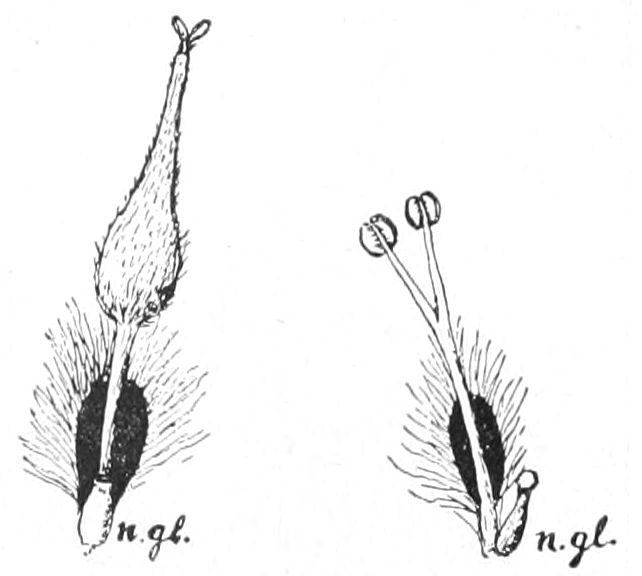
Enlarged willow blossoms.
Pistillate blossom showing nectar, gland, (n.gl.)
Staminate flower showing the nectar, gland (n.gl.)
The willow pussies are the pollen-bearing flowers; they are covered in winter by a brown, varnished, double, tentlike bract. The pussy in full bloom shows beneath each fur-bordered scale two stamens with long filaments and plump anthers; but there are no pistils in this blossom. The flowers which produce seed are borne on another tree entirely and in similar greenish gray catkins, but not so soft and furry. In the pistillate catkin each fringed scale has at its base a pistil which thrusts out a Y-shaped stigma. The question of how the pollen from one gets to the pistils of another is a story which the bees can best tell. The willow flowers give the bees almost their earliest spring feast and, when they are in blossom, the happy hum of the bees working in them can be heard for some distance from the trees. The pollen gives them bee bread for their early brood, and they get their honey supply from the nectar which is produced in little jug-shaped glands, at the base of each pollen-bearing flower on the “pussy” catkin, and in a long pocket at the base of each flower on the pistillate catkin. So they pass back and forth, carrying their pollen loads to fertilize the stigmas on trees where there is no pollen. It has been asserted that the pussies, or pollen-bearing flowers, yield no nectar but give only pollen, so that the bee is obliged to seek both trees in order to secure a diet of “balanced ration;” but the person who made this statement had never taken the pains to look at the tiny jugs over-flowing with nectar found at their bases.
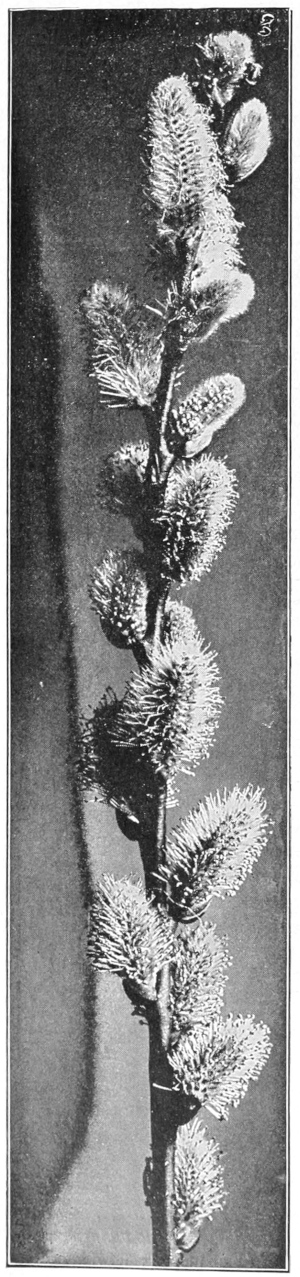
The willow pussies. The staminate blossoms of the willow.
Photo by Verne Morton.
In June the willow seed is ripe. The catkin then is made up of tiny pods, which open like milkweed pods and are filled with seed equipped with balloons. When these fuzzy seeds are being set free people say that the willows “shed cotton.”
Although the seed of the willow is produced in abundance, it is hardly needed for preserving the species. Twigs which we place in water to develop flowers will also put forth roots; even if the twigs are placed in water wrong side up, rootlets will form. A twig lying flat on moist soil will push out rootlets along its entire length as though it were a root; and shoots will grow from the buds on its upper side. This habit of the willows and the fact that the roots are long, strong and fibrous make these trees of great use as soil binders. There is nothing better than a thick hedge of willows to hold streams to their proper channels during floods; the roots reach out in all directions, interlacing themselves in great masses, and thus hold the soil of the banks in place. The twigs of several of the species, notably the crack and sand-bar willows, are broken off easily by the wind and carried off down stream, and where they lodge, they take root; thus, many streams are bordered by self-planted willow hedges.
The willow foliage is fine and makes a beautiful, soft mass with delicate shadows. The leaf is long, narrow, pointed and slender, with finely toothed edges and short petiole; the exact shape of the leaf, of course, depends upon the species, but all of them are much lighter in color below than above. The willows are, as a whole, water lovers and quick growers.