Part 3 — I. WILD-FLOWER STUDY (continued 4)
Reading edition
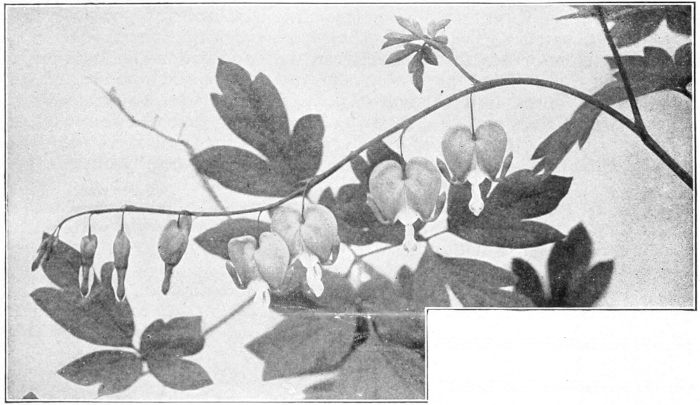
Photo by Verne Morton.
“The summer’s flower is to the summer sweet, Though to itself it only live and die.” —Shakespeare.
THE BLEEDING HEART
Teacher’s Story
For the intricate structure of this type of flower, the bleeding heart is much more easily studied than its smaller wild sisters, the Dutchman’s breeches or squirrel corn; therefore it is well to study these flowers when we find them in profusion in our gardens, and the next spring we may study the wildwood species more understandingly.
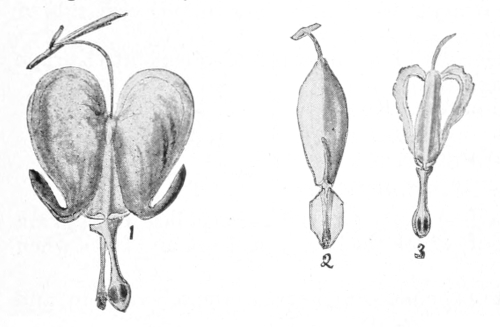
1, Flower of bleeding heart with swing-door ajar. 2, Side-view of flower showing the broad tips of the inner petals. 3, Flower with outer petals removed showing inner petals—and the heart-shaped bases of the stamens.
The flowers of the bleeding heart are beautiful jewel-like pendants arranged along the stem according to their age; the mature flower, ready to shed its petals, is near the main stem, while the tiny unopened bud is hung at the very tip, where new buds are constantly being formed during a long season of bloom. This flower has a strange modification of its petals; the two pink outer ones, which make the heart, are really little pitchers with nectar at their bottoms, and although they hang mouth downwards the nectar does not flow out. When these outer petals are removed, we can see the inner pair placed opposite to them, the two of them close together and facing each other like two grooved ladles. Just at the mouth of the pitchers these inner petals are almost divided crosswise; and the parts that extend beyond are spoon-shaped, like the bowls of two spoons which have been pinched out so as to make a wide, flat ridge along their centers. These spoon-bowls unite at the tip, and between them they clasp the anthers and stigma. Special attention should be given to the division between the two portions of these inner petals; for it is a hinge, the workings of which are of much importance to the flower. On removing the outer petals, we find a strange framework around which the heart-shaped part of the flower seems to be modeled. These are filaments of the stamens grouped in threes on each side; the two outer ones of each group are widened into frills on the outer edge, while the central one is stiffer and narrower. At the mouth of the pitchers all these filaments unite in a tube around the style; near the stigma they split apart into six short, white, threadlike filaments, each bearing a small, brilliant yellow anther. So close together are these anthers that they are completely covered by the spoon-bowls made by the inner petals, the pollen mass being flat and disklike. During the period when the pollen is produced, the stigma is flat and immature; but after the pollen is shed, it becomes rounded into lobes ready to receive pollen from other flowers.
Although the description of the plant of this flower is most complex and elaborate, the workings of the flower are most simple. As the nectar-pitchers hang mouth down, the bee must cling to the flower while probing upward. In doing this she invariably pushes against the outside of the spoon-bowls, and the hinge at their base allows her to push them back while the mass of pollen is thrust against her body; as this hinge works both ways, she receives the pollen first on one side and then on the other, as she probes the nectar-pitchers. And perhaps the next flower she visits may have shed its pollen, and the swing door will uncover the ripe stigma ready to receive the pollen she brings.
The sepals are two little scales opposite the bases of the outer petals. Before the flower opens, the “spouts of the nectar-pitchers” are clamped up on either side of the spoon-bowls, as if to keep everything safe until the right moment comes; at first they simply spread apart, but later curve backward. The seed-pod is long and narrow, and in cross-section is seen to contain two compartments with seeds growing on every side of the partition.
The bleeding heart is a native of China, and was introduced into Europe about the middle of the last century.
Reference—Our Garden Flowers, Keeler.
LESSON CLIV
The Bleeding Heart
Leading thought—The bleeding heart flower has its pollen and stigma covered by a double swing door, which the bees push back and forth when they gather the nectar.
Method—Bring a bouquet of the bleeding heart to the schoolroom, and let each pupil have a stem with its flowers in all stages. From this study, encourage them to watch these flowers when the insects are visiting them.
Observations—1. How are these flowers supported? Do they open upward or downward? Can you see the tiny sepals?
2. How many petals can you see in this flower? What is the shape of the two outer petals? How do they open? Where is the nectar developed in these petals?
3. Take off the two outer petals and study the two inner ones. What is their shape near the base? How are their parts shaped which project beyond the outer petals? What does the spoon-end of these petals cover? Can you find the hinge in these petals?
4. Where are the stamens? How many are there? Describe the shape of the stamens near the base. How are they united at the tip?
5. Where is the stigma? The style? The ovary?
6. Supposing a bee is after the nectar, where must she rest while probing for it? Can she get the nectar without pushing against the flat projecting portion of the inner petals? When she pushes these spoon-bowls back, what happens? Does she get dusted with pollen? After she leaves, does the door swing back? Suppose she visits another flower which has shed its pollen, will she carry pollen to its stigma? Does she have to work the hinged door to do this?
THE POPPIES
Teacher’s Story
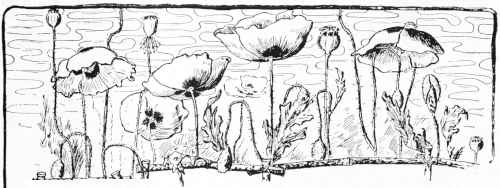
Poppies.
Drawn by Anna C. Stryke.
ERHAPS we might expect that a plant which gives strange dreams to those who eat of its juices should not be what it seems in appearance. I know of nothing so deceptive as the appearance of the poppy buds, which, rough and hairy, droop so naturally that it seems as if their weight must compel the stem to bend; and yet, if we test it, we find the stem is as stiff as if made of steel wire. Moreover, the flower and the ripened seed-capsule must be far heavier than the bud; and yet, as soon as the flower is ready to open, the stem straightens up, although it does not always remove the traces of the crook; and after the capsule is full of ripened seed, the stem holds it up particularly stiff, as if inviting the wind to shake out the seeds.
The rough covering of the bud consists of two sepals, as can be easily seen; but if we wish to see the poppy shed its sepals, we must get up in the morning, for the deed is usually done as soon as the first rays of the early sun bring their message of a fair day. The sepals break off at their base and fall to the ground. The two opposite outer petals unfold, leaving the two inner petals standing erect and on guard about the precious pollen, until the sunshine folds them back. An open poppy, when looked at below, shows two petals, each semicircular, and overlapping each other slightly; looked at from above, we see two petals, also half circles, set at right angles to the lower two, and divided from each other by the pistil.
The pistil of the poppy is, from the beginning, a fascinating box. At first, it is a vase with a round, circular cover, upon which are ridges, placed like the spokes of a wheel. If these ridges are looked at with a lens, particles of pollen may be seen adhering to them; this fact reveals the secret that each ridge is a stigma, and all of these radiating stigmas are joined so as better to catch the pollen. In a circle of fringe about the pistil are the stamens. In the study of the stamens, we should note whether their filaments expand or dilate near the anthers, and we should also note the color of the masses of pollen which crowd out from the anthers.
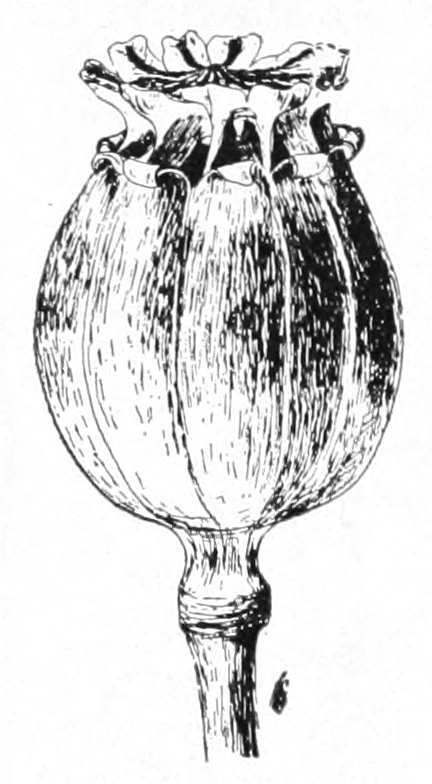
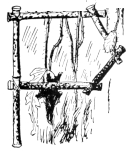
The poppy seed-shaker.
Drawn by Anna C. Stryke.
Despite the many varieties of poppies, there are only four species commonly cultivated. The opium poppy has upon its foliage a white bloom, the filaments of its stamens are dilated at the top, and its seed-capsule is smooth. The oriental poppy has all of these characters, except that its foliage is green and not covered with bloom. Its blossom is scarlet and very large and has a purple center in the petals and purple stamens; it has three sepals. Its flower stalks are stout and leafy. The corn poppy, which grows in the fields of Europe, is a weed we gladly cultivate. This, naturally, has red petals and is dark at the center of the flower; but it has been changed by breeding until now we have many varieties. Its foliage is finely cut and very bristly or hairy. Its seed-capsule is not bristly. To see this poppy at its best, we should visit northern Italy or southern France in late May, where it makes the grain fields gorgeous. This is the original parent of all the Shirley poppies. The Arctic, or Iceland poppy, has flowers of satiny texture and finely crumpled; its colors are yellow, orange or white, but never scarlet like the corn poppy; it has no leaves on its flower stem, and its seed-capsule is hairy. Of these four species, the opium poppy and the corn poppy are annuals, while the Arctic and the Oriental species are perennials.
The bees are over-fond of the poppy pollen and it is a delight to watch the fervor with which they simply wallow in it, brushing off all of the grains possible onto their hairy bodies. I have often seen a honey-bee seize a bunch of the anthers and rub them against the under side of her body, meanwhile standing on her head in an attitude of delirious joy. As showing the honey-bee’s eye for color, I have several times seen a bee drop to the ground to examine a red petal which had fallen. This was plain evidence that she trusted to the color to guide her to the pollen.
But perhaps it is the development of the poppy seed-capsule which we find the most interesting of the poppy performances. After fertilization, the stigma-disk develops a scalloped edge, a stigma rounding out the point of each scallop; and a sharp ridge, which continues the length of the globular capsule, runs from the center of each scallop. If examined on the inside, it will be seen that the ridge on the capsule is the edge of a partition which extends only part way toward the center of the capsule. On these partitions, the little seeds are grown in great profusion, and when they ripen, they fall together in the hollow center of the seed-box. But how are they to get out? This is a point of interest for the children to observe, and they should watch the whole process. Just beneath the stigma-disk, and between each two of the sharp ridges, the point loosens; later, it turns outward and back, leaving a hole which leads directly into the central hollow portion of the capsule. The way these points open is as pretty a story as I know in flower history. This beautiful globular capsule, with its graceful pedestal where it joins the stem, is a seed-shaker instead of a salt or pepper-shaker. Passing people and animals push against it and the stiff stem bends and then springs back, sending a little shower of seeds this way and that; or a wind sways the stalk, and the seeds are sown, a few at a time, and in different conditions of season and weather. Thus, although the poppy puts all her eggs in one basket, she sends them to market a few at a time. The poppy seed is a pretty object, as seen through the lens. It is shaped like a round bean, and is covered with a honeycomb network.
LESSON CLV
The Poppy
Leading thought—The poppies shed their sepals when the flowers expand; they offer quantities of pollen to the bees, which are very fond of it. The seed-capsule develops holes around the top, through which the seeds are shaken, a few at a time.
Method—It is best to study these flowers in the garden, but the lesson may be given if some of the plants with the buds are brought to the schoolroom, care being taken that they do not droop. If the teacher thinks wise, the pupils might prepare an English theme on the subject of the opium poppy and the terrible effects of opium upon the eastern nations.
Observations—1. Look at the bud of the poppy; how is it covered? How many sepals? Can you see where they unite? Is the stem bent because the bud is heavy? What happens to this crook in the stem when the flower opens? Does the crook always straighten out completely?
2. Describe how the poppy sheds its sepals. At what time of day do the poppies usually open?
3. Look at the back of, or beneath, an open flower. How many petals do you see? How are they arranged? Look at the base of the flower. How many petals do you see? How are they arranged in relation to the lower petals and to the pistil?
4. Look at the globular pistil. Describe the disk which covers it. How many ridges on this disk? How are they arranged? Look at the ridges with a lens and tell what they are.
5. Look at the stamens. How are they arranged? Describe the anthers—their color, and the color of the pollen. Watch the bees working on the poppies, and note if they are after nectar or pollen.
6. Find all the varieties of poppies possible, and note the colors of the petals on the outside, the inside and at the base; of the stamens, including filaments, anthers and pollen; of the pistil-disk and ovary. Sketch the poppy opened, and also in the bud. Sketch a petal, a stamen and the pistil, in separate studies.
7. Study the poppy seed-box as it ripens. How does the stigma-disk look? What is the shape of the capsule below the disk? Is it ridged? What relation do its ridges bear to the stigma ridges on the disk? Cut a capsule open, and note what these ridges on the outside have to do with the partitions inside. Where are the seeds borne?
8. Note the development of the holes beneath the edge of the disk of the poppy capsule. How are they made? What are they for? How are the seeds shaken from these holes? What shakes the poppy seed-box and helps sow the seeds? Look at a seed through a lens, and describe its form and decoration.
9. Notice the form of the poppy leaf, and note whether it is hairy or covered with bloom. What is there peculiar about the smell of the poppy plant? Where do poppies grow wild?
10. Is the slender stem smooth or grooved and hairy? Is it solid or hollow?
11. When a stem or leaf is pierced or broken off, what is the color of the juice which exudes? Does this juice taste sweet or bitter and unpleasant? Do you know what harmful drug is manufactured from the juice of one species of poppy? What countries cultivate and use it most extensively?
THE CALIFORNIA POPPY
Teacher’s Story
LTHOUGH this brilliant flower blossoms cheerfully for us in our Eastern gardens, we can never understand its beauty until we see it glowing in masses on the California foothills. We can easily understand why it was selected as the flower of that great State, since it burnished with gold the hills, above the gold buried below; and in that land that prides itself upon its sunshine, these poppies seem to shine up as the sun shines down. The literature of California, and it has a noble literature of its own, is rich in tributes to this favored flower. There is a peculiar beauty in the contrast between the shining flower and its pale blue-green, delicate masses of foliage. Although it is called a poppy and belongs to the poppy family, yet it is not a true poppy, but belongs to a genus named after a German who visited California early in the nineteenth century, accompanying a Russian scientific expedition; this German’s name was Eschscholtz, and he, like all visitors, fell in love with this brilliant flower, and in his honor it was named Eschscholtzia (es-sholts-ia) californica. This is not nearly so pretty, nor so descriptive, as the name given to this poppy by the Spanish settlers on the Pacific Coast, for they called it Copa-de-oro, cups of gold.
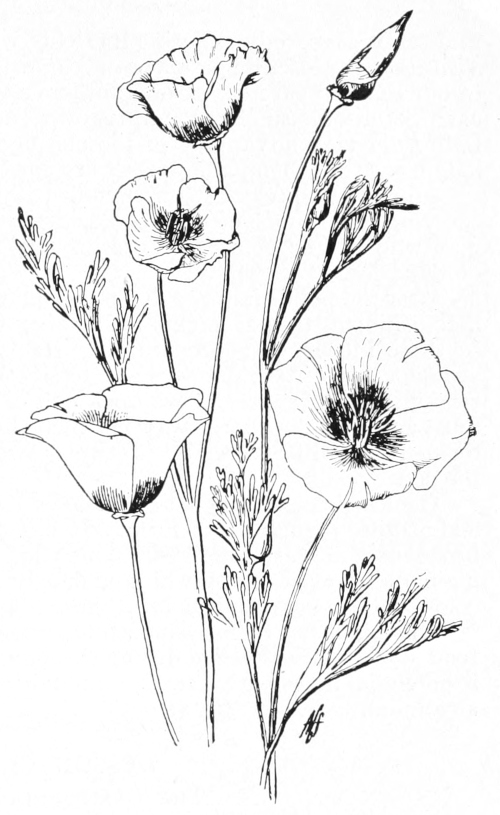
The bud of the Eschscholtzia is a pretty thing; it stands erect on the slender, rather long stem, which flares near the bud to an urnlike pedestal with a slightly ruffled rim, on which the bud is set. This rim is often pink above, and remains as a pretty base for the seed-pod. But in some garden varieties, the rim is lacking. The bud itself is covered with a peaked cap, like a Brownie’s toboggan cap stuffed full to the tip. It is the shape of an old-fashioned candle extinguisher; it is pale green, somewhat ribbed, and has a rosy tip; it consists of two sepals, which have been sewed together by Mother Nature so skillfully that we cannot see the seams. One of the most interesting performances to watch that I know, is the way this poppy takes off its cap before it bows to the world. Like magic the cap loosens around the base; it is then pushed off by the swelling expanding petals until completely loosened, and finally it drops.
California poppy.
Drawn by Anna C. Stryke.
The petals are folded under the cap in an interesting manner. The outer petal enfolds all the others as closely as it can, and its mate within it enfolds the other two, and the inner two enfold the stamens with their precious gold dust. When only partially opened, the petals cling protectingly about the many long stamens; but when completely opened, the four petals flare wide, making a flower with a golden rim and orange center, although among our cultivated varieties they range from orange to an anaemic white. To one who loves them in their glorious native hues, the white varieties seem almost repulsive. Compare one of these small, pale flowers with the great, rich, orange ones that glorify some favored regions in the Mojave Desert, and we feel the enervating and decadent influence of civilization.
The anthers are many and long, and are likely to have a black dot on the short filament; at first, the anthers stand in a close cluster at the center of the flower, but later they flare out in a many pointed star. Often, when the flowers first open, especially the earlier ones, the stigmas cannot be seen at all; but after a time the three, or even six stigmas, spread wide athwart the flower and above the stamen-star, where they may receive pollen from the visiting insects. The anthers give abundance of pollen, but there is said to be no nectary present. This flower is a good guardian of its pollen, for it closes during the nights and also on dark and rainy days, only exposing its riches when the sunshine insures insect visitors. It closes its petals in the same order in which they were opened in our Eastern gardens, although there are statements that in California, each petal folds singly around its own quota of anthers. The insects in California take advantage of the closing petals and often get a night’s lodging within them, where they are cozily housed with plenty of pollen for supper and breakfast; and they pay their bill in a strange way by carrying off as much of the golden meal as adheres to them, just as the man who weighs gold-dust gets his pay from what adheres to the pan of his scales.
After the petals fall, the little pod is very small, but its growth is as astonishing as that of Jack’s beanstalk; it finally attains a slim length of three inches, and often more. It is grooved, the groove running straight from its rimmed base to its rosy tip; but later a strange twisting takes place. If we open one of these capsules, lengthwise, we must admire the orderly way in which the little green seeds are fastened by delicate white threads, in two crowded rows, the whole length of the pod.
The leaf is delicately cut and makes the foliage a fine mass, but each leaf is quite regular in its form. It has a long, flattened petiole, which broadens and clasps the stem somewhat at its base. Its blade has five main divisions, each of which is deeply cut into fingerlike lobes. The color of this foliage and its form show adaptations to desert conditions.
This plant has a long, smooth tap root, especially adapted for storing food and moisture needed during the long, dry California summers; for it is perennial in its native state, although in the wintry East, we plant it as an annual.
LESSON CLVI
The California Poppy
Leading thought—The California poppy is a native of California. It blossoms during the months of February, March and April in greatest abundance. It is found in the desert as well as among the foothills.
Method—If possible, the students should study this in the garden. In the East, it flowers until frost comes, and affords a delightful subject for a September lesson. In California it should be studied in the spring, when the hills are covered with them. But the plant may be brought into the schoolroom, root and all, and placed in a jar, under which conditions it will continue to blossom.
Observations—1. Look at the California poppy as a whole and tell, if you can, why it is so beautiful when in blossom.
2. Look at the flower bud. What sort of a stem has it? What is the shape of the stem just below the bud? What is the color of the little rim on which the bud rests? What peculiarity has this bud? Describe the little cap.
3. Watch a flower unfold. What happens to the “toboggan cap?” How does the bud look after the cap is gone? What is its appearance when the petals first open? When they are completely open?
4. Describe the anthers. How do they stand when the flower first opens? How later? Can you see the stigmas at first? Describe them as they look later.
5. Does the poppy remain open at night? Does it remain open during cloudy or rainy weather? Why?
6. Do the petals have the same position that they did in the bud? As the flower matures, note how each petal curls. Do they all fall at once? Are there any anthers left after the petals fall?
7. How does the little pod look when the petals first fall? What happens to it later? Note the little rim at its base. Cut the seed-pod open lengthwise, examine the seeds with a lens, and describe how they are fastened to the sides of the pod. Are the ribs straight from end to end in the pod at first? Do they remain in this position? How does the pod open and scatter its seeds?
8. Study the leaf of this California poppy. Describe how it joins the stem. Sketch a leaf showing its chief divisions into leaflets and how each leaflet is divided. Note that the juice of the stem has the peculiar odor of muriatic acid.
9. Look at the root. Do you think it is fitted to sustain the plant through a long, dry summer? What kind of summers do they have in California? Where does the poppy grow wild?
10. Read all the accounts you can find of the California poppy, and write a little theme describing why it was chosen as the flower of that great State, and how it came by its name.
In a low brown meadow on a day Down by the autumn sea, I saw a flash of sudden light In a sweep of lonely gray; As if a star in a clouded night One moment had looked on me And then withdrawn; as if the spring Had sent an oriole back to sing A silent song in color, where Other silence was too hard to bear. I found it and left it in its place, The sun-born flower in cloth of gold That April owns, but cannot hold From spending its glory and its grace On months that always love it less, But take its splendid alms in their distress. Back I went through the gray and the brown, Through the weed-woven trail to the distant town; The flower went with me, fairly wrought Into the finest fiber of my thought. —A California Poppy in November, Irene Hardy.
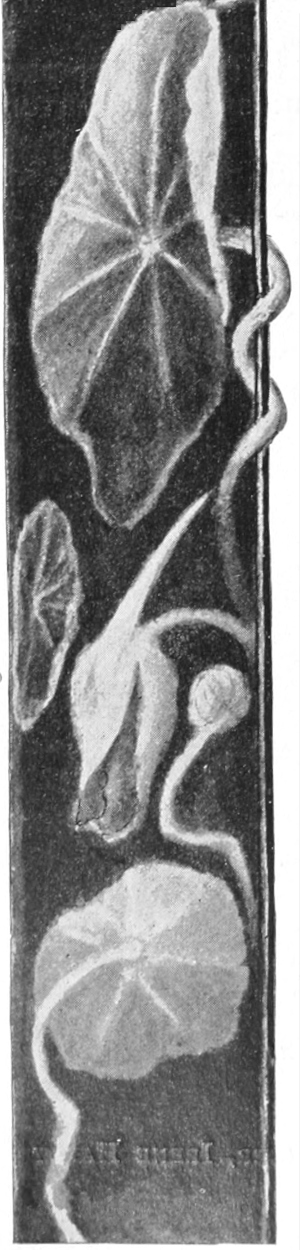
THE NASTURTIUM
THE NASTURTIUM
Teacher’s Story
“Little warriors, brave and fearless, with shields of emerald green, Are climbing over fence rails, and everywhere are seen Looking down on every side, while her brave Nasturtium army, Queen Nature views with pride.” —Ray Laurence.
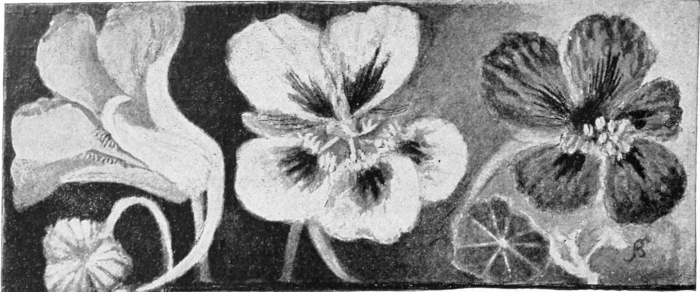
It is quite fitting that the nasturtium leaves should be shaped like shields, for that is one of their uses; they are shields to protect the young nasturtium seeds from the hot sun and from the view of devouring enemies. The nasturtiums are natives of Peru and Chili, and it is fitting that the leaves should develop in shield-shape, and the shields overlap until they form a tent to shade the tender developing fruit from the burning sun. But they were never meant to shield the flower, which thrusts its brilliant petals out between the shields, and calls loudly to the world to admire it. It would indeed be a pity for such a remarkable flower to remain hidden; its five sepals are united at their base, and the posterior one is extended into a long spur, a tube with a delectable nectar-well at its tip. The five petals are set around the mouth of this tube, the two upper ones differing in appearance and office from those below; these two stand up like a pair of fans, and on them are lines which converge; on the upper sepals are similar lines pointing toward the same interesting spot. And what do all these lines lead to, except a veritable treasure-cave filled with nectar! The lower petals tell another story; they stand out, making a platform, or doorstep, on which the visiting bee alights. But it requires a big insect to do the work of this flower, and what if some inefficient little bee or fly should alight on the petal-doorstep and steal into the cave surreptitiously! This contingency is guarded against thus: Each of these lower petals narrows to a mere insect footbridge at their inner end; and in order to render this footbridge quite impassable, it is beset with irregular little spikes and projecting fringes, sufficient to perplex or discourage any small insect from crawling that way.
But why all these guiding lines and guarded bridges? If you watch the same blossom for several successive days, it will reveal this secret. When a flower first opens, the stamens are all bent downward, but when an anther is ready to open its pollen doors, the filament lifts it up and places it like a sentinel blocking the doorway to the nectar treasure. Then when the robber comes, whether it be butterfly, bee or hummingbird, it gets a round of pollen ammunition for its daring. Perhaps there may be two or three anthers standing guard at the same time, but, as soon as their pollen is exhausted, they shrivel and give room for fresh anthers. Meanwhile, the stigma has its three lobes closed and lying idly behind and below the anthers; after all the pollen is shed, the style raises and takes its position at the cave entrance and opens up its stigmas, like a three-tined fork, to rake the pollen from any visiting insect, thus robbing the robber of precious gold-dust which shall fertilize the seeds in its three-lobed ovary. Although the flower needs to flare its colors wide to call the bees and hummingbirds, yet the growing seeds must be protected; therefore, the stem which held the flower up straight, now twists around in a spiral and draws the triplet seeds down behind the green shields.
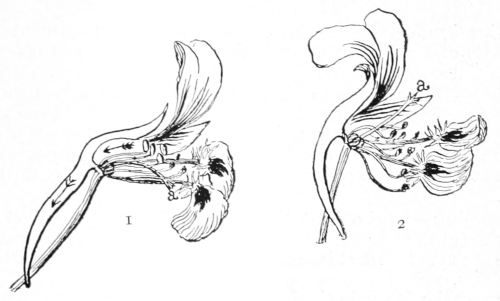
1. Nasturtium flower in early stage of blossoming. Note the anthers lifted in the path to the nectar which is indicated by the arrow. The closed stigma is shown deflected at a.
2. The same flower in later stage; the anthers are empty and deflected. The stigma is raised (a) in the nectar path.
Nasturtium leaves are very pretty, and are often used as subjects for decorative water-color drawings. The almost circular leaf has its stem attached below and a little at one side of the center; the leaves are brilliant green above but quite pale beneath, and are silvery when placed beneath the water. The succulent stems have a way of twisting half around the wires of the trellis and thus holding the plant secure to its support. But if there is no trellis, the main stem seems to awaken to the responsibility and grows quite stocky, often lifting the plant a foot or two in height, and from its summit sending out a fountain of leaf and flower stems.
The nasturtium is among the most interesting and beautiful of our garden flowers, and will thrive in any warm, sunny, fairly moist place. Its combinations of color are exceedingly rich and brilliant. H. H. says of it:
“How carelessly it wears the velvet of the same Unfathomed red, which ceased when Titian ceased To paint it in the robes of doge and priest.”
LESSON CLVII
The Nasturtium
Leading thought—The nasturtium has a special arrangement by which it sends its own pollen to other flowers and receives pollen from other flowers by insect messengers.
Method—The nasturtiums and their foliage should be brought into the schoolroom in sufficient quantity so that each child may have a leaf and a flower for study. The object of the lesson is to interest the pupils in studying, in their gardens, one flower from the bud until the petals wither, taking note of what happens each day and keeping a list of the insect visitors.
Observations—1. Look at the back of the flower. What is there peculiar about the sepals? How many sepals are there? How many join to make the spur? What is in this spur? Taste of the tip. Find where the nectar is.
2. Look the flower in the face. How do the two upper petals differ in shape from the three lower ones? What markings are there on the upper petals? Where do these lines point? Are there any markings on the sepals pointing in the same direction? If an insect visiting a flower should follow these lines, where would it go?
3. Describe the shape of the lower petals. Suppose a little ant were on one of these petals and she tried to pass over to the nectar-tube or spur, would the fringes hinder her?
4. Look down the throat of the spur, and tell what a bee or other insect would have to crawl over before it could get at the nectar.
5. In your garden, or in the bouquet in the window if you cannot visit a garden, select a nasturtium that is just opening and watch it every day, making the following notes: When the blossom first opens where are the eight stamens? Are the unripe, closed anthers lifted so as to be in the path of the bee which is gathering nectar? How do the anthers open? How is the pollen held up in the path to the nectar? Can you see the stigma of this flower? Where is it? Note the same flower on successive days: How many anthers are open and shedding pollen to-day? Are they all in the same position as yesterday? What happens to the anthers which have shed their pollen?
6. When the stigma rises in the nectar path, how does it look? Where are all the anthers when the stigma raises its three tines to rake the pollen off the visiting insect? Do you know why it is an advantage to the nasturtium to develop its seed by the aid of the pollen from another plant?
7. Can you see the beginning of the seed-case when the stigma arises to receive the pollen?
8. The flowers project beyond the leaves. Do the ripening seed-cases do this? What happens to their stems to withdraw them behind the leaf?
9. Sketch a nasturtium leaf, and explain why it is like a shield. How does the leaf look when under water?
10. What sort of stem has the nasturtium? How does it manage to climb the trellis? If it has no trellis to climb, does it lie flat upon the ground?
THE BEE-LARKSPUR
Teacher’s Story
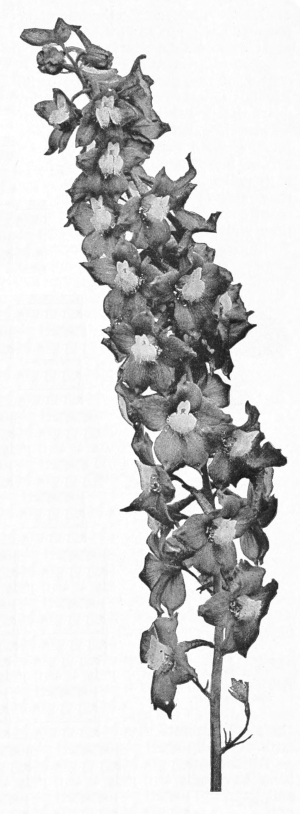
The bee-larkspur.
Photo by Cyrus Crosby.
This common flower of our gardens, sending up from a mass of dark, deeply-cut leaves tall racemes of purple or blue flowers, has a very interesting story to tell those who watch it day by day and get acquainted with it and its insects guests. The brilliant color of the flowers is due to the sepals, which are purple or blue, in varying shades; but as if to show that they are sepals instead of petals, each has on the back side near its tip, a green thickened spot. If we glance up the flower stalk, we can see that, in the upper buds, the sepals are green, but in the lower buds they begin to show the blue color; and in a bud just ready to open, we can see that the blue sepals are each tipped with a green knob, and this remains green after the sepals expand. The upper and rearmost sepal is prolonged into a spur, which forms the outside covering of the nectar-spur; it is greenish and wrinkled like a long-wristed, suede glove; two sepals spread wide at the sides and two more below. All this expanse of blue sepals is simply for a background for the petals, which, by their contrasting color, show the bees where to probe for nectar. Such inconsequential petals as they are! Two of them “hold hands” to make an arch over the entrance to the nectar tube; and just below these on each side are two more tiny, fuzzy, spreading petals, often notched at the tip and always hinged in a peculiar way about the upper petal; they stand guard at the door to the nectar storehouse. If we peel off the wrinkled sepal-covering of the spur, we can see the upper petals extending back into it, making a somewhat double-barreled nectary.
If we look into a larkspur flower just opened, we see below the petals a bunch of green anthers, hanging by white threadlike filaments to the center of the flower and looking like a bunch of lilliputian bananas. Behind these anthers is an undeveloped stigma, not visible as yet. After the flower has been open for a short time, three or four of the anthers rise up and stand within the lower petals; while in this position, their white pollen bursts from them, and no bee may then thrust her tongue into the nectar-spur without being powdered with pollen. As soon as the anthers have discharged their pollen, they shrivel and their places are taken by fresh ones. It may require two or three days for all the anthers to lift up and get rid of their pollen. After this has been accomplished, the three white, closely adhering pistils lift up their three stigmas in the self-same path to the nectar; and now they are ready to receive the pollen which the blundering bee brings from other flowers. Since we cannot always study the same flower for several consecutive days, we can read the whole story by studying the flowers freshly opened on the upper portion of the stalk, and those below them that are in more advanced stages.
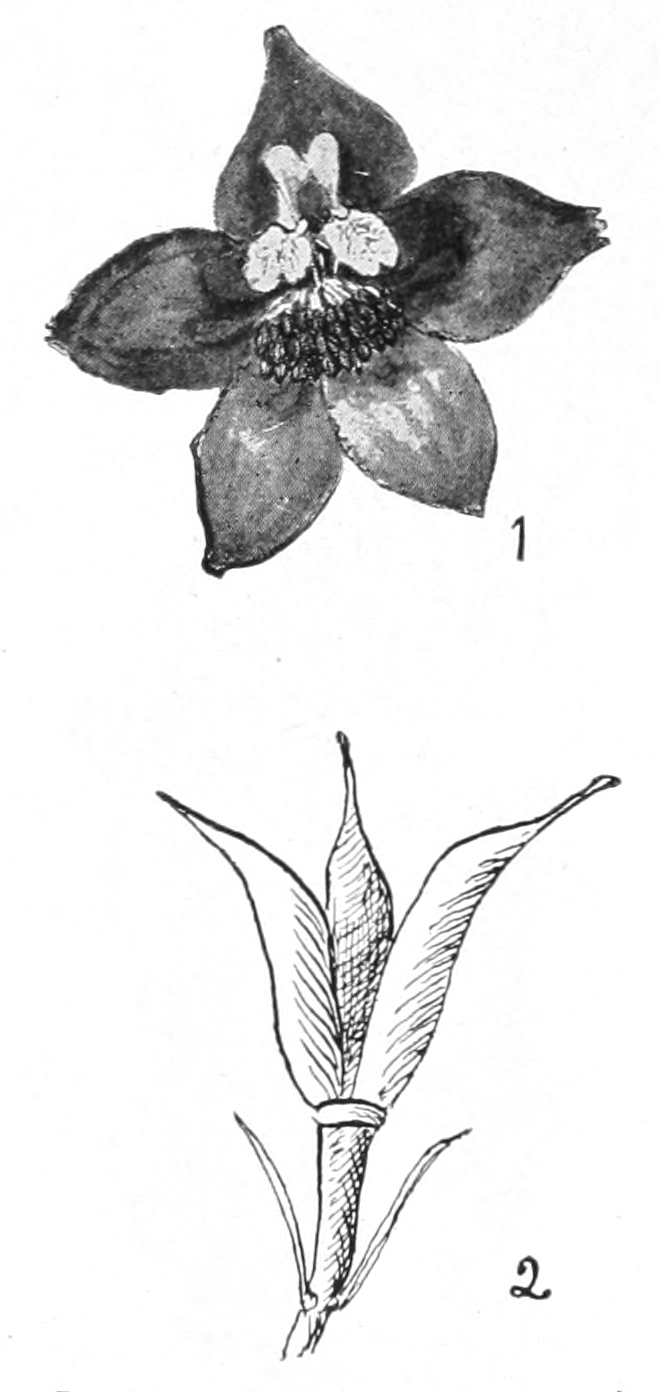
1, Drawing of the bee-larkspur flower enlarged.
2, The seed capsule of the bee-larkspur.
The bees, especially the bumblebee, will tell the pollenation story to us in the garden. The contrasting color of the petals and sepals tells her where to alight; this she does accurately, and the inconsequential lower petals seem made for her to grasp; she presses them to her breast with her front and middle legs with a dramatic, almost ecstatic, gesture that is comical to witness, and holds them firmly while she thrusts her head into the opening between them; she probes the spur twice, evidently finding there the two nectar-wells. It is a fascinating pastime to follow her as she goes from flower to flower like a Madam Pompadour, powdered with her white pollen. In order that a bee may work on these flowers, it is necessary that they hang vertically. The tips of the tall flower stalks are likely to bend or curl over; but no matter what the direction the broken or bent stem takes, the flowers will twist around on their pedicels until they face the world and the bee, exactly as if they were on a normally erect stem.
All the larkspurs have essentially the same pollen story, although some have only two petals; in every case the anthers at first hang down, and later rise up in the path to the nectar, in order to discharge their pollen; after they wither, the stigmas arise in a similar position.
The bee-larkspur has a very beautiful fruit. It consists of three graceful capsules rising from the same base and flaring out into pointed tips. The seeds are fastened to the curved side of each capsule, which, when ripe, opens so that they may be shaken out by the winds. When studying the bud, we notice two little bracts set at its base and these remain with the fruit.
LESSON CLVIII
The Bee-larkspur
Leading thought—The bee-larkspur begins blossoming early in the season, the blossom stalk elongating and developing new buds at its tip until late in autumn. The flower has a very interesting way of making the bees carry its pollen.
Method—Bring to the schoolroom a flower stalk of the bee-larkspur, and there study the structure and mechanism of the flower. This lesson should inspire the pupils to observe for themselves the visiting bees and the maturing seeds. Ask them to write an account of a bumblebee making morning calls on the larkspurs.
Observations—1. Which flowers of the larkspur open first—those near the tip of the stem or those below?
2. Examine the buds toward the tip of the flower stalk. What color are the sepals in these buds? Do the sepals change color as the flower opens? Note the little green knobs which tip the closed sepals that clasp the bud. What color are the sepals on the open flower? Is there any green upon them when open?
3. Where is the nectar-spur? Which sepal forms this? How are the other sepals arranged?
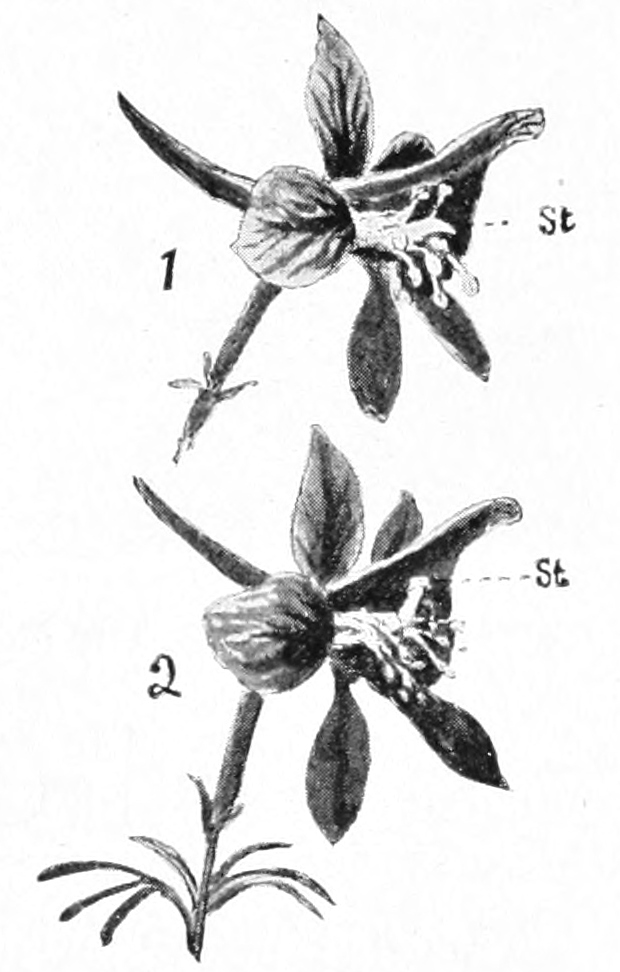
The larkspur.
1, showing early stage with stigma deflected.
2, showing advanced stage with stigma raised.
4. Now that we know the flower gets its brilliant color from its sepals, let us find the petals. Look straight into the flower, and note what forms the contrasting color of the heart of the flower; these are the petals. Can you see that two are joined above the opening into the nectar-tube? How many guard the entrance from below? How are these lower petals hinged about the upper one? Peel a sepal-cover from the nectar-spur, and see if the upper petals extend back within the spur, forming nectar-tubes.
5. Take a flower just opened, and describe what you see below the petals. What is the color of the anthers? Of the filaments? Can you see the stigma?
6. Take a flower farther down the stalk, which has therefore been open longer, and describe the position of the anthers in this. Are there any of them standing upright? Are they discharging their pollen? What color is the pollen? Are these upright anthers in the way of the bee, when she thrusts her tongue into the nectar-tube?
7. Take the oldest flower you can find. What has happened to the anthers? Can you see the pistils in this? In what position now are the stigmas?
8. Push aside the anthers in a freshly opened flower and see if you can find the stigmas. What is their position? How do they change in form and position after the pollen is shed? Do they arise in the path of the bee before all the pollen from the anthers of their own flower is shed? If so, how are they pollenated?
9. Suggestions for Observation in the Garden—Watch a bumblebee working on the larkspur and answer the following questions: How does she hold on to the flower? Where does she thrust her tongue? Can she get the nectar without brushing the pollen from the anthers which are lifting up at the opening of the nectar-tube? In probing the older flowers, how would she come in contact with the lifted stigmas? How do the petals contrast in color with the sepals? Does this tell the bees where to look for nectar? Compare the common larkspur with the bee-larkspur, and notice the likeness and difference. What kind of fruit capsules has the bee-larkspur? Describe the seeds, and how they are scattered.
THE BLUE FLAG, OR IRIS
Teacher’s Story
Beautiful lily, dwelling by still rivers Or solitary mere, Or where the sluggish meadow brook delivers Its waters to the weir! The burnished dragon fly is thine attendant, And tilts against the field, And down the listed sunbeams rides resplendent With steel-blue mail and shield. —From “Flower-de-luce,” Henry W. Longfellow.
The iris blossom has a strange appearance, and this is because nothing in it is as it seems. The style of the pistil is divided into three broad branches and they look like petals; and they have formed a conspiracy with the sepals to make a tunnel for bees, leaving the petals out of the plan entirely and the sepals “rise to the occasion.” The petals stand up lonely between the three strangely matched pairs, and all they accomplish by their purple guiding lines, is to basely deceive the butterflies and other insects which are in the habit of looking for nectar at the center of a flower. If we look directly down into the flower of the blue flag, there are ridges on the broad styles and purple veins on the petals, all pointing plainly to the center of the flower, and any insect alighting there would naturally seek for nectar-wells where all these lines so plainly lead. But there is an “April fool” for the insects which trust to these guides, for there is no nectar to be had there. Dr. Needham, in his admirable study of this flower and its visitors (American Naturalist, May, 1900), tells us that he has seen the little butterflies called “skippers,” the flag weevils and the flower beetles all made victims of this deceptive appearance; this is evidence that the nectar guiding lines on flowers are noted and followed by insects.
The blue flag is made for bees; the butterflies and beetles are interlopers and thieves at best. The bees are never deceived into seeking the nectar in the wrong place. They know to a certainty that the sepal with its purple and yellow tip and many guiding lines although far from the center of the flower, is the sure path to the nectar. A bee alights on the lip of the sepal, presses forward scraping her back against the down-hanging stigma, then scrapes along the open anther which lies along the roof of the tunnel; and she here finds a pair of guiding lines each leading to a nectar-well at the very base of the sepal. The bees which Dr. Needham found doing the greatest work as pollen-carriers were small solitary bees (Clisodon terminalis and Osmia destructa); each of these alighted with precision on the threshold of the side door, pushed its way in, got the nectar from both wells, came out and sought another side door speedily. One might ask why the bee in coming out did not deposit the pollen from its own anther upon the stigma; but the stigma avoids this by hanging down, like a flap to a tent, above the entrance, and its surface for receiving pollen is directed so that it gathers pollen from the entering bee and turns its back to the bee that is just making its exit.
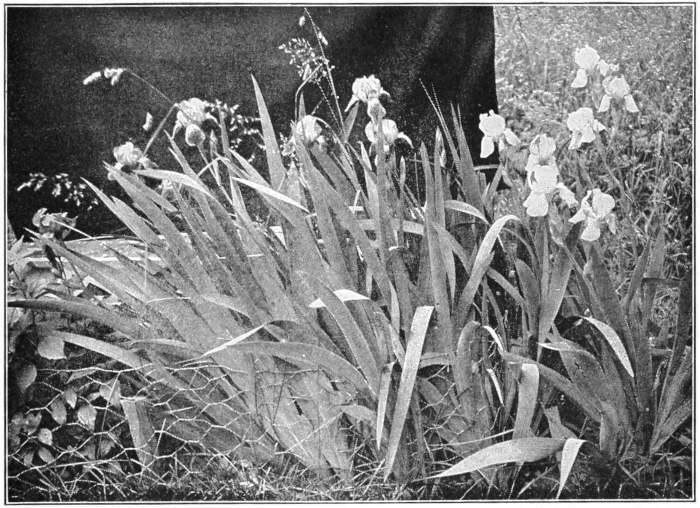
Iris in blossom.
Photo by Verne Morton.
The arrangement of the flower parts of the iris may be described briefly thus: three petals, three sepals, a style with three branches; the latter being broad and flat and covering the bases of the three sepals, making tubes which lead to the nectar; three anthers lie along the under side of the styles. The wild yellow iris is especially fitted for welcoming the bumblebee as a pollen-carrier, since the door between the style and the sepal is large enough to admit this larger insect. The bumblebees and the honey-bees work in the different varieties of iris in gardens.
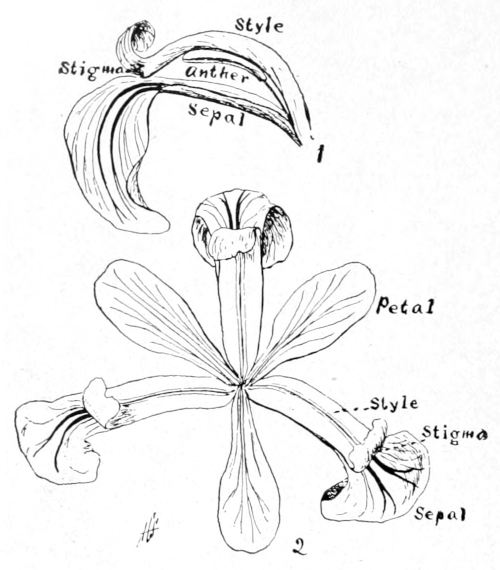
Detail of the blossoms of the blue flag flower.
1, Side-view of the passage to the nectar.
2, Looking directly into the iris flowers. Note the deceiving guide-lines in the petals.
In some varieties of iris there is a plush rug along the vestibule floor over which the bee passes to get the nectar. Through a lens, this plush is exquisite—the nap of white filaments standing up and tipped with brilliant yellow. Various theories as to the use of this plush have been advanced, the most plausible being that it is to keep the ants out; but the ant could easily pass along either side of it. While holding an iris in my hand, one day in the garden, a bumblebee visited it eagerly, never noting me; after she had probed the nectar-wells, she probed or nibbled among the plush, working it thoroughly on her way out. Was she a foolish bee, or did she find something there to eat? What child will find if other bees do this?
LESSON CLIX
The Blue Flag or Iris
Leading thought—Each iris flower has three side doors leading to the nectar-wells; and the bees, in order to get the nectar, must brush off the pollen dust on their backs.
Method—While the blue flag is the most interesting of our wild species of iris, yet the flower-de-luce, or the garden iris, is quite as valuable for this lesson. The form of the flowers may be studied in the schoolroom, but the pupils should watch the visiting insects in the garden or field.
Observations—1. Look for the side doors of the iris blossom. Which part of the flower forms the doorstep? How is it marked to show the way in? Which part of the flower makes the arch above the door?
2. Find the anther, and describe how it is placed. Can you see two nectar-wells? Explain how a bee will become dusted with pollen while getting the nectar.
3. Where is the stigma? What is there very peculiar about the styles of the iris? Can a bee, when backing out from the side door, dust the stigma with the pollen she has just swept off? Why not? How does the stigma of the next flower that the bee visits get some of the pollen from her back?
4. Look straight down into an iris flower. Can you see the three petals? How are they marked? How would these lines on the petals mislead any insect that was searching for nectar?
5. Watch the insects visiting the iris. Do you know what they are? What do they do?
6. Describe the way the iris flower-bud is enfolded in bracts. What is there peculiar about the way the iris leaves join the stem?
7. How many kinds of flag, or iris, do you know?
8. Describe the seed-vessel and seeds of the iris.
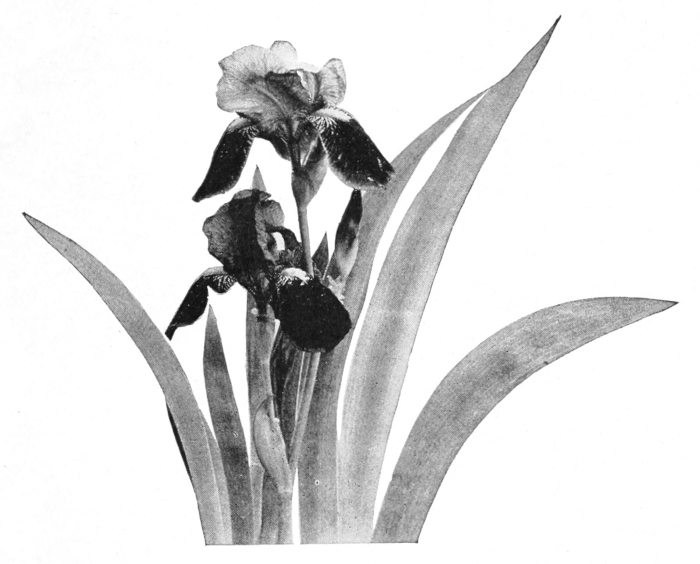
Fleur-de-lis.
Photo by Cyrus Crosby.
The fleur-de-lis is the national flower of France.
“It is said that the Franks of old had a custom, at the proclamation of a king, of elevating him upon a shield or target, and placing in his hand a reed, or flag in blossom, instead of a sceptre.” —“Among the Flowers and Trees with the Poets”, Wait and Leonard.
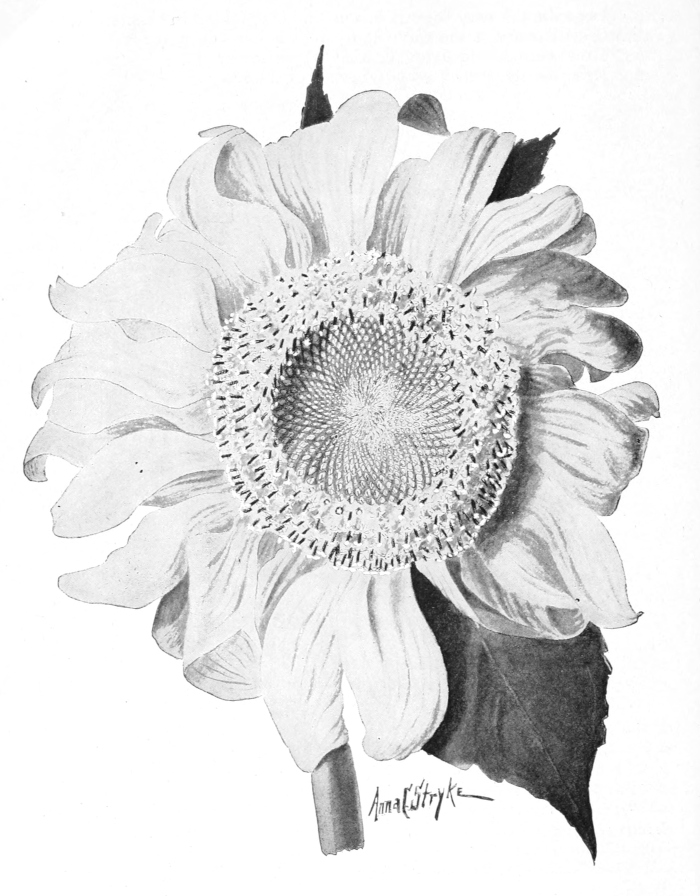
The sunflower. Next to the ray-flowers are the florets in last stages of blossoming with stigmas protruding; next within are rows in the earlier stage with pollen bursting from anther-tubes, while at center are the unopened buds.
THE SUNFLOWER
Teacher’s Story
Many of the most beautiful of the autumn flowers belong to the Compositæ, a family of such complicated flower arrangement that it is very difficult for the child or the beginner in botany to comprehend it; and yet, when once understood, the composite scheme is very simple and beautiful, and is repeated over and over in flowers of very different appearance. It is a plan of flower cooperation; there are many flowers associated to form a single flower-head. Some of these, the “ray,” or “banner,” flowers, hold out bright pennants to attract the attention of insects; while the disk-flowers, which they surround, attend to the matter of the pollenation and production of seed.
The large garden sunflower is the teacher’s ally to illustrate to the children the story of the composites. Its florets are so large that it is like a great wax model. And what could be more interesting than to watch its beautiful inflorescence—that orderly march toward the center in double lines of anther columns, with phalanxes bearing the stigmas surrounding them; and outside all, the ranks of ray-flowers flaunting their flags to herald to the world this peaceful conquest of the sleeping, tented buds at the center?
Ordinarily, in nature-study we do not pull the flowers apart, as is necessary in botany; in nature-study, all that we care to know of the flower is what it does, and we can see that without dissection. But with the compositæ the situation is quite different. Here we have an assemblage of flowers, each individual doing its own work for the community; and in order to make the pupils understand this fact it is necessary to study the individual florets.
We begin with the study of one of the buds at the center of the flower-head; this shows the white, immature-seed below, and the closed, yellow corolla-tube above. Within the corolla may be seen the brown anther-tube, and on the upper part of the seed are two little, white, earlike scales, to which especial notice should be directed, since in other composites there are many of these scales and they form the pappus—the balloon to carry the seed. The bud shows best the protecting chaffy scale which enfolds the seed, its pointed, spine-edged tip being folded over the young bud, as may be seen by examining carefully the center of a freshly opened sunflower. In this tubular bud (see Fig. p. 632), there is a telescopic arrangement of the organs, and one after another is pushed out. First, the corolla-tube opens, starlike, with five pointed lobes, very pretty and graceful, with a bulblike base; from this corolla pushes out the dark-brown tube, made up of five anthers grown together. By opening the corolla, we see the filaments of the stamens below the joined anthers. This anther tube, if examined through a lens, shows rows of tiny points above and below, two to each anther, as if they had been opened like a book to join edges with their neighbors. The anther-tube is closed at the tip, making a five-sided cone; and at the seams, the yellow pollen bulges out, in starlike rays. The pollen bulges out for good reason, for behind it is the stigma, like a ramrod, pushing all before it in the tube for it is its turn next to greet the outer world. The two stigma-lobes are pressed together like the halves of a sharpened pencil, and they protrude through the anther-tube as soon as all the pollen is safely pushed out; then the stigma-lobes separate, each curling backwards so as to offer a receptive surface to welcome pollen grains from other florets, or even other sunflowers. In the process of curling back, they press the anther-tube down into the corolla, and thus make the floret shorter than when in the pollen stage. The banner-flower differs in many essentials from the perfect florets of the disk. If we remove one from the flower-head, we find at its base a seedlike portion, which is a mere pretense; it is shrunken, and never can be a seed because it has connected with it no stigma to bring to it the pollen. Nor does this flower have stamens nor a tubular corolla; instead it has one great, petallike banner, many times longer and wider than the corollas of the other flowers. All this flower has to do is to hold its banner aloft as a sign to the world, especially the insect world, that here is to be found pollen in plenty, and nectar for the probing.
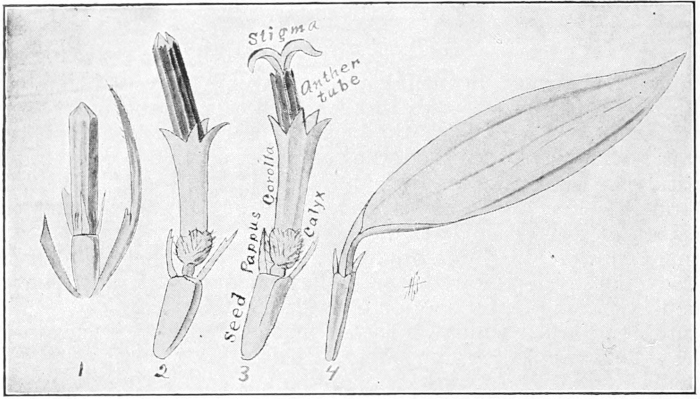
The flower of the sunflower-head enlarged.
1. A floret of the sunflower in the bud-stage as it appears at the center of the sunflower. Note the protecting bract at the right. 2. A floret in earliest stage of blossoming. 3. A floret in the latest stage of bloom with the parts named. 4. A ray or banner-flower.
But more wonderful than the perfection of each floret is their arrangement in the flower-head. Around the edge of the disk the banner-flowers, in double or treble rank, flare wide their long petals like the rays of the sun, making the sunflower a most striking object in the landscape. If the sunflower has been open for several days, next to the ray-flowers will be seen a circle of star-mouthed corollas from which both ripened pollen and stigmas have disappeared, and the fertilized seeds below them are attaining their growth. Next comes a two or three-ranked circle, where the split, coiled-back stigma-lobes protrude from the anther-tubes; within this circle may be two or three rows of florets, where pollen is being pushed out in starry radiance; and within this ring there may be a circle where the anther-tubes are still closed; while at the center lie the buds, arranged in exquisite pattern of circling radii, cut by radii circling in the opposite direction; and at the very center the buds are covered with the green spear-points of their bracts. I never look at the buds in the sunflower without wondering if the study of their arrangement is not the basis of much of the most exquisite decoration in Moorish architecture. To appreciate fully this procession of the bloom of the sunflower from its rim to its center, we need to watch it day by day—then only can its beauty become a part of us.
The great, green bracts, with their long pointed tips, which “shingle” the house of every sunflower family, should be noted with care, because these bracts have manifold forms in the great Compositæ family; and the pupil should learn to recognize this part of the flower-head, merely from its position. In the burdocks, these bracts form the hooks which fasten to the passer-by; in the thistle, they form the prickly vase about the blossom; while in the pearly everlasting, they make the beautiful, white, shell-like mass of the flower which we treasure as immortal. In the sunflower, these bracts are very ornamental, being feltlike outside and very smooth inside, bordered with fringes of pretty hairs, which may be seen best through a lens. They overlap each other regularly in circular rows, and each bract is bent so as to fit around the disk.
In looking at a mass of garden sunflowers, we are convinced that the heavy heads bend the stems, and this is probably true, in a measure. But the stems are very solid and firm, and the bend is as stiff as the elbow of a stovepipe; and after examining it, we are sure that this bend is made with the connivance of the stem, rather than despite it. Probably most people, the world over, believe that sunflowers twist their stems so that their blossoms face the sun all day. This belief shows the utter contentment of most people with a pretty theory. If you believe it, you had best ask the first sunflower you see if it is true, and she will answer you if you will ask the question morning, noon and night. My own observations make me believe that the sunflower, during the later weeks of its bloom, is like the Mohammedan, keeping its face toward the east. True, I have found many exceptions to this rule, although I have seen whole fields of sunflowers facing eastward, when the setting sun was gilding the backs of their great heads. If they do turn with the sun, it must be in the period of earliest blossoming before they become heavy with ripening seeds.
The sunflower seed is eagerly sought by many birds, and it is raised extensively for chicken-feed. The inadequate little pappus falls off, and the seeds are set, large end up, in the very ornamental diamond-shaped sockets. They finally become loosened, and now we see a reason for the bending flower-head; for, as the great stem is assaulted by the winds of autumn, the bended heads shake out their seed and scatter them far afield.
LESSON CLX
The Sunflower
Leading thought—The sunflower is not a single flower, but is a large family of flowers living together; and each little flower, or floret, as it is called, has its own work to do for the family welfare.
Method—Early in September, when school first opens, is the time for this lesson. If sunflowers are growing near by, they should be studied where they stand; and their story may thus be more completely told. Otherwise, a sunflower should be brought to the schoolroom and placed in water. If one is selected which has just begun to blossom, it will show, day by day, the advance of the blossoming ranks. I have kept such a flower fourteen days, and it blossomed cheerfully from its rim to its very center. A large sunflower that has only partially blossomed is also needed for taking apart to show the arrangement of this big flower-family. Take a bud from the center, a floret showing anther-tube and another showing the curled pair of stigmas, and a ray or banner-flower. (See Fig. p. 632). Each pupil should be furnished with these four florets; and after they have studied them, show them the other half of the sunflower, with each floret in place. After this preliminary study, let them observe the blossoming sunflower for several consecutive days.
Observations—1. A little flower which is part of a big flower-family is called a floret. You have before you three florets of a sunflower and a banner-flower. Study first the bud. Of how many parts is it composed? What will the lower, white part develop into? Can you see two little white points standing up from it on each side of the bud? Note the shape and color of the unopened floret. Note that there is a narrow, stiff, leaf-like bract, which at its base clasps the young seed, while its pointed tip bends protectingly over the top of the bud.
2. Take an open floret with the long, dark brown tube projecting from it. Note that the young seed is somewhat larger than in the bud, and that it still has its earlike projections at the top. Describe the shape of the open corolla. Look at the brown tube with a lens. How many sides has it? How many little points projecting at the top and bottom on each side of the tube? How does the tube look at the tip, through a lens? Can you see the pollen bursting out? If so, how does it look? Do you think that there is just one tubular anther, or do you think several anthers are joined together to make this tube? Open the corolla-tube carefully, and see if you can answer this last question. Open the anther-tube, and see if you can find the pistil with its stigmas.
3. Take a floret with the two yellow horns of the stigma projecting. Where is the brown anther-tube now? Is it as long as in the floret you have just studied? What has happened to it? What did the stigmas do to the pollen in the anther-tube? How do the two parts or lobes of the stigma look when they first project? How later?
4. Make a banner-flower. How many parts are there to it? How does the seedlike portion of the blossom look? Do you think it will ever be a good seed? Describe the corolla of this flower. How much larger is it than the corolla of the florets? Has the banner-flower any pistil or stamens? Of what use is the banner-flower to the sunflower family? Do you think that we would plant sunflowers in our gardens for their beauty if they had no banner-flowers?
5. After studying the separate flowers, study a sunflower in blossom, and note the following: Where are the banner-flowers placed? How many rows are there? How are they set so that their banners make the sunflower look like the sun? Do you see why the central portion of the sunflower is called the disk, and the banner-flowers are called the rays—in imitation of the sun?
6. Next to the banner-flowers, what sort of florets appear? How many rows are there? What kind form the next circle, and in how many rows? What stages of the florets do you find forming the inner circle, and how many rows? What do you find at the center of the flower-head? Note the beautiful pattern in which the buds are arranged. Can you see the separate buds at the very center of the sunflower? If not, why?
7. Make notes on a sunflower that has just opened, describing the stages of the florets that are in blossom; continue these notes every day for a week, describing, each day, what has happened. If the sunflower you are observing is in garden or field, note how many days elapse between the opening of the outer row of flowers and the opening of the central buds.
8. Look below or behind the sunflower, and note the way it is attached to the stem. What covers the disk? These green, overlapping, leaflike structures are called bracts. What is the shape of one of these bracts? What is its texture, outside and inside? Look at it, with a lens, along the edges, and note what you see. How are the bracts arranged? Do they not “shingle” the house in which the sunflower-family lives? This covering of the disk, or the house where the sunflower-family lives, is called the involucre.
9. Does the stem of the sunflower hold it upright? Some people declare that it twists its stem so as to face the sun all day. Do you think this is true?
10. Study a sunflower-head after the seeds are ripe. Do the little ears which you saw at the top of the seeds still remain? How does the sunflower scatter the seeds? Note how the disk looks after the seeds are all gone. What birds are especially fond of sunflower seeds? Of what use are the seeds commercially?
“Flowers have an expression of countenance as much as men or animals. Some seem to smile; some have a sad expression; some are pensive and diffident; others again are plain, honest, and upright, like the broad-faced Sunflower, and the hollyhock.” —Henry Ward Beecher.
“Eagle of flowers! I see thee stand, And on the sun’s noon-glory gaze; With eye like his thy lids expand And fringe their disk with golden rays; Though fixed on earth, in darkness rooted there, Light is thy element, thy dwelling air, Thy prospect heaven.” —“The Sunflower”, Montgomery.
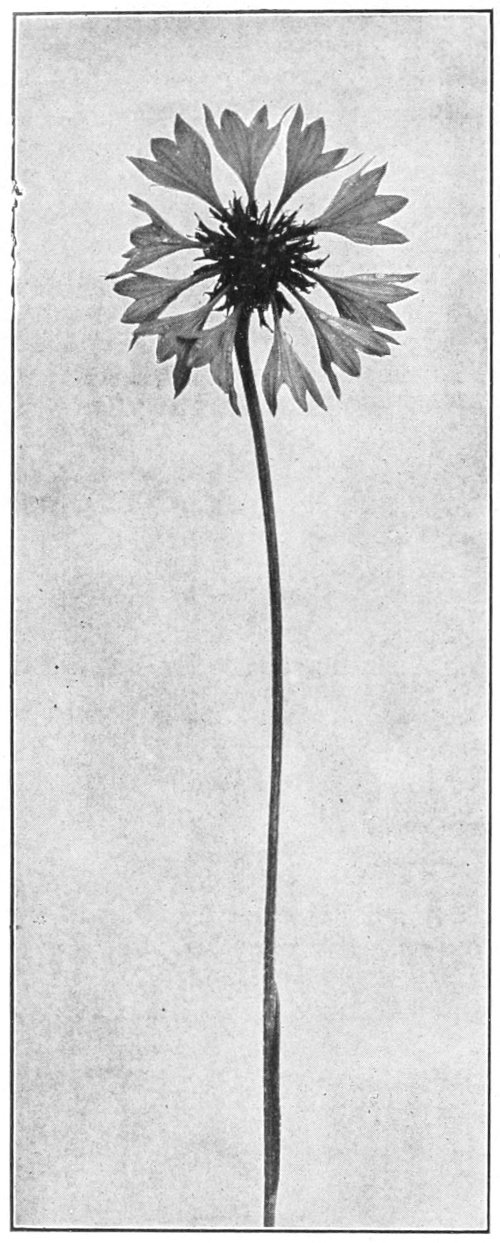
A bachelor’s button. Note the trumpet-shape of the ray-flowers.
Photo by Cyrus Crosby.
THE BACHELOR’S BUTTON
Teacher’s Story
This beautiful garden flower gives a variation in form from other composites when studied according to Lesson CXXXV. This valued garden flower came to us from Europe and it sometimes escapes cultivation and runs wild in a gentle way. We call it bachelor’s button; but in Europe it is called the cornflower, and under this name it found its way into literature. None of the flowers that live in families repays close study better than does the bachelor’s button. The ray-flowers are tubular but they do not have banners. Their tubes flare open like trumpets, and they are indeed color trumpets heralding to the insect world that there is nectar for the probing and pollen for exchange. Looked at from above, the ray-flowers do not seem tubular; from the sides, they show as uneven-mouthed trumpets with lobed edges; but though we search each trumpet to its slender depths we can find no pistils. These ray-flowers have no duty in the way of maturing seeds. In some varieties the ray-flowers are white, and in others they are blue and purple. They vary in number from 7 to 14, or more.
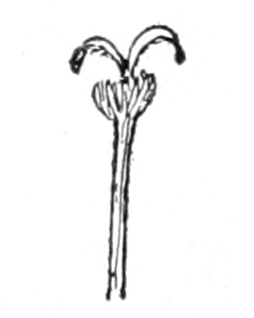
Stigma open and showing pollen-brush below. Enlarged.
The disk-flowers have a long corolla-tube, which is white and delicately lobed and is enlarged toward the upper end to a purple bulb with five, long, slender lobes. The anther-tube is purplish black, and is bent into almost a hook, the tip opening toward the middle of the flower-head. The pollen is glistening white tinged with yellow, and looks very pretty as it bursts out from the dark tubes. The purple stigma first appears with its tips close together, but with a pollen brush just below it; later it opens into a short Y. The buds at the center of the flower are bent hook-shaped over the center of the flower-head. The involucral bracts or “shingles” are very pretty, each one ornamented with a scaly fringe; they form a long, elegantly shaped base to the flower-head. After the flowers have gone and the seeds have ripened, these bracts flare open, making a wide-mouthed urn from which the ripened seeds are shaken by the winds; and after the seeds are gone, the white fuzz of their empty cases remains at the bottom of the urn. The seed is plump and shining, with a short fringe of pappus around the top and a contracted place at one side near the base where it grew fast to the receptacle; for these seeds are not set on end, as are those of the sunflower. The short pappus is hardly sufficient to buoy up the seed, and yet undoubtedly aids it to make a flying jump with the passing breeze.
LESSON CLXI
The Bachelor’s Button
Leading thought—Each bachelor’s button is made up of many little flowers which may be studied by the outline given in Lesson CXXXV.
THE SALVIA, OR SCARLET SAGE
Teacher’s Story
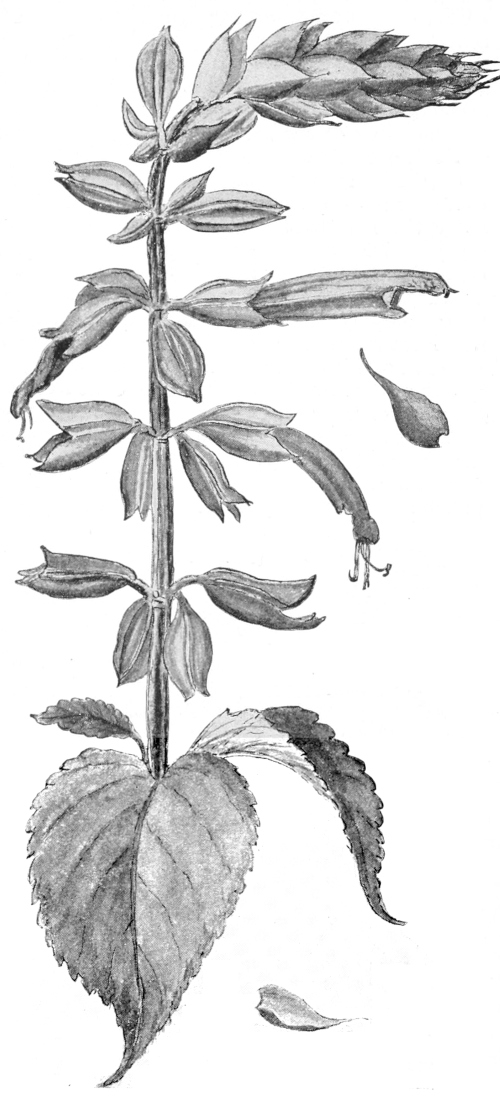
The salvia, or scarlet sage, showing the bracts still present above and falling as the flowers open.
The flower story of the sage is so peculiar that Darwin has used it to illustrate the mechanisms present in some flowers which the visiting insects must work in order to get the nectar. The scarlet sage, which gladdens our flower beds during the summer and autumn with its brilliance, has as interesting a story as has any of its family. Looking at it from the outside, we should say that its nectar-wells lie too deep to be reached by any insect except a moth or butterfly, or a humming bird; there is no platform for a bee to alight upon, and the tube is too long to be fathomed by a bee’s tongue; but the bees are very good business folk; they adapt themselves to flowers that are not adapted to them, and in autumn the glow of the salvia attracts the eye scarcely more than the hum of the visiting bees attracts the ear.
The calyx of the salvia is as red as the corolla, and is somewhat fuzzy while the corolla is smooth. The calyx is a three-lobed bulging tube held stiff by rather strong veins; there is one large lobe above and two small ones below the corolla. The corolla is a tube which is more than twice the length of the calyx; it is prolonged above into a projecting hood, which holds the anthers and the stigma; it has a short, cuplike lower lip and two little turned-back, earlike lobes at the side.
The special mechanism of the salvia is shown in the stamens; there are two of these lying flat along the floor of the corolla-tube and grown fast to it. Near the mouth of the tube, each of these lifts up at a broad angle to the roof, and is more or less T-shaped, at the tip of one of the arms of the T is an anther while the other arm is longer and slants down and inward to the floor of the tube, as shown at 2 in the figure.
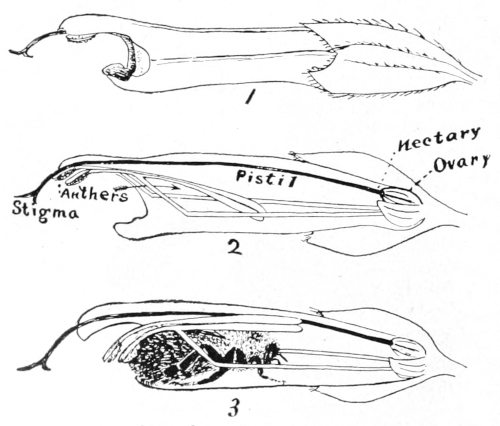
1. Blossom of scarlet sage as seen from outside.
2. The same flower with side removed showing the arrangement of its parts.
3. A bee working the stamen’s mechanism as she seeks the nectar.
The bee visiting the flower and entering the corolla-tube, pushes her head against the inner arms of the stamens, lifting them, and in so doing causes the anthers on the front arms of the T to lower and leave streaks of pollen along her fuzzy sides. The stigma is at first concealed in the hood; but, when ripe, it projects and hangs down in front of the opening of the corolla-tube, where it may be brushed along one side or the other by the visiting insect, which has been dusted with the pollen of some other flower. The stigma-lobes open in such a manner that they do not catch the pollen from the insect backing out of their own corolla. As the nectar is at the base of the corolla-tube, the bees, in order to get it, crawl in almost out of sight. Late in the season they seem to “go crazy” when gathering this nectar; I have often seen them searching the bases of the corolla-tubes which have fallen to the ground, in order to get what is left of the sweet treasure.
But the pollen story is not all that is of interest in the salvia. Some of the parts of the flower which are green in most blossoms, are scarlet as a cardinal’s robe in this. If we glance at a flower stalk, we see that at its tip it looks like a braided, flattened cone; this appearance is caused by the scarlet, long-pointed bracts, each of which covers, with its bulging base, the scarlet calyx which in turn enfolds the scarlet flower bud. These bracts fall as the flowers are ready to open, making a brilliant carpet about the plant. Each flower stem continues to develop buds at its tip for a long season; and this, taken together with its scarlet bracts and flowers, renders the salvia a thing of beauty in our gardens, and makes it cry aloud to pollen-carriers that here, even in late autumn, there is plenty of nectar.
LESSON CLXII
Salvia, or Scarlet Sage
Leading thought—This flower has the bracts and calyx scarlet instead of green, and this makes it a brilliant mass of color to please our eyes and attract the pollen-carrying insects. Its anthers are arranged at the tip of two levers, which the insects push up and down as they enter the flower, thus becoming dusted with pollen.
Method—The structure of this flower may be studied in the schoolroom and its mechanism there understood; but the most important part of the lesson is the observation out-of-doors upon the way the bees work the stamen levers when seeking the nectar. This is best observed during late September or October, after other flowers are mostly gone, and when the bees are working with frantic haste to get all the honey possible.
Observations—1. How does the calyx of the salvia differ from that of other flowers in color? How does it differ from the corolla in texture? How many lobes has it? How are they placed about the corolla?
2. What is the shape of the corolla? How does it make a hood over the entrance to the tube? What does the hood hold? Is there any platform made by the lower lip of the corolla for a visiting insect to alight upon?
3. Cut open one side of the corolla and describe how the stamens are arranged. Thrust your pencil into an uninjured flower and see if the anthers in the hood are moved by it. How? Describe how a bee in visiting this flower moves the anthers so as to become dusted with pollen.
4. Where is the stigma? How does it receive pollen from visiting insects? Would it be likely to get the pollen which has just been scraped off from its own anthers by the bee? Why?
5. Experiment to find where the nectar is. Do you ever see bees getting the nectar from fallen flowers? Do they get it from the “front” or the “back door?”
6. What other parts of this flower are red, which in other flowers are green? How does this make the budding portions of the flower stem look? Why does this make the salvia a more beautiful plant for our gardens?
7. Compare the mechanism of the stamens of the scarlet sage with the mechanism of the stamens of the common garden sage.
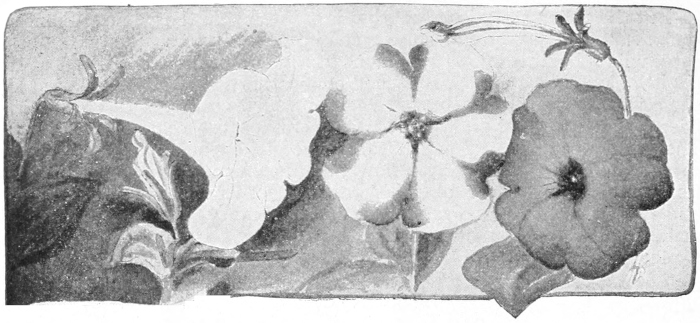
Drawn by Anna C. Stryke.
PETUNIAS
Teacher’s Story
HESE red-purple and white flowers, which, massed in borders and beds, make gay our gardens and grounds in late summer and early autumn, have an interesting history. Professor L. H. Bailey uses it as an illustration in his thought-inspiring book, “The Survival of the Unlike;” he says that our modern petunias are a strange compound of two original species; the first one was found on the shores of the La Plata in South America and was introduced into Europe in 1823. “It is a plant of upright habit, thick sticky leaves and sticky stems, and very long-tubed white flowers which exhale a strong perfume at nightfall.” The second species of petunia came from seeds sent from Argentina to the Glasgow Botanical Gardens in 1831. “This is a more compact plant than the other, with a decumbent base, narrower leaves and small, red-purple flowers which have a very broad or ventricose tube, scarcely twice longer than the slender calyx lobes.” This plant was called Petunia violacea and it was easily hybridized with the white species; it is now, strangely enough, lost to cultivation, although the white species is found in some old gardens. The hybrids of these two species are the ancestors of our garden petunias, which show the purple-red and white of their progenitors. The petunias are of the Nightshade family and are kin to the potato, tomato, egg-plant, tobacco and Jimson-weed, and, like the latter, the flowers are especially adapted to give nectar to the long-tongued sphinx or hummingbird moths.
The petunia corolla is tubular, and the five lobes open out in salver-shape; each lobe is slightly notched at its middle, from which point a marked midrib extends to the base of the tube. In some varieties the edges of the lobes are ruffled. Within the throat of the tube may be seen a network of darker veins, and in some varieties this network spreads out over the corolla-lobes. Although many colors have been developed in petunias, the red-purple and white still predominate; when the two colors combine in one flower, the pattern may be symmetrical, but is often broken and blotchy.
When a flower-bud is nearly ready to open the long, bristly tube of the corolla lies with its narrow base set in the calyx, the long, fuzzy lobes of which flare out in bell-shape; the tube is marked by lengthwise lines made by the five midribs; the lobes of the corolla are folded along the outer portions of these midribs, and these folded tips are twisted together much as if some one had given them a half turn with the thumb and finger. It is a pleasing experience to watch one of these flowers unfold. When a flower first opens, there lies near the bottom of the throat of the tube the green stigma, with two anthers snuggled up in front of it and two behind it, the latter being not quite so advanced in age as the former. As the filaments of the front pair of anthers are longer than those of the rear pair, the little group lies at a low angle offering a dusty doormat for entering insects. If we open a flower at this stage, we find another anther, as yet unopened, and which is on the shortest stamen of the five. This seems to be a little pollen-reserve, perhaps for its own use later in the season. There is an interesting mechanism connected with these stamens; each is attached to the corolla-tube at the base for about half its length, and at the point of attachment curves suddenly inward so as to “cuddle up” to the pistil, the base of which is set in the nectar-well at the bottom of the flower. If we introduce a slender pencil or a toothpick into the flower tube along the path which the moth’s tongue must follow to reach the nectar, we can see that the stamens, pressing against it at the point where they curve inward, cause the anthers to move about so as to discharge their pollen upon it; and as the toothpick is withdrawn they close upon it cogently so that it carries off all the pollen with which it is brought in contact.
If we look at the stigma at the center of its anther-guard, it has a certain close-fisted appearance, although its outer edges may be dusted with the pollen; as the flower grows older, the stigma stands above the empty anthers at the throat of the flower tube and opens out into two distinct lobes. Even though it may have accepted some of its own pollen, it apparently opens up a new stigmatic surface for the pollen brought from other flowers by visiting insects.
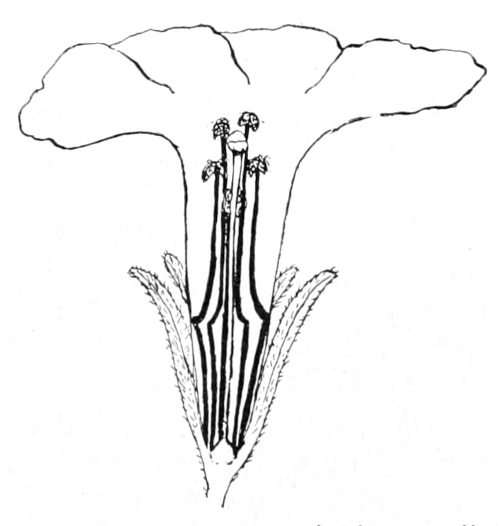
A petunia blossom cut open on the upper side, showing the pistil surrounded by the incurved stamens and the partially opened stigma surrounded by the anthers. Note the short stamen below the pistil.
Dr. James G. Needham says that at Lake Forest he has been attracted to the petunia beds in the twilight by the whirring of the wings of countless numbers of sphinx, or hummingbird moths which were visiting these flowers. We also may find these moths hovering over petunia beds in almost any region if we visit them on the warmer evenings. And it is a safe guess that the remote white ancestor of our petunias had some special species of sphinx moth which it depended upon for carrying its pollen; and the strong perfume it exhaled at nightfall was an odor signal to its moth friends to come and feast.
But even though the petunia flowers are especially adapted to the delectation of hummingbird moths, our bees which—like man—have claimed all the earth, will work industriously in the petunias, scrambling into the blossoms, with much remonstrating, high-pitched buzzing because of the tight fit, and thus rifle the nectar-wells that were meant for insects of quite different build.
The leaves of the petunia are so broadly ovate as to be almost lozenge-shape, especially the lower ones; they are soft, and have prominent veins on the lower side; they are without stipules, and have short flat petioles. The stems are soft and fuzzy and are usually decumbent at the base, except the central stems of a stool or clump which, though surrounded by kneeling sisters, seem to prefer to stand up straight.
The flower stems come off at the axils of the leaves, the lower flowers open first. The blossoms remain open about two days; at the first sign of fading, the lobes of the corolla droop dejectedly like a frill that has lost its starch, and finally the corolla—tube and all—drops off, leaving a little conical seed-capsule nestled snugly in the heart of the bell-shaped calyx. At this time, if this peaked cap of the seed-capsule be removed, the many seeds look like tiny white pearls set upon the fleshy, conical placenta. As the capsule ripens, it grows brown and glossy like glazed manila paper and it is nearly as thin; then it cracks precisely down its middle, and the seeds are spilled out at any stirring of the stems. The ripe seeds are dark brown, almost as fine as dust, and yet, when examined with a lens, they are seen to be exquisitely netted and pitted.
References—The Survival of the Unlike, L. H. Bailey; The Encyclopedia of Horticulture, Bailey; Our Garden Flowers, Harriet Keeler.
LESSON CLXIII
The Petunia
Leading thought—The petunias have an interesting history being native to South America. Their flowers are fitted by form and mechanism to entice the hummingbird moths as visitors, and to use them for carrying pollen.
Method—The petunias are such determined bloomers that they give us flowers up to the time of killing frosts, and they are therefore good material for nature lessons. Each pupil should have a flower in hand to observe during the lesson, and should also have access to a petunia bed for observations on the habits of the plant.
Observations—1. What colors do you find in the petunia flowers? If striped or otherwise marked, what are the colors? Are the markings symmetrical and regular?
2. Sketch or describe a flower, looking into it. What is the shape of the corolla-lobes? How many lobes are there? How are they veined? What peculiar markings are at the throat of the flower?
3. What are the color and position of the stigma? How are the stamens arranged? How many anthers do you see? What is the color of the anthers? Of the pollen?
4. Sketch or describe the flower from the side. What is the shape of the corolla-tube? Is it smooth or fuzzy? How is it marked? What are the number and shape of the sepals, or lobes, of the calyx?
5. Study a freshly opened flower, and describe the position and appearance of the anthers and stigma. Do they remain in these relative positions after the flower is old?
6. Cut open a flower, slitting it along the upper side. Describe the stamens and how they are attached. Is the pistil attached in the same manner? Where is the nectar? Thrust a slender pencil or a toothpick into the tube of a fresh flower. Does this spread the anthers apart and move them around? When it is withdrawn, is there pollen on it? Can you see in your open flower the mechanism by which the pollen is dusted on the object thrust into the flower?
7. What insects have tongues sufficiently long to reach the nectar-well at the bottom of the petunia flower? At what time do these insects fly? At what time of day do most of the petunia flowers open? Visit the petunia beds in the twilight, and note whether there are any insects visiting them. What insects do you find visiting these flowers during the day?
8. Sketch or describe the leaves of the petunia. How do the leaves feel? Look at a leaf with a lens and note the fringe of hair along its edges. Describe the veining of the leaf.
9. Describe the petunia stems. Are they stout or slender? How do they feel? With what are they covered? Where do the flower stems come off the main stalk?
10. Describe or sketch a flower-bud just ready to open. How are the tips of the lobes folded? How long does the flower remain in bloom? What is the first sign of its fading?
11. Describe the seed-capsule. Where does it open? Are the seeds many or few, large or small? What is their color when ripe? When examined with a lens, have they any pits or markings?
THE HORSESHOE GERANIUM
Teacher’s Story
The geraniums perhaps do more to brighten the world than almost any other cultivated flowers. They will grow for every one, whether for the gardener in the conservatory of the rich, or in a tin can on the windowsill of the crowded tenement of the poor. And it is interesting to know that this common plant has a cultivated ancestry of two hundred years’ standing. These geraniums, which are really not geraniums botanically but are pelargoniums, originally came from southern Africa, and the two ancestors of our common bedding geraniums were introduced into England in 1710 and 1714.
The geranium is of special value to the teacher, since it is available for study at any season of the year, and has a most interesting blossom. The single-flowered varieties should be used for this lesson, since the blossoms that are double have lost their original form. Moreover, the geranium’s blossom is so simple that it is of special value as a subject for a beginning lesson in teaching the parts of a flower; and its leaves and stems may likewise be used for the first lessons in plant structure.
The stem is thick and fleshy, and is downy on the new growth; there is much food stored in these stems, which accounts for the readiness with which cuttings from them will grow. Wherever a leaf comes off the stem, it is guarded by two stipules at the base; these stipules often remain after the leaves have fallen, thus giving the stem an unkempt look. The leaves are of various shapes, although of one general pattern; they are circular and beautifully scalloped and lobed, with veins for every lobe radiating from the petiole; they are velvety above and of quite different texture beneath, and many show the dark horseshoe which gives the name to this variety. The petiole is usually long and stiff and the leaves are set alternately upon the stem.
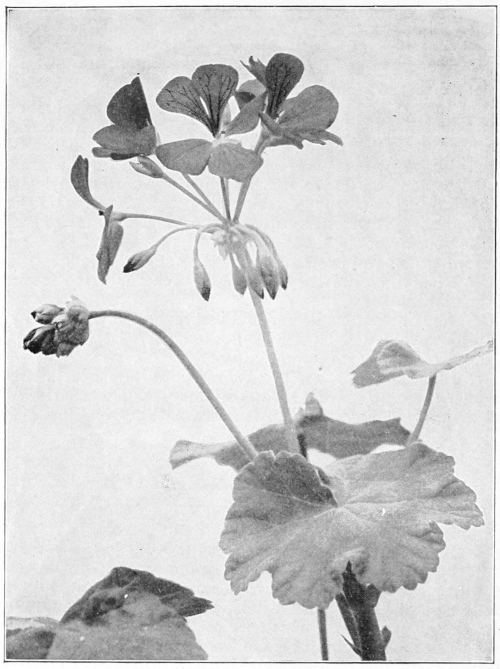
Horseshoe Geranium.
Photo by Sheldon.
Note the positions of the opened flowers and the buds. Note the shape of the two upper petals with their guide-lines, showing the position of the nectar-gland. The flower at the left, seen in profile, shows that these upper petals project farther forward than those below. Note the cluster of young buds set in a circlet of bracts just below this flower.
The flower has five petals, and at first glance they seem of much the same shape and position; but if we look at them carefully, we see that the upper two are much narrower at the base and project farther forward than do the lower three. Moreover, there are certain lines on these upper petals all pointing toward the center of the flower; these are the nectar guide-lines, and if we follow them we find a deep nectar-well just at the base of these upper petals and situated above the ovary of the flower. No other flower shows a prettier plan for guiding insects to the hidden sweets, and in none is there a more obvious and easily seen well of nectar. It extends almost the whole length of the flower stem, the nectar gland forming a hump near the base of the stem. If we thrust a needle down the whole length of this nectar tube we can see that this bright flower developed its nectar especially for some long-tongued insect, probably a butterfly. It is interesting to note that in the double geranium where the stamens have been all changed to petals and where, therefore, no seeds are formed, this nectar-well has been lost.
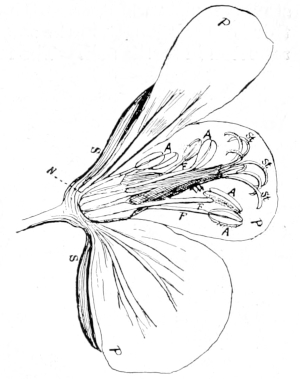
Diagram, flower of the horseshoe geranium.
S, sepals; P, petals; A, anther; F, filament; m, pistil; St., stigma; N, opening to nectar tube.
There are five sepals, the lower one being the largest. But the geranium is careless about the number of its stamens; most flowers are very good mathematicians, and if they have five sepals and five petals they are likely to have five or ten stamens. The geranium often shows seven anthers, but if we look carefully we may find ten stamens, three of them without anthers. But this is not always true; there are sometimes five anthers and two or three filaments without anthers. The color of the anthers differs with the variety of the flower. The stamens broaden below, and their bases are joined making a cup around the lower part of the ovary. The pistil is at the center of the flower and has no style, but at the summit divides into five long, curving stigmas; but again the geranium cannot be trusted to count, for sometimes there are seven or eight stigmas. Although many of our common varieties of geraniums have been bred so long that they have almost lost the habit of producing seed, yet we may often find in these single blossoms the ovary changed into the peculiar, long, beaklike pod, which shows the relationship of this plant to the cranesbill or wild geranium.
When the buds of the geranium first appear, all of them are nestled in a nest of protecting bracts, each bud being enclosed in its own protecting sepals. But soon each flower stem grows longer and droops and often the bracts at its base fall off; from this mass of drooping buds, the ones at the center of the cluster lift up and open their blossoms first. Often, when the outside flowers are in bloom, those at the center have withered petals but are hidden by their fresher sisters.
It would be well to say something to the pupils about those plants which have depended upon man so long for their planting that they do not develop any more seed for themselves. In connection with the geraniums, there should be a lesson on how to make cuttings and start their growth. The small side branches or the tips of the main stems may be used as cuttings. With a sharp knife make a cut straight across. Fill shallow boxes with sand, place them in a cool room and keep them constantly moist; plant the cuttings in these boxes, putting the stems for one-third of their length in the sand. After about a month the plants may be repotted in fertile soil. The fall is the best time to make cuttings.
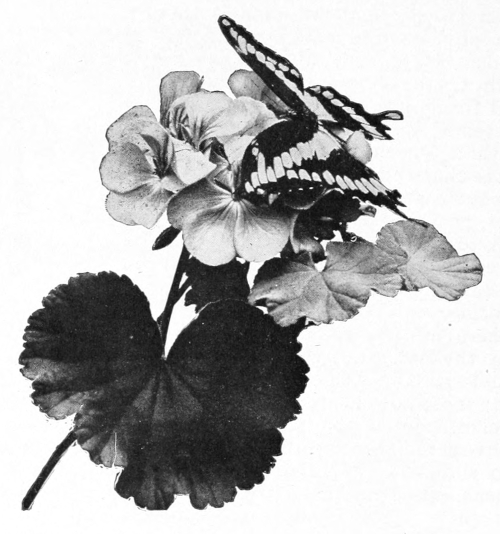
LESSON CLXIV
The Horseshoe Geranium
Leading thought—The geraniums are very much prized as flowers for ornamental beds. Let us see why they are so valued.
Method—A variety of geranium with single flowers should be chosen for this purpose, and it may be studied in the schoolhouse window or in the garden. As the parts of this flower are of a very general type, it is an excellent one with which to teach the names and purposes of the flower parts. Each child can make a little drawing of the sepals, petals, stamens and pistil, and label them with the proper names.
Observations—1. What sort of a stem has the geranium? Is it smooth or downy? What makes the geranium stem look so rough and untidy?
2. Study the leaf. Show by description or drawing its shape, its wings, its veins. What are its colors and texture above? Beneath? Is the petiole long or short? What grows at the base of the petiole where it joins the stem? What marking is there on the leaf, which makes us call this a “horseshoe geranium?” Are there other geraniums with leaves of similar shape that have no horseshoe mark?
3. Study the flower. Are the petals all the same size and shape? How many of them are broad? How many narrow? Do the narrow ones project in front of the others? Do these have guide-lines upon them? Where do these lines point? Find the nectar-well, how deep is it? Does it extend almost the entire length of the flower stem? For what insects must it have been developed? Are there nectar-tubes in the stems of the geraniums with double flowers? Why?
4. How many sepals are there? Are they all the same size? Where is the largest?
5. How many stamens can you see? What is the color of the filaments and of the anthers? How are the stamens joined at their bases? Can you find any stamens without anthers?
6. Where is the pistil situated? Can you see the ovary, or seed-box? How many stigmas? Describe their color and shape.
7. In what part of the flower will the seeds be developed? How does the geranium fruit look? Sketch the pod. Do the geraniums develop many seeds? Why not? Do you know the seed-pod of the wild geranium? If so, compare it with the pod of this plant.
8. Take a flower cluster when the flowers are all in the bud, and note the following: When the buds first appear, what protects them? What becomes of these bracts later? How do the sepals protect the bud? Are the bud stems upright and stiff or drooping? How many buds are there in a cluster?
9. Take notes on successive days as follows: What happens to the stem as the bud gets ready to bloom? Is it a central or an outside blossom that opens first? How many new blossoms are there each day? How long is it from the time that the first bud opens until the last bud of the cluster blossoms? What has this to do with making the geranium a valuable ornamental plant?
10. Make some geranium cuttings, and note how they develop into new plants. Place one of the cuttings in a bottle of water and describe how its roots appear and grow.
“God made the flowers to beautify The earth, and cheer man’s careful mood; And he is happiest who hath power To gather wisdom from a flower, And wake his heart in every hour To pleasant gratitude.” —Wordsworth.
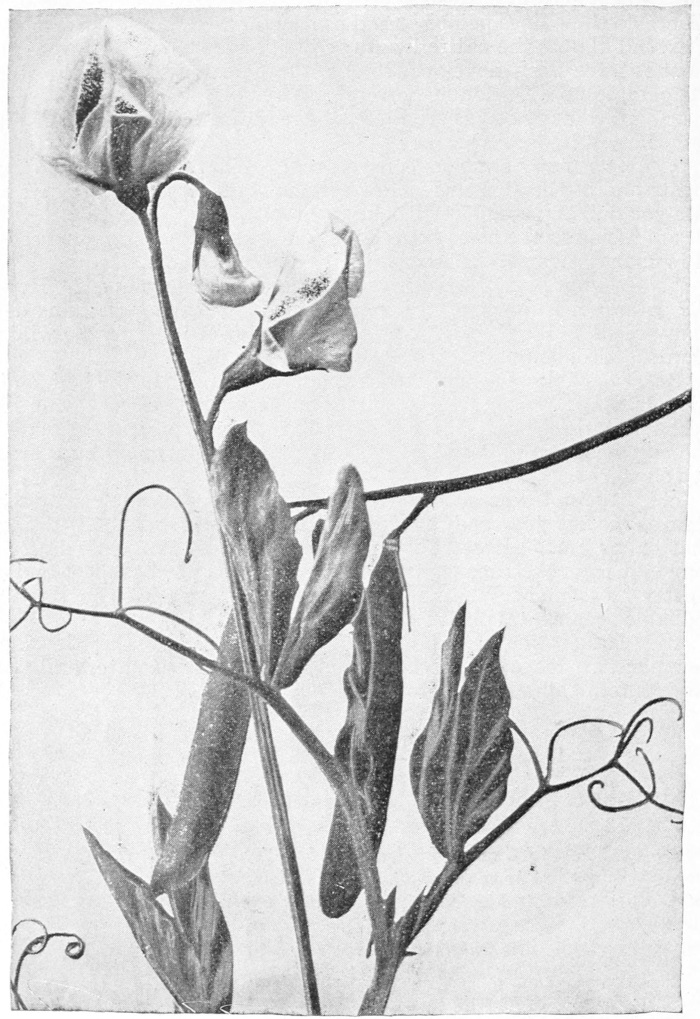
Sweet Peas.
“Here are sweet peas on tip for a flight, With wings of delicate flush o’er delicate white, And taper fingers catching at all things, To bind them all about with tiny rings.” —Keats.
THE SWEET PEA
Teacher’s Story
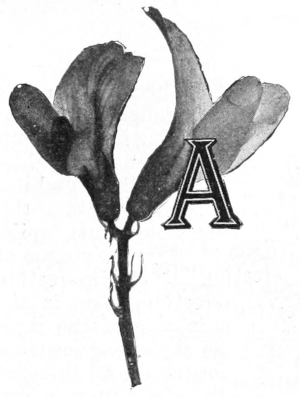
MONG the most attractive of the seeds which make up the treasure of the children’s seed packets, the sweet peas are of the prettiest. They are smooth, little white or brown globules, marked with a scar on the side, showing where they were attached to the pod. One of these peas divides readily into two sections; and after it has been soaked in water for twenty-four hours, the germ of the future plant may, with the aid of a lens, be seen within it. After planting, the sprout pushes through the seed-coat at a point very near the scar, and leaf shoots emerge from the same place; but the two act very differently. The leaf lifts upward toward the light, and the root plunges down into the soil. As the plant grows, it absorbs the food stored in the seed; but the seed remains below ground and does not lift itself into the air, as happens with the bean. The root forms many slender branches, near the tips of which may be seen the fringe of feeding roots, which take up the food and water from the soil. The first leaves of the pea seedling put forth no tendrils, but otherwise look like the later ones. The leaves grow alternately on the stalk, and they are compound, each having from three to seven leaflets. The petiole is winged, as is also the stem of the plant. There is a pair of large, clasping stipules at the base of each leaf. If we compare one of these leaves with a spray of tendrils, we can see that they resemble each other in the following points: The basal leaflets of the petiole are similar and the stipules are present in each case; but the leaflets nearest the tip are marvelously changed to little, stiff stems with a quirl at the tip of each ready to reach out and hook upon any object that offers surface to cling to. Sometimes we find a leaflet paired with a tendril. The sweet pea could not thrive without a support outside of itself.