Part 3 — I. WILD-FLOWER STUDY (continued 2)
Reading edition
There are several species of bindweed, but all agree in general habits. The field bindweed lacks the bracts at the base of the flower.
LESSON CXXIX
The Hedge Bindweed
Leading thought—There are some plants which have such weak stems that they are obliged to cling to objects for support. The bindweed is one of these, and the way that it takes hold of objects and grows upon them is an interesting story.
Method—It is better to study this plant where it grows; but if this is not practical, the vine with its support should be brought into the schoolroom, the two being carefully kept in their natural relative positions. Several of the questions should be given to the pupils for their personal observation upon this vine in the field. It is an excellent study for pencil or water-color drawing.
Observations—1. How does the bindweed get support, so that its leaves and its flowers may spread out in the sunshine? Why does its own stem not support it? What would happen to a plant with such a weak stem, if it did not twine upon other objects?
2. How does it climb upon other plants? Does its stem always wind or twist in the same direction? How does it first catch hold of the other plant? If the supporting object is firm, does it wind as often for a given space as when it has a frail support? Can you see the reason for this?
3. Look at the leaves. Sketch one, to be sure that you see its beautiful form and veins. Note if the leaves are arranged alternately on the stem, and then observe how and why they seem to come from one side of the stem. Why do they do this?
4. What is there peculiar about the flower bud? Look at its stem carefully and describe it. Cut it across and look at the end with a lens and describe it. Turn back two sepal-like bracts at the base of the flower or bud. Are they a part of the flower, or are they below it? Find the true sepals. How many are there? Are they all the same size?
5. Examine the flower in blossom. What is its shape? Describe its colors. Look down into it. How many stamens are there, and how are they set in the flower? How does the pistil look when the flower first opens? Later? Can you see the color of the pollen? Can you find where the nectar is borne? How many nectar-wells are there?
6. What insects do you find visiting bindweed flowers? Do the flowers remain open at night or on dark days?
7. Study the seed-capsule. How is it protected on the outside? What next enfolds it? Can you see now the uses of the sepals of several sizes? Cut a seed-capsule across with all its coverings, and see how it is protected. How many seeds are there in the capsule?
8. Has the bindweed other methods of spreading than by seeds? Look at the roots and tell what you observe about them.
9. Make a study of the plant on which the bindweed is climbing, and tell what has happened to it.
10. Compare the bindweed with the morning-glory, and notice the differences and resemblances.
Supplementary reading: “Morning-Glory Stories,” in Flowers and Their Friends, Morley; Botany Reader, Newell, Chap. 10; Golden Numbers, page 74.
THE DODDER
Teacher’s Story
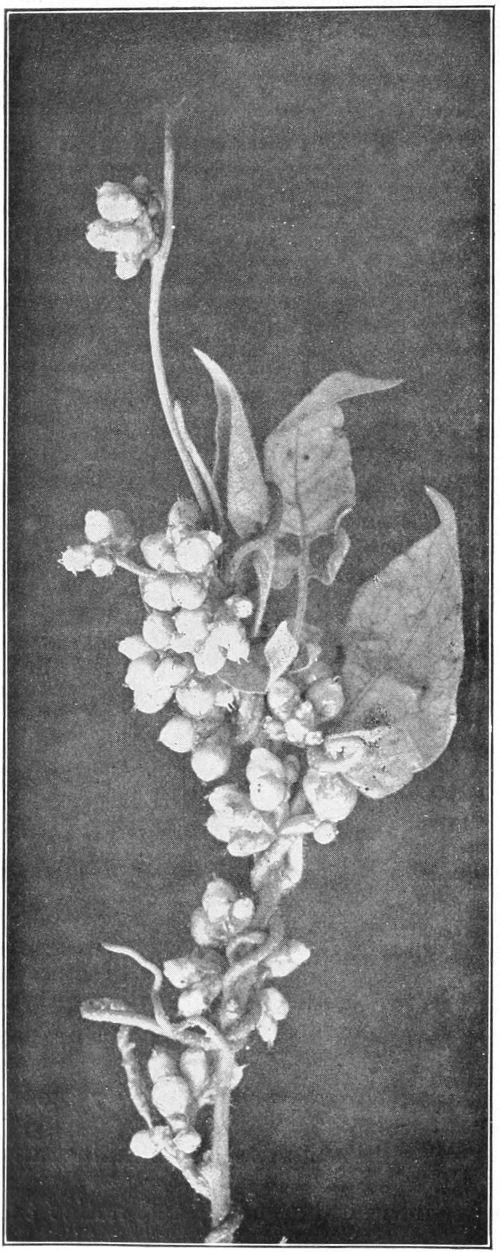
Dodder in blossom.
Photo by Cyrus Crosby.
If Sinbad’s “Old Man of the Sea” had been also a sneak thief, then we might well liken him to dodder. There is an opportunity for an excellent moral lesson connected with the study of dodder and its underhand ways. When a plant ceases to be self-supporting, when it gets its own living from the food made by other plants for their own sustenance, it loses its own power of food-making; and the dodder is an excellent example of the inevitable punishment for “sponging” a living. The dodder has no leaves of its own for it does not need to manufacture food nor to digest it. Its dull yellow stems reach out in long tendrils, swayed by every breeze, until they come in contact with some other plant to which they at once make fast. One of these tendrils seizes its victim plant as a serpent winds its prey, except that it always winds in the same direction—it passes under from the right side and over from the left. Who knows whether the serpents are always so methodical! After dodder gets its hold, little projections appear upon its coiled stems, which look like the prolegs of a caterpillar; but they are not legs, they are suckers, worse than those of the devil-fish; for the latter uses its suckers only to hold fast its prey; but the dodder uses its suckers to penetrate the bark of its victim, and reach down to the sap channels where they may, vampirelike, suck the blood from their victims, or rather the matured sap which is flowing from the leaves to the growing points of the host plant. Not having anything else to do, dodder devotes its energies to the producing of seeds, in order to do more mischief. The species which attack clover and other farm crops seem to manage to get their seeds harvested with the rest; and the farmer who does not know how to test his clover seed for impurities, sows with it the seeds of its enemy.
The dodder flowers are small, globular and crowded together. The calyx has five lobes; the corolla is globular, with five little lobes around its margin and a stamen set in each notch. A few of the species have a four-lobed calyx and corolla; but however many the lobes, the flowers are shiftless looking and are yellowish or greenish white; despite its shiftless appearance, however, each flower manages to mature four perfectly good, plump seeds.
There are, according to Gray, nine species of dodder more or less common in America. Some of the species, among which is the flax dodder, live only upon certain other species of plant life, while others take almost anything that comes within reach. Where it flourishes, it grows so abundantly that it makes large yellow patches in fields, completely choking out the leaves of its victims.
LESSON CXXX
The Dodder
Leading thought—There are some plants which not only depend upon other plants to hold them up, but they suck the life-juice from these plants and thus they steal their living.
Method—Bring in dodder with the host plant for the pupils to study in the schoolroom, and ask them to observe afterwards the deadly work of this parasite in the field.
Observations—1. What is the color of the stem? In which direction does it wind?
2. How is the stem fastened to the host plant? Tear off these suckers and examine the place where they were attached with a lens, and note if they enter into the stem of the host plant.
3. How does the dodder get hold of its victim? Has the dodder any leaves of its own? How can it get along and grow without leaves?
4. How do the flowers look through a lens? Are there many flowers? Can you see the petal lobes and the stamens?
5. How many seeds does each flower develop? How do the seeds look? In what way are they a danger to our agriculture?
I should also avoid the information method. It does a child little good merely to tell him matters of fact. The facts are not central to him and he must retain them by a process of sheer memory; and in order that the teacher may know whether he remembers, the recitation is employed,—re-cite, to tell over again. The educational processes of my younger days were mostly of this order,—the book or the teacher told, I re-told, but the results were always modified by an unpredictable coefficient of evaporation. Good teachers now question the child to discover what he has found out or what he feels, or to suggest what further steps may be taken, and not to mark him on what he remembers. In other words, the present-day process is to set the pupil independently at work, whether he is young or old, and the information-leaflet or lesson does not do this. Of course, it is necessary to give some information, but chiefly for the purpose of putting the pupil in the way of acquiring for himself and to answer his natural inquiries; but information-giving about nature subjects is not nature-study.—L. H. Bailey in “The Outlook to Nature.”
THE MILKWEED
Teacher’s Story
“Little weavers of the summer, with sunbeam shuttle bright, And loom unseen by mortals, you are busy day and night, Weaving fairy threads as filmy, and soft as cloud swans, seen In broad blue sky-land rivers, above earth’s fields of green.” —Ray Laurance.
S there any other young plant that shows off its baby-clothes as does the young milkweed! When it comes up through the soil, each leaf is folded lengthwise around the stem, flannel side out, and it is entirely soft and white and infantile. The most striking peculiarity of the milkweed plant is its white juice, which is a kind of rubber. Let a drop of it dry on the back of the hand, and when we try to remove it we find it quite elastic and possessed of all of the qualities of crude rubber. At the first trial it seems quite impossible to tell from which part of the stem this white juice comes, but by blotting the cut end once or twice, the hollow of the center of the stem is seen to have around it a dark green ring, and outside this is a light green ring. It is from the dark green ring encircling the stem cavity that the milk exudes. This milk is not the sap of the plant any more than resin is the sap of the pine; it is a special secretion, and is very acrid to the taste, rendering milkweed disgusting to grazing animals. If a milkweed stem be broken or gashed, this juice soon heals the wound and keeps out germs, and thus is of great use to the plant, since many insects feed upon it. If cut across, every vein in every leaf produces “milk”, and so does every small flower pedicel. When the “milk” is by chance smeared on cloth and allowed to dry, soap and water will not remove it, but it yields readily to chloroform, which is a solvent of rubber.
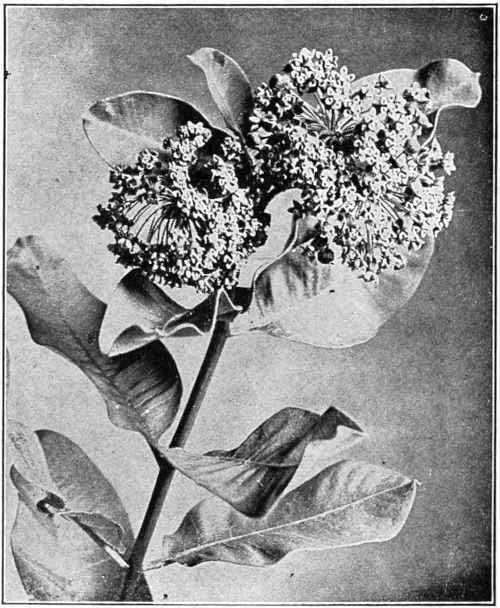
Milkweed in blossom.
Photo by Verne Morton.
The milkweed leaves are in stately conventional pairs; if one pair points east and west, the pair above and the pair below point north and south. The leaf is beautiful in every particular; it has a dark green upper surface, diversified with veins that join in scallops near the border; it is soft to the touch on the upper surface, and is velvety below. The lens reveals that the white under surface, or the nap of the velvet, is a cover of fine white hairs.
The flower of the milkweed is too complicated for little folks even to try to understand; but for the pupils of the seventh and eighth grades it will prove an interesting subject for investigation, if they study it with the help of a lens. In examining the globular bud, we see the five hairy sepals, which are later hidden by the five long, pinkish green petals which bend back around the stem. When we look into the flower, we see five little cornucopias—which are really horns of plenty, since they are filled with nectar; from the center of each is a little, fleshy tongue, with its curved point resting on the disk at the center of the flower. Between each two of these nectar-horns can be seen the white bordered opening of a long pocket—like a dress-pocket—at the upper end of the opening of which is a black dot. Slip a needle into the pocket opening until it pushes against the black dot, and out pops a pair of yellow saddle-bags, each attached to the black dot which joins them. These are the pollen-bags, and each was borne in a sac, shaped like a vest-pocket, one lying either side of the upper end of the long pocket. These pollen-bags are sticky, and they contract so as to close over the feet of the visiting bee.
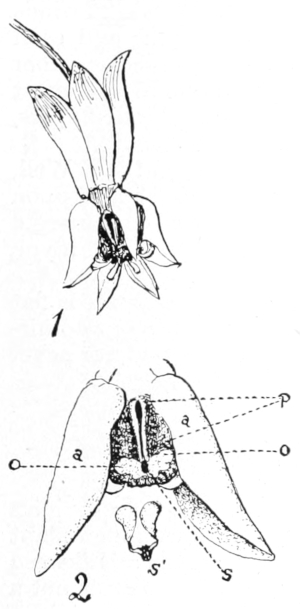
1, Milkweed flower, enlarged. 2, Same more enlarged. a,a, nectar-horns; p, pocket; o,o, openings to the pocket; s, pollen-bags in place; s′, pollen-bags removed.
Since the stem of the flower cluster droops and each flower pedicel droops, the bee is obliged to cling, hanging back down, while getting the nectar, and has to turn about as if on a pivot in order to thrust her tongue into the five cornucopias in succession; she is then certain to thrust her claws into a long pocket, and it proceeds to close upon them, its edges being like the jaws of a trap. The bee, in trying to extricate her feet, leaves whatever pollen-bags she had inadvertently gathered in this trap-pocket, which gives them passage to the stigma. But the milkweed flower, like some folks, is likely to overdo matters, and sometimes these pockets grasp too firmly the legs of the bee and hold her a prisoner. We often find insects thus caught and dead—a result as far from the plan of the flower as from that of the insect victim, had both been conscious. Sometimes bees become so covered with these pollen-bags, which they are unable to scrape off, that they die because of the clogging. But for one bee that suffers there are thousands that carry off the nectar triumphantly, just as thousands of people travel by water for one that is drowned.
The milkweed pod has been the admiration of nature students from the beginning, and surely there is no plant structure that so interests the child as this house in which the milkweed carries its seeds. When we look at a green pod, we first admire its beautiful shape; on either side of the seam, which will sometime open, are three or four rows of projecting points rising from the felty surface of the pod in a way that suggests embossed embroidery. We open the pod by pulling it apart along the seam; and this is not a seam with a raw edge but is finished with a most perfect selvage. When we were children we were wont to dispossess these large green pods of their natural contents, and because they snapped shut so easily, we imprisoned therein bumblebees “to hear them sing,” but we always let them go again. We now know that there is nothing so interesting as to study the contents of the pod just as it is. Below the opening is a line of white velvet; at one end, and with their “heads all in one direction,” are the beautiful, pale-rimmed, brown, overlapping seeds; and at the other end we see the exquisite milkweed silk with the skein so polished that no human reel could give us a skein of such luster. If we remove the contents of the pod as a whole, we see that the velvety portion is really the seed-support and that it joins the pod at either end. It is like a hammock full of babies, except that the milkweed babies are fastened on the outside of the hammock.
No sooner is our treasure open to the air than the shining silk begins to separate into floss of fairy texture. But before one seed comes off, let us look at the beautiful pattern formed by the seeds overlapping—such patterns we may see in the mosaics of mosques.
Pull off a seed, and with it comes its own skein of floss, shining like a pearl; but if we hold the seed in the hand a moment the skein unwinds itself into a fluff of shining threads as fine as spiders’ silk, and each individual thread thrusts itself out and rests upon the air; and altogether there are enough of the threads to float the seed, a balloon of the safest sort. If we wreck the balloon by rubbing the floss through our fingers, we shall feel the very softest textile fiber spun by Mother Nature.
If we look closely at our seed we see a margin all around it. Well, what if the balloon should be driven over sea, and the seed dropped upon the water? It must then drown unless it has a life preserver; this margin that we have noted is of the safest cork, and is warranted to float; if you do not believe it, try it.
If we pull off all the seeds, we can see that the velvety support is flat and that all of the seeds are attached to it, but before we stop our admiring study we should look carefully again at the inside of the pod, for never was there a seed cradle with a lining more soft and satiny.
LESSON CXXXI
The Milkweed
Leading thought—The milkweed when wounded secretes a milky juice which is of a rubberlike composition; it flows out of the wounded plant and soon hardens, thus protecting the wound from germs. Milkweed flowers depend entirely upon insects for pollenation; the pollen is not a free, yellow powder, but it is contained in paired sacs, which are joined in V-shape. The seeds are carried by balloons, and they can float on water as well.
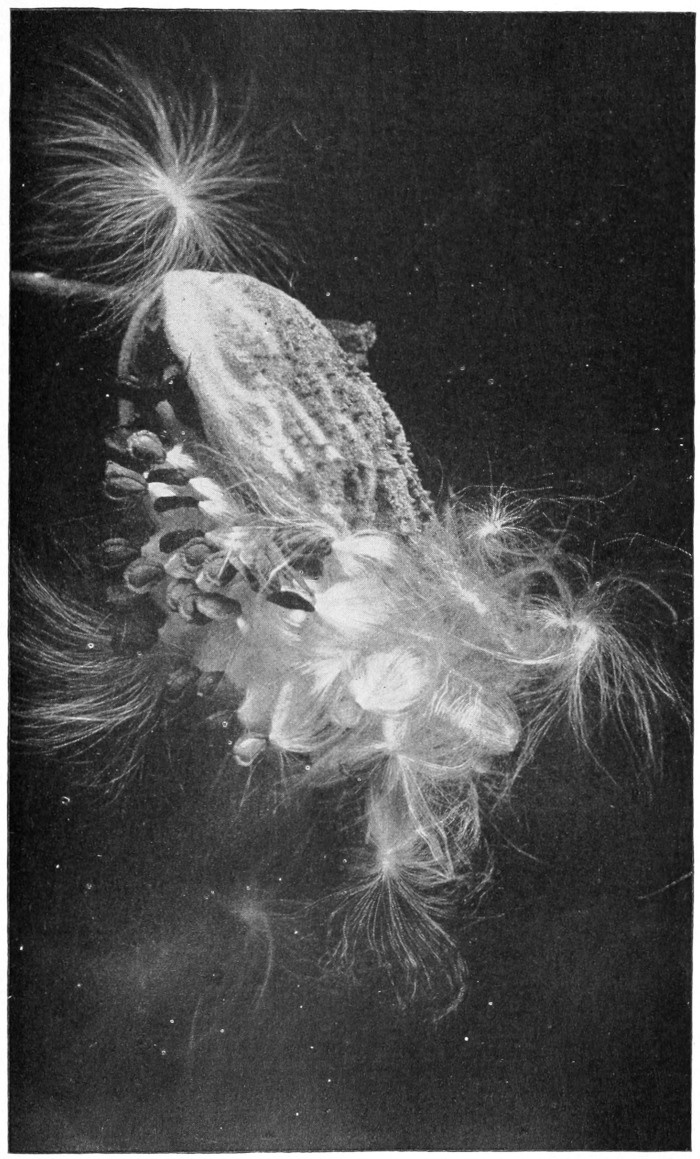
Milkweed seed-balloons just leaving the sheltering pod.
Method—Begin the study of the plant when it first appears above ground in April or May. Give the pupils the questions about the blossom for a vacation study, and ask that their observations be kept in their notebooks. The study of the pods and seeds may be made in September or October. When studying the milky juice, add a geography lesson on rubber trees and the way that rubber is made.
Observations—1. The plant. How does the milkweed look as it appears above ground in the spring? How are its leaves folded when it first puts its head up? Cut off a fully expanded plant a few inches above the ground. What flows out of the stem? Blot off the “milk” and study the cross-section of the stem. What is at the center? How many layers do you see around this center? Can you see from which the milkweed juice comes? How does the juice feel as it dries on your fingers? How does it look when dry? Place a few drops on a piece of paper and when it is dry pull it off and see if it is elastic. Break the edge of the leaf. Does the milky juice flow from it? Does it come from the veins? Do you think that this is the sap of the milkweed? Cut a gash in the milkweed stem and see how the “milk” fills the wound. How does this help the plant? Do cattle feed upon the milkweed when it grows in pastures? If not, why?
2. How are the leaves arranged on the stem? How do the upper and under sides of the leaves differ? Examine with a lens, and see what makes the nap of the velvet. What gives the light color to the under side? Sketch a leaf showing its shape and venation, noting especially the direction of the veins as they approach the edge of the leaf.
3. The flower. Where do the flower clusters come off the stems in relation to the leaves? Does the stem of the flower cluster stand stiff or droop? Take a good sized flower cluster and count the flowers in it. What would happen if all these flowers should develop into pods? How many flower clusters do you find on one plant? Which of these clusters open first? Last?
4. Take off a single bud with its stem, or pedicel. Does the milky juice come at the break? Is the bud stem stiff or drooping? What is its color and how does it feel? What is the shape of the bud? How many sepals has it? Look at the stem, sepals and bud with a lens and describe their covering. Look for a flower just opening where the petals stand out around it like a five-pointed star. What is their color? What happens to the petals when the flower is fully expanded? Can you see the sepals then? Look straight into the flower. Do you see the five nectar-horns? Look at them with a lens and describe them. What do you suppose is the use of the little curved tongue coming out of each? Where does the tip of the tongue rest? With a lens, look between two of the nectar horns; can you see a little slit or pocket, with white protruding edges? Note just above the pocket a black dot; thrust a needle into this pocket near its base and lift it toward the crown of the flower, touching the black dot. What happens?
5. Describe the little branched object that came out when you touched it with a needle. These are the pollen saddle-bags and each bag comes from a pocket at one side of, and above the long pocket. Do these saddle-bags cling to the needle? Look with a lens at some of the older flowers, and see if you can find the pollen-bags protruding from the long pocket. See if you can find how the long pocket is a passageway to the stigma. To see how the little saddle-bags were transported, watch a bee gathering nectar. Describe what happens.
6. Since the flowers bend over, how must the bee hold on to the flower while she gathers nectar from the horns? As she turns around, would she naturally pull out some of the saddle-bags? Catch a bee in a collecting tube and see if her feet have upon them these pollen-sacs. After gathering these pollen-sacs upon her feet, what happens to them when she visits the next flower? Is the opening of the long pocket like a trap to scrape the sacs off? Can you find on milkweed flowers any bees or other insects that have been entangled in these little traps and have thus perished? Try the experiment of drawing a thread into one of these traps and with your lens see if the opening closes over it.
7. How many kinds of insects do you find visiting the milkweed flowers? Can you detect the strong odor of the flowers? Why must the milkweed develop so many flowers and offer such an abundance of nectar?
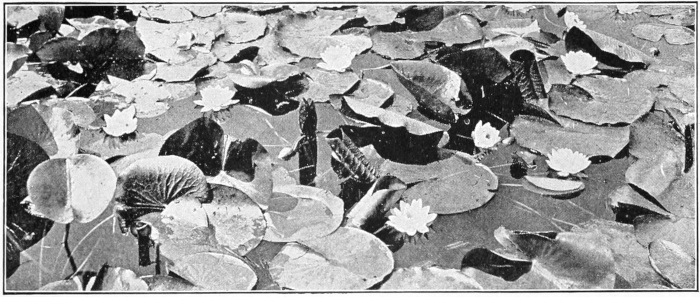
Photo by Verne Morton.
THE WHITE WATER LILY
Teacher’s Story
“Whence O fragrant form of light, Hast thou drifted through the night Swanlike, to a leafy nest, On the restless waves at rest.”
Thus asks Father Tabb, and if the lily could answer it would have to say: “Through ages untold have the waves upheld me until my leaves and my flowers have changed into boats, my root to an anchor, and my stems to anchor-ropes.”
There is no better example for teaching the relation between geography and plant life than the water lily. Here is a plant that has dwelt so long in a certain situation that it cannot live elsewhere. The conditions which it demands are quiet water, not too deep, and with silt bottom. Every part of the plant relies upon these conditions. The rootstock has but few root hairs; and it lies buried in the silt, not only because this gives it food, but because it can there act as an anchor. Rising from the rootstock is a stem as pliable as if made of rubber, and yet it is strong; its strength and flexibility are gained by having at its center four hollow tubular channels, and smaller channels near the outside. These tubes extend the whole length of the stem, making it light so that it will float, and at the same time giving it strength as well as flexibility. At the upper end of the stem is a leaf or flower, which is fashioned as a boat. The circular leaf is leathery and often bronze-red below, with prominent veins, making an excellent bottom to the boat; above, it is green with a polished surface, and here are situated its breathing-pores, although the leaves of most plants have these stomata in the lower surface. But how could the water lily leaf breathe, if its stomata opened in the water? The leaf is large, circular and quite heavy; it would require a very strong, stiff stem to hold it aloft, but by its form and structure it is fitted to float upon the water, a little green dory, varnished inside, and waterproof outside.
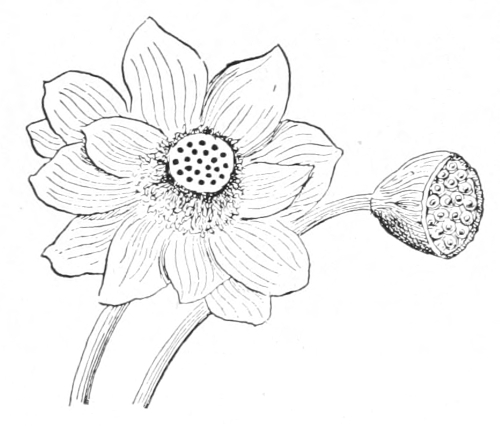
Egyptian lotus flower and seed-vessel.
The bud is a little, egg-shaped buoy protected by its four pinkish brown, leathery sepals; as it opens, we can see four rows of petals, each overlapping the space between the next inner ones; at the center there is a fine display of brilliant yellow anthers. Those hanging over the greenish yellow pit, which has the stigma at its center, are merely golden hooks. When the flower is quite open, the four sepals, each a canoe in form, lie under the lily and float it; although the sepals are brownish outside, they are soft white on the inside next the flower. Between each two sepals stands a large petal, also canoe-shaped, and perhaps pinkish on the outside; these help the sepals in floating the flower. Inside of these there is a row of large creamy white petals which stand upright; the succeeding rows of petals are smaller toward the center and grade into the outer rows of stamens, which are petallike at the base and pointed at the tip. The inner rows of stamens make a fine golden fringe around the cup-shaped pistil. This flower is of great use in teaching that sepals, petals and stamens have the same origin and grade into each other, showing the intermediate stages.
It has been stated that pond lilies, in the state of nature, have an interesting way of opening in the early morning, closing at noon and opening again toward evening. If we knew better the habits of the insects which pollenate these flowers, we should possibly have the key to this action. In our ponds in parks and grounds we find that each species of pond lily opens and closes at its own particular time each day. Each flower opens usually for several consecutive days, and the first day of its blooming it opens about an hour later and closes an hour earlier than on the days following. After the lilies have blossomed, the flower stem coils in a spiral and brings the ripening seeds below the surface of the water. The reason for this has not yet been discovered. After about two months the pod bursts letting the seeds out in the water. Each seed is in a little bag, which the botanists call an aril, and which serves as a life preserver floating the seed off for some distance from the parent plant. The aril finally decays and the seed falls to the bottom where, if the conditions are favorable, it develops into a new plant.
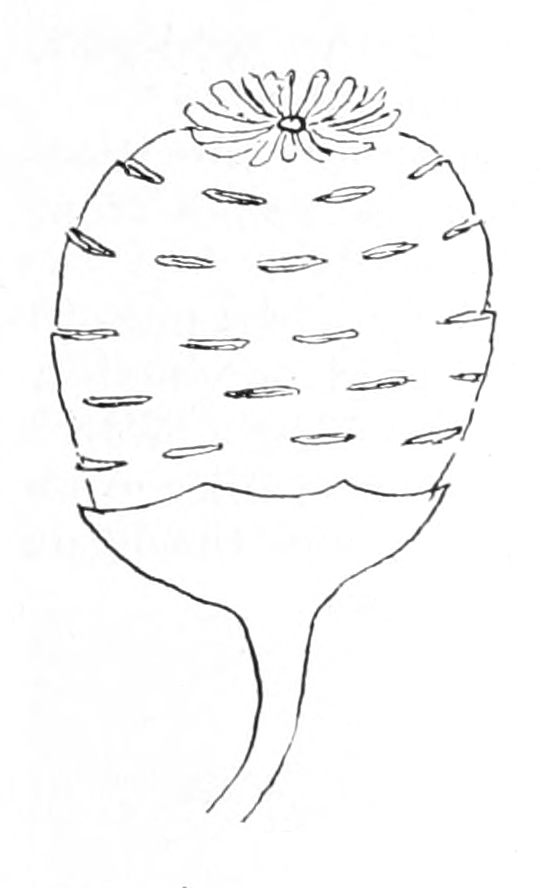
Seed vessel of white pond lily.
To emphasize the fact that the water lily is dependent upon certain geographical conditions, ask the pupils to imagine a water lily planted upon a hillside. How could its roots, furnished with such insufficient rootlets, get nourishment there? How could its soft, flexible stems hold aloft the heavy leaves and blossoms to the sunlight? In such a situation it would be a mere drooping mass. Moreover, if the pupils understand the conditions in which the water lilies grow in their own neighborhood, they can understand the conditions under which the plant grows in other countries. Thus, when they read about the great Victoria regia of the Amazon,—that water lily whose leaves are large enough to support a man,—they would have visions of broad stretches of still water and they should realize that the bottom must be silt. If they read about the lotus of Egypt, then they should see the Nile as a river with borders of still water and with bottom of silt. Thus, from the conditions near at hand, we may cultivate in the child an intelligent geographical imagination.
LESSON CXXXII
The Water Lily
Leading thought—The water lily has become dependent upon certain conditions in pond or stream, and has become unfitted in form to live elsewhere. It must have quiet waters, not too deep, and with silt bottom.
Method—The study should be made first with the water lilies in a stream or pond, to discover just how they grow. For the special structure, the leaves and flowers may be brought to the schoolroom and floated in a pan of water. The lesson may easily be modified to fit the yellow water lily, which is in many ways even more interesting, since in shallow water it holds its leaves erect while in deeper water its leaves float.
Observations—1. Where is the water lily found? If in a pond, how deep is the water? If in a stream, is it in the current? What kind of bottom is there to the stream or pond? Do you find lilies in the water of a limestone region? Why?
2. What is the shape of the leaf? What is the color above and below? What is the texture? How is it especially fitted to float? How does it look when very young?
3. Examine the petiole. How long is it? Is it stiff enough to hold up the leaf? Why does it not need to hold up the leaf? How does it serve as an anchor? Cut a stem across and describe its inside structure. How does this structure help it float?
4. Examine the open flower. How many sepals? How many rows of petals? How do the stamens resemble the petals? Can you see in the water lily how the sepals, petals and stamens may all be different forms of the same thing? How are the sepals fitted to keep the flower afloat? At what times of the day does the lily open? At what hours does it close?
5. Describe the pistil. When the lily first opens, how are the stamens placed around the pistil? What happens to the seed-box after the blossoms have faded? Does the seed-pod float upon the water as did the flower? What sort of stem has the flower? How does this stem hold the seed-pod below the water?
6. What sort of seed has the water lily? Sketch the seed-pod. How does the seed escape from it? How is it scattered and planted?
7. What sort of a root has the water lily? Are there many fine rootlets upon it? Why? How does this rootstock serve the plant aside from getting food?
8. Imagine a water lily set on a dry hillside. Could the stems uphold the flowers or leaves? Is the petiole large enough to hold out such a thick, heavy leaf? Could the root get food from a dry location? Why?
9. Judging from what you know of the places where water lilies grow and the condition of the water there, describe the Nile where the lotus grows. Describe the Amazon where the Victoria regia grows.
PONDWEED
Teacher’s Story
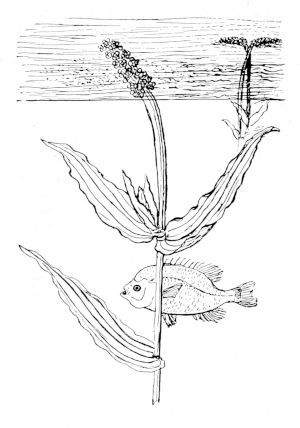
HE study of any plant which has obvious limitations as to where it may grow should be made a help in the study of geography. Pondweed is an excellent subject to illustrate this principle; it grows only in quiet beds of sluggish streams or in ponds, or in the shallow protected portions of lakes. It has tremendous powers of stretching up, which render it able to grow at greater depth than one would suppose possible, often flourishing where the water is from ten to twenty feet deep. Often, when the sun is shining, it may be seen like a bed of seaweed on the bottom. Its roots, like those of most water plants, have less to do with the matter of absorbing water and nourishment than do the roots of land plants, one of their chief functions being to anchor the plant fast; they have a firm grip on the bottom; and if pondweed is cut loose, it at once comes to the surface, floats helplessly on its side, and soon dies.
The stem is very soft and pliable and the plant relies entirely on the water to keep it upright. A cross-section of the stem shows that its substance is spongy, with the larger open cells near the outer edge, thus helping it to float. The leaves are two or three inches long, their broad bases encircling the stem, their tips tapering to slender points. They have parallel veins and ruffled edges. They are dull olive green in color, much darker than the stems; in texture they are very thin, papery, and so shining as to give the impression of being varnished. No land plants have such leaves; they remind us at once of kelp or other seaweeds. The leaves are scattered along the stems, by no means thickly, for water plants do not seem to need profuse foliage.
In blossom time the pondweed shows its real beauty. The stems grow and grow, like Jack’s bean stalk, and what was a bed of leaves on the pond bottom suddenly changes into a forest of high plants, each one standing tall and straight and with every leaf extended, as if its stems were as strong and stiff as ironwood; but if a wave disturbs the water the graceful undulations of the plant tell the true story of the pliant stems. There is something that arouses our admiration when we see one of these pondweeds grown so straight and tall, often three or four yards high, in order to place its little, greenish-brown flower-head above the water’s surface. We have spent hours looking down into such a submerged forest, dreaming and wondering about the real meaning of such adaptations.
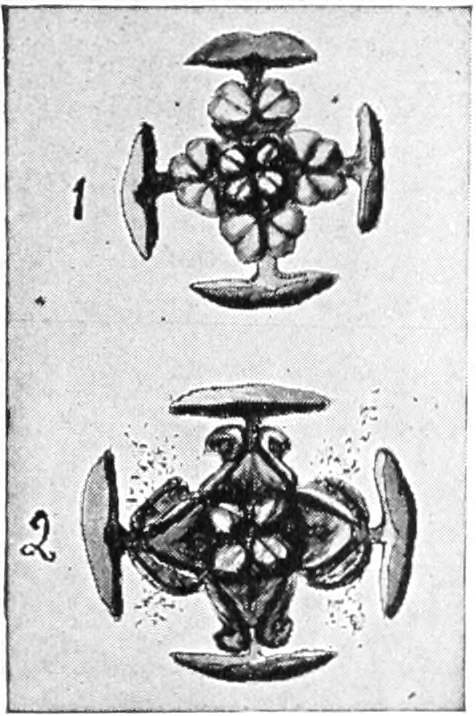
1, Flower of a pondweed enlarged, early stage, 2, same at later stage.
Although the stem is flexible, the somewhat curved, enlarged portion of it just below the flower-head is rigid; it is also more spongy than the lower part of the stem and is thus fitted to float the flower. The flower itself is one of the prettiest sights that nature has to show us through a lens. It is a Maltese cross, the four reddish stigmas arranged in a solid square at the center; at each side of this central square is a double-barrelled anther, and outside of each anther is a queer, little, dipper-shaped, green sepal. When the anthers open, they push away from the stigmas and throw their pollen toward the outside. There may be thirty or more of these tiny, cross-shaped flowers in one flower-head. In the bud, the cup-shaped sepals shut down closely, exposing the stigmas first, which would indicate that they ripen before the pollen is shed. The pollen is white, and is floated from plant to plant on the surface of the water; often the water for yards will be covered with this living dust.
LESSON CXXXIII
Pondweed
Leading thought—The pondweed lives entirely below the water; at blossom time, however, it sends up its flower stems to the surface of the water, and there sheds its pollen, thus securing cross-pollenation.
Method—As this is primarily a lesson that relates to geography, the pondweed should be studied where it is growing. It may be studied in the spring or fall, and the pupils asked to observe the blossoming which occurs in late July. After the pupils have seen where it grows, the plants themselves may be studied in an aquarium, or by placing them in a pail or basin of water. There are confusing numbers of pondweeds but any of them will do for this lesson. The one described in the Teacher’s Story is probably P. perfoliatus.
Observations—1. Where is the pondweed found? Does it ever grow out of water? Does it ever grow in very deep water? Does it ever grow in swiftly flowing water?
2. Has the pondweed a root? Does the pondweed need to have water carried to its leaves, as it would if it were living in the air? What is one of the chief uses of the roots to the pondweed? Break off a plant, does it float? Do you think it would float off and die, if it was not anchored by its root?
3. Compare the stem of pondweed with that of any land plant standing straight. What is the chief difference? Why does the pondweed not need a stiff stem to hold it up? Cut the stem across, and see if you can observe why it floats?
4. Examine the leaves. Are all of them below the surface of the water? If some float, how do they differ in texture and form from those submerged? How are they arranged on the stem? Are they set close together? What is the difference in texture between its leaves and those of the jewelweed, dock or any other land plant? If any leaves project out of the water are they different in form and texture from those submerged? Sketch the leaf, showing its shape, its edges, and the way it joins the stem.
5. How far below the surface of the water does the pondweed usually lie? Does it ever rise up to the water’s surface? When? Have you ever noticed the pondweed in blossom? How does the blossom look on the water? Can you see the white pollen floating on the surface of the water? Look down into the water and see the way the pondweed stands in order to float its blossoms.
6. Study the blossom. Note the stem that bears it. Is the part that bears the flower enlarged and stiffer than the stem below? Do you think that this enlarged part of the stem acts like the bob on a fish-line? Examine a flower cluster with a lens. How many flowers upon it? Study one flower carefully. Describe the four stigmas at the center. Describe the anthers arranged around them. Describe the sepal which protects each anther. When the anthers open do they discharge the pollen toward or away from the stigmas?
7. What happens after the flowers are pollenated? Do they still float? What sort of seed-capsule has the pondweed? Do the seeds break away and float?
“Again the wild cow-lily floats Her golden-freighted, tented boats, In thy cool caves of softened gloom, O’ershadowed by the whispering reed, And purple plumes of pickerel weed, And meadow-sweet in tangled bloom. “The startled minnows dart in flocks, Beneath thy glimmering amber rocks, If but a zephyr stirs the brake; The silent swallow swoops, a flash Of light, and leaves with dainty plash, A ring of ripples in her wake.” —“Birch Stream”, Anna Boynton Averill.
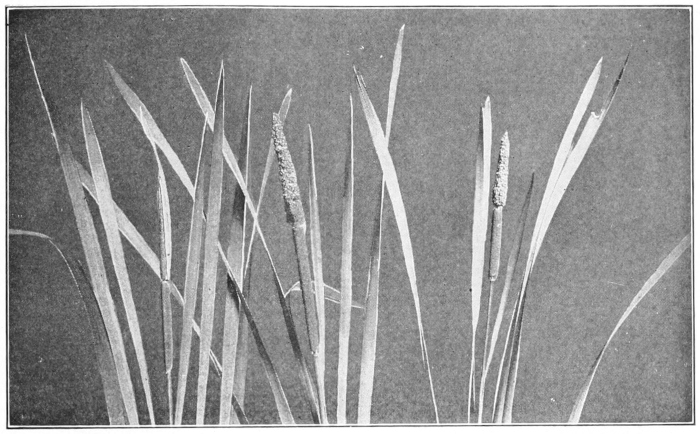
Cat-tail flag in blossom.
The staminate flowers are massed at the tip, and the pistillate flowers which form the “cat-tail” are massed lower down on the stalk.
Photo by Verne Morton.
THE CAT-TAIL
Teacher’s Story
In June and early July, if the cat-tail be closely observed, it will be seen to have the upper half of the cat’s tail much narrower and different in shape from the lower half—as if it were covered with a quite different fur. It seems to be clothed with a fine drooping fringe of olive-yellow. With the aid of a lens, we can see that this fringe is a mass of crowded anthers, two or three of them being attached to the same stalk by a short filament. These anthers are packed full of pollen, which is sifted down upon the pistillate flowers below by every breeze; and with every puff of stronger wind, the pollen is showered over all neighboring flowers to the leeward. There is not much use in trying to find the pistillate flowers in the plush of the cat-tail. They have no sepals nor petals, and are so imbedded in the thick pappus which forms the plush that the search is hardly worth while for nature-study, unless a microscope is used. The ovary is rather long, the style slender, and the stigma reaches out to the cut-plush surface of the cat-tail. The pupils can find what these flowers are by studying the seed; in fact, the seed does not differ very much from the flower, except that it is mature and is browner in color.
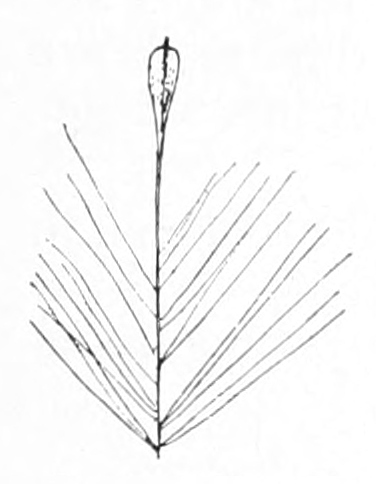
A cat-tail seed with its balloon.
It is an interesting process to take apart a cat-tail plant; the lower, shorter leaves surround the base of the plant, giving it size and strength. All the leaves have the same general shape, but vary in length. Each leaf consists of the free portion, which is long and narrow and flat towards its tapering tip but is bent into a trough as it nears the plant, and the lower portion of the leaf, which clasps the plant entirely or partially, depending upon whether it is an outer or inner leaf, and thus adds to its strength. We almost feel as if these alternate leaves were consciously doing their best to protect the slender, flower stem. The free part of the leaves is strengthened by lengthwise veins, and they form edges that never tear nor break. They are very flexible, and therefore yield to the wind rather than defy it. If we look at a leaf in cross-section, we can see the two thick walls strengthened by the framework of stiff veins which divide the interior into long cells. If we cut the leaf lengthwise we can see that these long cells are supported by stiff, coarse partitions.
Where the leaf clasps the stem, it is very stiff and will break rather than bend. The texture of the leaf is soft and smooth, and its shade of green is attractive. The length of the leaves is often greater than that of the blossom stalk, and their graceful curves contrast pleasantly with its ramrod-like stiffness. It is no wonder that artists and the decorators have used the cat-tail lavishly as a model. It is interesting to note that the only portion of the leaves injured by the wind is the extreme tip.
The cat-tail is adapted for living in swamps where the soil is wet but not under water all the time. When the land is drained, or when it is flooded for a considerable time, the cat-tails die out and disappear. They usually occur in marshy zones along lakes or streams; and such a zone is always sharply defined by dry land on one side and water on the other. The cat-tail roots are fine and fibrous and are especially fitted, like the roots of the tamarack, to thread the mud of marshy ground and thus gain a foothold. The cat-tails form one of the cohorts in the phalanx of encroaching plants, like the reeds and rushes, which surround and, by a slow march of years, finally conquer and dry up ponds. But in this they overdo the matter, since after a time the soil becomes too dry for them and they disappear, giving place to other plants which find there a congenial environment. The place where I studied the cat-tails as a child is now a garden of joe pye weed and wild sunflowers.
Reference—Plant Life, Coulter.
LESSON CXXXIV
The Cat-tail
Leading thought—The cat-tail is adapted to places where the soil is wet but not under water; its pollen is scattered by the wind, and its seeds are scattered by wind and water. Its leaves and stalks are not injured nor broken by the wind.
Method—As this is primarily a geography lesson, it should be given in the field if possible; otherwise the pupils must explore for themselves to discover the facts. The plant itself can be brought into the schoolroom for study. When studying the seeds, it is well to be careful, or the schoolroom and the pupils will be clothed with the pappus for weeks.
Observations—1. Where are the cat-tails found? Is the land on which they grow under water all the year? At any part of the year? Is it dry land all the year? What happens to the cat-tails, if the land on which they grow is flooded for a season? What happens to them, if the land is drained?
2. How wide a strip do the cat-tails cover, where you have found them? Are they near a pond or brook or stream? Do they grow out in the stream? Why do they not extend further inland? What is the character of the soil on which they grow?
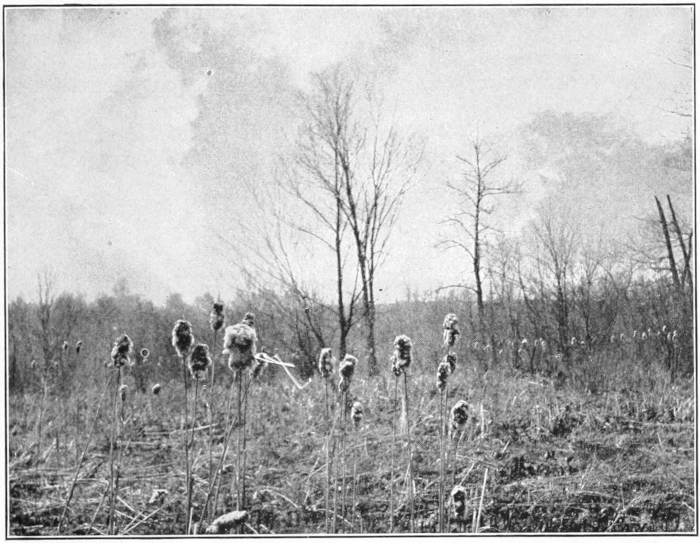
Cat-tails sending off their seed balloons.
Photo by Verne Morton.
3. What sort of a root has the cat-tail? Why is this root especially adapted to the soil where cat-tails grow? Describe the rootstock.
4. The cat-tail plant. Are the leaves arranged opposite or alternate? Tear off a few of the leaves and describe the difference between the lower and the upper end of a leaf as follows: How do they differ in shape? Texture? Pliability? Color? Width? Does each leaf completely encircle the stalk at its base? Of what use is this to the plant? Of what use is it to have the plant stiffer where the leaves clasp the stalk? What would happen in a wind storm if this top-heavy, slender seed stalk was bare and not supported by the leaves? What is the special enemy of long, tall, slender-leafed plants?
5. Take a single leaf, cut it across near where it joins the main stalk and also near its tip. Look at the cross-section and see how the leaf is veined. What do its long veins or ribs do for the leaf? Split the leaf lengthwise and see what other supports it has. Does the cat-tail leaf break or tear along its edges easily? Does the wind injure any part of the leaf?
6. Study the cat-tail flowers the last half of June. Note the part that will develop into the cat’s tail. Describe the part above it. Can you see where the pollen comes from? The pistillate flowers which are in the plush of the cat-tail have no sepals, petals, odor nor nectar. Do you think that their pollen is carried to them by the bees? How is it carried?
7. Examine the cat-tail in fall or winter. What has happened to that part of the stalk above the cat-tail where the anthers grew? Study two or three of the seeds, and see how they are provided for traveling. What scatters them? Will the cat-tail seed balloons float? Would the wind or the water be more likely to carry the cat-tail seeds to a place where they would grow? Describe the difference between the cat-tail balloon and the thistle balloon.
8. How crowded do the cat-tail plants grow? How are they arranged to keep from shading each other? In how many ways is the wind a friend of the cat-tails?
9. How do the cat-tails help to build up land and make narrower ponds and streams?
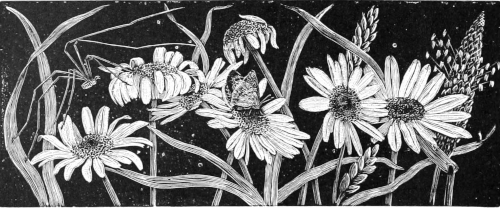
Daises and grasses.
LESSON CXXXV
A Type Lesson for a Composite Flower
Leading thought—Many plants have their flowers set close together to make a mass of color, like the geraniums or the clovers. But there are other plants where the flowers of one flower-head act like the members of a family, those at the center doing a certain kind of work for the production of seed, and those around the edges doing another kind of work. The sunflower, goldenrod, asters, daisies, cone-flower, thistle, dandelion, burdock, everlasting, and many other common flowers have their blossoms arranged in this way. Before any of the wild-flower members of this family are studied, the lesson on the garden sunflower should be given. (See Lesson CLXII).
Method—These flowers may be studied in the schoolroom with suggestions for field observations. A lens is almost necessary for the study of most of these flowers.
Observations—1. Can you see that what you call the flower consists of many flowers set together like a beautiful mosaic? Those at the center are called disk-flowers; those around the edges banner or ray-flowers.
2. Note that the flowers around the edges have differently shaped corollas than those at the center. How do they differ? Why should these be called the banner flowers? Why should they be called the ray-flowers? How many banner-flowers are there in the flower family you are studying? How are the banners arranged to make the flower-head more attractive? Cut off or pull out all the banner-flowers and see how the flower-head looks. What do the banner-flowers hold out their banners for? Is it to attract us or the insects? Has the banner-flower any stigma or stamens?
3. Study the flowers at the center. Are they open, or are they unfolded, buds? Can you make a sketch of how they are arranged? Are any of the florets open? What is the shape and the color of the corolla? Can you see the stamen-tubes pushing out from some? What color are the stamen-tubes? Can you see the two-parted stigmas in others? What color is the pollen. Do the florets at the center or at the outside of the disk open first? When they first open, do you see the stamen-tube or the stigma?
4. The flower-heads are protected before they open with overlapping bracts, which may be compared to a shingled house protecting the flower family. As the flower-head opens, these bracts are pushed back beneath it. Describe the shape of these bracts. Are they set in regular, overlapping rows? Are they rough or smooth? Do they end bluntly, with a short point, with a long point, with a spine, or a hook? How do the bracts act when the flower family goes to sleep? Do they remain after the seeds are ripened?
5. Take a flower-head apart, and examine the florets. Can you see what part of the floret will be the seed? Is there a fringe of pappus above it? If so, what will this be on the seed?
6. Study the ripe seeds. How are they scattered? Do they have balloons? Is the balloon close to the seed? Is it fastened to all parts of it?
THE GOLDENROD
Teacher’s Story
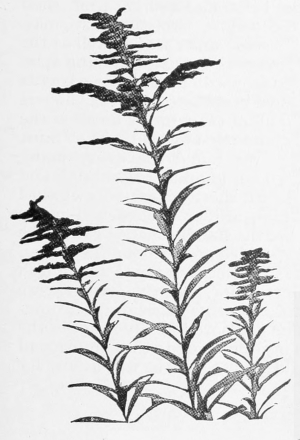
Goldenrod.
Once I was called upon to take some children into the field to study autumn flowers. The day we studied goldenrod, I told them the following story on the way, and I found that they were pleased with the fancy and through it were led to see the true purpose of the goldenrod blossoming:
“There are flowers which live in villages and cities, but people who also live in villages and cities are so stupid that they hardly know a flower city when they see it. This morning we are going to visit a golden city where the people are all dressed in yellow, and where they live together in families; and the families all live on top of their little, green, shingled houses, which are set in even rows along the street. In each of these families, there are some flowers whose business it is to furnish nectar and pollen and to produce seeds which have fuzzy balloons; while there are other flowers in each family which wave yellow banners to all the insects that pass by and signal them with a code of their own, thus: ‘Here, right this way is a flower family that needs a bee or a beetle or an insect of some sort to bring it pollen from abroad, so that it can ripen its seed; and it will give nectar and plenty of pollen in exchange.’ Of course, if the flowers could walk around like people, or fly like insects, they could fetch and carry their own pollen, but as it is, they have to depend upon insect messengers to do this for them. Let us see who of us will be the first to guess what the name of this golden city is, and who will be the first to find it.”
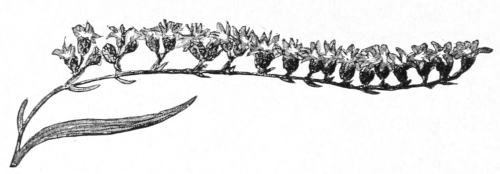
A street in goldenrod city.
The children were delighted with this riddle and soon found the goldenrod city. We examined each little house with its ornate, green “shingles.” These little houses, looking like cups, were arranged on the street stem, right side up, in an orderly manner and very close together; and where each joined the stem, there was a little, green bract for a doorstep. Living on these houses we found the flower families, each consisting of a few tubular disk-flowers opening out like bells, and coming from their centers were the long pollen-tubes or the yellow, two-parted stigmas. The ray-flowers had short but brilliant banners; and they, as well as the disk-flowers, had young seeds with pretty fringed pappus developing upon them. The banner-flowers were not set so regularly around the edges as in the asters; but the families were such close neighbors, that the banners reached from one house to another. And all of the families on all of the little, green streets were signalling insects, and one boy said, “They must be making a very loud yellow noise.” We found that very many insects had responded to this call—honeybees, bumblebees, mining and carpenter bees, blue-black blister beetles with short wings and awkward bodies, beautiful golden-green chalcid flies, soldier beetles and many others; and we found the spherical gall and the spindle-shaped gall in the stems, and the strange gall up near the top which grew among the leaves.
Unless one is a trained botanist it is wasted energy to try to distinguish any but the well-marked species of goldenrod; for, according to Gray, we have 56 species, the account of which makes twelve pages of most uninteresting reading in the new Manual. The goldenrod family is not in the least cliquish, the species have a habit of interbreeding to the confusion of the systematic botanist. Matthew’s Field Book serves as well as any for distinguishing the well-marked species.
LESSON CXXXVI
The Goldenrod
Leading thought—In the goldenrod the flower-heads or families are so small that, in order to attract the attention of the insects, they are set closely together along the stem to produce a mass of color.
Method—Bring to the school-room any kind of goldenrod, and give the lesson on the flowers there. This should be followed by a field excursion to get as many kinds of goldenrod as possible. The following observations will bring out differences in well-marked species:
Observations—1. Use Lesson CXXXV to study the flower. How many banner-flowers in the family? How many disk-flowers? Are the banners arranged as regularly around the edges as in the asters and daisies? How are the flower-heads set upon the stems? Which flower-heads open first—those at the base or at the tip of the stem? Do the upper stems of the plant blossom before those lower down?
2. Do the stems bearing flowers come from the axils of the leaves? What is the general shape of the flower branches? Do they come off evenly at each side, or more at one side? Are the flower branches long or short? Make a sketch of the general shape of the goldenrod you are studying.
Disk-flower and banner-flower of goldenrod.
3. Is the stem smooth, downy, or covered with bloom? What is its color? In cross-section, is it circular or angular?
4. What is the shape and form of the edges of the lower leaves? The upper ones? Are they set with, or without, petioles on the stem? Do they have a heart-shaped base? Are the leaves smooth or downy? Are they light, or dark green?
5. Field notes. Where do you find the goldenrod growing? Do you find one kind growing alone or several kinds growing together? Do you find any growing in the woods? If so, how do they differ in shape from those in the field?
6. How many kinds of insects do you find visiting goldenrod flowers? How many kinds of galls do you find on the goldenrod stems and leaves?
7. Study the goldenrods in November. Describe their seeds and how they are scattered.
“I am alone with nature, With the soft September day; The lifting hills above me, With goldenrod are gay. Across the fields of ether Flit butterflies at play; And cones of garnet sumac Glow down the country way. “The autumn dandelion Beside the roadway burns; Above the lichened boulders Quiver the plumèd ferns. The cream-white silk of the milkweed Floats from its sea-green pod; From out the mossy rock-seams Flashes the goldenrod.” —Mary Clemmer Ames.
THE ASTERS
Teacher’s Story
ET us believe that the scientist who gave to the asters their Latin name was inspired. Aster means star and these, of all flowers, are most starlike; and in beautiful constellations they border our fields and woodsides. The aster combination of colors is often exquisite. Many have the rays or banners lavender, oar-shaped and set like the rays of a star around the yellow disk-flowers; these latter send out long, yellow anther tubes, overflowing with yellow pollen, and add to the stellar appearance of the flower-head.
“And asters by the brookside make asters in the brook.”
Thus sang H. H. of these beautiful masses of autumn flowers. But if H. H. had attempted to distinguish the species, she would have said rather that asters by the brookside make more asters in the book: for Gray’s Manual assures us that we have 77 species including widely different forms, varying in size, color and also as to the environment in which they will grow. They range from the shiftless woodland species, which has a few whitish ray-flowers hanging shabbily about its yellow disk and with great, coarse leaves on long, gawky petioles climbing the zigzag stem, to the beautiful and dignified New England aster, which brings the glorious purple and orange of its great flower-heads to decorate our hills in September and October.
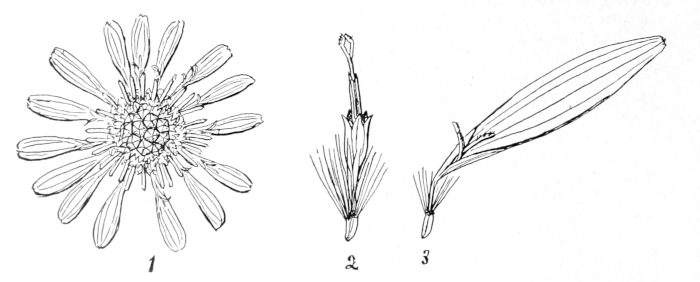
1, an aster flower-head enlarged; 2, a disk-flower; 3, a banner-flower.
Luckily, there are a few species which are fairly well marked, and still more luckily, it is not of any consequence whether we know the species or not, so far as our enjoyment of the flowers themselves is concerned. The outline of this lesson will call the attention of the pupils to the chief points of difference and likeness in the aster species, and they will thus learn to discriminate in a general way. The asters, like the goldenrods, begin to bloom at the tip of the branches, the flower-heads nearest the central stem, blooming last. All of the asters are very sensitive, and the flower-heads will close promptly as soon as they are gathered. The ray or banner-flowers are pistillate, and therefore develop seed. The seed has attached to its rim a ring of pappus, and is ballooned to its final destination. In November, the matured flower-heads are fuzzy, with seeds ready for invitations from any passing wind to fly whither it listeth.
LESSON CXXXVII
The Asters
Leading thought—There are very many different kinds of asters, and they all have their flowers arranged similarly to those of the sunflower.
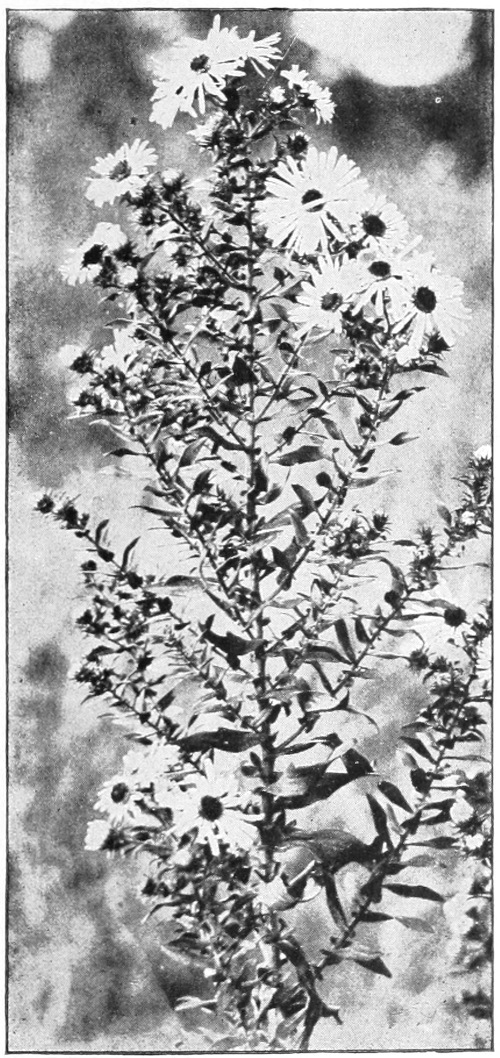
Asters.
Method—Have the pupils collect as many kinds of asters as possible, being careful to get the basal leaves and to take notes on where each kind was found—that is, whether in the woodlands, by the brooksides or in the open fields. This lesson should follow that on the sunflower.
Observations—1. What was the character of the soil and surroundings where this aster grew? Were there large numbers of this kind growing together? Were the flowers wide open when you gathered them? How soon did they close?
2. How high did the plants stand when growing? Were there many flowers, or few, on each plant?
3. Study the lower and the upper leaves. Describe each as follows: the shape, the size, the edges, the way it was joined to the stem.
4. Is the stem many-branched or few? Do the branches bearing flowers extend in all directions? Are the stems hairy or smooth, and what is their color?
5. What is the diameter of the single flower-head? What is the color of the ray-flowers? How many ray or banner-flowers are there? What is the shape of a single banner as compared with that of a sunflower? What are the colors of the disk-flowers? Of the pollen? Do the disk-flowers change color after blossoming?
6. Look at the bracts below the flower-head. Are they all the same shape? What is their color? Do they have recurved tips or do they overlap closely? Are they sticky?
7. Take the aster flower-head apart and look at it with a lens. In a disk-flower, note the young seed, the pappus, the tubular five-parted corolla, the anther tube and the stigmas. In the ray-flower, find the young seed, the pappus and the stigma.
8. Watch the bees working on asters, and find where they thrust their tongues to reach the nectar.
9. Study an aster plant in November, and describe the seeds and how they are scattered.
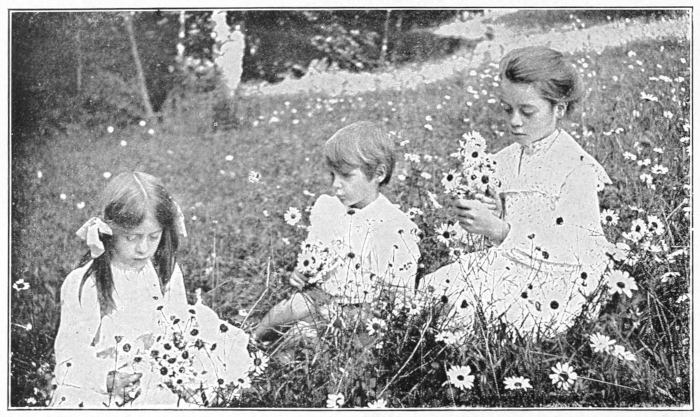
Gathering daisies.
Photo by Verne Morton.
THE WHITE DAISY
Teacher’s Story
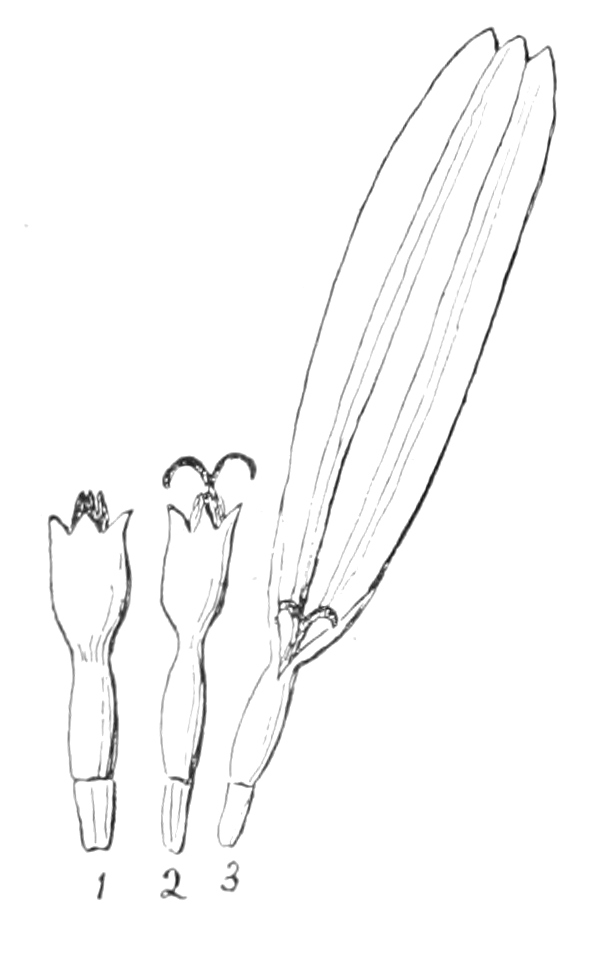
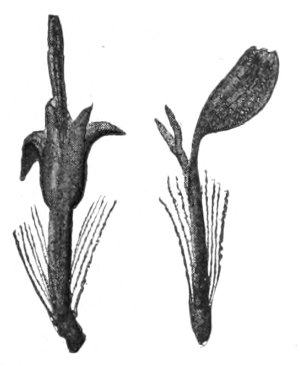
Daisy florets.
1, Disk-flower in pollen-stage; 2, Disk-flower in stigma-stage; 3, Ray-flower. All enlarged.
Every child loves this flower, and yet it is not well understood; it is always at hand for study from June until the frosts have laid waste the fields. However much enjoyment we get from the study of this beautiful flower-head, we should study the plant as a weed also, for it is indeed a pest to those farmers who do not practice a rotation of crops. Its root is long and tenacious of the soil, and it ripens many seeds which mingle with the grass seed, and thus the farmer sows it to his own undoing. The bracts of the involucre, or the shingles of the daisy-house, are rather long, and have parchment like margins. They overlap in two or three rows. In the daisy flower-head, the banner-flowers are white; there may be twenty or thirty of these, making a beautiful frame for the golden-yellow disk-flowers. The banner is rather broad, is veined, and toothed at the tip. The banner-flower has a pistil which shows its two-parted stigma at the base of the banner, and it matures a seed. The disk-flowers are brilliant yellow, tubular, rather short, with the five points of the corolla curling back. The anther-tubes and the pollen are yellow, so are the stigmas. The arrangement of the buds at the center is exceedingly pretty. The flowers develop no pappus, and therefore the seeds have no balloons. They depend upon the ignorance and helplessness of man to scatter their seeds far and wide with the grass and clover seed, which he sows for his own crops. It was thus that it came to America, and in this manner still continues to flaunt its banners in our meadows and pastures. The white daisy is not a daisy, but a chrysanthemum. It has never been called by this name popularly, but has at least twenty other common names, among them the ox-eye daisy, moon-penny, and herb-Margaret.
LESSON CXXXVIII
The White Daisy
Leading thought—The white-daisy is not a single flower but is made up of many little flowers and should be studied by the outline given in Lesson CXXXV.
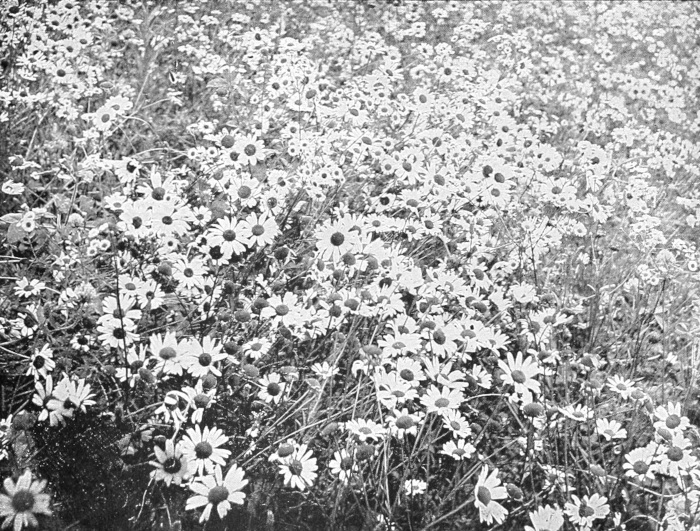
A daisy meadow.
THE YELLOW DAISY, OR BLACK-EYED SUSAN
Teacher’s Story
These beautiful, showy flowers have rich contrasts in their color scheme. The ten to twenty ray flowers wave rich, orange banners around the cone of purple-brown disk-flowers. The banners are notched and bent downward at their tips; each banner-flower has a pistil, and develops a seed. The disk-flowers are arranged in a conical, button-like center; the corollas are pink-purple at the base of the tube, but their five recurved, pointed lobes are purple-brown. The anther-tube is purple-brown and the stigmas show the same color; but the pollen is brilliant orange, and adds much to the beauty of the rich, dark florets when it is pushed from the anther-tubes. There is no pappus developed, and the seeds are carried as are the seeds of the white daisy, by being harvested with the seeds of grain.
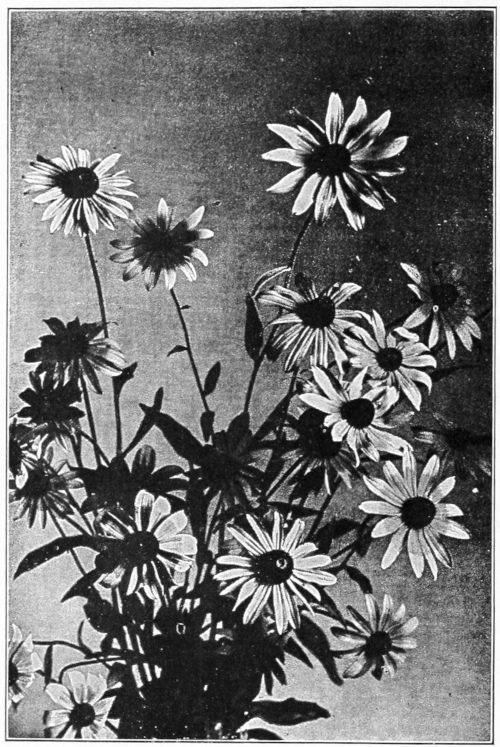
The stem is strong and erect; the bracts of the involucre, or “shingles”, are long, narrow and hairy, the lower ones being longer and wider than those above; they all spread out flat, or recurve below the open flower-head. In blossoming, first the ray-flowers spread wide their banners; then the flowerets around the base of the cone open and push out their yellow pollen through the brown tubes; then day by day the blossoming circle climbs toward the apex—a beautiful way of blossoming upward.
LESSON CXXXIX
The Black-Eyed Susan
Leading thought—This flower should be studied by the outline given in Lesson CXXXV.
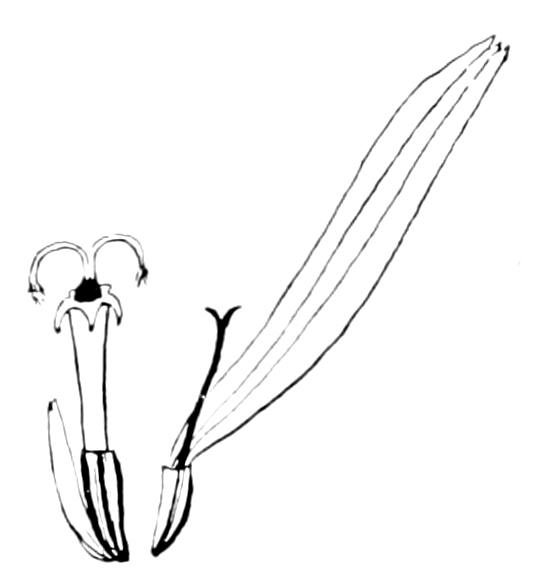
Disk-flower and ray-flower.
THE THISTLE
Teacher’s Story
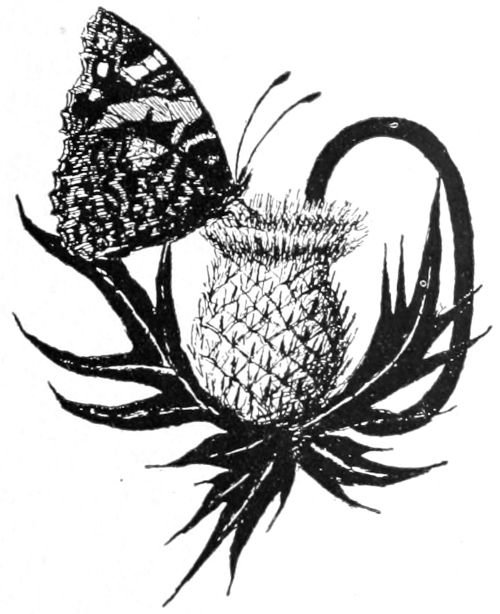
N looking at the thistle from its own standpoint, we must acknowledge it to be a beautiful and wonderful plant. It is like a knight of old encased in armor and with lance set, ready for the fray. The most impressive species is the great pasture, or bull, thistle (C. pumilis), which has a blossom-head three inches across. This is not so common as the lance-leaved thistle, which ornaments roadsides and fence corners, where it may remain undisturbed for the necessary second year of growth before it can mature its seeds. The most pernicious species, from the farmer’s standpoint, is the Canada thistle. Its roots are perennial, and they invade garden, grain field and meadow. They creep for yards in all directions, just deep enough to be sure of moisture, and send up new plants here and there, especially if the main stalk is cut off. Roots severed by the plow, send up shoots from both of the broken parts. Not so with the common thistle, which has a single main root, with many fibrous and clustered branches but with no side shoots.
The stalk of the lance-leaved thistle is strong and woody, and is closely hugged by pricky leaf stems, except for a few inches above the root. The leaves are placed alternately on the stalk; they are deep green, covered above with rough and bristling hairs, and when young are covered on the under side with soft, gray wool which falls away later. The spines grow on the edges of the leaves, which are deeply lobed and are also somewhat wavy and ruffled, thus causing the savage spears to meet the enemy in any direction. The ribs and veins are without spines. Small buds or branches may be found at the axils of the leaves; and if a plant is beheaded, those axiliary buds nearest the top of the stem will grow vigorously.
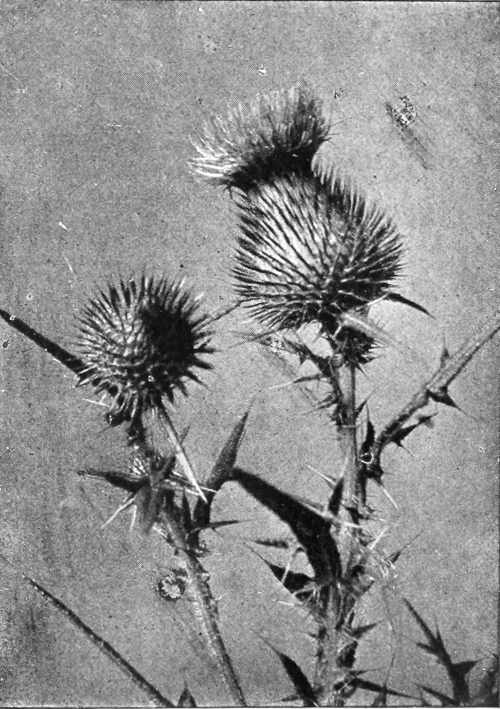
Lance-leaved thistle.
The thistle flowers are purple in color and very fragrant; they grow in single heads at the summit of the stalk, and from the axils of the upper leaves. The topmost heads open first. Of the individual flowers in the head, those of the outer rows first mature and protrude their pistils; the pollen grains are white. In each flower, the corolla is tube-shaped and purple, parting into five fringelike lobes at the top, and fading to white at its nectar-filled base.
The stamens have dark purple anthers, united in a tube in which their pollen is discharged. The pistil, ripening later, shoves out the pollen with its stigma, which at first is blunt at the end, its two-parted lips so tightly held together that not a grain of its own flower’s pollen can be taken. But when thrust far out beyond the anther-tube, the two-parted stigma opens to receive the pollen which is brought by the many winged visitors; for of all flowers, the thistles with their abundant nectar are the favorites of insects. Butterflies of many species, moths, beetles and bees—especially the bumblebees—are the happy guests of the thistle blooms.
The thistles believe in large families; a single head of the lance-leaved thistle has been known to have 116 seeds. The seeds are oblong, pointed, little akenes, with hard shells. Very beautiful and wonderful is the pappus of the thistle; it is really the calyx of the flower, its tube being a narrow collar, and the lobes are split up into the silken floss. At the larger end of the seed is a circular depression with a tiny hub at its center; into this ring, and around the knob, is fitted the collar which attaches the down to the seed. Hold the balloon between the eye and the light, and it is easy to see that the down is made of many-branched plumes which interlace and make it more buoyant. When first taken from its crowded position on the flower-head, the pappus surrounds the corolla in a straight, close tube; but if placed for just a few moments in the sun, the threads spread, the filmy branchlets open out, and a fairy parachute is formed, with the seed hanging beneath; if no breath of air touches it while spreading, it will sometimes form a perfect funnel; when blown upon, some of the silken threads lose their places on the rim and rise to the center. When driven before the breeze, this balloon will float for a long distance. When it falls, it lets go of the seed as the wind moves it along the rough surface of the ground, and when it is thus unburdened the down fluffs out in every direction, making a perfect globe.
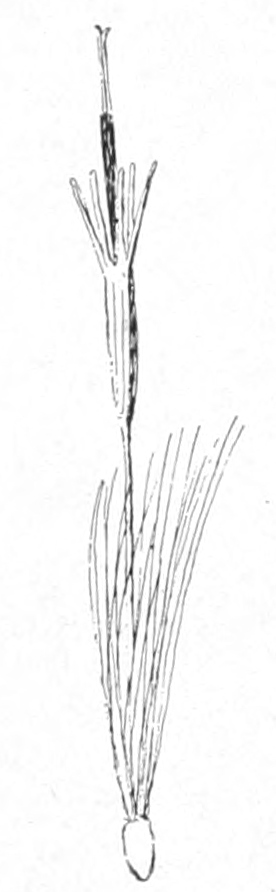
A floret from a thistle flower-head.
For the first season after the seed has rooted, the thistle develops only rosettes, meanwhile putting down roots and becoming permanently established. The next season, the flowers and seeds are developed, and then the plant dies. Would that this fact were true of the Canada thistle; but that, unfortunately, is perennial, and its persistent roots can only be starved out by keeping the stalks cut to the ground for the entire season. This thistle trusts to its extensively creeping rootstocks more than to its seeds for retaining its foothold and for spreading. While it develops many seed balloons, a large number of its seeds are infertile and will not grow.
LESSON CXL
The Common, or Lance-leaved, Thistle
Leading thought—The thistle is covered with sharp spines, and these serve to protect it from grazing animals. It has beautiful purple flowers, arranged in heads similar to those of the sunflower.
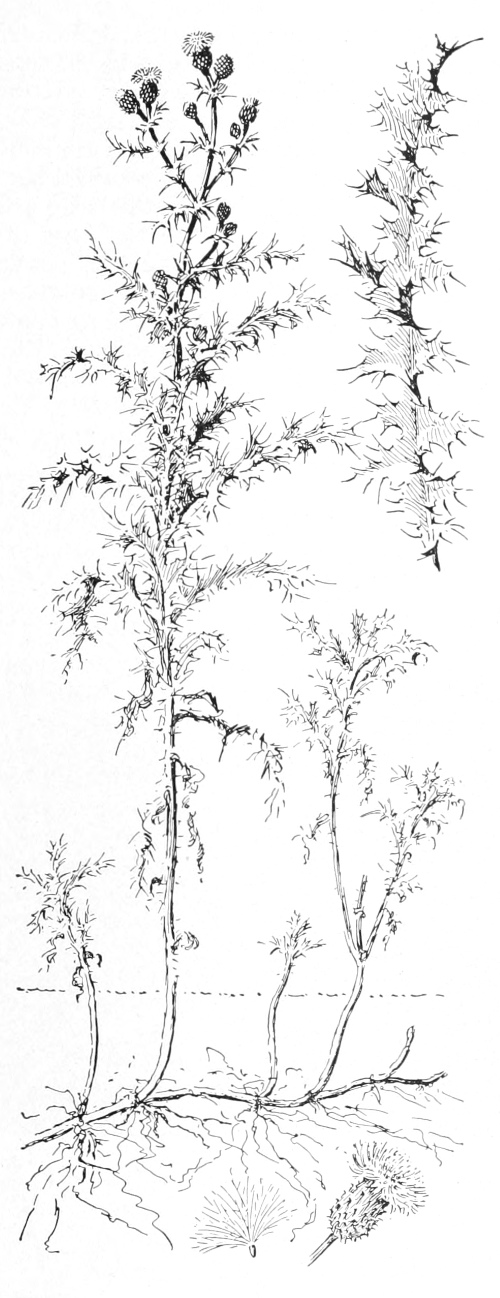
The Canada thistle.
Drawing by W. C. Baker.
Method—A thistle plant brought into the schoolroom—root and all—and placed in water will serve well for this lesson. The questions should be given the pupils as to where thistles are found. Any thistle will do for the lesson.
Observations—1. Where do you find the thistles growing? Do you find more than one species growing thickly together? Do you find any of the common thistles growing in soil which has been cultivated this season?
2. Describe the stalk, is it smooth? Is it weak or strong and woody? What sort of root has it?
3. Do the leaves grow alternately or opposite? Are they smooth or downy on one or both sides? Do the spines grow around the margins, or on the leaves and veins? Are the leaf edges flat, or wavy and ruffled?
4. How does this affect the direction in which the spines point? Are the leaves entire or deeply lobed? Have they petioles, or are they attached directly to the stalk?
5. Note if any buds or small branches nestle in the axils of the lower leaves. What effect does cutting the main stalk seem to have on each side shoot?
6. Do the flower-heads of the thistle grow singly or in clusters? Do they come from the summit of the stalk, or do they branch from its sides? Which blossom-heads open first—the topmost or those lowest on the stalk? Are the flowers fragrant? What insects do you most often see visiting thistle blossoms for pollen or nectar? Study the thistle flower according to Lesson CXXXV.
7. Carefully study a thistle balloon. How is the floss attached to the seed? Is it attached to the smaller, or the larger end? Hold the thistle balloon between your eye and the light. Does the down consist of single separate hairs, or have they many fine branches? How is the down arranged when all the flowers are packed together in the thistle-head? Take a seed from among its closely packed fellows in the thistle-head, and put it in the sun or in a warm, dry place where it cannot blow away. How long does it take for the balloon to open out? What is its shape? Is there any down at the center of the balloon or is it arranged in a funnel-shaped ring? Can you find a perfectly globular thistle balloon with the seeds still attached to it? How far do you think the thistle balloons might travel?
8. If a thistle seed finds a place for planting during the autumn, how does the young plant look the next season? Describe the thistle rosette. What growth does it make the second summer? What happens to it then?
9. Why can you not cultivate out the Canada thistles as you can the other species?
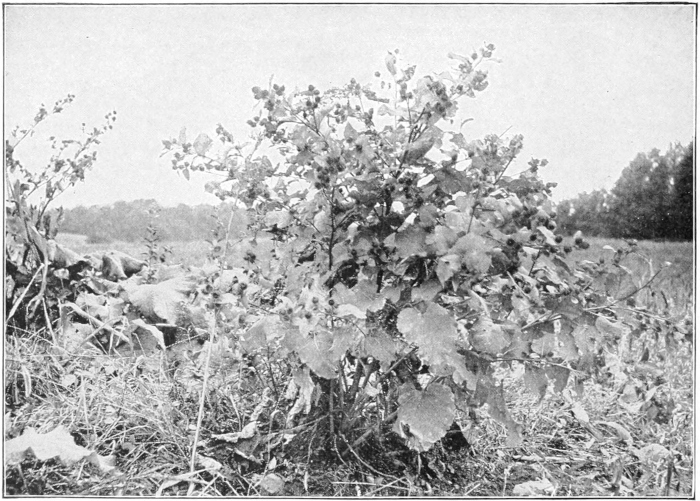
A successful life.
THE BURDOCK
Teacher’s Story
Psychologists say that all young things are selfish, and the young burdock is a shining example of this principle. Its first leaves are broad and long, with long petioles by means of which they sprawl out from the growing stem in every direction, covering up and choking out all the lesser plants near them. In fact, the burdock remains selfish in this respect always, for its great basal leaves see to it that no other plants shall get the good from the soil near its own roots. One wonders at first how a plant with such large leaves can avoid shading itself; but there are some people very selfish toward the world who are very thoughtful of their own families, and the burdock belongs to this class. We must study carefully the arrangement of its leaves in order to understand its cleverness. The long basal leaves are stretched out flat; the next higher, somewhat smaller ones are lifted at a polite angle so as not to stand in their light. This courtesy characterizes all the leaves of the plant, for each higher leaf is smaller and has a shorter petiole, which is lifted at a narrower angle from the stalk; and all the leaves are so nicely adjusted as to form a pyramid, allowing the sunlight to sift down to each part. While some of the uppermost leaves may be scarcely more than an inch long, the lower ones are very large. They are pointed at the tip and wide at the base; where the leaf joins the petiole it is irregular, bordered for a short distance on each side with a vein, and then finished with a “flounce”, which is so full that it even reaches around the main stem—another device for getting more sunlight for itself and shutting it off from plants below. On the lower side, the leaf is whitish and feltlike to the touch; above it is a raw green, often somewhat smooth and shining. The leaf is in quality poor, coarse and flimsy, and it hangs—a web of shoddy—on its strong supporting ribs; lucky for it that its edges are slightly notched and much ruffled, else they would be torn and tattered. The petiole and stems are felty in texture; the petiole is grooved, and expands at its base to grasp the stems on both sides with a certain vicious pertinacity which characterizes the whole plant.
The flower-heads come off at the axils of the upper leaves, and are often so crowded that the leaf is almost lost to sight. It is amazing to behold the number of flower-heads which develop on one thrifty plant. The main stem and the pyramid of lower branching stems, are often crowded with the green balls beset with bracts which are hooked, spiny, and which hold safe the flowers. This composite flower-house is a fortress bristling with spears which are not changed to peaceful pruning-hooks, although they are hooked at the sharp end, every hook turning toward the flowers at the center; the lower bracts are shorter and stand out at right angles, while the others come off at lesser angles, graded so as to form a globular involucre—a veritable block-house. The flower might be a tidbit for the grazing animal; but, if so, he has never discovered it, for these protective hooks have kept him from ever enjoying a taste. The bracts protect, not only by hooks at the tip, but by spreading out at the bases so as to make a thickly battened dwelling for the flower-family.
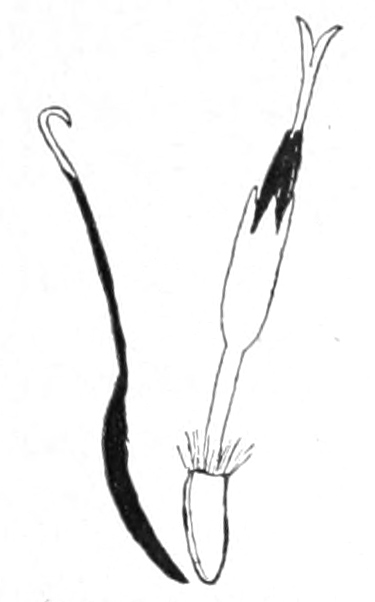
A burdock floret with hooked bract.
But if we tear open one of these little fortresses, we are well repaid in seeing the quite pretty florets. The corollas are long, slender, pink tubes, with five, pointed lobes. The anther-tubes are purple, the pistils and the stigmas white; the stigmas are broad and feathery when they are dusting out the pollen from the anther-tubes, but later they change to very delicate pairs of curly Y’s. The young seed is shining white, and the pappus forms a short, white fluff at the upper margin; but this is simply a family trait, for the burdock seeds never need to be ballooned to their destination; they have a surer method of travel. When in full bloom, the burdock flower heads are very pretty and the skillful child weaver makes them into beautiful baskets. When I was a small girl, I made whole sets of furniture from these flowers; and then, becoming more ambitious, wove some into a coronet which I wore proudly for a few short hours, only to discover later, from my own experience, that great truth which Shakespeare voiced,—“uneasy lies the head that wears the crown.”
In winter, the tough, gray stalks of the burdock still stand; although they may partially break, if they can thus better accomplish their purpose,—always falling toward the path. In this way, they may be sure of inserting the hooks of their seed storehouses into the clothing or covering of the passer-by; and when one gets a hold, mayhap a dozen others will hold hands and follow. If they catch the tail of horse or cow, then indeed they must feel their destiny fulfilled; for the animal, switching about with its uneasy appendage, threshes out the seeds, and unheedingly plants them by trampling them into the ground. Probably some of the livestock of our Pilgrim Fathers came to America thus burdened; for the burdock is a European weed, although now it flourishes too successfully in America. The leaves of the burdock are bitter, and are avoided by grazing animals. Fortunately for us, certain flies and other insects like their bitter taste, and lay eggs upon them, which hatch into larvæ that live all their lives between the upper and lower surfaces of the leaf. Often the leaves are entirely destroyed by the minute-larvæ of a fly, which live together cozily between these leaf blankets, giving the leaves the appearance of being afflicted with large blisters.
The burdocks have long vigorous taproots, and it is therefore difficult to eradicate them without much labor. But persistent cutting off the plant at the root will, if the cut be deep, finally discourage this determined weed.
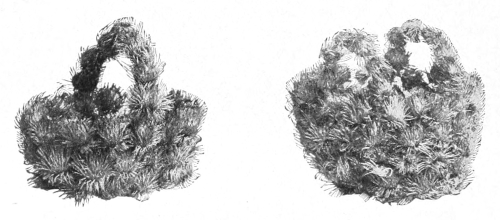
Baskets made from the burdock flower-heads.
LESSON CXLI
The Burdock
Leading thought—The burdock wins because its great leaves shade down plants in its vicinity, and also by having taproots. It scatters its seed by hooking its seed-heads fast to the passer-by.
Method—Study a healthy burdock plant in the field, to show how it shades down other plants and does not shade itself. The flowers and the seed-heads may be brought into the schoolroom for detailed study.
Observations—1. Note a young plant. How much space does its leaves cover? Is anything growing beneath them? How are its leaves arranged to cover so much space? Of what advantage is this to the plant?
2. Study the full-grown plant. How are the lower leaves arranged? At what angles to the stalks do the petioles lie? Are the upper leaves as large as the lower ones? Do they stand at different angles to the stalk?
3. Study the arrangement of leaves on a burdock plant, to discover how it manages to shade down other plants with its leaves and yet does not let its own upper leaves shade those below.
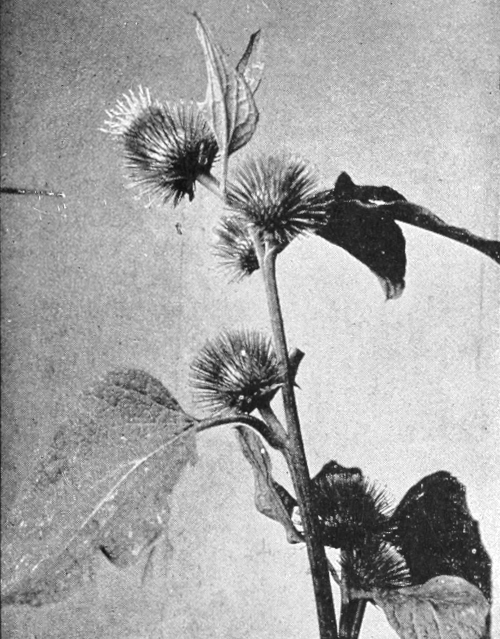
Burdock blossoming.
4. Study a lower and an upper leaf. What is the general shape? What peculiarity where it joins the petiole? What is the texture of the leaf above and below? The color? Describe the petiole and how it joins the stem.
5. Where do the flowers appear on the stem? Are there many flowers developed? Count all the flower-heads on a thrifty burdock.
6. The burdock has its flowers gathered into families, like the sunflower and thistle. Describe the burdock flower-family according to Lesson CXXXV.
7. What insects visit the burdock flowers? Can you make baskets from the flower-heads?
8. Study the burdock again in winter, and see what has happened to it. Describe the seed and the seed-heads. How are the seed-heads carried far away from the parent plant? How many seeds in a single “house?” How do they escape?
9. Write the biography of a burdock plant which came to America as a seed, attached to the tail of a Shetland pony.
PRICKLY LETTUCE, A COMPASS PLANT
Teacher’s Story
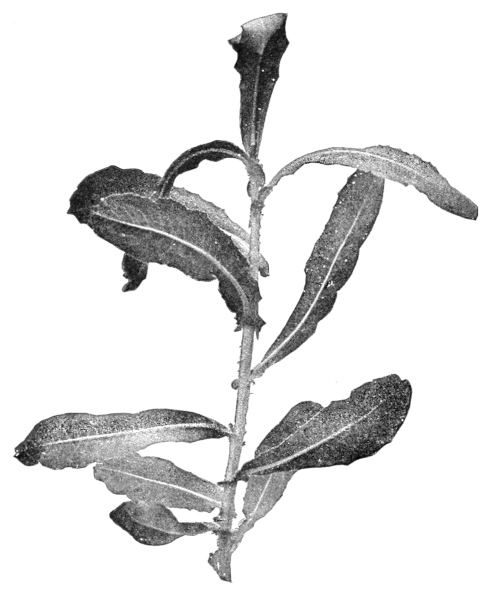
A common compass plant.
Photo by Cyrus Crosby.
The more we know of plants, the more we admire their ways of attaining success in a world where it is only attained by a species after a long struggle. While plants may not be conscious of their own efforts for living on successfully, they have developed them just the same, and they merit our admiration perhaps even more, than as if their strategy was the result of conscious thought. The prickly lettuce has a story to tell us about success attained by the prevention of exhaustion from thirst. In fact, the success of this weed depends much upon its being able to live in dry situations and withstand the long droughts of late summer. The pale green stems grow up slim and tall, bearing leaves arranged alternately and from all sides, since between two, one of which is exactly above the other, two other leaves are borne. Thus, if the leaves stood out naturally, the shape of the whole plant would be a somewhat blunt pyramid. But during the hot, dry weather, the leaves do not stand out straight from the stem; instead, they twist about so that they are practically all in one plane, and usually point north and south, although this is not invariably the case. The way this twisting is accomplished is what interests us in this plant. The long spatulate leaf has a thick, fleshy midrib, and at the base are developed two pointed lobes which clasp the stalk. The leaf is soft and leathery and always seems succulent, because it retains its moisture; it has a ruffled edge near its base, which gives it room for turning without tearing its margin. Each leaf tips over sidewise toward the stem, and as far as necessary to bring one edge uppermost. Thus the sun cannot reach its upper surface to pump water from its tissues. The ruffled margin of the upper edge is pulled out straight when the leaf stands in this position, while the lower margin is more ruffled than ever. Thus, it stands triumphantly, turning edgewise to the sun, retaining its moisture and thriving when cultivated plants are dry and dying.
It also has another “anchor to the windward.” A plant so full of juice would prove attractive food for cattle when pastures are dry. The leaves of this perhaps escape, because each has a row of very sharp spines on the lower side of the midrib. At first we might wonder why they are thus placed; but if we watch a grazing animal, as a cow, reach out her tongue to pull the herbage into her mouth, we see that these spines are placed where they will do the most efficient work. The teasel has the same clever way of warning off meddlesome tongues. The prickly lettuce also has spines on its stem, and the leaves are toothed with spines at their points.
LESSON CXLII
Prickly Lettuce
Leading thought—The sunshine sets the machinery in the leaf-factories going, and incidentally pumps up water from the soil, which pours out into the air from the leaves; but if the soil is dry the pump works just the same, and the plant thus robbed of its water soon withers and dies. The young plants of wild lettuce prevent the sun from pumping them dry during drought, by turning the edges of their leaves toward the sun, and thus not exposing the leaf surface to its rays. The leaves thus lifted stand in one plane. They are usually directed north and south. The lettuce also has spines to protect it from grazing animals.
Method—The lettuce should be studied in the field, and is a good subject for a lesson in late summer or September. This lesson should supplement the one on transpiration. The young plants show this arrangement of the leaves best. The flowers may be studied by the outline given in Lesson CXXXV.
Observations—1. Where does the prickly lettuce grow? What sort of a stem has it? How are the leaves arranged on the stem?
2. If the leaves stood straight out from the stem, what would be the shape of the plant? How do the leaves stand? Is their upper surface exposed to the rays of the sun? Which portion of the leaf is turned toward the sun?
3. If the leaves turn sideways and stand in one plane, do they stand north and south or east and west. How does the edgewise position of the leaf protect the plant during drought? Why does any plant wither during drought? If the leaves of the lettuce should extend east and west instead of north and south, would they get more sun? (See lesson on the Sun.)
4. What is the shape of the lettuce leaf? How does it clasp the stalk? How is the base shaped so that the leaf can turn without tearing its edges? Sketch a leaf thus turned fully, showing how it is done. Does the leaf turn toward the stem or away from it?
5. How are the leaves protected against grazing cattle? How does the cow use her tongue to help bring herbage to her mouth? How are the prickly spines placed on the lettuce leaf, to make the cow’s tongue uncomfortable? Sketch a leaf showing its shape, its venation and its spines.
THE DANDELION
Teacher’s Story
HIS is the most persistent and indomitable of weeds, yet I think the world would be very lonesome without its golden flower-heads and fluffy seed-spheres. Professor Bailey once said that dandelions in his lawn were a great trouble to him until he learned to love them, and then the sight of them gave him keenest pleasure. And Lowell says of this “dear common flower”—
“Tis Spring’s largess, which she scatters now To rich and poor alike, with lavish hand; Though most hearts never understand To take it at God’s value, and pass by The offered wealth with unrewarded eye.”
It is very difficult for us, when we watch the behavior of the dandelions, not to attribute to them thinking power, they have so many ways of getting ahead of us. I always look at a dandelion and talk to it as if it were a real person. One spring when all the vegetables in my garden were callow weaklings, I found there, in their midst, a dandelion rosette with ten great leaves spreading out and completely shading a circle ten inches in diameter; I said, “Look here, Madam, this is my garden!” and I pulled up the squatter. But I could not help paying admiring tribute to the taproot, which lacked only an inch of being a foot in length. It was smooth, whitish, fleshy and, when cut, bled a milky juice showing that it was full of food; and it was as strong from the end-pull as a whipcord; it also had a bunch of rather fine rootlets about an inch below the surface of the soil and an occasional rootlet farther down; and then I said “Madam, I beg your pardon; I think this was your garden and not mine.”
Dandelion leaves afford an excellent study in variation of form. The edges of the leaf are notched in a peculiar way, so that the lobes were, by some one, supposed to look like lions’ teeth in profile; thus the plant was called in France “dents-de-lion” (teeth of the lion), and we have made from this the name dandelion. The leaves are so bitter that grazing animals do not like to eat them, and thus the plants are safe even in pastures.
The hollow stem of the blossom-head from time immemorial has been a joy to children. It may be made into a trombone, which will give to the enterprising teacher an opportunity for a lesson in the physics of sound, since by varying its length, the pitch is varied. The dandelion-curls, which the little girls enjoy making, offer another lesson in physics—that of surface tension, too difficult for little girls to understand. But the action of this flower stem is what makes the dandelion seem so endowed with acumen. If the plant is in a lawn, the stem is short, indeed so short that the lawn-mower cannot cut off the flower-head. In this situation it will blossom and seed within two inches of the ground; but if the plant is in a meadow or in other high grass, the stem lifts up sometimes two feet or more, so that its blossom may be seen by bees and its seeds be carried off by the breeze without let or hindrance from the grass. We found two such stems each measuring over 30 inches in height.
Before a dandelion head opens, the stem, unless very short, is likely to bend down to protect the young flowers, but the night before it is to bloom it straightens up; after the blossoms have matured it may again bend over, but straightens up when the seeds are to be cast off.
It often requires an hour for a dandelion head to open in the morning and it rarely stays open longer than five or six hours; it may require another hour to close. Usually not more than half the flowers of the head open the first day, and it may require several days for them all to blossom. After they have all bloomed and retired into their green house and put up the shutters, it may take them from one to two weeks to perfect their seeds.
In the life of the flower-head the involucre, or the house in which the flower family lives, plays an important part. The involucral bracts, in the row set next to the flowers, are sufficiently long to cover the unopened flowers; the bracts near the stem are shorter and curl back, making a frill. In the freshly opened flower-head, the buds at the middle all curve slightly toward the center, each bud showing a blunt, five-lobed tip which looks like the tips of five fingers held tightly together. The flowers in the outer row blossom first, straightening back and pushing the banner outward; and now we can see that the five lobes in the bud are the five notches at the end of the banner. All the flowers in the dandelion-head have banners, but those at the center, belonging to the younger flowers, have shorter and darker yellow banners. After a banner is unfurled, there pushes out from its tubular base a darker yellow anther-tube; the five filaments below the tube are visible with a lens. A little later, the stigma-ramrod pushes forth from the tube, its fuzzy sides acting like a brush to bring out all the pollen; later it rises far above the anther-tube and quirls back its stigma-lobes, as if every floret were making a dandelion curl of its own. The lens shows us, below the corolla, the seed. The pappus is not set in a collar upon the dandelion seed, as it is in the aster seed; there is a short stem above the seed which is called the “beak” and the pappus is attached to this.
Every day more blossoms open; but on dark, rainy days and during the night the little green house puts up its shutters around the flower-family, and if the bracts are not wide enough to cover the growing family, the banners of the outer flowers have thick or brownish portions along their lower sides which serve to calk the chinks. It is interesting to watch the dandelion stars close as the night falls, and still more interesting to watch the sleepy-heads awaken long after the sun is up in the morning; they often do not open until eight o’clock. The dandelion flower-families are very economical of their pollen and profuse nectar, and do not expose them until the bees and other insects are abroad ready to make morning calls.
After all the florets of a dandelion family have blossomed, they retire again into their green house and devote themselves to perfecting their seeds. They may stay thus in retirement for several days, and during this period the flower stem often grows industriously; and when the shutters of the little green house are again let down, what a different appearance has the dandelion family! The seeds with their balloons are set so as to make an exquisite, filmy globe; and now they are ready to coquette with the wind and, one after another, all the balloons go sailing off. One of these seeds is well worth careful observation through a lens. The balloon is attached to the top of the beak as an umbrella frame is attached to the handle, except that the “ribs” are many and fluffy; while the dandelion youngster, hanging below, has an overcoat armed with grappling hooks, which enable it to cling fast when the balloon chances to settle to the ground.
Father Tabb says of the dandelion,—“With locks of gold today; tomorrow silver gray; then blossom bald.” But not the least beautiful part of the dandelion is this blossom-bald head after all the seeds are gone; it is like a mosaic, with a pit at the center of each figure where the seed was attached. There is an interesting mechanism connected with this receptacle. Before the seeds are fully out this soon-to-be-bald head is concave at the center, later it becomes convex, and the mechanism of this movement liberates the seeds which are embedded in it.
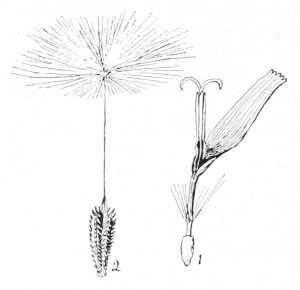
1, Floret of dandelion; 2, seed of dandelion. Both enlarged.
Each freshly opened corolla-tube is full to overflowing with nectar, and much pollen is developed; therefore, the dandelion has many kinds of insect visitors. But perhaps the bee shows us best where the nectar is found; she thrusts her tongue down into the little tubes below the banners, working very rapidly from floret to floret. The dandelion stigmas have a special provision for securing cross-pollenation; and if that fails, to secure pollen from their own flower-family; and now the savants have found that the pistils can also grow seeds without any pollen from anywhere. It surely is a resourceful plant!