Part 2 — III. BATRACHIAN STUDY
Reading edition
THE COMMON TOAD
Teacher’s Story “The toad hopped by us with jolting springs.”—Akers.
HOEVER has not had a pet toad has missed a most entertaining experience. Toad actions are surprisingly interesting; one of my safeguards against the blues is the memory of the thoughtful way one of my pet toads rubbed and patted its stomach with its little hands after it had swallowed a June-bug. Toads do not make warts upon attacking hands, neither do they rain down nor are they found in the bed-rock of quarries; but they do have a most interesting history of their own, which is not at all legendary, and which is very like a life with two incarnations.
The mother toad lays her eggs in May and June in ponds, or in the still pools, along streams; the eggs are laid in long strings of jellylike substance, and are dropped upon the pond bottom or attached to water weeds; when first deposited, the jelly is transparent and the little black eggs can be plainly seen; but after a day or two, bits of dirt accumulate upon the jelly, obscuring the eggs. At first the eggs are spherical, like tiny black pills, but as they begin to develop, they elongate and finally the tadpoles may be seen wriggling in the jelly mass, which affords them efficient protection. After four or five days, the tadpoles usually work their way out and swim away; at this stage, the only way to detect the head, is by the direction of the tadpole’s progress, since it naturally goes head first. However, the head soon becomes decidedly larger, although at first it is not provided with a mouth; it has instead, a V-shaped elevation where the mouth should be, which forms a sucker secreting a sticky substance by means of which the tadpole attaches itself to water weeds, resting head up. When two or three days old, we can detect little tassels on either side of the throat, which are the gills by which the little creature breathes; the blood passes through these gills, and is purified by coming in contact with the air which is mixed in the water. About ten days later, these gills disappear beneath a membrane which grows down over them; but they are still used for breathing, simply having changed position from the outside to the inside of the throat. The water enters the nostrils to the mouth, passes through an opening in the throat and flows over the gills and out through a little opening at the left side of the body; this opening or breathing-pore, can be easily seen in the larger tadpoles; and when the left arm develops, it is pushed out through this convenient orifice.
When about ten days old, the tadpole has developed a small, round mouth which is constantly in search of something to eat, and at the same time constantly opening and shutting to take in air for the gills; the mouth is provided with horny jaws for biting off pieces of plants. As the tadpole develops, its mouth gets larger and wider and extends back beneath the eyes, with a truly toadlike expansiveness.
At first, the tadpole’s eyes are even with the surface of the head and can scarcely be seen, but later they become more prominent and bulge like the eyes of the adult toad.
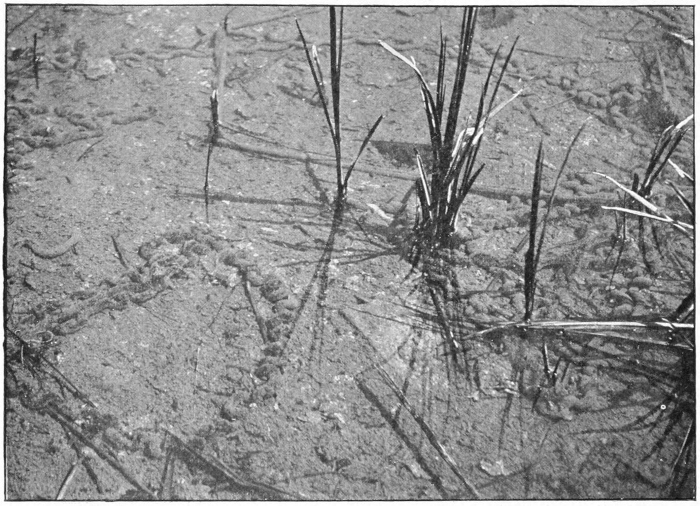
Toad’s eggs. Photo by Verne Morton.
The tail of the tadpole is long and flat, surrounded by a fin, thus making an organ for swimming. It strikes the water, first this side and then that, making most graceful curves, which seem to originate near the body and multiply toward the tip of the tail. This movement propels the tadpole forward, or in any direction. The tail is very thin when seen from above; and it is amusing to look at a tadpole from above, and then at the side; it is like squaring a circle.
There is a superstition that tadpoles eat their tails; and in a sense this is true, because the material that is in the tail is absorbed into the growing body; but the last thing a right-minded tadpole would do, would be to bite off its own tail. However, if some other tadpole should bite off the tail or a growing leg, these organs conveniently grow anew.
When the tadpole is a month or two old, depending upon the species, its hind legs begin to show; they first appear as mere buds which finally push out completely. The feet are long and provided with five toes, of which the fourth is the longest; the toes are webbed so that they may be used to help in swimming. Two weeks later the arms begin to appear, the left one pushing out through the breathing-pore. The “hands” have four fingers and are not webbed; they are used in the water for balancing; while the hind legs are used for pushing, as the tail becomes smaller.
As the tadpole grows older, not only does its tail become shorter but its actions change. It now comes often to the surface of the water in order to get more air for its gills, although it lacks the frog tadpole’s nice adjustment of the growing lungs and the disappearing gills. At last some fine rainy day, the little creature feels that it is finally fitted to live the life of a land animal. It may not be a half inch in length, with big head, attenuated body and stumpy tail, but it swims to the shore, lifts itself on its front legs, which are scarcely larger than pins, and walks off, toeing in, with a very grown up air, and at this moment, the tadpole attains toadship. Numbers of them come out of the water together, hopping hither and thither with all of the eagerness and vim of untried youth. It is when issuing thus in hordes from the water and seen by the ignorant, that they gain the reputation of being rained down, when they really were rained up. It is quite impossible for a beginner to detect the difference between the toad and the frog tadpole; usually those of the toads are black, while those of the frogs are otherwise colored, though this is not an invariable distinction. The best way to distinguish the two is to get the eggs and develop the two families separately.
The general color of the common American toad is extremely variable. It may be yellowish-brown, with spots of lighter color, and with reddish or yellow warts. There are likely to be four irregular spots of dark color along each side of the middle of the back, and the under parts are light colored, often somewhat spotted. The throat of the male toad is black and he is not so bright in color as is the female. The warts upon the back are glands, which secrete a substance disagreeable for the animal seeking toad dinners. This is especially true of the glands in the elongated swelling or wart, above and just back of the ear, which is called the parotid gland; these give forth a milky, poisonous substance when the toad is seized by an enemy, although the snakes do not seem to mind it. Some people have an idea that the toad is slimy, but this is not true; the skin is perfectly dry. The toad feels cold to the hand because it is a cold-blooded animal, which means an animal with blood the temperature of the surrounding atmosphere; while the blood of the warm-blooded animal, has a temperature of its own, which it maintains whether the surrounding air is cold or hot.
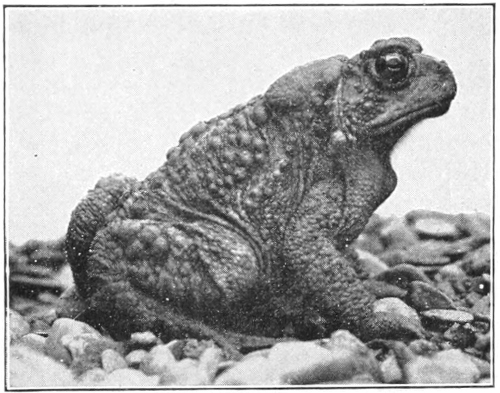
After a hard winter. Photo by Cyrus Crosby.
The toad’s face is well worth study; its eyes are elevated and very pretty, the pupil being oval and the surrounding iris shining like gold. The toad winks in a wholesale fashion, the eyes being pulled down into the head; the eyes are provided with nictitating lids, which rise from below, and are similar to those found in birds. When a toad is sleeping, its eyes do not bulge but are drawn in, so as to lie even with the surface of the head. The two tiny nostrils are black and are easily seen; the ear is a flat, oval spot behind the eye and a little lower down; in the common species it is not quite so large as the eye; this is really the ear-drum, since there is no external ear like ours. The toad’s mouth is wide and its jaws are horny; it does not need teeth since it swallows its prey whole.
The toad is a jumper, as may be seen from its long, strong hind legs, the feet of which are also long and strong and armed with five toes that are somewhat webbed. The “arms” are shorter and there are four “fingers” to each “hand;” when the toad is resting, its front feet toe-in, in a comical fashion. If a toad is removed from an earth or moss garden, and put into a white wash-bowl, in a few hours it will change to a lighter hue, and vice versa. This is part of its protective color, making it inconspicuous to the eyes of its enemy. It prefers to live in cool, damp places, beneath sidewalks or piazzas, etc., and its warty upper surface resembles the surrounding earth. If it is disturbed, it will seek to escape by long leaps and acts frightened; but if very much frightened, it flattens out on the ground, and looks so nearly like a clod of earth that it may escape even the keen eyes of its pursuer. When seized by the enemy, it will sometimes “play possum,” acting as if it were dead; but when actually in the mouth of the foe, it emits terrified and heart-rending cries.
The toad’s tongue is attached to the lower jaw, at the front edge of the mouth; it can thus be thrust far out, and since it secretes a sticky substance over its surface, any insects which it touches adhere, and are drawn back into the mouth and swallowed. It takes a quick eye to see this tongue fly out and make its catch. The tadpole feeds mostly upon vegetable matter, but the toad lives entirely upon small animals, usually insects; it is not particular as to what kind of insects; but because of the situations which it haunts, it usually feeds upon those which are injurious to grass and plants. Indeed, the toad is really the friend of the gardener and farmer, and has been most ungratefully treated by those whom it has befriended. If you doubt that a toad is an animal of judgment, watch it when it finds an earthworm and set your doubts at rest! It will walk around the squirming worm, until it can seize it by the head, apparently knowing well that the horny hooks extending backward from the segments of the worm, are likely to rasp the throat if swallowed the wrong way. If the worm prove a too large mouthful, the toad promptly uses its hands in an amusing fashion to stuff the wriggling morsel down its throat. When swallowing a large mouthful, it closes its eyes; but whether this aids the process, or is merely an expression of bliss, we have not determined. The toad never drinks by taking in water through the mouth, but absorbs it through the skin; when it wishes to drink, it stretches itself out in shallow water and thus satisfies its thirst; it will waste away and die in a short time, if kept in a dry atmosphere.
The toad burrows in the earth by a method of its own, hard to describe. It kicks backward with its strong hind legs, and in some mysterious way, the earth soon covers all excepting its head; then, if an enemy comes along, back goes the head, the earth caves in around it, and where is your toad! It remains in its burrow or hiding place usually during the day, and comes out at night to feed. This habit is an advantage, because snakes are then safely at home and, too, there are many more insects to be found at night. The sagacious toads have discovered that the vicinity of street lights is swarming with insects, and there they gather in numbers. In winter they burrow deeply in the ground and go to sleep, remaining dormant until the warmth of spring awakens them; then, they come out, and the mother toads seek their native ponds there to lay eggs for the coming generation. They are excellent swimmers; when swimming rapidly, the front legs are laid backward along the sides of the body, so as to offer no resistance to the water; but when moving slowly, the front legs are used for balancing and for keeping afloat.
The song of the toad is a pleasant, crooning sound, a sort of gutteral trill; it is made when the throat is puffed out almost globular, thus forming a vocal sac; the sound is made by the air drawn in at the nostrils and passed back and forth from the lungs to the mouth over the vocal chords, the puffed-out throat acting as a resonator.
The toad has no ribs by which to inflate the chest, and thus draw air into the lungs, as we do when we breathe; it is obliged to swallow the air instead and thus force it into the lungs. This movement is shown in the constant pulsation, in and out, of the membrane of the throat.
As the toad grows, it sheds its horny skin, which it swallows; as this process is usually done strictly in private, the ordinary observer sees it but seldom. One of the toad’s nice common qualities is its enjoyment in having its back scratched gently.
The toad has many enemies; chief among these is the snake and in only a lesser degree, crows and also birds of prey.
Reference—The Frog Book, Dickerson; Familiar Life in Field and Forest, Mathews; The Usefulness of the American Toad, U. S. Dept. Agr., Farmers Bulletin, No. 196.
LESSON XLIV
The Tadpole Aquarium
Leading thought—The children should understand how to make the tadpoles comfortable and thus be able to rear them.
Materials—A tin or agate pan or a deep earthenware wash-bowl.
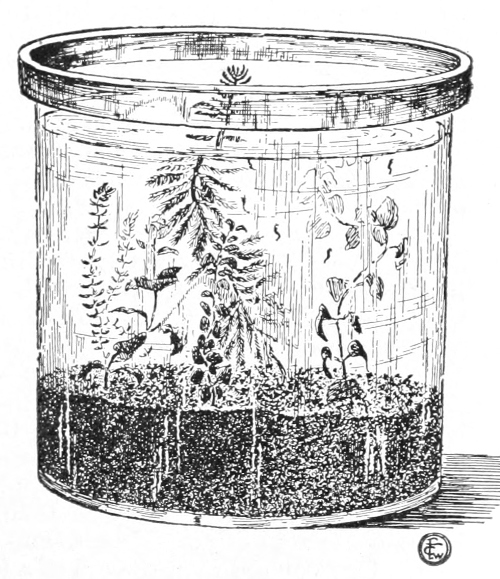
Things to be done—1. Go to some pond where tadpoles live.
2. Take some of the small stones on the bottom and at the sides of the pond lifting them very gently so as not to disturb what is growing on their surface. Place these stones on the bottom of the pan, building up one side higher than the other, so that the water will be more shallow on one side than on the other; a stone or two should project above the water.
3. Take some of the mud and leaves from the bottom of the pond, being careful not to disturb them and place upon the stones.
4. Take some of the plants found growing under water in the pond and plant them among the stones.
5. Carry the pan thus prepared back to the schoolhouse and place it where the sun will not shine directly upon it.
6. Bring a pail of water from the pond and pour it very gently in at one side of the pan, so as not to disarrange the plants; fill the pan nearly to the brim.
7. After the mud has settled and the water is perfectly clear, remove some of the tadpoles, which have hatched in the glass aquarium, and place in the “pond.” Not more than a dozen should be put in a pan of this size, since the amount of food and microscopic plants which are on the stones in the mud, will afford food for only a few tadpoles.
8. Every week add a little more mud from the bottom of the pond or another stone covered with slime, which is probably some plant growth. More water from the pond should be added to replace that evaporated.
9. Care should be taken that the tadpole aquarium be kept where the sun will not shine directly upon it for any length of time, because if the water gets too warm the tadpoles will die.
10. Remove the “skin” from one side of a tulip leaf, so as to expose the pulp of the leaf, and give to the tadpoles every day or two. Bits of hard-boiled egg should be given now and then.
Toads’ Eggs and Tadpoles
Leading thought—The toad’s eggs are laid in strings of jelly in ponds. The eggs hatch into tadpoles which are creatures of the water, breathing by gills, and swimming with a long fin. The tadpoles gradually change to toads, which are air-breathing creatures, fitted for life on dry land.
Method—The eggs of toads may be found in almost any pond about the first of May and may be scraped up from the bottom in a scoop-net. They should be placed in the aquarium where the children can watch the stages of development. Soon after they are hatched, a dozen or so should be selected and placed in the tadpole aquarium and the others put back into the stream. The children should observe the tadpoles every day, watching carefully all the changes of structure and habit which take place. If properly fed, the tadpoles will be ready to leave the water in July, as tiny toads.
Observations—1. Where were the toads’ eggs found and on what date? Were they attached to anything in the water or were they floating free? Are the eggs in long strings? Do you find any eggs laid in jellylike masses? If so, what are they? How can you tell the eggs of toads from those of frogs?
2. Is the jellylike substance in which the eggs are placed clear or discolored? What is the shape and the size of the eggs? A little later how do they look? Do the young tadpoles move about while they are still in the jelly mass?
3. Describe how the little tadpole works its way out from the jelly covering. Can you distinguish then which is head and which is tail? How does it act at first? Where and how does it rest?
4. Can you see with the aid of a lens the little fringes on each side of the neck? What are these? Do these fringes disappear a little later? Do they disappear on both sides of the neck at once? What becomes of them? How does the tadpole breathe? Can you see the little hole on the left side, through which the water used for breathing passes?
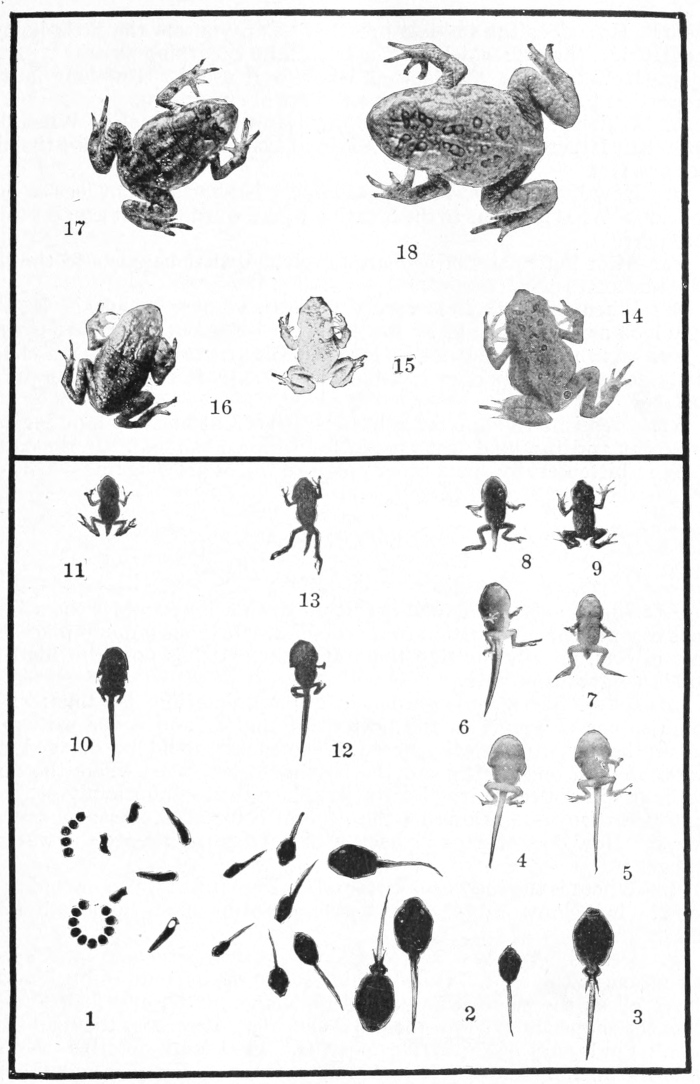
Toad development in a single season (1903).
1–18, Changes and growth from April to November 1–13, Development in 25 to 60 days 9–14, Different sizes, July 30, 1903 15–18, Different sizes, October 21, 1903 10, 11, The same tadpole, 11 is 47 hours older than 10 12, 13, The same tadpole, 13 is 47 hours older than 12
Photo by S. H. Gage.
5. How does the tail look and how is it used? How long is it in proportion to the body? Describe the act of swimming.
6. Which pair of legs appears first? How do they look? When they get a little larger are they used as a help in swimming? Describe the hind legs and feet.
7. How long after the hind legs appear before the front legs or arms appear? What happens to the breathing-pore when the left arm is pushed through?
8. After both pairs of legs are developed what happens to the tail? What becomes of it?
9. When the tadpole is very young can you see its eyes? How do they look as it grows older? Do they ever bulge out like toads’ eyes?
10. As the tadpole gains its legs and loses its tail how does it change in its actions? How does it swim now? Does it come oftener to the surface? Why?
11. Describe the difference between the front and the hind legs and the front and the hind feet on the fully grown tadpole. If the tail or a leg is bitten off by some other creature will it grow again?
LESSON XLV
The Toad
Leading thought—The toad is colored so that it resembles the soil and thus escapes the observation of its enemies. It lives in damp places and eats insects, usually hunting them at night. It has powerful hind legs and is a vigorous jumper.
Method—Make a moss garden in a glass aquarium jar thus: Place some stones or gravel in the bottom of the jar and cover with moss. Cover the jar with a wire screen. The moss should be deluged with water at least once a day and the jar should be placed where the direct sunlight will not reach it. In this jar, place the toad for study.
Observations—1. Describe the general color of the toad above and below. How does the toad’s back look? Of what use are the warts on its back?
2. Where is the toad usually found? Does it feel warm or cold to the hand? Is it slimy or dry? The toad is a cold-blooded animal, what does this mean?
3. Describe the eyes and explain how their situation is of special advantage to the toad. Do you think it can see in front and behind and above all at the same time? Does the bulge of the eyes help in this? Note the shape and color of the pupil and iris. How does the toad wink?
4. Find and describe the nostrils. Find and describe the ear. Note the swelling above and just back of the ear. Do you know the use of this?
5. What is the shape of the toad’s mouth? Has it any teeth? Is the toad’s tongue attached to the front or the back part of the mouth? How is it used to catch insects?
6. Describe the “arms and hands.” How many “fingers” on the “hand?” Which way do the fingers point when the toad is sitting down?
7. Describe the legs and feet. How many toes are there? What is the relative length of the toes and how are they connected? What is this web between the toes for? Why are the hind legs so much larger than the front legs?
8. Will a toad change color if placed upon different colored objects? How long does it take it to do this? Of what advantage is this to the toad?
9. Where does the toad live? When it is disturbed how does it act? How far can it jump? If very frightened does it flatten out and lie still? Why is this?
10. At what time does the toad come out to hunt insects? How does it catch the insect? Does it swallow an earthworm head or tail first? When swallowing an earthworm or large insect, how does it use its hands? How does it act when swallowing a large mouthful?
11. How does the toad drink? Where does it remain during the day? Describe how it burrows into the earth.
12. What happens to the toad in the winter? What does it do in the spring? Is it a good swimmer? How does it use its legs in swimming?
13. How does the toad look when croaking? What sort of a noise does it make?
14. Describe the action of the toad’s throat when breathing. Did you ever see a toad shed its skin?
15. What are the toad’s enemies? How does it act when caught by a snake? Does it make any noise? Is it swallowed head or tail first? What means has it of escaping or defending itself from its enemies?
16. How is the toad of great use to the farmer and gardener?
References—“The Life History of the Toad,” by S. H. Gage, Cornell Nature-Study Volume; The Frog Book, Dickerson.
Supplementary reading—“K’dunk, the fat one,” A Little Brother to the Bear, Long.
“In the early years we are not to teach nature as science, we are not to teach it primarily for method or for drill: we are to teach it for loving—and this is nature-study. On these points I make no compromise.” —L. H. Bailey.
THE TREE-FROG, OR TREE-TOAD
Teacher’s Story
“Ere yet the earliest warbler wakes, of coming spring to tell, From every marsh a chorus breaks, a choir invisible, As if the blossoms underground, a breath of utterance had found.” —Tabb.
SSOCIATED with the first songs of robin and bluebird, is the equally delightful chorus of the spring peepers, yet how infrequently do most of us see a member of this invisible choir! There are some creatures which are the quintessence of the slang word “cute” which, interpreted, means the perfection of Lilliputian proportions, permeated with undaunted spirit. The chickadee is one of these, and the tree-frog is another. I confess to a thrill of delight when the Pickering’s hyla lifts itself on its tiny front feet, twists its head knowingly, and turns on me the full gaze of its bronze-rimmed eyes. This is the tiniest froglet of them all, being little more than an inch long when fully grown; it wears the Greek cross in darker color upon its back, with some stripes across its long hind legs which join the pattern on the back when the frog is “shut up,” as the boys say.
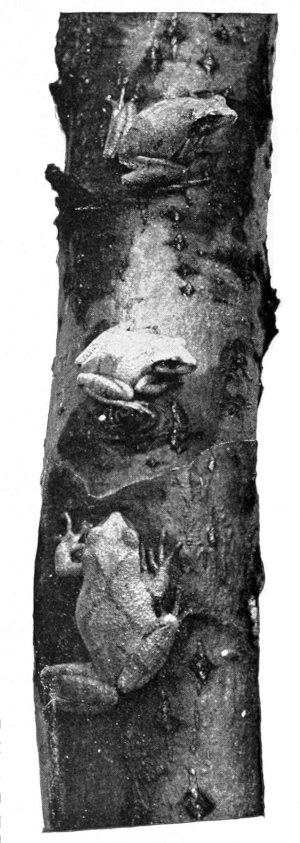
Sitting for their pictures. Pickering’s Hyla. Photo by Cyrus Crosby.
The reason we see so little of tree-frogs, is because they are protected from discovery by their color. They have the chameleon power of changing color to match their background. The Pickering’s hyla will effect this change in twenty minutes; in this species, the darker lines forming the cross change first, giving a mottled appearance which is at once protective. I have taken three of these peepers, all of them pale yellowish brown with gray markings, and have placed one upon a fern, one on dark soil and one on the purple bud of a flower. Within half an hour, each matched its surroundings so closely, that the casual eye would not detect them. The song of the Pickering’s hyla is a resonant chirp, very stirring when heard nearby; it sounds somewhat like the note of a water bird. How such a small creature can make such a loud noise, is a mystery. The process, however, may be watched at night by the light of a lamp, as none of the tree-frogs seem to pay any attention to an artificial light; the thin membrane beneath the throat swells out until it seems almost large enough to balloon the little chap off his perch. No wonder that, with such a sounding-sac, the note is stirring. There are several species of tree-frogs that trill in the branches above our heads all summer, and their songs are sometimes mistaken for those of the cicada, which is far more shrill.
The tree-frogs have toes and fingers ending in little round discs which secrete at will a substance by means of which they can cling to vertical surfaces, even to glass. In fact, the way to study these wonderful feet is when the frog is climbing up the sides of the glass jar. The fingers are arranged, two short inside ones, a long one, and another short one outside. The hind feet have three shorter inside toes quite far apart, a long one at the tip of the foot and a shorter one outside. When climbing a smooth surface like glass, the toes are spread wide apart, and there are other little clinging discs on their lower sides, although not so large as those at the tips. It is by means of these sticky, disc-like toes that the tree-frogs hold themselves upon the tree trunks.
The whole body of the tree-frog is covered with little tubercles, which give it a roughened appearance. The eyes are black with the iris of reddish color. The tongue is like that of other frogs, hinged to the front of the lower jaw; it is sticky and can be thrust far out to capture insects, of which the tree-frogs eat vast numbers.
The hylas breathe by the rapid pulsation of the membrane of the throat, which makes the whole body tremble. The nostrils are two tiny holes on either side of the tip of the snout. The ears are a little below and just behind the eyes, and are in the form of a circular slit.
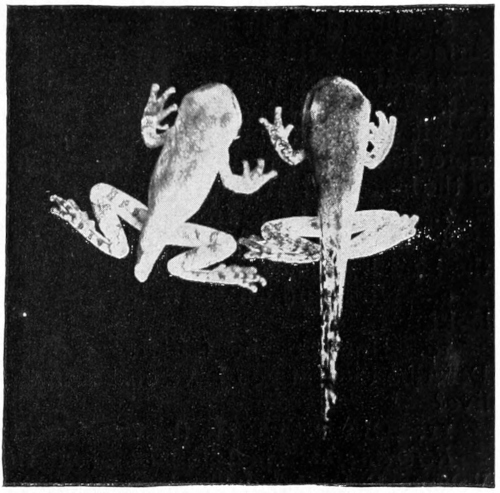
Tree-frog tadpoles.
The eggs of the spring peepers are laid in ponds during April; each egg has a little globe of jelly about it and is fastened to a stone or a water plant. The tadpoles are small and delicate; the under side of the body is reddish and shines with metallic lustre. These tadpoles differ from those of other frogs in that they often leave the water while yet the tail is still quite long. In summer, they may be found among the leaves and moss around the banks of ponds. They are indefatigable in hunting for gnats, mosquitoes and ants; their destruction of mosquitoes, as pollywogs and as grown up frogs, renders them of great use to us. The voice of this peeper may be heard among the shrubs and vines or in trees during late summer and until November. The little creatures sleep beneath moss and leaves during the winter, waking to give us the earliest news of spring.
LESSON XLVI
The Tree-frog or Tree-toad
Leading thought—The prettiest part of the spring chorus of the frog ponds is sung by the tree-frogs. These little frogs have the tips of their toes specially fitted for climbing up the sides of trees.
Method—Make a moss garden in an aquarium jar or a two-quart can. Place stones in the bottom and moss at one side, leaving a place on the other side for a tiny pond of water. In this garden place a tree-frog and cover the jar with mosquito netting and place in the shade. The frogs may be found by searching the banks of a pond at night with a lantern. However, this lesson is usually given when by accident the tree-frog is discovered. Any species of tree-frog will do; but the Pickering’s hyla, known everywhere as the spring peeper, is the most interesting species to study.
Observations—1. How large is the tree-frog? What is its color? Describe the markings.
2. Place the tree-frog on some light-colored surface like a piece of white blotting paper. Note if it changes color after a half hour. Later place it upon some dark surface. Note if it changes color again. How does this power of changing color benefit the tree-frog? Place a tree-frog on a piece of bark. After a time is it noticeable?
3. Describe the eyes. Note how little the tree-frog turns its head to see anything behind it. Describe its actions if its attention is attracted to anything. What color is the pupil? The iris?
4. Note the movement of breathing. Where does this show the most? Examine the delicate membrane beneath the throat. What has this to do with the breathing?
5. What is the tree-frog’s note? At what time of day does it peep? At what time of year? Describe how the frog looks when peeping.
6. How does the tree-frog climb? When it is climbing up a vertical surface study its toes. How many on the front foot? How are they arranged? How many toes on the hind foot? Sketch the front and hind feet. How do the toe-discs look when pressed against the glass? How does it manage to make the discs cling and then let go? Are there any more discs on the under side of the toes? Is there a web between the toes of the hind feet? Of the front feet?
7. Look at a tree-frog very closely and describe its nostrils and its ears.
8. Are the tree-frogs good jumpers? What is the size and length of the hind legs as compared with the body?
9. When and where are the eggs of the tree-frog laid? How do they look?
10. How do the tree-frog tadpoles differ from other tadpoles? Describe them if you have ever seen them. In what situations do they live?
11. Of what use are the tree-frogs to us?
References—“The Life History of the Toad,” Cornell Nature Study Volume, S. H. Gage; The Frog Book, Dickerson; Familiar Life of Field and Forest, Mathews; American Natural History, Hornaday; Elementary Zoology, V. L. Kellogg; From River Ooze to Tree-top, Sharp.
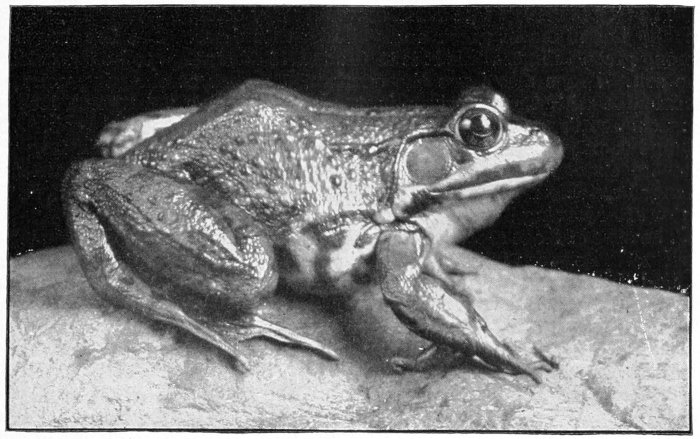
Bullfrog.
THE FROG
Teacher’s Story
HE stroller along brooksides, is likely to be surprised some day, at seeing a bit of moss and earth suddenly make a high leap and a far one, without apparent provocation. An investigation resolves the clump of moss into a brilliantly green and yellow, striped frog, and then the stroller wonders how he could have overlooked such an obvious creature. But the leopard frog is only obvious when it is out of its environment. The common green frog is quite as well protected since its color is exactly that of green pools. Most frogs spend their lives in or about water, and if caught on land, they make great leaps to reach their native element; the leopard frog and a few other species sometimes wander far afield.
In form, the frog is more slim than the toad, and is not covered with great warts; it is cold and slippery to the touch. The frog’s only chance of escaping its enemies, is through the slipperiness of its body and by making long, rapid leaps. As a jumper, the frog is much more powerful than the toad because its hind legs are so much larger and more muscular, in comparison with its size. The first toe in the front feet of the leopard frog is much swollen, making a fat thumb; the mechanics of the hind legs make it possible for the frog to feather the webbed feet as it swims. On the bottom of the toes are hardened places at the joints, and sometimes others besides, which give the foot a strong hold when pushing for the jump. The toe tips, when they are pressed against the glass, resemble slightly the tree-toads’ discs. The hind foot is very long, while on the front foot the toes radiate almost in a circle. The foot and leg are colored like the back of the body above, and on the under side resemble the under parts.
The frog is likely to be much more brightly colored than the toad, and usually has much of green and yellow in its dress. But the frog lives among green things, while it is to the toad’s advantage to be the color of the soil. Frogs also have the chameleon power of changing color, to harmonize with their environment. I have seen a very green leopard frog change to a slate-gray when placed upon slate-colored rock. The change took place in the green portions. The common green frog will likewise change to slate-color, in a similar situation. A leopard frog changed quickly from dark green to pale olive, when it was placed in the water after having been on the soil.
The eyes of frogs are very prominent, and are beautiful when observed closely. The green frog has a dark bronze iris with a gleaming gold edge around the pupil, and around the outer margin. The eye of the leopard frog is darker; the iris seems to be black, with specks of ruddy gold scattered through it, and there is an outer band of red-gold around the margin. When the frog winks, the nictitating membrane rises from below and covers the whole eye; and when the frog makes a special effort of any sort, it has a comical way of drawing its eyes back into its head. When trying to hide at the bottom of the aquarium, the leopard species lets the eye-lids fall over the eyes, so that they do not shine up and attract pursuers.
The ear is in a similar position to that of the toad, and in the bullfrog, is larger than the eye. In the green frog, it is a dull grayish disc, almost as large as the eye. In the leopard frog, it is not so large as the eye, and has a giltish spot at the center.
The nostrils are small and are closed when below the water, as may be easily seen by a lens. The mouth opens widely, the corners extending back under the eye. The jaws are horny and are armed with teeth, which are for the purpose of biting off food rather than for chewing it. When above water, the throat keeps up a rythmic motion which is the process of breathing; but when below water this motion ceases. The food of frogs is largely composed of insects, that frequent damp places or that live in the water.
The sound-sacs of the frogs, instead of being beneath the throat, as is the case with toads and tree-frogs, are at the side of the throat; and when inflated, may extend from just back of the eyes, out above the front legs. The song is characteristic, and pleasant to listen to, if not too close by. Perhaps exception should be made to the lay of the bullfrog, which like the song of some noted opera singers, is more wonderful than musical; the boom of the bullfrog makes the earth fairly quake. If we seize the frog by the hind leg, it will usually croak and thus demonstrate for us, the position of its sound-sacs.
In addition to the snakes, the frogs have inveterate enemies in the herons which frequent shallow water, and eat them in great numbers. The frogs hibernate in mud and about ponds, burrowing deep enough to escape freezing. In the spring, they come up and sing their spring songs and the mother frogs lay their eggs in masses of jelly on the bottom of the pond, usually where the water is deeper than in the situations where the toads’ eggs are laid. The eggs of the two can always be distinguished, since the toads’ are laid in strings of jelly, while the frogs’ are laid in masses.
It is amusing to watch with a lens, the frog tadpoles seeking for their microscopic food along the glass of the aquarium. There are horny upper and lower jaws, the latter being below and back of the former. The upper jaw moves back and forth slightly and rythmically, but the dropping of the lower jaw opens the mouth. There are three rows of tiny black teeth below the mouth and one row above; at the sides and below these teeth are little, finger-like fringes. Fringes, rows of teeth and jaws all work together, up and down, out and in, in the process of breathing. The nostrils, although minute, are present in the tadpole in its early stages. The pupil of the eye is almost circular and the iris is usually yellow or copper-bronze, with black mottling. The eyes do not wink nor withdraw. The breathing-pore on the left side, is a hole in a slight protuberance.
At first, the tadpoles of the frogs and toads are very much alike; but later, most of the frog tadpoles are lighter in color, usually being olive-green, mottled with specks of black and white. The frog tadpoles usually remain much longer than the toads in the tadpole stage, and when finally they change to adults, they are far larger in size than the toads are, when they attain their jumping legs.
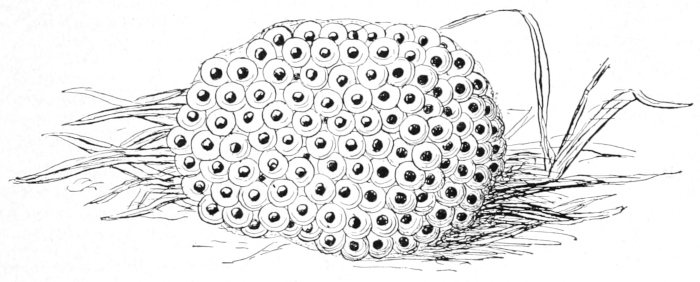
Frog’s eggs.
LESSON XLVII
The Frog
Leading thought—The frog lives near or in ponds or streams. It is a powerful jumper and has a slippery body. Its eggs are laid in masses of jelly at the bottom of ponds.
Method—The frog may be studied in its native situation by the pupils or it may be brought to the school and placed in an aquarium; however, to make a frog aquarium there needs to be a stick or stone projecting above the water, for the frog likes to spend part of the time entirely out of water or only partially submerged.
Observations—1. Where is the frog found? Does it live all its life in the water? When found on land how and where does it seek to escape?
2. Compare the form of the frog with that of the toad. Describe the skin, its color and texture. Compare the skin of the two.
3. Describe the colors and markings of the frog on the upper and on the under side. How do these protect it from observation from above? From below? How do we usually discover that we are in the vicinity of a frog?
4. Describe the frog’s ears, eyes, nostrils and mouth.
5. Compare its “hands and feet” with those of the toad. Why the difference in the hind legs and feet?
6. How does the frog feel to your hand? Is it easy to hold him? How does this slipperiness of the frog benefit it?
7. On what does the frog feed? What feeds on it? How does it escape its enemies?
8. What sounds does the frog make? Where are its sound sacs located? How do they look when they are inflated?
9. Is the frog a good swimmer? Is it a better jumper than the toad? Why?
10. Where are the frog’s eggs laid? How do they look?
11. Can you tell the frog tadpoles from those of the toad? Which remains longer in the tadpole stage? Study the frog tadpoles, following the questions given in Lesson XLIV.
12. What happens to the frog in winter?
FESTINA LENTE Once on a time there was a pool Fringed all about with flag-leaves cool And spotted with cow-lilies garish, Of frogs and pouts the ancient parish. Alders the creaking redwings sink on, Tussocks that house blithe Bob o’ Lincoln, Hedged round the unassailed seclusion, Where muskrats piled their cells Carthusian; And many a moss-embroidered log, The watering-place of summer frog, Slept and decayed with patient skill, As watering-places sometimes will. Now in this Abbey of Theleme, Which realized the fairest dream That ever dozing bull-frog had, Sunned, on a half-sunk lily pad, There rose a party with a mission To mend the polliwog’s condition, Who notified the selectmen To call a meeting there and then. “Some kind of steps,” they said, “are needed; They don’t come on so fast as we did: Let’s dock their tails; if that don’t make ’em Frogs by brevet, the Old One take ’em! That boy, that came the other day To dig some flag-root down this way, His jack-knife left, and ’tis a sign That Heaven approves of our design: ’Twere wicked not to urge the step on, When Providence has sent the weapon.” Old croakers, deacons of the mire, That led the deep batrachian choir, “Uk! Uk! Caronk!” with bass that might Have left Lablache’s out of sight, Shook nobby heads, and said “No, go! You’d better let ’em try to grow: Old Doctor Time is slow, but still He does know how to make a pill.” But vain was all their hoarsest bass, Their old experience out of place, And spite of croaking and entreating The vote was carried in marsh-meeting. “Lord knows,” protest the polliwogs, “We’re anxious to be grown-up frogs; But don’t push in to do the work Of Nature till she prove a shirk; ’Tis not by jumps that she advances, But wins her way by circumstances; Pray, wait awhile, until you know We’re so contrived as not to grow; Let Nature take her own direction, And she’ll absorb our imperfection; You mightn’t like ’em to appear with, But we must have the things to steer with.” “No,” piped the party of reform, “All great results are ta’en by storm; Fate holds her best gifts till we show We’ve strength to make her let them go; The Providence that works in history, And seems to some folks such a mystery, Does not creep slowly on, incog., But moves by jumps, a mighty frog; No more reject the Age’s chrism, Your queues are an anachronism; No more the future’s promise mock, But lay your tails upon the block, Thankful that we the means have voted To have you thus to frogs promoted.” The thing was done, the tails were cropped, And home each philotadpole hopped, In faith rewarded to exult, And wait the beautiful result. Too soon it came; our pool, so long The theme of patriot bull-frog’s song, Next day was reeking, fit to smother, With heads and tails that missed each other,— Here snoutless tails, there tailless snouts; The only gainers were the pouts. MORAL From lower to the higher next, Not to the top is Nature’s text; And embryo Good, to reach full stature, Absorbs the Evil in its nature. —Lowell.
THE NEWT, EFT OR SALAMANDER
Teacher’s Story
FTER a rain in spring or summer, we see these little orange-red creatures sprawling along roads or woodland paths, and since they are rarely seen except after rain, the wise people of old, declared they rained down, which was an easy way for explaining their presence. But the newts do not rain down, they rain up instead, since if they have journeys to make they must needs go forth when the ground is wet, otherwise they would dry up and die. Thus, the newts make a practice of never going out except when it rains. A closer view of the eft shows plenty of peculiarities in its appearance to interest us. Its colors are decidedly gay, the body color being orange, ornamented with vermilion dots along each side of the back, each red dot margined with tiny black specks; but the eft is careless about these decorations and may have more spots on one side than on the other. Besides these vermilion dots, it is also adorned with black specks here and there, and especially along its sides, looks as if it had been peppered. The newt’s greatest beauty lies in its eyes; these are black, with elongated pupils, almost parallel with the length of the head, and bordered above and below with bands of golden, shining iris which give the eyes a fascinating brilliancy. The nostrils are mere pin-holes in the end of the snout.
The legs and feet look queerly inadequate for such a long body, since they are short and far apart. There are four toes on the front feet and five on the hind feet, the latter being decidedly pudgy. The legs are thinner where they join the body and wider toward the feet. The eft can move very rapidly with its scant equipment of legs. It has a misleading way of remaining motionless for a long time and then darting forward like a flash, its long body falling into graceful curves as it moves. But it can go very slowly when exploring; it then places its little hands cautiously and lifts its head as high as its short arms will allow, in order to take observations. Although it can see quite well, yet on an unusual surface, like glass, it seems to feel the way by touching its lower lip to the surface as if to test it. The tail is flattened at the sides and is used to twine around objects in time of need; and I am sure it is also used to push the eft while crawling, for it curves this way and that vigorously, as the feet progress, and obviously pushes against the ground. Then, too, the tail is an aid when, by some chance, the eft is turned over on its back, for with its help, it can right itself speedily. The eft’s method of walking is interesting; it moves forward one front foot and then the hind foot on the other side; after a stop for rest, it begins just where it left off when it again starts on. Its beautiful eyes seem to serve the newt well indeed, for I find that, when it sees my face approaching the moss jar, it climbs promptly over to the other side. There are no eyelids for the golden eyes, but the eft can pull them back into its head and close the slit after them, thus making them very safe.
The eft with whose acquaintance I was most favored, was not yet mature and was afraid of earthworms; but he was very fond of plant-lice and it was fun to see the little creature stalking them. A big rose plant-louse would be squirming with satisfaction as it sucked the juice of the leaf, when the eft would catch sight of it and become greatly excited, evidently holding his breath since the pulsating throat would become rigid. There was a particularly alert attitude of the whole front part of the body and especially of the eyes and the head; then the neck would stretch out long and thin, the orange snout approach stealthily within half an inch of the smug aphid, and then there was a flash as of lightning, something too swift to see coming out of the eft’s mouth and swooping up the unsuspecting louse. Then there would be a gulp or two and all would be over. If the aphid happened to be a big one, the eft made visible effort to swallow it. Sometimes his eftship would become greatly excited when he first saw the plant-louse, and he would sneeze and snort in a very comical way, like a dog, when eager for game.
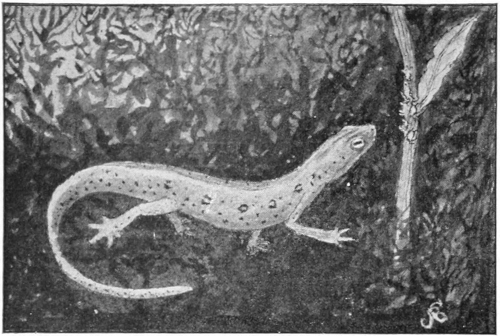
Red-spotted newt stalking plant-lice.
The following is the history of this species as summarized from Mrs. S. H. Gage’s charming “Story of Little Red Spot.” The egg was laid in some fresh water pond or the still borders of some stream where there is a growth of water weed. The egg, which is about the size of a small pea, is fastened to a water plant. It is covered with a tough but translucent envelope, and has at the center a little yellowish globule. In a little less than a month the eft hatches, but it looks very different from the form with which we are most familiar. It has gray stripes upon its sides and three tiny bunches of red gills on each side, just back of its broad head. The tail is long and very thin, surrounded by a fin; it is an expert swimmer and breathes water as does a fish. After a time, it becomes greenish above and buff below, and by the middle of August it develops legs and has changed its form so that it is able to live upon land; it no longer has gills or fin; soon the coat changes to the bright orange hue which makes the little creature so conspicuous.
The newt usually keeps hidden among moss, or under leaves, or in decaying wood, or other damp and shady places; but after a rain, when the whole world is damp, it feels confidence enough to go out in the open, and hunt for food. For two and a half years it lives upon land and then returns to the water. When this impulse comes upon it, it may be far from any stream; but it seems to know instinctively where to go. Soon after it enters the water, it is again transformed in color, becoming olive-green above and buff below, although it still retains the red spots along the back, as mementos of its land life; and it also retains its pepper-like dots. Its tail develops a fin which extends along its back and is somewhat ruffled. In some mysterious way it develops the power to again breathe the air which is mixed with water.
The male has the hind legs very large and flat; the female is lighter in color and has more delicate and smaller legs. It is here in the water that the efts find their mates and finish careers which must have surely been hazardous. During its long and varied life, the eft often sheds its skin like the snake; it has a strange habit of swallowing its cast-off coat.
LESSON XLVIII
The Newt, Eft, or “Salamander”
Leading thought—The newts change their form three times to fit different modes of life. They are born in the water and at first have fins and gills like fishes. They then live on land, and have lungs for breathing air and lose their fins; later they go back to the water and again develop the power of breathing the oxygen contained in water, and also a fin.
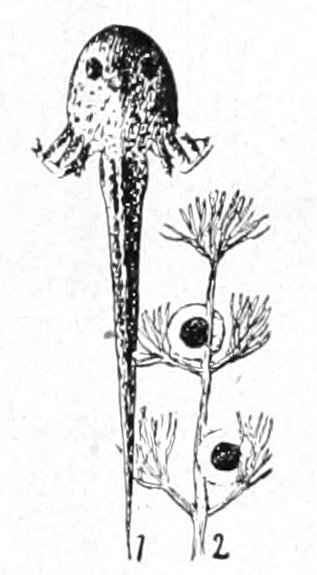
Early stage of vermilion-spotted newt. Eggs of newt attached to water plant.
Drawn by Anna Stryke.
Method—The little, orange eft or red-spotted salamander may be kept in an aquarium which has in it an object, as a stone or a clump of moss which projects above the water. For food it should be given small earthworms or leaves covered with plant lice. In this way it may be studied at leisure.
Observations—1. Look at the eft closely. Is it all the same color? How many spots upon its back and what colors are they? Are there the same number of spots on both sides? Are there any spots or dots besides these larger ones? How does the eft resemble a toad?
2. Is the head the widest part of the body? Describe the eyes, the shape and color of the pupil and of the iris. How does the eft wink? Do you think it can see well?
3. Can you see the nostrils? How does the throat move and why?
4. Are both pairs of legs the same size? How many toes on the front feet? How many toes on the hind feet? Does the eft toe-in with its front feet like a toad?
5. Does it move more than one foot at a time when walking? Does it use the feet on the same side in two consecutive steps? After putting forward the right front foot what foot follows next? Can it move backward?
6. Is the tail as long as the head and body together? Is the tail round or flat at the sides? How is it used to help the eft when traveling? Does the tail drag or is it lifted, or does it push by squirming?
7. How does the eft act when startled? Does it examine its surroundings? Do you think it can see and is afraid of you?
8. Why do we find these creatures only during wet weather? Why do people think they rain down?
9. What does the eft eat? How does it catch its prey? Does it shed its skin? How many kinds of efts have you seen?
10. From what kind of egg does the eft hatch? When is this egg laid? How does it look? On what is it fastened?
11. How many times during its life does the orange eft change color? What part of its life is spent upon land? What changes take place in its form when it leaves the water for life upon land, and what changes take place in its structure when it returns to the water?