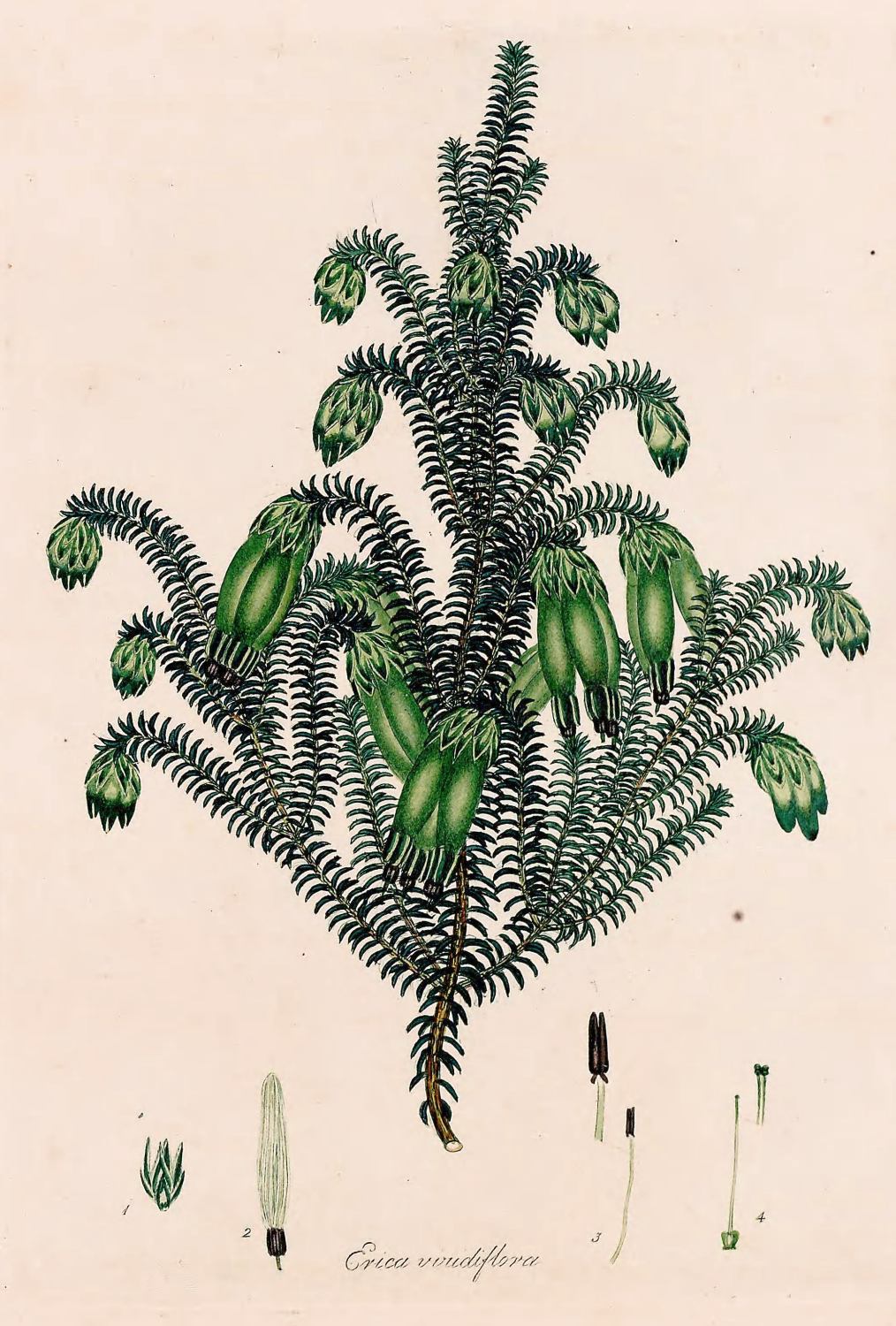
ERICA viridiflora.
Reading edition
CHARACTER SPECIFICUS.
Erica antheris minute bicornutis, subexsertis: floribus sessilibus, nutantibus: foliis ternatis: caule ramoso.
DESCRIPTIO.
Caulis humilis, erectus, fruticosus: ramulis plerumque ternis.
Folia terna, glabra, sub-trigona, curvata, acuta.
Flores terni in apicibus ramulorum, dependentes: pedunculi nulli: perianthium duplex, exteriori triphyllo: corolla viridis, viscosa, metulæ-flora: laciniis limbi erectis.
Germen tiaræforme, sulcatum, ad basin nectariis melliferis instructum.
Habitat ad Caput Bonæ Spei.
Floret a mense Junii usque ad Augustum.
REFERENTIA.
1. Calyx. 2. Stamina et pistillum. 3. Stamen unum, anthera lente aucta. 4. Germen et pistillum, stigmate lente aucto.
SPECIFIC CHARACTER.
Heath with tips minutely two-horned just without the blossom: flowers sessile, and hanging down: leaves by threes: stem shrubby.
DESCRIPTION.
Stem low, upright, and shrubby: smaller branches mostly by threes.
Leaves by threes, smooth, nearly three-sided, curved, and pointed.
Flowers grow by threes at the ends of the smaller branches, hanging down: footstalks none: cup double, the outer one three-leaved; blossom green, clammy, and skittle-shaped: segments of the border upright.
Seed-bud turban-shaped, furrowed, and furnished at the base with honey-bearing nectaries.
Native of the Cape of Good Hope.
Flowers from the month of June till August.
REFERENCE.
1. The Empalement. 2. Chives and Pointal. 3. A Chive, summit magnified. 4. Seed-bud and Pointal, summit magnified.
This little green-flowered shrub at first sight bears a strong resemblance to the E. clavata, but on close inspection will be found to differ in almost every particular, except colour, from that species. We first observed the E. viridiflora, at the Hammersmith nursery, in 1820, at which period there was only one plant of it that had been raised from Cape seed: at present there are many other plants of it, that will, upon comparison, be found to differ from the E. clavata, not only in the exterior, but also in the interior of the blossom, as the anthers in this species are minutely bicornute, and in the other beardless.