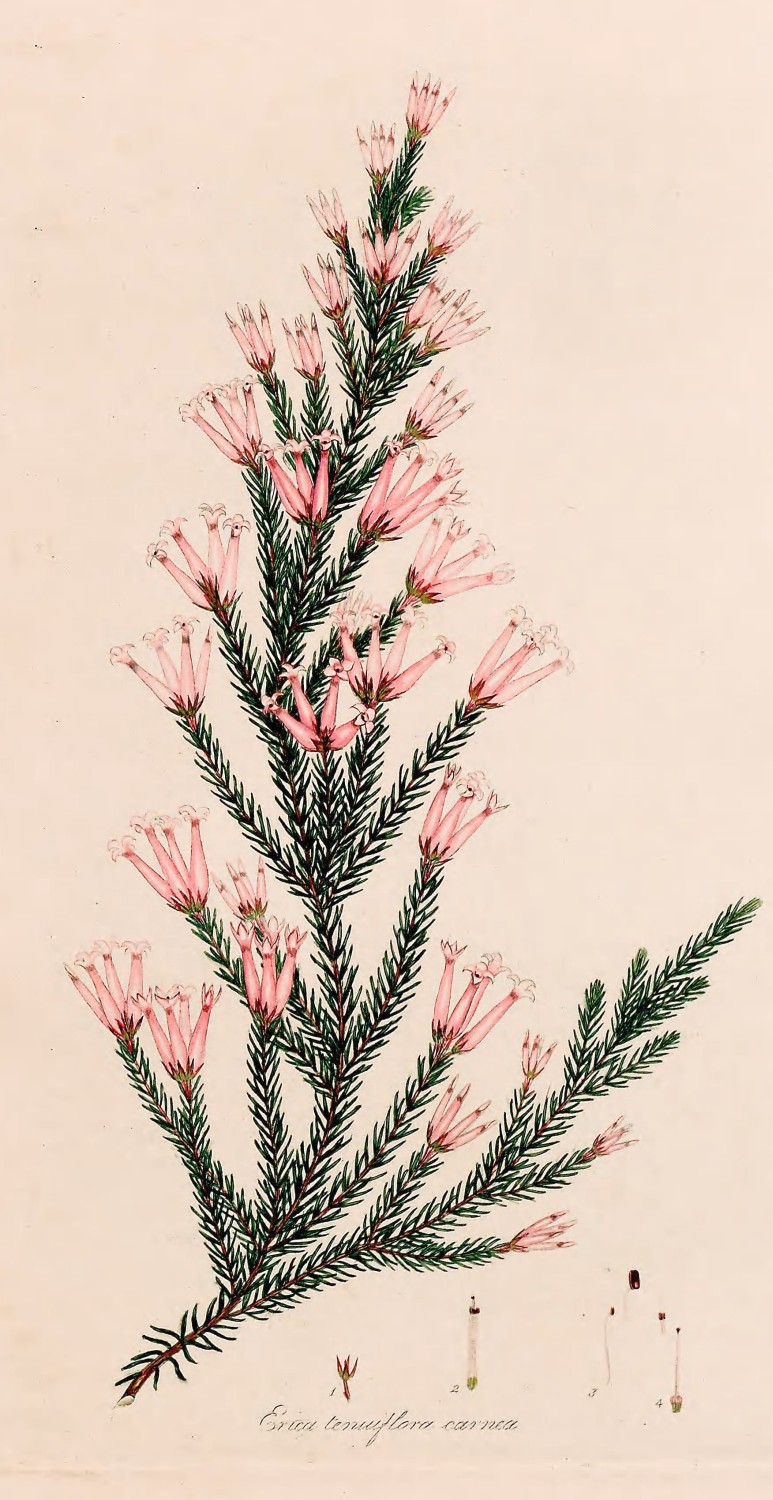
ERICA tenuiflora carnea.
Reading edition
CHARACTER SPECIFICUS.
Erica antheris muticis, inclusis: flores ramos terminant: foliis quaternis: caule fruticoso.
DESCRIPTIO.
Caulis pedalis et ultra, fruticosus, flexuosus, filiformis, virgatus.
Folia quaterna, leviter tomentosa, linearia, brevia, acuta, supra plana, subtus sulcata.
Flores ramos terminant, terni vel quaterni, plerumque adscendentes: corolla tubæformi, tenuissima, incarnata: laciniis oris æqualibus, cordatis, acutis, patentibus.
Germen tiaræforme, sulcatum, ad basin nectariis melliferis instructum.
Habitat ad Caput Bonæ Spei.
Floret per menses æstivales.
REFERENTIA.
1. Calyx. 2. Antheræ et Pistillum. 3. Stamen unum, anthera lente aucta. 4. Germen et Pistillum, stigmate lente aucto.
SPECIFIC CHARACTER.
Heath with beardless tips within the blossom: flowers terminate the branches: leaves by fours: stem shrubby.
DESCRIPTION.
Stem a foot or more high, flexuose, thread-shaped, and twiggy.
Leaves by fours, slightly downy, linear, short, pointed, flat on their upper surface, and furrowed beneath.
Flowers terminate the branches by threes and fours, mostly ascending: blossom trumpet-shaped, very slender, and flesh-coloured: segments of the border equal, heart-shaped, pointed, and spreading.
Seed-bud turban-shaped, furrowed, and furnished at the base with honey-bearing nectaries.
Native of the Cape of Good Hope.
Flowers during the summer months.
REFERENCE.
1. The Empalement. 2. The Chives and Pointal. 3. A Chive, one tip magnified. 4. Seed-bud and Pointal, summit magnified.
Our figure represents a fine new species of Erica communicated from the extensive collection of His Grace the Duke of Bedford at Woburn Abbey, where it was raised from seed in the summer of 1824. In its foliage it very much resembles the E. tenuiflora alba, figured in our third volume; the principal if not the only distinction is, when in bloom, the delicacy of its flowers, whose fine blush-colour gives it a decided preference over the white variety. It is considered as a variety through the medium of the E. spuria, a mule to which the genus is indebted for many fine variations.