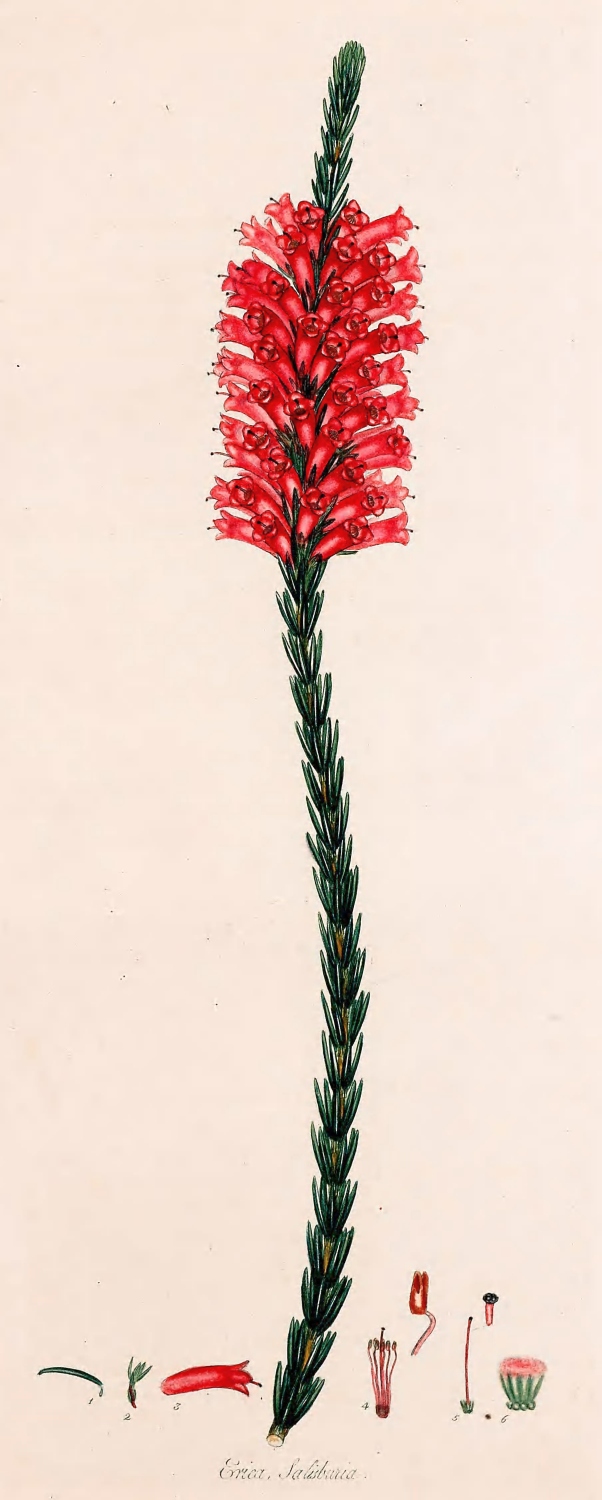
ERICA Salisburia.
Reading edition
CHARACTER SPECIFICUS.
Erica, antheris muticis, subinclusis: stylo exerto: floribus spicatis, confertis, prope ramorum apices: corolla clavata: ramis longissimis: foliis senis vel octonis, erectis.
DESCRIPTIO.
Caulis erectis, tetrapedalis: ramis plerumque simplicibus.
Folia verticillata, sena vel octona, erecta, lanceolata, intus plana, exterius sulcata: foliis ad basin angustioribus, acuminatis, patentibus.
Flores spicati, conferti, prope apices ramorum: corollis clavatis, coccineis, erecto-patentibus: pedunculis coloratis, bracteis tribus instructis.
Habitat ad Caput Bonæ Spei.
Floret a mense Octobris ad Februarium.
REFERENTIA.
1. Folium ad basin plantæ. 2. Calyx. 3. Corolla. 4. Antheræ et Pistillum, stigmate lente aucto. 5. Germen et Pistillum, stigmate lente aucto. 6. Germen lente auctum.
SPECIFIC CHARACTER.
Heath, with beardless tips, just within the blossom: shaft without: flowers growing in a spike, crowded together near the end of the branch: blossoms club-shaped: branches very long: leaves by six or eight, upright.
DESCRIPTION.
Stem upright, four feet high: branches mostly simple.
Leaves grow in whorls of six to eight, upright, and lance-shaped, flat on the inner and furrowed on the outer side: leaves at the base of the plant are narrower, pointed, and spreading.
Flowers grow in crowded spikes near the end of the branches: blossoms club-shaped, and of a scarlet colour, between erect and spreading: footstalks coloured, and furnished with three floral leaves.
Native of the Cape of Good Hope.
Flowers from the month of October till February.
REFERENCE.
1. A Leaf from the base of the plant. 2. The Empalement. 3. A Blossom. 4. The Chives and Pointal, one tip magnified. 5. Seed-bud and Pointal, summit magnified. 6. Seed-bud magnified.
This new species of Erica was first raised at the Hammersmith nursery about the year 1815, and is named after R. Salisbury, Esq., a most able botanist, and Vice-president of the Linnæan Society. Our drawing was made from a plant four feet high, with only one flower-stem, and without any collateral branches.