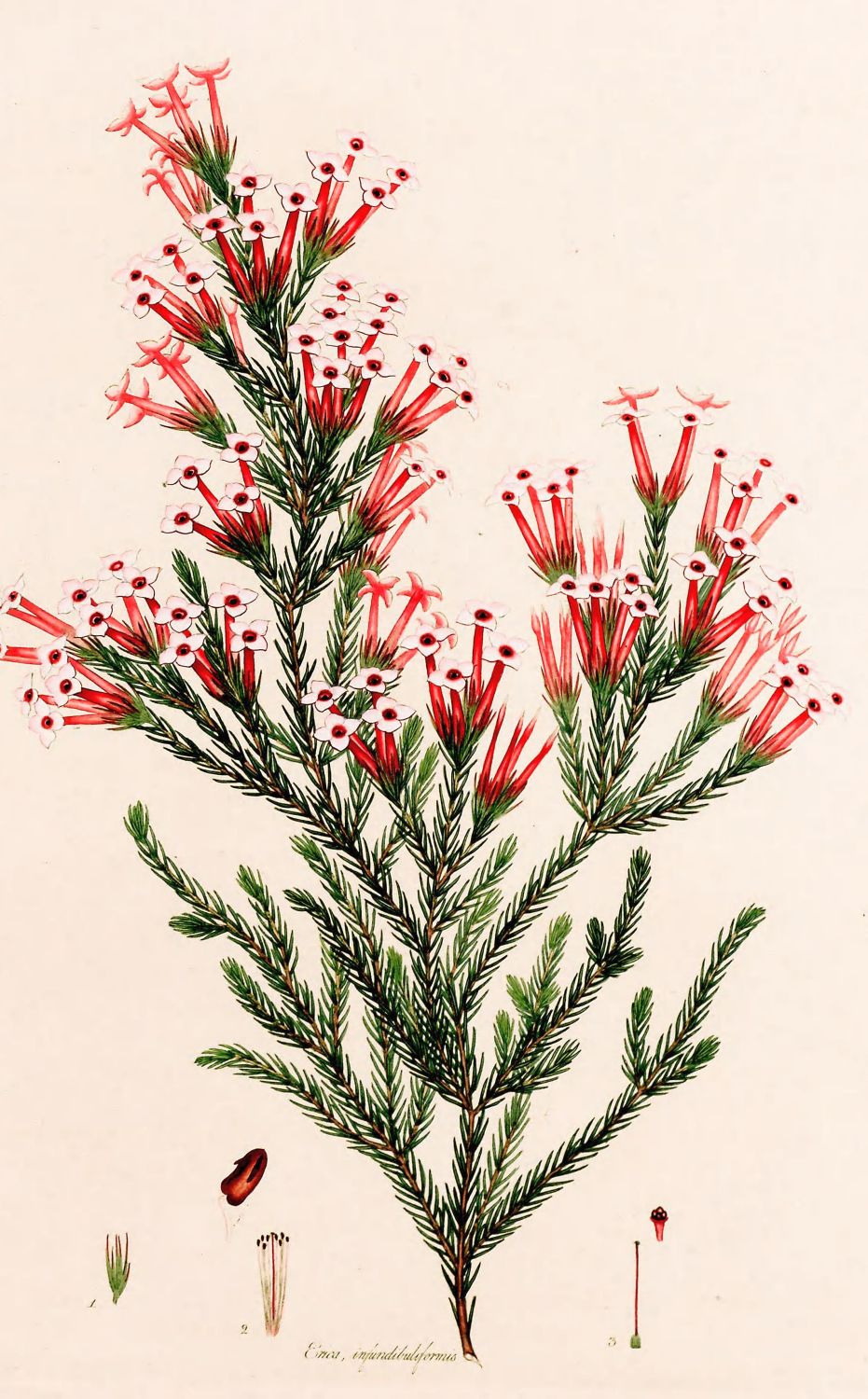
ERICA infundibuliformis.
Reading edition
CHARACTER SPECIFICUS.
Erica antheris superne bicornibus, inclusis: floribus terminalibus, quaternis: longis tenuis foliis ternis: caulis gracilis.
DESCRIPTIO.
Caulis fruticosus, debilis, pedalis et ultra: rami et ramuli filiformes virgati.
Folia terna, linearia, obtusa, glabra, erecto, patentia.
Flores ad apices ramulorum quaterni, pedunculis brevissimis, bracteis: tribus subulatis instructis: corollis tubulosis longis tenuis rubris: oris laciniis equalis patentes superne albis.
Germen tiaræforme, sulcatum, ad basin nectariis melliferis instructum.
Habitat ad Caput Bonæ Spei.
Floret a mense Augusti in Novembrem.
REFERENTIA.
1. Calyx. 2. Stamina et Pistillum, antherâ unâ lente auctâ. 3. Germen et Pistillum stigmate lente aucto.
SPECIFIC CHARACTER.
Heath with tips two-horned on the upper part, within the blossom: flowers terminal, grow by fours, long and slender: leaves by threes: stem slender.
DESCRIPTION.
Stem shrubby, weak, a foot or more high: the small and large branches are thread-shaped, and twiggy.
Leaves by threes, linear, blunt, smooth, erect, and spreading.
Flowers grows by fours at the ends of the small branches: footstalks very short, and furnished with three awl-shaped floral leaves: blossoms tubular, long, slender, and of a red colour: segments of the border spreading, equal and white on the upper surface.
Seed-bud turban shaped, and furrowed, with honey bearing nectaries at the base.
Native of the Cape of Good Hope.
Flowers from August till November.
REFERENCE.
1. The Empalement. 2. Chives and Pointal, one tip magnified. 3. Seed-bud and Pointal, summit magnified.
This fine species of Erica was raised from seed brought from the Cape of Good Hope by Mr. Niven: it bears a considerable resemblance to the E. tenuiflora, but differs in the specific character of its antheræ from all those we have hitherto figured: for when they are bearded, crested, or two-horned, those appendages have invariably been at the base, but in this one instance, they are almost at the top of the anthers, instead of the bottom.
It is a plant that flowers freely, and during the autumnal months makes a most elegant appearance.