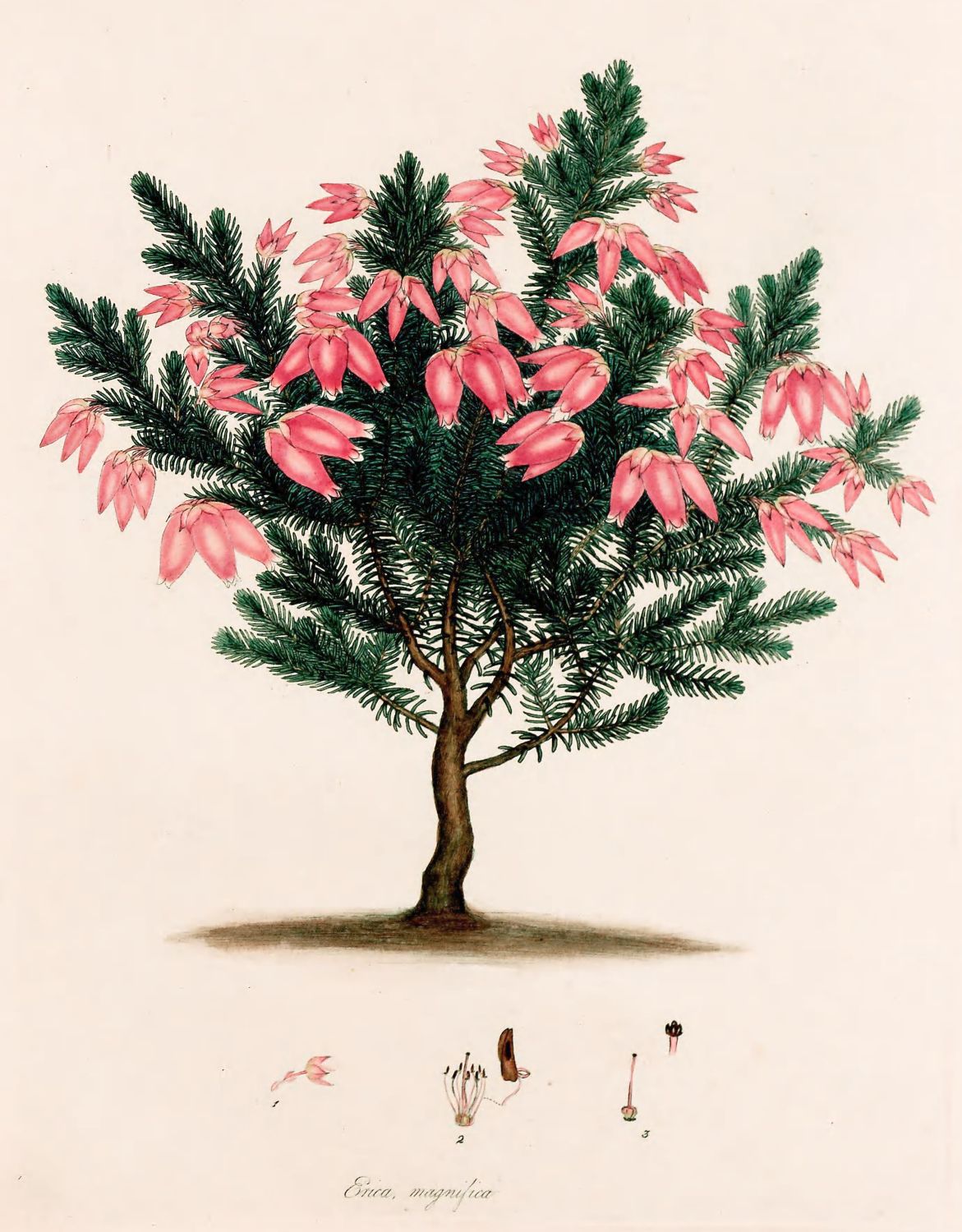
ERICA magnifica.
Reading edition
CHARACTER SPECIFICUS.
Erica, antheris bicornibus, inclusis: floribus metulæformibus, purpureis, nitidis: foliis ternis: ramis confertis: caule humili.
DESCRIPTIO.
Frutex pygmæus, ramis et ramulis numerosis confertis.
Folia ternata, linearia, obtusa, recta, subtùs leviter sulcata, marginibus rotundatis.
Flores plerumque ternati, patentes, aut cernui: pedunculi colorati, bracteis tribus instructi: corolla metulæformis, purpurea, lucida: oris laciniis erectis: calycis foliolis ovato-acutis, adpressis.
Germen tiaræforme, bicoloratum, ad basin nectariis melliferis instructum.
Habitat ad Caput Bonæ Spei.
Floret a mense Augusti in Novembrem.
REFERENTIA.
1. Calyx. 2. Stamina a Pistillo diducta, antherâ unâ lente auctâ. 3. German et Pistillum, stigmate lente aucto.
SPECIFIC CHARACTER.
Heath, with tips two-horned at the base, within the blossom: flowers skittle-shaped, purple, and shining: leaves by threes; branches crowded together: stem low.
DESCRIPTION.
A dwarf shrub, with numerous large and small branches crowded together.
Leaves by threes, linear, blunt-ended and straight, slightly furrowed beneath, and rounded on the edges.
Flowers grow mostly by threes, spreading or nodding: footstalks coloured, and furnished with three floral leaves: blossom skittle-shaped, purple, and shining: segments of the border upright: leaflets of the cup ovate, pointed, and pressed to the blossom.
Seed-bud turban-shaped, two-coloured, and furnished at the base with honey-bearing nectaries.
Native of the Cape of Good Hope.
Flowers from August till November.
REFERENCE.
1. The Empalement. 2. The Chives detached from the Pointal, one tip magnified. 3. Seed-bud and Pointal, summit magnified.
This Erica is a handsome bushy shrub, but certainly not magnificent, although, when first introduced in the year 1800, its claim to the specific title of magnifica was undoubtedly more appropriate than it now appears to be amongst the numerous species (and many of superior beauty) raised since that period from Cape seed. It is at present in but few collections; which is probably owing to its being of slow growth, and not easily increased. The only fine flowering plants we have seen lately have been in the conservatory of the Countess de Vandes, and at the nursery of Mr. Williams, whence our figure was taken.