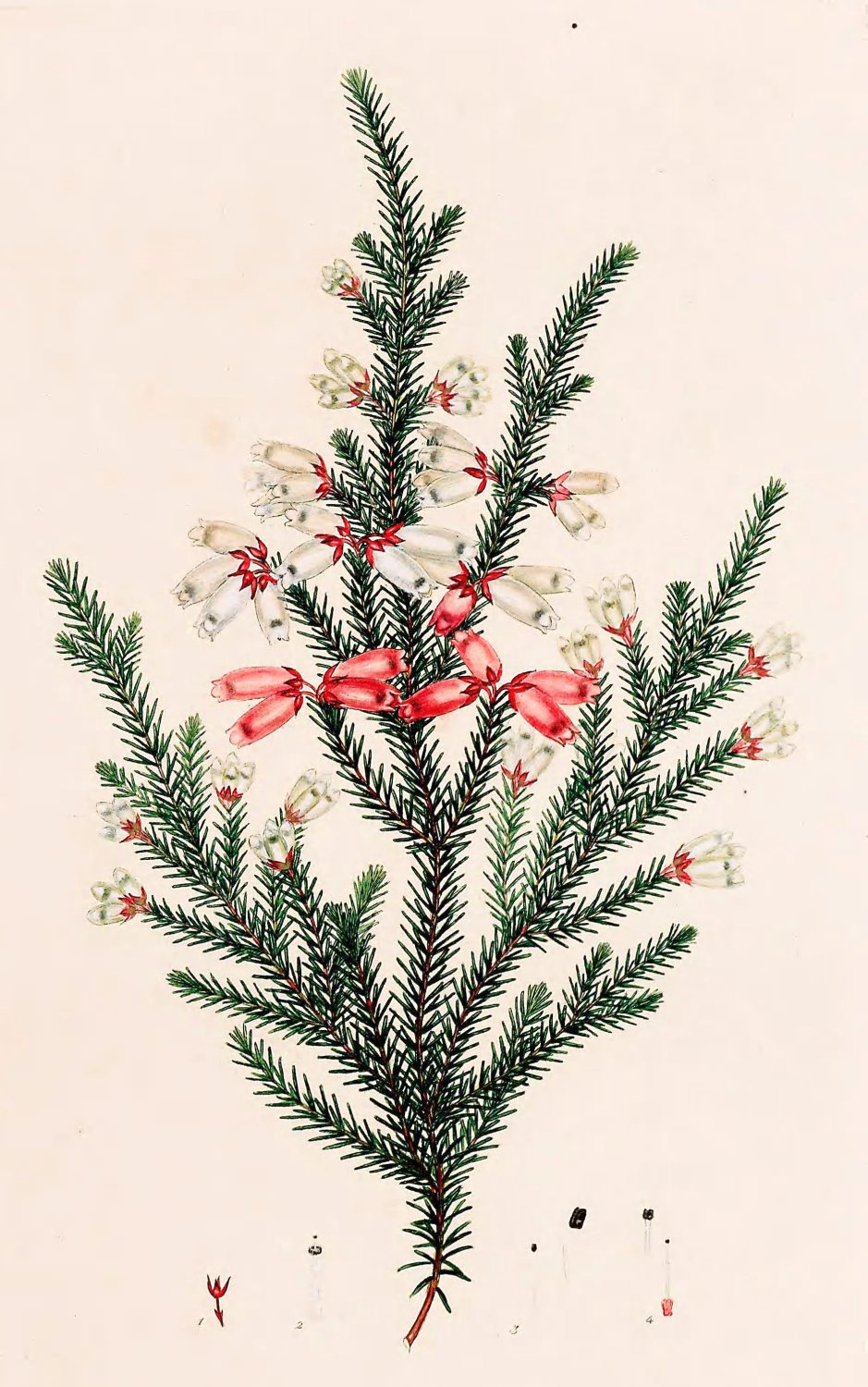
ERICA ruber-calyx.
Reading edition
CHARACTER SPECIFICUS.
Erica antheris muticis, inclusis: flores ramulos terminant: foliis quaternis: caule fruticoso.
DESCRIPTIO.
Caulis pedalis: ramis et ramulis numerosis, flexuosis, filiformibus.
Folia quaterna, linearia, recta, obtusa, erecto-patentia.
Flores ramulos terminant, plerumque quaterni, patentes: calyce et pedunculis rubris: corolla metulæformi, pellucida, imprimis alba, denique rosea: oris laciniis erectis.
Germen tiaræforme, sulcatum, ad basin nectariis melliferis instructum.
Habitat ad Caput Bonæ Spei.
Floret a mense Januarii ad Maium.
REFERENTIA.
1. Calyx. 2. Antheræ et Pistillum. 3. Stamen unum, anthera lente aucta. 4. Germen et Pistillum, stigmate lente aucto.
SPECIFIC CHARACTER.
Heath with beardless tips within the blossom: flowers terminate the smaller branches: leaves by fours: stem shrubby.
DESCRIPTION.
Stem a foot high: the large and smaller branches numerous, flexuose, and thread-shaped.
Leaves by fours, linear, straight, obtuse, and between erect and spreading.
Flowers terminate the smaller branches, mostly by fours, spreading: empalement and footstalks red: blossom skittle-shaped, transparent, white at first, then dying off a rose colour: segments of the border upright.
Seed-bud turban-shaped, furrowed, and furnished at the base with honey-bearing nectaries.
Native of the Cape of Good Hope.
Flowers from the month of January till May.
REFERENCE.
1. The Empalement. 2. The Chives and Pointal. 3. A Chive, one tip magnified. 4. Seed-bud and Pointal, summit magnified.
This species of Erica in the mutability of its flowers resembles the blossoms of the E. colorans. It was first raised from Cape seed at the Hammersmith Nursery in the summer of 1825, under the appellation of ruber-calyx: a specific title of one word would have been preferable, but it is very characteristic of the plant when in bloom, which is a recommendation not often to be met with where the best specific titles are already occupied. It is a handsome dwarf shrub, with abundance of successive bloom.