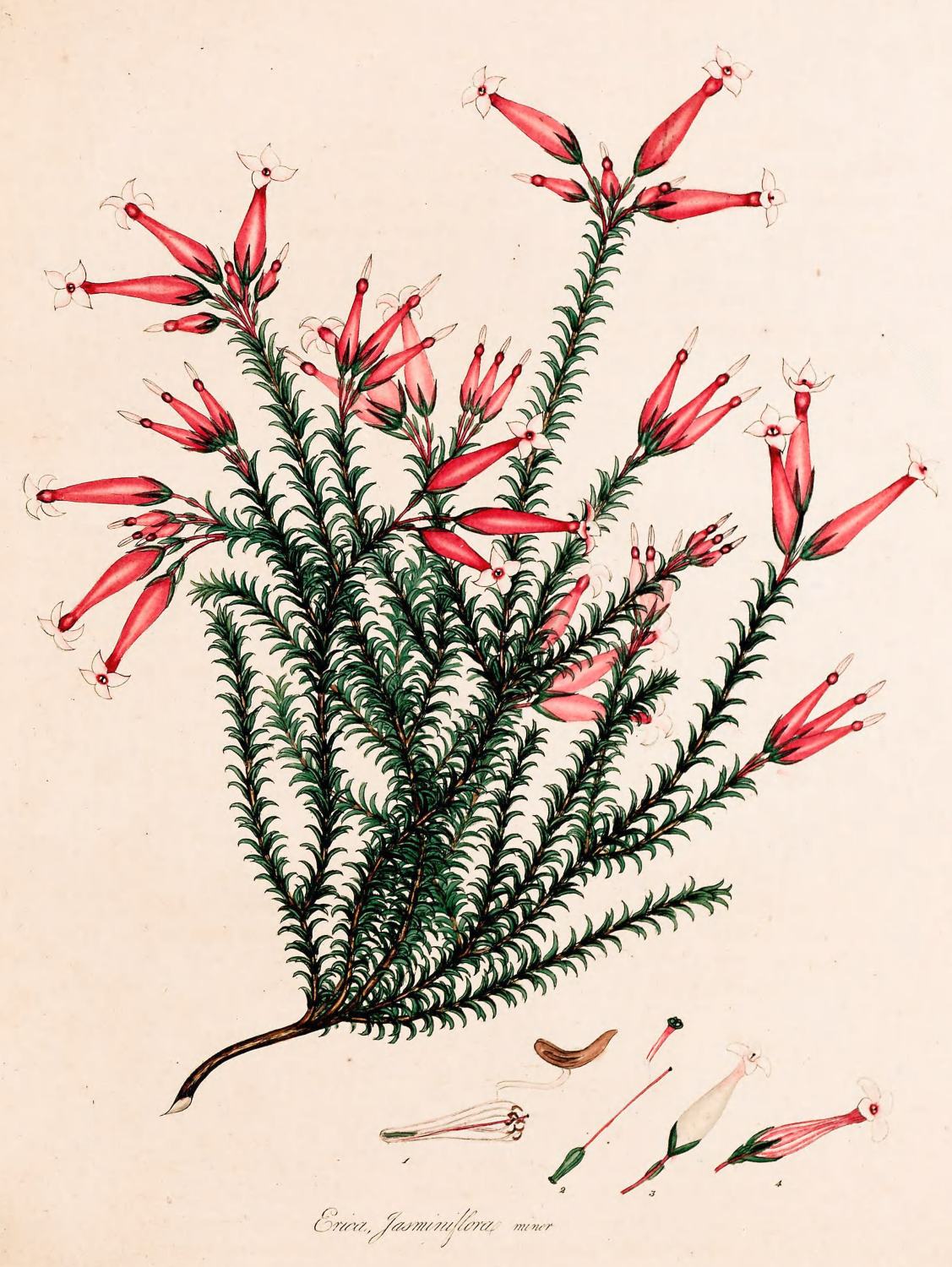
ERICA Jasminiflora, minor.
Reading edition
CHARACTER SPECIFICUS.
Erica, antheris muticis, inclusis: stylo sub-exerto: floribus terminalibus: foliis ternis: ramulis numerosis.
DESCRIPTIO.
Caulis fruticosus, pedalis, erecto-patens: ramis longis.
Folia terna, trigona, acuta, curvata, supra plana, subtus sulcata.
Flores terminales, terni vel seni: corolla rubra, sesquipollicaris, summa cylindrica, ad basin inflata, ore arctata: laciniis patentibus acutis: pedunculis longis coloratis.
Germen tiaræforme, sulcatum, ad basin nectariis melliferis.
Habitat ad Caput Bonæ Spei.
Floret a mense Aprili in Junium.
REFERENTIA.
1. Stamina et Pistillum, stigmate lente aucto. 2. Germen et Pistillum, stigmate lente aucto. 3. Flos varietatis albæ. 4. Flos varietatis striatæ.
SPECIFIC CHARACTER.
Heath, with beardless tips within the blossoms: shaft just without: flowers terminal: leaves by threes: branches numerous.
DESCRIPTION.
Stem shrubby, a foot high, between erect and spreading: branches long.
Leaves by threes, three-sided, pointed and curved, flat on their upper surface, and furrowed beneath.
Flowers terminate the branches in threes or sixes: blossoms red, an inch and a half long, the upper part cylindrical, swelled at the base, and contracted at the mouth: segments spreading and pointed: footstalks long and coloured.
Seed-bud turban-shaped and furrowed, with honey-bearing nectaries at the base.
Native of the Cape of Good Hope.
Flowers from the month of April till June.
REFERENCE.
1. The Chives and Pointal, one tip magnified. 2. Seed-bud and Pointal, summit magnified. 3. Flower of a white variety. 4. Flower of a striped variety.
Our figure represents a plant raised from seed in 1807 in the collection of the Hon. W. Irby, where we also found, at the same time, a variation with white flowers; and in the conservatory of the Countess de Vandes this year, 1811, observed another variety, the blossoms of which were elegantly striped in the tube: we have therefore added a flower of each variety to our dissections, as all the three plants were so very much like each other in every other particular, that we could not distinguish one from the other when out of bloom.