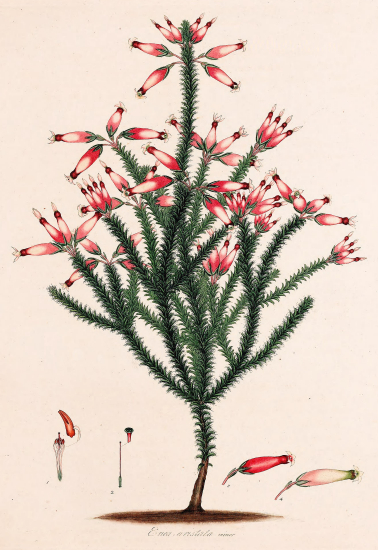
ERICA aristata, minor.
Reading edition
CHARACTER SPECIFICUS.
Erica, antheris muticis, inclusis: floribus quaternis, ampullaceis, viscosis: foliis ternis, confertis.
DESCRIPTIO.
Caulis erectus, fruticosus, pedalis et ultra: ramulis plerumque ternis, verticillatis.
Folia ternata, sub-trigona, supra plana; subtus sulco-exarata; margine pilis longis obsita.
Flores quaterni, patentes: corolla basi inflata, apice attenuata, ima parte rubra, in media alba, summa saturate purpurea, glutinosissima et lucida: laciniis oris patentibus: calycis foliolis lanceolatis, barbatis, adpressis.
Germen columnæforme, sulcatum, ad basin nectariis melliferis instructum.
Habitat ad Caput Bonæ Spei.
Floret a mense Junii in Octobrem.
REFERENTIA.
1. Stamina et Pistillum, antherâ unâ lente auctâ. 2. Germen et Pistillum, stigmate lente aucto. 3. Flos varietas rubra. 4. Flos varietas subalbida.
SPECIFIC CHARACTER.
Heath, with beardless tips within the blossom: flowers grow by fours, are flask-shaped, and viscous: leaves by threes, crowded together.
DESCRIPTION.
Stem upright, shrubby, a foot or more high: branches grow mostly by threes, in whorls.
Leaves by threes, nearly three-sided, flat on their upper surface, and deeply furrowed beneath; the margins are beset with long hairs.
Flowers grow by fours, spreading: the blossom is swelled at the base, and tapers to the point, red on the lower part, white in the centre, and of a deep purple towards the end, very glutinous, and shining: the segments of the border are spreading: the leaflets of the cup are lance-shaped, bearded, and pressed to the blossom.
Seed-bud pillar-shaped, furrowed, and furnished at the base with honey-bearing nectaries.
Native of the Cape of Good Hope.
Flowers from June till October.
REFERENCE.
1. The Chives and Pointal, one tip magnified. 2. Seed-bud and Pointal, summit magnified. 3. Flower of a red variety. 4. Flower of a pale variety.
Amongst cultivators, this plant bears the specific titles of aristata minor, and tricolor; neither of them very appropriate, as it does not possess three distinct colours; nor can it with propriety be considered as a variety of the E. aristata: but as it is well known by that appellation, we have retained it. There are two variations of it at present in cultivation with us; a flower of each is given, with the dissections. The pale-flowered variety is from the conservatory of the Marquis of Blandford, and we have not as yet seen it in any other collection. It appears to be a plant of easy culture, and was raised from Cape seed about the year 1806.