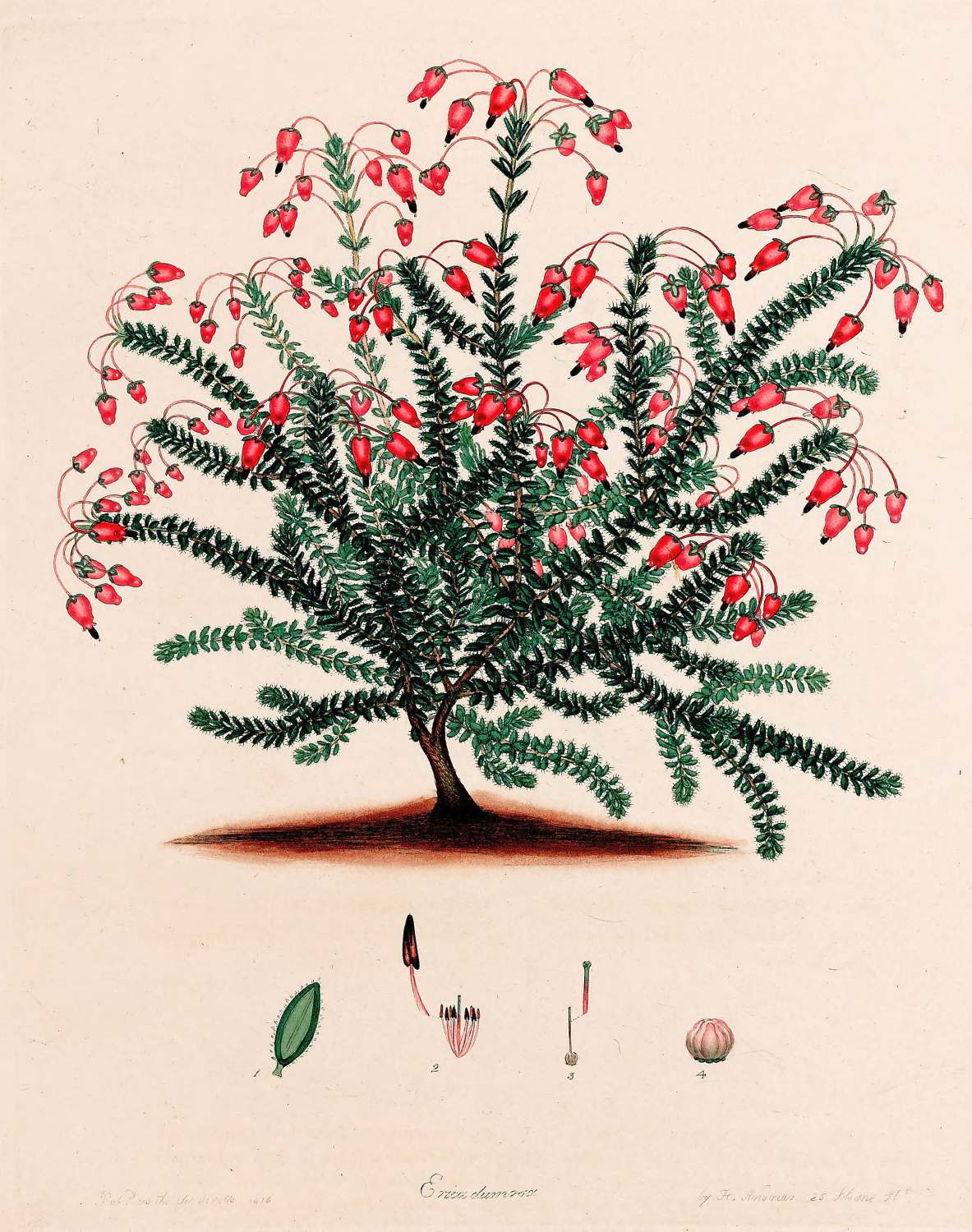
ERICA dumosa.
Reading edition
CHARACTER SPECIFICUS.
Erica, antheris muticis, exertis: floribus terminalibus, pendulis: pedunculis longissimis: foliis ternatis.
DESCRIPTIO.
Caulis humilis, fruticosus: ramis numerosis, filiformibus.
Folia ternata, ovata, hispida, patentia, margine revoluta, subtus glauca.
Flores terminales in umbellis: corolla pendula, urceolata, purpurea: pedunculis patentibus, longissimis, tenuibus.
Germen tiaræforme, sulcatum, tomentosum, ad basin nectariis melliferis instructum.
Habitat ad Caput Bonæ Spei.
Floret a mense Julii ad Novembrem.
REFERENTIA.
1. Folium auctum. 2. Stamina et Pistillum, antherâ unâ lente auctâ. 3. Germen et Pistillum, stigmate lente aucto. 4. Germen lente auctum.
SPECIFIC CHARACTER.
Heath, with beardless tips, without the blossom: flowers terminal and pendulous: footstalks very long: leaves by threes.
DESCRIPTION.
Stem low, shrubby: branches numerous and thread-shaped.
Leaves by threes, ovate, hispid, and spreading, rolled back at the edges, and glaucous beneath.
Flowers terminate the branches in umbels: blossom pendulous, pitcher-shaped, and purple: footstalks spreading, very long, and slender.
Seed-bud turban-shaped, furrowed, downy, and furnished at the base with honey-bearing nectaries.
Native of the Cape of Good Hope.
Flowers from the month of July till November.
REFERENCE.
1. A leaf magnified. 2. Chives and Pointal, one tip magnified. 3. Seed-bud and Pointal, summit magnified. 4. Seed-bud magnified.
The Erica dumosa is one of those few species whose rude exterior differs from the leading feature of neatness and uniformity so prevalent throughout this extensive family of plants. It is a dwarf shrub, with crowded irregular branches and coarse foliage, but possessing bright purple flowers on very long peduncles. By some cultivators it is called longipedunculata, a little more descriptive than specific, and which might be confounded with the E. pedunculata. But as a low bushy shrub it may easily be recognised by the unoccupied title of dumosa. Our figure represents an entire plant raised from seed at the Hammersmith Nursery in 1815. It requires rather more attention than usual, to prevent the long slender footstalks of the flowers from being too powerfully influenced by the atmosphere, which sometimes gives them a very disordered appearance.