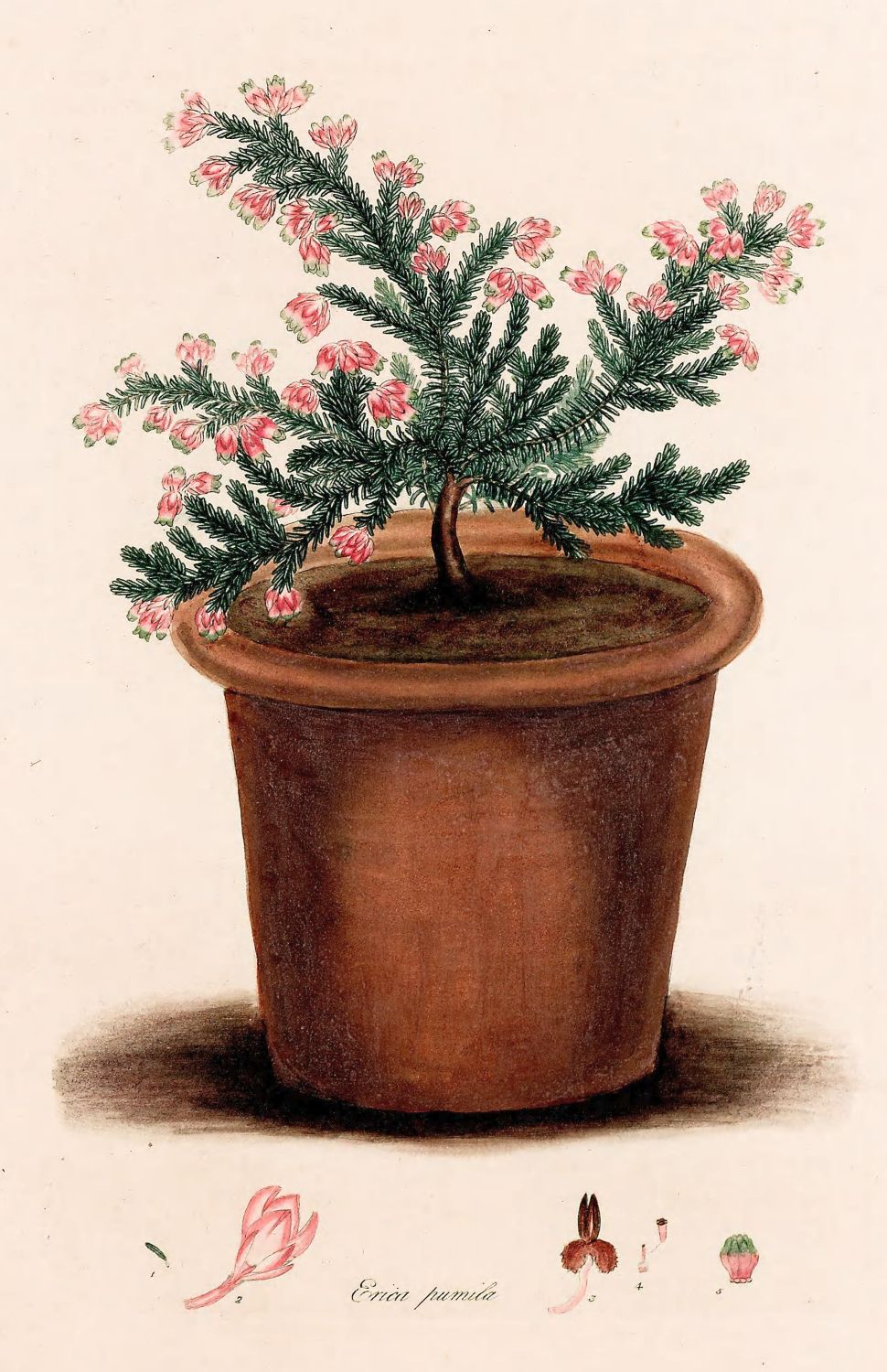
ERICA pumila.
Reading edition
CHARACTER SPECIFICUS.
Erica, antheris cristatis, inclusis: floribus cylindraceis, terminalibus, bicoloribus: foliis ternis, obtusis: ramis divaricatis: caule humili.
DESCRIPTIO.
Frutex pygmæus, rami et ramuli numerosi, divaricati, plerumque foliis tecti.
Folia ternata, linearia, obtusa, recta, glabra, supra plana, subtus sulcata, marginibus rotundatis.
Flores plerumque ternata, patento-cernui; pedunculi breves, colorati, bracteis tribus coloratis instructi; corolla cylindracea, incarnata; laciniis oris viridibus, pallidis, erectis; calycis foliolis ovatis, coloratis, adpressis.
Germen tiaræforme, bicoloratum, ad basin nectariis melliferis instructum.
Habitat ad Caput Bonæ Spei.
Floret a mense Maio in Augustum.
REFERENTIA.
1. Folium. 2. Calyx lente auctus. 3. Stamen auctum. 4. Germen et Pistillum, stigmate lente aucto. 5. Germen lente auctum.
SPECIFIC CHARACTER.
Heath, with crested tips, within the blossom: flowers cylindrical, terminal, and two-coloured: leaves by threes, obtuse: branches straddling: stem low.
DESCRIPTION.
A dwarf shrub, the large and small branches numerous, straddling, and mostly covered with leaves.
Leaves by threes, linear, obtuse, straight, smooth, flat on the upper surface, furrowed beneath, and rounded at the edges.
Flowers grow mostly by threes, spreading, or nodding; footstalks short, coloured, and furnished with three coloured floral leaves; blossoms cylindrical, flesh-coloured; segments of the border of a pale green, and upright: the leaflets of the cup are ovate, coloured, and pressed to the blossom.
Seed-bud turban-shaped, two-coloured, and furnished at the base with honey-bearing nectaries.
Native of the Cape of Good Hope.
Flowers from the month of May till August.
REFERENCE.
1. A leaf. 2. The Empalement magnified. 3. A Chive magnified. 4. Seed-bud and Pointal, summit magnified. 5. Seed-bud magnified.
The Erica pumila is a new species, and very distinct from any with which we are at present acquainted. Our figure represents the entire plant, just as we received it growing in a pot. It was first raised at the Hibbertian collection in 1805, by Mr. Knight, with whom it has flowered this summer, for the first time in England. From the very small size, and slow growth of all the plants of this species as yet in cultivation with us, we are inclined to think it will not at any future period assume a gigantic appearance; but will most likely, continue to retain a claim to the specific appellation of pumila.