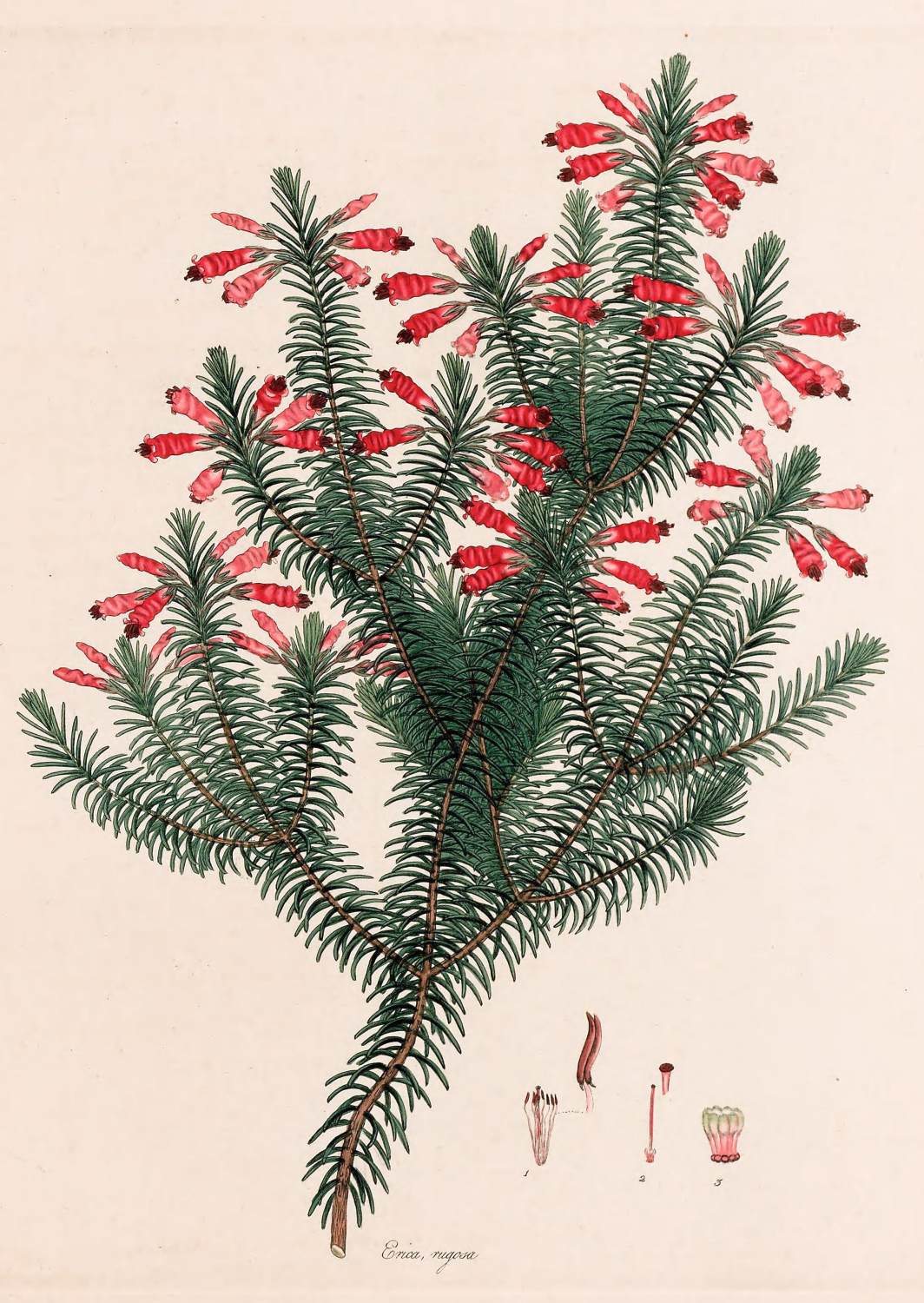
ERICA rugosa.
Reading edition
CHARACTER SPECIFICUS.
Erica, antheris bicornibus, sub-exertis: floriribus sub-terminalibus, rugosis, rubris: foliis linearibus: ramulis numerosis.
DESCRIPTIO.
Caulis fruticosus, erectus, bipedalis: ramulis ternis, verticillatis.
Folia irregulariter verticillata, 3 vel 5 linearia; parum curvata, patentia: petiolis longis.
Flores sub-terminales: corolla sub-tubulosa, patens, rugosa, saturate rubra; oris laciniis patentibus: pedunculi longi, colorati.
Germen tiaræforme, sulcatum, ad basin rubrum, cum nectariis melliferis, supernè villosum.
Habitat ad Caput Bonæ Spei.
Floret a mense Junii in Augustum.
REFERENTIA.
1. Stamina et Pistillum, stigmate lente aucto. 2. Germen et Pistillum, stigmate lente aucto. 3. Germen lente auctum.
SPECIFIC CHARACTER.
Heath, with tips two-horned at their base, just without the blossom; flowers nearly terminal, wrinkly, and red: leaves linear: branches many.
DESCRIPTION.
Stem shrubby, upright, two feet high: branches grow by threes, in whorls.
Leaves in irregular whorls, of 3 to 5 linear, slightly curved, and spreading; footstalks long.
Flowers nearly terminal: blossom nearly tubular, spreading, wrinkly, and of a deep red colour; segments of the border spreading: footstalks long and coloured.
Seed-bud turban-shaped, furrowed, red at the base, with honey-bearing nectaries, villose on the upper part.
Native of the Cape of Good Hope.
Flowers from the month of June till August.
REFERENCE.
1. Chives and Pointal, one tip magnified. 2. Seed-bud and Pointal, summit magnified. 3. Seed-bud magnified.
This curious species of Erica was raised from seed at the nursery of Mr. Rollinson about the year 1806, from which period it has flowered abundantly; but all attempts to increase it have hitherto proved abortive; and whether the wrinkly character of its blossoms would be continued were it to seed with us, is certainly doubtful, as it appears to be a contraction in the flowers bordering upon monstrosity; and we at first declined figuring it, expecting the wrinkles would not appear when next it bloomed; but for four successive summers it has still retained its strange appearance, more singular than beautiful, but probably more interesting by its oddity.