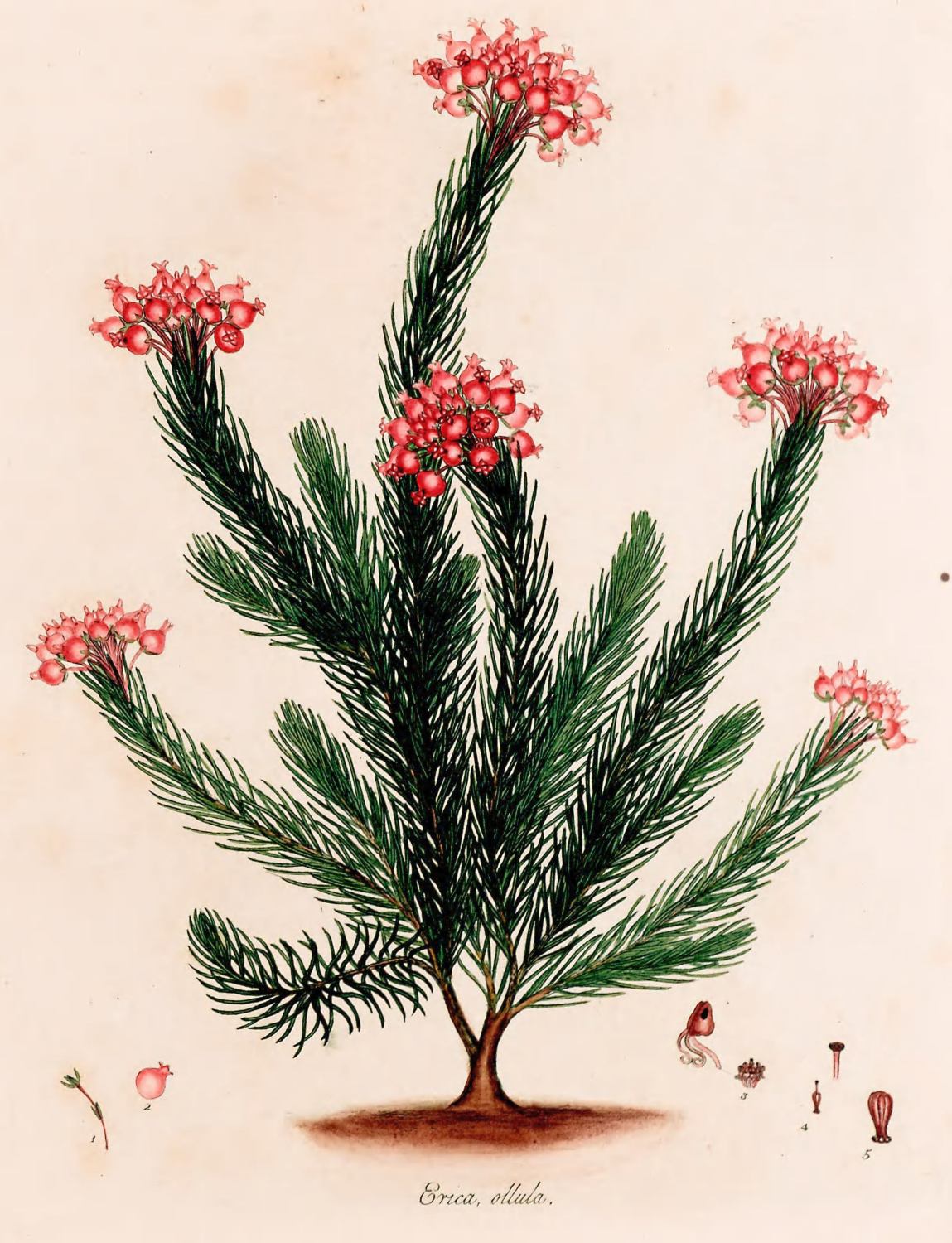
ERICA Ollula.
Reading edition
CHARACTER SPECIFICUS.
Erica, antheris aristatis, tortis, inclusis: flores ramos terminant in fasciculis: foliis sparsis.
DESCRIPTIO.
Caulis subpedalis, fruticosus: ramis longis, adscendentibus.
Folia sparsa, linearia, longa, obtusa: petiolis longis, adpressis.
Flores conferti, fasciculati, terminales: pedunculis longissimis, rubris, bracteis duabus distantibus: corolla urceolata, saturate carnea: oriis laciniis æqualibus, patentibus.
Germen tiaræforme, sulcatum, ad basin nectariis melliferis instructum.
Habitat ad Caput Bonæ Spei.
Floret a mense Julii ad Octobrem.
REFERENTIA.
1. Calyx. 2. Corolla. 3. Antheræ et Pistillum, anthera una lente aucta. 4. Germen et Pistillum, stigmate lente aucto. 5. Germen lente auctum.
SPECIFIC CHARACTER.
Heath, with twisted, bearded tips within the blossom: flowers terminate the branches in bunches: leaves scattered.
DESCRIPTION.
Stem scarce a foot high, shrubby: branches long and ascending.
Leaves scattered, linear, long, and blunt-ended: footstalks pressed to the branches.
Flowers crowded together in bunches at the ends of the branches: footstalks very long and red, with two floral-leaves set at a distance on them: blossom pitcher-shaped, and of a deep flesh-colour: segments of the border equal and spreading.
Seed-bud turban-shaped, furrowed, and furnished at the base with honey-bearing nectaries.
Native of the Cape of Good Hope.
Flowers from the month of July till October.
REFERENCE.
1. The Empalement. 2. A Blossom. 3. The Chives and Pointal, one tip magnified. 4. Seed-bud and Pointal, summit magnified. 5. Seed-bud magnified.
This handsome little shrub was, we believe, first raised from Cape seed about the year 1814. It is one of the most ornamental of those Ericas recently introduced. The flowers are crowded together in bunches, and remain a long time in successive bloom.