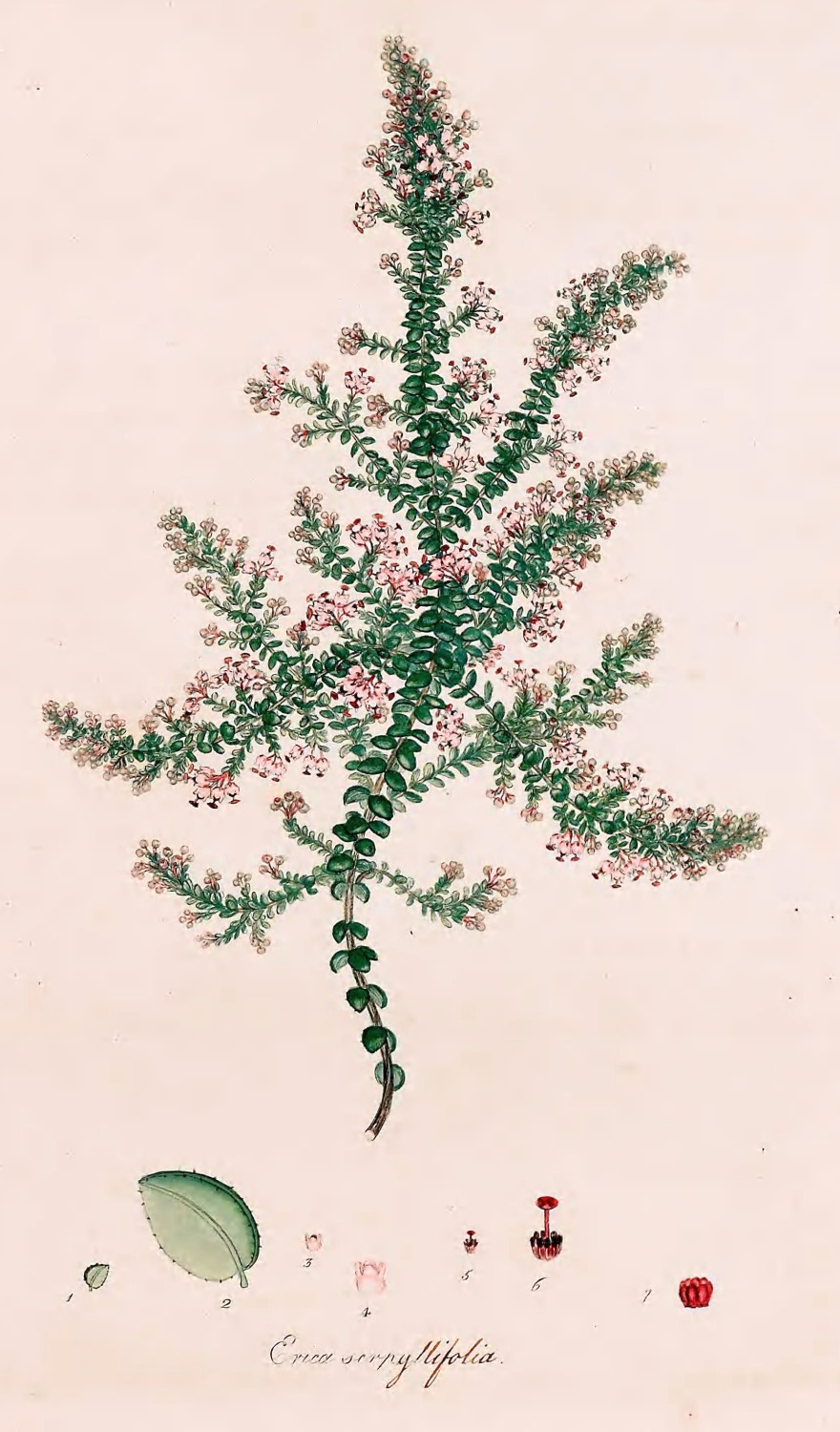
ERICA serpyllifolia.
Reading edition
CHARACTER SPECIFICUS.
Erica antheris muticis inclusis: stylo exerto: stigmate magno: foliis ternatis: caule debili, fruticoso.
DESCRIPTIO.
Caulis subpedalis, tenuis: ramis et ramulis filiformibus, numerosis, flexuosis.
Folia terna, cordata, patentia, supra subplana, setis minutis instructa, subtus glauca, marginibus revolutis.
Flores terni vel seni, in ramos terminant: corolla parva, campanulata, pallide carnea; stigmate magno, patente, tetragono, peltato, incluso.
Germen tiaræforme, sulcatum, villosum, ad basin nectariis melliferis instructum.
Habitat ad Caput Bonæ Spei.
Floret a mense Julii ad Novembrem.
REFERENTIA.
1. Folium. 2. Idem auctum. 3. Corolla. 4. Eadem aucta. 5. Stamen et Pistillum. 6. Eadem lente aucta. 7. Germen auctum.
SPECIFIC CHARACTER.
Heath with beardless tips within the blossom: shaft without: summit large: leaves ternate: stem weak and shrubby.
DESCRIPTION.
Stem near a foot high and slender: the large and smaller branches are thread-shaped, numerous, and flexuose.
Leaves by threes, heart-shaped, and spreading, nearly flat on their upper surface, and furnished with minute setæ or bristles; glaucous beneath, with the edges rolled back.
Flowers grow by threes or sixes, terminating the branches; blossom small, bell-shaped, and of a pale flesh-colour; stigma large, spreading, with four corners, inclosed in a shield.
Seed-bud turban-shaped, furrowed, villose, and furnished at the base with honey-bearing nectaries.
Native of the Cape of Good Hope.
Flowers from July till November.
REFERENCE.
1. A leaf. 2. The same magnified. 3. A blossom. 4. The same magnified. 5. Chive and Pointal. 6. The same magnified. 7. Seed-bud magnified.
The Erica serpyllifolia resembles two very opposed and distinct species of Heaths, the E. thymifolia and E. peltata. The former similarly nomenclated; resembling the latter in shape, colour, abundance of flowers, and enlarged stigma, the expansion of which is so rare and peculiar to the E. peltata; and is also a most prominent feature in the physiology of the present figure, but when out of bloom; and the Ericas thymifolia and maryfolia are the only species that can claim the least affinity.
It was first raised from Cape seed at the nursery of Messrs. Loddiges, Hackney. Our drawing is from a plant at Mr. Lee’s, in the summer of 1826.