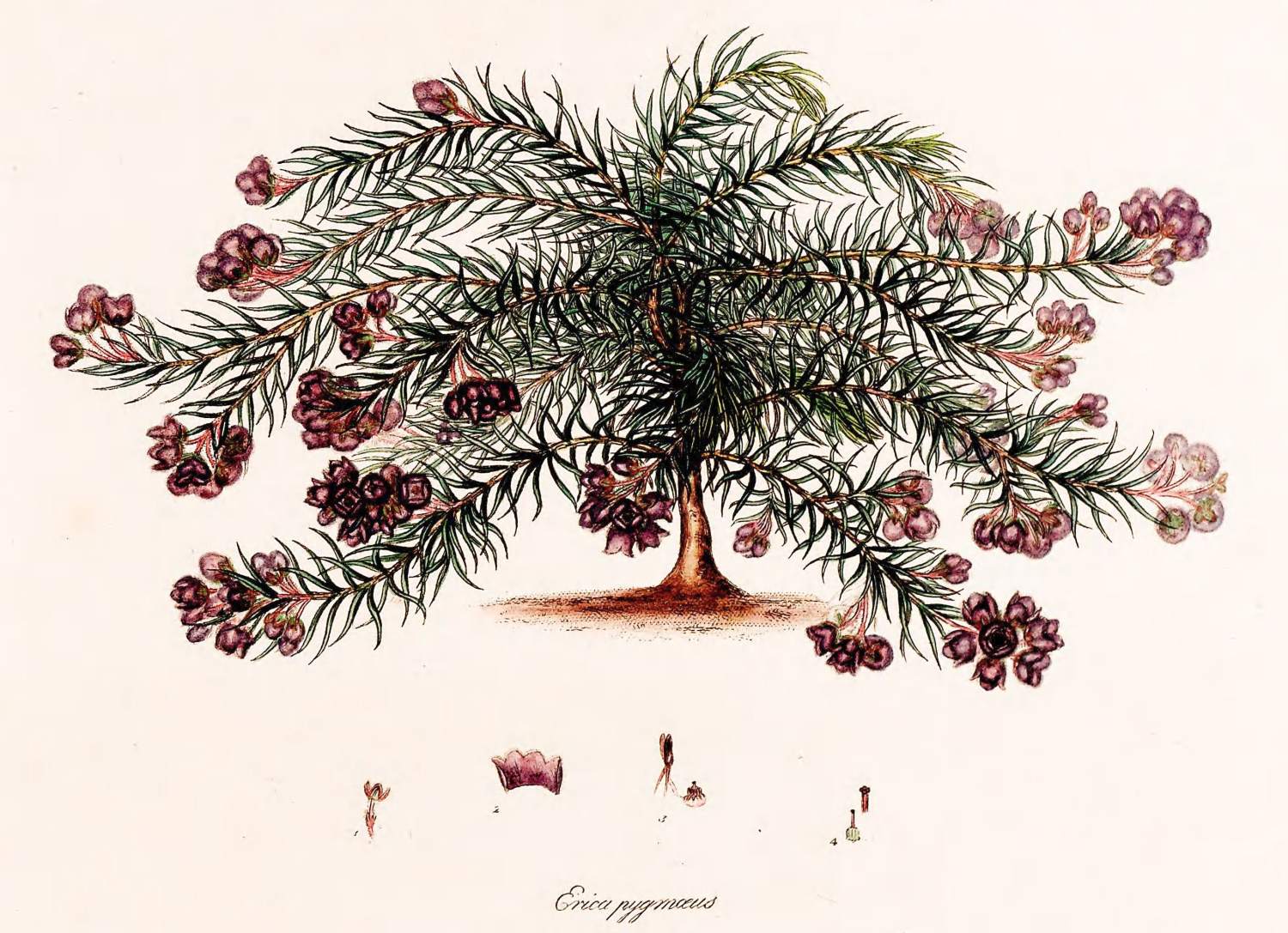
ERICA pygmæa.
Reading edition
CHARACTER SPECIFICUS.
Erica, antheris aristatis, inclusis: flores ramos terminant in umbellis: foliis ternatis: ramis virgatis.
DESCRIPTIO.
Caulis humilis: rami et ramuli numerosi, filiformes: rami longi, patentes, decumbentes.
Folia ternata, glabra, curvata, patentia, acuminata.
Flores ramos terminant in umbellis: in ramulis plerumque ternis: pedunculis longis, coloratis, pilosis: corolla campanulata, pilosa, saturate purpurea.
Germen tiaræforme, sulcatum, ad basin nectariis melliferis instructum.
Habitat ad Caput Bonæ Spei.
Floret a mense Julii ad Octobrem.
REFERENTIA.
1. Calyx. 2. Corolla expansa. 3. Antheræ et Pistillum, anthera una lente aucta. 4. Germen et Pistillum, stigmate lente aucto.
SPECIFIC CHARACTER.
Heath, with bearded tips, within the blossom: flowers terminate the branches in umbels: leaves by threes: branches twiggy.
DESCRIPTION.
Stem low: the large and small branches numerous and thread-shaped: the larger branches are long, spreading, and decumbent.
Leaves by threes, smooth, curved, spreading, and sharp-pointed.
Flowers terminate the branches in umbels: in the smaller branches mostly by threes: footstalks long, coloured, and hairy: blossoms bell-shaped, hairy, and of a deep purple colour.
Seed-bud turban-shaped, furrowed, and furnished at the base with honey-bearing nectaries.
Native of the Cape of Good Hope.
Flowers from the month of July till October.
REFERENCE.
1. The Empalement. 2. The Blossom spread open. 3. The Chives and Pointal, one tip magnified. 4. Seed-bud and Pointal, summit magnified.
Our figure represents an entire plant from the nursery of Mr. Lee, the only collection in which we have as yet seen this very distinct species of Erica. It is a dwarf shrub (more curious than beautiful), raised from Cape seed about the year 1810, and called E. sanguinolenta; which we have no doubt will be readily superseded by the more appropriate title of pygmæa, by which it may be easily recognised either in or out of bloom.