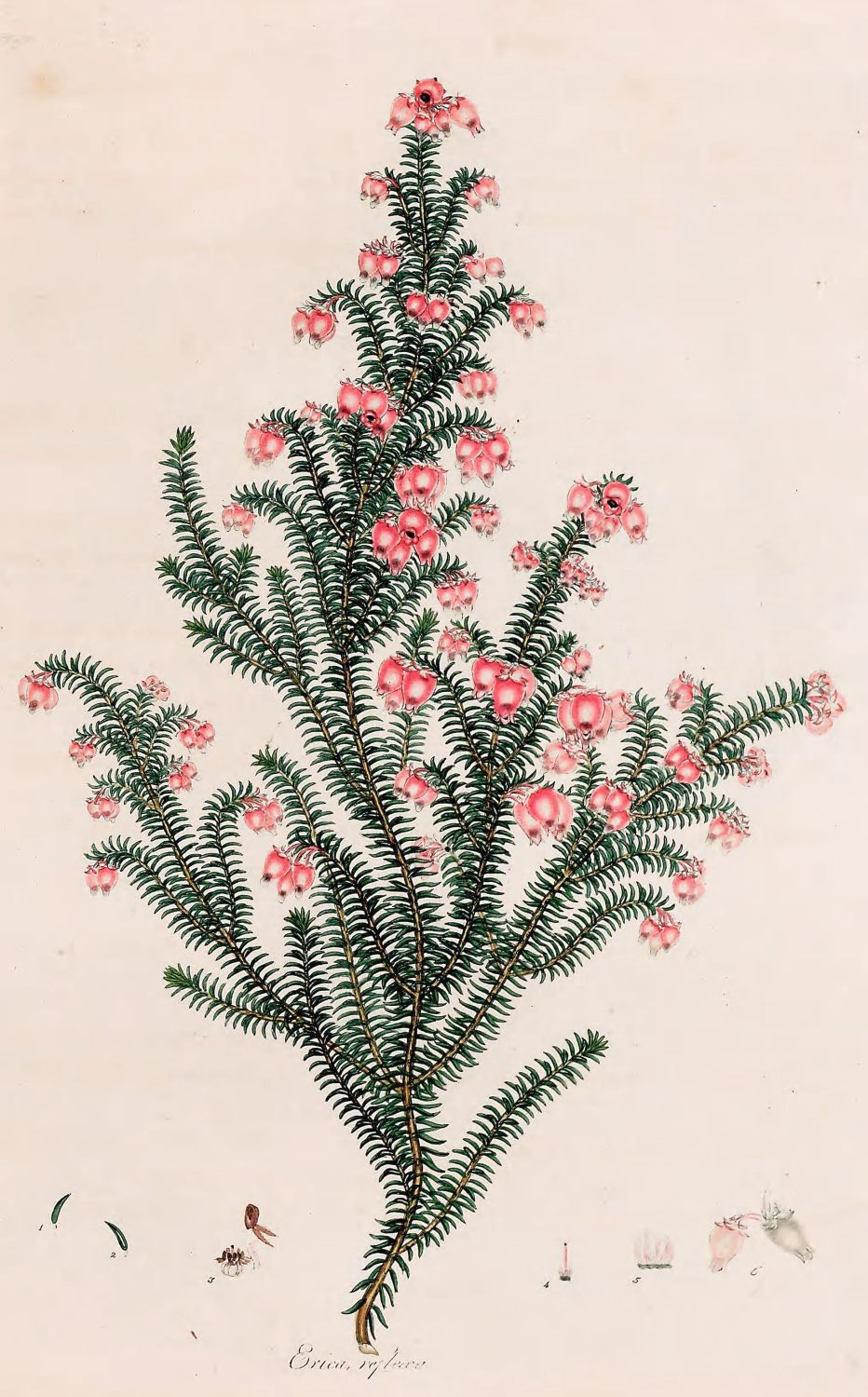
ERICA reflexa.
Reading edition
CHARACTER SPECIFICUS.
Erica antheris cristatis, inclusis: floribus ramulos terminantibus; corolla urceolata: foliis ternis: caule fruticoso: ramulis numerosis.
DESCRIPTIO.
Caulis pedalis et ultra, fruticosus, erecto-divaricatus: ramulis numerosis.
Folia terna, linearia, obtusa, supra plana, subtus sulcata.
Flores ramulos terminant in umbellis, plerumque quaterni, cernui: corolla urceolata, carnea, nitida.
Habitat ad Caput Bonæ Spei.
Floret a mense Julii ad Octobrem.
REFERENTIA.
1. Folium. 2. Idem inferum. 3. Stamina a Pistillo diducta, anthera una lente aucta. 4. Germen et Pistillum, stigmate lente aucto. 5. Germen lente auctum. 6. Flores Varietatum duarum.
SPECIFIC CHARACTER.
Heath, with crested tips within the blossom; flowers terminate the small branches; blossom pitcher-shaped: leaves by threes: stem shrubby: small branches numerous.
DESCRIPTION.
Stem a foot or more high, shrubby, upright or straggling: smaller branches numerous.
Leaves by threes, linear, obtuse, flat on their upper surface, and furrowed beneath.
Flowers terminate the smaller branches in umbels mostly by fours, nodding: blossom pitcher-shaped, flesh-coloured, and shining.
Native of the Cape of Good Hope.
Flowers from the month of July till October.
REFERENCE.
1. A Leaf. 2. The same shown from the under side. 3. The Stamens detached from the Pointal, one tip magnified. 4 Seed-bud and Pointal, summit magnified. 5. Seed-bud magnified. 6. Flowers of two Varieties.
Of this species of Erica there are three; one with white, another with delicate red flowers, and a third or intermediate variation with blossoms extremely pale.
Our figure represents the full blush variety, not only as best calculated to represent advantageously on paper, but as further removed in its appearance from the E. nitida figured in Vol. III., at present so very scarce, that the white-flowered reflexa is frequently sold for it, although the flowers in the one resemble a porringer, and the others are exactly pitcher-shaped.
Our drawing was made from plants in the summer of 1822 at the Hammersmith Nursery, where we have noticed them for the last ten years as most luxuriant ornamental greenhouse shrubs.