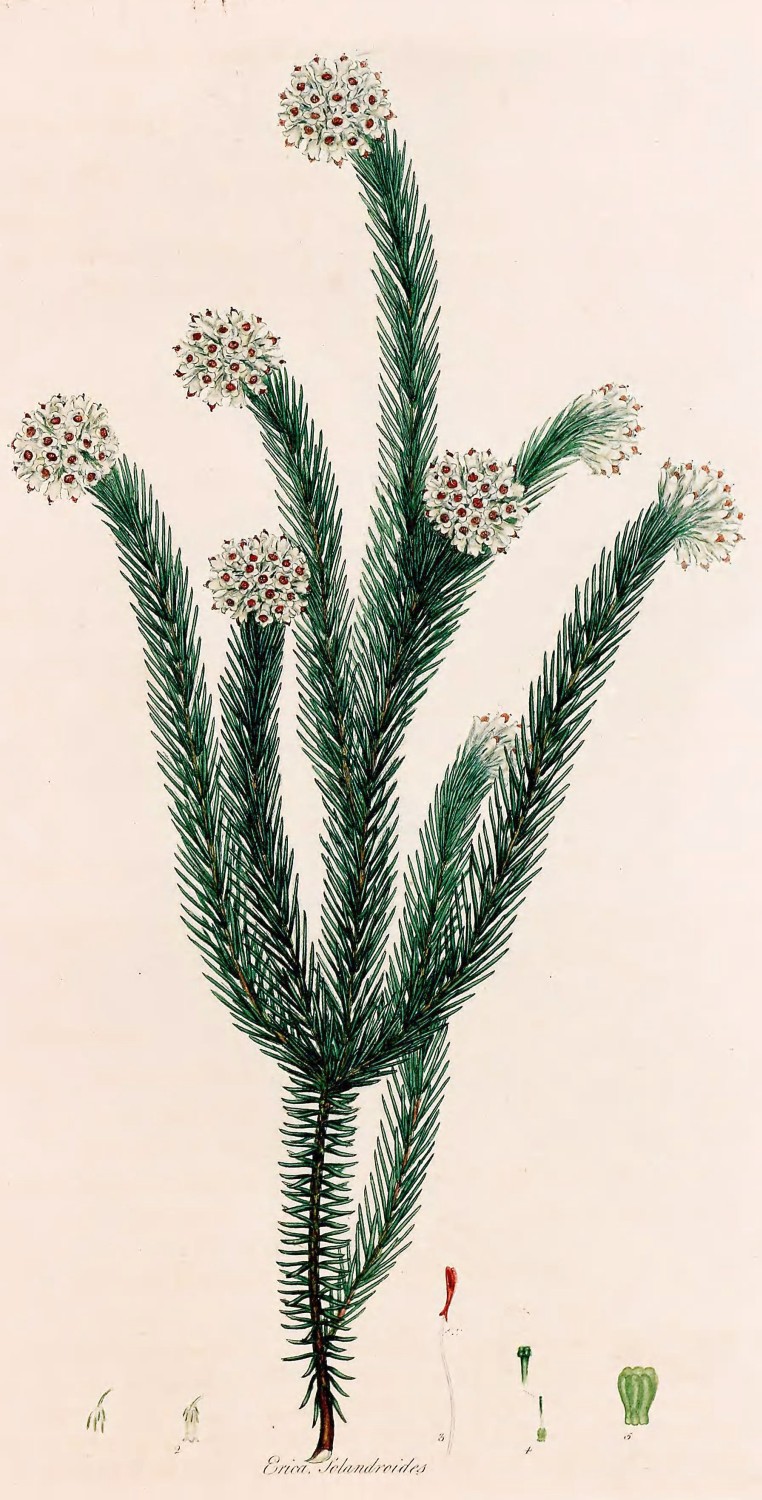
ERICA Solandroides.
Reading edition
CHARACTER SPECIFICUS.
Erica, antheris aristatis, sub-exertis: floribus capitatis, aggregatis, cernuis: foliis confertis, pilosis, obtusis: ramis longis, simplicibus: caule erecto.
DESCRIPTIO.
Caulis pedalis et ultra: ramis simplicibus, longis, erectis, vel flexuosis.
Folia irregularia, plerumque quatuor, aggregata, pilosa, linearia obtusa, adscendentia: foliis ad basin patentibus.
Flores capitatim terminales, aggregati: corolla parva, albente, tubo-campanulata: calyce duplici, exteriore trifoliato, subulato, piloso, adpresso: pedunculo brevi.
Habitat ad Caput Bonæ Spei.
Floret a mense Maio in Julium.
REFERENTIA.
1. Calyx lente auctus. 2. Flos. 3. Stamen unum lente aucto. 4. Germen et Pistillum, stigmate lente aucto. 5. Germen lente auctum.
SPECIFIC CHARACTER.
Heath, with bearded tips, just without the blossom: flowers grow in crowded heads, nodding: leaves crowded, hairy, and obtuse: branches long and simple: stem upright.
DESCRIPTION.
Stem a foot or more high: branches simple, long, upright, or flexuose.
Leaves irregular, mostly by fours, crowded together, hairy, linear obtuse, and ascending: leaves at the base of the plant spreading.
Flowers terminate the branches in crowded heads: blossom small, whitish, tubularly bell-shaped: cup double, the outer one three-leaved awl-shaped, hairy, and pressed to the blossom: footstalk short.
Native of the Cape of Good Hope.
Flowers from the month of May till July.
REFERENCE.
1. The Empalement. 2. A Flower. 3. A Chive magnified. 4. Seed-bud and Pointal, summit magnified. 5. Seed-bud magnified.
This Erica has been so often baptized, that we are under the necessity of detailing the order of their succession. First it was called E. Solandra after the late Dr. Solander; secondly, another plant of a similar appearance, but bearing purple flowers, was named after that gentleman. This plant was then for some years called the old Solandra; but has recently been named Erica stellata, which we cannot retain, having already occupied that specific title. No other way remained to avoid confusion, but again to rename it something like the first, and not unlike the second, by which means we hope to keep it in its proper sphere—at least to make it recognised for what it has been, by what it now is called.
Our drawing was made from plants at the Hammersmith Nursery.