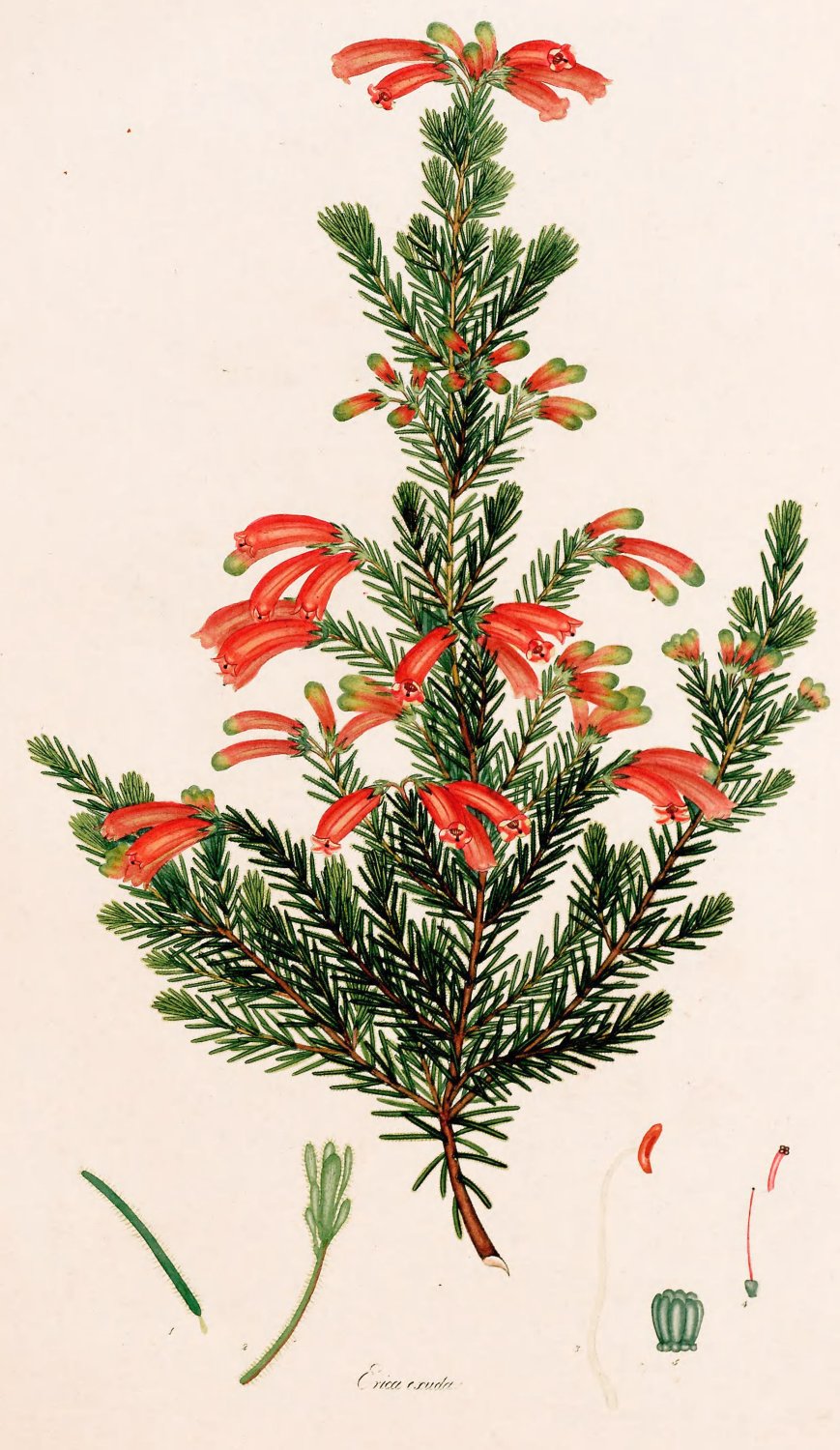
ERICA exudans.
Reading edition
CHARACTER SPECIFICUS.
Erica, antheris muticis, sub-inclusis; stylo sub-exerto: floribus cylindraceis, terminalibus: foliis quaternis, glandulosis, viscosis.
DESCRIPTIO.
Caulis sesquipedalis, fruticosus, ramulis numerosis erectis.
Folia quaterna, linearia, obtusa, glandulosa, viscosa, erecto-patentia.
Flores plerumque quaterni, cernui, terminales; corollis cylindraceis, costatis, luteolo-rubris, sub-uncialibus, arcuatis.
Germen tiaræforme, sulcatum, ad basin nectariis melliferis instructum.
Habitat ad Caput Bonæ Spei.
Floret a mense Julii ad Novembrem.
REFERENTIA.
1. Folium lente auctum. 2. Calyx lente auctus. 3. Germen lente auctum. 4. Germen et Pistillum, stigmate lente aucto.
SPECIFIC CHARACTER.
Heath with bearded tips, just within the blossom: shaft just without: flowers cylindrical, and terminating the branches: leaves by fours, glandular, and clammy.
DESCRIPTION.
Stem a foot and half high, shrubby, with numerous small upright branches.
Leaves by fours, linear, blunt-ended, glandular, viscous, and between erect and spreading.
Flowers mostly by fours, nodding, and terminal: blossoms cylindrical, ribbed, of a yellowish red, near an inch long, and slightly bowed.
Seed-bud turban-shaped, furrowed, and furnished at the base with honey-bearing nectaries.
Native of the Cape of Good Hope.
Flowers from July till November.
REFERENCE.
1. A Leaf magnified. 2. The Empalement magnified. 3. Seed-bud magnified. 4. Seed-bud and Pointal, summit magnified.
This Erica bears the compound appearance of the E. droseroides and E. costata; resembling the latter in its flowers, and the former in its foliage, which is covered with glands, from which a thin and viscous juice exudes. Our drawing of it was first taken from plants in the Nursery of Mr. Buchanan at Camberwell, as long back as 1805; since that time it has been so nearly lost, that it was shown to us as a novelty in 1815; and we should not be surprised if it again becomes an absentee, as the few Ericas that possess glands on the foliage are difficult to preserve either in beauty or health, being subject to the adhesion of all sorts of dust, which obscuring their verdure, at the same time obstructs that perspiration, which being so very apparent, indicates it to be indispensably requisite to the health of the plant.