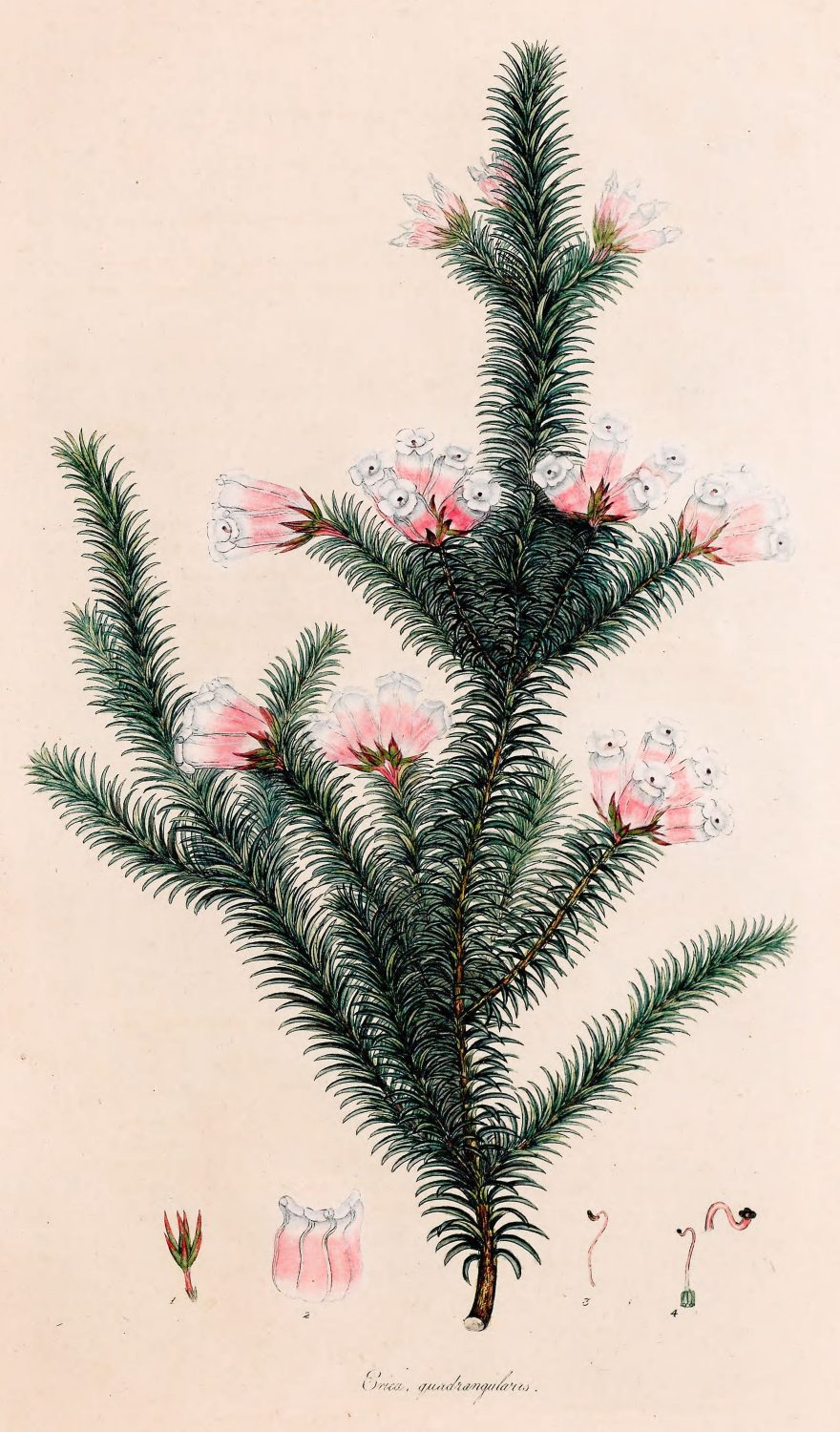
ERICA quadrangularis.
Reading edition
CHARACTER SPECIFICUS.
Erica, antheris muticis, inclusis: floribus terminalibus: corollis quadrangularibus: caule erecto.
DESCRIPTIO.
Caulis sesquipedalis, fruticosus, erectus, ramosus: ramis et ramulis longis.
Folia numerosa, sparsa, ensiformia, curvata, adscendentia et patentia, supra plana, subtus sulcata.
Flores ramulos terminant, terni, quaterni vel quini, erecti vel patentes: corolla bicolorata, supra alba, infra incarnata, tubulosa, quadrata, quatuor valvis vel suturis: oris laciniis revolutis.
Habitat ad Caput Bonæ Spei.
Floret a mense Aprili in Junium.
REFERENTIA.
1. Calyx. 2. Corolla expansa. 3. Anthera una. 4. Germen et Pistillum, stigmate lente aucto.
SPECIFIC CHARACTER.
Heath, with beardless tips within the blossom: flowers terminal: blossoms quadrangular: stem erect.
DESCRIPTION.
Stem a foot and a half high, shrubby, upright, and branching: the large and small branches long.
Leaves numerous, scattered, sword-shaped, curved, ascending and spreading, flat on their upper surface, and furrowed beneath.
Flowers terminate the smaller branches in threes, fours, or fives, erect or spreading: blossom two-coloured, white above and flesh-coloured beneath, tubular, squared, with four valves or seams: segments of the border rolled back.
Native of the Cape of Good Hope.
Flowers from the month of April till June.
REFERENCE.
1. The Empalement. 2. A Blossom spread out. 3. A Chive. 4. Seed-bud and Pointal, summit magnified.
This new species of Erica is at present but little known: the only collections in which we have seen it are Mr. Rollinson’s at Tooting, and Mr. Lee’s Nursery, where our drawing was taken in 1819. It was first raised from Cape seed in 1812, but is still a scarce plant, and not easily increased by cuttings. It is very handsome when in flower: its blossoms resemble wax, with four seams or valves, very unlike any other species we are at present acquainted with.