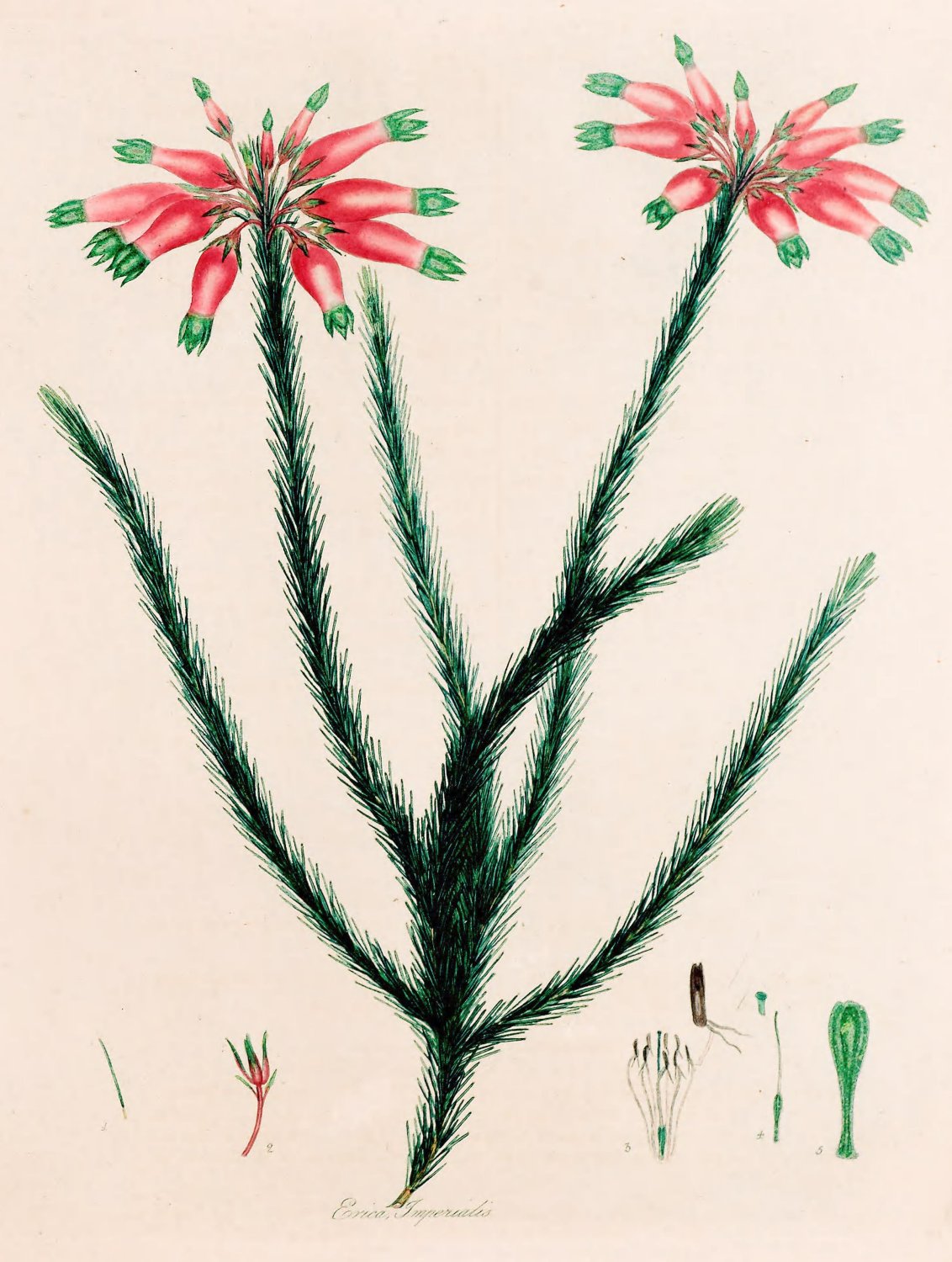
ERICA Imperialis.
Reading edition
CHARACTER SPECIFICUS.
Erica antheris aristatis, inclusis: floribus terminalibus, speciosissimis: foliis tremulis, spiraliter sparsis, truncatis: ramis simplicibus.
DESCRIPTIO.
Caulis bipedalis, erectus: ramis et ramulis simplicibus, longis.
Folia plerumque sena, linearia, obtusa, attenuata in petiolos longos capillares.
Flores ramos terminant in verticillis simplicibus, patentibus, viscosis: pedunculis longis, recurvatis: corolla cylindrico-clavata, longa: ima parte profunde carnea, apice viridi, ore arctata, laciniis rectis.
Germen clavatum, sulcatum. Stylus filiformis, subinclusus. Stigma peltatum, concavum.
Habitat ad Caput Bonæ Spei.
Floret a mense Novembri ad Januarium.
REFERENTIA.
1. Folium. 2. Calyx. 3. Stamina a Pistillo diducta, anthera una lente aucta. 4. Germen et Pistillum, stigmate lente aucto. 5. Germen lente auctum.
SPECIFIC CHARACTER.
Heath with bearded tips, within the blossom: flowers terminal and showy: leaves tremulous, spirally scattered, appearing cut off at the ends: branches simple.
DESCRIPTION.
Stem two feet high, upright: the large and small branches simple and long.
Leaves mostly by sixes, linear, blunt, and tapering into long hair-like footstalks.
Flowers terminate the branches in simple whorls, spreading and clammy: footstalks long and recurved: blossom cylindrically club-shaped and long: the lower part of a deep flesh-colour, the end green, compressed at the mouth, whose segments are straight.
Seed-bud club-shaped and furrowed. Shaft thread-shaped, and just within the blossom: summit shield-shaped and hollow.
Native of the Cape of Good Hope.
Flowers from the month of November till January.
REFERENCE.
1. A Leaf. 2. The Empalement. 3. The Chives detached from the Pointal, one tip magnified. 4. Seed-bud and Pointal, one tip magnified. 5. Seed-bud magnified.
Our figure represents a specimen from the conservatory of the Earl of Northampton (in November 1818), the only plant we could find in bloom for the last ten years. It is certainly less hardy than many of this fine tribe, and requires a clearer atmosphere than is to be met with in the vicinity of so large a city as London. It was first raised from Cape seed in the collection of G. Hibbert, Esq. in 1806.